ANYTHING BUT PRIMA: LEE SAAR AT P.S. 122


Reviewed by Christopher Atamian

The actress Lee Scher and her partner-choreographer Saar Harari belong to a generation of Israeli choreographers who have all been influenced to a greater or lesser degree by the immensely talented Ohad Naharin and his “Gaga” dance technique.  While I quite like Batsheva and Naharin, many of the choreographers that have followed in his wake, including Inbal Pinto and Lee Saar, have left me indifferent at best.  In Prima, four performers Jye-Hwei Lin, Hsin-Yi Hsiang, Hyerin Lee, and Candice Schnurr-all quite graceful and talented-dance around the stage, gesticulate, crawl and otherwise shake legs, arms and booties for the better part of forty-five minutes to a mix by d.j. filastine, Latino club music, and a fado or Arabic-inspired Spanish fusion of wailing and techno.  Sometimes they also crawl around in complete silence.

The highlight of the piece comes every so often when one of the dancers yells out her name, introducing herself to a somewhat weary audience.  At times the rather stock movement seemed influenced by break, rave, krump and even pole dancing, and at others it looked simply like random movement. I will not attempt to deduce the theoretical hermeneutics that I imagine may underlie this rather hermetic, uninspired choreography-what it either signified or meant is beyond me; on an aesthetic level it was rather bland as well.  Part of a critic’s job of course is to evaluate how close a choreographer or artist on comes to achieving his or her (stated) goals-in this context Lee Saar’s Prima was, I suppose, more or less successful.  But if a performance falls flat both theoretically and aesthetically then what, one wonders, is the viewer meant to take away from it?

Seen on November 22nd.

Photo taken from Broadway World.

NYCBALLET OPENING NIGHT: NEW MARTINS’ NAIVE & SENTIMENTAL MUSIC A SUCCESS!


New York City Ballet officially opened its 2009-10 winter season last night, with a performance and black tie gala dinner. The performance included Alexei Ratmansky’s Concerto DSCH (above photo of that ballet — dancers are Ana Sophia Scheller, Gonzalo Garcia, and Joaquin De Luz — by Paul Kolnik, taken from NYTimes), stars of the Paris Opera Ballet Aurelie Dupont and Mathias Heymann dancing the central pas de deux from Balanchine’s “Rubies,”


(photo taken from Kulturkompasset; Dupont is center, Heymann is holding the hand of another dancer).

And then the evening finished off with the world premiere of artistic director Peter Martins’ Naive and Sentimental Music, set to John Adams’ (brilliant) score of the same name (I’ll post photos when I receive them).

But first, there was a short film of the reconstruction of the inside of the Koch Theater (still can’t help but think of it as the State Theater…) while the orchestra played Tchaikovsky’s Sleeping Beauty overture (as it turned out, the perfect music to highlight the comically sped-up but ultimately awe-inducingly huge renovation process). Highlights of the renovated theater are — most importantly and coolly — the orchestra pit with a floor that can rise to stage-level (! — and this is how the orchestra played the overture), and two aisles now carved into the orchestra seating section. (Before, orchestra section had no aisles — so, though this is how Balanchine wanted it, apart from being extremely hard getting to a middle seat, it was a fire hazard).

Anyway, after the mandatory thank-you speeches by Peter Martins and David Koch (who funded the renovation), came the  Ratmansky. The fun frolicking threesome in blue (top photo) were danced by Joaquin De Luz, Gonzalo Garcia and Ashley Bouder (all three brilliantly on, Bouder thankfully back from an injury), and the adagio couple in green were Benjamin Millepied and Wendy Whelan (photo below). I think this was danced better than I’ve ever seen it done before — it could have been because I was so excited to see Bouder return, or because the dancers are all beginning-of-season fresh… but this is by far Ratmansky’s best, imo — it’s got the most complex structure and original movement.


(photo by Paul Kolnik, taken from Danza Ballet)

Next were the POB couple, who danced “Rubies” brilliantly — not only with precision and clarity but with great exuberance as well. One thing I meant to say earlier about La Danse (the Wiseman film about the POB) and forgot, was that the POB dancers are all so trained to make meaning out of every little thing they do — every step, every gesture, no matter how small. You have to have some kind of thought in your mind whatever you do. (This is not what Balanchine taught his dancers; he taught them simply to do his steps and those would contain everything the audience needed to know.) I feel that this allows POB dancers to bring a certain passion and humanity to all of the works they do — I noticed that from performance footage from that film as well as from last night.

And third came the highlight — for me anyway — of the night: the new Peter Martins’ ballet. The John Adams music was absolutely gorgeous — rich, many-layered, complex, intense, varied and structured into many sections — some lighter, many heavier, evocative, etc. etc. Beautiful! Oftentimes music like that overpowers the dancing, but not here.

In a short film shown before the dance (methinks Martins is taking after Wheeldon here with these little introductory films), Adams says the title refers to the difference between musicians whose music was fresh and original (the “naive” composers — like Mozart, he says) and those whose music was meant to speak to the past, to convey a sense of history, music that kind of carried the weight of the world on its shoulders so to speak (the “sentimental” — which he considers Beethoven). You could really see that in the music — some of it lighter, much of it weightier. Martins said in the film he tried to evoke that visually through dance, and I think he did so successfully — there’s a lighter, adagio section with dancers dressed in pristine white, another light but fast section with dancers in red, and then the more intense, almost severe sections with dancers in blues and deep greens and black.

Though most sections are danced in ensemble, Martins created the ballet for the principals only. This created an interesting dynamic, because, except for the middle section with the three pairs of dancers in white, almost all roles had equal weight — and yet practically all of the dancers stood out. It was an overload of star power!

And, though some sections seemed a slight bit underrehearsed (or maybe it was just that the footwork was so difficult and fast), everyone shone since Martins highlighted each dancer’s strengths: Maria Kowroski and Sara Mearns as lyrical women in white, Sterling Hyltin and Teresa Reichlin as kind of sharp-edged, sassy women in fiery red, Andrew Veyette and Daniel Ulbrich at the high-jumping bravura guys in black, there were some jazzy moves for Amar Ramasar, etc. etc.

Oh and I just love Tyler Angle 🙂 He partnered Yvonne Borree and I don’t think I’ve ever seen her so at ease and so fluid! She looked really beautiful. Nice also to see Stephen Hanna back from Billy Elliot! He partnered Darci Kistler in the white section.

It’s a rather long ballet but I was thoroughly engrossed and can’t wait to see it again. I hope they keep it in the rep.

Okay, that was the gala. Now onto the Nuts. Regular season begins in January.

RHAPSODY FANTAISIE


I am extremely behind on reviews but here are a couple of pictures (by Erin Baiano) of the cast of Christopher Wheeldon’s Rhapsody Fantasie, which the choreographer premiered with his company, Morphoses, in October. I can’t write a full review but I guess it’s interesting to see what lingers in the mind. I remember a variety of movement — from neo-classical ballet to more contemporary with some ballroom thrown in — I remember some swing-y moves and even some salsa basics! I remember interesting ensemble work — with dancers at times breaking into pairs for partner dancing, at times the men dancing together, performing various complicated lifts, which I found rather mesmerizing. And I remember Wheeldon’s signature modern ballet pas de deux with the complicated “pretzel shape” lifts (as in the top photo, of NYCB’s Wendy Whelan and Australian dancer Andrew Crawford). Besides Whelan and Crawford I found Drew Jacoby and Rubinald Pronk to be the most compelling pair, dancing their series of twisted shape after twisted shape with passion and psychological intention.


Opening Morphoses program 2 was Continuum, a Wheeldon ballet from several years ago (photo above, also by Erin Baiano). This was a very abstract work set to sharp, at times tense Ligetti music with brilliant lighting that made the dancers appear ghostly, as if their shadows, silhouetted on the back wall, were doing the dancing.

I love Christopher Wheeldon, who’s always trying to give audiences insight into the dance-making process. At the beginning of this program, he spoke a bit about the dances, and, regarding Continuum, he told us all to look out for a part where, as he was making that dance, he became mesmerized by a neighbor’s cat and dog. It was only all too obvious which pas de deux this was, and everyone laughed as the two dancers kind of crouched around each other getting ready for a playful (or maybe not so playful) attack. I don’t think the audience would have thought anything of it if he hadn’t pointed that out. Now if he can give us insight on how the whole thing comes together!…

AUF DEN TISCH / AT THE TABLE: MEG STUART’S CURATORIAL MAYHEM


Reviewed by Christopher Atamian

I caught Meg Stuart/Damaged Goods for the first time on November 8th at the Baryshnikov Arts Center. Auf Den Tisch is more a collaborative piece than Stuart’s choreography per se: a huge room is filled with tables lined up against each other with the audience sitting around it-critics, fellow artists, the general public and an occasional straggler or two judging from their reactions.  The performers: Trajal Harrell, Keith Hennessey, Janez Jansa, Jean-Paul Lespagnard, Jan Maertens, Yvonne Meier, Anja Müller, Vania Rovisco, Hahn Rowe, George Emilio Sanchez, Stuart and David Thomson are a diverse, talented lot. It would be impossible to describe the action, as these twelve artists performed just about every possible type of improvisation imaginable in a nod to Grand Union and other experimental groups from the past.  Jansa stood on a balcony looking out at the audience complaining in a Croatian accent that no one was risqué enough today to get naked in public as Richard Schechner did in the 60’s-then he proceeded to get naked and climb down among the hoi polloi: my older French colleague was unimpressed, noting with distaste that he had dirty feet. I thought he looked fine naked. The immer intellectual, immer thinking Harrell was alternately baffling as he read Rancière aloud (who could process the French philosopher at such break-neck speed?), fascinating as he fielded questions about forgiveness and charming as he zipped around the table in a bumble bee outfit.  By now, you must get an idea of what the performance was like…Parts of Auf den Tisch were also terribly slow.  Stuart officially “curated” this project-with a bit of nipping and tucking, it could have been much shorter and more enjoyable-not that pleasure was at the top of anyone’s agenda…Oh yes, as usual Yvonne Meier was her dry, hilarious self.

Photo taken from the Performa 2009 website.

MIRO MAGLOIRE’S NEW CHAMBER BALLET AT CITY CENTER


Reviewed by Christopher Atamian

Miro Magloire’s ballets are like exquisite little jeweled music boxes-each one opens up simple, precious and lovingly crafted.   Some are prettier than others and a few seem perhaps a touch unfinished, but each one is charming in its own way. Magloire’s company-New Chamber Ballet-presents its work at the intimate City Center Studios: it’s not the most elegant setting and Magloire must occasionally compete with some heavy-footed colleague stomping on his head on the floor above, but overall the setting works.  It’s also an intelligent model to adopt in this depressed economy, a great way to keep low overhead and still present four or fives times a year. Magloire, a former musician, is also an exponent of live music: it’s a delightful two-in-one presentation and his usual muse on piano, the lovely Melody Fader, is a gifted, nimble artist and a wonderfully quirky personality. On Sunday November 8, Magloire presented two solos: Sonatine, set to music by the same name by the late Karlheinz Stockhausen (a mentor of sorts to the choreographer) danced by Madeline Deavenport and brilliantly played by Fader and Erik Carlson-a veritable prodigy on violin.  Moments was danced with equal bravura by Lauren O’Toole to Salvatore Sciarrino’s Caprices No. 2 and 6 for violinPas de…is an interesting experiment, a riff on the traditional pas de trois, with Madeline Deavenport, Emery LeCrone and Victoria North taking turns dancing alone and in twos and threes.  What a treat it was to finally hear a piece set to Magloire’s own music-Two Pieces for Piano-a spare, modernist composition.  But it was Silk, set to Giuseppe Tartini’s simply gorgeous Sonata No. 7 per Violino Solo that stole the evening-enchanting, vigorous music that LeCrone, Vanessa Woods and Lauren Toole easily matched in terms of bravura and execution.  Kudos as well to Candice Thompson for her simple, sexy, elegant costumes.


Photos by Kristen Lodoen Linder: above of Madeline Deavenport; below of Erik Carlson and Lauren Toole in Moments.


RADIO CITY CHRISTMAS SPECTACULAR

pb112329

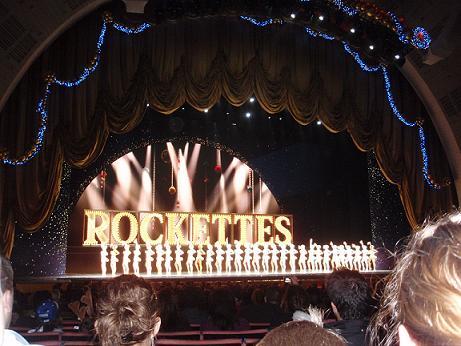
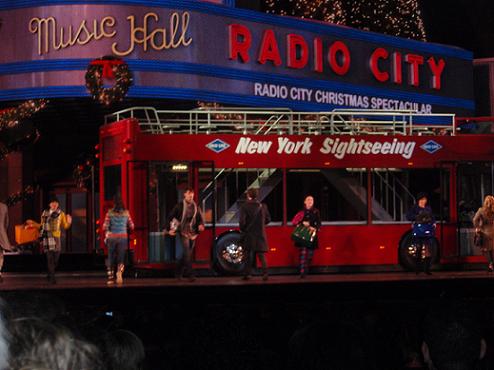
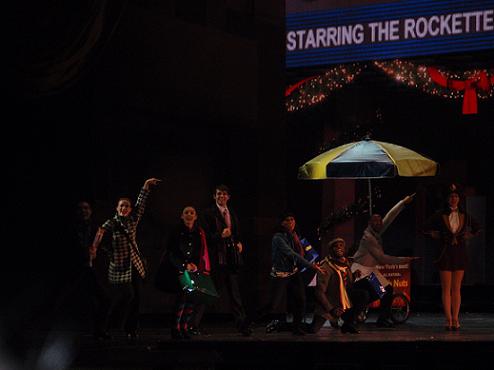
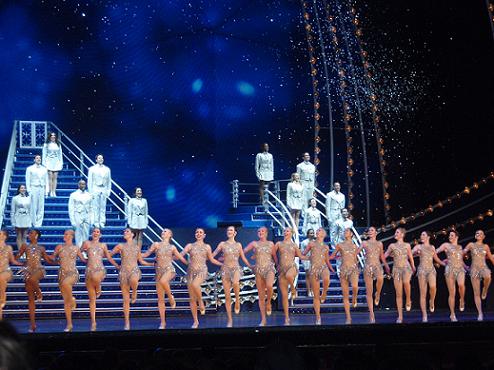
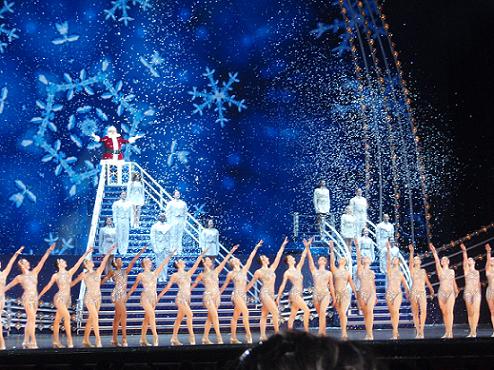
Last week, my friend — the illustrious Taylor Gordon! — invited me to watch her dance in the Radio City Christmas Spectacular. (Taylor, trained in classical ballet, is not a Rockette but a seasonal dancer in the show.) As last year, the show is a lot of fun, very Christmassy, very geared toward the tourist crowd and to children, with a somewhat corny story-line (younger boy strives to and eventually convinces older, more skeptical boy of Santa’s existence). But the dancing and the costumes and the sets are tremendous and are the reason you really go (if you’re an adult, that is 🙂 ).

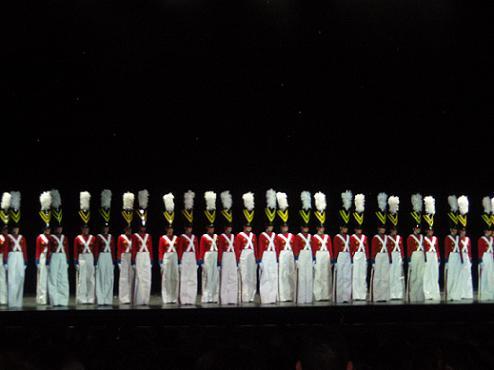
The Rockettes in particular are wondrous. Talk about astoundingly perfect synchronicity…

pb112334

pb112335

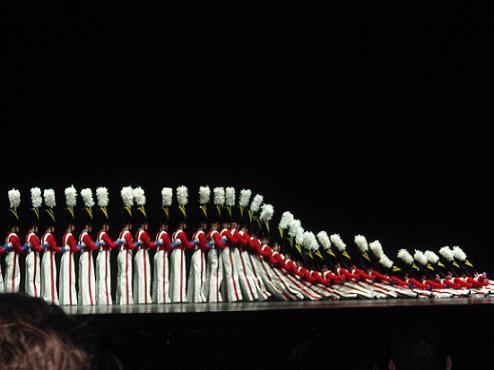
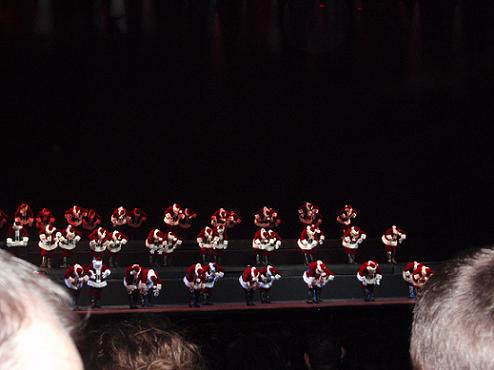
The soldier scene is my favorite. They march, they step, they turn in formation in almost mind-boggling unison, and then they fall, one by one, s-l-o-w-l-y, ever so slowly, one after and onto the other, in, again, mind-bogglingly perfect timing.

pb112336

And now a few pictures of Taylor! She’s in the middle, in the coolly colorful tights.

pb112338

Pink scarf, green bag, cool tights. So proud of her … again!

pb112343

As a Santa — I’ve no idea which one.

pb112332

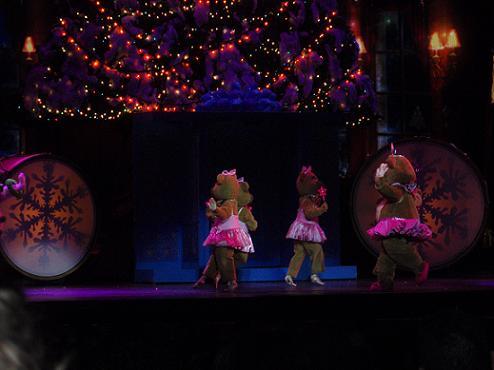
And as a tutu-clad bear.

pb112345

And a few more of the Rockettes.

pb112347

Kick line!

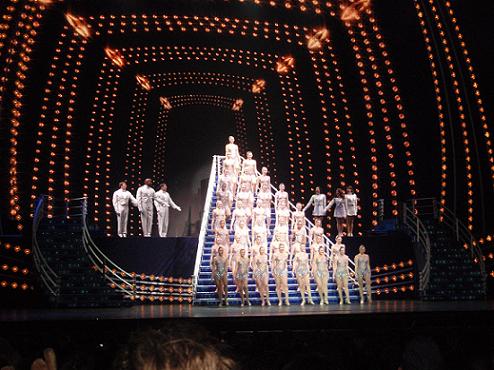
pb112349

Finale.

Taylor’s also a writer. Visit her blog for her accounts of what it’s like to be in the show.

And here is our friend Michael’s write-up of the evening.

BOUDER’S "BOLDNESS OF ATTACK" SHINES IN SCHER’S "TOUCH"


(left to right: Ashley Bouder, Antonio Carmena, Russell Janzen)


All photos of Ashley Bouder, Antonio Carmena and Russell Janzen by Matthew Murphy.

Review by Michael Northrop

Avi Scher & Dancers debuted the dynamic new piece “Touch” at the 2009 Contemporary Dance Festival at Manhattan Movement & Arts Center Saturday. The music, Aphex Twin’s “Blue Calx” performed by Alarm Will Sound, fit right in on a mixed bill that ranged from quieter balletic moments from the host company, Thang Dao Dance, to some entertaining, Pilobol-esque body-stacking from Phoenix Project Dance Theater.

That was it for fitting in, though. Everything else about “Touch” stood out, starting with the dancers. New York City Ballet corps member Russell Janzen, soloist Antonio Carmena, and principal Ashley Bouder were tremendous, and the choreography made the most of the trio’s athleticism. This was not a timid exploration of the stage. Whenever there was a question (a half step, a reach), the answer was yes (continue, embrace).

Janzen and Carmena came out shirtless in bike shorts. Aesthetically, this highlighted the physicality of the piece, which included some exceptional lifts. (Psychologically, it just made every guy in the audience feel like a toneless dumpazoid—or perhaps I project? In either case, it was a big hit with the row of teen girls behind me.)

Bouder, dressed in black, was marvelous. She reminded me of that great line, that great scene, from Geoffrey Rush’s Oscar-winning 1996 movie Shine: “Boldness of attack.” In the movie, Rush, as a brilliant pianist, has to be prodded to it. On Saturday, Bouder was committed to it from the start. Her pointework was precise but bristling with power.

Anyone who saw Scher’s work at the City Center Studios in June or the Ailey Citigroup Theater in September knows that he has a real flair for physical, crowd-pleasing pieces set to contemporary music. This fierce, fresh piece manages to both fit right in with that and, again, stand out.

MORPHOSES OPENS ITS 2009 NEW YORK SEASON WITH ITS BEST PROGRAM THUS FAR


Performance photos coming soon; in the meantime please enjoy another BRILLIANT photo by Kyle Froman.

Christopher Wheeldon’s Morphoses opened its NY season last night at City Center and I felt it was the best program they’ve done in their three years of existence. (At least Program A was; tonight I’ll see Program B). It’s a varied program with work by four different choreographers: Wheeldon himself; Bolshoi A.D.-turned ABT resident choreographer Alexei Ratmansky, whom all the critics downright worship; Australian Tim Harbour; and the Dutch husband and wife team Lightfoot Leon.

I must talk first about the third piece on the program, that by Lightfoot Leon, Softly As I Leave You. This is one of the most riveting pas de deux I’ve ever seen and it’s performed by the absolutely mesmerizing Drew Jacoby and Rubinald Pronk. Every single person who is not a professional critic was absolutely spellbound by it, could not stop talking about it. This happened at both the Fall For Dance Festival, where the work premiered (which I wrote about here), and last night. It’s simply about a couple, one partner’s decision to leave the other, and it’s a harrowing decision. After the lights went out on the final poignant image, the elderly woman on my left, whom I didn’t know, grabbed me and said, “Oh my God, that was so good!” And from my friend, who thinks the Arvo Part music used (Spiegel im Spiegel) is completely over-used and was expecting not to like it for that reason: “Oh my God, that music actually worked here!” she exclaimed, open-mouthed. She agreed it was one of the best duets she’d ever seen. And people were going on and on about it during intermission, both here and at FFD.

So why in the world do the critics hate it so much??? They ALL do. ALL OF THEM. It’s like in order to be a professional critic there are certain things you’re required to hate and this is one of them. And yet audiences are so overwhelmed by its power. Clement Crisp rants, “I can find not one iota of merit in its vulgar posturings.” Guardian critic Luke Jennings calls it “slick surfaced” and replete with “glib insincerity.” I can’t remember Alastair Macaulay’s exact words after its FFD premiere, but he hated it too. And a Ballet.co critic whom I spoke with at an ABT Guggenheim event (and who was the only non-Brit of the lot) complained how awful he thought it was as well.

This happened — I’m sorry, I’m getting off on a tangent — but this happened with practically every Fall For Dance piece, and with ABT’s recent season: EVERY SINGLE CRITIC hated every single one of the pieces the public adored (Barton, Millepied, Mark Dendy’s BRILLIANT Afternoon of the Fauns) and loved those they found least compelling (Ratmansky). I mean, more on this later, but what do you do if you’re an artistic director or choreographer? Do you cater to the critics — the “important people” or do you trust us, the commoners?

Anyway, mine and my friend’s second favorite piece of the night was Tim Harbour’s Leaving Songs. Guess what: all the critics hated it. I need to move to Europe… This dance had such emotional depth. It was about the cycle of life, death and rebirth — though I’m not sure you’d know that if the choreographer hadn’t said so in a little film clip shown before the program. But that doesn’t matter; you can come up with your own meaning anyway. The movement was kind of a combination of modern, classical and what looked to me to be African, and the music, by Australian composer Ross Edwards, is equally varied, at points sounding classical European, at points more percussive and African-sounding.

There were several striking moments, such as the point during a pas de deux where a man puts his hands around a woman’s neck and she falls before him. It kind of seems as if he’s strangling her out of anger, but then her arms flutter about beautifully, almost-bird like. It’s a combination of violence and grace. And there’s a moment where the group is dancing in ensemble and the movement is very wavy and undulating, very African, and everyone’s moving in unison and the music slows and the dancers slow, almost like they’re approaching death. Then the drums start pulsating and the dancers come to life and begin sidling cautiously but with intention toward the front of the stage. There are also several very sexually suggestive scenes with women’s legs splayed in the air. No tights are worn, and my friend and I couldn’t stop wondering how in the world they keep those leotards from shifting…

Anyway, I found the Harbour very compelling. And Rubinald Pronk really stood out here as well. He has so much fluidity and expansiveness in his body, and I don’t think anyone has more intense eyes.


(photo from Vail website)

Alexei Ratmansky’s Bolero was enjoyable too, largely because of the familiar Ravel music. For me, Ratmansky is one of those artists whose work doesn’t jump out at you and hit you over the head with its brilliance. Rather, I’ll need to see a dance of his several times before I get a sense of what it’s about, before I can fully appreciate it. Wheeldon’s work is the same. The critics seem to think this is the mark of a good choreographer — that it grows on you and you notice new things with each viewing, and I suppose it is. But for the average consumer, going to the ballet so often to see pieces over and over again to understand and appreciate them more fully can get prohibitively expensive. Dance art is not like a museum or art gallery where you can stand there for as long as you like.

Anyway, in Bolero, there are four pairs of women and men, each person wearing a number on his or her top. The women wear white tops and little skirts, almost like cheerleaders and the men wear black. If the women were cheerleaders, the men didn’t seem to be any kind of sports players though. They danced in groups divided between male and female, almost as if they were competing with each other, or as if their movement was some kind of back and forth dialog. And then toward the end, they began to partner each other more, the crescendo of the music complemented by various lifts that I found at points to be a little humorous, though it may have just been me. For example, when those trombones (I think that’s what they are anyway; maybe they’re tubas), are blaring kind of off-key at the end, the men lift the women over their heads, upside-down and the women do these upside-down developes, their legs splaying along with the warped trombones. I thought it was funny but I might be the only one.


And then the first piece on the program was Wheeldon’s Commedia (photo above by Erin Baiano), which was made in homage to Ballets Russes and was premiered last year. I wrote a bit about it here and here.

Here’s an excerpt from the company performing Commedia at the Vail International Dance Festival:

Also, this season marks the company’s collaboration with the young orchestra (most players are under 30, Wheeldon said), Philharmonic Orchestra of the Americas, founded and directed by the very entertaining, energetic Alondra de la Parra — yes, a female conductor OMG! The evening opened with Wheeldon giving a little address and then the orchestra playing on Overture to Estancia: Malambo by Alberto Ginastera. At the same time the orchestra played the Overture (this was their first time playing in a pit for dance, and not centerstage, by the way), a screen was dropped over the stage and a delightfully humorous film was shown of the dramatic conductor directing her crew, the violinists all swaying dramatically in unison at points. It was a lot of fun. Whole night was very good.

COMPANHIA DE DANCA AT CITY CENTER IN DEBORAH COLKER’S 4X4


Brazilian dance troupe Companhia de Danca just wrapped up a short run at NY’s City Center, performing Deborah Colker’s 4X4. Colker has choreographed sambas for some of the most prestigious schools to participate in the Rio Carnival, and she’s also the first woman to choreograph for Cirque du Soleil — she did their most recent show, Ovo.

You could really see the influence both of Carnival and Cirque du Soleil in 4×4. The whole program was very sexy, very acrobatic with the dancers performing feats that looked extremely difficult.


The title of the work refers to small spaces and how we humans try to adapt to them (which is very pertinent to my life right now as I try hard to tolerate the monstrous noises made by upstairs Godzilla and her mother…).

In the first piece, “Corners,” tall, thin, bare-legged, short-skirted and high-heeled women seem trapped in boxes, each within her own. Well, not really trapped though — just inside the box. Each woman climbs about her box, sometimes lying down on her back and tracing the box’s planes with her long legs, spider-like. Eventually men appear, climbing over the high backs of the boxes, then reaching down toward the women, pulling them up, eventually winding up in the box together, each couple performing a very gymnastic pas de deux that evoked a lot of oooh and aaahs from the crowd.


In the second piece, “Table,” a man and woman perform complicated lifts as a a conveyor-type belt runs atop the table, showing their impressive balancing skills.


In the third cutely funny piece, “Some People,” all the dancers take the stage. They dance and jump about joyously, full of life, while performing everyday gestures that may be natural but that you don’t really do in public — smelling, poking, grabbing / scratching your crotch — the men first, then the women almost in imitation of them.

Music to the first two pieces reminded me of Cirque du Soleil but with a Brazilian emphasis — electronics, some guitars, very percussive; music to the third was the song “Someday My Prince Will Come” by Larry Morey and Frank Churchill, which, given the crotch scratching, etc. was rather amusing.


The second half of the program consisted of one dance, “Vases,” with a short overture consisting of women dancing ballet en pointe (the only time in the show anyone’s in toe shoes) to Mozart, as played on an onstage piano by Colker herself (she’s also an accomplished classical pianist).

After the overture, several vases that appear to be made of china or another very breakable material are slowly dropped onto the floor. The vases appear to be set very close together and the dancers — now men joining the women —  must wend their ways around them — leaping, jumping, turning, partnering — at one point, the men push the women around like wheelbarrows, zigzagging in and around those crazy vases.

Soon, lights are dropped from the ceiling toward the vases and the dancers must weave around those as well. Eventually, the lights are dropped into the vases, and, each light still being attached to its wire and all the wires still attached to the ceiling, the dancers now have to dance around these delicate objects on the floor as well all these crazy wires strung from the ceiling. Talk about the need for nimbleness, agility, and amazing spacial sensibilities!

It was a sweet night. Though nothing seemed tremendously profound, I found all the dances to be humorous and cute, while involving difficult hurdles the dancers surmounted seemingly effortlessly.


Only thing, I was expecting and so looking forward to seeing Isabela Coracy (above), from this wonderful film, which I saw at Tribeca Film Festival earlier this year, but she doesn’t appear to be in the company any longer. The film’s producers were the ones who’d told us to expect to see her when Deborah Colker’s company came to town. Only When I Dance follows the lives of two dance students from the favelas (poor areas): Irlan Silva who is now with ABT’s studio company, and Isabela. I was so disappointed because she’s such a beautiful and talented ballerina, trained classically but very able to dance modern as well as the film showed, but the portions of the film devoted to her dance journey made clear how hard it is for black female ballerinas in Brazil — and, from what I’ve seen, elsewhere as well. She’s often told she doesn’t have the “right body,” she needs to diet, yadda yadda yadda — endlessly frustrating, even to you as the audience, because these criticisms seem to overtake any issues with her technique or artistry. And of course she’s not the least bit overweight.

Anyway, I was disappointed that she no longer seems to be with Companhia de Danca. I really wanted to see her dance live.

All photos except the one of Coracy taken from the company’s flickr page; the Coracy photos is taken from the film’s website.

CEDAR LAKE CONTEMPORARY BALLET OPENS ITS FIRST JOYCE SEASON


(Two top photos by Julieta Cervantes, third photo by Karli Cadel)

Small company Cedar Lake Contemporary Ballet opened their first season at the relatively large Joyce Theater in Chelsea Tuesday night to a nearly packed house. (Big kudos to them!) They performed an evening-length work by Sidi Larbi Cherkaoui, called Orbo Novo, which translates to “the new world” and kind of takes off from the book My Stroke of Insight by Jill Bolte Taylor, about her experiences suffering a stroke.

Large chunks of text are taken from parts of the book where Bolte Taylor talks about the onset of the stroke — feeling the searing pain behind her left eye, suddenly speaking gibberish while still understanding everything going on around her, hearing only gibberish out of the mouths of others (though she recognizes their voices over the phone), not being able to operate her right arm, seeing her body change form before her eyes, etc. etc. Immensely interesting — and frightening, and read very well by the dancers.

The dance, which (I assume) like the book, becomes a kind of meditation on right-brain versus the left. It is bookended by the dancers being trapped within a red structure (designed by Alexander Dodge), like prisoners, then eventually finding ways of crawling through the holes. At times the dancers wrap their legs around the holes in the structure, their bodies dangling down, hanging limply. At times, the structure is wheeled away and dancers take center stage — sometimes dancing in solos, sometimes in ensemble — their bodies at times writhing in a contorted manner, at times moving more fluidly to music (composed by Szymon Brzoska and performed live by the Mosaic String Quartet) that is at times mellifluous, at times sharp and discordant.

All of the dancers were wondrous, but as usual with this company, those who impressed me the most were the astounding  Acacia Schachte (in center of middle photo, and in bottom), Jason Kittelberger (top and bottom photos), and Ebony Williams. Fun too to see some faces that are familiar from other companies but new to Cedar Lake: Gwynenn Taylor Jones from Alvin Ailey and Manuel Vignoulle from Ballet du Grand Theatre de Geneve.

The company performs at the Joyce through October 25.

A FALL SMORGASBORD: CATHERINE GALLANT, EMIO GRECO, WILLIAM FORSYTHE, AND LUCINDA CHILDS

Reviewed by Christopher Atamian

In the past month I attended four very different performances that were all interesting for different reasons.  Readers will forgive me for giving brief overviews of each rather than the more in-depth analysis that they undoubtedly deserve, but lack of time and deadlines preclude me from doing them full justice!


On September 26, I had the pleasure of seeing Catherine Gallant/Dance present a series of rarely performed works at the Joyce Soho.  (Photo above of Gallant/Dance performing Isadora Duncan taken from Moving Arts Project.) These included works by Gallant herself, as well as José Limon, Isadora Duncan and Anna Sokolow.  Gallant’s company is rather unique because it is composed of dancers of all ages and body types—it was refreshing to see older women on stage (as in over 30!).  While they may not always have had the same power and lift as their younger counterparts, they displayed a welcome maturity, elegance and presence.  This was particularly true in the sublimely wistful 16 Waltzes Op. 39, choreographed in 1903, also referred to as “the many faces of love.”  Set to Brahms waltzes and as performed by Loretta Thomas, Eleanor Bunker, Michelle Cohen, Francesca Todesco, Marie Carstens and Gallant, the piece lulled the viewer into an almost blissfully intoxicated state.  It was also refreshing to see Anna Sokolow’s 1953 Lyric Suite, set to music by Alan Berg performed by Francesca Todesco, Eleanor Bunker, Michelle Cohen and Chriselle Tidrick.  Another highlight of the evening was the athletic Kristen Foote, a member of Jose Limón, interpreting Isadora Duncan’s Revolutionary (ca 1920-1924), with music by Alexandre Scriabin.  Foote displayed remarkable strength, vitality and grace in this simple but powerful piece.  That she could capture with each step and arm thrust the spirit of the October Revolution and spirit us, the audience, away to a Russia so distant in time and place, is a tribute to this remarkable young performer.  While one or two of the other pieces presented were arguably a bit lackluster, my only regret was that a larger audience hadn’t attend the performance, for Gallant is a historian and choreographer, a dancer and archeologist of dance history who brings to the stage pieces that we might never otherwise see.  We owe her a small debt for her good work and taste.


Emio Greco (photo above by Jean Pierre Moran) came to the Joyce in late September to present the second in his Dantesque trilogy, popopera[purgatorio]. I’ve already written a review of the performance for Dance Magazine which should be out in a few months so I won’t go into any detail here.  While I understand the issues that some critics may have had with the performance, Greco’s intellectual take on dance, the offbeat look of the dancers themselves, as well as the original, spasmodic movement vocabulary were interesting enough to me, although it wasn’t necessarily the most memorable show of the year. All told, the dancers gave a sexy, brassy performance. They also wielded and played the electric guitar-one for each dancer–with some panache.


I was rather surprised by the generally enthusiastic reviews of William Forsythe’s cacophonous mess Decreation (photos above by Julieta Cervantes) at BAM (October 7-10).   I am a huge fan of BAM, of their New Wave Festival and of William Forsythe who is obviously one of our great choreographers-in fact some of the most exciting performances that I have seen in the past years have been choreographed by Forsythe, including an outstanding Juilliard Spring Repertory Concert performance some years back of Limb’s Theorem III which included a wonderful, young Riley Watts contorting his body in the most fantastic ways, an amazing rotating globe and choreography that made the dancers appear almost super-natural or alien in their physicality.  But try as hard as I could, I couldn’t find anything noteworthy about Decreation, which is based on an essay by Canadian writer Anne Carson that examines lives unraveled by love: Sappho, Simone Weil and Marguerite Porete, a medieval mystic who was burned at the stake for not renouncing the views that she expounded in her book The Mirror of Simple SoulsDecreation begins with Dana Caspersen re-enacting a nasty spat with a past lover while George Reischl repeats her speech in German: they are both barely understandable and contort, grab at shirt, face and body in such visually unappealing ways that they look like two inmates in an insane asylum-perhaps an apt metaphor for something or other, but what is the relation to a failed relationship?  That it drives you mad? That’s it’s just exasperatingly distorting to the soul? And every time Reischl screams out “It’s a spiel” (so what’s new, love’s a game?) I wanted to reach out and well, slap him. At another point in the performance a women grabs her breasts with one hand and her crotch with the other, hanging on to her private parts as she is sandwiched between two male counterparts.  Decreation came off as a questionable mix of dance theatrical elements and surreal or post-modern theater-oh yes, and occasionally someone actually moved, as if to remind the audience that they were at a dance performance.  Certainly this work is complex, but in an abstruse and frankly ugly way: everyone on stage contorts in such odd and unappealing ways and David Morrow’s soundtrack is so grating that you aren’t quite sure how to enter the piece as a viewer. Forsythe received a standing ovation from a few people in the audience which proves, I suppose the old adage de gustibus non est disputandum. (Of the reviews that I have read so far only Tobi Tobias had the courage to call a spade a spade-so I will link to her review here, and to be fair, to Roslyn Sulcas’ altogether more positive New York Times review)


Finally, a redeeming, exquisite Lucinda Childs performance at the Joyce on October 6.  The highlight of the night was Childs’ Dance (photo above by Nathaniel Tilleston), which was accompanied by Sol Lewitt’s wonderful film projected onto a translucent screen, so that one could watch the dancers performing live with the original 1979 filmed performance simultaneously juxtaposed over them.  While this staging doesn’t work as well in a small theater like the Joyce, the dancers were simply exquisite as they performed relatively simple but quick steps (sideways jumps and turning jumps in arabesque) over and over again, mostly in straight lines, changing direction here or there, making absolutely exquisite patterns that have been likened elsewhere to Persian rug designs.  At first the execution seems almost identical, as do the dancers costumed in identical unisex black outfits, but each one actually added his or her own idiosyncratic head tilt or subtle interpretation. It’s not easy to choreograph to music as purposefully repetitious and as fast-paced as Phillip Glass but the dancers acquitted themselves famously, as if floating on a seemingly effortless ethereal cloud for close to an hour.  It was refreshing to see work of such distinction and quality: one felt transfixed as one should by great art.  (Childs, almost seventy, also danced a brief piece with less success, but how nice to see her up there anyway!)

{A random aside:  After another recent performance, I was discussing Ulysses Dove and his remarkable Red Demon with another dance critic (Dove passed away from AIDS in 1996) and about the past twenty years of choreography.  She gently reminded me that the generation that we lost to AIDS in the 80s and 90’s has left a large hole in our choreographic heritage-between older choreographers and the debatable quality of much of what we now see in contemporary dance.  I will go one step forward and say that while I am all for free expression and believe that anyone who wants to should try his or her hand at choreography, that we have way too many people of middling talent presenting dances today-which is neither good for dance nor for its reputation with the general public.]

MORE ON AMERICAN BALLET THEATER’S AVERY FISHER SEASON


Daniil Simkin and cast in Benjamin Millepied’s Everything Doesn’t Happen at Once in Gene Schiavone photo, courtesy of ABT; all photos by Gene Schiavone (except for Arron Scott headshot below and bottom picture).

Just to let people know, as the photos shows above, the guy who was flinging himself into the group lifts in the first cast of the Millepied was Daniil Simkin; in the second cast it was Arron Scott (below). The program notes only gave a special mention to the two dancers doing the pas de deux and a lot of people were asking who the main soloist was.


Anyway, here are a few more reviews:

Here is James Wolcott on opening night gala (and our fab Shun Lee dinner afterward 🙂 ), here is Apollinaire Scherr’s FT review; and here are more of Apollinaire’s thoughts on her blog, Foot in Mouth. I’m surprised there aren’t more reviews — this was a pretty big season, with three world premieres — but that’s all I can find at the moment. (Update: Robert Greskovic’s WSJ review just went up; thanks to Meg for letting me know.)

Re the Wolcott write-up: I forgot to mention the models — Iman and Veronica Webb, who, instead of A.D. Kevin McKenzie, thanked the gala sponsors and introduced the program — screwing up Benjamin Millepied’s name. It wouldn’t have been such a big deal if they wouldn’t have been so giggly over it. It seemed like they were reading their notes for the first time and were really unprepared. I really don’t know how to pronounce his name either — I’ve always said the last two syllables to rhyme with plie (without the “l”) but have been told that’s wrong. But damn did ABT get a lot of press for signing them on. Just Google “ABT Fall 2009 Season” and it’s all about Iman.


(Gillian Murphy, Cory Stearns and Eric Tamm in Aszure Barton’s One of Three)

Anyway, I saw four of the six programs, saw the Ratmansky and the Millepied ballets four times and the Barton three, and they each grew on me the more I saw them. The Saturday matinee was my last performance and I found it by far the best. I felt like the dancers were finally comfortable with the new dances, knew what they were all about, and really made them meaningful. I described the ballets here.

Oh and regarding SanderO’s comment on that earlier post: yes, I do need to see the story in the dance. The dancer and choreographer won’t pull me in at all if they don’t each tell me some sort of story. That doesn’t mean the ballet has to be a traditional full-length dramatic novel or something with a clearly defined beginning, middle, and end, inciting incident, rising action with crises 1,2, and 3, climax and resolution, etc etc. but there needs to be some kind of story; there needs to be some intention in the abstraction. A lot of critics use the word “evocative” — a dance needs to be evocative of something, and I just mean the same thing. If there isn’t something meaningful going on, there’s no reason for me to see it. I can appreciate the neat geometric patterns and pretty images, but that’s not enough to make me go.

Anyway, I saw more in Millepied’s Everything Doesn’t Happen at Once on further viewings. At first I thought it was kind of everything but the kitchen sink the way Apollinaire kind of describes, but after several viewings I saw more of an evolutionary, battle of the sexes theme throughout, which becomes a more literal battle by the end. The piece starts with the stage looking swimming-pool like with the dancers making broad strokes with their arms. The stage gets over-crowded and eventually someone in charge — looking rather conductor-like, kind of throws his arms up and dismisses everyone.

Then, there’s a pas de trois (two men one woman), which becomes a double pas de trois (same), which turns into the central pas de deux (man-woman). Throughout there seems to be struggle going on — in the pas de trois the men kind of manipulate the woman around, until she’s practically on her side. In the central pas de deux is in places tender, in places more angsty as if the girl is trying to get away from the guy or fight him in some way, and he is struggling to hang onto her.

By the end, the scene has evolved into a kind of battlefield with marching music and the ballerinas doing those Balanchinian marches en pointe. Except they’re more unsettling than cutesy, like in Balanchine. This is the part where Daniil / Arron gets tossed into the crowd, throws himself with wild abandon at the groups of men, who catch him mid-split, then gets caught up with a bunch of grabbing girls.

Interestingly, the audience laughed when this role was danced by Simkin — I think because he is small and a bit long-haired and it kind of looked like he was afraid he’d be taken for one of them and was trying like hell to assert his masculinity. (I think it would have worked better had the girls been chasing him and then he flings himself into the groups of guys rather than the other way around, but not a big deal).

But no one laughed when it was Arron. It looked far more serious with him in the role — it looked like he was practically getting raped by that rabid group of girls.

Also I noticed with Arron that after the rabid group of girls leaves him alone, he kind of internalized the tauning; there was now an invisible fist punching him all about. It really looked like he was getting beaten up by that thing. But the fist was invisible so it was like he’d been driven mad. It was very unsettling, and I think, with the music and the rest of the action, this feeling is more of what Millepied was going for — not all the high air flips, crazy long spins, and windmill jumps that Simkin is known for and did here. Simkin’s character made the end of the ballet more playful than battle-like.

There’s also a short section where there’s all this marching music and there’s more centerstage chaos with all 24 dancers out there at once and suddenly a group of dancers standing at one corner break into partners and go waltzing through the crowd. But it’s really short-lived, like even courtship is a battle.

I don’t know — that’s what I saw on further inspection. But I could be making it all up. It’s kind of fun with abstract ballets (the ones that have a lot going on in them anyway) to make up your own story. I mean, the way dances get made anyway, as I learned at a Guggenheim event last night featuring ABT’s efforts to adapt ballets to different stages (including this small one in AF Hall, meant for concerts), is that things get changed depending on space, depending on the logistics of the stage, depending on dancers. Whoever knows if the end product is what the choreographer originally had in mind anyway.

I don’t think Millepied’s was a perfect ballet — I found a lot of the bird-like patterns from his recent NYCB ballet, Quasi Una Fantasia, to be out of place here – he didn’t need all that; he should have focused more on the battle — but I found his the darkest, the most thematically clear and the most absorbing.


Stella Abrera and Gennadi Saveliev in Alexei Ratmansky’s Seven Sonatas.

The Ratmansky grew on me, as did the Barton. On the last day, Michele Wiles danced the main female character (in the long white ballgown) in the Barton and I loved her. She gave the character a real story. When she comes out onstage she is all bitchy and glamorous, but Michele it’s really an act; she is seeking attention from the main man (in that cast Blaine Hoven) while trying to maintain her haughty demeanor so as not to be shown up by him if he dismisses her. At one point, she extends her arm out to him, as if he’s supposed to kiss it but he turns and runs offstage. She crumbles. It’s heartbreaking.

I also really loved Craig Salstein, Jared Matthews and Daniil Simkin in Barton’s second cast (Matthews and Simkin alternated parts opposite Salstein). They danced a section in the second part and all three made it clear (Salstein most so) that they were in a little competition for the girl’s attention. The girl (Luciana Paris), meanwhile, was just dancing on her own, in her own world, paying them no mind at all. It was hilarious.

But back to Michele Wiles for a minute: a wonderful ABT patron gave me her ticket for a company class, which she couldn’t attend, and Michele seemed so sweet — smiling out and waving at people during the class and even during warm-up.

Also, can some choreographer please please please create a little solo or some kind of dance just for Gillian Murphy! Please! During that company class, during the center floor work when the dancers divided into groups and did turns in a diagonal down the center, Gillian blew everyone completely away. She was like a tornado. But a technically perfect tornado! Everyone in my section literally began to laugh and shake their heads in amazement. She needs something to showcase her technical brilliance and athletic prowess. C’mon ABT!

Each of the dancers brought their own special thing to the Ratmansky. Christine Shevchenko (an up and coming corps member) was gorgeous with the role created by Julie Kent (danced opposite David Hallberg). She was more lyrical than Julie, with flowing, expressive arms that resembled Natalia Makarova in Other Dances. Julie’s arms were more staccato. Hee Seo, who completely blew me away as well, did a combination of the two — by turns feathery and lyrical, and modern and staccato. Alexandre Hammoudi and Jared Matthews both danced David’s original part and they were very different than David. Both connected with their ballerinas much more — when they were left alone onstage they clearly looked about for her, wondering where she was, then accepting they were alone and falling into their solo.

David Hallberg. I can never get enough David Hallberg. He didn’t look around for his ballerina when she left him, but when she returned to the stage, he danced well with her. But when she was offstage, she was out of sight, out of mind with him — he was too busy making Ratmansky’s movement wholly his own. He seems to be a rapidly maturing artist, playing with the music, playing with rhythm, giving some things more emphasis than others. When I first saw him dance this role I thought his “character’s” movement was more modern than classical, but I think that was just because of the way he did one section where he keeps pushing out with his hands, like he’s stopping the air, or stopping something from getting too close. He slowed down that movement a lot, really emphasizing the arms, and then did some ensuing footwork at the speed of light, whereas the others did everything in equal measures -so it didn’t have the same look.


Jared Matthews and Maria Riccetto in Some Assembly Required, photo by Rosalie O’Connor.

ABT also put on Clark Tippet’s Some Assembly Required from 1989, a male-female pas de deux evoking a lovers’ quarral replete with difficult-looking angst-filled lifts, struggling pushes and pulls, then more tender making up. It went on a bit too long; some middle parts that were repetitive could have been taken out, but the cast I saw — Jared Matthews and Maria Riccetto did very well with it. Jared is dancing and dramatizing better than ever before, imo.

And the company also did Robbins’ Other Dances, another male-female pas de deux (this one pretty famous) that was choreographed on Baryshnikov and Makarova. I saw both casts — Marcelo Gomes and Veronika Part, and David Hallberg and Gillian Murphy. I liked both — although I think I honestly prefer Tiler Peck and Gonzalo Garcia’s at NYCB. Gonzalo has a smaller body, more like Baryshnikov’s, and I think some of the gestures — like the placing the hand behind the head, kind of primping, looked sweetest on him. Ditto for Tiler. David is dancing very aggressively these days. He’s making the absolute most of every movement — it can be stunning at times, and at times it seems a bit overdone, which it seemed to me a tad here.

I also think that joke on the Kirov dancers getting dizzy and losing their footing because they don’t spot-turn doesn’t come across as such to new audiences. When Marcelo and Gonzalo did it, many in the audience honestly thought the dancers screwed up for real, not on purpose. David really didn’t do the joke because he’s a cheat 🙂 I’m kidding — he did, but he spun, stopped, got dizzy, shook himself out of it, and started the next phrase all in the blink of an eye, so you didn’t even notice he “got lost.”

Gillian was good but it didn’t seem to be a dance that showcased her talents to their fullest. I’ll say it again — I really think she is the most athletic and technically one of the best female dancers in the world and she desperately needs more roles that prove that!