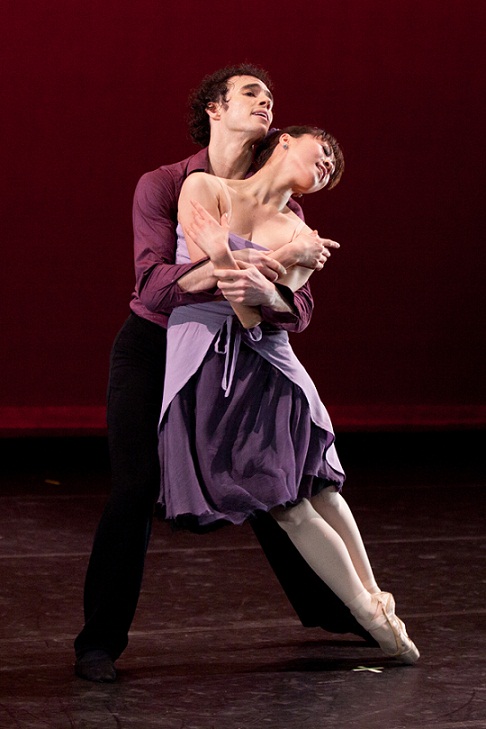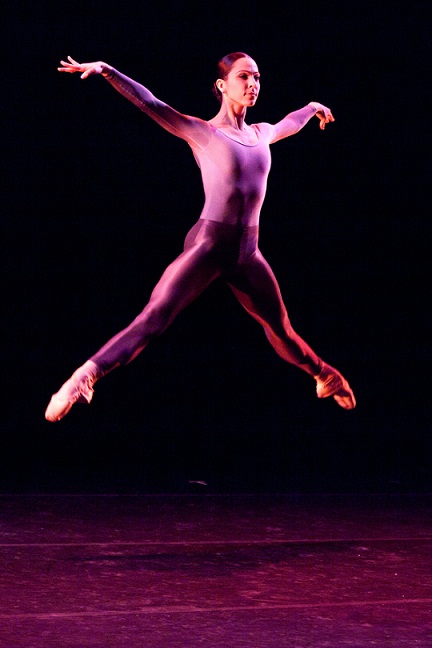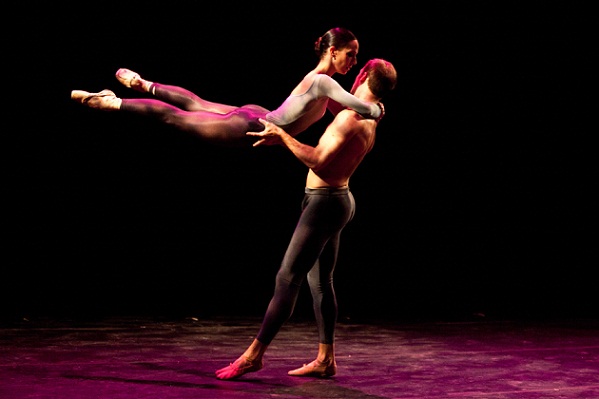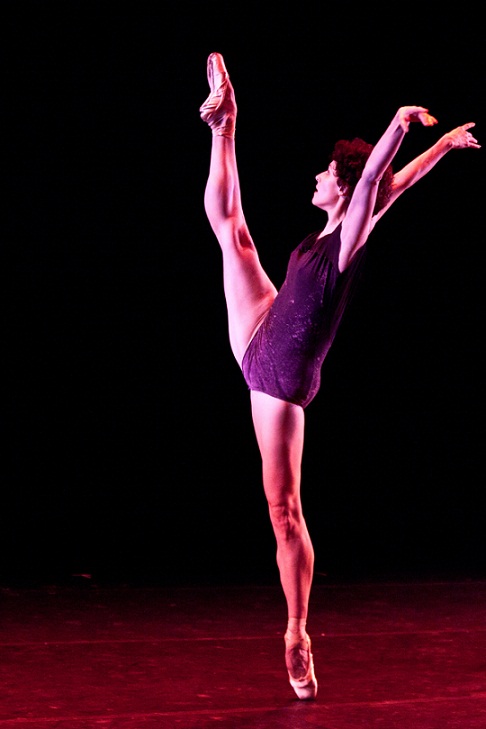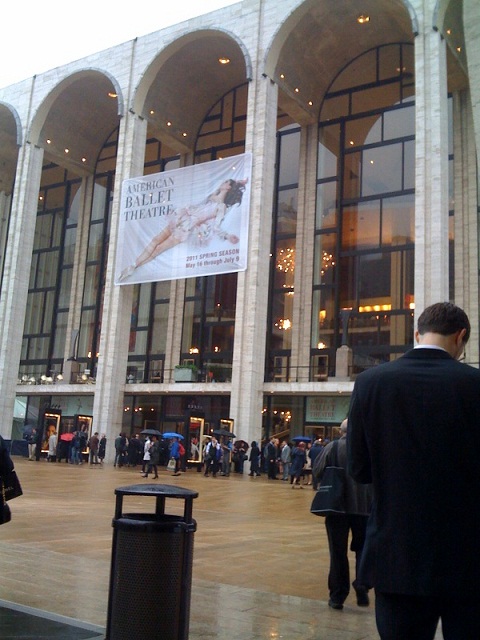
American Ballet Theater Spring 2011 Opening Night Gala

Last night was ABT’s Spring 2011 opening night gala. Dreary, rainy night … but what else is new for New York these days?

Once inside, I really enjoyed the show though. (I’m hoping to receive photos soon, which I’ll post). The program began with a short preview of Ratmansky’s The Bright Stream, which I’m excited to see next week. Seems to have a lot of humor, some bravura dancing, a cute storyline.


(Photo: The Bolshoi’s production of Bright Stream; Natalia Osipova is jete-ing).

Then, there were introductions by Rachel Moore, executive director of ABT, wearing a beautiful green dress, and Kevin McKenzie (AD), followed by Caroline Kennedy, who introduced the students of the Jacqueline Kennedy Onassis School of American Ballet as they danced a world premiere, Karelia March, by Raymond Lukens. The program says the students are Level 7, which must be the highest level, because some of those dancers looked like ABT principals. I’m not kidding, I swear. They really amazed me. That school is doing incredible things!

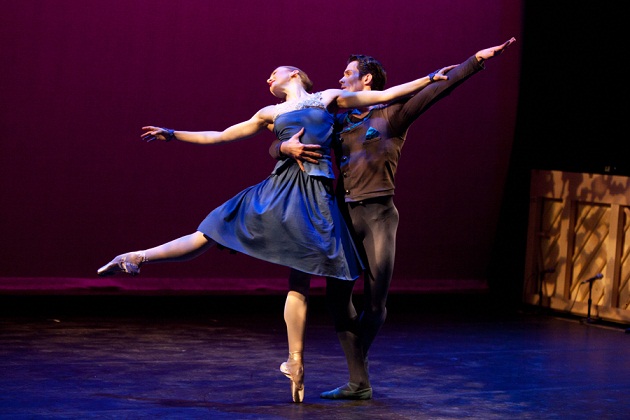
Next was Balanchine’s Tchaikovsky Pas de Deux, danced by David Hallberg and Gillian Murphy. Everytime I see David dance I think he must be the most perfect male dancer in the world. Gillian was stunning too.

Then came the Grand Pas de Deux from Ratmansky’s new Nutcracker, danced by Marcelo Gomes and Veronika Part. (No, they’re not performing that ballet during the Met season, but there seemed to be a few excerpts in the program from ballets they’re not performing). I missed seeing this couple – overall still my favorite – when the company premiered Ratmansky’s version in December. They were so sweet. Veronika danced with such wonderment in her eyes, such joy. And Marcelo was her perfect, adoring cavalier, all eyes on her. I don’t have kids, but I’d think they’re the perfect wedding couple to wow very young audiences.

Then came Majisimo, a classical ballet piece with Spanish flourishes created by Georges Garcia for the Ballet Nacional de Cuba in 1965 and set to Jules Massenet’s Le Cid. This piece was mainly meant to highlight Jose Manuel Carreno, who of course retires from ABT later this season. But it was really a dance for eight couples, and he danced only the male part of one of them – there were very few solos. He danced with Paloma Herrera. Xiomara Reyes was paired with Reyneris Reyes, guesting from Miami City Ballet. The other couples were comprised of Cuban dancers guesting from other companies as well: Lorena Feijoo and Joan Boada from San Francisco Ballet, and Lorna Feijoo and Nelson Madrigal from Boston Ballet. The dancers were spectacular, but I didn’t think that much of the choreography, which reminded me of a more bland version of an ensemble scene from Don Quixote. Jose had a series of turning jumps, and a really beautiful multiple pirouette that wowed the audience – drawing those turns out are what he’s most known for. And Xiomara really took my breath away with this crazy fast series of traveling turns in a diagonal down the stage. I’ve never seen her dance like that!


(Photo: Jose Carreno dancing with Polina Semionova in Diana e Acteon)

After intermission came two pas de deux from Swan Lake. A Twitter follower asked me why they needed to perform two scenes from the same ballet. I think that ABT, same as everyone else, is just trying to benefit from the Black Swan craze. They should have had Sarah Lane dance one of the pdd though! 😀 Anyway, first pas de deux – White Swan- was Paloma Herrera and Alexandre Hammoudi, which was good. But the second – the Black Swan – I found surprisingly magnificent! It was danced by Michele Wiles and Cory Stearns. There have been so many guest stars from Europe lately gracing ABT’s stage, I’d forgotten how perfect an Odile Michele Wiles is. And Cory really impressed me as well. Whatever he may lack in dance ability (I can’t imagine he’ll ever be a David Hallberg or Marcelo Gomes), he more than makes up for in acting and stage presence. He’s really good at bringing you into the world of the ballet and creating a character you can sympathize with.

Sandwiched in between the two SLs was Jessica Lang’s Splendid Isolation III, danced by Irina Dvorovenko and Maxim Beloserkovsky. I joked on Twitter that Max earned the hot guy of the night award for that, but seriously – he did! Irina was really beautiful as well. And her party dress, which she came out in for the final stage bow, was, as usual, gorgeous. She has such impeccable fashion taste, imo.


Following that was the highlight of the night, for me – Diana Vishneva and Marcelo Gomes in the Act I pdd from Manon. Such a perfectly choreographed pas de deux – beautifully romantic and full of love / lust but with so many breathtaking but capriciously executed, dangerous-looking lifts you sense something out of control. As beautiful as it is, this story isn’t going to have a happy ending. I am liking Diana Vishneva more and more. I’ve always thought she was a great dancer but she always seemed to play too much to the audience for the story ballets. She didn’t take me into the world of the character as much as I want an actor to. But the last two seasons she’s been doing just that: really developing the character and dancing to her partner – Marcelo here and in Lady of the Camellias last season, which is the first time she really blew me away – instead of the audience. This – the Manon pdd – was the audience favorite last night as well. The two got a storm of whoots and bravos at their curtain call, and practically had a standing ovation the audience was so loud in their applause. “So beautiful,” exclaimed the woman beside me. “Okay, we can go home now,” she joked.


(Couldn’t find a photo of Diana and Marcelo, but here is Diana dancing Manon with Manuel Legris. With all photos I post now, I’m linking to the original site via a click on the photo.)

Here are Marcelo and Diana in Lady of the Camellias:


Then, Alina Cojocaru, one of the European guest artists this season, danced the Rose Adagio from Sleeping Beauty. I’m not a huge fan of this ballet in general, but she was lovely. Patrick Ogle replaced Sascha Radetsky as one of the cavaliers.

Second to last was the Act II pdd from Lady of the Camellias danced by Julie Kent and Cory Stearns. Again, Cory did a very good acting job – and physically he fits the character perfectly, as Julie does hers, but I think some of those lifts are so difficult-looking… I just worry about the dancers. Isn’t that how Roberto Bolle got hurt last season – performing this role?

And the evening ended with another ensemble excerpt from Ratmansky’s Bright Stream. People who stood out most to me were Daniil Simkin and, again, Xiomara Reyes. I really am excited to see this ballet.

Tonight Don Quixote begins and runs through the beginning of next week. I’m excited to see Alina Cojocaru dance with Jose Carreno on Friday night, and Russian ballerina Polina Semionova guesting in the Saturday matinee with David Hallberg.
NYCB Spring Gala with SEVEN DEADLY SINS Premiere

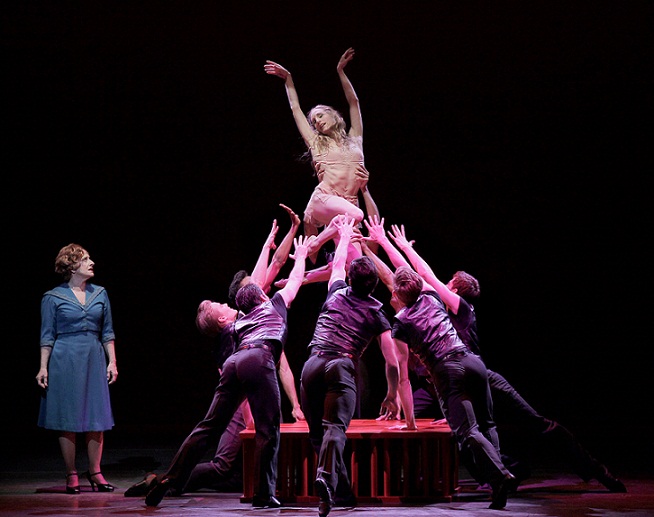
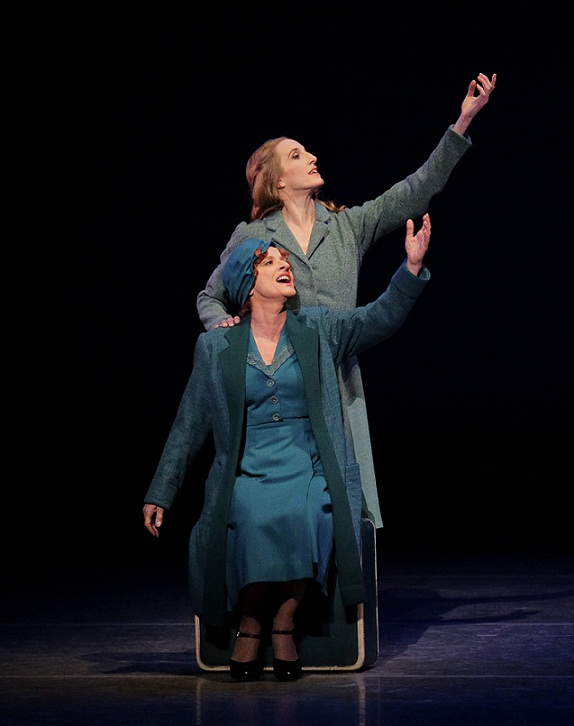
Here are some photos, all by Paul Kolnik, of Lynne Taylor-Corbett’s play-ballet, The Seven Deadly Sins, which premiered last night at New York City Ballet’s Spring gala performance. Above is Patti LuPone, who guest-starred with the company (performing the singing role of course!) and Wendy Whelan, who danced the lead. The top photo is from the “Prologue” of the play-ballet (or ballet chante as the program calls it).

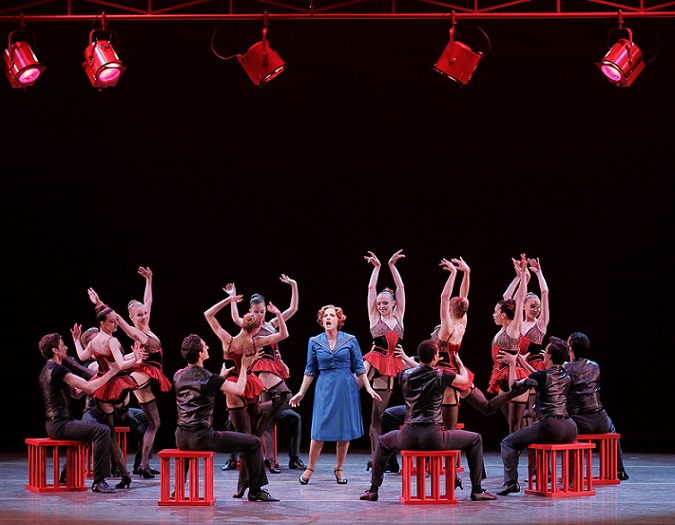
This is from the second part: “Pride”: Patti LuPone and cabaret dancer ensemble.

Also from “Pride.” Wendy Whelan is in the middle.

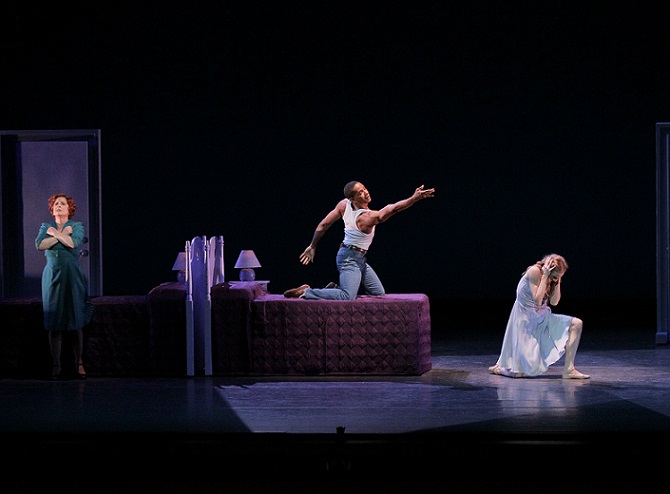
And this is from sixth part, “Lust,” probably my favorite over all. Craig Hall and Wendy Whelan are the dancers in the photo. Craig Hall and Sara Mearns (who danced the role of “Latina Diva” in the “Anger” section, and who I don’t have a picture of unfortunately), most stood out to me, as well as Vincent Paradiso as the Count in the “Greed” section. I think those dancers most stood out – at least Mearns and Paradiso – because they seem to have some kind of acting training. Maybe they don’t, maybe they’re just natural actor-types, but the more actor-ly you are, I think the easier this kind of role would be. Wendy Whelan said in an interview with Roslyn Sulcas in the New York Times that she was used to expressing herself with her body and her lines, that she was used to Balanchine’s dictum “don’t act, don’t think, just dance,” and that she found this kind of role challenging. As much of a NYCB star as she is, and as stunning as she is in Wheeldon and Balanchine’s more modern, angular-lined ballets, I just wonder if she was mis-cast for something like this.

Which isn’t to say that she didn’t dance very well last night. She danced a really beautiful pas de deux with Craig Hall, which is what made “Lust” my favorite section. And LuPone sang in a gorgeously powerful voice. The dancing was all superb. But something just didn’t work to me.

Balanchine choreographed the original Seven Deadly Sins, set to libretto and score by Bertolt Brecht and Kurt Weill, in 1933. The Balanchine version was revived in 1958. According to the Times article linked to above, both the original version and revivals received very good reviews. Since the Balanchine version appears to be largely lost now, and Peter Martins wanted to revive the ballet, he commissioned new choreography from Taylor-Corbett.

Maybe it was that the new choreography didn’t really express the story, which follows Anna, a woman whose various life experiences each represent one of the sins. It wasn’t really a full story, but one composed of scenes, each of which dramatized a sin (and LuPone and Whelan portray different aspects of Anna). But, I didn’t feel the scenes always worked well at doing that. For example, in my favorite section, “Lust,” I thought the Hall/Whelan bedroom scene was really beautiful, very romantic, but nothing said lust, as in sinful lust, to me. I almost felt like Whelan’s Anna had a loveless relationship with her husband, danced by Allen Peiffer, and she was really in love with Hall, and her leaving her husband and running into Hall’s arms was an urgently needed escape.

In my other favorite section, “Anger,” Sara Mearns is a kind of sexy, but rather humorously so, Copacabana dancer. She gets angry at Whelan’s Anna for something – I’m not quite sure what – maybe Anna stole her lover or took over Mearns’ role as head diva, drawing too much attention to herself…  Anyway, Mearns twists her face into a look of utter anger, then points at Whelan, who runs off crying and is then stripped down to her underwear by a group of men. But I thought it was done rather cartoonishly. So it was more funny and cute to me than a dramatic representation of the tragic consequences of anger.

In the “Greed” section, a count and a senator vie for something and end up in a duel, both of them getting killed. But it didn’t have any tragedy or pathos to me. Instead, it felt a bit like Balanchine’s Slaughter on Tenth, which made me want to giggle – probably the fact that it was Paradiso playing the role of the Count.

I don’t know. I guess I was expecting something with more tragedy and pathos and weight, and I felt like I saw a version of Slaughter on Tenth but without a through story-line. Maybe that was the intent. I’m going to see it again over the weekend, and maybe my opinion will change.

Did anyone else see it yet? I’m interested to hear what others think. Has anyone seen the Balanchine version?

After intermission,

— here’s my photo of the promenade – Balanchine’s Vienna Waltzes was performed beautifully.

Photo by Paul Kolnik.

All of the dancers were very good, but I particularly liked Megan Fairchild and Joaquin DeLuz in the fast-footed, playful scene in the forest, “Fruhlingsstimmen,” and Maria Kowroski and Charles Askegard in the last, beautifully ballroom-y section, “Der Rosenkavalier.”

NYCB Opens its Spring 2011 Season with “Balanchine: Black & White”


Photo from 2004 of Wendy Whelan and Jock Soto in Balanchine’s Agon, by Paul Kolnik.

Last night New York City Ballet opened its Spring season with three Balanchine “leotard” or “black and white” ballets (so-called because of the costumes). I have very little time to write because I’m off for a short trip to Phoenix later today. But I’ll just say, all the dancers looked very refreshed, in tiptop shape, and everyone danced very well and with lots of expression.

First on – and the highlight of the evening to me – was Square Dance, which I haven’t seen a huge number of times but which is really growing on me. The leads were Megan Fairchild and Anthony Huxley, who is really growing on me as well. He reminds me a bit of Alex Wong, except he’s more lyrical and it’s a little less about the stunning feats with him, though he is a very good dancer and I’m sure can do the stunning feats! His difficult-looking often flexed-footed solo was mesmerizing. He was even mesmerizing when he just stood off-center and watched Fairchild do her solo, the way he’d look at her, at times longingly, at times in awe. Megan danced with a lot of joy as well – all dancers were very emotionally compelling in this. And I’m not the only one who thought so – the audience really went crazy with applause after this dance.


Next on was Agon. The main couples were Wendy Whelan and Sebastien Marcovici, Teresa Reichlen and Andrew Veyette, Ashley Laracey and Amar Ramasar, and Amanda Hankes and Craig Hall. Andrew Veyette (above, photo by Paul Kolnik) really stood out to me in this. I think he is well-suited to all the angular lines so pronounced in these leotard ballets. Wendy Whelan and Sebastien Marcovici had a couple very minor flubs. During intermission, the little group of balletomanes I hang out with were reminiscing about how stunning she was when she used to dance this part with Jock Soto (which is why I posted the top picture). I really wish I could have seen that. It looks stunning from the picture.

The evening ended with Stravinsky Violin Concerto; leads were Maria Kowroski and Amar Ramasar, and Sterling Hyltin and Ask LaCour.  I always like this ballet and I always look for my favorite part – where, in the third section, Aria II, the man stands over the woman and turns her around and around, like a barrel. I think I’ve seen Robert Fairchild do it only once, but it was the first time I ever saw the ballet and now, to me, he owns that role and no one can do it like him. I thought of that when my intermission friends were reminiscing about their favorite dancers from the past and how differently they looked doing these black and white ballets – how much more precision there used to be – and it’s funny because Robert Fairchild is obviously not the first dancer to dance my favorite part but he’ll always define it to me. The first dancer, or the first set of dancers, that you see in a role or a dance will definitely leave an indelible impression. But someday I still very much would like to see the original Balanchine dancers in these ballets.

Anyway, this was opening night, but there was no red carpet since NYCB has their gala next week, on Wednesday – when the Patti LuPone collaboration will premiere!

Okay, I’m off to the land of lizards and gila monsters and sun and 99-degree temperatures! Assuming I’m able to finish packing…

American Ballet Theater’s “On To Act II” at the Guggenheim

Did you guys watch the live-stream last night or tonight? If you missed it, you can watch the video now archived on the Guggenheim’s ustream channel.

It feels weird to review a program that everyone can easily watch online, but I’ll just say my favorite moments last night were: the ABT II dancers in excerpts from Jessica Lang’s Vivace Motifs, which I thought looked like a lovely ballet; Hee Seo in the prayer scene from Coppelia; Susan Jaffe coaching Sarah Lane in another scene from that same ballet; and Jose Manuel Carreno’s interview by Wes Chapman.

I wasn’t really in love with the dance Carreno performed with Melanie Hamrick – Ronald Savkovic’s Transparante. I thought there was a bit too much falling down and standing up again, and, though some of the partnering and lifts were beautiful they were pretty basic and didn’t reveal much about the relationship of the characters and the dramatic action. But I loved hearing him talk – love how he still has that thick accent! Love that he said “oh shit” in reference to all the Don Quixotes he’s cast in during week one of ABT’s Met season! He doesn’t seem to have a plan for the future, but said he’d still do some freelance dancing for the next few years, and said he’s interested in exploring more contemporary work, other forms of dance. I think that’s why he wanted to dance Transparante instead of something from ABT’s season.

I liked Martine van Hamel’s discussion and performance of some of the character roles she continues to do – the wicked stepmother, always either drunk or hung-over, in Kudelka’s comical version of Cinderella, and the wicked fairy Carabosse in Petipa’s Sleeping Beauty. But they left out the Dacha Dweller from Ratmansky’s Bright Stream, which was on the program! None of us have seen that ballet yet and I was eagerly awaiting that excerpt … and then she said she wouldn’t do it because she couldn’t get something in it quite right yet. Well, I guess we’ll see it soon enough.

I really did like the excerpt from Jessica Lang’s Vivace Motifs. The ABT II dancers are always very good, especially Irlan Silva. Every time I see him dance I get annoyed that ABT hasn’t yet brought him into the main company. I don’t understand what they’re waiting for. He stands out so much to me. He seems better than most of ABT’s soloists and even some principals. And he’s not even in the corps yet. I really really really don’t get it.

Anyway, I’ll conclude this post with an excerpt of Carreno and Susan Jaffe dancing the Black Swan pdd from an earlier documentary about ABT:


And footage of Silva from the documentary, Only When I Dance:


Avi Scher & Dancers, Photos

Ack, you guys I’m working 13-hour days right now and have virtually no time for anything but working, eating, and sleeping, but I wanted to get some photos up of the recent performance by Avi Scher & Dancers that I saw at the Alvin Ailey Theater on Sunday afternoon. All photos are by fabulous dancer-turned photographer, Matthew Murphy.

I don’t have much time to write, but as always, I really enjoyed Avi’s choreography, combined with the excellent dancers he gets to perform his work. As always, it’s incredible – really truly incredible – to be able to see such renowned dancers on a small stage in a small, intimate theater.

Above are Carla Korbes and Seth Orza, principal dancers formerly with NYCB, now with Pacific Northwest Ballet, in Scher’s Mirrors, a somewhat Jerome Robbins-like piece (it reminded me a bit of Dances at a Gathering anyway), that had its premiere this weekend. Korbes and Orza beautifully danced the romantic pair at the heart of the piece. Also in that piece, ABT’s always entertaining Craig Salstein danced a comical duet with ABT’s Nicole Graniero. I love Craig. I do. As huge a crush as I used to have on Seth when he was with NYCB, I have to say Craig stole the show 🙂

Ooooh, I really loved this couple. It’s Joseph Gatti and Misa Kuranaga from Boston Ballet and they danced the second piece, Utopia. I loved both – and initially couldn’t figure out where I’d seen Gatti before but now I’m thinking it was a Wheeldon Morphoses piece. (Sorry, I don’t have time to look it up!) Kuranaga really took my breath away in this. She was really striking. She had such beautiful lines and danced with such passion. In the end, she threw herself at him ecstatically and he caught her. Sweet.

This is Ana Sophia Scheller, NYCB soloist, in Dreamscapes, the fourth piece of the night, which was also having its premiere. She had a fast-moving part up front and she did very well with it. She’s standing out to me more and more lately.

Scheller with Tyler Angle (NYCB principal, and one of my faves of that company). I thought the dancing in this last piece was spectacular. So many really top notch dancers… Sofiane Sylve, formerly of NYCB and now a principal with San Francisco Ballet, was stunning in a late section where she danced an insanely fast-footed allegro duet with with NYCB’s Savannah Lowery. Lowery always amazes me when I see her dance with Avi’s group on a small stage like this. She’s got such an athletic build and Scher always makes her look so good. He gives her choreography and costumes that really suit her. (NYCB’s Janie Taylor did the costumes).

Sofiane Sylve. It was nice to see her in NY again. And Orza 🙂

Scher is a very likable young choreographer who studied at the School of American Ballet. He has lots of NYCB connections and you can see influences of Balanchine, Robbins, and Christopher Wheeldon in his work (the third piece was called Classroom Fantasy, was danced by students of the Manhattan Youth Ballet, and reminded me a bit of Wheeldon’s early Scenes de Ballet albeit more comical). I think Scher is definitely a choreographer to keep an eye on for the future.

Paris Opera Ballet’s Dark-ish Coppelia

So, did anyone see the live-stream of POB’s Coppelia last Monday? I went but was extremely tired, so I guess my review should be read with that in mind. I was working a contract job with crazy long, graveyard shift hours and though the movie was at 1:30 in the afternoon Manhattan time (7:30 p.m. Paris time) I really should have been at home sleeping. But I had to miss POB’s earlier Caligula, so really wanted to see this.

It was different from the versions of Coppelia I’ve seen by the American companies. It was darker, not at all cutesy and Nutcracker-ish with doll-like movements of humans imitating toys and silly people mistaking dolls for girls. The program notes say the choreographer, Patrice Bart (after Arthur Saint-Leon) wanted to give “a bit more psychological depth to the characters and feed the drama of their relationships, including finding plausible motivations / reasons in certain passages.”

I’m all for darker ballets exploring human drama in greater depths than many of the classics do, but unfortunately, I just had a hard time grasping the story here and understanding the characters’ motivations despite Bart’s intentions. I think part of the problem was that Bart used the language of classical ballet, rather than modern. Tudor is probably the master of revealing psychology through movement, but his movement language was wholly unique. Here, Coppelius, for example, would do basic ballet turns, jumps, an arabesque, etc. – all very lyrical, within the classical ballet vocabulary, then would do some kind of intentionally awkward port de bras, jabbing an arm out this way and that and twisting his torso unnaturally. I guess that more modern, angular arm movement was supposed to show angst, and it did, but it was just so inferior to movement someone like Tudor would have used to show a psychological state.

I assume everyone knows the story and I probably shouldn’t – especially this version: Coppelius is haunted by the image of a woman he loved and lost. Swanilda evokes her memory for him. Frantz, a student, is in love with Swanilda, who kind of returns his affections but not as completely as he would like. Spalanzani is a toy-maker who seems to have some outlines of a doll he’s in the process of making, which also haunt Coppelius, reminding him of the woman he loved and lost.

According to the program notes, Coppelius is a seducer, not at all the silly wobbling clown from the American productions. He tries to seduce Swanilda, who seems, from what I could tell of the onstage action, to be a bit taken by him, but only to a point. She and her girlfriends break into Spalanzani’s toy factory, play with the toys – like in the American productions – but then Swanilda sees how taken Coppelius is with the outline of the doll Spalanzani is in the process of making, and for some reason, she decides to don the doll’s costume and dance for Coppelius. It’s unclear whether she is pretending to be the doll come to life – her movements aren’t at all doll-like, as in the American productions. But at one point, things get too serious, Coppelius gets too impassioned with her, and she runs off, somewhat afraid of him. Then she accepts Frantz and the two end up together, their silhouettes wandering off into the tunnel of light, as in the photo above.

Swanilda was danced by Dorothee Gilbert, whom I’d never seen before and really liked. Both she and Mathias Heymann, as Frantz, had a lot of presence, showed a lot of facial emotion, were good at miming. They told the story as best as they could given what I felt was limiting choreography. Heymann’s lines didn’t always seem to be all there though, and I just couldn’t stop thinking how much more clean and physically magnificent David Hallberg would have been in that role. Sometimes Frantz’s male friends seemed to outdance him with their precision, height of jump, etc. It was odd, but his dancing seemed to be a bit sloppy. I’ve seen him dance before though (can’t remember whether it was with NYCB or Trisha Brown or at the Guggenheim) but I know I didn’t think that about him before.

Gilbert’s dancing was much cleaner. She definitely didn’t focus on athleticism, like Natalia Osipova. But her dancing was lyrical and lovely, and she had a strong personality and clarity of intention. Her Swanilda was at times a tease, at times inquisitive, longing, fearful, confused. She always had something going on behind her eyes – which is one of the things I value most in a dancer and which there’s not enough of these days, imo.

My biggest problem though was with Jose Martinez, who danced the part of Coppelius, which is a dance role here, not a character role. I know he’s a big deal, longtime principal in Europe, and is on the verge of retiring and taking over the Spanish ballet company Nacho Duato currently helms (Martinez is Spanish as well). It well may have been his costume – he wore a long top coat, pleated pants that bulked at the pelvis, and black soft jazz shoes – so not at all ballet costuming. But his lines were not clean at all, his movement looked very sloppy, he was completely lacking sharpness and precision. Could be I just couldn’t see the precision because of the bulking pants, but still – I couldn’t stop thinking about how much better Marcelo Gomes, who I could really see in that role, would have been, despite the pants and coat.

I don’t know if you can still get the NY Times reviews now that the paper’s behind a paywall, but Macaulay has an interesting explanation: he says the POB ballet dancers of late (ever since Nureyev, actually) are trained that way – to not give so much attention to line, amongst other things like musicality and expressive phrasing.

I don’t know. It was my first time seeing POB perform as a company and I really wanted to  like them. Overall, I was unimpressed, unfortunately. I did really like Gilbert though and I will definitely want to see her dance again.

Larry Keigwin’s “Exit”

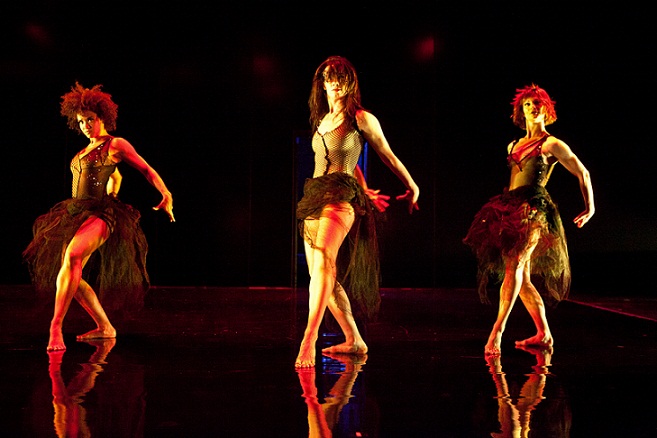
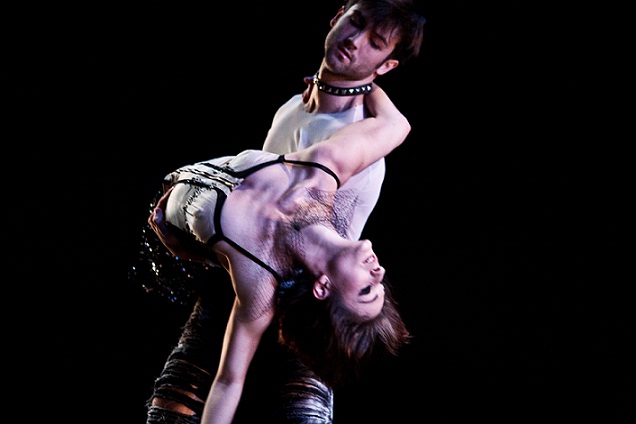
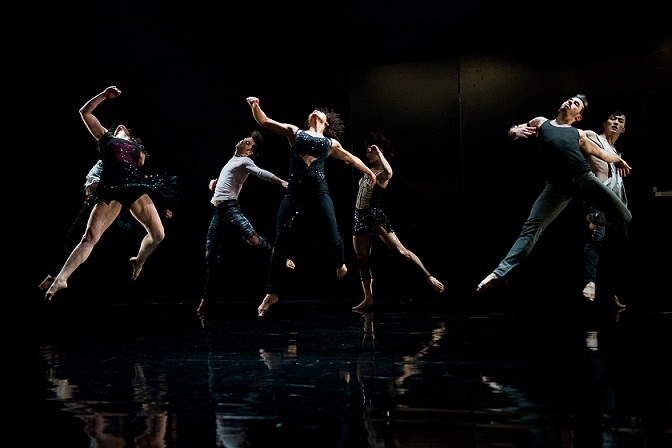
Larry Keigwin’s Exit had its world premiere on Tuesday night at the Joyce in Chelsea. Above two photos by Matthew Murphy. (Top: dancers are, l-r: Kristina Hanna, Liz Riga, Ashley Browne; Bottom photo: Aaron Carr and Ashley Browne). The two photos below are by Christopher Duggan.

I really enjoyed it, and didn’t want it to end, which is the way I usually feel with Keigwin + Company. My friend, who hadn’t seen the company since the wacky Kabaret at Symphony Space, loved it. It was abstract dance but there were little stories that took place between the seven dancers (three women and four men). The music, composed by Jerome Begin and Christopher Lancaster, was an intriguing blend of industrial and contemporary classical, with an amusing Patsy Cline-esque piece thrown in. The dance, which was an hour long and had a kind of club feel too it, was classic Keigwin – containing by turns hints of violence, humor, sadness, intensity, always loads of energy. He made good use of a back wall and its doorway (he often has dancers running up or along a wall, and there was a little of that here as well).

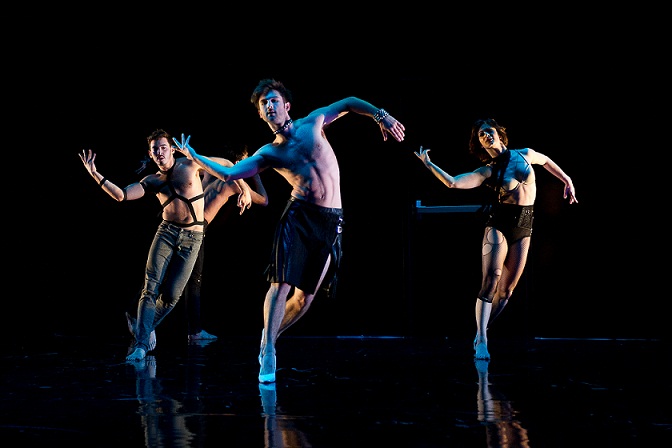
My favorite part of Exit was the most humorous – where two men, once an item, are having a little spat and Aaron Carr comes breezing through the door in the back wall dressed in black leather jock strap and high heels miming Patsy Cline-esque lyrics and acting like a total diva. It was hard to take your eyes off Carr (he’s the dancer in the center of the third photo, by the way – though dressed differently there) but I think the two men continued their spat then made up while he was diva-ing around. Later, all the dancers don the high heels but now in the dark only the white pumps are visible and the dancers playfully prance around like they’ve discovered a new toy. Amazingly, the men could move really well in them!

I was sad to see that Nicole Wolcott is no longer with the company (I’d forgotten she left) but Liz Riga (the dancer in the middle of the top photo above) has taken her place as my favorite in the company. Loved the way she’d whip her head about, her long black hair flying wickedly, and the way she’d forcefully strike out at her partner during the darker moments. And I love her size!

But actually all of the dancers Keigwin chooses are compelling in one way or another, and they each have their own unique thing, which is one of the things I so love about him. You never confuse the dancers with each other – they’re all different shapes and sizes and each exhibit their own sense of humor and beauty and creative energy.

Anyway, Exit is a lot of fun. Go see it – tix start at only $10! It’s showing through March 13th at the Joyce.

PS: DAMN! I just re-read my “review” of Keigwin Kabaret written almost four years ago now. What a horribly boring writer I’ve become! I don’t know what happened. I think it’s because critics started linking to me and I started feeling like I had to sound professional. Or maybe it’s that I got old. Or maybe that I stopped dancing myself. Anyway, I’ve become a horrendous bore! I’m sorry!

The Bolshoi’s Don Quixote


So who went to the live-streaming yesterday? The Manhattan showing was such a blast. Daniil Simkin, ABT soloist and Natalia Osipova’s friend, was there, and I saw Marc Kirshner from TenduTv and several critics. And Evan McKie, principal at the Stuttgart Ballet, who many of us know from the Winger, was tweeting from Stuttgart or Canada or wherever he was. He was very informative too! I tweeted a bit under the hashtag #DonQLive – after I found out we were using that hashtag; I also tweeted about the performance without the hashtag earlier.

Anyway, I loved it. As always, I loved Osipova, though my friend who went with me, a longtime Gelsey Kirkland fan, pointed out that though she has excellent technique and athletic ability, she was lacking in artistry, particularly in her ability here to evoke a Spaniard. It’s true, and funny, because that kind of thing used to drive me nuts – when ballet dancers would perform straight ballet without any culturally specific accent (see my harping here on Paloma Herrera’s Bayadere). I remember when Angel Corella and Paloma Herrera used to be THE couple to see in Don Q in America, and of course they danced it perfectly. But then the next set of dancers – whoever it was I saw after them, all I could think was, couldn’t they have taken some Flamenco, some Paso Doble? But somehow at some point, I stopped being bothered by it.

But, Osipova also doesn’t have the gracefulness of some of the others, like Yekaterina Shipulina as the Queen of the Dryads, and Chinara Alizade in the third act Grand Pas variation. I am beginning to notice that one – Alizade – more and more in these Bolshoi showings and I really like her.

Osipova is more of an athlete and my friend said she’d have made a great ice skater, or some kind of Olympian. Which is true. But I still think she adds so much to the ballet and creates so much excitement with all of the astounding things that she can do. The theater in Manhattan was more packed than I’ve ever seen it – nearly, if not completely full – and people were ooohing and aaahing during intermissions and afterward and were applauding throughout – like when, before the performance, the camera showed her backstage warming up.

Here she is in the Act One variation:


But it was Ivan Vasiliev who really wowed the audience – or at least he did as much as she. I’d seen him in Flames of Paris too and he was fabulous in that as well, but this is a larger role and so he stood out to me more here. He kept taking these flying leaps, sometimes with a turn thrown in,  and he got amazing height on them, especially given that he’s pretty short. He definitely has the muscular legs of a jumper. And he always landed so solidly, which not everyone who jumps that high does. And his form was perfect. And he had the flirty, slightly mischievous character down perfectly. And he had the Spanish flair, for the most part at least. So, he’s perfect, in a word! I don’t know if there’s been a dancer since Baryshnikov who’s danced such an exciting Basilio. Bring him to NYC, Kevin McKenzie!!

Here is he dancing on his own in the studio:


I also loved Andrei Merkuriev as Espada, the matador, though I don’t know if anyone will ever outperform my Marcelo Gomes in that role, imo 😀 But Merkuriev just did incredible things with that cape – I’ve never seen anyone – not in ballet or Paso – whip a cape around with such speed like that.

There were many more character dances than in ABT’s production. It was hard for me to keep straight who danced which one because in the program it wasn’t broken down by act and I can’t tell the difference between, for example, what was called the Spanish Dance, and the Bolero. If Anna Leonova danced the lyrical Flamenco-like solo, then I loved her. I thought she was beautiful and knew how to work the dress and her arms and hands and everything. It might have been Kristina Karasyova though, or one of the three listed under “Spanish Dance.” I also liked Anna Antropova as the gypsy dancer. Ditto for her. They might have been the same dancer, actually…because those dances were in different acts… Oh who knows.

Anyway, it doesn’t matter because I liked everyone and thought they danced beautifully. Honestly, this company is absolutely astounding. I don’t think there’s anyone in it who’s not only an excellent dancer but compelling to watch in one way or another as well. If you ever get a chance to see the Bolshoi, don’t miss it.

One more thing – about the third act Kitri variation. I’ve noticed when Osipova dances with ABT, she changes that variation from the one ABT usually does, and so I wasn’t at all surprised that she did the same here. I’ve always liked her version BETTER because she does those traveling passees at the speed of blasted light, and they look so much better on her than the hopping on pointe. But my friend thought the other version, which Gelsey Kirkland apparently did, was harder and more artistic. But then Evan McKie told me via Twitter that Natalia’s is the version the Russians usually do. So maybe it’s not an issue of changing the choreography to suit the dancer but just the dancer performing the version she knows best. Anyway, I tried to look up Gelsey on YouTube and could only find the final scene pas de deux with Baryshnikov; they don’t have the variations. But here’s what I’m talking about: first video is the ABT version, starring Nina Ananiashvili, second is Osipova:


Which do you guys like better, or do you like them both the same?

Anyway, the next Bolshoi live-stream will be Coppelia, coming up at the end of May. The next live-stream from Emerging Pictures will be the Paris Opera Ballet’s Coppelia, coming up on March 28th. Visit the Ballet in Cinema website for times and theaters. These are such a blast!

Above photo of Vasiliev and Osipova from here.

Sara Mearns Was Gorgeous in Swan Lake, But Overall Production Was Lacking


Last week was Sara Mearns week for me (well, for many New York ballet fans, I suspect). On Tuesday night, she made her debut as the Siren in NYCB’s Prodigal Son. (I’m still awaiting photos and will post as soon as I receive them!) Sean Suozzi danced the lead role. He did very well, but she just always stands out to me whatever she is in – particularly the story ballets. She was the best, most tantalizing, sinister, seductive, all around captivating Siren I’ve ever seen. The way she whipped that cape in between her legs, wrapping it around each one, the way she’d bend her knees slowly into a second-position plie while on point, basically squatting over the son’s head in a suggestive but also sinister manner, the way she’d raise her hand behind her head with the wrist bent and the fingers splayed to indicate her triumph over the son’s will, even just the way she’d walk out onstage on pointe, tiptoeing all around him – everything, every movement was in service of the character and was an integral part of the character’s story. I often feel like I’m seeing steps with other dancers. Just steps. The pas de deux between the son and the siren contains some of Balanchine’s oddest-looking choreography- especially those lifts – ‘here, stand on my knees, wrap your legs around my neck and let me carry you around like that,’ etc. I imagine it would feel very odd and foreign doing some of that, which of course was the point. It’s supposed to look warped and off-kilter. Everyone has mastered those steps, but to me, Mearns makes it the most deliciously warped. I love her.

Then, on Friday night, the company premiered their Swan Lake (Peter Martins version), and she danced the lead. (Photo above by Paul Kolnik, from Playbill Arts.)

In sum, I loved her; I wasn’t in love with the production. I went with several friends, two of whom don’t regularly go to the ballet, and that seemed to be the consensus. Everyone was excited to see Mearns dance again, but not to see that production. She was wonderful for all the same reasons I’ve written about before – she’s like a Veronika Part to me; she does such a full job of developing character, she brings you so fully into her world, you feel all of her pain with her. But of course she’s also an excellent dancer. She has a way of arching her back so, of working her arms and hands so, of extending her leg so high in arabesque, of extending her line so beautifully and making such full shapes – it’s a cliche, but her adagio / White Swan is just breathtaking. It almost makes you want to cry, and one of my friends did!

But she excels in the Black Swan / allegro role as well – not so much because she can do athletic feats like Gillian Murphy or Natalia Osipova (there were “just” a bizillion fouettes during the pas de deux, not a bizillion fouettes divided by multiple pirouettes and wild swan-like port de bras thrown into it all) but because she can do that all perfectly fine while still making it all about the character. When she does a series of lifts with Jared Angle where she spreads her legs into a straddle split in the air above his head, it’s just so wicked! And even at the beginning of the Black Swan, when she makes her entrance and presents her hand to the queen – it’s clear she’s up to no good. But she also doesn’t overdo it. She’s conniving and sinister but with a sweet face.

But the rest of the production: Jared’s an excellent partner, that’s clear. Mearns was way off her center of gravity in much of the White Swan partnering, and he securely held her balance, freeing her up to make those gorgeous shapes, and to act it all out the way she so brilliantly does. But in his own dancing, he just, like practically all dancers these days, goes for the cliche. It all looks so fake. I don’t believe he’s in love with her, or that he’s ever longing for what he doesn’t have, and that he’s devastated when she leaves him in the end. It’s all her sorrow and longing alone. So the performance was so unbalanced. I wish so much I could see her dance this with Marcelo Gomes, who really brings Prince Siegfried’s internal conflicts to life like no one else.

The other major issue I have with this production is the costumes – the costumes and the sets. I always forget about them until I see the ballet again, and, especially when I go with friends. My friends Friday night really found it hard to look beyond those costumes. For some reason, I kept thinking of the Flinstones, my friend, Marie, called them Jackson Pollack on speed or something to that effect (I haven’t read her review yet but will after I finish this post), and the others we went with just couldn’t stop talking about the brash colors. I remember my friend in the fashion industry saying of the Romeo and Juliet costumes (Per Kirkeby designed sets and costumes for both Martins productions) that the colors needed to be muted; these brash, bright, almost neon colors made the characters look like cartoons. Same with the Swan Lake costumes. Cartoonish is NOT what you want to go for in serious ballets like this.

Also, the RACISM. This is another thing I hate to admit I often forget about until I see the ballet again with a friend, and the friend is horrified at the fact that a black man is playing the evil character. Must von Rothbart always be danced by Albert Evans or Henry Seth? Are we not living in the year 2011? I mean, this is a huge reason why young people are so turned off from the ballet. And none of the very educated critics ever seem to be calling Martins on this. What’s up with that? Seriously? I think once you go to the ballet a lot you begin to forget about these things, you become immune to them. Which is horrible. But really, asking your audience to associate black men with evil is a horrible insult to that – probably very educated – audience.

Another problem here: Faycal Karoui (the conductor) was seriously on speed. He was flying through the first half. The poor dancers couldn’t even express the story. They really had to rush falling in love. If I’d never have seen this ballet before (and there were probably some such people there due to the Natalie Portman film), I don’t know if I would have gotten much out of the White Swan pas de deux. And that’s kind of an important part of this ballet…

All other dancers did well – I particularly liked Ana Sophia Scheller and Anthony Huxley (filling in for Sean Suozzi as Benno) in the first act Pas de Trois, and, in the second act, Abi Stafford and Joaquin DeLuz in the Divertissement Pas de Quatre, and Antonio Carmena in the Neapolitan Dance – but everyone did very well (those were just the ones who stood out to me). Oh and I loved Daniel Ulbricht throughout as the Jester. With his immense skill at jumps and turns – and combo jumping turns – and his comical sensibilities, he is perfect for such a role, as he is for Puck in Midsummer Night’s Dream – my favorite roles for him.

But I have to say, I was floored when none of the other dancers came out and took bows at the end of the production. Why? Whose idea was that? Only Mearns and Angle and Evans took bows. I realize the dancers are all very hard-working and probably needed to get home to get sleep for the next day’s matinee. But this severely cut Mearns’s bow and curtain calls short. It reduced the celebratory aspect of a production well done. Worse, it also really makes it look like none of the other dancers cared about Mearns, and about the production. It made it look like the company is not really a company of dancers who all work together and support each other. I’ve honestly never seen such a thing before. I’ve seen it where dancers who only dance during the first act will take their bows and curtain calls after the first act and not at the end of the whole, but the dancers who danced in the last act always come out for their bows at the end. Anyway, it really stood out to me. What did other people think?

Here is my friend Marie’s write-up.

For the Love of Duke


On Friday night Susan Stroman’s For the Love of Duke premiered at NYCB. Photos above by Paul Kolnik. Top: Tiler Peck, Sara Mearns, and Amar Ramasar; bottom: Mearns and Ramasar. Stroman is primarily a Broadway choreographer (I think her most famous work is probably Contact), and it shows both in her ballets’ strengths and limitations.

For the Love of Duke is divided into two parts. In the first, entitled “Frankie and Johnny … and Rose,” Tiler Peck and Amar Ramasar are Johnny and Rose, a couple in love. They perform a lovely lyrical pas de deux. Then along struts Sara Mearns – Frankie – and Johnny’s attentions are completely lost on her, to the disappointment of Rose. Johnny and Rose are snuggling on a bench together, and when Frankie comes prancing along, Johnny pushes Rose right off the bench, behind it, as if to hide her. Then he does a snazzier dance with Mearns / Frankie, she disappears, and he’s back with Rose … until Frankie comes strutting along again. And so on. At one point, Rose becomes the seductress, and Johnny pushes Frankie off the back of the bench. It was cute, and everyone danced spectacularly, but it got a bit old to me after a while.

The second part – “Blossom Got Kissed” – Stroman had actually choreographed before, creating it for NYCB in 1999. I liked this one better. Both parts, by the way, are choreographed to Duke Ellington and Billy Strayhorn, which is where the title of the whole comes from. Anyway, “Blossom” begins with a bunch of girls all dressed in sassy, jazzy red sitting on a bench tapping their feet to Ellington’s rhythm. Along comes Savannah Lowery as Blossom, dressed in a frilly ballet tutu. She sits alongside them on the bench and tries to tap with them. But she has no rhythm and is horribly off. Then they stand and do a jazzy dance, and, again, she tries to join, but just can’t get the hang of it. She is simply too classical ballet. Lowery was hilarious though and it was funny to see her continually try to get the rhythm and technique of jazz dance right by taking a foot and pounding it down flat on the floor. Then, a group of tux-clad men come along and do some swing dancing with the red-clad women. Blossom again tries hard to fit in but just can’t. Finally, a musician in the band (which was onstage), in the person of Robert Fairchild, comes out from the back of the stage, orders the music changed, and does a sweet lyrical ballet pas de deux with her.

I feel like I’ve seen “Blossom” before because Lowery’s hilarious flat-footedness looked familiar. I liked it better than the first part because to me it was funnier, and the story went a little further.

I think Stroman is very good at creating a story through dance, and that’s what I like about her. You can tell she’s not really a ballet choreographer though. Compared to the first two pieces of the night – Ratmansky’s Concerto DSCH and Wheeldon’s Polyphonia – the actual dance just wasn’t that rich. Still, I think she complemented the program well. It can never hurt to include in an evening of ballet a cute narrative dance with music that’s not usual ballet fare.

As always, I loved Concerto DSCH. Ratmansky was in the audience. I felt the music was played a bit too fast though (conductor was Ryan McAdams, Elaine Chelton the pianist). It looked like Ashley Bouder had a slight mishap, though I’m not sure because I was busy watching Joaquin DeLuz do a sequence of crazy fast steps into a somersault at the speed of light. Andrew Veyette again replaced Gonzalo Garcia, who I am really missing. I hope he’s okay. Veyette is doing a fine job as one of the two playful guys in blue, but there’s this repeating series of throws – where they each kind of propel the other into the air, and I love how Garcia always gets such height when he bounces off the other two.

Tyler Angle replaced Benjamin Millepied, and did wonderfully. I always notice things with Tyler that I haven’t noticed before – like how when he and the girl in green (Wendy Whelan) make their entrance, he’s spinning her around and around, and she looks like she’s hanging on to him for dear life. It kind of sets the tone of their relationship. I always notice the music much more when he dances as well.

Christopher Wheeldon’s Polyphonia is definitely one of my favorites of his. I love the musicality of it, and the originality of the combinations. It’s set to ten piano pieces by Ligeti, who, the program notes, developed micropolyphony – a type of music involving sustained dissonant chords that shift slowly over time. You can really see that “micropolyphony” in the dancing, as the sets of dancers (eight all together, divided into four pairs) begin dancing together in a line but each pair doing something completely different. Then, they eventually come together and dance in unison, but then they drift apart again later. There’s some very clever, almost humorous partnering throughout, but particularly in the second movement, Arc-en-ciel, Etudes pour piano, danced by Maria Kowroski and Jared Angle. I haven’t seen this ballet as often as I would like to. I was going to say I wish he’d include this one more often in Morphoses programs, and then I remembered

Last Week at New York City Ballet


Last week I went to two performances of NYCB – opening night and Thursday night’s “See the Music” program – and to two of the free all-day Balanchine events on Saturday. First, I’ll talk about the last two since I found them so informative. The free studio talk on Saturday afternoon – Balanchine’s birthday – was moderated by Sean Lavery (former NYCB principal dancer, now ballet master), and included Sterling Hyltin (in Paul Kolnik photo above with Robert Fairchild), Chase Finlay, and Jenifer Ringer. Lavery asked the dancers to talk about their first Balanchine ballets, their favorites, and what drew them to NYCB. Hyltin named as her favorite Duo Concertant (pictured above) which I’d just seen her dance on opening night. She said she liked the syncopated movement, the he goes and I go kind of back and forth movement conversation with her partner, and with the musicians. I really liked it too. The violinist and pianist are onstage (the music is Stravinsky), and I like the interaction between the dancers and the musicians, and between the two dancers, and I like the sharp, angular movement. She seemed particularly animated when I saw it. I love Robert Fairchild and think he’s such a sharp, masculine mover with a presence that commands your attention without meaning to – he kind of reminds me of a less cocky Ethan Stiefel – but she seemed so happy to be dancing this piece that she stood out to me more. It was nice to hear her talk about it.

But what I really loved was the School of American Ballet class taught by Peter Martins. He interacted cutely with the students, particularly “Cyrus,” (at least I think that was his name…) a tall, long-limbed young man who I think will soon be in the company. Cyrus didn’t always do everything perfectly (at least in Martins’s eyes) but he had a charming presence and a great leading-man physique and you can tell he works hard.

Martins had the class demonstrate ballet basics – beginning with the five positions, and they showed us a perfect fifth position (with the toes of the front foot touching the heel of the other and vice versa). More interestingly, he had the class show us the difference between a Balanchine hand and a classical ballet hand. I’d always noticed there was a difference but couldn’t figure it out exactly. God gave us five fingers, Balanchine had said, so we shouldn’t hide two of them. The Balanchine hand shows all five fingers, the classical ballet one only three (with the ring finger and pinky held so that they are hidden from view behind the middle finger).

Martins also had the students show us how Balanchine’s fourth position differed from others’. In Balanchine’s the back leg is straight; in all others’ the back leg is bent. Martins didn’t go into any functional explanation for this – just said “here, we think it looks better.” But I thought about it and thought, wow, it must be hard to take off in a jump for example with the back leg straight. And then I realized that’s partly why Balanchine’s choreography always looks so fluid, like one step leading right into another, without a lot of stopping to build up to a big athletic feat – a big jump or series of turns. Other companies – like the Russians, like the Bolshoi – are all about preparing so that you can do something astounding. So they’re all about the building up.

This was mentioned in the studio talk as well. Lavery also talked about how fluid Balanchine’s movement was, and how, for example, in a lift, a guy would pick up a girl, then take two steps, and put her down rather than walk all over stage with her hoisted above his head. Balanchine wanted her to come up, then down right again, because that was more fluid, rather than have her head bobbing around up there while the guy was running all around with her.

Martins also demonstrated the bows. At City Ballet, he said, we just do them as such, and the girls did a little curtsy with the back leg slightly bent, without going down on one knee. Making fun of the dramatic Swan Lake bows, Martins went all the way down on one knee, exclaiming, “Yes, yes, I know I’m good!!!” while putting his head down, forehead nearly touching the floor, and raising his arms up in back of him like wings, fingers pointed toward the ceiling. It was hilarious.

Anyway, here are a couple more photos of opening night:


Above: Ashley Bouder in Valse-Fantaisie, and below, the cast, including Andrew Veyette, in the same (all photos by Paul Kolnik)


I liked Balanchine’s Valse-Fantaisie (Veyette replaced Joaquin DeLuz – but don’t know why because DeLuz danced Concerto DSCH two nights later) but I really loved the first of the evening, Walpurgisnacht Ballet. I’d never seen Walpurgisnacht before and it’s funny but I always seem to love the Balanchine ballets that are the least often performed. This was really beautiful. It’s from Gounod’s Faust, and features a group of women (and only one man – here Charles Askegard) in deep red dresses, their hair down in the second half as the music increases in tempo so that there’s almost kind of a hedonistic madness in the mood – and the footwork is so intensely complicated and fast fast fast. Wendy Whelan even made a tiny little flub, which I’ve never seen her do before. Crazy! And breathtaking!

And the evening ended with The Four Temperaments. I’ve said before and I’ll complain again that I still don’t understand why everyone goes on about how brilliant this one is. To me, there are supposed to be four temperaments, and the ballet is divided accordingly into four variations after the theme: melancholic, sanguinic, phlegmatic, and choleric. But they all seem to be the same to me. The dance seems one-note throughout so that after the first variation, I’m waiting for it to end. I’ll keep seeing it though, perhaps performed by a variety of companies if I have the chance, and will keep looking for the nuances…

“See the Music” night opened with Faycal Karoui’s discussion of Mozartiana, Tchaikovsky’s homage to / riff on Mozart, which made me appreciate Tchaikovsky even more. Then that piece was danced – by Maria Kowroski, Daniel Ulbricht, and Tyler Angle. Tyler stood out to me. As always, he dances with so much meaning, so much intention, and so much expansiveness. He’s a really beautiful dancer.

Then came Ratmansky’s Concerto DSCH, danced by Wendy Whelan, Ashley Bouder, Joaquin DeLuz, Andrew Veyette (replacing this time Gonzalo Garcia), and Benjamin Millepied. Oh, Natalie Portman was there, albeit late – she came in with a friend after Karoui’s lecture and right before Mozartiana was performed. Then, she left right after Concerto DSCH, after Millepied was done performing, and before the last piece. I thought it was a shame she missed Sara Mearns in the last dance, but a Twitter friend said she had a movie premiere that night, so I guess she needed to leave early for that.

Anyway, as usual, Millepied did not stand out to me, and I couldn’t stop thinking of seeing Tyler Angle in that role before and the way he lunges romantically toward the main girl, making it clear how much he yearns for her. Millepied’s knees nearly touch the ground in his deep steps toward her and it just looks like a dance step, not like anything evoking a specific emotion. As always I loved Bouder and DeLuz in the fast, playfully firtatious three-some part. I missed Garcia – where is he? I hope not injured! – but thought Veyette did a fine job in his stead.

And the evening ended brilliantly with Sara Mearns and Charles Askegard dancing the ballet leads in Balanchine’s Cortege Hongrois, while Rebecca Krohn and Sean Suozzi just as brilliantly danced the folksy Hungarian leads. I really love that dance and it made me all the more eager to see Mearns in Swan Lake!

On both nights, I went with my friend, author Maria Mutsuki Mockett. She writes an author blog but has been attending the ballet much more frequently and is now blogging a lot about ballet as well. She’s an excellent writer, so please check out her blog!

Giselle: The Royal Versus the Bolshoi

Last Wednesday I went to see the Royal Ballet’s Giselle live-streamed direct from London. Today, I saw the Bolshoi’s live-streamed from Moscow, both via Emerging Pictures’ excellent Ballet in Cinema series. I have to say I think this new series is one of the most exciting things happening in ballet right now, if not the most exciting. You can see the world’s greatest ballet companies perform live in your hometown via your local movie theater (if, of course, you’re lucky enough to have a local cinema that’s participating – and hopefully you are!). Not only do you get to see the live performance, but the camera also takes you behind the scenes to see things even those in the theater can’t see – to the makeup rooms, the rehearsal areas where the dancers are warming up, getting dressed, and sewing their shoes, etc., behind the curtain during and after the performance where you see the dancers prepare for curtain calls, and down into the orchestra pit where camera focuses on the conductor and members of the orchestra. You also get a good view of the theater – from inside the auditorium to the lounge areas, even to the outside front. You really feel like you’re there. And knowing it’s in real time makes it all the more fun. I kept wanting to wave out to the audience members as they took their seats, some looking at the camera. But of course they couldn’t see us…

Anyway, it’s such an experience, and hopefully everyone will be able to have it at some point soon.

So, the Royal’s Giselle: the dancers were Marianela Nunez in the lead, Rupert Pennefather as Albrecht, Gary Avis and Hilarion, and Helen Crawford as Myrtha. Also, one dancer who wasn’t a lead but who I was just really captivated by was Yuhue Choe, who danced the female peasant in the peasant pas de deux.

Overall, I liked but didn’t love this production. My biggest problem was Pennefather, who I just didn’t find at all compelling – either in his dancing or his acting. He was definitely good-looking and had a regal bearing so I understand why they cast him, but his dancing was just nowhere near the level of someone like David Hallberg’s. In the second act in the would-be dance-to-death scene where he went to do his high jumps with the many braided entrechats, they just didn’t look polished or sharp enough. They almost looked fake – like he wasn’t really weaving his feet backward and foreword. I’m sure he was, it just looked sloppy. And as a character his Albrecht didn’t make much sense. At the beginning, when his servant helps him change into his peasant costume, he looks down at the costume, and smiles to himself, pleased. Then, he has fun dancing with Giselle, tricking her with the altered flower, etc. Later, when he’s found out and his betrothed asks him why on earth he’s dressed as a peasant, he immediately laughs it off, and practically runs toward her, kissing her hand. It’s never clear what he hopes to accomplish by pretending to be a peasant and seducing the unknowing peasant girl; what his motivation is for doing any of it. But he didn’t seem particularly dumb or playboy-like either. It just seemed like a role that wasn’t thought-out.

I did like Nunez. I thought she was a tremendous dancer, and she acted very well too. Her mad scene was real, completely believable, not at all overdone, with depth, one of the best I’ve seen. Of course it helps that the camera’s so focused up close on her face! You can easily see the emotions. The only thing was that body-wise she didn’t seem like a Giselle to me. She didn’t seem weak and delicate and fragile. And that strength came through in her dancing too. Her performance reminded me a little of Paloma Herrera’s Giselle. I thought Herrera was terribly miscast. I thought Nunez was such a remarkable dancer though that I was able for the most part to suspend disbelief, more so than with Herrera.

I thought Gary Avis was a really hot, hunky Hilarion 🙂 He’s a very good actor too. I think he was actually the best actor in the whole production. I really believed his love for Giselle, his urgent need to keep Albrecht away from her, and his devastation over what ended up happening to her. And ditto for the Bolshoi’s Hilarion (or Hans as he’s called there), Vitaly Biktimirov – at least in the hot & hunky department. He was a good dancer, but less of a good actor than Avis. I was talking with a friend and fellow blogger, Art, during intermission, and he said he thought the British were simply just trained to be actors as well as dancers, probably because of their history. The Russians weren’t so trained. And I agree with him. The Russians seem to do everything in a very melodramatic, somewhat phony way. I mean, not Veronika Part, not the Russians who come here. But when you see a production by a Russian company it just seems like everything is very performance-y, not natural.

I really loved Choe in the Royal’s peasant pdd and found myself wondering what type of Giselle she’d make. She looked perfect for the part. I thought her dancing was lovely, but I’m not sure if, had she danced Giselle, it would have been at the level of Nunez’s. Has anyone seen more of Choe? She’s a beautiful dancer.

Interestingly, Helen Crawford, who danced Myrtha, was a tiny little thing. Very pretty, very fine features, very delicate-looking. She also had the appearance of a Giselle. She did a superb job though acting the controlling, sometimes damning Queen of the Wilis. It was just interesting casting, though, because all of our Myrthas are the larger, more physically-imposing ballerinas.

I hate to say it, but I really didn’t like the Bolshoi’s very much. But I LOVED their performance of The Class Concert, a one-act that preceded their Giselle. The Class Concert was created in 1960, by Asaf Messerer,  and it’s one of those storyless ballets that takes place in a classroom and that are meant to highlight the magnificence of ballet, from beginning at the barre, and ending with the grand jumps and high overhead lifts of center-work. Kind of like Harald Lander’s Etudes or Christopher Wheeldon’s Scenes de Ballet. Anyway, those dancers are incredible. I mean, I was almost on the floor I was so in awe. From the small children to the young adults doing all the lifts and crazy chaine turns and high jumps – every hip was completely perfectly turned-out, every tendu perfectly pointed, every single body’s form was absolute perfection. They weren’t always moving in unison, but just the perfection of each of them individually made me not care that they weren’t always in sync. It was amazingly beautiful, but in a way, it was also slightly creepy. I mean, to attain that kind of miraculous perfection, you realize these children must do nothing but eat, sleep and ballet every day from the time they’re 2 years old foreword. Talk about Tiger Mothers. It’s a whole Tiger State.

Anyway, their Giselle I felt was lacking. I loved their Albrecht – Dmitry Gudanov. He had everything Pennyfather lacked – at least in the acting. Gudanov had definitely thought through his motivations for the character. Gudanov’s Albrecht was in love with Giselle. His servant tried to tell him he was going to hurt her, but he just blew his servant off. He was reckless but his heart was with Giselle. Later, when the princess, his betrothed, sees him in the peasant costume, at first he doesn’t know what to do, how to act. Then he slowly, begrudgingly takes her hand. But it’s clear he’s not in love with her and he really wants Giselle. He remains torn between her and Giselle even after he realizes he must chose his betrothed – at least for the time being. And then he’s shocked when Giselle reacts so badly. And then he’s devastated along with Hilarion, even going after him with a sword, when she dies. I still wasn’t in love with his dancing, though. Actually, he did everything very very well. He was a very good dancer. What I wasn’t in love with was Grigorovich’s choreography for him. I didn’t feel that the dance to death scene was in any way a seriously dangerous dance. It looked rather lyrical. There were no brises or jumps with the entrechats; instead there was a series of tour jetes back and forth, and they weren’t done particularly fast. It looked like he was flying gracefully through the air not like he was exhausting himself to the verge of death. And when he’d “collapse” he’d go down so lightly, it was like he was going to sleep, like Sleeping Beauty. No crashing to the floor in sheer exasperation ala Marcelo Gomes at all.

But who I really didn’t like was Svetlana Lunkina as Giselle. I’ve heard so many good things about her and my hopes were so high, but now I can’t understand the big deal at all. She seemed really really wooden to me. She really didn’t act at all. Her face was devoid of emotion throughout. And, unlike Nunez or Osipova, or any other dancer I’ve ever seen in the role, her dancing was nothing to write home about at all. She was adequate but she looked like a corps dancer to me. What am I missing? Maybe she was really just having a bad night, because during the wilis scene when she had those several slow turns on one leg, her balance looked very off. I really thought she might actually lose her balance and fall. So maybe it was just the pressure of the cameras and knowing so many people were watching.

Again, I really liked the ballerina who danced the peasant pas de deux – here, Chinara Alizade – and wondered what she would have looked like as Giselle.

Oh, and speaking of the peasant dances: hehe, these were the absolute fanciest peasant costumes I’ve ever seen! Art joked that these were peasants flown in from Paris for the occasion!

I had a blast though. And the Sunday performances are so nice because there are so many more people. I met two new dance fans who regularly read my blog! I felt kind of half-dead today – probably because of a late night last night – but I’m always so flattered when people recognize me and come up and talk to me. I’m always so thrilled to find that people like this blog and find it valuable and my viewpoints interesting and all! So thank you!