Janie Taylor Debuts in Millepied’s “Why Am I Not Where You Are” Etc.

I’ve been remiss in my New York City Ballet posts! Last week I saw two programs: one featuring three dances to three different violin concertos – Peter Martins’s Barber Violin Concerto, Robbins’ Opus 19 / The Dreamer, and Balanchine’s Stravinsky Violin Concerto. And the other program was another in the “See the Music” series but was also dedicated to Santiago Calatrava, who designed sets for all three of the ballets performed – Benjamin Millepied’s Why Am I Not Where You Are (pictured above, photo by Paul Kolnik), Christopher Wheeldon’s Estancia (pictured below, photo also by Kolnik), and Mauro Bigonzetti’s Luce Nascosta, all of which premiered last season and which I wrote about here, here, and here.

Calatrava was in the theater, and after encouragement by Peter Martins, he rose and took a bow.

Then, as with the first “See the Music” program, before the performance began, the orchestra pit rose and conductor Faycal Karoui gave a humorous little explanation of various parts of the Thierry Escaich score from Millepied’s Why, the first ballet performed.

These explanations are really interesting to me, I have to say. I only took one classical music class in college and now wish I’d taken more. Karoui talked about how there were four main parts to the score: a waltz, a tango, a disco, and a final climactic part, and he talked about the differences in tempo between them, and between them and a typical waltz, tango, etc.. He also talked about how the ballet has a central male character (danced very well by Sean Suozzi – in top picture, being carried by the group of men), and how you can hear that central character’s theme – or voice – throughout each section of the music. But the voice changes with each section: at first, he’s shy and mysterious (and his voice in the first section is portrayed by a violin solo), then as the orchestra grows sharper and stronger in the second, tango, section, so did the character, etc.

When we got to the “disco” section (it sounded nothing like disco to me but just slightly more mechanical and percussive than the preceding sections), Karoui really began rocking out as he led the orchestra. It was like he was actually dancing in a disco, and I nearly cracked up. I’m not sure if that’s what he normally does down in that pit – if he regularly starts to embody the music literally like that, or if he was just being a goof for the audience. He didn’t seem to be hamming it up at that point, though – oddly – so who knows. Anyway, he is very entertaining and I find his musical explanations very educational as well. What more can you ask than to be both entertained and educated, right?

Anyway, Janie Taylor debuted in the Millepied. She was supposed to have debuted when the ballet did last season but she was out with injury and so Kathryn Morgan had filled in. Character-wise I thought she played it the same as Morgan. Except with Morgan it seemed to have a West Side Story feel to it; with Janie it was darker and more La Valse-like. Both were tragic, but in a different way; Kathryn’s character seemed more innocent. Anyway, this was my second time seeing the ballet and it grew on me. It’s very dramatic, not a dull moment in the whole thing, and you’re really on the edge of your seat, both because of the intensity of the music – maintained throughout each section – and the dramatic story of the poor innocent guy who’s drawn into another world by his enchantment by this ethereal creature, only to get trapped and ultimately destroyed, along with her.

To me, Sara Mearns and Amar Ramasar, with their bravura roles, largely stole the show – I think I remember thinking the same last time. She with those crazy fast chaine turns all around stage that almost make you sickly dizzy, and he with his virtuosic leap sequence – they are kind of the sinister characters, seducing Suozzi but also the audience.

Then came Estancia, and it was my first time seeing Ana Sophia Scheller and Adrian Danchig-Waring (pictured above) in the leads. I’m not a huge fan of this ballet – well, I like the ensemble sections, particularly the dancing and taming of the “horses” – but I nearly fall asleep during the middle, romance part, where city boy wins country girl over. I think it’s just the choreography in that middle section (that I found relatively bland) that slows it down – along with the music – but I liked Scheller and Danchig-Waring just as much as the first pair of leads – Tiler Peck and Tyler Angle. In fact, they seemed to fit the roles a bit more. Scheller reminded me of the main character of Agnes de Mille’s Rodeo and there was something more sweetly, playfully tomboyish about her look than Peck’s. And Danchig-Waring perfectly suited the city boy trying to woo her. He acted his part very well. And his movement is always very sharp. Andrew Veyette and Georgina Pazcoquin as the horses who are eventually tamed, were fabulously entertaining.

And lastly was Bigonzetti’s Luce Nascosta (picture at left by Kolnik), which I’ve seen now three times and which I like but think is too long. I missed seeing Craig Hall in the middle section that seems to be softer and looser than the other sections, where the movement is more marked by those extreme shapes with the flexed hands, splayed fingers, and angular balances and slides on pointe. Hall seems to have the ability to move in a more undulating, kind of serpentine way than most of the others and it seems to me to suit that middle section well.

In the previous program, I loved Megan Fairchild again as the “modern” dancer in Barber Violin Concerto, and, as always, Gonzalo Garcia as “the dreamer” in Robbins’ Opus 19!
New York City Ballet’s First “See the Music” Program

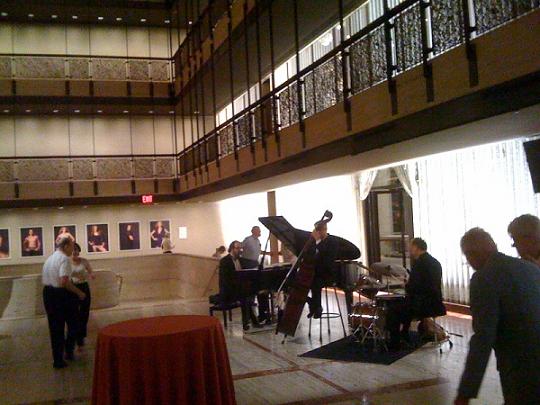
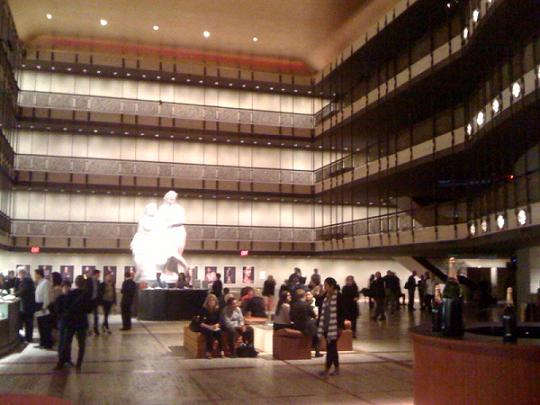
Friday night, my friends Hsien and Alyssa came with me to see the first program in NYCB’s “See the Music” series. First, we met for drinks on the promenade, which, as I mentioned, they’d opened an hour before showtime for the first week of this fall season. We watched members of the orchestra play some soft jazz music, which some patrons were dancing to. I know Hsien from my ballroom dancing days and we had to laugh because some of that music sounded straight out of Blackpool! (Blackpool’s one of the only – perhaps THE only – ballroom dance competition with live music.) (Above are a couple of my pictures of the promenade, about an hour before the performance, with people beginning to gather. My iPhone seems to take better photos outside…)

The two ballets performed were Ratmansky’s Namouna: A Grand Divertissement, which premiered last season, and Jerome Robbins’ The Four Seasons, which served for the first week of this first fall season as a tribute to fall.

Before the performance, Peter Martins came out and introduced the new series, explaining that it was inspired by Balanchine’s highly musical approach to dance, his belief that dance is music made visual, summarized by his words, “see the music, hear the dance.” Then the newly movable orchestra pit rose (as I knew it would!), and up came conductor Faycal Karoui with his crew, to explain a few things about Eduaord Lalo’s Namouna score. No one could give these talks but Karoui. He is hilarious, such a character!


Photo of Karoui by Paul Kolnik, taken from The Faster Times.

Karoui joked, in his thick French accent, that the music is very French, because of its … charm of course. Okay, then he became serious. The Lalo score is too long, of course, to talk about all of it, but Karoui focused on a few sections. One of the sections, he explained is characterized by its transparency of orchestration, meaning the harmonies don’t always  behave the way you expect them to; they are a surprise. He talked about how the beginning of the score had a nautical theme, and it opened with a sound like waves, but more German waves than French, he said, as the opening crescendo sounded more like Wagner’s The Flying Dutchman. He talked about the conversation between the harps and the strings, how Lalo plays with flexibility inside the tempos by following a quick tempo with a slower one, and he showed how Ratmansky had the dancers visualize part of that tempo by having the corps women at one point use cymbals onstage. After Karoui did a little dance himself while clapping the cymbals, he and Martins had the audience clap where the cymbals should be played to get us to internalize that rhythm a bit.

Karoui spoke at length about one of my favorite scenes in the ballet, where a group of smokers (led by Jenifer Ringer) really kind of tantalize the poor male lead, blowing smoke right into his yearning little face. It’s called “The Cigarette Waltz” believe it or not, and Karoui showed how the music really teases and tantalizes you into desperately wanting a cigarette, just like Ringer and her friends tantalize the poor sailor into wanting one of them. “Oooh, I really want one now,” Karoui cried after the orchestra demonstrated part of that waltz.

I liked Namouna much much better on seeing it a second time. I wrote about it earlier here (also, read Marina Harss’s fabulously detailed and in-depth description in Faster Times). It seemed less long this time, and each of the the parts seemed entertaining and compelling, each having its own theme and it own little storyline, however abstract the whole was. Maybe it was because of Karoui’s brief humorous explanations of the music, or maybe it’s just Ratmansky, because I always feel this way with his work – that nothing strikes me that much on first viewing, but that the more I see each ballet of his, the more I see in it, and the more entrancing I begin to find it.

That ballet was all the same, except this time Tyler Angle took over for Robert Fairchild as the main sailor guy. I’m told Robert is out for the moment with an injury. I loved Robert, but I really liked Tyler as well. Robert is so boyishly charming like Jose Carreno, and his dancing is more sharp and precise, hitting every count with spectacular flair and pizzaz, whereas Tyler’s more Romantic with his expression, with stretching port de bras and longing lunges, and he really draws out the music. They are such different dancers and it’s always nice to see another’s interpretation.

The next “See the Music” program will be this Sunday’s matinee.

New York City Ballet’s First Fall Season Opening Night


Tuesday night, New York City Ballet opened its very first fall season with performances of Balanchine’s Serenade, Peter Martins’s Grazioso, and Jerome Robbins’s The Four Seasons. First, before the performance began, Peter Martins came out and introduced each of the principal dancers, who came out onstage one by one, and said this season would be a celebration of them. Tiler Peck in particular was wearing this really gorgeous silky fuchsia dress. Martins said all principals were there except for Benjamin Millepied, who was doing something movie-related “en France,” he said with a funny faux Euro accent. Everyone laughed and gave the dancers a huge round of applause. The house was packed and it was clear how thrilled the company’s many fans are with there being a fall season this year. Martins made fun of himself for being so into toasts and said that during intermission, we’d all be given be given free champagne to toast the principals. Which we were – very fun!

The part of the performance I was mainly looking forward to was Janie Taylor’s debut in Serenade (above headshot and Serenade photo by Paul Kolnik) as the main ballerina. As usual with her, she completely made the ballet her own. I thought the ballet had a somewhat dark element with her, that I’ve never seen before. When she first ran out onstage, late for class, instead of looking like she was all frantic about being late because she’d been held up by a boy, it looked like she was running from something – from him. That man was Charles Askegard and when he danced the middle waltz part with her, the huge size difference between them added to the sense of foreboding, that she was fragile, he was pushing her around, and she’d eventually be hurt by him. At certain parts, it was literally like he was pulling her along. When he lifted her and she raised her legs in a split, it looked almost like she was trying to get away from him. Sara Mearns was the angel and Ask La Cour was the man who I call “blind justice” who take care of Taylor when she falls, and it was interesting how much the two male leads and two female leads looked alike. I almost got Taylor and Mearns mixed up at parts, thinking they were taking on the other’s role. And the end when the men raise Taylor up like pallbearers and she is carried off by them, arching her back, arms outstretched  – so hauntingly beautiful. It reminded me a bit of Balanchine’s La Valse.

I was also looking forward to Martins’s Grazioso, in which three handsome men – Gonzalo Garcia, Andrew Veyette and Daniel Ulbrich – vie for Ashley Bouder’s attention with their bravura moves. I don’t think this ballet has been performed since it premiered a few seasons ago. And I loved it all over again. I love how each guy has his own personality – Garcia is the romantic, Veyette is the manly man one, and Ulbrich is the one with all the high jumping tricks. And Bouder really played the tart, looking at each of them up and down at points kind of lasciviously, really trying to choose. The guy next to me was really giggly over it.

And the evening ended with Robbins’ The Four Seasons, which itself ends with a lovely tribute to fall.

This whole season the Koch theater will open an hour early. The promenade overlooking Lincoln Center Plaza will be open for cocktails, the gift shop will be open, and, for the rest of this opening week, there will also be live jazz performed by the NYCB Orchestra one hour before performance time. They have the promenade and mezzanine area done up nicely, with big plush chairs. Also taking place the rest of this week will be a “meet the artists” session whereby, beginning at 6:45 p.m. in the first ring of the auditorium, the principals dancers will be available to chat with ticket holders. There’s also a photo exhibition of the dancers by photographer HenryLeutwyler on display in the theater throughout the season.

Tomorrow night will be the first of seven “See the Music” performances which will provide a look inside NYCB’s 62-piece orchestra. At the beginning of each performance, Peter Martins and musical director Faycal Karoui will briefly discuss the program’s music, followed by the orchestra performing an excerpt of one of the ballet scores. The subject of tomorrow night’s discussion will be Eduoard Lalo’s score for Ratmansky’s Namouna: A Grand Divertissement, which premiered last season. Additional “See the Music” programs are Sept. 26 matinee, January 20, Feb. 1, Feb. 19 matinee, May 25 and June 11.

Ailey Camp!

A couple of weeks ago, the kind people at Alvin Ailey American Dance Theater invited me to visit one of their Ailey camps. The one nearest me was in Washington Heights, so I spent a morning up there watching the kids and their classes. Then, late last week, they invited me to that camp’s final performance, which took place at Columbia University’s Miller Theater.

What a sweet night! So precious – the kids were so proud, the parents were so proud, the teachers were so proud. And the kids danced very very well. Some of them could seriously have professional dance careers if they wanted.

But that’s not really the point of the Ailey camps. They’re not pre-professional schools, like the Ailey school; they’re for underprivileged, inner-city kids from ages 11-14 to have a wonderful summer experience learning to dance – or, rather, learning discipline and and self-respect and acquiring an appreciation for the arts through self-expression. The camps are focused on dance, of course, but the children also take classes in other forms of self-expression, such as writing – where they compose poems about their lives, drumming (could anything be more fun than beating rhythmically on a conga drum?!) , and personal improvement kind of classes where they learn about the effects of drugs and alcohol, nutrition, etc., but in a fun way, by grouping into teams and having a kind of group Jeopardy tournament. The dance classes encompass many forms — ballet, tap, Horton-based modern, jazz, and African. And they go from class to class each day, each class lasting about 45 minutes. So, it’s like a school, but a really fun school! The camps receive corporate funding and grants, so the kids pay nothing to go; they don’t even pay for leotards and tights, etc.

The performance was really lovely. The various groups danced ballet, modern, tap, jazz, lots of African (that seemed to be the most fun, both for the kids and the spectators), read poems, and there was a drum section. There was a beautiful lyrical modern dance by an ensemble of girls that ended up being a wonderful tribute to Denise Jefferson, who passed away a few weeks ago. And they had a big tribute to Judith Jamison (Alvin Ailey’s muse and central dancer, who has run the company for the past two decades and who will retire at the end of this season). That tribute involved a life-sized puppet that the kids constructed, which they managed to make dance, which was really spectacular, and elicited loads of applause.

As I said, a really special night.

Here are a couple of videos I found on YouTube. The first is of the Miami camp (there are, I think, 13 altogether, in cities around the U.S.), and explains what the camp is all about, and the second is scenes from past NY camps.

Four Young Choreographers at the Joyce


Earlier this week, I went to two programs at the Joyce Theater showcasing new works by four young female choreographers: Andrea Miller (whose company is Gallim Dance, photographed above), Camille A. Brown, Kate Weare, and Monica Bill Barnes. I found all four very good – by turns, entertaining, funny, provocative, and emotionally moving. All were very original. Here are some photos, all by Christopher Duggan.


Gallim Dance performed Miller’s Wonderland, which to me evoked this rather twisted Cabaret-esque, late Weimar Republic liberalism turned to chaos and horror kind of atmosphere. The dancers, dressed in grey-silver fabric with corset-like tops that made them look both robotic and sexually-charged, would from time to time don these fake, wide-eyed smiles. The dance opened to a Wild West-sounding theme, with a group of men appearing to romp around wielding lassos. Then, the lights dimmed and we heard the dancers all singing the Mickey Mouse Club song, which was funny until their voices started to blare and sound off-key. It was as if they were being forced to sing such a happy song. Then, the lights turned bright and the dancers ran madly about the stage. One woman stopped to make a sexy pose for the audience, and, still smiling, went cross-eyed. At one point, one woman marched back and forth from the back of the stage to the front, her face now devoid of expression, like a member of an armed force. Later, bodies fell, and a man wearing the wide-eyed smile again, rolled one body on top of another, into a pile. At another compelling point, amidst the fallen bodies, a woman pointed walked around holding her arms up, pointing down at herself angrily, but with a sad, almost victimized look on her face.


I found this piece the most provocative, the most politically charged of the two evenings. I think it went on a bit too long and needed some editing, but overall I found it very compelling and definitely worth seeing more than once. Ms. Miller trained with Batsheva and it shows (which I like!). I will definitely want to see her future work.

Next were a set of dances by Camille A. Brown, whose work is very different from Miller’s, but great fun, which you kind of need after something like Wonderland! Brown has worked with Ronald K. Brown – she spent several years in his company, Evidence, and that shows as well. I love Evidence, and I recognized many of the dancers from that company, dancing here. Her first piece, New Second Line, was very African, very rhythmic, a lot of fun. The audience was very into it, very into all of her pieces.


The second, one of my favorites, Good & Grown, was a solo performed by Ms. Brown and was set to the music of that Frank Sinatra song about the stages of a man’s life (“When I was 21…” etc. – that one). I always find a blue funk coming over me when I listen to that song. But in the second half, the music becomes faster and more upbeat, and the lyrics, sung by a woman, become about the stages of a young woman’s life. In the background was a set of gorgeous paintings, shown as slides but blending into one another. They basically depicted a young girl, looking up to her heros – Spike Lee, Mary J. Blige – with a set of dance shoes in the middle. The whole thing was so sweet! It made me want to be her, or to have a daughter of my own who could have those dreams.


Then there was Girls Verse I, a super-charged jazz funk-style piece for an ensemble of women.


Then was Been There, Done That, a duet danced by Ms. Brown and a man, Juel D. Lane, who was amazing! It was hilarious – they played characters seeming to argue over the choreography and then trying to outdo each other.


And the second half of the evening ended with City of Rain, another piece that reminded me a lot of Ronald K. Brown, with an ensemble dancing a spiritual, lyrical modern dance.


The second night opened with Kate Weare’s Bright Land.


This piece evoked to me a love triangle – or rectangle – with four dancers, two male, two female, arranging and rearranging themselves into various pairings with each other. Various emotional states were depicted, sometimes the dances flirted, expressed trepidation and acted somewhat combative with each other, at times became warmer and more conciliatory, loving. I loved that they had a live band onstage, playing folksy, bluegrass music that lent meaning to the dances and helped evoke the emotional states.


Both Kate Weare and Camille A. Brown used music created especially for them, and Brown also used the artwork I mentioned above (by Justin Morris) in her Good & Grown piece. It made me think artist collaborations are working much better in modern dance right now than in ballet.


And last on was Monica Bill Barnes, dancing with a group of three other women in her Another Parade. Most of the pieces on the program were having their world or NY premieres; Another Parade premiered last year and I remember seeing part of it at Fall For Dance last fall.


I’m not completely sure what to make of this dance as far as meaning, but it was hilarious! The women were dressed in these frumpy sweaters and school-girlish wool skirts, but they kept pulling their sweaters off their shoulders to show their bra straps, and kept swirling their hips awkwardly as if they were trying very hard to be sexy and failing hilariously miserably.


At times they seemed to be addressing another person onstage who we couldn’t see, or who wasn’t really there – regarding him (for some reason I assumed that absent person was a man) like he was nuts, and then seeking solace in another person who we also couldn’t see. Sometimes they’d put up their dukes, as if ready to fight that imaginary person, but in a cutely funny, not seriously threatening way. Sometimes they’d flirt with the audience. And sometimes they’d just let loose and start dancing, running around the stage, spassing out, having fun.


The music was part of what created the sweetly funny feel – it was a combination of pop music from the 60s and 70s (James Brown’s Get Up, I Feel Like a Sex Machine, Burt Bacharach’s I’ll Never Fall in Love Again) mixed with some Bach.

I think it was mainly about connection through dance – not necessarily like partner / ballroom-style dance, but connecting by making the same movement pattern, and communicating that way. At the end, each of the women pulled an audience member up onstage and danced with them, each pair swiveling their hips goofily at one another, then at the audience.

THE DUELING JULIETS: NATALIA OSIPOVA VERSUS DIANA VISHNEVA


So Saturday was another double feature for me, as for many ABT fans. And it was a fun double-header with the Russian women – the Bolshoi versus the Kirov, if you will – kind of going at each other 🙂  Natalia Osipova (top photo) made her debut as Juliet, opposite David Hallberg’s Romeo during the matinee, and in the evening, Diana Vishneva and Marcelo Gomes took the leads.

I can’t say I liked one over the other, though they were very very different. It was Osipova’s debut and Vishneva has performed it many times so the evening Juliet was a bit more sophisticated. But Osipova will grow into it and eventually make it her own. I think Osipova’s Juliet was much more girlish, cuter, particularly at the beginning, than I’ve seen her danced before. She practically ran from Paris when her parents first introduced them. Vishneva was girlish too but not as much; she knew it was time for her to be married and she was trying to be mature and ready herself.

Osipova tried hard to act the part well though, and I love that about her. She always does that. It’s not just about the dancing; she’s an actress too. And one huge thing I love about her is how well she works with David Hallberg.

Continue reading “THE DUELING JULIETS: NATALIA OSIPOVA VERSUS DIANA VISHNEVA”

AN ERA ENDS: DARCI KISTLER GIVES HER LAST PERFORMANCE WITH NYCB


Yesterday afternoon marked the end of an era as Darci Kistler, the last dancer to be hired, trained, and made into a star by George Balanchine, gave her last performance with New York City Ballet, where she’s danced for the past 30 years. Kistler, originally from Riverside, California, began studying at Balanchine’s School of American Ballet in 1976, was hired to dance with the company in 1980, and was made into a principal in 1982, at 17 years of age. She remains the youngest principal ever at NYCB.

It was a huge event, needless to say — practically every critic and blogger was there, longtime donor patrons were greeting each other right and left (and there was a party for them afterward). The house was completely packed, and the plaza was filled with people asking if anyone had a ticket for sale.

The program consisted of Balanchine’s Monumentum Pro Gesualdo and Movements for Piano and Orchestra, the Titania / Bottom pas de deux from his Midsummer Night’s Dream, his Danses Concertantes, and the beautiful final act of Peter Martins’s Swan Lake (which almost made me cry, and I don’t think I’m the only one).


Monumentum Pro Gesualdo and Movements for Piano and Orchestra is an abstract leotard ballet in two parts that Balanchine set to Stravinsky. I always prefer the second part, which its flirtatiousness, its angular lines and sharp shapes, to the more lyrical first part. Darci danced that second part with Sebastien Marcovici, and the first part with Charles Askegard. I’d only ever seen Maria Kowroski in the female lead in this ballet and it was interesting seeing another body in the role. Kistler danced it more smoothly lyrical and her edges were more rounded, but she played it up really well, really “acted” it, like she was really responding to Marcovici’s movement and he to hers, as if they were in conversation.

That Titania / Bottom pas de deux is one of my favorite parts of Balanchine’s Midsummer Night and I’m glad she chose it. She was sweetly hilarious as she fell head over heels for Henry Seth’s ‘donkey persona’ after both had spells cast on them by the mischievous Puck.

Danses Concertantes was the only ballet she didn’t dance; it was danced well by Megan Fairchild and Andrew Veyette.


And the program ended with the last act of Martins’s version of Swan Lake. The Martins is one of the only versions of this ballet I know of that doesn’t have some kind of happy ending, and it was really fitting here, this being the most bittersweet of farewells. In Martins’s version, Odette and Prince Siegfried can’t be together because he has been unfaithful to her with Odile. So the ballet ends with her bourreing backward, away from his outstretched arms, into her flock of swans, who envelop her. Jared Angle’s Siegfried continues reaching out toward her, in sorrowful outstretched lunges, but he’s unable to reclaim her. She literally retreats into the wings, and metaphorically returns to her ethereal, otherworldly place. So poetic, and so fitting for a prima ballerina retirement. And so sad…


All photos by Paul Kolnik. (Bottom photo I scanned from an earlier program)

MAURICE KAPLOW’S FAREWELL PERFORMANCE WITH NYCB


Thursday evening longtime New York City Ballet principal conductor Maurice Kaplow gave his final performance with the company. I had never been to a conductor’s farewell before, and, of course, part of what made this extra sensational was that the newishly mobile orchestra pit (photo above) was raised to stage level for part of the program.

There were four pieces in the program: Melissa Barak’s recently premiered Call Me Ben (the only piece Kaplow didn’t conduct), which was followed by Euryanthe, the Barber Violin Concerto, and ending with Western Symphony.

Euryanthe was only an orchestral piece – no dancing, by Carl Maria von Weber. When Kaplow first took the podium, everyone cheered, which grew into a standing ovation as the orchestra pit rose. One thing I didn’t realize (we’ve only seen the pit rise once before, during the first NYCB program following the Koch theater’s renovations last year) was that the conductor can’t stand at the podium while the pit is rising and falling; he must step down into the musicians’ area. When the pit was finally level with the stage and he climbed up to the podium, he looked out toward the applauding audience and took a grateful bow. Euryanthe was really beautiful, with a lovely, almost sentimental (given the occasion) violin section, followed by an exciting drum-heavy climax. It was nice to see the orchestra for once, and to be able to focus on the music.

Peter Martins’s Barber Violin Concerto really blew me away. I’d never seen it before, and I have to say it’s now one of my favorites of his.


Pictured from front to back: Megan Fairchild, Sara Mearns, Jared Angle, and Charles Askegard. There are two couples in this piece – one a classical ballet pair, the other a modern dance duo, and at first they dance each with their rightful partner, then the two members of the modern couple break apart and dance with the opposite sex ballet dancer. When I interviewed So You Think You Can Dance’s Billy Bell a while back, he’d laughingly said something to me I found funny, that as a hopeful choreographer he sought to “break” ballet dancers, meaning he wanted to get them to loosen up, not be so rigid and controlled with such straight, upright posture, and get them to really move. This piece reminded me of that. At first Sara Mearns’s classical ballerina in pretty satin pointe shoes wants nothing to do with this crazed barefoot Jared Angle, but eventually she realizes he’s not so bad and they do a quite nice pas de deux together.

Same with Megan Fairchild and Charles Askegard, except choreographically they were more fun, and Megan totally blew me away and made me think she is really a modern dancer. She was the most compelling person onstage and I couldn’t take my eyes off her, despite the fact that one of my big favorites, Sara Mearns, was up there with her. Megan looked like a real Paul Taylor dancer but even more stunning. Her character really taunted Charles Askegard’s classical danseur, jumping on his back, wrapping her flexed feet around his middle, darting in between his legs, really kind of climbing all over him. He looked tormented, then eventually relented and they danced a pas de deux together too. Interestingly, people giggled throughout this part – where Megan’s modern girl is taunting Charles’s classical man –  and the critic next to me who’d seen the ballet many times before said he’s never heard people laugh at that section, that he didn’t think it was supposed to be amusing but more raw. Maybe it was because of their size difference — Charles Askegard is the tallest dancer in the company (I think he’s 6’4) and Megan’s this tiny little thing who looks rather doll-like. I found it cute and flirtatious and now I don’t think I’d like it if I saw it done more raw, though I’d love to see other dancers do it. I’d love to see this ballet again.

Also, as the title of the piece would imply, there’s a really beautiful violin solo (played by Arturo Delmoni), where the violin almost sounds like a human voice.

Last on was Balanchine’s Western Symphony. Andrew Veyette danced the male “Rondo” role and after seeing Robert Fairchild in this role last week I thought I’d never be able to see another dancer do that part. But, whoa, Veyette completely floored me. He was on fire as he kicked his heels up high in the air, sexily do-se-doed toward Teresa Reichlen (who was stunning as well as the female lead in that section), then whipped her off into the wings where he pretend kissed her. She’ taller than he is and at first I thought they weren’t a good match, but they kind of played up their height differences. I loved it.

As usual during the curtain call, the maestro came out onstage and took a bow. But of course this time he didn’t merely motion down toward the orchestra, directing the applause at them, but took the stage alone, and, like the retiring dancers, was greeted by a row of dancers bearing bouquets. Eventually, the entire orchestra came up bearing flowers as well. Peter Martins came out onstage and hugged him. Very sweet. Then, Martins led the orchestra (joined by the audience) in singing “Happy Birthday,” so apparently it was Kaplow’s birthday as well. He’s been with the company for 20 years. I’ll miss seeing him in the house.

Photos by Paul Kolnik.

PETER MARTINS’ NEW "MIRAGE"


Photos by Paul Kolnik. Top: Robert Fairchild and Kathryn Morgan under Santiago Calatrava’s magnificent set; bottom: Erica Pereira and Anthony Huxley.

Earlier this week NYCB put on its last premiere of the season, artistic director Peter Martins’s Mirage. The ballet is set to music by Finnish composer Esa-Pekka Salonen, which was commissioned especially for this ballet, as was another set by architect Santiago Calatrava. Before the performance Mr. Martins and Mr. Salonen were awarded Letters of Distinction from the American Music Center for this ballet.

To be honest, I was kind of preoccupied with something and will need to see the ballet again to focus my attention more fully, but at first glimpse I found the music to be rich (Salonen actually conducted the orchestra for this ballet only)- particularly the violin parts (the violin soloist, Leila Josefowicz took a bow with the dancers at the end and received huge, well-deserved applause) and the Calatrava set to be awesome. Choreographically, I was particularly struck with an image that kept recurring where a man partnering a woman would hold her out to his side, and she’d begin facing the audience with her back leg up in arabesque, her arms outstretched like a plane, then would slowly rotate underneath her partner’s arm and end up facing the ceiling. The theme seemed to be aviation, flight, birds maybe, and I found that particular movement pattern to be original and compelling, and, judging by the “ooohs!” in the audience whenever it happened, I’m thinking I’m not alone.

There were three main pairs: Robert Fairchild (filling in for an injured Chase Finlay) and Kathryn Morgan, Jennie Somogyi and Jared Angle, and Erica Pereira and Anthony Huxley, and an ensemble. Everyone danced really well. I’m always particularly struck by Robert Fairchild and his brilliant, full-out lines.

The set, though, kind of stole the show in my opinion. It began as a bird-like structure with outstretched wings at the back of the stage behind the dancers. Throughout the ballet it slowly changed form, rising and moving above them, then lowering its “wings” until it resembled a crab’s claw, then closing into a circle, then opening back up again and rotating so that now its front piece, resembling a beak, looked out at the audience, as if the giant bird was preparing to fly out at us. I found myself entranced by that huge, ever-changing structure. And its movement seemed to coordinate well with the music, which was at times eerie, at times more mellifluous, and then would soar into a climax. I’m just not as sure that the choreography was as accordant, and that’s why I need to see this ballet again.

Also on the program were Balanchine’s moving Prodigal Son, starring Joaquin De Luz as the prodigal and Maria Kowroski as the siren, and the fun and flashy Western Symphony in which Rebecca Krohn, Craig Hall, Robert Fairchild, and Sara Mearns stood out. Such a fun ballet with those crazy cowboys and saloon girls, and the Tombstone-like set made me homesick for Arizona. I had to make myself Mexican food for a late-night snack.

ALBERT EVANS FAREWELL


Photos by Paul Kolnik (top, of Albert Evans during final curtain call, bottom with Wendy Whelan in Herman Schmerman)

Sunday afternoon longtime beloved principal with NYCBallet, Albert Evans, gave his final performance. He danced two roles he is well-known for – the pas de deux from William Forsythe’s Herman Schmerman, with Wendy Whelan, whom he’s often been partnered with, and Balanchine’s The Four Temperaments (he danced the third variation – “Phlegmatic”). It was perfect – -a humorous, playful pas de deux and a very serious, emotionally moving classic Balanchine ballet. He danced both fabulously. I haven’t seen Herman Schmerman much, and he made me want to see it again. And he danced “Phlegmatic” so well, with such precision and intensity (honestly, better than I remember seeing it danced previously) it made me take notice of a Balanchine ballet I honestly haven’t much liked before.

Also on the program was La Source, a pretty in pink ballet by Balanchine set to Delibes and danced very well by Joaquin de Luz and Megan Fairchild in the pas de deux and Lauren King as leader of the ensemble. I have in my notes “dive!!!” which means Megan must have dove into Joaquin’s arms with brilliant gusto!

And in the middle was The Lady with the Little Dog, a newish ballet by Alexey Miroshnichenko that premiered last season, danced again very well by Sterling Hyltin and Andrew Veyette. I think they re-staged and / or re-thought it a bit because it seemed so much better this time. I remember liking parts of it last time; I really loved it this time. The lifts are stunning and it’s very emotionally moving with lots of climactic build-up. I think it’s more focused on the couple this time and the “angels” are more functional and less involved in the choreography and I think that made a big difference. I always love Sterling’s little dog. This time he (or she?) wanted to be picked up a lot.

Anyway, Albert Evans is quite the character and his curtain call was probably the most celebratory I’ve seen at City Ballet. I said on Twitter that it was of Julio Bocca-esque proportions! Of course everyone – audience and the dancers – loves him, and many of the female dancers came out and did a little dance with him when giving him their bouquet. He did several little goofy dances himself, with lots of Rocky Horror Picture Show-style pelvic thrusts. He picked up one of his bouquets and flung it out to the audience. Then, he took off his shoes. Oh and he had a glass of champagne, brought out by a group of male principals. See, what I mean – Julio Bocca all over again! Crowd went wild, and didn’t want to leave the theater.

Since it was a nice day, after the performance I sat outside on the benches near the stage door with Oberon and we waited for Albert to emerge. He never did! Well, he probably did after several hours – Philip and I imagined he was getting plastered with Wendy Whelan and Maria Kowroski (neither of whom emerged either during the time we sat there) and his other regular female partners. A good hour after we’d been sitting out, a dancer came out and talked with Philip a bit and told him she just saw Albert inside yakking it up with everyone and he was still in his ballet clothes. So we decided we’d be waiting all night and we’d better leave. Did get to meet a lot of dancers though — all very charming and immensely polite and gentlemanly! Amar Ramasar, Robert Fairchild, Troy Schumacher (who made me want to dig back into Proust – have the tomes of his work but have never gotten around to cracking them open), Craig Hall, Tiler Peck, Abi Stafford… those are the ones I can remember. Fun day!

For more on Evans’s career, Oberon has a really good write-up with lots of photos.

SWAN LAKE: VERONIKA PART AND CORY STEARNS

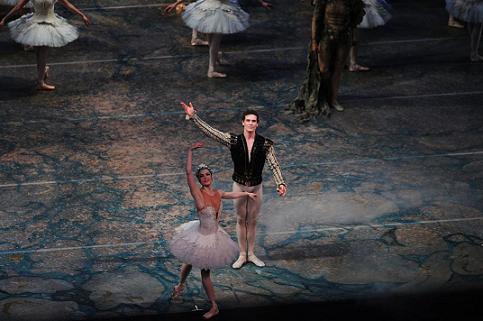
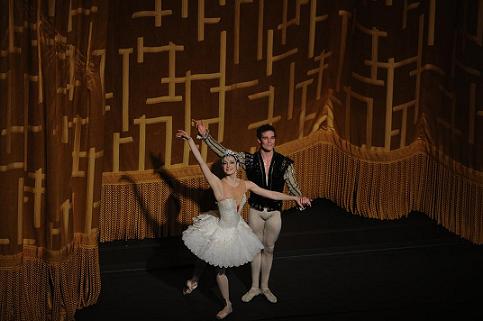
Here are some fabulous curtain call pics from last night’s Swan Lake at ABT. They’re taken by the wonderful Kokyat, and were sent to me by Oberon.

Thanks so much, you guys!

Veronika was divine in the role, as always. She and NYCB’s Sara Mearns are most definitely my favorite Odettes. Cory replaced Marcelo Gomes as Prince Siegfried, who was out due to injury (I don’t think serious; he is still listed for upcoming performances this season). So it was kind of a double replacement since Roberto Bolle was originally supposed to dance the role but he is also out with injury.

This is my first time seeing Cory in the role and I thought he did a fine job. He acted the part very well. I really believed he was a prince. He was very regal yet personable and boyish at the beginning. He conducted himself like royalty but also like a friend to his buddy Benno and to the villagers as they danced for him. He visibly became more angsty as his mother, the queen, told him he must choose a bride, and then he was clearly smitten with Veronika’s swan when he ventured upon her at the lakeside. I believed he was falling in love with her. The way he’d lay his head on her shoulder was so endearing. At one point it even looked like he kissed her neck! And then in the second half I believed he was seduced by her Odile and was devastated when he found out it was all an evil trick. He really acted it perfectly, in my opinion. He was charming, sweet, innocent, taken advantage of, in love, seduced – all of that, and he showed everything clearly.

I think he still has a ways to go as a dancer though. He didn’t have the power of Marcelo or the beautiful shaping of David Hallberg. He does have the potential to make beautiful lines though. I was talking about that with several other balletomanes afterward. But I think he gets nervous and tired. In the first scene his dancing was brilliant. His jumps had great height and were majestic and really emanated “prince.” But as the ballet went on he seemed to wear out a bit, and I can’t be sure since I’ve never had a reason to memorize the male choreography, but it seemed like at points (especially during the Black Swan Pas de Deux in the second half) that he took out some jumps and simplified some of the steps. Which was smart if he was concerned about being too tired to do some of those difficult lifts and assisted turns.

But as a commenter (and new Veronika fan!) just remarked in a comment on one of my previous posts (scroll down to bottom of comments), it’s a women’s ballet anyway. It’s more important that Odette / Odile be compelling. And Veronika never fails with that! She seemed a bit more confident on opening night dancing the Black Swan with Marcelo, but she still seemed pretty trusting here and they partnered well together.

Overall, very good performance!

Oh, also, Jared Matthews replaced Daniil Simkin as Benno. Not sure why. Hopefully Daniil is not injured because I’d really like to see him dance this part. Swan Lake continues through this Saturday. I’ll probably go once more. Maybe more 🙂

DAY OF SLEEPING BEAUTIES: ALINA COJOCARU AND NATALIA OSIPOVA


Alina Cojocaru and Jose Carreno in Sleeping Beauty, photo by Gene Schiavone. (My favorite pose in all of life – no hands fish dive 🙂 )


And Natalia Osipova and David Hallberg as Aurora and Prince Desire, photo by Rosalie O’Connor.

So, I spent another Saturday at Lincoln Center, watching back-to-back Sleeping Beauties. This is probably my least favorite ballet — neither the story nor the choreography really speaks to me – but I was curious to see Alina Cojocaru in the role (it’s supposed to be her best and she’s was guesting for only one day from the Royal Ballet in London), and now that I’m an official Natalia Osipova fanatic, I must see her in everything she’s in.

So, matinee was Cojocaru. I thought overall she was really lovely and did as much as she could with what to me is a bland role. She was fresh, girlish and inquisitive in the first part when she’s meeting all the cavaliers and before she pricks her finger, then is more beatific and ethereal in the vision scene (where Prince Desire, out hunting, envisions her and then is led by the Lilac Fairy to her bed where he’ll kiss and awaken her – I don’t know how many people know the ballet), and then is full of grown-up, sophisticated charm in the third part when she marries the prince. A lot of ballerinas don’t really distinguish between the various stages of the ballet – their Auroras are the same throughout, so I liked that Cojocaru did this.

I just have to say, I’m sorry but for the first part of the Rose Adagio (where four cavaliers present her with roses, at the beginning) I couldn’t stop focusing on her feet.

Continue reading “DAY OF SLEEPING BEAUTIES: ALINA COJOCARU AND NATALIA OSIPOVA”