A SHORT NOTE ON ARTISTIC DIRECTORS AND PROGRAM SELECTIONS


In light of the recent downpour of Tulsa Ballet reviews, many of which critized the selection of dances artistic director Marcello Angelini chose to bring to NY, my friend Christopher Atamian writes a note on programming selection. Chris also talks about Pilobolus, who were recently at the Joyce and big shame on me for missing them (I was recovering from an insanely exciting ballet season — the best EVER in my NY lifetime– and hystericizing over putting the finishing touches on my novel, so please forgive me for failing to cover this most exciting troupe).

I think Chris makes good points about not only the selection of programs but the placement of dances within the programs. I think this is one thing that Judith Jamison of Alvin Ailey is genius at: that company always performs their choreographically richest, most upbeat piece at the end: either Ailey masterpiece Revelations, the versatile hip hop / modern / African combo Love Stories, or Tharp’s wild-ride, The Golden Section. And interestingly, now that I think about it, New York City Ballet usually puts their premieres in the middle of the program, ending with a Balanchine. I definitely think you’d want to put the less established pieces in the middle, and bookend them with the tried and true. I do wonder if we “cranky New Yorkers” in Apollinaire Scherr’s words would have received Tulsa’s program better had Hue’s piece been in the middle or the beginning and the Duato at the end.

Anyway, here is Chris Atamian:

It is presumably the role of the artistic director to choose the particular program or set of dances that a company will perform on any given night.  I don’t know if anyone else has noticed a rather curious phenomenon, but I have attended a few performances of late by some truly fine companies that would have benefited enormously from a more judicious dance selection.  There was of course the Tulsa Ballet’s amazing 1-2 MacMillan-Duato punch at the Joyce which was unfortunately followed by a much weaker This Is Your Life by Young Soon Hue.  Why not start with the Hue piece-if one must include it-and then work up to the Macmillan and Duato? The audience would then walk away with an even stronger impression of this wonderful company.

The week before, I attended all three Pilobolus programs, also at the Joyce.  Program One began with a fine martial arts/capoeira-inspired piece Redline choreographed by Jonathan Wolken.  This was followed by a stunning piece Darkness and Light developed in collaboration with the truly astounding puppeteer Basil Twist involving shadow play and a presentation of nothing less than the cosmos itself, whirring by at breakneck speed in front of a mesmerized audience.  Then after a short break, the company came back with the 1971 work Walklyndon, a cute, short piece which involves the company dancers walking back and forth across the stage and engaging in some wonderfully humorous gags and movement with elements of clowning, physical humor and even a touch of vaudeville perhaps. The members wear hilarious, lively costumes.

I compared the piece elsewhere to a jived up version of Romper Room and I meant that in the best way: it’s humorous and soulful and it gives the audience a good idea of the company’s history and evolution-how else will younger people ever see the early pieces of a company which has now thrived for close to forty years?  My beef is that it came as a complete anticlimax after the Basil Twist piece-you could literally feel the audience deflate: they were waiting for something stellar, fast-paced and acrobatic and instead were presented with a funny and somewhat tame amuse-gueule. (Of course a company that specializes in say baroque dance or a classical ballet company may have an easier time of things programming an evening of performances simply because they have a theoretically more restrained group of works to choose from than a contemporary company…) There are of course many ways to curate a night of performances: by similarity or contrast; by choreographer; by time or setting; by pace or style; etc) No one way is correct per se, one just wishes that the choices were sometimes more judicious or logical.  As with everything in a very difficult field, that is easier said than done and there is always something to be said for experimentation.  And of course this is just one critic’s opinion….others are free to disagree with me!
THE TULSA BALLET AT THE JOYCE: DANCES FROM THE (HEART)LAND


Here is another take on Tulsa, written by my friend, the writer and critic, Christopher Atamian:

The Tulsa Ballet is a wonderful revelation, a group of exquisitely trained dancers with the ability to perform a wide variety of dances from different lexicons.  Indeed, it would be hard to pick two pieces more dissimilar than Kenneth MacMillan’s 1974 Elite Syncopations and Nacho Duato’s 1996 Por Vos Muero.

Macmillan’s fun and lively ballet was performed with evident brio by the Tulsa dancers. If you could survive going blind from Ian’s Spurling’s remarkably bright costumes (think Pucci meets the Electric Kool-Aid Acid Test) and overlook the fact that the stage sometimes looked too busy with too many dancers, then you were in for a real treat. The dancers performed the often eccentric arm movements and angled lifts, as well as the elements of mimicry and farce to perfection: the final group ensemble piece was bold and fast-paced. The “Bethena Waltz” pas-de-deux between Alfonso Martín and Karina Gonzalez  was particularly enjoyable as were sections with the lithe and elegant Kate Oderkirk. I don’t particularly like Joplin’s Ragtime, to which a large part of the ballet is set, so the fact that I enjoyed this piece was all the more to the Tulsa Ballet’s credit-there was something truly odd and exhilarating about the entire presentation.

Duato’s Por Vos Muero is sensuous and romantic whereas Elite Syncopations is more syncopated and humorous; the former is European in tone and musical selection while the latter is set to just about the most American music there is; MacMillan’s ballet is modern in atmosphere while Muero is medieval with elements of postmodern poetic recitation.  Again, the Tulsa dancers could have benefited from some more inspired costuming.  The women’s blue and brown dresses and bustles may have reflected historical Spanish fashion, but at times they also hindered our appreciation of the performers’ movement; the other contrasting semi-naked flesh-colored costumes seemed flimsy.  Por Vos Muero is set to exquisite 15th and 16th century Spanish music and illustrates a 16th century poem by Garcilosa de Vega, an extended love ode to an unnamed woman read here by the Spanish actor and pop star Miguel Bosé. The movement in Por Vos Muero mixes elements of Spanish court dance with a contemporary idiom developed by Duato which includes two-footed jumps, circular gestures of arms and legs, and the use of masks in one scene. When the male dancers come out in capes swinging incense censers, the entire theater becomes a dreamlike dominion, an oil painting come exquisitely to life. The dancers all acquitted themselves beautifully. Alfonso Martín, Karina Gonzalez and Ricardo Graziano were particularly stunning. The former two are powerful dancers that ally strength, grace and speed.

The last verses of Por Vos Muero are a stirring avowal of the heart:


I confess to owing all that I have to you

For you I was born, for you I am alive

For you I have to die, and for you I die.

By the time the two Tulsa dancers rush to the back of the stage and pose against a black background some of the audience members are also ready to symbolically die from pleasure, if not love.

As an endnote, along with a few other critics I was also disappointed by the final work, Korean choreographer Young Soon Hue’s This Is Your Life.  The piece begins with a staging of the 50’s TV show of the same name. After briefly being introduced to the show’s characters, the audience is treated to small vignettes illustrating their lives-the yearnings of their hearts and minds.  The actual dancing is quite good and some of the choreography engaging, but the piece feels disjointed and bland; at other times it looks like a strange mixture of Hairspray, Grease and West Side Story, without the excitement of any of the three. And yes, the orange-haired ridiculously effeminate hairdresser does border on the offensive. In fact many of the characters come off as stereotypes-the Chinese boy who wanted to be an actor but whose parents forced him to go into business; the girl with the Casanova boyfriend who must also be a bit short on self-respect, etc… More puzzling though, why the artistic director chose this particular piece to follow on the (literal!) heels of such fine works by MacMillan and Duato.  But no matter-the evening was fun, well-danced and enjoyable.  We hope to see the Tulsa Ballet again at the Joyce next summer.

HEDWIG DANCES, AUDIENCE MEMBERS SIT BACK AND ENJOY


.

Reviewed by Christopher Atamian

Jan Bartoszek’s Hedwig Dances arrived in New York this week via Chicago, where the company is based, and Havana, where four of the six dancers apparently hail from.  We’re happy they did.  Friday night at the Joyce Soho Hedwig presented three relatively short, lovely dances from three different choreographers: Bartoszek, Andrea Miller and Marianela Boan.  If you know nothing about contemporary dance, this trio-and the dancers performing them-provides a good sampler mixing styles and rhythms while demonstrating a deep seriousness of purpose, a hieratic, almost devotional aura and an evident passion for their work throughout.

In Bartoszek’s Night Blooming Jasmine, the six Hedwig dancers (Victor Alexander, Alitra Cartman, Justin Deschamps, Maray Gutierrez, Jessie Gutierrez and Michel Rodriguez) perform in summery cotton pants and shirts, moving around the stage with a lovely lightness of being reminiscent at times of Buddhist monks praying, at others of Christ-like crucifixions, as they recreate the movements and activities of the night (nb:the jasmine releases its scent after dusk…) One wouldn’t necessarily know that this is what the dance represents and it doesn’t matter: the movement vocabulary is original, varied and simply elegant.

Andrea Miller’s Dust, dedicated to her departed stepfather Jack, is ostensibly about mortality, loss and perhaps even trust.  Michel “Chino” Rodriguez and Deschamps run in a circle, push and pull off and onto each other, sometimes covering each others’ eyes as they bound forward, for the better part of eleven minutes. It’s an abstract piece, reminiscent of early modern improvisational work. Set to Arvo Pärt’s lovely and sad Fratres it hits just the right note. I have been watching Miller’s work since her student days at Juilliard and at her own company Gallim Dance, and this is perhaps my favorite piece of hers to date: simple, unpretentious, and level-in a word, mature.

Marianela Boan who choreographed the final piece, Stampede, with original score by Christian Cherry also works with improvisation, letting her dancers innovate as they go.  They negotiate space in and around yellow and black slashed crowd control ropes, moving them around the stage and changing their geometric configurations. The piece begins with Maray Gutierrez slipping in and out, under and over the ropes that are arranged in a boxing ring formation, until the robust and very macho Victor Alexander picks her up and literally sweeps her off her feet.  Some of the rope work is reminiscent of (rhythmic) gymnastics.  As the dancers negotiate each other, the ropes and imaginary crowd members, the dance becomes a metaphor for negotiating and overcoming life’s abstract obstacles as well. It’s a lovely piece and a lovely dance company.

Bartoszek held a Q & A after the Friday performance with her dancers. Both choreographer and performers displayed an infectious charm and good humor which counts for something, as well. We hope to see them at the Joyce again soon, next time in Chelsea…

Nota bene: Night Blooming Jasmine received its New York Premiere on Friday, Stampede and Dust their World Premieres. Victor Alexander technically hails from Pinar del Rio, not La Havana.  Marianela Boan is also Cubana!

THE POPULARITY OF KEIGWIN + COMPANY


During ballet season my time is so limited and I just can’t attend everything I want to. And so, regrettably, I had to miss Keigwin + Company at the Joyce last week. But my friend, writer Christopher Atamian, agreed to attend for me and write a review here. I’m a big fan of Larry Keigwin, but unfortunately my friend didn’t like the performance very much! Oh well, such is life… Anyway, I’m very thankful and flattered that professional writers want to write for my blog. I do want to make clear, though, the views expressed herein are Mr. Atamian’s and not my own. I’ve seen all of the pieces reviewed here except Triptych, which is new, and I’ve really liked all of them. I also think diversity of opinion and the dialog it can engender is very important to the arts. Here is Mr. Atamian’s review.

Continue reading “THE POPULARITY OF KEIGWIN + COMPANY”

MICHAEL TO THE RESCUE!: TERESA REICHLEN, JANIE TAYLOR AND TYLER ANGLE STAND OUT IN FINAL MIDSUMMER CAST


Yesterday was stressful. Had to make a hard hard choice: whether to spend the matinee at New York City Ballet watching three of my favorite dancers — Gonzalo Garcia, Tyler Angle, and Janie Taylor — make their debuts in Midsummer Night’s Dream, or at American Ballet Theater seeing Hee Seo debut as the title character in La Sylphide, with one of my favorite ABT dancers, David Hallberg opposite her. (Review coming very soon, along with earlier Sylphide cast, and two Midsummer casts — yes, I’m behind behind behind!)

I’d actually contemplated running back and forth across the Plaza, like I know some have done in times past, but the running times for the first acts were totally different and there was no way I was going to be able to see Gonzalo’s Oberon in Midsummer and then make it to the Met in time for David and Hee in the first act of Sylphide. So, I chose my David, and the lovely debuting Hee. Ever so thankfully I talked my friend, author Michael Northrop, into covering the goings on across the Plaza.

p6202228

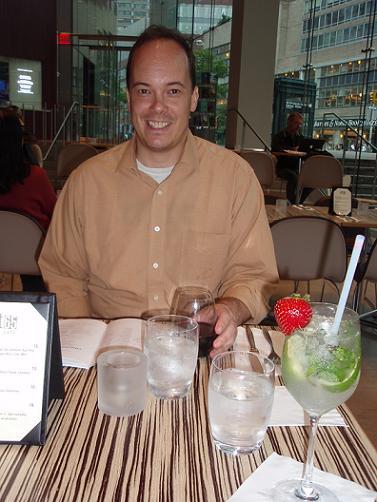
Afterwards, over drinks and food at the Alice Tully Hall Cafe (they have half-priced specialty drinks from 3-6 pm! And not watered-down at all! I nearly passed out after two sips of that mojito in front of me 🙂 ), he told me that Gonzalo did just fine with that crazy high-flying scherzo for Oberon in the first act (I knew he would!), and that he really liked Teresa Reichlin as Titania and Janie and Tyler in the second act divertissement, which received a lot of applause, which I can just imagine! He also agreed to write a little review, which I’ll post in a minute. (If you don’t know the story of Midsummer, read about it here — Balanchine pretty closely follows the Shakespeare).

p62022292

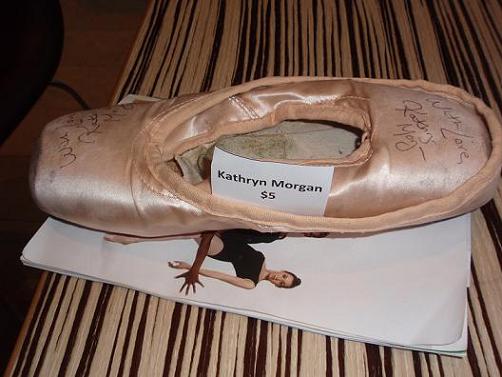
But first, it being Michael’s last day at NYCB this season, he browsed the gift shop, and ended up with a pair of Kathryn Morgan toe shoes. He told me (and, apparently the amused gift shop attendant) he figured she wasn’t going to be $5 for much longer 🙂 I guess their shoes cost a certain amount according to their status: principal ballerina shoes are $30, soloists are $15 and corps members $5. I didn’t know all this. I’ve never wandered over to the toe shoes section. I initially wondered why, then realized, oh, my favorite dancers don’t usually wear toe shoes. Sorry to be lewd, honestly, but I then couldn’t help but wonder — just because of that crazy strong mojito that nearly put me on the floor — why they don’t sell other kinds of used dancewear that my favorites *do* wear, alongside the toe shoes. Sorry! But can you imagine? Total alternate universe.

Anyway, here is Michael’s review:

At Dunkin’ Donuts, they sell munchkins 25 at a time. That’s about how many you get at New York City Ballet’s A Midsummer Night’s Dream, as well. The squadron of young dancers from SAB added a nice dose of fun and energy to a matinee that already had plenty of both on Saturday.

Daniel Ulbricht didn’t dance the role of Puck, so instead of gravity-defying antics, we just got antics. Corps member Troy Schumacher was announced as a late sub for soloist Sean Suozzi in the role, and there were some disappointed Ohhs around me. The thought: We’re getting the third string. Schumacher did an excellent job, though. He moved with an appropriately sprightly energy and showed a nice touch with the comedic moments. When he realized his magical matchmaking mistake, you could almost hear the “D’oh!”

Teresa Reichlen was fantastic as Titania, displaying just the right balance of regal, playful, and otherworldly for a fairy queen. And Robert Fairchild, a very busy man this season, excelled in yet another role (albeit in a ridiculous Prince Valiant costume) as Lysander. His put-upon love interest was once again Sterling Hyltin. The leads from NYCB’s Romeo + Juliet both showed they can handle Shakespeare’s comedy as well as his tragedy. Hyltin, for example, dialed up a slightly manic quality to great effect.

And Balanchine’s choreography tells the entire story in Act I, leaving Act II free for the divertissement. A quick wedding march and then Janie Taylor and Tyler Angle were center stage. They brought down the house.

Angle is a strong presence, but he defers so gracefully and lifts so effortlessly that he never soaks up more than his share of the spotlight. I noticed that when he partnered Tiler Peck in Mercurial Manoeuvres, and again on Saturday. Janie Taylor was both a delicate vision and a physical wonder, sometimes in turns, sometimes simultaneously. It’s a complete oxymoron in print, but she pulled it off onstage. Amazing.

The final scene was especially poignant for me, because I knew this was the last performance I’d see this season. Fireflies flickered around Puck against the dark backdrop of, yes, a midsummer night. It was the kind of night you don’t want to end, and the kind of season.

And here is Oberon’s (I mean Philip’s) review of the same cast.

And this just in! Another review (I’m interested in what he says of Gonzalo Garcia) — the one (by a pro critic who doesn’t say things are good when they’re not, and with great detail and specificity) that I’ve been waiting for 🙂 I knew Gonzalo’d nail it! I knew he’d be brilliant! I knew it!


GUEST BLOGGER CHRIS ATAMIAN REVIEWS GROUNDWORKS

My first guest blogger!

Christopher Atamian, who I met recently while watching Complexions at the Joyce, is a very accomplished arts writer. He writes regularly for Dance Magazine, and for the Daily Candy-esque (but far better!) arts e-letter eCognoscente (which he co-founded). He’s also the former dance critic for the New York Press and has written for the New York Times, among other leading publications. Chris has been kind enough to write a full review of the GroundWorks performance I posted about very briefly.

(I don’t know what kind of “dance publication” this is, by the way. Can’t figure it out.) Anyway, here’s the review:

Contemporary Dance Theater…Created from the Ground Up…in Cleveland, no less…Who knew? (Or: The Little Dance Company That Could)

Or if this were a “mainstream dance publication”: GroundWorks DanceTheater brought its unique mixture of subtle humor, intelligent choreography, and vigorous movement to the West End Theater, March 5-9, 2009.

By Christopher Atamian

Less is sometimes more, indeed. In the wonderfully intimate and strangely proportioned West End Theater (i.e. thirty-foot domed ceilings and decorative arches overlooking a mere 84 seats and a semi-circular dance floor the size of my back pocket), the Cleveland-based company presented a charming and sometimes clever New York début—think classically-influenced movement set to contemporary and new music. It’s hard to judge five dancers on a shoestring budget making what was by all accounts remarkable use of their tiny dance area. The company members are obviously quite talented—one wonders what their performances would look like with more elaborate sets and costumes and a few more dancers? Could GroundWorks evolve into a more important presence in the dance world?

Continue reading “GUEST BLOGGER CHRIS ATAMIAN REVIEWS GROUNDWORKS”