FRANCIS MASON, DANCE WRITER, DIES AT 88

I’m so sad to hear of this. I didn’t really know Mr. Mason, but over the last couple of years, he’s been seated next to me at many dance performances. I knew who he was because so many critics would stop by our row and greet him. He was the most lively man. I remember sitting next to him last year when then new ABT wunderkind Daniil Simkin danced Flames of Paris with Sarah Lane, and after Simkin completed an astounding series of barrel turns, Mr. Mason whistled, raised his eyebrows and shook his head, letting out a little laugh. I remember thinking, okay if this man, who’s apparently been around a while and seen a lot, is impressed by this guy, Simkin is officially impressive.

I also remember seeing Mr. Mason not long ago at a Cedar Lake installation performance. A young woman slid off our bench and began stretching and several of us kind of looked at each other, obviously wondering whether she was a dancer and part of the performance but too shy to ask. Mr. Mason took one look at her, and got up and called out to her, “Are you part of the performance?” (She wasn’t, she laughed.)

I feel like I just saw him and he looked perfectly healthy, although with elderly people I guess you never know — it can be any little thing that causes death. I’m actually shocked he was 88; I thought he was in his early 70s — probably because he was so active and sprightly.

And active he was, as you can see from the obituaries. I was just recently introduced to the excellent critical journal he edited, Ballet Review, one of the many things he did.

It’s just so sad thinking that you just saw the person and, now, that’s going to be the last time you ever saw them. I thought the same with Clive Barnes.

Here is James Wolcott’s obituary, and here Alastair Macaulay’s.

DISGRACE: IT’S JOHN MALKOVICH WHO DESERVES A NOBEL


Oh how I wish Anthony Lane would have reviewed this film; unfortunately the New Yorker didn’t assign him. I always value his insights, particularly on movies I find disturbing. And I found this one so not because of the subject matter (race and gender-based violence in post-apartheid South Africa), but because of the way men, women, blacks and whites are all depicted, the extremely outmoded essentialist terms in which women and men are portrayed (ie: I am man, therefore I desire to rape women; I am woman therefore I love children and won’t have an abortion, etc. etc.)

The film is based on the Booker-prize-winning novel of the same name by Nobel-winning writer, J.M. Coetzee, a white man from South Africa who currently lives in Australia.

David Lurie (Malkovich) is a 52-year-old white professor at a Cape Town university who’s attracted to younger biracial women. As the movie opens, we see him soliciting a prostitute who fits such description, and shortly thereafter he becomes taken with one of his students, Melanie, and the two begin having an affair. It’s not clear how Melanie feels about him though. She seems completely dead during their sex scenes, and whenever she leaves his house, she always looks sad and violated. But it’s not like he’s raping her; she’s there of her own volition and she’s an adult and went into the affair knowingly. Nor is it made clear that he’s committing quid pro quo sexual harrassment — telling her he’ll fail her if she doesn’t do as he pleases; in fact it’s later revealed that the opposite is true — he passes her even though she’s truant and fails to show up for exams.

Eventually her young black boyfriend finds out about them and exposes Lurie. Students drop his classes and the disciplinary committee calls him for a hearing. Lurie seems to agree with the committee that he’s done something wrong (though it’s not clear to me what this is — again, she’s an adult and the sex seems consensual), but won’t defend himself because he can’t apologize for what he considers his (male) “nature.” The disciplinary committee dismisses him from his post and he moves to the country, into his daughter’s farmhouse.

His daughter, Lucy, is a lesbian whose lover has just left her. She shares the farm with a black man, Petrus – -he lives not in the main house but in a shed — who’s worked part of the land, installing pipelines and a well, and who, because of his labor, now owns part of the land. I wish the film had done more to educate viewers about this practice. It’s not clear, in post-apartheid S.A., whether Lucy is trying to help Petrus (she’s clearly liberal-minded and believes in righting historical wrongs) or whether this is the way the new system works to enable black South Africans to gain land ownership. In any event, Petrus is depicted early on as someone who’s up to no good. He’s nearly drooling at the mouth when we (and Lurie) first meet him (like a dog, I guess, since that seems to be the main — totally overdone — metaphor here).

So the dogs: Lucy houses several out back in a cage, partly for humane purposes — apparently there’s an over-population of dogs in S.A. and Lucy’s friends with a female veterinary nurse who catches them, tries to adopt them out and then euthanizes them when she can’t — and partly for protection. We’re made aware up front it’s very dangerous out on the farm — there’s been a lot of pillagings. She also keeps a loaded rifle in the house. At one point, she and Lurie are walking one of the dogs and Lurie tells her dogs are “creatures of habit.” He tells her a story of his childhood neighbor’s dog. The dog (a male) would always go nuts when the bitch next door was in heat. He’d dig holes in the yard, tear things up, etc. — create chaos basically. So his owner would punish him every time this happened. Eventually, the minute the female dog went into heat, the male dog would crouch and whine and walk around with his tail between his legs. The horror of this Pavlovian game, Lurie says, is that the dog eventually learned to deny his own nature. This is why, Lurie says, he shouldn’t be expected to deny his own nature (screwing around with young women, presumably to their detriment).

One day, Lucy and Lurie return to the farm after walking some of the dogs, to find three young black men taunting the caged dogs. Lucy approaches them and asks them to stop. They give her a story about one of the boys being stranded and ask if he can come inside and use her phone. She cages the dogs she’s walked and tells him yes; he alone can come inside. This is a ruse and after she’s caged her dogs, the boys drag her and Lurie into the house, gang rape her, lock Lurie in the bathroom where they douse him with gasoline and set him on fire, and use Lucy’s gun to shoot and kill all of the caged dogs. They also loot the place and cart off Lucy’s possessions in Lurie’s car. Lurie manages to save himself with toilet water but he’s still badly burned.

Lurie tries to get Lucy to go to police but for some nonsensical reason she won’t. Ludicrously, she tells him he doesn’t know what happened because he didn’t witness “the crime” — ie, he wasn’t in her bedroom, which, ridiculously, he doesn’t argue with. Her friend echoes her — he “wasn’t there” during “the crime.” He tells her he’d like to talk to the police, but she tells him there’s no information he could give them that she can’t, which he also inexplicably doesn’t argue with.

So a man is bludgeoned and set on fire and almost killed, but he isn’t the victim of a crime? He sees the attackers as they kill the dogs and pour gasoline on him, then throw a match at him, while Lucy is still in the bedroom, but he has “no information” of “the crime” that she doesn’t have?

Sadly, there are still parts of the world where women are considered male property, and therefore her rape is seen as the worst possible thing that could ever happen to her (or her “owners”). Worse than being set on fire. Worse than being shot and killed. I find it beyond shocking that the rape is seen as the only crime here.

It turns out Lucy is pregnant with the child of one of the rapists. Lurie tries to get her to have an abortion but she responds with, “I’m a woman. I don’t hate children because of where they came from.”

Petrus, who was suspiciously missing during the time of the break-in and whom Lurie suspects of having set the whole thing up so that he could scare Lucy away and own the farm himself, returns to the farm, with a new wife, and throws a party in the shed. At this party, Lucy and Lurie discover that one of the boys who raped her is the son of Petrus’s new wife. Lurie wants to call the police but Lucy forbids him from doing so, saying she needs to get along with these people since they’re now co-owners of the farm.

Lurie goes to talk to Petrus. Petrus insists his new son is not one of the rapists, but tells Lurie because of what’s happened, he would still make him marry Lucy but for the fact that he is too young for her. Petrus then tells Lurie he will marry Lucy himself (I don’t know if the filmmakers forgot that Petrus is already married or whether in S.A. bigamy is legal). Lurie delivers this message to Lucy and she accepts Petrus’s marriage proposal. Lurie thinks she is completely nuts (as does most of the audience, I’d venture to say) and tries to plead with her but to no avail.

Eventually, through all of this trauma, Lurie realizes the wrongness of his ways (because, apparently, in this world, rape is equal to sex with prostitutes and consensual sex with adults). He visits the father of the student he seduced to apologize. It’s a testament to Malkovich’s enormous talents that this climactic scene actually works, based in nonsense though it is since he’s really done nothing wrong to this supposedly full-grown woman.

Lurie begins having an affair with Lucy’s friend, the humane euthanizer, and helps her put the dogs down. In the second climactic moment, Lurie sacrifices his favorite dog in order to show that he’s finally has decided to disavow his own male / dog “nature.”

By the end of the movie, Lurie has learned to accept his daughter and her pregancy. In the last shot, the camera slowly pans across the land (like in Howard’s End) to reveal the entire farm. The bright new house Petrus has built himself is a marked contrast from the shabby, broken home housing Lucy. So, through rape and pillage, black South Africans have “taken over.”

The biggest problem with the movie (apart from the bad metaphors, the infantalizing of women and the equating of sex with rape) is that all the black South Africans are portrayed either as evil or easily taken advantage of. I’m sure it can be very dangerous for whites on those farms, particularly for women living alone, and I’m sure there are many rapes. But the film doesn’t present the perspective of any of the black South Africans, the historical oppression, the conditions creating the severe inequality that have led to such hatred and violence. The film is one-sided and in my mind comes across as feeding into racist stereotypes.

The film’s only redeeming quality, to me (apart from some beautiful shots of South Africa), is Malkovich, who — I have no idea how — was able to make his way through all the aforementioned problems and create a truly sympathetic, memorable portrait of this man. He always does that though, no matter how unlikeable the character. The man is a genius.

Has anyone else seen the movie? Or read the book? I have the book, but haven’t gotten around to reading it yet. I didn’t like Diary of a Bad Year and so was putting it off but I probably should now because I have a feeling there was a lot left out. I hope there was anyway.

 

ARUNAS BIZOKAS & KATUSHA DEMIDOVA MAKE HISTORY


By bringing home the World Standard trophy from Tokyo this weekend. First time a U.S. couple has ever won the World Standard championship. Now if we could only return to the MGM era, we would have a new Fred and Ginger and the whole world could enjoy them as much as we ballroom fans do.


Also at the championship, Jonathan Wilkins and Hazel Newberry announced their retirement. No no NO, it can’t be Mr. Wilkins!!! Whatever are we going to do without our Ralph Fiennes of the ballroom 🙁

Reigning champs Mirko Gozzoli and Alessia Betti of Italy didn’t seem to compete, though Dance Beat doesn’t say why.

Photos by Andrew Miller, taken from Dance Beat.

THE WILIS ARE REAL: THE DANCING PLAGUE OF 1518

I was browsing around in the bookstore yesterday and spotted this. Apparently in the summer of 1518, in Strasbourg, one woman began dancing and couldn’t stop. This “hysteria” spread until a great number of people had literally danced themselves to death. It’s referred to as the dancing plague, which I’d never heard of before. The book is written by medical historian John Waller, and has received pretty good reviews. I’m definitely going to read it.

Of course it reminded me of the wilis of Giselle and made me think, though we moderns love to roll our eyes at some of these “silly” ballet characters — girls being turned into swans, maiden ghosts forcing the men who snubbed them in life to dance to their deaths — it’s interesting to explore their bases in history, myth and literature. The ideas usually came from somewhere.

FALL FOR DANCE ’09 PROGRAM 2

Highlights of Program 2, which I saw last night, were Morphoses and Tangueros Del Sur.


I was wandering around the lounge beforehand and ran into a couple of old friends from my first ballroom studio, Paul Pellicoro’s Dancesport. Always fun to catch up with old friends — especially since one of them belonged to my swing team and I shared with her my first ever lovely competition experience. Anyway, little did we know then, but one of our former tango teachers was in the show! Ivan Terrazas! I was so proud; he was absolutely electrifying (along with the rest of the Tangueros)!

Sir Alastair had gone on and on about this troupe — led by Natalia Hills and Gabriel Misse — when he saw them at the Vail Dance festival recently, and rightly so! Oh my gosh, that was the most astounding tango I’ve ever seen! The piece was called Romper el Piso and was mainly tango but with some footwork and rhythms from other Latin dances like Samba and a little bit of Cha Cha thrown in — but all danced with tango aesthetics. There were duos and trios, both mixed-sex and same-sex. The choreography was original and enlightening and the dancing so polished, precise, lightning fast, sharp, passionate, everything you can imagine in a tango, in a dance. I really hope some of you can see them tonight.

Afterward, my friend Alyssa and I hung out in the lounge. When we left we were a little tipsy (c’mon, the wine is $2!) and I kind of tripped over nothing on the way out, causing us to both burst out laughing. One of the cute tango guys said to us, “tranquilo, tranquilo!” but very flirtatiously 🙂

All photos above by Carlos Furman, courtesy of City Center.


The other knockout performance of the night — for me — was Softly As I Leave  You, choreographed by Lightfoot Leon and performed by the stunning Drew Jacoby, who is now one of my favorite female dancers (Alyssa’s as well) and Rubinald Pronk, performing on behalf of Morphoses. Christopher Wheeldon was in the audience and he got mobbed during intermission 🙂

It was the best thing I have ever seen by Morphoses — more Lightfoot Leon, Mr. Wheeldon, please please!

It’s set to a combo of music by Bach and Arvo Part (including the Part section all New Yorkers are now so familiar with, from Wheeldon’s After the Rain pdd), and begins with the statuesque Ms. Jacoby standing inside a box opening out to the audience, contorting herself to fit within its confines, struggling to break free, making the most mesmerizing shapes with her body. Then, in the second movement, Mr. Pronk comes out and they dance an, at times somber, at times peaceful, duet. Then, in the third (with the After the Rain music), they continue dancing together, but now come to a closure; he ends up in the box, she slowly walks behind it, disappearing offstage.

To me, this was about the human need for connection or the struggle between wanting to be alone and wanting to be with another. Alyssa saw it as someone being held back by something and struggling to overcome that; she was moved by the change of positions between the two dancers. Or, as the title suggests, I guess it can be about a woman leaving a man. The most compelling of these abstract duets Wheeldon is known for (either choreographing himself or including in his Morphoses programs) I think allow for that kind of interpretative range, while giving the viewer enough that they can really latch onto something and let their imaginations go with it.

The above photo of Jacoby and Pronk, by Erin Baiano (courtesy of City Center), is not from this piece.

Also on Program 2 was Martha Graham’s sweet ode to spiritual and human love, Diversion of Angels. Nice to see some of the Graham dancers, who are beginning to become familiar to me, again.

And closing the program was Noces by Dutch choreographer Stijn Celis, performed by Les Grand Ballets Canadiens de Montreal.

1

2

32

This was Program 2’s tribute to Ballets Russes. Branislava choreographed the original Les Noces, and there have been several versions since (Jerome Robbins’, Pascal Rioult’s). It was danced to Stravinsky’s choral score (which he created for Ballets Russes), but with some remixing too (I think). The music seemed to be longer, and there seemed to be some German language in the score, which sounded like it was from a Broadway show like Cabaret (but not Cabaret exactly). The program doesn’t seem to note any addition to the Stravinsky though so I may well have been hallucinating.

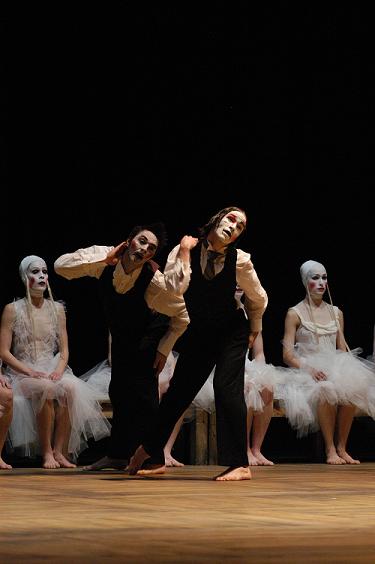
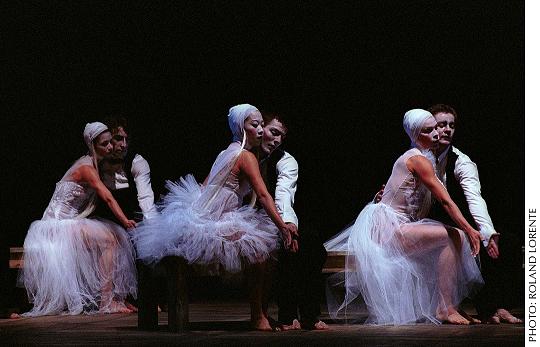
The dance (and the Stravinsky music) depicts a Russian peasant wedding and it’s very Rite of Spring-like — more focused on the sexual rite of passage, the consummation, and the rather forced marriage rituals than love or anything weddings evoke for us today. In the Celis (as well as Rioult) version, there isn’t a single man and woman but a group of men and women undergoing the marriage ceremony. The women here are dressed in sexy white bridesgowns, the skirts short and much of the material see-through mesh. The women have white-powdered, very made-up faces that look almost clownish, as do the men, who are dressed in tuxes. Alyssa thought their make-up looked zombie-like, like they’re walking dead. The movement is very frenetic, with lots of thrashing about, and the group consummation scene would have been comical, as the women bounced around on the men’s laps, if it wasn’t so violent.

I’ll be interested to see what the critics and other viewers say of this –whether it gets dismissed as gaudy “Eurotrash” or whether people take it more seriously as a commentary on ritual (or something else). I do think it worked as an homage to Ballets Russes because from what I know of that legendary company, they seemed to have been very cutting-edge, going far out to push ballet to its extremes, even if it induced a lot of eye rolling.

Big kudos to the dancers though for performing that long, near-continuous frenetic movement.

Photos of Les Grands Ballets Canadiens de Montreal courtesy of City Center.

FALL FOR DANCE ’09 PROGRAM 1


I’m on a tight schedule with my book rewrites, but here are some of the highlights of the Fall For Dance Festival (Program 1) thus far.

It’s always a delight to see Paul Taylor’s hilarious Offenbach Overtures with the would-be ballet dancers tripping all over each other, the muscly men first dueling then making up and swinging their way offstage in each others’ arms, the female cabaret dancers comically warring for attention. I was happy to see SLSG favorite Michael Apuzzo in my cast (he’s not in the photo above unfortunately, as he wasn’t in the first night’s cast) — he’s always very dramatic, full of character, and I noticed he had the highest, most straight-legged jetes as he and the other guys went sailing offstage at one point.

I was at this performance with my friend, Michael, and we hung out for a while in the lounge afterward (where they have $2 wine and beer and $4-$5 plates of food). I’m very shy, but I always seem to have really outgoing friends, and Michael went up to a woman with a bouquet and asked her what it was for — something along those lines. It turned out she was in Paul Taylor, and once I knew that, I recognized her as the striking Parisa Khobdeh, Michael’s partner (Michael Apuzzo that is, and partner in Offenbach that is). I then realized a bunch of the Paul Taylor dancers were hanging out in the lounge (except for that Apuzzo!) — so the FFD brochures  are not lying about the “come mingle with the dancers” parts of the adverts for the post-performance parties in the lounge.


Anyway, the other highlight of Program 1 was B/olero performed by the highly respected Israeli company, Batsheva, choreographed by their artistic director, Ohad Naharin, and set to the familiar Maurice Ravel music. Except this was a remix — at times the music would be slowed so that it would sound somewhat warped. The music would also veer from speaker to speaker, so it was like the sound was traveling around the auditorium.

Well, there are many Boleros around and Naharin’s was a more minimalist one in terms of the action, but not the emotion. It was a duet for two women dressed in black dresses. At times their movement was basic, at times still, at times spastic and chaotic, at times sexual and almost kinky, and at many times hypnotic. A common motif was the swinging back and forth of the arms, mechanically, like the arms of a clock, the rest of the body still. I always feel with his work that I have to see it several times to get the full effect, and I wished I could have seen this one again.


In celebration of the centennial of Ballets Russes, every night at FFD one company performs a piece on honor of that legendary company. Program 1’s was the Boston Ballet’s rendition of Nijinksy’s original Afternoon of a Faun. This was a real treat for me, as I’d never seen the Nijinsky version live and in full before. I’d only ever seen it on tape or, if I remember correctly, only the faun version (without the nymphs) performed by Royal Ballet star Johan Kobborg with the Kings of Dance.

Anyway, Nijinsky’s version is from 1912 and you can really imagine how shocking it must have been in its day, with the faun so overtly sexual, so taken with the nymphs, he ends up masturbating with a cloth left by one, which he recovers, takes up to his little rock perch, places it on the ground and begins rubbing his groin into it. You still don’t see much of that today onstage (at least not in ballet), so I think it’s still somewhat risque. And yet the faun, at least as portrayed by Altankhuyag Dugaraa, is so sweet and so endearing, and you feel for him after those nymphs tease him and you’re happy for him when he retrieves that cloth. I would so love to see a clip of Nijinsky in this. I would also love to see his Rite of Spring some day; I don’t think it’s been performed for eons though, I think because the choreography hasn’t really been preserved, sadly.


And completing Program 1 was Savion Glover, which I wrote about briefly in my previous post.

See the rest of Andrea Mohin’s NY Times slide show of Program 1 here.

NO WAY


I came home from my first night at the Fall For Dance Festival and turned on Jimmy Kimmel before I had a chance to watch my tape of Dancing With the Stars. I honestly thought he was kidding when he announced who was kicked off.

Even though I liked him, I can see Ashley, but Macy? I thought she had a good attitude toward the competition but maybe people interpreted it more as haughtiness? She definitely wasn’t the worst woman Tuesday night, and that’s not what the show’s about anyway. Why vote for the best person on the first night; why not vote for someone you can watch improve? Sucks that she never got to do Latin because I think she would have been a lot better at that than Standard.

I don’t get it at all.

She didn’t end up going on Jimmy Kimmel because, as Jonathan Roberts said, she was too upset, thinking she let her fans down.

Anyway, at least my whole evening didn’t suck:


Fall For Dance last night consisted of four companies, four dances (more about them all later), but my highlight was definitely Savion Glover. I know he’s been on one of the TV shows before — either Dancing With the Stars or So You Think You Can Dance — can’t remember which one. But this was my first time seeing him live and ooooh! You have to see him dance live; there’s nothing like it. This is one of the best dance performances — one of the best performances period — I’ve ever seen. And he’s such a cutie in person and he dances with so much genuine happiness, so much joy. And he’s small — smaller than I thought! Ah, I came out of City Center feeling like I often feel after seeing Alvin Ailey — I just wanted to dance all the way home.

DANCING WITH THE STARS SEASON 9 PREMIERE: THE WOMEN

Very excited to see Baz Luhrmann guest judge next week!


My favorites last night were Kelly Osbourne (and loved that her dad was on and that he became genuinely emotional over her splendid Viennese waltz! — as did her mum), Mya, and Macy Gray. What I really found endearing about Kelly was how blasted hard she obviously worked. She did not look so hot in practice sessions. And she was pretty down on herself. And then she came out there and did that gorgeous waltz with all that poise and polish and grace and watery fluidity. I almost cried for her — and I never watched her show!

I know, I know — overall, young swimsuit model Joanna Krupa was the best — her salsa alone showed that she’s rhythmic and used to moving her hips and, surprisingly her foxtrot showed she could be graceful and even delicate as well — but, I don’t know, I personally don’t find her as endearing as, say Macy. And Joanna’s full of confidence, which may not go down that well with the largely female voting public. I think she’ll be on for a while, but she may be the Sabrina Bryan of this season rather than the Brooke Burke.

I can’t help but love Macy’s ‘this is gonna be fun and I’m gonna work hard but I’m not getting caught up in all the competitive bullshit’ attitude. Love those facial expressions too! The judges were right on when they said she won the audience over with her magnetism. Not so good (I can’t bring myself to say ‘bad’!) as she was, I couldn’t take my eyes off her during that Viennese waltz. And I didn’t realize she was so tall — she’s got several inches on Jonathan Roberts!

I thought Mya was just so fluid in the Viennese waltz, and so killer in the cha cha. I disagree with whatever judge criticized the kick — I thought that kick was mad!

I like Debi Mazur a lot and she obviously isn’t a natural and doesn’t have training, but I want to see her improve. That’s what the show is about — working hard toward a goal and being able to do something you couldn’t before. I think she has the ability to improve. And she’s someone I can relate to and think others probably can too. So I really really hope she’s not the woman to go tonight. Bruno tells her she can’t dance but it doesn’t matter because she has great boobs. These kinds of comments are really not funny but clearly he’s not keen enough to realize that. Interesting how Maks covered Debi’s ears when he said that — I thought he was doing that to be funny but judging by the look on her face, it looked more that she was truly annoyed at Bruno and may haul off and sock him one.

I have to say Melissa Joan Hart didn’t leave much of an impression on me. I can’t really even remember her Viennese waltz to be honest. And I didn’t see her cha cha. Mark was kind of the star of that little routine 🙂 Oh Mark — you’re a hopeless show-off and we will always love you for it…

Kathy Ireland (whom I would never have recognized!) was like Paulina Porizkova all over again. Same problem with the lack of groundedness in the salsa, the bouncing around. Bruno told her there was no “sex,” and without sex there is no salsa. So, according to him, since she didn’t get down on the ground and practically perform a sex act with Tony Dovolani, she didn’t actually salsa. She did much better with the foxtrot I thought, though the judges thought she did only marginally better.

I feel like I shouldn’t be too angry at Bruno or Len for their comments though. It seems the producers have told one to lust all over the women and make as many sex-laced comments as possible and the other to spend the season doing his best impersonation of Dana Carvey’s old SNL character, Grumpy Old Man (or whatever that character was called) and piss on and on about the way no one is adhering to basic ballroom.

I personally thought Dmitry’s Viennese waltz for Mya was choreographically the most engaging routine of the night. Louis van Amstel is a master choreographer too and he’s largely the reason Kelly shined as she did.

Who did I leave out?… Oh, Olympic swimmer Natalie Coughlin. Wow, beautiful arms — particularly in practice. The judges seemed to like her salsa, but I thought it had the same problem as most of the others — not grounded enough and too hop-py. I knew she was going to nail the Standard though — with those feathery arms! — and she did with the foxtrot.

I’m looking forward to tonight — particularly the Patrick Swayze tribute.

Photo of Louis van Amstel and Kelly Osbourne taken from Louis’s DWTS thread.

LEVELS OF NOTHINGNESS STARRING ISABELLA ROSSELLINI

levels-of-nothingness-exh_ph01

levels-of-nothingness-exh_ph02

levels-of-nothingness-exh_ph03

levels-of-nothingness-exh_ph04

Photos above courtesy of the Guggenheim Museum.

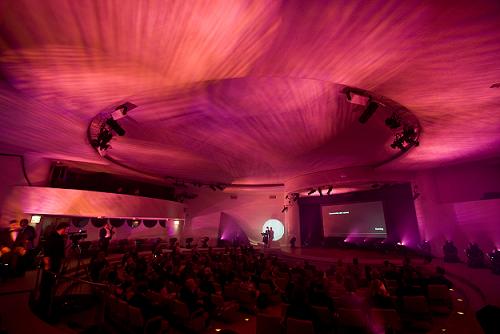
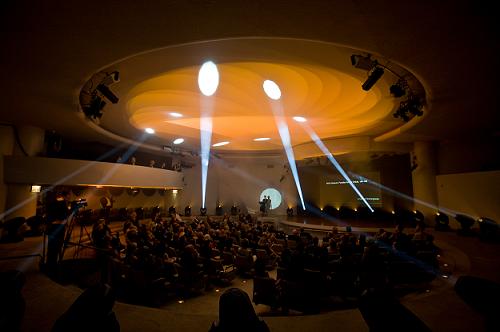
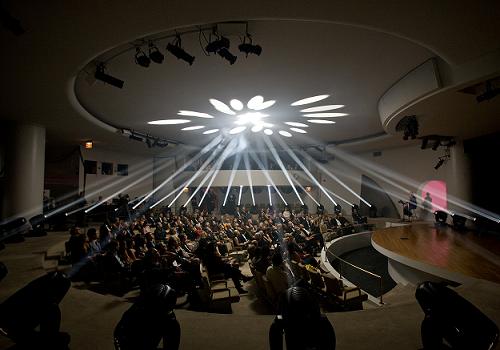
Over the weekend, I went to see a spoken word / light performance by Mexican artist Rafael Lozano-Hemmer called Levels of Nothingness, at the Guggenheim, as part of their Works & Process series. The work was inspired by Kandinsky’s Yellow Sound. (There is currently a large Kandinsky exhibit in the Guggenheim, in celebration of the museum’s 50th anniversary). Wassily Kandinsky is considered the father of abstract art, he used color extensively to evoke inner states, and he believed in the convergence of all art forms — painting, sound, movement. Yellow Sound is basically a compilation of his notes describing his ideas for an theatrical piece or an opera in which color and lighting played a large role.

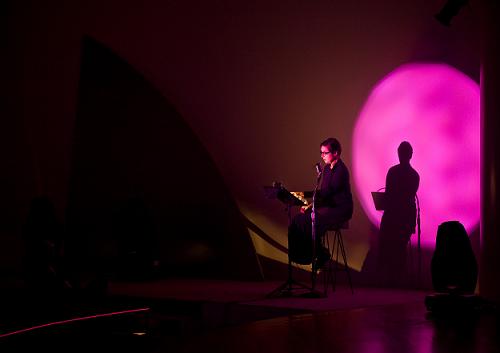
So, starting from that idea, Lozano-Hemmer (and co-writer Brian Massumi) constructed an interactive installation in which a system of lights would respond to spoken words. Actress Isabella Rossellini read the words, which were quotes from various philosophical texts about perception and color (interestingly, all texts were by non-Newtonian thinkers, who believed, in contrast to Newton, that one’s perception of color was subjective.) Basically, a computerized microphone analyzed Rossellini’s voice, taking into account her: pitch, wavelength, amplitude, intensity, speed, accent, intonation, and speech patterns. That information triggered robotic lights (these rather cute little R2D2-looking guys which were set up to surround the stage and perimeter of the auditorium) to create various light effect, such as those used in a rock concert — fly-aways, bump cues, color chases, ballyhoos, builds and flash-throughs — I don’t know what all of those things are but figure there may be theater-people reading who do!

Anyway, the effect was interesting but not really what I was expecting. Go here to see a clip of it; scroll down about halfway through the article until you see the video on the left side — on the video, you can click on the little box in the right-hand corner to enlarge the video to fit your entire computer screen.

It’s very cool to be sure, but it seemed more orchestrated than I was expecting. For example, every time Rossellini began on a new piece of text, she’d wait a few seconds for the machines to all re-adjust and prepare for that segment. So with each text there would be a specific light pattern: a white-based kaleidoscope one on the ceiling, a yellow-based one, a red light would light up behind her and go off and on as her voice stopped and started, sometimes there would be a multiplicity of lights all shining up at the ceiling making circles of light in multiple colors, etc. But they weren’t all happening at once. Each quote was set up to show one kind of pattern and then the lights would blink on and off or move around in the kaleidoscope according to her voice. It’s hard to explain, but watch that video if you want to see what I mean.

Afterward, the audience got to test it, which was fun. The host walked around with a microphone and let various people speak into it, reading from text projected on the back wall. Everyone was behaved and no one did crazy voices or spoke really loudly or anything so the lights were kind of mild as well. What I (and another woman, who asked) really wanted was for several different people to say the exact words side by side to see how the lighting design was different for each voice. But the system wasn’t set up to do that. At one point, Lozano-Hemmer re-read the same text an audience member had just read, and there did seem to be a subtle different in the lights, but I needed to see more of that to compare.

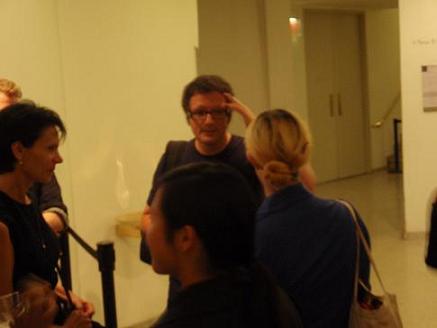
Anyway, after the performances, the Guggenheim hosts these little cocktail hours where you can meet the artists.

p9202312

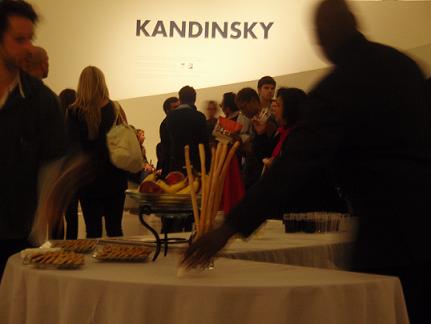
Here is Lozano-Hemmer speaking with some of the attendees. I couldn’t find Rossellini. Sorry so blurry — I hate flashing in people’s faces.

p9202308

Well, anyway, the Guggenheim seems to have replaced their tray-loads of mini sandwiches with these rather long bread sticks. Probably a wise idea to get rid of the mini sandwiches because, as James Wolcott has noted, people go downright mad for those things, nearly killing each other in the stampede toward the food tables. You’d think none of these people eat for a month before a Guggenheim Works & Process event just so they can load up on “free” (if you subtract the $30 you paid for the ticket) little cucumber and mayonnaise squares. Could never figure out what gives with that?

Anyway, the bread sticks are tasty, and surprisingly filling, but when I went to put one to my mouth I realized how blasted long they were — it was like eating a baton. You had to really hold the end of the breadstick out quite a distance from your mouth. It was rather amusing watching all these people standing around with a glass of wine in one hand, holding a bread stick up in the air with another! For a moment they looked like cigarette holders and the whole scene looked a bit Breakfast at Tiffany’s.

WAS THAT MAN BOOBS OR MAN MOVES?: DANCING WITH THE STARS SEASON 9 PREMIERE


Haha! Okay, well after spending much of my evening at the melodramatic (but riveting) Tosca (it was the Metropolitan’s Opera’s opening night gala, with the premiere of a new production of Puccini’s Tosca, by Met newcomer Luc Bondy), it was nice to come home to this rather goofy corny fun – -which is what social dancing mainly is after all! I don’t want to speak too soon, but, to be honest, I wasn’t really looking forward to this season since the last few have been rather blah, but I think with last night’s show, we’re back on track. Lots of characters, some riotously funny, some endearingly sweet, some good dancers, others not so good but serious and hard-working.

For me, the top two (last night was only the men; women compete tonight) were Donny Osmond and, unbelievably, Tom DeLay. I thought DeLay was a natural with the Cha Cha, UNBELIEVABLY! He really nailed it — that slide on the knees, all the faux guitar playing, those awesome New Yorkers, all that hip swaying! The only thing that wasn’t really there were the pelvic rolls. I also thought he was very elegant and polished with the Viennese Waltz and was surprised the judges were hard on him — particularly since none of the guys were that good with VW (except for Aaron). Partner Cheryl seemed annoyed with him in practice though. Well, just so she knows, a lot of people who don’t normally watch this show are watching because of him, so if I were her, I’d snap out of it. She’s been rather short-tempered with her partners lately…

Donny was a total natural – -he nailed both the Foxtrot and the Salsa, which is rare — doing well in both styles of dance I mean. Yeah, I know he has dance training (he “danced as an embryo” I think he said), but still. It’s gonna be a lot o fun watching him dance the season away. And whoa, how much better is he than his sister?!

I also liked Mark (pictured above, with Lacey), the Iron Chef, the martial arts guy. (Sorry, I don’t have all of their last names down yet; too much going on right now in my life; will know them by next week!) I thought his Cha Cha was very good — far from perfect (and he’s doing the dreaded pigeon toes) but he has a natural rhythm and sufficiently loose hips and he clearly knows how to have fun out there and put on a show. But what was he on about with the “man —“? Len accused him of being too martial artsy but having good hips and then he remarked that he’s hiding parts of his body right now, or parts of his dancing, and intends to bring on the “man –” I really thought he said “man moves,” but then Lacey had a rather bemused look on her face and then everyone who quoted him afterward seemed to be saying “man boobs.” Why did he say he was bringing out his “man boobs”? Anyway, quite the character, that one — obviously. I didn’t think his Viennese Waltz was as great — that flexed-footed ronde en l’air almost made me spit out my wine. No flexed feet in rondes en l’air Mark unless you’re trying to be the doll in the Nutcracker.

Okay, I know he’s not popular with the judges, but I totally liked Ashley Hamilton. I think I liked him so because, hello, he was actually a gentleman! I expected a skanky lascivious womanizing perve like his father but no! A total dapper, polished gent! How does a womanizing skank not raise another man to be a womanizing skank? Maybe it’s rebellion — rebellion against one’s parents can take different forms. Hmm. Anyway, I also thought he really looked like Sebastien Marcovici (who we know is not a womanizing skank because Janie would never have any such crap).


Anyway, yeah, Hamilton’s not a natural mover and he has his work cut out for him but I like his personality. I find him endearing and he has a good dance body and I think he can do it if he tries hard. I want him to stay on the show for a while.

Oh poor Chuck, the boxer. Can you say “stiff”? He was seriously nervous during both dances but especially during his first, the Foxtrot. I think he was concentrating very hard, but he needs to loosen up and kind of not think so much.

I thought Aaron (singer, actor) looked stiff as well during his Cha Cha. But he was much better in the Viennese Waltz. Much more polished and very surprisingly smooth. Only thing that wasn’t quite right was it looked like he was literally running at points — particularly during a continuous turn in close handhold. He needs to make it look more like he’s gliding not literally running around in a circle. He didn’t score any points with me when we first met him and he said he was happy Karina’s his teacher because she’s pretty and he wants that. Yeah, that’s definitely what’s important in an instructor.

I thought Louie was so cute! (“I’m small — I’m 5’5, 5’6 on a good day…”) I agree with Len that it’s clear he has no dance training but that he took it very seriously and respected the dance form, trying hard to do all the footwork properly (and nearly succeeding) and be a proper partner. He and Chelsie Hightower looked good together.

And, finally Michael, the footballer who used to be with the Dallas Cowboys, and is Jerry Rice’s former teammate. Cute how he’s all into play competing with Jerry, telling us he just wants to get better scores than Jerry in each of his dances. And he remembers exactly what Jerry got from his first Cha Cha. But it’s clearly all in fun. He’s another one with an endearing personality who I like and want to stay on for a while. He’s not a natural dancer — he’s lacking in grace and polish and form, but he’s got an innate sense of rhythm and he’s used to moving and I think he has the ability to do well. He had some good triple chas in that Cha Cha which I think shows when he really gets going, when he really gets into a groove, he can make it work.

Len annoyed me, for the first time ever I think, or one of the first times. He kept harping on everyone for not doing standard ballroom — Donny’s Foxtrot was too “razz-ma-tazz,” Mark’s was too kung-fu, etc. Well, we know, but it’s only the first week — let the dancers have a first dance that’s not totally out of their territory. And that was totally out of line for him to criticize Louie’s shaggy haircut as not being “ballroom enough.” One’s personal hair style has nothing to do with one’s dance ability and Len should know that. It seemed like he really wanted to put everyone into a box and make them conform to his own non-dance standards. Dance is about freedom of expression. I know he was sort of kidding, but he came across as an old fuddy duddy.

I think of the men Chuck, Ashley and Michael are going to be in the bottom. What do you guys think?