The new Bill T. Jones work inspired by Abraham Lincoln, which I can’t wait to see when it makes its way to New York, premiered over the weekend at the Ravinia Festival in Illinois. Here are three early reviews.

The new Bill T. Jones work inspired by Abraham Lincoln, which I can’t wait to see when it makes its way to New York, premiered over the weekend at the Ravinia Festival in Illinois. Here are three early reviews.
Here’s the big dance number on tonight’s Emmys, choreographed by So You Think You Can Dance’s Tabitha and Napoleon, performed in part by Maks Chmerkovskiy and Karina Smirnoff from Dancing With the Stars. Nice to integrate the two main TV dance shows in this way. But, ah, where have I seen that costume before, Karina?…
Medarethinks Yulia moved that fringe a bit better. Although of course she had more time to dance. I do sometimes wonder if Karina were still competing today whether she’d beat Yulia.
Friday night I went to see Australian choreographer Lucy Guerin’s Corridor at the Baryshnikov Arts Center. I love these more avant garde (for lack of a better term) kinds of dance pieces — where the choreographer clearly has an idea in mind and wants to make you think about it. I seem to see a lot of this kind of work at BAC.
Corridor is about the effects of modern forms of communication on the human body, and the body’s ability to receive and transmit those forms of communication. Guerin said the work was inspired by a scene from Kafka’s The Castle, which was partly about the comings and goings of various people down a long corridor.
Here, there was a long walkway, a corridor that looked a bit like a catwalk, and chairs for the audience were set up on each side. The piece opened with one dancer receiving a call on his cell phone. He was sitting in one of the audience seats so it wasn’t at first clear that he was a performer and this was part of the performance. He sauntered around on the walkway as other dancers, likewise seated, received phone calls as well and followed him onto the walkway. As soon as the audience realized the performance had begun and quieted down, a sharp buzz sounded over the speakers (some of which were seated under our chairs) and the dancers immediately put their cell phones in their pockets, widened their eyes and, as if on command, began making lots of sharp, angular movements. Ambient sound (traffic, construction, chattering voices, chirping birds, etc.) now played over the speakers.
There was so much going on in this piece, which was, unbelievably, less than an hour long, and there were so many different parts to it, it’s almost impossible for me to remember them all (which is one of the things I liked about it). So I’m just going to talk about what I most remember.
At one point, toward the beginning, the dancers broke into pairs. There were three men and three women and each pair (comprised of one man, one woman) stood in three different sections of the corridor. The man of the couple would make various movements — an arm circling above his head, another arm jutting out, bending over sideways, etc. — and the woman standing facing him would follow him. Each man was facing the same direction, each woman was facing each man. At one point, it became clear that the man and woman farthest to the west end of the corridor were the “leaders.” Or rather than man was the leader. The men farther down the corridor kept watching him, and imitating him. Their women followers, who could not see that man since they were facing their own men instead, imitated their man. The more rapidly the first man moved, the crazier and more chaotic and confused was the movement of the other couples, particularly the women who basically were following a man following another man. It was really interesting, and you could see the frustration growing on the faces of the male followers and their women.
Continue reading “LUCY GUERIN’S KAFKAESQUE, FOUCAULDIAN "CORRIDOR"”
I haven’t been watching SYTYCD this season (I don’t watch the auditions anymore), but my friend and former Latin ballroom teacher, Jacob Jason, just posted this on Facebook!!!!!
Knowing how well I like ABT soloist Kristi Boone, photographer Jade Young sent me her new headshot. (He did Marcelo‘s and Veronika‘s as well). I think it’s gorgeous!
Last night In-I, the collaboration between French actress Juliette Binoche and British dancer / choreographer Akram Khan, opened at BAM, and of course I was there. She’s one of my favorite actresses and I’d been wanting to see this since it premiered at Sadlers Wells in London a year ago. New York is the last stop on their tour.
I loved it, despite its imperfections (and I largely agree with Judith Mackrell’s early review). But I loved it, partly because I just love her period, and partly because, for me, it ended up creating a new respect for both interpretive art forms, dance and acting.
This collaboration (Binoche has virtually no dance training and Khan no acting) made me remember back when, what seems like light years ago now, Baryshnikov and Mark Morris founded their company, White Oak Dance Project. For opening night they were collaborating with Yo-Yo Ma and I really wanted to go. I tried to use this as a selling point in convincing my friend, who loved classical music, to go with me. I’ve always had this stupid habit of stating the over-obvious and, in elaborating, I said to her, “Baryshnikov will be dancing and Yo-Yo Ma will be playing the cello.” She burst out laughing. “Well I hope it’s not the other way around!” she said. Then we got to joking around about how entertaining it would be if Yo-Yo Ma danced and Baryshnikov played the cello. I said I’d actually really like to see that. She said she wouldn’t — it may be a fun experiment for them to do in a garage or something, but to put before an audience?…
I still wonder how that would come off — Baryshnikov bending over a cello and Ma jumping around a stage.
Anyway, I thought this collaboration (hard to know what to call it; it was mostly dance with some spoken word –the two talk to each other onstage and address the audience in monologues, so maybe it’s “dance-theater”) was more than an experiment in two artists from different worlds trying on each others’ shoes. It had a storyline; it was about the life of a relationship — from youthful fantasizing evolving into mature passion, getting sick of each others’ bad habits (there’s a very funny scene where he keeps leaving the toilet seat down and getting it all wet when he pees and she wants to kill him over it), fighting, misunderstanding, eventually accepting and even learning to delight in the difficulty of it all, as part of life. I have to say I understood the through-line of the drama through her. She gave the piece its emotional core.
He is a brilliant dancer and I loved watching him move. It was apparent she has very little dance training — she doesn’t have the expansiveness and breadth in her movement or the precision and sharpness of a lifelong professional dancer — but I love her for trying, because I think it shows how blasted hard dance is no matter how hard you work at it (and you can tell she worked very very hard). And I love that she was not a very skilled dancer, the piece was mainly dance, and still so much of what I understood and got out of it was due to her performance.
The best parts I thought were where each performer was in his / her own element. Judith Mackrell (link above) likes the beginning, where Binoche’s character is sitting in a movie theater and sees Khan, he dances about and she becomes infatuated with him. That scene works well because she’s sitting and watching him, while telling the audience how she feels about him, and he’s moving. There’s another scene later on – -my favorite in the whole thing — where they’ve just gotten into a vicious fight. She stomps off behind the back screen and he begins this really riveting solo where he writhes on the ground, gets up and contorts his body, flings arms, head and torso every which way in utter emotional agony, then does a deep back arch, literally bending over backward to please her. About halfway through the solo she walks back out onstage and sees him. As she approaches him, her expression changes; she slowly realizes how much their fight has tormented him and she feels remorse. You can see all that on her face alone. His movement and her facial expression compellingly conveyed each character’s inner turmoil.
There’s another part where he delivers a monologue to the audience. He just stands at the edge of the stage and talks to us, telling us about a youthful romance he had in which he fell in love with a girl who was not the same religion as he. He tells his priest and the priest withdraws a huge knife and holds it against his throat, telling him having the girl means his soul will die and asking him if that’s what he wants. Khan spoke too fast and sometimes jumbled his lines but at one point he started punching the air with his right fist when he spoke in the voice of the priest, and he started pointing shakily toward the audience with his other hand when he talked in what I felt was the inner voice of his boyhood self. Sometimes these motions were back to back — the fist violently but with a dancer’s control punching the air, then the trembling index finger. Once he kind of got into a groove with it, it was really mesmerizing — especially when combined with his extreme sideways leans when confronted with the imaginary knife at the neck. He was expressing himself far better with his arms and neck than with his words and I kind of wished at that point, he would just have had a voice-over do all of his spoken word so that he could focus on using his body to express himself.
Conversely, I kind of wished for her that she didn’t have so much movement so she could have focused on her words and her facial expressions and wordless gestures (actors obviously do use their bodies as instruments of expression, but it’s to create subtext — little ticks that a normal person would do that show that person’s character; totally different from dance). You can tell how hard she worked if you’ve tried to learn dance as an adult. She had several very difficult things — a couple of high lifts, fast travelling chaine turns. You can see how she worked to get those turns right — her spotting was very good and she held her body steady and balanced with her footing while still trying to get sufficient speed. The fact that she was still able to chaine toward him, into him, with meaning, with intention (she often laughed, sometimes playfully, sometimes tauntingly) while focusing on getting difficult movement right was really amazing. But if she didn’t have those crazy spins to contend with in the first place, how much more depth she could have conveyed. And ditto for a lift, where he sits her atop his shoulder and walks along the back screen. She stretches out her arms and closes her eyes and traces the screen with her shoulders and hands, a look of ecstasy crossing her lips. But she has to worry about maintaining position atop his small shoulder, of tightening her muscles so she can hold herself up there, limiting, I felt, how far she could go emotionally.
Anyway, I could think of more things to say but I think I should stop, at least for now — particularly since it’s now evening and my allotted time for me to work on my novel. Suffice it to say, this collaboration really made me think how, similarities aside, fundamentally different the two art forms are, and made me respect each more. I do think dancers could highly benefit from more acting classes because I think for many theater-goers, that’s ultimately what moves them — body movement alone doesn’t always make complete sense. But more on this later…
In-I continues at BAM through September 20th.
Here’s a nice video of clips from the Dancers Responding to AIDS performances, which took place during the Fire Island Dance Festival in July. Watch for Danny around the 1.43 and 3.24 marks. You can also spot Keigwin + Company (in the towels) and members of Cedar Lake Contemporary Ballet (around the 1.38 and 3.11 marks), as well as others whom I didn’t recognize. Anyone recognize the classical ballet dancers? They’re good! What a gorgeous setting.
Video via SYTYCDism.
Speaking of Larry Keigwin: I’d really really really wanted to see this at the Guggenheim — his new piece set to Steve Reich’s Pulitzer-prize-winning score from 2007, Double Sextet. Unfortunately I was horribly sick with a cold-turned sinus infection-turned several days-long TAC attack and just couldn’t make it. Anyway, Keigwin and ballet choreographer Peter Quanz each created dances to the same piece of music. Their creations, which were performed by members of their dance companies, varied greatly, showing the different interpretations and approaches dance artists can take to one piece of music. In addition to the Macaulay review in the NYTimes (which I linked to above), here is fellow blogger Evan’s take (with lots of pictures).
Oh this is so sad. I really thought he was going to beat pancreatic cancer, he’d beaten it for so long already.
Most of the videos of Dirty Dancing (which Twitter reports was the number one trending topic earlier today) have had their YouTube embedding disabled, but go here to see the final scene, which still makes me cry.
On November 2, Swayze was to receive the Rolex Dance Award at America Dances! presented at City Center by Career Transitions for Dancers. He will now receive the award posthumously and there will be a celebration in honor of him that evening.
Several interesting races happening today in New York. The one I’m watching most closely is that for Manhattan District Attorney. I’m personally hoping for Richard Aborn, who takes a more preventative than punitive approach to crime, advocating investing in after-school programs for at-risk kids, crackdowns on interstate gun trafficking and implementing gun buyback programs in order to decrease the number of illegal guns on NYC streets, and treating drug addiction as a public health problem. And most importantly, he believes in correcting the racial injustices that seem so inherent to our criminal justice system right now.
Anyway, whomever you vote for, just remember to vote.
Argh, I knew I should have gone to the U.S. National Championships this year. My favorite male Latin dancer, Slavik Kryklyvyy, and his new partner, Anna Melnikova, just competed in the Open to the World category in Florida. They placed second, behind Yulia Zagoruychenko and Riccardo Cocchi. I can imagine what an exciting comp that must have been though. Here’s a short video of Slavik and Anna’s Cha Cha round. Go here to see more competition videos of the champs in each category.
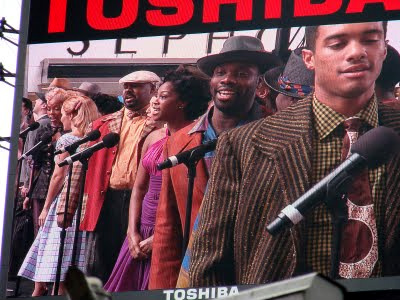
Reader Jonathan nicely sent me this picture. Apparently Danny Tidwell DID perform with the cast of Memphis in the Broadway on Broadway event on Sunday. I wasn’t able to go (I’ve been really sick). Did anyone else make it?
Thank you Jonathan for the picture!
I knew there was a reason I loved her Juliet so much:
”Watching movies gave me ideas. Dancers tend to exaggerate on stage because they want to make sure that everyone sees their emotions through the movements, but in movies, the acting is very subtle and realistic. I think it’s important to find a balance. You can’t overact just because you want the viewer in the back to notice you, but then you can’t control your feelings too much either,” Seo said, adding that she loved the original play by Shakespeare because the lines were so romantic. She added that such sentiment is ”hard to find these days.”
Later, she says:
”Ballet is art. I may be just dancing, but I’m dancing inside a beautiful set with beautiful music, and that is what makes ballet a synthetic art form. I want to be recognized as an artist. An artist who danced, who appreciated music and understood art.”
Here’s the rest of this sweet interview in the Korean Times.