KEIGWIN + COMPANY'S CAPTIVATING "RUNAWAY"

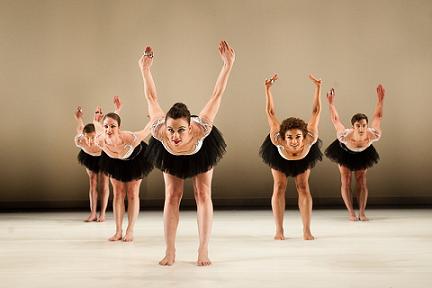
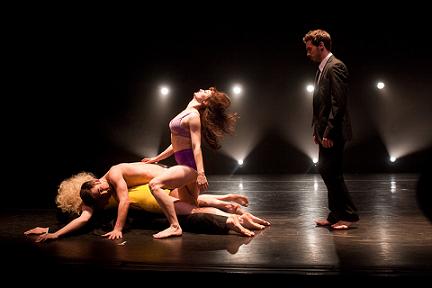
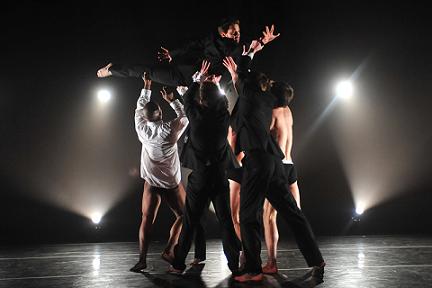
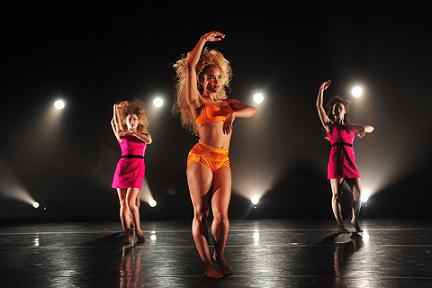
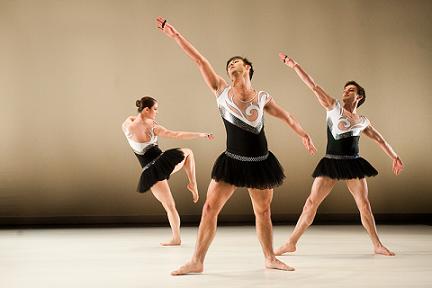
Here are some photos of Keigwin + Company’s recent season at the Joyce in Chelsea. Above is Larry Keigwin’s absolutely stunning Runaway, which I loved, and below is his Bird Watching, which had its premiere at the start of the season. All photos by Christopher Duggan.
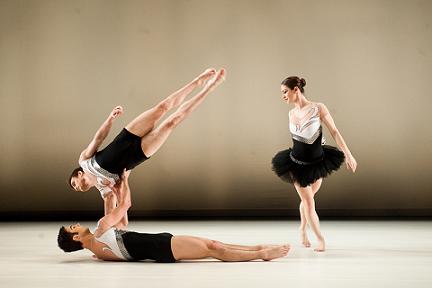
My friend and I were blown away by Runaway. It began with a woman onstage wearing a 60s-style dress and a huge bouffant hairdo, checking herself in a mirror held by two male tecchies. The program had advertised that there was to be a “scene change” between the former piece and this one, and it was soon made clear this “scene change” was part of the performance. As stage guys ripped up the floor matting and the back wall drop and laid new ones, this woman primped and posed in the handheld mirror, while men came onstage dressed in briefs, and began climbing into their black suits.

At one point a half-dressed woman ran across the stage, followed by a half-dressed man, running the other way. It was funny; everyone cracked up.

Then, the lights went down, and as the high-energy music (Jonathan Melville Pratt’s Thirteen) began to pump, several men dressed in suits began to walk quickly  across stage. The woman with the bouffant hairdo began to dance, her body making sharp angular movements. Soon several woman dressed like her joined the men, walking back and forth across the stage.As the music grew faster, the walking became more urgent, at times turning into a run, a sprint even. Then they began walking into the audience, using the aisles like catwalks.

Soon, they were joined by men who were dressed only in black briefs and women in colored underwear and bras, their hairdos also ratted beehives. The stage was aflutter with people walking or running back and forth, some stopping to dance in the middle, mimicking the first woman’s sharp angular movement. Throughout the whole, everyone had these straight-ahead stares, like zombies. Their walks meant business but their stares were vacant. It was like runaways on a runway. Very cool and not a dull moment! My friend, an emerging choreographer, was so inspired!

James Wolcott, equally fascinated and calling Runaway “what Nine should have been”, wrote about the piece here, and Oberon here. And you can see part of the action in their promo video, which I embedded in my earlier post, here.

Bird Watching was interesting though it didn’t sustain my attention the way Runaway did. It was more lyrical, set to classical music (Hayden’s Symphony No. 6 in D Major). I liked but didn’t love it I think mainly because I couldn’t tell the extent to which it was kind of riffing on certain classical motifs and meant as a funny commentary on them, and the extent to which it was meant to be taken seriously and on its own. Everyone — men included — were dressed in white tops and black tutus, and at one point I could see some movement patterns very similar to Swan Lake‘s White Swan pdd — performed by the men. It wasn’t so funny, though, as it was pretty, which was perhaps the point: that anyone can do anything without it being some kind of statement. I feel like I need to see it again though, and concentrate harder!

Also on the program were Mattress Suite, which I really liked. It was comprised of six vignettes, all involving a mattress, each set to different music and danced by a different set of characters. The story was the progress of a relationship: woman (the brilliant Nicole Wolcott) dancing around in her wedding dress elated and excited but slightly apprehensive, man (Keigwin, who, as a dancer, is often very funny, always charming) in his tux looking excited and lustful but a bit worried, then they’re together on the mattress, then they fight and she lifts the mattress erecting it between them like a barrier, she leaves, he has a fling — with two guys — the mattress getting a bit cramped there toward the end, and then she returns and is alone, struggling with her aloneness on the mattress. It’s by turns humorous, cute, sad, bittersweet. What I love about Keigwin is that his choreography is evocative of human behavior without being obvious or unoriginal. His movement is evocative but original and clever, in other words. And there’s plenty of room for the dancers to act their own drama.

And opening was the high-energy Caffeinated, from 2007, set to Philip Glass’s percussive Akhnaten, which I’ve seen before and is always fun.

But Runaway really blew me away. If you ever get the chance to see it, or his Bolero, or his lamentation in honor of Martha Graham, or anything by him really, go! Their Joyce season was short and is now over, but they’re always around.

MORPHOSES OPENS ITS 2009 NEW YORK SEASON WITH ITS BEST PROGRAM THUS FAR


Performance photos coming soon; in the meantime please enjoy another BRILLIANT photo by Kyle Froman.

Christopher Wheeldon’s Morphoses opened its NY season last night at City Center and I felt it was the best program they’ve done in their three years of existence. (At least Program A was; tonight I’ll see Program B). It’s a varied program with work by four different choreographers: Wheeldon himself; Bolshoi A.D.-turned ABT resident choreographer Alexei Ratmansky, whom all the critics downright worship; Australian Tim Harbour; and the Dutch husband and wife team Lightfoot Leon.

I must talk first about the third piece on the program, that by Lightfoot Leon, Softly As I Leave You. This is one of the most riveting pas de deux I’ve ever seen and it’s performed by the absolutely mesmerizing Drew Jacoby and Rubinald Pronk. Every single person who is not a professional critic was absolutely spellbound by it, could not stop talking about it. This happened at both the Fall For Dance Festival, where the work premiered (which I wrote about here), and last night. It’s simply about a couple, one partner’s decision to leave the other, and it’s a harrowing decision. After the lights went out on the final poignant image, the elderly woman on my left, whom I didn’t know, grabbed me and said, “Oh my God, that was so good!” And from my friend, who thinks the Arvo Part music used (Spiegel im Spiegel) is completely over-used and was expecting not to like it for that reason: “Oh my God, that music actually worked here!” she exclaimed, open-mouthed. She agreed it was one of the best duets she’d ever seen. And people were going on and on about it during intermission, both here and at FFD.

So why in the world do the critics hate it so much??? They ALL do. ALL OF THEM. It’s like in order to be a professional critic there are certain things you’re required to hate and this is one of them. And yet audiences are so overwhelmed by its power. Clement Crisp rants, “I can find not one iota of merit in its vulgar posturings.” Guardian critic Luke Jennings calls it “slick surfaced” and replete with “glib insincerity.” I can’t remember Alastair Macaulay’s exact words after its FFD premiere, but he hated it too. And a Ballet.co critic whom I spoke with at an ABT Guggenheim event (and who was the only non-Brit of the lot) complained how awful he thought it was as well.

This happened — I’m sorry, I’m getting off on a tangent — but this happened with practically every Fall For Dance piece, and with ABT’s recent season: EVERY SINGLE CRITIC hated every single one of the pieces the public adored (Barton, Millepied, Mark Dendy’s BRILLIANT Afternoon of the Fauns) and loved those they found least compelling (Ratmansky). I mean, more on this later, but what do you do if you’re an artistic director or choreographer? Do you cater to the critics — the “important people” or do you trust us, the commoners?

Anyway, mine and my friend’s second favorite piece of the night was Tim Harbour’s Leaving Songs. Guess what: all the critics hated it. I need to move to Europe… This dance had such emotional depth. It was about the cycle of life, death and rebirth — though I’m not sure you’d know that if the choreographer hadn’t said so in a little film clip shown before the program. But that doesn’t matter; you can come up with your own meaning anyway. The movement was kind of a combination of modern, classical and what looked to me to be African, and the music, by Australian composer Ross Edwards, is equally varied, at points sounding classical European, at points more percussive and African-sounding.

There were several striking moments, such as the point during a pas de deux where a man puts his hands around a woman’s neck and she falls before him. It kind of seems as if he’s strangling her out of anger, but then her arms flutter about beautifully, almost-bird like. It’s a combination of violence and grace. And there’s a moment where the group is dancing in ensemble and the movement is very wavy and undulating, very African, and everyone’s moving in unison and the music slows and the dancers slow, almost like they’re approaching death. Then the drums start pulsating and the dancers come to life and begin sidling cautiously but with intention toward the front of the stage. There are also several very sexually suggestive scenes with women’s legs splayed in the air. No tights are worn, and my friend and I couldn’t stop wondering how in the world they keep those leotards from shifting…

Anyway, I found the Harbour very compelling. And Rubinald Pronk really stood out here as well. He has so much fluidity and expansiveness in his body, and I don’t think anyone has more intense eyes.


(photo from Vail website)

Alexei Ratmansky’s Bolero was enjoyable too, largely because of the familiar Ravel music. For me, Ratmansky is one of those artists whose work doesn’t jump out at you and hit you over the head with its brilliance. Rather, I’ll need to see a dance of his several times before I get a sense of what it’s about, before I can fully appreciate it. Wheeldon’s work is the same. The critics seem to think this is the mark of a good choreographer — that it grows on you and you notice new things with each viewing, and I suppose it is. But for the average consumer, going to the ballet so often to see pieces over and over again to understand and appreciate them more fully can get prohibitively expensive. Dance art is not like a museum or art gallery where you can stand there for as long as you like.

Anyway, in Bolero, there are four pairs of women and men, each person wearing a number on his or her top. The women wear white tops and little skirts, almost like cheerleaders and the men wear black. If the women were cheerleaders, the men didn’t seem to be any kind of sports players though. They danced in groups divided between male and female, almost as if they were competing with each other, or as if their movement was some kind of back and forth dialog. And then toward the end, they began to partner each other more, the crescendo of the music complemented by various lifts that I found at points to be a little humorous, though it may have just been me. For example, when those trombones (I think that’s what they are anyway; maybe they’re tubas), are blaring kind of off-key at the end, the men lift the women over their heads, upside-down and the women do these upside-down developes, their legs splaying along with the warped trombones. I thought it was funny but I might be the only one.


And then the first piece on the program was Wheeldon’s Commedia (photo above by Erin Baiano), which was made in homage to Ballets Russes and was premiered last year. I wrote a bit about it here and here.

Here’s an excerpt from the company performing Commedia at the Vail International Dance Festival:

Also, this season marks the company’s collaboration with the young orchestra (most players are under 30, Wheeldon said), Philharmonic Orchestra of the Americas, founded and directed by the very entertaining, energetic Alondra de la Parra — yes, a female conductor OMG! The evening opened with Wheeldon giving a little address and then the orchestra playing on Overture to Estancia: Malambo by Alberto Ginastera. At the same time the orchestra played the Overture (this was their first time playing in a pit for dance, and not centerstage, by the way), a screen was dropped over the stage and a delightfully humorous film was shown of the dramatic conductor directing her crew, the violinists all swaying dramatically in unison at points. It was a lot of fun. Whole night was very good.

DANCING WITH THE STARS BRINGS ON THE NEW DANCES: LAMBADA, TWO-STEP, CHARLESTON AND BOLERO

I’ve never really learned any of these dances (other than some Charleston in Lindy Hop class) so I’m not sure if I can judge them properly, but I’ll try.

Chuck and Anna’s Two-Step: I thought he did well at some of it– particularly when he kicked in back and slapped opposite hand to opposite foot — but other than that, it seemed like he was walking most of the time, while she was giving her steps more flair. Social dancing is basically walking with attitude but much of his performance here was just walking.

Mark and Melissa’s Charlie Chaplinesque Charleston was absolute brilliance. Wow. That was her best dance by far. Her steps were so perfect, her little bounce spot-on, her character acting perfect, and even the lifts were marvelous. Often non-pro female dancers’ difficulty with the lifts stems from not being able to hold yourself properly in the air, not having the correct shaping (since you don’t realize how hard it is to maintain proper shape with no floor beneath you), but her shapes up there were excellent. I’m so impressed!

Natalie and Alec’s Bolero: Well, given their angst-filled practice it went a lot better than I was expecting.

Continue reading “DANCING WITH THE STARS BRINGS ON THE NEW DANCES: LAMBADA, TWO-STEP, CHARLESTON AND BOLERO”

FALL FOR DANCE ’09 PROGRAM 1


I’m on a tight schedule with my book rewrites, but here are some of the highlights of the Fall For Dance Festival (Program 1) thus far.

It’s always a delight to see Paul Taylor’s hilarious Offenbach Overtures with the would-be ballet dancers tripping all over each other, the muscly men first dueling then making up and swinging their way offstage in each others’ arms, the female cabaret dancers comically warring for attention. I was happy to see SLSG favorite Michael Apuzzo in my cast (he’s not in the photo above unfortunately, as he wasn’t in the first night’s cast) — he’s always very dramatic, full of character, and I noticed he had the highest, most straight-legged jetes as he and the other guys went sailing offstage at one point.

I was at this performance with my friend, Michael, and we hung out for a while in the lounge afterward (where they have $2 wine and beer and $4-$5 plates of food). I’m very shy, but I always seem to have really outgoing friends, and Michael went up to a woman with a bouquet and asked her what it was for — something along those lines. It turned out she was in Paul Taylor, and once I knew that, I recognized her as the striking Parisa Khobdeh, Michael’s partner (Michael Apuzzo that is, and partner in Offenbach that is). I then realized a bunch of the Paul Taylor dancers were hanging out in the lounge (except for that Apuzzo!) — so the FFD brochures  are not lying about the “come mingle with the dancers” parts of the adverts for the post-performance parties in the lounge.


Anyway, the other highlight of Program 1 was B/olero performed by the highly respected Israeli company, Batsheva, choreographed by their artistic director, Ohad Naharin, and set to the familiar Maurice Ravel music. Except this was a remix — at times the music would be slowed so that it would sound somewhat warped. The music would also veer from speaker to speaker, so it was like the sound was traveling around the auditorium.

Well, there are many Boleros around and Naharin’s was a more minimalist one in terms of the action, but not the emotion. It was a duet for two women dressed in black dresses. At times their movement was basic, at times still, at times spastic and chaotic, at times sexual and almost kinky, and at many times hypnotic. A common motif was the swinging back and forth of the arms, mechanically, like the arms of a clock, the rest of the body still. I always feel with his work that I have to see it several times to get the full effect, and I wished I could have seen this one again.


In celebration of the centennial of Ballets Russes, every night at FFD one company performs a piece on honor of that legendary company. Program 1’s was the Boston Ballet’s rendition of Nijinksy’s original Afternoon of a Faun. This was a real treat for me, as I’d never seen the Nijinsky version live and in full before. I’d only ever seen it on tape or, if I remember correctly, only the faun version (without the nymphs) performed by Royal Ballet star Johan Kobborg with the Kings of Dance.

Anyway, Nijinsky’s version is from 1912 and you can really imagine how shocking it must have been in its day, with the faun so overtly sexual, so taken with the nymphs, he ends up masturbating with a cloth left by one, which he recovers, takes up to his little rock perch, places it on the ground and begins rubbing his groin into it. You still don’t see much of that today onstage (at least not in ballet), so I think it’s still somewhat risque. And yet the faun, at least as portrayed by Altankhuyag Dugaraa, is so sweet and so endearing, and you feel for him after those nymphs tease him and you’re happy for him when he retrieves that cloth. I would so love to see a clip of Nijinsky in this. I would also love to see his Rite of Spring some day; I don’t think it’s been performed for eons though, I think because the choreography hasn’t really been preserved, sadly.


And completing Program 1 was Savion Glover, which I wrote about briefly in my previous post.

See the rest of Andrea Mohin’s NY Times slide show of Program 1 here.

DANCING WITH THE STARS SEASON NINE CAST ANNOUNCED


For people who missed Good Morning America this morning, the DWTS season 9 cast has been announced. I think I know about five of the contestants. Most excited about model Kathy Ireland and actor Debi Mazer at this early point. Also, they’re including more dances: Lambada, Charleston, Bolero and Two-Step. So it appears the show is veering away a bit from competitive ballroom and into the social-dance sphere (social dances both past and present, both in and outside of the U.S.). Will be interested to see how it pans out…

The show premieres Monday, September 21, 8 p.m. ET, on ABC.


THE POPULARITY OF KEIGWIN + COMPANY


During ballet season my time is so limited and I just can’t attend everything I want to. And so, regrettably, I had to miss Keigwin + Company at the Joyce last week. But my friend, writer Christopher Atamian, agreed to attend for me and write a review here. I’m a big fan of Larry Keigwin, but unfortunately my friend didn’t like the performance very much! Oh well, such is life… Anyway, I’m very thankful and flattered that professional writers want to write for my blog. I do want to make clear, though, the views expressed herein are Mr. Atamian’s and not my own. I’ve seen all of the pieces reviewed here except Triptych, which is new, and I’ve really liked all of them. I also think diversity of opinion and the dialog it can engender is very important to the arts. Here is Mr. Atamian’s review.

Continue reading “THE POPULARITY OF KEIGWIN + COMPANY”