
MICHAEL TO THE RESCUE!: TERESA REICHLEN, JANIE TAYLOR AND TYLER ANGLE STAND OUT IN FINAL MIDSUMMER CAST


Yesterday was stressful. Had to make a hard hard choice: whether to spend the matinee at New York City Ballet watching three of my favorite dancers — Gonzalo Garcia, Tyler Angle, and Janie Taylor — make their debuts in Midsummer Night’s Dream, or at American Ballet Theater seeing Hee Seo debut as the title character in La Sylphide, with one of my favorite ABT dancers, David Hallberg opposite her. (Review coming very soon, along with earlier Sylphide cast, and two Midsummer casts — yes, I’m behind behind behind!)

I’d actually contemplated running back and forth across the Plaza, like I know some have done in times past, but the running times for the first acts were totally different and there was no way I was going to be able to see Gonzalo’s Oberon in Midsummer and then make it to the Met in time for David and Hee in the first act of Sylphide. So, I chose my David, and the lovely debuting Hee. Ever so thankfully I talked my friend, author Michael Northrop, into covering the goings on across the Plaza.
p6202228

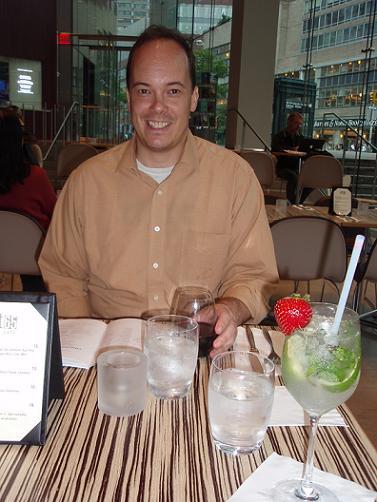
Afterwards, over drinks and food at the Alice Tully Hall Cafe (they have half-priced specialty drinks from 3-6 pm! And not watered-down at all! I nearly passed out after two sips of that mojito in front of me πŸ™‚ ), he told me that Gonzalo did just fine with that crazy high-flying scherzo for Oberon in the first act (I knew he would!), and that he really liked Teresa Reichlin as Titania and Janie and Tyler in the second act divertissement, which received a lot of applause, which I can just imagine! He also agreed to write a little review, which I’ll post in a minute. (If you don’t know the story of Midsummer, read about it here — Balanchine pretty closely follows the Shakespeare).
p62022292

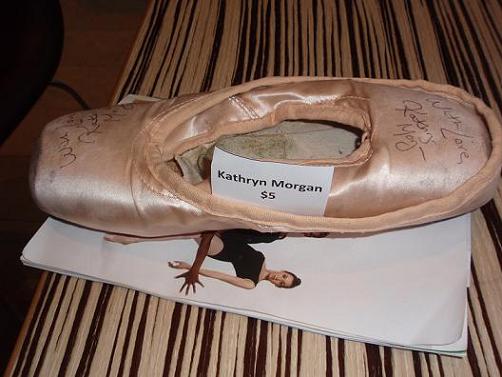
But first, it being Michael’s last day at NYCB this season, he browsed the gift shop, and ended up with a pair of Kathryn Morgan toe shoes. He told me (and, apparently the amused gift shop attendant) he figured she wasn’t going to be $5 for much longer πŸ™‚ I guess their shoes cost a certain amount according to their status: principal ballerina shoes are $30, soloists are $15 and corps members $5. I didn’t know all this. I’ve never wandered over to the toe shoes section. I initially wondered why, then realized, oh, my favorite dancers don’t usually wear toe shoes. Sorry to be lewd, honestly, but I then couldn’t help but wonder — just because of that crazy strong mojito that nearly put me on the floor — why they don’t sell other kinds of used dancewear that my favorites *do* wear, alongside the toe shoes. Sorry! But can you imagine? Total alternate universe.

Anyway, here is Michael’s review:

At Dunkin’ Donuts, they sell munchkins 25 at a time. That’s about how many you get at New York City Ballet’s A Midsummer Night’s Dream, as well. The squadron of young dancers from SAB added a nice dose of fun and energy to a matinee that already had plenty of both on Saturday.

Daniel Ulbricht didn’t dance the role of Puck, so instead of gravity-defying antics, we just got antics. Corps member Troy Schumacher was announced as a late sub for soloist Sean Suozzi in the role, and there were some disappointed Ohhs around me. The thought: We’re getting the third string. Schumacher did an excellent job, though. He moved with an appropriately sprightly energy and showed a nice touch with the comedic moments. When he realized his magical matchmaking mistake, you could almost hear the “D’oh!”

Teresa Reichlen was fantastic as Titania, displaying just the right balance of regal, playful, and otherworldly for a fairy queen. And Robert Fairchild, a very busy man this season, excelled in yet another role (albeit in a ridiculous Prince Valiant costume) as Lysander. His put-upon love interest was once again Sterling Hyltin. The leads from NYCB’s Romeo + Juliet both showed they can handle Shakespeare’s comedy as well as his tragedy. Hyltin, for example, dialed up a slightly manic quality to great effect.

And Balanchine’s choreography tells the entire story in Act I, leaving Act II free for the divertissement. A quick wedding march and then Janie Taylor and Tyler Angle were center stage. They brought down the house.

Angle is a strong presence, but he defers so gracefully and lifts so effortlessly that he never soaks up more than his share of the spotlight. I noticed that when he partnered Tiler Peck in Mercurial Manoeuvres, and again on Saturday. Janie Taylor was both a delicate vision and a physical wonder, sometimes in turns, sometimes simultaneously. It’s a complete oxymoron in print, but she pulled it off onstage. Amazing.

The final scene was especially poignant for me, because I knew this was the last performance I’d see this season. Fireflies flickered around Puck against the dark backdrop of, yes, a midsummer night. It was the kind of night you don’t want to end, and the kind of season.

And here is Oberon’s (I mean Philip’s) review of the same cast.

And this just in! Another review (I’m interested in what he says of Gonzalo Garcia) — the one (by a pro critic who doesn’t say things are good when they’re not, and with great detail and specificity) that I’ve been waiting for πŸ™‚ I knew Gonzalo’d nail it! I knew he’d be brilliant! I knew it!


NYCB: A DIFFERENT DREAMER, A BRILLIANT HALLELUJAH JUNCTION AND A SWAN LAKE DEBUT


I spent all of Saturday at New York City Ballet, watching both matinee and evening performances like the obsessive I am πŸ™‚ Highlight of the daytime performance was Jerome Robbins’s 1979 ballet, Opus 19 / The Dreamer in which Robert Fairchild and Janie Taylor made their NYC debuts in the lead roles. This is only my second time seeing this ballet — the first was a season or two ago when the main parts were danced by Gonzalo Garcia and Wendy Whelan. (Robbins created the ballet on Baryshnikov and Patricia McBride). My research has revealed that critics don’t consider this to be a major Robbins ballet; Arlene Croce seems not to have written a word about it. Audiences seem to adore it though, me included.

Funny but the first time I saw it, I thought the main male character was a “dreamer” in the sense of being an idealist. Wendy seemed to represent Gonzalo’s ideal. And there often seems to be a kind of charmingly airy, carefree, “head in the clouds” quality to Gonzalo’s dance persona.

Robert was more solid and sharp and weighty than Gonzalo. In his beginning solo, he’d slice through the air with his arms and legs, stretch an arm out, hand bent up, as if to be pushing out against something, or stopping something from getting too close to him. What that something is isn’t entirely clear. It seemed more like he was a literal dreamer, someone lost in a dream that was neither entirely pleasant nor unpleasant, something he kind of wanted to escape from but was drawn to as well. And Janie — I love her! — was all tantalizing, bewitching, taunting little mischief-maker haunting his subconscious, not leaving his psyche a moment’s peace. Whenever she was onstage, she completely captivated — both him and us. Even when she’d collapse in his arms, he’d struggle to straighten her up again. He’d lovingly wrap his arms around her; she’d be out of them in a split second. It was very different from the way Wendy danced, if I remember correctly. I wonder how Patricia McBride did it.

I read a review of a dancer who performed the male lead in the 80s. The writer — Jack Anderson — said the dancer — Jeffrey Edwards — looked like a thinker, very introspective. I always love watching Robert — I think he is one of the most fascinating movers around. I’m not sure if what I saw here was introspection or more like inner turmoil. He was definitely lost in himself — he doesn’t even seem to notice all the lavender-clothed dancers flitting about him, didn’t seem to notice anyone until Janie came darting by and commanded his attention. I guess it seemed more like he was lost in his own angst, haunted by his dreams, than lost in his thoughts or his art. But it would be hard, I’d think, to embody introspection.

They don’t seem to be performing this ballet a lot, but I’d love to see Tyler Angle dance the part as well.

Also during the day was Chaconne, which I’m growing to love more and more — particularly the first pas de deux where the man lifts the ballerina and she has her arms out to the sides and does these large, sweeping steps forward, every few beats lightly tickling the floor with one toe shoe, and it looks like she is flying — and Vienna Waltzes, which, probably ridiculously for me since I’m a ballroom dancer, honestly just kind of bores me. The choreography’s not very intricate or compelling (odd for Balanchine) — it’s mostly straight-forward waltzing, which I can only watch for so long. There’s a middle section composed of high-energy allegro ballet which was danced very theatrically by Yvonne Borree and Benjamin Millepied. That section seriously kept me from falling asleep.

Highlights from the evening program were Peter Martins’s Hallelujah Junction, Joaquin De Luz in Donizetti Variations, and Sebastien Marcovici’s debut as Prince Siegfried in Balanchine’s Swan Lake. I hadn’t seen this cast of Hallelujah before — it was Sterling Hyltin, Gonzalo Garcia, and Daniel Ulbricht. This cast wasn’t so dramatic, so romantic, so intent on telling a little story, as other I saw (Marcovici, Taylor, Veyette), but seemed more focused on simply making the music visual — and they did so to fascinating effect. I greatly enjoyed just sitting back and watching all that brilliantly fast-paced, razor-sharp movement — Gonzalo with his sexy impish bouyancy (he’s not really a small man but somehow he seems like he’s always airborne; I think he’d make a great Sleeping Beauty Bluebird), Sterling with her Russian ballerina-high extensions that she does with incredible speed, and Daniel for his intense precision. This is the best I think I’ve ever liked Daniel Ulbrich before. He didn’t just jump inhumanly high; he really nailed very difficult-looking, intricate footwork and he did so with such sharpness and tautness. If he’d only be given more than just jumping guys parts, he can show that he can actually dance extremely well.

Sebastien danced Siegfried with great passion, expectedly. Balanchine really eviscerated the man’s part in his version of the ballet but Sebastien went as far as he possibly could with it. At one point, one of the corps swans in the back row fell and of course the audience had to go “ooooooohhhhhhh,” but he didn’t let it faze him as his Siegfried searched desperately among the swans for his beloved Odette. He had a minor flub on one of the many traveling turn jump thingys but no big deal. It was heartbreaking when Wendy bourreed back away from him and he reached out to her like she was taking his life with him as she went. Also, I love the black and white plastic swans swimming in the little stream at the beginning and end, but the people working them should just make sure the white swan appears at the right time! One time Wendy wasn’t fully into the wings yet when her swan form began sailing across the stage and Charles Askegard’s Prince Sig didn’t know where to run — the swan or Wendy. This time it was a little late and Sebastien kind of had to go searching upstream for her πŸ™‚

Balanchine’s Donizetti Variations was danced brilliantly by Joaquin De Luz and Megan Fairchild. But what I really love about Joaquin isn’t his bravura dancing but his dramatic abilities — how he interacts with the other dancers. Even when dancing a storyless ballet, he’ll look at the others as they do their thing, shoot them a cocky grin — or a genuine smile — and do his thing, his steps a clever or comical response to theirs.

Also on this program was the newish ballet by Melissa Barak, A Simple Symphony – -my second viewing of that. She does borrow from Balanchine, but her choreography also has its own wit, which you notice on multiple viewings. Like Balanchine, the drama is in the actual choreography — every little flex or softening of the wrist meaning something. At one point, the ensemble of ballerinas all turn their hands and flex their wrists, and it looks like they’re cutely shrugging their shoulders. It’s such a pretty ballet with such mellifluous music though, sometimes you don’t want to focus on the choreography; you just want to sit back and enjoy the loveliness of it all.

NEW YORK CITY BALLET: JANIE’S DSCH, KATHRYN’S SCOTCH AND MORE VIEWINGS OF PREMIERES


I can see how ballet is so addictive, especially to those with dance training who’ve either danced the roles they see onstage or pick up choreography on sight. It’s so interesting to see different dancers perform the same roles, to see what they can each do with something, where they can take it. A ballet can look completely different depending on cast.

Janie Taylor recently debuted as the female lead in Ratmansky’s Concerto DSCH and I absolutely loved her. I thought she brought a certain vulnerability, delicateness, and romantic touch (both big and small “r”)to the role and as such created a poignant centerpiece to this ballet that is mainly full of fast, frolicking fun. She was perfect partnered with Tyler Angle, who gives everything an emotional, Romantic quality. There’s one point where the girl bourrees (tip toes) backward from the guy and he steps toward her in a series of lunges, arms outstretched. It was rather heart-grabbing when Janie and Tyler did that. It was like Tyler was reaching for her with all his might, but she just kept falling away from him, telling him no, it couldn’t be.

The original cast for the romantic couple was Wendy Whelan and Benjamin Millepied, and when I saw them perform it again a few days ago, I looked for that part. I almost didn’t see it until Wendy had bourreed practically into the wings. Benjamin, instead of reaching toward her with all his power, bent his knees and performed those walking lunges close to the ground, kind of bouncing up with every step forward. His arms were still outreached but the deep kneed, close to the ground walks gave it overall a more playful feel, or perhaps like he was looking up to Wendy, his supreme ballerina. Wendy’s of course such an icon in the ballet world and she’s stronger and less vulnerable and delicate than Janie and so it just had a kind of man worshiping woman instead of a boy trying desperately to hang on to his love feel.

Ashley Bouder has been out with an injury so Ana Sophia Scheller is filling in for her in the main allegro ballerina part, still dancing alongside Joaquin de Luz and Gonzalo Garcia.


There seemed to be a slight bit of drama going on between Scheller and Garcia at first — I don’t know what it was — he was his usual sexily mischievous, charismatic self and she seemed nervous and holding back a bit (albeit not with Joaquin), but hey, drama is always fun πŸ™‚ I think that has been all worked out though. The last time I saw them dance this together they were right on. She appears to be a lovely dancer and I’d like to see more of her.

I’ve also seen two very different casts in Scotch Symphony: the first Benjamin with Jenifer Ringer, the second Robert Fairchild and Kathryn Morgan. This is a sweet Balanchine ballet, telling the story of a young kilt-clad Scotsman lost in the Highlands who becomes completely smitten with an ethereal goddess dressed in Romantic tutu. He keeps trying to reach her but is thwarted right and left by a group of Scottish guards. Finally, they meet and dance a lovely pas de deux.

My friend, Alyssa, now has a huge crush on Benjamin. I don’t know how it happened; we were standing in line at the box office to pick up tickets one night and he was talking on the overhead screen, likely about his new ballet (I’m not sure because the sound was off) and Alyssa became mesmerized by his face. “That’s the guy who recently premiered a new ballet,” I said. “Oh, he’s a choreographer? He’s cute!!” Then when we got inside and were looking at the Playbills she screamed, “look, the cute guy is dancing!”


Afterward at dinner all she could talk about was how other dancers (like Daniel Ulbricht, who we saw in Tarantella that evening) were great jumpers and technically perfect and all, but Benjamin just brought so much more to the dance. “He was just so … so… he was perfect in everything he did, but he wasn’t just perfect, he was… ” she waxed unable to come up with the right word. It was Ethan all over again (whom she fell for after seeing at Martha’s Vineyard merely introducing his Stiefel and Stars and saying he was unable to dance because of the knee operations).

I nodded. He does have a certain beneath-the-surface charm (Benjamin that is), and he is a very good dancer, always coming through with those ever so challenging fast-paced Balanchine roles.

But of course I was dying to see Robert Fairchild in the same role, with Kathryn Morgan as his ethereal love object. They were so beautiful together. She’s just so angelic, and he always dances with such passion and boundless amounts of energy, and of course he’s always got that boyish charm that he’s had since debuting in Romeo two years ago at age 19 but that I don’t think is every going to go away. He’s such a hard-working young guy, you can tell — he puts everything he has into his dancing. He had a tiny fumble coming out of a jump and had to check himself with a couple extra steps to secure his footing (but he didn’t fall), and at one point he was a bit too far from Kathryn during a supported arabesque penchee and she couldn’t get her leg all the way up in the air. But, to me, honestly, when a dancer makes a blunder it only makes him or her all the more endearing, more human.


(Robert Fairchild, Kathryn Morgan)

I loved Tiler Peck in Tarantella — another role that usually belongs to Ashley Bouder, but Tiler brought a certain freshness and wit to this cutesy extreme high-speed dance. Ashley usually brings a sexy, flirtiness to it; Tiler was more sweet and smart. I like both, and, again, it shows dancers often make the dance.


Daniel Ulbricht (photo above by Paul Kolnik), as always, delivered on the technical and difficult athletic aspects of the dance — the high jumps the turns and all. Audiences always go absolutely wild over him. I personally like Joaquin de Luz a bit better (in this and the other roles he dances — he and Daniel usually alternate) because he delivers on the virtuosity as well but he makes it more about the character. At the end, the boy here steals a kiss from the girl. With Daniel, the high jumps and theatrics are the dance, the kiss is just a little reward at the end; with Joaquin the whole thing is about that kiss, the mad leaps and spins and turns with the tamborine are simply leading up to it. But audience do go completely wild over Daniel.


(Tiler Peck)

I saw the new ballets once again — Benjamin Millepied’s Quasi Una Fantasia and Jiri Bubenicek’s Toccata, and both grew on me. Funny, but I sat in orchestra this time for both — first time I was looking down from the first ring side, and it’s really interesting how different the ballets look from different vantage points — especially the Millepied. Looking down from above, this ballet really seemed to evoke a flock of birds, at times sinister and foreboding. Looking at it straight on, it was still unsettling — with that haunting Gorecki score — but at times the dancers resembled insects reminiscent of Robbins’s The Cage, and later, just figures — one weak and somewhat broken, the other strong — moving in various groupings. My friend Michael and I both noticed how he’d make various groupings or formations with the dancers — phalanxes, Michael called them. Sir Alastair had noted the same, saying he likely got the ability to work a large ensemble like that from Balanchine. I don’t always notice such things until someone points it out — I’m usually more focused on the theme, what the choreographer is trying to evoke, or make me think and feel.

I wish I had a picture of what the dance looked like from above. Overall, I think I still see Hitchkockian birds πŸ™‚

I still don’t know exactly what Toccata is about but I love how there is a great deal of really intense partnering, sometimes several duets happening at once, the dancers by turns pushing and pulling, sliding, strugging with and embracing each other, and I love how at points the bodies just kind of mesh into one another, just melt into each other. It’s really kind of sexy in its own way. I love Robert Fairchild in these kinds of abstract roles. As I think I’ve said before, he always makes a little character out of a role no matter how abstract, and he dances with such expansiveness. With that and his immense charisma he devours the whole stage.


(Robert Fairchild and Georgina Pazcoguin in Toccata, by Paul Kolnik, from Oberon’s Grove)

I’m also liking Maria Kowroski much better. I heard she is taking acting lessons and it shows. Every little step is meaning something, saying something, a little quip perhaps, a little retort, to her partner (who has often been Sebastian Marcovici these days) and to the audience. I particularly liked her in Balanchine’s modernist Movements for Piano and Orchestra and his sweet, more classical Chaconne. Huge kudos to Sebastien in the latter for doing some really intensely fast footwork and really nailing it all. He is a large guy and that’s not easy. A friend told me afterward he thought Sebastien looked a bit “heavy” in the role, and I can definitely see that — a smaller dancer would have looked much lighter and more frolicking and playful — where Sebastien brings more virility and power and intensity — but, again, what makes ballet so addictive is the different bodies, different strengths, different personalities, different interpretations.

NEW YORK CITY BALLET SPRING SEASON BEGINS! (PROGRAMS 1 AND 2)


NYCB’s Spring season began on Tuesday and I spent much of the weekend at the Koch theater. Friday night was my first time seeing Balanchine’s Divertimento No. 15, (set to Mozart), which Arlene Croce called one of his greatest ballets, and I can see why, particularly with all the complex, richly detailed variations. The ballet begins with an Allegro section danced by the whole ensemble, the women entering the stage first. But I have to say I felt like the dance properly began when the three male leads — Tyler Angle, Amar Ramasar, and Andrew Veyette– came onstage, particularly Angle and Veyette (I prefer Ramasar in the more dramatic roles but he always has a charisma that draws your eye). With the exception of Sterling Hyltin, who is becoming one of my favorite ballerinas, the men just stood out more. At one point, after executing a step perfectly on beat, Andrew looked out at the audience and flashed a knowing, mischievous grin that made me and my friend (and those around us) giggle, and that set the tone of the whole night for me.

Though all of the women seemed to keep time with the fast-tempo and execute all the intricacies of that insanely quick-footed choreography, Sterling’s dancing had the most dash and flair.

Continue reading “NEW YORK CITY BALLET SPRING SEASON BEGINS! (PROGRAMS 1 AND 2)”

New York City Ballet Season Finale and Wrap Up With Response to Sir A


So, Sunday marked the end of New YorkΒ  City Ballet’s winter season. I was honestly in a blue funk all day yesterday, which shows, I guess, that I am really beginning to love this company since I’ve normally only gotten so sad over ABT and Alvin Ailey.

Sunday was a one-day only program, the All-American Season Finale, which included Robbins’s Glass Pieces, Martins’s Hallelujah Junction, and Balanchine’s Tarantella and Stars and Stripes. Tarantella (this is the only time it showed this season) is always fun, with its cute Neapolitan peasant boy-tries-to-get-girl caricatures, lightening-charged footwork, and series of bravura solos for both man and woman, all performed with a tambourine. I was completely out of breath after watching Joaquin de Luz fly across the stage and ultimately steal a kiss from Megan Fairchild. Joaquin is not just a dancing virtuoso but a dramatist as well and his characters are always these virile, sexed-up, but charming, innocuous men. I really love him.

Glass Pieces and Hallelujah Junction also really grew on me. I don’t know if it was Maria Kowroski or what, but theΒ  slower, more adagio section of Glass Pieces was very compelling this time, and it really spiced up the last man-centric, drum-beating, section as well. At first I wasn’t a huge fan of Maria Kowroski, but either she has improved or she has really grown on me. I always thought she had an excellent dancer body, but now she is using it in a much more expressive way, really to say something. The only thing I’m not in love with choreography-wise in Glass Pieces is in the last section, how the men come jogging out, hands powerfully punching the air, doing their ‘man things’ to the booming drums, and then the women daintily slink in to the sound of the flutes. Corny.

I was able to watch more than just the mesmerizing lighting in Hallelujah Junction this time. I love the movement theme –toward the beginning — of the landing a jump or phrase on releve and then swiftly lowering the ankle to the floor. On Andrew Veyette it looked kind of teasing but in a sinister way, like the slicing of a knife. There is something very sinister in general about Andrew Veyette, very virile in a threatening way, which makes him perfect for the devious man dressed in black here.

And I love how Sebastien Marcovici, the man in white, kind of Janie Taylor’s saviour, would powerfully jete across stage after him, threatening him, banishing him. Sebastien and Janie are such the romantic couple, in part because they work so well together and in part because of their respective sizes. Someone very knowledgeable in the dance world told me they thought he’d been working out a lot, trying to build muscle. I do think he seems to have become more muscular lately, especially his legs. Building muscle often decreases the muscle’s flexibility and he doesn’t seem to make a perfect split on a jete like some of the others, but I still think it’s so romantic that he’s so much larger than little Janie; he can just sweep her off the floor and scoop her up into his arms — aw πŸ™‚

The program notes state that Stars and Stripes, the somewhat cheesily patriotic but excellently danced Balanchine ballet, was shown at presidential tributes, like that of Kennedy and Johnson, and at Nelson Rockefeller’s NY gubernatorial inauguration. It’s so weird to me to think of that, though I could see it performed back then. But now? At President Obama’s inauguration? It just doesn’t seem like it would fit. It would seem kind of anachronistic, sadly…

Anyway, the talk of the ballet world lately has been Sir Alastair’s New York Times season wrap-up.

Taylor Gordon, my friend and fellow blogger / dance writer, says, “whether you agree with him or not, it boggles me that one person has the power to say these things in basically the one print medium dance criticism has left. Ouch.”

Macaulay basically takes the women of NYCB to task, saying none of them really command authority like true ballerinas,

Continue reading “New York City Ballet Season Finale and Wrap Up With Response to Sir A”

New York City Ballet: Tradition and Innovation


On Friday, Judy and I went to see New York City Ballet’s “Tradition and Innovation” program. I know, I really should just move into Lincoln Center…

On the bill were Balanchine’s Concerto Barocco, Mauro Bigonzetti’s Oltremare, and Balanchine’s Tschaikovsky Suite No. 3 (I’m using their spelling of Tschaikovsky, with the first “s”; I often see it spelled without).

Concerto Barocco is one of Balanchine’s leotard ballets that makes music visual (the two ballerinas — here Wendy Whelan and Rachel Rutherford — almost become the double violins of Bach’s Double Violin Concerto in D Minor) and, according to Terry Teachout, is one of Balanchine’s most definitive. It’s funny. I’ve seen it before and really liked it then, but I think in contrast to the similar Stravinsky Violin Concerto, that I saw on Wednesday, it didn’t fascinate me as much. There didn’t seem to be as many interesting little flourishes. I still enjoyed it though — especially where the groups of women all hop repeatedly on pointe — it’s so sweet — and the way the dancers nearly become the violins is always fascinating.

Oltremare is one of my favorites this season. I’ve written about it before. It’s an expressionistic piece with some brilliant lifts, some high-charged jumps, at times the mood rather haunting, about immigrants coming to the New World, dejected about all they are leaving behind and fearful of what may lie ahead. My favorite part is always Andrew Veyette’s bravura turn. See a great video here of him talking about that role and the ballet in general, along with scenes from the ballet. (you may have to scroll down for it; I don’t know if the link will go directly to that video — but do scroll down, it’s worth watching!)


And my favorite of the night was Tschaikovsky Suite No. 3. It’s divided really into two parts, and I’ve seen the second — Theme and Variations (pictured above, Sterling Hyltin and Benjamin Millepied in the leads) — before a few times. (I wrote about a small bit about it here when ABT did it). I hadn’t realized though until now that there even was a first part.

Well, the first section is really beautiful (pictured at top), and kind of reminded me of La Valse. The ballet begins behind a black netted scrim, and takes place in a kind of Romantic dreamscape. A man, Ask La Cour, searches for his beloved, his ideal, represented by the poetic Sara Mearns, who kind of gets lost in all the women, all dressed in long, floating lavender gowns. Interestingly, no one was on pointe; everyone was barefoot, which would seem to undermine the women’s ethereal quality. And yet it gave the whole a kind of softness and lightness. They were almost like ghosts floating through the air.

The next part of this section was a soft, melancholic waltz performed by a duo — Rebecca Krohn and Jared Angle, which was juxtaposed with a fast, sprightly “Scherzo” by a really impressively quick-footed Tiler Peck (don’t think I’ve ever seen her like that before!) and the always high-jumping Daniel Ulbricht.

And then the curtain went down and when it lifted again, we were in a courtly ballroom in imperial Russia, no scrim in sight, the chandeliers shining brightly. Beautiful as the first Romantic, part with Sara Mearns, was, I still love this courtly celebration the best with the Tchaikovsky music swelling to a climax, the floor flooded with dancers, all performing the extremely fast combinations, the big huge twisty jumps for the men — my favorite. I first saw my favorite dancer dance this part, so it’s hard for me to judge fairly anyone else, but Benjamin Millepied did very well with that first set of continuous jumping turns that seem wondrously to go on and on and on, and then, in the end, when the music starts to go at the speed of light, because he is so much smaller than Marcelo, he seemed to keep up with it a little more. Marcelo is still more leading-manly though πŸ™‚ And Sterling Hyltin was the perfect princess. Funny, but when I see ABT perform, I tend to miss the women because the men so stand out to me. Not so with NYCB; they’re more equal. I kind of feel like I saw Sterling’s part for the first time.