For his portrayal of Albrecht in Giselle. Read more about it here.
Above photo from NY Times, of Hallberg as Albrecht opposite Natalia Osipova’s Giselle.

Photo from inside the gala tent last night at American Ballet Theater’s opening night gala taken from NY Social Diary, who, sadly, don’t seem to have any pics up of Irina Dvorovenko in her beautiful red gown. It was one of the most beautiful dresses I’ve ever seen — long and many-layered but each layer seemed to be made of a light, sheer piece of fabric, so the whole thing looked light and diaphanous, though it wasn’t really see-through, just looked that way. Anyway, if anyone finds a picture of her, please let me know! Roberto Cavalli probably designed it…
Anyway, so the opening night gala was last night. It was loooong — one of the longest I’ve seen. We didn’t get out until 9:30, and it began at 6:30. It opened with an excerpt from Frederick Ashton’s Birthday Offering, of seven couples waltzing at what seemed to be a party (I haven’t seen this ballet), with Irina Dvorovenko and Maxim Beloserkovsky the main couple.
Following that was a series of introductions and thank yous by Kevin McKenzie (Art. Dir.), Blaine Trump and Caroline Kennedy (the two women were honorary chairs of the evening, along with Michelle Obama, who wasn’t there), and then David Koch who has funded the upcoming production of the company’s Nutcracker this winter.
Then, a group of ABT II dancers performed an excerpt of Edwaard Liang’s Ballo Per Sei, which was a contemporary lyrical piece, set to Vivaldi. I recognized a SLSG favorite — Irlan Silva — right away.
Then came the “Rose Adagio” from Sleeping Beauty, performed by Michele Wiles, with Sascha Radetsky, Craig Salstein, Gennadi Saveliev, and Roman Zhurbin as suitors. I don’t think I’ve ever seen this performed so well. Michele really held those balances, and she was so vivacious! Both she and Paloma Herrera, who danced a later excerpt from SB later in the evening, really embodied a young Princess Aurora very well. Michele got loads of applause – the most thus far of the evening.
Then came David Hallberg and Natalia Osipova’s Olympic version of Giselle — this an excerpt from Act II. People laughed and shook heads in amazement at Osipova’s sky-high ballons and sprightly jumps and leaps. She is really incredible. And then at the end when she jeted off and he followed her, it was really beautiful. But athletically astounding as it was, it was still moving; nearly brought tears to my eyes. I mean, how do you manage to do athletic feats like that and make it seem like you’re a light, other-worldly spirit instead of nearly exhausting yourself to death? I don’t know if I’ll ever be able to see anyone else dance Giselle again besides Osipova now. I saw a couple of etoiles from the Paris Opera Ballet perform it at the Guggenheim a few months ago and all I could think was, “wait, where’s the ear-high develope?” and “that arabesque penchee is nowhere near 6:00!” Natalia Osipova has spoiled me.
Then came Veronika Part and Marcelo Gomes doing my favorite gala fare, the Black Swan pas de deux. They were magnificent. Veronika kept doing these equally astounding crazy penchees, and she was so tantalizing with all of her faux White Swan poses! She was really a bad tease! And perfect fouette sequence for her, and his jetes and all — they got loads of applause too (oh, and so did David and Natalia).
Then was the beautiful Thais Pas de Deux by Ashton, danced by Diana Vishneva and Jared Matthews. I recently saw this rehearsed at a studio visit by Hee Seo and Sascha Radetsky, and it looks so different onstage far away and with costumes and all. It looked a lot more like MacMillan than I remembered. I loved it; Diana and Jared did very well but I still can’t wait to see Hee and Sascha. For her gala gown, Diana was wearing a very interesting-looking Japanese-styled dress.
Ending the first half of the evening was the finale of Tharp’s Brahms-Hayden Variations, danced by a group of seven couples, replete with trademark Tharpian flash and crazy lifts and high energy. Can’t wait to see this now either. I have in my notes, “who is dancing with Hammoudi?!” When I looked at my program, I saw it was Stella Abrera. She is really back and really on!
First dance after the intermission was the “Kingdom of the Shades” scene from La Bayadere. Beautiful as always though it seemed some of the dancers were not completely in unison.
Then came Paloma Herrera and Cory Stearns dancing the Awakening Pas de Deux from Sleeping Beauty, which was followed by the wedding pas de deux from that ballet danced by Herman Cornejo and Xiomara Reyes. I particularly loved Paloma. As I said before, she and Michele Wiles really embodied the sweet, youthful spirit of Aurora. Paloma and Cory danced very well together. They seemed like a real couple.
Then was my second favorite excerpt of the night — the Act III Pas de Deux from Neumeier’s Lady of the Camellias, danced by a very passionate Roberto Bolle (who received a load of applause when the curtain initially opened on him) and a very dramatic Julie Kent. Every excerpt of this ballet makes me want to see the whole. Not much longer now — it begins next week, and I can’t wait. I think they received the greatest applause of the night. Audience really went wild, and it’s partly because he’s so internationally famous, but also I think because they just did so well with it. This seems to be a ballet that requires both good acting and excellent partnering ability because some of those lifts… The pianist, Soheil Nasseri, came onstage too for a bow at the end. He was very good.
Next to last was the Act III Pas de Deux from Don Quixote, danced by ABT audience faves Ethan Stiefel and Gillian Murphy. There was a slight mishap with the lift where he throws her up, she does a crazy twist in the air and then he catches her and the fish dive wasn’t hands free, but they each danced spectacularly on their own. It looked at one point like she was doing quadruple pirouettes between some of her fouettes, and he nearly kicked his leg to his forehead during some of his jumps and then did a flashy little jump during his fouette sequence that had the audience screaming.
The evening ended on a modern note with David Parsons’s Caught, danced by Angel Corella, who, expectedly did an exquisite job. The audience, many of whom hadn’t seen that dance before, seemed so spellbound they almost forgot to clap right away. Angel’s so cute 😀
And finally, everyone who danced came out onstage at the end and took a little bow while the orchestra continued to play. Dancers still in costume — Daniil Simkin, Craig Salstein, Gennadi Saveliev come to mind — did a flashy trick, the “Shades” did a little dance in unison, and then dancers who danced in the first half came out in party gown (which is how I fell in love with Irina’s dress).
Fun evening. During intermission I checked my cell-phone and found a text from a friend who saw me sitting in orchestra from the side par terre, where he was sitting. So I texted him to meet me afterward, and we went for martinis, clam chowder and crab cake sandwiches at Ed’s Chowder House across from the Plaza, my favorite post-ballet place to go since it replaced Center Cut mid-NYCB fall season. They have a TV in the bar, and I was happy that the Yankees were still on. So I saw A-Rod hit his game-tying home-run… But how my friend ever saw me in that enormous Met crowd I’ll never know. Though many arrived late, house ended up being packed.
Oh, and I almost forgot: at the beginning of his speech, Kevin McKenzie introduced several dancers – each representing an era of ABT (this being the company’s 70th anniversary)- who all came out and took a bow. Included were Lupe Serrano, Baryshnikov, Nina Ananiashvili (who got a lot of applause), Alessandra Ferri, Natalia Makarova, and cutie Frederick Franklin, who gave a little speech as well. Isabella Rosellini was in the audience, a few rows down from me. I didn’t recognize anyone else in the audience.
Since following her on Twitter, I’ve been waiting for magnificent ballerina Drew Jacoby’s DancePulp to launch. (photo of her above taken from here) And I just received a press release that it has — on Hulu, via TenduTv. DancePulp is a series of interviews with movers and shakers in the world of dance — don’t know when it’ll air but remember her tweeting that she was interviewing David Hallberg — conducted with Jacoby herself. Click on the “continue” link below to read the full press release.
Continue reading “DREW JACOBY’S DANCE PULP LAUNCHES ON HULU VIA TENDUTV”
Headshot by Paul Kolnik, from NYCB website.
One of my Twitter followers, a law blogger go figure, sent me a link to this article, by Gia Kourlas in the NYTimes about how several ballet dancers, mostly from NYCB (apart from Maria Kochetkova and Daniil Simkin) are now actively tweeting. I found Alberda’s posts to be absolutely hilarious. Follow him!
Kourlas didn’t mention them, but David Hallberg, Marcelo Gomes, Drew Jacoby and Roberto Bolle are all on Twitter too. Roberto and Marcelo, unfortunately, don’t tweet much. Marcelo in particular cracks me up though. He started the account to tweet about ABT’s recent Culinary Pas de Deux. He had several tweets leading up to it: can’t wait for the culinary pas de deux, follow us as we tweet throughout, etc., then the two tweets the night of the event were something like: almost time for the culinary pas de deux!, then, wow that was a great culinary pas de deux! But no tweets throughout 🙂
It’s hard because dancers are so used to expressing themselves with their bodies, not their words and I know they’re encouraged to do this — blog and tweet — to reach out and try to gain new fans. My advice though: they have to make sure they remember they’re talking to a general audience, not an audience of already converted ballet fans, lest their posts be largely lost on most. They have to try to bring new people into their world, not exclude them with terminology that wouldn’t make any sense to an outsider. That’s why I think David Hallberg made the Winger so popular for the time that he was actively blogging there. He wasn’t just its biggest star; he had a way of communicating with people who don’t know everything there is to know about ballet, and of making them want to know more. I’ll bet he doesn’t have any dancers in his family and basically had to grow up doing that. His tweets are mostly about his travels guest starring all over the world. His friend, Evan McKie, from the Stuttgart Ballet, who also used to blog on the Winger, is also on Twitter and it’s fun to keep up with him as well.
And those are only the ones I know of; there are probably many more. I don’t have time to search for people’s Twitter accounts, but just do as Kourlas suggests if you want to find them (or any other dancers): Google their name + Twitter and you should find them if they’re on there.
By the way, speaking of ABT’s Culinary Pas (see some photos of that here), my friend happened to go (she was invited by someone else, a patron, and didn’t even know it involved ABT until she got there!) She had a blast, said Marcelo and Craig Salstein (the organizers) were very nice, Craig in particular was very well spoken, which I’ve noticed before, that Marcelo and Gillian Murphy danced some duets from Dirty Dancing, including the mambo scene (said ballet dancers can’t move their hips properly for Latin dance 😀 ), and that Blaine Hoven was cutting up a rug on the dance floor along with Sascha Radetsky. I hate going to parties like this but love hearing about them afterward.
Photo of Desmond Richardson by Andrea Mohin, taken from NYTimes.
So, “Kings of the Dance” made the New York stop of its international tour this weekend at City Center. I was there Friday night. The last time this show toured here several years ago (it is produced by Russian dance promoter Sergei Danilian) there were only four male dancers — Angel Corella, Ethan Stiefel (both of American Ballet Theater), Johan Kobborg of the Royal Ballet in England, and Nikolay Tsiskaridze of the Bolshoi. This year, there were many more dancers and Tsiskaridze was the only one who returned (and, funny, but I totally didn’t recognize him). The others were: David Hallberg, Marcelo Gomes and Jose Manuel Carreno from ABT, Joaquin De Luz from NYCB, Guillaume Cote from Canada, Denis Matvienko from Ukraine, and Desmond Richardson from NY-based Complexions Contemporary Ballet (So You Think You Can Dance fans may recognize his photo above, since he has guest performed on the show a couple times).
What I liked about this program the last time it toured here was that there were fewer dancers, and that way you kind of “got to know” them better, by seeing them each perform several different pieces. Here, you basically only saw many dancers once, and a few twice. If you weren’t familiar with them (as my two friends who came with me weren’t), you could easily get them confused. They played a short movie at the beginning where each dancer (besides Desmond Richardson; I think he may have been a late addition to the American tour) talked a bit and you saw them dance. Jose’s cute Cuban accent seems to have gotten more pronounced 🙂 — I think he did it on purpose, knowing how many female fans would be in the audience! David’s voice somehow sounded a bit deeper than it does in person. Matvienko (who, for ballroom dancers, looks A LOT like former US champ Andrei Gavriline) and Tsiskaridze spoke in Russian and their words were translated.
What I loved about this program though was that there were so many solos that exposed us to so many different choreographers whose work I’d never seen (and some of whom I’d never even heard of) before. Every company in this country is obsessed with Balanchine, so it’s a wonderful wonderful change when we actually get a taste of something else. But more on that in a moment.
As with every Danilian production, there were lots and lots of Russians in the audience, and I think Desmond Richardson and Joaquin De Luz in particular grew a new fan base. Poor Joaquin — well, maybe: after the performance and during intermission I kept hearing, “That little guy was great!”, “That little guy was just incredible,” “Where can I see that little guy dance?” So, Joaquin is the great “little guy” whom everyone is seeking out now. And everyone went wild after Richardson’s solo, Lament, choreographed of course by Dwight Rhoden, an absolute master at presenting his friend’s spellbinding combination of gracefulness and masculinity. My friends were floored, along with the rest of the audience judging by the exclamations.
After the movie, they opened with Christopher Wheeldon’s For 4, for four dancers, which is a carry-over from the last performance. On the night I went it was performed by Matvienko, Carreno, De Luz, and Cote (but the cast varied each night). It’s an adagio lyrical piece, as with the vast majority of Wheeldon’s work, and I wished there would have been some more allegro parts with bravura solos. But that’s just not Wheeldon’s thing.
Then, after intermission, we saw a solo performed by each man, ending with a drop dead gorgeous duet danced by Cote and Gomes choreographed by French choreographer Roland Petit, from his Proust ou les Intermittances du Coeur. The men were dressed in skin-toned unitards, which almost made them look naked, and the duet to me seemed to be about a man obsessed with his reflection, or another side of himself, as each’s movement was mainly a reaction to the other’s. But at some points there was some really beautiful partnering, some really beautiful lifts and it seemed like a man dancing with his soul. Breathtaking!
Anyway, other highlights of the solo section were: a really beautiful solo for Marcelo choreographed by Adam Hougland, called Small Steps, which was like lyrical iron-pumping — a series of beautiful poses showing off his musculature interspersed with flowing lyrical movement; a beautiful, lyrical piece danced by David Hallberg from Frederick Ashton’s Dance of the Blessed Spirits; a fast, fun, more virtuosity-heavy solo by David Fernandez for Joaquin De Luz called Five Variations on a Theme; Jose Carreno dancing a gorgeous adagio to Ave Maria — a modern version — by Igal Perry (which I’d seen before and fell in love with it all over again); and Rhoden’s Lament for Richardson, which, like Marcelo’s solo, reminded me of lyrical iron-pumping (which I mean in a good way of course) highlighting as it did that seemingly incongruous combination of male elegance and virility.
The only ones that didn’t really work for me well were Boris Eifman’s Fallen Angel danced by Tsiskaridze, which I think just didn’t have enough context, and Vestris by Leonid Jakobson danced by Matvienko, which was by turns a comical and bravura piece first danced by Baryshnikov in 1969. I thought Matvienko was a lovely dancer with really beautiful lines who could really deliver on the jumps and especially turns, but I just think it needed to be better acted because there were some places where it almost seemed like he made a mistake, and then you realized it wasn’t a mistake by the dancer; it was supposed to be the character who humorously screwed up. I heard Baryshnikov was excellent and I wish I could see a video of that.
Then, we saw Spanish choreographer Nacho Duato’s Remanso, which I’d never seen live before, but saw in a video performed by ABT. It involves a wall with three dancers interacting with each other around it, climbing over it, looking around it. It’s sweet, flirtatious in places, and loving and romantic. The night I saw it it was danced by Gomes, Cote, and Hallberg, though this cast alternated each night as well.
The program ended with a bravura “Grand Finale” with each dancer coming out and doing jumps and turns, and all the big fancy “male things” of classical ballet.
But the thing I kept thinking throughout was, wow, that’s really cool choreography, who’s that choreographer? Oh, I’ve never heard of him, or, oh I’ve heard of him, how cool that I finally got to see something by him! I mean: Roland Petit, Igal Perry, David Fernandez, Adam Hougland, Nacho Duato, Leonid Jakobson. We NEVER get to see choreography by these people here. Petit is a major choreographer. As is Duato (we really see his choreography only when his own company tours here, infrequently), ditto for Eifman, and the others I’ve never even heard of. Why don’t we see more variety here? Why don’t we see more Mats Ek and Pina Bausch and John Cranko? Why do we have to drown in Balanchine over and over and over again? Why do dance companies think that we want to see Balanchine? Why do they think Americans are into this man? As far as I’m concerned, his only truly great work is Jewels. The rest, okay, his footwork is more intricate and there are certain subtle little embellishments in the variations, but really, what was so great about his ballets in their entirety? What was so great that we have to be so completely inundated with him here in the US? I mean, it makes sense that NYCB does his work because they were founded by him but every other major company in the US is likewise obsessed – San Francisco Ballet, Miami City, Boston, Pennsylvania, even the Kirov and POB when they tour here they think we want more of this crap. And whenever ABT doesn’t do classical, there seems to be an overload of Balanchine. Does anyone consider that maybe, just maybe, we might get bored? That he doesn’t speak to younger generations of Americans AT ALL? Did someone tell POB and Kirov that Americans only understand Balanchine so you have to do Balanchine when you come here? I think ballet is dying in this country because of every artistic director’s completely inscrutable obsession with this boring boring man.
Anyway, I greatly thank Mr. Danilian for allowing Americans to see something else for a change.
For a completely different perspective, see Macaulay’s review.
Photo taken from the Prix de Lausanne website.
Last weekend I went to another fabulous Guggenheim Works & Process event, this one in celebration of Frederic Franklin, the 95-year-old formerly of Ballets Russes who’s worked with American Ballet Theater for many years now performing non-dance character roles and setting ballets on the company and its studio company, ABT II. I’ve written about him here.
ABT, ABT II, and some of the Jacqueline Kennedy Onassis School students performed some ballets Franklin has staged for them. My favorite was the Hungarian Czardas section from Petipa’s Raymonda, performed by ABT II, with Irlan Silva and Meaghan Hinkis as the lead couple. So much fun — and really made me want to see the whole ballet. I’ve since gotten my hands on a couple videos — more on them later. But for now I just want to say how wonderful I thought Silva was — how much he stands out, how much strength and discipline and precision he has, along with that ever elusive star necessity, Presence. Even doing basic heel toe steps, he just brings it to another level.
Here are a couple of videos of him at the 2008 Prix de Lausanne, where he danced for his native Brazil and placed very well. The first is of his contemporary solo, a little-seen work by Nijinsky, and the second is his classical variation, from Le Corsaire.
And here is a video I found of that Czardas, danced by others.
Also performed, by others, were the classical Raymonda variations and the Sleeping Beauty Bluebird Pas de Deux. And, ABT dancers were David Hallberg and Xiomara Reyes dancing the Giselle Act II Pas de Deux. Which was far too short! But of course one must never miss the opportunity to see David Hallberg dance up close 🙂 Among other things, he knows how to make the most of a pose, to take the lines — particularly the leg lines — to their fullest and most sublime.
Photo of Hallberg dancing with Gillian Murphy, taken from here.
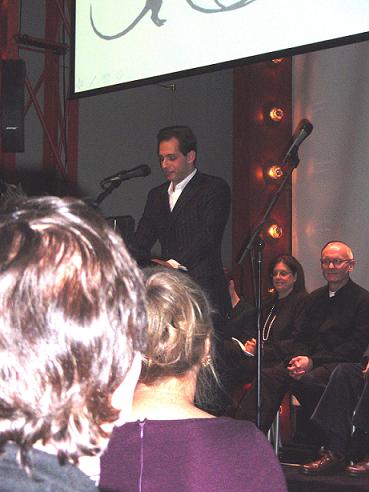
Yesterday morning at the Brooklyn Academy of Music, ABT announced their plan to hold an annual Nutcracker season at BAM. Above is SLSG favorite, soloist Craig Salstein, enthusiastically speaking to the crowd. He was the only dancer to address the crowd; David Hallberg was there too but stood in the back the whole time. A group of young dancers from the Jacqueline Kennedy Onassis School of Ballet (associated with ABT) was there as well — they’ll be dancing in the party scenes when the production opens next year, on December 23, 2010. For the first year, the season will be two weeks, but after that the company hopes to have a longer run.
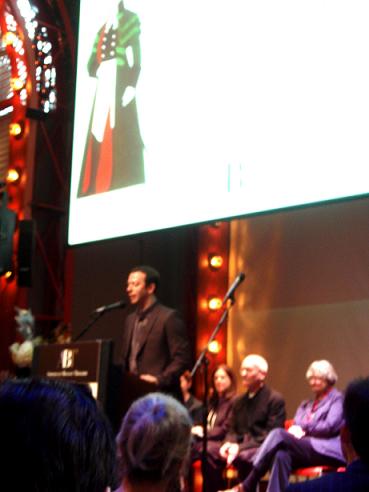
ABT resident choreographer Alexei Ratmansky will be choreographing.
Here’s a slightly better picture of him, by Fabrizio Ferri. Someday I will get a pro camera, I swear!
This was the first time I’d heard Ratmansky speak. He is very soft-spoken and has a heavy Russian accent and seemed to know what he wanted to say but struggled a bit to get the words out in English. And he makes the same grammatical mistakes as Pasha and Baryshnikov (mainly leaving out articles — there are no definite or indefinite articles in Russian — a, an, the — so they tend to leave those out: “…is great score,” etc.) I think English must be the hardest language to learn, especially for Russians. I know Russian is the hardest language I ever tried to learn…
Anyway, Ratmansky seemed shy and soft-spoken but genuinely excited, especially when talking about Tchaikovsky’s score, which he called the greatest ballet music ever written. I felt vindicated 🙂
But Brooklyn Borough President Marty Markowitz really kind of stole the show with his little speech. He was so out of place in this crowd of rather gentle artists with that booming Brooklyn-accented voice! He of course praised ABT’s decision to hold the season in Brooklyn, then told Ratmansky he should move to the borough since it boasts the greatest Russian population in the U.S. He also called Brooklyn the dance capital of New York (in terms of studio space — which leads to the great number of companies rehearsing there), which is in turn the creative capital of the U.S. These politicians do kind of know how to make their constituencies proud. After bemoaning the fact that the last time ABT was in Brooklyn was before Baryshnikov defected, he called the ABT / BAM plan “a grand jete into the future for Brooklyn.”
The project is expected to cost $5 million and is being partly funded by David A. Koch (yes, of the Koch Theater — he’s matching dollar for dollar donations up to $2.5). ABT also plans to perform community outreach, particularly in Brooklyn schools, including pre-performance workshops for the children, attendance at dress rehearsals, and dance classes.
The rest of the production team includes Jennifer Tipton, lighting designer extraordinaire, and Richard Hudson, an award-winning theater designer, who will design costumes and scenes. Below are some of his sketches:
The Royal Ballet in London recently opened their fall season with a revival of Kenneth MacMillan’s Mayerling (MacMillan of course is a SLSG favorite choreographer). It’s based on the true story of the apparent suicide / murder in 1889 of Crown Prince Rudolf of Austria and his lover Baronness Mary Vetsera whose bodies were found in Mayerling, Rudolf’s hunting lodge. Prince Rudolf, sole son of Emperor Franz Josef of Austria, was heir to the thrones of Austria, Hungary and Bohemia.
Londoners seem to be loving the ballet. From Neil Norman’s Daily Express review:
“Like John Cranko and Michael Corder, MacMillan choreographs for full-blooded men. There is never any doubt about the masculinity and virility of his creatures. The brothel scene that opens Act II reeks of cigar smoke and a sense of political unease is brilliantly conveyed by the huddled quartet of officers who periodically grab Rudolf to whisper into his ear.
“As the tragedy slides inexorably towards its conclusion, Rudolf’s entanglement with his young mistress, Mary Vetsera (Maria Galeazzi) drives him into a paroxysm of violent frustration. Watson’s tortured solo as he clutches his head and writhes in a kaleidoscope of movement had me clutching my kneecaps until my knuckles were white.
“The denouement is terrifying. As Watson duets with Galeazzi in unhinged passion, the stage seems to smoke with some of the most eloquently violent moves in classical ballet. It really doesn’t get much better than this. If you don’t have a ticket, do something dangerous to get one.”
A few other reviews are here, here, and here. For a full list of reviews see here.
And this from our friends over at the Ballet Bag, which whom I was chatting on Twitter. They told me they think our Marcelo Gomes would make an excellent Prince Rudolf. I think maybe David Hallberg would as well — may give him a chance to get all of that aggression out of his system 🙂
Here’s a photo they posted of the Royal’s excellent Johan Kobborg in the role.
Photo of Kobborg by Bill Cooper; top photo by Tristam Kenton from the Financial Times.
What do you guys think? Would an American audience take to such “eloquent violence”? Haglund thinks so, as do I — we have with his other ballets. C’mon Kevin McKenzie, give us a Mayerling!
Daniil Simkin and cast in Benjamin Millepied’s Everything Doesn’t Happen at Once in Gene Schiavone photo, courtesy of ABT; all photos by Gene Schiavone (except for Arron Scott headshot below and bottom picture).
Just to let people know, as the photos shows above, the guy who was flinging himself into the group lifts in the first cast of the Millepied was Daniil Simkin; in the second cast it was Arron Scott (below). The program notes only gave a special mention to the two dancers doing the pas de deux and a lot of people were asking who the main soloist was.
Anyway, here are a few more reviews:
Here is James Wolcott on opening night gala (and our fab Shun Lee dinner afterward 🙂 ), here is Apollinaire Scherr’s FT review; and here are more of Apollinaire’s thoughts on her blog, Foot in Mouth. I’m surprised there aren’t more reviews — this was a pretty big season, with three world premieres — but that’s all I can find at the moment. (Update: Robert Greskovic’s WSJ review just went up; thanks to Meg for letting me know.)
Re the Wolcott write-up: I forgot to mention the models — Iman and Veronica Webb, who, instead of A.D. Kevin McKenzie, thanked the gala sponsors and introduced the program — screwing up Benjamin Millepied’s name. It wouldn’t have been such a big deal if they wouldn’t have been so giggly over it. It seemed like they were reading their notes for the first time and were really unprepared. I really don’t know how to pronounce his name either — I’ve always said the last two syllables to rhyme with plie (without the “l”) but have been told that’s wrong. But damn did ABT get a lot of press for signing them on. Just Google “ABT Fall 2009 Season” and it’s all about Iman.
(Gillian Murphy, Cory Stearns and Eric Tamm in Aszure Barton’s One of Three)
Anyway, I saw four of the six programs, saw the Ratmansky and the Millepied ballets four times and the Barton three, and they each grew on me the more I saw them. The Saturday matinee was my last performance and I found it by far the best. I felt like the dancers were finally comfortable with the new dances, knew what they were all about, and really made them meaningful. I described the ballets here.
Oh and regarding SanderO’s comment on that earlier post: yes, I do need to see the story in the dance. The dancer and choreographer won’t pull me in at all if they don’t each tell me some sort of story. That doesn’t mean the ballet has to be a traditional full-length dramatic novel or something with a clearly defined beginning, middle, and end, inciting incident, rising action with crises 1,2, and 3, climax and resolution, etc etc. but there needs to be some kind of story; there needs to be some intention in the abstraction. A lot of critics use the word “evocative” — a dance needs to be evocative of something, and I just mean the same thing. If there isn’t something meaningful going on, there’s no reason for me to see it. I can appreciate the neat geometric patterns and pretty images, but that’s not enough to make me go.
Anyway, I saw more in Millepied’s Everything Doesn’t Happen at Once on further viewings. At first I thought it was kind of everything but the kitchen sink the way Apollinaire kind of describes, but after several viewings I saw more of an evolutionary, battle of the sexes theme throughout, which becomes a more literal battle by the end. The piece starts with the stage looking swimming-pool like with the dancers making broad strokes with their arms. The stage gets over-crowded and eventually someone in charge — looking rather conductor-like, kind of throws his arms up and dismisses everyone.
Then, there’s a pas de trois (two men one woman), which becomes a double pas de trois (same), which turns into the central pas de deux (man-woman). Throughout there seems to be struggle going on — in the pas de trois the men kind of manipulate the woman around, until she’s practically on her side. In the central pas de deux is in places tender, in places more angsty as if the girl is trying to get away from the guy or fight him in some way, and he is struggling to hang onto her.
By the end, the scene has evolved into a kind of battlefield with marching music and the ballerinas doing those Balanchinian marches en pointe. Except they’re more unsettling than cutesy, like in Balanchine. This is the part where Daniil / Arron gets tossed into the crowd, throws himself with wild abandon at the groups of men, who catch him mid-split, then gets caught up with a bunch of grabbing girls.
Interestingly, the audience laughed when this role was danced by Simkin — I think because he is small and a bit long-haired and it kind of looked like he was afraid he’d be taken for one of them and was trying like hell to assert his masculinity. (I think it would have worked better had the girls been chasing him and then he flings himself into the groups of guys rather than the other way around, but not a big deal).
But no one laughed when it was Arron. It looked far more serious with him in the role — it looked like he was practically getting raped by that rabid group of girls.
Also I noticed with Arron that after the rabid group of girls leaves him alone, he kind of internalized the tauning; there was now an invisible fist punching him all about. It really looked like he was getting beaten up by that thing. But the fist was invisible so it was like he’d been driven mad. It was very unsettling, and I think, with the music and the rest of the action, this feeling is more of what Millepied was going for — not all the high air flips, crazy long spins, and windmill jumps that Simkin is known for and did here. Simkin’s character made the end of the ballet more playful than battle-like.
There’s also a short section where there’s all this marching music and there’s more centerstage chaos with all 24 dancers out there at once and suddenly a group of dancers standing at one corner break into partners and go waltzing through the crowd. But it’s really short-lived, like even courtship is a battle.
I don’t know — that’s what I saw on further inspection. But I could be making it all up. It’s kind of fun with abstract ballets (the ones that have a lot going on in them anyway) to make up your own story. I mean, the way dances get made anyway, as I learned at a Guggenheim event last night featuring ABT’s efforts to adapt ballets to different stages (including this small one in AF Hall, meant for concerts), is that things get changed depending on space, depending on the logistics of the stage, depending on dancers. Whoever knows if the end product is what the choreographer originally had in mind anyway.
I don’t think Millepied’s was a perfect ballet — I found a lot of the bird-like patterns from his recent NYCB ballet, Quasi Una Fantasia, to be out of place here – he didn’t need all that; he should have focused more on the battle — but I found his the darkest, the most thematically clear and the most absorbing.
Stella Abrera and Gennadi Saveliev in Alexei Ratmansky’s Seven Sonatas.
The Ratmansky grew on me, as did the Barton. On the last day, Michele Wiles danced the main female character (in the long white ballgown) in the Barton and I loved her. She gave the character a real story. When she comes out onstage she is all bitchy and glamorous, but Michele it’s really an act; she is seeking attention from the main man (in that cast Blaine Hoven) while trying to maintain her haughty demeanor so as not to be shown up by him if he dismisses her. At one point, she extends her arm out to him, as if he’s supposed to kiss it but he turns and runs offstage. She crumbles. It’s heartbreaking.
I also really loved Craig Salstein, Jared Matthews and Daniil Simkin in Barton’s second cast (Matthews and Simkin alternated parts opposite Salstein). They danced a section in the second part and all three made it clear (Salstein most so) that they were in a little competition for the girl’s attention. The girl (Luciana Paris), meanwhile, was just dancing on her own, in her own world, paying them no mind at all. It was hilarious.
But back to Michele Wiles for a minute: a wonderful ABT patron gave me her ticket for a company class, which she couldn’t attend, and Michele seemed so sweet — smiling out and waving at people during the class and even during warm-up.
Also, can some choreographer please please please create a little solo or some kind of dance just for Gillian Murphy! Please! During that company class, during the center floor work when the dancers divided into groups and did turns in a diagonal down the center, Gillian blew everyone completely away. She was like a tornado. But a technically perfect tornado! Everyone in my section literally began to laugh and shake their heads in amazement. She needs something to showcase her technical brilliance and athletic prowess. C’mon ABT!
Each of the dancers brought their own special thing to the Ratmansky. Christine Shevchenko (an up and coming corps member) was gorgeous with the role created by Julie Kent (danced opposite David Hallberg). She was more lyrical than Julie, with flowing, expressive arms that resembled Natalia Makarova in Other Dances. Julie’s arms were more staccato. Hee Seo, who completely blew me away as well, did a combination of the two — by turns feathery and lyrical, and modern and staccato. Alexandre Hammoudi and Jared Matthews both danced David’s original part and they were very different than David. Both connected with their ballerinas much more — when they were left alone onstage they clearly looked about for her, wondering where she was, then accepting they were alone and falling into their solo.
David Hallberg. I can never get enough David Hallberg. He didn’t look around for his ballerina when she left him, but when she returned to the stage, he danced well with her. But when she was offstage, she was out of sight, out of mind with him — he was too busy making Ratmansky’s movement wholly his own. He seems to be a rapidly maturing artist, playing with the music, playing with rhythm, giving some things more emphasis than others. When I first saw him dance this role I thought his “character’s” movement was more modern than classical, but I think that was just because of the way he did one section where he keeps pushing out with his hands, like he’s stopping the air, or stopping something from getting too close. He slowed down that movement a lot, really emphasizing the arms, and then did some ensuing footwork at the speed of light, whereas the others did everything in equal measures -so it didn’t have the same look.
Jared Matthews and Maria Riccetto in Some Assembly Required, photo by Rosalie O’Connor.
ABT also put on Clark Tippet’s Some Assembly Required from 1989, a male-female pas de deux evoking a lovers’ quarral replete with difficult-looking angst-filled lifts, struggling pushes and pulls, then more tender making up. It went on a bit too long; some middle parts that were repetitive could have been taken out, but the cast I saw — Jared Matthews and Maria Riccetto did very well with it. Jared is dancing and dramatizing better than ever before, imo.
And the company also did Robbins’ Other Dances, another male-female pas de deux (this one pretty famous) that was choreographed on Baryshnikov and Makarova. I saw both casts — Marcelo Gomes and Veronika Part, and David Hallberg and Gillian Murphy. I liked both — although I think I honestly prefer Tiler Peck and Gonzalo Garcia’s at NYCB. Gonzalo has a smaller body, more like Baryshnikov’s, and I think some of the gestures — like the placing the hand behind the head, kind of primping, looked sweetest on him. Ditto for Tiler. David is dancing very aggressively these days. He’s making the absolute most of every movement — it can be stunning at times, and at times it seems a bit overdone, which it seemed to me a tad here.
I also think that joke on the Kirov dancers getting dizzy and losing their footing because they don’t spot-turn doesn’t come across as such to new audiences. When Marcelo and Gonzalo did it, many in the audience honestly thought the dancers screwed up for real, not on purpose. David really didn’t do the joke because he’s a cheat 🙂 I’m kidding — he did, but he spun, stopped, got dizzy, shook himself out of it, and started the next phrase all in the blink of an eye, so you didn’t even notice he “got lost.”
Gillian was good but it didn’t seem to be a dance that showcased her talents to their fullest. I’ll say it again — I really think she is the most athletic and technically one of the best female dancers in the world and she desperately needs more roles that prove that!
Photo of Veronika Part in The Dying Swan, taken from Vogue; photos of the three premieres coming as soon as I receive them.
After ABT‘s fall season opening night gala performance last night, the really wonderful James Wolcott and Laura Jacobs took friend Siobhan and me out for dinner at Shun Lee (I’d never been there — but wow, excellent excellent food!) and when Laura asked me if I was going to write about the performance, I kind of rolled my eyes and said, “I’ll try!” We all agreed that dance is absolutely the hardest art form to review, especially on seeing a dance for the first time. Let alone THREE dances seen for the first time. With visual art you can stand there all day and examine at it, with music you have recordings and scores, film critics generally see a movie several times before writing a review. With dance you have one chance — often one split mili-second — to remember a half an hour or so of movement, images, patterns, structure, costumes, music, lighting — everything. It’s impossible. Since starting this blog I have so much more respect for dance critics.
Anyway, there were three premieres last night: Seven Sonatas by Alexei Ratmansky, One of Three by Aszure Barton, and Everything Doesn’t Happen at Once by Benjamin Millepied. Also on the bill was a performance by Veronika Part of Fokine’s The Dying Swan. ABT performed, for the first time, in Lincoln Center’s Avery Fisher Hall, a concert hall not accustomed to housing dance performances. (ABT usually holds its fall season in City Center, but changed venues because of City Center’s renovation plans.)
I’m going to be seeing each premiere a couple more times this season and prefer to write after I’ve seen each more than once. But since the season is so short (it ends October 10, this Saturday), I’ll write something up front. These are only first impressions though, and I’ve found I see so many more things with repeated viewings.
Honestly, everything kind of blended together for me. Part of this was because of the sparseness of the Avery Fisher stage — there were no sets, no wings, no curtains — so dancers warmed up onstage before us, giving each piece a kind of Cabaret-like feel; and part of it was because costumes for each piece were all black and white. I remember lots of black, lots of white and the hardwood of that stage.
1) Ratmansky’s Seven Sonatas was performed to Domenico Scarlatti music by three male-female couples: David Hallberg and Julie Kent, Herman Cornejo and Xiomara Reyes, and Gennadi Saveliev and Stella Abrera. Costumes were all white — flowing dresses for the women, classical tights and 18th-Century tops for the men. The movement was a combination of classical and modern and, though the ballet was generally story-less, each couple seemed to have a little narrative: Cornejo and Reyes were the young, playful couple, Herman full of high jumps with many beats of the feet that really wowed the crowd and Xiomara dizzying rapid multiple turns. At one point Herman did this crazy turn in the air, landed on his back, and caught her. Crowd went wild.
Abrera and Saveliev seemed to be a more mature couple, perhaps in mourning. It seemed Abrera was a woman, possibly a mother, who’d lost a child or something — Saveliev seemed to be trying to console her and keep her from self-destructing. It seemed like she kept trying to break free of him and reach out to some invisible thing.
I’m not sure what Hallberg and Kent were meant to represent except maybe a modern couple — they seemed to have the most modern movement. David appeared to be trapped in a box and he kept pushing out; he had a lot of quick movement with fast stops in different directions and a lot of it in parallel — not turned-out — position. Julie had a lot of sharp, staccato movement. They could’ve also been a courting couple: at one point, David was on one knee and he invited Julie to run at him and jump on him. When she did, he took her into this lovely lift. It’s sweet and many in the audience lightly laughed.
The ballet was broken into duets and solos and bookended by two ensemble movements, the first pretty and lyrical, the latter more chaotic as they all perform their very different movement motifs at once, some trying on others’ movement styles — everyone does the staccato arm patterns for a while, etc. At the end, the women lay on the floor and the men wrapped their bodies over them.
One other thing: our David Hallberg is sporting longish hair these days 🙂 I think it looks good, and fun for a change! Funny thing is, he’s so beautiful and glamorous, I tend to get jealous if him, even though he’s a man… which I guess should be kind of odd…
2) Barton’s One of Three was set to Maurice Ravel’s Violin Sonata in G and danced by a whole slew of tuxedoed men, and three women — Gillian Murphy, Misty Copeland, and Paloma Herrera. Why is it that women choreographers tend to use men so much more! (And female dance-writers tend to focus on male dancers 🙂 — is this feminist?)
Anyway, the piece begins with Cory Stearns walking out dressed in a tux and black jazz shoes. He does a little solo and his movements are all modern, angular, which contrasted in an intriguing way with the tux. I don’t know if it was his being a bit weirded out by the curtainless stage (which forced him to walk out in the dark with all of us watching) or whether it was part of the character, but he seemed to have this loopy smile in the beginning, that was really rather endearing. I chatted with a friend during intermission and she felt just the same.
Anyway, soon Cory was joined by more tuxedoed men, and then by Gillian, who came prancing out in a long white cocktail gown with her radiant red hair tied back into a sleek twist. The men would kind of veer toward her, sideways, their bodies leading their heads in, to me, a rather amusing way. Gillian’s character was very haughty, very glam and posh and she acted like she was ordering the men around with her little finger. The men often seemed led by their bodies, moving first with the back, or at times one leg would take a step, the rest of the body reluctant to follow (I noticed that most with Jared Matthews, who I thought was dancing at his best last night). I found this a very interesting movement motif.
Misty Copeland was the lead character in the second movement. She wore a short black and white dress, her costume and character more flirty and wild. But same thing — she seemed to kind of taunt her tuxedoed men.
And third movement was led by Paloma, wearing a black lacey top and black pants. She smiled a lot more than Misty and Gillian, but she seemed to move in a slinky, sexually-empowered way, like a tanguera.
Now that I think about it, though there were many more men here, the women seemed to have all the power. Fun!
3) Next on was Part’s Dying Swan, which was really poignant, as I knew it would be. It’s a very short piece, but it’s funny how the ballerina can really do it however she wants to; I just saw Diana Vishneva perform this in the Fall For Dance Festival and her Dying Swan was very different. Whereas Diana spent most of the time on her toes, bourreeing, Veronika spent more time on the floor, one leg stretched out before her (like in above picture), then rising again to her toes for one more breath. Diana’s swan seemed to flutter about more, like she was fighting death, she lay down only at the very end. Veronika kept holding her arms up in front of her, her wrists bent and her hands cupped over, as if to foreshadow what would happen to her body. In general, Veronika’s swan accepted and approached death more gracefully or willingly, but Diana’s, with that broad wingspan, at times really looked strikingly birdlike. I don’t know if I can say I liked one interpretation better than the other — both were breathtaking and both very poignant.
Did anyone else see both swans?
4) And the program ended with Millepied’s Everything Doesn’t Happen at Once, set to David Lang music that was at times mellifluous and at times cacophonous or eerie. He used a large group of dancers but Marcelo Gomes, Isabella Boylston and Daniil Simkin had the main parts and so stood out the most (and Kristi Boone shone in a smaller role).
There was a lot going on here — both in the music and in the dance, and I felt that, unlike with Millepied’s earlier piece for ABT — From Here on Out — composed to music by Nico Muhly (who was in the audience) — in this one the movement kept up, didn’t let the music outshine it. The stage is set up to resemble — at least to me — a pool. Dancers would gather around it and watch the people dancing in the lit-up center. At the beginning there seemed to be a swimming motif, with large, rounded arm movements resembling breaststrokes. Movement is also evocative of birds as well though, and some of the same lifts were present as in Millepied’s recent work for NYCB, where the women are perched on the men’s shoulders, their arms outstretched sideways.
In the middle part, Marcelo and Isabella have a rather haunting solo. The ballet is generally story-less but as far as I could make out any narrative, it appeared she was sort of struggling against him. He seemed very careful and gentle with her (in sharp contrast to a later, more hostile duet he has with the super-strong Kristi Boone, who seemed to be either Isabella’s competitor or her double), but she — Isabella — nevertheless kept trying to push away from Marcelo as he held her. The duet ends with them walking toward the back of the stage holding hands, connected, but her body is lunging as far as possible away from his. A rather warped relationship.
Then there’s a rather amusing section where bravura dancer Daniil Simkin is struggling with a bunch of women. He tries to break free of them but then he keeps throwing himself into their arms, making them catch him in these rather breathtaking group lifts — one of them ending in a perfect split in the air. And he has a bunch of crazy multiple pirouettes that had the audience audibly gasping. It all went with his character though, who seemed rather crazed, like he may have just escaped from an asylum or something. I kept wondering who else was ever going to be able to perform that role…
I didn’t go to the gala party but in addition to Muhly, I saw Alessandra Ferri in the audience, one of the Billy Elliots, and apparently Natalie Portman was there.
Anyway, I’ll write more at the end of the season, when I’ve seen these new dances a few more times. Here is Haglund’s review.
“You have guests from all over the world to do their forte; it inspires the audience there to keep going and to commit to it. You are going to see a broad range of things. If you’re not into tutus and tiaras, you’ll see something more contemporary. You’ll be exposed to something you didn’t know existed. Your humanity will be opened to something very moving and very memorable.”
— Julie Kent on Indianapolis City Ballet’s upcoming all-star gala performance, in which she is a participant. And wow, look at this lineup: David Hallberg, Tiler Peck, Joaquin De Luz, Miguel Quinones, Sarah Lane, Jason Reilly (from Stuttgart) etc. etc. — dancers from all over the world are participating next Saturday night.
Apparently, Indianapolis City Ballet, which doesn’t yet have its own set of dancers, is testing the waters to see how much local interest there is in ballet. The company hopes to have its inaugural season during 2010-11.
Photo taken from The Winger, where you should read Carla Korbes’s post on her experiences at Vail and performing the Balanchine classic with the great DH. She’s also got several more photos posted including some of D and Ashley Bouder.