Kirov, Forsythe, and Alvin Ailey Outdoors


Last night I went to see the Kirov Ballet (based in St. Petersburg, Russia) currently performing (through this weekend) at New York’s City Center. I chose to see their all Forsythe program, since I haven’t seen much Forsythe, particularly his ballets. William Forsythe is a postmodern American choreographer who moved to Germany after poor reception to his work here. I’ve seen only a couple of his works, both of them recently made, which I wrote about here and here.

Anyway, I loved it! I’m reviewing the program for Explore Dance and I’ll link to my review once it’s up, but I love how Forsythe challenges the boundaries of both performance and ballet. Space-age looking tutus, classical movement that looks ever so slightly off-kilter, theater lights going on and off and curtains falling throughout the performance, classical poses intertwined with postmodern, harsh yet rhythmic music, dancers taking the stage to talk with each other and practice dance phrases all the while before an actual audience, ballerinas appearing to lift themselves, their men seeming to work against rather than with them, fast jumps and virtuostic leaps taken to their allegro extreme… Plus, I loved Elena Sheshina. It was mesmerizing simply watching her “practice” her routine over and over and over again. And it’s always a delight to watch shaggy-haired, deliciously mischievious-looking Mikhail Lobukhin (here he is dancing) (and in bottom photo above), and the liquidy Alexander Sergeev, whose limbs flow like water.

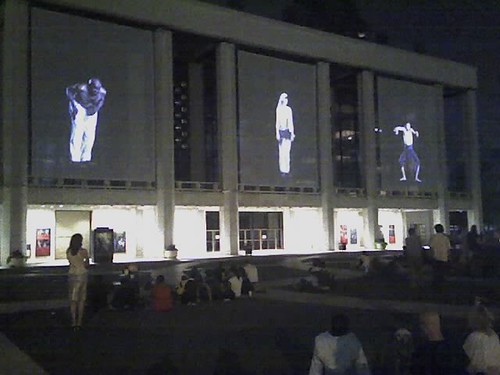
Afterward I walked down 55th Street to the Alvin Ailey studios to see filmmaker David Michalek‘s latest installation, of slow motion videos of the Ailey dancers.


It was cold so I didn’t stay long enough to see all of them. But I will defintely be back throughout the summer!

Happy Fiftieth Birthday to the Greatest Dance Company in the World!


Today marked the beginning of the Alvin Ailey American Dance Theater’s 18-month-long fiftieth anniversary celebration. I was unable to go to the performance since I was at the trial, but fortunately for me — for all of us! — they have events happening throughout the next year and a half, both in NY and throughout the country, and the world. Go here for a list. In particular, they’re going to be performing in several different churches throughout New York / New Jersey, Texas, Georgia, Illinois, and Pennsylvania as part of their Faith-Based Initiative, beginning at the Abyssinian Baptist Church in Manhattan this Sunday. An archive exhibit will be on display in Washington DC in May, and will move to Los Angeles later in the year. And in August, there will be several free performances and open dance classes throughout NYC. And, remember David Michalek’s Slow Dancing videos that I blogged about last summer ad nauseam? Well, he’s made one of Ailey dancers and it’ll be showing on the facade of their studios on 9th Avenue and 55th Street in Manhattan throughout the entire anniversary celebration. Free art, what more could you ask for!

There are tons of events though, so do go here for more details. And please don’t miss them if they come to your neck of the woods on tour. Global tour begins in September, and US in January. Happy year!

My Best of 2007 in Dance

It’s already the second day of 2008 (Happy New Year everyone!) and I’m just now getting my best of last year up; sorry so late! I was tagged by Jen & Jolene, so I’ll formulate my “best of” as a response to their survey:


1) Best Performance of the Year: I had many favorites, but I guess overall I’ll have to say Alessandra Ferri’s farewell performance with ABT in Romeo & Juliet at the Met. She was my favorite ballerina for many years and I’m still missing her. Plus, I was introduced to La Scala’s Roberto Bolle, who guest performed 😀

2) Best Male Performer of the Year: Definitely Clifton Brown of Alvin Ailey!


3) Best Female Performer of the Year: I thought a lot about this, and I know I’m mixing dance genres, but I’m going to say Yulia Zagoruychenko. She had a damn good year. She, with Max Kozhevnikov, made the Latin finals at Blackpool this year, being the only US couple to do so, then, later in the year, went on to displace the several-year-long U.S. National champs to win that title. At the end of the year, she survived a partner change and went on to win her first competition with him, Riccardo Cocchi. She is adored by many both nationally and internationally and she is very deserving of her hard-won success. Go Yulia and Riccardo!


4) Best New Discovery of the Year: This is too hard because there were so many dancers and choreographers whom I was introduced to this year who aren’t necessarily new to the scene, but just to me! List includes: choreographers Camille A. Brown, Luca Veggetti, Luciana Achugar, Kyle Abraham, and Robert Battle; composer Nico Muhly; dancers Kirven Boyd, Antonio Douthit and Yannick LeBrun (all of Alvin Ailey — the last I forgot to mention in my last post on AA; fortunately Susan reminded me in her comment!), and Roberto Bolle (who was new to me this year); Brazilian troupe Mimulus; Nora Chipaumire of Urban Bush Women (pictured above this number) at the Jacob’s Pillow Dance Festival; the Jacob’s Pillow Dance Festival itself (it’s been around for aeons, but I had my first experience there this year). That’s all I can think of for now, but I’m sure I’ll think of bizillions of people I forgot later…

5) Best Regional / Local Performance of the Year: I think this is more of a theater question since there’s usually a big distinction between regional theater and a Broadway show, or a company who tours, but, since physically it was “local,” I’ll say NYCB’s spring season opening night. It was just too much fun watching all those celebrities walk down that red carpet and overhearing goofy crowd comments, and then writing about it all (although my mother was aghast at me for my using the word “whores” in my blog title!)

6) Best Performance in a Non-Traditional Venue: This is a toss-up between the wonderful “Accounting For Customs” performed on the steps of the US Customs House, and the super fun and impossible-to-tear-yourself-away-from Lincoln Center ‘drive-in,’ David Michalek’s “Slow Dancing” films.


7) Favorite Televised Theater Event: I didn’t really have a favorite in this category (since the only thing I saw fitting it was Mark Morris’s “Mozart Dances” on PBS which I didn’t care for), so I’ll just state my favorite dance TV show, which was SO YOU THINK YOU CAN DANCE. Duh.


8) Biggest Dance Obsession: Alvin Ailey, Alvin Ailey, Alvin Ailey. Again, if you’ve read my blog over the past several weeks, Duh 😀

9) Most Likely To Be The Next Big Thing: Eee. Hard! So hard to predict. But I’m going to name a few: ABT’s Blaine Hoven and Vitali Krauchenka,


Kirven Boyd and Antonio Douthit at Alvin Ailey,


Craig Hall at NYCB,


choreographer Camille A. Brown…


Again, I’m sure I’m leaving people out…

10) Most Anticipated Performance Of 2008: Eee, another tough one. There are so many things I’m looking forward to this year. I guess the biggest is going to be Blackpool. Since the current decade-long Latin champs retired last year, there will be a new Latin winner, which is really exciting to me since it’s my favorite event there. I’m hoping for Slavik Kryklyvyy and Elena Khvorova,


I’m also looking forward to Twyla Tharp’s new ballet that ABT will premiere in the Spring at the Met,


And I’m looking forward to Nikolaj Hubbe’s farewell performance with NYCB (he is returning to Denmark). Not that I’m looking forward to bidding him farewell, but to the show NYCB will put on in his honor.

Okay my brain is tired now. If anyone else wants to add their “best ofs” in a comment here or on their own blog, please do so!

Voguish, Mysterious and Visually Enthralling: Shen Wei Dance Arts at the Guggenheim

Early last week I saw Shen Wei Dance Arts give a Works & Process presentation at the Guggenheim. This was my first time seeing this company, although I briefly saw Mr. Shen in David Michalek’s Slow Dancing Films. (I think “Mr. Shen” is right, by the way: first name follows the last in Chinese?…) I know this company has performed at many festivals around the world, and is a favorite of the Lincoln Center Festival, and after seeing their New York premiere of “Behind Resonance,” I know why.

The piece began with a group of dancers wearing unadorned but gorgeous floor-length, gray velvet garments (strapless dresses for the women, skirts for the men) walking majestically across the stage, finding a spot then standing perfectly still, and making a pose. After a few seconds, they would move, walk to another place on the stage, or sometimes in the audience, and do the same, stop in pose. In a sense it was like a fashion show, but I don’t mean that in a bad way. They weren’t making runway poses; rather they were making various shapes with the beautiful fabric. One female dancer leaned up against a side wall, her hands pressed hard against it, and her legs about two foot-lengths apart so that the fabric made a kind of triangular shape, like a large cone. Another would lean over a rail aligning the ramp leading from audience to stage and wrap one leg around it, the fabric stretching over and creating a kind of fan shape.

After several minutes, the dancers began taking various upside-down positions when they stopped. One man sat in the middle of the stage, then rolled back on his elbows and lifted his entire body up, where he held it, his legs spread apart so that the fabric now made an upside down triangle. A woman did a hand-stand against a back wall. It was interesting because, as the dancers walked the material trailed flowingly behind them, like a bridegown. I would have thought as they lifted their legs into the air, the gowns would have fallen straight down, but they didn’t; they stayed put at the dancers’ outspread ankles. The lights were dimmed into a kind of bluish haze and it was so visually mesmerizing.

After a few minutes of this, the dancers now began to pair, men lifting women, both making the triangular shapes now — the men upright with their legs spread about two foot-lengths apart, the women in the air. Not all lifts were the same of course, or that would be monotonous; one man would be holding a dancer in a horizontal overhead position, another would be held upside down, another upright in a back T position behind the man, etc. And not all dancers stopped in pose at once; they each had their own timing. So, as one was posed, another would be in the midst of a lift or finding a position.

Finally, after a few minutes of this, the lights dimmed more, and, as some dancers were still performing the lifts, the curtain widened to reveal two women, now wearing only flesh-toned shorts, rolling together very very slowly on the floor. As they rolled toward the audience, their bodies would become entangled with the other so much so that they began to resemble one, two-torsoed, contorted body. It began to look like a two-headed mermaid crawling on the ocean floor. Then the opposite curtain widened to reveal another female dancer on the other side of the stage, this one alone, rolling very slowly as well, but going backward instead of forward. Her body would slowly bend back, first from the hips, then the waist, then the collarbone, then the chin. When she rolled back at the collarbone, she looked completely headless for a time. Both the ‘two-torsoed creature’ on the opposite side of the stage and this woman looked simultaneously grotesque and beatific. The whole thing was simply enchanting. The music, which I hardly remember since I was so stunned by the visuals, was by David Lang, and was simple with an air of mystery, consisting of a bland background hum spiked with some bells every now and then. And these were only some excerpts from the piece; I’d so love to see the whole.

Though Shen Wei is from China, his troupe is multicultural, as it seems is their repertoire. At times in the beginning of this piece, the dancers would look almost like Tibetan monks, the way they walked in such a determined, straight-forward manner to their chosen destination for a pose, where, even when leaning their bodies in a pained-looking manner against a wall, their faces remained impassive, ascetic. At other times, they kind of resembled elegant Western models.

Mr. Shen recently traveled back to China and throughout Asia, to Tibet and Cambodia. He’s currently making a larger work called simply “Re” as in re-birth, re-newal, re-envision, re-visit, re-work — fill in the blank basically, about these travels. He showed us some slides of pictures he took there. I was most mesmerized by photos of trees in Western China. These enormous trees would somehow grow not from the ground, but atop a building. So, he had these pictures of a gigantic tree centered right on top of a mosque or a house, its roots snaking down the sides of the building. They were eerily breathtaking, just like “Behind Resonance.” I’ll be very interested to see what all Shen Wei does with these images, how he translates them into dance. The project is set to premiere in 2009. In the meantime, according to Danciti, the company will be performing Monday night at Cedar Lake, with many others, as part of the Dancers Responding to Aids benefit, if anyone is going to that. (I can’t afford to!)

Happy Happy Night: Feisty New Dance By Peter Martins and Promising New Ballet Movie!

I really had a nice time last night at New York City Ballet‘s opening night gala program, celebrating the start of their winter season. The highlights for me were the two world premieres — one of a new ballet, by NYCB artistic director, Peter Martins, the other a brief but fabulous excerpt from a new movie-in-the-making of Jerome Robbins‘s jazzy cool ballet, “N.Y. Export: Opus Jazz.” Rather than go in chronological order of the program, I’ll start with the highlights.

I’ve seen a lot of new ballets lately, and this one by Martins has definitely been one of my favorites. Titled “Grazioso,” it’s set to a score by Mikhail Glinka from the operas “Ruslan and Ludmilla” and “A Life For the Tsar.” I don’t know these operas, but the handy dandy Wikipedia tells me the first is based on a Pushkin poem with a complicated narrative, but at one point depicts three would-be suitors vying for Ludmilla’s hand in marriage. I assume this is the part Martins had set his ballet to, as that’s what I perceived “Grazioso” to be about.

And what a mad fun sexy competition it was! Everyone who knows me knows this is exactly the kind of thing I go for 🙂 : men trying to outdance each other with bravado galore. But there weren’t only high, twisty jumps and sailing-across-the-stage-in-a-splits leaps, Martins filled his male dancers’ variations with lots of very intricate, fast, complex footwork that required great precision and agility. And of course these men had that in spades. They were: Andrew Veyette, recently promoted to soloist, Daniel Ulbricht, who is known for his virtuosity and wowed audiences last season with his Mercutio in Martins’ “Romeo + Juliet,” and Gonzalo Garcia, a recent NYCB transplant from San Francisco Ballet, who I find to be very Rasta Thomas-esque. The sassy, daring, very athletic Ashley Bouder, whom I am growing to love more and more each time I see, danced Ludmilla.

One of the reasons I love Ashley is that she just throws herself into everything she does with such wild, intense abandon; she’s very much a risk-taker, which is what Balanchine wanted of his dancers. And, she’s a cute actor to boot. If I was a guy, though, I’d be very intimidated partnering her. She doesn’t really wait for the guy to be ready to go into a lift, she just throws herself up and he’d better be there to take her the rest of the way or else! That’s the way it should be of course — do your own thing and let the man figure out how to support you 😀

As far as the choreography: there was some cute partnering — at one point each man takes turns promenading Ashley around slowly and delicately, trying his best to be the most chivalrous. Then she takes off running, fluttering around all three men in an outer circle, like a Firebird, each one taking her hand and doing a little running lift with her before she rejects him and goes on to the next guy. Gonzalo, probably the best actor of the guys, feigned a stunned, dejected look when she threw off his hand and went into a lift with Daniel. Upon her rejection of him, Daniel simply shrugged and prepared for some more crazy bravura turns. Andrew looked thoroughly befuddled by her behavior, in a cute way of course! I liked these duets better than Martins’s “Romeo + Juliet” pas de deux, but I still think where Martins really excels choreography-wise is in the solo dancing, particularly with the men. As I said, some brilliant fast, fun, intricately-patterned footwork that made for a dazzling competition for Ludmilla’s flighty little hand.

The only thing I didn’t get was the costumes. Ashley was wearing this cute A-line cut, slightly puffed shoulder-sleeved dress with an apron-like covering. She looked like a chambermaid. The guys were wearing these 70s-style black tops that looked like they were made out of stretchy lycra with low-cut V necks lined with florescent colors — a different shade for each man. She looked like she belonged in a Dickens novel, they in Studio 54.

Second highlight was the movie-in-the-making adaptation of Jerome Robbins’s “N.Y. Export: Opus Jazz.” (above image is taken from the film’s website). Craig Hall is a natural film actor, let me tell you! He’s extremely photogenic and he has the subtle acting skills required for on-screen close-ups. They only showed a very brief excerpt but I think this is going to be fabulous when finished. They filmed it in what looks to be a run-down area of New Jersey, overlooking the Hudson River toward Manhattan. There’s a sole train track running through a patch of dead grass surrounded by abandoned buildings, and the filmed piece begins with Craig standing right in the middle of the tracks, a cocky, death-defying look on his face. Pretty Rachel Rutherford approaches him from behind, they perform a series of lifts, she seemingly trying to get him both off of the dangerous tracks and to love her. At the end, he walks away and she looks forelorn.

They were wearing regular, street clothes, I think just jeans and t-shirts. So, the filmmakers are taking the Robbins out of its 50s-era creation and placing it in the present to show how timeless Robbins — and ballet — really are.

And what I really love is that the filmmakers shot the pas de deux from various angles, some from high above, so you’re looking down on the would-be lovers at the different shapes their two bodies are making. It’s so much more interesting than seeing it straight on, from floor level, in the theater. This is what film can do for dance, I believe, really enhance the viewing and interpretive experience by showing different shapes and different viewpoints based on the angle of the camera and the distance of its gaze. I can’t wait for the film in whole to come out. The dancers who introduced it, Ellen Bar and Sean Suozzi, mentioned that it had just won an award, though I didn’t get the name of the festival.

So, the rest of the evening: they began with the Rose Adagio from “Sleeping Beauty,” Beauty being danced with the sweet, charming Megan Fairchild. This is the part where she is courted by four princes, who each take her around in a promenade, then let go of her hand while she performs those very difficult one-footed balances on her own. The new Martins ballet kind of had echoes of that now that I think of it. They also performed “Liturgy,” another Christopher Wheeldon Rorschach ballet. NYCB stars Wendy Whelan and Albert Evans (pictured at the top of this post, on the program’s cover) did the physically demanding, at times very beautiful and, as the name implies, beatific, pas de deux. I think I’m learning to not try to “get” Wheeldon — at least not his pas de deux — but just to appreciate Wendy’s mind-bogglingly, seemingly skeleton-less body and the enchanting, spidery shapes she makes with it. At intermission, I saw Philip and he exclaimed, “wasn’t Liturgy fantastic!” Taunting me! They also did a small excerpt from Balanchine’s “Western Symphony” a cutely raucous ballet celebrating the American West, replete with saloon girls, led by dazzling Maria Kowroski, and cowboys, led by Damian Woetzel. I’d seen him in a Fall For Dance Robbins piece several weeks ago and was underwhelmed by his performance then, thinking he didn’t give it his all. But, happily, he was back in full force last night, dancing and acting the rowdy, spur-kicking cowboy perfectly. Damian really is such a cutie.

They ended with a little filmed tribute to Lincoln Kirstein, this year being the centennial of his birth, and then on to the party, which I’m too poor to attend.

But I did see the set-up. Here’s where I stood sipping a glass of wine at pre-performance cocktail hour, apparently across the room from Sandi. I spied Kristin, and was about to say hello when interrupted by a bartender asking for my order. After I was finished, Kristin was nowhere to be found. There was no red carpet bearing famous people, so I guess there wasn’t much for her to film this time, as there had been for Martins’s “Romeo + Juliet” premiere. As I was leaving, I did see David Michalek waiting for the party to begin, which made me wonder if Candace Bushnell was there… the connection being of course celebrated artists married to star dancers, not that Michalek is venturing into the world of social satire / literary chick-lit 😀

Mesmerizing Traditional Thai Dance Versus Dumb White People Tricks

Last night I had my first Jerome Bel experience at Dance Theater Workshop in Chelsea. I went to see the latest work by the French experimental choreographer known for refusing to return the money of disgruntled customers, entitled “Pichet Klunchun and myself.” In the piece, which the program says is an exploration of “very problematic notions such as euro-centrism, inter-culturalism or cultural globalization,” Bel and Thai dancer Klunchun (who is brilliant, by the way) sit on chairs across from each other, Bel with a laptop on his knees. Bel first interviews Klunchun, asking him about his work, Thai culture, the type of dance he practices — “Khon” — a centuries-old Thai dance, and asks him to illustrate various moves. Klunchun then queries Bel about the same regarding himself. The first half of the program I found fascinating and I recommend that everyone in NYC go see it (showing through Saturday, the 10th) for that reason alone.

Khon, Klunchun reveals, began with a Thai king, who danced himself, and is a celebration of Buddha. The body is literally like a temple, the Buddha contained within both the center of the body and the center of the temple. So, arms legs, hands and feet, like Thai architecture, are shaped so that the energy flows out from the center, down through the limbs and rooftop structures, and is then re-directed back to the center, to the Buddha of the temple and soul. That’s why Thai dancers hold their hands and feet as such, which the fingers and toes splayed and flexed outward and upward. After he gives this explanation and begins dancing, you can really see the arcs of energy radiating out and back and out and back. Thai dancers practice flexing their fingers backward, and he shows us how. Ouch! Bel tried to flex his own, but to no avail. I tried as well, equally unsuccessful. It looks like it takes as much work as balletic turnout.

I found his this fascinating, along with Klunchun’s illustrations. At one point, he walks slowly slowly slowly across the room, showing how the spirit of a character who has died inhabits the stage (this after Bel asks him to feign dying onstage and Klunchun says he can’t; for a character to die onstage is for the king to die, for the country to die). Anyway, in his walks, the feet slowly lift from the floor, almost toe by toe, then the knee slowly bends, the leg rises, lifts, extends out, bends, the foot slowly drops to the floor, the step only ending when the last toe has touched ground. I can’t explain — you just have to see for yourself — but it was mesmerizing. His movements were so perfectly stylized down to the very last detail, so formalized, not a skin cell out of place. It really made me want to see the Thai dancer in David Michalek’s Slow Dancing films again, especially now that I understand the movement. He illustrated the four main characters of Khon: male, female, demon, and monkey — demon being his specialty; monkey he can’t do to save his life (my word choice of course; his language, like his dancing was very formal and ascetic). At first I couldn’t see the difference between the characters, but after Bel asked him to explain, I understood. Everything is so subtle. You have to watch really closely. And you will because it’s really so breathtaking in its simplicity. When Klunchun finally danced the role of a woman learning that her husband had died, I understood every movement, every discreet but articulated gesture to a tee. Beautiful! Bel thought so too.

Throughout Bel’s interrogatories, there were little culture clashes, most of which I felt were forced and contrived. Bel exclaims to Klunchun that Western dance (meaning ballet) also originated from a king — King Louis. But it’s a superficial similarity, of course, as, far from having the energy re-directed to one’s inward Buddha: the French king demanded that his court dancers have their bodies always turned not straight ahead, but toward him, thus the balletic turnout. “You direct your energy out,” Klunchun says at one point, demonstrating a very funny faux grand jete. “Out, out, out,” he said as he leaped through the air throwing his arms up. He was really quite an actor and could be very funny in his deadpan seriousness.

Then Bel turned the tables and asked Klunchun what he would like to know. After the exchange of some personal details intended to reveal cultural differences (Klunchun doesn’t understand how Bel can be unmarried and have a child, for example), Bel gets up and illustrates his work. He plays music from his computer. The song is “Let’s Dance” by David Bowie. Bel walks to center stage and stands stationary, looking out at the audience, eyeing us left to right. After about a minute, he begins jumping around, breaking into an unsophisticated version of club dance. After another minute or two of doing that, he sits. Klunchun, playing the outsider / voice of reason asks him, basically, WTF?? (my words again). Bel explains that in France they had a Revolution during which commoners overthrew all of the royals, sparing no family members. Hence, long live the French principle of egalite. He is deconstructing the spectator / performer dichotomy, showing the audience that he is just like them, no better. “But why then would they pay?” asks the voice of reason. “Well, they sometimes want their money back, in fact,” says Bel. The audience erupts with laughter — clearly these are all Bel groupies in the know about his history. “And do you give it back?” asks Klunchun. “No.” You see, Bel explains, he is a “contemporary” artist — this means not ballet, not Swan Lake, not the Nutcracker. “Contemporary” means there can be no expectations, no preconceived notions. It’s in the present. The government pays him a lot of money to go out and do research on this present state of things, about which he then produces work. He walks back to center stage, throws a vase of pencils and other small object onto the floor, falls down, and pretends to fall asleep atop the objects. Not to sound like a philistine, but I really don’t understand what kind of research one needs to do in order to come up with this, Mr. Bel?

Later, Bel talks about the work I think he is most known for, “Jerome Bel,” in which a man and woman, both naked, come out onstage, stand, look down at their bodies, and begin scrunching together a role of fat from their waists, which they kneed up and down and all around, distributing the fat throughout their torsos. “The body is such a marvel in and of itself,” Bel exclaims orgiastically, “who needs movement!” With this piece, he says, he was trying to explore the bare essentials of theater. What better way to do that than by having a stage with no props, no costumes and hardly any light?

Okay, knowing me, this is the kind of thing I would have thought was brilliant — or maybe not brilliant but something I would have at least been into — when I was in college, so I do see where he has his followers. After last night, I have decided that I am not, however, one of them, if my tone hasn’t made that obvious. Having only seen this one piece of his, though, I could be missing something. Here is another perspective from someone I highly admire.

At the end, Bel has just finished sleeping onstage for several minutes to “Killing Me Softly,” when he gets up and begins to pull down his pants. “No, no,” Klunchun stops him. “I don’t, I don’t want to see you naked, Mr. Bel, it is not right.” “Why,” says Bel unzipping. “Because in Thailand, there are certain people you, you don’t share nakedness with,” Klunchun says visibly distraught. “But, Mr. Klunchun,” Bel snickers, “in Bangkok clubs, there’s lots of nudity.” “That’s different,” Klunchun says, averting his eyes, unable to hide a look of disgust, “they’re, they’re working.” “I’m working too,” Bel says with the tone of a high-schooler. “But in Bangkok, they’re working for tourists.” With this the Bel groupies moaned as if the skies had parted. The international trafficking of women as sex slaves has long been one of the most disturbing social issues to me, so this may well not be everyone’s reaction, but I found it completely insulting that Bel assumed that I didn’t already know the truth of Klunchun’s last line, that that was supposed to be a revelation to me as a white person.

Anyway, as I said, “Pichet Klunchun and myself” is totally worth seeing for Klunchun alone. Who knows, you may up enjoying the deconstructionist French guy as well. Go here for tix.

Watching "window" by bill shannon

Watching “window” by bill shannon

Originally uploaded by swan lake samba girl via mobile.


This was so cool! Review to come. Definitely try to go if you can!

Okay, now that I’m back at my desk I can write more. Bill Shannon’s “Window” is the last of the works shown as part of the Lower Manhattan Cultural Council’s “Sitelines” series (consisting of site-specific dance performances) in its “River to River Festival” for this year. (“River to River” takes place downtown each summer). The two others I was able to see, I blogged about here and here.

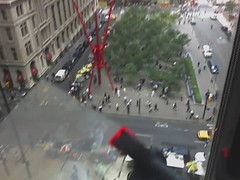
I really really liked “Window.” Bill Shannon is a disabled dance / conceptual artist who uses crutches. (If you’re in L.A. right now, he is one of the performers included in the David Michalek “Slow Dancing films” exhibit.) Here he and three other men — one wearing black pants, top and hood, one wearing all white, and one dressed in a business suit — performed break-dance and hip-hop out on Liberty Park Plaza while Shannon, skateboarding on crutches, zoomed around on the streets surrounding the park. At points Shannon would skate into the park and dance, very well mind you, on the crutches.

There were two sets of audiences: the random passersby in the park and on the street who got caught up in all the commotion; and us, those who RSVP’d to the event through lmcc’s website and were escorted into the 8th floor of the high-rise at 140 Broadway, where, amongst the bemused real-estate brokers who regularly inhabit the office, watched the scene down below through the window. A couple of camera people outside filmed the performances by Shannon and the three others and those films were projected live onto four screens inside, where we stood. One screen was set up in such a way that it would reflect on the ceiling, where you got kind of an upside-down version of what was going on outside. The filmmakers also played with the projections a bit so that the colors of the dancers’ clothing would change, or, at points, the dancers would be projected onto a different background; at times the images looked rather 3D. So, you had your choice of watching what was actually going on outside through the window, or the way it was projected onto the screen, as intermediated by the filmmakers.

They also had speakers set up inside, which played a variety of hip hop, techno and pop music. Shannon had headphones bearing a small microphone so he danced to the music and interacted with us through the mike.

I preferred watching what was actually going on through the window, partly because, Liberty Park being so big and crowded, everytime I took my eyes off of Shannon, I lost him. I also found it more interesting seeing how normal everyday besuited business people and tourists, not expecting to see a show — and a rather odd one at that (I didn’t see any speakers down there so assumed they couldn’t hear the music and only saw a bunch of guys rocking out to silence), interacted with him. Of course this being New York, most pretended not to notice him at all, although you could kind of see them spying him out of the corner of their eyes. They didn’t have the roads blocked off and at one point I thought he may be hit by a large white van barrelling down Liberty Street, but the driver thankfully saw the crazy guy bopping around on crutches whilst skateboarding and slowed to a stop. “Whoaaa” Shannon sang over the speakers.

At the beginning, Shannon looked up at us and called out, “How do you put rhythm into a city? How do you make a city come alive?” while clapping his hands above his head and shaking his hips to the percussion like a rock star. There was something at first eery but eventually comforting about watching him rockingly skateboard around what was once a triage unit, the construction site that was once Ground Zero and before that the World Trade Center diagonally behind him.

I Am Goin’ to Nationals!

Just got my plane ticket for Nationals, coming up at the beginning of September, in Orlando, Florida, where I’ve never been! I was actually pondering saving money and not going this year, but my friend, Michele, blasted some sense into me: it’s going to be far too exciting a year to miss. Am now trying to fill out above form to reserve my event tickets — $70 for Saturday night comp and $60 for Thursday and Friday night each — I do wish it wasn’t so expensive, but at least they’ve moved the competition to a cheaper hotel; last year it was in swanky Palm Beach, and the only hotel in the vicinity was the, basically, ten–star one in which the competition was held.

So, no alligators this year 🙂 (Last year, I took a brief excursion from competition madness to visit the Everglades)

Anyway, this is going to be a big year. Because of a couple of important retirements, new champions will be crowned in two events: American Rhythm and American Smooth.

I’m hoping Emmanuel Pierre-Antoine, my former teacher and an excellent dancer, will do well in Rhythm. Well, I know he’ll do WELL, but will he win is my big question?!


Or will the king and queen of rhythm be Emmanuel’s former partner, Joanna Zacharewicz and the super cute Jose deCamps?


We’ll know Thursday, September 6th, late late LATE night (these competitions are definitely for night owls)

The highlight for me though is always the International Latin. It’s always a showdown between these two:

current national champs Andrei Gavriline (my favorite American man) and Elena Kruyshkova, and


my favorite American woman, Yulia Zagoruychenko, and her partner Max Kozhevnikov.

They also have an open-to-the-world category, in which dancers who are not American residents or citizens can compete. Last year I was just in heaven — my two favorite Latin dancers in the world competed in that category: Slavik Kryklyvyy, who is just about my favorite dancer period (excepting this one of course of course:) ) (Slavik’s dancing here with Elena Khvorova)

and Sergey Surkov (parterning Melia).


Oh, I hope so so SO much they compete again this year. I’m thinking Slavik may not, may have only competed last year because he’d just broken up with his old partner, Karina Smirnoff and was testing out a new partnership before the really important world comps, but I really do hope he shows at this one. Otherwise, I’m stuck waiting until next May for Blackpool to see him again…

Two people I’m fairly sure who won’t be there are the couple I always long to see of course: Pasha and Anya, who are, sigh, off to bigger and better things these days… Of course I’m so happy for them, but it is sad knowing I’ll likely not see them compete at one of these events again. I’m thrilled though that so many opportunities are opening up for professional ballroom dancers. The same couples win these competitions year after year after year. And, while it’s always fun for us spectators to watch, I can imagine how frustrating it must be to be a professional dancer knowing you’re likely going to place exactly where you have been for the past umpteenth years.

Anyway, unrelated to the USDSC, here’s some interesting stuff I found on the net:

1) Boris Willis has created a funny little “manly dance” for me, apropos of all my blogging on Bad Boys of Dance and Ted Shawn’s Men Dancers, etc. etc. etc. Thanks Boris!

2) The artist David Michalek, who made those Slow Dancing films I was going on about forever, has linked on his site to a bunch of us bloggers who covered the exhibit. So very cool to see artists taking bloggers so seriously and considering us to be our own little form of press! And, I noticed by reading down his list of bloggers that Alex Ross, classical music critic for the New Yorker, posted a couple of pictures of the event on his blog, one of which intentionally includes both Midsummer Night Swing and Slow Dancing together like many of mine do. I’m glad someone else found the two events coinciding with each other interesting. He describes them, though, as “juxtaposed surreally” with each other in the photo. I’m still interested in why people think it’s odd that an exhibit of filmed dancers should coexist with people actually dancing, that people could enjoy both the physical experience of dancing themselves and of watching dance. To me it seems ideal, not surreal, to have these two events co-occur.

3) Root Magazine, based in San Francisco, is having a little thing on burlesque right now. There’s a write-up on a group that has its origins in Samba, which I found interesting. Root’s editor also deals with the feminist issue, which makes me happy.

4) And, finally, as I’m sure most people already know but I was a bit late to discover (oops 🙂 ), there’s a blog devoted to SYTYCD called, appropriately, Blogging So You Think You Can Dance. It’s really pretty good: they have links to practically everything extant on the internet dealing with the show, and they give detailed, fairly objective write-ups of what happened each night (which is great for me since I’m always out and missing it!) Thanks guys 🙂

Samba & michalek – perfect combo :)

Samba & michalek – perfect combo 🙂

Originally uploaded by swan lake samba girl via mobile.


… and Desmond Richardson of course (in the background)! I swear they seemed to be moving faster tonight — the Michalek dancers I mean! Maybe it was just an effect of the fast, fun Samba of the Midsummer Night Swing event, or maybe it really was sped up a bit, especially in some of the middle parts?… Hmmm… Maybe it’s just that I’ve seen the exhibit so many times now that I have no perspective anymore! Anyway, something about it made it especially spectacular tonight, and it’s definitely growing on me more and more each time.

And then I got home just in time for the horrible results on STYTCD. I’m so upset about Anya. She is a really beautiful, rhythmic dancer and I’m really going to miss her on the show. I don’t know how the other two female contestants performed tonight, but I do know that as far as ballroom goes, Anya Garnis is one of the very best in this country. Oh well, what can you do? Good news is that Pasha and Danny will be touring 🙂 🙂 🙂

Poetry in Silence: My Last Post on the Michalek Exhibit, I Swear!

Okay, I’ll have everyone know that it is currently between the hours of 9 pm and 1 am and I am NOT, I repeat NOT, on Lincoln Center Plaza!!! This is a huge step forward for me; yes, I feel that I am steadily on my way to overcoming my addiction…

Here are some pictures from last night, Sunday, when I attended “Slow Dancing” for my fourth time in, yes, the mere four days the exhibit has shown, this time with my fellow blogger, Oberon. It was a “schmoozing with the artists” night for us:

Oberon cutely peeking over his shoulder at me. And, in the background is Michalek (in red bandana) talking to the filmed dancer on crutches, whose name I now know (thanks to the playbills near the State Theater entrance 🙂 ) to be Bill Shannon, or “Crutchmaster.”

And here is Philip with his favorite ballerina, the spectacularly amazing, and, given her enormous status, almost ridiculously nice and personable, Wendy Whelan:

Sorry to be going on about it ad nauseam now, but I’m just so excited about this exhibit because I feel like it has so much potential to be really powerful. It’s like ballet for the masses, and I LOVE it.

Interesting thing about last night was, unlike the previous ones, there was no Midsummer Night Swing. So it was shown in stunningly dead silence. At first Philip and I were thinking, hmmm, this is going to be odd without music, maybe they could have classical or something?… But then after it began we agreed it was really quite beautiful, really poetic this way. Actually, it was more like a regular concert dance performance, like being at the ballet, but outside. And in this poetic silence, I feel like my previous suggestion of having the dancers’ names on the screens, would be as ludicrous as having an announcer yell out names, SuperBowl style, during a Met performance. But then, I still think it would make good sense to post the names prominently during the MNS crowd, because those people are not going to go running up to the State Theater to pick up a brochure or search for a poster; in that context, it needs to be easier.

Anyway, the lack of raucous crowd enables you really to focus on the odd beauty of the movement; I saw many things I’d missed before. Of course I had Philip and Wendy as guides. Wendy told us to watch for Allegra Kent, a former prima ballerina who danced many a performance, with the New York City Ballet, right inside that State Theater. At the start of her routine, she briefly turns her back to you, the viewer here, in order to face her beloved theater, and, inside, her audiences past. She raises her arms up high, in eternal gratitude to them, to what happened beyond those doors, now long ago. It’s such a poignant gesture of reverance to those fans, to the past, and, given who she is, to ballet history in general, and you just want to cry.


And I guess that’s why I want there to be a way of spreading that message to everyone; if you don’t know who she is, I fear she may just look like some weird lady casting a spell or something, you know? And that would be just a travesty.

When Janie Taylor came on, Philip squealed, grabbed my arm and galloped, dragging me along behind, over to the far right of the plaza, beyond the Midsummer Stage, where we could have a full view — something that definitely wouldn’t have been possible if it was a social dance night.

“Oooh, her hair, look at her hair, look at her hair!” he screamed, flailing about so wildly he really could’ve knocked me out had I been a little closer. Funny, but that flying mane did look cooly like a waterfall this time. Philip should be a professional laugher, or whatever those people are called who get paid to fire up the audience.

So, I dunno; I feel like my perception of the event, of the spectacle, varies on the context. There was still a congregation, but of course nowhere near the size of that on a Midsummer Night. It was a night for the true diehards. I’m glad I saw it when it was quiet and I could really concentrate (and meet Wendy!), but I still love watching with the Swingers, seeing what they see. (Thanks, by the way, to Michele, who commented on my last post, giving her view from that salsa mosh pit!) I have seen many of the social dancers, taking breaks, stand back and gaze up, and try to imitate some of the moves. You develop a dance aesthetic as a watcher / participant and it’s fun to try to mirror those screen giants, so long as no one gets hurt with some crazy over-the-head leg extension… 🙂

David Michalek's "Slow Dancing": A Good Idea But Poorly Executed (*Update in Bold)

Hehe, my friend, Ariel Davis, a young journalist currently in NYC for an internship with a big magazine, emailed me bright and early yesterday morning to tell me that we were quoted in the NYTimes! Of course I immediately scoured the article. Well, we weren’t actually quoted, in that our names weren’t listed, but we were the ones exclaiming, “he looks like a god,” the top quote in Claudia LaRocco’s write-up of the opening night of the Slow Dancing films I’ve been mobile-blogging about for about the past fifty posts now. (I promise to stop soon with the cell phone blogging; it’s just so exciting, in its own way). Anyway, the “god” Ariel and I were speaking of was Herman Cornejo of course 🙂

Anyway, I’m going to see it several more times before it leaves NY, but so far my thoughts are that the project is a great idea that has some real kinks to work out.

For starters, Lincoln Center is really annoying me and if I was Michalek I would be pissed. Slow Dancing starts at 9 p.m and continues until 1:00 in the morning; Midsummer Night Swing ends at 10:00 p.m. But after the MNS band stops playing, Lincoln Center really shuts down: the alcohol and snack bars all close shop, making it impossible to enjoy a drink with friends while watching the films, and, more seriously, a very noisy cleanup begins. The Aquafina guy noisily dismembers his metal booth then hauls it all, bit by bit, to a huge garbage-like truck waiting, motor running, in the nearby taxi cab lane; the bar guys clinkily clear bottles and glasses from their shelves; garbage collectors noisily bag trash and load it onto little trucks, which they drive dangerously through the crowd darting in and out and around groups of people, sometimes even honking if you don’t see them coming — how’s the audience supposed to focus on the film with all this crap going on? You feel like Lincoln Center’s telling you it’s time to go home now, show’s over, you’re out past your bedtime. Until July 29th, when this exhibit ends, could they possible re-arrange clean-up schedules? It’s hugely disrespectful to the artist and his audience.

As for the project itself, I think it’s a great idea and it seemed to work well when I saw it indoors at the earlier Works & Process event at the Guggenheim Museum, but for some reason, it’s not as exciting outdoors on the huge Plaza. I think part of my being so captivated at Guggenheim stemmed from the fact that I know and love all three dancers who were showcased that night: Wendy Whelan (ballerina of New York City Ballet), Herman Cornejo (American Ballet Theater), and Desmond Richardson (Complexions). But the vast majority of the dancers participating in the whole project I don’t know, or at least don’t recognize.

As LaRocco alludes to in her article, not a lot of the people on the Plaza for Midsummer Night Swing paid much attention to the films, unfortunately. Several heads did turn when the screens first lit up, and people watched for the first couple of minutes, but when they couldn’t see very much happening, they returned to their own fun. LaRocco bemoans that these social dancers, themselves participating in Dance, are ignorant of those on the screens, many of them the greats of ballet and modern dance.

Well, why should those dancers, having such a blast learning to dance themselves, stop what they’re doing in order to worship these people on the screens, whom they don’t know? Might someone, perhaps, tell them who they are?

From what I’ve seen so far, here are my critiques of the project:

1) No one knows who the dancers are and no one is bothering to tell them. If they’re not going to have easily available pamplets listing the names and credentials of the dancers, with pictures, could they run the names and a brief word about who they are somewhere prominent on the screen, at least at the start of each performance? Names humanize people. I’ve noticed this watching people watching filmed ballroom dance competitions — people who aren’t really seriously into the art of ballroom just kind of glance at the screen and look away after all of a minute — there are far too many people out there on the floor at once, it’s too much to take in, it’s confusing and nonsensical.

But once names are placed over the dancers (briefly, not for the entire time the camera’s focused on them of course), people pay much more attention, even if they’ve never heard the name before (which is highly likely). You think, ‘oh that couple’s obviously from Russia with huge names like that,’ ‘oh a Japanese couple,’ ‘wow, another Russian; a lot of Russians in ballroom, who knew…’ ‘oh wow, those are the national champions, yeah, they are really good,’ etc. etc. Names humanize. A little bit of info goes a long way.

Update: I went again tonight (Sunday), with Oberon, and found that there are little Lincoln Center playbills near the entrance to the State Theater, along with a poster, both giving the names and a brief background of each dancer next to his or her picture. I still like the idea of printing the names somewhere on the screens though! Also, I met Wendy Whelan tonight — she’s a very sweet person! Here is a picture of her and Oberon. Awww 🙂

2) There are either too many of the same types of dancers or there’s not enough variety and spontaneity in the rotations. At several points, there are two to three dancers shown all at once who are all doing modern. This is boring and reductive. Also, can everyone not be dressed exactly the same? Wendy Whelan and Janie Taylor are ballerinas but they’re both dressed in the same silky flowing gowny things as about ninety percent of all the women. To someone who doesn’t know dance, it could be confused with yet more modern. Couldn’t at least one be in a tutu and on pointe. And, could someone do a fouette or multiple pirouettes? The movement is too much the same. It would be much more interesting if there was, say, in the middle a classical ballerina on pointe in a tutu doing fouettes, then say the African dancer guy on one end, and maybe William Forsythe doing his modern on the other end; then shift in the next sequence to the bellydancer, adjacent to the head-spinning break dancer, and sandwiched in between, the drag queen; then next sequence, say the guy on the crutches, the pregnant woman, another ballerina; or have a ballerina surrounded by a strong ballet guy and one of the modern women. Just make sure there’s variety in every sequence of three. That makes it interesting and it’s more of a celebration of Dance, in its rich variety.

3) I realize the point of the project is to show movement in extreme slow motion, but I feel that it is too slow. At points you can’t even see the dancers moving at all. This actually may be a glitch in the film, because at some points I think the films have actually stopped for a while — sometimes even for as much as a full minute. This is confusing to the audience, who is already perplexed enough trying to figure out, as LaRocco illustrated with one couple’s conversation, if there actually is movement. Possible technical problems aside, though, the movement is generally still too slow. Instead of people admiring every detail of the body in motion, every ripple of a muscle, the audience just gets bored, especially if the dancer isn’t “flashy” enough. These past couple days I’ve become most fascinated with Glem Rumsey, who dances here as his flamboyant drag persona “Shasta Cola.” I find myself waiting for him to come on because I know I’m going to be most entertained. In contrast, one of the dancers I was most excited to watch was Janie Taylor. Yet, I find myself getting unexpectedly bored when she’s on here. She does nothing really over-the-top; no spectacular balletic feats. Even that crazy hair flip that generated a lot of press talk pre-show opening — it’s nothing; I almost missed it. There’s no appreciation for subtlety when the movement is this weighted down. The guy on crutches is initially intriguing because you’re wondering what he’s going to do, but you get bored and stop watching when he takes so long to get going. All of a sudden you look back and him and he’s in the air. You think, ‘oh wow,’ but it still doesn’t hold your attention for long because it takes a number of minutes for the guy to do one rotation. You lose interest. Same thing with the Whirling Dervish. Slow-mo can have a very dramatic effect, but not when it’s this slow.

My own personal favorites are Herman Cornejo, Desmond Richardson, William Forsythe, and the aforementioned Rumsey, all of whom, excepting Rumsey, I’m pretty sure I like simply because they’re already so familiar to me. I’m bringing a bunch of friends to the show over the next couple weeks, many non-dance-goers, so will be interested to hear what they think, who their favorites, if any, are. Will most definitely report back!

In the meantime, I’ve started an album on the photo page; I expect to add more pictures, but here are the first few.