AMERICAN BALLET THEATER’S PROKOFIEV PROGRAM


On the Dnieper grew on me after seeing it the second time on Tuesday night, with the new cast, although I still generally preferred the first cast. If you missed my earlier post on Ratmansky’s new ballet, it’s here. Second cast was: Jose Carreno as Sergei the returning soldier; Hee Seo as Natalia, his betrothed; Diana Vishneva as Olga, the flirt who steals his heart; and Alexandre Hammoudi as Olga’s volatile fiance.

I absolutely loved Diana as Olga. She and Hee Seo, who was excellent as well, really drove home the ballet’s pathos and heartbreak. A BalletTalk poster said that with Diana, Olga became the central character and I think they’re right. Diana’s Olga was the most dynamic character in the whole thing; she really underwent a change in those mere 40 minutes. And it was believable. She starts out this carefree and careless flirtatious girl, frolicking around, teasing Sergei, teasing her boyfriend. And when her flirtatiousness with Sergei sets the whole disastrous string of events in motion — Sergei falls for her and she for him, her fiance has an emotional breakdown and beats Sergei, her parents are distraught, and she realizes what she and Sergei have done to poor Natalia — she really grows up, overnight, becomes a totally different person, takes responsibility for her actions. When she and Sergei bow to Natalia at the end in a prayer for forgiveness, before running off to their new life together, you feel equal heartbreak for both women.

Hee Seo and Veronika Part were equally compelling, although Seo seemed a little younger and more naive up front and I didn’t notice the holding out of the arms and the resting of the head on the shoulder like I did with Veronika. Jose, who’s generally ABT’s best actor I think (he never overdoes it; everything is authentic), was good as Sergei, but different from Marcelo. Jose seemed to be searching for something at the beginning, trying to rediscover his hometown with those short, staccato steps in each direction. His movements at the beginning were more modern than ballet, sharp and staccato at points, like he was unnerved that he didn’t recognize things or that things were different. (That kind of movement is more visible on a smaller body though.) Marcelo didn’t seem as sad or desperate up front. But then when torn between the two women, with Jose Iย  didn’t notice the back and forth of the jumps, this way and that, as I did with Marcelo. The jumps first to one woman, then the other, are my favorite Sergei movement trait, along with the throwing himself to the ground in anguish, almost like a half push-up.

Alexandre Hammoudi was a very different fiance from David Hallberg. Alexandre was quieter, especially up front, not seeming to realize the potential dangers of Olga’s flirtatiousness. He underwent a character change, like Diana’s Olga, then, becoming aggrieved and angry when he realized what had happened. David was more volatile up front, as if that was fundamentally part of the fiance’s character. Those extremely fast-paced steps during his anger scene were not as pronounced with Alexandre as with David. It looked more like he was kicking up leaves (which they had strewn on the ground); with David he was using those feet like daggers. David made such an impression with that character, and specifically that going nuts scene — I’m never going to forget it; I’m never going to forget that insane, almost terrifying, tap dance.

Okay, can I stop talking about this ballet now and focus on the other Prokofiev pieces?!

I generally wasn’t in love with Desir (photo at top of post) by James Kudelka, at least not as it was danced here. The movement is lovely and much of it original and the dancers are excellent but something was just lacking and I can’t figure out exactly what. It’s a ballet about several different couples, and I think my problem is that all the couples are basically the same, at least the way it’s being danced by ABT. With someone like Tharp or Robbins, different couples have different issues — there’s a romantic couple, a sexed-up couple, a fighting couple, etc. Here, the first two couples on first, dressed in fiery red — the women in long, flowing dresses that really whirl when they turn, the men in brown pants and long-sleeved colored tops —ย  both seem passionate and in love, all but Gillian Murphy from the first night’s cast, wearing bright smiles. But I don’t know if the happy smiles are supposed to be there. Some of the movement is rather chaotic. The woman seems to want to go one way and the man keeps turning her the other, mid-air. Gillian was the only one who made this dramatic, as if there was something not quite right going on between the characters. Apollinaire Scherr noticed that as well; read her very insightful comments on the whole program here (scroll down).

Then we move to a set of four couples, all dancing at once. My favorite part of the whole ballet is the men of these couples. At one point, men and women split and the men all dance together, followed by the women doing a group dance. When the men group dance in this way, each is doing his own thing — one jumping arms up toward the sky as if in ecstasy, another jeteing back and forth as if confused, another spinning himself into a whirlwind, etc. Then the women dance and they all do exactly the same thing — hold up their skirts and tip toe around, jump waving the skirts all about, all in unison, in sync. They’re all the same character — what does this say about men and women? Then, the couples pair up again, each man to a woman, and there’s one really funny part where the women stand still and the men do a bunch of high, twisty turning jumps,their limbs flying — as if to protest, “what’s up with that?,” “how can you say that to me?” It’s very funny, very evocative of real life relationships. The audience seemed to laugh louder on the first night though.

Still, in all, the couple who stood out to me the most is the more adagio one with all the beautiful lifts. The second night it was danced by Jared Matthews and Maria Riccetto, who were very good, but there was just something extra special about Cory Stearns and Isabella Boylston that really took my breath away the first night. Another performance I’m not going to forget.

And then Prodigal Son. This isn’t really my favorite ballet and I don’t honestly see how critics can trash Boris Eifman so and love this. What’s with all that fist-pounding on the thighs, the wide-mouthed screams at what, being asked to get water from the well with his sisters? How melodramatic is that? I know it’s a classic now, but I feel if it premiered today people would laugh and roll their eyes. Unless Balanchine meant for parts of it to be funny, like that up front melodrama, and the “sex” scenes. Anyway, read Apollinaire’s comments about Prodigal too, though; she made me appreciate it more, and talked about how certain dancers can play up the immaturity in those early thigh-pounding scenes so that it doesn’t look so full of melodrama.

Herman Cornejo as the son and Michele Wiles as the Siren danced the leads on opening night; Angel Corella and Kristi Boone the second night. Unfortunately I have to miss the third cast — the magnificent Daniil Simkin and the tantalizingly beautiful Irina Dvorovenko. If anyone sees them, please report! I’m dying to know how they do together!

Herman was excellent dance-wise. As expected, he nailed all those high-flying, angst-ridden jumps at the beginning. He danced a little more carefully than Angel, who had a minor slip at the beginning, then looked like he might fall on his way down that slide in the middle section. But I felt Angel delivered on the drama better; he took me through the emotions with him. The way he watched his Siren, he was like a little boy mesmerized. It made you mesmerized by her too. And then the way he danced with her — it was like an awkward, boy losing his virginity, sex scene. I’ve never seen it quite look like that before, though it’s probably supposed to! Then when he was robbed and left to die (Herman was really shockingly stunningย  in this part too — he was a horrid sight, his body up there, leaning almost lifeless against the cross-like slide), and came crawling back home body all dirt-encrusted, then into his father’s arms, like a baby. It does end up being very emotionally compelling, silly as it is at the top. I’d like to see Herman in this later, after he’s had a few goes at it. I think if he could up the drama more, he’d be perfect.

Kristi so far has been my favorite Siren! This role I find a bit inherently awkward too — all that wrapping the long train of her costume around her legs, crouching to get it between her thighs. It almost always looks more weird than sexy, but somehow Kristi whipped the fabric around so fast, it was spellbinding, practically had a dominatrix feel. And then when she does those — what I call upside-down crab walks — where she’s on her hands and toe pointes, belly up and she walks past him develope-ing her legs up with each step, spider-like — most dancers kick straight up, but Kristi’s developes went all the way back, practically to her chest. It looked so much more tantalizing than I’ve seen that before. Kristi’s pointed toes are so pronounced, her feet practically look like ensnaring sickles — she probably has a better Siren body than anyone (except for maybe Veronika Part — I wonder if she’ll ever be cast?)

Okay, I’m done. Sorry I keep writing so much! If anyone sees the Daniil / Irina Prodigal cast, please let me know!
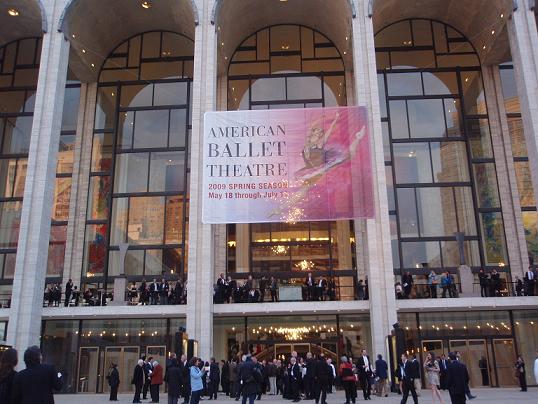
AMERICAN BALLET THEATER OPENING NIGHT!

p5182145

Yay, the season has offically begun! This picture was taken during intermission; that’s why it doesn’t look that crowded. I was sprinting in, nearly late, as usual, so didn’t have time to snap some pics before the performance but fortunately it was still light outside during intermission.

Anyway, Michelle Obama (who served as one of the gala’s honorary chairs) looked smashing in a sleek dark grey sleeveless, knee-length dress with tiny black ruffles lining the bottom. I’m sure there will be beaucoup des pictures seeing as how many blasted camera people there were; I’ll be sure to steal some when they’re posted on all the society websites ๐Ÿ™‚ (Oh, look, here it is in the NYTimes already)


It was just about the craziest thing I’ve seen on the Met Opera stage: after Veronika Part’s mouthwatering Mozartiana opened the show, artistic director Kevin McKenzie came out and thanked everyone who needed thanked — all the donors, designer Caroline Herrera who funds the gala, etc., and Senator Chuck Schumer came out and gave a little talk about the importance of funding for the arts, etc. Then, Schumer disappeared behind the curtain and moments went by. Everyone kind of looked around at each other like “what’s going to happen next?!”

Soon, the curtain was pulled back to allow some people to carry out a podium with a banner “American Ballet Theater” draped over its front. The doors to the lobby opened and a flock of people bearing weapon-sized cameras blasted in. Several men dressed in black promptly rose from their aisle seats and followed the flock of weapon-camera-bearers to the front of the aisle, near the stage. Caroline Kennedy was announced. She came out, everyone applauded, and she mentioned that the school of ballet associated with ABT, the Jacqueline Kennedy Onassis School, would be performing on the Met Opera stage for the first time ever tonight. Everyone ooohed and aaahed. Then, she announced First Lady Michelle Obama.

The curtain pulled back again and out she came. Of course everyone gave a standing ovation. She smiled radiantly, then, after a moment, directed us to be seated. Then she gave a short speech. It was a little hard to focus on what she was saying with everyone — both professional photographers and audience members with cell phone and digital cameras alike — flashing away as they were, but she talked about the necessity of the Arts for a culture to flourish, the importance of arts education, etc. Then she introduced the Jacqueline Kennedy Onassis School students.

As soon as she disappeared behind the curtain, the auditorium remained still pending the exit of the flock of pro camera wielders. It’s funny because there were all these non-dance writers in the press section. You could hear the sighs of relief, the sinking down into the chairs, and the putting away of pens and paper — and cell phones, which they’d used to light their writing paper during Mrs. Obama’s speech, which would have been extremely annoying had it not been for all the flashing bulbs anyway. But it made me wonder how they’d ever survive as performing arts critics! I mean, who needs light to see to write!

Anyway, the students were excellent. They performed Le Defile (The Procession) by Raymond Lukens. There were three large groups of them, in three levels — the very little ones, a medium-age / level group, and the older, very advanced ones. The choreography was basically a showcase of classical ballet steps, much like a very advanced ballet class — jumps, jumps with changing feet, jumps with changing feet that went on forever performed by a set of advanced boys (which drove the audience to wild applause), jetes, chaine turns, multiple pirouettes, fouttes, etc., and then a bit of partnering. It gave the students a chance to show what they could do — and the advanced ones could do a great deal! Extremely impressive, and great fun.

Then on were Xiomara Reyes and Herman Cornejo doing an excerpt from August Bournonville’s La Sylphide. This was the most dramatic I think I’ve ever seen Xiomara. I was sitting in the back of the orchestra and she really projected. She was really sweet. And Herman as always amazed with his virtuosity, his jumps, his razer-sharp precision, his astounding clarity of line.

The corps in both this, La Sylphide, and Swan Lake, later in the evening, were absolutely amazing, by the way. Not a head arched back more than the others, not a leg raised higher. They were all so on. When they work together like that, in perfect unity; it’s really visually breathtaking.

Then was Balanchine’s Tchaikovsky Pas de Deux danced by Ethan Stiefel and Gillian Murphy. Ethan and his strutting around stage, taking his own good time after their duet and before beginning his solo, making the conductor wait for him! And his high jumps with all miraculously many beats of the feet. I wished my friend Alyssa could have come so she could see he’s not just Mr. Sexy; he’s a superb dancer. And Gillian was radiant, and a perfect foil with her speed-of-light chaine turns. They enjoyed a long, slow kiss during the curtain call. The audience went mad!

Then was the hunt scene from Sylvia danced by Michele Wiles followed by a piece d’occasion (the first of two of the night), by Alexei Ratmansky, for Nina Ananiashvili, called Waltz Masquerade. It was set to the Waltz from Aram Khachaturian’s Masquerade Suite and it was cute and comical. She was dressed in this long, red dramatic, Carmen-like dress with a sexy black lace overlay on the top. There were four tuxedoed men, each bearing a gold candlelabra, one at each corner of the stage. These men turned out to be: Jose Carreno at the front left corner; Marcelo Gomes, at back left; Angel Corella back right; and a blonde on the front right who I initially thought was David Hallberg (I was sitting FAR back from the stage!) until the fun began and he shook his head about like a sassy mop and I realized DH just does not have enough goofball in him to do such a thing, even if he tried. So, I decided it was either Ethan or Maxim Beloserkovky. Anyway, Nina’s character was supposed to be dancing about the stage in a melodramatic solo — but it was purposefully melodramatic, and so comical. Like a silly, cartoon version of an upcoming swan song, really, which, is of course, what’s coming up for her later in the season (and will be much more sobering when it does). At one point, she just passionately crashes to the ground and remains there, in a heap. Nothing happens. The men, obviously her servants, start looking at each other like, what now? They shrug, slowly walk over to her. Then, Marcelo starts imitating her melodramatic dance, but far more cartoonishly, and of course it’s hilarious. The others join in. Max (I think it was Max, not Ethan) does his thrashing hair thing. I couldn’t see facial expressions but I assume they were making fun of their master. Then she wakes up, catches them, and they’re sent back to their posts.

After intermission was the balcony pas de deux from MacMillan’s Romeo and Juliet, danced by Marcelo and Diana Vishneva. At first, Diana approaches her balcony with all the drama of a ballerina playing Juliet, rather than Juliet herself. I rolled my eyes. This is what I don’t like about her. She’s an excellent dancer but she’s all about the pomp and circumstance and not about the character. Maybe it’s a Russian thing, but I don’t see that in Veronika Part or Irina Dvorovenko. Anyway, she eventually lightened up, thankfully, and I felt like I was watching not a prima ballerina being a prima ballerina but Juliet herself, falling hopelessly in love. When she runs around him one foot solid on the ground, the other on pointe, it’s so girlish, so real yet so poetic. Those are the best — I don’t know what to call them — runs around kneeling Romeo — that I’ve ever seen — not even Alessandra Ferri’s were that sweet. Still, I felt some of the lifts lacked the beauty and magic ofย  those Marcelo and Julie Kent do together when they dance this scene. I don’t feel she dances that well with a partner; she’s more into herself. Marcelo’s leaps around the stage and big high passionate jumps were thrilling. He got some good bravos for those.

Then were Paloma Herrera and Max Beloserkovsky in the Act II pas de deux from Swan Lake. I was hoping it’d be the Black Swan pdd, but no. I guess the program was pretty bravura-heavy already. I don’t see him dance much, but Max is really quite good. He’s really a character and he’s the perfect Prince Siegfried, regal yet vulnerable and tragically in love. And he’s a good partner.

Then was the mad fun of Le Corsaire, with Irina Dvorovenko, David Hallberg as Conrad, and Angel Corella as Ali. Except something happened at the beginning and I hope David’s okay. The tallest guy in the entire opera house had to sit in front of me and I was trying to navigate my way around his enormous head just as a bunch of people up front went “Oooooooh!” When I was finally able to see the stage, Irina was standing in front of David, face toward the audience. She didn’t seem to have any particular expression on her face, but, then, I was light years away from her. Then David did an assisted pirouette with her and everyone applauded, so it must have been a lift that didn’t quite happen or something. Anyway, I hope he’s okay; I know his shoulder sometimes comes out of socket. Anyway, all seemed to be fine after that: all three were brilliant. Of course. Angel astounded, as always, and I started giggling during his first solo and couldn’t stop all the way through the second. I love Irina. She was radiant. She did those continuous turning kicks on pointe like they were nothing. She has the drama and the virtuosity when needed and the always beautiful, graceful lines. And David’s leaps all over the stage were magnificent. I could see this goofy ballet over and over and over again, as long as no one gets hurt ๐Ÿ™‚ Angel did not leap out from behind the curtain during curtain call, sadly.

Then there was another piece d’occasion. Herbie Hancock played piano, onstage, while first Jose Carreno, then Stella Abrera, danced to his music. This was cute and comical as well, and kind of reminiscent of Jerome Robbins’s Other Dances or Suite of Dances, where the dancer(s) connect mainly with the musician. At one point, Hancock went nuts with the keys, obviously way too fast to be danceable, and Jose stopped in his tracks, looked over at him, and lifted his hands, like what gives, dude? He sat down near the base of the piano and just rested. The same happened with Stella. She danced, then stopped and gave Hancock a look when he began another little virtuoso section. She finally sat down beside him on the piano bench, and eventually, he ended on a romantic note, she snuggling next to him softly, sweetly.

The evening ended with the finale of Balanchine’s Theme and Variations. The leads were danced by Sarah Lane and Daniil Simkin. It was a nice way to end the program, but with the likes of Simkin, I wondered why they only did that group finale, where he and Sarah are basically leading a processional, instead of some of the earlier bravura parts with all the corkscrew turns for the man. An opening night gala performance is meant at least in part to showcase the dancers doing what they do best, and he is best at the bravura stuff, not leading processionals.

Anyway, the whole night, as usual, was magic. Saw Sigourney Weaver and Kelly Ripa in the audience.

Oh, for my Dancing With the Stars readers, I taped the show, but for lord knows what reason it was somehow muted. I have no idea how on earth I managed to do such a thing, but it was pretty amusing watching the show in pure silence — no words, no music. Needless to say, I’ll have to watch online tomorrow.

But now, dead tired, must sleep. Goodnight.

DANCING WITH THE STARS, WEEK WHATEVER: JIVE AND RUMBA — Update With Marcelo Photos

Sorry, I think I’m a little off on the weeks! Probably because of the double elimination week.

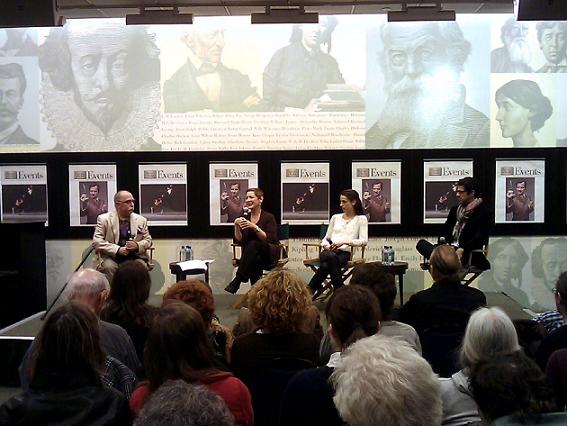
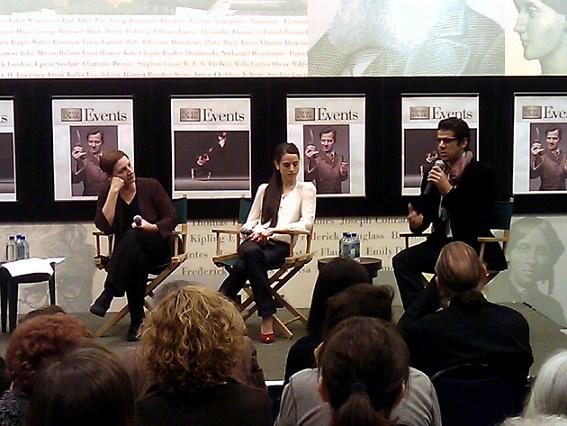
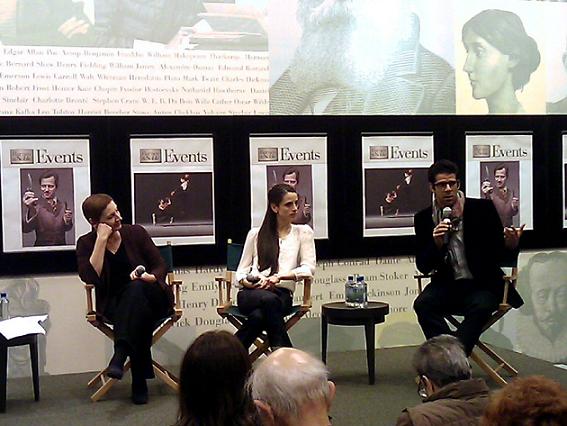
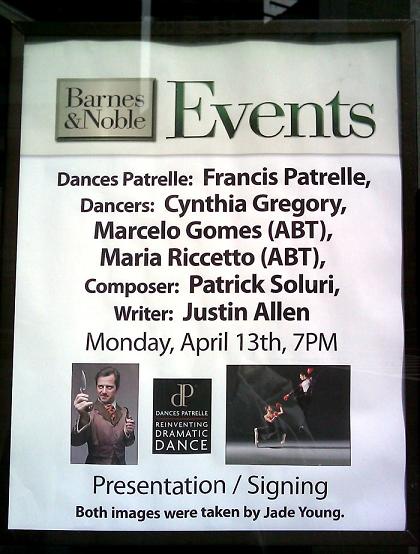
I’m late with my post tonight because I went to an event at Barnes & Noble. Francis Patrelle is a SWEETHEART! I can’t wait to see his company later this week now; such an endearing personality. Seriously, one of the most personable choreographers I’ve heard speak!

bn1

(I wasn’t able to take any pictures because my camera battery went dead, but Scott Schlexer, Marcelo’s representative, who was also there, kindly sent me some of his!)

Marcelo was there, Maria Riccetto, Cynthia Gregory — looking very regal! — I love how she holds herself — and several Dances Patrelle dancers and people involved in the upcoming production at Danny Kaye Playhouse. Writers of books dances are based on, composers, and even the songwriter of the Judy Garland song that Come Rain / Come Shine is danced to. He even played piano and sang, and he was very good!


Marcelo didn’t talk much, but when he did I could hardly focus on what he was saying because … who told me he had no accent! Haha, he TOTALLY has an accent! And his voice is a bit higher-pitched than I expected. He actually kind of sounds like Pasha, except with a Latin, not Russian accent. Not an American accent! Anyway, I remember him saying he liked dancing with Maria — that she’s very light. Oh gawd, Francis Patrelle introduced Marcelo by saying he dances with all these huge ABT women! At first I thought he meant in stature, and then he made it clear he meant in size! I was dying, though no one else seemed to be. Patrelle is a total joker anyway — he says he loves to joke around in rehearsal, and it’s clear. So, he said, Marcelo’s used to dancing with all these large women, so I gave him tiny Maria, and he really throws her around that stage with ease — something to that effect. So then Marcelo nicely said something about how wonderful Maria was to dance with. Aw.

bn5

(from right to left: Marcelo, Maria, Cynthia, and Francis Patrelle)

Marcelo also said his favorite ballet is Giselle. I know he really meant to say Romeo and Juliet though, and Swan Lake. Not Giselle! No, again Patrelle set him up for it by introducing him as just having guest danced in St. Petersburg with the Kirov, dancing Giselle with Diana Vishneva ๐Ÿ™‚

Maria seemed rather soft-spoken. But very sweet. And definitely tinier than Veronika Part and Stella Abrera and Michele Wiles and most of the other larger-than-life ABT ballerinas. Funny she doesn’t look that tiny onstage though.

And Cynthia Gregory (retired ABT prima ballerina, who staged the piece Marcelo and Maria are performing with DP this weekend), sat in the middle of the group, exhibiting excellent ballerina posture and stately demeanor ๐Ÿ™‚ I want to be Cynthia Gregory.

bn6

(Marcelo saying something very important ๐Ÿ™‚ )

bn7

bn3

(Marcelo and Maria “waiting in the wings” while children dance and others have the stage. Thanks again to Scott for the photos!)

Okay, on to Dancing With the Stars. Anyway, this will be a bit out of order because I started watching during Derek and Lil Kim’s Jive. So:

Derek and Lil Kim Jive: Hmm. That song: Elvis’s Jailhouse Rock; when I first heard it, I thought, that’s the hardest song to Jive to — it’s way the hell fast for an amateur; is he nuts? But now I see why it worked: Len’s right — they didn’t dance a lot of Jive! A lot of posing and posturing, a lot of too grounded step kicks with no proper snap and jump — they hardly came off the floor! But that opening set of pivot spins was gorgeous. Those are hard and she deserves major kudos for doing those perfectly!

Continue reading “DANCING WITH THE STARS, WEEK WHATEVER: JIVE AND RUMBA — Update With Marcelo Photos”

The Kirov’s Dramatic Balanchine


Russians are such great dramatists; they make everything they can out of everything they do, and the effect is so moving, so exciting. Yesterday marked the end of the Kirov Ballet‘s 3-week stay in New York. They left on a huge bang, performing three of George Balanchine’s most revered works: the beautiful “Serenade,” the first ballet Balanchine made after his emigration from Russia to the U.S.; “Rubies”, Balanchine’s tribute to American-style ballet; and “Ballet Imperial,” his homage to the grand ballet traditions of Imperial Russia.

Probably because of the trial, stupidly, I got a bit teary-eyed after “Serenade” (the only time I’ve ever cried during a dance performance was seeing Alvin Ailey’s Revelations not long after 9/11; I’m not a crier … I do wonder what Serenade would look like on Ailey. Hmmm. I don’t think that company has enough women though…).

I’ve written about this ballet before, but this is the first time I’ve ever seen it so dramatic, so acted. Balanchine famously created it as practice for his students, and as it took shape it evolved into this beautifully poetic work. Costumed in sky blue, diaphonous, floor-length gowns, the “students” become angelic creatures as they proceed from parallel-footed to turned-out position, and practice leg work, then port de bras. Though one of Balanchine’s many story-less ballets, you still sense a narrative there, and these dancers locate it and tell it to its fullest. When a student arrived to class late, Balanchine worked that into his choreography. But this student, Victoria Tereshkina, doesn’t just run into the midst of things and take her position; she’s late for a reason. She’s very distressed, very emotionally shorn. Perhaps she’s just been in a horrible fight with someone, a lover? She tries to work through her pain during practice, but it’s no use, until a male dancer, Yevgeny Ivanchenko, arrives and takes her out of her pain for a time as they waltz around the floor.

She gets so caught up in him that after he leaves, upon exiting the stage behind the other students, she faints, falling to the ground in a dramatic heap. Interestingly, here is where, when the New York City Ballet performs this ballet, the ballerina lets her hair down, her long (usually blonde) flowing hair now lying in a pool around her. When other ballerinas enter stage, they now have their hair down as well. To me, this signfies the “ballet class” portion of the ballet is over and the real drama has begun. But here, all of the ballerinas kept their hair in taut buns.

The “dark angel” enters, her hands firmly clasped over the eyes of the male dancer in front of her — the character who I’ve always called “blind justice” but who here is called “Elegia,” who makes his way to the fallen girl, to rescue her soul, which, by the end, he does. Ekaterina Kondaurova was breathtakingly beautiful, and full of mystery, as the dark angel, and Alexander Sergeev (who performed in just about every piece I saw both by the Kirov and in Diana Vishneva’s “Beauty in Motion” program) danced with great sensitivity and understated pathos.

Next on was “Rubies” (pictured at the top of the post), Balanchine’s homage to what he viewed as the America dance tradition, with all of its jazziness and sass and show-girl-esque charm. I’ve written about that ballet in detail here. I LOVED Olesia Novikova, who danced the female lead of the main pas de deux, not so much with flirtatious sexiness — that was left to Ekaterina Kondaurova as the main vixen-esque ballerina — but more with cute, charming playfulness. She and her beau, Vladimir Shklyarov, equally playful, acted off of each other, regarding each other quizzically, mischievously, tapping each other on the shoulder, before launching into their competing solos. Kondaurova also played off of the actions of her ‘men-servants’ as one of four danseurs surrounding her lifted her leg into a lovely arabesque from behind, causing her to bend down, her chin nearly falling into the palm of another man, facing her and down on one knee ready to receive her blessing. But the way she looked at him, her eyes harsh and squinting, you didn’t want to be that man! And yet it was cute, it made everyone laugh.

I just love how these dancers gave everything they did a reason; though these are all story-less ballets, the intentions behind the dancers’ eyes, their focused gazes, drew you in to their world and brought that ballet to life.

Last on was “Ballet Imperial,” which I’ve written about here. I realize this is one of Balanchine’s masterpieces, but for some reason, it’s never done a whole lot for me. As a tribute to the grand balletic traditions of his homeland, I much prefer the “Diamonds” part of “Jewels.” Ballet Imperial is very pretty though. It was supposed to be danced here by prima ballerina Diana Vishneva, but for reasons not explained to us, was danced instead by Uliana Lopatkina (correction: it was Alina Somova — thanks Susan!), whom I thought turned out to be just radiant. I didn’t mind not seeing Vishneva, since she’s also a principal with American Ballet Theater, so I can see her all summer long (plus, I had errands to run afterward and didn’t have the time for a 10-hour curtain call ๐Ÿ™‚ ), but there were a great many “ooooooh nooooo’s” in the audience at the substitution announcement. I felt badly for Somova — how’s that for a welcome?!

Anyway, I will miss the Kirov. They brought Balanchine to life for me and gave me a chance to see a full evening of works by American expatriate, William Forsythe. I hope they return to NY frequently.

Misc

Hello. Sorry no post on the Sean Bell shooting trial last night; I was busy getting some dance reviews done and up. Did anyone see Lifetime TV’s new show on Friday night? I thought it was sweet and good-intentioned but a little phony in places. Anyway, my post of that will hopefully be up today on Huffington. Here’s my Explore Dance review of Diana Vishneva’s “Beauty in Motion.”

Yesterday was a big day for trial testimony. We heard from two emergency services personnel who responded to the scene as well as a videographer who shot some video clips, some of which we saw, including upsetting footage of Trent Bennefield being put on a stretcher and taken to hospital, and we heard the first part of Undercover Officer Sanchez’s account of that night. He was called by the People but so far seems only to have given testimony favorable to the defense. We’ll hear the rest of that today. More tonight…

Diana Vishneva's "Beauty in Motion" at City Center

I’m writing a review of this for Explore Dance, so will make this short; I wanted to post something quickly since it’s only showing tonight and tomorrow (Sunday) matinee.

It’s funny to me that dance-makers and fans always complain that critics are destroying dance with their negative reviews. I think they often do the opposite, creating loads of hype, sometimes deserved, sometimes not. And you don’t know which it is until you’ve seen the program. In this case, I’d say the program is worth seeing, but not for the reasons the critics say. The highlight to me was the brilliant brilliant Desmond Richardson of Complexions Contemporary Ballet, in the third ballet of the night, “Three Point Turn,” Dwight Rhoden’s exciting piece about the turbulence of male / female relationships. Richardson had two breathtaking solos that brought the crowd, rightly, to its feet. For a ballet-trained dancer he excels at the sharp, angular, staccato movements that are the hallmark of modern. He’s really a marvel.

I also enjoyed in that last piece Kirov danseur Mikhail Lobukhin. He’s a muscular man with a longish blonde mane and highly arched feet that, when he points, enable him to make beautiful lines. He has kind of an androgynous appeal, which works well for this piece in which masculine violent passion and feminine romantic love are often evoked simultaneously.

In the first ballet of the evening, Alexei Ratmansky’s “Pierrot Lunaire,” which aims to put to dance a set of Fifteenth-Century European poems about a clown’s descent into madness and back again, and in which the clown is depicted alternately by four dancers (all from the Kirov), Alexander Sergeev was my favorite. He interpreted his clown’s changing happiness, sadness, sexual fervor, and madness with the most pathos, and I couldn’t take my eyes off of him.

The show is meant to celebrate Diana Vishneva, the Russian ballerina who is currently a principal with American Ballet Theater as well as the Kirov Ballet, or Mariinsky Theater, in St. Petersburg. The middle piece, by Moses Pendleton, the modern, not ballet, choreographer who founded theatrical dance companies, Pilobolus and MOMIX, is the one that most celebrates Vishneva, because it allows her to have the stage entirely to herself. I don’t think she works tremendously well with others (which I’ve noted before), and I have yet to see what all the critics are so orgasmic about with her, but Pendleton gave her some brilliant props to work with — particularly a large mirror upon which she lay in various positions, she and her reflection together evoking a series of imaginative shapes, and a beaded headdress which she wore and spun around repeatedly in, making interesting forms with the material — and the result seemed to be the crowd-pleaser of the night (other than Richardson).

At the end of the last piece, the curtain went down, then rose again. All dancers besides Vishneva were onstage. The dancers linked hands and came forward for a group bow. Then, each came forward one at a time — five in all — then another group bow. The dancers began looking at each other, a bit concerned. The conductor — shaggy-haired and good-looking I might add! — came onstage and took a bow. The dancers took another group bow. The singer came onstage and took a bow. The audience applauded on and on, for a good ten minutes. The dancers looked at each other, more worried. Audience members began to shrug their shoulders. “Is she coming out?” someone whispered. A few began to leave. One dancer, I think it was innocent-faced Sergeev, gave a nod and the dancers walked forward, arms linked, for yet another bow. Vishneva has refused to take bows before: at ABT’s opening night Met gala last year, she wouldn’t come out for her Sleeping Beauty curtain call. Ballet Talk talkers surmised she was upset about her performance. I didn’t see anything lacking in her performance and wondered whether it was just that she had to share the stage with two other dancers who played Sleeping Beauty (at the gala, they had three women dance the part for variety). I turned around to peek at Kevin McKenzie (ABT’s artistic director, who happened to be sitting behind me); he didn’t seem to have a clue as to what might be up either. I turned around and put on my coat. Some other orchestra members came out for some bows. Then another dancer group bow. The lady beside me excused herself and walked past me. I was just about to grab my bag and go when, finally, in what must have been a good fifteen minutes after the end of the last ballet, she emerged from the wings, bedecked in a velvety black, floor length gown with a several-foot-long train. But she didn’t just walk out onstage to the middle of the lined-up dancers; she walked around clear to the back of the stage, proceeded all the way around the row of dancers, went nearly into the opposite wings, and came around in front, prancing to the front of the stage and taking several very long, drawn-out bows. I think by that time all of our standing ovations and applause had long been spent on Richardson, and I heard several harrumphs of annoyance. I know it may be a Russian thing for the prima ballerinas to act like drama queens in taking their bows, and some may see it as a point of amusement for American audiences, but I think people were more confused and annoyed than entertained.

Anyway, the show’s worth seeing for the interesting choreography, the excellent guest dancers from the Kirov, and for Richardson. Go here for tix. Here are a couple of other write-ups from my fellow bloggers, Jolene and Art in California, who have different points of view regarding Vishneva, from me.

Apollinaire and Diana!

My friend Apollinaire Scherr has an excellent article on the bewitching ballerina Diana Vishneva in this week’s New York Magazine! Apollinaire makes me so jealous the way the writes about dance ๐Ÿ™‚ And check out the spellbinding photograph by Armen Danilian.

Vishneva will be performing next week at City Center with Desmond Richardson from Complexions Contemporary Ballet. The two will dance choreography by the man everyone in NY is talking about these days, Alexei Ratmansky. Go here for tix and info.