DREW JACOBY’S DANCE PULP LAUNCHES ON HULU VIA TENDUTV


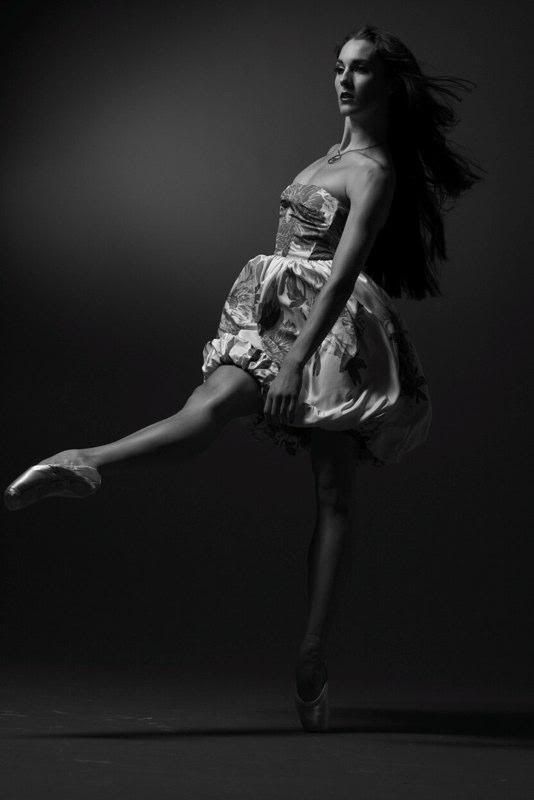
Since following her on Twitter, I’ve been waiting for magnificent ballerina Drew Jacoby’s DancePulp to launch. (photo of her above taken from here) And I just received a press release that it has — on Hulu, via TenduTv. DancePulp is a series of interviews with movers and shakers in the world of dance — don’t know when it’ll air but remember her tweeting that she was interviewing David Hallberg — conducted with Jacoby herself. Click on the “continue” link below to read the full press release.

Continue reading “DREW JACOBY’S DANCE PULP LAUNCHES ON HULU VIA TENDUTV”

DEVIN ALBERDA IS HILARIOUS!


Headshot by Paul Kolnik, from NYCB website.

One of my Twitter followers, a law blogger go figure, sent me a link to this article, by Gia Kourlas in the NYTimes about how several ballet dancers, mostly from NYCB (apart from Maria Kochetkova and Daniil Simkin) are now actively tweeting. I found Alberda’s posts to be absolutely hilarious. Follow him!

Kourlas didn’t mention them, but David Hallberg, Marcelo Gomes, Drew Jacoby and Roberto Bolle are all on Twitter too. Roberto and Marcelo, unfortunately, don’t tweet much. Marcelo in particular cracks me up though. He started the account to tweet about ABT’s recent Culinary Pas de Deux. He had several tweets leading up to it: can’t wait for the culinary pas de deux, follow us as we tweet throughout, etc., then the two tweets the night of the event were something like: almost time for the culinary pas de deux!, then, wow that was a great culinary pas de deux! But no tweets throughout πŸ™‚

It’s hard because dancers are so used to expressing themselves with their bodies, not their words and I know they’re encouraged to do this — blog and tweet — to reach out and try to gain new fans. My advice though: they have to make sure they remember they’re talking to a general audience, not an audience of already converted ballet fans, lest their posts be largely lost on most. They have to try to bring new people into their world, not exclude them with terminology that wouldn’t make any sense to an outsider. That’s why I think David Hallberg made the Winger so popular for the time that he was actively blogging there. He wasn’t just its biggest star; he had a way of communicating with people who don’t know everything there is to know about ballet, and of making them want to know more. I’ll bet he doesn’t have any dancers in his family and basically had to grow up doing that. His tweets are mostly about his travels guest starring all over the world.Β  His friend, Evan McKie, from the Stuttgart Ballet, who also used to blog on the Winger, is also on Twitter and it’s fun to keep up with him as well.

And those are only the ones I know of; there are probably many more. I don’t have time to search for people’s Twitter accounts, but just do as Kourlas suggests if you want to find them (or any other dancers): Google their name + Twitter and you should find them if they’re on there.

By the way, speaking of ABT’s Culinary Pas (see some photos of that here), my friend happened to go (she was invited by someone else, a patron, and didn’t even know it involved ABT until she got there!) She had a blast, said Marcelo and Craig Salstein (the organizers) were very nice, Craig in particular was very well spoken, which I’ve noticed before, that Marcelo and Gillian Murphy danced some duets from Dirty Dancing, including the mambo scene (said ballet dancers can’t move their hips properly for Latin dance πŸ˜€ ), and that Blaine Hoven was cutting up a rug on the dance floor along with Sascha Radetsky. I hate going to parties like this but love hearing about them afterward.

RHAPSODY FANTAISIE


I am extremely behind on reviews but here are a couple of pictures (by Erin Baiano) of the cast of Christopher Wheeldon’s Rhapsody Fantasie, which the choreographer premiered with his company, Morphoses, in October. I can’t write a full review but I guess it’s interesting to see what lingers in the mind. I remember a variety of movement — from neo-classical ballet to more contemporary with some ballroom thrown in — I remember some swing-y moves and even some salsa basics! I remember interesting ensemble work — with dancers at times breaking into pairs for partner dancing, at times the men dancing together, performing various complicated lifts, which I found rather mesmerizing. And I remember Wheeldon’s signature modern ballet pas de deux with the complicated “pretzel shape” lifts (as in the top photo, of NYCB’s Wendy Whelan and Australian dancer Andrew Crawford). Besides Whelan and Crawford I found Drew Jacoby and Rubinald Pronk to be the most compelling pair, dancing their series of twisted shape after twisted shape with passion and psychological intention.


Opening Morphoses program 2 was Continuum, a Wheeldon ballet from several years ago (photo above, also by Erin Baiano). This was a very abstract work set to sharp, at times tense Ligetti music with brilliant lighting that made the dancers appear ghostly, as if their shadows, silhouetted on the back wall, were doing the dancing.

I love Christopher Wheeldon, who’s always trying to give audiences insight into the dance-making process. At the beginning of this program, he spoke a bit about the dances, and, regarding Continuum, he told us all to look out for a part where, as he was making that dance, he became mesmerized by a neighbor’s cat and dog. It was only all too obvious which pas de deux this was, and everyone laughed as the two dancers kind of crouched around each other getting ready for a playful (or maybe not so playful) attack. I don’t think the audience would have thought anything of it if he hadn’t pointed that out. Now if he can give us insight on how the whole thing comes together!…

JACOBY AND PRONK IN LIGHTFOOT LEON’S SOFTLY AS I LEAVE YOU


Photo by Bill Cooper of the mesmerizing Drew Jacoby and Rubinald Pronk in Lightfoot Leon’s spellbinding Softly as I Leave You, which is on both Morphoses programs (currently at City Center) and which I’ve been going on about in my last post, here, and earlier here.

And look — finally an American critic has something good to say about it!!

Says Lisa Jo Sagolla of Backstage magazine, “Lightfoot Leon’s Softly as I Leave You, a stunningly inventive duet involving a frightening coffinlike wooden box, is so fiercely emotional that its impact is universally chilling.”

I couldn’t find any YouTube clips of Jacoby and Pronk in Softly but, if you’re unfamiliar with them, here are a couple of others I found: the first a sexy little music video and the second is of them rehearsing with Mia Michaels.

Review coming soon of Program B, which includes Christopher Wheeldon’s new Rhapsody Fantaisie, which I liked.

MORPHOSES OPENS ITS 2009 NEW YORK SEASON WITH ITS BEST PROGRAM THUS FAR


Performance photos coming soon; in the meantime please enjoy another BRILLIANT photo by Kyle Froman.

Christopher Wheeldon’s Morphoses opened its NY season last night at City Center and I felt it was the best program they’ve done in their three years of existence. (At least Program A was; tonight I’ll see Program B). It’s a varied program with work by four different choreographers: Wheeldon himself; Bolshoi A.D.-turned ABT resident choreographer Alexei Ratmansky, whom all the critics downright worship; Australian Tim Harbour; and the Dutch husband and wife team Lightfoot Leon.

I must talk first about the third piece on the program, that by Lightfoot Leon, Softly As I Leave You. This is one of the most riveting pas de deux I’ve ever seen and it’s performed by the absolutely mesmerizing Drew Jacoby and Rubinald Pronk. Every single person who is not a professional critic was absolutely spellbound by it, could not stop talking about it. This happened at both the Fall For Dance Festival, where the work premiered (which I wrote about here), and last night. It’s simply about a couple, one partner’s decision to leave the other, and it’s a harrowing decision. After the lights went out on the final poignant image, the elderly woman on my left, whom I didn’t know, grabbed me and said, “Oh my God, that was so good!” And from my friend, who thinks the Arvo Part music used (Spiegel im Spiegel) is completely over-used and was expecting not to like it for that reason: “Oh my God, that music actually worked here!” she exclaimed, open-mouthed. She agreed it was one of the best duets she’d ever seen. And people were going on and on about it during intermission, both here and at FFD.

So why in the world do the critics hate it so much??? They ALL do. ALL OF THEM. It’s like in order to be a professional critic there are certain things you’re required to hate and this is one of them. And yet audiences are so overwhelmed by its power. Clement Crisp rants, “I can find not one iota of merit in its vulgar posturings.” Guardian critic Luke Jennings calls it “slick surfaced” and replete with “glib insincerity.” I can’t remember Alastair Macaulay’s exact words after its FFD premiere, but he hated it too. And a Ballet.co critic whom I spoke with at an ABT Guggenheim event (and who was the only non-Brit of the lot) complained how awful he thought it was as well.

This happened — I’m sorry, I’m getting off on a tangent — but this happened with practically every Fall For Dance piece, and with ABT’s recent season: EVERY SINGLE CRITIC hated every single one of the pieces the public adored (Barton, Millepied, Mark Dendy’s BRILLIANT Afternoon of the Fauns) and loved those they found least compelling (Ratmansky). I mean, more on this later, but what do you do if you’re an artistic director or choreographer? Do you cater to the critics — the “important people” or do you trust us, the commoners?

Anyway, mine and my friend’s second favorite piece of the night was Tim Harbour’s Leaving Songs. Guess what: all the critics hated it. I need to move to Europe… This dance had such emotional depth. It was about the cycle of life, death and rebirth — though I’m not sure you’d know that if the choreographer hadn’t said so in a little film clip shown before the program. But that doesn’t matter; you can come up with your own meaning anyway. The movement was kind of a combination of modern, classical and what looked to me to be African, and the music, by Australian composer Ross Edwards, is equally varied, at points sounding classical European, at points more percussive and African-sounding.

There were several striking moments, such as the point during a pas de deux where a man puts his hands around a woman’s neck and she falls before him. It kind of seems as if he’s strangling her out of anger, but then her arms flutter about beautifully, almost-bird like. It’s a combination of violence and grace. And there’s a moment where the group is dancing in ensemble and the movement is very wavy and undulating, very African, and everyone’s moving in unison and the music slows and the dancers slow, almost like they’re approaching death. Then the drums start pulsating and the dancers come to life and begin sidling cautiously but with intention toward the front of the stage. There are also several very sexually suggestive scenes with women’s legs splayed in the air. No tights are worn, and my friend and I couldn’t stop wondering how in the world they keep those leotards from shifting…

Anyway, I found the Harbour very compelling. And Rubinald Pronk really stood out here as well. He has so much fluidity and expansiveness in his body, and I don’t think anyone has more intense eyes.


(photo from Vail website)

Alexei Ratmansky’s Bolero was enjoyable too, largely because of the familiar Ravel music. For me, Ratmansky is one of those artists whose work doesn’t jump out at you and hit you over the head with its brilliance. Rather, I’ll need to see a dance of his several times before I get a sense of what it’s about, before I can fully appreciate it. Wheeldon’s work is the same. The critics seem to think this is the mark of a good choreographer — that it grows on you and you notice new things with each viewing, and I suppose it is. But for the average consumer, going to the ballet so often to see pieces over and over again to understand and appreciate them more fully can get prohibitively expensive. Dance art is not like a museum or art gallery where you can stand there for as long as you like.

Anyway, in Bolero, there are four pairs of women and men, each person wearing a number on his or her top. The women wear white tops and little skirts, almost like cheerleaders and the men wear black. If the women were cheerleaders, the men didn’t seem to be any kind of sports players though. They danced in groups divided between male and female, almost as if they were competing with each other, or as if their movement was some kind of back and forth dialog. And then toward the end, they began to partner each other more, the crescendo of the music complemented by various lifts that I found at points to be a little humorous, though it may have just been me. For example, when those trombones (I think that’s what they are anyway; maybe they’re tubas), are blaring kind of off-key at the end, the men lift the women over their heads, upside-down and the women do these upside-down developes, their legs splaying along with the warped trombones. I thought it was funny but I might be the only one.


And then the first piece on the program was Wheeldon’s Commedia (photo above by Erin Baiano), which was made in homage to Ballets Russes and was premiered last year. I wrote a bit about it here and here.

Here’s an excerpt from the company performing Commedia at the Vail International Dance Festival:

Also, this season marks the company’s collaboration with the young orchestra (most players are under 30, Wheeldon said), Philharmonic Orchestra of the Americas, founded and directed by the very entertaining, energetic Alondra de la Parra — yes, a female conductor OMG! The evening opened with Wheeldon giving a little address and then the orchestra playing on Overture to Estancia: Malambo by Alberto Ginastera. At the same time the orchestra played the Overture (this was their first time playing in a pit for dance, and not centerstage, by the way), a screen was dropped over the stage and a delightfully humorous film was shown of the dramatic conductor directing her crew, the violinists all swaying dramatically in unison at points. It was a lot of fun. Whole night was very good.

FALL FOR DANCE ’09 PROGRAM 2

Highlights of Program 2, which I saw last night, were Morphoses and Tangueros Del Sur.


I was wandering around the lounge beforehand and ran into a couple of old friends from my first ballroom studio, Paul Pellicoro’s Dancesport. Always fun to catch up with old friends — especially since one of them belonged to my swing team and I shared with her my first ever lovely competition experience. Anyway, little did we know then, but one of our former tango teachers was in the show! Ivan Terrazas! I was so proud; he was absolutely electrifying (along with the rest of the Tangueros)!

Sir Alastair had gone on and on about this troupe — led by Natalia Hills and Gabriel Misse — when he saw them at the Vail Dance festival recently, and rightly so! Oh my gosh, that was the most astounding tango I’ve ever seen! The piece was called Romper el Piso and was mainly tango but with some footwork and rhythms from other Latin dances like Samba and a little bit of Cha Cha thrown in — but all danced with tango aesthetics. There were duos and trios, both mixed-sex and same-sex. The choreography was original and enlightening and the dancing so polished, precise, lightning fast, sharp, passionate, everything you can imagine in a tango, in a dance. I really hope some of you can see them tonight.

Afterward, my friend Alyssa and I hung out in the lounge. When we left we were a little tipsy (c’mon, the wine is $2!) and I kind of tripped over nothing on the way out, causing us to both burst out laughing. One of the cute tango guys said to us, “tranquilo, tranquilo!” but very flirtatiously πŸ™‚

All photos above by Carlos Furman, courtesy of City Center.


The other knockout performance of the night — for me — was Softly As I LeaveΒ  You, choreographed by Lightfoot Leon and performed by the stunning Drew Jacoby, who is now one of my favorite female dancers (Alyssa’s as well) and Rubinald Pronk, performing on behalf of Morphoses. Christopher Wheeldon was in the audience and he got mobbed during intermission πŸ™‚

It was the best thing I have ever seen by Morphoses — more Lightfoot Leon, Mr. Wheeldon, please please!

It’s set to a combo of music by Bach and Arvo Part (including the Part section all New Yorkers are now so familiar with, from Wheeldon’s After the Rain pdd), and begins with the statuesque Ms. Jacoby standing inside a box opening out to the audience, contorting herself to fit within its confines, struggling to break free, making the most mesmerizing shapes with her body. Then, in the second movement, Mr. Pronk comes out and they dance an, at times somber, at times peaceful, duet. Then, in the third (with the After the Rain music), they continue dancing together, but now come to a closure; he ends up in the box, she slowly walks behind it, disappearing offstage.

To me, this was about the human need for connection or the struggle between wanting to be alone and wanting to be with another. Alyssa saw it as someone being held back by something and struggling to overcome that; she was moved by the change of positions between the two dancers. Or, as the title suggests, I guess it can be about a woman leaving a man. The most compelling of these abstract duets Wheeldon is known for (either choreographing himself or including in his Morphoses programs) I think allow for that kind of interpretative range, while giving the viewer enough that they can really latch onto something and let their imaginations go with it.

The above photo of Jacoby and Pronk, by Erin Baiano (courtesy of City Center), is not from this piece.

Also on Program 2 was Martha Graham’s sweet ode to spiritual and human love, Diversion of Angels. Nice to see some of the Graham dancers, who are beginning to become familiar to me, again.

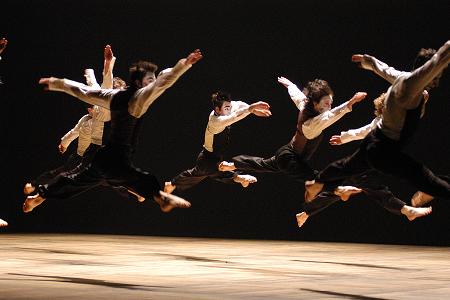
And closing the program was Noces by Dutch choreographer Stijn Celis, performed by Les Grand Ballets Canadiens de Montreal.
1

2

32

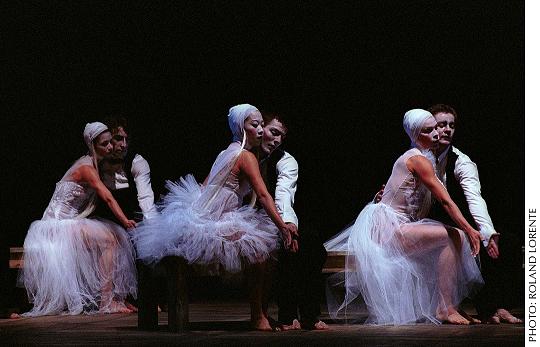
This was Program 2’s tribute to Ballets Russes. Branislava choreographed the original Les Noces, and there have been several versions since (Jerome Robbins’, Pascal Rioult’s). It was danced to Stravinsky’s choral score (which he created for Ballets Russes), but with some remixing too (I think). The music seemed to be longer, and there seemed to be some German language in the score, which sounded like it was from a Broadway show like Cabaret (but not Cabaret exactly). The program doesn’t seem to note any addition to the Stravinsky though so I may well have been hallucinating.

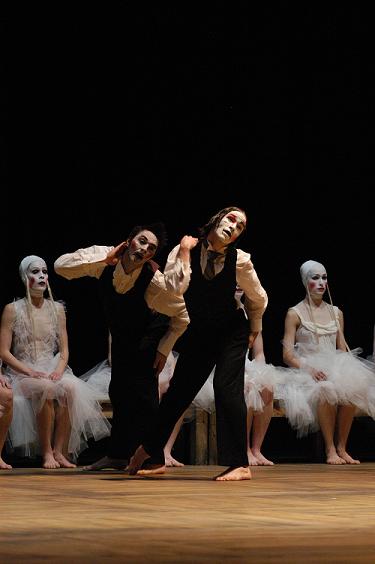
The dance (and the Stravinsky music) depicts a Russian peasant wedding and it’s very Rite of Spring-like — more focused on the sexual rite of passage, the consummation, and the rather forced marriage rituals than love or anything weddings evoke for us today. In the Celis (as well as Rioult) version, there isn’t a single man and woman but a group of men and women undergoing the marriage ceremony. The women here are dressed in sexy white bridesgowns, the skirts short and much of the material see-through mesh. The women have white-powdered, very made-up faces that look almost clownish, as do the men, who are dressed in tuxes. Alyssa thought their make-up looked zombie-like, like they’re walking dead. The movement is very frenetic, with lots of thrashing about, and the group consummation scene would have been comical, as the women bounced around on the men’s laps, if it wasn’t so violent.

I’ll be interested to see what the critics and other viewers say of this –whether it gets dismissed as gaudy “Eurotrash” or whether people take it more seriously as a commentary on ritual (or something else). I do think it worked as an homage to Ballets Russes because from what I know of that legendary company, they seemed to have been very cutting-edge, going far out to push ballet to its extremes, even if it induced a lot of eye rolling.

Big kudos to the dancers though for performing that long, near-continuous frenetic movement.

Photos of Les Grands Ballets Canadiens de Montreal courtesy of City Center.