IT’S ROMEO & JULIET WEEK AT ABT, WITH CELEBRATION OF FREDERIC FRANKLIN’S 95TH BDAY


Finally, Pashmina week is here!

I couldn’t find any pictures of the pashmina lifts, but watch this video — two occur around 430-440 and 528-532. By the way, that clip, from a BBC broadcast apparently, is really good — the Royal’s Darcey Bussell talks about MacMillan’s gorgeous balcony pas de deux and then it’s performed by the great Carlos Acosta and Tamara Rojo.

Anyway, last night’s debut cast at ABT was Marcelo Gomes and Diana Vishneva in the leads. It was excellent. The audience collectively rose to its feet right after the curtain went down on the two lovers, dead in the crypt, and hardly anyone sat down or left until after the final curtain call. And a significant amount of people didn’t even want to leave then, after all the lights came up. I don’t think I’ve ever seen quite that kind of crowd reaction before. Diana was the best I’ve ever seen her (she’s really growing on me). The end was a bit melodramatic and overdone, but that aside, her performance was brilliant — perfectly and passionately danced and in character throughout. And the bourrees πŸ˜€ Marcelo is always perfect. He’s the lifting king in this very lift-heavy ballet. And he’s of course very romantic and passionate to boot πŸ™‚ He’s never not completely made my night at ABT. He kissed Diana on the lips during curtain call; audience went “awwwwwww!”

Herman Cornejo danced Mercutio, and, believe me, there’s no one better for that part. No one! Audience went wild over him, nearly as much as the leads. Veronika Part replaced Stella Abrera as Lady Capulet. It’s not a dancing role but a very serious acting one. I’ve never seen a more tragic Lady Capulet. I really felt her horror at Tybalt’s death. I almost cried with her. Isaac Stappas was a very good Tybalt, very virile, very threatening, but ultimately vulnerable. And Carlos Lopez was a very good Benvolio — he landed all of his jumps very well πŸ™‚


And 95-year-old Frederic Franklin played Friar Lawrence (and got loads of applause for it when he first appeared onstage — for a minute I thought they were going to have to stop the music so he could take a bow!)

So the rest of the week: Marcelo will dance Romeo once more, on Wednesday night, with Paloma Herrera as Juliet. Tonight (Tuesday) and Saturday night Roberto Bolle dances with Irina Dvorovenko (a must-see performance). Wednesday and Saturday matinees are David Hallberg and Gillian Murphy. And Friday night are Herman Cornejo and Xiomara Reyes in the leads. Thursday night’s performance should be special: the young Hee Seo and Cory Stearns are making their debuts in the roles, and, according to the Playbill, there is also to be a little celebration that night in honor of Franklin, who will again play Friar Lawrence.

Pretty amazing to still be onstage at 95!


For ABT’s schedule and ticket info, go here.

NATALIA OSIPOVA AND HERMAN CORNEJO’S LA SYLPHIDE


Monday night, I saw the Bolshoi’s Natalia Osipova guest-star with ABT in their production of La Sylphide. I wrote a little about her and more about Herman Cornejo, at the bottom of my prior post. Just to reiterate, if you ever want to see pure excellence, do see Herman Cornejo in something — anything. He is just pure, unmitigated, supreme, excellence!


August Bournonville’s La Sylphide is the story of a Scotsman, James (Cornejo), who is engaged to be married to a woman named Effie, but is seduced by a sylph (Osipova), who no one but he can see. Gurn, a young man in love with Effie, sees James talking and dancing to the air, and tries to warn everyone that he thinks James has gone mad. But people ignore him. An old witch-like lady, Madge (think MacBeth) prophesies that Gurn will marry Effie. Later, when the wedding party guests perform a fun Scottish folk dance, James continues to be taunted / haunted by the sylph who flies through the air. James chases her but she flies out the window. Later, James is on the verge of marrying Effie, even holding up to her the wedding ring, when the sylph plucks it right from his hand and flies out the window. He chases after her into the forest, her lair. Effie collapses into tears and Gurn leads the groomsmen in search of the missing groom.

The second Act takes place in the forest. The sylph seduces James with food, drink, and dance, but every time he tries to touch her she flies away. James wanders the forest, upset about the sylph’s elusiveness. He happens upon Madge and her mates who are concocting a poisonous brew in which they are soaking a scarf. He tells Madge of his troubles and she tells him the scarf is magic; if he wraps it around the sylph’s wings, he can have her. James takes it. When he next sees the sylph, he seduces her with the scarf’s beauty. She flies toward it, delighted and excited, as he waves it around. But once he wraps it around her wings, she slowly dies.

James, brokenhearted, falls into unconsciousness, as the wedding procession of Gurn and Effie is heard in the distance and the sister sylphs carry the sylphide to heaven.

Neither the story nor choreography are as grand and memorable as Giselle, and I’d written before that I was stunned by Osipova’s athletic prowess but not really moved by her Giselle. Here, I thought that, though I didn’t like the choreography as much, her playful, sky-high jumps made much more sense in this story. Here, she’s not human, she’s not of this world. She’s both a faery and a figure in a man’s dream. So, her unearthly high springing jumps went along with that; they were believable within the story. She is a really beautiful dancer and can certainly jump like no one’s business, but I wished she would have been a bit more tantalizing and playfully vexing, the way Janie Taylor was in Robbins’ The Dreamer. Not like a vixen or an evil spirit; I just mean more forcefully refusing to leave him alone, making him realize what a dull life he’s leading; how he longs for something more. Just like in Giselle, she seemed to be dancing on her own, not really working opposite a partner. It’s probably really hard, though, when there are language barriers, and I think both times either she or her partner (David Hallberg, and Herman) filled in for someone else last minute.

I thought Herman did an excellent job of showing how tormented he was by her, and how confused he was about what to do, how frustrated he was about his life. And his super-charged solo variation expressed that. No one jumps like him. No one. No one turns like Angel Corella and no one jumps like Herman Cornejo. He opened that variation with the best tour jete I’ve ever seen, and I knew — the whole audience knew judging by the gasps — we were in for something huge. Then onto all the high jumps with the fluttering beats of the feet. Everything he does is marked by sheer perfection — perfect sharpness, perfect precision, perfect control, perfect line, perfect clarity, perfect enunciation, beyond perfect height, beyond human height. He’s a god!

My problem with this choreography is that there’s not enough for him to do. And I got really frustrated. I didn’t want that variation to end. Nor did I want Daniil Simkin’s (as Gurn) solo variation to end. There wasn’t enough for him to shine in his either. He had a few kicking jumps, but I need for him to do so much more; Daniil’s too great of a dancer as well! Daniil was hilarious, though, when he imitated to the guests James’s bizarre actions, his weird dancing to the air. In addition to being a superb bravura dancer, he’s a very lively actor too.

On before La Sylphide was Paul Taylor’s light, lyrical Airs. I’m going to write about this more after I’ve seen it a couple more times this weekend, but I love watching ABT dancers do Paul Taylor! I hope no one takes offense and I love Paul Taylor’s dancers, but ABT just brings so much more to “modern dance” than a modern dance company. They bring poetry. Paul Taylor is American modern, and when his dancers dance him it looks celebratory, celebratory of humankind and of the dancing spirit, like something you’d like to get up on stage and do with them. It’s participatory, inviting. Of course you know if you’ve ever tried how hard, how impossible it actually is to dance like them without loads of training. But when you see ABT dancers dance that’s obvious from the get-go. It’s not celebratory and participatory, it’s elevated, awe-inducing dance, dance as an art. You know what I mean? All of the dancers were excellent — particularly Kristi Boone and Misty Copeland, but I loved Arron Scott the most because he so exemplified what I said above: outwardly he looked just like a Paul Taylor dancer, but he starts to move and he’s just so much more!


HAUNTED BY CHRISTOPHER WHEELDON :)

img00180

Last night I read from my new novel (which is still VERY much a work in progress) with the Writers Room at the Cornelia Street Cafe, and it actually went okay! Better than I expected! Several of my wonderful friends showed up to give me much-needed encouragement and support (maybe someday I’ll be confident enough actually to post here ahead of time when I’ll be reading…) and they all seemed genuinely to like the piece I read. And several people I didn’t know came up to me afterward — including a filmmaker who gave me her card! — to tell me how much they liked it. One woman said she wanted to read it as soon as it was out! Though she told me the way she didn’t want it to end. I assured her it didn’t πŸ™‚ So, I just have to write the rest of the book now…

But I was so worried because the subject matter is kind of controversial and the character whose piece I read from is a young black man with a certain kind of voice that my face and body certainly don’t in any way fit, so I worried I just wouldn’t be able to pull it off. And I am a horribly sucky reader and always will be — I’m just shy and I’m not an actress and that’s just that. But people still got what I was trying to convey through the actual words, so I am extremely happy about that. That’s all I can ever ask for!

Anyway, funny thing is that there was this guy sitting up front who looked just like Christopher Wheeldon. Seriously, just like him except about 10 years younger. And it really freaked me out because then I started thinking of this. And then I started thinking what if someone reacts to me like that! I mean, you can’t please everyone of course, and there are always going to be people who don’t like you, but, well, all I can say is that the more I write (and the closer my first novel gets to publication), I am feeling a lot less critical, at least of new works πŸ™‚

Anyway, now that this all-too stressful event is over, I’ll blog about the Natalia Osipova / Herman Cornejo La Sylphide at American Ballet Theater Monday night. She was good, he was insanely excellent. It’s like with Kathryn Morgan the other night in NYCBallet Dancers’ Choice — I don’t know if there are words to describe him. If you want to see sheer perfection, go see him in something — anything. I can’t imagine anyone better in all the world. I mean, every great dancer brings something to the stage, and he simply brings perfection, in the Webster Dictionary definition of the word: “an exemplification of supreme excellence.” One of my Twitter friends (who’s a very established ballet dancer) told me he’s a “dancer’s dancer,” which I can totally see. He’s a non-dancer’s dancer too πŸ™‚

Anyway, more tomorrow, I mean later today. I have to sleep now.

ABT GUEST-STAR NATALIA OSIPOVA’S ATHLETICALLY ASTOUNDING GISELLE


The Bolshoi! Russian ballerinas! Insane extensions, insane jumps, insane speed!

Last night Bolshoi ballerina Natalia Osipova guest-performed with American Ballet Theater as Giselle. David Hallberg was her Albrecht, Jared Matthews Hilarion, and Veronika Part was Myrta. (Go here for a synopsis of that ballet).

It was all-around some of the best dancing I’ve ever seen, but I have to say, on a scale of 1-10, in terms of chemistry between Osipova and Hallberg, I’d give it a 1.5, and in terms of all-around acting (excluding Kristi Boone’s captivating turn as Bathilde and a rather amusing Vitali Krauchenka as her father), a 2. Regarding the chemistry, to be fair, Osipova was originally supposed to dance with Ethan Stiefel, but because of an injury, David danced in Ethan’s place. A Twitter friend DM’d me asking why she didn’t dance with Angel Corella and I think it’s a good question. He would have been a better fit size-wise and stylistically for her.

But as I said, the dancing was tremendous. During the second act, Osipova did a develope to her ear, she did those hops with her arms in the air as if she had springs in her toe shoes or had a trampoline beneath her, and she did that flat-footed jumping turn at the speed of damn light. Seriously, when she made her entrance during the Wilis act, I put my opera glasses to my face, watched her walk out, and suddenly she was gone from my frame of view. I searched around and around for her with the damn glasses attached to my face wondering where in the world she went. When everyone around me suddenly started screaming BRAAAVAAAA BRAAVAAA BRAAAVAAA, I nearly dropped the glasses. When I took them away, I saw her mid-jumping turn going around and around, in a blur.

Audience (largely Russian, at least in the back orchestra) went stark raving nuts for her. I nearly had my left eardrum blown out over the ear-high develope. And those hopping jumps — seriously, she was half-way to the ceiling. I mean, when Paloma did them (I really did like her Giselle the more I think about it) she raised her head, like those jumps were a prayer to return to life. But here Natalia was going boing boing boing, up to the sky, head straight forward probably so as not to take away from her springing height. I mean, I don’t know. I love to be moved by the image a step creates, as Paloma did, but I can’t deny the thrill of those insanely high jumps and that lightening-fast turn and that insanely high develope.

The high bravura jumps in the first, peasant act, though, worked with her characterization. Her Giselle was all frolicking gaity, a girl in love with dance, in love with life. Her mad scene was over-the-top histrionics. The critic next to me described it as traditional.

And then David. Well, at the beginning he did his Albrecht as a romantic not a carefree playboy. But his was a romantic who was pretty madly infatuated with her. I think David is trying hard to get rid of his nice guy image. He rapped on her door like her mother’d better let her out or else. And when his squire didn’t full-out approve of his peasant costume, I thought he was going to kill him. And after the mad scene, he had kind of a mad scene of his own: I thought he was going to throw poor Jared’s Hilarion straight into the orchestra pit.

But ditto for David on the virtuosic dancing. I think by the time the second act came around, he was following Natalia’s bravura lead, doing sky-high jetes. He only did a Marcelo throw back of the head on the first jump in the diagonal, and then did the ten bizillion entrechats, same as Roberto Bolle. But David’s Nureyev feet!Β  His feet are so heavenly — I think he has the best of any dancer around today, at least any dancer I’ve ever seen. Those entrechats were from God.

As Myrta, Veronika Part jeted around the stage like I’ve never seen her leap before. She really takes up the stage when she leaps and she appeared to just be flying. I don’t even think I noticed all those jumps before! Her Myrta was icy cold and remained so throughout. Of course it was hard to concentrate on her face with all the theatrics going on behind her, but I didn’t see her peeking over her shoulder like Michele Wiles did. After she directed Hilarion’s death, she turned from him, toward us, and gave a wickedly simple little “and that’s that” nod right to the beat of the music, right as he fell, a smug smirk crossing her lips. Splendidly frightful!

I loved Kristi Boone as Bathilde, Albrecht’s betrothed princess. This is a pure character role, no dancing, and she was radiant in that gorgeous red dress, initially all supremely bitchy and regal, then softening when Giselle started pressing her skirttails to her face, allowing the poor girl to have one thing in common with nobility — a love of clothing. Then, when she realized Albrecht’s betrayal, instead of stomping all over Giselle’s pride and insisting Albrecht kiss her gloved hand, she looked more wounded and discomfited.

Vitali Krauchenka was rather amusing as Bathilde’s father, the prince, probably unwittingly so. He seemed to have his eyes half-closed the whole time and the way he looked at her, following her all around as she decided where to sit, whom to talk to, etc., it looked like he was saying “yes, yes, miss priss, whatever you want.” It cracked me up. I think he might have been better opposite Maria Bystrova’s Bathilde though. Hers was more of an unrelenting snobby witch.

Hee Seo and Blaine Hoven were very good in the peasant pas de deux. It was one of the most entertaining peasant pdd’s I’ve seen, which I guess went along with the virtuosity of the whole night.

Only the Russians πŸ™‚ I’ll be excited to see more of Osipova next week. She’s dancing La Sylphide with Herman Cornejo on Monday night and again with David Hallberg on Wednesday evening. Go here for the full schedule.

AMERICAN BALLET THEATER’S PROKOFIEV PROGRAM


On the Dnieper grew on me after seeing it the second time on Tuesday night, with the new cast, although I still generally preferred the first cast. If you missed my earlier post on Ratmansky’s new ballet, it’s here. Second cast was: Jose Carreno as Sergei the returning soldier; Hee Seo as Natalia, his betrothed; Diana Vishneva as Olga, the flirt who steals his heart; and Alexandre Hammoudi as Olga’s volatile fiance.

I absolutely loved Diana as Olga. She and Hee Seo, who was excellent as well, really drove home the ballet’s pathos and heartbreak. A BalletTalk poster said that with Diana, Olga became the central character and I think they’re right. Diana’s Olga was the most dynamic character in the whole thing; she really underwent a change in those mere 40 minutes. And it was believable. She starts out this carefree and careless flirtatious girl, frolicking around, teasing Sergei, teasing her boyfriend. And when her flirtatiousness with Sergei sets the whole disastrous string of events in motion — Sergei falls for her and she for him, her fiance has an emotional breakdown and beats Sergei, her parents are distraught, and she realizes what she and Sergei have done to poor Natalia — she really grows up, overnight, becomes a totally different person, takes responsibility for her actions. When she and Sergei bow to Natalia at the end in a prayer for forgiveness, before running off to their new life together, you feel equal heartbreak for both women.

Hee Seo and Veronika Part were equally compelling, although Seo seemed a little younger and more naive up front and I didn’t notice the holding out of the arms and the resting of the head on the shoulder like I did with Veronika. Jose, who’s generally ABT’s best actor I think (he never overdoes it; everything is authentic), was good as Sergei, but different from Marcelo. Jose seemed to be searching for something at the beginning, trying to rediscover his hometown with those short, staccato steps in each direction. His movements at the beginning were more modern than ballet, sharp and staccato at points, like he was unnerved that he didn’t recognize things or that things were different. (That kind of movement is more visible on a smaller body though.) Marcelo didn’t seem as sad or desperate up front. But then when torn between the two women, with Jose IΒ  didn’t notice the back and forth of the jumps, this way and that, as I did with Marcelo. The jumps first to one woman, then the other, are my favorite Sergei movement trait, along with the throwing himself to the ground in anguish, almost like a half push-up.

Alexandre Hammoudi was a very different fiance from David Hallberg. Alexandre was quieter, especially up front, not seeming to realize the potential dangers of Olga’s flirtatiousness. He underwent a character change, like Diana’s Olga, then, becoming aggrieved and angry when he realized what had happened. David was more volatile up front, as if that was fundamentally part of the fiance’s character. Those extremely fast-paced steps during his anger scene were not as pronounced with Alexandre as with David. It looked more like he was kicking up leaves (which they had strewn on the ground); with David he was using those feet like daggers. David made such an impression with that character, and specifically that going nuts scene — I’m never going to forget it; I’m never going to forget that insane, almost terrifying, tap dance.

Okay, can I stop talking about this ballet now and focus on the other Prokofiev pieces?!

I generally wasn’t in love with Desir (photo at top of post) by James Kudelka, at least not as it was danced here. The movement is lovely and much of it original and the dancers are excellent but something was just lacking and I can’t figure out exactly what. It’s a ballet about several different couples, and I think my problem is that all the couples are basically the same, at least the way it’s being danced by ABT. With someone like Tharp or Robbins, different couples have different issues — there’s a romantic couple, a sexed-up couple, a fighting couple, etc. Here, the first two couples on first, dressed in fiery red — the women in long, flowing dresses that really whirl when they turn, the men in brown pants and long-sleeved colored tops —Β  both seem passionate and in love, all but Gillian Murphy from the first night’s cast, wearing bright smiles. But I don’t know if the happy smiles are supposed to be there. Some of the movement is rather chaotic. The woman seems to want to go one way and the man keeps turning her the other, mid-air. Gillian was the only one who made this dramatic, as if there was something not quite right going on between the characters. Apollinaire Scherr noticed that as well; read her very insightful comments on the whole program here (scroll down).

Then we move to a set of four couples, all dancing at once. My favorite part of the whole ballet is the men of these couples. At one point, men and women split and the men all dance together, followed by the women doing a group dance. When the men group dance in this way, each is doing his own thing — one jumping arms up toward the sky as if in ecstasy, another jeteing back and forth as if confused, another spinning himself into a whirlwind, etc. Then the women dance and they all do exactly the same thing — hold up their skirts and tip toe around, jump waving the skirts all about, all in unison, in sync. They’re all the same character — what does this say about men and women? Then, the couples pair up again, each man to a woman, and there’s one really funny part where the women stand still and the men do a bunch of high, twisty turning jumps,their limbs flying — as if to protest, “what’s up with that?,” “how can you say that to me?” It’s very funny, very evocative of real life relationships. The audience seemed to laugh louder on the first night though.

Still, in all, the couple who stood out to me the most is the more adagio one with all the beautiful lifts. The second night it was danced by Jared Matthews and Maria Riccetto, who were very good, but there was just something extra special about Cory Stearns and Isabella Boylston that really took my breath away the first night. Another performance I’m not going to forget.

And then Prodigal Son. This isn’t really my favorite ballet and I don’t honestly see how critics can trash Boris Eifman so and love this. What’s with all that fist-pounding on the thighs, the wide-mouthed screams at what, being asked to get water from the well with his sisters? How melodramatic is that? I know it’s a classic now, but I feel if it premiered today people would laugh and roll their eyes. Unless Balanchine meant for parts of it to be funny, like that up front melodrama, and the “sex” scenes. Anyway, read Apollinaire’s comments about Prodigal too, though; she made me appreciate it more, and talked about how certain dancers can play up the immaturity in those early thigh-pounding scenes so that it doesn’t look so full of melodrama.

Herman Cornejo as the son and Michele Wiles as the Siren danced the leads on opening night; Angel Corella and Kristi Boone the second night. Unfortunately I have to miss the third cast — the magnificent Daniil Simkin and the tantalizingly beautiful Irina Dvorovenko. If anyone sees them, please report! I’m dying to know how they do together!

Herman was excellent dance-wise. As expected, he nailed all those high-flying, angst-ridden jumps at the beginning. He danced a little more carefully than Angel, who had a minor slip at the beginning, then looked like he might fall on his way down that slide in the middle section. But I felt Angel delivered on the drama better; he took me through the emotions with him. The way he watched his Siren, he was like a little boy mesmerized. It made you mesmerized by her too. And then the way he danced with her — it was like an awkward, boy losing his virginity, sex scene. I’ve never seen it quite look like that before, though it’s probably supposed to! Then when he was robbed and left to die (Herman was really shockingly stunningΒ  in this part too — he was a horrid sight, his body up there, leaning almost lifeless against the cross-like slide), and came crawling back home body all dirt-encrusted, then into his father’s arms, like a baby. It does end up being very emotionally compelling, silly as it is at the top. I’d like to see Herman in this later, after he’s had a few goes at it. I think if he could up the drama more, he’d be perfect.

Kristi so far has been my favorite Siren! This role I find a bit inherently awkward too — all that wrapping the long train of her costume around her legs, crouching to get it between her thighs. It almost always looks more weird than sexy, but somehow Kristi whipped the fabric around so fast, it was spellbinding, practically had a dominatrix feel. And then when she does those — what I call upside-down crab walks — where she’s on her hands and toe pointes, belly up and she walks past him develope-ing her legs up with each step, spider-like — most dancers kick straight up, but Kristi’s developes went all the way back, practically to her chest. It looked so much more tantalizing than I’ve seen that before. Kristi’s pointed toes are so pronounced, her feet practically look like ensnaring sickles — she probably has a better Siren body than anyone (except for maybe Veronika Part — I wonder if she’ll ever be cast?)

Okay, I’m done. Sorry I keep writing so much! If anyone sees the Daniil / Irina Prodigal cast, please let me know!

DAY OF THE UNEXPECTED: AN OPERA WHOSE CHARACTERS ARE SMELLS & A TUDOR-ESQUE STORY BALLET BY RATMANSKY


I had a crazy day. This afternoon I went to the Guggenheim to see this new ScentOpera — an opera told entirely through music and smell (each seat had a little microphone that blew the scents into your face) — which I’ll write about soon. Suffice it to say it was very interesting and I think Nico Muhly has found his niche: composing for smell — because, unlike with dance, his music most definitely did not overpower these whiffs at all, at least not as created by perfumier Christophe Laudamiel. I nearly passed out from “Funky Green Impostor.”

Anyway, more about that soon.

Tonight was the premiere of ABT‘s new resident artist Alexei Ratmansky’s first ballet for the company — a night for which many have been waiting ever so eagerly. For those not up on the ballet-world gossip: Mr. Ratmansky (from the Ukraine, and former artistic director of the Bolshoi) initially was rumored to be contemplating taking the resident choreographer position at NYCB. Then he didn’t and everyone was depressed because Christopher Wheeldon was leaving to start his own company and everyone really liked Ratmansky and wanted to see more of his work stateside. Then, next thing everyone hears is that he’s accepted the same from ABT, making everyone happy but confused — NYCB is known for being more daring and contemporary in its repertoire; ABT sticks more to the traditional classical story ballets. Ratmansky,who was leaving the Bolshoi because he wanted more of a challenge (the Bolshoi’s rep is akin to ABT’s), seemed a better fit for NYCB.

Anyway, I was expecting tonight something along the lines of Concerto DSCH or something he’s done for NYCB (which is all that I’ve seen by him): a contemporary Balanchine-esque ballet without a linear narrative but with a discernible theme and with original, clever, thought-provoking choreography. Instead, On the Dnieper (the Dnieper is a river in the Ukraine), set to Prokofiev’s music of the same name, is a story ballet that I found to be about three parts Tudor, one part Robbins (with some of the fight scenes).

It’s the story of Sergei (danced by Marcelo Gomes), a young soldier who returns home, after war, to his fiance Natalia (Veronika Part), only to realize he no longer loves her but is attracted to Olga (Paloma Herrera), a flighty, flirtatious local girl who is betrothed to another man (David Hallberg). After a brief encounter, Olga falls for Sergei and begins to doubt her love for her fiance. One evening at a party, Olga dances with her fiance and Sergei becomes jealous and challenges the fiance to a fight. Sergei is felled, and Natalia rescues him — picks him up, cleans him off. But soon Olga is back. Natalia, after trying desperately and unsuccessfully to win Sergei back, heartbroken, does what she knows she must for the man she loves — helps him escape with Olga.

It reminded me of Antony Tudor because there’s a lot of drama — albeit without all the heavy psychology — a lot of hurt, wounded tragic characters with broken dreams, unrequited love, painful sadness that just reverberates through the whole auditorium. And the characters each seem to have a way of moving unique to them: Marcelo’s Sergei jumps back and forth a lot with lots of beats of the feet — as if he can’t decide whom to choose, what to do, as if he’s torn.

David Hallberg’s fiance is rather borderline psychopathic, highly impassioned (to make an understatement) but almost frighteningly controlling of Paloma’s Olga. After the way David had described his character on the Winger, I was expecting a reprisal of his “friend” in Tudor’s Pillar of Fire or his R&J Paris – -vulnerable and hurt but proud and trying to bear his pain noblely in a way that made me want Juliet to leave Romeo for him. That’s not what we got at all! Our first viewing of him is slicing madly through the air at Paloma and her friends as if to say, stop everything, I’m here. Besides the jumps and aggressive arms, he has a lot of crazy fast footwork throughout. At one point, when his jealousy is getting the better of him, he starts shuffling his feet so fast, he actually looks down at them, stunned, like he really can’t control them. A way out-of-control Fred Astaire.

Paloma is all about the fickle, flirtatious girlish jumps. And Veronika is more adagio, and she keeps extending her arms both to one side, then laying her head on that shoulder as if an expression of her loyalty and devotion to Sergei. Later, when she realizes he’s drawn to another woman, this movement looks more like a prayer that he’ll return to her. Veronika is heartbreaking and she’s the emotional centerpiece to the ballet. You really want to cry for her at the end.

I think it’s a good ballet — a little slow in places, but generally compelling and with meaningful movement that echos the characters’ desires and actions. It just surprised me that it wasn’t what I’m used to from him. I think after seeing so much NYCB, I’m becoming so enamored of Balanchine and non-narrative contemporary rep of the kind he’s done on that company. I hope that not all of the work he’ll do for ABT will be story ballets. I hope he will do some ConcertoΒ  DSCH and Russian Seasons and Dreams of Japan-like ballets for ABT as well. ABT’s dancers are so brilliant; it’s fascinating watching what they can do with those kinds of movement-heavy, dramatically open-ended kinds of dances.

Also on the program — which I’ll write more about after seeing the other casts — were Balanchine’s Prodigal Son (danced tonight by Herman Cornejo, replacing Ethan Stiefel, who’s still out with an injury), and James Kudelka’s Desir. Desir is about several different relationships — mostly couples — about sexual angst, romance, fighting, etc. I liked parts of it but not all (I’ll write more about it after more viewings), but what really floored me was a beautifully romantic pas de deux with sweeping lift after sweeping lift performed by Cory Stearns and Isabella Boylston. I’ve never really seen Isabella before and Cory I have but not much, and he’s definitely never stood out as much as he did tonight. Those lifts looked hard and he didn’t tire one bit. He was the ideal strong male partner, showing her off, making her look beautiful, giving her such gorgeous height, sweeping her up through the air, without being the least bit show-off-y himself. He was all about her and they both shone. They were breathtaking. And I’m definitely not the only one who thought so. The audience went wild with applause when they took their bows. They got even more applause than Gillian Murphy and Blaine Hoven! (who were excellent as the angst-ridden couple who eventually gets it together in the end). I’m glad Kevin McKenzie gives young dancers these kinds of chances to stand out.

More soon on the rest of the ballets, and hopefully some pictures as well.

SLAVIK MAY HAVE A NEW PARTNER AND DANIIL DEBUTS CORSAIRE


Blackpool update: Anna Melnikova and Stefano DiFillipo from Italy (above photo by Andrew Miller from Dance Beat World) won the highly coveted Amateur Latin, placing first in all five dances, then announced their breakup. “I hate it when couples split just when they’ve won something major,” says Eleanor. “It’s like Max and Yulia all over again!”

I can’t find anything on Dance Beat confirming this but another friend told me it’s now been announced that Slavik and Anna will compete together — which would be a good reason for her breaking up with Stefano (and would make me very happy … for Slavik I mean).

Dance Beat reports that Valentin Chmerkovskiy and Daria Chesnokova (US champs in Amateur Latin), disappointingly, didn’t even place in the semi-finals.


(photo from Dance Beat)

Also, Hanna Karttunen (now broken up with Slavik) has announced that she will return to competing with her former partner, Victor DaSilva (who was on that TV show Superstars of Dance) in the exhibition category. Yes! I was so hoping that would happen!

Latin pro comp is tonight!


In the ballet world (or my ballet world, rather), the incredible Daniil Simkin debuted last night in ABT’s Le Corsaire (his Met stage debut anyway), dancing the role of Lankendem, the harem owner. (Herman Cornejo was supposed to dance and Daniil’s debut was supposed to be tomorrow night, but Herman is out with an injury, which I’m told isn’t expected to last long, thankfully). I think Daniil did more continuous barrel turns than I’ve ever seen before, traveling around the stage about one and a half times, doing his signature thing by making the very last one high off the ground, super fast, and straight-legged. (I don’t know the ballet term). He also goes up really high on releve (balls of the feet) when lifting his ballerina, which gives her a great deal of height. He danced beautifully with Yuriko Kajiya last night. She looked really weightless in his arms. During curtain calls, he got almost as much applause as Angel Corella’s Ali the slave!

I’ll write more after seeing the next two Corsaire casts, but last night’s opening-night cast for that ballet was excellent: tall, blonde god David Hallberg was perfect as the hero Conrad, by turns romantically tormented over thwarted attempts to get — and keep —Β  his love, then fearsome and commanding as head pirate (more fearsome and commanding than I think I’ve ever seen David!) Carlos Lopez as Birbanto, Conrad’s friend-turned traitor, and Paloma Herrera as Conrad’s love interest, Medora, were both excellent. I’ve sometimes seen Lopez have some trouble landing jumps solidly, but he seems to have overcome that. He was perfect last night.

AMERICAN BALLET THEATER OPENING NIGHT!

p5182145

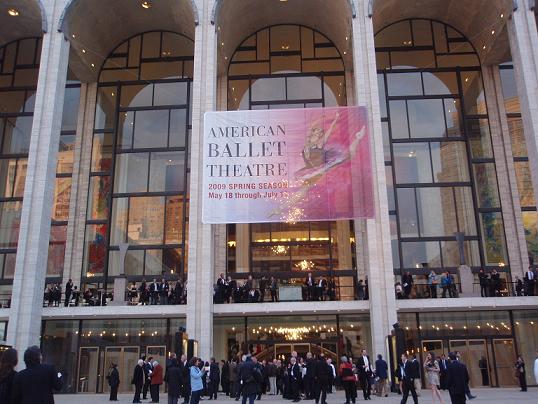
Yay, the season has offically begun! This picture was taken during intermission; that’s why it doesn’t look that crowded. I was sprinting in, nearly late, as usual, so didn’t have time to snap some pics before the performance but fortunately it was still light outside during intermission.

Anyway, Michelle Obama (who served as one of the gala’s honorary chairs) looked smashing in a sleek dark grey sleeveless, knee-length dress with tiny black ruffles lining the bottom. I’m sure there will be beaucoup des pictures seeing as how many blasted camera people there were; I’ll be sure to steal some when they’re posted on all the society websites πŸ™‚ (Oh, look, here it is in the NYTimes already)


It was just about the craziest thing I’ve seen on the Met Opera stage: after Veronika Part’s mouthwatering Mozartiana opened the show, artistic director Kevin McKenzie came out and thanked everyone who needed thanked — all the donors, designer Caroline Herrera who funds the gala, etc., and Senator Chuck Schumer came out and gave a little talk about the importance of funding for the arts, etc. Then, Schumer disappeared behind the curtain and moments went by. Everyone kind of looked around at each other like “what’s going to happen next?!”

Soon, the curtain was pulled back to allow some people to carry out a podium with a banner “American Ballet Theater” draped over its front. The doors to the lobby opened and a flock of people bearing weapon-sized cameras blasted in. Several men dressed in black promptly rose from their aisle seats and followed the flock of weapon-camera-bearers to the front of the aisle, near the stage. Caroline Kennedy was announced. She came out, everyone applauded, and she mentioned that the school of ballet associated with ABT, the Jacqueline Kennedy Onassis School, would be performing on the Met Opera stage for the first time ever tonight. Everyone ooohed and aaahed. Then, she announced First Lady Michelle Obama.

The curtain pulled back again and out she came. Of course everyone gave a standing ovation. She smiled radiantly, then, after a moment, directed us to be seated. Then she gave a short speech. It was a little hard to focus on what she was saying with everyone — both professional photographers and audience members with cell phone and digital cameras alike — flashing away as they were, but she talked about the necessity of the Arts for a culture to flourish, the importance of arts education, etc. Then she introduced the Jacqueline Kennedy Onassis School students.

As soon as she disappeared behind the curtain, the auditorium remained still pending the exit of the flock of pro camera wielders. It’s funny because there were all these non-dance writers in the press section. You could hear the sighs of relief, the sinking down into the chairs, and the putting away of pens and paper — and cell phones, which they’d used to light their writing paper during Mrs. Obama’s speech, which would have been extremely annoying had it not been for all the flashing bulbs anyway. But it made me wonder how they’d ever survive as performing arts critics! I mean, who needs light to see to write!

Anyway, the students were excellent. They performed Le Defile (The Procession) by Raymond Lukens. There were three large groups of them, in three levels — the very little ones, a medium-age / level group, and the older, very advanced ones. The choreography was basically a showcase of classical ballet steps, much like a very advanced ballet class — jumps, jumps with changing feet, jumps with changing feet that went on forever performed by a set of advanced boys (which drove the audience to wild applause), jetes, chaine turns, multiple pirouettes, fouttes, etc., and then a bit of partnering. It gave the students a chance to show what they could do — and the advanced ones could do a great deal! Extremely impressive, and great fun.

Then on were Xiomara Reyes and Herman Cornejo doing an excerpt from August Bournonville’s La Sylphide. This was the most dramatic I think I’ve ever seen Xiomara. I was sitting in the back of the orchestra and she really projected. She was really sweet. And Herman as always amazed with his virtuosity, his jumps, his razer-sharp precision, his astounding clarity of line.

The corps in both this, La Sylphide, and Swan Lake, later in the evening, were absolutely amazing, by the way. Not a head arched back more than the others, not a leg raised higher. They were all so on. When they work together like that, in perfect unity; it’s really visually breathtaking.

Then was Balanchine’s Tchaikovsky Pas de Deux danced by Ethan Stiefel and Gillian Murphy. Ethan and his strutting around stage, taking his own good time after their duet and before beginning his solo, making the conductor wait for him! And his high jumps with all miraculously many beats of the feet. I wished my friend Alyssa could have come so she could see he’s not just Mr. Sexy; he’s a superb dancer. And Gillian was radiant, and a perfect foil with her speed-of-light chaine turns. They enjoyed a long, slow kiss during the curtain call. The audience went mad!

Then was the hunt scene from Sylvia danced by Michele Wiles followed by a piece d’occasion (the first of two of the night), by Alexei Ratmansky, for Nina Ananiashvili, called Waltz Masquerade. It was set to the Waltz from Aram Khachaturian’s Masquerade Suite and it was cute and comical. She was dressed in this long, red dramatic, Carmen-like dress with a sexy black lace overlay on the top. There were four tuxedoed men, each bearing a gold candlelabra, one at each corner of the stage. These men turned out to be: Jose Carreno at the front left corner; Marcelo Gomes, at back left; Angel Corella back right; and a blonde on the front right who I initially thought was David Hallberg (I was sitting FAR back from the stage!) until the fun began and he shook his head about like a sassy mop and I realized DH just does not have enough goofball in him to do such a thing, even if he tried. So, I decided it was either Ethan or Maxim Beloserkovky. Anyway, Nina’s character was supposed to be dancing about the stage in a melodramatic solo — but it was purposefully melodramatic, and so comical. Like a silly, cartoon version of an upcoming swan song, really, which, is of course, what’s coming up for her later in the season (and will be much more sobering when it does). At one point, she just passionately crashes to the ground and remains there, in a heap. Nothing happens. The men, obviously her servants, start looking at each other like, what now? They shrug, slowly walk over to her. Then, Marcelo starts imitating her melodramatic dance, but far more cartoonishly, and of course it’s hilarious. The others join in. Max (I think it was Max, not Ethan) does his thrashing hair thing. I couldn’t see facial expressions but I assume they were making fun of their master. Then she wakes up, catches them, and they’re sent back to their posts.

After intermission was the balcony pas de deux from MacMillan’s Romeo and Juliet, danced by Marcelo and Diana Vishneva. At first, Diana approaches her balcony with all the drama of a ballerina playing Juliet, rather than Juliet herself. I rolled my eyes. This is what I don’t like about her. She’s an excellent dancer but she’s all about the pomp and circumstance and not about the character. Maybe it’s a Russian thing, but I don’t see that in Veronika Part or Irina Dvorovenko. Anyway, she eventually lightened up, thankfully, and I felt like I was watching not a prima ballerina being a prima ballerina but Juliet herself, falling hopelessly in love. When she runs around him one foot solid on the ground, the other on pointe, it’s so girlish, so real yet so poetic. Those are the best — I don’t know what to call them — runs around kneeling Romeo — that I’ve ever seen — not even Alessandra Ferri’s were that sweet. Still, I felt some of the lifts lacked the beauty and magic ofΒ  those Marcelo and Julie Kent do together when they dance this scene. I don’t feel she dances that well with a partner; she’s more into herself. Marcelo’s leaps around the stage and big high passionate jumps were thrilling. He got some good bravos for those.

Then were Paloma Herrera and Max Beloserkovsky in the Act II pas de deux from Swan Lake. I was hoping it’d be the Black Swan pdd, but no. I guess the program was pretty bravura-heavy already. I don’t see him dance much, but Max is really quite good. He’s really a character and he’s the perfect Prince Siegfried, regal yet vulnerable and tragically in love. And he’s a good partner.

Then was the mad fun of Le Corsaire, with Irina Dvorovenko, David Hallberg as Conrad, and Angel Corella as Ali. Except something happened at the beginning and I hope David’s okay. The tallest guy in the entire opera house had to sit in front of me and I was trying to navigate my way around his enormous head just as a bunch of people up front went “Oooooooh!” When I was finally able to see the stage, Irina was standing in front of David, face toward the audience. She didn’t seem to have any particular expression on her face, but, then, I was light years away from her. Then David did an assisted pirouette with her and everyone applauded, so it must have been a lift that didn’t quite happen or something. Anyway, I hope he’s okay; I know his shoulder sometimes comes out of socket. Anyway, all seemed to be fine after that: all three were brilliant. Of course. Angel astounded, as always, and I started giggling during his first solo and couldn’t stop all the way through the second. I love Irina. She was radiant. She did those continuous turning kicks on pointe like they were nothing. She has the drama and the virtuosity when needed and the always beautiful, graceful lines. And David’s leaps all over the stage were magnificent. I could see this goofy ballet over and over and over again, as long as no one gets hurt πŸ™‚ Angel did not leap out from behind the curtain during curtain call, sadly.

Then there was another piece d’occasion. Herbie Hancock played piano, onstage, while first Jose Carreno, then Stella Abrera, danced to his music. This was cute and comical as well, and kind of reminiscent of Jerome Robbins’s Other Dances or Suite of Dances, where the dancer(s) connect mainly with the musician. At one point, Hancock went nuts with the keys, obviously way too fast to be danceable, and Jose stopped in his tracks, looked over at him, and lifted his hands, like what gives, dude? He sat down near the base of the piano and just rested. The same happened with Stella. She danced, then stopped and gave Hancock a look when he began another little virtuoso section. She finally sat down beside him on the piano bench, and eventually, he ended on a romantic note, she snuggling next to him softly, sweetly.

The evening ended with the finale of Balanchine’s Theme and Variations. The leads were danced by Sarah Lane and Daniil Simkin. It was a nice way to end the program, but with the likes of Simkin, I wondered why they only did that group finale, where he and Sarah are basically leading a processional, instead of some of the earlier bravura parts with all the corkscrew turns for the man. An opening night gala performance is meant at least in part to showcase the dancers doing what they do best, and he is best at the bravura stuff, not leading processionals.

Anyway, the whole night, as usual, was magic. Saw Sigourney Weaver and Kelly Ripa in the audience.

Oh, for my Dancing With the Stars readers, I taped the show, but for lord knows what reason it was somehow muted. I have no idea how on earth I managed to do such a thing, but it was pretty amusing watching the show in pure silence — no words, no music. Needless to say, I’ll have to watch online tomorrow.

But now, dead tired, must sleep. Goodnight.

WHO WOULD MAKE A BETTER MODEL THAN A DANCER?


I was in the bookstore the other day looking for literary magazines and somehow got caught up in the latest issue of Vogue Hommes International. I’ve been a fan of Keanu Reeves all the way back since River’s Edge (honestly) and I saw on the cover that there was an interview inside with Bret Easton Ellis (novelist, Less Than Zero, American Psycho, Glamorama, etc. etc.) Interview with BEE is pretty funny, actually, in a way it likely wasn’t intended to be. IE: interviewer: So, you were an icon in, like the 80’s. BEE: Yeah, it was hard being an icon. And confusing. Seriously. I’d get in a fight with my boyfriend and I’d be like, wait, you can’t criticize me; I’m an icon!” But my favorite BEE quote is here.

Anyway, I was flipping through and there are all these little mini interviews with and photos of writers (Stefan Merrill Block too!), architects, actors and filmmakers, of course designers and models.


But not a single dancer anywhere. Why not? They’d make such good models πŸ™‚


(Sergey Surkov, my photo; Slavik Kryklyvyy from here)


(Arunas Bizokas, my photo; Linas Koreiva, from here and here)

Vogue Hommes should so hire me to compile a dancer spread! Fabrizio Ferri can do the pictures. Maybe Bruce Weber, though he can get kind of cliched and corny… No, Fabrizio.

Then, yesterday, I saw Valentino: The Last Emperor, which was pretty good. The Dolce Vita-esque scenes were the best πŸ™‚Β  And it reminded me of Fashion Week’s being moved from Bryant Square to Lincoln Center, and I thought how excellent (and fitting of course) it would be to have NYCB and ABT ballerinas as the models, an idea Kristin Sloan had proposed on the Winger a while back. Ballerinas generally have far better bodies than models. Come on!


Daniil’s Debut and a Riveting Pillar of Fire


Last night was the New York debut of ABT‘s newest star soloist, Russian-born, Daniil Simkin. He danced the Tico-Tico section of Company B, which I wrote about here, and which is going to be a dance I can tell will grow on me each time I see it. Tico Tico is probably the solo with the most bravura theatrics, and it suited him well. He has a small, compact body and can go very high on those jumps, really sail around the floor on those barrel turns. But the solo is also jazzy, and he pulled off the softer, subtler elements as well. At the solo’s end he got huge applause from the crowd, and more whooting applause mid-dance (which rarely happens with dance crowds these days) in the very last ensemble section, when he went whizzing halfway up to the ceiling in a twisty turning jump. “That little one was sure something!” exclaimed a couple of women as we left the theater.

My only thing — and this goes for the whole cast, not just him — at the end of the male solos, each man falls to the floor. This is meant to show that they’ve died in war. It it only their spirits that are dancing; the duets are the memories of the women they’ve left behind; the solos are ghosts. So, the dance on its surface is fun and frivolity with jazzy music and pretty girls and the whole nine yards, but there’s underlying tragedy, which gives the dance its power.


On the way out of the theater a woman was complaining to her friend that the ABT dancers “aren’t doing it right; it’s not clear they’ve fallen,” she said. And I agree. At the end of Daniil’s solo, he raised his arms and pushed back from the waist while disappearing into the wings as if he was hit in the stomach by a bullet. But he wore the same happy carefree smile as he had throughout the whole solo (likely because the audience could tell he was finishing, the cheers were beginning to sound and he’d just finished his NYC debut), so you’d never know he’d been shot. But it wasn’t just him — others in this cast did the same. I think the first cast, and especially Herman Cornejo, gave those moments more gravity and pathos. I still don’t know if it was enough though — something tells me people missed the war leitmotif altogether — but it was more. Don’t know how much is enough, really. I’ve never seen Paul Taylor’s company perform it so it’s hard to tell the choreographer’s original intent. You definitely don’t want to overdo it or it becomes preachy. It has to be subtle.

Anyway, I will look forward to seeing Simkin again next week in the Russian ballet, Flames of Paris (Ratmansky, woo hoo!) which I’m, obviously, immensely excited about. Simkin, by the way, keeps a blog; it looks like he updates his Twitter feed more often than the posts.

Also on were Antony Tudor’s Pillar of Fire and Jiri Kylian’s Overgrown Path. This was my first time seeing Pillar and I found it absolutely riveting.


The ballet’s from 1942 and the story’s dated — girl longs for good boy, good boy’s into her sister, girl doesn’t want to grow up to be spinster like older sis, so goes for bad boy who takes her virginity and “ruins” her, so that when good boy leaves brainless sis and comes around, she’s damaged goods. This results in tragedy; she can now only have good boy in her dreams, in the moonlight. At least that was my interpretation.

The great thing about Tudor, dated as this story is, is that he’s so dramatic, his drama comes from within, within the body. You can tell his dancers have to spend so much time working out the characters, and everything is made so clear not so much by facial expressions, but by body movement and posturing and gestures — which is dance, after all. David Hallberg as the good boy (I know, immensely annoying — good boy is shiny American blonde, bad boy is big dark Brazilian Marcelo; there are also “lovers of innocence” blonde and wearing white nightgowns and “lovers of experience” dark-haired and dressed in ‘slutty’ gypsy-like attire, but we won’t go there for the time being) has this quick, rushed gait, so that he passes right by Gillian’s heroine, paying no attention whatsoever to her body, contorted and hunched-over from the waist, cramp-like, with pain. Marcelo definitely notices her, and throughout he keeps doing this thing, rubbing his hands with the flat of his palms on both sides of his groin. It’s so sexual and so sexy and so threatening. I kept bolting upright and leaning forward every time he did it, and had to keep reminding myself, this is City Center, you move a millimeter and you’re blocking every single head behind you.

Marcelo was Marcelo, perfectly in character as always, and Gillian blew me (and the audience, judging by the substantial applause) away with her inner development and tragic portrayal of heroine Hagar. Only thing lacking (apart from the stereotypical casting and costuming), and just a smidgen, was David, in the beginning. His walk was perfect (Tudor concentrated greatly on gaits as a revealer of character), but he was a bit too severe. I couldn’t really see how Gillian’s Hagar was so enthralled with him. He seemed like a jerk the way he ignored her. Then, when he comes around to her, he slows it down, but then he has his regular pointy-footed, slightly hip-swaying, rumba-esque walks. It’s quintessential sexy David, but I don’t know if it’s this character.


The only piece that wasn’t to my liking was Kylian’s Path. They’re putting it on this season because Kylian made it in honor of Tudor, who considered the Czech choreographer his artistic grandson, and the season is devoted to Tudor. It just seemed too one-note, too dreary, without a serious drama you could latch onto. It’s meant to evoke sadness and pathos — is set to piano music by Leos Janacek, who composed the piece (On an Overgrown Path) not long after losing his son, then daughter, and you see a set of women who seem to be mourners, heads hung down, at times reaching out into the air as if in vain, and a young woman dances several duets with a man (Jose Carreno, who, weirdly, couldn’t even save the ballet for me), then disappears into the curtains. I don’t know, maybe I wasn’t in the mood, maybe it’ll grow on me, because I’ve certainly liked other things Kylian has done.

The company has a mini-website devoted to Tudor, where you can view videos and pictures here.

ABT Gala: Craig Salstein Has a Future as a Choreographer, and Herman Steals the Show (Or At Least The Second Half Of It)


So, last night was opening night of ABT’s fall Contemporary season (which will last for the next two weeks) at City Center. I love galas, for the most part: I love seeing all my favorite dancers in the best excerpts from my favorite ballets. Although the only piece that really fit that tonight was Jose Manuel Carreno dancing the bravura pas de deux in Don Quixote with Xiomara Reyes. I am such a child; I again got a bad case of the giggles the second he stepped onstage — both during the duet and then when he had his leaping, fouetteing, barrel-turning solo — this always happens with Jose — and really had to control myself; I was sitting only a few seats down from Kevin McKenzie (who is thin — most go the opposite way after they stop dancing — and as I mentioned before, behind Alessandra). Anyway, see a video here of Jose dancing DQ with Paloma Herrera.


First, because it’s most on my mind since it was the only piece (performed in its entirety) on the second half of the program: Company B, choreographed by Paul Taylor, which I LOVED. I’d never seen it before: it’s a jazzy modern piece (no toe shoes) set to several 40s era songs by The Andrews Sisters (like Boogie Woogie Bugle Boy of Company B). Both song and dance are cute and fun on their surfaces, but in the background from time to time a line of men march slowly, their bodies at the back of the stage, in shadowed silhouette. Some of them hold what appear to be guns. Some hold their arms up as in surrender. They are going off to war (timely then — during the era of the songs, timely now). But you almost don’t notice them. At points, a sweet romantic duet will be centerstage, and one of these men will join the dancers, flying happily about the stage, along with them, then suddenly slam to the ground, as if shot. Because of the marked contrast between fun and play and love, and being shot dead in the line of battle, the background war theme is all the more poignant.

Herman Cornejo stood out to me here. He was cutely carefree, leaping about (as usual, halfway to the ceiling, though the height seemed like pure coincidence, like he hadn’t meant to go that high at all, it was just natural for him), then is left sadly, starkly alone in the end, without the girl, without his carefree ways, and perhaps eventually without life (at times he is also one of the silhouettes in the background). Herman used to be all about huge jumps and leaps and turns to me, but he’s grown hugely as an artist, and now the jumps and leaps and turns are all done in the furtherance of character, though no less awe-inducing. He grows on me each time I see him perform. The Taylor piece was perfect for him. And, as I said, it’s timely and I’m thrilled ABT’s chosen to put it on this season. It’s showing several more times and I can’t wait to see it again and again.

The first half of the program consisted mainly of excerpts (except for Craig Salstein’s excellent Time, which I’ll get to in a sec); in addition to DQ, there was Balanchine’s Theme and Variations performed by my favorite, Marcelo Gomes, and Paloma Herrera. When, at the beginning of a solo, Marcelo walked out onstage and kind of looked out at us, it looked like he was looking right at me. How does he do that? How does a performer do that? It’s uncanny! When Kevin then came out and gave his little thank-you to all the gala sponsors, he did the same thing. Angel Corella does it too. Hmmm.

Anyway, Marcelo was excellent, of course. The far-too-shy crowd was ridiculously late in applauding his series of 15 or so continuous twisty multiple-turning-jumps. American audiences, argh! Marcelo is the quintessential romantic leading man, as I’ve said about 10,000 times throughout the course of this blog :)Γ‚ — the way he lifted Paloma about every which way, all over his head; partnering is his forte. But, because of his size, you can tell when the choreography is really fast πŸ™‚


Second on was a scene from Romeo and Juliet (when Romeo leaves Verona), danced by David Hallberg and Gillian Murphy. But this R&J was not the one I’m used to, the one by MacMillan; it was choreographed by Antony Tudor (whom the company is honoring this season; it would have been his 100th birthday this year). Tudor’s R&J is much more dramatic than pashmina, without all the flourishes and breathtaking lifts, but instead with lots of yearning arabesques where the dancers lean toward each other, balancing on the tip of their toes, nearly falling forward, longing but seemingly unable to reach the other. It was passionate in its own sad way and makes me look forward to more Tudor.


And then there was Time, a new piece by well-liked soloist Craig Salstein, a short solo, danced by Michele Wiles. I think this piece marks his choreographic debut. It was originally made in December 2007 for Dancers Responding to AIDS. I loved it. It was soft and lyrical but had modern elements as well, such as short, staccato movements of the arms and legs, and a frontward leaning arch, with arms extending up and back, like a bird taking flight, reminiscent of Alvin Ailey or Martha Graham. Michele danced with a sorrowful passion; it was hauntingly beautiful. As its name and the group it was created for implied, it felt like a woman struggling hard to extend her time here on earth. She would reach upward toward the heavens, but in vain, and she kept brushing her right leg backward, as if trying to brush off a negative thought, a harsh reality. Later, she would dance with fluidity and grace, in acceptance. And the movements would repeat themselves, like they would psychologically in someone who is grieving: denial, anger, acceptance, denial, anger, acceptance. To me, this one little work showed that Craig has wonderful originality, understands how to build structure, understands different kinds of movement and what they do, and has a strong sense of how to convey what he is trying to convey to the audience and really move us. BRAVO CRAIG!!! And brava Michele!

There was a little more, but these were my favorites. Also, Gillian Murphy and Jared Matthews impressed me last night. I don’t know exactly why because she’s always technically brilliant, but Gillian just shined last night; everything she did brought my attention right to her, even when she was surrounded by many others; she just had an extra glow. And Jared I’ve always seen as kind of the skinny blonde guy who blends in with everyone else, but he is looking more and more polished, dancing with greater and greater sharpness and precision and standing out for those reasons — and he was looking even rather majestic last night.