James Wolcott on Deborah Jowitt in the Seventies

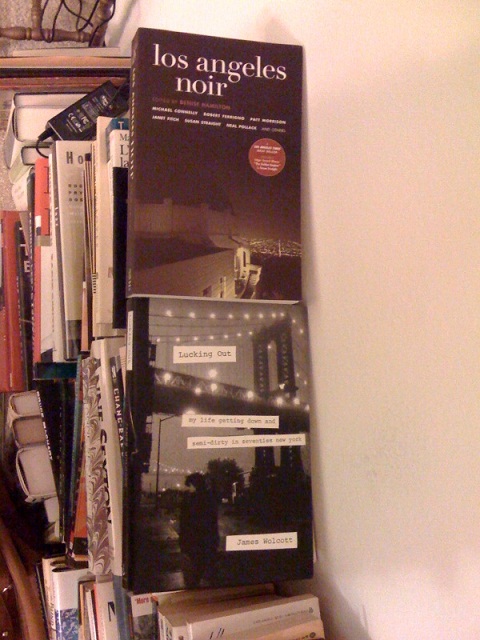
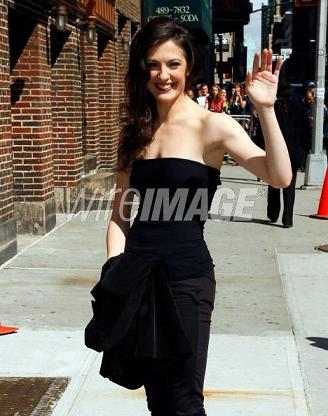
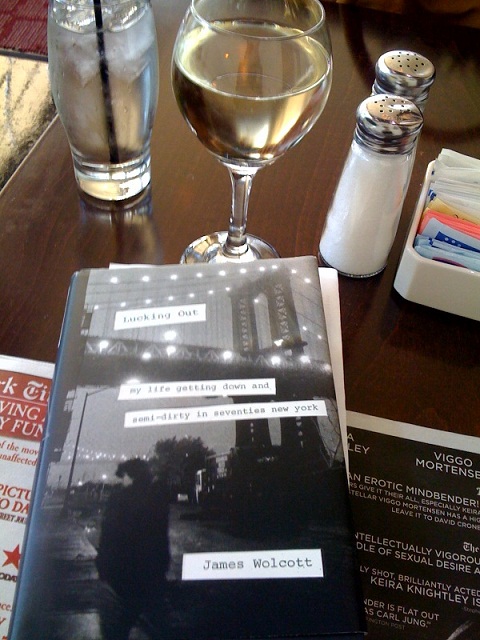
I’ve been reading James Wolcott’s memoir, Lucking Out: My Life Getting Down and Semi-Dirty in Seventies New York (photo above taken at the ArcLight Hollywood Cafe). It’s about his life as a writer in New York and his years working at the Village Voice in the magazine’s early days. (He got a job there after sending Norman Mailer a copy of an essay he wrote about Mailer’s appearance on a TV show for his school newspaper and Mailer went wild over it. It’s so hard to believe there was a time in NY when careers were based on talent and not on pedigree and Ivy League schools…)

Anyway, at the beginning, Wolcott describes several of the writers who worked at the Voice back then. Of course I was very intrigued by his words about the magazine’s now legendary dance critic:

“The dance critic Deborah Jowitt had the fine-boned fortitude of a frontier settler with eyes forever fixed on future horizons; her merciful consideration of even the most flailing effort and her descriptive set pieces suitable for framing set her apart from the tomahawk throwers.”

Apart from his brilliant writing (those metaphors, and adjectives!) I found this interesting because it seems that the “tomahawk throwing” form of criticism is so in vogue these days. I guess because in the internet age, incendiary writing begets comments which beget more readers, or ROI or what have you… I’ve had several people (mostly writers) tell me the problem with my blog has always been that I’m not critical enough – I could never be a “real” critic because I’m too nice, and forgiving of crappy art. Those same people are also critical of other, professional critics for the same. But what’s wrong with “merciful consideration” and rich description? Sometimes it’s far harder to try and find the value in something – to try to figure out what exactly the artist is trying to do and to place that attempt in context and describe why it’s worthy than it is to ridicule it or tear it apart. And description – especially of a largely abstract art form – is damn hard.

I feel Wolcott’s words describe Edwin Denby as well, and when I read his small pieces about dance in the forties and fifties, read together in book form one article right after the other, it’s like they tell a story of that era. I wonder if that sense of narrative would be lost in writing that focuses more on attack than on giving the reader an overall picture of what happened.

Anyway, it’s a really good book – Wolcott’s that is – and makes me miss New York – even though that’s not the New York I know, unfortunately.

Now off to a Michael Connelly reading at a Barnes and Noble that is thankfully more centrally located than blasted Santa Monica (even though I love Santa Monica). I still have to drive though. Am still so not used to driving everywhere. Every time I go out I’m still so inclined to walk or take the subway or bus. You just can’t though. They run infrequently or not at all at night and walking is impossible unless the event you’re going to happens to be right in the same neighborhood – and then you still may be walking a mile or so.

Settling into LA II: Santa Monica, Rose Bowl Flea Market, NoHo Arts Festival, and Universal Studios

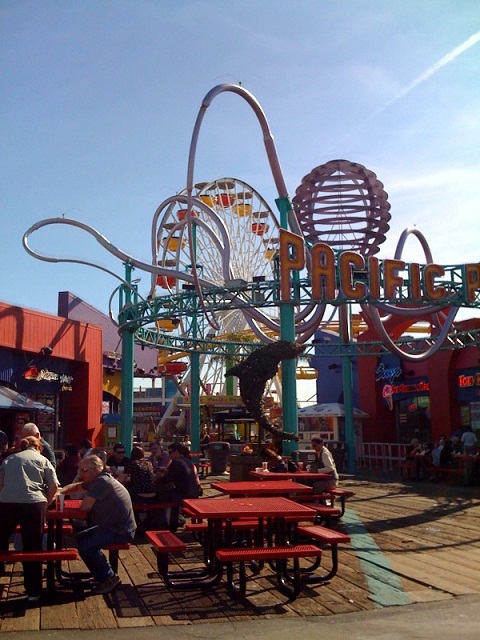
Here are some more of my recent LA photos. I guess before really settling in, there’s a period where you just have to be a tourist 🙂

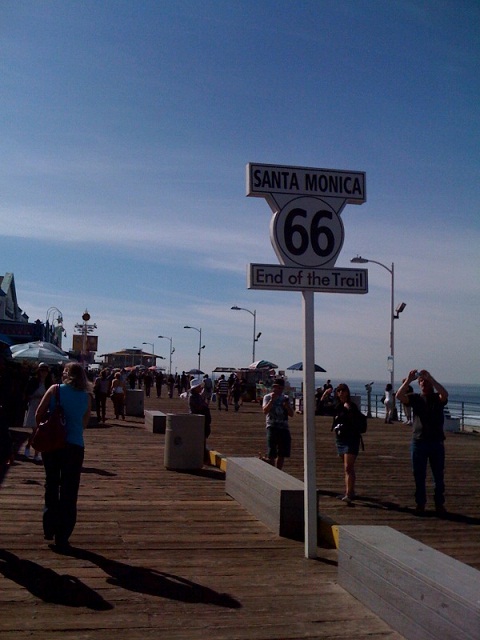
Most of my friends seem to live near Santa Monica, so I’ve been spending a good amount of time out there. Above is the Pier, where Route 66 officially ends.

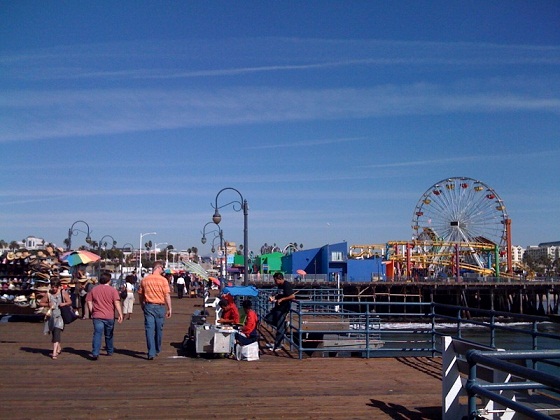
It’s a bit Coney Island-esque with the ferris wheel and all (which is lit up at night). Not nearly as fascinatingly cheesy though 🙂 And no Nathan’s hot dogs.

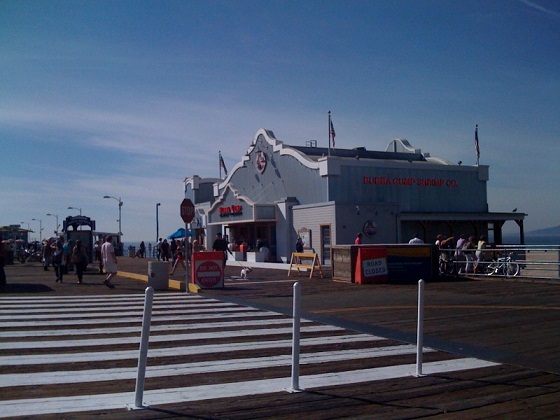
The Pier’s very touristy – mainly filled with souvenir shops and restaurants like this one, called Bubba Gump, and named after the movie, Forrest Gump, and specializing in seafood of course.

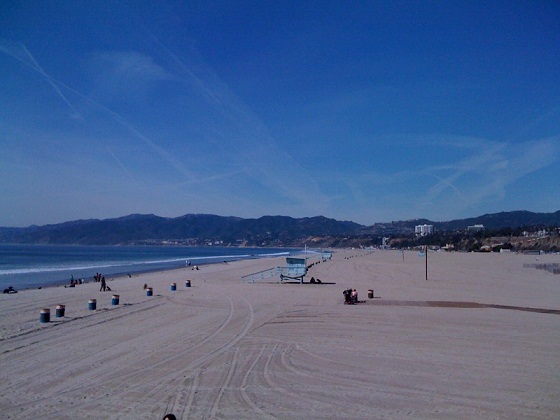
Here’s the beach.

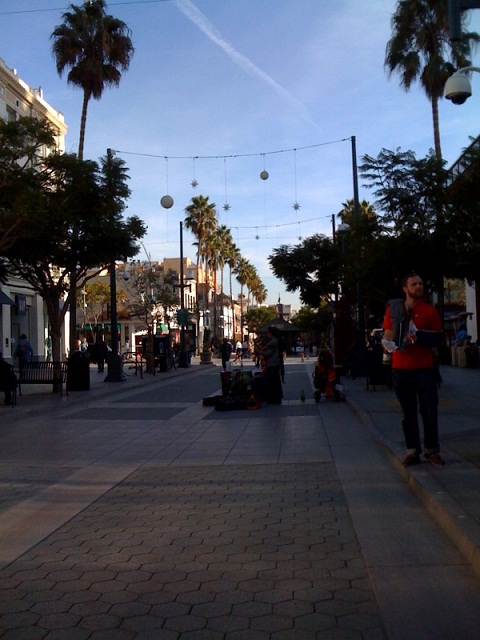
And here’s the Third Street Promenade (so named because its cobblestoned street, which goes on for three blocks, is vehicle-free), which is also pretty touristy, with lots of chain stores like Banana Republic and Barnes and Noble and Starbucks.

In places though it kind of reminded me of Vienna, with little cafes and wine bars in the middle of the street.

There were also some street musicians.

And a Christmas tree.

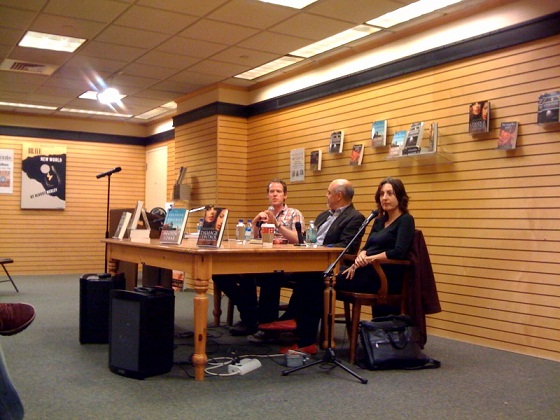
I went to Barnes and Noble for a discussion of LA Noir by three novelists of the genre: Denise Hamilton, Hector Tobar, and Scott O’Connor. It was really pretty interesting and made me feel that LA and NY have more in common than not. It made me feel at home, like readings often do, and made me want to pick up where I left off several weeks ago now with my own writing project.

I picked up one of the short story compilations that the writers contributed to, Los Angeles Noir, and also James Wolcott’s new memoir, Lucking Out: My Life Getting Down and Semi-Dirty in Seventies New York, which I’ve been meaning to get since I first heard about its release. Unbelievably, I hadn’t been in a bookstore since Borders closed a couple months ago.

I have to say, visiting bookstores used to be one of my favorite things to do. They’ve always made me feel safe and warm and un-alone, if I was feeling lonely. But they just don’t make me feel that way anymore. This one was pretty empty, sadly, even on an event night – empty both of people and books. It was also pretty dimly lit – making it hard to find the books you’re looking for; it was as if the salespeople just wanted everyone to leave so they could close and go home. I don’t know, this bookstore actually depressed me.

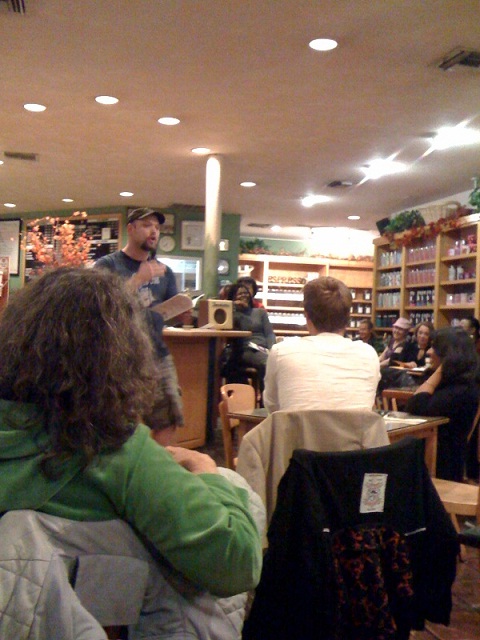
But hopefully cafes and bars will take over in celebrating and spreading literary culture. Here’s a lively poetry reading at a coffee shop called Priscilla’s back in my hood.

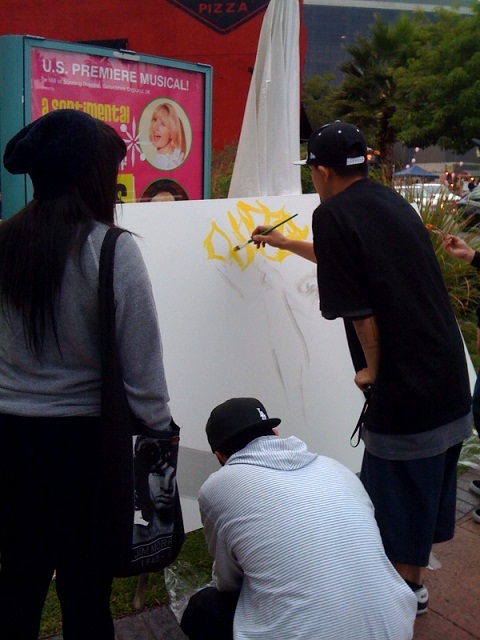
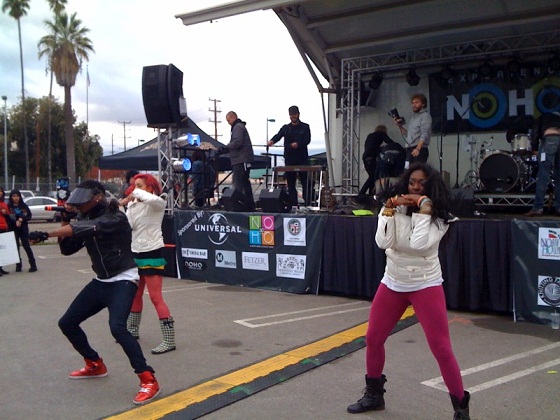
Here are a few photos of my trip to the NoHo Arts Festival last weekend. NoHo (North Hollywood) is kind of a bohemian area that, to New Yorkers, I’d liken to Bushwick. There are lots of dance studios (mainly teaching hip hop and jazz, some ballet), acting studios, very small theaters (as in off, off-Broadway), and a few galleries. For the festival, they had these little stations around town where all passersby could contribute to a work of art.

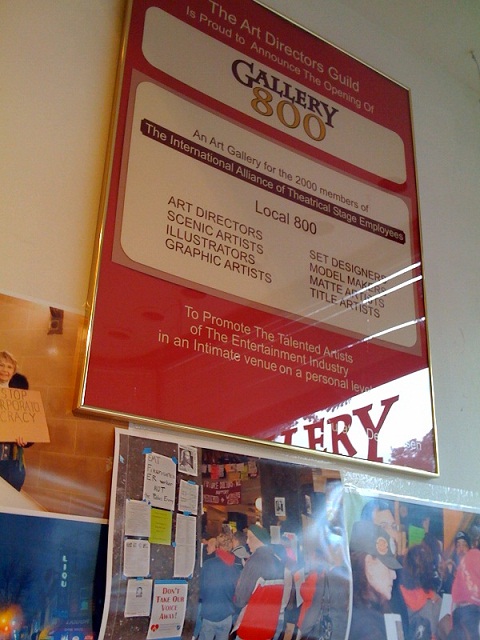
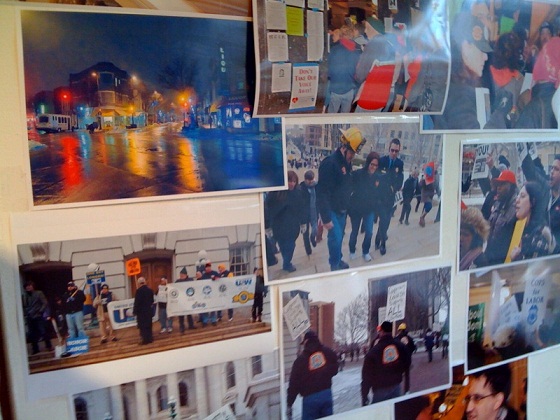
One of the galleries, showcasing art by those working in theater, and some photojournalism.

Here’s a hip hop singer, Brooklyn J., performing on the mainstage with several female backup dancers.

Here’s a band. Music seemed to be mainly punk and grunge.

The arts festival coincided with a little farmers market, which I guess happens every Saturday near the subway. I was particularly intrigued by this vendor, Homeboy Bakery, who has several lines of products (bread, desserts, tortilla chips and salsa, etc.) for sale at both farmers markets and in local groceries, and whose mission is to help young people from troubled backgrounds stay out of trouble by keeping them employed with creative jobs.

I spent Veteran’s Day at Universal Studios. I’m such a tourist! I couldn’t help it. I hadn’t been there in over thirty years. I think the only parts of the studio tour that are still in existence from then are the Jaws and Psycho exhibits!

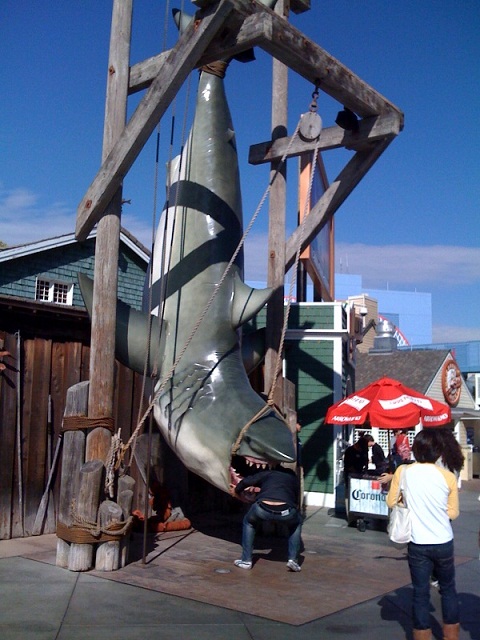
I couldn’t get a good shot of the phony shark coming up to attack the tour trolley. In this photo, he’s just set off some explosive device and is now coming for us.

On the ride, they show you via the overhead monitors what the scenes that were shot on the sites you’re visiting looked like in the finished movie. Here’s a photo of the actor from Jaws messing about with the mechanical shark.

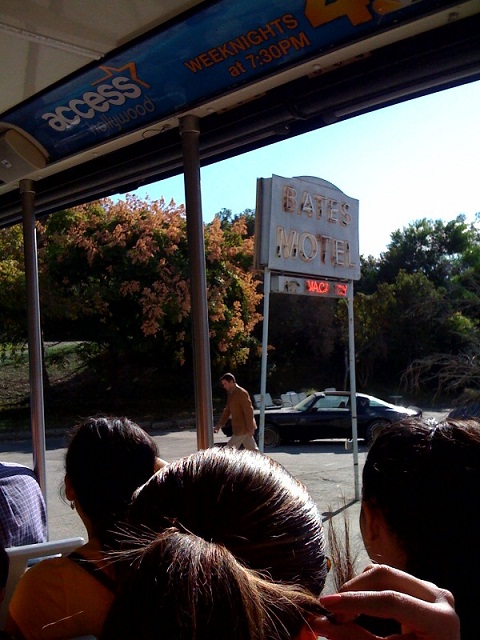
Here’s the Bates Motel, where they have an actor playing Norman come out, drag his mother’s body about, and eventually threaten guests on the ride.

Here’s part of a set from a plane crash. I forgot the movie… but this is from an actual plane.

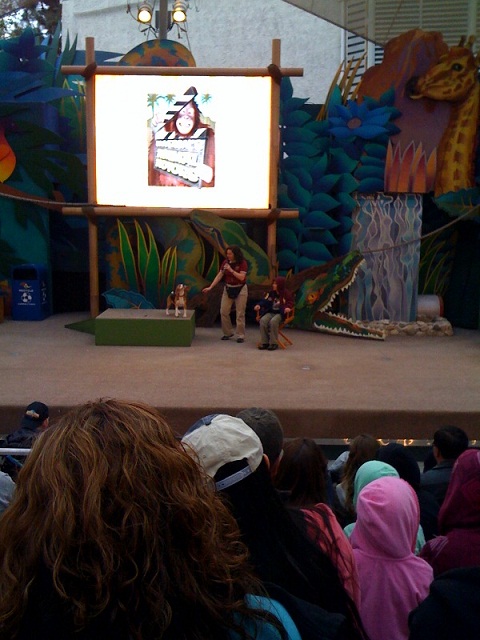
I also sat in on a little demo on how they train animals to “act” in the movies. These animals – dogs, cats (cats are the hardest of animals to train because of their independent nature), birds, an adorable little fox, a little monkey, and a chimpanzee, were so sweet and amazingly well-behaved; kind of made me want to be a trainer…

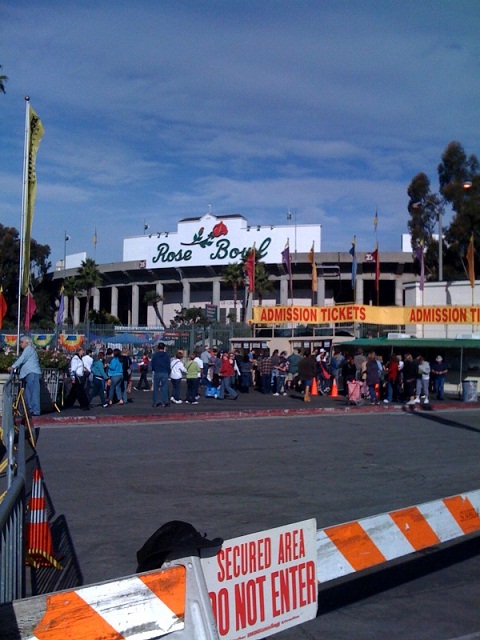
And on Sunday, I went to the Rose Bowl Flea Market in Pasadena, which takes place on the second Sunday of every month. I’d read a lot about this, so just had to check it out. Plus, I needed to get a few things for the apartment.

The amount of crazy stuff there – it was a hoot! Like these old fire hydrants…

And this piece of furniture that looks like it once sat in a museum, or maybe a hotel lobby.

And all these signs. A couple behind me became quite excited over the Jack Daniels one.

I badly wanted one of these Sixties era yellow lounge chairs! But nowhere to put them…

Or this Freudian-looking burgundy couch.

I needed a couple of end tables, so ended up getting this very art deco-looking piece (whose scent Rhea has approved),

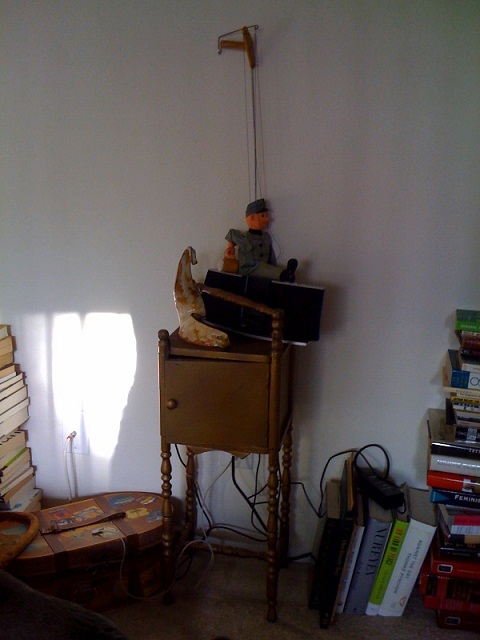
and, though I really have no idea what it is, this piece. All I know is it’s small and has an ornate top handle for carrying that matches its legs, and it has a little door that opens up and provides a little container for books, or in my case a CD player and old CDs. I thought it was fun and very very old.

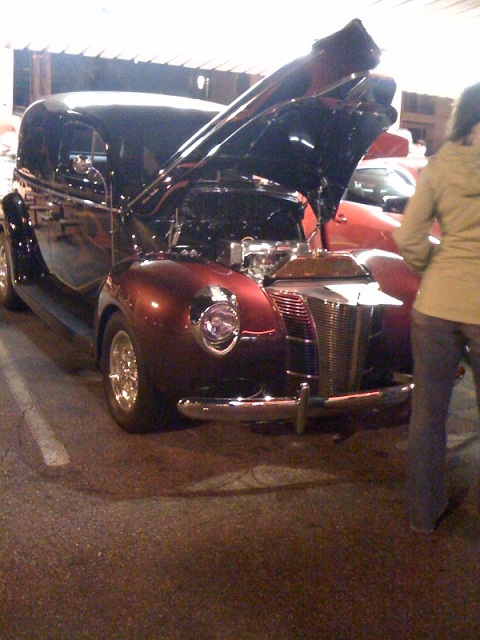
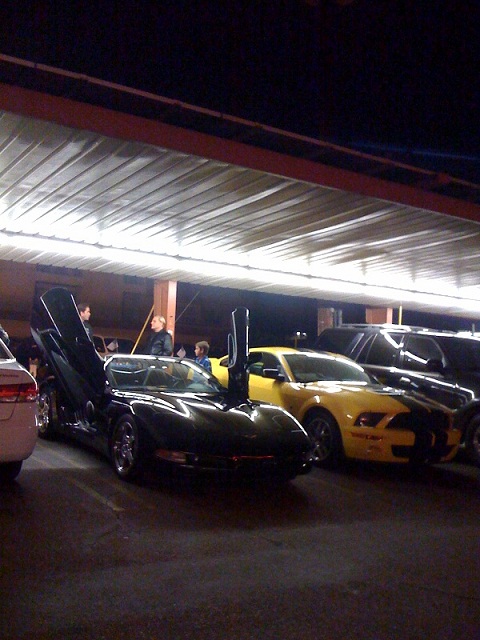
Finally, back in Burbank, here are some cars at the antique car show held in the Bob’s Big Boy parking lot every Friday night.

Okay, that’s all for now. Next, I hope to visit Hollywood Hills… hopefully to see Stravinsky’s house (see Ballet Lover’s comment on my last post!) And on Sunday, I’ll be going to a dance performance – an actual ballet performance – finally! I’ll be the guest of LA Times writer (and Arts Meme blogger) Debra Levine for the live-streaming of the Bolshoi’s Sleeping Beauty starring our David Hallberg. Can’t wait!

American Ballet Theater’s Original New Nutcracker


More photos coming soon. This one (of Gillian Murphy and Catherine Hurlin as the two versions of Clara) is taken from culture.wnyc.org.

Last night was the official opening of ABT’s much awaited new Ratmansky-choreographed Nutcracker at BAM. I loved almost every single second of it. I’ve only seen about six different versions of this ballet, but this one to me seems most original. It’s very entertaining, very humorous at points, and can somehow maintain the attentions of small children while being clever and witty – and beautiful – for adults. It’s very theatrical and it’s not as “dancy” as the one I just saw from the Bolshoi (Grigorovich’s version)- there’s more non-balletic jumping and playing around in Act I at the party, but there’s plenty of beautifully choreographed classical ballet during the grown Clara and Nutcracker Prince pas de deux and the ensemble snow scene and waltz of the flowers.

It opens with the cooks and maids in the kitchen preparing Christmas dinner. They’re going about their merry preparations when suddenly their space is invaded by mice. The mice completely take over, chase out the cooks, jump up on the tables and grab for the hanging meats. Adorable and hilarious. There’s one very cutely mischievous little mouse who appears throughout.

Then the party scene happens and Drosselmeyer (a non-dance role here) presents the children with two sets of life-sized dolls. The dancing was very good, but there were no sharp, stunted staccato movements as in the Bolshoi’s, so the dancers didn’t look like real dolls to me. I loved the costumes for Harlequin and Columbine though. They looked the most commedia dell’arte that I’ve seen. All costumes were brilliant – one of the most excellent things about ABT’s production. They, and the equally brilliant sets, were made by Richard Hudson, of Lion King fame.

When the dolls are ordered to return to their boxes, the children do a group dance that looks more like fitful stomping than anything balletic. But it’s still musical and evocative and cute, and it got a lot of laughs. The nutcracker that Drosselmeyer then gives Clara (danced brilliantly by Catherine Hurlin) is half-doll, half-human. He’s danced by a boy (Tyler Maloney) but he has a full nutcracker head, so he can’t do as much as the Bolshoi’s human nutcracker doll – his movements are much more limited. Once Clara’s dream begins, the boy removes his doll head before escorting her off to the Kingdom of the Sweets. I have to say, I really liked the boy who danced Clara’s bratty brother, Fritz – Kai Monroe. He was very entertaining, did a good job with both the acting and the dancing (high jumps!), and I think he will be one to watch for.

The Battle scene between the mice and the nutcracker and his soldiers was good, and, again, the costume for the mouse king (Thomas Forster) was fantabulous. I couldn’t even count the heads he had there were so many. I think of all battle scenes, I like Balanchine’s the best. I love how a mouse will scurry ominously across the floor right in time with a flute chord. Then the mice begin to gather and organize right in time with the flute ensemble so that it seems like the mice are talking. And Balanchine’s battle scene seems the most theatrical. Balanchine’s growing tree is also magnificent. Here, the tree only grows a bit, but soon they multiply and trees begin to eat up the wings, which was also spectacular.

The snow scene was really beautiful and this is where we first meet the grown-up Clara and her nutcracker prince (last night they were Gillian Murphy and David Hallberg, but there are many casts – see James Wolcott’s review of a preview starring Veronika Part and Marcelo Gomes here). Their first pas de deux is a beautiful waltz, and it’s made very clear that this is Clara’s grown-up vision of herself and her prince. The child Clara and Nutcracker boy waltz alongside Gillian and David until the classical ballet steps takes over, and the children stop dancing and gaze longingly at their grown-up selves as they finish the pas de deux. There’s a really beautiful Viennese waltz-type of lift where he spins around with her perched on his shoulders.

The Kingdom of the Sweets is really different from other versions. The “Sugar Plum Fairy” or “Nanny” as she is alternately called here, is not a dance role, but more of an escort through this kind of tour of It’s a Small World. She dons an absolutely gorgeous ancient Indian costume, as does her male companion. The dancer representatives from various countries are not dolls; they are real, but most of the dances are very different. The Arabians, for example, are danced by one man (last night, Sascha Radetsky) and four women, and the women are all cutely chasing the one very wickedly flirtatious man. It reminded me a bit of Kevin McKenzie’s von Rothbart deviously flirting with all the court women at the beginning of the Black Swan pas de deux. At the end of this dance, though, the tables are turned and the women come into their own and no longer need him. Now of course, he’s not very happy about that. It’s great fun and I loved this dance the best.

The Russians (Mikhail Ilyin, Craig Salstein and Arron Scott) were more folksy than bravura ballet, which was fine, because they later did a circle of barrel turns as their part of the final ensemble dance.

And we see Mother Ginger again (or who, as a child, I called The Fat Lady with the big skirt). I haven’t seen her since Balanchine! And there’s an added element of hilarity here involving the mischievous little mouse from the kitchen!

The only dance I didn’t really care for was the Chinese. As I’d expected, these roles were danced by Daniil Simkin and Sarah Lane. But Ratmansky didn’t really use them for what they are known for and the dance is very tame compared to this dance in the other Nut versions. I really wanted to see Daniil go flying around the stage in those crazy million times-overrotated turning leaps that he’s known for. There weren’t even any high jumps. It’s just that I look to the Russian and Chinese dances for the bravura parts and it’s okay if they’re lacking in one dance, but not both! The Chinese weren’t as goofily portrayed though as in other versions, so I appreciated that.

And I loved the waltz of the flowers. Included here are some very charming bees, but they’re not used in a slapstick way at all, which I thought they would be when I initially saw them. They dance is very classical and there’s a beautiful part where the four male bees toss the red and pink-clad ballerinas into each others’ arms in a circular rotation. That received a lot of audience applause.

And then is the ending pas de deux again between Gillian and David. I’d written before, when I saw an excerpt at the Guggenheim, that it looked more modern lyrical than classical, but last night it looked very classical to me. Ratmansky used my favorite lift from the Grigorovich Bolshoi version where the prince lifts and holds Clara up by one lower leg and carries her all around stage like that. The solo variations were nice. David didn’t seem to have the height he normally does on his jetes (I was told later at dinner though, by a dancer – not from ABT – that that choreography was crazy hard) but he made up for it in a series of spins. I know in ballet they’re called turns, but he was going so fast they looked more like ice-skating spins to me!

The only thing I found bothersome was the acoustics in the BAM opera house. Maybe I’ve just never heard live music played there but it just seemed like the orchestra was playing so softly. The sounds of the toe shoe-clad feet and the sounds of children coughing dominated.

Oh, one final thing: when David Koch, who financed a good part of the production, gave his opening speech, he accidentally called Kevin McKenzie “Peter.” Got a lot of ooooohs from the audience. I couldn’t hear through the ooooohs what he said after that – I assume it was an apology – but whatever it was it elicited even more ooooooohs. Funny.

Overall it’s a brilliant new ballet, a very original new production. Definitely get out to BAM if you can! Go here for the rest of the schedule.

JEWELS


Janie Taylor and Benjamin Millepied in “Rubies.” All photos are by Paul Kolnik.


Sterling Hyltin and Gonzalo Garcia in “Rubies.”


Jonathan Stafford and Sara Mearns in “Diamonds.”


Maria Kowroski and Charles Askegard and cast in “Diamonds.”


Abi Stafford and Jason Fowler in “Emeralds.”

So New York City Ballet ended its Winter season with Balanchine’s Jewels, his three-act abstract ballet in homage to three different styles of classical ballet: “Emeralds” set to Gabriel Faure in honor of the French style; “Rubies” set to Stravinsky in honor of the American jazzy / showgirl-y style; and “Diamonds” set to Romantic Tchaikovsky and in the imperial, celebratory Russian style.

“Diamonds” has long been my favorite part, but the more I see of the full-length ballet (“Rubies” is often performed apart from the rest, in mixed rep programs), the other two are growing on me, particularly “Emeralds” with its complex patterns, its subtlety and nuance. And of course I like “Rubies” because I think, through this part of the ballet, new audiences unfamiliar with Balanchine can best see how he created a certain kind of “Americanized” ballet for his adopted country.

There were several debuts in the various roles: Janie Taylor and Gonzalo Garcia in “Rubies,” and I think Sterling Hyltin in “Rubies” as well (it was my first time seeing her anyway). Janie was an absolute blast to watch. She doesn’t really have the proper hips for this heavily hip-jutting, hip-swaying role — she’s so tiny and waify — but she was putting everything she had into it, taking every single movement, every jump and stretch and supported penchee and pose as far as it could possibly go and you just couldn’t take your eyes off her. It was the best performance of that part that I’ve seen since Ashley Bouder debuted in it a couple years ago. What was also so stunning about Janie’s performance was her commitment to perfecting every little detail in making a certain shape — it reminded me of her absolutely captivating performance as the Novice in Robbins’ The Cage. Except this wasn’t a creepy male-devouring insect, but a fun flirty showgirl. And yet there was a certain darkness to it — I think there always is with her (Alastair Macaulay has noted the same), but that darkness somehow worked here. She made the role her own, which is what a great interpretive artist must always do.

Janie Taylor danced with Benjamin Millepied, who was very good as well — the most animated I’ve seen him lately, actually. Maybe Natalie Portman was in the audience? I didn’t see her though.

When Gonzalo debuted he danced with Sterling. Of course I always love Gonzalo and, as always, he was very animated and dramatic, making a little story out of every little interaction with Sterling. Which is what I always love about him and what I find so engaging. They did have a few kinks to work through though – -sometimes it seemed like they’d nearly missed hands in connecting, like they weren’t completely in sync with each other. But that was only physical and was likely something you might have only caught if you were sitting up close (as I was). Emotionally they connected perfectly — which to me is more important — unless of course a physical mis-connection results in a fall or something. Hyltin does have the hips for this role and she seemed like she was having a lot of fun with it too. She was really stunning.

Of course I loved Sara Mearns in “Diamonds,” which I knew I would. This was my first time seeing her in the role and she was perfect. It was just like Swan Lake all over again. Sir Alastair in his end of the season review calls her the best ballerina in NYCB and perhaps all of New York and I generally agree, especially regarding her adagio. I guess the perfect ballerina would be someone with her or Veronika Part’s adagio technique and Gillian Murphy or Paloma Herrera’s allegro — I would have preferred for Mearns, for example, to be a tiny bit more seductive with the fouettes in the SL Black Swan pdd — but I don’t know if that ballerina exists today. I don’t know if she’s existed ever. Maybe Gelsey Kirkland? I don’t know, I never saw her dance live, but judging by what I hear from those who did, and from my own video-watching, she seems to have had everything…

Anyway, “Emeralds”: I liked Abi Stafford in the solo; I liked her port de bras — very beautiful arms, very well-articulated gesturing. Her performance was sweet. I also liked Jenifer Ringer as the second girl who does what I call “the courtship walk” with the male dancer. Her performance was full of subtlety and charm; I sensed a kind of  sweet shyness as she tip-toed en pointe along with the boy, first going in his direction, then kind of changing direction and walking around him in circles, making him kind of follow her.

At my final performance of the season, I sat next to James Wolcott and Laura Jacobs, who introduced me to several Ballet Review people. Ballet Review seems like such an excellent publication and it’s really too bad the articles aren’t available online because Jacobs has a very interesting scholarly piece on this ballet, arguing that it’s more about Balanchine’s love of Suzanne Farrell than anything else. If you can get your hands on it, I highly recommend that article!

BOOK BREAK

Just FYI, I’ve finally managed to reduce my novel’s Amazon price from $17.99 to $14.99. That’s the print price; the Kindle is $9.99. The endlessly wonderful James Wolcott has given me yet another shout-out — thank you Mr. Wolcott! And how sweet is this, and this!

I haven’t participated in a meme for a long time and so thought I’d take the one posted by Laurel-Rain in her Seasons blog (the last link above). The rules are to find the book nearest you, turn to page 56 and write the 5th sentence (and maybe a sentence or two after that for context, if you like). For me, that book is

Bravura! Lucia Chase and the American Ballet Theatre by Alex C. Ewing (Chase’s son), which I received for review purposes. I’m about a quarter of the way through; so review coming soon. Here’s the passage:

“Lucia would have had to be blind not to see that Mordkin was being pushed out of the picture. Yet she was most decidedly not the author of the early plans for Ballet Theatre, nor was she calling the critical shots. Other than providing the seed money for Pleasant to proceed with his grand design, Lucia had made a strict and unequivocal effort to stay out of management.”

So far, my favorite parts have been more about Lucia’s personal life than the details of setting up the company — such as her relationship with her husband, who died tragically young, when the couple’s two children were still babies. For years after his death, she would write him notes, telling him what she was doing, thinking, about her life. A way of keeping him around, I guess. So heartbreaking. Right now I’m reading about her love / hate relationship with Agnes de Mille — delicious fun!

That’s nonfiction. Here is a novel, Picking Bones From Ash, that was just about the same distance away from me. It’s by my friend, Marie Mutsuki Mockett, and I recently finished it and wrote a review of it on Goodreads. I absolutely loved it; I learned so much — about Japanese culture, European culture, Japan itself, Buddhism, classical music, historical artifacts, how to discern the period in which a piece of art was made — just read it, it’s filled with such beautiful detail and the story is so suspenseful you really won’t be able to put it down after a certain point. Anyway, here is page 56’s fifth sentence:

“We continued to spend time together on the weekends and during the holidays when I was home in Hachinohe. In the middle of my second year of college, however, Masayoshi began to act a little bit strange again. It all started when his father had a small stroke around the same time that I was caught up in preparing for the annual Messiah concert.”

One other book I just received in the mail and am currently reading is this:

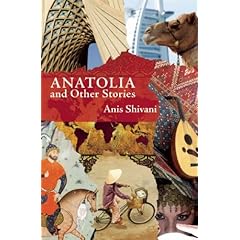
Anatolia and Other Stories is a collection of short stories by Anis Shivani, whose work I became familiar with in the literary journal Boulevard. According to a quote by award-winning novelist Laila Halaby on the inside cover, the collection “takes us around the globe in stories that juxtapose old and new, east and west, with characters that do their best to navigate the generational / religious / cultural / socioeconomic tensions inherent in our global economy. Shivani’s observations are dead-on, especially when dealing with themes of loss, family dynamics, and subtleties of power.”

Finally, here’s another book related to dance that I didn’t have time to review, but that is getting good reviews.

The Sugarless Plum, by Zippora Karz, details the New York City Ballet dancer’s struggles coping with the dangerous  and life-altering Type 1 Diabetes, which she was diagnosed with at age 21, while still a corps member in the company. Despite the disease she nevertheless managed to rise through the ranks and enjoy a solid, 16-year ballet career.

If anyone wants to participate in the meme, just link back to this post on your blog, or, if you don’t have a blog, you can write the book’s passage in a comment here.

VERONIKA PART AND MATTHEW RENKO IN AVI SCHER’S TOUCH

Here are some photos Jade Young and Avi Scher sent me of Monday afternoon’s performance at City Center’s studio 4.


All photos by the fabulous Jade Young, who I was able to finally meet (along with Marcelo and Veronika’s agent — and former ABT dancer — Scott Schlexer)! It was a great afternoon — SO many people were there: James Wolcott from Vanity Fair, Mark Kirshner from TenduTV, Reese Thompson from Ballet.co, and practically all the bloggers I know of — like Philip and Taylor — and many many blog readers. It was a small room but it was so overcrowded I know there are several people there that I missed (which was probably a good thing since my laryngitis was so bad I really sounded like a frog). Apart from Veronika’s fame, I think Avi is just such a nice and talented guy that people turn up to support him and check out what he’s doing, even if the program is really short. Which this was … it was a couple of  excerpts he showed (for APAP) from his larger work, Touch, which will premiere at the Alvin Ailey theater later this spring. I will definitely post when I have more details!

VERONIKA PART & AVI SCHER

If you’re in New York (and you won’t be at work next Monday afternoon, Jan. 11th), absolutely do not miss SLSG favorite assoluta Veronika Part up close as she performs a duet choreographed for her and Matthew Renko by another SLSG favorite, choreographer Avi Scher. The free performance will be in City Center‘s studio 4 (upstairs). It starts at 3:30 and should last an hour or two.

Top image of Part taken from here (this was when she arrived for her stint on the David Letterman show). Second photo by Kokyat, taken from the event’s Facebook listing. Visit Oberon’s Grove to see some more excellent photos by Kokyat of the duo rehearsing.

Also, the Ballet Bag has honored James Wolcott and SLSG by including our coverage of the fabulous Ms. Part as among their favorite blog posts of the year.  Thank you Bag Ladies!

ED'S CHOWDER HOUSE IS THE NEW PJ CLARKE'S FOR AFTER-BALLET DRINKS AND DELICIOUS FOODY THINGS!

pb2823552

pb282357

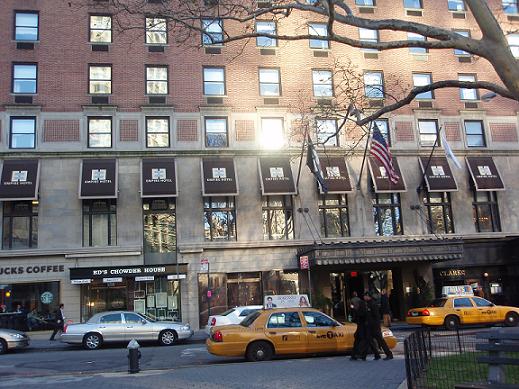
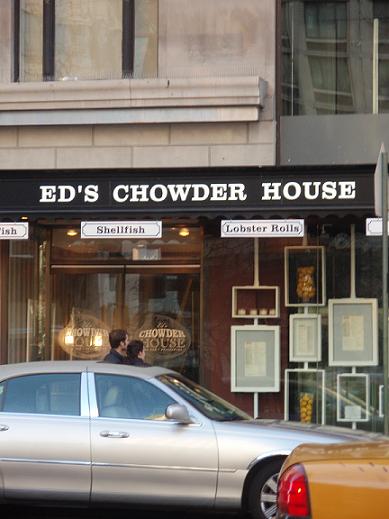
So, after NYCBallet’s Nutcracker Friday night (review coming soon), my friend Mika and I discovered a new place for after-ballet drinks and interesting foodie things — Ed’s Chowder House (located right across the street from Lincoln Center, two doors down from PJ Clarke’s and at the bottom of the Empire Hotel).

The dining area is nice, but the bar room (where you can get less expensive a la carte items — mostly fresh fish and chowders) is what really rocks. My friends and I always used to go to PJ Clarke’s, which is a bit cheaper, but it was always so crowded — both bar and resturant, the bar stools have no backs and are extremely uncomfortable, and the wait staff is always so pissy about seating you at a table if your party is not fully arrived or if you’re only getting appetizers or desserts — even if you get an expensive cocktail (or three) and a couple appetizers to share (which comes out to be far more money-wise than if you order one entree and a non-alcoholic drink). And then once you are seated the wait staff makes it their sole mission to get you out of there as soon as humanly possible, nearly opening your mouth for you and shoveling in the food. I once nearly had to smack a waiter on the hand for repeatedly trying to take my plate away… Plus, I was in there nearly every night last season, and could the hostess’s face ever register any recognition?…

Rosa Mexicano around the corner is lovely, but for me, it’s best in summer so you can sit outside. The bar is too cramped (though the chairs do have backs) and the restaurant area is not very interesting, imo, though the little swimmer guys diving down the waterfall-covered wall aligning the stairway are very dancerly and cute.

Anyway, we were extremely excited to find an excellent alternative in Ed’s! The bar area is spacious and there are multiple little tables behind the actual bar. Bar is made out of very cool material by the way — hard to describe — we weren’t sure if the objects underneath the glazed covering were sea shells, but they were very cool — do check it out! The restaurant area can get a bit pricey, but the bar serves really good a la carte items — oysters, various chowders, seafood appetizers like lobster rolls, scallop ravioli and mini crab cakes, and individually-ordered fish steaks and interesting sides like chili-glazed spinach and horseradish mashed potatoes. And they have a nice cocktail list and a pretty good wine selection. They made the best Tanqueray martini – which I now call the “Laura Jacobs martini” since she introduced me to it a few weeks ago when she and James Wolcott took us out for after-ABT dinner at Shun Lee — and it’s the best I’ve had since that evening.

And they have bowls full of chewy saltwater taffey on the way out 🙂

MORE ON AMERICAN BALLET THEATER’S AVERY FISHER SEASON


Daniil Simkin and cast in Benjamin Millepied’s Everything Doesn’t Happen at Once in Gene Schiavone photo, courtesy of ABT; all photos by Gene Schiavone (except for Arron Scott headshot below and bottom picture).

Just to let people know, as the photos shows above, the guy who was flinging himself into the group lifts in the first cast of the Millepied was Daniil Simkin; in the second cast it was Arron Scott (below). The program notes only gave a special mention to the two dancers doing the pas de deux and a lot of people were asking who the main soloist was.


Anyway, here are a few more reviews:

Here is James Wolcott on opening night gala (and our fab Shun Lee dinner afterward 🙂 ), here is Apollinaire Scherr’s FT review; and here are more of Apollinaire’s thoughts on her blog, Foot in Mouth. I’m surprised there aren’t more reviews — this was a pretty big season, with three world premieres — but that’s all I can find at the moment. (Update: Robert Greskovic’s WSJ review just went up; thanks to Meg for letting me know.)

Re the Wolcott write-up: I forgot to mention the models — Iman and Veronica Webb, who, instead of A.D. Kevin McKenzie, thanked the gala sponsors and introduced the program — screwing up Benjamin Millepied’s name. It wouldn’t have been such a big deal if they wouldn’t have been so giggly over it. It seemed like they were reading their notes for the first time and were really unprepared. I really don’t know how to pronounce his name either — I’ve always said the last two syllables to rhyme with plie (without the “l”) but have been told that’s wrong. But damn did ABT get a lot of press for signing them on. Just Google “ABT Fall 2009 Season” and it’s all about Iman.


(Gillian Murphy, Cory Stearns and Eric Tamm in Aszure Barton’s One of Three)

Anyway, I saw four of the six programs, saw the Ratmansky and the Millepied ballets four times and the Barton three, and they each grew on me the more I saw them. The Saturday matinee was my last performance and I found it by far the best. I felt like the dancers were finally comfortable with the new dances, knew what they were all about, and really made them meaningful. I described the ballets here.

Oh and regarding SanderO’s comment on that earlier post: yes, I do need to see the story in the dance. The dancer and choreographer won’t pull me in at all if they don’t each tell me some sort of story. That doesn’t mean the ballet has to be a traditional full-length dramatic novel or something with a clearly defined beginning, middle, and end, inciting incident, rising action with crises 1,2, and 3, climax and resolution, etc etc. but there needs to be some kind of story; there needs to be some intention in the abstraction. A lot of critics use the word “evocative” — a dance needs to be evocative of something, and I just mean the same thing. If there isn’t something meaningful going on, there’s no reason for me to see it. I can appreciate the neat geometric patterns and pretty images, but that’s not enough to make me go.

Anyway, I saw more in Millepied’s Everything Doesn’t Happen at Once on further viewings. At first I thought it was kind of everything but the kitchen sink the way Apollinaire kind of describes, but after several viewings I saw more of an evolutionary, battle of the sexes theme throughout, which becomes a more literal battle by the end. The piece starts with the stage looking swimming-pool like with the dancers making broad strokes with their arms. The stage gets over-crowded and eventually someone in charge — looking rather conductor-like, kind of throws his arms up and dismisses everyone.

Then, there’s a pas de trois (two men one woman), which becomes a double pas de trois (same), which turns into the central pas de deux (man-woman). Throughout there seems to be struggle going on — in the pas de trois the men kind of manipulate the woman around, until she’s practically on her side. In the central pas de deux is in places tender, in places more angsty as if the girl is trying to get away from the guy or fight him in some way, and he is struggling to hang onto her.

By the end, the scene has evolved into a kind of battlefield with marching music and the ballerinas doing those Balanchinian marches en pointe. Except they’re more unsettling than cutesy, like in Balanchine. This is the part where Daniil / Arron gets tossed into the crowd, throws himself with wild abandon at the groups of men, who catch him mid-split, then gets caught up with a bunch of grabbing girls.

Interestingly, the audience laughed when this role was danced by Simkin — I think because he is small and a bit long-haired and it kind of looked like he was afraid he’d be taken for one of them and was trying like hell to assert his masculinity. (I think it would have worked better had the girls been chasing him and then he flings himself into the groups of guys rather than the other way around, but not a big deal).

But no one laughed when it was Arron. It looked far more serious with him in the role — it looked like he was practically getting raped by that rabid group of girls.

Also I noticed with Arron that after the rabid group of girls leaves him alone, he kind of internalized the tauning; there was now an invisible fist punching him all about. It really looked like he was getting beaten up by that thing. But the fist was invisible so it was like he’d been driven mad. It was very unsettling, and I think, with the music and the rest of the action, this feeling is more of what Millepied was going for — not all the high air flips, crazy long spins, and windmill jumps that Simkin is known for and did here. Simkin’s character made the end of the ballet more playful than battle-like.

There’s also a short section where there’s all this marching music and there’s more centerstage chaos with all 24 dancers out there at once and suddenly a group of dancers standing at one corner break into partners and go waltzing through the crowd. But it’s really short-lived, like even courtship is a battle.

I don’t know — that’s what I saw on further inspection. But I could be making it all up. It’s kind of fun with abstract ballets (the ones that have a lot going on in them anyway) to make up your own story. I mean, the way dances get made anyway, as I learned at a Guggenheim event last night featuring ABT’s efforts to adapt ballets to different stages (including this small one in AF Hall, meant for concerts), is that things get changed depending on space, depending on the logistics of the stage, depending on dancers. Whoever knows if the end product is what the choreographer originally had in mind anyway.

I don’t think Millepied’s was a perfect ballet — I found a lot of the bird-like patterns from his recent NYCB ballet, Quasi Una Fantasia, to be out of place here – he didn’t need all that; he should have focused more on the battle — but I found his the darkest, the most thematically clear and the most absorbing.


Stella Abrera and Gennadi Saveliev in Alexei Ratmansky’s Seven Sonatas.

The Ratmansky grew on me, as did the Barton. On the last day, Michele Wiles danced the main female character (in the long white ballgown) in the Barton and I loved her. She gave the character a real story. When she comes out onstage she is all bitchy and glamorous, but Michele it’s really an act; she is seeking attention from the main man (in that cast Blaine Hoven) while trying to maintain her haughty demeanor so as not to be shown up by him if he dismisses her. At one point, she extends her arm out to him, as if he’s supposed to kiss it but he turns and runs offstage. She crumbles. It’s heartbreaking.

I also really loved Craig Salstein, Jared Matthews and Daniil Simkin in Barton’s second cast (Matthews and Simkin alternated parts opposite Salstein). They danced a section in the second part and all three made it clear (Salstein most so) that they were in a little competition for the girl’s attention. The girl (Luciana Paris), meanwhile, was just dancing on her own, in her own world, paying them no mind at all. It was hilarious.

But back to Michele Wiles for a minute: a wonderful ABT patron gave me her ticket for a company class, which she couldn’t attend, and Michele seemed so sweet — smiling out and waving at people during the class and even during warm-up.

Also, can some choreographer please please please create a little solo or some kind of dance just for Gillian Murphy! Please! During that company class, during the center floor work when the dancers divided into groups and did turns in a diagonal down the center, Gillian blew everyone completely away. She was like a tornado. But a technically perfect tornado! Everyone in my section literally began to laugh and shake their heads in amazement. She needs something to showcase her technical brilliance and athletic prowess. C’mon ABT!

Each of the dancers brought their own special thing to the Ratmansky. Christine Shevchenko (an up and coming corps member) was gorgeous with the role created by Julie Kent (danced opposite David Hallberg). She was more lyrical than Julie, with flowing, expressive arms that resembled Natalia Makarova in Other Dances. Julie’s arms were more staccato. Hee Seo, who completely blew me away as well, did a combination of the two — by turns feathery and lyrical, and modern and staccato. Alexandre Hammoudi and Jared Matthews both danced David’s original part and they were very different than David. Both connected with their ballerinas much more — when they were left alone onstage they clearly looked about for her, wondering where she was, then accepting they were alone and falling into their solo.

David Hallberg. I can never get enough David Hallberg. He didn’t look around for his ballerina when she left him, but when she returned to the stage, he danced well with her. But when she was offstage, she was out of sight, out of mind with him — he was too busy making Ratmansky’s movement wholly his own. He seems to be a rapidly maturing artist, playing with the music, playing with rhythm, giving some things more emphasis than others. When I first saw him dance this role I thought his “character’s” movement was more modern than classical, but I think that was just because of the way he did one section where he keeps pushing out with his hands, like he’s stopping the air, or stopping something from getting too close. He slowed down that movement a lot, really emphasizing the arms, and then did some ensuing footwork at the speed of light, whereas the others did everything in equal measures -so it didn’t have the same look.


Jared Matthews and Maria Riccetto in Some Assembly Required, photo by Rosalie O’Connor.

ABT also put on Clark Tippet’s Some Assembly Required from 1989, a male-female pas de deux evoking a lovers’ quarral replete with difficult-looking angst-filled lifts, struggling pushes and pulls, then more tender making up. It went on a bit too long; some middle parts that were repetitive could have been taken out, but the cast I saw — Jared Matthews and Maria Riccetto did very well with it. Jared is dancing and dramatizing better than ever before, imo.

And the company also did Robbins’ Other Dances, another male-female pas de deux (this one pretty famous) that was choreographed on Baryshnikov and Makarova. I saw both casts — Marcelo Gomes and Veronika Part, and David Hallberg and Gillian Murphy. I liked both — although I think I honestly prefer Tiler Peck and Gonzalo Garcia’s at NYCB. Gonzalo has a smaller body, more like Baryshnikov’s, and I think some of the gestures — like the placing the hand behind the head, kind of primping, looked sweetest on him. Ditto for Tiler. David is dancing very aggressively these days. He’s making the absolute most of every movement — it can be stunning at times, and at times it seems a bit overdone, which it seemed to me a tad here.

I also think that joke on the Kirov dancers getting dizzy and losing their footing because they don’t spot-turn doesn’t come across as such to new audiences. When Marcelo and Gonzalo did it, many in the audience honestly thought the dancers screwed up for real, not on purpose. David really didn’t do the joke because he’s a cheat 🙂 I’m kidding — he did, but he spun, stopped, got dizzy, shook himself out of it, and started the next phrase all in the blink of an eye, so you didn’t even notice he “got lost.”

Gillian was good but it didn’t seem to be a dance that showcased her talents to their fullest. I’ll say it again — I really think she is the most athletic and technically one of the best female dancers in the world and she desperately needs more roles that prove that!

ABT OPENING NIGHT GALA FALL 2009: THREE PREMIERES IN BLACK AND WHITE, AND WOOD


Photo of Veronika Part in The Dying Swan, taken from Vogue; photos of the three premieres coming as soon as I receive them.

After ABT‘s fall season opening night gala performance last night, the really wonderful James Wolcott and Laura Jacobs took friend Siobhan and me out for dinner at Shun Lee (I’d never been there — but wow, excellent excellent food!) and when Laura asked me if I was going to write about the performance, I kind of rolled my eyes and said, “I’ll try!” We all agreed that dance is absolutely the hardest art form to review, especially on seeing a dance for the first time. Let alone THREE dances seen for the first time. With visual art you can stand there all day and examine at it, with music you have recordings and scores, film critics generally see a movie several times before writing a review. With dance you have one chance — often one split mili-second — to remember a half an hour or so of movement, images, patterns, structure, costumes, music, lighting — everything. It’s impossible. Since starting this blog I have so much more respect for dance critics.

Anyway, there were three premieres last night: Seven Sonatas by Alexei Ratmansky, One of Three by Aszure Barton, and Everything Doesn’t Happen at Once by Benjamin Millepied. Also on the bill was a performance by Veronika Part of Fokine’s The Dying Swan. ABT performed, for the first time, in Lincoln Center’s Avery Fisher Hall, a concert hall not accustomed to housing dance performances. (ABT usually holds its fall season in City Center, but changed venues because of City Center’s renovation plans.)

I’m going to be seeing each premiere a couple more times this season and prefer to write after I’ve seen each more than once. But since the season is so short (it ends October 10, this Saturday), I’ll write something up front. These are only first impressions though, and I’ve found I see so many more things with repeated viewings.

Honestly, everything kind of blended together for me. Part of this was because of the sparseness of the Avery Fisher stage — there were no sets, no wings, no curtains — so dancers warmed up onstage before us, giving each piece a kind of Cabaret-like feel; and part of it was because costumes for each piece were all black and white. I remember lots of black, lots of white and the hardwood of that stage.

1) Ratmansky’s Seven Sonatas was performed to Domenico Scarlatti music by three male-female couples: David Hallberg and Julie Kent, Herman Cornejo and Xiomara Reyes, and Gennadi Saveliev and Stella Abrera. Costumes were all white — flowing dresses for the women, classical tights and 18th-Century tops for the men. The movement was a combination of classical and modern and, though the ballet was generally story-less, each couple seemed to have a little narrative: Cornejo and Reyes were the young, playful couple, Herman full of high jumps with many beats of the feet that really wowed the crowd and Xiomara dizzying rapid multiple turns. At one point Herman did this crazy turn in the air, landed on his back, and caught her. Crowd went wild.

Abrera and Saveliev seemed to be a more mature couple, perhaps in mourning. It seemed Abrera was a woman, possibly a mother, who’d lost a child or something — Saveliev seemed to be trying to console her and keep her from self-destructing. It seemed like she kept trying to break free of him and reach out to some invisible thing.

I’m not sure what Hallberg and Kent were meant to represent except maybe a modern couple — they seemed to have the most modern movement. David appeared to be trapped in a box and he kept pushing out; he had a lot of quick movement with fast stops in different directions and a lot of it in parallel — not turned-out — position. Julie had a lot of sharp, staccato movement. They could’ve also been a courting couple: at one point, David was on one knee and he invited Julie to run at him and jump on him. When she did, he took her into this lovely lift. It’s sweet and many in the audience lightly laughed.

The ballet was broken into duets and solos and bookended by two ensemble movements, the first pretty and lyrical, the latter more chaotic as they all perform their very different movement motifs at once, some trying on others’ movement styles — everyone does the staccato arm patterns for a while, etc. At the end, the women lay on the floor and the men wrapped their bodies over them.

One other thing: our David Hallberg is sporting longish hair these days 🙂 I think it looks good, and fun for a change! Funny thing is, he’s so beautiful and glamorous, I tend to get jealous if him, even though he’s a man… which I guess should be kind of odd…
2) Barton’s One of Three was set to Maurice Ravel’s Violin Sonata in G and danced by a whole slew of tuxedoed men, and three women — Gillian Murphy, Misty Copeland, and Paloma Herrera. Why is it that women choreographers tend to use men so much more! (And female dance-writers tend to focus on male dancers 🙂 — is this feminist?)

Anyway, the piece begins with Cory Stearns walking out dressed in a tux and black jazz shoes. He does a little solo and his movements are all modern, angular, which contrasted in an intriguing way with the tux. I don’t know if it was his being a bit weirded out by the curtainless stage (which forced him to walk out in the dark with all of us watching) or whether it was part of the character, but he seemed to have this loopy smile in the beginning, that was really rather endearing. I chatted with a friend during intermission and she felt just the same.

Anyway, soon Cory was joined by more tuxedoed men, and then by Gillian, who came prancing out in a long white cocktail gown with her radiant red hair tied back into a sleek twist. The men would kind of veer toward her, sideways, their bodies leading their heads in, to me, a rather amusing way. Gillian’s character was very haughty, very glam and posh and she acted like she was ordering the men around with her little finger. The men often seemed led by their bodies, moving first with the back, or at times one leg would take a step, the rest of the body reluctant to follow (I noticed that most with Jared Matthews, who I thought was dancing at his best last night). I found this a very interesting movement motif.

Misty Copeland was the lead character in the second movement. She wore a short black and white dress, her costume and character more flirty and wild. But same thing — she seemed to kind of taunt her tuxedoed men.

And third movement was led by Paloma, wearing a black lacey top and black pants. She smiled a lot more than Misty and Gillian, but she seemed to move in a slinky, sexually-empowered way, like a tanguera.

Now that I think about it, though there were many more men here, the women seemed to have all the power. Fun!

3) Next on was Part’s Dying Swan, which was really poignant, as I knew it would be. It’s a very short piece, but it’s funny how the ballerina can really do it however she wants to; I just saw Diana Vishneva perform this in the Fall For Dance Festival and her Dying Swan was very different. Whereas Diana spent most of the time on her toes, bourreeing, Veronika spent more time on the floor, one leg stretched out before her (like in above picture), then rising again to her toes for one more breath. Diana’s swan seemed to flutter about more, like she was fighting death, she lay down only at the very end. Veronika kept holding her arms up in front of her, her wrists bent and her hands cupped over, as if to foreshadow what would happen to her body. In general, Veronika’s swan accepted and approached death more gracefully or willingly, but Diana’s, with that broad wingspan, at times really looked strikingly birdlike. I don’t know if I can say I liked one interpretation better than the other — both were breathtaking and both very poignant.

Did anyone else see both swans?

4) And the program ended with Millepied’s Everything Doesn’t Happen at Once, set to David Lang music that was at times mellifluous and at times cacophonous or eerie. He used a large group of dancers but Marcelo Gomes, Isabella Boylston and Daniil Simkin had the main parts and so stood out the most (and Kristi Boone shone in a smaller role).

There was a lot going on here — both in the music and in the dance, and I felt that, unlike with Millepied’s earlier piece for ABT — From Here on Out — composed to music by Nico Muhly (who was in the audience) — in this one the movement kept up, didn’t let the music outshine it. The stage is set up to resemble — at least to me — a pool. Dancers would gather around it and watch the people dancing in the lit-up center. At the beginning there seemed to be a swimming motif, with large, rounded arm movements resembling breaststrokes. Movement is also evocative of birds as well though, and some of the same lifts were present as in Millepied’s recent work for NYCB, where the women are perched on the men’s shoulders, their arms outstretched sideways.

In the middle part, Marcelo and Isabella have a rather haunting solo. The ballet is generally story-less but as far as I could make out any narrative, it appeared she was sort of struggling against him. He seemed very careful and gentle with her (in sharp contrast to a later, more hostile duet he has with the super-strong Kristi Boone, who seemed to be either Isabella’s competitor or her double), but she — Isabella — nevertheless kept trying to push away from Marcelo as he held her. The duet ends with them walking toward the back of the stage holding hands, connected, but her body is lunging as far as possible away from his. A rather warped relationship.

Then there’s a rather amusing section where bravura dancer Daniil Simkin is struggling with a bunch of women. He tries to break free of them but then he keeps throwing himself into their arms, making them catch him in these rather breathtaking group lifts — one of them ending in a perfect split in the air. And he has a bunch of crazy multiple pirouettes that had the audience audibly gasping. It all went with his character though, who seemed rather crazed, like he may have just escaped from an asylum or something. I kept wondering who else was ever going to be able to perform that role…

I didn’t go to the gala party but in addition to Muhly, I saw Alessandra Ferri in the audience, one of the Billy Elliots, and apparently Natalie Portman was there.

Anyway, I’ll write more at the end of the season, when I’ve seen these new dances a few more times. Here is Haglund’s review.

FRANCIS MASON, DANCE WRITER, DIES AT 88

I’m so sad to hear of this. I didn’t really know Mr. Mason, but over the last couple of years, he’s been seated next to me at many dance performances. I knew who he was because so many critics would stop by our row and greet him. He was the most lively man. I remember sitting next to him last year when then new ABT wunderkind Daniil Simkin danced Flames of Paris with Sarah Lane, and after Simkin completed an astounding series of barrel turns, Mr. Mason whistled, raised his eyebrows and shook his head, letting out a little laugh. I remember thinking, okay if this man, who’s apparently been around a while and seen a lot, is impressed by this guy, Simkin is officially impressive.

I also remember seeing Mr. Mason not long ago at a Cedar Lake installation performance. A young woman slid off our bench and began stretching and several of us kind of looked at each other, obviously wondering whether she was a dancer and part of the performance but too shy to ask. Mr. Mason took one look at her, and got up and called out to her, “Are you part of the performance?” (She wasn’t, she laughed.)

I feel like I just saw him and he looked perfectly healthy, although with elderly people I guess you never know — it can be any little thing that causes death. I’m actually shocked he was 88; I thought he was in his early 70s — probably because he was so active and sprightly.

And active he was, as you can see from the obituaries. I was just recently introduced to the excellent critical journal he edited, Ballet Review, one of the many things he did.

It’s just so sad thinking that you just saw the person and, now, that’s going to be the last time you ever saw them. I thought the same with Clive Barnes.

Here is James Wolcott’s obituary, and here Alastair Macaulay’s.