
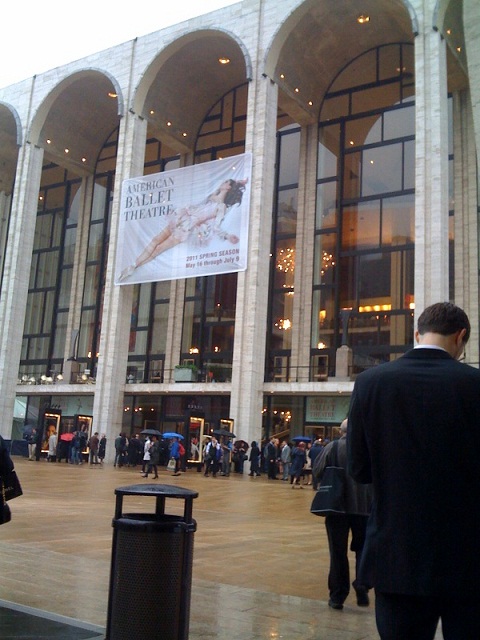
American Ballet Theater Spring 2011 Opening Night Gala

Last night was ABT’s Spring 2011 opening night gala. Dreary, rainy night … but what else is new for New York these days?

Once inside, I really enjoyed the show though. (I’m hoping to receive photos soon, which I’ll post). The program began with a short preview of Ratmansky’s The Bright Stream, which I’m excited to see next week. Seems to have a lot of humor, some bravura dancing, a cute storyline.


(Photo: The Bolshoi’s production of Bright Stream; Natalia Osipova is jete-ing).

Then, there were introductions by Rachel Moore, executive director of ABT, wearing a beautiful green dress, and Kevin McKenzie (AD), followed by Caroline Kennedy, who introduced the students of the Jacqueline Kennedy Onassis School of American Ballet as they danced a world premiere, Karelia March, by Raymond Lukens. The program says the students are Level 7, which must be the highest level, because some of those dancers looked like ABT principals. I’m not kidding, I swear. They really amazed me. That school is doing incredible things!

Next was Balanchine’s Tchaikovsky Pas de Deux, danced by David Hallberg and Gillian Murphy. Everytime I see David dance I think he must be the most perfect male dancer in the world. Gillian was stunning too.

Then came the Grand Pas de Deux from Ratmansky’s new Nutcracker, danced by Marcelo Gomes and Veronika Part. (No, they’re not performing that ballet during the Met season, but there seemed to be a few excerpts in the program from ballets they’re not performing). I missed seeing this couple – overall still my favorite – when the company premiered Ratmansky’s version in December. They were so sweet. Veronika danced with such wonderment in her eyes, such joy. And Marcelo was her perfect, adoring cavalier, all eyes on her. I don’t have kids, but I’d think they’re the perfect wedding couple to wow very young audiences.

Then came Majisimo, a classical ballet piece with Spanish flourishes created by Georges Garcia for the Ballet Nacional de Cuba in 1965 and set to Jules Massenet’s Le Cid. This piece was mainly meant to highlight Jose Manuel Carreno, who of course retires from ABT later this season. But it was really a dance for eight couples, and he danced only the male part of one of them – there were very few solos. He danced with Paloma Herrera. Xiomara Reyes was paired with Reyneris Reyes, guesting from Miami City Ballet. The other couples were comprised of Cuban dancers guesting from other companies as well: Lorena Feijoo and Joan Boada from San Francisco Ballet, and Lorna Feijoo and Nelson Madrigal from Boston Ballet. The dancers were spectacular, but I didn’t think that much of the choreography, which reminded me of a more bland version of an ensemble scene from Don Quixote. Jose had a series of turning jumps, and a really beautiful multiple pirouette that wowed the audience – drawing those turns out are what he’s most known for. And Xiomara really took my breath away with this crazy fast series of traveling turns in a diagonal down the stage. I’ve never seen her dance like that!


(Photo: Jose Carreno dancing with Polina Semionova in Diana e Acteon)

After intermission came two pas de deux from Swan Lake. A Twitter follower asked me why they needed to perform two scenes from the same ballet. I think that ABT, same as everyone else, is just trying to benefit from the Black Swan craze. They should have had Sarah Lane dance one of the pdd though! 😀 Anyway, first pas de deux – White Swan- was Paloma Herrera and Alexandre Hammoudi, which was good. But the second – the Black Swan – I found surprisingly magnificent! It was danced by Michele Wiles and Cory Stearns. There have been so many guest stars from Europe lately gracing ABT’s stage, I’d forgotten how perfect an Odile Michele Wiles is. And Cory really impressed me as well. Whatever he may lack in dance ability (I can’t imagine he’ll ever be a David Hallberg or Marcelo Gomes), he more than makes up for in acting and stage presence. He’s really good at bringing you into the world of the ballet and creating a character you can sympathize with.

Sandwiched in between the two SLs was Jessica Lang’s Splendid Isolation III, danced by Irina Dvorovenko and Maxim Beloserkovsky. I joked on Twitter that Max earned the hot guy of the night award for that, but seriously – he did! Irina was really beautiful as well. And her party dress, which she came out in for the final stage bow, was, as usual, gorgeous. She has such impeccable fashion taste, imo.


Following that was the highlight of the night, for me – Diana Vishneva and Marcelo Gomes in the Act I pdd from Manon. Such a perfectly choreographed pas de deux – beautifully romantic and full of love / lust but with so many breathtaking but capriciously executed, dangerous-looking lifts you sense something out of control. As beautiful as it is, this story isn’t going to have a happy ending. I am liking Diana Vishneva more and more. I’ve always thought she was a great dancer but she always seemed to play too much to the audience for the story ballets. She didn’t take me into the world of the character as much as I want an actor to. But the last two seasons she’s been doing just that: really developing the character and dancing to her partner – Marcelo here and in Lady of the Camellias last season, which is the first time she really blew me away – instead of the audience. This – the Manon pdd – was the audience favorite last night as well. The two got a storm of whoots and bravos at their curtain call, and practically had a standing ovation the audience was so loud in their applause. “So beautiful,” exclaimed the woman beside me. “Okay, we can go home now,” she joked.


(Couldn’t find a photo of Diana and Marcelo, but here is Diana dancing Manon with Manuel Legris. With all photos I post now, I’m linking to the original site via a click on the photo.)

Here are Marcelo and Diana in Lady of the Camellias:


Then, Alina Cojocaru, one of the European guest artists this season, danced the Rose Adagio from Sleeping Beauty. I’m not a huge fan of this ballet in general, but she was lovely. Patrick Ogle replaced Sascha Radetsky as one of the cavaliers.

Second to last was the Act II pdd from Lady of the Camellias danced by Julie Kent and Cory Stearns. Again, Cory did a very good acting job – and physically he fits the character perfectly, as Julie does hers, but I think some of those lifts are so difficult-looking… I just worry about the dancers. Isn’t that how Roberto Bolle got hurt last season – performing this role?

And the evening ended with another ensemble excerpt from Ratmansky’s Bright Stream. People who stood out most to me were Daniil Simkin and, again, Xiomara Reyes. I really am excited to see this ballet.

Tonight Don Quixote begins and runs through the beginning of next week. I’m excited to see Alina Cojocaru dance with Jose Carreno on Friday night, and Russian ballerina Polina Semionova guesting in the Saturday matinee with David Hallberg.

American Ballet Theater’s “On To Act II” at the Guggenheim

Did you guys watch the live-stream last night or tonight? If you missed it, you can watch the video now archived on the Guggenheim’s ustream channel.

It feels weird to review a program that everyone can easily watch online, but I’ll just say my favorite moments last night were: the ABT II dancers in excerpts from Jessica Lang’s Vivace Motifs, which I thought looked like a lovely ballet; Hee Seo in the prayer scene from Coppelia; Susan Jaffe coaching Sarah Lane in another scene from that same ballet; and Jose Manuel Carreno’s interview by Wes Chapman.

I wasn’t really in love with the dance Carreno performed with Melanie Hamrick – Ronald Savkovic’s Transparante. I thought there was a bit too much falling down and standing up again, and, though some of the partnering and lifts were beautiful they were pretty basic and didn’t reveal much about the relationship of the characters and the dramatic action. But I loved hearing him talk – love how he still has that thick accent! Love that he said “oh shit” in reference to all the Don Quixotes he’s cast in during week one of ABT’s Met season! He doesn’t seem to have a plan for the future, but said he’d still do some freelance dancing for the next few years, and said he’s interested in exploring more contemporary work, other forms of dance. I think that’s why he wanted to dance Transparante instead of something from ABT’s season.

I liked Martine van Hamel’s discussion and performance of some of the character roles she continues to do – the wicked stepmother, always either drunk or hung-over, in Kudelka’s comical version of Cinderella, and the wicked fairy Carabosse in Petipa’s Sleeping Beauty. But they left out the Dacha Dweller from Ratmansky’s Bright Stream, which was on the program! None of us have seen that ballet yet and I was eagerly awaiting that excerpt … and then she said she wouldn’t do it because she couldn’t get something in it quite right yet. Well, I guess we’ll see it soon enough.

I really did like the excerpt from Jessica Lang’s Vivace Motifs. The ABT II dancers are always very good, especially Irlan Silva. Every time I see him dance I get annoyed that ABT hasn’t yet brought him into the main company. I don’t understand what they’re waiting for. He stands out so much to me. He seems better than most of ABT’s soloists and even some principals. And he’s not even in the corps yet. I really really really don’t get it.

Anyway, I’ll conclude this post with an excerpt of Carreno and Susan Jaffe dancing the Black Swan pdd from an earlier documentary about ABT:


And footage of Silva from the documentary, Only When I Dance:


Morphoses at the Guggenheim

Over the weekend, Morphoses had its first NYC program sans former artistic director Christopher Wheeldon. They presented two pieces, at the Guggenheim, as part of the museum’s Works and Process program. They commissioned two choreographers – American Jessica Lang and Swedish dancemaker Pontus Lidberg- to each make a different dance set to a score by Pulitzer Prize-winning composer David Lang.

(I wrote about seeing an early rehearsal here).

Using most of the same dancers (most of whom are from American Ballet Theater now, instead of New York City Ballet, as they were when Wheeldon was A.D.), the two came up with vastly different dances, both very engaging.

Lang’s (top four photos – all photos by Richard Termine) was more a study of gravity, as she explained (hence Misty Copeland here “climbing the wall”), and of contrasts between the masculine and feminine (indicated, to her, in the music by percussion and chimes).

Interestingly Lidberg heard the music differently and used the percussion section first, melting into the chime section, so apparently the music had no prearranged order. His dance was more lyrical, with the visual theme of a night-blooming flower.

I love that Morphoses now seems to be using a lot of ABT dancers – all soloists or standout corps members — Misty Copeland and Kristi Boone, Eric Tamm, Blaine Hoven, and Isaac Stappas – because I really connect with them. Other dancers included Melissa Barak, Laura Feig, Gabrielle Lamb, Rachel Sherak, Andrea Spiridonakos, and Matthew Prescott. And Lang mentioned that she also used her husband, modern dancer Kanji Segawa (the man doing the floor work on the right-hand side in the photo third from the top), in her piece, which worked well since the aesthetic of modern dance is more “grounded” than ballet.

To hear the music and see some of the dance, here is an excellent video made by the Guggenheim:

MORPHOSES REHEARSAL – JESSICA LANG MAKES ME WANT TO DANCE AGAIN…

Tonight I was invited by the Guggenheim Works & Process peeps to a Morphoses rehearsal. Funny, I kept expecting Christopher Wheeldon to be there… but of course he wasn’t. This was really special because it was a first rehearsal; the dancers were just meeting the two choreographers whose work they’ll be performing in September in Martha’s Vineyard, and in October here in NY. I’ve never been to a rehearsal that early before – usually the choreographers don’t want an audience until the work is complete or nearly complete.

The two choreographers were Jessica Lang and Pontus Lidberg. They’ve each been commissioned to set a dance to the same David Lang score. Always fun to see what different artists come up with to the same piece of music. This was very lyrical music, part of it choral, and they had the same five dancers to work with – three women, two men.

First we saw Jessica Lang, and her choreography was very lyrical, very classically balletic, very pretty.

Continue reading “MORPHOSES REHEARSAL – JESSICA LANG MAKES ME WANT TO DANCE AGAIN…”

ALVIN AILEY II


Last night for the first time I saw Alvin Ailey II, Alvin Ailey’s studio company comprised mainly of young dancers. Wow! The dancers were so remarkable — all of them! I couldn’t believe it. Usually when you see the studio company the dancers are up and coming, not quite as good as the ones in the full touring company, but these dancers truly amazed me. No wonder so many go on to join the main troupe.

There were four pieces: three modern and one jazzy, classical Ailey (which I really loved). First was Valse (pictured above), by a young, highly accomplished choreographer, Sidra Bell, with modern music that had lots of percussion (which I liked) by Dennis Bell. This piece reminded me a bit of Jorma Elo with a lot of movement alternating between sharp and staccato and more flowing, and lots of jagged shapes and rather intensely-thrust lines created in part by hyperextended arms and legs (which I like, but realize is very modern and not to everyone’s tastes).

Josh Johnson in particular stood out to me. He’s a tall dancer with long long lines, like Antonio Douthit and Yannick Lebrun and Amos Machanic in Alvin Ailey. Maybe because of his long lines I noticed him more here, but he’d reach up skyward with one arm, then grab it with the other hand and bring it back down, as if the arm was out of control and he needed to bring it back in line. This kind of mechanical movement, like the body struggling to break free from robotic-like movements imposed on it, is what reminded me of Elo. Costumes were also intriguingly incongruous: male dancers wore black tops with high necklines and puffed sleeves that looked king-ly, along with spandex biking-shorts; women wore corset-looking tops with ballet-like tulle skirts. It was an interesting dance, definitely with a dark undercurrent, like Balanchine’s Valse.

Second was “The Calling”, a short section from Jessica Lang’s Splendid Isolation II. Fana Fraser danced this solo beautifully. She wore a white gown with a long long train that spread out in all directions across the floor, nearly taking up the stage. She began with her back toward the audience, but turned somehow under that dress without disturbing the intricate fan-like pattern made by the flared skirt on the floor, and lowered and raised her legs so that it looked like she was melting into the ground, then rising up from it. The rest of the dance consisted of lovely arm movement while her feet remained stationery.

Next was Hope (The Final Rise) by AAII artistic director Troy Powell.


This was one of my favorites, but it’s hard to explain why! The piece was full of energy and there was a lot of very difficult movement, with fast kicks and whizzing spins going into difficult-looking lifts. I felt like this was the artistic director’s test for the dancers, and they came through with flying colors 🙂 The music, by David Chesky, had a strong, powerful, even militant feel to it, with a voice chanting, “Rise up, children, right now.”

And then, the evening ended with my favorite piece of the night, the very well-liked George Faison’s Movin’ On.


This was a jazzy balletic piece — a combination of both classical ballet and jazz steps — that was wonderfully reminiscent of classic Alvin Ailey. It takes place in a night club, much like Night Creature and Blues Suite, and consists of a set of unique and endearing characters just hanging out, playing music, flirting with each other, dancing the night away, playing starlet, having a good time. There are three men — members of the jazz band — who jump atop chairs and move just like the instruments. There’s a sweetly arrogant Night Creature-like woman who fancies herself a jazz starlet, and struts and glides and jetes across the stage just like one. And there’s a ballerina who becomes attracted to the street boy. I loved the two who danced the latter couple in particular. Both — Megan Jakel and Jarvis McKinley–  stood out to me all night. McKinley moves very well, especially in the more jazzy movements. And I thought Jakel, along with Fana Fraser, were very charismatic. They just had that something that drew your eye to them. And Josh Johnson, who danced one of the musicians, has such a fluidity. The way his arms waved about, they were like water. At one point, Faison himself read (offstage) a Langston Hughes poem, Harlem, which gave the whole thing a rather sobering feel. Like all the fun and frolic was masking a deeper tragedy. Judging by the mass of applause, the rest of the audience loved this dance as well.

I noticed in the program that S. Epatha Merkerson from Law and Order helped to underwrite the costumes for the production. I remember she’d read a poem (onstage) in a recent Complexions piece that I loved. Who knew she was so involved in dance!