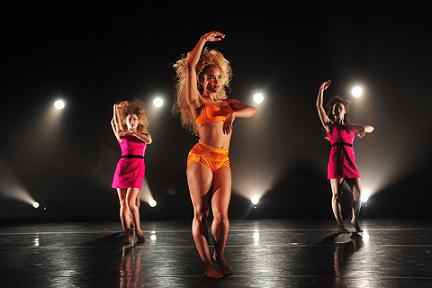
Body Traffic in L.A.

On Thursday night I was invited to an L.A. preview of Body Traffic‘s upcoming New York premiere. They’ll be performing in N.Y. at the Joyce (Chelsea) June 6th and 7th (they just received a $25,000 grant from the Joyce) as part of the Gotham Dance Festival, and I very highly recommend them.

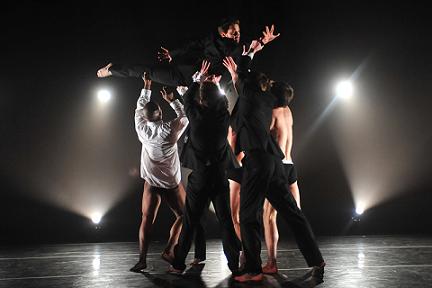
Being new to L.A., this was my first experience with the four-year-old company (which is co-founded and directed by Tina Finkelman Berkett and Lillian Barbeito) and they weren’t at all what I was expecting. (I guess in L.A. I tend to expect to be surrounded by popular entertainment dance – hip-hop, the kind of contemporary modern showcased on So You Think You Can Dance, etc.) This company is more Batsheva, and the work is very intelligently choreographed and intelligently danced.

I don’t want to write much about the program right now; I’m just anxious for New Yorkers to see it and it’s work I think the New York critics will actually like, for a change!

The highlight, for me, was Israeli choreographer Barak Marshall’s And At Midnight, the Green Bride Floated Through the Village Square… which was kind of a cross between a dance and a play with multiple speaking parts (very funny, clever repartee) interspersed with ensemble dance. I loved it. Marshall gave an onstage interview during intermission. He has an endearing personality, as well as a beautiful voice. He sang a lovely, haunting-sounding song for us, in I think he said Yemeni, at the request of the interviewer.

Also on the program was Dutch choreographer Stijn Celis’s Fragile Dwellings, a poignant piece with four dancers dedicated to the homeless people of Los Angeles, and O2Joy by Richard Siegal set to music by Ella Fitzgerald, Billie Holiday, Glenn Miller, and the Oscar Peterson Trio and just about the best homage to the pure joy of dance I’ve seen.

If you’re in New York, please do not miss them at the Joyce (June 6 & 7)!

To give you an idea, here are excerpts from an earlier Barak Marshall work:

Marcelo Gomes to Dance with Cisne Negro

Although we’re on late-summer hiatus from ballet season here in NYC, SLSG favorite Marcelo Gomes will be performing at the Joyce Theater on August 15th, with the Brazilian modern dance company, Cisne Negro (which means Black Swan in Portuguese). I’ve never seen this company before, but of course am now intrigued. They’re at the Joyce from August 15-20, but Marcelo is only dancing on opening night. He’s to dance a solo, called Paganini, which he choreographed himself but on a female dancer from La Scala Ballet. He’s now re-set the piece on himself. It’s set to violin music, which will be played live by Charles Yang. Go here for more info on the rest of the program.

Here’s a short video clip of the company:

Photos above by Reginaldo Azevedo.

GALLIM DANCE UPCOMING AT THE JOYCE


From August 9th through 14th, Gallim Dance (photographed above), which I highly recommend, will be performing at the Joyce Theater. I recently saw them rehearse the program they’ll be performing, Wonderland, and I loved it. Young artistic director and choreographer Andrea Miller has studied dance in Israel with Ohad Naharin and has danced with his excellent company, Batsheva, and it shows. This is the kind of modern dance I most love: high energy, full of meaning, thought-provoking, and that really has something to say.

Gallim will be sharing that bill with Camille A. Brown, who’s choreographed for Alvin Ailey and Urban Bush Women and whose work I really like.

Alternating nights with them are two other female choreographers and their companies – Monica Bill Barnes and Kate Weare. I’ve found their work by turns clever, funny, and provocative, and I recommend them as well.

The Gallim / Brown bill is August 9, 11, 13, and 14th, and the Barnes / Weare is August 10, 12, and 14th. Go here for more info.

KEIGWIN + COMPANY'S CAPTIVATING "RUNAWAY"

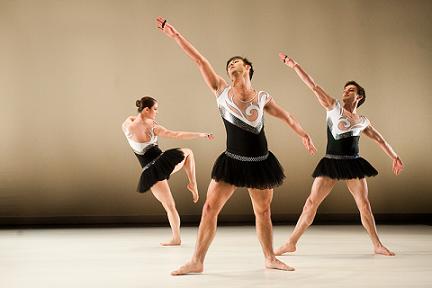
Here are some photos of Keigwin + Company’s recent season at the Joyce in Chelsea. Above is Larry Keigwin’s absolutely stunning Runaway, which I loved, and below is his Bird Watching, which had its premiere at the start of the season. All photos by Christopher Duggan.
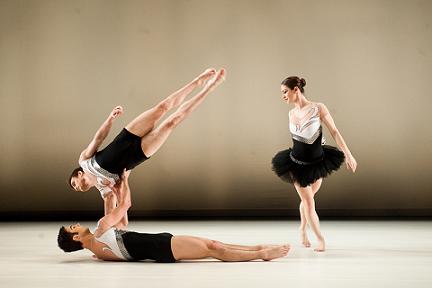
My friend and I were blown away by Runaway. It began with a woman onstage wearing a 60s-style dress and a huge bouffant hairdo, checking herself in a mirror held by two male tecchies. The program had advertised that there was to be a “scene change” between the former piece and this one, and it was soon made clear this “scene change” was part of the performance. As stage guys ripped up the floor matting and the back wall drop and laid new ones, this woman primped and posed in the handheld mirror, while men came onstage dressed in briefs, and began climbing into their black suits.

At one point a half-dressed woman ran across the stage, followed by a half-dressed man, running the other way. It was funny; everyone cracked up.

Then, the lights went down, and as the high-energy music (Jonathan Melville Pratt’s Thirteen) began to pump, several men dressed in suits began to walk quickly  across stage. The woman with the bouffant hairdo began to dance, her body making sharp angular movements. Soon several woman dressed like her joined the men, walking back and forth across the stage.As the music grew faster, the walking became more urgent, at times turning into a run, a sprint even. Then they began walking into the audience, using the aisles like catwalks.

Soon, they were joined by men who were dressed only in black briefs and women in colored underwear and bras, their hairdos also ratted beehives. The stage was aflutter with people walking or running back and forth, some stopping to dance in the middle, mimicking the first woman’s sharp angular movement. Throughout the whole, everyone had these straight-ahead stares, like zombies. Their walks meant business but their stares were vacant. It was like runaways on a runway. Very cool and not a dull moment! My friend, an emerging choreographer, was so inspired!

James Wolcott, equally fascinated and calling Runaway “what Nine should have been”, wrote about the piece here, and Oberon here. And you can see part of the action in their promo video, which I embedded in my earlier post, here.

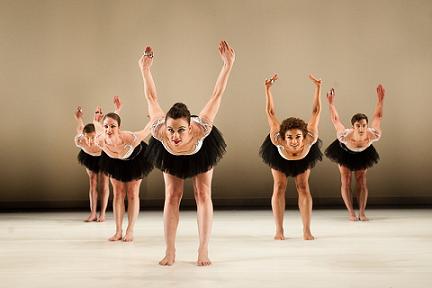
Bird Watching was interesting though it didn’t sustain my attention the way Runaway did. It was more lyrical, set to classical music (Hayden’s Symphony No. 6 in D Major). I liked but didn’t love it I think mainly because I couldn’t tell the extent to which it was kind of riffing on certain classical motifs and meant as a funny commentary on them, and the extent to which it was meant to be taken seriously and on its own. Everyone — men included — were dressed in white tops and black tutus, and at one point I could see some movement patterns very similar to Swan Lake‘s White Swan pdd — performed by the men. It wasn’t so funny, though, as it was pretty, which was perhaps the point: that anyone can do anything without it being some kind of statement. I feel like I need to see it again though, and concentrate harder!

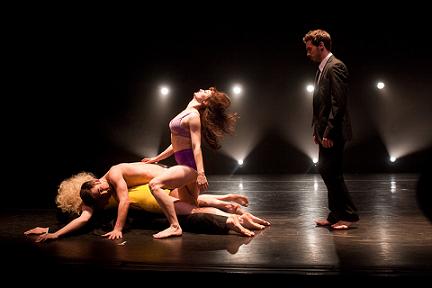
Also on the program were Mattress Suite, which I really liked. It was comprised of six vignettes, all involving a mattress, each set to different music and danced by a different set of characters. The story was the progress of a relationship: woman (the brilliant Nicole Wolcott) dancing around in her wedding dress elated and excited but slightly apprehensive, man (Keigwin, who, as a dancer, is often very funny, always charming) in his tux looking excited and lustful but a bit worried, then they’re together on the mattress, then they fight and she lifts the mattress erecting it between them like a barrier, she leaves, he has a fling — with two guys — the mattress getting a bit cramped there toward the end, and then she returns and is alone, struggling with her aloneness on the mattress. It’s by turns humorous, cute, sad, bittersweet. What I love about Keigwin is that his choreography is evocative of human behavior without being obvious or unoriginal. His movement is evocative but original and clever, in other words. And there’s plenty of room for the dancers to act their own drama.

And opening was the high-energy Caffeinated, from 2007, set to Philip Glass’s percussive Akhnaten, which I’ve seen before and is always fun.

But Runaway really blew me away. If you ever get the chance to see it, or his Bolero, or his lamentation in honor of Martha Graham, or anything by him really, go! Their Joyce season was short and is now over, but they’re always around.

GUINNESS CUPCAKES?!

They’re included with the special $22 prix fixe dinner tonight at Good Enough to Eat, a wonderful UWS eatery. Yum!  Unfortunately, don’t know if I’ll be able to make it; I’ll be at City Center for Corella Ballet’s United States debut!

Also currently showing in NY is Keigwin + Company at the Joyce Theater in Chelsea. It’s their first full season on that stage. They’re one of my favorite modern dance companies and if you’re in NY I highly recommend them. Here’s a promo video:

And here’s an early review from Oberon.

Happy St. Patrick’s Day, everyone!

GYOR NATIONAL BALLET FROM HUNGARY AT THE JOYCE


Photo by Bela Szabo, of Gyor National Ballet’s Rite of Spring, from here.

Reviewed by Christopher Atamian.

Györ National Ballet (at The Joyce January 26-31)

From the land of Bartók and Kodály, strudel and palascinka, comes Hungary’s Györ National Ballet, a vibrant dance company that everyone should have the pleasure of seeing at least once during their next New York appearance.  It takes considerable originality and artistic vision to re-interpret Petrushka and Rite of Spring with the verve and sometimes breathtaking visual appeal that Györ brought to the Joyce on January 26.  The company was founded in 1979 by two graduates of the National Ballet Institute.  Led by Janós Kiss since 1991, it has since won accolades worldwide: all twelve members that performed here are talented, vibrant and passionate dancers with evident balletic training behind them.

The presentation at the Joyce, titled “A Stravinsky Evening” was dedicated to the twentieth anniversary of the fall of the Iron Curtain.  The original Petrushka ballet was of course choreographed by Mikhail Fokin but this version, credited to Dmitrij Simkin and James Sutherland presents a fresh look at the well-worn story.  Here Petrushka (Bálint Sebestyén) is transformed into a free thinker who resists communist indoctrination, while the sorcerer (Balázs Pátkai) is a party leader in uniform who tracks him down, interrogates and tortures him. Both Sebestyén and Pátkai dance their roles beautifully.  Pátkai is appropriately rigid and authoritarian (but sinuous and sinister as well) while Sebestyén is equally adept at performing different tempos and phrasings—at one point he dances torso nu to a particularly sensitive segment of Stravinsky’s music with rare, almost spellbinding sensuality, as if he were actually in a trance: his body quivers all over as he moves arms and legs into languorous serpentine positions. The other dancers are also attuned to soft almost ethereal body movements; as a whole they executed beautifully but their strength was surely the seemingly effortless synchronicity that they achieved with the Stravinsky score.  The piece ends as it begins with a fast-paced pop-inspired communist scout march—a lovely bookend to the Stravinsky. The dancers again perform as communist scouts, mainly running in place and repeating a few movements in synchronicity—illustrating with deft alacrity that complete oxymoron known as “happy totalitarianism.”

This Petrushka presents the type of work that European companies often still perform best: intelligent, classically-based work updated for contemporary audiences—based in literature or myth, the stories told seem fresh and relevant.  In the program notes, Simkin avers: “I present here, not dolls with human feelings…as in Fokin’s work, but humans who act like puppets in a society controlled by propaganda where misleading the masses and brainwashing controls the whole society.” Simkin and Sutherland introduce current themes and update ballet’s sometimes archaic fairy tale themes, while presenting innovative movement not slavishly hampered by traditional technique and point work.  The scenery and costumes, also by Dmitrij Simkin were arresting: a large shining red star hung over a stage; a large head of Lenin lay in the background. The piece sometimes lacked subtlety—Stravinsky is already domineering enough as it is without being hit over the head with an overt political message; and when the Lenin head was rolled around and literally knocked everyone to the ground, you sort of just sighed at the obviousness of it all. But that is small criticism surely when compared to its overall depth and beauty.

Attila Kun’s Rite of Spring was sheer delight.  Here the set changes to minimalist and ultra-modern: a white rectangle surrounded on the edges by a black border, all of it glinting like marble under the stage lights.  The eleven dancers of both sexes, all equally beautiful physically, wear only white—the men in long pants, bare-chested in cotton frocks, the women in culottes and asymmetrical tops that made them look as if they had just come down an Hervé Leger catwalk.  At one point the dancers sit down facing each other two-by-two to apply ceremonial paint, remaining stoic in light of what is about to take place. The clean lines and unencumbered choreography create the illusion that perhaps we are not about to witness something terrible.  And the lithe Lilla M. Horváth is simply astounding as “The Chosen One,” both as an actress and dancer, even as she futilely fights for her life and gasps her last breath. The other dancers—all assistants and too numerous here to mention—defy time and place, something almost Egyptian or ageless in their presentation as if they had walked off an episode of Stargate, noble in demeanor, sporting long limbs and almost extraterrestrial in bearing! As the piece comes to a close, the dancers have not only presented a pagan sacrifice, but also the idea of renewal and hope, much like modern Hungary emerged from communist rule, proud and independent.

PACIFIC NORTHWEST BALLET MAKES ITS JOYCE DEBUT (and Marco Goecke Steals the Show IMO)


Tuesday night, the Pacific Northwest Ballet opened its 5-day run at the Joyce. This was my first time seeing this company, and it has a reputation as one of the most prestigious in the U.S. Helmed by Peter Boal, a former dancer with New York City Ballet, the company is already familiar to many NYCB fans, but not yet to me.

I really wish they could have brought the whole company and danced at City Center, a more suitable stage for ballet. The Joyce is small and known for modern dance and so they could only bring a small portion of the company. And, the small stage limited their choice of choreography and prevented the dancers from dancing full-out. So I felt it lacked a certain balletic grandeur, although I still greatly enjoyed the evening.

For one thing, I was thrilled to finally be able to see Brazilian ballerina Carla Korbes dance, after being introduced to her on the Winger. She had a part in just about every ballet and she did not disappoint — she has great charisma and dances with great dramatic intention.

I was also happy to be able to see Seth Orza again 😀 (Everyone who’s read this blog for a while knows how downright devastated I was when he left NYCB…) He’s so sharp and precise, and so strong — I think he definitely needs to be promoted to principal (he’s now a soloist, as he was when he left NYCB).

So, there were four pieces on the program: Opus 111 by Twyla Tharp, Fur Alina by Edwaard Liang, Mopey by Marco Goecke (my favorite, and pictured above, James Moore dancing), and 3 Movements by Benjamin Millepied.

I’ll start with my favorite — Mopey, by Goecke, danced very intensely by Moore.


I’d always been curious about this young German choreographer ever since this little exchange (the “Evan M.” being Evan McKie, a principal with Stuttgart Ballet).

Anyway, Mopey is hard to describe — basically just a solo for a man who by turns twists and contorts his body into awkward shapes, bounces up and down, makes muscle-man poses, waves his arms about gracefully, appears to be possessed and struggling to control his limbs — his fingers bent and curved down somewhat grotesquely, almost monster-like. It was short but really engrossing.   Here’s a YouTube clip of a dancer from Stuttgart dancing an excerpt from the piece. Unlike in the clip, which is danced only to one piece of music, Moore danced first to silence, then to Bach, then to pop punk by The Cramps.

I also liked Millepied’s 3 Movements, pictured below (dancers are James Moore and Lucien Postlewaite).


All photos by Angela Sterling, by the way.

It was abstract but I thought I detected a bit of a men versus women showdown (I think this is a recurring theme of his — at least in his recent works). It was set to rather unsettling Steve Reich music and filled with original movement, the way the groups of men and women would go at each other at times, almost like they were from separate clans. But the costumes were contemporary: almost casual work attire for the men and little flirty dresses for the women. Costumes were designed by Millepied’s girlfriend, Isabella Boylston, corps dancer at ABT.

I also liked Fur Alina by Liang. It was a man woman pas de deux danced by Carla Korbes and Karel Cruz and it seemed to be the somber story of two lovers slowly deciding to part. It was set to Arvo Part (who it seems, understandably, is becoming the most used composer for contemporary ballet these days — at least for these despairing pas de deux).

Oddly, the Tharp was my least favorite (below: dancers in front are Korbes and Batkhurel Bold).


I’ve never seen Opus 111 before and this one (set to Brahms) didn’t seem to have any of Tharp’s signature comical character roles or her theme of ballet versus other kind of dance (fill in the blank: American social —  like in Deuce Coupe, Scottish folk, hip hoppy aerobics —  like in Upper Room) or her crazy, almost death-defying lifts. It was pretty and lyrical and the dancers lightly flew around the stage, at times coupling off. But sweet as it was, it just seemed to lack something. Might have been the small stage though and they just couldn’t dance it full-out?… Sir Alastair saw something more in it though.

I hope the company comes to NY again — to City Center.

RASTA THOMAS’ ROCK THE BALLET OPENS TONIGHT IN NYC


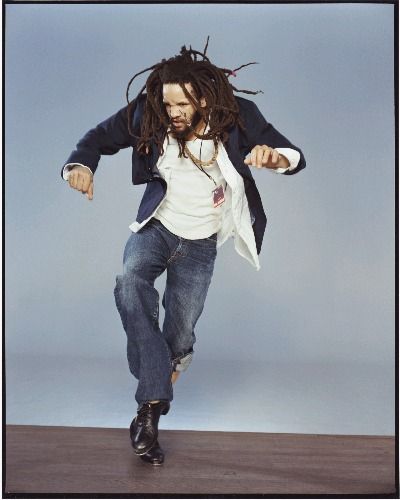
Rasta Thomas’ new Bad Boys of Dance show, “Rock the Ballet,” opens tonight at the Joyce Theater. I’ll be there later in the week. Here’s what I wrote last time I saw Bad Boys; below is a video of some footage of the current show, in Barcelona, interspersed with audience interviews (in Spanish).

And here’s one from the group’s performance on a Spanish TV show:

It looks like they’re including women this time (at least one, at least one human 🙂 ). I can never tell if he’s being ironic or not with the choreography… In any event, the reason to see this show is the man himself, Rasta Thomas, brilliant brilliant dancer.

Above image taken from here.

MERCY!


Photo by Andrea Mohin, from NY Times, of Complexions’ cast of Mercy, Desmond Richardson center.

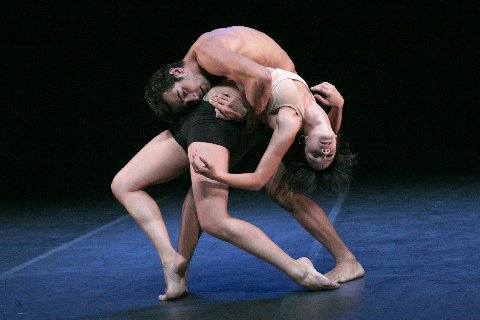
Complexions is currently at the Joyce in Chelsea and they’ve got two nice new pieces (both by artistic director, Dwight Rhoden) — Dirty Wire and Mercy. I liked both but particularly Mercy. It’s spiritual but uses a medley of both classical and contemporary music, is very dramatic, and has themes of sin and treachery. I found the movement original and expressive, and the miraculous Desmond Richardson has a rather intense, mysterious solo. All of the Complexions dancers are excellent though. Rhoden really works them hard — his movement is almost always very fast — sometimes almost spastic, on purpose — and great precision is required in order to make those lightning-fast changes of shape.

They’re on through November 29th. Go here for details.

GARTH FAGAN DANCE

Roslyn Sulcas just reminded me that I am missing Garth Fagan Dance, currently at the Joyce Theater. I may try to go later in the run, but since they’re only on through Nov. 1 and since I’m so busy right now, I might not make it.

Anyway, here are a couple of clips I thought you all might enjoy. First is one of my favorites of his, From Before, and second is from Griota New York, which they performed at the Jacobs Pillow Festival last year.