NINA AND MARCELO’S HEARTBREAKING GISELLE


Last night began ABT’s Giselle week. Nina Ananiashvili and Marcelo Gomes debuted the leads, with Gennadi Saveliev as Hilarion, the village huntsman in love with Giselle, and Gillian Murphy as Mytra, the second Act’s Queen of the Wilis.

It’s not hard to see why Giselle is the oldest ballet that’s still performed today. It’s a quintessential ballet — dance being at the heart of the story — and there’s plenty of drama, with emotionally complex characters, lots of room for acting, and of course really beautiful dance.

Basic story is this: Giselle is a peasant girl with a weak heart (both literally and metaphorically) who nevertheless loves to dance. Count Albrecht is a nobleman who pretends to be a fellow peasant so that he can seduce her. She buys his disguise, falls for him, and then realizes, via Hilarion, that he is not who he claims to be, and is in fact, engaged to a princess. Her heart breaks, she goes mad, and dies.


Act two takes place in the land of the Wilis — women who died heartbroken, their love unrequited. During the nighttime, they rise from their graves and dance to death any man who enters their realm. Hilarion, visiting Giselle’s grave, meets just such a demise, but when Albrecht arrives at her grave, now heartbroken and deeply remorseful for what he’s done, Giselle is able to protect him from Myrta and the other Wilis. He is nearly danced to death, but she saves his life. If danced and acted well, it ends up being a beautiful, deeply human story of forgiveness.

Last year when I saw this ballet I was annoyed that Count Albrecht seemed to lack proper motivation, that he wasn’t a fully-drawn character. But I thought Marcelo did really well at fixing all the loose ends. At the beginning, he is kind of a jerk (to the extent that Marcelo can ever be πŸ™‚ ), really there just because she’s a pretty peasant girl and she likes to dance and it’s fun to dance with her, and who cares about toying with her feelings? She’s just a peasant girl. Of course he doesn’t know how weak she is and how much he’s going to fall for her. And then when Hilarion exposes him and he’s presented with his fiance and has to kiss her hand and bow to her, and Giselle subsequently goes mad and falls dead, he realizes what he’s done. The impact hits hard.

I don’t think it works if Albrecht is all dreamy up front, when he first approaches Giselle. He could just be a romantic in love with two women, but then what is he doing out there in the peasant village in the first place? When did he first see Giselle and fall for her? And is he an idiot? What does he think is going to happen with his prior marriage commitment to the Prince’s daughter? I think it only works if Albrecht is a careless playboy up front, like Marcelo’s. And then that gives him a dynamic range, so he can change later on.

Then the second beautiful Act consists of his prayer for forgiveness, which I’m convinced no one is going to do as well as Marcelo! He was really heartbreaking. Marcelo does this thing (which a man in the audience also recognized and remarked to his friend on the way out) where he throws his head back after landing a jump. So, he’d do these long jumps across stage and on the landing arch his neck back and throw his chin up. It looks all the more Romantic and all theΒ  more expansive and all the more prayerful and all the more heart-wrenching! I’ve never seen anyone else do that.

And he kept crashing to the ground during the dance-to-death scenes. I’ve never seen anyone do it quite like that. He really fell hard to the ground at points. But he did it in such a way that it looked not only like he was dancing to death, as commanded by Myrta, but like he actually was so heartbroken and angry at himself that he wanted to die. It was a far more intense interpretation than I’ve seen before. (It looked more dramatic last night — maybe just because it was live — but you can see some of what I’m talking about here.)

Nina was gorgeous, particularly in the Wilis Act. I think I still prefer Julie Kent’s mad scene to everyone else’s, maybe because she was the first person I saw in the role and she had such subtlety. She didn’t overdo it; you had to read it on her face, and that made it all the more real, made her collapse into death all the more tragic. But the way Nina stood over Marcelo and held her arms up behind him, like she was now his angel, like she would be for the rest of his life — made me want to cry. And the way she’d bourree across the stage so light like a spirit — perfectly ghostly, both angelic and haunting.

And Gillian was an excellent Myrta. Because she’s sinister up front, commanding Hilarion’s death, and then remains all-controlling throughout, when Albrecht appears and Giselle makes clear she need to protect him, it’s ultimately Gillian’s Myrta who allows that to happen. So Myrta ends up forgiving as well, making the story all the more full and moving. Gennadi was very good in the dance-to-death scene, but I didn’t like him so well in the first Act. I think he was too mean and controlling. I know Hilarion loves Giselle and wants to expose Albrecht, but I might have been a little afraid of his Hilarion if I were her. Too angry and impetuous. But he’s a very good bravura dancer and those insanely fast chaines where he whips himself into a chaotic frenzy were stunning.

Curtain calls again were crazed. I honestly don’t remember hearing so many “Bravaaaaaaas” ever before. People were screaming. Nina is obviously a very beloved ballerina. Her last Giselle is on Friday, when Jose Carreno will dance Albrecht. And her last performance with ABT will be later this season in Swan Lake.

HELP!


Okay, just one more post before I settle down for the weekend.

Next week is going to be pure insanity. Practically every single Giselle cast at ABT is a must-see. Retiring ballerina Nina Ananiashvili is dancing her last two Giselles Monday (with Marcelo Gomes) and Friday (with Jose Carreno); Tuesday Diana Vishneva dances the lead (whom many critics consider best in the role); Wednesday matinee David Hallberg and Maria Riccetto make their debuts; Wednesday night Veronika Part dances the Queen of the Wilis with Irina Dvorovenko in the lead; Thursday night La Scala superstar Roberto Bolle makes his debut as the newest company principal; Saturday matinee Herman Cornejo dances Albrecht; and Saturday night is visiting Bolshoi ballerina Natalia Osipova in the lead. (By the way, Saturday night casting has recently been changed to David Hallberg as Albrecht, dancing in place of the apparently still-injured Ethan Stiefel.)

Across the plaza at New York City Ballet, the newish ballet Lifecasting by Douglas Lee (which is your only chance to see Ashley Bouder dance this season) shows on Wednesday night, Friday night, and the Sunday matinee along with the critically acclaimed Christopher Wheeldon ballet, Mercurial Manoeuvres (one of my personal favorites of his). And their always fun Dancers’ Choice program is on Sunday night. (Visit Oberon for more deets on that).

I had also wanted to see Jennifer Muller’s The Works 35th Anniversary program at the Joyce in Chelsea but just don’t know if I’m going to be able to pull it off.


Also, the following week, on Tuesday, June 16 from 5:30-7 pm, Roberto Bolle (photo from here) will be at Rizzoli Bookstore (on 57th Street between 5-6th Avenues) signing copies of his book (of photos of him dancing at La Scala).

Happy weekend, everyone!

AMERICAN BALLET THEATER OPENING NIGHT!

p5182145

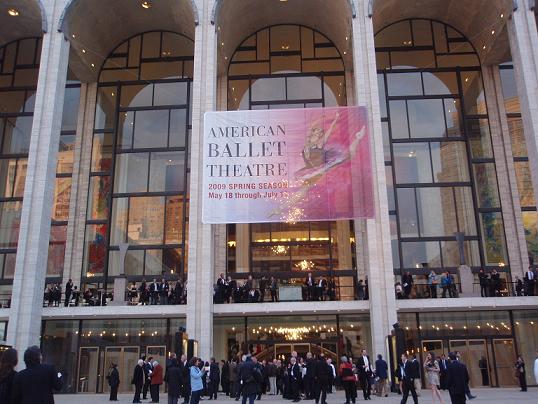
Yay, the season has offically begun! This picture was taken during intermission; that’s why it doesn’t look that crowded. I was sprinting in, nearly late, as usual, so didn’t have time to snap some pics before the performance but fortunately it was still light outside during intermission.

Anyway, Michelle Obama (who served as one of the gala’s honorary chairs) looked smashing in a sleek dark grey sleeveless, knee-length dress with tiny black ruffles lining the bottom. I’m sure there will be beaucoup des pictures seeing as how many blasted camera people there were; I’ll be sure to steal some when they’re posted on all the society websites πŸ™‚ (Oh, look, here it is in the NYTimes already)


It was just about the craziest thing I’ve seen on the Met Opera stage: after Veronika Part’s mouthwatering Mozartiana opened the show, artistic director Kevin McKenzie came out and thanked everyone who needed thanked — all the donors, designer Caroline Herrera who funds the gala, etc., and Senator Chuck Schumer came out and gave a little talk about the importance of funding for the arts, etc. Then, Schumer disappeared behind the curtain and moments went by. Everyone kind of looked around at each other like “what’s going to happen next?!”

Soon, the curtain was pulled back to allow some people to carry out a podium with a banner “American Ballet Theater” draped over its front. The doors to the lobby opened and a flock of people bearing weapon-sized cameras blasted in. Several men dressed in black promptly rose from their aisle seats and followed the flock of weapon-camera-bearers to the front of the aisle, near the stage. Caroline Kennedy was announced. She came out, everyone applauded, and she mentioned that the school of ballet associated with ABT, the Jacqueline Kennedy Onassis School, would be performing on the Met Opera stage for the first time ever tonight. Everyone ooohed and aaahed. Then, she announced First Lady Michelle Obama.

The curtain pulled back again and out she came. Of course everyone gave a standing ovation. She smiled radiantly, then, after a moment, directed us to be seated. Then she gave a short speech. It was a little hard to focus on what she was saying with everyone — both professional photographers and audience members with cell phone and digital cameras alike — flashing away as they were, but she talked about the necessity of the Arts for a culture to flourish, the importance of arts education, etc. Then she introduced the Jacqueline Kennedy Onassis School students.

As soon as she disappeared behind the curtain, the auditorium remained still pending the exit of the flock of pro camera wielders. It’s funny because there were all these non-dance writers in the press section. You could hear the sighs of relief, the sinking down into the chairs, and the putting away of pens and paper — and cell phones, which they’d used to light their writing paper during Mrs. Obama’s speech, which would have been extremely annoying had it not been for all the flashing bulbs anyway. But it made me wonder how they’d ever survive as performing arts critics! I mean, who needs light to see to write!

Anyway, the students were excellent. They performed Le Defile (The Procession) by Raymond Lukens. There were three large groups of them, in three levels — the very little ones, a medium-age / level group, and the older, very advanced ones. The choreography was basically a showcase of classical ballet steps, much like a very advanced ballet class — jumps, jumps with changing feet, jumps with changing feet that went on forever performed by a set of advanced boys (which drove the audience to wild applause), jetes, chaine turns, multiple pirouettes, fouttes, etc., and then a bit of partnering. It gave the students a chance to show what they could do — and the advanced ones could do a great deal! Extremely impressive, and great fun.

Then on were Xiomara Reyes and Herman Cornejo doing an excerpt from August Bournonville’s La Sylphide. This was the most dramatic I think I’ve ever seen Xiomara. I was sitting in the back of the orchestra and she really projected. She was really sweet. And Herman as always amazed with his virtuosity, his jumps, his razer-sharp precision, his astounding clarity of line.

The corps in both this, La Sylphide, and Swan Lake, later in the evening, were absolutely amazing, by the way. Not a head arched back more than the others, not a leg raised higher. They were all so on. When they work together like that, in perfect unity; it’s really visually breathtaking.

Then was Balanchine’s Tchaikovsky Pas de Deux danced by Ethan Stiefel and Gillian Murphy. Ethan and his strutting around stage, taking his own good time after their duet and before beginning his solo, making the conductor wait for him! And his high jumps with all miraculously many beats of the feet. I wished my friend Alyssa could have come so she could see he’s not just Mr. Sexy; he’s a superb dancer. And Gillian was radiant, and a perfect foil with her speed-of-light chaine turns. They enjoyed a long, slow kiss during the curtain call. The audience went mad!

Then was the hunt scene from Sylvia danced by Michele Wiles followed by a piece d’occasion (the first of two of the night), by Alexei Ratmansky, for Nina Ananiashvili, called Waltz Masquerade. It was set to the Waltz from Aram Khachaturian’s Masquerade Suite and it was cute and comical. She was dressed in this long, red dramatic, Carmen-like dress with a sexy black lace overlay on the top. There were four tuxedoed men, each bearing a gold candlelabra, one at each corner of the stage. These men turned out to be: Jose Carreno at the front left corner; Marcelo Gomes, at back left; Angel Corella back right; and a blonde on the front right who I initially thought was David Hallberg (I was sitting FAR back from the stage!) until the fun began and he shook his head about like a sassy mop and I realized DH just does not have enough goofball in him to do such a thing, even if he tried. So, I decided it was either Ethan or Maxim Beloserkovky. Anyway, Nina’s character was supposed to be dancing about the stage in a melodramatic solo — but it was purposefully melodramatic, and so comical. Like a silly, cartoon version of an upcoming swan song, really, which, is of course, what’s coming up for her later in the season (and will be much more sobering when it does). At one point, she just passionately crashes to the ground and remains there, in a heap. Nothing happens. The men, obviously her servants, start looking at each other like, what now? They shrug, slowly walk over to her. Then, Marcelo starts imitating her melodramatic dance, but far more cartoonishly, and of course it’s hilarious. The others join in. Max (I think it was Max, not Ethan) does his thrashing hair thing. I couldn’t see facial expressions but I assume they were making fun of their master. Then she wakes up, catches them, and they’re sent back to their posts.

After intermission was the balcony pas de deux from MacMillan’s Romeo and Juliet, danced by Marcelo and Diana Vishneva. At first, Diana approaches her balcony with all the drama of a ballerina playing Juliet, rather than Juliet herself. I rolled my eyes. This is what I don’t like about her. She’s an excellent dancer but she’s all about the pomp and circumstance and not about the character. Maybe it’s a Russian thing, but I don’t see that in Veronika Part or Irina Dvorovenko. Anyway, she eventually lightened up, thankfully, and I felt like I was watching not a prima ballerina being a prima ballerina but Juliet herself, falling hopelessly in love. When she runs around him one foot solid on the ground, the other on pointe, it’s so girlish, so real yet so poetic. Those are the best — I don’t know what to call them — runs around kneeling Romeo — that I’ve ever seen — not even Alessandra Ferri’s were that sweet. Still, I felt some of the lifts lacked the beauty and magic ofΒ  those Marcelo and Julie Kent do together when they dance this scene. I don’t feel she dances that well with a partner; she’s more into herself. Marcelo’s leaps around the stage and big high passionate jumps were thrilling. He got some good bravos for those.

Then were Paloma Herrera and Max Beloserkovsky in the Act II pas de deux from Swan Lake. I was hoping it’d be the Black Swan pdd, but no. I guess the program was pretty bravura-heavy already. I don’t see him dance much, but Max is really quite good. He’s really a character and he’s the perfect Prince Siegfried, regal yet vulnerable and tragically in love. And he’s a good partner.

Then was the mad fun of Le Corsaire, with Irina Dvorovenko, David Hallberg as Conrad, and Angel Corella as Ali. Except something happened at the beginning and I hope David’s okay. The tallest guy in the entire opera house had to sit in front of me and I was trying to navigate my way around his enormous head just as a bunch of people up front went “Oooooooh!” When I was finally able to see the stage, Irina was standing in front of David, face toward the audience. She didn’t seem to have any particular expression on her face, but, then, I was light years away from her. Then David did an assisted pirouette with her and everyone applauded, so it must have been a lift that didn’t quite happen or something. Anyway, I hope he’s okay; I know his shoulder sometimes comes out of socket. Anyway, all seemed to be fine after that: all three were brilliant. Of course. Angel astounded, as always, and I started giggling during his first solo and couldn’t stop all the way through the second. I love Irina. She was radiant. She did those continuous turning kicks on pointe like they were nothing. She has the drama and the virtuosity when needed and the always beautiful, graceful lines. And David’s leaps all over the stage were magnificent. I could see this goofy ballet over and over and over again, as long as no one gets hurt πŸ™‚ Angel did not leap out from behind the curtain during curtain call, sadly.

Then there was another piece d’occasion. Herbie Hancock played piano, onstage, while first Jose Carreno, then Stella Abrera, danced to his music. This was cute and comical as well, and kind of reminiscent of Jerome Robbins’s Other Dances or Suite of Dances, where the dancer(s) connect mainly with the musician. At one point, Hancock went nuts with the keys, obviously way too fast to be danceable, and Jose stopped in his tracks, looked over at him, and lifted his hands, like what gives, dude? He sat down near the base of the piano and just rested. The same happened with Stella. She danced, then stopped and gave Hancock a look when he began another little virtuoso section. She finally sat down beside him on the piano bench, and eventually, he ended on a romantic note, she snuggling next to him softly, sweetly.

The evening ended with the finale of Balanchine’s Theme and Variations. The leads were danced by Sarah Lane and Daniil Simkin. It was a nice way to end the program, but with the likes of Simkin, I wondered why they only did that group finale, where he and Sarah are basically leading a processional, instead of some of the earlier bravura parts with all the corkscrew turns for the man. An opening night gala performance is meant at least in part to showcase the dancers doing what they do best, and he is best at the bravura stuff, not leading processionals.

Anyway, the whole night, as usual, was magic. Saw Sigourney Weaver and Kelly Ripa in the audience.

Oh, for my Dancing With the Stars readers, I taped the show, but for lord knows what reason it was somehow muted. I have no idea how on earth I managed to do such a thing, but it was pretty amusing watching the show in pure silence — no words, no music. Needless to say, I’ll have to watch online tomorrow.

But now, dead tired, must sleep. Goodnight.

DANCES PATRELLE DOES JUDY GARLAND AND EDGAR ALLAN POE


On Friday night I saw Dances Patrelle, who is celebrating its 20th anniversary, to see their Murder at the Masque: The Casebook of Edgar Allan Poe, a world premiere, and Come Rain / Come Shine, a revival from 1986, both choreographed by artistic director Francis Patrelle. Funny, it’s the first time I’ve ever seen anyone besides Dance Times Square perform at the Danny Kaye Playhouse at Hunter College, so, I was a slight bit confused throughout the evening because of that. I couldn’t figure out what Marcelo was doing on the stage instead of Pasha and what people were doing in pointe shoes instead of Latin stilettos… I guess it’s fitting I brought with me my ballroom friend, Mika.

And I’m so glad I did. She had a blast. Said it was some of the best ballet she’d ever seen. AS I KNEW IT WOULD BE!!! Said Marcelo was very Slavik (as in Kryklyvyy, as in man drama queen total show-off show-stealer, as in I’m totally predictable in my taste in male dancers whether it be ballet, ballroom, or whatever style. Oh well…)

Anyway, Murder, on first, was a dramatic ballet murder mystery that was interestingly told. The figure of Poe seemed to be writing the story as we were seeing it, from afront a scrim, and it seemed to me he was changing things throughout. I’m still not sure who committed the murder in the end (but that may well be because I was so excited about the second piece of the night). It had an air of Balanchine’s La Sonnambula about it — unsettling, foreshadowing tragedy, and set at a ball and in the same period — and Patrick Soluri’s music set that tone perfectly. Matthew Dibble, guest starring with the company (he’s danced with Twyla Tharp’s company), danced the lead very well, expectedly.


Second on was Come Rain / Come Shine, Patrelle’s longish but lovely set of dances for three couples set to a group of Judy Garland songs. Sorry I’ve posted that picture above about 10,000 times on this blog; it’s the only one I have of that dance πŸ™‚ All six dancers in that ballet were guesting from ABT: Roman Zhurbin (ballet god) and Gemma Bond danced the first, youngish, romantic couple; Isaac Stappas and Kristi Boone (who BLEW ME AWAY) danced the second, more mature, argumentative couple; and Marcelo Gomes and Maria Riccetto danced the third couple, consisting of cocky, taunting, teasing, out-of-control man and the poor woman whom he’s got his eyes on. Of course Marcelo had to have the cocky part, and his role, which was very “That’s Life” from Tharp’s Sinatra Songs, consisted of him flying all about and around her, doing every trick in the book — ginormous jetes, Balanchinian continuous twisty jumps, turns and turns and jumps jumps jumps galore — which of course I love πŸ™‚ Oh, and Maria’s tiny, so he did a bunch of the one-handed assisted pirouettes he often does with Julie Kent that drove the audience here WILD. The guy behind me was seriously orgasmic. Mika and I were giggling throughout, and finally, on the last assisted pirouette, I just burst out laughing.

What would the world be like with no Marcelos? Ballet would just not be fun. To say the least.

Roman was Roman — not doing a thing wrong, everything perfect, perfect form, perfect precision, perfect acting, just sheer perfection.

Gemma was likewise perfect and Isaac was strong and Maria sweet.

(But it was Kristi who really blew me away. Where did she come from?! I guess I’ve never really seen her up close before … well, I did notice her before — in Tudor’s Jardin des Lilacs, which ABT put on in their Tudor centennial celebration last season — she danced the role of the lover of the man betrothed to another and she danced with such longing for him and anger at the situation and beautiful composure in the face of despair. But time got away from me and I never had time to write about that performance… Well, she had a similar character here: a woman fighting with her man, seemingly not able to fully trust him, not wanting to give herself completely to him for that reason, but unable to stop loving him nonetheless. She and Isaac (who happen to be real-life husband and wife) are really the emotional centerpiece of this ballet and she acted it with such intense emotion. She made me feel everything her character was feeling, really took me to that place. And she made such amazing shapes with her body! Isaac kept throwing her into these overhead and waist-high fish positions and she’d raise her arms up and curve them over, turning her head to face the floor. At times it looked like she was letting him lift her but was also rejecting him, couldn’t bear to look at him. At other times, she kind of looked like a dove, and in a way she was trying to make peace, so the image made sense. So she didn’t just make original, remarkable shapes; she made shapes that had meaning, and were also original and cool.

And also, her feet and legs — such strength! Her feet were almost like Veronika Part’s her points were so pronounced!Β  If I was a ballerina I’d want people to notice that — strong feet and legs. I wouldn’t want to look like I was floating through the air like a feather, I’d want to look more strong and toned and powerful, like my legs were carrying me through the world. Anyway, I am a new Kristi Boone fan, needless to say.

It was an intoxicatingly rich evening and I felt like I always feel when I leave the Kaye Playhouse after seeing divine dancing: deliriously high, and then kind of sad…

New York City Ballet: Founding Choreographers I


Tuesday night I went to see New York City Ballet’s Founding Choreographers I program (I know, I’m very late; it’s been a nasty week of migraines and sanity-destroying upstairs neighbors — more on the latter later).

It was a good, varied program. First on were two short abstract but very musical “leotard ballets” by Balanchine, both set to Stravinsky, that went together nicely (though they were choreographed years apart), Monumentum Pro Gesualdo and Movements for Piano and Orchestra. The pieces are mainly abstract and play with geometrical shapes and configurations, and there’s a bit of cute “Egyptian” styling in the flexed hand and feet gestures, and the ballets really give the dancers the chance to show off their musicality, especially the second, fast-paced one. I’m liking Maria Kowroski (in the top picture with Charles Askegard) better and better. She was very charismatic. Even though the ballets were story-less, she was kind of playing a part, and it really drew your attention to her. Askegard was really on too.

The second piece, Robbins’ Dances at a Gathering (pictured second, up top) was what I really went for. It was Kathryn Morgan’s debut in the ballet. She was very good, but who really ended up standing out to me was Sara Mearns. She danced her part in a way that really reminded me of ABT’s artiste supreme Julie Kent in Robbins’ similar but shorter, more virtuosic version, Other Dances. Mearns, like Kent, really connected with the music — not just like she was dancing to the music but with it; it, rather than the male dancer, became her partner. I remember in Other Dances when Kent girlishly lifted her shoulders and a big, joyful grin sweetly overcame her face when the onstage pianist first put his fingers to the keys. Sure Angel was there too, but the music is what made her dance, he was secondary. Robbins has I think three (that I know of) of these dancers-interacting-with-musicians dances: this one, Other Dances, and Suite of Dances, danced by a solitary man to/with an onstage cellist.

The problem to me with Dances at a Gathering is that there’s so much, it’s just too long, and you lose the quality and the mood that are so prevalent in the other two. Instead of one dancer connecting with a musician, or a duo with each partner connecting in his and her own particular way, here there’s a multitude of dancers, each trying to do that throughout the l-o-n-g dance. Every time I see it, I’m in love with it until about half-way through when it starts to drag. Then there’ll be another section that draws me in, and then another section that drags, then another section that drags, then another that begins to draw me in again where I begin to think, gee if there weren’t all those sections earlier that dragged, this one would be quite engaging, but by this point, I just want the damn thing to end already. And I know I’m not the only one who felt that way. You can feel the whole audience shifting in their seats. You can hear the heavy breathing. Someone needs to seriously edit that ballet!

Anyway, that said, I also really liked Benjamin Millepied. He dashed around the stage as if he were desperately searching for someone or something he’d lost. There was a longing and a quiet urgency to his performance that was really quite poignant.


See principal Megan Fairchild talk about that ballet (and see excerpts) here.

Last on was Balanchine’s Stars and Stripes, the high-speed, super-energetic ballet danced to John Philip Sousa’s marching band music that today looks kind of goofy in its hyper-patriotism. At first you want to roll your eyes at what seem to be a cheesy series of Rockette-like high kicks and formation changes and almost circus-like high jumps and stage-traversing turning jetes in the soldier section, but then you realize that in 1958, when it premiered, it was still kind of a point at which America was becoming acquainted with ballet, with the movements and with the Petipa structure — the wondrous in sync ensemble work, the pas de deux with the breathtaking lifts, the solos with their athletic jumps for the man, fouettes and fast chaine turns for the woman. As eye-rolling as this ballet may now be, if you look at it with a historical eye it was very original in its celebratory Americanization of the classical.