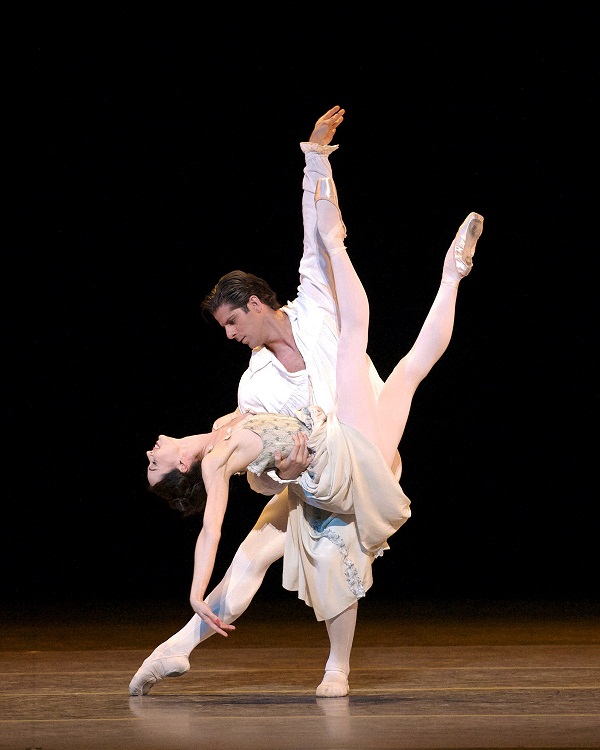
ABT’s LADY OF THE CAMELLIAS


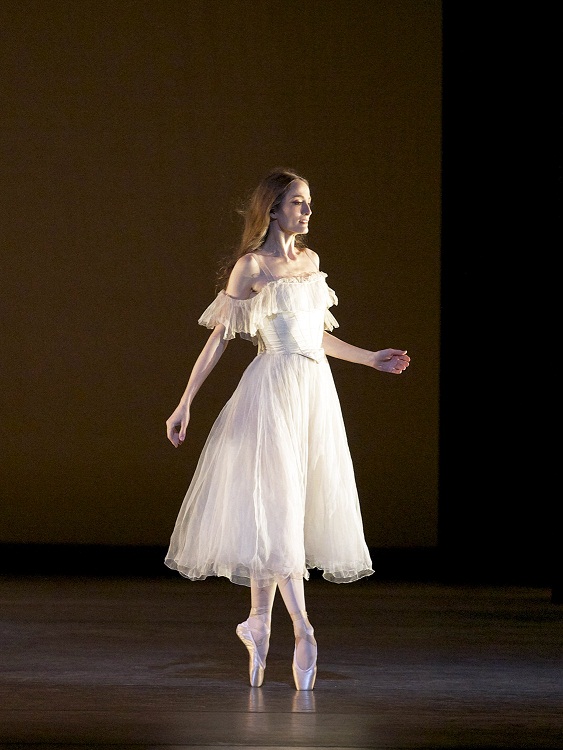
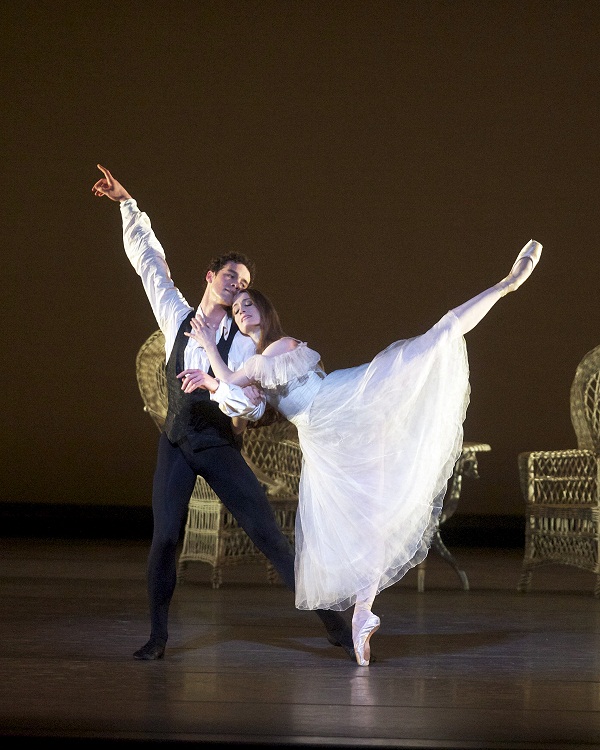
(Photo of Cory Stearns and Irina Dvorovenko in John Neumeier’s Lady of the Camellias, taken from ABT website – click on photo for link).

I so love this ballet. It’s my favorite ABT is putting on this season (since there’s no Manon or Romeo and Juliet). I went to see Lady of the Camellias Saturday night – out of curiosity, went to see the new cast – Cory Stearns and Irina Dvorovenko – and just came away from the Met feeling like I had the fullest, richest, most rewarding night at the ballet this season. I just feel like something about the minimal, but completely realistic sets, the authentic and beautiful period costumes (both costumes and sets are by Jurgen Rose), the depth of emotion conveyed by the story, the heartbreaking story itself, the book it’s based on, the gorgeous partnering, all just really drew me in and made me feel like I was inside of the narrative.

First, I love how there are no curtains – you just walk in to the auditorium and there’s the open stage;  you walk in on the set. And then the first dancer comes out on stage before the chandeliers have risen to dim the auditorium’s lights … so it’s not like a performance at all; it’s like you’re eavesdropping on the characters and their story.

And I love how at points the dancers use the front side of the stage.  You feel like they’re right above you. And you can watch both side stories – taking place there – and the center story, taking place center stage – at once.

I should say, this is the story of a younger man, in love with an older woman – a famous Parisian courtesan (the text is based on the 1849 novel by Alexandre Dumas, fils) who is dying of consumption. It’s a tragedy, as, through the meddlings of others who don’t want them to be together for various reasons – they are torn apart.

Cory Stearns was perfect as the younger man, Armand Duval. He danced very well – executed all of those seemingly impossible but beautiful lifts 🙂 , and he really brought his character to life. He is a natural actor. Either that or he has acting training, because he’s one of the best in the company at that, in my opinion. I love Diana Vishneva in the main role – Marguerite Gautier (and my friend and I passed Diana, holding flowers and still made up, as we were walking from the Italian restaurant where we had dinner to the Met), but I thought Dvorovenko did very well too, danced beautifully, had strong chemistry with Stearns, and overall fit her role as well.

I also loved the supporting cast. Gennadi Saveliev doesn’t often impress me, but wow, he did Saturday night in the role of the party attendant who’s having big fun with that horse whip, holding it next to his pelvis and making suggestive movements, and all that. He was a lot of fun, and he danced the bravura parts spectacularly. Luciana Paris shone as his partner, the sultry, hip swaying, Mlle. Duvernoy, and Melanie Hamrick was also radiant as Olympia, Armand’s would-be mistress, had he not been so in love with Marguerite. Vitali Krauchenka and Grand DeLong were totally believable as, respectively, Armand’s father, and the regal, all-powerful angry Duke who wants Marguerite for himself. And finally, Stella Abrera danced beautifully as Marguerite’s reflection of herself (or Manon Lescaut in the ballet-within-the-ballet, however you want to see it). Blaine Hoven was a good partner for her, as Des Grieux. His ballet technique is near perfect – even someone without a huge amount of ballet training can tell that – and I think he is acting and emoting much better than before, though I still think he has a ways to go before he might be considered principal material.

The pianists (music is Chopin) – Koji Attwood, Nimrod Pfeffer, and Emily Wong – were brilliant. They deserved their substantial applause at the end, during curtain calls.

Everything just came together to make a really memorable ballet. And these weren’t even the “star” dancers – these were the “up and comings”! The choreographer, John Neumeier, originally created the ballet for the Stuttgart Ballet. He currently runs the Hamburg Ballet (both companies being in Germany, of course, though I think Neumeier is American). So many of my European friends think ballet is so much more alive in Europe than in America, and they enjoy going there so much more than here. I can see why. More Neumeier and MacMillan, Kevin McKenzie!
Photos from ABT’s Opening Night Gala

Here are some photos from American Ballet Theater’s opening night gala on May 16th, which I wrote about here. Above, Marcelo Gomes and Diana Vishneva in Manon excerpt, my favorite of the night. All photos by Gene Schiavone.

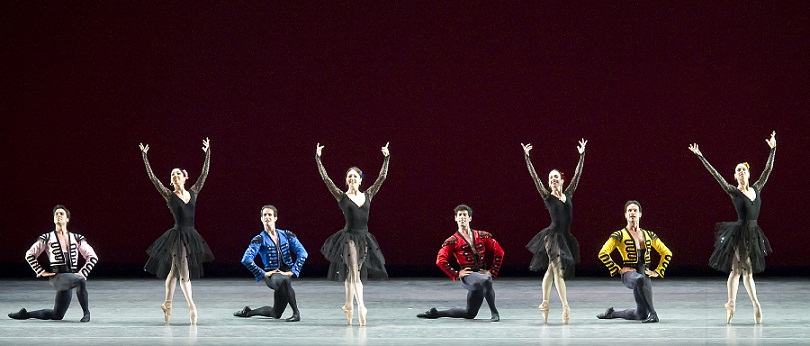
Jose Carreno (in yellow) and cast of Majisimo (including Lorena Feijoo, Lorna Feijoo, Joan Boada, Nelson Madrigal, Reynaris Reyes, Xiomara Reyes, and Paloma Herrera).

Above, Julie Kent in Lady of the Camellias excerpt. Below, with Cory Stearns in LofC.

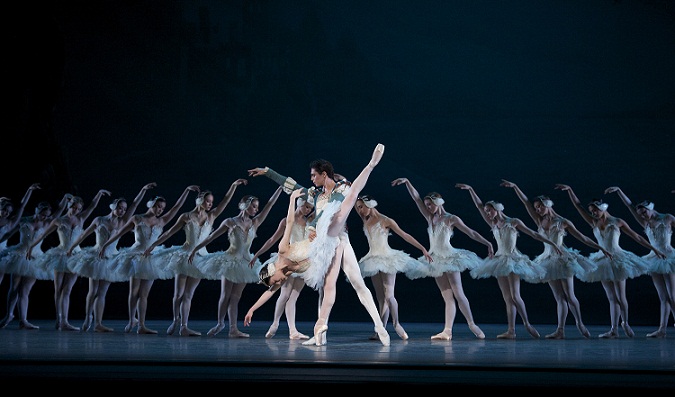
Paloma Herrera, Alexandre Hammoudi, and cast in Swan Lake, from Act II pas de deux.

American Ballet Theater Spring 2011 Opening Night Gala

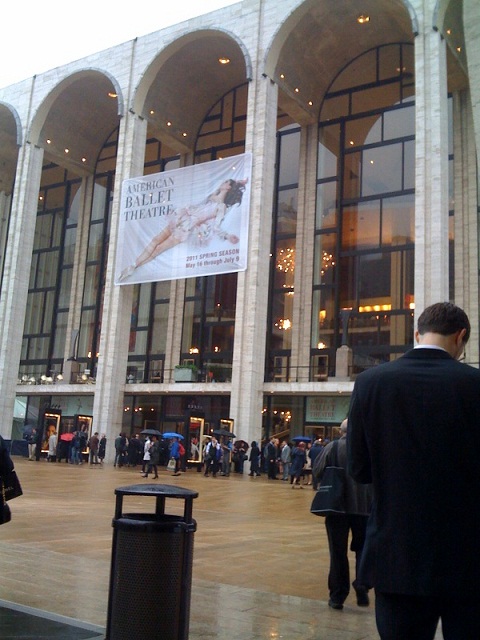
Last night was ABT’s Spring 2011 opening night gala. Dreary, rainy night … but what else is new for New York these days?

Once inside, I really enjoyed the show though. (I’m hoping to receive photos soon, which I’ll post). The program began with a short preview of Ratmansky’s The Bright Stream, which I’m excited to see next week. Seems to have a lot of humor, some bravura dancing, a cute storyline.


(Photo: The Bolshoi’s production of Bright Stream; Natalia Osipova is jete-ing).

Then, there were introductions by Rachel Moore, executive director of ABT, wearing a beautiful green dress, and Kevin McKenzie (AD), followed by Caroline Kennedy, who introduced the students of the Jacqueline Kennedy Onassis School of American Ballet as they danced a world premiere, Karelia March, by Raymond Lukens. The program says the students are Level 7, which must be the highest level, because some of those dancers looked like ABT principals. I’m not kidding, I swear. They really amazed me. That school is doing incredible things!

Next was Balanchine’s Tchaikovsky Pas de Deux, danced by David Hallberg and Gillian Murphy. Everytime I see David dance I think he must be the most perfect male dancer in the world. Gillian was stunning too.

Then came the Grand Pas de Deux from Ratmansky’s new Nutcracker, danced by Marcelo Gomes and Veronika Part. (No, they’re not performing that ballet during the Met season, but there seemed to be a few excerpts in the program from ballets they’re not performing). I missed seeing this couple – overall still my favorite – when the company premiered Ratmansky’s version in December. They were so sweet. Veronika danced with such wonderment in her eyes, such joy. And Marcelo was her perfect, adoring cavalier, all eyes on her. I don’t have kids, but I’d think they’re the perfect wedding couple to wow very young audiences.

Then came Majisimo, a classical ballet piece with Spanish flourishes created by Georges Garcia for the Ballet Nacional de Cuba in 1965 and set to Jules Massenet’s Le Cid. This piece was mainly meant to highlight Jose Manuel Carreno, who of course retires from ABT later this season. But it was really a dance for eight couples, and he danced only the male part of one of them – there were very few solos. He danced with Paloma Herrera. Xiomara Reyes was paired with Reyneris Reyes, guesting from Miami City Ballet. The other couples were comprised of Cuban dancers guesting from other companies as well: Lorena Feijoo and Joan Boada from San Francisco Ballet, and Lorna Feijoo and Nelson Madrigal from Boston Ballet. The dancers were spectacular, but I didn’t think that much of the choreography, which reminded me of a more bland version of an ensemble scene from Don Quixote. Jose had a series of turning jumps, and a really beautiful multiple pirouette that wowed the audience – drawing those turns out are what he’s most known for. And Xiomara really took my breath away with this crazy fast series of traveling turns in a diagonal down the stage. I’ve never seen her dance like that!


(Photo: Jose Carreno dancing with Polina Semionova in Diana e Acteon)

After intermission came two pas de deux from Swan Lake. A Twitter follower asked me why they needed to perform two scenes from the same ballet. I think that ABT, same as everyone else, is just trying to benefit from the Black Swan craze. They should have had Sarah Lane dance one of the pdd though! 😀 Anyway, first pas de deux – White Swan- was Paloma Herrera and Alexandre Hammoudi, which was good. But the second – the Black Swan – I found surprisingly magnificent! It was danced by Michele Wiles and Cory Stearns. There have been so many guest stars from Europe lately gracing ABT’s stage, I’d forgotten how perfect an Odile Michele Wiles is. And Cory really impressed me as well. Whatever he may lack in dance ability (I can’t imagine he’ll ever be a David Hallberg or Marcelo Gomes), he more than makes up for in acting and stage presence. He’s really good at bringing you into the world of the ballet and creating a character you can sympathize with.

Sandwiched in between the two SLs was Jessica Lang’s Splendid Isolation III, danced by Irina Dvorovenko and Maxim Beloserkovsky. I joked on Twitter that Max earned the hot guy of the night award for that, but seriously – he did! Irina was really beautiful as well. And her party dress, which she came out in for the final stage bow, was, as usual, gorgeous. She has such impeccable fashion taste, imo.


Following that was the highlight of the night, for me – Diana Vishneva and Marcelo Gomes in the Act I pdd from Manon. Such a perfectly choreographed pas de deux – beautifully romantic and full of love / lust but with so many breathtaking but capriciously executed, dangerous-looking lifts you sense something out of control. As beautiful as it is, this story isn’t going to have a happy ending. I am liking Diana Vishneva more and more. I’ve always thought she was a great dancer but she always seemed to play too much to the audience for the story ballets. She didn’t take me into the world of the character as much as I want an actor to. But the last two seasons she’s been doing just that: really developing the character and dancing to her partner – Marcelo here and in Lady of the Camellias last season, which is the first time she really blew me away – instead of the audience. This – the Manon pdd – was the audience favorite last night as well. The two got a storm of whoots and bravos at their curtain call, and practically had a standing ovation the audience was so loud in their applause. “So beautiful,” exclaimed the woman beside me. “Okay, we can go home now,” she joked.


(Couldn’t find a photo of Diana and Marcelo, but here is Diana dancing Manon with Manuel Legris. With all photos I post now, I’m linking to the original site via a click on the photo.)

Here are Marcelo and Diana in Lady of the Camellias:


Then, Alina Cojocaru, one of the European guest artists this season, danced the Rose Adagio from Sleeping Beauty. I’m not a huge fan of this ballet in general, but she was lovely. Patrick Ogle replaced Sascha Radetsky as one of the cavaliers.

Second to last was the Act II pdd from Lady of the Camellias danced by Julie Kent and Cory Stearns. Again, Cory did a very good acting job – and physically he fits the character perfectly, as Julie does hers, but I think some of those lifts are so difficult-looking… I just worry about the dancers. Isn’t that how Roberto Bolle got hurt last season – performing this role?

And the evening ended with another ensemble excerpt from Ratmansky’s Bright Stream. People who stood out most to me were Daniil Simkin and, again, Xiomara Reyes. I really am excited to see this ballet.

Tonight Don Quixote begins and runs through the beginning of next week. I’m excited to see Alina Cojocaru dance with Jose Carreno on Friday night, and Russian ballerina Polina Semionova guesting in the Saturday matinee with David Hallberg.

ALL DAY AT ABT: ALL AMERICAN AND ALL ASHTON PROGRAMS

Last Saturday I had my first crazy ABT day where I spent the whole day at Lincoln Center, seeing both matinee and evening performances. I’ll do the same tomorrow with two Sleeping Beauties – can’t miss Alina Cojocaru (who I’ve never seen before) guesting from the Royal Ballet in the lead, and then in the evening the spectacular Natalia Osipova.

Anyway, last Saturday the matinee was their All-American program; the evening was the All-Ashton. The All-American opened with Twyla Tharp’s Brahms-Hayden Variations, which I’m sorry to say is the first Tharp that’s bored me. I just couldn’t connect to it. It had none of her trademark thrilling throws and lifts and clever partnering or dramatic, actable parts, and none of her enlightening contrasts between ballet and other forms of dance. Not that I saw anyway. I think the excerpt the company performed during the opening night gala was the only part I liked. There were good dancers – Marcelo Gomes, Stella Abrera, Herman Cornejo – but they didn’t seem to have that much to work with. It was just kind of lyrical gaiety. Like Mark Morris.


Then was Paul Taylor’s Company B, which is always fun – especially when Craig Salstein dances the hotly dorky guy in “Oh Johnny Oh” and Herman Cornejo the flashy “Boogie Woogie Bugle Boy,” but somehow it lost some of its magic on the large Met stage. I don’t know – I think it plays better at City Center – you somehow miss the silhouettes in the back at the Met, or you don’t connect them to what’s happening center stage as well.


And last was my favorite of the day, Robbins’ Fancy Free, this time starring Sascha Radetsky (image above, from here) as the cocky, sexy Latin sailor, Carlos Lopez as the dreamier one, and Daniil Simkin as the little acrobatic one. The two main women were Maria Riccetto as the girl in yellow whom the guys originally approach, and then Isabella Boylston as the girl in pink who momentarily gets interested in hot cocky Latin guy. Well, Sascha Radetsky completely took my breath away here. Before he had his momentary hiatus in with Netherlands Ballet, I’d always thought he was cute and a very solid, precise dancer, but he couldn’t act. I think he must have taken acting lessons in the Netherlands because he’s just so much better now. I really believe him in each role I’ve seen him in. And he really inhabited this sailor. He was really so compelling to watch; I couldn’t even focus on Daniil and his crazy sky-high jumps with Radetsky on the same stage.

Hehe, but one thing that really stood out for me was Isabella Boylston’s back-leading! All throughout ballroom training we were yelled at ad nauseam  — not just me but all the women — for constantly back-leading. And that’s because grown women generally pick up dance steps a lot faster than grown men (not necessarily true for girls versus boys but definitely true for men vs women for some reason). Anyway, it’s only now I really know why. It looks horrible. I know this is ballet with choreographed steps and not ballroom, but their characters are doing social dance so it really had to look like he was leading her in the steps, not like she was anticipating what he’d so and then turn herself or make the move before he led her to do it. It ended up looking like she was in control, and he’s supposed to be seducing her here. I’m sure they’ll get it with more practice, it just looked obviously wrong and out of character. But maybe that’s just my ballroom training talking because they definitely got the most applause.


The Ashton program opened with Birthday Offering (image above from Dance View Times), which ended up being my favorite piece of the night. Absolutely gorgeous costumes (by Andre Levasseur) and what lovely variations with fast, fancy, very original footwork for the women. Stella Abrera, Simone Messmer, and Gemma Bond in particular stood out to me. Hee Seo (my favorite Juliet) danced as well – not in love with the choreography for her variation as much but she has the most beautiful Alessandra Ferri feet. She and Veronika Part both!

Then came the Thais Pas de Deux, which was performed by Jared Matthews and Diana Vishneva. I can’t wait to see Hee Seo and Sascha Radetsky perform this at the end of the month. I saw them in rehearsal and they really took my breath away. They’re so sweet together, and they really bring out the beauty of the choreography in a way that Diana and Jared as a partnership just didn’t, in my mind. Diana and her melodramatic curtain calls really crack me up. At first they annoyed me but I’m beginning to accept that they’re part of the performance for her and they’re just her. Who knows, maybe someday I’ll find it endearing.

But as far as her dancing, she’s hit or miss with me. I haven’t gotten around to writing about it yet, but I absolutely loved her in Lady of the Camellias. She brought so much more to the role than Julie Kent had the day before and she really brought me into the drama of it all – she and Veronika Part both (who danced the Manon role). And her dancing was gorgeous. She and Marcelo were excellent in that. A performance to see again and again (if ABT would only make a DVD of it…)

Then was The Awakening Pas de Deux from Ashton’s Sleeping Beauty, danced by Veronika Part and David Hallberg. It’s funny but choreography can look so completely different on different bodies and it looked like a wholly different piece than when Paloma Herrera and Cory Stearns danced it on opening night.

Finally, was The Dream, Ashton’s version of Midsummer Night’s Dream. Honestly, I was getting really tired by this point and I’ll have to see it again. I did really like Cory Stearns as Oberon. He is another dancer who’s a hit or miss with me but I found his Oberon was endearing while still being rather demanding with Titania up front. He did a good job, and he dancing was beautiful. Alexei Agoudine was a lot of fun as Bottom (who’s on pointe here, unlike in the Balanchine version and has a lot more to do), and Daniil Simkin was Puck. I enjoyed his Puck but found myself unable to get Daniel Ulbrich’s Puck out of my mind. I’ve been told I have to see Herman Cornejo in this role. And so I hope to before the season ends.

In between performances I had ice cream in the park behind Lincoln Center cinemas, where I saw Blaine Hoven and Marcelo, and then I went and had a glass of wine in the outside patio area of the newish Alice Tully Hall cafe. It’s nice out there when it’s warm, which it was for part of the time. So far we seem to be having another chilly summer. Tomorrow I have two friends who, happily, are as crazy as I am, so I will have people to hang with instead of just my book 🙂

ABT’S LADY OF THE CAMELLIAS NOT VULGAR!


Photo by Gene Schiavone, of Roberto Bolle and Julie Kent in Lady of the Camellias, taken from ABT website.

I was so busy last week carting pounds and pounds of books back and forth from the Javits Center – and killing my back and shoulders in the process, that I haven’t had time yet to figure out how to reinstall my Disqus system, which means you still can’t comment here, unfortunately. Sorry! I was going to wait to write about ABT’s Lady of the Camellias (and their other ballets I’ve seen) until I had the comments system up again, and until I’ve seen the second Lady cast, but I just have a few things to say now, mainly prompted by the critics, as usual.

This ballet, by John Neumeier, the artistic director of the Hamburg Ballet, is based on – and closely follows – the 1848 novel by Alexandre Dumas, Fils, which in turn is based on the tragic true story of a beautiful and rather famous Parisian courtesan, Marguerite Gautier, who falls in love with a young rich Frenchman, Armand Duval. The story is told in flashback and through various viewpoints and utilizes a play within a play to create theme (or a ballet within a ballet — in this case Manon, which tells the same doomed story of a prostitute and her lover), but this complicated structure doesn’t seem to confuse since the basic story is pretty clear. Though she initially rejects him when they meet at a performance of Manon, Marguerite eventually falls for Armand, and is torn between her role in society and her love for him. Armand is by turns angry, jealous, smitten, in love, and finally devastated when Marguerite terminates her relationship with him, due to pressures from the powerful Duke and Armand’s upright father, then dies of tuberculosis. Neumeier, an American who, like William Forsythe, has for most of his career worked in Germany, made the ballet in 1978, but this is the first time ABT has performed it. The novel has previous incarnations in the opera La Traviata and the Greta Garbo movie Camille.

I saw not Tuesday’s opening night but Thursday’s performance, by the same cast as opening night: Roberto Bolle as Armand, Julie Kent as Marguerite, and Gillian Murphy and David Hallberg as the “ballet within the ballet” dancers from Manon, Manon and Des Grieux. My first thoughts are: I loved Neumeier’s Death in Venice (based on the Mann novel) and I loved this as well. He really knows how to make a theatrical ballet, how to grab you and make you feel like you’re in these characters’ story. The settings are extravagant and specific, evocative of the 19th Century, the costumes are plush, and good use is made of the front edges of the stage, where the dancers come to reflect on the onstage action or to carry on with their own drama outside of the main action. The music is all Chopin, both orchestral and piano, and often the pianist is onstage; at times he actually becomes a character in the drama, interacting with the others, making music while they dance, and whom the characters may tease, or stop from playing to create a commotion. There were so many things to watch — the characters on the front side of the stage, the ensemble dancing in the middle, the pianist. It created a world. And the ballet within the ballet was done very well too: a red curtain masking the back half of the stage parted to reveal David and Gillian in heavy makeup and 18th Century garb, and they danced a Manon pas de deux as the others reacted — Armand falling for the beautiful Marguerite as Marguerite began to identify with Gillian’s Manon.

And then the beautiful partnering between Marguerite and Armand becomes front and center whenever it happens. Many critics are finding the choreography vulgar and crass but I didn’t. I thought the many sweeping lifts were beautiful and evocative of that world – this isn’t Romeo and Juliet, it’s the story of a courtesan and her very passionate lover, so it makes sense for Armand to lift Marguerite high above his head in adulation one moment then bring her down and place her on the floor the next. At times it reminded me of Kenneth MacMillan (both his versions of Romeo and Juliet and Manon) without copying him; the lifts were original. At one point, Armand holds his arms out in a T shape and Marguerite wraps her arms around his from behind. It looks like she’s on a cross. Or at times he’ll pick her up by holding onto her lower arms, which she’ll hold down. It looks like she’s a prisoner and can’t move – which she is in a way. And then there are lifts where she’s lying on her side, like he’s glorifying her.

Also, some of the choreography reminded me of Tudor, such as when Marguerite is begging for acceptance from Armand’s father and she circles around him repeatedly on pointe, or where a character will show hesitation and conflicted feelings with the almost Swan Lake-like rapid fluttering of a foot or by going in one direction, then with intentionally awkward rapidity, stopping and going in the opposite.

And I loved some of the floor choreography. At one point, Marguerite and Armand are sitting opposite each other, back to back, legs extended out, and they lean back and lovingly wrap their necks around each other’s side to side. So sweet.

I don’t know, look at some of these NYTimes slides and see if you think “vulgar” or original, evocative. Critics are also saying the choreography is severely lacking in musicality. To be honest, I didn’t pay much attention to that. I thought Chopin was evocative of that era, that world, as was the choreography, but I didn’t pay attention to the ways that the movement complemented the music. In general I don’t think a certain movement has to hit a certain beat; sometimes movement can play with a rhythm, question it, or work against it for effect. I don’t even think movement needs music. But I’ll pay attention to the music and movement when I see the ballet again next week.

I’ll also write more about the dancers’ interpretations after I’ve seen the second cast.

ABT OPENING NIGHT GALA MET SEASON 2010


Photo from inside the gala tent last night at American Ballet Theater’s opening night gala taken from NY Social Diary, who, sadly, don’t seem to have any pics up of Irina Dvorovenko in her beautiful red gown. It was one of the most beautiful dresses I’ve ever seen — long and many-layered but each layer seemed to be made of a light, sheer piece of fabric, so the whole thing looked light and diaphanous, though it wasn’t really see-through, just looked that way. Anyway, if anyone finds a picture of her, please let me know! Roberto Cavalli probably designed it…

Anyway, so the opening night gala was last night. It was loooong — one of the longest I’ve seen. We didn’t get out until 9:30, and it began at 6:30. It opened with an excerpt from Frederick Ashton’s Birthday Offering, of seven couples waltzing at what seemed to be a party (I haven’t seen this ballet), with Irina Dvorovenko and Maxim Beloserkovsky the main couple.

Following that was a series of introductions and thank yous by Kevin McKenzie (Art. Dir.), Blaine Trump and Caroline Kennedy (the two women were honorary chairs of the evening, along with Michelle Obama, who wasn’t there), and then David Koch who has funded the upcoming production of the company’s Nutcracker this winter.

Then, a group of ABT II dancers performed an excerpt of Edwaard Liang’s Ballo Per Sei, which was a contemporary lyrical piece, set to Vivaldi. I recognized a SLSG favorite — Irlan Silva — right away.

Then came the “Rose Adagio” from Sleeping Beauty, performed by Michele Wiles, with Sascha Radetsky, Craig Salstein, Gennadi Saveliev, and Roman Zhurbin as suitors. I don’t think I’ve ever seen this performed so well. Michele really held those balances, and she was so vivacious! Both she and Paloma Herrera, who danced a later excerpt from SB later in the evening, really embodied a young Princess Aurora very well. Michele got loads of applause – the most thus far of the evening.

Then came David Hallberg and Natalia Osipova’s Olympic version of Giselle — this an excerpt from Act II. People laughed and shook heads in amazement at Osipova’s sky-high ballons and sprightly jumps and leaps. She is really incredible. And then at the end when she jeted off and he followed her, it was really beautiful. But athletically astounding as it was, it was still moving; nearly brought tears to my eyes. I mean, how do you manage to do athletic feats like that and make it seem like you’re a light, other-worldly spirit instead of nearly exhausting yourself to death? I don’t know if I’ll ever be able to see anyone else dance Giselle again besides Osipova now. I saw a couple of etoiles from the Paris Opera Ballet perform it at the Guggenheim a few months ago and all I could think was, “wait, where’s the ear-high develope?” and “that arabesque penchee is nowhere near 6:00!” Natalia Osipova has spoiled me.

Then came Veronika Part and Marcelo Gomes doing my favorite gala fare, the Black Swan pas de deux. They were magnificent. Veronika kept doing these equally astounding crazy penchees, and she was so tantalizing with all of her faux White Swan poses! She was really a bad tease! And perfect fouette sequence for her, and his jetes and all — they got loads of applause too (oh, and so did David and Natalia).

Then was the beautiful Thais Pas de Deux by Ashton, danced by Diana Vishneva and Jared Matthews. I recently saw this rehearsed at a studio visit by Hee Seo and Sascha Radetsky, and it looks so different onstage far away and with costumes and all. It looked a lot more like MacMillan than I remembered. I loved it; Diana and Jared did very well but I still can’t wait to see Hee and Sascha. For her gala gown, Diana was wearing a very interesting-looking Japanese-styled dress.

Ending the first half of the evening was the finale of Tharp’s Brahms-Hayden Variations, danced by a group of seven couples, replete with trademark Tharpian flash and crazy lifts and high energy. Can’t wait to see this now either. I have in my notes, “who is dancing with Hammoudi?!” When I looked at my program, I saw it was Stella Abrera. She is really back and really on!

First dance after the intermission was the “Kingdom of the Shades” scene from La Bayadere.  Beautiful as always though it seemed some of the dancers were not completely in unison.

Then came Paloma Herrera and Cory Stearns dancing the Awakening Pas de Deux from Sleeping Beauty, which was followed by the wedding pas de deux from that ballet danced by Herman Cornejo and Xiomara Reyes. I particularly loved Paloma. As I said before, she and Michele Wiles really embodied the sweet, youthful spirit of Aurora. Paloma and Cory danced very well together. They seemed like a real couple.

Then was my second favorite excerpt of the night — the Act III Pas de Deux from Neumeier’s Lady of the Camellias, danced by a very passionate Roberto Bolle (who received a load of applause when the curtain initially opened on him) and a very dramatic Julie Kent. Every excerpt of this ballet makes me want to see the whole. Not much longer now — it begins next week, and I can’t wait. I think they received the greatest applause of the night. Audience really went wild, and it’s partly because he’s so internationally famous, but also I think because they just did so well with it. This seems to be a ballet that requires both good acting and excellent partnering ability because some of those lifts… The pianist, Soheil Nasseri, came onstage too for a bow at the end. He was very good.

Next to last was the Act III Pas de Deux from Don Quixote, danced by ABT audience faves Ethan Stiefel and Gillian Murphy. There was a slight mishap with the lift where he throws her up, she does a crazy twist in the air and then he catches her and the fish dive wasn’t hands free, but they each danced spectacularly on their own. It looked at one point like she was doing quadruple pirouettes between some of her fouettes, and he nearly kicked his leg to his forehead during some of his jumps and then did a flashy little jump during his fouette sequence that had the audience screaming.

The evening ended on a modern note  with David Parsons’s Caught, danced by Angel Corella, who, expectedly did an exquisite job. The audience, many of whom hadn’t seen that dance before, seemed so spellbound they almost forgot to clap right away. Angel’s so cute 😀

And finally, everyone who danced came out onstage at the end and took a little bow while the orchestra continued to play. Dancers still in costume — Daniil Simkin, Craig Salstein, Gennadi Saveliev come to mind — did a flashy trick, the “Shades” did a little dance in unison, and then dancers who danced in the first half came out in party gown (which is how I fell in love with Irina’s dress).

Fun evening. During intermission I checked my cell-phone and found a text from a friend who saw me sitting in orchestra from the side par terre, where he was sitting. So I texted him to meet me afterward, and we went for martinis, clam chowder and crab cake sandwiches at Ed’s Chowder House across from the Plaza, my favorite post-ballet place to go since it replaced Center Cut mid-NYCB fall season. They have a TV in the bar, and I was happy that the Yankees were still on. So I saw A-Rod hit his game-tying home-run… But how my friend ever saw me in that enormous Met crowd I’ll never know. Though many arrived late, house ended up being packed.

Oh, and I almost forgot: at the beginning of his speech, Kevin McKenzie introduced several dancers – each representing an era of ABT (this being the company’s 70th anniversary)- who all came out and took a bow. Included were Lupe Serrano, Baryshnikov, Nina Ananiashvili (who got a lot of applause), Alessandra Ferri, Natalia Makarova, and cutie Frederick Franklin, who gave a little speech as well. Isabella Rosellini was in the audience, a few rows down from me. I didn’t recognize anyone else in the audience.

ABT AT 70 AT THE GUGGENHEIM

Last night American Ballet Theatre put on a little celebration of its 70th anniversary and gave a little preview of its upcoming Met season (which begins next Monday, May 17th) at the Guggenheim, as part of the museum’s Works and Process events. Dancers from each decade of ABT’s existence — Susan Jaffe, Susan Jones, Donald Saddler, Lupe Serrano, and Rachel Moore – spoke briefly about what the company was like back in the day, and then there was (happily) a great deal of dancing.

Stella Abrera, Marian Butler, Jared Matthews and Sascha Radetsky performed the Lovers’ Quarrel from Ashton’s The Dream (based on Shakespeare’s Midsummer Night’s Dream), followed by Xiomara Reyes and Alexei Agoudine dancing the Titania / Bottom pas de deux from that ballet. I’ve never seen Ashton’s version of this ballet — only Balanchine’s — and the choreography looks so rich, richer to me, in a way, than Balanchine’s (though I know a lot of NYCB fans will balk at that). So, I’ll be looking forward to that. Audience cracked up, of course.

Then, Abrera, Isabella Boylston, and Yuriko Kajiya performed the Shades Trio from La Bayadere. Stella in particular took my breath away. Veronika Part and Eric Tamm then did a gorgeous pas de deux from John Neumeier’s Lady of the Camellias (which I’ve never seen before and now can’t wait to; it appears to be his version of Manon). Though everyone from ABT looks near perfect, everyone just pales in comparison to Veronika. I just can’t ever take my eyes off her. After last night I’m really really looking forward to her in Lady.

Then came the pas de deux between romantic sailor guy and the girl in pink from Robbins’ Fancy Free, which was danced well by Sascha Radetsky and Isabella Boylston (who has probably developed a fan base among Natalie Portman haters). Judging by the applause and a few words I overheard, the audience really took to them. Part and Abrera then performed the La Bayadere fight scene between Nikiya and Gamzatti (Abrera is an excellent Gamzatti by the way), and the program ended with the final Don Quixote pas de deux danced sweetly by Yuriko Kajiya and Jared Matthews.

As far as the discussion, interesting points to me were when Jaffe said of all the characters she’s danced, she felt closest to Tatiana in Eugene Onegin (I wasn’t a regular ABT-goer when Jaffe danced and didn’t know they’d ever done that ballet — made me desperately want them to bring it back), Lupe Serrano mentioned that there used to be only one cast per ballet (which we’ve talked about before on this blog as being perhaps preferable to the current system of rotating dancers since it’d be more likely to, like opera, create stars), and Saddler (who began with the company in 1939 and performed in its inaugural season) talked a bit about founder Lucia Chase, who wanted a “star system” for the company, and what it was like to dance ballet at a time when there really wasn’t any here. He said Fokine was the greatest influence on him, as, like Tudor (later a great influence on him as well), each step was reflective of character.