Angelenos Boo Merce!: L.A. Dance Project’s Dramatic Premiere

This past weekend marked the premiere of L.A. Dance Project at the Walt Disney Concert Hall in downtown LA. Of course this is the event – the full-evening debut of Benjamin Millepied’s new LA-based company – that all dance-going Angelenos have been eagerly awaiting. There were two performances: opening night was Saturday; I went to the Sunday matinee. According to reports of Saturday’s performance, Natalie Portman was present, fully decked out in Oscar attire. Robert Pattinson was also there. No report of what he thought though, other than that the evening made clear to him that he has no talent for dance. His words 🙂

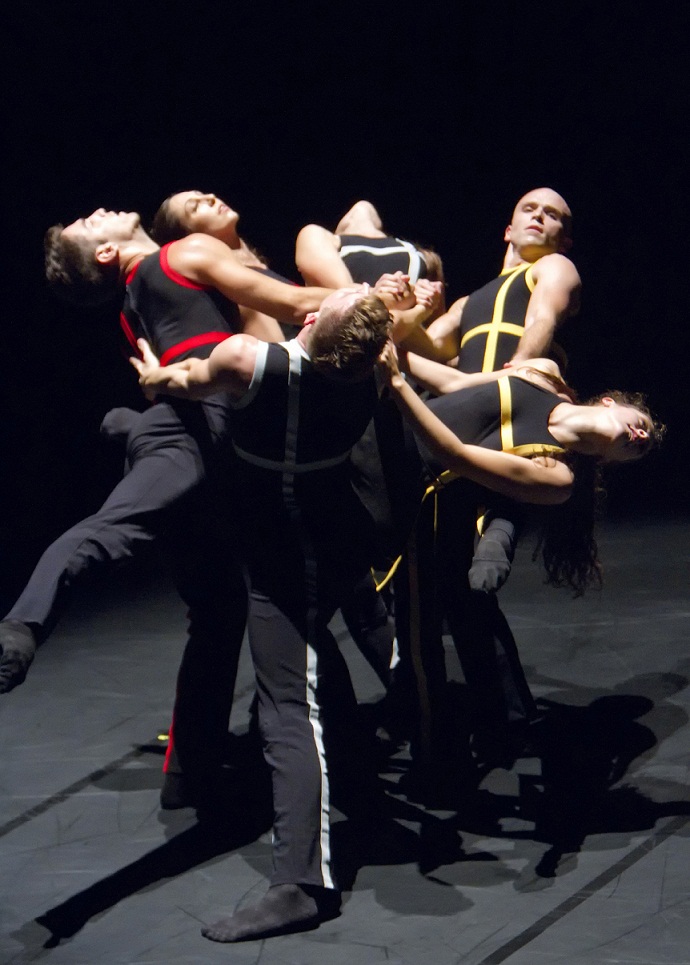
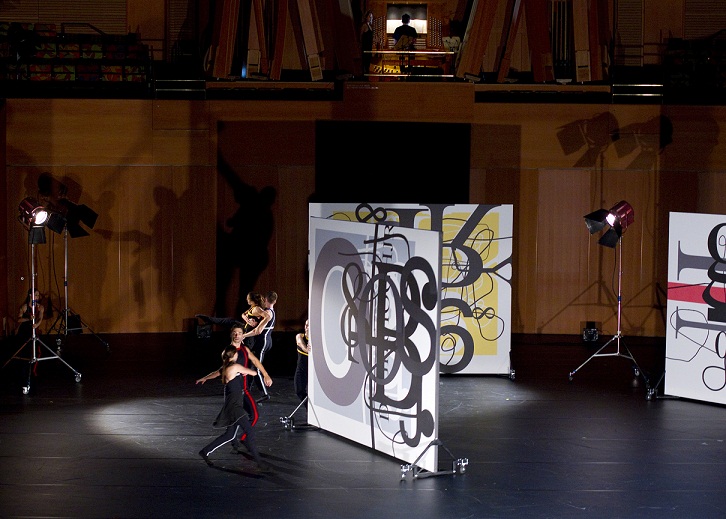
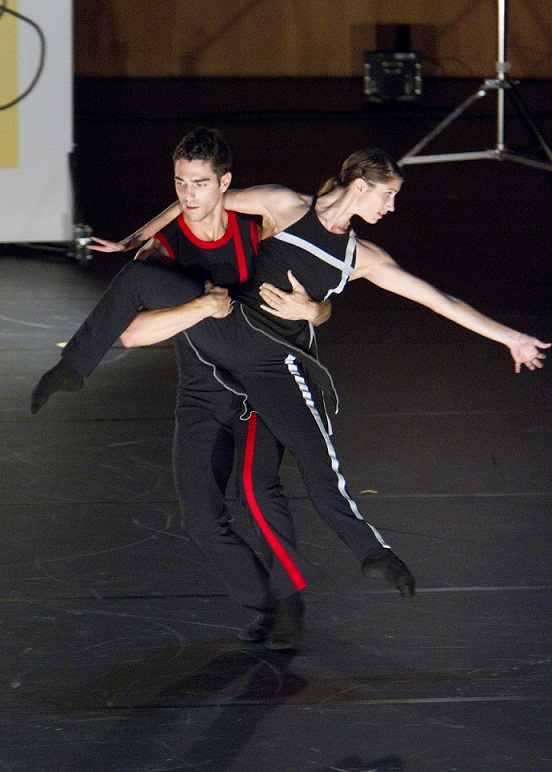
There were three pieces on the program: William Forsythe’s Quintett, from 1993; Merce Cunningham’s Winterbranch, from 1964; and the world premiere of a Millepied dance, Moving Parts (photo above, by Eric Politzer; all photos by Politzer).

By far the most astounding, confounding, spellbinding, brilliant piece on the program was the Cunningham. And for that reason alone L.A. Dance Project proved itself an invaluable asset to its new community. Every critic so far has said the same, so I know I’m not alone in thinking that. But I don’t know how much dance-going Angelenos would agree. During my performance, a woman sitting next to me angrily got up and walked to the back of the theater. Immediately after the dance ended, she cried out, “Thank God!” more than loudly enough for everyone in the entire theater to hear. Many showed their agreement with her as a chorus of loud boos started to emanate throughout the auditorium. This soon was countered by a chorus of cheers. For a moment there was a war going on. I have to say I’ve never ever seen that kind of visceral, dramatic reaction to any dance performance in New York. I’ve never seen that anywhere in response to dance; the only time I’ve ever seen a work of art booed was the Metropolitan Opera’s recent re-interpretation of Tosca.

I mean, part of me was excited that dance could evoke such strong feelings. But part of me was disappointed in the booing Angelenos for not being the least bit open-minded, for not giving the piece even a second’s consideration; for failing to think, “I’m going to go home and look up this Merce Cunningham person on the internet and find out what in the world that was all about.” Cunningham is obviously a master, and I don’t know as much about him as I should. This definitely made me want to know more. It also made me kind of sad that I wasn’t around in the 60s if that kind of art was going on. I wish Alastair Macaulay would have been in L.A. reviewing this for the NY Times. I’d like to know what he would’ve thought – of the piece, and the audience reaction, he loves Cunningham so.

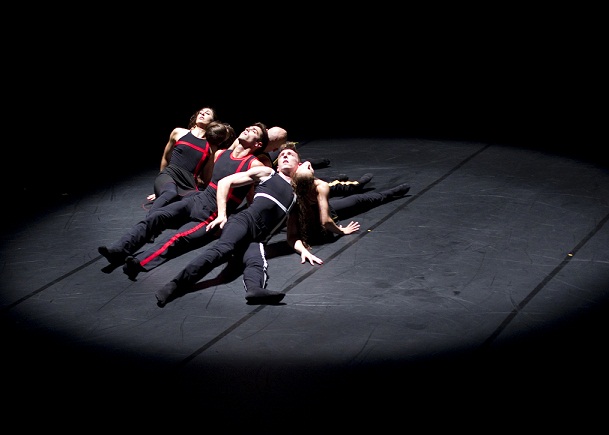
According to program notes, Winterbranch was taken out of the Cunningham repertoire not long after it premiered, so most people probably know nothing about it. It was a collaboration between Cunningham, Robert Rauschenberg, and sound artist La Monte Young. Rauschenberg designed the costumes (all six dancers are in black sweatsuits with smudges of black painted under their eyes) as well as the absolutely brilliant lighting (which was reconstructed for this stage by Beverly Emmons).

At the beginning one dancer (originally Merce himself) slithers across a dark stage carrying a flashlight. Following him, other dancers take the stage, and the piece is basically a meditation on the act of falling and and pulling yourself back up. Dancers sometimes fall quickly and violently, sometimes they fall slowly, as if they’re being crushed by some invisible psychological weight. Sometimes they have difficulty rising; they crawl over each other, they contort their bodies and crab-walk across stage. Meanwhile the stage is dark, except for that brilliant Rauschenberg lighting whereby a light will briefly flash, like a headlight, then fade, then reappear tunnel-like, growing stronger, again like the lights of an approaching car.

About half-way through the sound starts. And, yes, it’s very harsh. Young’s composition is called simply 2 Sounds and those two sounds are: the sound of “ashtrays scraped against a mirror;” and of “pieces of wood rubbed against a Chinese gong.”

Yes, the whole thing was very unsettling. It felt like being caught in headlights, perhaps in a tunnel, or on a dark street, with sound so shrill you couldn’t escape. It felt very industrial, urban, Los Angeles – probably why Millepied thought to bring it here.

Wasn’t Cunningham all about questioning what dance is? Do people really want it to be all about pretty girls doing sexy things? Don’t people want to be challenged? Believe me, the people doing the complaining (mainly about the sound from what I overheard) didn’t look like they’d never been to a rock concert before. And after this ended my eardrums were nowhere near numb.

I think Millepied took a real chance bringing such a piece to a place where perhaps many have only seen classical ballet and popular dance on television. And for that I respect him more than ever.
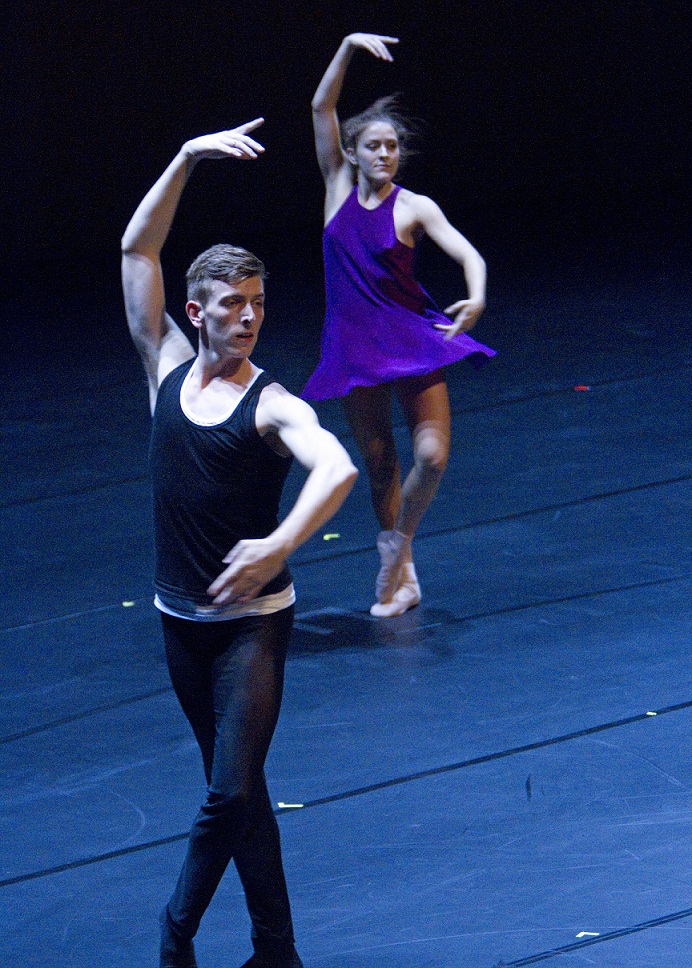
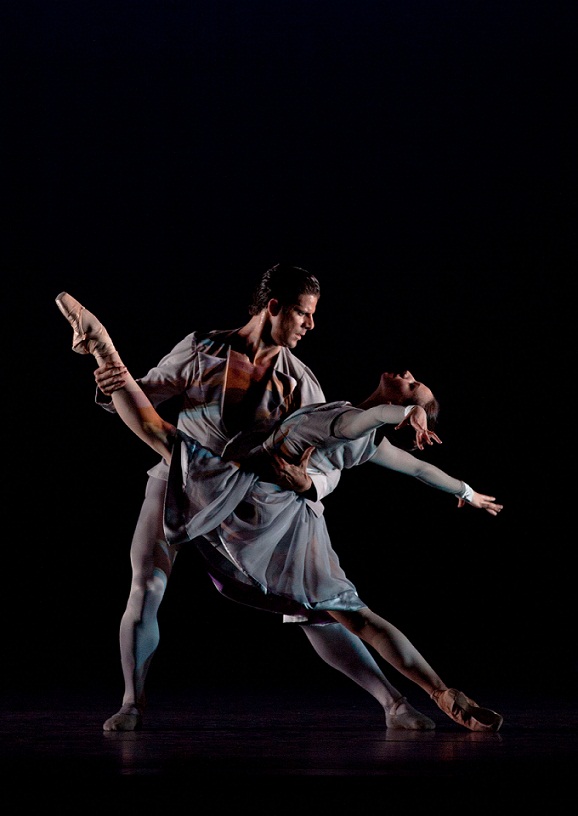
The other two pieces weren’t quite as strong. I think Forsythe’s Quintett (photo above) meant more if you knew about it, about him, and about his wife who died young of ovarian cancer. It’s a waltz but there are five people – three men and two women. So there’s a woman missing. The music is Gavin Bryars’s Jesus’ Blood Never Failed Me Yet, a sweet, folksy choral piece in which the singer keeps repeating that line over and over and over again. The dancing is mainly light and joyful, and the press notes state that he meant it to be a kind of tribute to her. Unfortunately the program notes don’t give out that information, so the audience was unaware.

I kept thinking of Forsythe’s intense, unforgettable installation piece, You Made Me a Monster, another take on the same thing, with a completely different mood, which showed in New York several years ago at the Baryshnikov Arts Center (and which I wrote about here). The dancer Charlie Hodges – my favorite of the six-person dance troupe – reminded me of a similar-looking dancer in Monster. His movement was the most expansive with every motion seemingly filled with intent. And he was the character who seemed to evoke the sole man, the man without the partner. Quintett had much more lightness and fluidity than Monster, and was far more hopeful than tragic, and it nearly made me cry. I’m just not sure if an audience who knew nothing about his wife and the work’s origins, and who’d never seen Monster, would have gotten the same out of it.

Third on was Millepied’s new Moving Parts, a collaboration with the always rousing Nico Muhly, costumers Kate and Laura Mulleavy of Rodarte, and visual artist Christopher Wool. I thought the most interesting parts of this collaboration were Muhly’s music – a bold, rich combination – at times mellifluous, at times slightly off-kilter a la Philip Glass – of violin, clarinet, and organ (played spectacularly on the magnificent, elevated organ at the top of the concert hall) and Wool’s artwork, consisting of three large canvasses bearing a combination of letters and numbers. One or two of the six dancers would push the paintings, on wheels, around the stage, the others dancing around them. The dancers wore basic black unitards; and were paired – male and female – by a same colored stripe running along the top of the costumes. Each painting also bore one of those colors. But this color-coordination didn’t seem to have much meaning.

The dancers were all very good – Hodges, Frances Chiaverini, Julia Eichten, Morgan Lugo, Nathan Makolandra, and Amanda Wells, but I didn’t find the choreography particularly intriguing or the dance as a whole to have much meaning. But I find Millepied to be like that – he’s either on or off. This time he was off, but next time he may well be very on.

Nevertheless, every time this company performs, I will always be there. That Cunningham revival made me trust that Millepied will always bring something significant.

Here are a few more photos of Moving Parts, courtesy of the Music Center.
ABT is Coming to Orange County with Ratmansky’s New FIREBIRD

How excited am I! This Thursday through Sunday, my beloved ABT will be performing at the Segerstrom Center for the Arts in Orange County. They’re premiering Ratmansky’s new Firebird – and none other than SLSG faves Marcelo Gomes and Natalia Osipova are scheduled to star! (David Hallberg and Simone Messmer are co-starring.) The two other dances on the bill are Wheeldon’s Thirteen Diversions (photo above, by Rosalie O’Connor, of Marcelo with Isabella Boylston) and Merce Cunningham’s Duets. The latter two I haven’t seen yet since I missed the company’s City Center season last year.

Read a preview of Firebird by Joseph Carman here.

This will be my first time at Segerstrom / Orange County. If any of my Angeleno or former Angeleno readers would like to give me advice on the best way to get down there from Century City on a weeknight, I’d be most thankful 🙂 I will most definitely report back, particularly on the new Firebird!


DANCE AND ART IN WILLIAMSBURG THIS WEEKEND

My friend Alyssa is an independent arts curator and she has a show this Friday and Saturday night in Williamsburg that may be of interest to my NY-based dance peeps.

It’s a collaboration between artist Sarah Olson and choreographer  Cori Kresge (who is a member of the Merce Cunningham Repertory Understudy Group and of the Merce Cunningham teaching faculty) called “Galvanic Folklore From the Accelerating Universe: an Evening of Dance and Music Inspired by Scientific Theories and Evolutionary Fantasies.” There will be a reception each evening preceding both of the 8:00 performances and Olson’s art exhibition, “A Two Night Stand: the Birds and the Trees,” which is a response to the choreography, will be on display.

Go here for more details.

INTERVIEWS WITH SONYA TAYEH AND BILLY BELL


Okay, here are the interviews I did with Sonya Tayeh and Billy Bell last week at the DeMa Dance Company rehearsal. (Bell and Tayeh are most known for their work on So You Think You Can Dance, if you don’t know – Bell was on the show briefly at the beginning of the season and had to withdraw due to illness, and Tayeh is a choreographer). I spoke with them very quickly, during their tiny lunch break, and I shared the interview with a writer from Dance Spirit magazine. It was hard to get everything down (especially with Billy, who is a fast talker!) and remember the other writer’s questions, etc. (I intend to get a flip camera for the future). Anyway, it’s hard to put this in a question / answer format, so I’m just going to summarize and paraphrase what they each said.

Billy was so sweetly enthusiastic and excited about his life. So much fun to talk to!

First things first – SYTYCD, since that’s how most people know him. He said he definitely plans to return to the show next season. The producers told him he’ll be automatically advanced to the top 100 – so he’ll start out at the Vegas auditions and go from there.

He had to leave the show at the beginning of this season after being diagnosed with Mononucleosis. The problem wasn’t that he was contagious any longer by the time he was diagnosed, but that the illness had significantly enlarged his spleen, and he even had to be hospitalized. Doctors told him if he moved too much with his spleen so enlarged, he could have ruptured it and died. It would likely take a few months for the spleen to return to normal size, they said, which is why he had to leave the show at that point. Now, it’s nearly back to normal though it’s still a slight bit enlarged. “That’s why I wasn’t really dancing full-out,” he said with a little laugh, referring to the rehearsal we’d just seen. Dance Spirit woman and I nearly fell off the couch at this. “If that wasn’t full out, I can’t imagine what you normally look like!” she said. And I agreed. He seemed completely healed to me, to make a massive understatement.

I asked him how he got started in dance. He said he started late, in high school, and he actually began with Hip Hop. His lack of early training didn’t matter for that dance because, unlike ballet for example, the movement isn’t codified. But he soon became interested in Jazz, for which he needed ballet training. He initially learned by mimicking movement, but he soon enrolled in the ballet academy at Ballet Florida and, in order to make up for lost time, really threw himself into it, moving very close to the studio and taking several hours of dance per day, along with his other studies. After a while of ballet, he became interested in tap, and so began training in that too. He’s interested in multiple dance forms but considers his main style to be contemporary ballet.

I asked him who his favorite dancers were or if he had any particular heroes or sources of inspiration. He immediately named Andrea Miller, choreographer and director of Gallim Dance, whom he called his “personal mentor.” He’s worked with her before – when he was 18, his first pro experience — and he performed her work at the Joyce SoHo. He loves her approach to movement and how she teaches: she wants you to experience the movement in your body, he said; it’s not just about the positions, but about how the movement makes you feel. He’s excited to be able to work with her again at Juilliard; she’s to set a piece there soon.

I asked him what other choreographers or companies he’d like to work with. In addition to Gallim, he named William Forsythe and Ohad Naharin’s Batsheva. He finds in this “dance theater” an outer simplicity and yet so much complexity behind it. “What’s going on inside you – (with Gallim and Naharin’s Gaga training) – is simple and yet so complex.” He would also love to do some Paul Taylor, Merce Cunningham, Jose Limon, Jerome Robbins, to name a few.

But his biggest passion: choreographing. He wants to dance while he’s young but eventually his goal is to create dances. He said with a laugh that he loves “destroying ballet” – kind of bending those rods ballet dancers seem to hold up their spines and freeing them up, allowing them to go back and forth between different kinds of movement. He loves being able to work with dancers and bring certain things out in them. He strives to move people emotionally, to move the audience, he loves having that power. He choreographed his first piece — 15 minutes long — at Dreyfoos, his high school back in Florida. It was performed there at a show in January.

But that’s in the future. In the meantime, he’s finishing up at Juilliard (he’s about halfway through his BFA; has another couple years to go), he has the SYTYCD Vegas auditions coming up next season, he’s participating in a choreographic competition that travels throughout the States, and he just became a principal dancer at DeMa this month. Despina Simegiatos, one of the artistic directors of DeMa, says back when she was looking for strong male dancers for her fledgling company, she found him on YouTube, through some videos he’d posted, and really fell for him. He hadn’t yet gone on SYTYCD.

He’s excited about working with DeMa because it’s a company that seeks to fuse the creative with the commercial. Companies are where artists can focus on their creative work, but commercial work is what pays the bills. In an ideal world these would be fused, but in the U.S. they rarely are, he said. He seeks to be able to transition back and forth between the two. He’s excited about working with Sonya because he was just about to work with her before he had to leave the show. A couple of other Juilliard students are also dancing with DeMa, which makes the company feel homey to him.

He sweetly said he considers himself the luckiest person in the world that he gets to do what he loves and get paid for it.

Sonya Tayeh, like her work, was very intriguing and I wish I would have had more time with her but she was so busy creating this piece. This is her first time working with DeMa. As I mentioned earlier, her dance, titled When the Love Enters, the Light Shines, is six minutes long and is set to Bjork’s Unison.

When asked a bit about this piece, she said it’s about finding moments where you look at your life and you’re just in love with it. She actually found making this dance a bit challenging, she said. She’s really in love right now, very comfortable with herself and unafraid, and usually her choreography is about fighting. Lately she’s been so peaceful. But it’s nice to exhale, she said with a laugh.

When asked what she wants of her dancers, she said all she asks is that they listen to her instructions but that they try to find the emotion in themselves, to embody it in the movement, not just go through movements she’s creating. She has a very disciplined way of working and seeks to embellish movement as much as possible. She likes to have fast, abrupt stops and starts; she likes elements of surprise. She’s high-strung, she said with a little laugh – she has wild hair, wears crazy clothes, is really out there. Her choreography echoes that.

I asked her what inspires her, how she works, and what her goals are. She said it’s hard to talk about inspiration. She’ll have an idea in her head, but not the movement. She needs to get to the studio to see the dancers in order to create the movement. She begins with a mood in her head. She doesn’t watch much of others’ choreography because she’s afraid of duplicating them. Instead she watches a lot of documentaries of dancers and dance makers for inspiration. She watches cartoons, a lot of animation, and has a rather fantastical mind. Her focus is on making a mark in the world with movement, with her choreography.

Here are some more pictures, by Kim Max, of Tayeh rehearsing with the DeMa dancers (the picture at the top of the post is of Tayeh choreographing on Bell).


UPCOMING: BURN THE FLOOR, TAKE DANCE, PASCAL RIOULT IN THE PARK, AND MERCE


A few things to do this week and next if you’re suffering post-ballet season boredom:

This Thursday evening, TAKE Dance Company, a small modern company I like, founded by former Paul Taylor dancer Takehiro Ueyama, opens at Dance Theater Workshop in Chelsea. I’ve seen some of the works on the program before (and saw parts of Footsteps, which they’re premiering, in rehearsal). I’ve always found his work mesmerizing and I’m excited to see Footsteps in full. They show through August 2. Go here for details and to see a video; also visit Oberon who has been covering the company’s rehearsals.

This Friday night, Rioult, Pascal Rioult’s wonderful little modern dance company, is performing at Central Park’s Summerstage along with Germaul Barnes’s Viewsic Expressions. Two of my favorite dances of Rioult’s, his sexy version of Les Noces and his gorgeous Views of the Fleeting World, are on the program.

This weekend, Saturday and Sunday evenings and Sunday afternoon, Merce Cunningham Dance Company are to perform a collection of Cunningham’s work, past and present, in Rockefeller Park as part of the River to River Festival. Those performances will of course be all the more momentous (and heartbreaking) in light of the choreographer’s recent death.


Finally, Burn the Floor, the ballroom show by Jason Gilkison (of So You Think You Can Dance fame, and a former Australian ballroom champion) officially opens on Broadway next Tuesday. It’s in previews right now. I saw it last night and loved it (review coming soon). It’s great fun; makes you want to dance home 🙂 I’m tempted to say it’s worth it just to see Peta Murgatroyd — WHOA. She’s a ballerina-turned Latin dancer and she just combines the best of everything… Try to go to a performance prior to August 16th so you can see Maks Chmerkovskiy and Karina Smirnoff in the cast as well. Maks is an absolute hoot to watch live!


MERCE CUNNINGHAM HAS DIED


My friend Deborah just alerted me to this horrible news. One of the world’s great pioneer choreographers has just died (last night; the news was released this morning). We all knew this was coming at some point; he was 90 (and still choreographing, often from his bed). But I think many thought he was one of those who’d make it to 100 or past. This on the heels of news of Pina Bausch is devastating to the dance world. So, his recent program at BAM is his last…

Cunningham’s work was groundbreaking in its use of technology, its questioning whether dance needs music (he collaborated with music pioneer John Cage and his works were often danced to silence or to sound that the dancers heard for the first time during the first performance), its questioning of what “performance” is (he would often use chance encounters), and in creating an original (and sometimes controversial) movement language.

But others, like NY Times chief critic Alastair Macaulay, knew his work much better than I (Macaulay was a great admirer of Cunningham, as was Mikhail Baryshnikov), so I’ll await his full Times obituary.

How awful.


MARTHA GRAHAM’S CLYTEMNESTRA


Last night Martha Graham Dance Company, the oldest dance company in the U.S. — and one of the most esteemed — opened at Skirball Center at NYU. I love opening nights because they’re so perfect for people watching. Practically all the critics were there as well as several bloggers (Philip has some beautiful pictures), as well as many dancers, from Merce Cunningham (two of whom I met through gracious Apollinaire Scherr!), Jose Limon, and Paul Taylor. And Damian Woetzel from NYCB was there. Happily, I nearly smacked right into the mesmerizing Jonathan Frederickson of Limon a couple of times in the lobby — at least I think it was him — (and, like most dancers and actors, he is far more petite in person than onstage!). And I spotted Michael Apuzzo dashing upstairs to the balcony at the end of the intermission. If you didn’t see it, he actually commented here — how sweet! — but I was still far too shy to say hello, though my friend Alyssa told me I should have…

Continue reading “MARTHA GRAHAM’S CLYTEMNESTRA”

MERCE AT 90


So, this weekend marked choreographer Merce Cunningham‘s 90th birthday, with celebrations and performances of his latest work — Nearly Ninety at BAM. Unfortunately I was unable to go — and Apollinaire reminds me just how much I missed — but I decided to compile a list of some reviews since this was such a momentous occasion (many consider Cunningham to be the greatest living choreographer, or the greatest living American choreographer; some consider him to be the last left of the greats):

Macaulay goes even farther and calls Cunningham “the greatest living artist since the death of Samuel Beckett”;

Tobi Tobias hails the choreographer, but critiques Nearly Ninety as well as the decision to let famed dancer Holley Farmer go;

Leigh Witchel describes Nearly Ninety as “dreamlike” in the NY Post;

Blogger Evan Namerow of Dancing Perfectly Free talks about the role of chance operations in NN;

Aynsley Vandenbrouke says NN is Merce’s “ode to his dancers”;

Jordan Hruska calls NN “Bionic Theater” in the Times Magazine’s blog;

New York Magazine’s Daily Intel blog blurbs mainly on the wheelchair-bound curtain call, etc.;

WWDLifestyle has a short list of some celebs who attended the post-performance party on Thursday night;

and here’s a YouTube performance clip from ArtRavels;

And, here are a couple of pre-performance overviews, from NYTimes and NY Magazine.

Apparently, NN will now travel to Madrid.

UPDATE: Also, here is Apollinaire Scherr’s review in the Financial Times. (I’m very happy to see, by the way, that she is now the dance critic for FT!) And here are more of her thoughts on the program and the Cunningham dancers on her Foot in Mouth blog.

And Eva Yaa Asantewaa in Dance Magazine.

Please let me know if I missed anyone.

BARYSHNIKOV TALK GOOD BUT I AM PISSED AT BARNES & NOBLE

P3101957

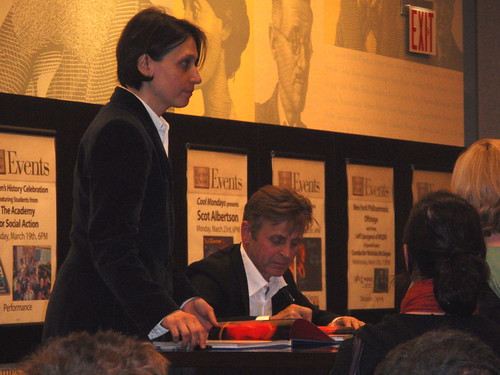
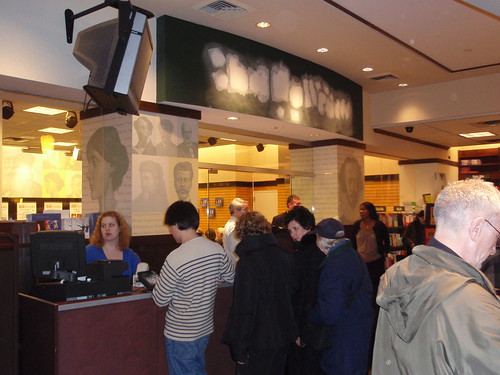
Last night at Barnes & Noble, Lincoln Square, Mikhail Baryshnikov talked briefly with New Yorker dance critic Joan Acocella about his new book of photos of the Merce Cunningham Dance Company, Merce My Way. (I love the title, by the way).

The talk was brief (about half an hour) but pretty good. But, honestly, I had a very hard time getting over my anger at Barnes & Noble. I arrived early in order to get a good seat up front, knowing (hoping at least) it would be crowded. But on my way in, I was stopped by a B&N employee. She said they were giving “preference” to people who purchased his book, which cost $36. She pointed me to the cash register, set up, conveniently, right next to the entrance.

I was so mad. There was such a crowd already, it was pretty clear “preference” meant that unless you were buying a book, you weren’t getting in. And in this economy, $40 is a lot to spend when you’re not expecting it. Honestly, I found it a really sleazy, unfair corporate practice to take advantage of his fame like that to sell books. A lot of people must have come from a ways away to see him, and you’re not really going to walk away if you’ve traveled. People were standing around looking like they didn’t know what to do, hesitantly withdrawing their wallets and picking up a book. “We’re a couple, can we get in on one book?” I heard someone ask the people at the door.

P3101951

I mean, this was advertised as a regular talk / author reading event, which are always free. Nothing in the adverts (at least the ones I saw) said anything about having to purchase a book. As Ron Hogan (of the pub / book blogs Galley Cat and Beatrice) tweeted me (and damn, was I a mad tweeter last night), “seriously. if bookstores want to pull that crap, let them charge $40 IN ADVANCE and include the book w/admission.”

Just as I was getting mad about missing Bill T. Jones (who was giving a talk downtown) for this b.s., I saw my friend Monica Wellington (who I met through Philip). They’d agreed to let her buy the Joan Acocella book instead, which was less expensive. She told them at the door we were together, so they let me in. Thank you thank you, Monica!!

Anyway, the talk was pretty good, albeit short (about half an hour). I’d never heard him speak before, other than giving a brief sound byte on a pre-recorded interview. He is, as expected, charming and smart, though he talks very slowly, thinks hard about his words as if he’s always too far ahead of himself, struggles with English, and digresses frequently. None of which were a big deal, and his digressions often led to entertaining little tidbits.

Continue reading “BARYSHNIKOV TALK GOOD BUT I AM PISSED AT BARNES & NOBLE”

BARYSHNIKOV, JOAN ACOCELLA, BILL T. JONES

P3081949

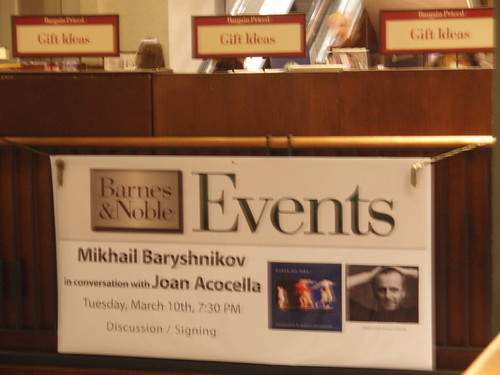
Please excuse the blurry photo; I took it on the escalator last night at Barnes and Noble, where I went after Paul Taylor (review soon!) Thankfully I decided to visit the bookstore; I hadn’t known about this, even though I’m on B&N’s events mailing list…

So, this Tuesday, March 10th, Joan Acocella (New Yorker dance critic) will be in conversation with Mikhail Baryshnikov at Barnes & Noble, Lincoln Square (66th and Broadway) to discuss Baryshnikov’s new book of photos of the Merce Cunningham Dance Company, Merce My Way.


But same night same time, Bill T. Jones is giving a talk at Skirball. Now what?