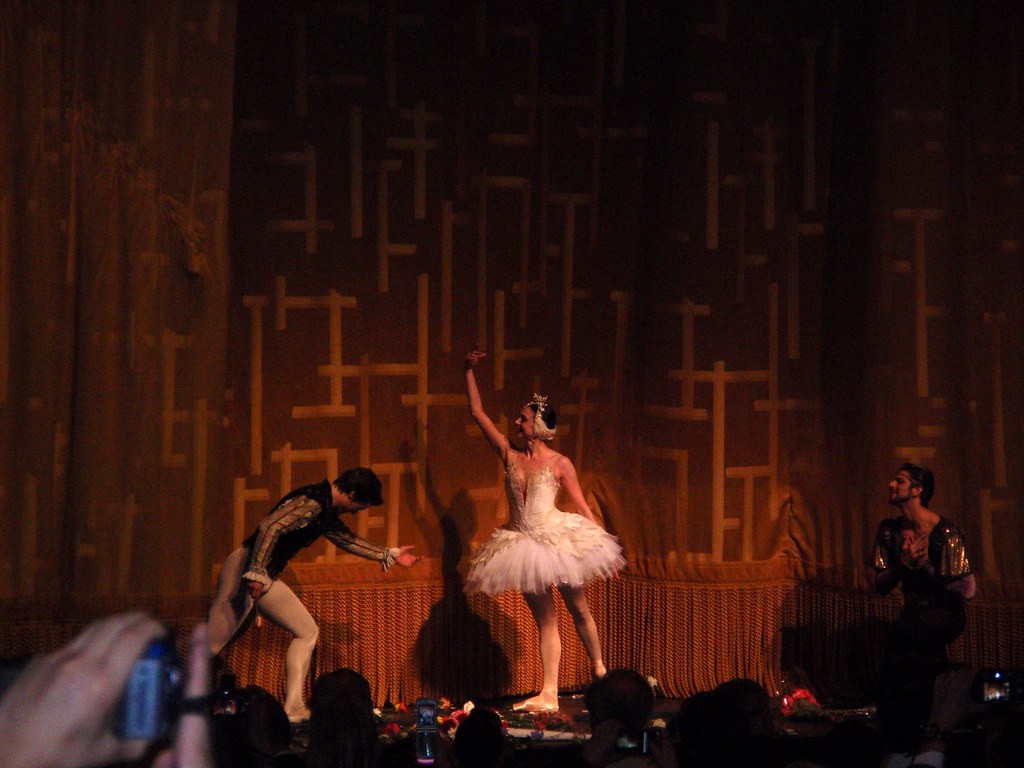
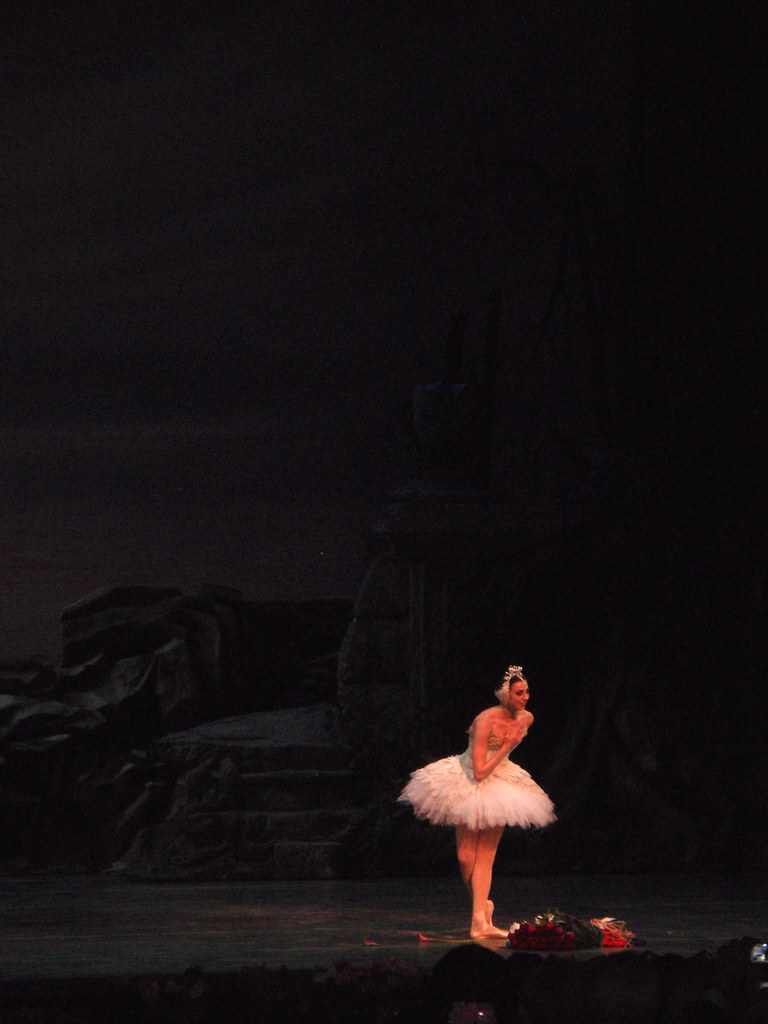
Excited for ABT’s Nutcracker at Segerstrom!


I was so excited when it was announced a while back that my favorite ballet company, American Ballet Theater, will be performing its Nutcracker season at the Segerstrom Center for the Arts, in Orange County. I’ve so missed ABT since moving out of NY, and now I’ll get them for a whole two weeks! Alexei Ratmansky’s version of the classic is one of the best. And of course ABT has the greatest dancers around, in my admittedly very biased opinion 🙂

My faves, Marcelo Gomes and Veronika Part, will be opening the season. I’m also excited to see Misty Copeland in the lead, and Hee Seo.

If you’re in O.C., I hope to see you there!

Below is the just-announced casting:

Thursday, December 10, 7:30 p.m.
Veronika Part
Marcelo Gomes

Friday, December 11, 7:30 p.m.
Gillian Murphy
James Whiteside

Saturday, December 12, 2 p.m.
Isabella Boylston
Alban Lendorf

Saturday, December 12, 7:30 p.m.
Veronika Part
Marcelo Gomes

Sunday, December 13, 1 p.m.
Stella Abrera
Alexandre Hammoudi

Sunday, December 13, 6:30 p.m.
Gillian Murphy
James Whiteside

Tuesday, December 15, 7:30 p.m.
Hee Seo
Cory Stearns

Wednesday, December 16, 7:30 p.m.
Misty Copeland
Herman Cornejo

Thursday, December 17, 7:30 p.m.
Isabella Boylston
Alban Lendorf

Friday, December 18, 7:30 p.m.
Sarah Lane
Joseph Gorak

Saturday, December 19, 2 p.m.
Stella Abrera
Alexandre Hammoudi

Saturday, December 19, 7:30 p.m.
Misty Copeland
Herman Cornejo

Sunday, December 20, 1 p.m.
Hee Seo
Cory Stearns

Sunday, December 20, 6:30 p.m.
Sarah Lane
Joseph Gorak

Photo of Hee Seo and Cory Stearns by Gene Schiavone, courtesy of Segerstrom Center for the Arts.

Misty Copeland and FIREBIRD Excerpts Live-Streamed from the Guggenheim


For Californians (like me) who missed Misty Copeland’s Firebird at Segerstrom last month, or for New Yorkers and others hoping to catch a pre-Met season glimpse, she’ll be performing excerpts of it at the Guggenheim as part of the museum’s Works and Process event next Sunday and Monday nights, April 29th and 30th. The event is sold out but will be live-streamed on the Guggenheim’s ustream channel, so everyone everywhere can watch. It begins at 7:30 pm ET, so 4:30 PST, and they usually last an hour and a half. The Guggenheim usually does a good job with these live-streams and if you sign up for a ustream account, you can participate in the live chat. Otherwise, they usually keep the videos posted for a while so you can watch at your leisure.

It’s not just Misty performing though; it’s a celebration of ABT’s upcoming Met season. So you’ll see others perform excerpts of the upcoming ballets as well, such as Cory Stearns and Hee Seo in Onegin, Sascha Radetsky in Swan Lake, Craig Salstein and Kristi Boone and others in The Dream, and ABT Studio Company members will perform the Swan Lake Czardas. Also, according to the press release, Roman Zhurbin will perform a special character medley. Hmmm, sounds very intriguing!

Panelists include Copeland, Zhurbin, Salstein, and Reid Anderson, director of the Stuttgart Ballet, and the moderator will be John Meehan, professor of dance at Vassar.

You can also follow on Twitter @WorksandProcess and by hashtag #WPLive. But I highly recommend the live-streaming if you can!

Above photo of Misty Copeland with Herman Cornejo by Gene Schiavone, taken from LA Times Culture Monster.


Misty Copeland on Tavis Smiley


Apropos of our recent discussion on race and ballet, ABT’s Misty Copeland was recently on the Tavis Smiley show. She talks about race, ballet, elitism, her training, her recent appearance onstage with Prince, the immense difficulty of ballet, and of course, Black Swan. She’s very well spoken. Go Misty!

Also, speaking of Black Swan, here’s an essay by former NYCB dancer Toni Bentley in the Daily Beast. Bentley has more guts than anyone else in the industry, that’s for damn sure. Go Toni!

Above photo of Copeland taken from Martini Pink.

Morphoses at the Guggenheim

Over the weekend, Morphoses had its first NYC program sans former artistic director Christopher Wheeldon. They presented two pieces, at the Guggenheim, as part of the museum’s Works and Process program. They commissioned two choreographers – American Jessica Lang and Swedish dancemaker Pontus Lidberg- to each make a different dance set to a score by Pulitzer Prize-winning composer David Lang.

(I wrote about seeing an early rehearsal here).

Using most of the same dancers (most of whom are from American Ballet Theater now, instead of New York City Ballet, as they were when Wheeldon was A.D.), the two came up with vastly different dances, both very engaging.

Lang’s (top four photos – all photos by Richard Termine) was more a study of gravity, as she explained (hence Misty Copeland here “climbing the wall”), and of contrasts between the masculine and feminine (indicated, to her, in the music by percussion and chimes).

Interestingly Lidberg heard the music differently and used the percussion section first, melting into the chime section, so apparently the music had no prearranged order. His dance was more lyrical, with the visual theme of a night-blooming flower.

I love that Morphoses now seems to be using a lot of ABT dancers – all soloists or standout corps members — Misty Copeland and Kristi Boone, Eric Tamm, Blaine Hoven, and Isaac Stappas – because I really connect with them. Other dancers included Melissa Barak, Laura Feig, Gabrielle Lamb, Rachel Sherak, Andrea Spiridonakos, and Matthew Prescott. And Lang mentioned that she also used her husband, modern dancer Kanji Segawa (the man doing the floor work on the right-hand side in the photo third from the top), in her piece, which worked well since the aesthetic of modern dance is more “grounded” than ballet.

To hear the music and see some of the dance, here is an excellent video made by the Guggenheim:

ALICIA ALONSO 90TH BIRTHDAY CELEBRATION AT ABT


Last night was a very special night at ABT; the company put on a special show in honor of Alicia Alonso, the former ABT ballerina from Cuba who’s credited with bringing ballet to Latin America and bringing Latin American stars to the world, who turned 90 years old this year.


The evening began with a short film including interviews with Alonso reflecting on her career and clips of her dancing. The most amazing such clip was at the end of her dancing, I think La Sylphide, and she was doing tiny but incredibly, insanely fast-footed passees back and forth and back and forth; she was going so fast she looked like a hummingbird.  The audience went wild.

Then Kevin McKenzie came out, gave a brief intro, and said, “This evening’s for you,” while motioning up to the parterre. Ms. Alonso slowly rose – she was in the center of the parterre, and everyone rose with her, giving her a long standing ovation. She looked really beautiful in a long blue sparkly gown with her signature full, flowing headscarf  (this one blue and sparkling, to match her gown). Amazing how she seemed to acknowledge everyone in the room as she looked all around with a serene smile on her face. Especially since she has supposedly been nearly blind for the past 20 years and likely couldn’t see any of us. Anna Deavere Smith has defined Presence as having the ability to make it seem to each and every audience member like you’re singling him/her out from the crowd, looking right at them, dancing right for them. So clearly Ms. Alonso has that!

Then, the show began. It was Don Quixote, with a different couple playing the lead in each Act, most of them the company’s principal dancers from Latin America. First Act couple was Marcelo Gomes and Paloma Herrera (from Brazil and Argentina respectively), second was Herman Cornejo (Argentina) and Xiomara Reyes (Cuba), and third was Jose Carreno (Cuba) dancing with the beyond wondrous Natalia Osipova (from Russia, the only dancer playing one of the leads who’s not from Latin America).

It was very fitting that Carreno danced the third Act since he’s the only dancer still in the company who Alonso directly trained (though her daughter, Laura, who continues to run the school, which travels all over Latin America, has had a hand in training the rest).

Carreno is 42 now and I’m always so scared every time I see him this season that this is the last performance of whatever I’m seeing that I’ll watch him dance. I hope this isn’t the last Don Quixote because he’s so perfect for Basilio. More on his and Natalia’s full-length Don Quixote (on Tuesday night) to come, but suffice it to say for now, he is the absolute king of turns, the way he holds onto those last few pirouettes in a series of multiple turns. Sometimes he’ll just stand on one leg at the end and hold the balance forever. And she wins the award for most insane dance genius. I can’t even begin to go into everything she does that makes the crowd go nuts (the sky-high jumps that make it seem she must have springs in her shoes!, the fouettes with the bizillions of multiple pirouettes thrown in, the passees – and high passees at that –  that she does at the speed of frigging light), and she’s the perfect playful, flirty Kitri to boot. Before seeing her dance this role I was going to complain that no one has the charisma and ability of Gelsey Kirkland (whom I’ve only seen on video) but I can’t say that anymore.

Herman Cornejo is of course king of jumps, and his jetes in the second act were absolutely breathtaking (people were talking about them all intermission). And Marcelo is the king of drama – I’ve said before and will say again that he could have a career in Hollywood after his dance career ends — he’s always wholly in the character (ditto for Veronika Part, who stole the stage as Mercedes, the street dancer, and was absolutely beautiful as the Queen of the Dryads), and he’s larger than life with flawless technique to boot.

Other non-main-character standouts were Daniil Simkin as the gypsy (he arched so far back in his jumps he made himself into a perfect ball, and his ability to do several of those barrel turns with one and half rotations all in a row always draws the “OOOOOOOOOHHHH”s from the crowd), and Misty Copeland was full of athletic prowess, as usual. She also cracked me up when she and Marcelo were onstage together at the beginning flirting naughtily right in front of Kitri. She is another very actorly type. I also thought Luciana Paris did well as the female part of the gypsy couple. Even in light of Daniil’s audience wowing theatrics, she held her own with some beautiful full back arches and lovely styling with her arms and hands.

The evening came to a perfect end as, at the end of the last Natalia / Jose curtain call, the curtains closed, then opened to reveal the whole stage, and Jose walking Alicia Alonso out from the wings. Judging by the number of heads turning around to the parterre, where she’d been sitting, I think the audience was hopeful that she’d come out onstage but worried she might not, so everyone stayed waiting, and was very happy when she did. Ovation lasted for quite a while; I don’t think anyone wanted to leave, but the company was having a party for her afterward (which I didn’t go to but a friend did – I’m waiting for the report) so had to kind of limit the length of curtain calls. Very very special evening!

Top image from Voice of Dance; two middle images from Cuba Absolutely.

Here’s a video of Jose dancing DQ with Gillian Murphy  – the ones of him dancing with Paloma have disabled embedding, and horribly, the video from Born to Be Wild with Alicia talking about him has been taken off of YouTube 🙁

ABT OPENING NIGHT GALA FALL 2009: THREE PREMIERES IN BLACK AND WHITE, AND WOOD


Photo of Veronika Part in The Dying Swan, taken from Vogue; photos of the three premieres coming as soon as I receive them.

After ABT‘s fall season opening night gala performance last night, the really wonderful James Wolcott and Laura Jacobs took friend Siobhan and me out for dinner at Shun Lee (I’d never been there — but wow, excellent excellent food!) and when Laura asked me if I was going to write about the performance, I kind of rolled my eyes and said, “I’ll try!” We all agreed that dance is absolutely the hardest art form to review, especially on seeing a dance for the first time. Let alone THREE dances seen for the first time. With visual art you can stand there all day and examine at it, with music you have recordings and scores, film critics generally see a movie several times before writing a review. With dance you have one chance — often one split mili-second — to remember a half an hour or so of movement, images, patterns, structure, costumes, music, lighting — everything. It’s impossible. Since starting this blog I have so much more respect for dance critics.

Anyway, there were three premieres last night: Seven Sonatas by Alexei Ratmansky, One of Three by Aszure Barton, and Everything Doesn’t Happen at Once by Benjamin Millepied. Also on the bill was a performance by Veronika Part of Fokine’s The Dying Swan. ABT performed, for the first time, in Lincoln Center’s Avery Fisher Hall, a concert hall not accustomed to housing dance performances. (ABT usually holds its fall season in City Center, but changed venues because of City Center’s renovation plans.)

I’m going to be seeing each premiere a couple more times this season and prefer to write after I’ve seen each more than once. But since the season is so short (it ends October 10, this Saturday), I’ll write something up front. These are only first impressions though, and I’ve found I see so many more things with repeated viewings.

Honestly, everything kind of blended together for me. Part of this was because of the sparseness of the Avery Fisher stage — there were no sets, no wings, no curtains — so dancers warmed up onstage before us, giving each piece a kind of Cabaret-like feel; and part of it was because costumes for each piece were all black and white. I remember lots of black, lots of white and the hardwood of that stage.

1) Ratmansky’s Seven Sonatas was performed to Domenico Scarlatti music by three male-female couples: David Hallberg and Julie Kent, Herman Cornejo and Xiomara Reyes, and Gennadi Saveliev and Stella Abrera. Costumes were all white — flowing dresses for the women, classical tights and 18th-Century tops for the men. The movement was a combination of classical and modern and, though the ballet was generally story-less, each couple seemed to have a little narrative: Cornejo and Reyes were the young, playful couple, Herman full of high jumps with many beats of the feet that really wowed the crowd and Xiomara dizzying rapid multiple turns. At one point Herman did this crazy turn in the air, landed on his back, and caught her. Crowd went wild.

Abrera and Saveliev seemed to be a more mature couple, perhaps in mourning. It seemed Abrera was a woman, possibly a mother, who’d lost a child or something — Saveliev seemed to be trying to console her and keep her from self-destructing. It seemed like she kept trying to break free of him and reach out to some invisible thing.

I’m not sure what Hallberg and Kent were meant to represent except maybe a modern couple — they seemed to have the most modern movement. David appeared to be trapped in a box and he kept pushing out; he had a lot of quick movement with fast stops in different directions and a lot of it in parallel — not turned-out — position. Julie had a lot of sharp, staccato movement. They could’ve also been a courting couple: at one point, David was on one knee and he invited Julie to run at him and jump on him. When she did, he took her into this lovely lift. It’s sweet and many in the audience lightly laughed.

The ballet was broken into duets and solos and bookended by two ensemble movements, the first pretty and lyrical, the latter more chaotic as they all perform their very different movement motifs at once, some trying on others’ movement styles — everyone does the staccato arm patterns for a while, etc. At the end, the women lay on the floor and the men wrapped their bodies over them.

One other thing: our David Hallberg is sporting longish hair these days 🙂 I think it looks good, and fun for a change! Funny thing is, he’s so beautiful and glamorous, I tend to get jealous if him, even though he’s a man… which I guess should be kind of odd…

2) Barton’s One of Three was set to Maurice Ravel’s Violin Sonata in G and danced by a whole slew of tuxedoed men, and three women — Gillian Murphy, Misty Copeland, and Paloma Herrera. Why is it that women choreographers tend to use men so much more! (And female dance-writers tend to focus on male dancers 🙂 — is this feminist?)

Anyway, the piece begins with Cory Stearns walking out dressed in a tux and black jazz shoes. He does a little solo and his movements are all modern, angular, which contrasted in an intriguing way with the tux. I don’t know if it was his being a bit weirded out by the curtainless stage (which forced him to walk out in the dark with all of us watching) or whether it was part of the character, but he seemed to have this loopy smile in the beginning, that was really rather endearing. I chatted with a friend during intermission and she felt just the same.

Anyway, soon Cory was joined by more tuxedoed men, and then by Gillian, who came prancing out in a long white cocktail gown with her radiant red hair tied back into a sleek twist. The men would kind of veer toward her, sideways, their bodies leading their heads in, to me, a rather amusing way. Gillian’s character was very haughty, very glam and posh and she acted like she was ordering the men around with her little finger. The men often seemed led by their bodies, moving first with the back, or at times one leg would take a step, the rest of the body reluctant to follow (I noticed that most with Jared Matthews, who I thought was dancing at his best last night). I found this a very interesting movement motif.

Misty Copeland was the lead character in the second movement. She wore a short black and white dress, her costume and character more flirty and wild. But same thing — she seemed to kind of taunt her tuxedoed men.

And third movement was led by Paloma, wearing a black lacey top and black pants. She smiled a lot more than Misty and Gillian, but she seemed to move in a slinky, sexually-empowered way, like a tanguera.

Now that I think about it, though there were many more men here, the women seemed to have all the power. Fun!

3) Next on was Part’s Dying Swan, which was really poignant, as I knew it would be. It’s a very short piece, but it’s funny how the ballerina can really do it however she wants to; I just saw Diana Vishneva perform this in the Fall For Dance Festival and her Dying Swan was very different. Whereas Diana spent most of the time on her toes, bourreeing, Veronika spent more time on the floor, one leg stretched out before her (like in above picture), then rising again to her toes for one more breath. Diana’s swan seemed to flutter about more, like she was fighting death, she lay down only at the very end. Veronika kept holding her arms up in front of her, her wrists bent and her hands cupped over, as if to foreshadow what would happen to her body. In general, Veronika’s swan accepted and approached death more gracefully or willingly, but Diana’s, with that broad wingspan, at times really looked strikingly birdlike. I don’t know if I can say I liked one interpretation better than the other — both were breathtaking and both very poignant.

Did anyone else see both swans?

4) And the program ended with Millepied’s Everything Doesn’t Happen at Once, set to David Lang music that was at times mellifluous and at times cacophonous or eerie. He used a large group of dancers but Marcelo Gomes, Isabella Boylston and Daniil Simkin had the main parts and so stood out the most (and Kristi Boone shone in a smaller role).

There was a lot going on here — both in the music and in the dance, and I felt that, unlike with Millepied’s earlier piece for ABT — From Here on Out — composed to music by Nico Muhly (who was in the audience) — in this one the movement kept up, didn’t let the music outshine it. The stage is set up to resemble — at least to me — a pool. Dancers would gather around it and watch the people dancing in the lit-up center. At the beginning there seemed to be a swimming motif, with large, rounded arm movements resembling breaststrokes. Movement is also evocative of birds as well though, and some of the same lifts were present as in Millepied’s recent work for NYCB, where the women are perched on the men’s shoulders, their arms outstretched sideways.

In the middle part, Marcelo and Isabella have a rather haunting solo. The ballet is generally story-less but as far as I could make out any narrative, it appeared she was sort of struggling against him. He seemed very careful and gentle with her (in sharp contrast to a later, more hostile duet he has with the super-strong Kristi Boone, who seemed to be either Isabella’s competitor or her double), but she — Isabella — nevertheless kept trying to push away from Marcelo as he held her. The duet ends with them walking toward the back of the stage holding hands, connected, but her body is lunging as far as possible away from his. A rather warped relationship.

Then there’s a rather amusing section where bravura dancer Daniil Simkin is struggling with a bunch of women. He tries to break free of them but then he keeps throwing himself into their arms, making them catch him in these rather breathtaking group lifts — one of them ending in a perfect split in the air. And he has a bunch of crazy multiple pirouettes that had the audience audibly gasping. It all went with his character though, who seemed rather crazed, like he may have just escaped from an asylum or something. I kept wondering who else was ever going to be able to perform that role…

I didn’t go to the gala party but in addition to Muhly, I saw Alessandra Ferri in the audience, one of the Billy Elliots, and apparently Natalie Portman was there.

Anyway, I’ll write more at the end of the season, when I’ve seen these new dances a few more times. Here is Haglund’s review.

TWO SYLVIAS: ROBERTO BOLLE & MICHELE WILES AND DIANA VISHNEVA & ETHAN STIEFEL

Yesterday I had one of those crazed balletomane days where I went to both matinee and evening performances of Sylvia at ABT. Cast for matinee was the esteemed Diana Vishneva as Sylvia, forever-a-heartthrob Ethan Stiefel as Aminta, the shepherd in love with her, Jared Matthews as Orion, the evil hunter, and Craig Salstein as Eros, or Cupid.


Second cast, which, with the exception of Vishneva was overall far better, was Michele Wiles in the lead, Roberto Bolle as Aminta, Cory Stearns as Orion, and Daniil Simkin as Eros. In the second cast, Kristi Boone also stood out as Diana, the goddess of the hunt and of chastity, and both goats Misty Copeland and Craig Salstein; Carlos Lopez in the first cast was a good goat (feel a bit funny saying that). Both Terpsichores I saw really magically devoured the stage quite well: Simone Messmer and Veronika Part.


Anyway, this is my first time seeing a full-length Frederick Ashton ballet and now I’m curious to see more. It reminded me a bit of Midsummer Night’s Dream, with the gods and nymphs and the love unrequited and then requited theme and the mystical, enchanting, dream-like quality of it all.

Here’s the story: scantily-clad Aminta the shepherd is in love with Sylvia, one of goddess Diana’s nymphs who, at the top of the ballet has just led a very successful hunt. She and her fellow huntresses celebrate their victorious hunt. Then, having renounced love, Sylvia taunts the god Eros, who, painted in silver and wearing a leaf fig over his private parts, spends the first act standing atop a pedestal. (This is a very fun ballet.) Evil Orion is also in love with Sylvia and seeks to possess her.

Continue reading “TWO SYLVIAS: ROBERTO BOLLE & MICHELE WILES AND DIANA VISHNEVA & ETHAN STIEFEL”

NINA ANANIASHVILI'S FAREWELL PERFORMANCE WITH AMERICAN BALLET THEATER

P6272307

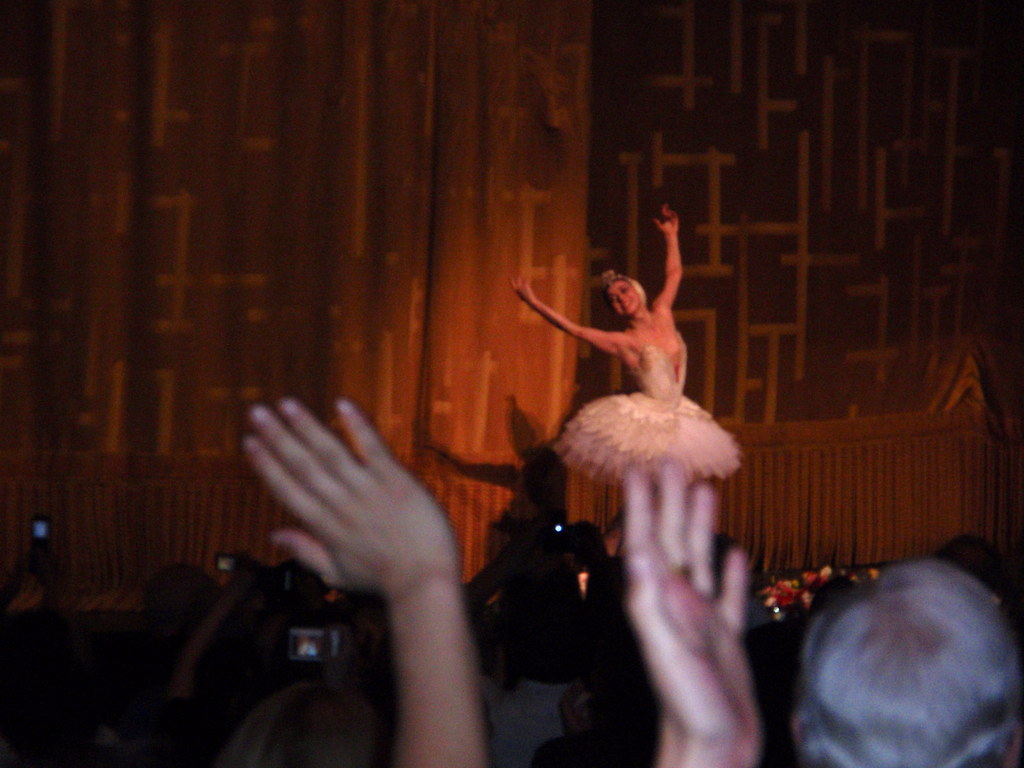
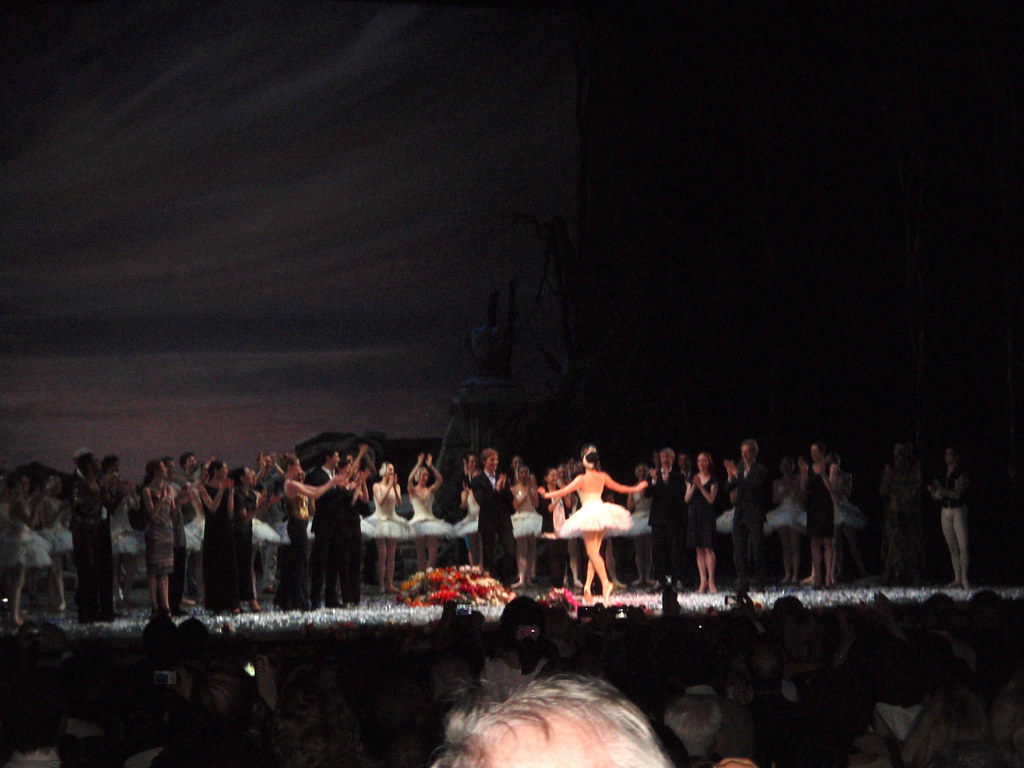
The widely beloved ballerina from the Republic of Georgia gave her farewell performance, of Swan Lake, with ABT to a completely packed house on Saturday night.  Angel Corella danced Siegfried and Marcelo Gomes von Rothbart.

Of course it was a wonderful performance, one her bizillions of adoring fans will never forget. It was my first time seeing her in this role and she was gorgeous. One thing that really struck me was how she’d wave her hands while in the guise of a swan. Not only her arms, like the other ballerinas do, but actually her hands. They looked like feathers they were so light and delicate and fluttering. I’d never seen anyone do that. She also did the rapidly fluttering foot during the White Swan pas de deux better than any ballerina I’ve seen. She is splendid at small details like that that make all the difference in a performance.

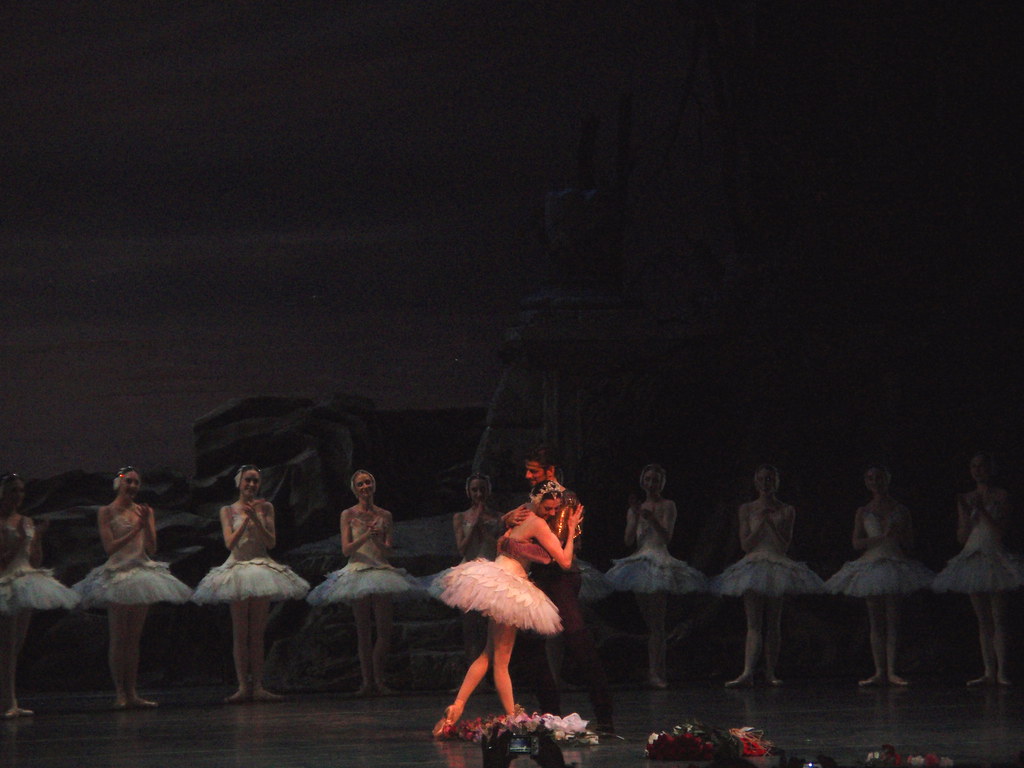
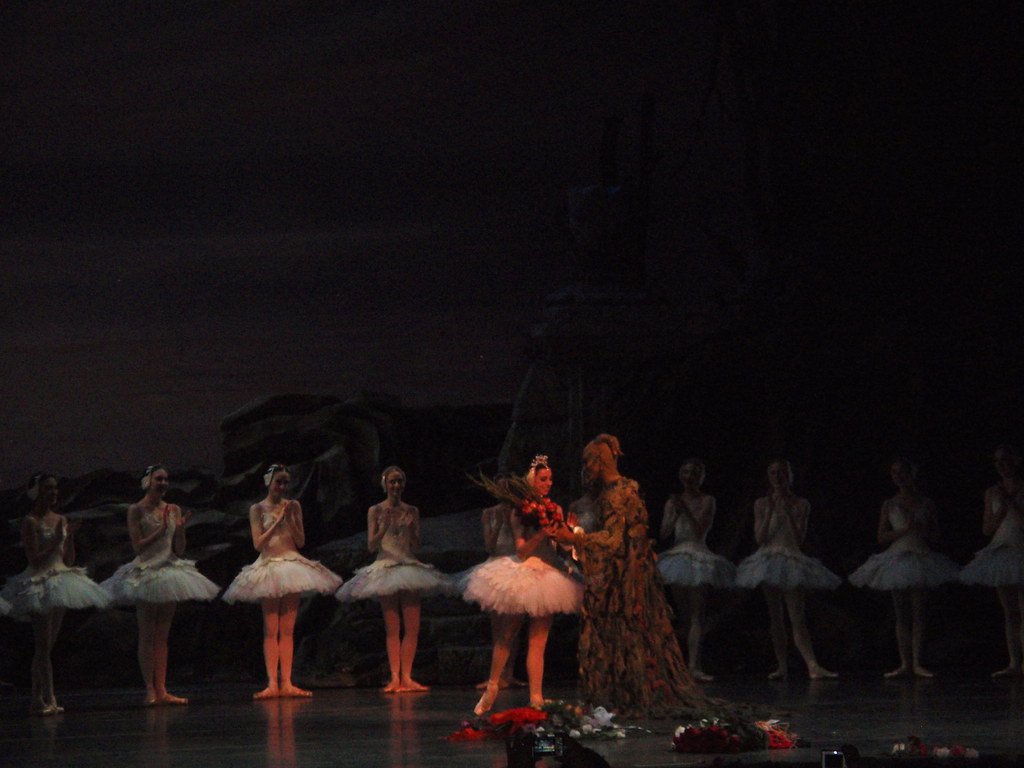
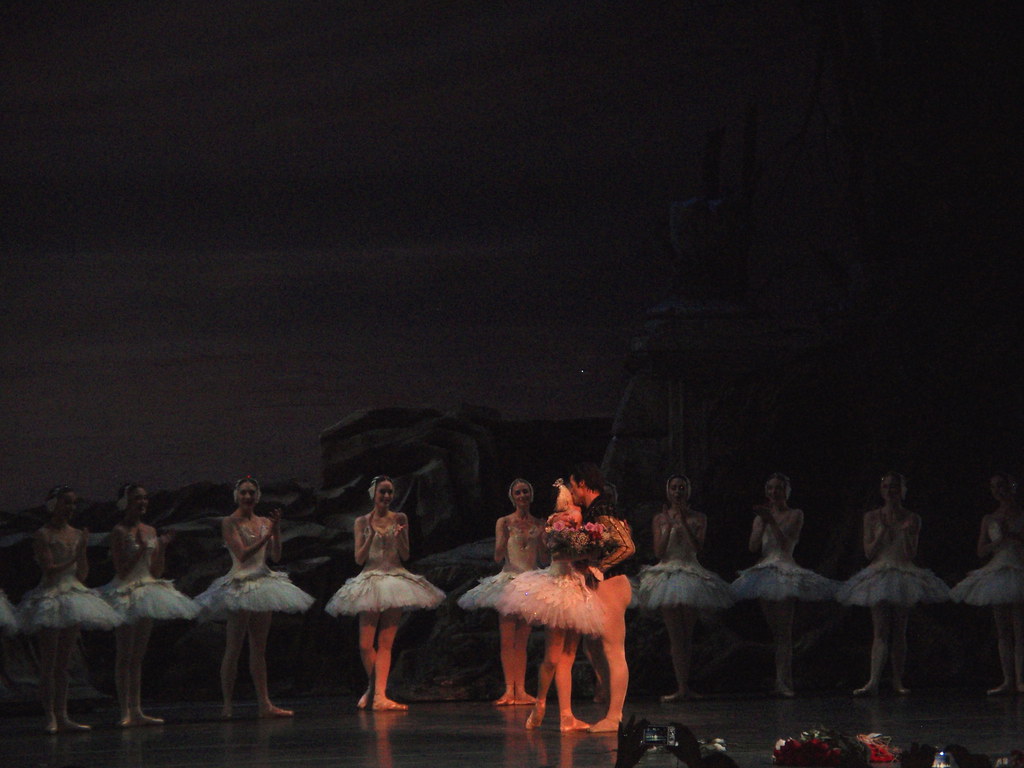
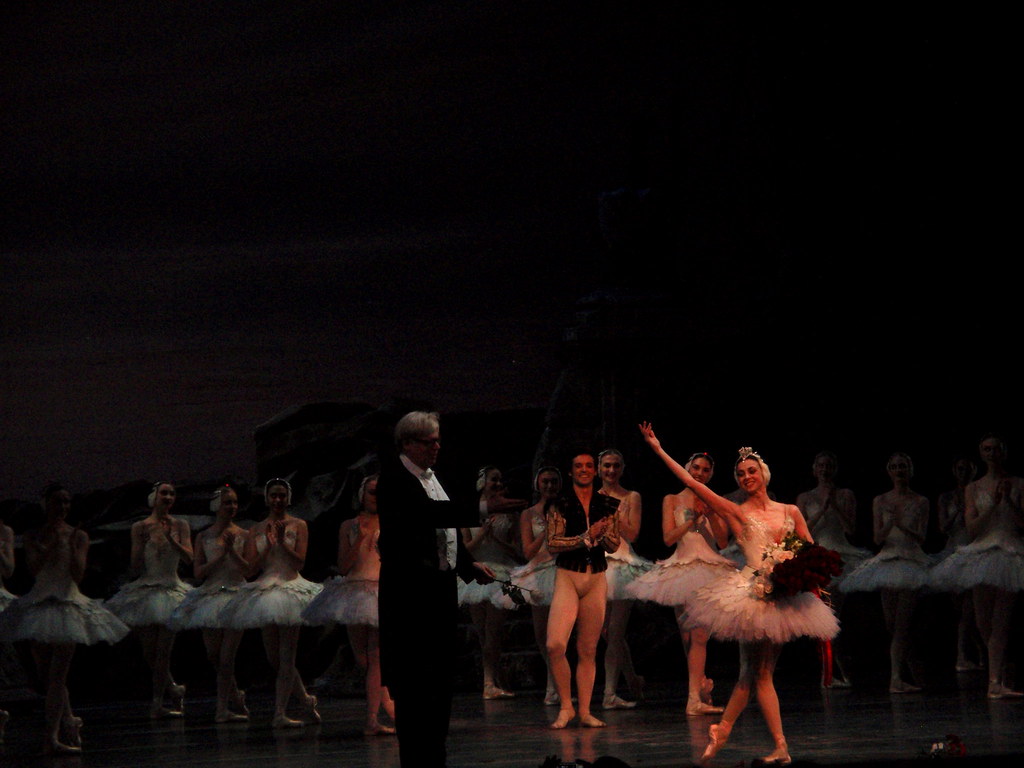
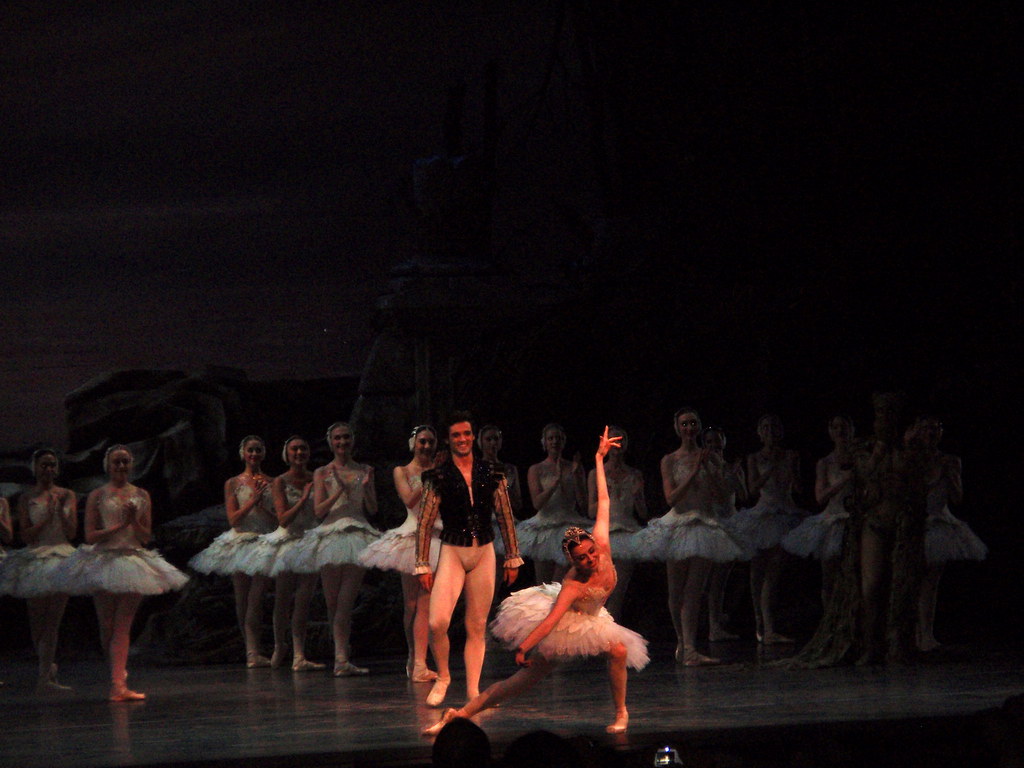
Unlike the others, she faced the audience, instead of the back of the stage, as she bourreed offstage after the end of the White Swan pas. I’m not sure if she always does that or if it was only this time since it was her last and she wanted to see the audience. Her face was full of sorrow but there was also this kind of “that’s life, that’s that, this is my fate” subtext behind her eyes — a thought Odette might have as well as a retiring ballerina. At the end, during bows, she bourreed offstage again, this time with her back to the audience, her face toward her pile of bouquets and the many dancers and former partners lined up onstage who’d come out to issue her her farewell. (Shown in pic below)

P6272300

Of course Angel was his usual passionate Siegfried self, and Marcelo was a mouth-wateringly sexy von Rothbart. I liked the way he picked one court lady up (I think it was Misty Copeland) and tossed her aside, so he could flirt with another. Marcelo’s ultimately too sweet though and his sweetness shines through — I don’t see how anyone’s actually ever completely believed his performances as the quintessential bad guy 🙂 I also like how he jumped up to the throne, taking Siegfried’s princely place next to his mother, in one flying leap. It was acrobatic and eye-catching, and very presumptuous, as von Rothbart is. Actually, watching Marcelo made me like David Hallberg better — David was much like him. They both did the part very well. There were a few more giggles during David’s turn as von Roth, but that could have been because he’s usually “the nice guy.”

And of course Marcelo and Angel, both of them full of theatrics, had to pull the stunt of the season: at the end of the Black Swan pas de deux, Marcelo picked up Nina and tossed her high, right into Angel’s arms, and he caugh her in a fish dive. Very dramatic, and of course the audience went completely nuts with applause. They performed said stunt again during the curtain calls. I didn’t get a picture of it, but someone caught in on YouTube!!! Oh how I love illegally enthusiastic fans! Thanks to Haglund for finding it!

Here are a few more of my favorite pics:

P6272289

What every girl wants — a hug from Marcelo! Even if he is dressed as evil von Rothbart.

P6272298

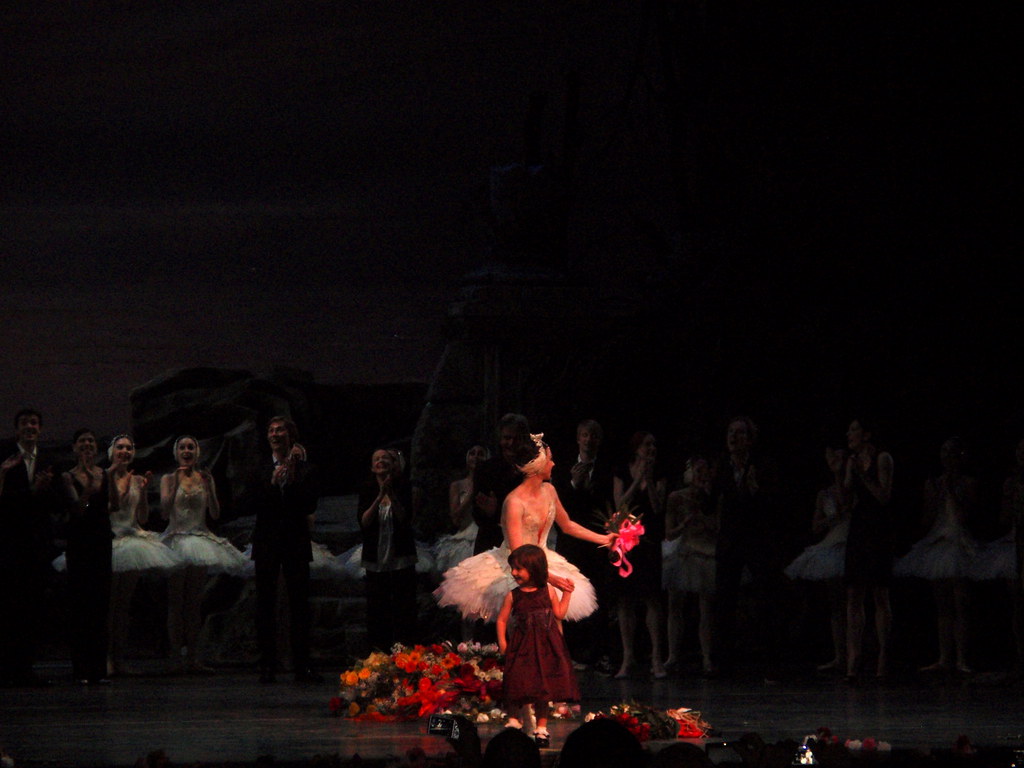
Her little girl was brought out onstage and took a bow with her mother 🙂

P6272291

Receiving a hug from Isaac Stappas, who danced von Rothbart in swamp creature form.

P6272286

Getting a kiss from handsome Angel.

P6272279

Giving a dancerly nod to conductor Ormsby Wilkins.

P6272268

I love the arm in the air!

P6272305

In front of the curtain with those two stuntsmen, either right before or right after aforementioned three-way-fish-dive.

P6272283

Those are some of my favorites. See the full album here.

A couple of other hightlights: Blaine Hoven danced one of the Neapolitan high-jumper guys in the court scene. When he did this series of kick jumps, he sent his kicking leg nearly all the way up to his head. Maybe I should begin calling him Blaine Osipova…

And Simone Messmer danced as one of the girls in the Benno pas de trois. Recently I’ve begun to find her very captivating but am not sure why. One of the reasons, I’m now thinking, is that she is so amazingly athletic. She did this series of entrechats (high jumps where the feet change back and forth in front of and behind one another, like a braid) like a man! Seriously — those were damn David Hallberg entrechats! I don’t mean that in a bad way at all — my favorite ballerinas (aside from Janie Taylor 🙂 ) are the most athletic ones.

Trying to think of other things that happened during curtain call. David Hallberg was cute — he bowed down to her several times repeatedly as if to say “I’m not worthy, I’m not worthy.” Audience went wild. Gillian Murphy and Ethan Stiefel came out together. Roberto Bolle came out, all dapper, in a shiny black tux. I remember Paloma Herrera, Diana Vishneva, Maxim Beloserkovsky, Kevin McKenzie (who looked like he may cry). I didn’t see Jose Manuel Carreno (unless I missed him. What’s up with him though — he doesn’t seem to be dancing any more this season??) I didn’t spot Julie Kent, although she just had her baby so that’s understandable. Curtain calls lasted for maybe twenty minutes, although I’m not entirely sure since I had to leave to go to a housewarming party. Anyway, wonderful night. It goes without saying Nina has a huge amount of fans and will be badly missed.

NATALIA OSIPOVA AND HERMAN CORNEJO’S LA SYLPHIDE


Monday night, I saw the Bolshoi’s Natalia Osipova guest-star with ABT in their production of La Sylphide. I wrote a little about her and more about Herman Cornejo, at the bottom of my prior post. Just to reiterate, if you ever want to see pure excellence, do see Herman Cornejo in something — anything. He is just pure, unmitigated, supreme, excellence!


August Bournonville’s La Sylphide is the story of a Scotsman, James (Cornejo), who is engaged to be married to a woman named Effie, but is seduced by a sylph (Osipova), who no one but he can see. Gurn, a young man in love with Effie, sees James talking and dancing to the air, and tries to warn everyone that he thinks James has gone mad. But people ignore him. An old witch-like lady, Madge (think MacBeth) prophesies that Gurn will marry Effie. Later, when the wedding party guests perform a fun Scottish folk dance, James continues to be taunted / haunted by the sylph who flies through the air. James chases her but she flies out the window. Later, James is on the verge of marrying Effie, even holding up to her the wedding ring, when the sylph plucks it right from his hand and flies out the window. He chases after her into the forest, her lair. Effie collapses into tears and Gurn leads the groomsmen in search of the missing groom.

The second Act takes place in the forest. The sylph seduces James with food, drink, and dance, but every time he tries to touch her she flies away. James wanders the forest, upset about the sylph’s elusiveness. He happens upon Madge and her mates who are concocting a poisonous brew in which they are soaking a scarf. He tells Madge of his troubles and she tells him the scarf is magic; if he wraps it around the sylph’s wings, he can have her. James takes it. When he next sees the sylph, he seduces her with the scarf’s beauty. She flies toward it, delighted and excited, as he waves it around. But once he wraps it around her wings, she slowly dies.

James, brokenhearted, falls into unconsciousness, as the wedding procession of Gurn and Effie is heard in the distance and the sister sylphs carry the sylphide to heaven.

Neither the story nor choreography are as grand and memorable as Giselle, and I’d written before that I was stunned by Osipova’s athletic prowess but not really moved by her Giselle. Here, I thought that, though I didn’t like the choreography as much, her playful, sky-high jumps made much more sense in this story. Here, she’s not human, she’s not of this world. She’s both a faery and a figure in a man’s dream. So, her unearthly high springing jumps went along with that; they were believable within the story. She is a really beautiful dancer and can certainly jump like no one’s business, but I wished she would have been a bit more tantalizing and playfully vexing, the way Janie Taylor was in Robbins’ The Dreamer. Not like a vixen or an evil spirit; I just mean more forcefully refusing to leave him alone, making him realize what a dull life he’s leading; how he longs for something more. Just like in Giselle, she seemed to be dancing on her own, not really working opposite a partner. It’s probably really hard, though, when there are language barriers, and I think both times either she or her partner (David Hallberg, and Herman) filled in for someone else last minute.

I thought Herman did an excellent job of showing how tormented he was by her, and how confused he was about what to do, how frustrated he was about his life. And his super-charged solo variation expressed that. No one jumps like him. No one. No one turns like Angel Corella and no one jumps like Herman Cornejo. He opened that variation with the best tour jete I’ve ever seen, and I knew — the whole audience knew judging by the gasps — we were in for something huge. Then onto all the high jumps with the fluttering beats of the feet. Everything he does is marked by sheer perfection — perfect sharpness, perfect precision, perfect control, perfect line, perfect clarity, perfect enunciation, beyond perfect height, beyond human height. He’s a god!

My problem with this choreography is that there’s not enough for him to do. And I got really frustrated. I didn’t want that variation to end. Nor did I want Daniil Simkin’s (as Gurn) solo variation to end. There wasn’t enough for him to shine in his either. He had a few kicking jumps, but I need for him to do so much more; Daniil’s too great of a dancer as well! Daniil was hilarious, though, when he imitated to the guests James’s bizarre actions, his weird dancing to the air. In addition to being a superb bravura dancer, he’s a very lively actor too.

On before La Sylphide was Paul Taylor’s light, lyrical Airs. I’m going to write about this more after I’ve seen it a couple more times this weekend, but I love watching ABT dancers do Paul Taylor! I hope no one takes offense and I love Paul Taylor’s dancers, but ABT just brings so much more to “modern dance” than a modern dance company. They bring poetry. Paul Taylor is American modern, and when his dancers dance him it looks celebratory, celebratory of humankind and of the dancing spirit, like something you’d like to get up on stage and do with them. It’s participatory, inviting. Of course you know if you’ve ever tried how hard, how impossible it actually is to dance like them without loads of training. But when you see ABT dancers dance that’s obvious from the get-go. It’s not celebratory and participatory, it’s elevated, awe-inducing dance, dance as an art. You know what I mean? All of the dancers were excellent — particularly Kristi Boone and Misty Copeland, but I loved Arron Scott the most because he so exemplified what I said above: outwardly he looked just like a Paul Taylor dancer, but he starts to move and he’s just so much more!


ROBERTO BOLLE’S ABT DEBUT

Well, I guess it’s not literally his ABT debut since he danced Romeo and Juliet with Alessandra Ferri for her farewell performance (during which I totally fell for him). But it’s his first performance as a member of the company.


Tonight (or last night, rather, seeing as how it’s now after midnight), he danced Count Albrecht in Giselle (description of that ballet here, if you’re unfamiliar with it).

Well, as much as I loved him as Romeo, I wasn’t quite as in love with his Albrecht, especially after seeing Marcelo in this role on Monday night. Maybe I’m just not used to his style. During intermission, a friend told me he thought it was very operatic, very Italian opera, which I took to mean, very melodramatic with lots of overdone mime and emotion and all. The acting just seemed so overwrought, like he was being a danseur onstage and not a real man in love with this girl. And the weeping at her grave, the running to her body and crying over her after her collapse — it all seemed unreal. But like I said maybe that’s just another style and I’m not used to it. It is rather interesting to have people from all over the world dancing on the Met stage bringing their different aesthetics.

The man does have gorgeously long thin legs, though, and some of his jumps were downright spellbinding. And he’s also a wonderfully strong partner, lifting Paloma Herrera’s Giselle way up over his head, while she lifted her leg up in the air seemingly with the greatest of ease. They were really beautiful together, dance-wise.

When he did the jumps during the would-be -dance-to-death scene, I noticed (now that I’m completely fixated on this!) that he didn’t throw his head back like Marcelo (and from what commenter Marie says, Angel too). Rather, he lunged his upper body a bit toward the side, and very slowly, like I’ve seen the Russian men do, very Romantic-looking. And then he’d fall to the ground, but he didn’t throw himself down like Marcelo — it was just like a stumble ending in a fall. So, it was more Romantic than tragic if that makes sense. His movement was lighter and more flowing, like a wave, emotional but not so evocative of near death and inner torment and prayer for salvation.

Oh, my favorite moment for him though was when he did these continuous jumps with many many entrechats (rapid braiding of the feet). I know they’re in the choreography but he did them and did them and did them, he just didn’t stop. I really didn’t know when he’d stop. He almost didn’t. The audience went nuts. He really didn’t stop until he, as a dancer — I think, couldn’t go on anymore. So, he literally tired himself out; his Albrecht literally danced until he almost collapsed.

I liked Paloma in the lead but she wasn’t dancing with the same aesthetic; she was more human, which is perhaps why they didn’t seem a proper match (which I overheard said during intermission). I liked her mad scene — it wasn’t over the top. And she did these hops during the Wilis scene like no one else. She looked up to the sky and she jumped and jumped, and it was like a longing to return to life. It was so sad.

The only thing I didn’t like about her Giselle was that she kept clutching her heart. We all know she has a weak heart, but if you had a heart condition you wouldn’t necessarily grab at your chest all the time; you’d grab a hold of a bench or another person, etc. to keep from fainting, you’d pat your sweat-covered head, etc. There are other, more authentic signs of a problem heart.

I really liked Isaac Stappas as Hilarion. His Hilarion was still strong and angry (understandably) about Albrecht’s betrayal, but he was also vulnerable and hurt. He took Giselle’s rejection of him nobly. And his dance to death scene was heartbreaking. He kept doing those slow-motion, galloping leaps toward Michele Wiles’s fabulous Myrta with his hands raised toward her, sometimes together as if in prayer. He was really begging her to let him live.

There was only one very small thing I didn’t like about his performance: at one point, he sees Albrecht’s sword, and realizes it belongs to him. So, he turns his back to the audience and points to the castle. Too much. We know the sword belongs to Albrecht and Albrecht lives in the castle. He only needs to look at the castle, if even that.

Michele Wiles’s interpretation of Myrta is more complicated than Gillian Murphy’s I think. Michele’s Myrta initially seemed colder and more unforgiving but then I realized that was really only on the surface. When Giselle covers Albrecht in protection, Michele’s Myrta turns her back, her way of saying “go ahead, dance together, but just for a while.” And then she keeps turning around to peek at them, and, seeing them continuing to dance, rapidly turns back again, as if the only way she can let him live is if she pretends not to see that he’s there. But then she knows he’s there, so pretending to look the other way is a conscious decision to let him continue living. I like Michele’s Myrta.

Misty Copeland and Craig Salstein were excellent as the peasants — I don’t really like this pas de deux, it’s honestly a bit boring to me, but they brought everything they could to it. Kristi Boone and Simone Messmer captured my attention in the Wilis scene as Myrta’s two right-hand Wilis, Zulma and Moyna. Kristi’s so strong and her body always carries such graceful power and control, and Simone — from what I’ve seen of her at least — has this rather bewitching presence (for lack of a better term). There’s just something about her that captivates your attention.

Audience went completely mad during curtain call. There were lots of Italians in that audience, at least where I was sitting. Practically the whole orchestra rose in standing ovation while the curtain was still going down on the final act. When Roberto came out for his solo bow it was pandemonium people were cheering so loudly!