Let The Countdown Begin!

It’s that time of half year again 🙂 As of yesterday, it’s six weeks ’til City Center season!!!!! 😀 😀 😀

Also, last night was Martha Graham‘s opening night at the Joyce Theater in Chelsea. I didn’t go, but am eagerly awaiting reviews from those who did. I will be going later this week. I can’t wait! If you like, read Gia’s preview of this foundational American dance company’s comeback.

Day of Merce and Frustration!

Yesterday I went to the Merce Cunningham exhibit at the New York Performing Arts Library at Lincoln Center. At noon there was a short, live, four-person performance of solos and duets right in the lobby. All dancers — two male, two female — wore blue unitards and the music sounded somewhat like the ocean. At times the dancers looked a bit like they were swimming. Of course it was abstract, but that’s what I got out of it.

I then headed into the exhibit, which was really pretty cool. I’m embarrassed to admit it, but this was my first experience with Cunningham (aside from the time Winger Tony Schultz and I saw him in the audience, wheelchair-bound, at another modern dance performance). Embarrassing to admit since he’s only one of the founding fathers of dance in this country! The exhibit was pretty comprehensive and very entertaining. They had videos of several of his works, all performed in the last ten years, but some choreographed far earlier. Cunningham himself danced mainly in the 40s and 50s. He is still choreographing, but of course no longer dancing.

The videos were my favorite part of the exhibit. They had several screens mounted on the wall, you took a chair hooked up to earphones and selected the music from whichever screen you wished to concentrate on. I actually found all screens mesmerizing and it was hard to focus on only one at a time. Funny thing, though, you really didn’t need to. The music (oftentimes sounds — of waterfalls, birds, people talking, etc.) seemed not to matter at all; you could have selected any soundtrack and watched any one of the screens. This, to me, marked Cunningham the complete opposite of Mark Morris, whose choreography is his rendition of that particular musical piece in motion. Also in contrast to how I personally felt watching Morris’s Mozart Pieces on PBS, Cunningham’s choreography was so engaging, I actually didn’t care what the sound was like.

My favorite video was called “How to Pass, Kick, Fall and Run” which was accompanied not by music but by Cunningham and another man, named David Vaughn, reading bits of text to the audience. At times their voices would overlap so you couldn’t even really make out the words, at times you could and the text was very humorous, and at times you just couldn’t pay attention to the text because the moving bodies were just so mesmerizing, even though they weren’t doing anything tremendously virtuostic. One passage, read by Vaughn, told of a man who gave a lecture on how to attend a lecture. He instructed attendees to listen, which they couldn’t do if they were taking notes. One woman was taking notes. The man next to her told her she was not supposed to take notes. She quickly read over her notes and said to the man, “that’s right. I’m not supposed to take notes; I’ve got that written right here.” The audience laughed like crazy. Throughout the reading of the text, the dancers, wearing colorful sweaters over plain black leotards, would jump, hold each other and bounce, kick playfully, scamper across the stage, then do slower prettier arabesques, sometimes with an awkwardly bent standing leg. The movements kind of did and didn’t correspond to the text. If you watched it a couple of times, it did, in a way. For example, at one point Vaughn began a brief vignette in which two women went to a women’s business meeting, and at that point two female dancers would wrap arms around each other and hop on one leg around in a circle, then let go of each other and both hopped toward the front of the stage. Kind of goofy-looking, but then a man emerged and they began a complicated, serious, lift sequence with him. Is a business meeting silly, serious, or both at times? I don’t know. But I found the process of watching the piece a few times and arriving at different conclusions each time rather fun and invigorating. It was also cool to recognize one of the dancers, Holley Farmer, who was in the David Michalek films.

Then, they had tons of pictures of the company performing, from 1945 up through the present, another film showing an interview with Cunningham, numerous costumes some of which were quite colorful and interesting-looking to put it mildly (one was a leotard with aluminum cans taped to the legs! — wish I would have seen that piece!), a bunch of musical scores and choreographer’s notes (the latter of which looked like heiroglyphics to me and made me wonder how in the world choreographers notate a work to preserve it), and some posters by such great artists as Jasper Johns and Andy Warhol promoting the company on tour and at home.

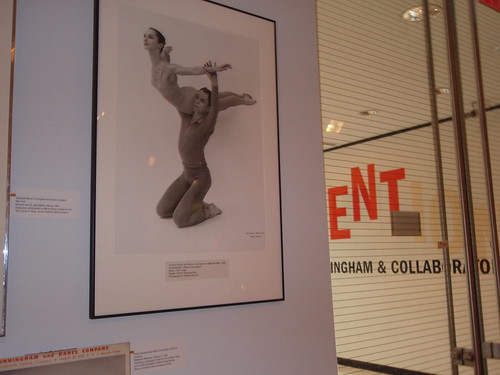
Top pic is of Carolyn Brown dancing with Cunningham himself in the company’s early days, which was interesting to me since I’d recently seen her speak about her new memoir about dancing with Merce, at Jacob’s Pillow (in that picture that I linked to above, from the previous blog entry, she is the woman in the white dress). It was quite a long time ago that she had danced with him and, wow, was she was a striking beauty back then.

Anyway, for people in NYC, I urge you to check it out. It’s a real history lesson, a fun informative trip through time, since Cunningham is such a foundational figure in dance in this country. It closes on October 13th, so you still have some time.

I recently bought a new camera with more pixels, a more powerful zoom, and motion control (so as to take better photos of all the lovely ballroom dancing I will soon be viewing, like tomorrow!) Hopefully, the pics will be better than before (the picture in this entry is better than previous ones, right!). But I’m having trouble uploading from my new software to my Plogger. Spent a good deal of the day trying to figure it out to no avail. It has no problem uploading the pics from my former camera software (which it seems is incompatible with the new camera). Argh, I HATE technology — just can’t figure things out! So, for the time being anyway, I’m using my Flickr account to upload new pictures. I created a link down at the bottom of the blogroll to my Flickr page, which is likely where I’ll end up putting the pictures from the dance competition I’m about to head off to… Have to go pack!

Oh, and my TAC headache seems to be officially over, for now anyway. Yay! Thank you so much, you guys for your concern 🙂 I really appreciate it 🙂

A Little Overwhelmed!

Each day yet more of the splendid Fall Season’s offerings flood my mailbox. So exciting! But a little nervewracking, given all the things I have to order tickets for! This is why I so love NY though — that unique combination of intoxicating stimulation and potentially migraine-inducing excess… (or in my case, TAC-headache-inducing excess … am trying to tell myself I do NOT feel one coming on, but am armed with meds just in case…)

Well, I guess this is what the holiday is for, to breathe deeply, lounge around, rest up for the happy hubbub to come 🙂 Happy Labor Day, everyone, have a long and relaxing weekend!

Hahaha, Where’s the Dorky Waldo?!

ha, I can’t believe it but Barbara recognized me in this picture, in the Times today, accompanying Jennifer Dunning’s article on the “States & Resemblance” piece I blogged about earlier this week. How did you see me, Barbara; I almost didn’t see myself?!! Haha, how embarrassing 🙂 (I’m in back, holding the paper in front of my face, a shiny pink metallic purse at my side, and head cocked and looking all pensive — what a goof!) Thanks for pointing it out to me, Barbara! Okay, this is the second time I’ve been nameless in the NYTimes! 🙂

Postmodern Dance Can Be Fun!: "States and Resemblance" Near the East River Piers

Last night I went to see the second in the three-work series “Sitelines” — site-specific dance performances organized by the Lower Manhattan Cultural Council, taking place at various downtown locales. This one, entitled “States & Resemblance,” was choreographed by Dean Moss and Japanese video artist Ryutaro Mishima, and took place on a nice little elevated park overlooking the East River that I hadn’t even known existed.

Above is a picture of the scene. Painted on the ground was an ambiguous grey splotch dotted with several large black spots that spilled out of the grey and all around the park’s winding paths. One such path led to a larger grassy lawn, where they are apparently showing a series of several old films shot in NY as part of the River to River festival (all these fun outdoor festivals in NYC during the summer!)

Well, I’m not entirely sure what to make of the piece, so I’ll describe it. The performance began in the lawn area, with Moss and Mishima running and jumping around playfully. I’d seen an earlier draft of this at the Nothing Festival at Dance Theater Workshop a few months ago, and there the men were naked. Here, they were nearly so, wearing only resplendent white dance belts, which, because of their sheen, were actually rather beautiful.

After cavorting around the lawn with each other for a few minutes, an Asian woman (whom the program notes is Indonesian mask artist Restu Imansari Kusumaningrum) dressed in shiny skirt and top, emerged from the park and walked to the edge of the lawn ringing a bell. That signaled for the men to walk into the park, where, in the center atop the dots, they slowly and soberly put on pants and button-down shirts — casual work clothes. The woman wandered around the park for a while, ringing the bell every so often while the men, after dressing, stood on the main grey area, first doing a series of poses during which their hands then arms would slowly begin to quiver, then a series of balances on one foot.

Suddenly, Mishima turned on Moss, attacking him. The men fought, jumping at and bouncing off each other, struggling with each other, with Moss trying to make peace with Mishima but Mishima resisting. While this happened, Kusumaningrum found a place in the grass to sit peacefully, where she donned a face mask.

Mishima eventually broke free from Moss and walked to the outer edges of the sidewalk, to where the crowd was sitting, and began laughing and singing at us aggressively and haughtily, momentarily a bit frightening. Kusumaningrum, disrupting the crowd by moving to various areas of the park, tried on a series of masks. Moss, now walking very slowly and hunched over like an old man, approached Mishima, who picked up a television set whose screen bore a close-up of an elderly person grinning widely, many teeth missing, and confrontationally thrust the screen out at the crowd.

Eventually, the two men went into a back area of the park and sat down in the high grass, hiding themselves from the audience. Kusumaningrum walked out to the center area, lay down and thrashed about on the ground, donning another mask. Eventually she stopped and pointed to the area where Moss and Mishima were sitting. The men slowly rose. Over each of their faces was taped a large black dot, the same as were spotting the ground.

So what does all this mean? Well, the little blurb on the Sitelines flier tells us that it is intended to be “a meditation on the pain, beauty, and inevitability of how things, people, and experience pass away … reflect(ing) on the process of aging as one of the most binding aspects of our existence.”

I could definitely see the aging in the way the men acted boyishly, playfully on the lawn, near naked, in an innocent beatific state, then as if called by their mother, or by time, to grow up and don career clothes. I could see Mishima’s attempt to defy the passage of time by lashing out against Moss, who nevertheless eventually grew into an old man, taking Mishima with him. At the end, the large black dots covering their faces suggests ashes to ashes, dust to dust, our bodies do eventually become part of the earth, part of the environment, and thus timeless. I didn’t completely get the significance of the masks, unless they were meant to convey in another way how we try to evade and hide, pretend, develop facades?

I’m sure there are plenty of other interpretations as well. In general, I find this kind of postmodern / experimental dance intriguing and fun so long as there’s enough there for you really to cull something from it all and come up with various analyses. I definitely felt like there was enough here to do that. Here’s a write-up on the piece by Gia Kourlas in TONY. It’s showing a few more times this week and next; go here for the schedule.

Brief Snapshots From Downtown Dance Festival

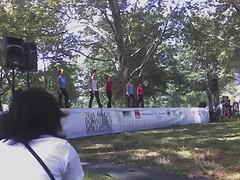
I’m exhausted from spending the weekend down at the lower tip of the island watching other people dance (how does that happen?), so this is going to be short (word-wise at least). The Downtown Dance Festival took place during lunch hour each day last week at Chase Manhattan Plaza in the Financial District, then moved for the weekend to a nice little outdoor amphitheater in Battery Park. I wasn’t able to see all of the dance companies (nearly 20 in all), but here are some highlights from what I did see.

First, sorry, but I simply must bombard people with just a couple more photos of Quorum Ballet, who performed again Saturday in Battery Park. They were really so lovely… so, just, HOT for lack of a better word 🙂


I wrote in my last post on them that their lifts looked a bit “trick-happy” and on watching again I think that might be in part because the lead female dancer, Theresa da Silva, would often look out into the audience and choose someone to flirt with, which seemed to happen most often while she was airborne. Very interesting, and something I haven’t really seen in concert dance before, only in ballroom comps and some club acts. Anyway, their next performance in NY will be February 13th at the Tribeca Performing Arts Center. I urge everyone in the city to check them out!


I also liked the Ashley Browne / Kinetic Project. Some very sweet duets with fun, pop music from Jill Scott, Mos Def, and Fiona Apple.


Ms. Bne is a choreographer I could really see working on SYTYCD. I really wish they would open the show up to other choreographers besides the same ole Mia Michaels and Wade Robeson. I mean, keep them, but instead of having them choreograph something practically every week, let the country see some of this other awesome talent!


Another favorite, Vissi Dance Theater. I loved them! Their mission statement reads, “Vissi is committed to art that explores moral and social issues… Vissi seeks to speak to the human condition, lift the spirit, ask questions, celebrate the joy of life and reflect the truths of human nature.” I felt they did that splendidly. This piece above, danced by four women, reminded me a bit of Alvin Ailey’s Cry with its upbeat celebration of womanhood, and was kind of a combo of modern dance with disco / hustle, to music by Macy Gray and Jocelyn Brown.


Their second piece, named “Melbabcd,” was a combo of all kinds of stuff — modern, hustle, hip hop, Latin, African, you name it. Great fun, as dance that makes you think and has social relevance can often be 🙂 This one kind of reminded me of Bill T. Jones with its very colorful cast of characters. I’d love to see more full-length work by this company.

The choreographer, Courtney Ffrench, by the way, is another whom I can really see peppering up SYTYCD with some romping group numbers. C’mon Nigel, expand those horizons!

Another highlight:


Gallim Dance Group. This piece is from “Snow” based on the novel by Orhan Pamuk and choreographed by Andrea Miller (yet another who could inject that aforesaid pop-fest with a blast of brain power). This was a haunting piece, like I imagine the book to be (okay, admitting I haven’t read it here!). The women bent their bodies every which way, inched forward, ran backward — the movement was beautiful but juxtaposed with musical lyrics like “question democracy…” became chilling. A Juilliard grad formerly with Ohad Naharin’s Batseva, which I’ve enthusiastically blogged about before, Miller’s mission is to “explore issues such as feminity, power, community and solitude.” Gallim will be performing at Dance Theater Workshop in Chelsea in September. See them there if you can.

On Sunday, we were treated to Darshana Jhaveri Manipuri Dance who came all the way from India, and who specialize in bringing the classical Indian dance, Manipuri, to contemporary audiences. So sweet, so lovely, and so educational.

This guy BLEW ME AWAY. He had this amazingly intense look of concentration the whole time. Sometimes when a performer has that look in his or her eyes, you’re almost mesmerized just by the face. He beat the hell out of this double sided drum, as well as another that required a stick, later on. Not only did he play those drums, he danced while playing. And not only did he dance, he did these continuous barrel turns at whiplash speed. The entire audience sat there open-mouthed.


And here he is barrelling all over stage with the other, larger drum. Between turns, he made beautifully intricate gestures with that drumstick. At one point, he put the drum down on the center of the stage and did repeated turns around it, beating it with the stick after each rotation, and managing somehow to hit the stick on the drum right in time with the lightening-fast music. Talk about the necessity of great speed and precision on those turns — if a turn was off, you wouldn’t just see it, you’d hear it. It was breathtaking, and I can’t tell you how much respect I now have for this classical Indian dance form.

Okay, I can’t write anymore. I do have a few more pictures of the whole festival, along with the Sitelines performance series, in my photoalbum, here.

Speaking of Sitelines, Apollinaire and Eva Yaa Asantewaa are having a very interesting discussion of the Macaulay NYTimes review of the Reggie Wilson / Andreya Ouamba work I wrote of earlier. Eva’s review of the piece puts me to shame — she saw all kinds of things I hadn’t thought of — do read it! I do have thoughts on the subject of socio-cultural meaning in dance and whether the choreographic duo’s mission statement should have been confined to grant application writing, as Macaulay argues, but am far too exhausted to formulate them now…

In The Company of Beautiful People: Quorum Ballet At the Downtown Dance Festival


Nice thing about New York in August is that there are lots of outdoor art festivals offering free viewings. I of course have been attending as many of the little dance performances as I can. Many are by very small companies, and the works are brief. Here’s a troupe that caught my eye yesterday, Quorum Ballet from Lisbon, Portugal, who performed at Chase Plaza as part of the Downtown Dance Festival organized by Battery Dance Company.


Their movement style was what I’d call contemporary ballet mixed with modern — no toe shoes but some lovely balletic lifts — and in one piece I saw a smidgeon of Flamenco. Music was mainly poppy with a fun, solid beat.


Beautifully sexy movement, and I don’t think I’ve ever seen such a gorgeous group of dancers! It’s a small, very new company founded only in 2005, by choreographer and dancer Daniel Cardoso,


(how much does he look like Herman or Joaquin 🙂 — jumps not unlike them too!), who, along with lead dancer Theresa da Silva, was previously affiliated with seminal modern dance company Martha Graham. (The two are pictured above and below, in “Kismet,” my favorite, and the piece that, at least in its solo parts, reminded me of a balletic flamenco).


Here are some more pics from their other pieces:


My only qualm was that some of their lifts looked a bit too “trick-y” as in, you kind of felt like drum rolls should be preceeding them, similar to what I’ve seen at many of the exhibition dancesport competitions I’ve been to. Suits some people’s tastes but not mine, and I don’t think this company really intended for them to be that way, although maybe they felt they were playing to an audience unaccustomed to dance and felt like they should play up the showy aspects. And some of the lifts seemed a bit out of sync with the style. For example, the “bluebird” lift above (where da Silva is balancing on Cardoso’s shoulder, back arched), a typical ballet lift, seemed to me a bit at odds with the flamenco-y flavor of that dance. I would rather have seen more original parterning, specific to the dance style, such as that employed by Mimulus, which I wrote about earlier. But the solo and ensemble work were just gorgeous.

Cardoso had some beautiful pelvic and ribcage isolations going on. Very Latin 🙂


Okay, that’s all for now. Will likely be more to come depending on whatever else strikes my fancy in the next few days … 🙂

At the Doors of U.S. Customs

As promised, here are a bunch of pics I took of yesterday’s first peek at the collaboration between Brooklyn-based choreographer Reggie Wilson, and Andreya Ouamba (originally from Congo but now residing in Senegal), entitled, intriguingly, “Accounting For Customs.” The work is part of the Lower Manhattan Cultural Council’s “Sitelines” project — comprised of dances that are created specifically for a certain site, outdoors, free and open to the public 🙂

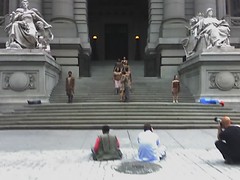
This dance took place on the steps of the U.S. Customs House, which the dancemakers assured was significant. I honestly had to stop and think of what the Customs House represented. I have no background, or interest, in economics and actually almost got lost trying to find the place, since I think of this building as The Museum of the American Indian (which it now is; in 1973 Customs was moved to the WTC, don’t know where it is now…). Well, I guess the work that goes on in an official Customs Building is the setting of tariffs U.S. citizens have to pay on goods over a certain amount that they purchased abroad, right? So, a customs house deals with the price one pays for bringing something “foreign” into one’s own culture. A custom is also of course a cultural tradition.

Wilson has said (see Kourlas article linked to above) that one of his interests is to examine the intersection between “traditional” (by which I assume, in the African context, he means traditional African dance) and “contemporary” (by which I assume he means, in the American context, modern, hip hop, jazz, etc.). How do people react to contemporary dance containing traditional movement, he asks. Do they see the contemporary movement “evolving” the traditional, or “bastardizing” it. And how does innovation happen in this context — which force is credited with being “innovative?”

Thought-provoking questions no doubt. I’m not sure I can answer them, but I did really like what he and Ouamba came up with here. It was short but evocative and fun. The dancers began in a horizontal line on a low step, then two by two they paired off, greeted and hugged each other, then, holding hands, ran up the stairs, both together and apart, as they were separated by a central hand rail. Some dancers fell and lay down on a middle step, forcing others to find a way around them. Soon all dancers had fallen and lay down on a step, some atop each other. After a short silence, a loud bang emanated from the speakers (was it a car’s backfire, a gunshot?…), and the dancers then began rolling up the steps, eventually manoevering themselves to a crouched position, and crawled downstairs. All then stood up and danced, each his or her own way, up and down and all around those steps — at times fighting each other, at times being playful, at times embracing, helping each other up or down, carrying each other, stopping on a step to do a pose — a pretty arabesque evoking flight / freedom, a more urban, hip-hoppish stance — at times they would crash up against the side pillars, pushing and shoving against them, at times holding onto them for dear life while another tried to pry them off. All the while a woman dressed in traditional African costume sat off to the side, under a pillar, making crafts and from time to time looking over at the dancers — the children of the diaspora… her children. The music (not live, but played over loudspeakers that in my opinion were not amped up enough for outdoors) varied between what I assume was Senegalese music, poppy tunes with pulsating drums, folksy guitars playing a melody that sounded like a patriotic American song, and silence. At one point the woman on the side hummed a spiritual.

Anyway, great thing about outdoor performances is that you can take many pics!


I really liked these two guys. At one point they kind of hustled each other down the steps — rather playfully aggressive, each throwing the other down a few notches in a funky little turn. I think I’d be too scared to do that on narrow stairs. According to the articles, they only had two weeks of rehearsal!

In places the scene as a whole was even a little Rent-esque. Very urban. The photographer in the front with the long dreadlocks and the colorful outfit — he must work for some major publication around here because I see him practically everywhere!

Here’s the woman making her crafts and humming spirituals off to the right.


I loved this guy in the front … obviously — I kept taking pictures of him!


As I said, it was short and not entirely fleshed out, but their larger project together is to take place in 2009 at the Brooklyn Academy of Music. I’ll definitely be excited to see what they come up with given more time!

If you’re in New York, to see this work, about 20 minutes in length, just go down to the Customs House, at Bowling Green station, at either 12:30 or 1:30 today and tomorrow.

Mark Morris, Mozart, and Full-Length Concert Dance on TV

Over the weekend, I watched Mark Morris’s Mozart Dances, filmed for TV and shown as part of PBS’s Live From Lincoln Center. I actually watched the tape I made of it three times, plus I’d also seen it live last year. Doug Fox was very disappointed with the televised filming; visit his blog for some interesting commentary. Also, as I’d linked to earlier, read Apollinaire’s article for more on the filming aspect of the program, and an interview with the filmmaker.

Before turning to the filming, I briefly want to give my two cents on the dance itself. I’m not a huge fan of contemporary Mark Morris. I’ve skimmed Joan Acocella’s book on him and wish like anything I would have been able to see Strip Tease and some of his earlier, more iconoclastic work from the 80s when he was a young upstart. Now, it seems like he’s toning it down. My first thought on seeing the program was that it was too slow and repetitive, making it long-winded and a bit tedious. But each time I watched, I liked it more and more and saw more of the things Acocella had written about, just in subtler form. (Go here for her current New Yorker article on this piece). One of the ways in which the dance is broken down is by gender, as Alastair Macaulay noted in the Times. The first movement is danced almost entirely by women, the second by men, the third by both together. In the first, the women, as Macaulay also noted, look very weighted and “flat footed.” The men in the second act (my favorite), in contrast, look light and feathery. This is the opposite of course of classical ballet, where the ballerina on pointe looks poetic floating about in the air and the grounded man is her support, her connection to the earth. So to an extent this is the usual Morris turning those gender assumptions on their heads.

And he does it well: during the part of the first act’s piano concerto where the music sounds like a lullaby, the women, wearing these almost dominatrix-looking black costumes — black bra and underwear with diaphonous black chiffon gown hanging from the bottom of the bra to the knee — do not tiptoe around in a circle all willowy and delicate, but brashly stomp forward, arms swinging front to back as if in a march. Hardly the maternal ideal. During the men’s portion, at one point, the men, wearing blousy, billowing white shirts, dance in a circle as well. But their dance is quite different; it’s light and lyrical, poetic, like a Balanchine ballet. But where Balanchine would have pretty ballerinas with long flowing blonde hair bouncing around, playfully holding hands with each other, raising arms, and inviting a dancer through their arc, Morris’s dancers do the same but the whole look is altered because they are men. Or is it? What is femininity and why does gender matter in dance? Maybe it doesn’t. And I love Joe Bowie, the main soloist in the men’s section. I love that the man who, at least to me, represents Mozart himself is an urbane black guy dressed in hipply ripped black conductor’s jacket and black spandex bike shorts. Morris definitely challenges gender and race assumptions, though it’s rather pathetic that they still need to be challenged. And the costumes were simply superb.

Also, Morris is known for being a very “musical” choreographer, meaning what exactly? He works with the music well? To me, his dance is almost a contradiction of the music. His dancers’ movement is very modern, yet the music is obviously classical. Also as Macaulay notes, Mozart has a lot of beautiful lyrical flourishes in his compositions. Morris doesn’t seem to follow those by creating his own lyrical poetic flourishes; the dancing instead is rather intentionally mundane, earthy. There’s no virtuosity either (big leaps, multiple pirouettes and fouette turns, etc.) Which is part of why Morris doesn’t thrill me. Cool costumes, evocativeness and assumption-questioning aside, to me the whole thing generally dragged and there didn’t seem to be any climactic arcs or discernable overall themes.

Interestingly Morris says during his interview segment of the show, that he doesn’t like “poses;” he finds the steps in between poses to be “the dancing.” I guess that’s what I’m missing here. Of course that’s what Ballet and Latin are all about, so call me shallow, or bun-brain or Latin girl or whatever, but I’m for the poses. Of course getting from one pose to another easily is what dancing is all about and it’s necessary to make smooth transitions. [In my own dancing I concentrate so much on the pose — the arabesque (one leg lifted in back), the develope (slow, unfolding delicate kick), or how my body looks in position in a lift, that I forget to think about getting into the position in the first place. The result: I look like crap on my way into a lift, etc. But I think this is common among students / amateurs, and I’m learning… :)] In any event, watching my Morris tape a few times, though, the dance has grown on me a lot, so maybe if I kept watching it would continue to do more for me.

So, the film aspect. Funny but I felt the exact opposite of Doug. I didn’t think the camera did enough, had enough of a point of view. I was glad that, for once during a full-length concert dance performance, someone didn’t simply plop a tripod at the edge of the stage and hit ‘record’; the camera-operator actually had an opinion, told the viewer where to look. The camera would at times home in on one dancer, either his or her entire body or just torso, then would pan out to the ensemble. At times it would follow a dancer or smaller group of dancers, excluding perhaps things happening at the other end of the stage. These were all reasons Doug gave for disliking it; I felt that this was too rarely done, and when done was still too lacking in focus. When the camera homed in on a dancer’s upper body, it did a half-assed job; if you want to humanize the dancer, make people relate to him or her, get a close up of the person’s face. It doesn’t have to stay there long, but a few close-ups go a long way. The eyes are the window to the soul, you know.

And you can’t just focus the camera in and out without playing with angles. Everything here was a straight shot. Forgive me, by the way, for not knowing correct film terminology; I know what I mean, but don’t know if I am expressing it right because I have no film-making (only extensive film-viewing 🙂 ) background. For example, when some of the dancers were doing pirouettes, do a close-up of that dancer and angle the camera so that it’s focusing on the dancer at a diagonal. It makes the dancer look superhuman, like s/he has miraculous balance and it’s really cool. And, like with those little wrist-flourishes the dancers were doing, home up really closely and find a better shot — maybe of the wrist coming toward the camera — to make it look multi-dimensional or something. And, as I said, unfortunately, there were no big jumps and leaps here, but if there were, have the camera underneath the dancer. This emphasizes the majesty of the height and showcases the dancer’s musculature. Generally, it always heroizes the subject to have the camera focused upward at him / her — so this could have been done at any point, with pirouettes, etc. Conversely, if you want to highlight a dancer’s vulnerability, create poignancy or sympathy, do the opposite and place the camera at a downward angle on top of him or her. Also, it would be cool to have, like in those highly successful Anaheim Ballet videos on YouTube, the camera directly behind or immediately next to the dancer so that the viewer would be given a sense of what the dancer sees, during, for example, fast pirouettes.

Of course none of this could be done with the Morris the way it was constructed. To do any of the above, the choreographer would have to work very closely with the filmmaker discussing the most effective correlation of movement and film angles. It would change the entire choreography. This piece was meant for the stage; Morris meant for the audience to come to its own conclusions about its meaning and evocation. He specifically tells us during the interview segment (which I loved — in a way those interviews were the best part), that he directs his dancers not to make any decisions about the emotion of the movement — if a movement is fast, dance it fast, not happy; if it’s slow, dance it slowly, not sad. So, he certainly wouldn’t want the filmmaker intruding on the audience’s turf either. Which is largely why this didn’t work for me. You can’t effectively film a play made for theater for the same reasons you can’t film a dance made for the stage. You can obviously create a film version of a play, a film version of a dance, but they are versions, not the same exact thing placed on film. Film is a completely different animal than live theater and it must be treated as such for it to be effective, exciting, and garner a good-sized audience.

I mean, I’m glad that this film exists and that I have it taped; I can now watch it repeatedly and gain more appreciation for Morris. I’m just saying that I doubt that anyone new to dance was blown away by it, unlike with SYTYCD. Did anyone else see it?

A few final thoughts. Doug was also annoyed by the film’s flashing to musician Emmanuel Ax, playing piano, or to the conductor. I actually liked this because I felt it gave the viewer an idea of the whole performance with all of its various elements. The conductor and musicians are part and parcel of a live performance. Plus, I loved the music so much, I wanted to see who was responsible for it! I also liked the interviews with Ax and Morris. I like that Ax mentioned that he had a camera on the piano so he could see the dancers as well. Sometimes, when I’m at the ballet and I’m lucky and have a seat up close and central where I get a good view of the conductor, I like watching how he relates to the dancers, if at all. Sometimes it seems that the conductor doesn’t even look up onstage, which can result in music played way too fast, not giving the dancers sufficient time to get where they need to go or to act something out fully in a dramatic ballet. And the interview with Morris: it’s always fun to hear a choreographer talk about his work. Always! I also liked the behind-the-curtain shots, though I don’t know if anyone noticed them but me. I love how some of the dancers just collapsed after that curtain went down! And, when Sam Waterson (did his voice seem shaky and nervous or was it just me?) gave his opening remarks, it was prior to the curtain going up, so we got to see dancers warming up and talking and planning, maybe giving each other little pep talks. That was quite fun too!

I would have liked to have seen some interviews with the dancers as well. One of the reasons these shows — SYTYCD and Dancing With the Stars — are so popular (I know, some of us have had this discussion before with America’s Ballroom Challenge), is that the competitors are portrayed as not ‘just’ dancers, but real people to whom everyone can relate. Little background stories are given — where the dancers are from, how they fell in love with dance, etc., little interviews, little clips of them in rehearsal trying to learn choreography, sometimes struggling with it (again, something we all can relate to), having their own hurdles to overcome — it’s all part of what makes the dancers, and therefore the dance, come alive to us. Mark Morris after all isn’t performing, his dancers are! They could have at least had interviews with Bowie and Lauren Grant, the two main soloists, or we could have heard the dancers talking with Morris during the segment where he is shown instructing them.

Okay, that’s all I can think of, for now…