Capitalism, Poetic Clothes hangers, and $500 Apartments in the Village?!

Last night I went to see experimental choreographer John Jasperse‘s new work “Misuse Liable to Prosecution” at BAM’s Harvey theater in Brooklyn. Fun night! I went with Tony Schultz from the Winger, and we met up with some of his friends, one of whom is Ashley Byler, an up and coming choreographer who also contributes to the Winger and just landed a coveted residency at experimental dance venue Dance Theater Workshop in Chelsea. (Her first show will be in May.) We all went out for drinks and little foodie things afterward at nearby Scopello, which I loved. Very good food, spacious comfy area and very decent prices. I guess this is why people live in the outer boroughs… Everyone was so smart and it was a great time hanging out and talking about dance and art and Jasperse and Chuck Close and Labannotation, and all kinds of compelling stuff! I didn’t get home until early this morning, which is why I’m late with my review…

Anyway, Jasperse. Ashley and Tony loved it, I liked but didn’t love it, but thought certain parts were brilliant. According to the program notes, Jasperse began with the idea, “What is it like to exist in a capitalist society with little or no capital?” Sets and props are comprised of other people’s discarded items — clothes hangers, brooms, milk crates, bottles, etc., which Jasperse and his group of four dancers seek to re-invent, finding new, poetic meaning in society’s refuse. So, I guess by finding new uses and meaning in what society deems trash, while starting with the initial capitalist question, he is in a roundabout way perhaps questioning what a capitalist society finds meaningful (work that produces money) and what it doesn’t (experimental art / art in general).

I felt that the most brilliant reinvention of trash was the set. As I walked into the theater, my eye was immediately drawn to the stage, which looked ablaze with gleaming white holiday lights weaved into some kind of intricate snowflake formation. It was really breathtaking. Once I sat down and looked more closely though, I realized the Christmas lights were actually about 1,000 ordinary clear plastic clothes hangers. The way the plastic was lit by stage lights produced the glowing effect. It reminded of a sculpture I once saw in an American exhibit in the then newly-opened Kiasma Museum of contemporary art in Helsinki. From afar this striking piece hanging from the ceiling looked like a gorgeous chandelier. But on closer inspection I realized it was made entirely of chicken bones, which made me momentarily disgusted. I had to walk away, but I then kept returning to that piece, it was so jarringly mesmerizing. When I first saw the coat hanger sculpture, part of which hung quite close to the stage, forcing the dancers to interact with pieces of it, I thought it was brilliant. I felt that the movement, though, just didn’t rise to that same level.

As four dancers walked slowly around the stage carefully balancing several tied-together broomsticks on their heads, Jasperse came up front, sat on a milk crate (the name of the work, by the way, comes from a warning on a milk crate, which is really rather funny when you think about it — what possible wrongful, prosecution-inducing uses are there for a milk crate?), propped an orange traffic cone on top of a broomstick, and used the cone as a bullhorn reading various economic statistics through it: Judge Judy’s salary is something like $26 million more than that of all of the United States Supreme Court justices combined (which enrages me), employees of small arthouse BAM make half of what those of Manhattan’s posh Lincoln Center do, how much our government spends on the Iraq war as compared to funding for the arts (don’t even ask), how much money Jasperse makes ($26,000), and his various expenses, including those involved in transporting props to the studio, rehearsal space fees, food, and, most audience-wowing, his apartment — $500 a month, in the Village! Well, that’s certainly a thing of value, Mr. Jasperse! (For non-New Yorkers, the average teensy one-bedroom in the Village is currently going for $3350, says my friend who is looking.)

Anyway, after these stats are read, Mr. Jasperse joins the other dancers interacting with various props. Music is played by a woman (musician Zeena Parkins) standing off to the side wearing a mini-dress made of FedEx envelopes who plays a homemade industrial-looking harp. Bagpipes occasionally sound from above, from musicians standing on the balcony sides.

Some of my favorite moments: a dancer brings Mr. Jasperse a large box containing an item he seems to have purchased. He opens the box, finds a bean bag chair. He takes the chair out and looks quizzically at it, as the dancer throws the open box over his head. He takes the box off and begins playing with the bean bag chair, eventually with others, who throw it at each other like a giant hacky sack. Eventually, when the players tire of the game, Jasperse winds up with the bean bag chair over his head, walking around stage completely unable to see or breathe, stumbling into the clothes hanger sculpture. So, it’s like he’s been consumed by his own consumption.

Another favorite moment: four dancers take off their jeans. They then sit down on the ground and meticulously begin to fold the pants, like you see Banana Republic and Gap employees often doing. As soon as they’ve smoothed them all out, ready to be presented to the customer on the display table, the dancers lie down on them, use them as bed and blanket, wend their feet through the pants legs, eventually getting all tangled up. They then rise, untangle themselves, take the pants in one hand, grab the bottom of a leg, and begin whirling them around over head like a lasso. They whip the pants at the floor, each other, and eventually into the back wall. I saw in this well-founded anger at all those horrendous chain stores that have completely taken over and all but ruined parts of the city like SoHo, which, for non-New Yorkers, used to be the gallery district and is now basically a mall.

At another point, a male and female dancer take a clothes line on which several garments are hung, lie down, and, using only their feet, somehow weave the clothes all into the woman’s top. She ends up a Humpty-Dumpty-esque literal “stuffed shirt.”

A part the audience found amazing, judging by the ooohs and aaaahs: two women roll out a sheet as if they’re about to have a picnic. They disappear into the wings and return with several water bottles, which they put onto their picnic cloth. They disappear again, making me think they were going to get their baskets filled with food. But instead they return with more bottles, then more and more, until it’s not they who are having a picnic at all but the water bottles themselves. They then lie on the sheets amongst the bottles, and, using only their feet and legs, scrunch up the sheet so that eventually they have several water bottles lined up between their legs. They lift their legs in the air, rotate them, the bottles still held tightly between legs, then one by one deposit each bottle into the sheet, still using only their legs. I guess it is a difficult feat, but what was this supposed to mean? At another point, one which takes up a large part of the whole, a mattress is brought out and dancers thrash themselves at it, the mattress eventually enveloping a dancer as had the bean bag chair earlier. But the bean bag chair had arrived in a box, so it was like a purchase; the mattress was just lugged out onstage. A lot of these kinds of uses of the props were comical and interesting and involved difficult feats using entwined limbs, but some of them I couldn’t figure any meaning into, and none had the poetry of the clothes hanger set.

At the end, Jasperse returns to his traffic-cone megaphone and tells the audience that he couldn’t really figure out how to end the piece. He thought of lining the theater’s edges with explosives and setting them off like firecrackers so that the walls would fall like dominoes and the ceiling would open up so we could see the sky. The audience cracked up at this. Realizing that wouldn’t do, he asked us all to take a deep breath and open our imaginations instead. He gave us a moment to do so, then told us all he hoped we enjoyed the rest of our evenings. It felt like the end of a yoga class.

I guess it’s kind of one of those things where everyone takes away something different. Here’s Counter Critic’s review, and here’s Jennifer Dunning’s in the Times. It’s showing tonight and tomorrow, go here for tix.

Castration, Female Genital Mutilation, and Male Spanish Choreographers Making Sexist, Un-American Faux Pas!!!

Yep, rollicking great fun in Brooklyn the other night! On Thursday night I went to the Brooklyn Academy of Music to see Spanish choreographer Nacho Duato‘s modern dance troupe, Compania Nacional de Danza, which I have been wanting to see ever since I saw a brief piece he’d choreographed for ABT a couple years ago. On the program were three pieces: “Por Vos Muero,” a beautiful work celebrating the variety of social dance in 15th and 16th Century Spain, set to lovely Baroque music and spoken word by pop musician Miguel Bose (whom I used to have a big crush on when I was first introduced to him in Spanish class); “Castrati,” an absolutely breathtaking all-male piece about the centuries-old Italian practice of castrating male opera singers so they could perform soprano roles, set to Vivaldi; and “White Darkness,” a dance that illustrated the effect of drug use through movement, at times spasmodic and violent, at times euphoric.

All three works were filled with beautiful movement that alternated between dark and heavy and light and lyrical to show different moods or states of being. The pieces were all gorgeously danced and Duato has a very strong, athletic, good-looking company. My favorite piece, though, was the second, “Castrati.” It began with one group of men all wearing these very interesting, almost foreboding, dark brown, monk-looking robes, which opened to reveal a muscular chest, then were buttoned tightly at the waist, and then flared into a skirt which was open in the front to reveal nude-colored footless tights. These men also wore these heavy black wrist-bands which added to the virility to the costume. This ensemble produced lots of high, heavily-landed jumps, hard kicks, fists pounding in the air, and crotch-grabbing, almost in Eminem fashion. So, it was very virtuostic, puissant, very manly. Yet, the way the skirts flared seemed to contrast sharply with all this “manliness”; it added a lyrical, more feminine quality. I guess you could read this group as either the ‘male’ men of the opera (the baritones and tenors), or as the pre-castrated version of the sopranos, or perhaps the sopranos’ lost masculine selves.

Then that group of men exited and a man wearing only skin-toned shorts danced a sad, lonely, frightened-looking solo, as he crouched on the floor in a fetal ball, shuddering. I was really scared for him.

His solo was followed by two men wearing powdery face makeup, white corsets and tights — so, the castrati, or the sopranos. This duet was obviously meant to evoke effeminacy, their dancing very feathery light and tightly controlled, their movements very small and slight, rather dainty, I guess, but in a beautiful, not silly, way. It was both sublime and immensely fake, like modern men in drag, as their built chest muscles popped out over the upper ties of the corsets. They looked sad, but was that because their painted-on faces were meant to be so, or because of what they had endured?

The three groups alternated, at times the baritone / ‘masculine’ men danced alongside the feminine men, sometimes partnering them, and in the end both groups hovered over the poor sole man wearing only the nude shorts, who ended up devoured and then, ultimately, bloodied by the group (fake blood of course). When the three groups danced together, the movement all became fluid and lyrical to me — making it both beautiful and violent and frightening. It seemed at times the ‘manly’ men would take on some of the more lyrical charms of the sopranos, symbolizing the fluid nature of masculinity, of gender, perhaps. Basically, what I loved about this piece was that it both made me think about the nature of masculinity and the issue of castration — it produced beauty but at what cost? — and it stimulated my visual and aural senses with the beauty of the movement and music. So, it engaged me both intellectually and sensually, which, to me, is what the best art does.

Anyway, according to the rather detailed program notes, the practice of castrating men to perform the soprano roles was borne of the Church’s forbidding women to speak in church, or in a theater. Opera, originating from church choir, was thus was forbidden from using women singers. “Castration,” the program says, “produced extraordinary vocal skills and a rather peculiar color to the voices, which meant castrati were in great demand and highly paid.” The program notes also give a brief history of castration in general, asserting that Egyptians used it as punishment, Arabs for religious reasons, and Turks to create a group of men with no sexual urgings to guard their harems. The program didn’t need to go into all of this detail, but it’s interesting that it did.

After the second show of every run, BAM holds an audience Q & A with the choreographer. There were a few interesting moments at this BAM dialog. One man approached the audience mike, and in a very agitated tone, asked Duato who was responsible for making the audience understand the meaning of the work. Duato looked confused and asked him to repeat his question. The man again asked whether it was the dancers who were supposed to impart meaning, the choreographer, or how the audiences were supposed to understand what was going on. Who decided the meaning? He seemed very frustrated; he sounded like I felt after the Wheeldon! Duato thought about it a bit, then told us how he worked: he went into the studio with music and a thematic idea; he did not go into the studio with any movement in mind, the dancers were responsible for that, and he worked out the movement together with them, to the music, after telling them his themes and ideas. So, everyone was responsible. He also likened dance to poetry, said his dances had no narrative, but he tried to give his audiences images to reflect and express his ideas, and if the viewer got something from it, even if it wasn’t what he had in mind, then he is happy with that. He gave an anecdote: a woman once told him she hadn’t read the program notes and thought the drug piece was about the passage of time, the salt thrown down from above onto the dances not a powder drug, but the sands of an hourglass. She was really shocked to discover it was intended to be about drugs. But Duato was happy because she loved the exploration of the passage of time that she saw. He was happy that his work spoke to her in that way, in a way that had meaning to her.

A little later, two young women, very Barnard-looking (but possibly young graduate students), approached the microphone. One asked, reading from her notebook, whether he ever considered setting the “Castrati” theme on women, and if so, how would that look. Murmurs sounded throughout the (rather packed, for a discussion) theater. Duato looked thoroughly confused. “No, but this is about the men, can’t be women,” he said frowning.

“No, I mean, in the context of female castration in general..” she began to clarify… But he didn’t seem to hear. “To have women jumping around aggressively like that,” he continued, “no, women can’t do those kinds of things.” At this, “Ooooohs” reverberated through the auditorium. Elizabeth Streb, where are you when we need you!?

“No, she means female genital mutilation” someone, a male voice, said.

“But… wait, why not?” Barnard woman said, now looking rather dejected at his answer to her misunderstood question.

“No, no,” Duato said now realizing, with her expression and all the “ooooooohs,” he’d said something very wrong but not really knowing what. “I mean, those jumping, it doesn’t look right on women. Too much. Women are beautiful.” More, louder “oooooooooooooohs!” “No,” he continued now getting flustered. “Women … I LOVE women,” he said spreading his arms out, He’s Got The Whole World In His Hands style. “Women, they are beautiful, but they are delicate,” he said, open-mouthed and flailing about. Many many more ooooooooohs. Duato looked flummoxed.

“But but but … that’s not … right…” Barnard started.

“No, she doesn’t even mean that,” another male voice called out. “She means female genital mutilation,” someone else said. Pandemonium was starting to happen, papers shuffled, people sat up, whispered to each other. “Ask your question again,” another male voice (all were male voices!) said. “Go back to you question, ask it again,” said another.

Barnard, now visibly upset from Duato’s women can’t do the same things as men faux pas said, “Yeah, I meant female castration, how would you show that?”

Duato looked even more befuddled. “Female… what? No, no, it can’t be,” he nervously laughed. “I mean, how can it be? These are men this happened to, the castrati, can’t be women?”

“No, female genital mutilation, female genital mutilation,” audience members started shouting. Poor Mr. Duato. First it was a sea of “ooooooooohs,” now a chorus of people chanting “female genital mutilation” at him. He looked horrified. Looking back it was rather funny.

Eventually, the moderator had to close the discussion and send us all home because it was so late, but as people began to gather their things and put on their jackets, several men approached the young women. “You just didn’t ask your question properly,” one said to her. “Yeah, he didn’t understand what you were trying to ask,” another agreed. I wanted to stay around and listen to their conversation but ushers were now walking up and down the rows asking people to leave and I had a long commute home. If I would have thought, I would have given her my card and asked her to email me or comment on my blog. Sometimes I just don’t think!

Anyway, I found the whole experience interesting, from the question itself, to some of Duato’s answers, to his misunderstanding of her, to all of the men who were trying to help her get her question across, obviously taking great interest in it. I thought it was a rather odd question to ask an artist, though I think I understand why she asked it. I think because the program notes went into such detail about the history of castration, she probably thought he was speaking to the entire history of the practice and not just the sopranos. Duato clearly didn’t seem to understand what she was saying, though I wasn’t sure whether he thought she was asking how would women look dancing exactly as the men had danced including the masculinity of the baritones, whether he didn’t understand that she was asking him to think of castration in an entirely different context, or whether he really didn’t even know what female genital mutilation was. It could have even been a language barrier issue with his Spanish, who knows. But I found her question interesting in that, to her, dance spoke at least in part on socio-cultural terms. On my way home I thought, well, what was she asking, and how could he have answered? If female genital mutilation in the places where it is still practiced stems from the belief that women are not entitled to their sexuality, which must be quelled in order to avoid a supposedly chaotic society, and the practice is so deadly dangerous, then where is the beauty, which was a huge element of Duato’s dance. The contrast of the violence with the beauty was part of what made the piece work for me. But then I realized that these sopranos were pre-pubescent boys when they were castrated and their fate was someone else’s decision. Certainly from the perspective of the young boy, what happened to him was not only through his own volition, but rather violent as well. So, where was the beauty in that? Maybe those corseted sopranos were only sad and it was my superimposed notion of beauty that made me think of them as such, that they weren’t like men in drag at all and I shouldn’t be thinking of the work in terms of its challenging gender assumptions.

Anyway, in the end, the whole evening from performance to discussion made me aware of what I look for in dance, and taught me that others share some of the same issues I do — others have a hard time deciphering meaning in abstract forms and don’t understand how the process many choreographers use aids in that; and others look for social relevance in art and don’t always focus on the visuals and the beauty of the movement and music. It also taught me that very good art provokes discussion, makes people more curious, and is ultimtely a dialog, a give and take, between the creator and the receiver. I hope Duato thinks about that question she asked even if just for the same reasons I did and not to construct another dance out of it.

And as for those notions of what female dancers are and aren’t capable of or what will or will not look good on them, I think Mr. Duato needs to be taught a thing or two!

More Voices on Morphoses

So, the first round of Morphoses reviews are flowing in. Thank you Tobi Tobias for saying what I was trying so very hard to say way too late at night (there are plusses and minuses to writing immediately after a performance: on one hand the “afterimages” in Arlene Croce speak are the most vivid and fresh that they’ll ever be, but on the other sometimes your brain needs to chew things over a bit). Particularly resonant with me was Tobias’s paragraph about Wheeldon not engaging the emotions of his audience, or even perhaps himself. And thank you, Ms. Tobias for giving me one brief glimpse into the value of “Slingerland.”

One thing Tobias mentions that struck me: she says that she doesn’t know if Wheeldon’s desire to give the dancers too much free reign in the dances’ creations is a good thing. I’ve now heard several choreographers (Jorma Elo, Wheeldon, and most recently Nacho Duato — promise I’ll get to that review today!) say that the way they work is that they have some vague notion of what they want when they go into the studio, they choose the music, they have a general idea in mind, then they let the dancers go and figure it all out, discover the movement and how best to convey that idea. Helen Pickett even said at a Works & Process event that she lets her dancers improvise right on stage, during the actual performance. So what is the choreographer then? The music selector, the originator of the basic idea? I’ve heard theater and film people laugh when someone asks if they’d thought of a co-director. No way, they all say, there’s got to be one person and one person alone behind the helm of a project or everything just gets all confused and there’s no “voice” to the work and meaning is lost. I wonder if that’s partly what’s happening to me, I can’t always make sense of things in dance because there are too many interpretations going on at once on that stage and there’s no single voice or authority (ie: that of an older person with life experience and well-developed artistry) in control?

Anyway, I so would have liked to have gone to the Morphoses open rehearsal yesterday, but unfortunately couldn’t take off work. Kristin went and wrote a bit about it — apparently it was a rehearsal of Mesmerics, one of the pieces on Program 2, wherein Wheeldon corrected and instructed dancers on the movement, but it doesn’t seem that he talked about his process. There was an audience give and take but Kristin didn’t write anything about. I always like to hear what audiences have to say about something, what others get and don’t get and what they want to understand and know from an artist. Oh well, maybe next time I can go. Damn work interfering with my blogging life!! Also, maybe Works & Process can institute a little audience Q & A into their programs in the future?

Here’s Sir Alastair’s review. He echoes others, saying that the most notable thing about the company thus far was the fame of the dancers (true), but also adds that in his opinion, Wheeldon doesn’t take seriously enough his female dancers, makes them too passive. It’s an interesting take and something I hadn’t thought of.

Joel Lobenthal in The Sun gives a very fair, balanced review saying Wheeldon may not be the “great white hope” of ballet but is nevertheless a young, very talented choreographer “still in the process of finding himself.”

Apollinaire’s Newsday review is also fair and balanced (as always with her), and I love this paragraph in particular: “The sculptural twining of limbs yields imagistic sparks, but they don’t light a fire this time. Wheeldon seems to have gotten carried away by his own dexterous invention.” So, my “meaningless weird abstract shape after meaningless weird abstract shape” gibberish expressed much more eloquently 🙂 She also gives me more to understand regarding Forsythe.

By the way, speaking of my phrasing, James Wolcott linked to my write-up (so wonderfully nice of him!!), calling it “a trembling ordeal of terror worthy of the Simpsons’ Halloween special” as I found myself “buried under a paper mache rock slide of ‘meaningless weird abstract shapes,’ and live[d] to tell the tale.” Hehehehe, I couldn’t stop laughing. I guess it did sound like a nutty Simpsons-esque Halloween cartoon! Good, imaginative writers can make things sound so nice… (Off the topic of Wheeldon but on the topic of Wolcott, he has an entertaining, socio-cultural history of the Twist in the November Vanity Fair.)

And here is Philip, who said what I thought he would, focusing on all of the great dancers involved in the program (although he is also a big opera lover and talked about the beauty of the music a bit too).

Here’s a Washington Times review.

Here’s what Ballet Talk balletomanes had to say.

And, in case I left something out, here is a fuller list of reviews, including those from London, where Morphoses premiered in September.

Critics Becoming Subjects of Art, JP Morgan's Interesting Alternative to Altria, and Nacho Duato at BAM!

I saw Spanish choreographer Nacho Duato’s Compania Nacional de Danza last night at BAM and had an absolute blast — both during the performance and afterward at BAMs audience dialog with the choreographer, which was nearly as well attended as the dance performance — something I don’t think I’ve EVER seen before. Anyway, I have lots and lots and lots to say about both the dances (in particular about the second piece performed, “Castrati,” a gorgeous work about Italian male sopranos) and the talk (the latter not so much for what the choreographer said but for the audience’s scintillating questions and how he responded to them … or not!) It was a thrilling evening, and I don’t know how long it’s going to take me to get the post up and I don’t get a lot of readers on late Friday afternoons, so I’ll just say now that I highly encourage everyone in NY to go out to BAM and see this show: it’s only on tonight and tomorrow. Go here for info.

A couple of other things: experimental choreographer Clare Byrne sent me a couple of videos she put on YouTube in response to chief NYTimes dance critic Alastair Macaulay’s writings (and some of his remarks recently at Barnard), which I think are quite funny, especially the second one (which can apply to some other people I know as well 🙂 ). I once saw a piece at PS122 about the choreographer’s excitement over a cool pair of shoes he saw Gia Kourlas wearing, which was pretty funny. Interesting when critics become the subjects of the art they critique…

And here is something else I found really interesting. JP Morgan is apparently running a writing contest for students. The subject is which non-profit organization do you think is most deserving of funding, and the winner gets a $25,000 grant given to their subject organization. Chris Elam of Misnomer Dance Theater is encouraging students to enter the contest in support of dance.

Finally, Doug Fox is going to be giving a talk downtown next Wednesday on the internet and the future of dance. He found classical music writer (and blogger) Alex Ross’s article in the New Yorker about the internet’s promotion of classical dance thought-provoking. I’d skimmed that article but started to get discouraged because many of the things he highlighted seemed largely inapplicable to dance because of the way music better records than dance (shades of Paul Parish here). Anyway, read Ross’s article and Doug’s post on it yourself and if you have any thoughts write to Doug and he’ll hopefully address it all next week.

And (NYers) don’t forget to go to BAM this weekend (and read my enormous upcoming write-up on castration and female genital mutilation and gender and masculinity and femininity and beauty and drag and all the other deliciously sexy thoughts Duato’s work and discussion of it provoked!) Dance can really be so much fun 🙂

Yay, Christopher Wheeldon Saves Ballet! And Wendy Whelan :) And Pasha!

Okay, Pasha didn’t save ballet; he actually doesn’t have much of anything to do with ballet, other than that he’s touring with Danny Tidwell right now. But he’s on my mind because last night, on my way to Fall For Dance, I stopped by Dance Times Square to pick up my receipt for the long-awaited and highly anticipated “DTS Students And Friends Outing” to the Nassau Coliseum next Tuesday to see Pasha’s tour!!! Er, I mean the So You Think You Can Dance concert tour 🙂 I chatted with Melanie a bit, and she told me that they’re trying hard hard hard, fingers crossed fingers crossed, to get the SYTYCD tour powers that be to allow us all backstage. Apparently they don’t have a problem with a couple of people, but they freaked a bit when she told them we’re a group of, more like … 40. Still! Come on, we’re a bunch of ballroom dancers, how rowdy can we be??? Please SYTYCD people in power, let us in to see our friend and beloved former teacher! We promise to behave! We promise!!

Okay, on to Fall For Dance. This is a most excellent event that’s taken place at City Center in midtown for the past I think three years now. Each night for about two weeks four or five different dance companies perform an excerpt from their repertoire. Tickets are a miraculously low $10 for the whole night. So, audiences — especially young audiences — can be exposed to several new companies for only $10 a night!

Last night marked the very first performance in New York by a promising new ballet company, called Morphoses, whose mission is to bring new life and new audiences to that most poetic of dance forms that many have feared is getting a bit withery and dried up. It’s founded by 34 year-old Christopher Wheeldon, formerly the first-ever resident choreographer at New York City Ballet. Wheeldon doesn’t yet have a permanent group of dancers, but is using guest dancers from several ballet companies, mainly NYC Ballet. I’ve loved so many of Wheeldon’s pieces that I’ve seen at NYCB over the past couple of years, so I have really high hopes, as do, I think, the vast majority of ballet lovers here. Last night the company performed not a brand new work, but one created by Wheeldon a couple of years ago for NYCB, a lovely duet called “After the Rain.” I see it as kind of a bittersweet pas de deux whose theme is a couple’s attempt to patch things up and find some common ground in the aftermath of a bad fight. It was danced by two NYCB dancers, the really cute Craig Hall and celebrated prima ballerina Wendy Whelan, to Arvo Part music composed of a string and piano section, in which the light tapping of high piano keys actually sounds like rain drops. It goes without saying that Wendy is just such an incredible dancer; when I see someone like her perform I realize it’s not just a choreographer who’s responsible for the success of his or her work. She dances with such conviction, with a fully formed thought in her mind of what her movements mean so that even though she dances mostly abstract ballets, as with this one, there’s just such an intensity and drama to her performance, the audience finds a story anyway. Well, listen to her talk about her work herself. I really love that City Center has done this this year — put up these little audiocasts on their website of interviews with several of the artists whose work is being performed at FFD. Go here to see a list of participating companies arranged by date, click on “info” for a breakdown menu of companies performing on that date, then click on that company to be taken to their info page where you can see an interview. Very cool!

So last night was actually my second night at FFD. I went Wednesday night as well but didn’t have time to blog about it yesterday. Highlights for me have been, in addition to Wheeldon, Keigwin + Company, a rather hip, young modern dance ensemble. I really wish Larry Keigwin, the company’s choreographer, would do a piece or two for SYTYCD. He’s so much fun. They performed “Love Songs” — several humorous duets performed by three different couples, pieces of which I’ve seen before. Each couple had its own distinct ‘couple personality,’ and told its own humorous story of relationship angst. On first and last was a youngish charmingly awkward pair who were obviously trying rather desperately to get to know each other better. They danced to a set of Neil Diamond songs. In another set, a more sophisticated couple, danced by Keigwin himself and one of my favorite modern dancers Nicole Wolcott, performed a voluptuous witty tango-y pas de deux to clever-sounding French music. And the third couple, the most wickedly funny imo, evoked, to Aretha Franklin music, the classic struggle between male and female for the upper hand in the relationship, rendered all the cuter by their mismatched sizes — fleshy woman (Liz Riga, my second favorite female modern dancer), smaller man. At times, when the woman wore the pants, she would drag her beau around, at times lifting and carrying him around the floor, and, when Franklin belted out some of her “let me tell you how it is” lyrics, she’d bop her head at him right along with the words. Then the reverse would happen; he’d have her begging. Then tables would turn, she’d have him back in the palm of her hands (literally with those crazy lifts), but he’d become too needy; she realized she should be careful what she wished for. It was so fun, funny, evocative, and very relatable.

The other one I loved Wednesday night (along with the crowd) was Urban Bush Women‘s performance of its most famous piece “Batty Moves.” They tell you in the program notes that Batty is a Caribbean word for rear end, and the piece is a rather fun, raucous celebration of the African-American female form. The women sang rap lyrics, called out to the audience encouraging proud black women to rise, then launched into solo after solo of amazing combination African / modern dance. The audience was on its feet; a perfect ending to Wednesday night’s show.

Unfortunately, I felt really badly for ballet Wednesday night. The audience was filled with young and /or newcomers to dance and people related so much more to Keigwin and Urban Bush Women. The two ballets performed — one by Royal Ballet of Flanders — was a very abstract and rather slow-moving meditation on the passage of time and consisted of four couples dressed in generic pink leotards and white shorts doing abstract movements center stage while others dressed in black simply walked slowly around the stage’s perimeter.

The other ballet performed Wednesday night was NYCB’s small-scale one-man performance of Jerome Robbins’s “A Suite of Dances,” in which a male dancer interacts with an onstage violinist, at times almost cutely competitively. Robbins is my favorite “old time” choreographer, but he did most of his great work in the 1940s and 50s. And even though this particular piece had its premiere in 1994, the movement still had a very 50s feel to it, like Fancy Free. I love many of his ballets (particularly Fancy Free, as it’s often performed by my favorites like him and him), but I feel like every time I go to the ballet nine times out of ten they’re putting on something decades or centuries old. The audience was so much more into the aforementioned two pieces, not the ballet. I left with the feeling that ballet is encountering some serious relevancy problems. Kristin Sloan and I had an interesting little back and forth regarding “Suite” in the comments section on this post. I understand what she is saying, that’s it’s a softer sale, but I don’t know if the audience is really automatically pulled into a man’s own playful encounter with music. At least it doesn’t have the same urgency or speak to the human condition in the same way that glorifying a body Western Culture has long deemed “other” does. I don’t know, perhaps I would have had a different reaction if one of my favorites had performed the piece. There’s something about Marcelo‘s very being that is somehow always contemporary and relatable. It’s an extremely interesting discussion, though, classical ballet’s ability to speak to modern audiences, and I’m very interested to know what others think.

Anyway, that’s why I was so happy last night to see the Wheeldon. It was contemporary, meaningful, relatable, and gorgeously, poetically danced. Also standing out to me in last night’s program was the piece immediately preceding Wheeldon’s, “Inventing Pookie Jenkins” by Kyle Abraham. It began with Abraham, an African American man, sitting in a pile of white tulle, which, when he stood, was revealed to be a long skirt reminiscient to me of Matthew Bourne’s all-male Swan Lake. He moved about, first on the ground, then standing, at times jerky, at times with beautiful lyric fluidity, to a soundtrack of gunshots and ambulance or police sirens. Then the soundtrack changed to a provocative / celebratory hip hop song, “Respect Me” by Dizzee Rascal. Abraham’s movements alternated between hip hop and lyrical modern, as he seemingly tried to break free of … of what? A policeman’s custody, stereotypes superimposed on him, even his own self-image — which took on both a racial and gender significance. It really just blew me away and if you ever get a chance to see him perform, by all means do!

Tomorrow night is, sadly, the last night of the festival. I’ll be looking forward to “Quick” by Indian company Srishti, in which several ‘London businessmen’ use classical Bharantanatyam technique and South Indian rhythms to deal with today’s cut-throat corporate climate. Interesting! I’ll also be looking forward to “The Evolution of a Secured Feminine” by Camille A. Brown, which I’m dying to see just because of its name alone! (go here for Eva Yaa Asantewaa’s audio interview with Brown), Jorma Elo’s Brake the Eyes, which I blogged about before, and South African troupe Via Katlehong Dance.

Finally, I’m very excited about the illustrious Vanity Fair contributing editor James Wolcott’s commenting on my last post on Nureyev!!! Apropos of that post, apparently there was a big book party for author Kavanagh, which he attended and wrote about on his blog. Sounds fun, albeit a bit nerve-wracking! There were many members of the ‘glitterati’ there, including Jay McInerney, an abundance of “New Yorker” people, and even our favorite Sir Alastair 🙂 It made me think of the book parties I’ve been to — only two: one for my former Feminist Jurisprudence professor, Drucilla Cornell, a comparably very academic, toned-down affair, and one for a friend of a friend, Ben Schrank, at which I made a flaming fool of myself in front of favorite author Colson Whitehead, a story which I’ll have to save for another day since this post is now 500,000 words long.

Anyway, while I’m kind of on the subject, for reasons that are too ridiculously complicated to explain, I haven’t been able to set up a “recent comments” column here yet, so just want to point out that artist Bill Shannon whose work “Window” I reviewed earlier, left a comment on that post, along with a YouTube link; and Ruth left a comment on my Suzanne Farrell post inviting interested people to participate in a Farrell fan site she’s set up.

Okay, I’m finally done blabbering. More on my final FFD later this weekend 🙂

What Do Young People Want?!: Tap Dancing Rock Concert "Revolution" at the Joyce and Beautiful, Charming New Ballets At Columbia

With dance audiences supposedly dwindling, it seems like all the talk these days is how to attract the young (generally ages 20-40). Last week I attended two very different performances whose mission was basically just that. On Thursday I went to the Joyce in Chelsea for the tap dancing rock concert called “Revolution” by the show’s founders, tap dancer and rock and roller Michael Schulster, and the absolutely breathtakingly, mind-bogglingly spectacular Irish step dancer, Joel Hanna. Here’s a rather fun interview with the two very excited guys in Newsday. Anyway, If it isn’t clear from the list of adjectives I used to describe him, go see the show if you haven’t already if only to see Hanna. He’s the Joaquin Cortes of Irish step dancing. His fast fancy footwork is only the half of it; he dances with such an intense fiery passion it just sets the whole stage ablaze and makes you, as with Cortes, yearn to find out more about the underlying spirit of his dance. I remember seeing Riverdance when it first came out and I don’t ever remember seeing dancing quite like this. There was such a Latin fervor to Hanna’s pounding, beating steps I felt like he must have been influenced by Flamenco, or that Irish step dancing shared something fundamental with that Romani dance.

Unfortunately, I felt the rest of the show was unremarkable. It started out fun though. Electric guitars blared “Paradise City” by Guns ‘N Roses over the speakers (actually one of my favorite songs, not kidding!), and a set of six screens erected above the band showed different images of the dancers getting ready — in make-up, in a studio warming up, and eventually coming up the stairs to make their stage entrance. Very rock concert, maybe somewhat goofy, but uniquely cool for concert dance if you’re open-minded about it. As soon as an ensemble of dancers emerged onstage — four women and about eight men– and began tap dancing to the guitars, a camera guy entered and began filming them live from a variety of angles, the images then projected to the screens above.

I had a complicated oral argument in court Friday morning that I was nervous about, so my first thought was, excellent, something really to take my mind off my anxiety! After the initial heavy metal number, Schulster, a good tap dancer (though his rock and roll fascination makes him far different from my favorites in this department: Savion Glover or Jason Samuels Smith) took the stage for a solo. A tape was shown on the back screen of Schulster beating a punching bag with boxing gloves, explaining that his tap shoes were an instrument, akin to a musician’s guitar. The screen went blank, a combo of electric guitars and flashing strobe lights set the stage on fire and Schulster, center stage, began tapping like a fiend to the electrified strumming. Audience members (a combination of traditional dance-goers well over the target age and young’uns I’d never seen before) went nuts, screaming and cheering, raising their hands in the air as the strobe lights flashed through the crowd, blinding me at times, just like in a rock concert. I started laughing and couldn’t stop — it was really a lot of fun, and my argument was nowhere in my mind!

Then Hanna took the stage for the third number, the first of his thankfully many solos and I nearly fell out of my seat. It’s funny because here was true talent, and, at first the audience was so stunned they could only watch, no hoots and hollers, no screams, just staring at the stage in disbelief the way audiences unfamiliar with dance initially react to genius. After he finished of course everyone took a moment to process, then went wild with the applause.

The problem was, for me, it didn’t really move after this, as Sir Alastair’s rather sardonic review of the show indicates. It was just more of the same for the next hour and a half. Most annoying to me was the way the women were used. In their first number they wore skin-tight jeans, ridiculously movement-restricting, and such high stilettos everyone seemed off-kilter. Of course it didn’t matter that they couldn’t move in their attire because all they did was make a series of ludicrous sexy poses. It was like a Robert Palmer video, which, had Schulster played such music in the background, I might have actually liked the number, thinking it was intended as an ironic statement. Fortunately he didn’t confuse me. No ironic distance from his beloved rock genre there. Throughout this number, camera guy committed my cardinal sin — homing his camera in on the women’s body parts, and you can imagine just which body parts those were. While the men danced of course the camera captured their bodies in whole, often shooting them from below, making them look like demi-gods, or diagonally, making their dancing appear dizzyingly cool. I’ve noted before that I think dance filmed that way, at least in moderation so it’s not TOO dizzying, can be fun and engaging. But THE BOOBS AND BUTTS THING IS MY PET PEEVE, CAMERA MAN. It’s as if young men need to be told what to find sexy; they can’t figure it out themselves. What’s that about?

Anyway, later in the show, there was a number involving several duets with some nice partnering. At one point, a woman jumped on the back of a man, desperately attempting to win him back, he throwing her off. The audience gasped. The lift did look rather hard. I liked it because it was the one moment where I felt we got a little bit of meaning, a story. There were characters who wanted something from one another, who were having a conflict. It grabbed your attention. The show needed a lot more of that, a lot less of the sex poses, and more variety and depth. Even with Hanna’s fantastic dancing, I felt like more connection to Irish culture was needed. For example, when I’ve watched Cortes perform (whom I mentioned above), yeah he was a hot sweating shirtless guy dancing his heart out, but the performance was so much more than that. With the band playing the fascinating accompanying Gypsy music, at times celebratory at times haunting, his dancing expressed that complicated emotion. I knew nothing about Romani culture but from that alone longed to learn more. From the little I know of Irish culture, it contains the same dual complexity. Why not use Black 47 music, or something similar? Instead of just entertaining us, make us think.

It’s playing at the Joyce through next week; go here for tickets. As I said, worth seeing for Hanna’s raw talent alone.

The audience at Columbia University’s on-campus Miller Theater was almost the opposite of Revolution’s. This saddened and confused me. The majority of performances at Miller are of new music; this event, in combination with the Guggenheim’s Works & Process, was an ideal commission for the theater combining as it did new music and new dance. George Steel, the Theater’s director, says that he seeks to engage young people, at a minimum, the Columbia student population, in the arts. I saw very few students though. When I was in college and grad school (at University of Arizona and Brown University respectively) I went to practically every single thing the on-campus theaters took on. I remember seeing everything from Vienna Boys Choir to Cats to Christopher Durang’s play “Beyond Therapy” to Les Ballets Trockadero. I had so much fun taking in everything I could; youth is the ideal time to expand your mind with access to the most affordable culture you’ll ever have — that provided by your University. Perhaps with Columbia students, it’s just that there’s just so much culture in New York and everything’s easily accessible. I hope…

Anyway, the ballets included were: “dogwood” by Amanda Miller, a very modern piece in which four dancers made movements at times jerky and intentionally awkward suggestive of discomfort, at times more lyrical and fluid, and used chairs that to me resembled cartoonish mini-thrones and evoked something out of “Through the Looking-Glass”; “Four/Voice” by Italian choreographer Luca Veggetti, a very beautiful ballet exploring the intersection of dance and music; and “Sweet Alchemy” by Alison Chase, a charming ballet involving three sets of partners and their interactions with each other. Here’s the New York Times article (which I haven’t read yet).

My favorites were the latter two. I was surprised to have liked the Veggetti so much since I don’t know a lot about classical music and I’m usually not one to have much of an appreciation simply for danced interpretations of music. But here I was really mesmerized watching the dancers interpret in different ways the striking sounds made by a solitary cello played over a taped recording. The colors were really lovely as well, a combination of gold and black, the scheme repeated in the backdrop and stage lighting as well. These visuals worked very harmoniously with the music; somehow the colors just sounded like the cello, if that makes any sense. The dancers — two men (some of my favorites from New York City Ballet: Robert Fairchild and Daniel Ulbricht), and two women — at times resembled cello strings themselves. I really got lost in it, watching their bodies strike the chords. I was so disappointed when it ended! Beautiful!

As for “Sweet Alchemy” — what a fitting name 🙂 The ballerinas were dressed in short-skirted, flirty, rose-colored dresses evocative of a French countryside in summertime, and their slippers were tie-dyed dark pink on the bottoms. Music was performed by a string quartet. Chase is a former choreographer for the playful, comedic dance troupe, Pilobolus, famous for making shapes evocative of funny-looking creatures and other amusing objects. Although this was ballet and not modern (as is Pilobolus), you could see the influence. The dancers (all from NYCB), worked in partnerships of two, sometimes three, making interesting shapes and interacting with each other. At one point the men did what appeared to be hurdle-jumping over each other, in competition for the attention of the women, who at first sat facing them, then in unison, turned their backs. It was cutely funny. The women would climb all over the men, each using her danseur as a human jungle gym. Fun! 🙂 At times the men would lift the women awkwardly upside-down, the way a father would carry a misbehaving child off kicking and screaming. Except the women weren’t kicking and screaming. So tables were turned. Men were tricked into doing heavy lifting, perhaps? At times the men would carry the women so that their feet would touch the back wall, she scampering along the wall as he skittered along on the ground, ala Larry Keigwin, except here it was light and humorous rather than more intense. It was all sweetly, playfully romantic. Similar to Revolution, there was a large screen on the back wall, which showed, instead of live filmed shots of the dancers, still pictures of them. Some pictures homed in on an embrace, torsos pressed against each other, arms wrapped around backs, bodies linked, enmeshed in each other. So much more sensual, maybe even somewhat erotic if you want to see it that way, than the Robert Palmeresque poses and shots of sexualized body parts, if you ask me. An abstract work, there was no linear narrative here. You had to piece things together for yourself, use your imagination. It’s not as easy as being told what to think, but I would hope young audiences, at least intelligent ones, would be intrigued by the challenge.

One more thing: it’s so weird, albeit very cool(!), to see ballet in such a small, intimate setting. You notice little foibles that on a majestic stage like the Met Opera House or NYCB’s State Theater are completely lost on the audience. You see the difficulty in a lift betrayed by a man’s shaking knees or a woman’s vibrating body as she holds herself in position in the air, intense concentration or fearful hesitation registered ever so discreetly in the eyes. You notice that Charles Askegard is, delightfully, like, eight feet tall 🙂 I love this aspect of a small theater: it makes ballet more real, more human, to me.

Update: Here’s Apollinaire’s Newsday review of the pieces; here’s Tobi Tobias on the same; and here’s Claudia LaRocco’s NYTimes review (a different write-up from the one I linked to above). I’m the only one who liked the Chase! The others also found things I hadn’t in the Miller. Everyone seemed to like the Veggetti 🙂

Lovely, Poetic TangoBalletOpera At Skirball Center

Last night, Philip invited me to a type of concert dance I’d never experienced before: a combination of opera, dance, and spoken word labeled, by the work’s author Astor Piazzolla, a tango operita. Piazzolla’s MARIA DE BUENOS AIRES, performed by the Gotham Chamber Opera and the David Parsons Dance Group, focuses on the life of Maria, a young woman from the suburban slums of Argentina, who makes her way to Buenos Aires where, lured by the music and dance of tango, she becomes a prostitute and is eventually destroyed.

I found the amalgamation of the three art forms delightful. At the start, as an ensemble of dancers tangoed in pairs of two or three, a man acting as a kind of chorus standing atop a pile of chairs spoke, forebodingly, in Spanish. Then two singers emerged, one, contralto Nicole Piccolomini, playing Maria, the other bass-baritone Ricardo Herrera, as one of her lovers. Two dancers, each representing the two main characters, danced the words they sang. The main action was portrayed by the two pairs, with the chorus and ensemble re-appearing throughout. All words spoken and sung were in Spanish and there were no supertitles (although a set can be downloaded from their website). Throughout much of the operita, the dancers were onstage at the same time as the singers, so you really didn’t need the supertitles anyway — the dancers beautifully conveying as they did what those words were.

The dancing was breathtaking. Co-choreographed by modern dancer Parsons and tango great Pablo Pugliese, it wasn’t pure tango, but a fusion of the quintessential Argentinian social dance with ballet, with lots of beautiful lifts and sensual partnering, resulting in movement at times sexy and sultry, at times poetic. I enjoyed this combination more than the more pure concert tango I’ve seen by the likes of Guillermina Quiroga and Luis Bravo. The balletic movement added an ethereal dimension to the voluptuous social dance. I was so smitten by the dancing in fact, that I can’t wait to see Parsons’ company — a colorful, multi-ethnic bunch that worked well here to exemplify the full flavor of Argentina — again. Although… the addition of the opera made me wonder if I’d be as fulfilled with only the dancing. The song, dance and spoken word each added a layer to the whole portrait of Maria.

I don’t really know how to talk about opera since I haven’t seen a lot of it, but the voices of Piccolomini and Herrera were gorgeously, decadently rich. Piccolomini in particular has a lush, sultry voice that really just seduces you like a thick, full-bodied Merlot. And the woman has vixenish allure galore!

My only real qualm was with the story. I really didn’t see one. The program notes made clear there was to be no linear narrative, but rather the (eye-rolling IMO) theme — “Maria, both Madonna and whore, represents the spirit of tango, Buenos Aires, and all of womanhood” — was to be expressed through poetic vignettes. I certainly don’t need a linear narrative and I like the idea of the vignettes, but I only really saw “Maria the whore” here. Maria, young and naive, only appeared for a second at the beginning, throughout the middle I only saw Maria the seducer and rarely Maria the seduced, and, at the end, Maria gives birth to another version of herself, beginning the process from virgin to whore to mother anew. But I wouldn’t have known a birth was what I was witnessing as the dancer Maria pops out from under a table and is carried about flexed-footed by a male dancer if the program notes didn’t so indicate. And I would have been more moved if I would have seen more dimensions to Maria, if I would have witnessed her transition from naive young girl to seduced to prostitute to mother.

Still, the dancing and singing were so superb, and the amalgam of the three art forms unique, this is definitely worth seeing. But hurry, you only having tonight and tomorrow night! It’s at Skirball: go here for tickets.

Here is Philip’s review. (I didn’t post many photos because Philip has compiled a lovely little gallery here; two photos above are courtesy of Richard Termine, send to me by Philip).

"The New York City Dance Community"

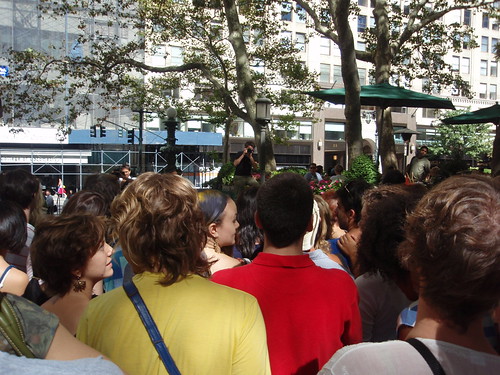
dance community NY group photo in bryant park

I don’t know who in the dance community annoys me more: those who consider themselves hipper than thou and call themselves “downtown,” or those who consider Ballet the only form of dance.

Spurred by Eva’s suggestion, I went to Bryant Park this afternoon to take part in the first ever group photograph of the New York dance community, organized by Belgian online dance initiative Sarma and local dance collective Chez Bushwick. Everyone who considered themselves part of the dance community was invited. Since I’m a dance blogger, ballet and modern fan and amateur ballroom dancer, I decided that included me.

When I arrived I spotted a robust, jovial-looking, curly-haired man wearing a t-shirt that announced he was a member of the photo op, and headed toward him. I kind of look like Sylvia Plath but shorter and with darker hair, or maybe Suzanne Farrell but not anywhere near as pretty 🙂 I have long hair and was wearing a ballet-y black bouncy-skirted sundress bow-tied at the waist by a red silk scarf, and sandals whose straps were topped with embroidered flowers. I was carrying an oversized pink bag bearing books. After making brief eye contact with me, the man peered around me to another woman and began greeting her, until I stopped right in front of him.

“Oh hi,” he said to me, surprised. “Um, we’re actually taking a photograph of the New York dance community here. Would you like to participate?” he asked hesitantly.

“Uh-huh, that’s what I’m here for,” I said.

“Oh. Oh good,” he said handing me a piece of paper announcing the rules (you gave them permission to use the photos of you on the internet and in magazines, yadda yadda). He also told me after the picture was taken, I was to sign my name on a roster of attendees and would receive a sticker entitling me to a free drink at one of the concession stands. He then told me they were running a little behind schedule and directed me to take a seat at one of the tables in an adjacent elevated area along the path.

I did as he suggested. Turned out to be the perfect little perch for me since its elevation gave me a good view of the crowd. I enjoy being an observer. Plus, I was having a bad hair day and was a little worried of running into Marcelo or David or one of my ballet heartthrobs, so could be on the lookout and duck for cover if need be. I had nothing to worry about as it turned out: there wasn’t a soul from the ballet world there.

Many people began arriving, and I didn’t know anyone. Finally, I spotted a fellow blogger in the crowd. As he was making his way to the tabled area after receiving his instruction paper, I waved to him.

“What are you doing all the way over here?” he said as he approached. I didn’t really understand the question so responded with a quizzical look.

“We don’t ever see each other,” he then announced, “because you’re a snobby elitist who only goes to uptown things. I go to all the cool downtown things.”

I just stared at him, not really knowing what to say. He laughed. Apparently I was supposed to take it as a joke.

“Well, I’m going to go around and meet new people while you sit here like a wallflower.” And he was off.

I kind of sat there stupefied. I think I saw Eva, but after that didn’t feel like getting up to say hello. Maybe some other time. I saw Jonah Bokaer, one of the organizers of the event and a dancer with Merce Cunningham. He’s rather cute in person 🙂 He was going around giving people who looked like they belonged small bottles of water. That didn’t include me. He looked right through me when he passed directly in front of my table even though I had my piece of paper with the instructions prominently displayed. A twenty-something woman with dark hair bearing a green “press pass” around her neck was going around with a notepad. She stopped at a table in front of me at which sat a man and two women with really cool-looking dreadlocks. I overheard them tell her they were retired dancers, now choreographers. I wondered if the interviewer was Gia.

About half an hour later, an announcer muttered something over a microphone that barely worked. From the crowd’s actions, I figured he was telling people to line up to his left. I followed suit, but kind of wish I’d just have stayed where I was to take pictures. I got a space all the way in the back of the crowd. I could hear him now telling taller people to move to the back, but apparently the average man over six feet either doesn’t understand English or has no sense of his size in comparison to others. Or else “downtown” male dancers are just rude. Some tiny women in the back brought over some chairs and stood on them. Soon, a security guard was in on the action ordering the people to get off the chairs. They paid him no mind. He yelled louder. They continued to ignore him. I couldn’t believe their audacity. And it did look dangerous: the plastic chairs were very insubstantial and the ground was really rocky and unstable. I wouldn’t stand on such a thing and these were dancers. He walked right up to one of them and yelled in her face to get off the chair or else. This was far more exciting than the photographer up front!

“Oh come on, officer” she whined like a character in Rent. Thankfully the last picture was snapped and the whole experience over, so there was no further trouble.

Good thing about being in the back was I was first in line to record my name. That of course didn’t mean I was actually first to do so. As the man handed me pen and paper, someone reached over my head and snatched the whole right out of my fingers, bumping me on the crown with the back board. Other pens and rosters were handed about, arms flying feet stomping everywhere. About fifteen minutes later I was finally able to scribble my name, identity (blogger), place of birth and email address, and receive my sticker, which I promptly took to the nearest concession stand.

“What’s this thing?” the clerk snapped.

“We’re supposed to get a free drink?” I said.

She laughed shaking her head. “I don’t know nothin’ about this.”

“The dance community gathering, over there,” I pointed to the raucous crowd bombarding the man with the rosters and stickers.

“I don’t know and I don’t wanna know,” she spit.

I guess it was a fitting end to a discomfiting experience. Weird, I was just saying how good it felt to be part of the dance community.

Survived First Dance Class in Four Months!

Okay, how come I always look like an ass in ballet class, but a ballerina in all the other styles of dance I take? Tonight, I took my first dance class in four months now (yikes) — a beginner Flamenco class at 92nd St. Y. Seriously, in lieu of the beautiful palmas (fluidly wrist-bending Latin / Indian hand movements that are one of the three basic elements of the dance), I did the perfect port de bras (balletic arm movements). I mean, I’m sure they wouldn’t have looked like perfect port de bras in ballet class, but they sure did in Flamenco. No matter how much Latin I take, for some reason I always have the tendency to turn my wrists inward so that my palms are toward my body (as in ballet), rather than turned out, away from it, as they usually are in Latin. It’s ridiculous.

And damn do those castanets require patience! We only did basic taps, but tapping the pinkie finger, then the ring, then the middle, then the pointer, then moving to the left hand in a continuous one-two-three-four-five rhythm, faster and faster and faster was so unbelievably trying on my nerves, for some reason. I had to keep shaking my hands like I was shaking off a bug or something. And keeping my arms up in the air was a bit painful, embarrassingly. I am just a bit out of shape here 🙁 And forget trying to coordinate the castanet taps with the wrists with the arms with the foot toe / heel stomps (my favorite part — gets rid of some real aggression :D)… forget it! This dance is so hard. It’s not athletically hard in the way ballet is, but it requires maximum coordination that I don’t have!

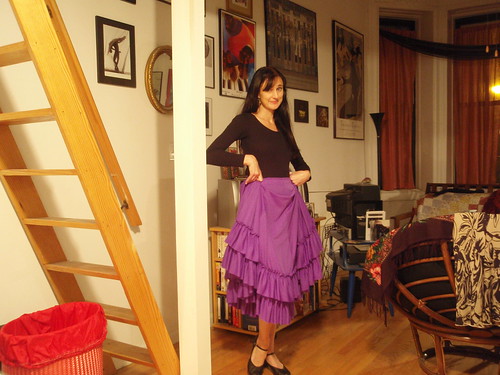
I’ll probably stick with it anyway; it’s good for me 🙂 Unfortunately, the teacher has a strict dress code — all black — so I can’t wear my pretty purple Flamenco skirt (above). Don’t really understand this — I took a Flamenco class at Ballet Hispanico months ago and wore the skirt to Paso Doble classes at two different ballroom studios and no one’s ever had a problem with the color. It cost $75 too, so I have no intention of buying another one in black. My black ballroom skirt will have to do, though it doesn’t have the pile of ruffles at the bottom so is not going to look wholly right for Flamenco… I just always pride myself on being different, so was rather pleased with myself for finding such a color.

I’ll never forget the first dance class that blew me completely to Heaven, made me feel like I was experiencing a whole new level of humanity, made my heart race: it was basic ballroom Samba with Roula Giannopolu at DanceSport studio. I remember I was squealing when I came out of there, practically crippled with blisters, my classmates trying to steady me and asking if I was okay. “What kind of music was that?” I screamed out demandingly, collapsing on the lobby sofa. No one knew and Roula had sprinted off to her next class. “That was like ballet and African and Latin and just the whole world!” I cried, flailing about. I haven’t had that same exact experience since and I so long for that feeling again. I think I may sign up for group ballroom classes next month. I like the solitary Latin dance classes I’ve taken — Brazilian Samba at Alvin Ailey and now Flamenco. But ballroom’s really where my heart is.

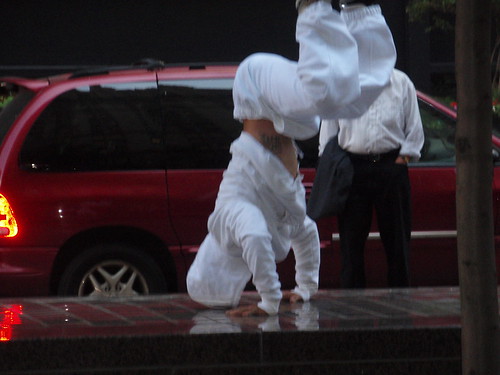
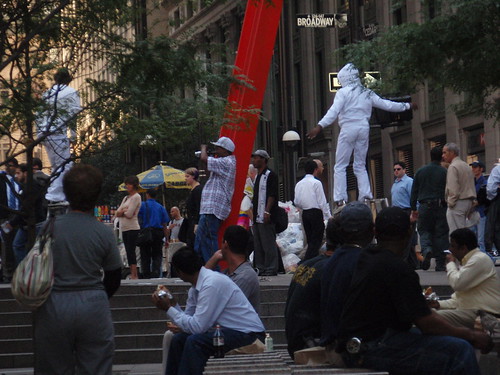
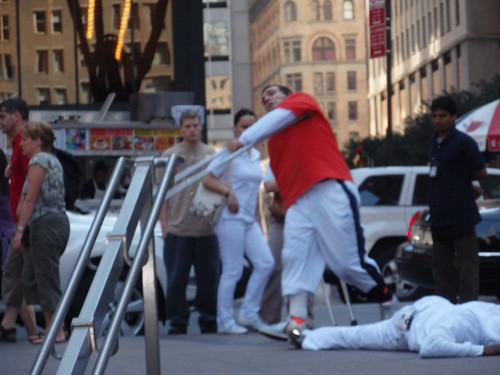
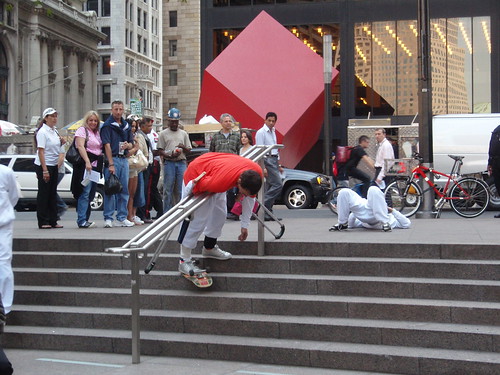
Anyway, on another note, here are some more pictures I took today during my lunch hour of the Bill Shannon “Window” site-specific dance performance that I blogged about at the beginning of the week. It was funny seeing it down on Liberty Plaza this time, after having watched from the high-rise before. I had thought when I was inside looking down that people were trying to be good New Yorkers and avoid any weirdish person making a “scene,” but being down there with the people, I realized that the area the dance was performed in was so vast, without music, it was actually pretty hard even to notice. You had to really seek him and his dancers out to see him. Dance is also so music-dependent I realized. Upstairs we had the music blasting from the speakers to accompany the movement we saw out on the plaza. It really got you into it, made you move a little yourself. Being down there with no speakers, the movement just didn’t have the same meaning, it wasn’t as fun, it wasn’t as noticeable, it wasn’t as “performancey” which I guess was the point…

One of Shannon’s break-dancers.

The guys in white are the performers. It might be apparent, it might not.

This is Shannon himself, on the crutches. I didn’t notice him zooming around on the skateboard this time; he used it more as a prop than a vehicle, unless I just arrived a bit late and missed that part of it.


On, and another thing, at one point a woman walked up to him while he was on the ground break-dancing. I guess because he had the crutches, she thought he was hurt and tried to help him up! He spoke with her a bit, but with all the city noises, I couldn’t possibly hear what they were saying. I wonder whether he went along with her, told her what was really going on, or if I just completely misunderstood the whole interaction and she was actually part of the performance!

Martha Graham Review to Come!

My friend Dea and I went to see Martha Graham dance company last night. This was only my second time seeing them live and the first was many years ago and I now can remember nothing but the magnificent costumes. I want to do more research before I write my review. In general, I felt like the dancing was superb, the dancers were excellent actors as well as movers, and they gave everything they had. Miki Orihara (pictured above) in particular was stunning as the woman scorned, the Medea character, in the first of the three pieces I saw, “Cave of the Heart.”

It takes only one viewing to grasp how original Graham’s movement style is, along with the costumes and sets, and the overall themes and storylines of her dances. She was into dramatizing into dance Greek tragedies and Biblical stories. Lots of toga-style costumes; lots of Greek / ‘Egyptian’ movements: palms up, arms out to the sides, elbows bent; lots of flexed feet, large steps, lots of angularity. Her movement style was clearly that of the stories she was enacting through dance. My first impressions of her thematically are that she saw sex and sexual relationships as very destructive and often fatal.

Two of the pieces I saw — as with almost all dances in the company’s rep this season — were from the 40s and 50s; the third was from 1981. “Cave of the Heart” was a re-telling of the Greek tragedy, Medea, and “Embattled Garden” the story of Adam and Eve. Timeless stories for sure. My question is, is a certain movement style equally timeless? Are sets and costumes timeless? I felt like I was getting an important lesson in history, much the way I felt when I investigated that Merce Cunningham exhibit at the NY Public Library. I have a masters degree in History, was once on my way to becoming a professional historian, so obviously I care greatly about the subject. But I kind of think dance companies need to have an equal amount of the new with the old.

The third piece in last night’s program, “Acts of Light,” the one from 1981, was gloriously abstract, movement for movement’s sake, likely the least “Graham-ish” and my favorite, Dea’s least, go figure 🙂 Some toga costumes on the first couple doing a duet, but in the end, the stage was ablaze with the ensemble dressed in very tight-fitting unitards that at first looked nude, but when the lights lit up I realized were radiant gold. So much more sensual than actual nudity.

Dea noticed we appeared to be the only two people under 40 in the audience, an increasingly disconcerting phenomenon at dance performances these days.

Anyway, sorry these thoughts are so disjointed. I want to read over the materials I was given and do a little more research on Graham before writing a longer review, and I’m busy at work today 🙁 I promise to get my write-up posted this weekend though! In the meantime, here are Apollinaire’s blog thoughts (she went opening night and loved it), here’s her Newsday story, and here’s Sir Alastair’s upbeat take.

[One note regarding Apollinaire’s blog review: there are three pieces by contemporary choreographers that were shown on opening night but that aren’t part of the company’s repertory — one, by Larry Keigwin, seems to have been in tribute to 9/11 which was nice. Apollinaire asserts that one of these works each is to be performed each night during the season, which would have been nice, but last night none of those contemporary works were shown).

Martha Graham is showing in NYC from now through September 23rd; tix, which can be purchased here, are $44 for non Joyce members, except on Sunday nights when they’re only $25. It’s most definitely worth seeing whether you end up liking her very specific style or not, or think it’s dated or not. Graham is a seminal figure in dance in this country. So please go if you can (and let me know what you think)!