
Ugh, I had planned to do my write-ups of Gypsy and Pilobolus this afternoon (basically, liked but didn’t love both of them), but got carried away with a brief, of all things! Evil case I found at the last minute that threw a wrench in my argument! Anyway, Alyssa and I are off to Jacob’s Pillow to see Brazilian Samba / Ballet /Ballroom troupe MIMULUS, and my eagerly awaited BAD BOYS OF DANCE hehehe. So excited! I promise lots of blogging (and write-ups of Gypsy and Pilobolus when I return). Only drawback is that I’ll have to miss this week’s SYTYCD 🙁 But looking forward to reading all about it and hearing everyone’s take and seeing YouTube clips when I get back! Please Pasha and Danny be safe…
Pilobolus yay!
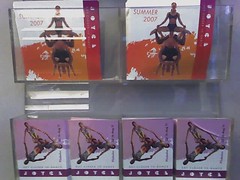
Poetry in Silence: My Last Post on the Michalek Exhibit, I Swear!
Okay, I’ll have everyone know that it is currently between the hours of 9 pm and 1 am and I am NOT, I repeat NOT, on Lincoln Center Plaza!!! This is a huge step forward for me; yes, I feel that I am steadily on my way to overcoming my addiction…
Here are some pictures from last night, Sunday, when I attended “Slow Dancing” for my fourth time in, yes, the mere four days the exhibit has shown, this time with my fellow blogger, Oberon. It was a “schmoozing with the artists” night for us:

Oberon cutely peeking over his shoulder at me. And, in the background is Michalek (in red bandana) talking to the filmed dancer on crutches, whose name I now know (thanks to the playbills near the State Theater entrance 🙂 ) to be Bill Shannon, or “Crutchmaster.”
And here is Philip with his favorite ballerina, the spectacularly amazing, and, given her enormous status, almost ridiculously nice and personable, Wendy Whelan:

Sorry to be going on about it ad nauseam now, but I’m just so excited about this exhibit because I feel like it has so much potential to be really powerful. It’s like ballet for the masses, and I LOVE it.
Interesting thing about last night was, unlike the previous ones, there was no Midsummer Night Swing. So it was shown in stunningly dead silence. At first Philip and I were thinking, hmmm, this is going to be odd without music, maybe they could have classical or something?… But then after it began we agreed it was really quite beautiful, really poetic this way. Actually, it was more like a regular concert dance performance, like being at the ballet, but outside. And in this poetic silence, I feel like my previous suggestion of having the dancers’ names on the screens, would be as ludicrous as having an announcer yell out names, SuperBowl style, during a Met performance. But then, I still think it would make good sense to post the names prominently during the MNS crowd, because those people are not going to go running up to the State Theater to pick up a brochure or search for a poster; in that context, it needs to be easier.
Anyway, the lack of raucous crowd enables you really to focus on the odd beauty of the movement; I saw many things I’d missed before. Of course I had Philip and Wendy as guides. Wendy told us to watch for Allegra Kent, a former prima ballerina who danced many a performance, with the New York City Ballet, right inside that State Theater. At the start of her routine, she briefly turns her back to you, the viewer here, in order to face her beloved theater, and, inside, her audiences past. She raises her arms up high, in eternal gratitude to them, to what happened beyond those doors, now long ago. It’s such a poignant gesture of reverance to those fans, to the past, and, given who she is, to ballet history in general, and you just want to cry.
And I guess that’s why I want there to be a way of spreading that message to everyone; if you don’t know who she is, I fear she may just look like some weird lady casting a spell or something, you know? And that would be just a travesty.
When Janie Taylor came on, Philip squealed, grabbed my arm and galloped, dragging me along behind, over to the far right of the plaza, beyond the Midsummer Stage, where we could have a full view — something that definitely wouldn’t have been possible if it was a social dance night.
“Oooh, her hair, look at her hair, look at her hair!” he screamed, flailing about so wildly he really could’ve knocked me out had I been a little closer. Funny, but that flying mane did look cooly like a waterfall this time. Philip should be a professional laugher, or whatever those people are called who get paid to fire up the audience.
So, I dunno; I feel like my perception of the event, of the spectacle, varies on the context. There was still a congregation, but of course nowhere near the size of that on a Midsummer Night. It was a night for the true diehards. I’m glad I saw it when it was quiet and I could really concentrate (and meet Wendy!), but I still love watching with the Swingers, seeing what they see. (Thanks, by the way, to Michele, who commented on my last post, giving her view from that salsa mosh pit!) I have seen many of the social dancers, taking breaks, stand back and gaze up, and try to imitate some of the moves. You develop a dance aesthetic as a watcher / participant and it’s fun to try to mirror those screen giants, so long as no one gets hurt with some crazy over-the-head leg extension… 🙂
David Michalek's "Slow Dancing": A Good Idea But Poorly Executed (*Update in Bold)
Hehe, my friend, Ariel Davis, a young journalist currently in NYC for an internship with a big magazine, emailed me bright and early yesterday morning to tell me that we were quoted in the NYTimes! Of course I immediately scoured the article. Well, we weren’t actually quoted, in that our names weren’t listed, but we were the ones exclaiming, “he looks like a god,” the top quote in Claudia LaRocco’s write-up of the opening night of the Slow Dancing films I’ve been mobile-blogging about for about the past fifty posts now. (I promise to stop soon with the cell phone blogging; it’s just so exciting, in its own way). Anyway, the “god” Ariel and I were speaking of was Herman Cornejo of course 🙂

Anyway, I’m going to see it several more times before it leaves NY, but so far my thoughts are that the project is a great idea that has some real kinks to work out.
For starters, Lincoln Center is really annoying me and if I was Michalek I would be pissed. Slow Dancing starts at 9 p.m and continues until 1:00 in the morning; Midsummer Night Swing ends at 10:00 p.m. But after the MNS band stops playing, Lincoln Center really shuts down: the alcohol and snack bars all close shop, making it impossible to enjoy a drink with friends while watching the films, and, more seriously, a very noisy cleanup begins. The Aquafina guy noisily dismembers his metal booth then hauls it all, bit by bit, to a huge garbage-like truck waiting, motor running, in the nearby taxi cab lane; the bar guys clinkily clear bottles and glasses from their shelves; garbage collectors noisily bag trash and load it onto little trucks, which they drive dangerously through the crowd darting in and out and around groups of people, sometimes even honking if you don’t see them coming — how’s the audience supposed to focus on the film with all this crap going on? You feel like Lincoln Center’s telling you it’s time to go home now, show’s over, you’re out past your bedtime. Until July 29th, when this exhibit ends, could they possible re-arrange clean-up schedules? It’s hugely disrespectful to the artist and his audience.
As for the project itself, I think it’s a great idea and it seemed to work well when I saw it indoors at the earlier Works & Process event at the Guggenheim Museum, but for some reason, it’s not as exciting outdoors on the huge Plaza. I think part of my being so captivated at Guggenheim stemmed from the fact that I know and love all three dancers who were showcased that night: Wendy Whelan (ballerina of New York City Ballet), Herman Cornejo (American Ballet Theater), and Desmond Richardson (Complexions). But the vast majority of the dancers participating in the whole project I don’t know, or at least don’t recognize.

As LaRocco alludes to in her article, not a lot of the people on the Plaza for Midsummer Night Swing paid much attention to the films, unfortunately. Several heads did turn when the screens first lit up, and people watched for the first couple of minutes, but when they couldn’t see very much happening, they returned to their own fun. LaRocco bemoans that these social dancers, themselves participating in Dance, are ignorant of those on the screens, many of them the greats of ballet and modern dance.
Well, why should those dancers, having such a blast learning to dance themselves, stop what they’re doing in order to worship these people on the screens, whom they don’t know? Might someone, perhaps, tell them who they are?
From what I’ve seen so far, here are my critiques of the project:
1) No one knows who the dancers are and no one is bothering to tell them. If they’re not going to have easily available pamplets listing the names and credentials of the dancers, with pictures, could they run the names and a brief word about who they are somewhere prominent on the screen, at least at the start of each performance? Names humanize people. I’ve noticed this watching people watching filmed ballroom dance competitions — people who aren’t really seriously into the art of ballroom just kind of glance at the screen and look away after all of a minute — there are far too many people out there on the floor at once, it’s too much to take in, it’s confusing and nonsensical.
But once names are placed over the dancers (briefly, not for the entire time the camera’s focused on them of course), people pay much more attention, even if they’ve never heard the name before (which is highly likely). You think, ‘oh that couple’s obviously from Russia with huge names like that,’ ‘oh a Japanese couple,’ ‘wow, another Russian; a lot of Russians in ballroom, who knew…’ ‘oh wow, those are the national champions, yeah, they are really good,’ etc. etc. Names humanize. A little bit of info goes a long way.
Update: I went again tonight (Sunday), with Oberon, and found that there are little Lincoln Center playbills near the entrance to the State Theater, along with a poster, both giving the names and a brief background of each dancer next to his or her picture. I still like the idea of printing the names somewhere on the screens though! Also, I met Wendy Whelan tonight — she’s a very sweet person! Here is a picture of her and Oberon. Awww 🙂
2) There are either too many of the same types of dancers or there’s not enough variety and spontaneity in the rotations. At several points, there are two to three dancers shown all at once who are all doing modern. This is boring and reductive. Also, can everyone not be dressed exactly the same? Wendy Whelan and Janie Taylor are ballerinas but they’re both dressed in the same silky flowing gowny things as about ninety percent of all the women. To someone who doesn’t know dance, it could be confused with yet more modern. Couldn’t at least one be in a tutu and on pointe. And, could someone do a fouette or multiple pirouettes? The movement is too much the same. It would be much more interesting if there was, say, in the middle a classical ballerina on pointe in a tutu doing fouettes, then say the African dancer guy on one end, and maybe William Forsythe doing his modern on the other end; then shift in the next sequence to the bellydancer, adjacent to the head-spinning break dancer, and sandwiched in between, the drag queen; then next sequence, say the guy on the crutches, the pregnant woman, another ballerina; or have a ballerina surrounded by a strong ballet guy and one of the modern women. Just make sure there’s variety in every sequence of three. That makes it interesting and it’s more of a celebration of Dance, in its rich variety.
3) I realize the point of the project is to show movement in extreme slow motion, but I feel that it is too slow. At points you can’t even see the dancers moving at all. This actually may be a glitch in the film, because at some points I think the films have actually stopped for a while — sometimes even for as much as a full minute. This is confusing to the audience, who is already perplexed enough trying to figure out, as LaRocco illustrated with one couple’s conversation, if there actually is movement. Possible technical problems aside, though, the movement is generally still too slow. Instead of people admiring every detail of the body in motion, every ripple of a muscle, the audience just gets bored, especially if the dancer isn’t “flashy” enough. These past couple days I’ve become most fascinated with Glem Rumsey, who dances here as his flamboyant drag persona “Shasta Cola.” I find myself waiting for him to come on because I know I’m going to be most entertained. In contrast, one of the dancers I was most excited to watch was Janie Taylor. Yet, I find myself getting unexpectedly bored when she’s on here. She does nothing really over-the-top; no spectacular balletic feats. Even that crazy hair flip that generated a lot of press talk pre-show opening — it’s nothing; I almost missed it. There’s no appreciation for subtlety when the movement is this weighted down. The guy on crutches is initially intriguing because you’re wondering what he’s going to do, but you get bored and stop watching when he takes so long to get going. All of a sudden you look back and him and he’s in the air. You think, ‘oh wow,’ but it still doesn’t hold your attention for long because it takes a number of minutes for the guy to do one rotation. You lose interest. Same thing with the Whirling Dervish. Slow-mo can have a very dramatic effect, but not when it’s this slow.

My own personal favorites are Herman Cornejo, Desmond Richardson, William Forsythe, and the aforementioned Rumsey, all of whom, excepting Rumsey, I’m pretty sure I like simply because they’re already so familiar to me. I’m bringing a bunch of friends to the show over the next couple weeks, many non-dance-goers, so will be interested to hear what they think, who their favorites, if any, are. Will most definitely report back!

In the meantime, I’ve started an album on the photo page; I expect to add more pictures, but here are the first few.
William Forsythe!
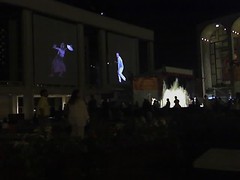
Originally uploaded by swan lake samba girl via mobile.
A favorite choreographer / dancer of mine on the far right screen.
Screens are up!
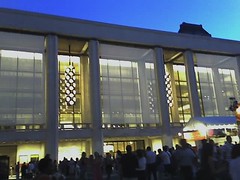
Originally uploaded by swan lake samba girl via mobile.
Screens are up! Waiting for the show to begin.
Ugh!
Oh! Look at what I am missing! Right up my alley 🙂 Am so so SO jealous of anyone going to Jacob’s Pillow this year!
Update: thanks to my wonderful, spontaneous friend (who has not lived in NYC for so long now that she has forgotten how to operate a motor vehicle :)), we are going up after all! Will be seeing Bad Boys as well as Mimulus, a Brazilian company that fuses tango, samba, ballroom, theater, and contemporary dance — right up my alley as well! This is my first time at the Pillow. Can’t wait!
I Finally Got My Dramatic Odette!: "Swan" Wrap-Up, Taye Diggs, and a Fun Reader-Participation Survey!
So, Saturday afternoon I saw my third, and probably overall favorite, Swan Lake at ABT. As I mentioned in my last post, I had gone hoping to see Veronika Part in the lead role but, sadly, she was unable to perform due to an injury. I MUST see her perform this role at some point! Next year…
The Trouble With Favorites
So, taking her place were Irina Dvorovenko, as the White Swan, Princess Odette / Black Swan, Odile, and her husband and frequent partner, Max Beloserkovksy, as the Prince. Seeing Irina, whose performances I used to go to much more often, made me realize what I miss by having my favorites and only going to see them. Not that it’s unimportant to have favorites — I think it’s a huge part of what draws you to a certain company and then, in turn, to ballet or dance, in general. And, my two are of course him and most definitely him 🙂 🙂 . The problem for me is, it means missing out on ballerinas like Irina, who, for some odd reason, doesn’t ever dance with these two guys. And I ended up getting everything from Irina that I had complained about not getting from the two previous ballerinas I’d seen!
Backtracking for a sec, I first saw Diana Vishneva and First Favorite Man 🙂 , and, as I had blogged earlier, wasn’t very moved by Diana, mainly because she seemed to have no connection with Marcelo’s Prince Siegfried; her Odette (White Swan / Princess), as I said, existed in a completely separate world from him.
Then, Friday night I had my second SWAN viewing, with Second Favorite Man 🙂 ) and Michele Wiles in the leads. To this one, I brought a friend, and one who has never, at least to her recollection, seen a live ballet performance. She’s familiar with classical music though, and with Tschiakovsky, and was interested in going because of that.
Classical, Story Ballets Involve Dramatic Action
It’s always fun to introduce a new person to ballet to see what they think, what their initial reaction is: whether they found the love of their life, were bored to tears, were completely stupefied, were completely mesmerized, or, by turns, were actually all of the above. I guess my friend was pretty much the last: in the end, she said she found Ballet intriguing enough to try another, but concluded that Swan Lake really was just not going to be her favorite. I’m a relative newcomer to the scene too, having been going for a couple years, and I pretty much shared her issues with this cast / production, which were the same as with the Diana / Marcelo one: a fun, flirtatious, overall good Black Swan who made the second half of the production a little more lively than the first, but a too ethereal White Swan who couldn’t garner audience sympathy, forcing the first half to be long and boring, and overall preventing the audience from connecting to the characters, story, and action. My friend said she thought the second ballerina (in the black) was better than the first: she didn’t know they were the same!
My feelings about Michele are a repeat of Diana: at the beginning, David’s Prince spots the Swan at the lake, prepares to shoot her with his crossbow, until he sees her transform into the beautiful girl Odette, then hides in the bushes and watches, transfixed by her beauty. Odette is supposed to spot him, and began fearfully to flutter away until he convinces her he means no harm. She then supposedly tells him her tragic story of being turned into a bird by the evil von Rothbart; mesmerized, he listens attentively, falls deeply in love. She falls for him too, and her plight is caught up in their love, as only his pure love can break the spell, allowing her to become a girl again.
Diana’s and Michele’s Odettes, however, are completely unmoved by, even unaware of, their princes. They danced beautifully as swans (Diana had more feathery, watery arms than Michele, though Michele blew me away at the tail end of the scene as her arms turned airy and liquidy and she nearly flew on pointe into the wings– don’t know why she couldn’t have done that throughout), their princes come out of hiding, toss their crossbows away, shake their heads to say, “no, I’m not going to hurt you,” and run to the girls. The girls are supposed to tell their princes the story of the spell, through that beautiful pas de deux. But Diana and Michele don’t even so much as look at the men throughout this entire scene. So, the men are basically having a conversation with themselves, an internal conflict over this creature, while she dances about in her own world. “Wait, when did she tell him the story?” my friend asked at intermission, frowning down at her Playbill. “I feel like I missed all of this,” she said pointing to the synopsis. She did; she missed everything because it didn’t happen.
Diana and Michele were better in the second half (where von Rothbart casts his daughter, Odile — the false Odette — in Odette’s likeness to trick and seduce the Prince), but still weren’t ideal. Their dancing was spectacular, all those crazy fast fouettes and pirouettes and jumps were thrilling, but, apart from the dancing, there was no drama: they still weren’t connecting to their princes, so the seduction and flirtation wasn’t there.
In other words, a drama happens when two or more people interact with each other. One character wants something from another and there is a conflict, leading to a dramatic situation. I realize that a ballet is not exactly the same as a play. A ballet involves, obviously, movement, part of which tells the story. But story-ballets (and, to me, even shorter, more abstract ones, as I’ll talk about later) are dramas and they need full, three-dimensional characters who bounce off of each other.
Irina understood this. Irina’s gorgeous Swan is dancing beautifully center stage, arms aflutter, in her own tragic world, just turning from swan to girl, when Max’s Prince, overtaken by her beauty, rushes toward her bow and arrow still in hand. Irina’s girl actually looks at him, realizes she’s in danger, holds her arms up to her face, shielding herself, and begins bourreing quickly backward. He tosses the bow and arrow aside and runs toward her, gesturing that he won’t hurt her. She then performs the beautiful pas de deux with him, perfectly conveying to him her sad story of the spell. Obviously, she can’t say anything in words (and the words are in the Playbill so it doesn’t matter), but, I mean, she tells him everything with her body and her facial expressions. She’s not in her own world; she’s “talking” to him. Even when her body is turned away from him, and she can’t look at him, she registers his presence with closed eyes, head tilted back ever so slightly, subtely, toward him. And his body language and facial expressions convey that he listens, hears, and understands. The whole story was perfectly, compellingly HERE. When von Rothbart enters from the back of the stage to claim her his Swan, taking her from the Prince, and the Prince retrieves his bow and arrow, Irina quickly bourres backward to von Roth., shielding his body entirely with hers, her head turned dramatically up, as if even to protect even his head from a blow. She even shakes her head “no” at the Prince. Irina’s Odette makes it all too clear that the Prince can’t kill v. Roth or she will die as well.
I know critics don’t often like Irina, and I’m not entirely certain as to why, but I’ve heard it’s partly because she “overacts.”And I seem to remember hearing specific complaints about those turned-up chins of hers. Well, all I can say is that I felt that she made more dramatic sense of this story than anyone else I’ve seen, and I wished my friend would have seen her Swan.
The Men, And What Makes Hallberg So Sexy?
As for the men: I’m not a huge fan of Max — he doesn’t seem to have the technical prowess or the stage personality of either of my favorite guys — his jumps are not as high and his legs don’t fully straighten out into splits when he does them, unlike with the other two, and doesn’t have Marcelo’s humanity and relatability or David’s brainy sensitivity or either man’s inherent sexiness of movement (can I just ask, for a minute, WHAT IS IT ABOUT THE WAY DAVID WALKS across stage? He has this way of settling into his hip socket, or maybe it’s that he lifts his pronounced, pointed foot entirely off the floor with each step, or maybe his weight is a slight bit more foreward, like in Rhumba walks — whatever it is, the way he moves about stage when he’s not leaping or pirouetting is so crazy sexy and so unlike anyone else’s movement. Since he’s practically the only American man in ABT, I wonder, is it an American thing — something in his training? Maybe it’s nothing more than that he simply has longer legs than most). And it’s definitely not something he does on purpose. Joan Acocella recently noted that he doesn’t seem to know he’s a star. He doesn’t seem to know how hot he is either 🙂 !!– I hope it stays that way. I don’t want him to become a pompous ass!
But back to Max: regardless of the above, I thought he did a very good job with this character. He showed the growth of the Prince, noble but immature at the start, into a man transformed by love. He was princely, yet human and real. And, as I said, he worked very well with Irina’s Odette, listening to her story, reacting to it, using his body and face.
Miming Doesn’t Work
I met up with Delirium Tremens afterward and we chatted a bit. She has a big ballet background, having studied ballet at School of American Ballet and Joffrey, and she gave me this brief lesson in mime in case I missed something. It was really interesting, but some of the miming gestures looked to me nothing like what they actually are. Like, making fists with both hands and crossing your arms at the wrist is supposed to symbolize “death.” I thought when I saw the various ballerinas doing that, it meant “no” or was somehow intended to convey some sort of angst. But I didn’t know it meant, “if you do this it will result in death.” I’d have to see them again, but it made me wonder if perhaps the first two ballerinas I saw relied very heavily on mime to convey their stories, and that’s why I couldn’t understand? I know Irina did a little, but she backed it up with generally understood facial expression and body movement. If the choreographers and stage directors are going to rely on mime to tell a story, which I don’t think is a good idea, they need to somehow make everyone aware of what everything means, so that not only people with dance background can enjoy the performance!
Dancers Are Smaller Than They Appear!
I ended up hanging around Lincoln Center for much of Saturday afternoon since I was to meet Apollinaire at the Library of the Performing Arts (adjacent to the Met Opera House) later in the day for an evening performance. I ran into several dancers on their way to work– Adrienne Schulte, Herman Cornejo, and Jared Matthews on his way away from work (he performed yesterday as the Prince’s sidekick, and he was excellent by the way! Sky-high jumps, very agile and quick-footed dancing with a lot of precision and clarity. His prince sidekick was almost as good as the athletically spectacular Sascha Radetsky‘s — not quite as clean but almost, almost. Jared is working super hard, as is Sascha. Anyway, it’s so amazing to me how much smaller they all are up close when you see them on the street!
Vitali Krauchenka’s Awesome Swampy von Rothbart
And, one more little note on SL: can I please please please see more of this guy:
His swamp-creature-y von Rothbart was compelling beyond words. The ballet ends with him, dying after Odette’s death has taken the life from him. I’m not a fan of pure evil; but rather prefer nuance and complexity, and, not to sound cheesy,but his performance honestly almost brought me to tears.
His von Rothbart loved Odette and is just in so much pain in that last scene after she’s committed suicide. He makes me feel so much sympathy for him, even though he’s supposed to be “the bad guy.” And with that intense, oh so familiar music building to a dramatic crescendo, he makes the tragic ending so moving. Please, Kevin, more Vitali!
Taye Diggs
Okay, Taye Diggs: Very briefly, since this post is now bordering on 100,000 words — Saturday night, Apollinaire invited me to go with her to see Taye Diggs’ newish modern dance company, Dre Dance, at the Joyce in SoHo. I know Diggs only for his role in the movie GO, but he was a star of the original Broadway show, Rent, and acted in the movie version as well. He has other Broadway credits, but who knew he was a modern dance choreographer!
It was a lot of fun. I sat next to Diggs himself during the first half, then his co-choreographer, Andrew Palermo, during the second. Diggs is a much smaller man in real life too! I guess that is kind of the rule in the performing arts: everyone looks larger than life on stage or screen… The dancing was very interesting, very dramatic. They gave us press packets including a DVD of rehearsal and I’m going to look over everything and perhaps write more later, but for now, my initial reaction was that I thought it was, just, really cool. Choreography was original and involved a lot of emotional intensity and was set to mostly contemporary, very rhythmic music with a strong, fun beat — kind of poppy but not recognizably so, except for a little Rufus Wainright. The program was a compilation of pieces they’ve choreographed over the past two years, with the exception of one new piece, so the performance as a whole didn’t have a single narrative or theme. But, storyless though the whole was, with each piece the dancers themselves, through interactions with each other, told a kind of mini story — angry and fighting one another at times, at points hungry for attention from each other, needily begging each other for compassion (one dancer tried to climb atop another, hugging her, the other pushing her away). Each dancer very intensely wanted something from another, from the others as a unit; it was full of drama, which is Diggs’ thing after all. During the last piece, a woman came out in a business suit, hair tied in a bun. In a moment of anger, she ripped off the suit jacket, ripped the knot out of her hair and shook and shook and shook, first body then hair. Then, she calmed herself, took a deep breath, and slowly put her suit jacket back on and hair up. I found this such a short, yet powerful statement about the necessity of composing yourself for work, for life, of taming the inner self in order to get along in society. All of the pieces were this way: small vignettes containing characters who desperately wanted something from each other, creating intriguing, compelling sitations that made you desperately want to know the fuller story. The complete antithesis of my first two SWANS.
Fun, Reader Survey!
One last thing: there’s a really fun discussion underway on the Foot in Mouth blog. Apollinaire Scherr and I were discussing the never-ending question of why ballet is not as highly revered right now as it once was, and I had posed the question of why opera and some other of the “high arts” are currently more popular. San Fransisco dance critic Paul Parish surmised that it’s because opera is better recorded and therefore more accessible to the public. As someone who became an avid balletomane initially through a video not a live performance, I disagreed, and responded here.
This is a really fun discussion, and please, all of you Ballet fans out there, do participate! What initially drew you to ballet? Was it a film / video or a live performance? Was it “Center Stage” or another ballet movie? What are your favorite videos? Is a live performance better than a video? Why or why not? And do you agree that ballet is not well-recorded and thus cannot reach as large an audience as opera? Why do you think other arts or other dance forms are more popular right now than ballet? And, what can be done to better promote ballet? To add your two cents to this debate, please go to Foot in Mouth and add your comment, either here or here.
Dance of The Best Kind — Provocative, Evocative and Meaning-Laden: Ohad Naharin’s DecaDance
Wednesday night I went to contemporary ballet company Cedar Lake‘s performance space in west Chelsea to see “DecaDance,” a new work comprised of pieces from the past 20 years choreographed by Israeli dancemaker Ohad Naharin for his Tel Aviv-based company, Batsheva.
Still a bit disoriented from jet lag, a long drawn-out meds-laden TAC headache, and coming down from my ballroom high, I was worried I just wouldn’t be into a small, modern dance performance enough to appreciate it (I’d ordered the ticket a while ago). But, happily, I was very wrong! “DecaDance” was just what the doctor ordered to get me out of my Blackpool-withdrawal depression and back into the ever-alive NYC dance scene.
To me, this is the best kind of dance: movement creating images that, combined with provocative words and/or exhilarating, exotic, or evocative music, unsettle, evoke, just compel you stop, look, and think. I remember Joan Acocella reviewing in the New Yorker Telophaza, the work Batsheva performed nearly a year ago at last year’s Lincoln Center Festival. I remember her saying she wished with all the goings-on in the world at the time, Israel’s premier dance company would have put on a program infused with some kind of political meaning. I understood her sentiment, mainly because I like that kind of work as well and am always immensely interested in knowing what it’s like to be a citizen of another country, to exist in a world completely different from my own, but I thought it unfair to demand dance containing some kind of meaning about world politics from a troupe simply because of the geopolitical situation of its country. But the funny thing is that, watching Wednesday night, though none of the pieces made any kind of simplistic statement, I think my brain just naturally infused everything I saw with a socio-political undertone, perhaps because of that geopolitical situation.
The program began with a line of dancers, dressed in white leotards and black tights. The dancers shouted chants whose meaning I couldn’t understand, then one by one, each dancer took a couple of steps forward and danced, then stepped back into line while another dancer took a turn. Then, after each dancer had his or her piece, the line stepped backward together, fading into the background shadows. The way the light reflected only the bright white leotards had the effect of making their legs fade into the dark, so that they looked like limbless torsos. The chanting made me think of a military regime, and the legless bodies of the effect of war. I have no idea if that was what Naharin had in mind, but that’s what I got.
That scene led to a very brief pas de deux between two women (or was it a woman and a man … can’t remember) dressed in black corsets lifting, scratching at, bouncing off of each other, and that blended into a scene with several men engaging either in a monk-like ritual cleansing involving a bucket of dark, muddied water, or else splashing themselves with war paint. About three-quarters of the way through that scene a scantily-clad yet virile-looking woman wearing a feathery headdress and a face-full of garish make-up (perhaps another kind of war paint) walked sexily across stage on low stilts. After the men left, she returned with a free-standing microphone atop a giant pitchfork and, in the manner of a cabaret performer, lip-synced the words to an industrial techno-aria. Because of her raunchy garb, gawdy makeup and the manly yet sexy way she walked on the body-distorting stilts, she evoked for me a frightening vision from the late Weimar Republic or perhaps a contemporary Russian sex slave (thanks to Blackpool, I have Russia on the mind lately: anytime there’s a ballroom dance competition, the environs are tranformed into a “little Russia”) — either way, a grotesque reminder of the way a time of uninhibited freedom can turn into a reign of terror or how one person’s idea of fun is another’s hell.
My favorite piece involved several women who danced to a spoken word accompaniment. In all of the reviews I’ve read where this program or different versions of it have been performed elsewhere, none mention this piece, so I have no idea what it’s called and unfortunately can’t remember the words of the voice-over perfectly. One of the annoying things about this program is that the playbill doesn’t specify which piece is from which longer work, and which musical number accompanies which work, so I couldn’t figure out what each piece was called or research it very well. Naharin says, the playbill notes, that he enjoys “breaking down and reconstructing” his work, “enabl[ing him] to look at many elements in the works from a new angle,” so he obviously doesn’t want us to get bogged down in trying to figure out which piece is from which larger work, but wants us to see it as a new whole. The ‘problem’ or maybe I should say ‘challenge’ with this for me is, I’m unfamiliar with his work and so have no idea if I’m totally reading anything completely wrong. I may have a wholly different interpretation if I saw, for example, the Weimar / Russian slave woman in the context of the whole “Sabotage Baby.” It made me want to see his other works so I could compare, see if I “got it right” or see how my interpretation shifted depending on context.
Anyway, back to my favorite piece, about which I couldn’t research since I couldn’t figure out it’s title, longer whole, or sound accompaniment …: the male (if memory serves correctly) voice-over, issues forth various orders to the women dancers, and perhaps to the audience, providing, as I saw it, an ironic commentary on living female. The voice orders you / them to play the game enough to be able to own a house and car, resist working or thinking too hard so as to over-stress their fragile compositions, reject big ideas or philosophies, reject too much beauty so as not get carried away with art, and my favorite line — always wipe your ass really well because it’s uncouth to let others know you just shit. The piece – both the lyrics of the voice-over and the dance movements, was repetitive: the speaker repeated each line before adding a new one. And each woman had a certain movement corresponding with each word. Everytime the phrase repeated, so did each woman’s dance phrase. It was really interesting seeing the way the dance phrase corresponded to the written, and the way the movement added to the meaning of the words. For example, when the voice-over dictated, “reject Beethoven, the spider, the damnation of Faust,” a phrase near the beginning of the piece and thus repeated many many times, it was interesting to see each dancer’s interpretation of “spider,” “Beethoven,” and “damnation of Faust.” Some movements were unique to each dancer; others universal. It definitely didn’t speak to the state of Israel or have any huge overarching meaning for world affairs in the way the Acocella article wished for, but sometimes I find those quietly ‘personal-is-political’ pieces to have the most profundity.
Then there are a couple of pieces that “break the fourth wall”– ie: involve audience participation. One female dancer tried to pull me onstage with her to participate in this group jumpy hip hop – turned tango-y number, but I had to refuse because I was still woozy from the meds and, perhaps, ridiculously, still jet lag. Anyway, I never feel comfortable doing such things. She was nice and let me go, found someone else to get up there with her!
There are some other compelling pieces that I left out. I’m really interested to hear what others think about this. I found it very evocative, thought-provoking, very open to interpretation, and just a lot of fun. It’s showing through July 1st at Cedar Lake. Go!
Baryshnikov @ doug varone

Originally uploaded by swan lake samba girl via mobile.
Baryshnikov @ Doug Varone‘s Dense Terrain at Brooklyn Academy of Music. Ha ha, I know it’s only the back of his head, but I swear it’s him! Was sitting two rows down from me!! Interesting performance, not sure what to make of it… but it was very thought-provoking and full of meaning, interesting movement, dealt with difficulties of communication through language, was very dramatic, violent in parts, provocative music, somewhat political but not obviously so and message was not simplistic, used multimedia, reminded me a bit of Forsythe…
Ad Hoc Ballet, and Final Thoughts on Romeo + Juliet With Major Kudos to NYCB for Audience Accessibility
I’m so behind on my blogging! I meant to blog about all of these things I did over the weekend MUCH earlier in the week, but with ABT opening and all, it’s just been…crazy!
So, last Saturday evening I went to see ad hoc ballet, a very intriguing new company founded by engagingly unique Deborah Lohse, with dancers Amy Brandt, Elizabeth Brown, and Candice Thompson, a new contributor to the Winger and the reason I found about about this cool new company in the first place! I had also seen Lohse a couple of weeks ago at Symphony Space in a work by choreographer Monica Bill Barnes and was immediately drawn to her.
I just love ad hoc’s mission statement: “ad hoc Ballet is committed to creating new works, which incorporate elements of classical ballet and modern dance, while exploring current social tribulations. Drawing inspiration from outsider populations that America tends to ignore and uniting pathology with empathy to uncover new movement, ad hoc Ballet explores the beauty in the alternatives to the classical aesthetic of perfection.” This is just the kind of dance I love — dance with contemporary social meaning that is rooted in the beauty of classical ballet and incorporates modern elements to explore issues and devise new, original forms of movement.
This performance was called “The Lucy Poems,” a title taken from a group of William Wordsworth poems, which Thompson talked a bit about on the Winger, and dealt with mental illness. The hour-long ballet opened with Lohse sitting in the corner in various contorted body positions, surrounded by a circle of very bright lights — so bright, they kind of blinded me to look at her. After she finished her first short piece, the lights went completely off and loud, brash sounds emanated from the speakers. It was really rather frightening, and gave you a sense of what the world must be like to a mentally ill person. Then the lights came on again, the music mellowed, and the other three dancers, all on pointe, took the stage and danced various duets and solos. It was really captivating. At times the dancers would contort and distort their bodies, taking different positions and shapes, then they would be perfectly “normal” and dance in the manner of a classical ballerina, as if mental illness could be something that came in waves or attacks. I went to see the program with Doug Fox and we both found compelling the ways that the dancers at times would visibly struggle to control their limbs, as if their arms and legs had minds of their own and operated independently of their minds. What was so amazing was that you could see this struggle played out in the face and body of the dancers — which I’d think would be really hard to do. Another thing I really liked about The Lucy Poems was, in contrast to for example, Forsythe’s You Made Me A Monster, that, sad subject though it was, there were moments of peace, and even within the contortions, there was a strange beauty to the movement.
The costumes were really interesting too and perfectly suited to the theme. They were dresses of haphazardly patched-together pieces of raggedy-edged blue denim-looking fabric, and were tied tightly around the backs of the dancers — so tightly they resembled sleeveless straight-jackets, if that makes any sense, or perhaps corsets, revealing possibly an underflying gender motif?…
It was a brief and small-scale but really spellbinding production and I will definitely look forward to seeing more from this promising company.
Earlier on Saturday, the wonderfully nice Newsday critic Apollinaire Scherr invited me to NYCB‘s matinee for one final viewing of their new Romeo + Juliet. As Apollinaire’s guest, I actually had a good seat at NYCB for once — thanks Apollinaire!! Though, I have to say, I think all seats in the State Theater, including those in Fourth Ring are really quite good.
So I think this was the cast with the youngest leads of all — Erica Pereira, still an apprentice with the company, and Allen Peiffer. I thought Pereira was really sweet — very small and with fluid movements and really beautiful willowy arms; she just glided around the stage, she was just a delight. She worked well with her Romeo, though, very cutely, she didn’t LOOK at him a whole lot! She kept her bright smile and shining face mostly turned out toward the audience, at least throughout her first pas de deux, as if a bit nervous to regard him. She almost looked surprised when he lifted her, from behind! Adorable given given her age — it is kinda scary to look at the boy 🙂 The couple next to us, a sweet, elderly pair who’d been coming to the ballet for many many years, just adored her.
Daniel Ulbricht was an awesome Mercutio again, and this time Craig Hall was Tybalt — the most imposing of all of the Tybalts. He didn’t have Joaquin‘s virtuostic flair, but he acted the part well and he actually wore well that costume (that everyone but me, basically, seems to have had a problem with).
But, the ballet as a whole … I still had the same problem with the overacting and the lack of interesting choreography. The couple next to us, loving as I said, Pereira, felt the same about what they considered a lack of movement in the choreography. But these are the things that the critics and the avid balletomanes, who have seen every version of the ballet under the sun, are kind of naturally going to focus on. But Martins was trying to reach out to new audiences. And here’s what two such new audience members had to say:
My friend from work and her husband, compelled by the brilliant ads they saw in the Times (the design of which is pictured above on the postcard setting on my lap), along with my offer to buy them $10 discounted Fourth Ring tickets, attended Sunday’s final performance, starring the original cast. My friends, a public interest attorney (meaning, poorer but more arty than the average lawyer 🙂 ) and an actor, have sophisticated aesthetic sensibilities but have not attended a concert dance performance in years. They know the play of course, but nothing of all of the prior versions of the ballet, and almost nothing of the dancers and who’s a big ballet star and who is not (though my friend did know of Kistler).
So, their verdict: they couldn’t get enough of Ulbricht 🙂 🙂 , they thought the leads — Fairchild and Hyltin were lovely, their dancing was beautiful and they captured the innocense of youth. They thought the minimalist sets were fine, but the costumes garish, particularly Tybalt’s, and unlike me, had a hard time appreciating Joaquin’s brilliant dancing because of it. They thought the choreography was a little “fast” in places — such as the balcony scene, when Juliet only has a second to look down and find Romeo before running down the steps; they wanted her to do a little lyrical dancing up on the balcony ballet before slowly spotting him and then processing whether or not she should go to him, then excitedly skipping down) and the death scenes at the end happened too fast to be believable. And, like me, they thought the acting was way too overdone. My friend laughed this off though, thinking it was silly but not a huge deal, and telling me her father-in-law, a ballet fan, won’t go to the story ballets because of the “bad acting. I mean, everyone knows the story of Romeo and Juliet,” she said, “we don’t need all the extreme gestures.” So, to them, it didn’t ruin the ballet at all, but was just a silly but inevitable thing that one should expect to see in a story ballet.
My problem with the overacting — and it was the same way with all three casts that I saw so I’m now assuming the dancers were only following Martins’s instructions — is that, I really believe in a story ballet it’s of the utmost importance, it’s what emotionally moves the audience and propels the drama along, and if it’s totally overdone, it ends up looking cartoonish — resulting in the exact opposite effect. In the Saturday afternoon cast, Jonathan Stafford played Paris and his kissing Juliet’s hand in an attempt to win her over at one point was so abrupt, so overdone, it just looked comical. As revealed by the excellent Tragic Love videos made by Kristin Sloan (discussed further below), the company spent so much time on the sword-fighting — and it shows; that scene is by far the best. Mercutio doesn’t toss up his sword the moment he is fatally stabbed, clench his chest and fall straight to the ground screaming; rather, it takes him a lot longer than that — as it would had he actually been struck. Tybalt’s death is the same. If they would have just had some actors come in and instruct the dancers on how to emote without overdoing it to a ridiculous extreme, I think the whole would have been so much better. I realize these dancers are used to performing abstract ballets; so much more reason then to have actors come in and help out for this kind of ballet.
Last Thursday evening, I attended a studio talk at which members of the original cast — Robert Fairchild, Sterling Hyltin, and Joaquin De Luz — spoke. I have to say NYCB people are really some of the nicest people. Originally the talk was to be held in the Rose Building, where apparently they normally take place, but it was moved last minute to a studio in the State Theater, so there were a lot of lost people wandering around in the bowels of the studio corridors! None of the young dancers made fun of me in the least, annoying though I must have been holding them up on stairs and in narrow hallways trying to figure out where in the world I was supposed to be! When I finally arrived at my proper destination, the moderator and the other organizers actually congratulated me 🙂
Anyway, the discussion was very interesting. One thing the moderator asked the dancers was how they dealt with all the criticism of this new production. (I actually didn’t think there was that much harsh criticism though.) Hyltin was sweet. She said, after a bad experience once reading, in the midst of the run of a particular ballet she was performing, a critic’s harsh words about her, which really hindered her next performances, she no longer reads reviews until the run was finished. I think that’s very wise. Although all artists put themselves in the public eye and must be able to take criticism, dancers in general tend to be the youngest of artists, and these dancers in particular are very young, so it’s got to be hard on them. DeLuz, older and more jaded, with a good sense of humor, shrugged his shoulders and said he stopped letting it get to him: they’re gonna say what they’re gonna say you know; you can usually predict at this point who will say what. Fairchild, called “Robbie” — how cute! 🙂 — ran in late and sweaty from a rehearsal. I realized listening to him talk at this, just how young he really is. All wide-eyed and smiling brightly, he chirped, “Well, I’m totally new at this, so I read EVERYTHING!!” He sounded pretty happy about it and I don’t remember any bad reviews of him. But, in general, I have to say to Hyltin (and to Morgan, whom I was a little hard on in my last post!), maybe sometimes, not always, but sometimes, the critics are harsh because they see a kernel of something there and are anxious to see it taken to another level. I’d think that a critic’s not noticing you is worse than them saying something critical. A critic is writing for the general public and readers of his or her publication rather than the dancers and ballet-makers, but maybe, taken the right way, a critic’s words can help improve something. Assuming of course that the critic is open to looking at the next performance with fresh eyes, which I think was what Joaquin was complaining is all too often unlikely. Hyltin said after she finishes her run, she will read some reviews, take what she can of the criticism, and learn from it, and leave the rest. I think that’s so smart — she’s a wise young woman 🙂
And one other happy thing about ‘Robbie’ 🙂 🙂 : the dancers were also asked how they prepared for their roles. Apropos of what I said in my earlier post about watching the greats dancers of the past, he said his sister, the magnificient Megan, gave him a DVD of Nureyev and Fonteyn dancing the ballet 🙂 So, see, the good dancers do agree with me!
One last thing about R+J: I feel that something that was left out of many of the reviews was recognition of all the hard work the company put, especially Kristin Sloan, into making this production publicly accessible to everyone, both in and outside of New York, and to attracting new audiences. That Tragic Love video series broadcast over the internet, originally on NYCB’s website and now on bliptv, here, is downright trailblazing. Also, the advertising, with those very cool designs, the already inexpensive but further discounted seats in honor of Kirstein’s birthday, the studio talks allowing audiences to hear directly from the dancers — invaluable to me for one — for all of that, NYCB is really on the forefront of promoting ballet and expanding audiences, particularly through internet use, and for that alone it deserves MAJOR KUDOS.
One final thing about Romeo + Juliet and then I swear I’m done, is this from the Wired blog. Which prompted me to write this to Apollinaire, who sweetly posted my thoughts. I fully realize this writer, Todd Jatras, who from his oeuvre appears to be of the Sebastian Junger uber-mensch school of journalism, is writing for a certain audience and is trying to convince his readers to try a ballet performance, as he did, after meeting Kristin and viewing her awesome Tragic Love videos. And I’m very happy that he did and that he admitted his formerly-held prejudices about “muscely men in tights”, etc., were silly. But it just worries me that promoting a ballet on the bases that it’s just like action-packed film with lots of sword fights is problematic … I mean, what are people then going to think of the more abstract ballets, which is what NYCB primarily puts on? And why must one go to the ballet in order to see the same thing you can see at the movies? For a Schwarzenneger film, you need simply to run up to your local mulitplex; ballet is art; it’s like the opera, it’s like an art museum — people should go for the same reasons they’d go to those things, to be exposed to something different, to have a cultural experience. I mean, I obviously love a good drama too, which is why Romeo and Juliet is one of my favorite ballets, and I CAN’T WAIT to see ABT’s Othello next week (!!), but ballet is drama mixed with poetic movement and beautiful music, or it’s abstract beauty and lyricism … it’s just so much more than a Schwarzenneger film! And that led me to wonder why the same people who don’t mind spending an evening at the opera or afternoon at an art museum — who are NOT expecting to see Schwarzenneger action in such a place — are hesitant to go to the ballet, when it’s the same art form… I don’t get it.
Okay, one more thing, not related to R+J but to NYCB: Sarah, a friend who I met on the Winger (where I’ve made many new ballet friends 🙂 ) sent me some information about a talk hosted by the Jewish Community Center next Monday, in celebration of the centennial of Kirstein’s birth, on the making of Dybbuk, one of Jerome Robbins’s ballets. NYCB dancers will be there performing and there will be a talk on staging this ballet and the music used in it. For more information, go here and here.
Okay sorry for the hugely long post; I’m done, for now!
Dance as Performance / Dance as a Way of Life: "Dancing-on-View" at the Baryshnikov Arts Center
Last night, I was invited to a final rehearsal of “Dancing-On-View,” a four-hour-long series of modern dance pieces created by choreographer and former Twyla Tharp muse, Sara Rudner (who shows herself in one piece here to be, still, an amazing dancer). The performance, which will be this Sunday, May 13, from 5 to 9 p.m., is very low-key and informal — guests do not have to stay for the entire four hours but may come and go as they wish. And, because it takes place in a studio (at the Baryshnikov Arts Center) and audience members sit in chairs and cushions set up along a back wall, you really get the sense that you’re eavesdropping on a rehearsal — on real dancers taking the floor and performing a solid routine, but also just relating to one another, joking around and even bickering with each other, in the way dancers do.
The dancers — about 15 or so and all women — take turns taking the center and performing a routine, practicing at the back barre, speaking and laughing with each other on the sidelines (and sometimes in the center as well), and even sitting on the floor and taking a small class in, for example, facial expressiveness. At points, several of these things are happening on the floor at once. That “Face Clinic,” for instance, happens in one corner of the stage at the same time as a solo is being performed on another part, and a duet in yet another. The “face clinic” instructor tells the students, all making very amusing faces by the way, to pay no mind to the dancing, just as the soloist, commanded from a director on the sideline to “invade the circle,” begins dancing right into the students. It’s hilarious!
I made it about 3 1/4 hours — it’s hard to sit for 4 hours straight — and most of my favorite pieces came around hour three (the playbill breaks the pieces down by Hour, instead of by Act). In addition to that “Face Clinic,” I liked Laurel Dugan’s sharp, nimble turning moves in “Circles,” and a fun solo, “Crazy,” performed by Rachel Lehrer, a very fast-moving, humorously expressive dancer. Another dancer who caught my eye was Megan Boyd, who I thought was just a great mover and reminded me a bit of Dana Caspersen of William Forsythe’s company.
My favorite piece came at the end of Hour 3 and was performed by Rudner herself. Rudner took the center and begin making these beautiful, fluid, continuous turns all around the floor, while talking a bit about what it was like to work with Tharp “back in the day.” She then asked people to ask her questions. Hesitantly, audience members did: who were Rudner’s favorite dance teachers, where else would she live if she couldn’t live in New York, what was her first memory, how would she describe the next few steps she performed, etc. And as she completely improvised the answers, her movements would reflect and inform those answers. For example, when she gave her “first memory” as “swimming,” she made swimming-like movements; when asked where else she would live, she stopped in her tracks and stared — she’d never lived anywhere besides NY and never would…
After attending this, my curiosity piqued, I read up a little on the event and found a blurb in The New Yorker Magazine saying that Rudner organized her first such Dancing-on-View in 1975 when she was still herself dancing for Tharp. Her purpose was to “break down the distinction between dance as performance and dance as a way of life,” says the blurb. (Read more here.) Yep, it certainly does make you think about that. It’s a really unique experience. Tickets are $15. For reservations and more info, call 212-674-8194. Go!