Where Does the "Queen" End and the "Woman" Begin?: Alexis Arquette. And, Alonzo King’s LINES Ballet

Last night, I saw at the Tribeca Film Festival a documentary about the journey of Alexis Arquette, of the famous acting family, from man to woman.

I’m glad I pre-ordered tickets; door sales lines were long:

Entitled “Alexis Arquette: She’s My Brother,” this was one of the most fascinating documentaries I’ve seen, but not for the reasons touted by the filmmakers, who, unfortunately, had to return to L.A. and England and were unable to stay for an after-show Q&A. Will teach me not to wait until the end of the festival to see a movie — that’s one of the reasons I go to festival films, argh. And how much I would have LOVED to meet Alexis — a true character! Anyway, the press release stated that, though filled with celebrities, drag queens and Hollywood glitterati, the film was a serious look at transgendered life. I felt like it was actually more about the former, and regarding the latter, it left me with more questions than it answered — neither of which made it at all a disappointment. To the contrary, it was absolutely mesmerizing.

My only other experiences with the subject of transgender life come from Jeffrey Eugenides’s profound, brilliant novel Middlesex, one of the greatest American novels, ever, I think. And that story differered from this because the main character was hermaphrodic and, without an operation, decided to re-define himself as a man after being raised female. I missed the Felicity Huffman movie, which Oberon blogged about in detail. Other than that, I remember a person in college, who called herself Tatiana. My school was huge, though, and I never knew her; I only knew she tried out for both male and female parts on the cheer squad, freaking out many a male cheerleader, including my lovely then boyfriend. I felt sorry for her.

But this, I found to be more a very sympathetic portrait of a younger sibling lost in the shadows of his very famous sisters and searching desperately for his own voice. It drove home the point, without necessarily meaning to, that growing up in the light of the cameras with a large family and many flamboyant, big-personalitied drag queen friends, can, ironically, make for a very lonely life.

Of course he doesn’t seem lonely, having adopted that same ‘huge personality’ as his sisters and drag companions. It’s a self-made documentary, so his face and voice are everpresent, and, while his incessant whining can really grate on your nerves at times, overall he’s just simply fascinating. By the way, I’m very aware that some would say it’s wrong to use masculine pronouns to refer to him since he sees himself as a woman, but this was the crux of my problem here. Unlike Cal in Middlesex, who begins life as a girl but narrates his story from his older, male point of view which compels the reader to envision him as a man, Alexis, who changed his name in his teens but, interestingly, never says what from, for the vast majority of the film actually is a man and seems, to me, essentially masculine — a total preening Queen, who loves dressing in drag and wearing makeup and continuously changing hair colors, but definitely a man. The film includes several clips of him growing up, and spending his teens, twenties and early thirties as a gay man, and a really good-looking one at that — in fact, he kind of reminded me of Evan McKie on the Winger 🙂

A gay man, he seemed to know little of women’s bodies. When he goes to the plastic surgeon, of course he wants humongous breasts, with nipples practically at chin-level. The surgeon can only laugh. “What, you can’t do that?” Alexis asks dejectedly. Forced to undergo psychiatric therapy in order to gain the right to have the surgery — understandably humiliatingly aggravating (is this mandatory for people having breast enhancement or lyposuction?) — Alexis brings his therapist a self-made drawing of how he envisions his future vagina: it resembles a sweet, tiny peach core. First thing though, he is quick to assert, the nose has got to go. His nose, he tells his surgeon, is that of a man — the type of man he is attracted to for sure — but it’s just not a female nose. So, he has a very idealized notion of the exact female body he wants. It wasn’t surprising to me that many of his friends began to accuse him of making the film not because he actually wants the reassignment surgery, but for attention.

For a film about changing one’s sex organs, it dealt very little with actual sexuality. There are some really interesting interviews with doctors about how far male to female reassignment surgery has come in the last few years: parts of the penis are maintained and used to construct the clitoris, making the new clitoris nearly as sensitive as a real one — but that’s more physical than sexual. As a gay man attracted to and used to sleeping with other gay men, if he became a woman he would need to turn to straight men for romantic partnership, with whom he seemed to have little experience. That’s just so completely mind-boggling to me. I’d think it would take a very open-minded straight man to go for someone who was once another man. At one point, he does film himself with a very young boyfriend, but he is still male then, and it’s unclear whether this shy, untalkative young man, so different from Arquette, is gay, straight, or bi.

Unlike in Middlesex, where I felt myself vehemently hating any character who wanted Cal to remain female, here I found myself wanting so badly for Alexis NOT to get the surgery. Maybe it was just that I kept thinking of that young Alexis as so Evan-y and such a beautiful man, or maybe it’s that I was just so scared for him, as I would be for anyone, to have such a serious surgery. I won’t reveal the end, but he begins to freak out a little as well after he “passes” his psych exam.

All in all, I found it an absolutely fascinating portrait of a preening but confused, emotionally needy, but very human person whose need to feel comfortable in his skin, though taken to another level here, is ultimately something everyone can relate to. If he was trying to gain celebrity, and I DON’T think he was, I have to say, he is as unforgettable as Cal, Eugenides’s main character. From here on, I think every time I see anything starring any Arquette, I will definitely think of him. I highly highly highly recommend it when it hits the theaters.

On Thurday night, Dea and I, used Dance Link’s two-for-one ticket offer (you’ll get a one-year subcription to their discount program if you attend the Fall For Dance Festival), and went to see the fabulous Alonzo King’s LINES Ballet at the Joyce in Chelsea. They danced two pieces, “Migration” (about “the hierarchical migration of birds and mammals”), and our favorite, “The Moroccan Project,” a gorgeous contemporary ballet danced to beautifully rhythmic and melodious African, Moroccan, Arabic, and Andalusian Flamenco music. To me, it epitomized what I love in contemporary ballet — dance ripe with possibilities for taking traditional ballet and fusing it with other kinds of beautiful movement from around the world — here, African, Spanish, Moroccan, Indian — to create something really sublime and worldly.

The piece consisted of a combination of beautiful duets — some romantic, some playful, some fraught with discontent — solos, and ensemble work. During the group parts, the dancers would never dance alone but always worked with and off of each other, looking closely at each other, reacting to each other’s movement, at one point literally bouncing off of each other: during one of my favorite parts, four men laced arms and turned away from a lone woman who, in “Red Rover” fashion, thrashed and hurled her body at them desperately attempting to convince them to allow her into their fraternal circle.

Another favorite part of mine were the “solos” — where only one dancer is actually moving on one part of the stage, but other dancers are onstage as well, very closely watching the moving dancer, examining his or her movement, their facial expressions and tilted heads intently trying to understand the statement that moving dancer was making with her or his body. Visually, it had the effect of being an exercise in learning another language: the moving dancer was definitely speaking to the stationary dancers, and they were surely listening and understanding. With the music bearing foreign lyrics beating in the background, the point is compellingly made that dance is another language as vibrant, complex and meaningful as any spoken.

Dea and I also noticed that the dancers — all wearing matching costumes of understated peach dresses for the women, tan gaucho-styled pants for the men — somehow blended in with each other, though they had varying skin color: no one person stood out as being, for example, “the African American dancer” or “the Latino dancer.” Because it was a truly multi-ethnic company, it did not look at all out of the ordinary for, for example, a red-haired freckled man to be doing intense African-based movements to Gnawan percussive instruments. How awesome is that!! “If I could be a ballet dancer,” Dea said, “this is the kind of company I’d want to be in!”

Also, Dea brought this for me from Brazil:


It’s a CD by a Brazilian singer named Marisa Monte, with lots of really pretty samba songs. I’ve never heard of her and I love the music — how sweet is Dea 🙂
Final Thoughts on The Nothing Festival With a Focus on Luciana Achugar

For the past two weeks, choreographer Tere O’Connor’s “The Nothing Festival” which took place at Dance Theater Workshop in Chelsea and just concluded this weekend has been the talk of the town. Basically, in an effort to explore how meaning is produced in dance, O’Connor asked eight modern / post-modern choreographers to choreograph a 30-minute piece starting from “nothing” — that is, with no preconceived concept. The first set of four choreographers — Douglas Dunn, HIJACK, Sam Kim, and Dean Moss — showed their work during the first week’s performances; the second set of four — Jon Kinzel, Luciana Achugar, Susan Rethorst, and Walter Dundervill — the second week; and sandwiched in between, on the afternoon of the 21st, was a four-hour-long panel discussion moderated by O’Connor and including all eight choreographers (which is pictured above). O’Connor also led shorter discussions following each weekday performance with the choreographers whose work was being shown on that night. Doug Fox from the Great Dance blog and I attended the April 21st discussion and the first set of performances that night, and I attended the second set on the 25th.

As I said, this festival has been the talk of the dance town, and so much has already been said, that I don’t have a tremendous amount to add. But since no one has talked at length about Achugar’s work, and since it was my personal favorite, I’m going to focus on that piece. First, though, for anyone who doesn’t know about the festival and wishes to explore the ideas and bit of controversy it engendered, I’ll be a good blogger and try to point to everything that’s already been said:

First, go here for TONY dance editor Gia Kourlas’s very useful interview with O’Connor; critic Roslyn Sulcas wrote an early and much debated critique of the idea behind the festival but that is unfortunately no longer available to non-NYTimes subscribers so linking is pointless; for Newsday critic Apollinaire Scherr’s initial write-up, go here; for a first set of responses to that, including O’Connor’s, go here; for Doug’s comments to Apollinaire, go here; for my own musings to Apollinaire on the April 21st discussion, go here; for critic Eva Yaa Asantewaa’s analysis, go here; for Doug Fox’s coverage on his own blog, go here and here; for Village Voice’s Deborah Jowitt’s very thorough review, go here; and finally, for Jennifer Dunning’s NYTimes review of the whole festival, go here. I think I got it all; if I didn’t, I apologize!

As a relative newcomer to the post-modern dance scene, my only expectation going into this festival was that I was going to learn something about the relation between dance and meaning. This festival definitely met my expectations on that front. Although I often felt during the April 21st discussion that I was kind of eavesdropping on a debate already well underway and some of the language used (while giving me a certain nostalgia for my grad school days 🙂 ) was a bit foreign to me, I still got the overall sense of great frustration dance-makers feel when trying to apply for grants to funders focused on the commercial value of the project and their need to know details of what the piece is about before it is even begun, as well as their deep annoyance at dance critics who, some choreographers feel, impose their own pre-conceived notions of what dance is and is not in determining, and recommending, whether something is worth seeing. I had some strong feelings about the discussion, which I posted as a comment on Scherr’s blog, and which she responded to (which I linked to above but will again), so am not going to repeat that here. In general, several critics were in attendance and it was really interesting to see them interact with the choreographers; at one point things got heated, but I appreciated that because I felt like serious frustrations were vented and deeper discussion came out of it. O’Connor had just embarked on a dialog with former Village Voice writer Elizabeth Zimmer on what is important in viewing a dance — is it just the beauty of the movement or is there more? — when time limitations forced an abrupt end. In the end, I love the discussion that the festival engendered, both on April 21st and in all of the newspapers and blogs, and I hope there can be more like it.

So, the performances: overall, my favorite piece — which is not at all to say it was “the best” but just that it spoke to me the most — was Luciana Achugar’s “Franny and Zooey” (not a direct relation to the book by Salinger, as the choreographer explained at the post-show discussion). I’m not sure exactly why it was my favorite — it just seemed to have the most going on in it that I could relate to. It began with spotlights jumping around, shining out on various places on the stage and in the audience. At points, while focused on the audience, it was rather blinding. The spotlight ended on a woman who ran out onstage and collapsed to the ground, where she lay, seemingly unconscious. The focus then changed to a video projected on the back wall showing a woman — Achugar — in a studio warming up, then trying to organize her movements into a dance. Unexpectedly, two cats, named Franny and Zooey, pets of the studio owner, entered, plopped down on the floor and began doing cat things — bathing, sleeping, curiously human-watching… Achugar tried to shoo them away, since, as she revealed post-show, she was allergic, but for the most part, the cats were oblivious. Slowly, the focus — both Achugar’s and the viewer’s, came to be on them. I noticed as they got up, shifted in space, and pranced around, how balletic and dancer-like the cats were balancing as they did toward the balls of their paws (if paws have balls that is!), looking all weightless and feathery, and the dramatic things they can do with those tails, waving them about in the air. I remember when my cat was still alive how much I wanted a tail 🙂 — such an instrument of expression! Anyway, Achugar seemed to share my thought, as soon she crouched down on all fours and began imitating the cats. Throughout this videotaped activity, female dancers — four in all besides Achugar — took the stage and danced. At one point, the video was turned off and the women approached the audience, the tops of their dresses unbuttoned provocatively. As they took to the aisles, walking very slowly, they looked directly at audience members in each row, making sure to make eye contact. It was slightly uncomfortable for me, and I thought of this activity along with the initial blinding spotlights shined out on the audience, as turning the spectator / looked at, viewer / viewed relationship on its head — now the gaze of the women, provocatively dressed and soon to be naked — was turned on us, making us complicit in their world, kind of in the manner of Manet’s Olympie… Achugar, on the video, soon disrobed as she crawled around, cat–like on the studio floor. In the end, the women lift up the real Achugar, lying on the stage floor, all engage in a playful romp in which clothes wind up being shed, then dance around the stage naked, jovially and “unashamed” to use Dunning’s word. While there may have been no fully fledged story, I felt like there were hints of body image issues overcome, exploration of range of human movement and notions of beauty through casting a watchful eye on another species, and, as I said, challenging the dichotomy of the (traditionally female) watched versus watcher.

Parts of other pieces caught my eye too (but I won’t go into as much detail or this post would be 100,000 words long): the contrast both literally and stylistically between Walter Dundervill’s movement (that man can really dance and he’s very sexy — I wish I could move like him!) and the constricting, corseted 18th Century costumes — it was a spectacle just to watch him dress his dancers; Susan Rethorst’s depiction of a large group of women humorously vying for space in the tiny apartment she is now forced to work from after losing her studio to skyrocketing rents, and her ability as a dancer to evoke profundity from such a simple, very human, everyday gesture as shoulder shrugging — Dunning remarked on this too; and, as I mentioned in my comment to Apollinaire, I was struck visually by Sam Kim’s piece in which two women, wearing lacey white dresses, inch-long darkly polished fingernails, and their hair long and unruly — sometimes prettily feminine, sometimes montrously out-of-control, by turns caress, madly fight, then placate each other nearly rendering each other catatonic at times, which was titled “Cult” and I surmised could have denoted a kind of cult of femininity and its potential destructiveness.

I knew I was going to see experimental pieces, none of which would be fully formed, and so I didn’t judge them on those grounds. I enjoyed the process of simply sitting in the audience watching, thinking about the movement, the interactions between the dancers, the visuals, the progression of the piece, and arriving at my own conclusions about the meaning of each work, or what I took from it.

Last, in her article Jowitt talks about the artwork on display in the lobby.

Doug and I found it fascinating as well. A video camera surreptitiously set up on the wall near the street records patrons’ images and projects them onto a screen on the opposite wall. Movement of outside passersby triggers this little skeletal figure to begin dancing on the screen. Very amusing to look up at the screen and see this little bouncing skeleton guy “dancing” with you 🙂

Balanchine Versus Muhammad Ali’s Daughter, Ballet’s Continuing Relevance, Alastair Macaulay, and Great Dance Writing From the Past

Yesterday, in the New York Times, our new chief dance critic there Alastair Macaulay wrote an article about New York City Ballet’s new season, which officially kicked off on Tuesday. Because this Monday marks the 24th Anniversary of George Balanchine’s death, it is only fitting, he noted, that NYCB open with a week’s worth of Balanchine ballets, created between 1928 and 1975. The first night’s rep included a ballet that is obviously a favorite of Macaulay’s, “The Four Temperaments,” created in 1946. He says of this ballet, “Balanchine’s pared-down conception of ballet became a brave-new-world breakthrough.” He goes on to talk specifically about the movement employed, wherein the transfer of body weight — from the standing leg to the lifted leg but before the lifted leg has reached the ground — was somewhat revolutionary, combining as it did a fundamentally jazzy American style with classical ballet, and thereby “offending the European sense of propriety.” He continues, suggesting that Balanchine’s power is lost on the company’s younger dancers, who can’t for some reason adequately convey the beauty and meaning of “the master.” He opens this thought with:

“When people who have come to Balanchine choreography in the last 20 years ask me what makes me miss New York City Ballet in his lifetime (though I caught only the tail end of that golden age), I find myself saying that the company’s dancing in those days blazed with a kind of energy that was positively disturbing: it shook you by the shoulders as if to say, “This matters.” “The Four Temperaments” is one of many Balanchine ballets so extraordinary in their architecture and its conception that many new dance-goers must surely feel that they still matter now; I can only say it mattered more.”

Though it’s not tremendously profound or long, the article has turned heads, especially in the ballet world, and for good reason: it takes a solid point of view and makes a serious statement about the art’s current “state” (Matt’s term!) that is not off the cuff but based in knowledge and passion, and perhaps unwittingly, opens debate.

I have to say, of all the times I’ve gone to NYCB, I’ve never been able to understand Balanchine’s genius. I go to NYCB to see the Jermone Robbins pieces, the Peter Martins, those by new choreographer Christopher Wheeldon, and the company’s Diamond Project series, in which they showcase new ballets by contemporary choreographers. I, as I think most of the public, know Balanchine as the man who starved his ballerinas into his ideal of feminine perfection, most notably Maria Tallchief, while insisting that he was exalting womanhood. “Ballet is woman,” he proclaimed. I’m sorry, but for a socially concious woman today, that behavior, and the resultant image as well, border on the repulsive: indeed, his ballets are filled mostly with emaciated-looking, very frail, very thin young women fluttering about the stage almost angelically, as if they’re not of this world, and very few men.

If you examine what today’s audiences watch, and want to see in dance, this image of woman doesn’t resonate. As I blogged about in my last post, all of the female contestants on Dancing With the Stars — and if you care about ballet’s future you must care about that show because like it or not that is the pulse of dance in this country right now — have been booted — all of the uber thin supermodels, beauty queens and TV celebrities, that is. Leaving as the sole woman Laila Ali, the boxer, and former heavyweight champ Muhammad Ali’s daughter. I believe a large part of the reason many go to see a dance performance is for the sensual experience, and I believe the concept of what is sexy and sensual in both men and women has changed drastically over the years, and this change is partly responsible for many young people today not “getting” ballet. Sexy today is — well, first of all, to at least half of dance-goers sexy is man, not woman 🙂 And regarding women, sexy is strong, unexpected (Ali lifts men after all!), grounded and earthly, and muscular, not frail, not ethereal, not succumbing to men’s standards and expectations.

When I attended The Nothing Festival last weekend and this week at Dance Theater Workshop (which I will definitely blog about later this weekend), post-modern choreographer Walter Dundervill bemoaned that there are no contemporary dance writers like Arlene Croce, the former critic for The New Yorker, sending me straight to the bookstore to check out her work. So far, I’ve just skimmed through, but I am overwhelmed at her uncanny ability to pinpoint a thought so clearly and thoroughly yet succinctly. Here is what she had to say about American Ballet Theater in a January 1975 review of their opening night gala:

“Back to the Forties

If the number of fine ballets that American Ballet Theater had to show for its thirty-five years of existence equaled the number of fine dancers it currently has under contract, its anniversary gala, on January 11, would have been a night to remember. But numerically and stylistically the equation is unbalanced. The handful of illustrious ballets that made the company’s name can’t support dancers like Baryshnikov and Kirkland and Makarova and Nagy and Gregory and Bujones, and even if it could, it’s patently impossible to build a gala retrospective around “Fancy Free” and “Pillar of Fire” and “Romeo and Juliet” and “Three Virgins and a Devil,” all but the last created between 1941 and 1944. The creativity of that first decade had no sequel in the fifties, the sixties, the seventies. When you are seeing Ballet Theater choreography at its best, you are almost always seeing a picture of the forties. The dancers of the seventies don’t fit into that picture. The ballets are still interesting and they’re a challenge to perform, but their aesthetic is dead. Often the sentiment is dead, too. Audiences can’t get excited about them in the old way because the life of the period that produced them has receded and they’re insulated from the way we think and move today. When they are presented as they were at the gala … it’s hard not to see their position in a contemporary repertory as an extended irrelevance…” (WRITING IN THE DARK, DANCING IN THE NEW YORKER, pgs 86-87).

First, I find it rather funny that these are exactly the same ballets that ABT is putting on today, thirty-two years after she wrote this. And it’s true that “Fancy Free,” while a cute and fun ballet for its time, is largely lost on contemporary audiences. I recently took friends to see ABT and this was on the rep. They mostly thought it was mildly cute and engaging, but mainly silly and somewhat sexist. I said, well yeah, it was created in the 40s, but I mean, what about Marcelo — isn’t he so great with his hip-swaying “Rhumba”, didn’t you love Craig‘s splitting jumps off of the bar!?” They laughed — they didn’t know the dancers like I did but thought it was cute that I attached to them so. I think Robbins, Balanchine and all of that great choreography of yore is lost on today’s audience, and not because today’s audiences are stupid philistines, but because, to use Croce’s words, these ballets’ “aesthetic is dead. Often the sentiment is dead too. Audiences can’t get excited about them in the old way because the life of the period that produced them has receded and they’re insulated from the way we think and move today.”

I think Macaulay’s pointing out the revolutionary quality of Balanchine’s work is tremendously important if younger audiences are going to understand and value his work. But that still doesn’t mean they’re going to be moved by him. American Jazz is a hundred years old now; seeing it combined with ballet doesn’t do much to the average dance goer; it certainly doesn’t, as Macaulay hopes, “make many new dance-goers … surely feel that [his ballets] still matter now.”

Hip hop, ballroom, and other social and ethnic forms of dance are the most living, breathing dance styles right now because they mean something to viewers. Hip hop emanates from ghetto life and much of the moves are a kind of recognizable street vocabulary of movement, ballroom is about two people working together and connecting with one another — which everyone can relate to (I don’t think Dancing With the Stars would be popular if it showcased solitary dancing), and a lot of social dance today in the U.S. comes out of Latin American and African countries — they’re fun and rhythmic and contain cultural lessons of strong interest in today’s global world. I feel that contemporary ballet choreographers need to merge these forms of dance with ballet to create something new, original, and beautiful whose meaning and movement resonates with contemporary audiences, the way that Balanchine and Robbins did nearly a century ago. I also think there need to be more writers like Macaulay to point out the historical import of the former greats, and he seems, at least thus far, like a positive return to the Croce style of writing. But, while everyone needs to read a classic once in a while as an historical lesson and an example of true literary genius, if there weren’t contemporary novelists pushing the art form further, the novel would have died long ago. Obviously, Balanchine and Robbins should be kept in the rep of the big companies, but they can’t be the main focus if this art form is to be kept alive as well.

Gender Bender Confusion!

Last night I went to see the last third of a three-part dance series on the theme “Gender Benders” at Symphony Space. This one was by Monica Bill Barnes & Company and Nicholasleichterdance. (Unfortunately, I missed the second part of the series, by Les Ballets Grandiva; the first was Keigwin Kabaret, which I blogged on earlier). Like the Keigwin, this was comprised of a series of short pieces, some mostly dance, others more like wordless skits, some containing both, and all presumably aiming to challenge our notions of gender.A couple of the pieces choreographed by Barnes and performed by her and Deborah Lohse that stuck in my mind were these cutely humorous Vaudeville-esque sketches featuring the two women in overdone makeup and platinum blonde wigs and wearing maid-like aprons over ruffly skirts, who were kind of simultaneously sexed-up — one kept bunching her skirt and wanting to lift it — and naively sweet and confused. It was very funny, very cute, and Lohse’s expressions were brilliant. She has a tall, thin, somewhat gangly frame, and she really seemed to know how to use that to maximum comical effect here. I recognized her name in the progam then her face as soon as I saw her onstage, and I realized where from when I read her bio: she has her own newly-started company, ad hoc Ballet, whose website I’d visited after the introduction of a new Winger contributor from that company. Anyway, I’d actually like to learn more about Vaudeville since I’ve seen a few modern companies use it now. Kind of ridiculous that I know so little since my boyfriend in grad school was writing his dissertation on its history, and I read Fred Astaire’s autobiography

I really LOVED Nicholas Leichter though. My favorite pieces were his “Baby Doll,” a solo which he performed, and “Undertow,” a piece for four men wearing tight form-fitting skirts with sexy thigh-high back slits, leather jackets with nude mesh undershirts, and finger and toenail polish. That piece explored in a short time a rather large panoply of male interactions, as the men, flirted with, hugged and caressed, lifted, fought with, and threw each other about. The costumes, along with some of the snaky Samba-y hip swaying would have been very “sexy” on women — but how did they look on men, I felt Leichter asked.

In “Baby Doll,” Leichter came out onstage alone, dressed in a man’s pinstriped suit, then, pretending to have a conversation with someone else — initially maybe someone gazing at him, then coming onto him, then perhaps a lover who was jilting him — reacted against what that absent other was doing. Initially, he seemed embarrased about being looked at, then nervous and somewhat frightened, then burst into hysterical laughter, then hurt and crying, lashed out. At one point, he pulled his pants down and mooned the absent other, then waddled around the stage, too lazy or angry to pull them back up. It was funny but disconcerting to see a man do such a thing, do all these things. Also, I thought how “feminine” the emoting and the reactions were, which contrasted sharply with his muscular “masculine” physique.

The thing that threw me was, I hadn’t known who Leichter was before this, so I looked in the program and saw the name of the performer for this piece listed as “Clare Byrne.” I then looked at the insert, and saw that they had changed it to Leichter as the performer for tonight’s show. I thought, huh, “Clare” is a strange name for a man … then when I got home looked up the name on the web and found that she was not a man at all. (In fact, she’s the one who’s doing that Kneeling piece throughout next week at various NY locations, which I am definitely going to scope out!) But, unless the whole thing was just a misprint, I couldn’t believe he had choreographed this piece for a woman — it would have been so completely different for a woman to have performed it — gone would be everything I just said above. And that made me think that, of everything I saw in this “gender bender” series, it was really only the men’s performances that I found “gender-assumption” challenging. Not that I didn’t find the women’s dancing beautiful or remarkably athletic. But, I guess women can kind of look or act any ole way — we can wear short sexy skirts, pantssuits, men’s underwear, army camoflauge or ruffly skirts, and we can be ballerinas or pole dancers or breakers or sexy sambistas and it’s all just that; nothing looks out of the ordinary. But for a man to cry or emote at all, to don nail polish and a skirt with a high back-slit and move his hips in a sexy figure eight motion… it just makes you stop, look, and think. And, I mean, how many of the DWTS celebrity males have (beyond annoyingly) freaked over looking too feminine in the Latin dances — Ian and Billy Ray this time around, George Hamilton last time; and there were several guys in my old social dancing school who dropped out of the international Latin classes because they were “too girly”… It’s interesting though, because at the same time, I don’t think this greater gender flexibility amounts to women actually having more power…

Anyway, this was a short program, but it’s inexpensive and thought-provoking. Visit Symphony Space for tix; it’s on through the 21st.

Lar Lubovitch And His Phalanx of Cute Guys, Julianne’s Awesome Samba on DWTS, and Fabulously Weird Boris Eifman

Sorry this post is about so many diverse dancey things; just too busy and have to blog all at once…

Last night I went to see the Lar Lubovitch Dance Company at the Skirball Center at NYU. Three works were performed, two of which were world premieres: “Little Rhapsodies” starring Dance Magazine readers’ “sexiest dancer of the year,” Rasta Thomas 🙂


along with Jay Franke and the amazing Sean Stewart; and “Dvorak Serenade,” featuring Drew Jacoby, one of the most beautifully muscular women I’ve seen. I really liked “Rhapsodies,” the piece for the three men, which, set to Robert Schumann music, was by turns cute and sexy, humorous, jazzy, and lyrical. And, Thomas 🙂 He really is good-looking, with a very charming stage personality. The piece was kind of quietly, sweetly understated until about three-quarters of the way through, when he came running out and did this spectacular tour jete (that’s a turn and leap all in one — go here and look up jete entrelace to see Vladminir Malakhov demonstrate). The Serenade was beautiful as well: lyrical with light, diaphonous costumes on both women and men. A contemporary piece, there was no pointe work, so you could really see the dancers’ gorgeously arched feet, particularly Jacoby’s.

My favorite piece of the night though was “Love’s Stories,” from 2005, with three pretty, lifty duets by various couples, and two jazzy solos by Stewart. That man has no bones in his arms at all — they moved so fluidly and at times with such speed they were a shadowy blur. The second pas de deux was my favorite: “Prelude to Kiss,” danced by Marty Lawson and Kate Skarpetowska. One of the most romantic, sexiest I’ve ever seen — at the end he tugs her top straps down her shoulders and plants a passionate kiss on her neck; she collapses in his arms … yes, if a man wants to kiss you, he should be so bold — but only after picking you up and carrying you all around the room for a good 10 minutes 🙂

Also, I just have to say, there were all these good-looking guys in the audience. In fact, I don’t think I’ve ever seen so many at one performance. I wondered if they were dancers. During the first intermission, Mr. Lubovitch quietly, nonchalantly walked into the orchestra and took a seat two rows down from me. At the second intermission, all the cute guys immediately gravitated toward him, where they hovered about, chatting him up. So, they were dancers, or at least involved in dance, and with Lar. So, there it is: go to a Lar Lubovitch performance and see hot guys 🙂 — both onstage and in the audience 🙂

Anyway, I was surprised to see that the house was not very packed. People are paying big bucks to see Thomas dance Othello at the Met in the spring, but you can see him up close for only $40 here… There are two programs; Program B, which I didn’t see, includes a piece performed by the Limon Dance Company but excludes Stewart’s solos from Love’s Stories. It’s on through the 21st; go here for tickets.

Onto Dancing With the Stars. The highlight for me this week was definitely Julianne Hough‘s samba. When I first saw her walks, I thought, wow, she’s a pro and she’s not doing those cruzado walks with the proper technique at all. But boy did they look enticing. And they also looked familiar. After she did that mad fun squatting pelvic roll with undulating rib cage, which I’ve never seen in ballroom but have most definitely seen in Quenia Ribeiro‘s Rio / Carnival-style class at the Ailey studios, I realized that those alternative, rather runway-looking cruzado walks were familiar to me because I’ve seen them on Quenia’s tape, as well as in Carnival videos on YouTube. She was basically fusing formal, ballroom samba with the social, Rio-style form of the dance, and to very fun effect. I thought she was simply beautiful! And obviously the judges felt the same since they had Apolo and her re-perform their routine last night. I’ve often found this rather annoying reluctance by ballroom dancers to think outside the official syllabi so I really appreciate someone who can and will do that. So go Julianne!!!

That said, of course I’m annoyed that Heather was in the bottom two, over John, especially after the judges said something to her that really resonated with me– that she, more than anyone else, really knew how to let loose, have fun, and act like no one was watching, which is, I think, the first hurdle any beginning dancer has to overcome… you can’t free yourself to dance until you’ve made the decision to shed certain inhibitions. Well, she may well not be on the show after next week, and, at this point, I just feel like throwing my hands up and saying, ‘oh well… what can you do?’ I kind of liked Clyde too, personality-wise — he was such a sweet little thing … or sweet big thing rather! — but he wasn’t that good dance-wise, so it’s okay that he’s gone…

I also like that they’re showing the celebrities having “normal” busy lives. This is how real people who take ballroom dance lessons are as well — okay, we’re not out filming episodes of our TV shows and traveling to China and England every weekend, but we have jobs, we work, and we’re not professional dancers who spend 80 hours a week in the studio. So, I felt like that kind of sent a jolt of reality into the dancing aspect of the show: see, you can only get so good when you actually have to work for a living and dance isn’t your full-time occupation.

Tonight I went to see the “The Seagull” by the Eifman Ballet, a company based in St. Petersburg, Russia. When I’d gone to her reading a couple of weeks ago, critic Joan Acocella called choreographer Boris Eifman “a menace to society.” She did this in an eye-rolling, definitely not joking way. After seeing them tonight, I have to say, I have no idea what she was talking about. Actually, that’s not true — I could see how someone might feel that way about his work. But, for me, this was one of the best performances I’ve seen this year. It was fantastically weird, over the top, melodramatic, completely angst-filled, over-acted, by turns mesmerizingly beautiful, creepy, and frightening, and, as one person sitting near me said, “chaotic.” But to me all that’s exactly what made it. For one thing it was the antithesis of boring — don’t think I’ve ever been so entranced all the way through a full-length ballet; for another, I felt like Eifman was kind of ridiculing the melodrama of classical ballet. If he’s a “menace” to the dance world; it’s a menace in a good kind of way — someone who holds a kind of funhouse mirror up to something revered, compelling you to think about what you’re seeing. The main music was by Rachmaninoff, flavored with interludes of hip hop and techno. A modern reinterpretation of the classical and based on the Chekhov play, the choreography was stunning, the sets were used to brilliant effect, and the dancers were just incredible. It was like a company of all Wendy Whelans or something– everyone, men and women alike, had that long, beyond thin, hyper-flexible, sinewy-muscled body that moved as if there were no ligaments or tendons whatsoever to constrict it. And, I just feel like Russians just own the world of ballet, both classical and modern, — they just do. Even the hip hop was rapturous. When I left City Center tonight, I felt more than ever before how much I regret giving up dance as a child…

Misnomer and Keigwin & Co. at Skirball Center

On Thursday night, Tony Schultz from the Winger invited me to an evening of performances by two fabulously innovative and engaging modern dance companies, Misnomer and Keigwin and Company. It was my first time being ‘comped in’ as a ‘press member’ and it was very exciting! Thank you Tony 🙂 🙂

After the performances, they had an after-show dance party, so that is what the above picture is about — regular people kicking off their shoes and preparing to take to the stage themselves! Both of these companies seem to have a kind of “bring dance to the people” mission, albeit executed in different ways. Misnomer has a very cool website, one of the most intricate I’ve seen by a dance company, and Chris Elam, the artistic director, has expounded an audience outreach initiative that landed him in the pages of Business Week. Keigwin, on the other hand, from what I’ve seen by him so far, seems interested in questioning / bridging the so-called “high-art / low-art” dichotomy by including in his modern pieces burlesque and vaudeville artists — as in Keigwin Kabaret, which I recently blogged about — or, as in his new piece celebrating NYC life — BOLERO NYC (which just debuted on Thursday) — by involving non-dance-trained actors and just regular people from the streets. So, I felt the dance party following the performance was kind of a continuation of that, a continuation of BOLERO NYC, saying dance is for everyone.

Anyway, this was my first time seeing Misnomer, and they were unlike anything I’ve ever seen. First, Chris Elam performed a mesmerizing solo, CAST-IRON CRUTCHES. The man just moves in the most incredible ways; he’s like a one-man Pilobolus or something. It looked somewhat animalistic but really really beautiful. His solo was followed by a short film depicting busy people on a crowded stairway, which was really cool — sometimes the heads and faces were such a blur I couldn’t tell whether they were going up or down. And, then he premiered his longer work performed by the whole company, FUTURE PERFECT, a sweet, humorous, thought-provoking take on human social and romantic interactions. I’ve read that he gets a lot of his ideas from his world travels and it is clear that he is an astute observer of other cultures and peoples; I think this is what makes his work so different and intriguing. Here are a couple of pictures of Elam from Misnomer’s website.


And go here for video snippets of FUTURE PERFECT during rehearsal.

This was my second time seeing Keigwin (first was the Kabaret), and, again, I really enjoyed them. His stuff is very fast-paced, sometimes aerobic (as in CAFFEINATED), oftentimes humorous and gender-bending (at one point, in the second piece, NATURAL SELECTION, Nicole Wolcott, whom I just love, carried small but powerful Julian Barnett), and filled with lots of incredible feats (Ying-Ying Shiau running sideways along a back wall assisted by two men), and dynamic, energetic dancing to fast, pulsing music. Liz Riga stood out to me more this time. She has a commanding presence and fills up the stage with her movement. Oh, and correction: I realized, Alexander Gish, who was in Thursday’s performance, was not the guy I said he was in Kabaret, who did the little cherub-faced waiter with the butcher knife number. I’m not sure who that guy was, but I saw him in the audience Thursday night! Here are a couple of pictures from their website:

The show is happening again tonight, Saturday, at the Skirball Center for the Performing Arts at NYU. Very interesting, very innovative and loads of fun with after-party for everyone including dancing onstage and alcohol and little snacky foods in the lobby 🙂

Help, I Don’t Want a Lap Dance!!!

Last night Alyssa and I went to see the closing night of Keigwin Kabaret at Symphony Space on the Upper West Side. Here we are with our little silver tambourines that were atop each seat’s armrests when we arrived. If audience tambourines are supplied, you know you’re in for a little zaniness!

Anyway, the show didn’t start until 8:30, so we met at Cleopatra’s Needle beforehand, where we caught the beginning of a jazz band and got some drinks and snacks.

I have GOT to stop snacking at night on chocolate martinis and french fries … I’ve gained five pounds in the last couple of weeks; Luis is going to drop me flat on my butt in my lesson tomorrow night…

Anyway, even with the fries to soak up the alcohol, the martini was rather strong and by the time we arrived at Symphony Space, we (or I anyway) were a little tipsy. When we sprinted into the lobby ten minutes before the show was to begin, and the usher asked us which show we were there for so as to direct us either to the upstairs or downstairs theater, we looked at each other quizzically. I’d completely forgotten the name… Alyssa, quicker than I, blurted out “Gender!” and the guy told us, “downstairs.” No gender upstairs, nope, all gender is downstairs…

When we got downstairs, the place was pretty full and the only available seats were in the first two rows. A bit of a tiff eruped between us and several other near-late-comers, over who would have to sit in the first row. “What are they going to be doing,” one woman shrieked? “I don’t want a lap dance!” No one up front at least seemed to know what to expect. Alyssa and I eventually ended up with the highly coveted second-row seats, I am, as it turned out, very happy to say! Note to everyone who is unfamiliar with extreme hyperactive drag king extraordinare, Murray Hill: if you’re a shy, non-audience-participation-type, DO NOT SIT IN THE FRONT ROW OR ANYWHERE NEAR IT when seeing a show that he emcees. Alyssa and I seemed to be either too non-visible and uninteresting, or else too obviously completely freaked out, to be his fodder, but an unfortunate but well-humored guy in the first row who happened to be wearing a colorful, Christmas-y sweater, was not so lucky. Nor were the people in back of us, nor the guy in back of them … but more on HIM later…

Anyway, the, as the name implies, cabaret-style show, was a lot of fun. The company’s artistic director, Larry Keigwin, was a great dancer (and really cute to boot!), and I LOVED assistant artistic director Nicole Wolcott. She was such a beautiful dancer. I so wanna be like her! Seriously, she really makes me want to learn modern now. She made it seem freeing and fun while also being based in solid formal technique, if that makes any sense, and she just moved so amazingly gorgeously in her solo, to “Stand Back” by Stevie Nicks. I also really liked her duet with Keigwin, a tango-y kind of thing to French music, the first part of which involved chokehold-drop (what they’re called in ballroom anyway) after chokehold-drop. This is where the man wraps his hands around the woman’s neck and it looks like he’s strangling her, then drops her into a dangerous-looking dip. Teachers of mine have wanted to put it into my routines, but I’ve refused to do it because it seems dangerous to me (all the more so since I’m a frightened amateur who doesn’t really know what she’s doing) and because I feel like it just looks somewhat misogynistic. But, since this was a gender-bender thing and they were specifically questioning that, it worked here. Although, I would have preferred for her to do it to him a few times as well, but perhaps it is hard for a woman to balance a man’s body that way … but isn’t that what gender-bending stuff is made of…?

Anyway, the show was a combo of modern dance performed by Keigwin and Wolcott and their company, which includes Patrick Ferreri (who’s damn cute! and performed a hilarious drunk-off-his-butt riff on Tharp’s final Sinatra Suite, danced to One For My Baby, which I think Angel should DEFINITELY try out on ABT audiences next time he performs it 🙂 ), and Julian Barnett (who did this sweetly endearing thing to a heavy mental number on overcoming being a picked-on gay kid). And, there were the cabaret performers including my favorite Mike Albo, who did this scream-inducing parody of TV show “Ugly Betty” by mimicking the gay male character who plays the slavish, somewhat whorish employee of Vanessa Williams’ Cruella deVillish boss and sidekick to her scheming receptionist, Amanda. Other dancers included Ying-Ying Shiau, Liz Riga, Alexander Gish (who portrayed a cute but frightening cherub-faced waiter who got a little over excited about a big ole butcher knife he carried around in his pocket), and Jamacian burlesque dancer Akynos, whose pasty came off at the end of her number, leading her to finish with her left hand over her breast. How do those things stay on anyway???

One of the craziest parts of the evening was when they ran this audience-participation contest, drawing three people out of the audience at seemingly random to compete in ‘sexiest in dance’ to Justin Timberlake music. Hill picked on the guy from the fourth row who was cackling loudly throughout, and insisted he come up onstage to be the male contestant. Hill kept calling him “a gay” while he was in the audience, and when he got onstage, Hill said, “Oh, I thought you were a gay out there in the audience, but now that you’re up here I see that you’re not one at all.” Alyssa and I were DYING of embarrassment; he is nuts. Anyway, I don’t know if this guy was part of the act, but after initially looking out at the audience, like, crap, what did I get myself into, he proceeded to, I swear, perform the funniest, sexiest, cutest, lewdest cheesecake / beefcake strip-tease I’ve ever seen. Afterward, Hill asked him what he did for a living and he said vaguely that he was in show-biz. Don’t know who he is, but I definitely want to see him again! I don’t know what the guy’s sexuality was — I try not to make assumptions since I’m usually wrong — but if Hill was right in his final analysis, I think it’s perhaps funniest to see straight men who are freaking out try to do strip-tease…

All in all, I thought it was fun, though, I have to say, it was billed as part of a several-part program Symphony Space is doing entitled “Gender Benders,” and nothing besides the presence of Murray Hill, who is the biggest walking talking gender bender I’ve ever seen, challenged my notions of gender. I guess Shiau and Riga ridiculed the male gaze, the former by standing at the edge of the stage doing nothing more than licking an ice cream cone, the latter by kind of “talking” with her breasts with the assistance of Wolcott, standing behind her; and there were plenty of gay men humorously grabbing their crotches and riffing on both straight and gay male identities, etc. Hill remarked that he’s never been north of 23rd Street (though I saw him at the Supper Club, in Times Square, not long ago…), acting like it’s such a big deal to be all the way uptown, but uptown is still New York City, for cry-eye. This kind of show is more needed for the middle-Americans who frequent Hooters and drool over the waitresses’ tight shirts only to have near-nervous breakdowns when people like Matt and his fellow ABT guys sing at the bar. Also, I found it interesting how the audience would go “woooo” and hoot anytime the women were onstage being ‘sexy’, but when the men were on grabbing their crotches, everyone laughed. I just think as a society in general, we’re still very uncomfortable “objectifying” men the same way we do women… Anyway, Keigwin & Co. will be performing at Skirball Center near NYU next week. I definitely want to see more of them!

Just really quickly since this post is now about 100,000 words long, Friday night, on Gia’s Winger recommendation again, I went to see “Becky, Jodi and John” at Dance Theater Workshop. Much more mellow than Keigwin Kabaret, but I found it compelling in its sublelty and bittersweet humor. Choreographed by John Jasperse and featuring him, Becky Hilton, and Jodi Melnick (all 43 years old, oddly enough), it dealt mainly with aging and dance: the dancer’s ‘aging’ body; how changing self-esteem and increasing self-knowlege alters how you present yourself and what you’re willing to do during a performance (after Jasperse asks her to do the project, Melnick goes through a long, humorous litany of problems she’s been having lately with her joints and muscles, and tells him there are certain things she doesn’t like to show anymore, such as her arms); the choreographer’s ‘aging’ mentality and how s/he’s perceived by critics and peers as “old” (at one point, Jasperse came out onstage naked, carrying a load of bricks, placed the bricks down and assembled them into a structure while another dancer read a critic’s review of his work, telling him he was too “formalist” and needed to loosen up); and the power and absolute necessity of maintaining friendships with each other over the years and across the miles (after Jasperse finishes his ‘building’ he walks to Melnick who stares down at his genitals questioningly, humorously, then they perform a beautiful pas de deux illustrating their mutual reliance on each other for physical and emotional support. Like the Forsythe and Young works I blogged about recently, this also was multi-media, using video projections, spoken word, and of course dance to explore its themes. While it was centered around dance, I still think many people could relate to the themes — to the process of aging, feeling your body begin to give, feeling “old” compared to the younger generation, maintaining friendships while people go their separate ways, etc.

Also, I just have to say, I just saw Melnick in another piece, Vicky Schick’s Plum House with Laurel Dugan, also at Dance Theater Workshop, and it blows my mind that she is 43. She looks soooo young. Not that 43 is not young of course! All three dancers did amazing things with their bodies, especially in the first part, where they’re spread out on the floor in various stretch poses. I, for one, could not have the turnout required to do some of that floor work…

Here is a picture of the lobby, where they have a splendid chocolate bar! It was the most crowded I’ve ever seen it, and I think the shows sold out all nights, so hooray for them!

Finally, I just want to point out that Dance Theater Workshop has an interesting little thing on their MySpace blog. In their playbills, they pose a series of questions about the performance you’re there to see, titled “Cat Got Your Tongue?” They are: 1) How did the body move?; 2) How did you feel during the dance?; 3) How was the piece organized?; 4) What was the dancers’ relationship to each other, to the audience?; and 5) What, if anything, do you think the artist wanted to communicate with you? I think they’re interesting questions designed to make you think about what you just saw, thereby getting more out of it. Sometimes, oftentimes, modern dance is difficult to make sense of for the average viewer, which is the main reason, I think, why modern dance does not draw the audiences that ballet and other kinds of dance do. I feel like I get more out of a performance after I blog about it, so I think DTW’s MySpace blog is a potentially wonderful tool.

GAGA and Joan Acocella


Last night, my friends, Alyssa and Angie, and I went to the Cedar Lake Contemporary Ballet studios in west Chelsea to take a GAGA dance / movement class from an assistant of Ohad Naharin, the artistic director of the Israeli dance company, Batsheva. From now through April 27th, the company is in town performing their most recent piece, Decadance, at Cedar Lake’s studios, and during that time, they are teaching daily weekday classes in Naharin’s unique dance methodology, in which his dancers train daily. The cool thing is that they have classes for both professional dancers (during the day), and for non-pros like me in the evenings!

Okay, I have to say, this is one of the best dance classes I’ve ever taken. There was no technique taught at all; rather it was all about utilizing your senses, letting all movement be ultimately about pleasure, and really letting yourself go. First, we began simply by feeling our weight shift, one leg to the other. Then we felt our hands kneeding dough, then the sensation of making circles with our hands, then our feet, then our legs, then our whole body, including internal organs. We melted into the ground, turned our bodies into water, rubbed imaginary oil over ourselves soothingly, used our bodies as drums and our palms as drumsticks, fell to the floor, jumped up quickly, fell again, jumped up again, again and again till we should have been out of breath but somehow weren’t, lay down, pulled ourselves up again and again till our abdominals (or at least mine) should have ached but somehow didn’t, bounced around the floor, bouncing and bouncing as much and as quickly as possible, feeling like complete idiots and laughing madly at ourselves and each other. “Yes, laugh at yourself, feel silly,” the instructor said.

At one point — my favorite — she had us balance on one leg and kick out, back, and all around with the other. Of course, I have some balance problems from an earlier inner ear problem, so had to concentrate on holding my center properly while balanced solidly over the middle of my standing leg, feeling my full foot spread out to grab the the floor, then concentrated on doing the perfect developee with my other leg. Well, she could read my mind, I swear. “No!” she yelled at me, lose your balance, don’t be afraid, lose it, LOSE IT!” So, I stopped concentrating, and let my standing leg wobble all about, kicked the other out randomly, haphazardly in every direction paying no mind to control or line. And, amazingly, AMAZINGLY, I didn’t lose balance at all! My balance was even BETTER than in ballet class where I’m often holding onto the barre for dear life! I don’t know if it was a fluke, but something, something worked! She smiled at me at the end because I think I really made progress in letting myself go and not giving a crap about what I looked like.

Oh, and the other thing — NO MIRRORS!!! It made ALL the difference, I swear! For the first time ever in a dance class I was not hystericizing about how awful I looked — about how I was the skinny spaghetti girl who could not move her hips or whose … everything … looked too big and oversized in the leotard (does ANYONE over the age of 12 actually look good in one?). Matt once blogged about some choreographer issuing the directive, “Banish All Mirrors,” and I don’t know if it was Naharin (Matt has no search function set up on his blog, grrrrr…), but all I can say is the no mirrors thing here really helped me to feel the movement coming from within my body, to sense the space around me, and really help me to keep my balance and to move without over-analyzing and obsessing how I looked doing something. Anyway, if it’s not clear, I highly recommend this class to anyone in NYC! Classes are $12 and are ongoing through April 27th. Look them up here.

Then tonight, I went to hear one of my favorite dance writers, New Yorker dance critic Joan Acocella read from her new book, Twenty-Eight Artists and Two Saints, a wonderful-looking collection of essays on artists of all kinds from Baryshnikov and choreographer Jerome Robbins, to food writer M.F.K. Fisher, to authors Dorothy Parker (a favorite of mine), Susan Sontag (another fave), and Philip Roth, to visual artist Louise Bourgeois (whom I LOVE). I feel like I have all the same favorites as she. I’d never met her before or heard her read in person, and I didn’t know what to expect since she can be a pretty severe critic in her writing. But like most writers, she was a completely different person in real life from her writing voice. She was immensely personable and down to earth, funny, downright encyclopedic in her range of knowledge, very grateful for her fans, and very humble and embarrassed when one praised her, calling her Mark Morris book “Blakeian” and comparing her to film critic Pauline Kael. She read from her Baryshnikov essay because that one, she said, was the most popular. Of course this made me happy, since he is the one dancer profiled in the book. I wanted to ask her two questions: 1) if she felt there was anyone who was a contemporary Baryshnikov and if not, why; and 2) if she had any advice for an aspiring critic. But there was such a plethora of questions, and she was so generous in answering them all, we ran clear out of time before getting to me.

When I approached her to have her sign my book, I did ask her the second one though. Unfortunately her answer was one I didn’t really want to hear. “Oooh,” she moaned. “Oooh, dear, there are just no jobs, it’s just bad…” “Dance?” she asked. “Yeah,” I said. “Ooooh,” she moaned louder shaking her head. Apparently all arts criticism is bad off, but dance is particularly a no go. “I had to take non-writing jobs to support myself all the way up until eight years ago when I got the New Yorker job,” she confessed. “It’s just so hard to make a living.” Ugh. If there are no jobs for writers, who is there to promote dance?…

Calling Forth My Own Dancer Alter Ego, and Other Thoughts on Women and Dancers and Bodies and Men…

Last night I went to the monthly Writers’ Room member readings at Cornelia Street Cafe in the Village (in which I’ll be reading at some point in the not-too-distant-future). Reading were Susan Buttenwieser, a Pushcart Prize finalist, Lara Tupper, a lounge singer-turned novelist whose debut novel, “A Thousand and One Nights” has just been published (how jealous am I?!?!), and last but not least, Signe Hammer, who, because of her bio, I was very interested in hearing. The funny host, playwright Stan Richardson, whom I personally like (though I’m not sure that sentiment is universal amongst the WR crew) always asks the readers what, from the bio they provide him, they are most proud of (still have no damn clue what I am going to say when it comes my turn…) Susan said hers was being nominated for the prize, Lara said hers was being a member of the Barry Manilow fan club (hehehe), and Signe said her short-lived career as a dance / performance artist with Meredith Monk‘s original dance group, The House, was her proudest moment! Immediately everyone clapped loudly; all the writers and their friends knew already of Monk with no further explanation. So, Yay For Dance!! She gave some brief little humorous tidbits about her work with Monk, saying they founded site-specific “Dance Theater” (performing at the Guggenheim and Judson Playhouse before obtaining their own space), as opposed to “Dance Dance” which is what she termed Twyla Tharp’s main enterprize, after trying and failing at Dance Theater. Tharp, she said with humor, realized the genre wasn’t for her after her first effort, which Monk remembered as being a piece where bodies hurled through the air as if propelled by a canon, one after the other, and … that was it. After labeling her and Monk as “Downtown,” Stan asked her if she considered herself “downtown” in terms of her writing, and she snapped, “no, downtown is dead!” Because there is no derriere-garde anymore, she proclaimed, there is no avant-garde either. Hmmmm.

Anyway, the readings were interesting, but maybe it’s just that I’ve seen so much dance lately (and, I guess contemporary Dance Theater), that, I kinda think, uh, the art of simply reading from some pieces of paper requires somewhat of a performance artist. I mean, lying down on your futon with your legs hanging over the back of the frame with a book open in your face — how I read anyway — that’s just the way words were meant to be taken in– by visualizing them on the page. Hearing them spoken just doesn’t allow them to penetrate my brain the same way. Usually. Except when spoken by Ann Liv Young and Laurel Dugan and Forsythe’s dancers. Hmmm, maybe I should ask Laurel to help me, to be my dancer alter ego! Ha ha. No, stage is far too small, and Stan would freak. I’ll have to call forth my own dancer alter ego 🙂

Anyway, in the audience, I met this lady:

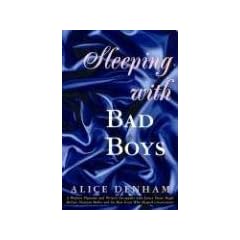
Her name is Alice Denham and she was all excited about her new book, whose full title is “Sleeping With Bad Boys: Literary New York in the 1950s and 1960s,” being reviewed in the New York Times. I looked her up and she’s been reviewed all over the place! She gave me a little flyer showing the front and back covers of the book. Back cover reads “Denham’s lusty memoir is a juicy tell-all about a time when male writers were gods and an aspiring and gorgeous female novelist tries to win respect… Caught between the sheets are James Dean, Norman Mailer, Philip Roth… The steam rises page by page as Denham — the only Playboy Playmate to have her fiction published in the same issue as her centerfold — chases her dream of writing as a young, oversexed beauty in the literary swirl of 1950s Greenwich Village…” The Denham I met seemed interesting, intelligent, quirky, and opinionated, as she rolled her eyes at some of our host’s jokes and wasn’t shy about yelling out, “that’s the ONLY funny one of the night” at the one that actually made her laugh (and she’s of course a lot older now than in her picture as shown above)… but she didn’t seem so ‘oversexed’ to me. I guess she read my thoughts because she said, “Oh, they sexed it up, you know,” rolling her eyes. “It’s really a feminist account of a woman in the 50s trying to be taken seriously as a writer.” Looks good, and I do think I’ll check it out. And Susan Brownmiller of “Our Bodies Our Selves” gave it a thumbs up!

One thing though: feminism and the whole (false) mind / body binarism has captured my interest of late, and Denham’s back cover made me think of it again. As dancers, our bodies are all important, and in a way, I guess we are our bodies. But we are also obviously intellectual beings. It’s just upsetting when someone — a man, doesn’t want to accept that, who thinks that because you’re a dancer he can treat you a certain way, disrespect you, say certain things, look at you a certain way — all things that can even be a bit threatening. I’m a lawyer, I’m not used to this. And it’s definitely not all men — definitely not even most; most men are totally cool; it’s just some who ruin it. Do a lot of female dancers get this treatment? What about “sexy” female writers like Denham? Or Candace Bushnell? Ann Liv Young said she got some suggestions about ways she could make her piece “sexier” by men who didn’t understand her work; she just rolled her eyes inwardly and thanked them. Very Dorothy Parker. I love her. Someone asked for Santoro’s phone number, I think she said as well. I wonder how Santoro reacted.

Anyway, on a more positive thought, regarding feminism: there are some really cool things going on in the city this weekend. There’s a “Global Feminisms” exhibit at the Brooklyn Museum on feminist art, and “Indwelling” — a combination of photography exhibits on women’s bodies by female artists, screenings of shorts films such as the movie “A Girl Like Me” which I saw at TriBeCa film festival and blogged about earlier — awesome awesome AWESOME short film by a high-schooler about young African-American girls’ self-perceptions — and some play readings such as The Vagina Monologues. The theme is women’s body images, and it celebrates the 25th Anniversary of the Women’s Therapy Centre Institute and takes place at Cooper Union’s Great Hall. Sounds excellent.

"The Virgin is a Lovely Number"


On Thursday night, I went to see Ann Liv Young‘s “Snow White” after seeing it posted on The Winger, by Gia Kourlas, who also has a good interview with the young iconoclastic choreographer in TONY. Very in-your-face, very rawly unabashedly unerotically naked, very hilariously WTF??, very post-post-post-feminist, and I LOVED it! This was my first time seeing anything by her, and I had to do some research, both on her work and the classic fairytale, to make a bit of sense (but I love that sort of thing — and I had no idea reinvention of the fairytale was so popular — in addition to Anne Sexton and Gregory Maguire, Angela Carter and A.S. Byatt have had their take). Young said it was based on the Grimm Brothers version and not Disney, which was pretty obvious, but I don’t think she needed to say that anyway: it’s really just her own thing entirely.

I’m not sure if I got what I was supposed to get out of it, or if there’s even some specific thing that she wanted me to get, but some themes I saw were pretense or illusion versus the real, tearing apart sex and gender stereotypes– rather lewdly too, subverting the (male, I guess) gaze, questioning the meaning of eroticism and nakedness versus nudity, etc.. It was kind of like a play within a play, but in a way that questioned what was performance and what was real. When the audience walked into the theater, the three performers were already standing onstage looking out at us waiting for us to take our seats. Young herself kind of glared out at us, a challenging look in her eye: she was not up there to please us, to show us prettiness and gratification. Similarly, at the end of the performance (which was rather abrupt), they just got up, took their things and walked off the stage, not waiting for or needing our applause, no bows, no “curtain calls.” And throughout the show, things would go wrong — sound devices that wouldn’t work, costume malfunctions, problematic props, etc. — and would be fixed onstage. It’s as if she’s questioning what a performance is, what are its confines, and at points, I wasn’t even completely sure if what was happening was supposed to be happening or if it was part of the show.

But back to the beginning. The three performers — one man (Michael Guerrero), two women (Liz Santoro and Young herself) — all wearing simple white ballet leotards and heavy black sneakers (the last of which is the only item of clothing that remains part of the costume throughout), play a rock song — Guerrero on drums, Santoro keyboards and Young singing. Each person, by the way, plays two characters — Guerrero the sound technician and The Queen, Santoro The Woodsman and The Prince, and Young the play’s director and Ms. White. After the song finished, all three stripped naked and changed into their next costume — all onstage. No strip-tease, nothing artful or sexy about it, just a clothing change done onstage — and therefore — really somewhat shocking. Certainly not Kenneth Clarke’s definition of “the nude.” Plus, none of the bodies are “idealized” — no makeup, no starving oneself for months on end or working out like a madperson for the idealized physique — these are real bodies.

For the next song, Young sings naked (except for the heavy black sneakers), while Guerrero works the sound and Santoro changes into her Prince costume — underwear with a giant strap-on dildo. The sound goes wrong, not enough is coming out of the mikes, and Young stops the performance mid-song to yell and scream at everyone for it. One male European blogger I read likened her to Eve Ensler, but to me, this ranting naked woman reminded me more of Karen Finley. Except, where Finley would often rant about overtly political issues, Young’s fist-pounding naked woman is political in another way: if traditional onstage female nudity (ie: for male gratification) must render (at least in fantasy) the woman vulnerable, humiliated, and subjugated to men in order for it to be titillating, Young’s dictating everyone around, forcing even the rather muscular man to run frantically about, his penis dangling between his legs, is nothing but amusing. She is hardly the vulnerable, submissive one, and is humiliating everyone else. Maybe the image is a bit shocking as well; I found it funny.

The Disney version has oft been criticized for reifying the virgin / whore dichotomy. As Sexton’s poem notes, the Queen is the sexed-up slut well deserving of her eventual demise, Snow the glorious good girl who is, for all intents and purposes a virgin — of course every woman must at some point perform those horrid ‘wifely duties’ but Snow’s “china-blue doll eyes … open to say Good Day Mama” but are “shut for the thrust of the unicorn…” Since she denies her sexuality, the fantasy of her virginity remains intact. Here, Young screws all such fantasies: the “Prince,” topless and with her giant strap-on dildo, climbs aboard Young, balancing his body over hers in a push-up, as if looking into the glass-box where the poor dead beautiful Snow lies. But instead of being a beautiful dead girl, Young is alive and active. She jumps up, pushes the Prince over, climbs atop him and straddles the dildo. Young told Kourlas part of what she wished to do was play with skepticism, so she wants the audience to see it penetrate her. The spectacle is rather outlandish and the audience kind of didn’t know how to react. Personally I don’t see how anyone could possibly find this ‘girl-on-girl action’ to be intended for male titilation — it seems way too vulgar — but Young told Kourlas that a European male viewer wrote to her that he thought the performance was quite sexy, but if she wanted to make it yet sexier she should lose the tennis shoes. In an earlier piece, entitled “Michael,” which I only read about and now wished I would have seen, apparently part of the action takes place in a trailer bearing three naked women dancing, and a male outside peering through the window, naked as well, and masturbating. He later comes inside the trailer, only to have his penis tied to the couch by the women, who pour soda over him while screaming, “I don’t love you anymore.” Is she saying that this is the fate that befalls the poor man who assumes women’s bodies exist solely for his gratification? Anyway, at one point during Snow White, Young reads to the audience some letters of criticism from former viewers, but she didn’t include this tennis shoe one and I wish she would have.

In the last section, the three performers pretend to be part of a radio talk show. One discussion revolves around how each character’s Valentine’s Day was spent. Young tells a story in which she was driving down the freeway topless, rocking out to cranked-up music and having herself a great time. A trucker sees her and begins following her. Of course, right then her tire goes flat. She throws a shirt on, jumps out of the car, and goes to the trunk to retrieve her spare, when the trucker stops and approaches her. He shoves her up against her trunk and pulls down his pants. Just then his black lab jumps out of the truck and attacks him, allowing her to run away. She flees into some bushes and hides, only to hear a shotgun go off. After the trucker pulls away, she goes back out to the street and holds the dog in her arms as he dies. A caller phones in and tells her if she’d just keep her clothes on her life would be much easier. Very disturbing, and Finley-esque.

Anyway, “Snow White” is playing at The Kitchen this Wednesday through Saturday. There’s tons of good stuff I left out. My friend, unfortunately, was disturbed by it, so I guess it may not be for everyone, but if you want to see a real spectacle that will likely challenge your notions of things and make you think, then just go and check it out for yourself.

You Made Me a Monster

Last night, I went to see another piece by Forsythe, this time at the Baryshnikov Arts Center. My usual dance friends were all busy, so I managed to convince my friend and fellow co-worker, Jonathan, who rarely goes to dance events, to accompany me. This task proved to be quite difficult since the website described the work as involving “audience participation.” When you’re a ballroom dancer and you invite your very dance-shy friends to socials at your studio promising them they can simply sit and watch all the action, only to get there and have everyone and their dog dragging them kicking and screaming out onto the dance floor, then go and invite them to an audience participatory dance event, they simply won’t trust you. I had to promise him on my life that this was a world-class concert dance company and the only ones doing the actual dancing would be the professionals.

Anyway, You Made Me a Monster was, like Three Atmospheric Studies, dance theater, and involved not only dance but other elements of theater as well, this time sculpture, sound effects, and words (this time not spoken but written, and projected from a video monitor onto a screen). The theme was the devastating effects of cancer on the body.

A group of 80 of us walked into a room where about 10 or so tables were set up, each bearing a partially constructed model of a human skeleton made from cardboard pieces. Guides divided us into smaller groups, took each group to a different table, and directed us to build off of the partly put-together puzzle, but not in a logical way. In other words, a spine should not resemble an actual spine, but the audience-member should twist and bend the carboard bone so that it made an artful design, then attach it to the model not where it “should” go on a “normal” human body, but in a more unconventional, surprising place. If we liked, we could also take some of the pieces of white paper below the table and trace the shadows made by the distorted model body.

Okay. Can you pick the lawyers out of the art crowd?… Yes, with us, this proved almost as bad as if we’d been asked to dance. While everyone else at our table enthusiastically went to work, Jonathan and I looked at each other, picked up a cardboard piece, looked quizzically at it, surreptitiously regarded the instructions we were told to pay no attention to, looked at each other again hopeless confusion covering our faces. Beginning to stress out about looking like a couple of idiots, I finally shrugged my shoulders and started bending and twisting a femur. Jonathan frowned at what I think was a collarbone, then put it down and excused himself to go to the bathroom for the next ten minutes. He’s never coming with me to a “dance event” again, I know it… In the end, I contributed to our table’s body by placing a very long, twisty bone protruding straight up from the center. It looked more amusing than anything else.

About ten minutes into our “body-building” project, shrill, screeching sounds began to emerge from the speakers, and dancers, three in all, came out, approached a table (each a different one), and began conveying through movement the design we’d created with our “bodies.” Their movement was much like that of the mother and diplomat’s assistant that I described in Three Atmospheric Studies — twisted, distorted, and contorted to grotesque, misshapen effect. I recognized the dancers from Atmospheric Studies, since I’d just seen it.

Funny thing, Matt Murphy had told me one of his favorite dancers from Atmospheric Studies was “the bald guy.” That man was one of the dancers here. I hadn’t noticed him much at Atmospheric Studies, since he didn’t “play” one of the main characters. Here, he took my breath away. Matt was so right! Dancers … they do notice dancing! With me, I guess supreme dance skill has to be shoved right in my face for me to see it…

After finishing at the tables, the dancers went to the front, stage area, and danced behind three separate stands each holding a piece of paper with a tracing an audience-member had made of the shadows of their model. They resembled musicians playing instruments while reading music sheets.

Behind them was a screen, onto which was projected a series of sentences, each running across the screen one by one. This use of words was somewhat ineffective to me. Every once in a while, I’d see solitary words or phrases that shouted-out to me, like “xenophobia,” “seeds of one’s internal destruction,” “reproductive organs were removed,” “grasp of space … uncanny, delirious,” “repulsive, occult, lethal,” Aliens” etc. etc. But I couldn’t focus on the words because that would take my concentration away from the dancers, and I didn’t want to do that. So, I only got an intermittent sensory effect from various words or sentence parts, without understanding how they fit together into a fuller narrative. I would have much preferred the words to have been spoken. There were sound effects blaring over the speakers as well, but to have the words on top of the sound effects would have enabled me to better understand them, since I feel that sounds can better compete with each other than visuals. You can only look at one thing at a time!

I noticed right before leaving that the pieces of paper on top of and underneath the tables contained those same sentences. I snatched one and put it into my bag. I’m not sure if they were there for us to take, but I’m very glad I did, because I read it on my subway ride home, and it made the performance all the more sorrowfully compelling to me. A man, whether it’s Forsythe I’m unsure, tells about his wife’s illness then death from cancer of her reproductive organs. The woman, a dancer, had been bleeding profusely, obviously weakening her and making her unable to perform. Her doctor, who happened to be a woman, told her it was just that she was dancing too much — obviously a judgment laced with sexism and devastatingly destructive medical inaccuracies — something with which a few of us are just a bit familiar. He goes on to talk about what a “dance genius” his wife was: “She had been able to reach into the profound heart of dancing and bring it to light…” The two were working on a piece about xenophobia, in response to several murders of political refugees in Germany. She had likened her cancer to xenophobia, which “constitutes a fear that the seeds of one’s internal destruction reside in a foreign body…” One thing I love about Forsythe is his ability to merge and analogize seemingly disparate things to shed new light on both. The “story” ends when, years after the woman has died, the man and his children began to assemble a cardboard jigsaw puzzle-like model of a human skeleton given to the wife before her death by a friend. They did not follow instructions, however, but “randomly bent, folded and attached the various intricate pieces until there was a model of something I understood. it was a model of grief.”

Amazing writing central to the piece that I thought should have been more central to the performance. As Jonathan and I were walking to the subway, I said that the dancing seemed one-note to me. He said he thought it was thematic and he enjoyed it overall and didn’t need a narrative with a big-bang climax. It WAS thematic and I didn’t need those things either, but I still wished there would have been something beside all the images of distorted, mangled, devastated bodies. I wished there would have been some beauty somewhere. I guess I found that in this writing, which was beautifully written. I just don’t know how many people saw the pieces of paper to pick up before leaving, so I don’t know how many people missed out on it.

One last note, on gender: two of the dancers here were men, one a woman. I thought it was interesting that Forsythe used male dancers to portray a woman’s illness from a feminine form of cancer. He also used female dancers in traditionally male roles in Atmospheric Studies — ie: a diplomat. This is interesting to me, this kind of playing with gender roles and assignments, unless I am reading too much into it. However, there was one line in this written story that struck me. After the woman’s cancer-ridden reproductive organs were removed, the man says, “I noticed afterward, she no longer smelled like a woman.” He goes on to talk about how, once she started on a course of radiation therapy, she began to “bend” “los[ing] the ability to fully lengthen her body” as a dancer must. So, the cancer depleted her of both her ‘womanness’ and her ‘dancerness’ — the two things that defined her, at least to the man (who is the one, after all, left to speak for her). But the line about the reproductive organs and “smelling like a woman” bothered me. It’s horrible for a woman to lose her reproductive organs — it’s horrible for anyone to have to lose any of their organs — and I definitely think doctors have been too haste to recommend hysterectomies and mastectomies and have done so out of pure and simple laziness over having to deal with the complexities of our bodies. But what exactly does ‘a woman’ smell like? Do we all smell the same? Are we all one thing, are we all defined by the same thing — our reproductive organs?

Can (Or Should) Dance Have "(Political) Meaning"?

As with DEATH IN VENICE, I’m totally late in writing this (blasted briefs, annoying job!), but better late than never, right?… On Thursday night, Dea and I went out to BAM to see THREE ATMOSPHERIC STUDIES choreographed by American-expatriate-in-Germany, William Forsythe.

I’ve seen excerpts of Forsythe’s work before, but this was the first full-length piece I’ve seen by him, and I had no idea what to expect, but I absolutely LOVED it. Instead of pure dance, it was German ‘dance theater’ (“tanztheater”) so there was dialog, as well as acted-out or talked-about images, in addition to movement. There were three “studies” (ie: Acts). In the first, a woman comes out and tells the audience that the scene is going to be about the arrest of her son, and she points to the dancer, wearing a bright red shirt, who is portraying that character. Aside from that, the first scene consists entirely of dance, and, from there, becomes rather chaotic and remains so throughout. Dancers violently grab each other, hurl themselves at each other, jump on each other, throw each other, run from each other, fight, fear and comfort each other. It was honestly really amazing to me that no one got hurt. I also attended a pre-performance discussion at which Forsythe spoke a bit, and one audience member asked him if he considered whether his dancers would be injured and he assured us that dancers have a “very meticulous” sense of time and space. There was no music (apart from the dancers’ heavy breathing which acted as a kind of natural sound effect), so he must have been making a huge understatement! If someone was one millisecond of time or one milimeter off on floorspace, they or the person they were hurling themselves at at full force and lightening speed could have really got whacked. When I dance, I count my music by the beats; still baffles me how they all kept such exacting time with no music?…

At various points, the dancers momentarily freeze to make painting-like tableaux. It wasn’t until the second scene when the woman whose son had been arrested began speaking to a translator to tell her version of the events that I realized that, because there was so much violent commotion in the first scene and because I was so in awe of the amazing ways the dancers manipulated the floor and moved their bodies, I’d totally missed ‘the story’ of the arrest. Forsythe had said that one of the ideas he wanted to play with was our ability as an audience, both in the theaters of dance and of world affairs, “to pay attention”. I realized that I’d failed that test, and had no idea how the arrest happened, even after the woman had specifically pointed out to me what I was supposed to watch for!

So, in the second scene, the woman tries, unsuccessfully, to give her account to a translator so that she can make a police report. The language barriers, the fact that there simply are no words for certain concepts or objects (“you say ‘bird’, I can give you ‘airplane’ … for ‘castle’ how about ‘apartment building'”) is a metaphor for the severe limitations of language to connect people. At the same time that this dialog is happening, there’s a dancer in the middle, speaking and illustrating with movement, the content of several different photographs and paintings. Sometimes his words overtake the woman’s and the interpretor tries unsuccessfully to translate his descriptions of the images into words as well. There was a lot of confusion as to the meaning of this, but to me, it was a way of saying that we can be bombarded with so many images that, ironically, they ultimately prevent us from empathizing with the subjects depicted in them. Forsythe said another thing he wished to explore was “compassion fatigue” — how the multiplicity, and perhaps sensationalism, of images of others’ suffering exhausts our ability to feel compassion for them, and results in drowning out the truth depicted therein. So the image becomes more important than the reality. At the end of the second scene, the woman, interrupted by the dancer’s voice describing yet another “composition” cries out, in frustration, “which composition are we on now?”

The most powerful, disturbing part of that scene was toward the end, when the woman rises from her chair and moves around the stage, contorting and distorting both her body and voice in quite grotesque ways. That frightening distortion I thought graphically illustrated both her emotional devastation and the impossibility of her truth being told because of the distorting effects of images and language. Forsythe is known for exploring the relativity of truth. Perhaps he is saying pure movement is the best way of getting to truth?

I guess the last “study” is the most “political” if you want to call it that — at least in terms of it echoing a current, specific geopolitical situation. There has been a bombing and the woman, whose whole village has now been destroyed, is so devastated she can now hardly move. A man is struggling to hold her up. A dancer portraying a diplomat tries to console the woman, telling her (rather amusingly at times) the bombing has been for the good of the community, etc., and a dancer whom she (interestingly, the diplomat is played by a woman) points to as her assistant (also a woman) conveys the diplomat’s words through dance. The assistant’s body-distorting, somewhat grotesque movements, reminiscient of the woman’s in the second scene, evince the ludicrousness of the diplomat’s words and their powerlessness to explain, defend, or console.

I found that the combination of the dialog, images, and most importantly, the brilliant movement, made me think about all of those ideas that were explored — the relativity of truth and its vulnerability to reduction to false images, the effect of bombardment of images on the observer’s attention span and ability to connect to the subject, and the distorting effect of language. And I felt the theatrical combination of the three art forms was more powerful than one alone. Discussion of this piece has centered on whether dance can (or should) provide political commentary. But I’m unsure of the reasons for this focus. I think this ballet was ‘political’ in the sense that everything is political — the word comes from the word “polis” — the people, after all — so anything that has as its subject matter human beings, is to an extent ‘political.’ But I was compelled to think about the issues mentioned above, not that war is bad or the current situation in Iraq is the U.S.’s fault or something simplistic and obvious like that. In general, I think it’s far more productive to talk about the ideas presented by a work of art than whether they are political.

Anyway, today Ashley commented on Matt’s blog as well, posing some more interesting questions related to the Forsythe discussion underway there: what meaning professional dancers as opposed to audience members with little or no dance training extract from a ballet; whether non-dancers can understand pure movement in the same way pro dancers do; and, if non-dancers don’t comprehend pure movement, what then attracts them to the ballet — particularly the contemporary, story-less ballets and modern dance? I thought those queries were really intriguing, particularly in light of viewing this work. I, for one — someone with very little dance training — don’t “understand” pure movement at all, and don’t really try to either. The contemporary story-less ballets that I enjoy, I enjoy because I love watching the dancers move in amazingly beautiful ways. But then, the dancers have to be really really good. And, in fact, sometimes they have to be dancers with whom I’m already familiar. I don’t know if I would have loved “Clear” which ABT recently did, if David, Max, Angel, and Jared were not dancing it; I don’t know if I would have liked “Meadow” as much if it wasn’t Marcelo and Julie performing. I need to connect to the dancers, especially with story-less ballets (which is why I think books like “Round About the Ballet,” magazine interviews, and websites like the Winger are so important to promoting ballet and concert dance).

I think a lot of dance fans also go to the ballet for the sensual experience: they perhaps enjoy Balanchine, for example, because they savor the feminine beauty, the pretty, dulcet charm of his ballets. I prefer ABT’s celebration of masculine (including both male and female) beauty and strength exuded by the ballets they present. I think people often go for the sensations the experience, the way the ballets make them feel, rather than to make them think. But then, for me, Forsythe is a welcome change to all that, at least once in a while. I think I’ve been seeing so much contemporary ballet of the “Clear” and “Meadow” variety during ABT’s recent City Center season, I was quite starved for more — to be given a chance to use my mind, to be compelled to decipher meaning, at points rather complex. That’s me, anyway. Very interesting to ponder just what it is that draws non-dancers who presumably derive no solid ‘meaning’ from pure movement to concert dance though…