For the Love of Duke


On Friday night Susan Stroman’s For the Love of Duke premiered at NYCB. Photos above by Paul Kolnik. Top: Tiler Peck, Sara Mearns, and Amar Ramasar; bottom: Mearns and Ramasar. Stroman is primarily a Broadway choreographer (I think her most famous work is probably Contact), and it shows both in her ballets’ strengths and limitations.

For the Love of Duke is divided into two parts. In the first, entitled “Frankie and Johnny … and Rose,” Tiler Peck and Amar Ramasar are Johnny and Rose, a couple in love. They perform a lovely lyrical pas de deux. Then along struts Sara Mearns – Frankie – and Johnny’s attentions are completely lost on her, to the disappointment of Rose. Johnny and Rose are snuggling on a bench together, and when Frankie comes prancing along, Johnny pushes Rose right off the bench, behind it, as if to hide her. Then he does a snazzier dance with Mearns / Frankie, she disappears, and he’s back with Rose … until Frankie comes strutting along again. And so on. At one point, Rose becomes the seductress, and Johnny pushes Frankie off the back of the bench. It was cute, and everyone danced spectacularly, but it got a bit old to me after a while.

The second part – “Blossom Got Kissed” – Stroman had actually choreographed before, creating it for NYCB in 1999. I liked this one better. Both parts, by the way, are choreographed to Duke Ellington and Billy Strayhorn, which is where the title of the whole comes from. Anyway, “Blossom” begins with a bunch of girls all dressed in sassy, jazzy red sitting on a bench tapping their feet to Ellington’s rhythm. Along comes Savannah Lowery as Blossom, dressed in a frilly ballet tutu. She sits alongside them on the bench and tries to tap with them. But she has no rhythm and is horribly off. Then they stand and do a jazzy dance, and, again, she tries to join, but just can’t get the hang of it. She is simply too classical ballet. Lowery was hilarious though and it was funny to see her continually try to get the rhythm and technique of jazz dance right by taking a foot and pounding it down flat on the floor. Then, a group of tux-clad men come along and do some swing dancing with the red-clad women. Blossom again tries hard to fit in but just can’t. Finally, a musician in the band (which was onstage), in the person of Robert Fairchild, comes out from the back of the stage, orders the music changed, and does a sweet lyrical ballet pas de deux with her.

I feel like I’ve seen “Blossom” before because Lowery’s hilarious flat-footedness looked familiar. I liked it better than the first part because to me it was funnier, and the story went a little further.

I think Stroman is very good at creating a story through dance, and that’s what I like about her. You can tell she’s not really a ballet choreographer though. Compared to the first two pieces of the night – Ratmansky’s Concerto DSCH and Wheeldon’s Polyphonia – the actual dance just wasn’t that rich. Still, I think she complemented the program well. It can never hurt to include in an evening of ballet a cute narrative dance with music that’s not usual ballet fare.

As always, I loved Concerto DSCH. Ratmansky was in the audience. I felt the music was played a bit too fast though (conductor was Ryan McAdams, Elaine Chelton the pianist). It looked like Ashley Bouder had a slight mishap, though I’m not sure because I was busy watching Joaquin DeLuz do a sequence of crazy fast steps into a somersault at the speed of light. Andrew Veyette again replaced Gonzalo Garcia, who I am really missing. I hope he’s okay. Veyette is doing a fine job as one of the two playful guys in blue, but there’s this repeating series of throws – where they each kind of propel the other into the air, and I love how Garcia always gets such height when he bounces off the other two.

Tyler Angle replaced Benjamin Millepied, and did wonderfully. I always notice things with Tyler that I haven’t noticed before – like how when he and the girl in green (Wendy Whelan) make their entrance, he’s spinning her around and around, and she looks like she’s hanging on to him for dear life. It kind of sets the tone of their relationship. I always notice the music much more when he dances as well.

Christopher Wheeldon’s Polyphonia is definitely one of my favorites of his. I love the musicality of it, and the originality of the combinations. It’s set to ten piano pieces by Ligeti, who, the program notes, developed micropolyphony – a type of music involving sustained dissonant chords that shift slowly over time. You can really see that “micropolyphony” in the dancing, as the sets of dancers (eight all together, divided into four pairs) begin dancing together in a line but each pair doing something completely different. Then, they eventually come together and dance in unison, but then they drift apart again later. There’s some very clever, almost humorous partnering throughout, but particularly in the second movement, Arc-en-ciel, Etudes pour piano, danced by Maria Kowroski and Jared Angle. I haven’t seen this ballet as often as I would like to. I was going to say I wish he’d include this one more often in Morphoses programs, and then I remembered

SLSG’s Dance Highlights of 2010

Instead of trying to remember which were my favorite performances of the year, I’m just going back through my blog archives from January of this year and linking to the most memorable posts. More fun that way! A lot happened in a year…

January

Pacific Northwest Ballet made their debut at the Joyce; it was my first time seeing them live.

The Post‘s Page 6 announced that you know who and you know who are dating, and the ridiculous homewrecker attacks began.

Baryshnikov and Annie Liebovitz starred in a very cool Louis Vuitton ad.

February

I totally fell for New York City Ballet’s Sleeping Beauty.

…and Mark Sanchez 🙂

I found myself quoted in Colin Jarman’s book, Dancing With the Quotes.

I also fell for Sara Mearns’s Odette in Peter Martins’s Swan Lake.

On a personal note, my former judge, the esteemed Honorable Sylvia Pressler, passed away.

The Kings of Dance came to town.

Morphoses shocked the ballet world by announcing that Christopher Wheeldon was leaving the company.

March

My friend’s organization, Art for Change, held a benefit for Haiti after the earthquake.

Rasta Thomas’s Bad Boys of Dance announced that Danny Tidwell and SYTYCD’s Jacob Karr were joining the company.

Corella Ballet Castilla y Leon finally made their NYC debut!

I found myself actually getting press for liking Kate Gosselin – or for not hating Kate Gosselin rather – on Dancing With the Stars.

I fell for Keigwin + Company’s Runaway.

I was delighted to receive an email from NYCB ballerina Yvonne Borree’s aunt regarding of all things, my novel.

April

I had my first experience as a dance writer panelist! Thank you, Marc, from TenduTV!

Tiler Peck appeared on Dancing With the Stars in a Travis Wall routine, which everyone was so excited about. But it ended up amounting to not a whole lot…

Roberto Bolle danced a naked Giselle, in Italy of course.

May

New York City Ballet opened their spring season with premieres of Millepied’s Why Am I Not Where You Are and Ratmansky’s Namouna, both of which I liked, though Ratmansky’s had to grow a bit on me.

Baryshnikov returned to the stage.

I greatly enjoyed ABT’s new production, Lady of the Camellias, though most critics panned it.

June

ABT celebrated Alicia Alonso’s 90th birthday with three all-star Latin American casts (plus Natalia Osipova) dancing in Don Quixote.

Yvonne Borree gave her farewell performance at NYCB.

Bill T. Jones won a Tony for best choreographer for Fela!

Philip Neal gave his farewell performance at NYCB.

Natalia Osipova was mugged right outside of Lincoln Center.

Two of the greatest ballerinas in Europe – Osipova, and Alina Cojocaru – gave back to back Sleeping Beauty performances at ABT.

Albert Evans gave his farewell performance at NYCB.

Tap great Savion Glover made headlines by voicing his annoyance with Alastair Macaulay’s NY Times criticism of him – onstage, during a show.

Conductor Maurice Kaplow gave his farewell performance with NYCB.

Darci Kistler officially ended the era of the Balanchine-trained dancer with her farewell performance with NYCB.

July

Carlos Acosta announced his retirement from ballet and his foray into modern dance.

Alex Wong, probably the second greatest contestant ever on SYTYCD was injured and unable to finish the show.

My friend, Taylor Gordon, was profiled as a freelance ballet dancer in a New York Times article 🙂

Alvin Ailey American Dance Theater’s beloved Denise Jefferson passed away.

Nilas Martins retired from NYCB oddly sans fanfare, sans criticism, sans a performance.

August

I interviewed tWitch about his role in the movie Step It Up. Fun fun interview!

I had a blast covering Ailey Camp.

I nearly fell over when Wendy Perron, esteemed E-I-C of Dance Magazine recommended Swallow on Twitter!

September

NYCB began their excellent “See the Music” series.

October

I loved Ashley Bouder’s Serenade.

Emerging Pictures’s awesomely exciting Ballet in Cinema series began with the Bolshoi’s Flames of Paris.

This cool new Lincoln Center-area street art sprouted up.

One of my favorite posts of the year, though it received no comments, was about Anne Fortier’s novel, Juliet. I jokingly daydreamed about it being made into a film, and which of my favorite ballet stars might take the lead.

November

ABT made an historic visit to Cuba and oh how I wished I could have gone with them.

I think I was the only person in the entire dance world to sympathize with Bristol Palin on Dancing With the Stars.

I had a blast covering New York So You Think You Can Dance auditions.

All of a sudden Black Swan was everywhere.

Nearly fell over again upon hearing Riccardo Cocchi and Yulia Zagoruychenko took the world Latin ballroom title – making them the first U.S. couple ever to do so.

December

My take on SugarPlumpGate.

Black Swan finally premiered which I didn’t love but was happy to have ballet brought back into the spotlight.

I was in awe of Alvin Ailey’s 50-dancer Revelations, staged in honor of the 50th anniversary of that dance. I also loved several other dances in their City Center season – Ailey’s Cry, Ronald K. Brown’s Dancing Spirit, and Geoffrey Holder’s The Prodigal Prince – just to name a few.

Robert Wilson / Roberto Bolle’s Perchance to Dream exhibit in Chelsea was a lot o’ frightening fun.

ABT’s new Nutcracker premiered, which I really enjoyed, almost as much as the Bolshoi’s.

Portman and Millepied revealed they are now engaged and expecting.

I had great fun, despite the crazy snowstorm, going down to Wall Street and covering Judith Jamison’s ringing of the closing bell at the NYSE.

Pretty busy year.

Happy New Year, everyone!

Benjamin Millepied’s “Plainspoken”

Last Thursday was NYCB’s Fall gala, during which they presented the New York City premiere of Benjamin Millepied’s Plainspoken (photo at left, of Teresa Reichlen and Sebastien Marcovici, by Paul Kolnik; the ballet originally premiered in Wyoming this August), along with Robbins’ fabulous homage to Fred Astaire and Rita Hayworth, I’m Old Fashioned, and Balanchine’s Tarantella and Western Symphony.

The evening began with the orchestra pit rising and the always lively Faycal Karoui leading the orchestra in a rendition of Leonard Bernstein’s Candide Overture. I love that movable orchestra pit – best thing, in my opinion, about the recent renovations to the Koch Theater.

I was hoping there would be introductions and short speeches, including one by Sarah Jessica Parker, who served as honorary chair for the after-performance party. But no such luck – I guess because it wasn’t the beginning of the season, like galas usually are. I didn’t even get to see Parker come down the red carpet, there were so many paparazzi blocking my view. I certainly heard her though – or, rather, the paparazzi, as they screamed her name like she was the Messiah. I didn’t recognize anyone else. Lots of good-looking people perfectly coiffed and dressed in black tie but no one I recognized. I didn’t see Natalie Portman, though I heard she was there. I never recognize famous people, though. I’m really bad that way.

Anyway, I’m Old Fashioned was, as always, enjoyable, albeit too long. No dance-maker needed an editor more than Jerome Robbins in my opinion- and Tyler Angle stood out to me in his solos and duets with Maria Kowroski. But my favorite part of the evening was the second half of the post-intermission, when Ashley Bouder and Daniel Ulbrich just nailed Balanchine’s super fast-paced bravura-heavy duet, Tarantella (Ulbrich smacked the tambourine so hard one of the little metal things came flying off) and then Sara Mearns just astounded me in the last section of Western Symphony. How in the world does she stand on pointe, on her own unsupported by a male dancer, and lift her other leg in the air into a perfect split, into practically a six o’clock penchee? How how how? She and Charles Askegard really put on a show as tart-y saloon dancer and cowboy. She is really just unbelievable.

Okay, so onto Plainspoken. Well, sometimes I like Millepied, and sometimes the work just falls a bit flat to me. I didn’t much care for this one, though I’ve liked his last several ballets for ABT and NYCB. This was very abstract, no story that I could find, and I’m just not a fan of purely abstract ballets that I can’t find any story in whatsoever. It was a ballet for four couples: Sterling Hyltin and Tyler Angle, Teresa Reichlen and Amar Ramasar, Jennie Somogyi and Sebastien Marcovici, and Janie Taylor and Jared Angle (the last were generally my and my friend’s favorite pair – I think because Janie always brings something dark to her roles, there’s always something beneath the surface with her even if you can’t put your finger on what it is). The couples sometimes changed partners though, and there would be different-sized groupings.

The music was by Pulitzer prize-winning composer David Lang – it was a commissioned score – but to me the music here wasn’t nearly as rich as, for example, that used by Morphoses recently. This was mainly strings and piano and each section seemed emotionally the same. There didn’t seem to be a lot of contrast between the movements or a build-up toward the end. The sections were each differently lit – by a different color and a background curtain that would rise and lower to reveal more or less light than the section before. But the set was nothing very dramatic and the different colors didn’t, for me at least, evoke a different mood.

Movement-wise, there seemed to be a swimming theme. At various points the dancers would sit on the floor and make motions evocative of swimming – sweeping arms through the air, paddling legs – backward, then forward, then all dancers lying on their backs with their feet in the air like a synchronized swim team. At other points, the women would be carried somewhat Chaconne-like across the stage. I remember a slide characterizing Janie’s section, and she made it seem as if she was being taken by the men who slid her, against her will, across the floor.

I also have in my notes that the movement toward the beginning, in the first section, was a combination of robotic and more casual walks, kind of like the ensemble walking across the back of the stage in the second part of Robbins’s Glass Pieces. This kind of movement was interspersed with the swimming-like motions. In later sections, dancers seemed to run in place.

Oh, and during Janie’s section, there was a point where the men all picked her up and hoisted her high above them, like in MacMillan’s Manon or the Balanchine ballet where the woman is carried around the whole time by a group of men and the lone man on the floor keeps reaching up for her (sorry, can never remember the name of that ballet). My friend loved this part, and I did as well, but couldn’t really figure out how it played into the rest of that section.

In general, my first impressions of this ballet were: some interesting movement reminiscent of other ballets that didn’t seem to add up to much and didn’t really make me feel anything.

At the end, Millepied, Lang and the costume designer (Karen Young) and lighting designer (Penny Jacobus) took the stage for a bow. The applause seemed more polite than hearty (in contrast to the crazy applause Wheeldon always gets!), but that could just be me projecting my own thoughts onto everyone else.

What about you guys? I saw some mentions on Facebook of people liking it. Who else saw it and what did you think?

Morphoses at the Guggenheim

Over the weekend, Morphoses had its first NYC program sans former artistic director Christopher Wheeldon. They presented two pieces, at the Guggenheim, as part of the museum’s Works and Process program. They commissioned two choreographers – American Jessica Lang and Swedish dancemaker Pontus Lidberg- to each make a different dance set to a score by Pulitzer Prize-winning composer David Lang.

(I wrote about seeing an early rehearsal here).

Using most of the same dancers (most of whom are from American Ballet Theater now, instead of New York City Ballet, as they were when Wheeldon was A.D.), the two came up with vastly different dances, both very engaging.

Lang’s (top four photos – all photos by Richard Termine) was more a study of gravity, as she explained (hence Misty Copeland here “climbing the wall”), and of contrasts between the masculine and feminine (indicated, to her, in the music by percussion and chimes).

Interestingly Lidberg heard the music differently and used the percussion section first, melting into the chime section, so apparently the music had no prearranged order. His dance was more lyrical, with the visual theme of a night-blooming flower.

I love that Morphoses now seems to be using a lot of ABT dancers – all soloists or standout corps members — Misty Copeland and Kristi Boone, Eric Tamm, Blaine Hoven, and Isaac Stappas – because I really connect with them. Other dancers included Melissa Barak, Laura Feig, Gabrielle Lamb, Rachel Sherak, Andrea Spiridonakos, and Matthew Prescott. And Lang mentioned that she also used her husband, modern dancer Kanji Segawa (the man doing the floor work on the right-hand side in the photo third from the top), in her piece, which worked well since the aesthetic of modern dance is more “grounded” than ballet.

To hear the music and see some of the dance, here is an excellent video made by the Guggenheim:

MORPHOSES REHEARSAL – JESSICA LANG MAKES ME WANT TO DANCE AGAIN…

Tonight I was invited by the Guggenheim Works & Process peeps to a Morphoses rehearsal. Funny, I kept expecting Christopher Wheeldon to be there… but of course he wasn’t. This was really special because it was a first rehearsal; the dancers were just meeting the two choreographers whose work they’ll be performing in September in Martha’s Vineyard, and in October here in NY. I’ve never been to a rehearsal that early before – usually the choreographers don’t want an audience until the work is complete or nearly complete.

The two choreographers were Jessica Lang and Pontus Lidberg. They’ve each been commissioned to set a dance to the same David Lang score. Always fun to see what different artists come up with to the same piece of music. This was very lyrical music, part of it choral, and they had the same five dancers to work with – three women, two men.

First we saw Jessica Lang, and her choreography was very lyrical, very classically balletic, very pretty.

Continue reading “MORPHOSES REHEARSAL – JESSICA LANG MAKES ME WANT TO DANCE AGAIN…”

NEW PLANS FOR MORPHOSES

Most of us have already heard (and were somewhat shocked by) the news that Christopher Wheeldon has decided to leave Morphoses, the company he founded three years ago. And most of us were wondering how or if the company was going to go on without his name attached. Today, Lourdes Lopez, Morphoses’ co-founder and executive director, announced a new plan for the company: to have resident artists curate programming on a seasonal basis.

Here is more from the press release:

“Morphoses will adopt a curatorial model in which the company will invite artists from various disciplines to take on the role of resident artist for one season, leading the company’s artistic vision for that year,” said Ms. Lopez.

The embrace of a curatorial model is a natural evolution and expansion of the company’s mission and vision.  To date, more than half of the company’s repertory is comprised of works by a diverse group of emerging and well-known choreographers that include Michael Clark, William Forsythe, Tim Harbour, Adam Hougland, Lightfoot LeĂłn, Edwaard Liang, Pontus Lidberg, Annabelle Lopez Ochoa, Liv Lorent, Emily Molnar, Alexei Ratmansky, as well as Frederick Ashton, George Balanchine and Jerome Robbins; the balance of the works were created by Christopher Wheeldon.

Morphoses has become a robust platform for some of the most talented choreographers in contemporary ballet, enabling them to create work with a versatile company of dancers.  Collaborators have included such artists as Los Carpinteros, Francisco Costa, Hugo Dalton, Narciso Rodriguez, Joby Talbot, Isabel and Ruben Toledo, and Martha Wainwright.

“Christopher’s artistic vision and talent has helped make Morphoses one of today’s most important dance companies,” said Ms. Lopez.

By adopting this curatorial model, the company will afford artists the opportunity to use Morphoses as a stage to forge dynamic creative partnerships that will produce innovative works for the dance world. This model will enhance the company’s capacity to reach out to a larger, broader audience and engage a younger generation.  The company has begun the process of identifying the roster of resident artists for the upcoming seasons and will be announcing plans in the near future.

“In addition to its artistic achievements, Morphoses has established a successful business model and self-sustaining administrative structure that allows the company’s resources to be focused on its artistic goals, bringing forward a new generation of talent to younger audiences,” added Ms. Lopez.  Since its founding, Morphoses has achieved artistic and financial success through annual seasons in New York and London, domestic and international touring, and private and institutional support.

“The company has built up a reserve of funds to support the curatorial model,” stated Catherine Gildor, a member of the board of Morphoses. “We see this as validation of the crucial role that Morphoses has taken on in the world of contemporary ballet and are therefore committed to building upon our success.”

Morphoses’ mission is to broaden the scope of classical ballet by emphasizing innovation and fostering creativity through collaboration.

For more information, visit www.morphoses.org.

RHAPSODY FANTAISIE


I am extremely behind on reviews but here are a couple of pictures (by Erin Baiano) of the cast of Christopher Wheeldon’s Rhapsody Fantasie, which the choreographer premiered with his company, Morphoses, in October. I can’t write a full review but I guess it’s interesting to see what lingers in the mind. I remember a variety of movement — from neo-classical ballet to more contemporary with some ballroom thrown in — I remember some swing-y moves and even some salsa basics! I remember interesting ensemble work — with dancers at times breaking into pairs for partner dancing, at times the men dancing together, performing various complicated lifts, which I found rather mesmerizing. And I remember Wheeldon’s signature modern ballet pas de deux with the complicated “pretzel shape” lifts (as in the top photo, of NYCB’s Wendy Whelan and Australian dancer Andrew Crawford). Besides Whelan and Crawford I found Drew Jacoby and Rubinald Pronk to be the most compelling pair, dancing their series of twisted shape after twisted shape with passion and psychological intention.


Opening Morphoses program 2 was Continuum, a Wheeldon ballet from several years ago (photo above, also by Erin Baiano). This was a very abstract work set to sharp, at times tense Ligetti music with brilliant lighting that made the dancers appear ghostly, as if their shadows, silhouetted on the back wall, were doing the dancing.

I love Christopher Wheeldon, who’s always trying to give audiences insight into the dance-making process. At the beginning of this program, he spoke a bit about the dances, and, regarding Continuum, he told us all to look out for a part where, as he was making that dance, he became mesmerized by a neighbor’s cat and dog. It was only all too obvious which pas de deux this was, and everyone laughed as the two dancers kind of crouched around each other getting ready for a playful (or maybe not so playful) attack. I don’t think the audience would have thought anything of it if he hadn’t pointed that out. Now if he can give us insight on how the whole thing comes together!…

JACOBY AND PRONK IN LIGHTFOOT LEON’S SOFTLY AS I LEAVE YOU


Photo by Bill Cooper of the mesmerizing Drew Jacoby and Rubinald Pronk in Lightfoot Leon’s spellbinding Softly as I Leave You, which is on both Morphoses programs (currently at City Center) and which I’ve been going on about in my last post, here, and earlier here.

And look — finally an American critic has something good to say about it!!

Says Lisa Jo Sagolla of Backstage magazine, “Lightfoot Leon’s Softly as I Leave You, a stunningly inventive duet involving a frightening coffinlike wooden box, is so fiercely emotional that its impact is universally chilling.”

I couldn’t find any YouTube clips of Jacoby and Pronk in Softly but, if you’re unfamiliar with them, here are a couple of others I found: the first a sexy little music video and the second is of them rehearsing with Mia Michaels.

Review coming soon of Program B, which includes Christopher Wheeldon’s new Rhapsody Fantaisie, which I liked.

MORPHOSES OPENS ITS 2009 NEW YORK SEASON WITH ITS BEST PROGRAM THUS FAR


Performance photos coming soon; in the meantime please enjoy another BRILLIANT photo by Kyle Froman.

Christopher Wheeldon’s Morphoses opened its NY season last night at City Center and I felt it was the best program they’ve done in their three years of existence. (At least Program A was; tonight I’ll see Program B). It’s a varied program with work by four different choreographers: Wheeldon himself; Bolshoi A.D.-turned ABT resident choreographer Alexei Ratmansky, whom all the critics downright worship; Australian Tim Harbour; and the Dutch husband and wife team Lightfoot Leon.

I must talk first about the third piece on the program, that by Lightfoot Leon, Softly As I Leave You. This is one of the most riveting pas de deux I’ve ever seen and it’s performed by the absolutely mesmerizing Drew Jacoby and Rubinald Pronk. Every single person who is not a professional critic was absolutely spellbound by it, could not stop talking about it. This happened at both the Fall For Dance Festival, where the work premiered (which I wrote about here), and last night. It’s simply about a couple, one partner’s decision to leave the other, and it’s a harrowing decision. After the lights went out on the final poignant image, the elderly woman on my left, whom I didn’t know, grabbed me and said, “Oh my God, that was so good!” And from my friend, who thinks the Arvo Part music used (Spiegel im Spiegel) is completely over-used and was expecting not to like it for that reason: “Oh my God, that music actually worked here!” she exclaimed, open-mouthed. She agreed it was one of the best duets she’d ever seen. And people were going on and on about it during intermission, both here and at FFD.

So why in the world do the critics hate it so much??? They ALL do. ALL OF THEM. It’s like in order to be a professional critic there are certain things you’re required to hate and this is one of them. And yet audiences are so overwhelmed by its power. Clement Crisp rants, “I can find not one iota of merit in its vulgar posturings.” Guardian critic Luke Jennings calls it “slick surfaced” and replete with “glib insincerity.” I can’t remember Alastair Macaulay’s exact words after its FFD premiere, but he hated it too. And a Ballet.co critic whom I spoke with at an ABT Guggenheim event (and who was the only non-Brit of the lot) complained how awful he thought it was as well.

This happened — I’m sorry, I’m getting off on a tangent — but this happened with practically every Fall For Dance piece, and with ABT’s recent season: EVERY SINGLE CRITIC hated every single one of the pieces the public adored (Barton, Millepied, Mark Dendy’s BRILLIANT Afternoon of the Fauns) and loved those they found least compelling (Ratmansky). I mean, more on this later, but what do you do if you’re an artistic director or choreographer? Do you cater to the critics — the “important people” or do you trust us, the commoners?

Anyway, mine and my friend’s second favorite piece of the night was Tim Harbour’s Leaving Songs. Guess what: all the critics hated it. I need to move to Europe… This dance had such emotional depth. It was about the cycle of life, death and rebirth — though I’m not sure you’d know that if the choreographer hadn’t said so in a little film clip shown before the program. But that doesn’t matter; you can come up with your own meaning anyway. The movement was kind of a combination of modern, classical and what looked to me to be African, and the music, by Australian composer Ross Edwards, is equally varied, at points sounding classical European, at points more percussive and African-sounding.

There were several striking moments, such as the point during a pas de deux where a man puts his hands around a woman’s neck and she falls before him. It kind of seems as if he’s strangling her out of anger, but then her arms flutter about beautifully, almost-bird like. It’s a combination of violence and grace. And there’s a moment where the group is dancing in ensemble and the movement is very wavy and undulating, very African, and everyone’s moving in unison and the music slows and the dancers slow, almost like they’re approaching death. Then the drums start pulsating and the dancers come to life and begin sidling cautiously but with intention toward the front of the stage. There are also several very sexually suggestive scenes with women’s legs splayed in the air. No tights are worn, and my friend and I couldn’t stop wondering how in the world they keep those leotards from shifting…

Anyway, I found the Harbour very compelling. And Rubinald Pronk really stood out here as well. He has so much fluidity and expansiveness in his body, and I don’t think anyone has more intense eyes.


(photo from Vail website)

Alexei Ratmansky’s Bolero was enjoyable too, largely because of the familiar Ravel music. For me, Ratmansky is one of those artists whose work doesn’t jump out at you and hit you over the head with its brilliance. Rather, I’ll need to see a dance of his several times before I get a sense of what it’s about, before I can fully appreciate it. Wheeldon’s work is the same. The critics seem to think this is the mark of a good choreographer — that it grows on you and you notice new things with each viewing, and I suppose it is. But for the average consumer, going to the ballet so often to see pieces over and over again to understand and appreciate them more fully can get prohibitively expensive. Dance art is not like a museum or art gallery where you can stand there for as long as you like.

Anyway, in Bolero, there are four pairs of women and men, each person wearing a number on his or her top. The women wear white tops and little skirts, almost like cheerleaders and the men wear black. If the women were cheerleaders, the men didn’t seem to be any kind of sports players though. They danced in groups divided between male and female, almost as if they were competing with each other, or as if their movement was some kind of back and forth dialog. And then toward the end, they began to partner each other more, the crescendo of the music complemented by various lifts that I found at points to be a little humorous, though it may have just been me. For example, when those trombones (I think that’s what they are anyway; maybe they’re tubas), are blaring kind of off-key at the end, the men lift the women over their heads, upside-down and the women do these upside-down developes, their legs splaying along with the warped trombones. I thought it was funny but I might be the only one.


And then the first piece on the program was Wheeldon’s Commedia (photo above by Erin Baiano), which was made in homage to Ballets Russes and was premiered last year. I wrote a bit about it here and here.

Here’s an excerpt from the company performing Commedia at the Vail International Dance Festival:

Also, this season marks the company’s collaboration with the young orchestra (most players are under 30, Wheeldon said), Philharmonic Orchestra of the Americas, founded and directed by the very entertaining, energetic Alondra de la Parra — yes, a female conductor OMG! The evening opened with Wheeldon giving a little address and then the orchestra playing on Overture to Estancia: Malambo by Alberto Ginastera. At the same time the orchestra played the Overture (this was their first time playing in a pit for dance, and not centerstage, by the way), a screen was dropped over the stage and a delightfully humorous film was shown of the dramatic conductor directing her crew, the violinists all swaying dramatically in unison at points. It was a lot of fun. Whole night was very good.

NO IT’S NOT THE TOE SHOES, CHRISTOPHER WHEELDON!


Here’s a Sarah Crompton interview with Christopher Wheedon in the London Telegraph. Morphoses is about to open their fall season there, debuting a new ballet by Wheeldon and one by Australian choreographer Tim Harbour. At the end of the month, New York audiences will get to see those premieres.

In the article, Wheeldon talks about trying to increase ballet’s appeal to new audiences. He surmises it may be certain ballet aesthetics, such as the toe shoes, that are a turn-off, that may make ballet inaccessible. I strongly disagree though. I think people are generally awed by the toe shoes and by the beauty and immense athleticism of the art form. They’re all the more awe-inspiring when you see them up close, a thought I had recently in the Guggenheim’s tiny theater watching ABT, their studio company, and the students at ABT’s Kennedy-Onassis School of Ballet perform in a Works & Process event there.

I really think people in general are drawn to stories. That’s what I hear anyway from other dance-goers, or would-be dance-goers (who patronize theater and opera but shy away from dance). I think abstract ballets can definitely be intriguing but I think if your repertoire consists of only the kind of story-less ballets Balanchine made it’s going to suffer. I’ll be very excited to see the Alice in Wonderland that Wheeldon’s doing for the Royal.

FALL FOR DANCE ’09 PROGRAM 2

Highlights of Program 2, which I saw last night, were Morphoses and Tangueros Del Sur.


I was wandering around the lounge beforehand and ran into a couple of old friends from my first ballroom studio, Paul Pellicoro’s Dancesport. Always fun to catch up with old friends — especially since one of them belonged to my swing team and I shared with her my first ever lovely competition experience. Anyway, little did we know then, but one of our former tango teachers was in the show! Ivan Terrazas! I was so proud; he was absolutely electrifying (along with the rest of the Tangueros)!

Sir Alastair had gone on and on about this troupe — led by Natalia Hills and Gabriel Misse — when he saw them at the Vail Dance festival recently, and rightly so! Oh my gosh, that was the most astounding tango I’ve ever seen! The piece was called Romper el Piso and was mainly tango but with some footwork and rhythms from other Latin dances like Samba and a little bit of Cha Cha thrown in — but all danced with tango aesthetics. There were duos and trios, both mixed-sex and same-sex. The choreography was original and enlightening and the dancing so polished, precise, lightning fast, sharp, passionate, everything you can imagine in a tango, in a dance. I really hope some of you can see them tonight.

Afterward, my friend Alyssa and I hung out in the lounge. When we left we were a little tipsy (c’mon, the wine is $2!) and I kind of tripped over nothing on the way out, causing us to both burst out laughing. One of the cute tango guys said to us, “tranquilo, tranquilo!” but very flirtatiously 🙂

All photos above by Carlos Furman, courtesy of City Center.


The other knockout performance of the night — for me — was Softly As I Leave  You, choreographed by Lightfoot Leon and performed by the stunning Drew Jacoby, who is now one of my favorite female dancers (Alyssa’s as well) and Rubinald Pronk, performing on behalf of Morphoses. Christopher Wheeldon was in the audience and he got mobbed during intermission 🙂

It was the best thing I have ever seen by Morphoses — more Lightfoot Leon, Mr. Wheeldon, please please!

It’s set to a combo of music by Bach and Arvo Part (including the Part section all New Yorkers are now so familiar with, from Wheeldon’s After the Rain pdd), and begins with the statuesque Ms. Jacoby standing inside a box opening out to the audience, contorting herself to fit within its confines, struggling to break free, making the most mesmerizing shapes with her body. Then, in the second movement, Mr. Pronk comes out and they dance an, at times somber, at times peaceful, duet. Then, in the third (with the After the Rain music), they continue dancing together, but now come to a closure; he ends up in the box, she slowly walks behind it, disappearing offstage.

To me, this was about the human need for connection or the struggle between wanting to be alone and wanting to be with another. Alyssa saw it as someone being held back by something and struggling to overcome that; she was moved by the change of positions between the two dancers. Or, as the title suggests, I guess it can be about a woman leaving a man. The most compelling of these abstract duets Wheeldon is known for (either choreographing himself or including in his Morphoses programs) I think allow for that kind of interpretative range, while giving the viewer enough that they can really latch onto something and let their imaginations go with it.

The above photo of Jacoby and Pronk, by Erin Baiano (courtesy of City Center), is not from this piece.

Also on Program 2 was Martha Graham’s sweet ode to spiritual and human love, Diversion of Angels. Nice to see some of the Graham dancers, who are beginning to become familiar to me, again.

And closing the program was Noces by Dutch choreographer Stijn Celis, performed by Les Grand Ballets Canadiens de Montreal.

1

2

32

This was Program 2’s tribute to Ballets Russes. Branislava choreographed the original Les Noces, and there have been several versions since (Jerome Robbins’, Pascal Rioult’s). It was danced to Stravinsky’s choral score (which he created for Ballets Russes), but with some remixing too (I think). The music seemed to be longer, and there seemed to be some German language in the score, which sounded like it was from a Broadway show like Cabaret (but not Cabaret exactly). The program doesn’t seem to note any addition to the Stravinsky though so I may well have been hallucinating.

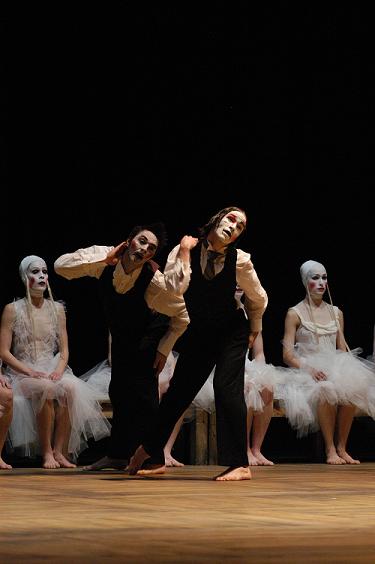
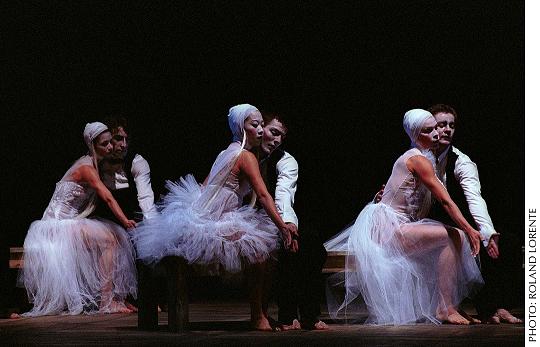
The dance (and the Stravinsky music) depicts a Russian peasant wedding and it’s very Rite of Spring-like — more focused on the sexual rite of passage, the consummation, and the rather forced marriage rituals than love or anything weddings evoke for us today. In the Celis (as well as Rioult) version, there isn’t a single man and woman but a group of men and women undergoing the marriage ceremony. The women here are dressed in sexy white bridesgowns, the skirts short and much of the material see-through mesh. The women have white-powdered, very made-up faces that look almost clownish, as do the men, who are dressed in tuxes. Alyssa thought their make-up looked zombie-like, like they’re walking dead. The movement is very frenetic, with lots of thrashing about, and the group consummation scene would have been comical, as the women bounced around on the men’s laps, if it wasn’t so violent.

I’ll be interested to see what the critics and other viewers say of this –whether it gets dismissed as gaudy “Eurotrash” or whether people take it more seriously as a commentary on ritual (or something else). I do think it worked as an homage to Ballets Russes because from what I know of that legendary company, they seemed to have been very cutting-edge, going far out to push ballet to its extremes, even if it induced a lot of eye rolling.

Big kudos to the dancers though for performing that long, near-continuous frenetic movement.

Photos of Les Grands Ballets Canadiens de Montreal courtesy of City Center.

KYLE FROMAN = VISIONARY


Just looking at a couple of the photos New York City Ballet dancer turned photographer Kyle Froman has shot for Morphoses to publicize that company’s upcoming City Center season (tix go on sale for that today, by the way) and am realizing what an excellent photographer he is. I mean, he doesn’t just take pictures of dancers in action (which is an art in itself) but he has a real vision for dance with the way he poses his subjects against a setting and the overall images he creates and the feelings they evoke. He’s like Balanchine as a photographer. I don’t see a lot of dance photography like this.


I enjoyed watching him dance with NYCB — particularly his hilarious turn as the pompous Russian danseur in Balanchine’s Slaughter on Tenth — but sometimes I think a dancer finds his or her true calling when he “retires.”

Here is his website. He also has a book out, In the Wings, consisting of photos he took behind the scenes at NYCB when he was still dancing there.