Angelenos Boo Merce!: L.A. Dance Project’s Dramatic Premiere

This past weekend marked the premiere of L.A. Dance Project at the Walt Disney Concert Hall in downtown LA. Of course this is the event – the full-evening debut of Benjamin Millepied’s new LA-based company – that all dance-going Angelenos have been eagerly awaiting. There were two performances: opening night was Saturday; I went to the Sunday matinee. According to reports of Saturday’s performance, Natalie Portman was present, fully decked out in Oscar attire. Robert Pattinson was also there. No report of what he thought though, other than that the evening made clear to him that he has no talent for dance. His words 🙂

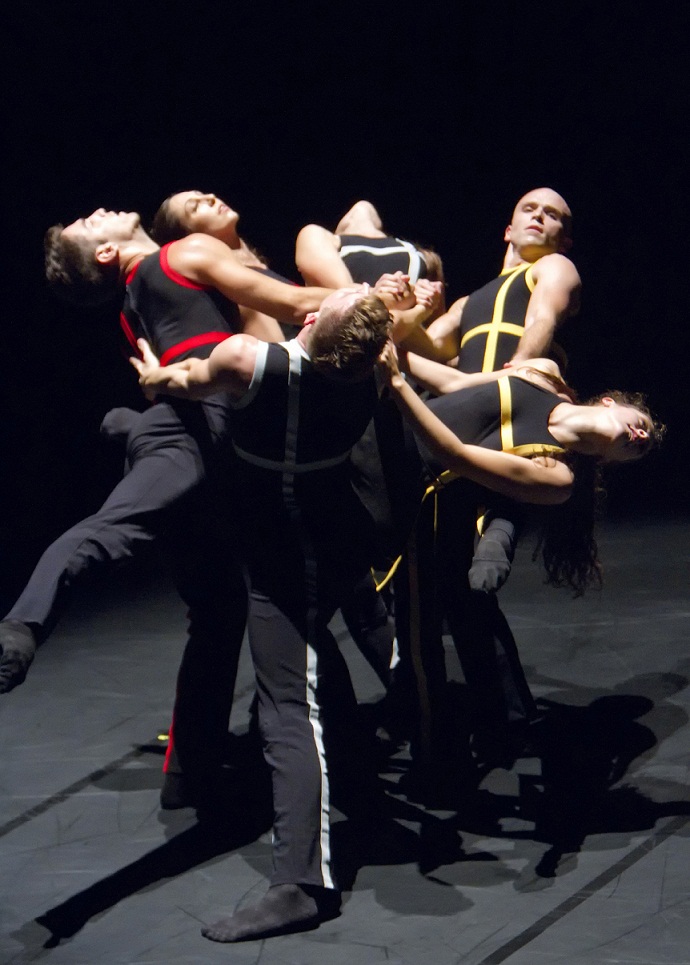
There were three pieces on the program: William Forsythe’s Quintett, from 1993; Merce Cunningham’s Winterbranch, from 1964; and the world premiere of a Millepied dance, Moving Parts (photo above, by Eric Politzer; all photos by Politzer).

By far the most astounding, confounding, spellbinding, brilliant piece on the program was the Cunningham. And for that reason alone L.A. Dance Project proved itself an invaluable asset to its new community. Every critic so far has said the same, so I know I’m not alone in thinking that. But I don’t know how much dance-going Angelenos would agree. During my performance, a woman sitting next to me angrily got up and walked to the back of the theater. Immediately after the dance ended, she cried out, “Thank God!” more than loudly enough for everyone in the entire theater to hear. Many showed their agreement with her as a chorus of loud boos started to emanate throughout the auditorium. This soon was countered by a chorus of cheers. For a moment there was a war going on. I have to say I’ve never ever seen that kind of visceral, dramatic reaction to any dance performance in New York. I’ve never seen that anywhere in response to dance; the only time I’ve ever seen a work of art booed was the Metropolitan Opera’s recent re-interpretation of Tosca.

I mean, part of me was excited that dance could evoke such strong feelings. But part of me was disappointed in the booing Angelenos for not being the least bit open-minded, for not giving the piece even a second’s consideration; for failing to think, “I’m going to go home and look up this Merce Cunningham person on the internet and find out what in the world that was all about.” Cunningham is obviously a master, and I don’t know as much about him as I should. This definitely made me want to know more. It also made me kind of sad that I wasn’t around in the 60s if that kind of art was going on. I wish Alastair Macaulay would have been in L.A. reviewing this for the NY Times. I’d like to know what he would’ve thought – of the piece, and the audience reaction, he loves Cunningham so.

According to program notes, Winterbranch was taken out of the Cunningham repertoire not long after it premiered, so most people probably know nothing about it. It was a collaboration between Cunningham, Robert Rauschenberg, and sound artist La Monte Young. Rauschenberg designed the costumes (all six dancers are in black sweatsuits with smudges of black painted under their eyes) as well as the absolutely brilliant lighting (which was reconstructed for this stage by Beverly Emmons).

At the beginning one dancer (originally Merce himself) slithers across a dark stage carrying a flashlight. Following him, other dancers take the stage, and the piece is basically a meditation on the act of falling and and pulling yourself back up. Dancers sometimes fall quickly and violently, sometimes they fall slowly, as if they’re being crushed by some invisible psychological weight. Sometimes they have difficulty rising; they crawl over each other, they contort their bodies and crab-walk across stage. Meanwhile the stage is dark, except for that brilliant Rauschenberg lighting whereby a light will briefly flash, like a headlight, then fade, then reappear tunnel-like, growing stronger, again like the lights of an approaching car.

About half-way through the sound starts. And, yes, it’s very harsh. Young’s composition is called simply 2 Sounds and those two sounds are: the sound of “ashtrays scraped against a mirror;” and of “pieces of wood rubbed against a Chinese gong.”

Yes, the whole thing was very unsettling. It felt like being caught in headlights, perhaps in a tunnel, or on a dark street, with sound so shrill you couldn’t escape. It felt very industrial, urban, Los Angeles – probably why Millepied thought to bring it here.

Wasn’t Cunningham all about questioning what dance is? Do people really want it to be all about pretty girls doing sexy things? Don’t people want to be challenged? Believe me, the people doing the complaining (mainly about the sound from what I overheard) didn’t look like they’d never been to a rock concert before. And after this ended my eardrums were nowhere near numb.

I think Millepied took a real chance bringing such a piece to a place where perhaps many have only seen classical ballet and popular dance on television. And for that I respect him more than ever.
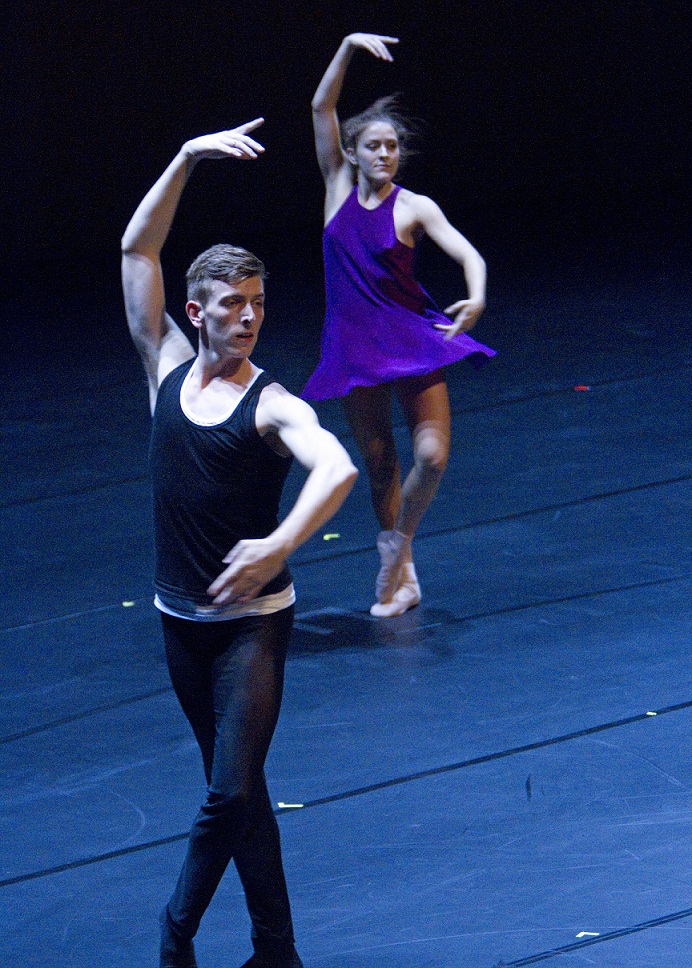
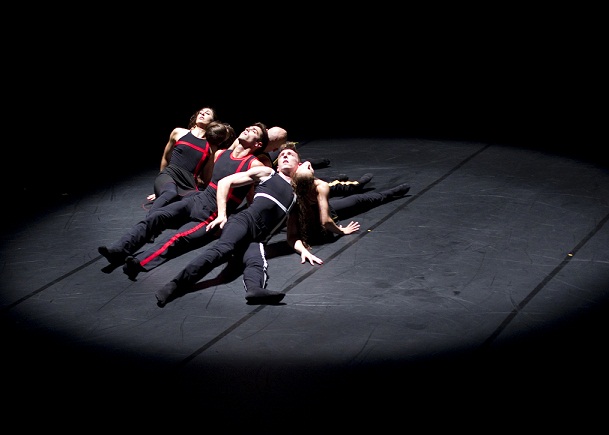
The other two pieces weren’t quite as strong. I think Forsythe’s Quintett (photo above) meant more if you knew about it, about him, and about his wife who died young of ovarian cancer. It’s a waltz but there are five people – three men and two women. So there’s a woman missing. The music is Gavin Bryars’s Jesus’ Blood Never Failed Me Yet, a sweet, folksy choral piece in which the singer keeps repeating that line over and over and over again. The dancing is mainly light and joyful, and the press notes state that he meant it to be a kind of tribute to her. Unfortunately the program notes don’t give out that information, so the audience was unaware.

I kept thinking of Forsythe’s intense, unforgettable installation piece, You Made Me a Monster, another take on the same thing, with a completely different mood, which showed in New York several years ago at the Baryshnikov Arts Center (and which I wrote about here). The dancer Charlie Hodges – my favorite of the six-person dance troupe – reminded me of a similar-looking dancer in Monster. His movement was the most expansive with every motion seemingly filled with intent. And he was the character who seemed to evoke the sole man, the man without the partner. Quintett had much more lightness and fluidity than Monster, and was far more hopeful than tragic, and it nearly made me cry. I’m just not sure if an audience who knew nothing about his wife and the work’s origins, and who’d never seen Monster, would have gotten the same out of it.

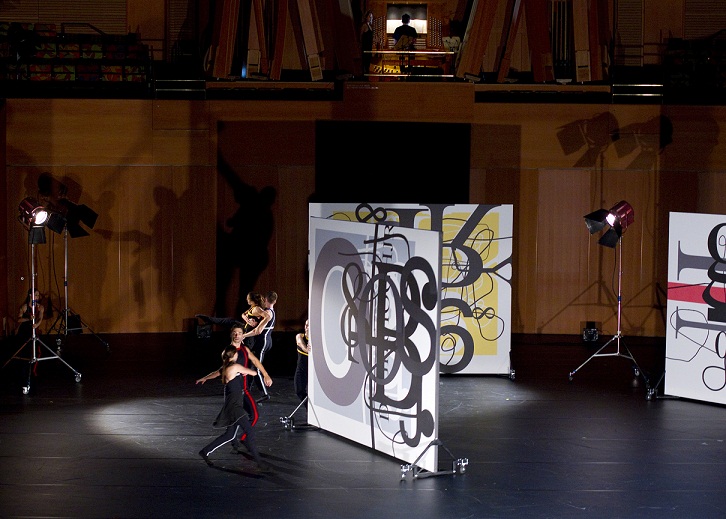
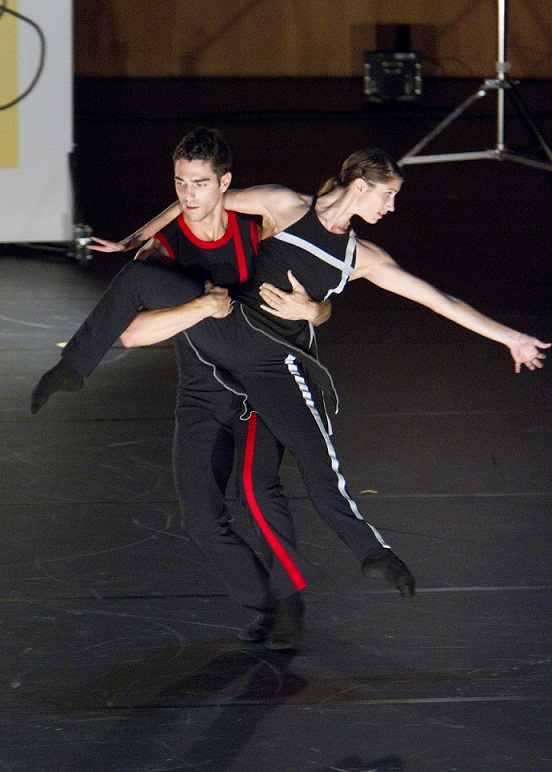
Third on was Millepied’s new Moving Parts, a collaboration with the always rousing Nico Muhly, costumers Kate and Laura Mulleavy of Rodarte, and visual artist Christopher Wool. I thought the most interesting parts of this collaboration were Muhly’s music – a bold, rich combination – at times mellifluous, at times slightly off-kilter a la Philip Glass – of violin, clarinet, and organ (played spectacularly on the magnificent, elevated organ at the top of the concert hall) and Wool’s artwork, consisting of three large canvasses bearing a combination of letters and numbers. One or two of the six dancers would push the paintings, on wheels, around the stage, the others dancing around them. The dancers wore basic black unitards; and were paired – male and female – by a same colored stripe running along the top of the costumes. Each painting also bore one of those colors. But this color-coordination didn’t seem to have much meaning.

The dancers were all very good – Hodges, Frances Chiaverini, Julia Eichten, Morgan Lugo, Nathan Makolandra, and Amanda Wells, but I didn’t find the choreography particularly intriguing or the dance as a whole to have much meaning. But I find Millepied to be like that – he’s either on or off. This time he was off, but next time he may well be very on.

Nevertheless, every time this company performs, I will always be there. That Cunningham revival made me trust that Millepied will always bring something significant.

Here are a few more photos of Moving Parts, courtesy of the Music Center.
Benjamin Millepied, Christopher Wheeldon, and Alexei Ratmansky Premieres at ABT


Above: Isabella Boylston and Marcelo Gomes in Christopher Wheeldon’s Thirteen Diversions, which premiered at American Ballet Theater two weeks ago. (Photo by Rosalie O’Connor.)

Once again, I’m behind on posts. May was a crazy month, filled with family emergencies, last minute travel, and trying to juggle paying legal work with book industry stuff and blogging. Hopefully June will be a bit quieter, though not likely at the rate it’s going thus far…

Anyway, on May 24th, ABT held a night of premieres, showing three new works by today’s “in” choreographers. Wheeldon’s Thirteen Diversions, set to Benjamin Britten’s Diversions for Piano and Orchestra, was overall my favorite. It seemed to have the most going on in terms of emotions, the most developed sections, the most varied movement, and interesting lighting design (by Brad Fields) to boot, though I know others were bothered by that. Background was lit with different colors each section and began with part of the back darkened, with light slowly encroaching. It created an atmosphere of mystery. I also felt like Wheeldon’s dance allowed the dancers to shine the most. Gillian Murphy and David Hallberg were a duo whose dancing had a sweet, light feel to it, like a relationship in bloom, while Marcelo Gomes and Isabella Boylston kind of went back and forth, with more depth and nuance to their relationship. She’d go from peaceful to needy to wanting to escape him back to needing him. They danced it well.


Above: Michele Wiles and Thomas Forster in Ratmansky’s Dumbarton, which I liked as well. (Photo by Rosalie O’Connor.) Dumbarton, set to Stravinsky’s Dumbarton Oaks, was mostly light and lyrical, with dancers clothed in light-colored contemporary costumes (by Richard Hudson). At times, though, the dance took on a more mournful tone, as the music would grow slower and Misty Copeland would collapse, then be carried off by a group of men. But then she’d reappear again in the next, lighter scene, as if nothing had happened. Then, it would happen again. I wasn’t sure if we were going back and forth in time or if there was a continuity of life kind of motif at play.


Millepied’s Troika was a relatively short dance, for three men, set to Bach.  Above are Sascha Radetsky, Alexandre Hammoudi, and Daniil Simkin (being thrown) in photo by Mikhail Logvinov. I started out really liking it but it kind of lost steam. I thought each man would have a different personality or embody a different mood: Simkin more playful, Radetsky more masculine, Hammoudi more soft and lyrical. To an extent it was danced that way, but then mid-way through they each seemed to be doing the same things. They started to blend into one another. Maybe that was the point. At the end, there was a series of lifts where Radetsky and Hammoudi kind of threw Simkin. He’d playfully try to escape them, but they’d catch him, scoop him up, and toss him. Someone remarked that this reminded them of Tharp. It also reminded me of Millepied’s earlier work for ABT, where Simkin was tossed in the air by a group of men in the midst of trying to escape a group of women. So Millepied repeats his themes over a few times.

Also on the program was a revival of Tudor’s Shadowplay with Craig Salstein and Xiomara Reyes in the leads. Created in 1967 and set to Le Livre de la Jungle by Charles Koechlin, it had a very dated feel and many have noted this is not one of Tudor’s better works. To me, it had a kind of Rite of Spring meets Prodigal Son feel to it. Salstein plays a poetic, monk type of figure who wants to be alone to meditate. But he is constantly bothered by this group of beings who appear to be half human, half primate who swing around gymnastically on a set of tree branches. Eventually they bring to him a woman, who’s very Siren-like, and whose sinister charms the protagonist is ultimately able to ignore. That’s what I saw in it anyway.

I felt a bit underwhelmed by the evening overall. It’s always exciting to see new dances though. And it could just be me and my penchant for full-length story ballets 🙂

One other thing: some of the gossip blogs stated that ABT had stricken Sarah Lane from the performance because of Natalie Portman’s presence. I didn’t know Lane was supposed to be dancing that night so have no idea if that’s at all true. Can’t imagine it is. Boylston still danced, and, as I said, I thought she danced very well.

Kurt Froman on Training Natalie Portman to Dance


But his funniest, most interesting words are about Mila Kunis:

“Mila, and I mean this in the best way, she is such a loud-mouthed kind of broad. You know exactly where you stand with her, if she’s not happy with something. All she wanted to do is smoke cigarettes and drink coffee, where it was like, “Come on Mila, we’ve got to work!” And Natalie was like completely the opposite, in a way. She never complained once…

“Mila was the further behind in terms of training. She’s not — she doesn’t have a really good sense of her body, she’s not really a dancer or whatever.”

It’s funny, but I know exactly what he means about not having a good sense of your body… something I never knew about myself until I started trying to to dance.

Anyway, this is from an interview in Front Row Magazine, by Peter Simek, with Kurt Froman (former NYCB dancer- turned – Movin’ Out lead dancer and choreographer for Billy Elliot on Broadway.) Apparently, the interview with Froman was originally published around the time the movie came out, but these excerpts didn’t make the final cut. Simek decided to publish them now in light of the current who danced what controversy. Btw, you all probably already know this, but Sarah Lane gave an interview to 20/20 about said issue. Froman gave the interview a long time ago, without knowledge that this would become a controversy, so it has the air of truth. Scroll down to the bottom to read exactly what he said about Portman.

But I also find it really interesting what he said about training Kunis. At least at the beginning, their intention was to make her like a real Odile – marked by virtuosity. Froman choreographed while Millepied was busy with a prior commitment and that’s what he was trying to go for with Kunis – to make her as believable as a virtuoso as possible. But then when Millepied returned, he changed everything, making Kunis’s character more about her sex appeal, and her sexual comfort level with herself (as opposed to Odette / Portman’s lack thereof). So then they added things like Kunis’s dancing with her hair down, being so comfortable with herself that she didn’t care about messing up, etc., and they took out the virtuosity. This, he said, was okay because it went along far better with what Aronofsky wanted than what Froman had been trying to train her to do. I just find that interesting, because that was one of the parts of the film where I had the hardest time suspending disbelief – that the company director would seriously consider replacing the lead with a seemingly ditzy girl who thought it was funny when she couldn’t do a series of turns without nearly falling over. Of course everyone keeps pointing out that the movie wasn’t about dance but about sexuality, madness, etc. And they’re right. It’s just interesting to me that initially the film seemed to be a little more about the actual ballet than it ended up. Makes me wonder if things were changed after everyone realized how impossible it was to make a couple of very good actresses believable as high-level ballerinas.

Sorry this is all I’ve been blogging about lately! It’s definitely not all I care about. But I’ve returned to practicing law and so am now trying to juggle three things: my job, my book, and this blog. I apologize if it’s slow going from time to time. I definitely plan to cover as much NYCB and ABT as I can this summer!

More BLACK SWAN Controversy, and The Paris Opera Ballet’s COPPELIA


I’m still crazy busy but just wanted to point out two things. First, if you haven’t already heard, there’s now a storm of controversy over how much dancing Natalie Portman actually did in Black Swan. Dance Magazine EIC Wendy Perron wants more credit given to Sarah Lane, Portman’s ABT double (whose dancing I love; for image credits above, click on the photos). Portman didn’t mention Lane in her Oscar acceptance speech (though she did mention the dancers in general) but, further, there was apparently also a special effects video produced about the making of the film in which Lane’s face was never shown, though her dancing body was, and in which Lane was never credited. Lane seems not to want to say too much, says she was asked to remain silent on the issue, to not talk about the film, particularly before the Oscars. Lane gave an interview to Dance Magazine in December about her role in the movie, saying she wasn’t “looking for any sort of recognition.” Millepied of course defends his muse, saying Lane did “just the footwork.”

Lane also mentioned in that Dance Magazine interview that Maria Riccetto did some of Mila Kunis’s dancing, which I didn’t know. Both Portman and Kunis must be very petite women!

Anyway, will the controversy surrounding this film ever end? Hopefully not! It’s keeping ballet in the minds of the public, if you ask me…

Thanks to reader Jeff (who I noticed is also mentioned in Perron’s blog, linked to above) for pointing me to the controversy.


Also, this Monday, March 28th, the Paris Opera Ballet will live-stream its Coppelia, via Emerging Pictures’ always excellent Ballet in Cinema series. Curtain is Paris time at 7:30 p.m., which is 1:30 p.m. here on the east coast. In Manhattan, it’s showing at the Big Theater again. For other times and locations, visit the Ballet in Cinema website.

Okay, all I have time for now. Thanks for continuing to read my blog while I remain swamped 🙂

Natalie Portman’s Black Swan Acceptance Speech at the Oscars


So what did you guys think of it? I tried to find a YouTube video but couldn’t find a free one. Interesting that companies are going to start charging for subscriptions for that kind of thing… Anyway, I love that she thanked and named all the professional dancers who trained her this time, and that she expressed how wonderful and enlightening it was to work with them all. She honestly elevated the film with her speech in my opinion.

And how sweet was it for her to try to bring Millepied up with her onstage! I watched E!’s red carpet show – mainly to see her – but she arrived last and seemingly without Millepied (since she was interviewed alone). I was like, where is he?! But he was there, of course.

Speaking of the red carpet show, I loved Mila Kunis’s dress.


And Scarlett Johansson’s, though it didn’t seem to go over too well with Kelly Osbourne and the other woman who was hosting the show:


And Helena Bonham Carter noted that her dress was by Colleen Atwood, who is the costume designer who ended up winning best costume design for Alice in Wonderland. She said she preferred to celebrate the movies rather than fashion on this night:


I thought all of the best actor and best supporting actor speeches were good. Loved Colin Firth’s, loved him in King’s Speech, but still love Jesse Eisenberg as well. Love that in her excitement, Melissa Leo used profanity. How’d they bleep that out so quickly? And did Kirk Douglas actually grab her butt? Someone on Twitter said they thought they saw that. He was kind of acting in an antiquated sexist kind of way, with all his flirting with Hathaway and all, so I totally believe he may have. He would have made me so nervous if I were Leo. Poor Leo, I thought. This is her moment, not his. Interesting (and proper) move, to include Douglas as a presenter, because Anne Hathaway and James Franco seemed to keep sending the message that they were invited to host because they represented the young, hip generation. Is that true? She seemed like a big, clumsy, awkward goof – probably the nerves, and he seemed to have taken a bit too much Valium (or something else) to calm his. Does Hollywood feel the need to pander to the young ‘uns too? Like ballet and the opera? How odd – movies are generally for the younger generations, I’d thought… Anyway, they bored me, those hosts. And Kirk Douglas scared me. Isn’t there, like, someone in between, who’s not too unsophisticated to take on that kind of role but who can also keep from violating current-day boundaries?

Anyway, overall a decent night. The end of the evening speeches made up for the poor hosting. Kind of.

Moonlight on the Beach

Happy President’s Day everyone! I’m spending the week in South Carolina at my cousin’s timeshare – I needed a few days away from New York and the ocean is  my favorite place. (If I ever have money, I’m definitely buying a beach house somewhere.  I could never be one of those New Yorkers who buys a country home up in the mountains. I don’t understand those people. Who wants to risk a run-in with a bear or coyote or jaguar? Not to mention deal with permanently cold temperatures…) Anyway, the light from last night’s full moon on the ocean was gorgeous. My iPhone is not so good at taking pictures at night, so you’ll have to take my word for it 🙂

The condo’s wireless connection is a bit off and on, plus, it’s unexpectedly nice weather here – 71 degrees today, plus I’m supposed to be working on my novel, so I don’t know how much time I’ll have to blog. But here are a few items of interest:

Roberto Bolle makes his Hollywood debut;

John Epperson talks about his role as “Jaded Piano Player” in Black Swan; and

Our friend Benjamin Millepied is now getting hounded by the tabloids for working too hard and not paying enough attention to Ms. Portman

Also, here are some photos I just received of the magnificent Sara Mearns debuting as the Siren (opposite Sean Suozzi) in Balanchine’s Prodigal Son a couple weeks ago at NYCB:


Finally, if you haven’t seen Natalia Osipova dance yet, next Sunday, March 6th, will be your chance. She’ll be dancing Kitri in Don Quixote with the Bolshoi, in a performance that will be live-streamed direct from Moscow via Emerging Pictures’ Ballet in Cinema series. NY performance time is 11:00 a.m., at the Manhattan Big Theater, and she’ll be dancing opposite Ivan Vasliev. This is the role that made her famous, and she owns it, so try not to miss it if it’s showing at a theater near you. Check Emerging Pictures’ website for times and locations.

Okay, that’s all for now. Happy holiday everyone!

Last Week at New York City Ballet


Last week I went to two performances of NYCB – opening night and Thursday night’s “See the Music” program – and to two of the free all-day Balanchine events on Saturday. First, I’ll talk about the last two since I found them so informative. The free studio talk on Saturday afternoon – Balanchine’s birthday – was moderated by Sean Lavery (former NYCB principal dancer, now ballet master), and included Sterling Hyltin (in Paul Kolnik photo above with Robert Fairchild), Chase Finlay, and Jenifer Ringer. Lavery asked the dancers to talk about their first Balanchine ballets, their favorites, and what drew them to NYCB. Hyltin named as her favorite Duo Concertant (pictured above) which I’d just seen her dance on opening night. She said she liked the syncopated movement, the he goes and I go kind of back and forth movement conversation with her partner, and with the musicians. I really liked it too. The violinist and pianist are onstage (the music is Stravinsky), and I like the interaction between the dancers and the musicians, and between the two dancers, and I like the sharp, angular movement. She seemed particularly animated when I saw it. I love Robert Fairchild and think he’s such a sharp, masculine mover with a presence that commands your attention without meaning to – he kind of reminds me of a less cocky Ethan Stiefel – but she seemed so happy to be dancing this piece that she stood out to me more. It was nice to hear her talk about it.

But what I really loved was the School of American Ballet class taught by Peter Martins. He interacted cutely with the students, particularly “Cyrus,” (at least I think that was his name…) a tall, long-limbed young man who I think will soon be in the company. Cyrus didn’t always do everything perfectly (at least in Martins’s eyes) but he had a charming presence and a great leading-man physique and you can tell he works hard.

Martins had the class demonstrate ballet basics – beginning with the five positions, and they showed us a perfect fifth position (with the toes of the front foot touching the heel of the other and vice versa). More interestingly, he had the class show us the difference between a Balanchine hand and a classical ballet hand. I’d always noticed there was a difference but couldn’t figure it out exactly. God gave us five fingers, Balanchine had said, so we shouldn’t hide two of them. The Balanchine hand shows all five fingers, the classical ballet one only three (with the ring finger and pinky held so that they are hidden from view behind the middle finger).

Martins also had the students show us how Balanchine’s fourth position differed from others’. In Balanchine’s the back leg is straight; in all others’ the back leg is bent. Martins didn’t go into any functional explanation for this – just said “here, we think it looks better.” But I thought about it and thought, wow, it must be hard to take off in a jump for example with the back leg straight. And then I realized that’s partly why Balanchine’s choreography always looks so fluid, like one step leading right into another, without a lot of stopping to build up to a big athletic feat – a big jump or series of turns. Other companies – like the Russians, like the Bolshoi – are all about preparing so that you can do something astounding. So they’re all about the building up.

This was mentioned in the studio talk as well. Lavery also talked about how fluid Balanchine’s movement was, and how, for example, in a lift, a guy would pick up a girl, then take two steps, and put her down rather than walk all over stage with her hoisted above his head. Balanchine wanted her to come up, then down right again, because that was more fluid, rather than have her head bobbing around up there while the guy was running all around with her.

Martins also demonstrated the bows. At City Ballet, he said, we just do them as such, and the girls did a little curtsy with the back leg slightly bent, without going down on one knee. Making fun of the dramatic Swan Lake bows, Martins went all the way down on one knee, exclaiming, “Yes, yes, I know I’m good!!!” while putting his head down, forehead nearly touching the floor, and raising his arms up in back of him like wings, fingers pointed toward the ceiling. It was hilarious.

Anyway, here are a couple more photos of opening night:


Above: Ashley Bouder in Valse-Fantaisie, and below, the cast, including Andrew Veyette, in the same (all photos by Paul Kolnik)


I liked Balanchine’s Valse-Fantaisie (Veyette replaced Joaquin DeLuz – but don’t know why because DeLuz danced Concerto DSCH two nights later) but I really loved the first of the evening, Walpurgisnacht Ballet. I’d never seen Walpurgisnacht before and it’s funny but I always seem to love the Balanchine ballets that are the least often performed. This was really beautiful. It’s from Gounod’s Faust, and features a group of women (and only one man – here Charles Askegard) in deep red dresses, their hair down in the second half as the music increases in tempo so that there’s almost kind of a hedonistic madness in the mood – and the footwork is so intensely complicated and fast fast fast. Wendy Whelan even made a tiny little flub, which I’ve never seen her do before. Crazy! And breathtaking!

And the evening ended with The Four Temperaments. I’ve said before and I’ll complain again that I still don’t understand why everyone goes on about how brilliant this one is. To me, there are supposed to be four temperaments, and the ballet is divided accordingly into four variations after the theme: melancholic, sanguinic, phlegmatic, and choleric. But they all seem to be the same to me. The dance seems one-note throughout so that after the first variation, I’m waiting for it to end. I’ll keep seeing it though, perhaps performed by a variety of companies if I have the chance, and will keep looking for the nuances…

“See the Music” night opened with Faycal Karoui’s discussion of Mozartiana, Tchaikovsky’s homage to / riff on Mozart, which made me appreciate Tchaikovsky even more. Then that piece was danced – by Maria Kowroski, Daniel Ulbricht, and Tyler Angle. Tyler stood out to me. As always, he dances with so much meaning, so much intention, and so much expansiveness. He’s a really beautiful dancer.

Then came Ratmansky’s Concerto DSCH, danced by Wendy Whelan, Ashley Bouder, Joaquin DeLuz, Andrew Veyette (replacing this time Gonzalo Garcia), and Benjamin Millepied. Oh, Natalie Portman was there, albeit late – she came in with a friend after Karoui’s lecture and right before Mozartiana was performed. Then, she left right after Concerto DSCH, after Millepied was done performing, and before the last piece. I thought it was a shame she missed Sara Mearns in the last dance, but a Twitter friend said she had a movie premiere that night, so I guess she needed to leave early for that.

Anyway, as usual, Millepied did not stand out to me, and I couldn’t stop thinking of seeing Tyler Angle in that role before and the way he lunges romantically toward the main girl, making it clear how much he yearns for her. Millepied’s knees nearly touch the ground in his deep steps toward her and it just looks like a dance step, not like anything evoking a specific emotion. As always I loved Bouder and DeLuz in the fast, playfully firtatious three-some part. I missed Garcia – where is he? I hope not injured! – but thought Veyette did a fine job in his stead.

And the evening ended brilliantly with Sara Mearns and Charles Askegard dancing the ballet leads in Balanchine’s Cortege Hongrois, while Rebecca Krohn and Sean Suozzi just as brilliantly danced the folksy Hungarian leads. I really love that dance and it made me all the more eager to see Mearns in Swan Lake!

On both nights, I went with my friend, author Maria Mutsuki Mockett. She writes an author blog but has been attending the ballet much more frequently and is now blogging a lot about ballet as well. She’s an excellent writer, so please check out her blog!

Natalie Portman’s Black Swan Golden Globe Acceptance Speech

Did you guys watch last night? I thought she looked radiant, and her speech was really sweet. She seemed genuinely happy about both the film and her personal life. She still seemed to be in a state of blissful shock about the latter. I found the part where she reminded the audience about Benjamin Millepied’s character smirking when Vincent Cassel’s character asked him if he would sleep with Portman’s black swan, then said, “see – he’s a good actor because he really does want to sleep with me!” sweetly innocent, though I can imagine some might have thought it a bit crass or childish. Millepied to me looked a little out of his element though. He looked uncomfortable when the camera focused on him.

Some dance fans on Twitter noted that Portman thanked everyone involved in the film but the dancers. I think that’s more of a testament to the fact that this wasn’t really a dance film – the other dancers had the relevance and necessity of extras – than to any forgetfulness on her part.

Dance film or not, I’m glad she won. I think she was by far the best of the actresses nominated in her category.

And did you guys see Jackie Reyes sitting next to Aaron Sorkin! I know one person did! I guess she’s no longer with ABT though; she’s now a student at Columbia. I wonder why she left ABT. Though she was in the corps she always stood out to me and she was only 24 and had time to work toward a promotion…

I’m also glad The Social Network won so many awards, including the biggest – best film. I think it had the most reach and breadth and depth and importance of the films nominated. It also had great acting by everyone all around, great writing, great story-telling – everything you’d expect an award-winner to have. I wished Jesse Eisenberg could have won for best actor because I think he did a tremendous job. He found the vulnerability in that character and really created sympathy for him – that’s hard to do when your character is generally a supreme jerk. But there was no way with him going up against Colin Firth.

And speaking of social networks these days, I don’t know how many of you are on Twitter, but as I was watching I was following the #goldenglobes hashtag. I love doing that now when I’m watching something popular. I do it often during big sports games now. It’s one of my favorite things about Twitter because you can connect with people all over the country – all of the world really – who you don’t know but who are doing the same thing you’re doing at that moment. And sometimes people say very funny, clever things – especially during a big celebrity fest like this.

Anyway, Twitter puts the “top tweets” on a given subject at the top of its hashtag list. These are usually – or have been in the past – the tweets that have been the most re-tweeted. This is a way of rewarding the funninest, wittiest tweets on something, or a tweet that has resonance to many – people re-tweet and those tweets rise to the top of the list. Well, last night as I was following along on the hashtag, all of a sudden a tweet by Paramount was suddenly planted at the top. And it was obviously an advertisement for one of their films. It wasn’t a tweet that was clever or funny and had been re-tweeted. I assume the studio had purchased it as ad space from the Twitter execs. That’s what it seemed like anyway. And then several tweets like that started appearing at the top of the hashtag list. If you were reading on a cell phone with a small screen, you had to do some real scrolling down every time you refreshed the page to see the newest tweets.

After a while it became annoying and I just stopped following the hashtag. It really kind of saddened me though. What would Mark Zuckerberg say? According to The Social Network, at first he didn’t want advertising on Facebook because he thought it would ruin it by being too intrusive, not to mention corny. And he was right. But at least on Facebook the advertisements don’t interfere with your ability to use the site for what it’s for – to socialize.

Is Millepied a K-Fed or a Baryshnikov?

I’ve seen a good number of articles like this one popping up on various celebrity gossip blogs, contending that Benjamin Millepied poked holes in his condoms and is basically just after Natalie Portman for fame and money – I guess like Kevin Federline arguably was with Britney Spears. Millepied has always seemed kind of like a romantic, like a Balanchine, always falling for his muses, so it didn’t really faze me when I heard he was dating the latest ballerina he’d choreographed on. Of course I don’t know him, and everything on those blogs is hearsay. I’m more interested in the public perception though.

I’m just wondering if anyone remembers well the Baryshnikov era. Was Baryshnikov similarly attacked for impregnating Jessica Lange? I was a very small child when that all happened but it seemed like the public just adored him, the two of them together. Or maybe that was just me lost in my little girl ballerina dreams. Actually, come to think of it, I don’t remember when the two first became a couple; I have no memory of him until they’d already split and I was terribly jealous of their beautiful daughter because she got to go to the White Nights premiere with her father in Hollywood. Anyway, if he was perceived differently, I wonder what is different.

In other Hollywood/ballet gossip, Aaron Sorkin is allegedly dating ABT’s Jacqueline Reyes.

Is Ballet A Dying Art?


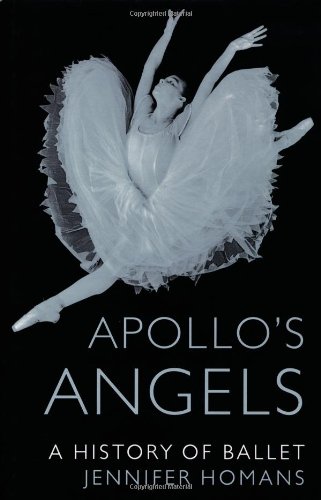
I must confess I haven’t yet read Jennifer Homans’ acclaimed but controversial history of ballet, Apollo’s Angels. I’m working hard on my second novel and have been knee deep in prison and cop memoirs and haven’t had time for much outside reading. I hope to read it soon though.

In the meantime, I have read some of the reviews, including Laura Jacobs’ in the WSJ and Toni Bentley’s in the NY Times. The two reviews focus on very different aspects of the book so it’s interesting to read both of them. Bentley says Homans is best on Balanchine (both Bentley and Homans danced with him). But Jacobs find the earlier sections enlightening as well.

The controversial aspects of the book seem to be toward the end when Homans argues that, for various reason (but according to Bentley many of them being that Balanchine has passed and his legacy is not being kept alive), ballet is a dying art.

I don’t want to go on too much since I haven’t yet read the book, but I will say that ballet seems to be alive and well in many European and Latin American countries. I do notice a real influx of visitors to my blog whenever the big European stars perform with ABT. I don’t think Roberto Bolle, Alina Cojocaru and Natalia Osipova fans think ballet is dying and certainly not because Balanchine is no longer with us. Ballet may be less popular in this country since the Baryshnikov era passed though, and it remains to be seen whether movies like Mao’s Last Dancer and Black Swan can do anything to revive it. I’m doubtful but want to be hopeful. I think it’s more likely that Natalie Portman marrying Benjamin Millepied will draw audiences to ballet than the actual movie will.

But then I recently ran across this interview with Homans over at the Ballet Bag, a London blog. At the beginning of the post, the writers say audiences there have been dwindling a bit and they’re worried about the future of the art form as well. Which scares me.

Anyway, has anyone read the book?

Another thing I wanted to call attention to is the book cover. The top one is the British cover, the second the American. Which do you guys like better, and think will sell more books? Just about every single time I see a European cover beside an American cover, I like the European better. But maybe it’s just me.

Jenifer Ringer Talks About Her Weight on the Today Show

If you guys haven’t seen this yet, Jenifer Ringer was on the Today Show talking about Sir Alastair’s criticism of her weight, her past eating disorder, and the struggle to be thin for ballerinas in general. I hadn’t known, but Natalie Portman lost 20 pounds for Black Swan!

Poor Jared Angle! He hasn’t gotten anything out of this – and he supposedly sampled half the damn Sweet Realm!

Oh also, it’s interesting to look at the comments in the Huffington Post post; quite different from those on Jennifer Edwards’ earlier post in which many commenters supported Macaulay.