My Take on BLACK SWAN


I saw it over the weekend. Overall, I thought it was hilarious. Totally campy and just plain funny. Way too silly to be scary though. And I think Aronofksy was going for both. So, to me, it failed to that extent. But it may have just been me. Maybe I just have a dark sense of humor, because I went with two friends – one a ballet fan of the Gelsey Kirkland era, the other not. They both loved it and were on the edge of their seats throughout, although they also laughed quite a bit (particularly Gelsey Kirkland friend). Gelsey Kirkland friend said it reminded him of Dancing on My Grave. I must read that! I don’t know why I haven’t yet…

Anyway, so if you don’t know the story, it’s about this young ballerina who dances with a New York City ballet company housed in the Koch Theater. The artistic director (played by Vincent Cassel) is basically Peter Martins but with brown hair and a French accent.ย  Peter Martins guy tells the company that they are doing a new production of Swan Lake and to attract new audiences, they are going to cast a brand new ballerina, a new face. The old prima, Winona Ryder, is approaching menopause anyway. Never mind that she looks the same age she did in Reality Bites, at least to me. Apparently this company doesn’t have a system of principals and corps members because no one has any idea who the new face is going to be.

Peter Martins guy soon reveals that he favors Nina (Portman), but thinks she can only do the White Swan. He thinks she’ll have trouble with the Black Swan (he never uses the names Odette and Odile, which I know annoyed some ballet fans on Twitter, but I think it would have alienated non-ballet audiences had he used those names). He tries to seduce her (literally) in the name of getting her into the character of the Black Swan, which of course in the film is characterized as a sinister, conniving slut. But maybe he goes too far and unleashes the inner beast in Nina. She suddenly seems hell-bent on destroying herself (and she’s had problems in the past with self-mutilation and, it’s hinted at, anorexia). Or, maybe it’s that a new dancer from San Francisco (Mila Kunis) is trying to destroy her in order to take her place as the lead. My biggest problem with the movie is that it’s billed as a thriller but we never really find out the answer to that question. At the end, you’re still left wondering WFT was that about??? I mean, you’re left wondering that with many David Lynch films too, but with those, if you think long and hard enough, you can piece it all together. This, I don’t think so. I think it was just meant to be scary, sexy, creepy, gory camp.

For serious ballet fans, you have to suspend disbelief. Natalie Portman I thought did an excellent acting job, and her dancing is very very good for someone with very little training. I know Sarah Lane was supposedly her double, but you never really see any stunning dancing. The camera mostly focuses on Portman’s arms – and Benjamin Millepied did say he focused on the port de bras when training her and Kunis because you just can’t teach someone with no training to go on pointe and do the fouettes and pirouettes and all. So, you simply have to suspend disbelief that someone at Nina’s level would land the lead in the first place. And if you’re looking for thrilling dancing – the fouettes, the lightening-speed chaine turns, a beautiful pas de deux, etc., you’re not going to get it.

When we were all walking out, I did hear a couple people say now they wanted to see Swan Lake. Of course I hope it renews interest in the ballet, but it does worry me a bit that people will be disappointed, because the film makes it seem like the black swan pas de deux is a sex scene. The Peter Martins character keeps yelling at Nina to “seduce me, seduce me!” During a break he rhetorically asks Millepied (playing the role of Siegfried) if he would ever sleep with Nina (except he termed it differently). No one in the audience laughed but me. What am I the only New Yorker who reads the tabloids??? But in the ballet, the ballerina seduces both Siegfried and the audience with her allegro dancing, with her athletics. It’s more dance than theater; the seduction is in the dancing not the acting.

The whole thing had a Valley of the Dolls feel to it. Barbara Hershey is Portman’s mother, and she seems a bit off herself. You sometimes wonder if the mother (who never made it out of the corps, and who left ballet to have Nina) is trying to sabotage her daughter as well. There are some really funny (though I’m not sure if they were meant to be) screaming screeching cat-fight scenes between the two of them. But I think the funniest are between Winona Ryder as the aging ballet star forced into retirement and Nina, particularly those involving discussions of how to get ahead in the ballet company (guess; not by great dancing)… I miss Winona Ryder. I miss movies like Heathers

Anyway, I still don’t know how to feel about this movie. I’m happy that it’s put ballet on people’s minds again, but how misleading is it to what an actual ballet performance is all about? What do you guys think? It seems to have received fairly good reviews from the film critics.
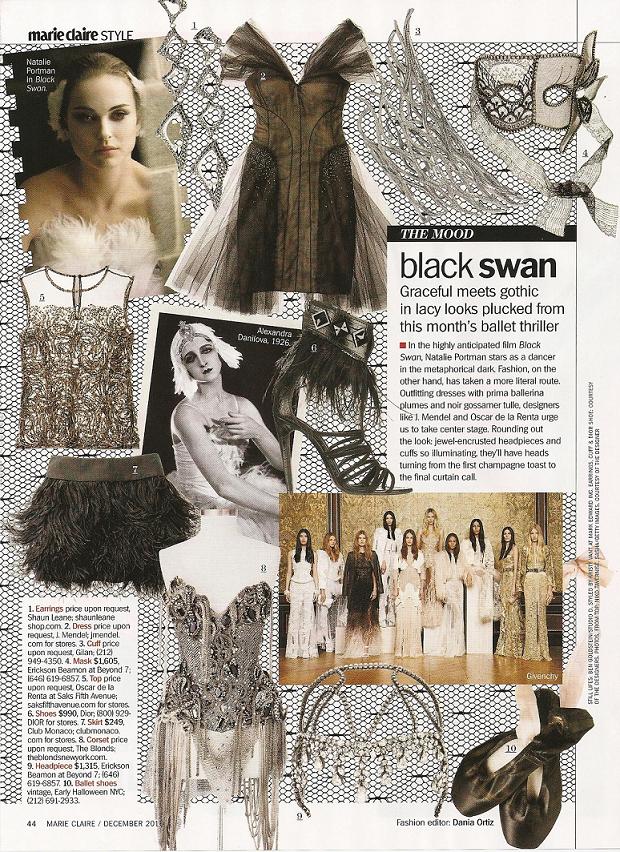

Black Swan-Inspired Fashion

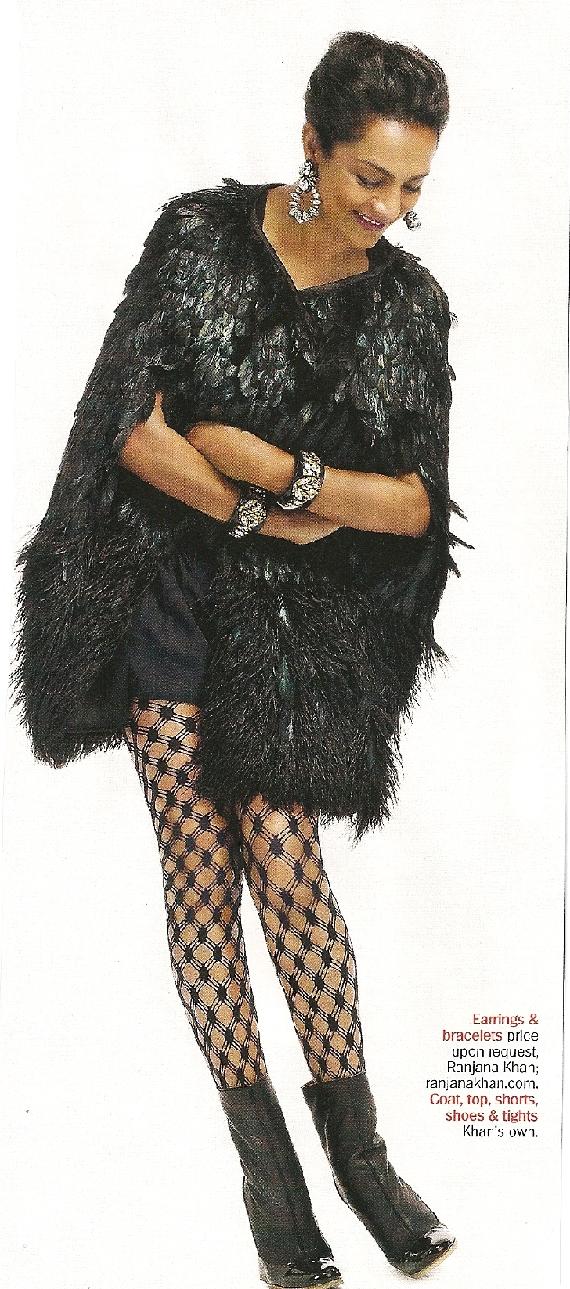
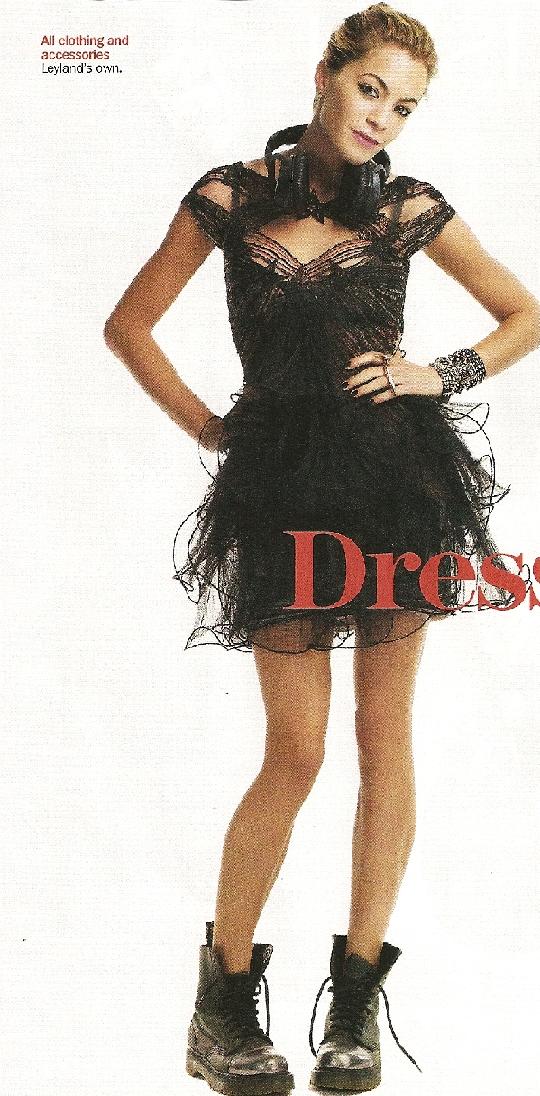
I was flipping through Marie Claire and saw this spread on current fashions inspired by the Black Swan movie:

They also had a spread on fashions inspired by Burlesque, the new film starring Cher and Christina Aguilera:

And then as I kept flipping through the magazine, it seemed I kept spotting more and more Swan-looking garb:

Benjamin Millepied Interviewed at Black Swan Premiere

This is actually a pretty interesting interview, by Amy Kaufman, of the Los Angeles Times, at the Black Swan premiere in LA. Millepied talks about the differences between working with trained and untrained dancers, and how he trained the untrained specifically for film. When asked whether Natalie Portman and Mila Kunis are ready to join a ballet company, he says “oh no”! ๐Ÿ™‚

Natalie Portman Black Swan Interview in UK Express

Natalie Portman talks with the UK Express about how much harder her role in Black Swan was than other film roles she’s had.

โ€œ’There were a few days when I thought I might die, literally,’โ€ says Natalie. ‘Maybe Iโ€™m being dramatic but it was a huge challenge. Iโ€™ve worked on projects that are similarly emotional, but to have the physical side at the same time was something. To express feelings with your body, not through words, is tough for any actor.'”

Wow. That’s what dancers are – actors plus elite athletes ๐Ÿ™‚

Read the rest of the interview here.

Benjamin Millepied’s “Plainspoken”

Last Thursday was NYCB’s Fall gala, during which they presented the New York City premiere of Benjamin Millepied’s Plainspoken (photo at left, of Teresa Reichlen and Sebastien Marcovici, by Paul Kolnik; the ballet originally premiered in Wyoming this August), along with Robbins’ fabulous homage to Fred Astaire and Rita Hayworth, I’m Old Fashioned, and Balanchine’s Tarantella and Western Symphony.

The evening began with the orchestra pit rising and the always lively Faycal Karoui leading the orchestra in a rendition of Leonard Bernstein’s Candide Overture. I love that movable orchestra pit – best thing, in my opinion, about the recent renovations to the Koch Theater.

I was hoping there would be introductions and short speeches, including one by Sarah Jessica Parker, who served as honorary chair for the after-performance party. But no such luck – I guess because it wasn’t the beginning of the season, like galas usually are. I didn’t even get to see Parker come down the red carpet, there were so many paparazzi blocking my view. I certainly heard her though – or, rather, the paparazzi, as they screamed her name like she was the Messiah. I didn’t recognize anyone else. Lots of good-looking people perfectly coiffed and dressed in black tie but no one I recognized. I didn’t see Natalie Portman, though I heard she was there. I never recognize famous people, though. I’m really bad that way.

Anyway, I’m Old Fashioned was, as always, enjoyable, albeit too long. No dance-maker needed an editor more than Jerome Robbins in my opinion- and Tyler Angle stood out to me in his solos and duets with Maria Kowroski. But my favorite part of the evening was the second half of the post-intermission, when Ashley Bouder and Daniel Ulbrich just nailed Balanchine’s super fast-paced bravura-heavy duet, Tarantella (Ulbrich smacked the tambourine so hard one of the little metal things came flying off) and then Sara Mearns just astounded me in the last section of Western Symphony. How in the world does she stand on pointe, on her own unsupported by a male dancer, and lift her other leg in the air into a perfect split, into practically a six o’clock penchee? How how how? She and Charles Askegard really put on a show as tart-y saloon dancer and cowboy. She is really just unbelievable.

Okay, so onto Plainspoken. Well, sometimes I like Millepied, and sometimes the work just falls a bit flat to me. I didn’t much care for this one, though I’ve liked his last several ballets for ABT and NYCB. This was very abstract, no story that I could find, and I’m just not a fan of purely abstract ballets that I can’t find any story in whatsoever. It was a ballet for four couples: Sterling Hyltin and Tyler Angle, Teresa Reichlen and Amar Ramasar, Jennie Somogyi and Sebastien Marcovici, and Janie Taylor and Jared Angle (the last were generally my and my friend’s favorite pair – I think because Janie always brings something dark to her roles, there’s always something beneath the surface with her even if you can’t put your finger on what it is). The couples sometimes changed partners though, and there would be different-sized groupings.

The music was by Pulitzer prize-winning composer David Lang – it was a commissioned score – but to me the music here wasn’t nearly as rich as, for example, that used by Morphoses recently. This was mainly strings and piano and each section seemed emotionally the same. There didn’t seem to be a lot of contrast between the movements or a build-up toward the end. The sections were each differently lit – by a different color and a background curtain that would rise and lower to reveal more or less light than the section before. But the set was nothing very dramatic and the different colors didn’t, for me at least, evoke a different mood.

Movement-wise, there seemed to be a swimming theme. At various points the dancers would sit on the floor and make motions evocative of swimming – sweeping arms through the air, paddling legs – backward, then forward, then all dancers lying on their backs with their feet in the air like a synchronized swim team. At other points, the women would be carried somewhat Chaconne-like across the stage. I remember a slide characterizing Janie’s section, and she made it seem as if she was being taken by the men who slid her, against her will, across the floor.

I also have in my notes that the movement toward the beginning, in the first section, was a combination of robotic and more casual walks, kind of like the ensemble walking across the back of the stage in the second part of Robbins’s Glass Pieces. This kind of movement was interspersed with the swimming-like motions. In later sections, dancers seemed to run in place.

Oh, and during Janie’s section, there was a point where the men all picked her up and hoisted her high above them, like in MacMillan’s Manon or the Balanchine ballet where the woman is carried around the whole time by a group of men and the lone man on the floor keeps reaching up for her (sorry, can never remember the name of that ballet). My friend loved this part, and I did as well, but couldn’t really figure out how it played into the rest of that section.

In general, my first impressions of this ballet were: some interesting movement reminiscent of other ballets that didn’t seem to add up to much and didn’t really make me feel anything.

At the end, Millepied, Lang and the costume designer (Karen Young) and lighting designer (Penny Jacobus) took the stage for a bow. The applause seemed more polite than hearty (in contrast to the crazy applause Wheeldon always gets!), but that could just be me projecting my own thoughts onto everyone else.

What about you guys? I saw some mentions on Facebook of people liking it. Who else saw it and what did you think?

YVONNE BORREE’S FAREWELL PERFORMANCE


On Sunday afternoon, principal ballerina Yvonne Borree gave her farewell performance at New York City Ballet. I always find farewell performances so sad, especially for the ballerinas, for some reason. And Yvonne just doesn’t seem old enough to retire! At all.

Anyway, it was a really lovely program and she looked beautiful. She danced the third, “Andante,”ย  movement in Balanchine’s Brahms-Schoenberg Quartet. She was partnered by Benjamin Millepied, a very good partner for her, as she looks very comfortable dancing with him, and when they first took the stage, the audience really went wild with applause — and really wouldn’t let up! That’s uncommon for NYCB fans – even with a farewell performance; they usually save their applause until the very end. And the applause wasn’t just clapping; people were really whooting and screaming and calling out “Yvonne, Yvonne!” I think I am not the only one who will miss her. At the end of each section, she got more applause and at the end of Brahms, she and Millepied got three curtain calls. She deserved it. And he did too — I think Natalie Portman is giving him some acting lessons because he’s really doing much better, not just dancing (he’s always been a good dancer) but really projecting as well.

Then came Wheeldon’s new Estancia, which grew on me. I think the dancers found the humor in it — or maybe they did before and I was paying too much attention to the choreography to notice, but it seemed they really vamped it up, with Tyler Angle failing hilariously miserably at taming Andrew Veyette’s “horse,” letting Veyette get away after Tiler Peck roped him all up nicely, then Tyler being felled and rolling around the floor, nearly sweeping Tiler off her feet (in a bad way). It was really cute. And the dancing is really marvelous.

Then, the performance ended with Yvonne doing a pas de deux with Jared Angle — another good partner for her (for everyone really) – Balanchine’s Duo Concertant, which I love.


I love how the couple interacts with the onstage violinist and pianist, with the music, and with each other, and yet it is at times a very abstract ballet with lots of angular shapes. And the end is gorgeous but bittersweet, as the stage darkens and the spotlight begins to highlight only her, her head, then various parts of her body, ending with her arm, in the air, reaching upward and outward. It almost made me cry.

And of course the applause went on and on, and all of her partners (besides Nikolaj Hubbe unfortunately) came out onstage to give her a bouquet. Damian Woetzel and Peter Boal got the most whoots.

I’ve only been coming to New York City Ballet regularly for about the past three or four years and I feel I didn’t get to see enough of her. My favorite performances of hers are the delicate, ethereal sleepwalker in Balanchine’s La Sonnambula, which I think she danced with Sebastien Marcovici, and in that ballroom-esque ballet with the art deco mirror of Peter Martins that I love but no one shares my feelings about … ๐Ÿ™ Can’t think of what it’s called right now but she was always Nilas Martins’s partner. I loved it. And now, my other favorite of hers is Duo Concertant, which I’d never seen her dance before.

Apparently, she’ll still be around. According to Oberon, she’ll stay at NYCB’s School of American Ballet and teach.

Photos by Paul Kolnik.

ABT AT 70 AT THE GUGGENHEIM

Last night American Ballet Theatre put on a little celebration of its 70th anniversary and gave a little preview of its upcoming Met season (which begins next Monday, May 17th) at the Guggenheim, as part of the museum’s Works and Process events. Dancers from each decade of ABT’s existence — Susan Jaffe, Susan Jones, Donald Saddler, Lupe Serrano, and Rachel Moore – spoke briefly about what the company was like back in the day, and then there was (happily) a great deal of dancing.

Stella Abrera, Marian Butler, Jared Matthews and Sascha Radetsky performed the Lovers’ Quarrel from Ashton’s The Dream (based on Shakespeare’s Midsummer Night’s Dream), followed by Xiomara Reyes and Alexei Agoudine dancing the Titania / Bottom pas de deux from that ballet. I’ve never seen Ashton’s version of this ballet — only Balanchine’s — and the choreography looks so rich, richer to me, in a way, than Balanchine’s (though I know a lot of NYCB fans will balk at that). So, I’ll be looking forward to that. Audience cracked up, of course.

Then, Abrera, Isabella Boylston, and Yuriko Kajiya performed the Shades Trio from La Bayadere. Stella in particular took my breath away. Veronika Part and Eric Tamm then did a gorgeous pas de deux from John Neumeier’s Lady of the Camellias (which I’ve never seen before and now can’t wait to; it appears to be his version of Manon). Though everyone from ABT looks near perfect, everyone just pales in comparison to Veronika. I just can’t ever take my eyes off her. After last night I’m really really looking forward to her in Lady.

Then came the pas de deux between romantic sailor guy and the girl in pink from Robbins’ Fancy Free, which was danced well by Sascha Radetsky and Isabella Boylston (who has probably developed a fan base among Natalie Portman haters). Judging by the applause and a few words I overheard, the audience really took to them. Part and Abrera then performed the La Bayadere fight scene between Nikiya and Gamzatti (Abrera is an excellent Gamzatti by the way), and the program ended with the final Don Quixote pas de deux danced sweetly by Yuriko Kajiya and Jared Matthews.

As far as the discussion, interesting points to me were when Jaffe said of all the characters she’s danced, she felt closest to Tatiana in Eugene Onegin (I wasn’t a regular ABT-goer when Jaffe danced and didn’t know they’d ever done that ballet — made me desperately want them to bring it back), Lupe Serrano mentioned that there used to be only one cast per ballet (which we’ve talked about before on this blog as being perhaps preferable to the current system of rotating dancers since it’d be more likely to, like opera, create stars), and Saddler (who began with the company in 1939 and performed in its inaugural season) talked a bit about founder Lucia Chase, who wanted a “star system” for the company, and what it was like to dance ballet at a time when there really wasn’t any here. He said Fokine was the greatest influence on him, as, like Tudor (later a great influence on him as well), each step was reflective of character.

JEWELS


Janie Taylor and Benjamin Millepied in “Rubies.” All photos are by Paul Kolnik.


Sterling Hyltin and Gonzalo Garcia in “Rubies.”


Jonathan Stafford and Sara Mearns in “Diamonds.”


Maria Kowroski and Charles Askegard and cast in “Diamonds.”


Abi Stafford and Jason Fowler in “Emeralds.”

So New York City Ballet ended its Winter season with Balanchine’s Jewels, his three-act abstract ballet in homage to three different styles of classical ballet: “Emeralds” set to Gabriel Faure in honor of the French style; “Rubies” set to Stravinsky in honor of the American jazzy / showgirl-y style; and “Diamonds” set to Romantic Tchaikovsky and in the imperial, celebratory Russian style.

“Diamonds” has long been my favorite part, but the more I see of the full-length ballet (“Rubies” is often performed apart from the rest, in mixed rep programs), the other two are growing on me, particularly “Emeralds” with its complex patterns, its subtlety and nuance. And of course I like “Rubies” because I think, through this part of the ballet, new audiences unfamiliar with Balanchine can best see how he created a certain kind of “Americanized” ballet for his adopted country.

There were several debuts in the various roles: Janie Taylor and Gonzalo Garcia in “Rubies,” and I think Sterling Hyltin in “Rubies” as well (it was my first time seeing her anyway). Janie was an absolute blast to watch. She doesn’t really have the proper hips for this heavily hip-jutting, hip-swaying role — she’s so tiny and waify — but she was putting everything she had into it, taking every single movement, every jump and stretch and supported penchee and pose as far as it could possibly go and you just couldn’t take your eyes off her. It was the best performance of that part that I’ve seen since Ashley Bouder debuted in it a couple years ago. What was also so stunning about Janie’s performance was her commitment to perfecting every little detail in making a certain shape — it reminded me of her absolutely captivating performance as the Novice in Robbins’ The Cage. Except this wasn’t a creepy male-devouring insect, but a fun flirty showgirl. And yet there was a certain darkness to it — I think there always is with her (Alastair Macaulay has noted the same), but that darkness somehow worked here. She made the role her own, which is what a great interpretive artist must always do.

Janie Taylor danced with Benjamin Millepied, who was very good as well — the most animated I’ve seen him lately, actually. Maybe Natalie Portman was in the audience? I didn’t see her though.

When Gonzalo debuted he danced with Sterling. Of course I always love Gonzalo and, as always, he was very animated and dramatic, making a little story out of every little interaction with Sterling. Which is what I always love about him and what I find so engaging. They did have a few kinks to work through though – -sometimes it seemed like they’d nearly missed hands in connecting, like they weren’t completely in sync with each other. But that was only physical and was likely something you might have only caught if you were sitting up close (as I was). Emotionally they connected perfectly — which to me is more important — unless of course a physical mis-connection results in a fall or something. Hyltin does have the hips for this role and she seemed like she was having a lot of fun with it too. She was really stunning.

Of course I loved Sara Mearns in “Diamonds,” which I knew I would. This was my first time seeing her in the role and she was perfect. It was just like Swan Lake all over again. Sir Alastair in his end of the season review calls her the best ballerina in NYCB and perhaps all of New York and I generally agree, especially regarding her adagio. I guess the perfect ballerina would be someone with her or Veronika Part’s adagio technique and Gillian Murphy or Paloma Herrera’s allegro — I would have preferred for Mearns, for example, to be a tiny bit more seductive with the fouettes in the SL Black Swan pdd — but I don’t know if that ballerina exists today. I don’t know if she’s existed ever. Maybe Gelsey Kirkland? I don’t know, I never saw her dance live, but judging by what I hear from those who did, and from my own video-watching, she seems to have had everything…

Anyway, “Emeralds”: I liked Abi Stafford in the solo; I liked her port de bras — very beautiful arms, very well-articulated gesturing. Her performance was sweet. I also liked Jenifer Ringer as the second girl who does what I call “the courtship walk” with the male dancer. Her performance was full of subtlety and charm; I sensed a kind ofย  sweet shyness as she tip-toed en pointe along with the boy, first going in his direction, then kind of changing direction and walking around him in circles, making him kind of follow her.

At my final performance of the season, I sat next to James Wolcott and Laura Jacobs, who introduced me to several Ballet Review people. Ballet Review seems like such an excellent publication and it’s really too bad the articles aren’t available online because Jacobs has a very interesting scholarly piece on this ballet, arguing that it’s more about Balanchine’s love of Suzanne Farrell than anything else. If you can get your hands on it, I highly recommend that article!

NATALIE PORTMAN: "HOMEWRECKER"??

Apparently the New York Post’s Page Six people have found out about Benjamin Millepied’s prior relationship with ABT’s Isabella Boylston (and are finding it newsworthy) because they’re now depicting Natalie Portman as a “homewrecker” who tore the two apart. (Doesn’t that term usually apply to someone who splits a family apart?) They’re saying Millepied and Boylston were together for three years, lived together before Portman moved in on him, and were thinking of marriage. Really? Wasn’t he dating Saskia Beskow until pretty recently? And isn’t Boylston rather young — were they really together for that long? And marriage??? Celeb bloggers are picking the story up as well.

Isn’t it so surreal though that Page Six is interested in this at all? I guess I’ve repeatedly bemoaned that we haven’t had a famous dancer since Baryshnikov — and I think Millepied may be the first since him to date a celebrity. I wonder if more people will actually turn up at NYCB when he’s dancing, or at ABT to see Boylston?