NOOOOOOOOOOOOOOOOOOOOO


Not to be melodramatic but waaaaaaaaaaaaaaaaaaaaaaaaaaaaaaaaaaaaaaaaaaaaaaaa.

Worst thing about last night’s Yankees / Rangers game: not going to be able to watch certain New York City Ballet dancers (no names mentioned 🙂 ) getting plastered at a certain Lincoln Center-area bar during the World Series.

Seriously, I am so upset…

Photo of Derek Jeter taken from here.

More Photos of Millepied’s “Plainspoken”

Here are a couple more photos of Benjamin Millepied’s Plainspoken, which premiered last week at New York City Ballet and which I wrote about here.  Top is, from left: Amar Ramasar, Sterling Hyltin and Tyler Angle; below, from left: Jennie Somogyi, Amar Ramasar, Sterling Hyltin, Tyler Angle, and Jared Angle. Both photos by Paul Kolnik.


Benjamin Millepied’s “Plainspoken”

Last Thursday was NYCB’s Fall gala, during which they presented the New York City premiere of Benjamin Millepied’s Plainspoken (photo at left, of Teresa Reichlen and Sebastien Marcovici, by Paul Kolnik; the ballet originally premiered in Wyoming this August), along with Robbins’ fabulous homage to Fred Astaire and Rita Hayworth, I’m Old Fashioned, and Balanchine’s Tarantella and Western Symphony.

The evening began with the orchestra pit rising and the always lively Faycal Karoui leading the orchestra in a rendition of Leonard Bernstein’s Candide Overture. I love that movable orchestra pit – best thing, in my opinion, about the recent renovations to the Koch Theater.

I was hoping there would be introductions and short speeches, including one by Sarah Jessica Parker, who served as honorary chair for the after-performance party. But no such luck – I guess because it wasn’t the beginning of the season, like galas usually are. I didn’t even get to see Parker come down the red carpet, there were so many paparazzi blocking my view. I certainly heard her though – or, rather, the paparazzi, as they screamed her name like she was the Messiah. I didn’t recognize anyone else. Lots of good-looking people perfectly coiffed and dressed in black tie but no one I recognized. I didn’t see Natalie Portman, though I heard she was there. I never recognize famous people, though. I’m really bad that way.

Anyway, I’m Old Fashioned was, as always, enjoyable, albeit too long. No dance-maker needed an editor more than Jerome Robbins in my opinion- and Tyler Angle stood out to me in his solos and duets with Maria Kowroski. But my favorite part of the evening was the second half of the post-intermission, when Ashley Bouder and Daniel Ulbrich just nailed Balanchine’s super fast-paced bravura-heavy duet, Tarantella (Ulbrich smacked the tambourine so hard one of the little metal things came flying off) and then Sara Mearns just astounded me in the last section of Western Symphony. How in the world does she stand on pointe, on her own unsupported by a male dancer, and lift her other leg in the air into a perfect split, into practically a six o’clock penchee? How how how? She and Charles Askegard really put on a show as tart-y saloon dancer and cowboy. She is really just unbelievable.

Okay, so onto Plainspoken. Well, sometimes I like Millepied, and sometimes the work just falls a bit flat to me. I didn’t much care for this one, though I’ve liked his last several ballets for ABT and NYCB. This was very abstract, no story that I could find, and I’m just not a fan of purely abstract ballets that I can’t find any story in whatsoever. It was a ballet for four couples: Sterling Hyltin and Tyler Angle, Teresa Reichlen and Amar Ramasar, Jennie Somogyi and Sebastien Marcovici, and Janie Taylor and Jared Angle (the last were generally my and my friend’s favorite pair – I think because Janie always brings something dark to her roles, there’s always something beneath the surface with her even if you can’t put your finger on what it is). The couples sometimes changed partners though, and there would be different-sized groupings.

The music was by Pulitzer prize-winning composer David Lang – it was a commissioned score – but to me the music here wasn’t nearly as rich as, for example, that used by Morphoses recently. This was mainly strings and piano and each section seemed emotionally the same. There didn’t seem to be a lot of contrast between the movements or a build-up toward the end. The sections were each differently lit – by a different color and a background curtain that would rise and lower to reveal more or less light than the section before. But the set was nothing very dramatic and the different colors didn’t, for me at least, evoke a different mood.

Movement-wise, there seemed to be a swimming theme. At various points the dancers would sit on the floor and make motions evocative of swimming – sweeping arms through the air, paddling legs – backward, then forward, then all dancers lying on their backs with their feet in the air like a synchronized swim team. At other points, the women would be carried somewhat Chaconne-like across the stage. I remember a slide characterizing Janie’s section, and she made it seem as if she was being taken by the men who slid her, against her will, across the floor.

I also have in my notes that the movement toward the beginning, in the first section, was a combination of robotic and more casual walks, kind of like the ensemble walking across the back of the stage in the second part of Robbins’s Glass Pieces. This kind of movement was interspersed with the swimming-like motions. In later sections, dancers seemed to run in place.

Oh, and during Janie’s section, there was a point where the men all picked her up and hoisted her high above them, like in MacMillan’s Manon or the Balanchine ballet where the woman is carried around the whole time by a group of men and the lone man on the floor keeps reaching up for her (sorry, can never remember the name of that ballet). My friend loved this part, and I did as well, but couldn’t really figure out how it played into the rest of that section.

In general, my first impressions of this ballet were: some interesting movement reminiscent of other ballets that didn’t seem to add up to much and didn’t really make me feel anything.

At the end, Millepied, Lang and the costume designer (Karen Young) and lighting designer (Penny Jacobus) took the stage for a bow. The applause seemed more polite than hearty (in contrast to the crazy applause Wheeldon always gets!), but that could just be me projecting my own thoughts onto everyone else.

What about you guys? I saw some mentions on Facebook of people liking it. Who else saw it and what did you think?

NYCB Brings Back “The Magic Flute” and Ashley Bouder Astounds in “Serenade”

On Thursday evening, New York City Ballet performed for the first time since 1982 Peter Martins’s The Magic Flute (pictured below – both photos by Paul Kolnik). But first on was Balanchine’s Serenade, with Rebecca Krohn (in the photo at left, the ballerina the farthest left) debuting in the role of the “angel.” Jenifer Ringer (center) was the “lost girl,” and Ashley Bouder (on the right) the dancer who dominates the first section.

Every time I see this ballet I see something new and though she wasn’t debuting in the role, this was my first time seeing Ashley Bouder. She completely blew me away and brought to life a “character” I never really even noticed before. I use quotes because of course Balanchine insisted that this is a story-less ballet and he didn’t create any such characters, but over time viewers have come to create their own story and now, for example, everyone calls the ballerina whose actions seem to bless and save the woman who falls and seems distraught over a man, the “dark angel.” Anyway, I realized for the first time when I saw Ashley dance that her character is supposed to be the A-student, the one who can do all the astounding feats and just flies all over the stage in those jetes. I kept thinking of Natalia Osipova. Wow. That’s always been my least favorite part of the ballet – that “class section” at the beginning; I always long for the final, more poetic part when what can most be read as a story takes place, with the angel and a male figure representing to me blind justice save the tragic woman’s soul.

Anyway, for the first time I really didn’t want the first part to end. Ashley was just so spellbinding. It wasn’t just that her jetes were so stunning though; it was that she created a character who ate up the stage, but not out of competitiveness and need for attention, but simply because she was so good she couldn’t help it. That’s what her dancing conveyed to me anyway, and then I couldn’t take my eyes off her.

Rebecca Krohn did very well in her debut as the angel. Only thing was that she was so much shorter than tall Ask la Cour (in photo above) that when followed him from behind with her hands wrapped around his eyes, she really had to stretch.

Jonathan Stafford also made his debut in this ballet, as the “distraught girl’s boyfriend,” if you want to call him that. I thought he danced very well, but I think I personally prefer Charles Askegard in this role because I see that man as tantalizing her, tormenting her, and responsible for her downfall, and there is just something innately cocky about Askegard. Jonathan Stafford is too sweet 🙂

Okay, so The Magic Flute. NYCB as I said hasn’t performed this in a while and it’s kind of obvious why: it just doesn’t seem to fit at all in their repertoire. It was a short story ballet filled with slapstick and cutesy characters. It was danced very well – and Megan Fairchild and Andrew Veyette are two of the company’s best actors and they did in my mind as much as could possibly be done it. Everyone did well, actually, and it seems the dancers enjoyed the opportunity to do something they never get a chance to.

The story bears no relation whatsoever to the Mozart opera. It’s the story of a farm girl (Megan) who likes a peasant boy (Andrew) but she is betrothed to this incredibly hilariously dorky older man, the town’s Marquis (played well by Adam Hendrickson).This is where most of the slaptick comes in – in trying to seduce them the Marquis falls all over the village women, goes to kiss Megan’s hand but ends up with Andrew’s, literally falls all over poor Megan, etc. etc. Eventually, a strange hooded character indicates to the peasant boy that everything will be all right, he will get the girl, but he must watch for something to fall from the sky. That something is a flute, which comes bearing a huge sign for all the audience to see: “If you play this flute, people will dance against their will.” Audience cracked up at this of course.

So, Andrew grabbed the flute and tried it out on his friends, realizing it works! I have to say Andrew’s flute playing was very believable. Of course the flutist is in the orchestra pit but damn did it look like Andrew was making that music!

So, now every time the Marquis tried to grab Andrew and toss him off Megan, Andrew would starting playing the flute and the Marquis would start hopping around like a madman. Angry at his lack of control, he pulls his men on peasant boy, eventually tries to get the court involved, and soon everyone is madly hopping about. There’s no choreography for the uncontrollable dancing – everyone just hops about punching the air at random. Eventually everything works itself out and Andrew and Megan end up happily together.

The costumes were cute and the sets were very well done (it was suggested at intermission that ABT might want to hire set designer David Mitchell for their productions), I’m just not sure this ballet really belongs at NYCB. But it’s nice for a change.

The program ended with Balanchine’s patriotic Stars and Stripes set to Sousa. Savannah Lowery had the lead in the second section – the “second campaign” – and she fell during her stage entrance. It looked like just a slip but then she didn’t dance her part full out at all – jetes were very low and she looked very concerned going on pointe. It soon became clear she’d really hurt herself when she didn’t return for her solo seconds later. The company didn’t have time to replace her with another ballerina right then, so the corps members just kind of looked on and sweetly smiled as they stood still during what should have been Lowery’s solo. It was kind of like that experimental Jerome Bel film where the camera focuses solely on the corps members while the Swan Lake music swells.

Anyway, by the end, after the fourth campaign when all campaigns return, she’d been replaced by trooper Gwyneth Muller, who my companion noticed seemed not to have much makeup on. There probably aren’t too many emergencies like this where a dancer who thinks she’s done for the night (she’s played Megan’s mother in The Magic Flute) but hasn’t yet left the building has to get in costume and run back out onstage for a main solo! Anyway, she did well. I hope Savannah’s okay though.

Janie Taylor Debuts in Millepied’s “Why Am I Not Where You Are” Etc.

I’ve been remiss in my New York City Ballet posts! Last week I saw two programs: one featuring three dances to three different violin concertos – Peter Martins’s Barber Violin Concerto, Robbins’ Opus 19 / The Dreamer, and Balanchine’s Stravinsky Violin Concerto. And the other program was another in the “See the Music” series but was also dedicated to Santiago Calatrava, who designed sets for all three of the ballets performed – Benjamin Millepied’s Why Am I Not Where You Are (pictured above, photo by Paul Kolnik), Christopher Wheeldon’s Estancia (pictured below, photo also by Kolnik), and Mauro Bigonzetti’s Luce Nascosta, all of which premiered last season and which I wrote about here, here, and here.

Calatrava was in the theater, and after encouragement by Peter Martins, he rose and took a bow.

Then, as with the first “See the Music” program, before the performance began, the orchestra pit rose and conductor Faycal Karoui gave a humorous little explanation of various parts of the Thierry Escaich score from Millepied’s Why, the first ballet performed.

These explanations are really interesting to me, I have to say. I only took one classical music class in college and now wish I’d taken more. Karoui talked about how there were four main parts to the score: a waltz, a tango, a disco, and a final climactic part, and he talked about the differences in tempo between them, and between them and a typical waltz, tango, etc.. He also talked about how the ballet has a central male character (danced very well by Sean Suozzi – in top picture, being carried by the group of men), and how you can hear that central character’s theme – or voice – throughout each section of the music. But the voice changes with each section: at first, he’s shy and mysterious (and his voice in the first section is portrayed by a violin solo), then as the orchestra grows sharper and stronger in the second, tango, section, so did the character, etc.

When we got to the “disco” section (it sounded nothing like disco to me but just slightly more mechanical and percussive than the preceding sections), Karoui really began rocking out as he led the orchestra. It was like he was actually dancing in a disco, and I nearly cracked up. I’m not sure if that’s what he normally does down in that pit – if he regularly starts to embody the music literally like that, or if he was just being a goof for the audience. He didn’t seem to be hamming it up at that point, though – oddly – so who knows. Anyway, he is very entertaining and I find his musical explanations very educational as well. What more can you ask than to be both entertained and educated, right?

Anyway, Janie Taylor debuted in the Millepied. She was supposed to have debuted when the ballet did last season but she was out with injury and so Kathryn Morgan had filled in. Character-wise I thought she played it the same as Morgan. Except with Morgan it seemed to have a West Side Story feel to it; with Janie it was darker and more La Valse-like. Both were tragic, but in a different way; Kathryn’s character seemed more innocent. Anyway, this was my second time seeing the ballet and it grew on me. It’s very dramatic, not a dull moment in the whole thing, and you’re really on the edge of your seat, both because of the intensity of the music – maintained throughout each section – and the dramatic story of the poor innocent guy who’s drawn into another world by his enchantment by this ethereal creature, only to get trapped and ultimately destroyed, along with her.

To me, Sara Mearns and Amar Ramasar, with their bravura roles, largely stole the show – I think I remember thinking the same last time. She with those crazy fast chaine turns all around stage that almost make you sickly dizzy, and he with his virtuosic leap sequence – they are kind of the sinister characters, seducing Suozzi but also the audience.

Then came Estancia, and it was my first time seeing Ana Sophia Scheller and Adrian Danchig-Waring (pictured above) in the leads. I’m not a huge fan of this ballet – well, I like the ensemble sections, particularly the dancing and taming of the “horses” – but I nearly fall asleep during the middle, romance part, where city boy wins country girl over. I think it’s just the choreography in that middle section (that I found relatively bland) that slows it down – along with the music – but I liked Scheller and Danchig-Waring just as much as the first pair of leads – Tiler Peck and Tyler Angle. In fact, they seemed to fit the roles a bit more. Scheller reminded me of the main character of Agnes de Mille’s Rodeo and there was something more sweetly, playfully tomboyish about her look than Peck’s. And Danchig-Waring perfectly suited the city boy trying to woo her. He acted his part very well. And his movement is always very sharp. Andrew Veyette and Georgina Pazcoquin as the horses who are eventually tamed, were fabulously entertaining.

And lastly was Bigonzetti’s Luce Nascosta (picture at left by Kolnik), which I’ve seen now three times and which I like but think is too long. I missed seeing Craig Hall in the middle section that seems to be softer and looser than the other sections, where the movement is more marked by those extreme shapes with the flexed hands, splayed fingers, and angular balances and slides on pointe. Hall seems to have the ability to move in a more undulating, kind of serpentine way than most of the others and it seems to me to suit that middle section well.

In the previous program, I loved Megan Fairchild again as the “modern” dancer in Barber Violin Concerto, and, as always, Gonzalo Garcia as “the dreamer” in Robbins’ Opus 19!

New York City Ballet Fall Gala Upcoming October 7


To celebrate its first fall season, NYCB will have a fall gala on October 7th. It will feature the premiere of a new ballet by Benjamin Millepied set to a score by Pulitzer Prize-winning composer David Lang. The program will also include Balanchine’s Tarantella and Western Symphony and Robbins’ I’m Old Fashioned (photographed above, by Paul Kolnik). Sarah Jessica Parker, newly elected to the NYCB Board of Directors, will serve as the event’s honorary chair.

Benefit tickets, which include a pre-performance cocktail reception and post-performance supper ball are available for $1500, $2500, and $5000 and tickets for the performance and cocktail reception are $250. The cocktail reception will begin at 5:30, the performance at 7, and the supper will follow. Click below to read the full press release.

Continue reading “New York City Ballet Fall Gala Upcoming October 7”

New York City Ballet’s First “See the Music” Program

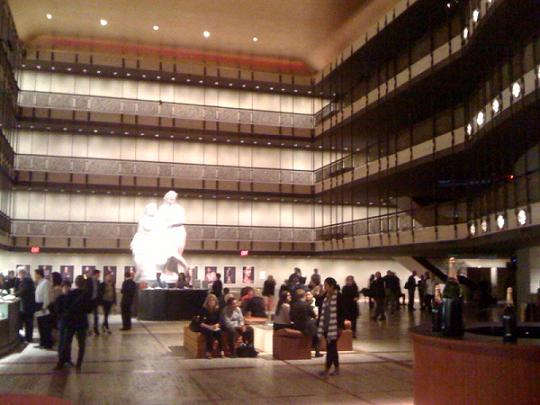
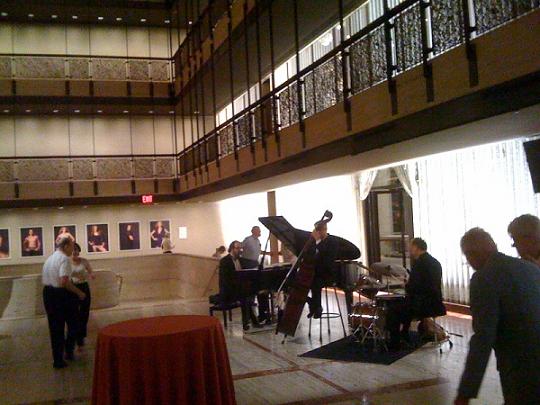
Friday night, my friends Hsien and Alyssa came with me to see the first program in NYCB’s “See the Music” series. First, we met for drinks on the promenade, which, as I mentioned, they’d opened an hour before showtime for the first week of this fall season. We watched members of the orchestra play some soft jazz music, which some patrons were dancing to. I know Hsien from my ballroom dancing days and we had to laugh because some of that music sounded straight out of Blackpool! (Blackpool’s one of the only – perhaps THE only – ballroom dance competition with live music.) (Above are a couple of my pictures of the promenade, about an hour before the performance, with people beginning to gather. My iPhone seems to take better photos outside…)

The two ballets performed were Ratmansky’s Namouna: A Grand Divertissement, which premiered last season, and Jerome Robbins’ The Four Seasons, which served for the first week of this first fall season as a tribute to fall.

Before the performance, Peter Martins came out and introduced the new series, explaining that it was inspired by Balanchine’s highly musical approach to dance, his belief that dance is music made visual, summarized by his words, “see the music, hear the dance.” Then the newly movable orchestra pit rose (as I knew it would!), and up came conductor Faycal Karoui with his crew, to explain a few things about Eduaord Lalo’s Namouna score. No one could give these talks but Karoui. He is hilarious, such a character!


Photo of Karoui by Paul Kolnik, taken from The Faster Times.

Karoui joked, in his thick French accent, that the music is very French, because of its … charm of course. Okay, then he became serious. The Lalo score is too long, of course, to talk about all of it, but Karoui focused on a few sections. One of the sections, he explained is characterized by its transparency of orchestration, meaning the harmonies don’t always  behave the way you expect them to; they are a surprise. He talked about how the beginning of the score had a nautical theme, and it opened with a sound like waves, but more German waves than French, he said, as the opening crescendo sounded more like Wagner’s The Flying Dutchman. He talked about the conversation between the harps and the strings, how Lalo plays with flexibility inside the tempos by following a quick tempo with a slower one, and he showed how Ratmansky had the dancers visualize part of that tempo by having the corps women at one point use cymbals onstage. After Karoui did a little dance himself while clapping the cymbals, he and Martins had the audience clap where the cymbals should be played to get us to internalize that rhythm a bit.

Karoui spoke at length about one of my favorite scenes in the ballet, where a group of smokers (led by Jenifer Ringer) really kind of tantalize the poor male lead, blowing smoke right into his yearning little face. It’s called “The Cigarette Waltz” believe it or not, and Karoui showed how the music really teases and tantalizes you into desperately wanting a cigarette, just like Ringer and her friends tantalize the poor sailor into wanting one of them. “Oooh, I really want one now,” Karoui cried after the orchestra demonstrated part of that waltz.

I liked Namouna much much better on seeing it a second time. I wrote about it earlier here (also, read Marina Harss’s fabulously detailed and in-depth description in Faster Times). It seemed less long this time, and each of the the parts seemed entertaining and compelling, each having its own theme and it own little storyline, however abstract the whole was. Maybe it was because of Karoui’s brief humorous explanations of the music, or maybe it’s just Ratmansky, because I always feel this way with his work – that nothing strikes me that much on first viewing, but that the more I see each ballet of his, the more I see in it, and the more entrancing I begin to find it.

That ballet was all the same, except this time Tyler Angle took over for Robert Fairchild as the main sailor guy. I’m told Robert is out for the moment with an injury. I loved Robert, but I really liked Tyler as well. Robert is so boyishly charming like Jose Carreno, and his dancing is more sharp and precise, hitting every count with spectacular flair and pizzaz, whereas Tyler’s more Romantic with his expression, with stretching port de bras and longing lunges, and he really draws out the music. They are such different dancers and it’s always nice to see another’s interpretation.

The next “See the Music” program will be this Sunday’s matinee.

New York City Ballet’s First Fall Season Opening Night


Tuesday night, New York City Ballet opened its very first fall season with performances of Balanchine’s Serenade, Peter Martins’s Grazioso, and Jerome Robbins’s The Four Seasons. First, before the performance began, Peter Martins came out and introduced each of the principal dancers, who came out onstage one by one, and said this season would be a celebration of them. Tiler Peck in particular was wearing this really gorgeous silky fuchsia dress. Martins said all principals were there except for Benjamin Millepied, who was doing something movie-related “en France,” he said with a funny faux Euro accent. Everyone laughed and gave the dancers a huge round of applause. The house was packed and it was clear how thrilled the company’s many fans are with there being a fall season this year. Martins made fun of himself for being so into toasts and said that during intermission, we’d all be given be given free champagne to toast the principals. Which we were – very fun!

The part of the performance I was mainly looking forward to was Janie Taylor’s debut in Serenade (above headshot and Serenade photo by Paul Kolnik) as the main ballerina. As usual with her, she completely made the ballet her own. I thought the ballet had a somewhat dark element with her, that I’ve never seen before. When she first ran out onstage, late for class, instead of looking like she was all frantic about being late because she’d been held up by a boy, it looked like she was running from something – from him. That man was Charles Askegard and when he danced the middle waltz part with her, the huge size difference between them added to the sense of foreboding, that she was fragile, he was pushing her around, and she’d eventually be hurt by him. At certain parts, it was literally like he was pulling her along. When he lifted her and she raised her legs in a split, it looked almost like she was trying to get away from him. Sara Mearns was the angel and Ask La Cour was the man who I call “blind justice” who take care of Taylor when she falls, and it was interesting how much the two male leads and two female leads looked alike. I almost got Taylor and Mearns mixed up at parts, thinking they were taking on the other’s role. And the end when the men raise Taylor up like pallbearers and she is carried off by them, arching her back, arms outstretched  – so hauntingly beautiful. It reminded me a bit of Balanchine’s La Valse.

I was also looking forward to Martins’s Grazioso, in which three handsome men – Gonzalo Garcia, Andrew Veyette and Daniel Ulbrich – vie for Ashley Bouder’s attention with their bravura moves. I don’t think this ballet has been performed since it premiered a few seasons ago. And I loved it all over again. I love how each guy has his own personality – Garcia is the romantic, Veyette is the manly man one, and Ulbrich is the one with all the high jumping tricks. And Bouder really played the tart, looking at each of them up and down at points kind of lasciviously, really trying to choose. The guy next to me was really giggly over it.

And the evening ended with Robbins’ The Four Seasons, which itself ends with a lovely tribute to fall.

This whole season the Koch theater will open an hour early. The promenade overlooking Lincoln Center Plaza will be open for cocktails, the gift shop will be open, and, for the rest of this opening week, there will also be live jazz performed by the NYCB Orchestra one hour before performance time. They have the promenade and mezzanine area done up nicely, with big plush chairs. Also taking place the rest of this week will be a “meet the artists” session whereby, beginning at 6:45 p.m. in the first ring of the auditorium, the principals dancers will be available to chat with ticket holders. There’s also a photo exhibition of the dancers by photographer HenryLeutwyler on display in the theater throughout the season.

Tomorrow night will be the first of seven “See the Music” performances which will provide a look inside NYCB’s 62-piece orchestra. At the beginning of each performance, Peter Martins and musical director Faycal Karoui will briefly discuss the program’s music, followed by the orchestra performing an excerpt of one of the ballet scores. The subject of tomorrow night’s discussion will be Eduoard Lalo’s score for Ratmansky’s Namouna: A Grand Divertissement, which premiered last season. Additional “See the Music” programs are Sept. 26 matinee, January 20, Feb. 1, Feb. 19 matinee, May 25 and June 11.

First Day of Bryant Park Fall Festival Rained Out

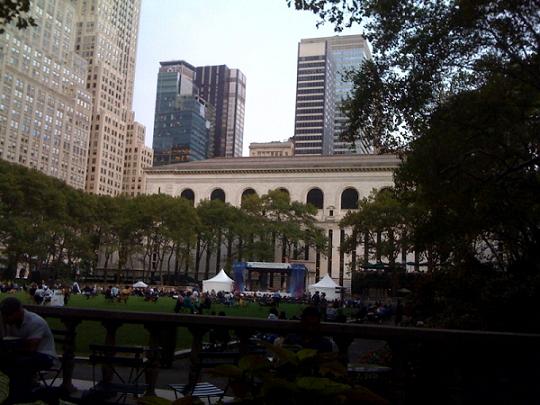
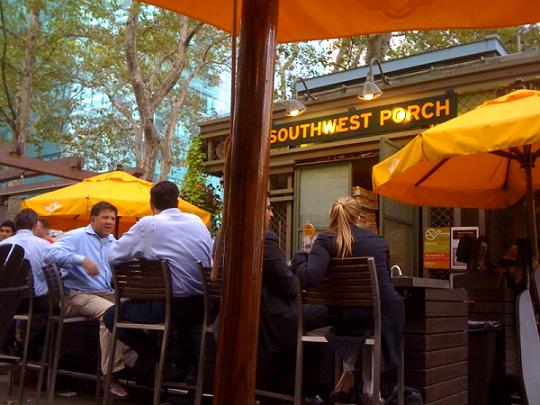
After hearing via Gothamist that New York City Ballet was opening the first Bryant Park Fall Festival, I trekked down to the park last night, scored a perfect seat at the Southwest Porch – well, maybe not perfect; it’s a little far from the stage, ordered a drink and snack and waited for my friend to show up and the public rehearsal / performance to begin.

Unfortunately it never happened. About ten minutes before 6, the waitress came rushing to my table, asked me if I could pay now as it was about to thunderstorm badly. Thunderstorm? At the beginning of the day, there was no such thing in the weather forecast. I almost didn’t believe her until about two minutes later a man came out onstage and announced that, due to the weather, the performance would be canceled. And the waitress and announcer were right: about five minutes later the thunder erupted, the rain began. New York weather has been crazy like this for a while now, like the past two / three years. I guess it’s the ozone. You just can’t plan an event outdoors anymore.

Anyway, I did get to see Wendy Whelan and Sebastien Marcovici (I think) rehearsing Christopher Wheeldon’s After the Rain (I guess, in retrospect, an apt title), which is one of the ballets they were supposed to perform. And NYCB begins their first ever fall season tonight, inside, at the Koch Theater.

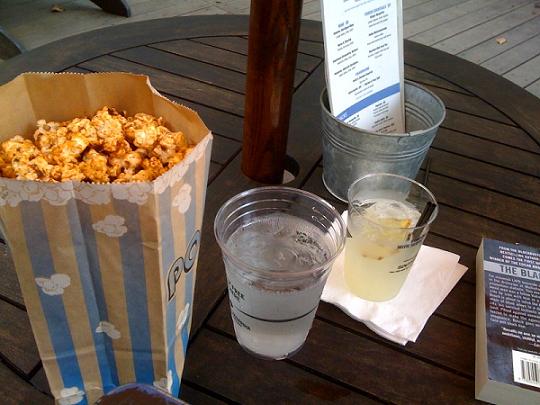
I do really like Southwest Porch during the summer. Their ginger margaritas are excellent; their S’mores are a lot of fun (though you usually need to ask for extra graham crackers). But I discovered last night that I am not a fan of their flavored popcorn. I had the ancho chile / lime flavor and it was just way too much seasoning. You couldn’t even taste the popcorn. My mouth was on fire.

NILAS MARTINS QUIETLY RETIRES FROM NYCB


According to the New York Times Arts Beat blog, Nilas Martins, longtime principal with New York City Ballet (and son of Artistic Dir. Peter Martins) has retired. Without a farewell performance, without flowers, without fanfare. The story is that he has a knee injury and suffered continuing problems with that, and ended up getting a job with the DeVos Institute of Arts Management at Kennedy Center and just didn’t feel up to coming back and giving a final performance. I can’t say I blame him. He’d received so much criticism the past couple years he probably just didn’t want to see the onslaught of newspaper articles. I want to write a larger post about this, but I received a recent comment on one of my prior posts on a NYCB retirement (that I now can’t seem to find) about how the critics were too negative with  the retirements, writing about the dancers’ faults toward the end instead of their entire career.

It’s a real issue.

I do believe, as Arlene Croce famously said, that a critic’s duty in a democracy is to be critical. But on the other hand, I feel like maybe different standards should apply for the retirement performances. The person is retiring, do their current weaknesses at the end of their long career and the fact that they’re not dancing as well as they did in their twenties and early thirties really need to be focused on? It’s probably easily assumed by the public that they’re not dancing as well as they once did.  And poor Yvonne Borree – the critic assigned to cover her farewell was the youngest on staff; too young to have seen Borree dance in her prime, so all she could say, apart from describing the performance, was that she as a viewer couldn’t ever connect with her. And she should have said what she felt without buttering it up; she’s a journalist not a publicist. But couldn’t they have found someone who’d followed Borree’s career and saw what had been so special about her cover her final performance?

Anyway, more thoughts on this later. For now, I wish Nilas a successful arts management career in DC.

Above photo from the Daily News.

ABT TO MAKE HISTORIC CUBA VISIT

According to this online newspaper, ABT is to perform in the Havana Festival in October. And according to this blog post, some members of New York City Ballet will join them. I can’t remember if I’ve heard this news before, but it sounds familiar.  It doesn’t seem to be posted on ABT’s website though. Anyway, ABT hasn’t toured Cuba since 1960. It’s all part of the 90th birthday of Alicia Alonso celebrations. Wow. Lucky dancers – I’m so jealous! I’ve wanted to go to Cuba for a long, long time.

AN ERA ENDS: DARCI KISTLER GIVES HER LAST PERFORMANCE WITH NYCB


Yesterday afternoon marked the end of an era as Darci Kistler, the last dancer to be hired, trained, and made into a star by George Balanchine, gave her last performance with New York City Ballet, where she’s danced for the past 30 years. Kistler, originally from Riverside, California, began studying at Balanchine’s School of American Ballet in 1976, was hired to dance with the company in 1980, and was made into a principal in 1982, at 17 years of age. She remains the youngest principal ever at NYCB.

It was a huge event, needless to say — practically every critic and blogger was there, longtime donor patrons were greeting each other right and left (and there was a party for them afterward). The house was completely packed, and the plaza was filled with people asking if anyone had a ticket for sale.

The program consisted of Balanchine’s Monumentum Pro Gesualdo and Movements for Piano and Orchestra, the Titania / Bottom pas de deux from his Midsummer Night’s Dream, his Danses Concertantes, and the beautiful final act of Peter Martins’s Swan Lake (which almost made me cry, and I don’t think I’m the only one).


Monumentum Pro Gesualdo and Movements for Piano and Orchestra is an abstract leotard ballet in two parts that Balanchine set to Stravinsky. I always prefer the second part, which its flirtatiousness, its angular lines and sharp shapes, to the more lyrical first part. Darci danced that second part with Sebastien Marcovici, and the first part with Charles Askegard. I’d only ever seen Maria Kowroski in the female lead in this ballet and it was interesting seeing another body in the role. Kistler danced it more smoothly lyrical and her edges were more rounded, but she played it up really well, really “acted” it, like she was really responding to Marcovici’s movement and he to hers, as if they were in conversation.

That Titania / Bottom pas de deux is one of my favorite parts of Balanchine’s Midsummer Night and I’m glad she chose it. She was sweetly hilarious as she fell head over heels for Henry Seth’s ‘donkey persona’ after both had spells cast on them by the mischievous Puck.

Danses Concertantes was the only ballet she didn’t dance; it was danced well by Megan Fairchild and Andrew Veyette.


And the program ended with the last act of Martins’s version of Swan Lake. The Martins is one of the only versions of this ballet I know of that doesn’t have some kind of happy ending, and it was really fitting here, this being the most bittersweet of farewells. In Martins’s version, Odette and Prince Siegfried can’t be together because he has been unfaithful to her with Odile. So the ballet ends with her bourreing backward, away from his outstretched arms, into her flock of swans, who envelop her. Jared Angle’s Siegfried continues reaching out toward her, in sorrowful outstretched lunges, but he’s unable to reclaim her. She literally retreats into the wings, and metaphorically returns to her ethereal, otherworldly place. So poetic, and so fitting for a prima ballerina retirement. And so sad…


All photos by Paul Kolnik. (Bottom photo I scanned from an earlier program)