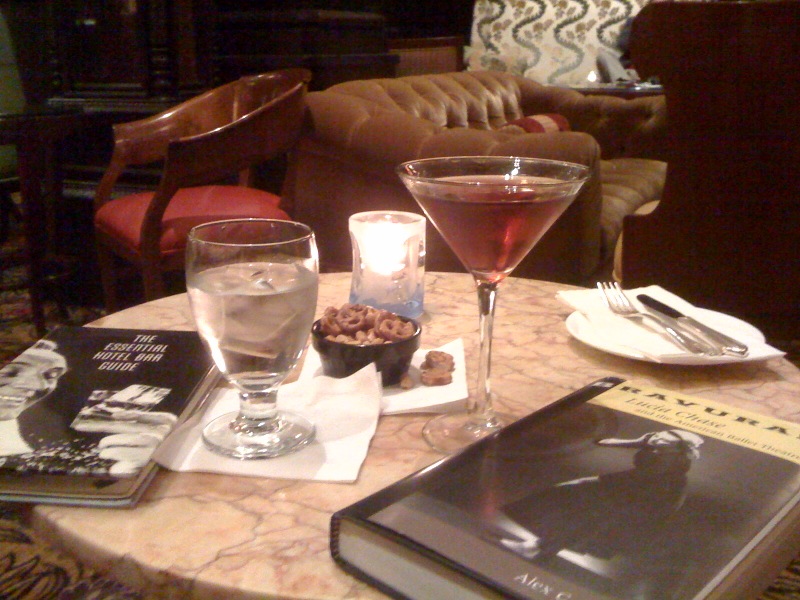
Literary Aperitif

Hi guys – I’ve just begun a new Tumblr blog, called Literary Aperitif, pairing two of my loves (other than dance of course): books and booze. I wanted to call the blog something along those lines but didn’t realize there were about 100,000 websites, meetups, blogs, books, book clubs, webzines, and what have you, all with variations of that name… Anyway, I plan for that one to be photo-heavy, minimalist on words (unlike this blog :S)

Sorry once again that I’m so behind here. Part of the reason for that is that I write so many review-style posts, and it really takes a long time (as opposed to posting pics and doing mini photo-based essays, which takes virtually no time at all). And I haven’t had a lot of time since I began working full time plus again. Nevertheless, I maintain fantasies of spending this weekend blogging about: the Mariinsky at the Lincoln Center Festival, the Royal Danish Ballet’s recent visit to NY, the Paris Opera Ballet’s Children of Paradise (streamed live via Emerging Pictures’ Ballet in Cinema series), the Bolshoi’s Swan Lake (ditto), a wrap-up of American Ballet Theater’s Met season, a wrap-up of So You Think You Can Dance thus far (including what’s been said during some of the Friday afternoon over-the-phone press conferences I’ve participated in each week with the eliminated contestants), and the Manhattan Dancesport Championship held in Brooklyn last weekend. Okay, I’m obviously not going to get to it all this weekend – especially when I have more Mariinsky to see tomorrow and Saturday – but I’ll have material for the rest of the summer, if you can bear with me that long 🙂

Paris Opera Ballet’s Dark-ish Coppelia

So, did anyone see the live-stream of POB’s Coppelia last Monday? I went but was extremely tired, so I guess my review should be read with that in mind. I was working a contract job with crazy long, graveyard shift hours and though the movie was at 1:30 in the afternoon Manhattan time (7:30 p.m. Paris time) I really should have been at home sleeping. But I had to miss POB’s earlier Caligula, so really wanted to see this.

It was different from the versions of Coppelia I’ve seen by the American companies. It was darker, not at all cutesy and Nutcracker-ish with doll-like movements of humans imitating toys and silly people mistaking dolls for girls. The program notes say the choreographer, Patrice Bart (after Arthur Saint-Leon) wanted to give “a bit more psychological depth to the characters and feed the drama of their relationships, including finding plausible motivations / reasons in certain passages.”

I’m all for darker ballets exploring human drama in greater depths than many of the classics do, but unfortunately, I just had a hard time grasping the story here and understanding the characters’ motivations despite Bart’s intentions. I think part of the problem was that Bart used the language of classical ballet, rather than modern. Tudor is probably the master of revealing psychology through movement, but his movement language was wholly unique. Here, Coppelius, for example, would do basic ballet turns, jumps, an arabesque, etc. – all very lyrical, within the classical ballet vocabulary, then would do some kind of intentionally awkward port de bras, jabbing an arm out this way and that and twisting his torso unnaturally. I guess that more modern, angular arm movement was supposed to show angst, and it did, but it was just so inferior to movement someone like Tudor would have used to show a psychological state.

I assume everyone knows the story and I probably shouldn’t – especially this version: Coppelius is haunted by the image of a woman he loved and lost. Swanilda evokes her memory for him. Frantz, a student, is in love with Swanilda, who kind of returns his affections but not as completely as he would like. Spalanzani is a toy-maker who seems to have some outlines of a doll he’s in the process of making, which also haunt Coppelius, reminding him of the woman he loved and lost.

According to the program notes, Coppelius is a seducer, not at all the silly wobbling clown from the American productions. He tries to seduce Swanilda, who seems, from what I could tell of the onstage action, to be a bit taken by him, but only to a point. She and her girlfriends break into Spalanzani’s toy factory, play with the toys – like in the American productions – but then Swanilda sees how taken Coppelius is with the outline of the doll Spalanzani is in the process of making, and for some reason, she decides to don the doll’s costume and dance for Coppelius. It’s unclear whether she is pretending to be the doll come to life – her movements aren’t at all doll-like, as in the American productions. But at one point, things get too serious, Coppelius gets too impassioned with her, and she runs off, somewhat afraid of him. Then she accepts Frantz and the two end up together, their silhouettes wandering off into the tunnel of light, as in the photo above.

Swanilda was danced by Dorothee Gilbert, whom I’d never seen before and really liked. Both she and Mathias Heymann, as Frantz, had a lot of presence, showed a lot of facial emotion, were good at miming. They told the story as best as they could given what I felt was limiting choreography. Heymann’s lines didn’t always seem to be all there though, and I just couldn’t stop thinking how much more clean and physically magnificent David Hallberg would have been in that role. Sometimes Frantz’s male friends seemed to outdance him with their precision, height of jump, etc. It was odd, but his dancing seemed to be a bit sloppy. I’ve seen him dance before though (can’t remember whether it was with NYCB or Trisha Brown or at the Guggenheim) but I know I didn’t think that about him before.

Gilbert’s dancing was much cleaner. She definitely didn’t focus on athleticism, like Natalia Osipova. But her dancing was lyrical and lovely, and she had a strong personality and clarity of intention. Her Swanilda was at times a tease, at times inquisitive, longing, fearful, confused. She always had something going on behind her eyes – which is one of the things I value most in a dancer and which there’s not enough of these days, imo.

My biggest problem though was with Jose Martinez, who danced the part of Coppelius, which is a dance role here, not a character role. I know he’s a big deal, longtime principal in Europe, and is on the verge of retiring and taking over the Spanish ballet company Nacho Duato currently helms (Martinez is Spanish as well). It well may have been his costume – he wore a long top coat, pleated pants that bulked at the pelvis, and black soft jazz shoes – so not at all ballet costuming. But his lines were not clean at all, his movement looked very sloppy, he was completely lacking sharpness and precision. Could be I just couldn’t see the precision because of the bulking pants, but still – I couldn’t stop thinking about how much better Marcelo Gomes, who I could really see in that role, would have been, despite the pants and coat.

I don’t know if you can still get the NY Times reviews now that the paper’s behind a paywall, but Macaulay has an interesting explanation: he says the POB ballet dancers of late (ever since Nureyev, actually) are trained that way – to not give so much attention to line, amongst other things like musicality and expressive phrasing.

I don’t know. It was my first time seeing POB perform as a company and I really wanted to  like them. Overall, I was unimpressed, unfortunately. I did really like Gilbert though and I will definitely want to see her dance again.

More BLACK SWAN Controversy, and The Paris Opera Ballet’s COPPELIA


I’m still crazy busy but just wanted to point out two things. First, if you haven’t already heard, there’s now a storm of controversy over how much dancing Natalie Portman actually did in Black Swan. Dance Magazine EIC Wendy Perron wants more credit given to Sarah Lane, Portman’s ABT double (whose dancing I love; for image credits above, click on the photos). Portman didn’t mention Lane in her Oscar acceptance speech (though she did mention the dancers in general) but, further, there was apparently also a special effects video produced about the making of the film in which Lane’s face was never shown, though her dancing body was, and in which Lane was never credited. Lane seems not to want to say too much, says she was asked to remain silent on the issue, to not talk about the film, particularly before the Oscars. Lane gave an interview to Dance Magazine in December about her role in the movie, saying she wasn’t “looking for any sort of recognition.” Millepied of course defends his muse, saying Lane did “just the footwork.”

Lane also mentioned in that Dance Magazine interview that Maria Riccetto did some of Mila Kunis’s dancing, which I didn’t know. Both Portman and Kunis must be very petite women!

Anyway, will the controversy surrounding this film ever end? Hopefully not! It’s keeping ballet in the minds of the public, if you ask me…

Thanks to reader Jeff (who I noticed is also mentioned in Perron’s blog, linked to above) for pointing me to the controversy.


Also, this Monday, March 28th, the Paris Opera Ballet will live-stream its Coppelia, via Emerging Pictures’ always excellent Ballet in Cinema series. Curtain is Paris time at 7:30 p.m., which is 1:30 p.m. here on the east coast. In Manhattan, it’s showing at the Big Theater again. For other times and locations, visit the Ballet in Cinema website.

Okay, all I have time for now. Thanks for continuing to read my blog while I remain swamped 🙂

Jacob’s Pillow Announces 2011 Season With Highlights Including Annie Liebovitz Exhibit and POB

Jacob’s Pillow, the summer dance festival that takes place in the Berkshires, has announced this year’s season. Highlights (to me) include a summer-long dancer photo exhibit by Annie Liebovitz and the Paris Opera Ballet. I don’t have much time to write today, so am including the whole press release here. Click on the link below to view it.

Continue reading “Jacob’s Pillow Announces 2011 Season With Highlights Including Annie Liebovitz Exhibit and POB”

ABT OPENING NIGHT GALA MET SEASON 2010


Photo from inside the gala tent last night at American Ballet Theater’s opening night gala taken from NY Social Diary, who, sadly, don’t seem to have any pics up of Irina Dvorovenko in her beautiful red gown. It was one of the most beautiful dresses I’ve ever seen — long and many-layered but each layer seemed to be made of a light, sheer piece of fabric, so the whole thing looked light and diaphanous, though it wasn’t really see-through, just looked that way. Anyway, if anyone finds a picture of her, please let me know! Roberto Cavalli probably designed it…

Anyway, so the opening night gala was last night. It was loooong — one of the longest I’ve seen. We didn’t get out until 9:30, and it began at 6:30. It opened with an excerpt from Frederick Ashton’s Birthday Offering, of seven couples waltzing at what seemed to be a party (I haven’t seen this ballet), with Irina Dvorovenko and Maxim Beloserkovsky the main couple.

Following that was a series of introductions and thank yous by Kevin McKenzie (Art. Dir.), Blaine Trump and Caroline Kennedy (the two women were honorary chairs of the evening, along with Michelle Obama, who wasn’t there), and then David Koch who has funded the upcoming production of the company’s Nutcracker this winter.

Then, a group of ABT II dancers performed an excerpt of Edwaard Liang’s Ballo Per Sei, which was a contemporary lyrical piece, set to Vivaldi. I recognized a SLSG favorite — Irlan Silva — right away.

Then came the “Rose Adagio” from Sleeping Beauty, performed by Michele Wiles, with Sascha Radetsky, Craig Salstein, Gennadi Saveliev, and Roman Zhurbin as suitors. I don’t think I’ve ever seen this performed so well. Michele really held those balances, and she was so vivacious! Both she and Paloma Herrera, who danced a later excerpt from SB later in the evening, really embodied a young Princess Aurora very well. Michele got loads of applause – the most thus far of the evening.

Then came David Hallberg and Natalia Osipova’s Olympic version of Giselle — this an excerpt from Act II. People laughed and shook heads in amazement at Osipova’s sky-high ballons and sprightly jumps and leaps. She is really incredible. And then at the end when she jeted off and he followed her, it was really beautiful. But athletically astounding as it was, it was still moving; nearly brought tears to my eyes. I mean, how do you manage to do athletic feats like that and make it seem like you’re a light, other-worldly spirit instead of nearly exhausting yourself to death? I don’t know if I’ll ever be able to see anyone else dance Giselle again besides Osipova now. I saw a couple of etoiles from the Paris Opera Ballet perform it at the Guggenheim a few months ago and all I could think was, “wait, where’s the ear-high develope?” and “that arabesque penchee is nowhere near 6:00!” Natalia Osipova has spoiled me.

Then came Veronika Part and Marcelo Gomes doing my favorite gala fare, the Black Swan pas de deux. They were magnificent. Veronika kept doing these equally astounding crazy penchees, and she was so tantalizing with all of her faux White Swan poses! She was really a bad tease! And perfect fouette sequence for her, and his jetes and all — they got loads of applause too (oh, and so did David and Natalia).

Then was the beautiful Thais Pas de Deux by Ashton, danced by Diana Vishneva and Jared Matthews. I recently saw this rehearsed at a studio visit by Hee Seo and Sascha Radetsky, and it looks so different onstage far away and with costumes and all. It looked a lot more like MacMillan than I remembered. I loved it; Diana and Jared did very well but I still can’t wait to see Hee and Sascha. For her gala gown, Diana was wearing a very interesting-looking Japanese-styled dress.

Ending the first half of the evening was the finale of Tharp’s Brahms-Hayden Variations, danced by a group of seven couples, replete with trademark Tharpian flash and crazy lifts and high energy. Can’t wait to see this now either. I have in my notes, “who is dancing with Hammoudi?!” When I looked at my program, I saw it was Stella Abrera. She is really back and really on!

First dance after the intermission was the “Kingdom of the Shades” scene from La Bayadere.  Beautiful as always though it seemed some of the dancers were not completely in unison.

Then came Paloma Herrera and Cory Stearns dancing the Awakening Pas de Deux from Sleeping Beauty, which was followed by the wedding pas de deux from that ballet danced by Herman Cornejo and Xiomara Reyes. I particularly loved Paloma. As I said before, she and Michele Wiles really embodied the sweet, youthful spirit of Aurora. Paloma and Cory danced very well together. They seemed like a real couple.

Then was my second favorite excerpt of the night — the Act III Pas de Deux from Neumeier’s Lady of the Camellias, danced by a very passionate Roberto Bolle (who received a load of applause when the curtain initially opened on him) and a very dramatic Julie Kent. Every excerpt of this ballet makes me want to see the whole. Not much longer now — it begins next week, and I can’t wait. I think they received the greatest applause of the night. Audience really went wild, and it’s partly because he’s so internationally famous, but also I think because they just did so well with it. This seems to be a ballet that requires both good acting and excellent partnering ability because some of those lifts… The pianist, Soheil Nasseri, came onstage too for a bow at the end. He was very good.

Next to last was the Act III Pas de Deux from Don Quixote, danced by ABT audience faves Ethan Stiefel and Gillian Murphy. There was a slight mishap with the lift where he throws her up, she does a crazy twist in the air and then he catches her and the fish dive wasn’t hands free, but they each danced spectacularly on their own. It looked at one point like she was doing quadruple pirouettes between some of her fouettes, and he nearly kicked his leg to his forehead during some of his jumps and then did a flashy little jump during his fouette sequence that had the audience screaming.

The evening ended on a modern note  with David Parsons’s Caught, danced by Angel Corella, who, expectedly did an exquisite job. The audience, many of whom hadn’t seen that dance before, seemed so spellbound they almost forgot to clap right away. Angel’s so cute 😀

And finally, everyone who danced came out onstage at the end and took a little bow while the orchestra continued to play. Dancers still in costume — Daniil Simkin, Craig Salstein, Gennadi Saveliev come to mind — did a flashy trick, the “Shades” did a little dance in unison, and then dancers who danced in the first half came out in party gown (which is how I fell in love with Irina’s dress).

Fun evening. During intermission I checked my cell-phone and found a text from a friend who saw me sitting in orchestra from the side par terre, where he was sitting. So I texted him to meet me afterward, and we went for martinis, clam chowder and crab cake sandwiches at Ed’s Chowder House across from the Plaza, my favorite post-ballet place to go since it replaced Center Cut mid-NYCB fall season. They have a TV in the bar, and I was happy that the Yankees were still on. So I saw A-Rod hit his game-tying home-run… But how my friend ever saw me in that enormous Met crowd I’ll never know. Though many arrived late, house ended up being packed.

Oh, and I almost forgot: at the beginning of his speech, Kevin McKenzie introduced several dancers – each representing an era of ABT (this being the company’s 70th anniversary)- who all came out and took a bow. Included were Lupe Serrano, Baryshnikov, Nina Ananiashvili (who got a lot of applause), Alessandra Ferri, Natalia Makarova, and cutie Frederick Franklin, who gave a little speech as well. Isabella Rosellini was in the audience, a few rows down from me. I didn’t recognize anyone else in the audience.

MAKSIM CHMERKOVSKIY NOMINATED FOR ASTAIRE AWARD!


Maks Chmerkovskiy has been nominated for a Fred Astaire award for his dancing in Burn the Floor. Other nominees of note are Holley Farmer for Tharp’s Come Fly Away in the female dancer category and Tharp herself and Bill T. Jones in the choreographer category for Come Fly and Fela! respectively. Also nominated are the female ensemble of Fela! and the male ensemble of Memphis, as well as that show’s choreographer Sergio Trujillo, and Frederick Wiseman is nominated in the film category for his documentary on the Paris Opera Ballet, La Danse. Awards ceremony takes place June 7th at the theater in John Jay College. See the rest of the noms here.

Above photo of Chmerkovskiy from NY Daily News.

KINGS OF THE DANCE SHOWS HOW DANCER-RICH BUT CHOREOGRAPHY-IMPOVERISHED BALLET IS IN THE BALANCHINE-INUNDATED U.S.


Photo of Desmond Richardson by Andrea Mohin, taken from NYTimes.

So, “Kings of the Dance” made the New York stop of its international tour this weekend at City Center. I was there Friday night. The last time this show toured here several years ago (it is produced by Russian dance promoter Sergei Danilian) there were only four male dancers — Angel Corella, Ethan Stiefel (both of American Ballet Theater), Johan Kobborg of the Royal Ballet in England, and Nikolay Tsiskaridze of the Bolshoi. This year, there were many more dancers and Tsiskaridze was the only one who returned (and, funny, but I totally didn’t recognize him). The others were: David Hallberg, Marcelo Gomes and Jose Manuel Carreno from ABT, Joaquin De Luz from NYCB, Guillaume Cote from Canada, Denis Matvienko from Ukraine, and Desmond Richardson from NY-based Complexions Contemporary Ballet (So You Think You Can Dance fans may recognize his photo above, since he has guest performed on the show a couple times).

What I liked about this program the last time it toured here was that there were fewer dancers, and that way you kind of “got to know” them better, by seeing them each perform several different pieces. Here, you basically only saw many dancers once, and a few twice. If you weren’t familiar with them (as my two friends who came with me weren’t), you could easily get them confused. They played a short movie at the beginning where each dancer (besides Desmond Richardson; I think he may have been a late addition to the American tour) talked a bit and you saw them dance. Jose’s cute Cuban accent seems to have gotten more pronounced 🙂 — I think he did it on purpose, knowing how many female fans would be in the audience! David’s voice somehow sounded a bit deeper than it does in person. Matvienko (who, for ballroom dancers, looks A LOT like former US champ Andrei Gavriline) and Tsiskaridze spoke in Russian and their words were translated.

What I loved about this program though was that there were so many solos that exposed us to so many different choreographers whose work I’d never seen (and some of whom I’d never even heard of) before. Every company in this country is obsessed with Balanchine, so it’s a wonderful wonderful change when we actually get a taste of something else. But more on that in a moment.

As with every Danilian production, there were lots and lots of Russians in the audience, and I think Desmond Richardson and Joaquin De Luz in particular grew a new fan base. Poor Joaquin — well, maybe: after the performance and during intermission I kept hearing, “That little guy was great!”, “That little guy was just incredible,” “Where can I see that little guy dance?” So, Joaquin is the great “little guy” whom everyone is seeking out now. And everyone went wild after Richardson’s solo, Lament, choreographed of course by Dwight Rhoden, an absolute master at presenting his friend’s spellbinding combination of gracefulness and masculinity. My friends were floored, along with the rest of the audience judging by the exclamations.

After the movie, they opened with Christopher Wheeldon’s For 4, for four dancers, which is a carry-over from the last performance. On the night I went it was performed by Matvienko, Carreno, De Luz, and Cote (but the cast varied each night). It’s an adagio lyrical piece, as with the vast majority of Wheeldon’s work, and I wished there would have been some more allegro parts with bravura solos. But that’s just not Wheeldon’s thing.

Then, after intermission, we saw a solo performed by each man, ending with a drop dead gorgeous duet danced by Cote and Gomes choreographed by French choreographer Roland Petit, from his Proust ou les Intermittances du Coeur. The men were dressed in skin-toned unitards, which almost made them look naked, and the duet to me seemed to be about a man obsessed with his reflection, or another side of himself, as each’s movement was mainly a reaction to the other’s. But at some points there was some really beautiful partnering, some really beautiful lifts and it seemed like a man dancing with his soul. Breathtaking!

Anyway, other highlights of the solo section were: a really beautiful solo for Marcelo choreographed by Adam Hougland, called Small Steps, which was like lyrical iron-pumping — a series of beautiful poses showing off his musculature interspersed with flowing lyrical movement; a beautiful, lyrical piece danced by David Hallberg from Frederick Ashton’s Dance of the Blessed Spirits; a fast, fun, more virtuosity-heavy solo by David Fernandez for Joaquin De Luz called Five Variations on a Theme; Jose Carreno dancing a gorgeous adagio to Ave Maria — a modern version — by Igal Perry (which I’d seen before and fell in love with it all over again); and Rhoden’s Lament for Richardson, which, like Marcelo’s solo, reminded me of lyrical iron-pumping (which I mean in a good way of course) highlighting as it did that seemingly incongruous combination of male elegance and virility.

The only ones that didn’t really work for me well were Boris Eifman’s Fallen Angel danced by Tsiskaridze, which I think just didn’t have enough context, and Vestris by Leonid Jakobson danced by Matvienko, which was by turns a comical and bravura piece first danced by Baryshnikov in 1969. I thought Matvienko was a lovely dancer with really beautiful lines who could really deliver on the jumps and especially turns, but I just think it needed to be better acted because there were some places where it almost seemed like he made a mistake, and then you realized it wasn’t a mistake by the dancer; it was supposed to be the character who humorously screwed up. I heard Baryshnikov was excellent and I wish I could see a video of that.

Then, we saw Spanish choreographer Nacho Duato’s Remanso, which I’d never seen live before, but saw in a video performed by ABT. It involves a wall with three dancers interacting with each other around it, climbing over it, looking around it. It’s sweet, flirtatious in places, and loving and romantic. The night I saw it it was danced by Gomes, Cote, and Hallberg, though this cast alternated each night as well.

The program ended with a bravura “Grand Finale” with each dancer coming out and doing jumps and turns, and all the big fancy “male things” of classical ballet.

But the thing I kept thinking throughout was, wow, that’s really cool choreography, who’s that choreographer? Oh,  I’ve never heard of him, or, oh I’ve heard of him, how cool that I finally got to see something by him! I mean: Roland Petit, Igal Perry, David Fernandez, Adam Hougland, Nacho Duato, Leonid Jakobson. We NEVER get to see choreography by these people here. Petit is a major choreographer. As is Duato (we really see his choreography only when his own company tours here, infrequently), ditto for Eifman, and the others I’ve never even heard of. Why don’t we see more variety here? Why don’t we see more Mats Ek and Pina Bausch and John Cranko? Why do we have to drown in Balanchine over and over and over again? Why do dance companies think that we want to see Balanchine? Why do they think Americans are into this man? As far as I’m concerned, his only truly great work is Jewels. The rest, okay, his footwork is more intricate and there are certain subtle little embellishments in the variations, but really, what was so great about his ballets in their entirety? What was so great that we have to be so completely inundated with him here in the US? I mean, it makes sense that NYCB does his work because they were founded by him but every other major company in the US is likewise obsessed – San Francisco Ballet, Miami City, Boston, Pennsylvania, even the Kirov and POB when they tour here they think we want more of this crap. And whenever ABT doesn’t do classical, there seems to be an overload of Balanchine. Does anyone consider that maybe, just maybe, we might get bored? That he doesn’t speak to younger generations of Americans AT ALL? Did someone tell POB and Kirov that Americans only understand Balanchine so you have to do Balanchine when you come here? I think ballet is dying in this country because of every artistic director’s completely inscrutable obsession with this boring boring man.

Anyway, I greatly thank Mr. Danilian for allowing Americans to see something else for a change.

For a completely different perspective, see Macaulay’s review.

NYCBALLET OPENING NIGHT: NEW MARTINS’ NAIVE & SENTIMENTAL MUSIC A SUCCESS!


New York City Ballet officially opened its 2009-10 winter season last night, with a performance and black tie gala dinner. The performance included Alexei Ratmansky’s Concerto DSCH (above photo of that ballet — dancers are Ana Sophia Scheller, Gonzalo Garcia, and Joaquin De Luz — by Paul Kolnik, taken from NYTimes), stars of the Paris Opera Ballet Aurelie Dupont and Mathias Heymann dancing the central pas de deux from Balanchine’s “Rubies,”


(photo taken from Kulturkompasset; Dupont is center, Heymann is holding the hand of another dancer).

And then the evening finished off with the world premiere of artistic director Peter Martins’ Naive and Sentimental Music, set to John Adams’ (brilliant) score of the same name (I’ll post photos when I receive them).

But first, there was a short film of the reconstruction of the inside of the Koch Theater (still can’t help but think of it as the State Theater…) while the orchestra played Tchaikovsky’s Sleeping Beauty overture (as it turned out, the perfect music to highlight the comically sped-up but ultimately awe-inducingly huge renovation process). Highlights of the renovated theater are — most importantly and coolly — the orchestra pit with a floor that can rise to stage-level (! — and this is how the orchestra played the overture), and two aisles now carved into the orchestra seating section. (Before, orchestra section had no aisles — so, though this is how Balanchine wanted it, apart from being extremely hard getting to a middle seat, it was a fire hazard).

Anyway, after the mandatory thank-you speeches by Peter Martins and David Koch (who funded the renovation), came the  Ratmansky. The fun frolicking threesome in blue (top photo) were danced by Joaquin De Luz, Gonzalo Garcia and Ashley Bouder (all three brilliantly on, Bouder thankfully back from an injury), and the adagio couple in green were Benjamin Millepied and Wendy Whelan (photo below). I think this was danced better than I’ve ever seen it done before — it could have been because I was so excited to see Bouder return, or because the dancers are all beginning-of-season fresh… but this is by far Ratmansky’s best, imo — it’s got the most complex structure and original movement.


(photo by Paul Kolnik, taken from Danza Ballet)

Next were the POB couple, who danced “Rubies” brilliantly — not only with precision and clarity but with great exuberance as well. One thing I meant to say earlier about La Danse (the Wiseman film about the POB) and forgot, was that the POB dancers are all so trained to make meaning out of every little thing they do — every step, every gesture, no matter how small. You have to have some kind of thought in your mind whatever you do. (This is not what Balanchine taught his dancers; he taught them simply to do his steps and those would contain everything the audience needed to know.) I feel that this allows POB dancers to bring a certain passion and humanity to all of the works they do — I noticed that from performance footage from that film as well as from last night.

And third came the highlight — for me anyway — of the night: the new Peter Martins’ ballet. The John Adams music was absolutely gorgeous — rich, many-layered, complex, intense, varied and structured into many sections — some lighter, many heavier, evocative, etc. etc. Beautiful! Oftentimes music like that overpowers the dancing, but not here.

In a short film shown before the dance (methinks Martins is taking after Wheeldon here with these little introductory films), Adams says the title refers to the difference between musicians whose music was fresh and original (the “naive” composers — like Mozart, he says) and those whose music was meant to speak to the past, to convey a sense of history, music that kind of carried the weight of the world on its shoulders so to speak (the “sentimental” — which he considers Beethoven). You could really see that in the music — some of it lighter, much of it weightier. Martins said in the film he tried to evoke that visually through dance, and I think he did so successfully — there’s a lighter, adagio section with dancers dressed in pristine white, another light but fast section with dancers in red, and then the more intense, almost severe sections with dancers in blues and deep greens and black.

Though most sections are danced in ensemble, Martins created the ballet for the principals only. This created an interesting dynamic, because, except for the middle section with the three pairs of dancers in white, almost all roles had equal weight — and yet practically all of the dancers stood out. It was an overload of star power!

And, though some sections seemed a slight bit underrehearsed (or maybe it was just that the footwork was so difficult and fast), everyone shone since Martins highlighted each dancer’s strengths: Maria Kowroski and Sara Mearns as lyrical women in white, Sterling Hyltin and Teresa Reichlin as kind of sharp-edged, sassy women in fiery red, Andrew Veyette and Daniel Ulbrich at the high-jumping bravura guys in black, there were some jazzy moves for Amar Ramasar, etc. etc.

Oh and I just love Tyler Angle 🙂 He partnered Yvonne Borree and I don’t think I’ve ever seen her so at ease and so fluid! She looked really beautiful. Nice also to see Stephen Hanna back from Billy Elliot! He partnered Darci Kistler in the white section.

It’s a rather long ballet but I was thoroughly engrossed and can’t wait to see it again. I hope they keep it in the rep.

Okay, that was the gala. Now onto the Nuts. Regular season begins in January.

PARIS OPERA BALLET STARS TO DANCE IN NYCBALLET OPENING NIGHT


How funny — I was just going on in my last post about how I fell in love with the Paris Opera Ballet through Frederick Wiseman’s currently-showing film La Danse, and now I receive news that two etoiles with that company — Aurelie Dupont (in photo above, taken from Bailarinas) and Mathias Heymann — will be performing with New York City Ballet in their opening night gala, on November 24th. In exchange, NYCB’s Ashley Bouder and Gonzalo Garcia (both SLSG faves) will perform with Paris Opera Ballet, on November 12th. Both couples will dance the “Rubies” section of Balanchine’s Jewels.

Additionally, NYCB’s opening night performance will include Alexei Ratmansky’s Concerto DSCH (my personal favorite of his) and a premiere by Peter Martins set to John Adams music and starring all of the company’s principal dancers.


Photo of DSCH by Paul Kolnik, from NYTimes.

NYCB’s Nutcracker season begins the Friday following opening night, November 27th. Visit the website for tix and info.

Most exciting though about the dancer exchange. I’ve never seen Heymann perform live and I’ve only seen Dupont dance Trisha Brown, not full-out ballet.

Here are a couple videos of Heymann I found on YouTube: first as Bluebird in Sleeping Beauty and second in a contemporary solo:

And here is Dupont as Kitri in Don Q:

Sorry, you guys, I’m just so into videos these days!

SINCE SEEING WISEMAN’S "LA DANSE" I HAVE NOT BEEN ABLE TO GET LAETITIA PUJOL OUT OF MY MIND


(photo taken from here)

Since seeing Frederick Wiseman’s excellent film La Danse a couple days ago — a documentary about the Paris Opera Ballet — I have not been able to get the fascinating etoile (star, highest level of dancer over there), Laetitia Pujol, out of my mind. The film is basically a series of rehearsals with some actual performance footage thrown in, and, unbelievably, it’s absolutely mesmerizing. If anyone’d described it that way to me beforehand — a bunch of rehearsal footage — I would’ve thought I’d be bored out of my mind, but it’s so incredibly interesting watching these dancers rehearse with top choreographers like Wayne McGregor and Angelin Preljocaj and Mats Ek. And the performances — omg – -that company does everything from the aforementioned contemporary choreographers, to Pina Bausch’s Tanztheater, to Petipa to Balanchine. Parisians are so damn lucky! We get either Petipa or Balanchine over here… not at all fair…

Anyway, Pujol blew me completely away. I’d never seen her dance before and somewhere in the middle of the film she’s rehearsing and she does the most mind-blowing series of turns all over the damn room. I’ve spent the past couple hours searching YouTube and, yay, finally found what she was doing! It’s Etudes, here:

For some reason, the spins looked a slight bit faster in the film, but you get the idea.
Here are a couple of others of Pujol:
The first, Le Baiser, which I love,

And Giselle, with Nicolas Le Riche:

One odd thing about the movie is that it’s a documentary, but there are no captions, so you have to try to guess who all the choreographers and dancers are. There are credits at the end, but you can’t possibly figure out who is who at that point, when there are all these names filling up the screen. At first I thought this was kind of a discredit to the artists not to list their names and titles or bios when they are shown in the film, but then I thought, well, it would kind of interrupt the flow of the action; this made it seem more like a narrative film, like one of those narrative films that’s shot with a handheld camera or the like to make you think you’re eavesdropping on someone’s actual life — which, it turns out, you are! Interesting filming device…

The real-life rehearsals do have their moments of (probably unintentional) humor, such as when one of the choreographers is describing to a young dancer learning the role of Medea that she’s portraying a god, a person whose intense, other-worldly powers make loving fraught with danger, and she says “Oh, like Edward Scissorhands.” At times, though, people laughed at seemingly odd things, like when a young dancer new to the company tells the director she longs to dance like Pujol and the director tells her, “Well, she has her own personal intelligence.” People in the audience seemed to think that was funny, but clearly, Pujol does have “her own personal intelligence”; dancing isn’t just about excellence of technique, it’s about using your brain. And these dancers are so fascinating because they’re so clever, they’re such powerful performers.

Go see this movie if you at all can. In NY, it’s at Film Forum.

EXPERIMENTAL DAY


Last Thursday I spent the afternoon at the Tribeca Film Festival watching a series of intriguing experimental shorts (some far better than others of course), and the evening at Brooklyn Academy of Music watching Trisha Brown Dance Company, whose program included a couple of pieces that are experimental, or at least were when they were created.

The reason I’d chosen the Human Landscapes series of shorts at Tribeca was that I expected most of the films to be about the landscape of the body — so kind of related to dance. But, except for two – -maybe three — all were about cityscapes — human interaction with urban environments with the focus on the latter, which I didn’t mind because I love cities.

The film that most caught my eye in the program listing was Chop Off by M.M. Serra, about a man, performance artist R.K., who sees self-amputation as an art form. At first I thought “amputation” was metaphorical, but, no no, the film revealed it was actually quite literal.

Continue reading “EXPERIMENTAL DAY”