PAUL TAYLOR


Before Corella Ballet moved into City Center, Paul Taylor Dance Company had their month-long season there, in celebration this year of Paul Taylor’s 80th birthday. I didn’t go to as many performances as last year, but went to see the two new dances premiering this season: Also Playing (pictured above) – a sweetly funny tribute to Vaudeville, and Brief Encounters, by turns sensual, mysterious, unsettling, and funny, and danced all in black underwear with golden lighting by James Ingalls. I also saw Piazzolla Caldera, not a new piece but from 1997, but new to me. I loved it — very sexy Argentine tango but in places also humorous. This is typical Paul Taylor: humor mixed with sensual / sexy / musicality, athleticism, etc. I don’t have time to write a full review but here are some photos, all by Tom Caravaglia.

These next two are from Also Playing:


These are from Brief Encounters:


(above photo by Gloria Wright, taken from here)

And this one, again by Tom Caravaglia, of Piazzolla Caldera:


FALL FOR DANCE ’09 PROGRAM 1


I’m on a tight schedule with my book rewrites, but here are some of the highlights of the Fall For Dance Festival (Program 1) thus far.

It’s always a delight to see Paul Taylor’s hilarious Offenbach Overtures with the would-be ballet dancers tripping all over each other, the muscly men first dueling then making up and swinging their way offstage in each others’ arms, the female cabaret dancers comically warring for attention. I was happy to see SLSG favorite Michael Apuzzo in my cast (he’s not in the photo above unfortunately, as he wasn’t in the first night’s cast) — he’s always very dramatic, full of character, and I noticed he had the highest, most straight-legged jetes as he and the other guys went sailing offstage at one point.

I was at this performance with my friend, Michael, and we hung out for a while in the lounge afterward (where they have $2 wine and beer and $4-$5 plates of food). I’m very shy, but I always seem to have really outgoing friends, and Michael went up to a woman with a bouquet and asked her what it was for — something along those lines. It turned out she was in Paul Taylor, and once I knew that, I recognized her as the striking Parisa Khobdeh, Michael’s partner (Michael Apuzzo that is, and partner in Offenbach that is). I then realized a bunch of the Paul Taylor dancers were hanging out in the lounge (except for that Apuzzo!) — so the FFD brochures  are not lying about the “come mingle with the dancers” parts of the adverts for the post-performance parties in the lounge.


Anyway, the other highlight of Program 1 was B/olero performed by the highly respected Israeli company, Batsheva, choreographed by their artistic director, Ohad Naharin, and set to the familiar Maurice Ravel music. Except this was a remix — at times the music would be slowed so that it would sound somewhat warped. The music would also veer from speaker to speaker, so it was like the sound was traveling around the auditorium.

Well, there are many Boleros around and Naharin’s was a more minimalist one in terms of the action, but not the emotion. It was a duet for two women dressed in black dresses. At times their movement was basic, at times still, at times spastic and chaotic, at times sexual and almost kinky, and at many times hypnotic. A common motif was the swinging back and forth of the arms, mechanically, like the arms of a clock, the rest of the body still. I always feel with his work that I have to see it several times to get the full effect, and I wished I could have seen this one again.


In celebration of the centennial of Ballets Russes, every night at FFD one company performs a piece on honor of that legendary company. Program 1’s was the Boston Ballet’s rendition of Nijinksy’s original Afternoon of a Faun. This was a real treat for me, as I’d never seen the Nijinsky version live and in full before. I’d only ever seen it on tape or, if I remember correctly, only the faun version (without the nymphs) performed by Royal Ballet star Johan Kobborg with the Kings of Dance.

Anyway, Nijinsky’s version is from 1912 and you can really imagine how shocking it must have been in its day, with the faun so overtly sexual, so taken with the nymphs, he ends up masturbating with a cloth left by one, which he recovers, takes up to his little rock perch, places it on the ground and begins rubbing his groin into it. You still don’t see much of that today onstage (at least not in ballet), so I think it’s still somewhat risque. And yet the faun, at least as portrayed by Altankhuyag Dugaraa, is so sweet and so endearing, and you feel for him after those nymphs tease him and you’re happy for him when he retrieves that cloth. I would so love to see a clip of Nijinsky in this. I would also love to see his Rite of Spring some day; I don’t think it’s been performed for eons though, I think because the choreography hasn’t really been preserved, sadly.


And completing Program 1 was Savion Glover, which I wrote about briefly in my previous post.

See the rest of Andrea Mohin’s NY Times slide show of Program 1 here.

FALL FOR DANCE 2009


It’s September — happy September everyone — and for New Yorkers that means Fall For Dance is just around the corner. Tickets go on sale 11 a.m. September 13th, so time to get thinking about what all you want to see. For people unfamiliar with this festival (which this year takes place from September 22 – October 3), three to four companies perform each night and tickets are only $10 a piece per night. A great opportunity for first-time dance-goers. Tix sell out out at the speed of light, though, so have your computer turned on and your browser pointing here by above said time on above said date.

In celebration of the centennial of Ballets Russes, many of the participating companies are performing BR classics like Nijinsky’s Afternoon of a Faun and Fokine’s Dying Swan and Spectre de la Rose. There are also several lectures in the City Center studio centered around BR and its influence today. Go here for the schedule and more info.


NATALIA OSIPOVA AND HERMAN CORNEJO’S LA SYLPHIDE


Monday night, I saw the Bolshoi’s Natalia Osipova guest-star with ABT in their production of La Sylphide. I wrote a little about her and more about Herman Cornejo, at the bottom of my prior post. Just to reiterate, if you ever want to see pure excellence, do see Herman Cornejo in something — anything. He is just pure, unmitigated, supreme, excellence!


August Bournonville’s La Sylphide is the story of a Scotsman, James (Cornejo), who is engaged to be married to a woman named Effie, but is seduced by a sylph (Osipova), who no one but he can see. Gurn, a young man in love with Effie, sees James talking and dancing to the air, and tries to warn everyone that he thinks James has gone mad. But people ignore him. An old witch-like lady, Madge (think MacBeth) prophesies that Gurn will marry Effie. Later, when the wedding party guests perform a fun Scottish folk dance, James continues to be taunted / haunted by the sylph who flies through the air. James chases her but she flies out the window. Later, James is on the verge of marrying Effie, even holding up to her the wedding ring, when the sylph plucks it right from his hand and flies out the window. He chases after her into the forest, her lair. Effie collapses into tears and Gurn leads the groomsmen in search of the missing groom.

The second Act takes place in the forest. The sylph seduces James with food, drink, and dance, but every time he tries to touch her she flies away. James wanders the forest, upset about the sylph’s elusiveness. He happens upon Madge and her mates who are concocting a poisonous brew in which they are soaking a scarf. He tells Madge of his troubles and she tells him the scarf is magic; if he wraps it around the sylph’s wings, he can have her. James takes it. When he next sees the sylph, he seduces her with the scarf’s beauty. She flies toward it, delighted and excited, as he waves it around. But once he wraps it around her wings, she slowly dies.

James, brokenhearted, falls into unconsciousness, as the wedding procession of Gurn and Effie is heard in the distance and the sister sylphs carry the sylphide to heaven.

Neither the story nor choreography are as grand and memorable as Giselle, and I’d written before that I was stunned by Osipova’s athletic prowess but not really moved by her Giselle. Here, I thought that, though I didn’t like the choreography as much, her playful, sky-high jumps made much more sense in this story. Here, she’s not human, she’s not of this world. She’s both a faery and a figure in a man’s dream. So, her unearthly high springing jumps went along with that; they were believable within the story. She is a really beautiful dancer and can certainly jump like no one’s business, but I wished she would have been a bit more tantalizing and playfully vexing, the way Janie Taylor was in Robbins’ The Dreamer. Not like a vixen or an evil spirit; I just mean more forcefully refusing to leave him alone, making him realize what a dull life he’s leading; how he longs for something more. Just like in Giselle, she seemed to be dancing on her own, not really working opposite a partner. It’s probably really hard, though, when there are language barriers, and I think both times either she or her partner (David Hallberg, and Herman) filled in for someone else last minute.

I thought Herman did an excellent job of showing how tormented he was by her, and how confused he was about what to do, how frustrated he was about his life. And his super-charged solo variation expressed that. No one jumps like him. No one. No one turns like Angel Corella and no one jumps like Herman Cornejo. He opened that variation with the best tour jete I’ve ever seen, and I knew — the whole audience knew judging by the gasps — we were in for something huge. Then onto all the high jumps with the fluttering beats of the feet. Everything he does is marked by sheer perfection — perfect sharpness, perfect precision, perfect control, perfect line, perfect clarity, perfect enunciation, beyond perfect height, beyond human height. He’s a god!

My problem with this choreography is that there’s not enough for him to do. And I got really frustrated. I didn’t want that variation to end. Nor did I want Daniil Simkin’s (as Gurn) solo variation to end. There wasn’t enough for him to shine in his either. He had a few kicking jumps, but I need for him to do so much more; Daniil’s too great of a dancer as well! Daniil was hilarious, though, when he imitated to the guests James’s bizarre actions, his weird dancing to the air. In addition to being a superb bravura dancer, he’s a very lively actor too.

On before La Sylphide was Paul Taylor’s light, lyrical Airs. I’m going to write about this more after I’ve seen it a couple more times this weekend, but I love watching ABT dancers do Paul Taylor! I hope no one takes offense and I love Paul Taylor’s dancers, but ABT just brings so much more to “modern dance” than a modern dance company. They bring poetry. Paul Taylor is American modern, and when his dancers dance him it looks celebratory, celebratory of humankind and of the dancing spirit, like something you’d like to get up on stage and do with them. It’s participatory, inviting. Of course you know if you’ve ever tried how hard, how impossible it actually is to dance like them without loads of training. But when you see ABT dancers dance that’s obvious from the get-go. It’s not celebratory and participatory, it’s elevated, awe-inducing dance, dance as an art. You know what I mean? All of the dancers were excellent — particularly Kristi Boone and Misty Copeland, but I loved Arron Scott the most because he so exemplified what I said above: outwardly he looked just like a Paul Taylor dancer, but he starts to move and he’s just so much more!


A YEAR WITH TAKE DANCE


So, last weekend I, along with several other bloggers, was invited to see the film, A Year With TAKE Dance, by Damian Eckstein, about the small company TAKE Dance, which premiered as part of the New York International Independent Film and Video Festival at the Village East Cinemas in the East Village. I’ve seen TAKE Dance a couple of times, and have written about them here.  Artistic director and choreographer, Takehiro Ueyama, originally from Toyko, danced with Paul Taylor for a while, before starting his own company in 2004. What I’ve seen of his work so far I’ve really enjoyed –it’s mesmerizing, with very sharply drawn, evocative images, much of them stunning, most of the movement slow and really drawn out. His dances remind me a bit of Shen Wei’s best work. But you have to have a lot of patience! There isn’t much fast-paced dancing. Sitting through one of his dances is kind of like the equivalent of watching a very experimental film — mainly for very serious lovers of that art form.

So, I was kind of surprised to learn that a film had been made of his small, rather experimental company. I learned at the premiere, when the director, Damian Eckstein, spoke a bit beforehand, that he’d worked with the company many times, mainly composing music for them. So, there you have it.

Anyway, several of my fellow bloggers have already written about it: Philip, Taylor, and Ariel. At first I found myself disliking it, but as it went on, I liked it more and more and I left the theater thinking it a success. The biggest problem is that most of Ueyama’s dances are the kind that really don’t show up so well on film. We’ve had umpteenth discussions about dance on film and TV, which kind of dance does best (ie: flashy Latin ballroom, flashy hip hop), etc., on Apollinaire Scherr’s blog, and most of Ueyama’s choreography — particularly those dances shown first on the film — One, Looking For Water — fits in the not so great on a 2-dimensional screen category. The music is so light as to almost be nonexistant, the movement is slow slow slow — almost like Butoh, except, well, faster than Butoh, but you know what I mean. Every movement is kind of drawn out to its maximum potential, and you really need to see it in person to see all of its miraculous dimensions. The two-dimensionality of film is just so reductive, you lose so much, and then since it’s so flat, you begin to get bored as a watcher.

Fortunately, there’s so much more than just filmed versions of the dances. Once Eckstein really begins to interview the dancers, we start to get a sense of their personalities, and the company comes to life. But it seems like he went chronologically — like his earliest filmed segments are those which appear earliest in the film — when the dancers are not used to having a camera pointed at them and are reserved. I worry that the places where they lighten up and begin to have fun come a little too late.

In viewing the film, I tried hard to put myself in the position of someone who knew nothing about this company, who knew nothing about dance; since film tends to reach much wider audiences than does dance, there likely will be many who see it who aren’t dance people. And I wonder how Waiting for Guffman-esque it may appear to them up front. After we’ve seen all of this extremely slow-moving, extremely subtle movement, then we see the dancers looking straight at the camera talking about their work with such serious, deadpan expressions on their faces. Like all of this slow movement is hyper challenging. It is, as a matter of fact, but I wonder if I was not a dance person and might not be able to see that on screen if I’d think it was a Christopher Guest-esque satire. Most of the audience was filled with TAKE fans and friends so what a general audience might think was impossible to tell from the opening-night crowd.

But about halfway through, the dancers start to feel more free, laughing, making fun of Ueyama’s hilarious expressions of which he is often unaware, his unique “Japanenglish”, his personality, his cryptic instructions that you’d have to have worked with him for some time to understand, the way one dancer completely baffles everyone by shaving his formerly shaggy head the night before a big performance (the before and after pics of this one — if I was his partner, don’t know if I’d recognize him up there onstage!) — basically everyone’s naturally sweet personality, their idiosyncracies, come out and it becomes a company of real people that everyone, regardless of dance background, can relate to.

Jill Echo, a former Paul Taylor dancer who now works with TAKE as a dancer as well as rehearsal director, talks about getting fired from Paul Taylor, and how embarrasing that was since her dismissal was made rather public in Dancemaker, an award-winning, popular documentary about Paul Taylor. You feel horrible for her. (I remember seeing the documentary and feeling sorry for the dancer who was fired — because the other dancers kind of went on and on and on about it — how awful it would be to be thirty and unemployed, what’s she going to do, etc. etc. — but I didn’t remember the dancer’s name and never would have known it was Echo if she didn’t say so here.) She says Ueyama told her not to worry, she was beautiful, she wasn’t going to leave dance, she was going to work with him now. We also see James Samson (current Paul Taylor dancer, whom SLSG has crushed on here) and former, retired PT dancer Andy LeBeau (and Samson’s boyfriend) speak about being able to dance together again with TAKE. You end up really liking Ueyama for giving people these kinds of chances.

And then at the end, Eckstein shows clips from Ueyama’s dances that are more suited to film – his fast-paced, high-energy Linked, and Love Stories, in picture above (which was inspired by a Magritte painting).

So the film went out on a good note and overall, I found it very entertaining and enjoyable. I do wonder what others thought, particularly non-dance people. If anyone happens to find my blog through an internet search, please do comment! Find out more about the company here, and view a trailer of the film here.

ARDEN COURT AND ESPLANADE: THE APPEAL OF PAUL TAYLOR


So, a little season wrap-up of Paul Taylor Dance Company before my computer crashes (was trying to avoid taking it in, I’m so dependent on it, but think I’m going to have to…)

I liked many of the dances — the 60s era Changes (set to music by the Papas and the Mamas), Mercuric Tidings, the hilarious Offenbach Overtures, but my favorites ended up being Arden Court and Esplanade — which I think are beloved by many Paul Taylor fans. And I can see why. They are beautiful dances, very lyrical, very musical, but also very American, and with a good deal of humor. Both contained movement that was light and lyrical, but very grounded. Dancers do a lot of quick traversing of the stage (particularly in Esplanade) and they run with knees deeply bent, toes pointed forward, hair and garments blowing in the breeze they create, making for grand, sweeping patterns. Knees are often bent in a jump, feet flexed during a kick. It’s almost the antithesis of ballet — at least classical. These are real, human bodies — not ethereal beings seemingly suspended in the air, heaven-bound– but people doing human things. It’s like a celebration of being human. It has a kind of poetry to it, although not the same poetry as ballet.

There’s also a good deal of humor. A man will lie down and a woman will run up and over him, usually playfully. At one point during Arden Court, all dancers are lined up at the back of the stage, raising their arms, holding hands. But one man chooses to do a handstand instead, lifting his feet high in the air. The dancers immediately to his right and left look at him like he’s nuts, then kind of shrug, laugh, and lock fingers with his toes. It’s amusing and the audience giggles but it’s also kind of a celebration of American ideals: free-thinking, independence, individuality.

Both are more “movement for movement’s sake” pieces rather than linear narratives, although in Esplanade, the mood shifts several times from sweetly frolicking to more sobering, the more sobering parts seeming to tell the story of a family member — a daughter — who is lost; the mother fraught with worry and then sorrow, the father searching desperately for her. But then the mood shifts back, becomes more cheerful and celebratory, as male dancers toss the women between them, like a game of catch (in which the women are willing, excited participants), then dancers run crazy fast across stage, sliding when they reach a corner, like they’re having the times of their lives. I was thinking when I saw those slides how much they looked like runners sliding into home base in baseball. I’d live-tweeted on my way home from the theater that I loved that dance, and when I got home there was a reply to me from one of my Twitter friends saying how much they loved the “baseball slides.” I love it!

There’s also this earlier part where a dancer kind of hop-scotches over a group of dancers lying prone, shown here:


Anyway, I really enjoyed the season and am very thankful I got to go so many times. I’m a lifelong balletomane and I’ve always seen modern as kind of  “incorrect ballet.” No turnout, frequently bent knees, no pointe — how can it be?! (Alvin Ailey had its own special appeal, with its combo of African and American and its unique themes). But now I see the beauty of American.

So, if I’m slow in posting or approving comments for the next week, it may be because my computer had to go to hospital…

JAMES SAMSON IS ALSO VERY CUTE


This is my profund thought of the day. Sorry, it’s Saturday morning and it’s been a long week.

Anyway, I do think Samson has an expansive quality to his dancing that makes him very compelling to watch, and the quintessential Paul Taylor dancer. I remember noticing him in TAKE (his headshot is at the bottom of that linked-to post, by the way). The way he makes broad, sweeping movements, the way he makes use of the stage, the fullness and breadth.

Last night was ...Byzantium, Changes, and Arden Court, the latter two of which I loved, particularly the last, which was really lovely and made me realize what it is about Paul Taylor that people love. More coming soon!

In the meantime, I’m off to my last Paul Taylor performance of the season. Sadly.

PAUL TAYLOR’S BELOVED RENEGADE


Saturday night I saw Paul Taylor’s 2008 dance, Beloved Renegade, which is having its New York premiere this season, receiving rave reviews from the critics and bloggers (some of which I linked to here).

I liked but didn’t love it and it could have been because my expectations were high, or because part of it reminded me of his earlier Company B, which I loved (and which I believe is his masterpiece). It’s set to Gloria (choral music) by Francis Poulenc and I found it to be an expressionistic piece based on poet Walt Whitman’s Leaves of Grass. At the top of the program notes on the dance, are Whitman’s words from Leaves: “I sound my barbaric yawp over the roofs of the world.” And each section is titled after a section of that long poem: “I am the poet of the body and I am the poet of the soul,” “I sing the body electric,” “I bend to the dying lad, his eyes open, a half-smile gives he me,” etc.

There’s kind of a poetic figure, dressed in all white and danced by the very compelling Michael Trusnovec, who mainly, for the first part, watches others dance — a young, playful couple, an older couple, — and it’s like he’s reflecting on his own life, or keenly observing the lives of others to record, reflect on, analyze (which is what writers do, after all). It doesn’t seem as if he knows what will happen beforehand, and he seems devastated when the boy of the young couple dies — perhaps in the war. There’s a sad scene where several soldier-types crawl on the ground toward Trusnovec’s poet. He helps one halfway up, cradles him in his arms, before he dies. Whitman was a medic in the Civil War so this section is likely an expression of that.

And that’s where I couldn’t get Company B out of my mind.

Continue reading “PAUL TAYLOR’S BELOVED RENEGADE”

SEASON CRUSH: PAUL TAYLOR’S MICHAEL APUZZO


Now that Sebastien and Roberto and cohorts have, evilly, fled New York City for Washington DC, poor SLSG has had no choice but to look elsewhere for worthy crush objects. Quite happily, she has found one in this new Paul Taylor guy!

Seriously, I noticed this one right away in the first piece on Saturday’s program, Mercuric Tidings, a fun, flighty, pure movement / music-made-visual dance set to Franz Schubert. Apuzzo was sprightly and precise and had great form, but was also very animated and theatrical.

I nearly burst out laughing when I looked at his bio in the program because I always go for the dramatic types!

Continue reading “SEASON CRUSH: PAUL TAYLOR’S MICHAEL APUZZO”

BARYSHNIKOV, JOAN ACOCELLA, BILL T. JONES

P3081949

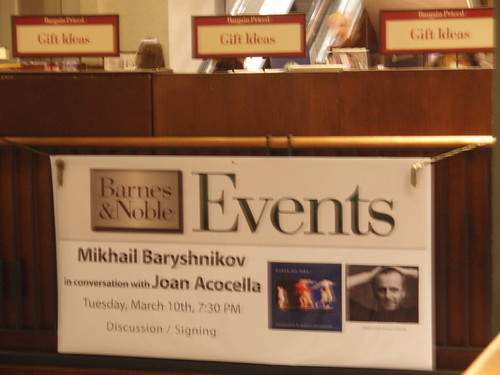
Please excuse the blurry photo; I took it on the escalator last night at Barnes and Noble, where I went after Paul Taylor (review soon!) Thankfully I decided to visit the bookstore; I hadn’t known about this, even though I’m on B&N’s events mailing list…

So, this Tuesday, March 10th, Joan Acocella (New Yorker dance critic) will be in conversation with Mikhail Baryshnikov at Barnes & Noble, Lincoln Square (66th and Broadway) to discuss Baryshnikov’s new book of photos of the Merce Cunningham Dance Company, Merce My Way.


But same night same time, Bill T. Jones is giving a talk at Skirball. Now what?

PAUL TAYLOR: DREAMS AND FUNNIES


So, Paul Taylor season is currently underway at New York City Center. I’ll be going several times next week and will be writing more then, but last week I saw three dances: Funny Papers, De Suenos (Of Dreams), and De Suenos Que Se Repiten (Of Dreams That Keep Recurring) — the third a continuation of the second. The first is a humorous piece from 1994 based on newspaper comics, with sections entitled I’m Popeye the Sailor Man and I Like Bananas Because They Have No Bones. The two Dreams pieces, from 2007, like real dreams, ranged from funny to nonsensical to ominous, then back to funny again and were populated by characters like a faun (above), a “golden girl” / angelic character tiptoeing around with a golden crown / halo atop her head, righting all the wrongs created by a devil, peasant women selling flowers and the women or men who buy them, and some underworld urchins who go to battle. I didn’t find any of these pieces tremendously profound, but they were funny and entertaining and often contained surprises both in movement and character-type — not at all cliched.

Paul Taylor is of course one of the masters of American modern dance, loved by most critics and dance fans. My experience with his work thus far has been limited mainly to American Ballet Theater’s production last season of his Company B, which I loved. So I greatly look forward to seeing more next week. The company performs through March 15th. Go here for more info and tickets.