Brief Update & Review of Peter Martins / Paul McCartney Collab at NYCB

Hey everyone,

Just a brief update since this motel’s wifi is expensive and not secure: but I now have a car (a cute little Toyota Prius – used) as well as an apartment in LA that I love but that unfortunately won’t be ready for move in for two more weeks. Which means I’m back in Phoenix for the next two weeks, shuffling around between family who have space for me and who aren’t allergic to Rhea and pet-friendly motels. Once I’m settled in to my new place – which, again, I LOVE!!! – I will most definitely resume regular blogging.

In the meantime, I did see the much spoken about new Peter Martins / Paul McCartney collaboration – Ocean’s Kingdom – at New York City Ballet when it premiered a couple weeks back. NYCB has sent me some pictures but I don’t have time to post them now. I will soon! I liked but didn’t love the ballet. I thought the story-line was simplistic and not very compelling and didn’t love the choreography, although there were some good pas de deux between Sara Mearns and Robert Fairchild – the lovers. I very was impressed with Paul McCartney’s ability to create such a rich orchestral score – really lovely. I thought Mearns, Fairchild, Amar Ramasar, and Georgina Pazcoguin all danced very well. Ramasar, who as most of you know is non-white, danced the part of the bad guy… So sigh on that. But he danced very well. For the most part, I wasn’t in love with the costumes, designed by Stella McCartney, except Pazcoguin’s, which was lovely and worked well. I kept worrying Mearns’s was going to come off, an idea my male friend liked and wished would have come to fruition. It didn’t; at least not the night we saw it.

McCartney was in the audience and gave a big wave to the audience when Martins introduced him. He has big, big hair! He doesn’t look his age at all. Martins toasted him not with champagne but with a cup of tea. Alec Baldwin was sitting right behind him in the audience. I don’t recall seeing any other celebs there but I’m sure there were oodles.

Anyway, as I said, I promise to post pictures of that ballet as well as some others from the beginning of the season that City Ballet has sent to me as soon as I’m home and have a secure (and free) internet connection. This afternoon is Charles Askegard’s farewell performance, which I unfortunately won’t be able to see. I hope to see his new company tour LA though, soon soon soon!

Thank you so much for continuing to read my blog, everyone, when I’ve been too busy to post much lately! I very greatly appreciate everyone’s support through this rather huge transition in my life. Thank you again, and will talk soon!

NYCB Wants To Monitor Its Dancers’ Social Media Posts

The dance twittersphere is currently aflutter over this Wall Street Journal article. It seems to have started with some tweets by NYCB corps dancer, Devin Alberda, gently poking fun at NYCB benefactor David Koch, at A.D. Peter Martins’ recent drunk driving arrest, and mock-criticizing one of the yellow-face characters in Martins’ Magic Flute for its racial connotations. I’ve seen some of Alberda’s blog and twitter posts and have often found him to be clever and funny but have also sometimes wondered, hmmm, is that going too far? Actually, I’ve seen blog posts (other than Alberda’s) and thought, wow, I wonder what such and such artistic director would think if he saw that. But then I don’t think any less of the company, maybe just the dancer. And since I don’t want to know more, I don’t return to that blog. So, really, no harm done there.

Anyway, NYCB is now in negotiations with the dancers’ union to attain the ability to monitor the dancers’ tweets and Facebook and other social media posts. If the union gives them the right to do so, according to the article, they’ll be one of the first performing arts organizations to have that power.

It’s an interesting issue because, on one hand, it’s never smart to publicly criticize your boss of course, but what about when arguing that a certain stereotype in a certain ballet carries racist connotations is tantamount to such a criticism? In part, it’s a free speech issue, which somehow makes the issue seem especially problematic for an arts organization. I mean, in interviews artists will sometimes speak openly about something deemed offensive in a piece they perform (opera, a play, a ballet, etc.), though usually not as snidely as Alberda. But some on Twitter are also saying companies have the right to control their “brand”  and many companies do such monitoring.

Others are saying Twitter and blogs are good for ballet because it’s such a rarefied, insular art form, it can only help for the public to have greater access to dancers’ daily lives via these popular platforms. But if the blogs and tweets are monitored, then it seems like they’re controlled, and not authentic. I’ve read dancer blogs before where it’s obvious a dancer is just a PR spokesperson for the company, and I don’t take them seriously at all. I usually read once or twice then never return. And it also makes me think the company’s using the dancer. So, maybe, if the posts are going to be heavily monitored, it would have the same effect on the public as not allowing them at all.

And what about dancers attacking critics? And what about the whole system of patronage, which ballet largely operates under? What if a dancer says something that has the potential to anger a patron?

Very complicated issue. Any thoughts? It’s a good article.

Sara Mearns Was Gorgeous in Swan Lake, But Overall Production Was Lacking


Last week was Sara Mearns week for me (well, for many New York ballet fans, I suspect). On Tuesday night, she made her debut as the Siren in NYCB’s Prodigal Son. (I’m still awaiting photos and will post as soon as I receive them!) Sean Suozzi danced the lead role. He did very well, but she just always stands out to me whatever she is in – particularly the story ballets. She was the best, most tantalizing, sinister, seductive, all around captivating Siren I’ve ever seen. The way she whipped that cape in between her legs, wrapping it around each one, the way she’d bend her knees slowly into a second-position plie while on point, basically squatting over the son’s head in a suggestive but also sinister manner, the way she’d raise her hand behind her head with the wrist bent and the fingers splayed to indicate her triumph over the son’s will, even just the way she’d walk out onstage on pointe, tiptoeing all around him – everything, every movement was in service of the character and was an integral part of the character’s story. I often feel like I’m seeing steps with other dancers. Just steps. The pas de deux between the son and the siren contains some of Balanchine’s oddest-looking choreography- especially those lifts – ‘here, stand on my knees, wrap your legs around my neck and let me carry you around like that,’ etc. I imagine it would feel very odd and foreign doing some of that, which of course was the point. It’s supposed to look warped and off-kilter. Everyone has mastered those steps, but to me, Mearns makes it the most deliciously warped. I love her.

Then, on Friday night, the company premiered their Swan Lake (Peter Martins version), and she danced the lead. (Photo above by Paul Kolnik, from Playbill Arts.)

In sum, I loved her; I wasn’t in love with the production. I went with several friends, two of whom don’t regularly go to the ballet, and that seemed to be the consensus. Everyone was excited to see Mearns dance again, but not to see that production. She was wonderful for all the same reasons I’ve written about before – she’s like a Veronika Part to me; she does such a full job of developing character, she brings you so fully into her world, you feel all of her pain with her. But of course she’s also an excellent dancer. She has a way of arching her back so, of working her arms and hands so, of extending her leg so high in arabesque, of extending her line so beautifully and making such full shapes – it’s a cliche, but her adagio / White Swan is just breathtaking. It almost makes you want to cry, and one of my friends did!

But she excels in the Black Swan / allegro role as well – not so much because she can do athletic feats like Gillian Murphy or Natalia Osipova (there were “just” a bizillion fouettes during the pas de deux, not a bizillion fouettes divided by multiple pirouettes and wild swan-like port de bras thrown into it all) but because she can do that all perfectly fine while still making it all about the character. When she does a series of lifts with Jared Angle where she spreads her legs into a straddle split in the air above his head, it’s just so wicked! And even at the beginning of the Black Swan, when she makes her entrance and presents her hand to the queen – it’s clear she’s up to no good. But she also doesn’t overdo it. She’s conniving and sinister but with a sweet face.

But the rest of the production: Jared’s an excellent partner, that’s clear. Mearns was way off her center of gravity in much of the White Swan partnering, and he securely held her balance, freeing her up to make those gorgeous shapes, and to act it all out the way she so brilliantly does. But in his own dancing, he just, like practically all dancers these days, goes for the cliche. It all looks so fake. I don’t believe he’s in love with her, or that he’s ever longing for what he doesn’t have, and that he’s devastated when she leaves him in the end. It’s all her sorrow and longing alone. So the performance was so unbalanced. I wish so much I could see her dance this with Marcelo Gomes, who really brings Prince Siegfried’s internal conflicts to life like no one else.

The other major issue I have with this production is the costumes – the costumes and the sets. I always forget about them until I see the ballet again, and, especially when I go with friends. My friends Friday night really found it hard to look beyond those costumes. For some reason, I kept thinking of the Flinstones, my friend, Marie, called them Jackson Pollack on speed or something to that effect (I haven’t read her review yet but will after I finish this post), and the others we went with just couldn’t stop talking about the brash colors. I remember my friend in the fashion industry saying of the Romeo and Juliet costumes (Per Kirkeby designed sets and costumes for both Martins productions) that the colors needed to be muted; these brash, bright, almost neon colors made the characters look like cartoons. Same with the Swan Lake costumes. Cartoonish is NOT what you want to go for in serious ballets like this.

Also, the RACISM. This is another thing I hate to admit I often forget about until I see the ballet again with a friend, and the friend is horrified at the fact that a black man is playing the evil character. Must von Rothbart always be danced by Albert Evans or Henry Seth? Are we not living in the year 2011? I mean, this is a huge reason why young people are so turned off from the ballet. And none of the very educated critics ever seem to be calling Martins on this. What’s up with that? Seriously? I think once you go to the ballet a lot you begin to forget about these things, you become immune to them. Which is horrible. But really, asking your audience to associate black men with evil is a horrible insult to that – probably very educated – audience.

Another problem here: Faycal Karoui (the conductor) was seriously on speed. He was flying through the first half. The poor dancers couldn’t even express the story. They really had to rush falling in love. If I’d never have seen this ballet before (and there were probably some such people there due to the Natalie Portman film), I don’t know if I would have gotten much out of the White Swan pas de deux. And that’s kind of an important part of this ballet…

All other dancers did well – I particularly liked Ana Sophia Scheller and Anthony Huxley (filling in for Sean Suozzi as Benno) in the first act Pas de Trois, and, in the second act, Abi Stafford and Joaquin DeLuz in the Divertissement Pas de Quatre, and Antonio Carmena in the Neapolitan Dance – but everyone did very well (those were just the ones who stood out to me). Oh and I loved Daniel Ulbricht throughout as the Jester. With his immense skill at jumps and turns – and combo jumping turns – and his comical sensibilities, he is perfect for such a role, as he is for Puck in Midsummer Night’s Dream – my favorite roles for him.

But I have to say, I was floored when none of the other dancers came out and took bows at the end of the production. Why? Whose idea was that? Only Mearns and Angle and Evans took bows. I realize the dancers are all very hard-working and probably needed to get home to get sleep for the next day’s matinee. But this severely cut Mearns’s bow and curtain calls short. It reduced the celebratory aspect of a production well done. Worse, it also really makes it look like none of the other dancers cared about Mearns, and about the production. It made it look like the company is not really a company of dancers who all work together and support each other. I’ve honestly never seen such a thing before. I’ve seen it where dancers who only dance during the first act will take their bows and curtain calls after the first act and not at the end of the whole, but the dancers who danced in the last act always come out for their bows at the end. Anyway, it really stood out to me. What did other people think?

Here is my friend Marie’s write-up.

Last Week at New York City Ballet


Last week I went to two performances of NYCB – opening night and Thursday night’s “See the Music” program – and to two of the free all-day Balanchine events on Saturday. First, I’ll talk about the last two since I found them so informative. The free studio talk on Saturday afternoon – Balanchine’s birthday – was moderated by Sean Lavery (former NYCB principal dancer, now ballet master), and included Sterling Hyltin (in Paul Kolnik photo above with Robert Fairchild), Chase Finlay, and Jenifer Ringer. Lavery asked the dancers to talk about their first Balanchine ballets, their favorites, and what drew them to NYCB. Hyltin named as her favorite Duo Concertant (pictured above) which I’d just seen her dance on opening night. She said she liked the syncopated movement, the he goes and I go kind of back and forth movement conversation with her partner, and with the musicians. I really liked it too. The violinist and pianist are onstage (the music is Stravinsky), and I like the interaction between the dancers and the musicians, and between the two dancers, and I like the sharp, angular movement. She seemed particularly animated when I saw it. I love Robert Fairchild and think he’s such a sharp, masculine mover with a presence that commands your attention without meaning to – he kind of reminds me of a less cocky Ethan Stiefel – but she seemed so happy to be dancing this piece that she stood out to me more. It was nice to hear her talk about it.

But what I really loved was the School of American Ballet class taught by Peter Martins. He interacted cutely with the students, particularly “Cyrus,” (at least I think that was his name…) a tall, long-limbed young man who I think will soon be in the company. Cyrus didn’t always do everything perfectly (at least in Martins’s eyes) but he had a charming presence and a great leading-man physique and you can tell he works hard.

Martins had the class demonstrate ballet basics – beginning with the five positions, and they showed us a perfect fifth position (with the toes of the front foot touching the heel of the other and vice versa). More interestingly, he had the class show us the difference between a Balanchine hand and a classical ballet hand. I’d always noticed there was a difference but couldn’t figure it out exactly. God gave us five fingers, Balanchine had said, so we shouldn’t hide two of them. The Balanchine hand shows all five fingers, the classical ballet one only three (with the ring finger and pinky held so that they are hidden from view behind the middle finger).

Martins also had the students show us how Balanchine’s fourth position differed from others’. In Balanchine’s the back leg is straight; in all others’ the back leg is bent. Martins didn’t go into any functional explanation for this – just said “here, we think it looks better.” But I thought about it and thought, wow, it must be hard to take off in a jump for example with the back leg straight. And then I realized that’s partly why Balanchine’s choreography always looks so fluid, like one step leading right into another, without a lot of stopping to build up to a big athletic feat – a big jump or series of turns. Other companies – like the Russians, like the Bolshoi – are all about preparing so that you can do something astounding. So they’re all about the building up.

This was mentioned in the studio talk as well. Lavery also talked about how fluid Balanchine’s movement was, and how, for example, in a lift, a guy would pick up a girl, then take two steps, and put her down rather than walk all over stage with her hoisted above his head. Balanchine wanted her to come up, then down right again, because that was more fluid, rather than have her head bobbing around up there while the guy was running all around with her.

Martins also demonstrated the bows. At City Ballet, he said, we just do them as such, and the girls did a little curtsy with the back leg slightly bent, without going down on one knee. Making fun of the dramatic Swan Lake bows, Martins went all the way down on one knee, exclaiming, “Yes, yes, I know I’m good!!!” while putting his head down, forehead nearly touching the floor, and raising his arms up in back of him like wings, fingers pointed toward the ceiling. It was hilarious.

Anyway, here are a couple more photos of opening night:


Above: Ashley Bouder in Valse-Fantaisie, and below, the cast, including Andrew Veyette, in the same (all photos by Paul Kolnik)


I liked Balanchine’s Valse-Fantaisie (Veyette replaced Joaquin DeLuz – but don’t know why because DeLuz danced Concerto DSCH two nights later) but I really loved the first of the evening, Walpurgisnacht Ballet. I’d never seen Walpurgisnacht before and it’s funny but I always seem to love the Balanchine ballets that are the least often performed. This was really beautiful. It’s from Gounod’s Faust, and features a group of women (and only one man – here Charles Askegard) in deep red dresses, their hair down in the second half as the music increases in tempo so that there’s almost kind of a hedonistic madness in the mood – and the footwork is so intensely complicated and fast fast fast. Wendy Whelan even made a tiny little flub, which I’ve never seen her do before. Crazy! And breathtaking!

And the evening ended with The Four Temperaments. I’ve said before and I’ll complain again that I still don’t understand why everyone goes on about how brilliant this one is. To me, there are supposed to be four temperaments, and the ballet is divided accordingly into four variations after the theme: melancholic, sanguinic, phlegmatic, and choleric. But they all seem to be the same to me. The dance seems one-note throughout so that after the first variation, I’m waiting for it to end. I’ll keep seeing it though, perhaps performed by a variety of companies if I have the chance, and will keep looking for the nuances…

“See the Music” night opened with Faycal Karoui’s discussion of Mozartiana, Tchaikovsky’s homage to / riff on Mozart, which made me appreciate Tchaikovsky even more. Then that piece was danced – by Maria Kowroski, Daniel Ulbricht, and Tyler Angle. Tyler stood out to me. As always, he dances with so much meaning, so much intention, and so much expansiveness. He’s a really beautiful dancer.

Then came Ratmansky’s Concerto DSCH, danced by Wendy Whelan, Ashley Bouder, Joaquin DeLuz, Andrew Veyette (replacing this time Gonzalo Garcia), and Benjamin Millepied. Oh, Natalie Portman was there, albeit late – she came in with a friend after Karoui’s lecture and right before Mozartiana was performed. Then, she left right after Concerto DSCH, after Millepied was done performing, and before the last piece. I thought it was a shame she missed Sara Mearns in the last dance, but a Twitter friend said she had a movie premiere that night, so I guess she needed to leave early for that.

Anyway, as usual, Millepied did not stand out to me, and I couldn’t stop thinking of seeing Tyler Angle in that role before and the way he lunges romantically toward the main girl, making it clear how much he yearns for her. Millepied’s knees nearly touch the ground in his deep steps toward her and it just looks like a dance step, not like anything evoking a specific emotion. As always I loved Bouder and DeLuz in the fast, playfully firtatious three-some part. I missed Garcia – where is he? I hope not injured! – but thought Veyette did a fine job in his stead.

And the evening ended brilliantly with Sara Mearns and Charles Askegard dancing the ballet leads in Balanchine’s Cortege Hongrois, while Rebecca Krohn and Sean Suozzi just as brilliantly danced the folksy Hungarian leads. I really love that dance and it made me all the more eager to see Mearns in Swan Lake!

On both nights, I went with my friend, author Maria Mutsuki Mockett. She writes an author blog but has been attending the ballet much more frequently and is now blogging a lot about ballet as well. She’s an excellent writer, so please check out her blog!

My Take on BLACK SWAN


I saw it over the weekend. Overall, I thought it was hilarious. Totally campy and just plain funny. Way too silly to be scary though. And I think Aronofksy was going for both. So, to me, it failed to that extent. But it may have just been me. Maybe I just have a dark sense of humor, because I went with two friends – one a ballet fan of the Gelsey Kirkland era, the other not. They both loved it and were on the edge of their seats throughout, although they also laughed quite a bit (particularly Gelsey Kirkland friend). Gelsey Kirkland friend said it reminded him of Dancing on My Grave. I must read that! I don’t know why I haven’t yet…

Anyway, so if you don’t know the story, it’s about this young ballerina who dances with a New York City ballet company housed in the Koch Theater. The artistic director (played by Vincent Cassel) is basically Peter Martins but with brown hair and a French accent.  Peter Martins guy tells the company that they are doing a new production of Swan Lake and to attract new audiences, they are going to cast a brand new ballerina, a new face. The old prima, Winona Ryder, is approaching menopause anyway. Never mind that she looks the same age she did in Reality Bites, at least to me. Apparently this company doesn’t have a system of principals and corps members because no one has any idea who the new face is going to be.

Peter Martins guy soon reveals that he favors Nina (Portman), but thinks she can only do the White Swan. He thinks she’ll have trouble with the Black Swan (he never uses the names Odette and Odile, which I know annoyed some ballet fans on Twitter, but I think it would have alienated non-ballet audiences had he used those names). He tries to seduce her (literally) in the name of getting her into the character of the Black Swan, which of course in the film is characterized as a sinister, conniving slut. But maybe he goes too far and unleashes the inner beast in Nina. She suddenly seems hell-bent on destroying herself (and she’s had problems in the past with self-mutilation and, it’s hinted at, anorexia). Or, maybe it’s that a new dancer from San Francisco (Mila Kunis) is trying to destroy her in order to take her place as the lead. My biggest problem with the movie is that it’s billed as a thriller but we never really find out the answer to that question. At the end, you’re still left wondering WFT was that about??? I mean, you’re left wondering that with many David Lynch films too, but with those, if you think long and hard enough, you can piece it all together. This, I don’t think so. I think it was just meant to be scary, sexy, creepy, gory camp.

For serious ballet fans, you have to suspend disbelief. Natalie Portman I thought did an excellent acting job, and her dancing is very very good for someone with very little training. I know Sarah Lane was supposedly her double, but you never really see any stunning dancing. The camera mostly focuses on Portman’s arms – and Benjamin Millepied did say he focused on the port de bras when training her and Kunis because you just can’t teach someone with no training to go on pointe and do the fouettes and pirouettes and all. So, you simply have to suspend disbelief that someone at Nina’s level would land the lead in the first place. And if you’re looking for thrilling dancing – the fouettes, the lightening-speed chaine turns, a beautiful pas de deux, etc., you’re not going to get it.

When we were all walking out, I did hear a couple people say now they wanted to see Swan Lake. Of course I hope it renews interest in the ballet, but it does worry me a bit that people will be disappointed, because the film makes it seem like the black swan pas de deux is a sex scene. The Peter Martins character keeps yelling at Nina to “seduce me, seduce me!” During a break he rhetorically asks Millepied (playing the role of Siegfried) if he would ever sleep with Nina (except he termed it differently). No one in the audience laughed but me. What am I the only New Yorker who reads the tabloids??? But in the ballet, the ballerina seduces both Siegfried and the audience with her allegro dancing, with her athletics. It’s more dance than theater; the seduction is in the dancing not the acting.

The whole thing had a Valley of the Dolls feel to it. Barbara Hershey is Portman’s mother, and she seems a bit off herself. You sometimes wonder if the mother (who never made it out of the corps, and who left ballet to have Nina) is trying to sabotage her daughter as well. There are some really funny (though I’m not sure if they were meant to be) screaming screeching cat-fight scenes between the two of them. But I think the funniest are between Winona Ryder as the aging ballet star forced into retirement and Nina, particularly those involving discussions of how to get ahead in the ballet company (guess; not by great dancing)… I miss Winona Ryder. I miss movies like Heathers

Anyway, I still don’t know how to feel about this movie. I’m happy that it’s put ballet on people’s minds again, but how misleading is it to what an actual ballet performance is all about? What do you guys think? It seems to have received fairly good reviews from the film critics.

NYCB Brings Back “The Magic Flute” and Ashley Bouder Astounds in “Serenade”

On Thursday evening, New York City Ballet performed for the first time since 1982 Peter Martins’s The Magic Flute (pictured below – both photos by Paul Kolnik). But first on was Balanchine’s Serenade, with Rebecca Krohn (in the photo at left, the ballerina the farthest left) debuting in the role of the “angel.” Jenifer Ringer (center) was the “lost girl,” and Ashley Bouder (on the right) the dancer who dominates the first section.

Every time I see this ballet I see something new and though she wasn’t debuting in the role, this was my first time seeing Ashley Bouder. She completely blew me away and brought to life a “character” I never really even noticed before. I use quotes because of course Balanchine insisted that this is a story-less ballet and he didn’t create any such characters, but over time viewers have come to create their own story and now, for example, everyone calls the ballerina whose actions seem to bless and save the woman who falls and seems distraught over a man, the “dark angel.” Anyway, I realized for the first time when I saw Ashley dance that her character is supposed to be the A-student, the one who can do all the astounding feats and just flies all over the stage in those jetes. I kept thinking of Natalia Osipova. Wow. That’s always been my least favorite part of the ballet – that “class section” at the beginning; I always long for the final, more poetic part when what can most be read as a story takes place, with the angel and a male figure representing to me blind justice save the tragic woman’s soul.

Anyway, for the first time I really didn’t want the first part to end. Ashley was just so spellbinding. It wasn’t just that her jetes were so stunning though; it was that she created a character who ate up the stage, but not out of competitiveness and need for attention, but simply because she was so good she couldn’t help it. That’s what her dancing conveyed to me anyway, and then I couldn’t take my eyes off her.

Rebecca Krohn did very well in her debut as the angel. Only thing was that she was so much shorter than tall Ask la Cour (in photo above) that when followed him from behind with her hands wrapped around his eyes, she really had to stretch.

Jonathan Stafford also made his debut in this ballet, as the “distraught girl’s boyfriend,” if you want to call him that. I thought he danced very well, but I think I personally prefer Charles Askegard in this role because I see that man as tantalizing her, tormenting her, and responsible for her downfall, and there is just something innately cocky about Askegard. Jonathan Stafford is too sweet 🙂

Okay, so The Magic Flute. NYCB as I said hasn’t performed this in a while and it’s kind of obvious why: it just doesn’t seem to fit at all in their repertoire. It was a short story ballet filled with slapstick and cutesy characters. It was danced very well – and Megan Fairchild and Andrew Veyette are two of the company’s best actors and they did in my mind as much as could possibly be done it. Everyone did well, actually, and it seems the dancers enjoyed the opportunity to do something they never get a chance to.

The story bears no relation whatsoever to the Mozart opera. It’s the story of a farm girl (Megan) who likes a peasant boy (Andrew) but she is betrothed to this incredibly hilariously dorky older man, the town’s Marquis (played well by Adam Hendrickson).This is where most of the slaptick comes in – in trying to seduce them the Marquis falls all over the village women, goes to kiss Megan’s hand but ends up with Andrew’s, literally falls all over poor Megan, etc. etc. Eventually, a strange hooded character indicates to the peasant boy that everything will be all right, he will get the girl, but he must watch for something to fall from the sky. That something is a flute, which comes bearing a huge sign for all the audience to see: “If you play this flute, people will dance against their will.” Audience cracked up at this of course.

So, Andrew grabbed the flute and tried it out on his friends, realizing it works! I have to say Andrew’s flute playing was very believable. Of course the flutist is in the orchestra pit but damn did it look like Andrew was making that music!

So, now every time the Marquis tried to grab Andrew and toss him off Megan, Andrew would starting playing the flute and the Marquis would start hopping around like a madman. Angry at his lack of control, he pulls his men on peasant boy, eventually tries to get the court involved, and soon everyone is madly hopping about. There’s no choreography for the uncontrollable dancing – everyone just hops about punching the air at random. Eventually everything works itself out and Andrew and Megan end up happily together.

The costumes were cute and the sets were very well done (it was suggested at intermission that ABT might want to hire set designer David Mitchell for their productions), I’m just not sure this ballet really belongs at NYCB. But it’s nice for a change.

The program ended with Balanchine’s patriotic Stars and Stripes set to Sousa. Savannah Lowery had the lead in the second section – the “second campaign” – and she fell during her stage entrance. It looked like just a slip but then she didn’t dance her part full out at all – jetes were very low and she looked very concerned going on pointe. It soon became clear she’d really hurt herself when she didn’t return for her solo seconds later. The company didn’t have time to replace her with another ballerina right then, so the corps members just kind of looked on and sweetly smiled as they stood still during what should have been Lowery’s solo. It was kind of like that experimental Jerome Bel film where the camera focuses solely on the corps members while the Swan Lake music swells.

Anyway, by the end, after the fourth campaign when all campaigns return, she’d been replaced by trooper Gwyneth Muller, who my companion noticed seemed not to have much makeup on. There probably aren’t too many emergencies like this where a dancer who thinks she’s done for the night (she’s played Megan’s mother in The Magic Flute) but hasn’t yet left the building has to get in costume and run back out onstage for a main solo! Anyway, she did well. I hope Savannah’s okay though.

Janie Taylor Debuts in Millepied’s “Why Am I Not Where You Are” Etc.

I’ve been remiss in my New York City Ballet posts! Last week I saw two programs: one featuring three dances to three different violin concertos – Peter Martins’s Barber Violin Concerto, Robbins’ Opus 19 / The Dreamer, and Balanchine’s Stravinsky Violin Concerto. And the other program was another in the “See the Music” series but was also dedicated to Santiago Calatrava, who designed sets for all three of the ballets performed – Benjamin Millepied’s Why Am I Not Where You Are (pictured above, photo by Paul Kolnik), Christopher Wheeldon’s Estancia (pictured below, photo also by Kolnik), and Mauro Bigonzetti’s Luce Nascosta, all of which premiered last season and which I wrote about here, here, and here.

Calatrava was in the theater, and after encouragement by Peter Martins, he rose and took a bow.

Then, as with the first “See the Music” program, before the performance began, the orchestra pit rose and conductor Faycal Karoui gave a humorous little explanation of various parts of the Thierry Escaich score from Millepied’s Why, the first ballet performed.

These explanations are really interesting to me, I have to say. I only took one classical music class in college and now wish I’d taken more. Karoui talked about how there were four main parts to the score: a waltz, a tango, a disco, and a final climactic part, and he talked about the differences in tempo between them, and between them and a typical waltz, tango, etc.. He also talked about how the ballet has a central male character (danced very well by Sean Suozzi – in top picture, being carried by the group of men), and how you can hear that central character’s theme – or voice – throughout each section of the music. But the voice changes with each section: at first, he’s shy and mysterious (and his voice in the first section is portrayed by a violin solo), then as the orchestra grows sharper and stronger in the second, tango, section, so did the character, etc.

When we got to the “disco” section (it sounded nothing like disco to me but just slightly more mechanical and percussive than the preceding sections), Karoui really began rocking out as he led the orchestra. It was like he was actually dancing in a disco, and I nearly cracked up. I’m not sure if that’s what he normally does down in that pit – if he regularly starts to embody the music literally like that, or if he was just being a goof for the audience. He didn’t seem to be hamming it up at that point, though – oddly – so who knows. Anyway, he is very entertaining and I find his musical explanations very educational as well. What more can you ask than to be both entertained and educated, right?

Anyway, Janie Taylor debuted in the Millepied. She was supposed to have debuted when the ballet did last season but she was out with injury and so Kathryn Morgan had filled in. Character-wise I thought she played it the same as Morgan. Except with Morgan it seemed to have a West Side Story feel to it; with Janie it was darker and more La Valse-like. Both were tragic, but in a different way; Kathryn’s character seemed more innocent. Anyway, this was my second time seeing the ballet and it grew on me. It’s very dramatic, not a dull moment in the whole thing, and you’re really on the edge of your seat, both because of the intensity of the music – maintained throughout each section – and the dramatic story of the poor innocent guy who’s drawn into another world by his enchantment by this ethereal creature, only to get trapped and ultimately destroyed, along with her.

To me, Sara Mearns and Amar Ramasar, with their bravura roles, largely stole the show – I think I remember thinking the same last time. She with those crazy fast chaine turns all around stage that almost make you sickly dizzy, and he with his virtuosic leap sequence – they are kind of the sinister characters, seducing Suozzi but also the audience.

Then came Estancia, and it was my first time seeing Ana Sophia Scheller and Adrian Danchig-Waring (pictured above) in the leads. I’m not a huge fan of this ballet – well, I like the ensemble sections, particularly the dancing and taming of the “horses” – but I nearly fall asleep during the middle, romance part, where city boy wins country girl over. I think it’s just the choreography in that middle section (that I found relatively bland) that slows it down – along with the music – but I liked Scheller and Danchig-Waring just as much as the first pair of leads – Tiler Peck and Tyler Angle. In fact, they seemed to fit the roles a bit more. Scheller reminded me of the main character of Agnes de Mille’s Rodeo and there was something more sweetly, playfully tomboyish about her look than Peck’s. And Danchig-Waring perfectly suited the city boy trying to woo her. He acted his part very well. And his movement is always very sharp. Andrew Veyette and Georgina Pazcoquin as the horses who are eventually tamed, were fabulously entertaining.

And lastly was Bigonzetti’s Luce Nascosta (picture at left by Kolnik), which I’ve seen now three times and which I like but think is too long. I missed seeing Craig Hall in the middle section that seems to be softer and looser than the other sections, where the movement is more marked by those extreme shapes with the flexed hands, splayed fingers, and angular balances and slides on pointe. Hall seems to have the ability to move in a more undulating, kind of serpentine way than most of the others and it seems to me to suit that middle section well.

In the previous program, I loved Megan Fairchild again as the “modern” dancer in Barber Violin Concerto, and, as always, Gonzalo Garcia as “the dreamer” in Robbins’ Opus 19!

New York City Ballet’s First “See the Music” Program

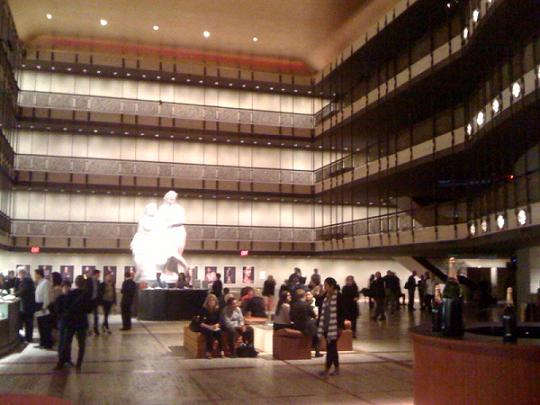
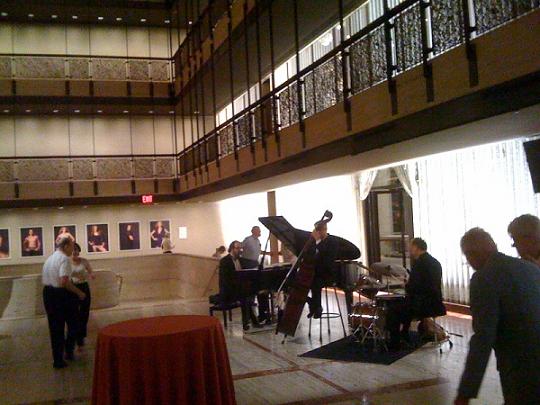
Friday night, my friends Hsien and Alyssa came with me to see the first program in NYCB’s “See the Music” series. First, we met for drinks on the promenade, which, as I mentioned, they’d opened an hour before showtime for the first week of this fall season. We watched members of the orchestra play some soft jazz music, which some patrons were dancing to. I know Hsien from my ballroom dancing days and we had to laugh because some of that music sounded straight out of Blackpool! (Blackpool’s one of the only – perhaps THE only – ballroom dance competition with live music.) (Above are a couple of my pictures of the promenade, about an hour before the performance, with people beginning to gather. My iPhone seems to take better photos outside…)

The two ballets performed were Ratmansky’s Namouna: A Grand Divertissement, which premiered last season, and Jerome Robbins’ The Four Seasons, which served for the first week of this first fall season as a tribute to fall.

Before the performance, Peter Martins came out and introduced the new series, explaining that it was inspired by Balanchine’s highly musical approach to dance, his belief that dance is music made visual, summarized by his words, “see the music, hear the dance.” Then the newly movable orchestra pit rose (as I knew it would!), and up came conductor Faycal Karoui with his crew, to explain a few things about Eduaord Lalo’s Namouna score. No one could give these talks but Karoui. He is hilarious, such a character!


Photo of Karoui by Paul Kolnik, taken from The Faster Times.

Karoui joked, in his thick French accent, that the music is very French, because of its … charm of course. Okay, then he became serious. The Lalo score is too long, of course, to talk about all of it, but Karoui focused on a few sections. One of the sections, he explained is characterized by its transparency of orchestration, meaning the harmonies don’t always  behave the way you expect them to; they are a surprise. He talked about how the beginning of the score had a nautical theme, and it opened with a sound like waves, but more German waves than French, he said, as the opening crescendo sounded more like Wagner’s The Flying Dutchman. He talked about the conversation between the harps and the strings, how Lalo plays with flexibility inside the tempos by following a quick tempo with a slower one, and he showed how Ratmansky had the dancers visualize part of that tempo by having the corps women at one point use cymbals onstage. After Karoui did a little dance himself while clapping the cymbals, he and Martins had the audience clap where the cymbals should be played to get us to internalize that rhythm a bit.

Karoui spoke at length about one of my favorite scenes in the ballet, where a group of smokers (led by Jenifer Ringer) really kind of tantalize the poor male lead, blowing smoke right into his yearning little face. It’s called “The Cigarette Waltz” believe it or not, and Karoui showed how the music really teases and tantalizes you into desperately wanting a cigarette, just like Ringer and her friends tantalize the poor sailor into wanting one of them. “Oooh, I really want one now,” Karoui cried after the orchestra demonstrated part of that waltz.

I liked Namouna much much better on seeing it a second time. I wrote about it earlier here (also, read Marina Harss’s fabulously detailed and in-depth description in Faster Times). It seemed less long this time, and each of the the parts seemed entertaining and compelling, each having its own theme and it own little storyline, however abstract the whole was. Maybe it was because of Karoui’s brief humorous explanations of the music, or maybe it’s just Ratmansky, because I always feel this way with his work – that nothing strikes me that much on first viewing, but that the more I see each ballet of his, the more I see in it, and the more entrancing I begin to find it.

That ballet was all the same, except this time Tyler Angle took over for Robert Fairchild as the main sailor guy. I’m told Robert is out for the moment with an injury. I loved Robert, but I really liked Tyler as well. Robert is so boyishly charming like Jose Carreno, and his dancing is more sharp and precise, hitting every count with spectacular flair and pizzaz, whereas Tyler’s more Romantic with his expression, with stretching port de bras and longing lunges, and he really draws out the music. They are such different dancers and it’s always nice to see another’s interpretation.

The next “See the Music” program will be this Sunday’s matinee.

New York City Ballet’s First Fall Season Opening Night


Tuesday night, New York City Ballet opened its very first fall season with performances of Balanchine’s Serenade, Peter Martins’s Grazioso, and Jerome Robbins’s The Four Seasons. First, before the performance began, Peter Martins came out and introduced each of the principal dancers, who came out onstage one by one, and said this season would be a celebration of them. Tiler Peck in particular was wearing this really gorgeous silky fuchsia dress. Martins said all principals were there except for Benjamin Millepied, who was doing something movie-related “en France,” he said with a funny faux Euro accent. Everyone laughed and gave the dancers a huge round of applause. The house was packed and it was clear how thrilled the company’s many fans are with there being a fall season this year. Martins made fun of himself for being so into toasts and said that during intermission, we’d all be given be given free champagne to toast the principals. Which we were – very fun!

The part of the performance I was mainly looking forward to was Janie Taylor’s debut in Serenade (above headshot and Serenade photo by Paul Kolnik) as the main ballerina. As usual with her, she completely made the ballet her own. I thought the ballet had a somewhat dark element with her, that I’ve never seen before. When she first ran out onstage, late for class, instead of looking like she was all frantic about being late because she’d been held up by a boy, it looked like she was running from something – from him. That man was Charles Askegard and when he danced the middle waltz part with her, the huge size difference between them added to the sense of foreboding, that she was fragile, he was pushing her around, and she’d eventually be hurt by him. At certain parts, it was literally like he was pulling her along. When he lifted her and she raised her legs in a split, it looked almost like she was trying to get away from him. Sara Mearns was the angel and Ask La Cour was the man who I call “blind justice” who take care of Taylor when she falls, and it was interesting how much the two male leads and two female leads looked alike. I almost got Taylor and Mearns mixed up at parts, thinking they were taking on the other’s role. And the end when the men raise Taylor up like pallbearers and she is carried off by them, arching her back, arms outstretched  – so hauntingly beautiful. It reminded me a bit of Balanchine’s La Valse.

I was also looking forward to Martins’s Grazioso, in which three handsome men – Gonzalo Garcia, Andrew Veyette and Daniel Ulbrich – vie for Ashley Bouder’s attention with their bravura moves. I don’t think this ballet has been performed since it premiered a few seasons ago. And I loved it all over again. I love how each guy has his own personality – Garcia is the romantic, Veyette is the manly man one, and Ulbrich is the one with all the high jumping tricks. And Bouder really played the tart, looking at each of them up and down at points kind of lasciviously, really trying to choose. The guy next to me was really giggly over it.

And the evening ended with Robbins’ The Four Seasons, which itself ends with a lovely tribute to fall.

This whole season the Koch theater will open an hour early. The promenade overlooking Lincoln Center Plaza will be open for cocktails, the gift shop will be open, and, for the rest of this opening week, there will also be live jazz performed by the NYCB Orchestra one hour before performance time. They have the promenade and mezzanine area done up nicely, with big plush chairs. Also taking place the rest of this week will be a “meet the artists” session whereby, beginning at 6:45 p.m. in the first ring of the auditorium, the principals dancers will be available to chat with ticket holders. There’s also a photo exhibition of the dancers by photographer HenryLeutwyler on display in the theater throughout the season.

Tomorrow night will be the first of seven “See the Music” performances which will provide a look inside NYCB’s 62-piece orchestra. At the beginning of each performance, Peter Martins and musical director Faycal Karoui will briefly discuss the program’s music, followed by the orchestra performing an excerpt of one of the ballet scores. The subject of tomorrow night’s discussion will be Eduoard Lalo’s score for Ratmansky’s Namouna: A Grand Divertissement, which premiered last season. Additional “See the Music” programs are Sept. 26 matinee, January 20, Feb. 1, Feb. 19 matinee, May 25 and June 11.

NILAS MARTINS QUIETLY RETIRES FROM NYCB


According to the New York Times Arts Beat blog, Nilas Martins, longtime principal with New York City Ballet (and son of Artistic Dir. Peter Martins) has retired. Without a farewell performance, without flowers, without fanfare. The story is that he has a knee injury and suffered continuing problems with that, and ended up getting a job with the DeVos Institute of Arts Management at Kennedy Center and just didn’t feel up to coming back and giving a final performance. I can’t say I blame him. He’d received so much criticism the past couple years he probably just didn’t want to see the onslaught of newspaper articles. I want to write a larger post about this, but I received a recent comment on one of my prior posts on a NYCB retirement (that I now can’t seem to find) about how the critics were too negative with  the retirements, writing about the dancers’ faults toward the end instead of their entire career.

It’s a real issue.

I do believe, as Arlene Croce famously said, that a critic’s duty in a democracy is to be critical. But on the other hand, I feel like maybe different standards should apply for the retirement performances. The person is retiring, do their current weaknesses at the end of their long career and the fact that they’re not dancing as well as they did in their twenties and early thirties really need to be focused on? It’s probably easily assumed by the public that they’re not dancing as well as they once did.  And poor Yvonne Borree – the critic assigned to cover her farewell was the youngest on staff; too young to have seen Borree dance in her prime, so all she could say, apart from describing the performance, was that she as a viewer couldn’t ever connect with her. And she should have said what she felt without buttering it up; she’s a journalist not a publicist. But couldn’t they have found someone who’d followed Borree’s career and saw what had been so special about her cover her final performance?

Anyway, more thoughts on this later. For now, I wish Nilas a successful arts management career in DC.

Above photo from the Daily News.

AN ERA ENDS: DARCI KISTLER GIVES HER LAST PERFORMANCE WITH NYCB


Yesterday afternoon marked the end of an era as Darci Kistler, the last dancer to be hired, trained, and made into a star by George Balanchine, gave her last performance with New York City Ballet, where she’s danced for the past 30 years. Kistler, originally from Riverside, California, began studying at Balanchine’s School of American Ballet in 1976, was hired to dance with the company in 1980, and was made into a principal in 1982, at 17 years of age. She remains the youngest principal ever at NYCB.

It was a huge event, needless to say — practically every critic and blogger was there, longtime donor patrons were greeting each other right and left (and there was a party for them afterward). The house was completely packed, and the plaza was filled with people asking if anyone had a ticket for sale.

The program consisted of Balanchine’s Monumentum Pro Gesualdo and Movements for Piano and Orchestra, the Titania / Bottom pas de deux from his Midsummer Night’s Dream, his Danses Concertantes, and the beautiful final act of Peter Martins’s Swan Lake (which almost made me cry, and I don’t think I’m the only one).


Monumentum Pro Gesualdo and Movements for Piano and Orchestra is an abstract leotard ballet in two parts that Balanchine set to Stravinsky. I always prefer the second part, which its flirtatiousness, its angular lines and sharp shapes, to the more lyrical first part. Darci danced that second part with Sebastien Marcovici, and the first part with Charles Askegard. I’d only ever seen Maria Kowroski in the female lead in this ballet and it was interesting seeing another body in the role. Kistler danced it more smoothly lyrical and her edges were more rounded, but she played it up really well, really “acted” it, like she was really responding to Marcovici’s movement and he to hers, as if they were in conversation.

That Titania / Bottom pas de deux is one of my favorite parts of Balanchine’s Midsummer Night and I’m glad she chose it. She was sweetly hilarious as she fell head over heels for Henry Seth’s ‘donkey persona’ after both had spells cast on them by the mischievous Puck.

Danses Concertantes was the only ballet she didn’t dance; it was danced well by Megan Fairchild and Andrew Veyette.


And the program ended with the last act of Martins’s version of Swan Lake. The Martins is one of the only versions of this ballet I know of that doesn’t have some kind of happy ending, and it was really fitting here, this being the most bittersweet of farewells. In Martins’s version, Odette and Prince Siegfried can’t be together because he has been unfaithful to her with Odile. So the ballet ends with her bourreing backward, away from his outstretched arms, into her flock of swans, who envelop her. Jared Angle’s Siegfried continues reaching out toward her, in sorrowful outstretched lunges, but he’s unable to reclaim her. She literally retreats into the wings, and metaphorically returns to her ethereal, otherworldly place. So poetic, and so fitting for a prima ballerina retirement. And so sad…


All photos by Paul Kolnik. (Bottom photo I scanned from an earlier program)

MAURICE KAPLOW’S FAREWELL PERFORMANCE WITH NYCB


Thursday evening longtime New York City Ballet principal conductor Maurice Kaplow gave his final performance with the company. I had never been to a conductor’s farewell before, and, of course, part of what made this extra sensational was that the newishly mobile orchestra pit (photo above) was raised to stage level for part of the program.

There were four pieces in the program: Melissa Barak’s recently premiered Call Me Ben (the only piece Kaplow didn’t conduct), which was followed by Euryanthe, the Barber Violin Concerto, and ending with Western Symphony.

Euryanthe was only an orchestral piece – no dancing, by Carl Maria von Weber. When Kaplow first took the podium, everyone cheered, which grew into a standing ovation as the orchestra pit rose. One thing I didn’t realize (we’ve only seen the pit rise once before, during the first NYCB program following the Koch theater’s renovations last year) was that the conductor can’t stand at the podium while the pit is rising and falling; he must step down into the musicians’ area. When the pit was finally level with the stage and he climbed up to the podium, he looked out toward the applauding audience and took a grateful bow. Euryanthe was really beautiful, with a lovely, almost sentimental (given the occasion) violin section, followed by an exciting drum-heavy climax. It was nice to see the orchestra for once, and to be able to focus on the music.

Peter Martins’s Barber Violin Concerto really blew me away. I’d never seen it before, and I have to say it’s now one of my favorites of his.


Pictured from front to back: Megan Fairchild, Sara Mearns, Jared Angle, and Charles Askegard. There are two couples in this piece – one a classical ballet pair, the other a modern dance duo, and at first they dance each with their rightful partner, then the two members of the modern couple break apart and dance with the opposite sex ballet dancer. When I interviewed So You Think You Can Dance’s Billy Bell a while back, he’d laughingly said something to me I found funny, that as a hopeful choreographer he sought to “break” ballet dancers, meaning he wanted to get them to loosen up, not be so rigid and controlled with such straight, upright posture, and get them to really move. This piece reminded me of that. At first Sara Mearns’s classical ballerina in pretty satin pointe shoes wants nothing to do with this crazed barefoot Jared Angle, but eventually she realizes he’s not so bad and they do a quite nice pas de deux together.

Same with Megan Fairchild and Charles Askegard, except choreographically they were more fun, and Megan totally blew me away and made me think she is really a modern dancer. She was the most compelling person onstage and I couldn’t take my eyes off her, despite the fact that one of my big favorites, Sara Mearns, was up there with her. Megan looked like a real Paul Taylor dancer but even more stunning. Her character really taunted Charles Askegard’s classical danseur, jumping on his back, wrapping her flexed feet around his middle, darting in between his legs, really kind of climbing all over him. He looked tormented, then eventually relented and they danced a pas de deux together too. Interestingly, people giggled throughout this part – where Megan’s modern girl is taunting Charles’s classical man –  and the critic next to me who’d seen the ballet many times before said he’s never heard people laugh at that section, that he didn’t think it was supposed to be amusing but more raw. Maybe it was because of their size difference — Charles Askegard is the tallest dancer in the company (I think he’s 6’4) and Megan’s this tiny little thing who looks rather doll-like. I found it cute and flirtatious and now I don’t think I’d like it if I saw it done more raw, though I’d love to see other dancers do it. I’d love to see this ballet again.

Also, as the title of the piece would imply, there’s a really beautiful violin solo (played by Arturo Delmoni), where the violin almost sounds like a human voice.

Last on was Balanchine’s Western Symphony. Andrew Veyette danced the male “Rondo” role and after seeing Robert Fairchild in this role last week I thought I’d never be able to see another dancer do that part. But, whoa, Veyette completely floored me. He was on fire as he kicked his heels up high in the air, sexily do-se-doed toward Teresa Reichlen (who was stunning as well as the female lead in that section), then whipped her off into the wings where he pretend kissed her. She’ taller than he is and at first I thought they weren’t a good match, but they kind of played up their height differences. I loved it.

As usual during the curtain call, the maestro came out onstage and took a bow. But of course this time he didn’t merely motion down toward the orchestra, directing the applause at them, but took the stage alone, and, like the retiring dancers, was greeted by a row of dancers bearing bouquets. Eventually, the entire orchestra came up bearing flowers as well. Peter Martins came out onstage and hugged him. Very sweet. Then, Martins led the orchestra (joined by the audience) in singing “Happy Birthday,” so apparently it was Kaplow’s birthday as well. He’s been with the company for 20 years. I’ll miss seeing him in the house.

Photos by Paul Kolnik.