IS SO YOU THINK YOU CAN DANCE "CULTURALLY RADICAL"?

Here’s an interesting perspective from the Huffington Post’s Miles Mogulescu on So You Think You Can Dance:

“Here, the culture wars of the past 30 years appear over, at least for an hour or two, and the progressive side–which has stood for racial equality, gender equality, and gay rights–is the undisputed winner, without the need even to overtly comment about it. I’m not sure what Glenn Beck, Sarah Palin, or the editorial page of The Wall Street Journal would have to say if they were watching. But then, Rupert Murdoch has never been known to let his conservative political views get in the way of making a buck.”

I’m not sure that I agree with him that the show represents a huge but unspoken triumph for women’s or gay rights but I find the race issue interesting because I’ve had several people comment on my own Huffington Post pieces on the show saying how great it is that blacks and whites and Asians and Latinos are all dancing together without issue. I guess I never even noticed because it’s so ridiculous to think that it should be any other way. And it’s not, in New York. Is it still in other parts of the country??? I mean, really, both on the concert dance stage and in social dance clubs there just doesn’t seem to be a race issue, unless I really have my head up my butt…

FELA! ON BROADWAY A MUST-SEE


All photos by Monique Carboni.

If you’re in NY or are coming here at all for the holidays, definitely do not miss FELA! It’s honestly one of the best musicals — if not the best — I’ve ever seen (and I don’t often like musicals!)


It’s a very “real” musical in that it takes place in a night-club in Lagos, Nigeria — called The Shrine — founded by  real-life Nigerian composer, musician, founder of Afrobeat, and human rights activist Fela Kuti (1938-1997). It’s the late 1970s and he and his dancers (mostly female) perform their unique — and fascinating — blend of what seems to me traditional African, Reggae, and funk, and you’re part of the night-club audience!


Through the songs — most of them are actual music by Kuti — Kuti tells his story, and that of his mother, Funmilayo Ransome-Kuti, who was killed by the police just months earlier, when they raided Kuti’s compound. Funmilayo was a feminist and human rights activist who was vocal in her opposition to colonialism, and to the corrupt government, and her death, along with the attack on Kuti’s compound, were politically-motivated.

It’s hard to understand the exact political problems in Kuti’s Nigeria — I’d think it would be near impossible to explain something that complicated in a show like this — but suffice it to say the government is corrupt, there’s no accountability of government officials, the police force / Army is murderous, Nigerian citizens are suffering, and Kuti is speaking out against it all through his songs.


The story-line moves back and forth in time, much of it devoted to Kuti’s memory of Funmilayo, played brilliantly by Lillias White (in photo above).


The show is expertly choreographed and directed by Bill T. Jones (photo above by Joseph Moran), who, I feel, does his best work on Broadway. The dancing is so incredibly stunning. I have never seen African dance done this well. Jones must have looked long and hard for those miraculous performers! The play obviously provides a great history lesson, but, seriously, you can go for the dancing alone and be completely blown away.

But, as I said, you’re made to feel you’re part of the Shrine audience — and Kuti (played, on my night, excellently by Sahr Ngaujah — Kevin Mambo alternates with him in the role) will ask everyone to stand up and clap, dance (at your seat!), sing, repeat words after him — it’s a lot of fun. At one point, they re-enact the police breaking into the compound, kidnapping several of the dancers, torturing them, beating Kuti, and throwing Funmilayo out of a top-floor window, killing her. But when the police storm the place, the dancers and cast -members run about the theater, through the aisles, you hear screams, shots. You feel like you’re one of them, and it’s really actually quite frightening for a split second. I actually wished they’ve have done a bit more of that — had not just the compound’s inhabitants running around screaming, but the police chasing them, waving batons, threatening everyone, including you, the “foreigner.” (My friend who I saw the show with, a black man, thought I was a bit off my nut wanting this — this rather authentic re-enaction of police brutality…)

Anyway, brilliant brilliant show — a definite must-see! I also loved Saycon Sengbloh as a female friend, whom Kuti meets during his travels. She mainly sings, and, like White, she’s got a really beautiful, powerful voice.

One last thing: at the end, the dancers and singers all emerge from the wings and carry through the aisles and out onto the stage small tombstones. It’s really cool — there are cameras all about filming live and the scene is supposed to be a political demonstration. Because of the cameras, even though the audience is all seated, everyone still kind of looks like they’re part of the demonstration. Very cool effect. Anyway, Kuti carries a tombstone bearing his mother’s name; the others’ bear words like peace, dignity, etc. At the end, they stack all tombstones atop one another onto a pile in the middle. I noticed as we were putting on our coats to leave that the one in the middle said “I am Sean Bell.” I thought that was interesting because obviously Sean Bell is a contemporary American reference and this took place in Nigeria decades ago. And, the Nigerian police stormed Kuti’s compound and attacked him and his followers for their outspoken political beliefs, whereas Bell was shot and killed by police during a failed prostitution bust because they thought — notoriously wrongly of course — that his friend was reaching toward his waistband to retrieve a gun. One outlash of violence seems so much more politically-motivated than the other. But then maybe the Bell case is political just in the fact that the police had targeted a club in a black part of town in the first place and were looking for criminal activity. Maybe both the Kuti and Bell communities were equally “under siege” in a way. I don’t know … racism in the U.S. these days takes such complicated forms because there are just layers upon layers upon layers of historical oppression.

DISGRACE: IT’S JOHN MALKOVICH WHO DESERVES A NOBEL


Oh how I wish Anthony Lane would have reviewed this film; unfortunately the New Yorker didn’t assign him. I always value his insights, particularly on movies I find disturbing. And I found this one so not because of the subject matter (race and gender-based violence in post-apartheid South Africa), but because of the way men, women, blacks and whites are all depicted, the extremely outmoded essentialist terms in which women and men are portrayed (ie: I am man, therefore I desire to rape women; I am woman therefore I love children and won’t have an abortion, etc. etc.)

The film is based on the Booker-prize-winning novel of the same name by Nobel-winning writer, J.M. Coetzee, a white man from South Africa who currently lives in Australia.

David Lurie (Malkovich) is a 52-year-old white professor at a Cape Town university who’s attracted to younger biracial women. As the movie opens, we see him soliciting a prostitute who fits such description, and shortly thereafter he becomes taken with one of his students, Melanie, and the two begin having an affair. It’s not clear how Melanie feels about him though. She seems completely dead during their sex scenes, and whenever she leaves his house, she always looks sad and violated. But it’s not like he’s raping her; she’s there of her own volition and she’s an adult and went into the affair knowingly. Nor is it made clear that he’s committing quid pro quo sexual harrassment — telling her he’ll fail her if she doesn’t do as he pleases; in fact it’s later revealed that the opposite is true — he passes her even though she’s truant and fails to show up for exams.

Eventually her young black boyfriend finds out about them and exposes Lurie. Students drop his classes and the disciplinary committee calls him for a hearing. Lurie seems to agree with the committee that he’s done something wrong (though it’s not clear to me what this is — again, she’s an adult and the sex seems consensual), but won’t defend himself because he can’t apologize for what he considers his (male) “nature.” The disciplinary committee dismisses him from his post and he moves to the country, into his daughter’s farmhouse.

His daughter, Lucy, is a lesbian whose lover has just left her. She shares the farm with a black man, Petrus – -he lives not in the main house but in a shed — who’s worked part of the land, installing pipelines and a well, and who, because of his labor, now owns part of the land. I wish the film had done more to educate viewers about this practice. It’s not clear, in post-apartheid S.A., whether Lucy is trying to help Petrus (she’s clearly liberal-minded and believes in righting historical wrongs) or whether this is the way the new system works to enable black South Africans to gain land ownership. In any event, Petrus is depicted early on as someone who’s up to no good. He’s nearly drooling at the mouth when we (and Lurie) first meet him (like a dog, I guess, since that seems to be the main — totally overdone — metaphor here).

So the dogs: Lucy houses several out back in a cage, partly for humane purposes — apparently there’s an over-population of dogs in S.A. and Lucy’s friends with a female veterinary nurse who catches them, tries to adopt them out and then euthanizes them when she can’t — and partly for protection. We’re made aware up front it’s very dangerous out on the farm — there’s been a lot of pillagings. She also keeps a loaded rifle in the house. At one point, she and Lurie are walking one of the dogs and Lurie tells her dogs are “creatures of habit.” He tells her a story of his childhood neighbor’s dog. The dog (a male) would always go nuts when the bitch next door was in heat. He’d dig holes in the yard, tear things up, etc. — create chaos basically. So his owner would punish him every time this happened. Eventually, the minute the female dog went into heat, the male dog would crouch and whine and walk around with his tail between his legs. The horror of this Pavlovian game, Lurie says, is that the dog eventually learned to deny his own nature. This is why, Lurie says, he shouldn’t be expected to deny his own nature (screwing around with young women, presumably to their detriment).

One day, Lucy and Lurie return to the farm after walking some of the dogs, to find three young black men taunting the caged dogs. Lucy approaches them and asks them to stop. They give her a story about one of the boys being stranded and ask if he can come inside and use her phone. She cages the dogs she’s walked and tells him yes; he alone can come inside. This is a ruse and after she’s caged her dogs, the boys drag her and Lurie into the house, gang rape her, lock Lurie in the bathroom where they douse him with gasoline and set him on fire, and use Lucy’s gun to shoot and kill all of the caged dogs. They also loot the place and cart off Lucy’s possessions in Lurie’s car. Lurie manages to save himself with toilet water but he’s still badly burned.

Lurie tries to get Lucy to go to police but for some nonsensical reason she won’t. Ludicrously, she tells him he doesn’t know what happened because he didn’t witness “the crime” — ie, he wasn’t in her bedroom, which, ridiculously, he doesn’t argue with. Her friend echoes her — he “wasn’t there” during “the crime.” He tells her he’d like to talk to the police, but she tells him there’s no information he could give them that she can’t, which he also inexplicably doesn’t argue with.

So a man is bludgeoned and set on fire and almost killed, but he isn’t the victim of a crime? He sees the attackers as they kill the dogs and pour gasoline on him, then throw a match at him, while Lucy is still in the bedroom, but he has “no information” of “the crime” that she doesn’t have?

Sadly, there are still parts of the world where women are considered male property, and therefore her rape is seen as the worst possible thing that could ever happen to her (or her “owners”). Worse than being set on fire. Worse than being shot and killed. I find it beyond shocking that the rape is seen as the only crime here.

It turns out Lucy is pregnant with the child of one of the rapists. Lurie tries to get her to have an abortion but she responds with, “I’m a woman. I don’t hate children because of where they came from.”

Petrus, who was suspiciously missing during the time of the break-in and whom Lurie suspects of having set the whole thing up so that he could scare Lucy away and own the farm himself, returns to the farm, with a new wife, and throws a party in the shed. At this party, Lucy and Lurie discover that one of the boys who raped her is the son of Petrus’s new wife. Lurie wants to call the police but Lucy forbids him from doing so, saying she needs to get along with these people since they’re now co-owners of the farm.

Lurie goes to talk to Petrus. Petrus insists his new son is not one of the rapists, but tells Lurie because of what’s happened, he would still make him marry Lucy but for the fact that he is too young for her. Petrus then tells Lurie he will marry Lucy himself (I don’t know if the filmmakers forgot that Petrus is already married or whether in S.A. bigamy is legal). Lurie delivers this message to Lucy and she accepts Petrus’s marriage proposal. Lurie thinks she is completely nuts (as does most of the audience, I’d venture to say) and tries to plead with her but to no avail.

Eventually, through all of this trauma, Lurie realizes the wrongness of his ways (because, apparently, in this world, rape is equal to sex with prostitutes and consensual sex with adults). He visits the father of the student he seduced to apologize. It’s a testament to Malkovich’s enormous talents that this climactic scene actually works, based in nonsense though it is since he’s really done nothing wrong to this supposedly full-grown woman.

Lurie begins having an affair with Lucy’s friend, the humane euthanizer, and helps her put the dogs down. In the second climactic moment, Lurie sacrifices his favorite dog in order to show that he’s finally has decided to disavow his own male / dog “nature.”

By the end of the movie, Lurie has learned to accept his daughter and her pregancy. In the last shot, the camera slowly pans across the land (like in Howard’s End) to reveal the entire farm. The bright new house Petrus has built himself is a marked contrast from the shabby, broken home housing Lucy. So, through rape and pillage, black South Africans have “taken over.”

The biggest problem with the movie (apart from the bad metaphors, the infantalizing of women and the equating of sex with rape) is that all the black South Africans are portrayed either as evil or easily taken advantage of. I’m sure it can be very dangerous for whites on those farms, particularly for women living alone, and I’m sure there are many rapes. But the film doesn’t present the perspective of any of the black South Africans, the historical oppression, the conditions creating the severe inequality that have led to such hatred and violence. The film is one-sided and in my mind comes across as feeding into racist stereotypes.

The film’s only redeeming quality, to me (apart from some beautiful shots of South Africa), is Malkovich, who — I have no idea how — was able to make his way through all the aforementioned problems and create a truly sympathetic, memorable portrait of this man. He always does that though, no matter how unlikeable the character. The man is a genius.

Has anyone else seen the movie? Or read the book? I have the book, but haven’t gotten around to reading it yet. I didn’t like Diary of a Bad Year and so was putting it off but I probably should now because I have a feeling there was a lot left out. I hope there was anyway.

 

Alvin Ailey Day at Lincoln Center Film Society

p2011898

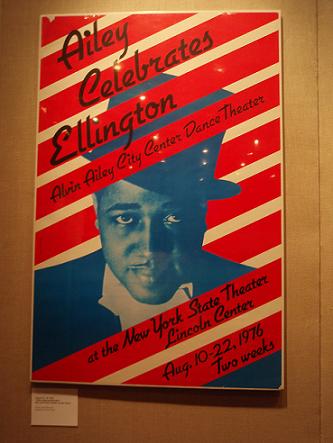
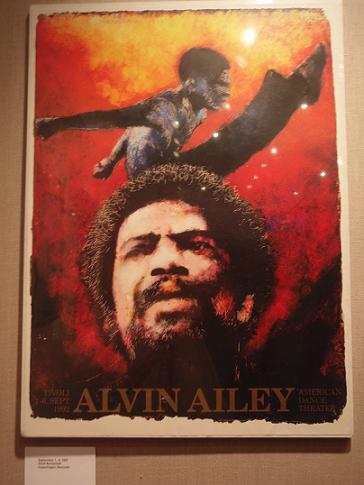
I spent most of my day yesterday at the Walter Reade theater at Lincoln Center watching films about Alvin Ailey: rare footage of interviews and rehearsals with the legendary choreographer, and of him as a young dancer in the 50s and early 60s dancing with the equally legendary Carmen de Lavallade, along with later coverage of Judith Jamison and others dancing, newer PBS specials on the company, and even a couple of panel discussions with filmmakers, collaborative artists, and dancers who worked with Ailey. What a treat! The all-day event was co-produced by the company (AAADT) and the Film Society of Lincoln Center in honor both of the company’s 50th anniversary and the start of Black History Month.

p2011897

First off, there was a collection of vintage posters in the art gallery right across the hall from the theater. (top two pics above, taken by me.) There was also a little reception with complimentary wine. Complimentary strong wine (which, I hadn’t eaten much and, well, probably got carried away excitedly tweeting over seeing some of the dancers there — namely

Yannick Lebrun — wearing gold earrings in both ears and dressed very stylishly in one of those skinny scrunchy bubble-jackets, baggy jeans and bright red-soled sneakers — it’s always fun to see your favorite dancers outside of the theater, just dressed like ‘normal people’. Also there were  Renee Robinson, Matthew Rushing, Vernard Gilmore, and Hope Boykin, and choreographer Robert Battle. Renee and Yannick both showed up to the church event they had last year and I love that both the newest company member and the dancer who’s been there the longest show up to these kinds of things).

Anyway, the first set of films consisted of a movie directed by Orlando Bagwell made for PBS called “A Hymn for Ailey.” I’d never seen it before, but it was a filmed version of Judith Jamison’s dance / theater piece for the stage, Hymn, which she choreographed for the stage not long after Alvin Ailey died (of AIDS, in 1989). I’d never seen that either and I wish the company would stage it again. It was filmed mainly in the church where Ailey’s funeral was held, the magnificient Saint John the Divine. Dancers danced to a series of spoken word pieces recited by playwright / actor Anna Deavere Smith, who was, of course, a very powerful presence in the film. At times she’d stand next to the dancer — at one point Renee Robinson — and speak about body image, as Renee danced her words, and interacted with her at the same time, at one point seeming about to lash out on a negative thought, as if she were a mirror. At another, she spoke about Ailey’s artistry as an excellent male dancer who’s name I didn’t know belted out the movement with great passion. Or, one of the parts that stayed with me for a while — Smith took on the voice of an African woman talking about how much easier it is to be “real,” to be oneself, back in Africa; how here everyone has to wear a mask to survive. It kind of reminded me of Invisible Man. Both the performance and the words were very moving.

p2011893

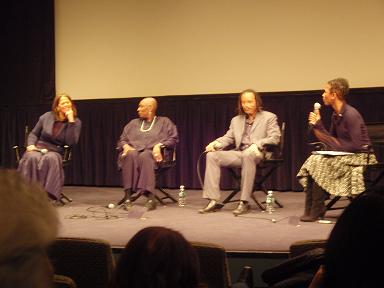
(there was a panel discussion after the Bagwell film, including from right to left, company rehearsal director Ronni Favors, filmmaker Bagwell, Jamison, and Deavere Smith). Judith Jamison is so charismatic, I’m sure it goes without saying. No matter what she’s talking about, you just want to hang on to her every word.

But the biggest highlight of that program — of the day for me — was footage of Alvin Ailey rehearsing a female dancer, Donna Wood Sanders, for her role in Masekela Langage (depicting denizens of a bar, set simultaneously in 1960s race-torn Chicago and apartheid-era South Africa, or anywhere oppression exists). I can’t tell you how much I got from this and I really really wish companies would do this more — would show audiences rehearsals and give us a glimpse into the artistic process. He was telling her, you’re an older woman, you’re stuck, trapped in this bar, in this place, you can’t escape and your life is dreary but that doesn’t mean you’re giving up. And, as she’d do certain things in the choreography, like push her arms out and step backward, he’d say to her, “let me see you in a prison, trying desperately to escape, but you can’t.” And she’d do the movement in such a way that that’s exactly what you saw. It was brilliant. And so powerful. I sometimes wonder how much is lost when a choreographer like that dies, if the entirety of his rehearsal and notes on direction are not kept. Dancers should of course add their own interpretations, but not without reviewing the master’s directions again for guidance. Now I want to see this ballet again.


Also included in the programs I saw were an interview Harry Belafonte conducted with Alvin Ailey, vintage footage of dancers Carmen de Lavallade, James Truitte, and Ailey performing classic works by Ailey’s mentor, Lester Horton. I particularly enjoyed The Beloved, depicting a relationship fraught with tension but compassion that kind of reminded me of some of Ulysses Dove’s work.  (A program later in the day included films of some of his dances, but unfortunately I couldn’t stay).

A final highlight of the day for me was watching vintage footage of Alvin dancing Porgy and Bess with Carmen de Lavallade. Learn about that story (originally an opera) and its history here. Ailey danced the part of the the man who threatens the crippled Porgy and seduces but mistreats Porgy’s beloved Bess. I’d never actually seen much of Alvin Ailey dancing and this was such a treat. As someone said in one of the films — I think it was Jamison but am not sure — “He WASN”T skinny!,” which made me laugh, but she’s right.


He was a meaty man. And he had hefty strength and ferocity to his dancing, a virility that was simultaneously sexy and threatening and that I totally didn’t expect since, by the way he speaks and from what I’ve read about him, he seems to have been such a soft, gentle man, and given that most of the male characters he created in his ballets seem like soft, gentle men as well, full of vulnerability and sympathy. Plus, with the possible exception of Glenn Allen Sims, no one  in the current company really dances like that. Not that that’s a bad thing – -just a different aesthetic.

I wish I could have stayed for the full day, but I went to ABT’s female choreographers program at the Guggenheim, which I’ll write about soon. This company always makes me so happy and inspired.

Blacks Acting "White" is Hilarious, But What Would the Reverse Be?

…and other questions I had after seeing Young Jean Lee‘s The Shipment, a very compelling off off-Broadway play about Black identity in America by a Korean-American playwright, starring an all-black cast.


Warning: if you’re in NY and you plan to see this, you may not want to read this yet!

I’d been really excited about seeing this play for a while and it definitely didn’t disappoint. Also made me think. A lot. And methinks this “review” may be all over the place because of those thoughts.

The play is divided into three sections, or acts. The first consists of a foul-mouthed Eddie Murphy-type stand-up comedian who says he’d love to spend all his time telling jokes about pooping (his very favorite subject of comedy) but is being forced to talk about race instead (because he’s black, because it unfortunately affects him as a black American). He remarks on some of the differences between whites and blacks: whites obsess about their weight throughout their lives, blacks — once they get married, forget about that shit. Occasionally, he’s confrontational but in a funny way, and, though I think he made many in the mostly white, mostly young, very liberal audience somewhat uncomfortable at points, everyone laughed. This was my least favorite section, mainly because I wish Lee would have been more specific at times and also because she overlooked class differences a bit. For example, the comedian says that whites love to accuse blacks of “whining,” but look at what whites whine about: “Ooh, I just don’t know what to dooo with my life!,” he says in falsetto, or “Ooh, am I too fat?!” It’s funny — because that’s exactly what a lot of whites do whine about — but upper-middle-class whites. Believe me, poor whites are not worried about how they look; they’re worried about putting food on the table, about how far they can stretch their next paycheck. Just visit any small working-class town in the south or the mid-west.

But also, I don’t really know what whites accuse blacks of whining about. Historical oppression? The disproportionate rates of incarceration? Racial targeting by the police? I’ve never heard any whites accuse blacks of whining about any of these things. Most whites don’t even want to think about those things.

Continue reading “Blacks Acting "White" is Hilarious, But What Would the Reverse Be?”