Jose Manuel Carreno’s ABT Farewell


Thursday night at the Met, Jose Manuel Carreno, a longtime favorite of mine, gave his farewell performance with American Ballet Theater. (He will dance a few more performances with the company as they tour Los Angeles and Japan later this month, and he ended up filling in unexpectedly for an injured dancer in Saturday’s matinee, but Thursday was the night ABT celebrated his illustrious career).

He danced Swan Lake with Julie Kent as Odette and Gillian Murphy as Odile. Of course Odette and Odile are danced by the same ballerina but this was a special performance and so he chose to have not one but two ballerinas he’s often partnered throughout his career as alternating white and black swans.

Above photo is of the white swan pas de deux with Julie Kent. Below is of the black swan pdd with Gillian Murphy. All photos are by Rosalie O’Connor.


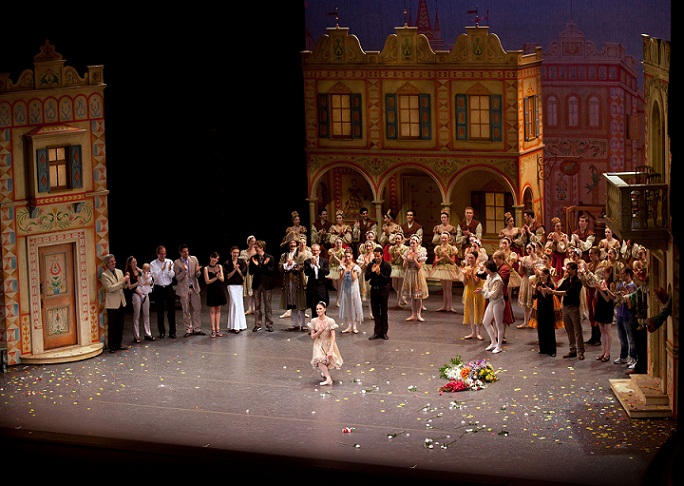
And below, of his curtain calls.


The performance was spectacular but not flawless. Jose danced wonderfully. I’ve personally been more moved by his performances in Romeo and Juliet and Manon, but then I’m more a fan of modern ballet choreographers like MacMillan, than classical ballet. I wish he would have danced one of those as his farewell but I totally understand why he chose Swan Lake – it’s only the quintessential ballet after all πŸ™‚

The best part was Act III, with Gillian as the black swan. It was just amazing feat after amazing feat. I swear I’m pretty sure I saw Gillian put a quintuple pirouette in between her fouettes; there were definitely quadruples in there. I wonder sometimes if Natalia Osipova has not substantially raised the bar for this kind of thing. I feel like everyone’s trying so hard to do as many athletically stunning things as they can. I honestly almost screamed when she threw in the quintuple. Can you imagine someone actually screaming in the audience in the middle of the performance? Glad I managed to hold it in πŸ™‚ Suffice it to say Gillian was definitely a thrill, and Odile is her forte. She did have a tiny stumble toward the end, coming out of the fouette sequence, but I’m not one to care about things like that. I personally care more that a dancer takes chances than plays it so safe she fails to move or wow the audience (as I think I’ve said a few hundred times by now on this blog). Then Jose followed her crazy fouettes with a turn sequence of his own, with more multiple pirouettes thrown in. It also seemed that some of their assisted pirouettes went on for, like, five minutes! At the end of the pdd, the applause went on for quite some time.

I should say, every time Jose did any kind of solo, no matter how small – a few turns, a few jumps, anything – the audience went crazy with applause. As they did when his Siegfried first entered the stage. I thought for a minute the orchestra was going to have to stop the story for him to take a bow, but he kept on going with the action, in character.

So, Julie Kent’s white swan: well, I think she is an absolutely beautiful dancer, and she does things that Sara Mearns and Veronika Part and other ballerinas I love as Odette either can’t or don’t do – like the fast tiny fluttering of the feet that really make her look swan-like, or the super quick changes of the feet between her traveling passees that make it look like she is really a swan about to take off in flight. Her legs and feet are super strong and she can attain really surprising speed and precision at certain points. And I was sitting in the back of the orchestra and I could still see that incredible footwork. And yet somehow I’m not nearly as moved by her as by Sara and Veronika. She doesn’t make me feel her pain or take me into her world the way they do. Maybe she’s just not as powerful an actress, although I thought she was very good in Lady of the Camellias. I thought Jose generally partnered Gillian better, which is interesting because she’s a larger ballerina. He lifted Julie high above his head just beautifully, but then there were some moments that the assisted pirouettes that went on forever and a day with Gillian were more problematic with Julie. At one point, Julie veered sharply to one side and I worried she’d fall. But she didn’t.

Still, it was a beautiful performance all in all.

This was my first time seeing David Hallberg as von Rothbart. (You can see him in one of the curtain call photos above, in the purple). He’s a beautiful, beautiful dancer. Seriously, I don’t think any man can dance as beautifully as David Hallberg, and I’ll go to any ballet with him in (with good choreography for him of course), just to see that. But. I like Marcelo Gomes better. I know that’s controversial, and I’ve been thinking a lot about how I’m not really a fan of classical ballet partly because of this (judging by the difference of opinion between myself and my classical ballet-fan friends), but I just don’t like black and white. I prefer sexy, charmingly dangerous von Rothbarts, not pure evil von Rothbarts. And David was evil. The way he masterfully whipped around that purple cape, the way he worked his facial muscles into a hard hard look, the way he approached the queen and each woman at the ball with intention, the way he pointed straight at poor Siegfried when he first arrived with Gillian. He scared the hell out of me. And I guess if you think von Rothbart is pure evil and should be portrayed as such, then there’s no one more perfect than David to dance him. The evil is tempered a bit by David’s beautiful dancing, which made him the second best von Rothbart in my opinion, just because it added a nuance that otherwise wouldn’t have been there. But Marcelo’s v.R.’s sexiness, his irresistible charm, his deviousness, make him so much more deliciously dangerous.

I was a slight bit disappointed in the curtain calls. I think I was spoiled by Julio Bocca’s farewell being my first at ABT. That man was such a prima, his curtain calls went on forever, ending with him in underwear (well, tights), taking his time drinking a beer, then dousing himself with it. Or was it champagne he poured all over himself? (Will have to look back at my old blog post.) Anyway, it was all as if to say, I’ve had a blast here, I’ve worked my arse off, and now I’m so so ready to let loose. This all would have been inappropriate for Jose though, especially since his two daughters came out onstage with him at the end, sharing his bows. So sweet. But yeah, no getting plastered and prancing around in underwear for him. Marcelo, David, and Cory did hoist Jose over their heads, as David and Marcelo did Julio.

A couple ballerinas from the past – Alessandra Ferri, Susan Jaffe – presented him with bouquets. And Julio himself was there as well. He walked out onstage toward Jose doing a hip-shaking little rumba. Almost all the principals were onstage at the end – Paloma Herrera in particular was dressed to the nines, which was sweet since she was one of his main partners. I didn’t see Diana Vishneva or Natalia Osipova or Michele Wiles. I was hoping Carlos Acosta might show, but no such luck.

Jose’s daughters are really beautiful. Afterward some friends and I went to Ed’s Chowder House for drinks and snacks and we were debating whether the older one was his stepdaughter with Lourdes Novoa or biological daughter. Does he have one stepdaughter and two biological daughters or one of each? Anyway, the littlest daughter looks to be a teenager now. She’s really beautiful. But she was just a baby not so long ago. I guess time does go by when you’re not paying attention. The audience didn’t seem to want to say goodbye. Finally, the curtains went down and the lights went on, management making clear it’s over, folks, go home. But people kept standing there kind of dumbfounded.

Well, I’m really going to miss him. I’m going to miss him as Basilio in Don Quixote, I’m going to miss him as both the harem owner and Ali the slave in Le Corsaire (like Marcelo, he’s endearing in every single role he has – how can one be an endearingΒ  harem-owner? I have no idea, but just watch him), I’m going to miss him as Des Grieux in Manon, I’m going to miss him as Albrecht in Giselle (I think he was the only one who still did the Baryshnikovian brisees in his near dance to death scene instead of the entrechats), I’m going to miss his sexy cocky Latin sailor in Robbins’ Fancy Free, I’m going to miss his sexy cocky leading man in Tharp’s Sinatra Suites, and most of all I’m going to miss his Romeo. In most recent years, he’s been the oldest dancer in that role, and somehow the most boyish, the most innocent, the one who’s made me cry the most times at the end in that crypt with his Juliet draped lifelessly over his arms.

Well, I still have memories. And YouTube videos πŸ™‚

Paloma Herrera Celebrates 20 Years with ABT

Photo by Rosalie O’Connor.

On Saturday night, Paloma Herrera celebrated twenty years with ABT. Her celebratory performance was Coppelia, which she danced with Angel Corella, in one of the only performances he’ll be seen in at ABT this season, sadly. I realized how much I missed him Saturday night. He’s got to be one of the most endearing, charming, downright lovable dancers ABT has ever had. I hope he dances more often next year. And he can still deliver, particularly on the turns – the fouettes, and particularly on partnering. He polished off a one-handed lift with Paloma no problem. And he’s not a big guy. “That’s pure technique,” said the critic sitting next to me.

Paloma danced really beautifully too, and I realized Saturday night what a remarkable dancer she is. She did some beautiful balances, seemingly without shaking one iota. And she did an amazing sequence of fouettes where she didn’t bring her non-standing leg all the way around but kept it barely bent and at her side, making those whipping turns so much harder. She got loads of applause. She’s particularly suited to a role like this, and like Kitri in Don Quixote. The pair could easily have danced that one too since they’re pretty much known for DQ. They used to be THE couple at ABT years ago, and now she’s celebrating 20 years with the company and he’s off in Spain starting his own. And all the young ones have taken over πŸ™‚

And the night before I saw two of those young ones: Natalia Osipova and Daniil Simkin (pictures hopefully coming soon!) My friend (who’d seen the Bolshoi’s Nutcracker via Emerging Pictures with me) and I agreed that the Russians can just do those extremely sharp, staccato doll-like movements better than anyone. Of course they just seem to know how to put on a show in general better than anyone. Ballet to them isn’t just about technique and perfect dancing, it’s above all a show.

Anyway, Natalia is superhuman. She really is. No one can jete like her, and I think I’m going to have to include men here. Daniil was absolutely superb in his solos, and he’s known for being a jumper, but I swear when she jumped and he followed her with a jump, hers were higher. I almost fell out of my seat. And her “doll-come-to-life” in the second act – I’ve never seen anyone genuinely look so toy-like. Even the children in the audience were enthralled; you could hear a few actually laughing themselves silly throughout the entire second act. When do small children maintain interest throughout an entire act of a ballet? Maybe the parents were Russians and knew Osipova would pull it off πŸ™‚

Osipova’s definitely not perfect and she was going so fast in a series of spins across stage she had a little stumble on one. But who cares? I’d so much rather someone put everything they have into a performance than play it so safe it just fades away. Seeing Herrera in the role after Osipova made me realize that Osipova’s just always going to do things more stunningly than others (at least for the most part). Not necessarily with better technique or more beautifully but more stunningly. That’s the kind of dancer she is. But that definitely doesn’t mean that no one else has anything to offer.

Anyway, back to Paloma. So, during the bows, each of the principals came up on stage and gave her a bouquet, which was followed by a confetti shower. She and Angel got several curtain calls, not surprisingly. I think all serious, longtime ABT fans miss Angel and their performance together was a bittersweet reminder of this kind of “changing of the guard” that’s going on at ABT. Afterward, I went with a group of friends to Fiorello’s, across from Lincoln Center, for drinks and dessert, and she came in with two people who I assume were her parents and sat down at the booth next to us. Our ballet gossip promptly ended but what a special end to a fabulous evening for us.

THE BRIGHT STREAM at ABT


David Hallberg in Ratmansky’s The Bright Stream, Rosalie O’Connor photo.

I’m not exactly sure yet what to think of this ballet, which made its premiere at American Ballet Theater last week. There are a couple more performances left this week and I think I may see it one or two more times. Right now I kind of feel like the history of the production (as told by Marina Harss in ABT’s Playbill) is more interesting than what I actually saw.

According to Harss, the production was originally choreographed by Fyodor Lopukhov and premiered in Leningrad in 1935. But Stalin hated it so, he banned it, and eventually even sent the man who helped write the libretto to the Gulag. It was the last ballet Dmitri Shostakovich ever composed. Alexei Ratmansky (artistic director of the Bolshoi from 2004-2009) restaged it during his reign there, and the Russians loved it.

With a history like that, you have to wonder what it was that angered Stalin so. I can’t see it.Β  I just see it as a rather silly ballet – kind of reminiscent of Shakespeare’s Midsummer Night Dream but not quite there – that takes place on a collective farm during one harvest season. According to the newspaper Pravda, Harss writes, the producers’ crime was “balletic falsehood,” meaning, she says, it wasn’t a realistic portrayal of what people are like who live on a collective farm. In other words, there was too much silliness, and farmers are serious workers, not goofs. But Ratmansky explains that, in reviving the ballet, he was attracted both to the “lovely, danceable” music and the lightly humorous vaudevillian aspect of the tale, as well as to an underlying darkness, an edge, he found in Shostakovich. “There is always something hidden in Shostakovich,” he says.

To me, that’s fascinating, and is the reason I’m going to need to see it again … and the reason I’m going to need to listen to more Shostakovich.

I think, though, the problem to me may have been more that the Russians have a keener sense of how to put on something like this, where basically every role has bravura parts. I plan to go see the Osipova / Vasiliev / Simkin cast this week to see if I feel differently about it. I saw the third cast – Veronika Part as the main character, Zina (and Part was beautiful, and the one perfect thing I felt about this cast – she was the heart and soul of the ballet), Alexandre Hammoudi as her straying husband, and Cory Stearns and Stella Abrera as the main ballet dancers in the theatrical troupe that comes to town and shakes things up. I liked Cory too. He had the cross-dressing role that David Hallberg is pictured in above and he was very good. He’s a good actor, good with both comedy and romance and has a charming, very stand-0ut stage presence.

Anyway, the plot is rather complicated, and when I expressed that to my friend she laughed and said she’d given up on the synopsis and decided just to enjoy the beautiful music and the humorous dancing. She liked it much better than I did, probably because she decided to stop trying to figure things out and just enjoy… The plot: Zina works as a local amusements organizer. Her husband, Pyotr, has a wandering eye. When a traveling theatrical troupe comes to town to stage a ballet, Zina recognizes the main ballerina – they once took classes together. They dance together, and reminisce — it’s really Zina reminiscing about her dancing past (and Part did this just beautifully) – while Pyotr becomes enchanted with the ballerina. There are also a couple of older, long-married dacha dwellers, who are rather goofy and humorous (danced by past ABT greats Victor Barbee and Martine Van Hamel). The male dacha dweller falls for the ballerina, and the female becomes enamored of the male ballet dancer. When it becomes clear how attracted to the ballerina Pyotr has become, Zina begins to cry. The ballerina calms her, promises her she has no intentions of returning his affections, and suggests they all play a trick on the married dacha dwellers and on Pyotr whereby she will dress as the male ballet dancer and the male ballet dancer will dress as her. So, that’s why the whole cross-dressing thing happens. There are many subplots as well, one involving a milk maid and her companion, a handsome tractor driver (who decides to dress as a dog), but this theme of married man falling for someone who is not his wife, then realizing how much he does value her, is the main theme of the ballet.

It was pretty funny to see Cory Stearns try to dance on pointe, but funnier to watch his character get carried away with the spread-legged, very masculine-looking jumps in that white sylph dress. He and the ballerina are, after all, ultimate hams in need of audience applause, so it makes sense that he forgets himself for a time and starts really acting like a man. I really wonder how David Hallberg does that part – and that makes me want to see his cast as well. Stella Abrera was fine as the ballerina, and mildly funny when she becomes a boy, but she’s not as spectacular of a dancer as, for example, Natalia Osipova, and I’d think that role should go to an allegro dancer like her. I imagine Osipova must be absolutely perfect in that role (since she can do mind-blowingly crazy high jetes better than many men).

Alexandre Hammoudi did well as Pyotr, though there didn’t seem to be a whole lot to that role, which makes me curious to see Marcelo Gomes and Ivan Vasiliev in the part.

I feel like, because the story-line is so slight, and because, as I said earlier, practically every role has some bravura parts, that this is a ballet that needs really spectacular dancing, that needs people cast in every part who are the kind of dancers who are constantly saying, “Hey, look at me, I can jete to the ceiling!” or “I can develope over my head!” or whatnot. And ABT dancers just aren’t trained to be that way – at least most of them aren’t.

One other gripe is the costumes, particularly for the men. The blasted pants. The mens’ lines were clumsy and unfinished and I think it was because the pants were too restrictive. It’s unusual that every single man would be unable to do a proper straight-legged jete or lift his leg more than a couple inches off the ground in arabesque – especially Gennadi Savliev, who always comes through on the stunning athletics. It had to be the pants. I understand why Ratmansky wanted to set the period with the costumes, but as with classical ballets, can’t the tops be the period-setters and the bottoms just be regular tights? Ballet is all about form!

Did anyone see the other casts yet?

Photos of ABT’s New Nutcracker

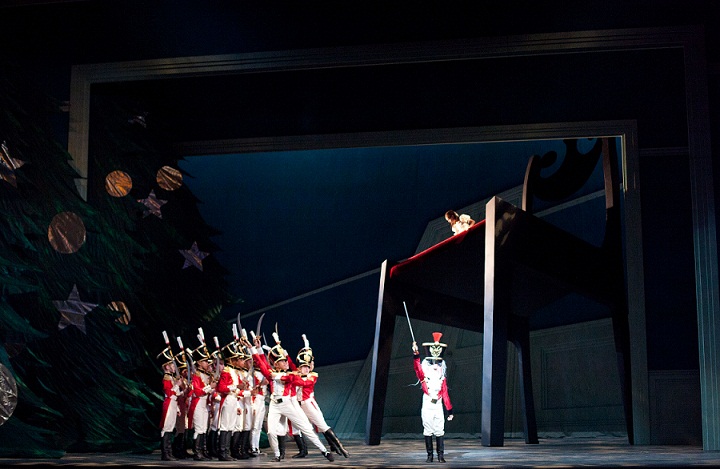
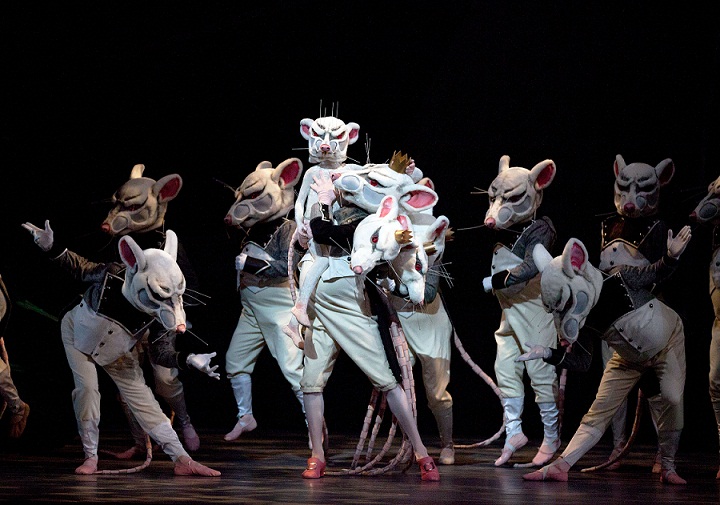
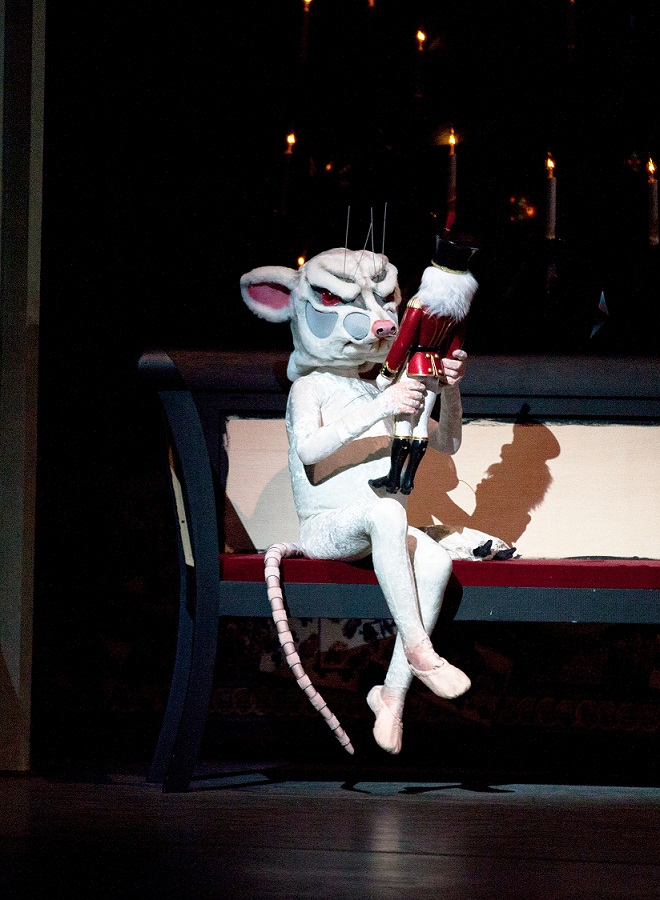
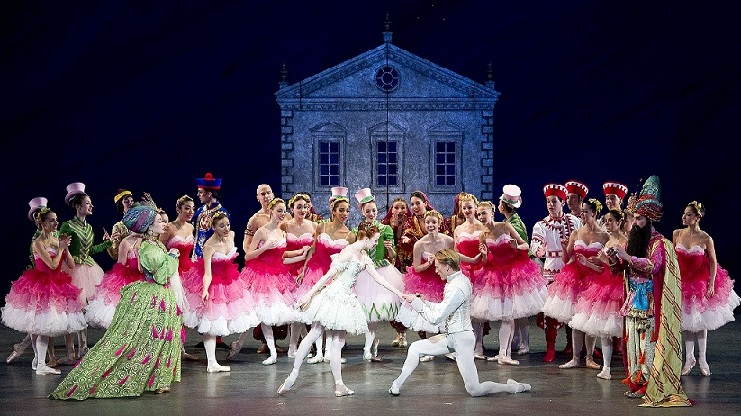
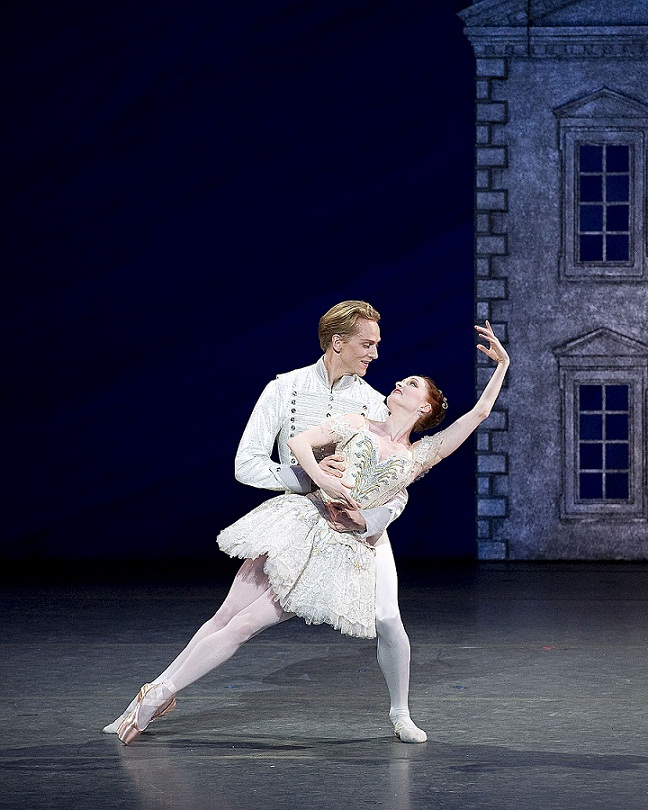
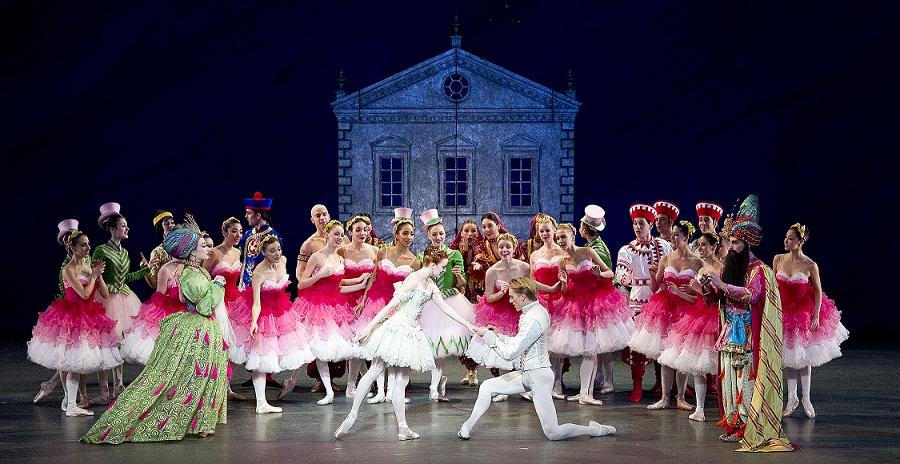
As promised, here are some photos of Ratmansky’s new Nutcracker for ABT.

I forgot to mention in my last post how much I loved the Alice in Wonderland-like high chair for Clara to sit atop to watch the mice / nutcracker & soldier battle scene. Really brilliant sets. Richard Hudson is a genius.

The battle scene and the many-headed mouse king.

The mischievous little mouse (Justin Souriau-Levine) holds the nutcracker doll.


David Hallberg and Gillian Murphy as the Nutcracker Prince and grown-up Clara. I forgot to mention that they do get married in this version.

David and Gillian in the final pas de deux.

Top four photos byΒ  Rosalie O’Connor; bottom two by Gene Schiavone, courtesy of ABT.

MY FRIEND TAYLOR GORDON IN THE NEW YORK TIMES


There’s an interactive feature with my friend, dancer Taylor Gordon, in the New York Times today. She talks about her career as a freelance ballet dancer – from performing in Radio City Music Hall’s Christmas Spectacular to taking extra work in ABT Met season productions, to venturing into jazz and contemporary roles. Yay Taylor!

And here is the full article by Claudia La Rocco.

Photo above by Rosalie O’Connor, taken from Explore Dance.

DAY OF SLEEPING BEAUTIES: ALINA COJOCARU AND NATALIA OSIPOVA


Alina Cojocaru and Jose Carreno in Sleeping Beauty, photo by Gene Schiavone. (My favorite pose in all of life – no hands fish dive πŸ™‚ )


And Natalia Osipova and David Hallberg as Aurora and Prince Desire, photo by Rosalie O’Connor.

So, I spent another Saturday at Lincoln Center, watching back-to-back Sleeping Beauties. This is probably my least favorite ballet — neither the story nor the choreography really speaks to me – but I was curious to see Alina Cojocaru in the role (it’s supposed to be her best and she’s was guesting for only one day from the Royal Ballet in London), and now that I’m an official Natalia Osipova fanatic, I must see her in everything she’s in.

So, matinee was Cojocaru. I thought overall she was really lovely and did as much as she could with what to me is a bland role. She was fresh, girlish and inquisitive in the first part when she’s meeting all the cavaliers and before she pricks her finger, then is more beatific and ethereal in the vision scene (where Prince Desire, out hunting, envisions her and then is led by the Lilac Fairy to her bed where he’ll kiss and awaken her – I don’t know how many people know the ballet), and then is full of grown-up, sophisticated charm in the third part when she marries the prince. A lot of ballerinas don’t really distinguish between the various stages of the ballet – their Auroras are the same throughout, so I liked that Cojocaru did this.

I just have to say, I’m sorry but for the first part of the Rose Adagio (where four cavaliers present her with roses, at the beginning) I couldn’t stop focusing on her feet.

Continue reading “DAY OF SLEEPING BEAUTIES: ALINA COJOCARU AND NATALIA OSIPOVA”

CORELLA BALLET OPENING NIGHT NYC


Photos top to bottom: Angel and Carmen Corella in Solea, Herman Cornejo and Adiarys Almeida in Sunny Duet, and Corella Ballet cast in Christopher Wheeldon’s DGV. All photos by Rosalie O’Connor.

Last night Corella Ballet Castilla Y Leon made their U.S. debut. It was one of the best evenings I’ve had at the ballet since ABT ended their Met season last July. Angel Corella (beloved ABT principal and founder of this company) is known of course for his bravura dancing, his ability to form a character on the stage even in the few storyless ballets ABT does, his passion, his charisma, his sweetness, his charm, but mostly of course his virtuosity. And even though he himself only danced in two pieces last night (with only a small duet in the Wheeldon), the whole evening had that same overall brilliance. It’s like he managed to find a company of dancers exactly like himself. I don’t know how he did that because I thought there was only one of him, but even the corps members seemed to have all of those qualities.

The night began with Angel’s own String Sextet, his first piece of choreography, set to Tchaikovsky’s String Sextet “Souvenir of Florence.” It was very allegro, very fast-paced, with lots of brilliant partnering — a ballerina would spin at lightning speed into her partner, they’d go into assisted pirouettes or a supported arabesque penchee (with the ballerina’s legs always in a perfect split), another would jump into her partner’s arms and he’d catch her in a variety of positions. Kazuko Omori and Yevgen Uzlenkov completely blew me away, as did all of the couples but those two in particular. It’s like, where did he find these people and how did I not know they existed?! Omori is a brilliant allegro dancer but she also had the qualities of an adagio ballerina, with lots of expression in her upper body. Then, in the third movement, Joseph Gatti blew everyone away with his bravura, Angel-esque solo replete with jetes and fouettes and crazy high tornado jumps. The crowd went wild for him, as expected. Both the duets and solos and the ensemble parts were equally captivating. Toward the end everyone did a fish dive in unison and it’s so sweet. It was like all the best parts of classical ballet — or at least my favorites πŸ™‚

Next was Walpurgisnacht, by Leonid Lavrovsky, which reminded me of the Corsaire pas de trois between Ali the slave, Conrad the pirate, and ballerina. Again the beautifully expressive, lightning-footed Omori and high jumping Gatti starred, and the stunning Kirill Radev danced the part that reminded me of Conrad. He had this series of scissor jumps but the splits were forward-facing, straddle position, rather than long-wise, like usual. And then he’d do these multiple pirouettes with these seemingly impossible held-out endings. The crowd was nearly screaming with applause, which doesn’t often happen in New York.

Then was Sunny Duet, from 1973, by Vladimir Vasiliov and Natalia Kasatkina, danced by our Herman Cornejo and Adiarys Almeida. Everyone applauded for Herman when he took the stage πŸ™‚ This ballet was sweetly romantic, like man in adoration of his woman, with Arabian / Bayaderesque styling. Herman really blew me away last night with his partnering. The pdd began with this extended overhead lift where he looked up at her for what seemed to be minutes, in the end making it into a single-handed lift. I’ve always thought he was a brilliant soloist but that he had some trouble in the partnering, but not last night! He was also very dramatic, and, at one point, where they go into their bravura solos, he played off of her, giving her this “oh yeah, well this is how I feel!” look before doing a bunch of crazy turns or jumps. The original, archived music, by Arno Babajanyan, was played on tape. There was a note in the program stating, “The company is committed to the revival of worthy pieces that have had an important influence on classical ballet. The piece will be performed as it was originally created by the legendary Russian choreographers Natalia Kasatkina and Vladimir Vasiliov. The artists will be performing to Arno Babajanian’s archival recording, as this specially commissioned score no longer exists.”

Next was Solea, choreographed by Flamenco dancer and choreographer Maria Pages, and performed by Angel and his sister Carmen. I was happy to see Carmen back onstage; I was sad when she left ABT. This was an absolutely beautiful combination of ballet and Flamenco, though I often see Paso Doble in what people call Flamenco, being a ballroom person — still not sure of the difference… For example, at one point, they would come at each other, she swirling her long skirt about, cape-like, he coming at her like a matador — that’s Paso — but instead of rushing toward each other, hips thrust forward, they’d do chaine spins — she on pointe, spinning right past each other, balletically. Then they’d approach each other again, she’d retreat quickly back with supercharged bourrees. I love it! I’ve always wanted to see a Paso Ballet, but most ballroom dancers don’t seem to know how to choreograph such a thing, even if they have extensive ballet background. Then, during the Flamenco taps (which you can hear in the recorded music), Angel would do his trademark lightning fast fouettes, or else entrechats, or just crazy fast footwork; and she’d do the same on pointe. Flamenco taps on pointe! And each of them had the perfect Flamenco styling. And there was a kind of back and forth “competition”, which I guess is called “Bulerias” in the world of Flamenco, which was kind of like a set of “variations” or solos in ballet, with him doing the trademark jetes around the perimeter of the stage and she responding with her own thing. And at the end, they came together and she stood behind him and he wrapped her arms around him. Sweet. Audience gave them a standing ovation.

Last was Christopher Wheeldon’s DGV: Danse a Grand Vitesse, which was I think the most intense, spellbinding Wheeldon ballet I’ve ever seen. It was premiered in 2006 by the Royal Ballet and was nominated for an Olivier Award. Set to music by Michael Nyman, which was commissioned by the French railway company TGV in 1993 to commemorate their opening of a new high-speed train line, there were several large pieces of twisted metal in the background — between which the dancers would weave in and out from time to time. The music had a very “locomotive” rhythm to it and the whole thing — both music and movement — had a kind of eerie feel to it. Movement was trademark Wheeldon — very modern, lots of angularity, sharp jagged lines, unique partnering. Women were often carried overhead and upside down with their legs in a split or sideways with their knees bent outward and toes together, creating an intentionally awkward shape. At times the music would stop completely while the dancing continued — creating some of the most intense moments. This is the first time the piece has been performed outside of the Royal, the program notes say, and, with its intensity, it was a perfect choice for this company.

So, the evening was a celebration of classical ballet, fusing classical ballet with traditional Spanish dance, and contemporary ballet, which seems to be what this company is about. Excellently done!

There’s one other piece on the program, Epimetheus, which will show Saturday afternoon. It’s by a young choreographer / dancer with the company, Russell Ducker. Will report back as soon as I’ve seen it!

MORE ON AMERICAN BALLET THEATER’S AVERY FISHER SEASON


Daniil Simkin and cast in Benjamin Millepied’s Everything Doesn’t Happen at Once in Gene Schiavone photo, courtesy of ABT; all photos by Gene Schiavone (except for Arron Scott headshot below and bottom picture).

Just to let people know, as the photos shows above, the guy who was flinging himself into the group lifts in the first cast of the Millepied was Daniil Simkin; in the second cast it was Arron Scott (below). The program notes only gave a special mention to the two dancers doing the pas de deux and a lot of people were asking who the main soloist was.


Anyway, here are a few more reviews:

Here is James Wolcott on opening night gala (and our fab Shun Lee dinner afterward πŸ™‚ ), here is Apollinaire Scherr’s FT review; and here are more of Apollinaire’s thoughts on her blog, Foot in Mouth. I’m surprised there aren’t more reviews — this was a pretty big season, with three world premieres — but that’s all I can find at the moment. (Update: Robert Greskovic’s WSJ review just went up; thanks to Meg for letting me know.)

Re the Wolcott write-up: I forgot to mention the models — Iman and Veronica Webb, who, instead of A.D. Kevin McKenzie, thanked the gala sponsors and introduced the program — screwing up Benjamin Millepied’s name. It wouldn’t have been such a big deal if they wouldn’t have been so giggly over it. It seemed like they were reading their notes for the first time and were really unprepared. I really don’t know how to pronounce his name either — I’ve always said the last two syllables to rhyme with plie (without the “l”) but have been told that’s wrong. But damn did ABT get a lot of press for signing them on. Just Google “ABT Fall 2009 Season” and it’s all about Iman.


(Gillian Murphy, Cory Stearns and Eric Tamm in Aszure Barton’s One of Three)

Anyway, I saw four of the six programs, saw the Ratmansky and the Millepied ballets four times and the Barton three, and they each grew on me the more I saw them. The Saturday matinee was my last performance and I found it by far the best. I felt like the dancers were finally comfortable with the new dances, knew what they were all about, and really made them meaningful. I described the ballets here.

Oh and regarding SanderO’s comment on that earlier post: yes, I do need to see the story in the dance. The dancer and choreographer won’t pull me in at all if they don’t each tell me some sort of story. That doesn’t mean the ballet has to be a traditional full-length dramatic novel or something with a clearly defined beginning, middle, and end, inciting incident, rising action with crises 1,2, and 3, climax and resolution, etc etc. but there needs to be some kind of story; there needs to be some intention in the abstraction. A lot of critics use the word “evocative” — a dance needs to be evocative of something, and I just mean the same thing. If there isn’t something meaningful going on, there’s no reason for me to see it. I can appreciate the neat geometric patterns and pretty images, but that’s not enough to make me go.

Anyway, I saw more in Millepied’s Everything Doesn’t Happen at Once on further viewings. At first I thought it was kind of everything but the kitchen sink the way Apollinaire kind of describes, but after several viewings I saw more of an evolutionary, battle of the sexes theme throughout, which becomes a more literal battle by the end. The piece starts with the stage looking swimming-pool like with the dancers making broad strokes with their arms. The stage gets over-crowded and eventually someone in charge — looking rather conductor-like, kind of throws his arms up and dismisses everyone.

Then, there’s a pas de trois (two men one woman), which becomes a double pas de trois (same), which turns into the central pas de deux (man-woman). Throughout there seems to be struggle going on — in the pas de trois the men kind of manipulate the woman around, until she’s practically on her side. In the central pas de deux is in places tender, in places more angsty as if the girl is trying to get away from the guy or fight him in some way, and he is struggling to hang onto her.

By the end, the scene has evolved into a kind of battlefield with marching music and the ballerinas doing those Balanchinian marches en pointe. Except they’re more unsettling than cutesy, like in Balanchine. This is the part where Daniil / Arron gets tossed into the crowd, throws himself with wild abandon at the groups of men, who catch him mid-split, then gets caught up with a bunch of grabbing girls.

Interestingly, the audience laughed when this role was danced by Simkin — I think because he is small and a bit long-haired and it kind of looked like he was afraid he’d be taken for one of them and was trying like hell to assert his masculinity. (I think it would have worked better had the girls been chasing him and then he flings himself into the groups of guys rather than the other way around, but not a big deal).

But no one laughed when it was Arron. It looked far more serious with him in the role — it looked like he was practically getting raped by that rabid group of girls.

Also I noticed with Arron that after the rabid group of girls leaves him alone, he kind of internalized the tauning; there was now an invisible fist punching him all about. It really looked like he was getting beaten up by that thing. But the fist was invisible so it was like he’d been driven mad. It was very unsettling, and I think, with the music and the rest of the action, this feeling is more of what Millepied was going for — not all the high air flips, crazy long spins, and windmill jumps that Simkin is known for and did here. Simkin’s character made the end of the ballet more playful than battle-like.

There’s also a short section where there’s all this marching music and there’s more centerstage chaos with all 24 dancers out there at once and suddenly a group of dancers standing at one corner break into partners and go waltzing through the crowd. But it’s really short-lived, like even courtship is a battle.

I don’t know — that’s what I saw on further inspection. But I could be making it all up. It’s kind of fun with abstract ballets (the ones that have a lot going on in them anyway) to make up your own story. I mean, the way dances get made anyway, as I learned at a Guggenheim event last night featuring ABT’s efforts to adapt ballets to different stages (including this small one in AF Hall, meant for concerts), is that things get changed depending on space, depending on the logistics of the stage, depending on dancers. Whoever knows if the end product is what the choreographer originally had in mind anyway.

I don’t think Millepied’s was a perfect ballet — I found a lot of the bird-like patterns from his recent NYCB ballet, Quasi Una Fantasia, to be out of place here – he didn’t need all that; he should have focused more on the battle — but I found his the darkest, the most thematically clear and the most absorbing.


Stella Abrera and Gennadi Saveliev in Alexei Ratmansky’s Seven Sonatas.

The Ratmansky grew on me, as did the Barton. On the last day, Michele Wiles danced the main female character (in the long white ballgown) in the Barton and I loved her. She gave the character a real story. When she comes out onstage she is all bitchy and glamorous, but Michele it’s really an act; she is seeking attention from the main man (in that cast Blaine Hoven) while trying to maintain her haughty demeanor so as not to be shown up by him if he dismisses her. At one point, she extends her arm out to him, as if he’s supposed to kiss it but he turns and runs offstage. She crumbles. It’s heartbreaking.

I also really loved Craig Salstein, Jared Matthews and Daniil Simkin in Barton’s second cast (Matthews and Simkin alternated parts opposite Salstein). They danced a section in the second part and all three made it clear (Salstein most so) that they were in a little competition for the girl’s attention. The girl (Luciana Paris), meanwhile, was just dancing on her own, in her own world, paying them no mind at all. It was hilarious.

But back to Michele Wiles for a minute: a wonderful ABT patron gave me her ticket for a company class, which she couldn’t attend, and Michele seemed so sweet — smiling out and waving at people during the class and even during warm-up.

Also, can some choreographer please please please create a little solo or some kind of dance just for Gillian Murphy! Please! During that company class, during the center floor work when the dancers divided into groups and did turns in a diagonal down the center, Gillian blew everyone completely away. She was like a tornado. But a technically perfect tornado! Everyone in my section literally began to laugh and shake their heads in amazement. She needs something to showcase her technical brilliance and athletic prowess. C’mon ABT!

Each of the dancers brought their own special thing to the Ratmansky. Christine Shevchenko (an up and coming corps member) was gorgeous with the role created by Julie Kent (danced opposite David Hallberg). She was more lyrical than Julie, with flowing, expressive arms that resembled Natalia Makarova in Other Dances. Julie’s arms were more staccato. Hee Seo, who completely blew me away as well, did a combination of the two — by turns feathery and lyrical, and modern and staccato. Alexandre Hammoudi and Jared Matthews both danced David’s original part and they were very different than David. Both connected with their ballerinas much more — when they were left alone onstage they clearly looked about for her, wondering where she was, then accepting they were alone and falling into their solo.

David Hallberg. I can never get enough David Hallberg. He didn’t look around for his ballerina when she left him, but when she returned to the stage, he danced well with her. But when she was offstage, she was out of sight, out of mind with him — he was too busy making Ratmansky’s movement wholly his own. He seems to be a rapidly maturing artist, playing with the music, playing with rhythm, giving some things more emphasis than others. When I first saw him dance this role I thought his “character’s” movement was more modern than classical, but I think that was just because of the way he did one section where he keeps pushing out with his hands, like he’s stopping the air, or stopping something from getting too close. He slowed down that movement a lot, really emphasizing the arms, and then did some ensuing footwork at the speed of light, whereas the others did everything in equal measures -so it didn’t have the same look.


Jared Matthews and Maria Riccetto in Some Assembly Required, photo by Rosalie O’Connor.

ABT also put on Clark Tippet’s Some Assembly Required from 1989, a male-female pas de deux evoking a lovers’ quarral replete with difficult-looking angst-filled lifts, struggling pushes and pulls, then more tender making up. It went on a bit too long; some middle parts that were repetitive could have been taken out, but the cast I saw — Jared Matthews and Maria Riccetto did very well with it. Jared is dancing and dramatizing better than ever before, imo.

And the company also did Robbins’ Other Dances, another male-female pas de deux (this one pretty famous) that was choreographed on Baryshnikov and Makarova. I saw both casts — Marcelo Gomes and Veronika Part, and David Hallberg and Gillian Murphy. I liked both — although I think I honestly prefer Tiler Peck and Gonzalo Garcia’s at NYCB. Gonzalo has a smaller body, more like Baryshnikov’s, and I think some of the gestures — like the placing the hand behind the head, kind of primping, looked sweetest on him. Ditto for Tiler. David is dancing very aggressively these days. He’s making the absolute most of every movement — it can be stunning at times, and at times it seems a bit overdone, which it seemed to me a tad here.

I also think that joke on the Kirov dancers getting dizzy and losing their footing because they don’t spot-turn doesn’t come across as such to new audiences. When Marcelo and Gonzalo did it, many in the audience honestly thought the dancers screwed up for real, not on purpose. David really didn’t do the joke because he’s a cheat πŸ™‚ I’m kidding — he did, but he spun, stopped, got dizzy, shook himself out of it, and started the next phrase all in the blink of an eye, so you didn’t even notice he “got lost.”

Gillian was good but it didn’t seem to be a dance that showcased her talents to their fullest. I’ll say it again — I really think she is the most athletic and technically one of the best female dancers in the world and she desperately needs more roles that prove that!

FALL FOR DANCE 2009


It’s September — happy September everyone — and for New Yorkers that means Fall For Dance is just around the corner. Tickets go on sale 11 a.m. September 13th, so time to get thinking about what all you want to see. For people unfamiliar with this festival (which this year takes place from September 22 – October 3), three to four companies perform each night and tickets are only $10 a piece per night. A great opportunity for first-time dance-goers. Tix sell out out at the speed of light, though, so have your computer turned on and your browser pointing here by above said time on above said date.

In celebration of the centennial of Ballets Russes, many of the participating companies are performing BR classics like Nijinsky’s Afternoon of a Faun and Fokine’s Dying Swan and Spectre de la Rose. There are also several lectures in the City Center studio centered around BR and its influence today. Go here for the schedule and more info.


CRAIG SALSTEIN TO THE RESCUE


So last night I went to Christopher Wheeldon’s Morphoses at Central Park’s SummerStage, who were performing to live music by Martha Wainwright. Of course I would have gone no matter, but hearing that my favorite, Marcelo Gomes, was guest-performing with the company, made it all the more urgent.

Anyway, Morphoses events are often very well-attended and there was a bit of a mix-up with my tickets — they’d issued me a guest, rather than press pass and so my friend and I got ousted from the section up front. I understand these things happen, especially with very popular dance companies and it wouldn’t have been a big deal if I could see well at long distances at night (and if I hadn’t helped others get in whose tickets weren’t mixed up….) But whatever, I could deal I thought, even though I felt like a total loser.

So, my friend and I walked to the back dejectedly. But, then, when we got all the way to the back, it ended up our tickets weren’t for the reserved risers but for the skybox, a tent-covered, elevated section that put us far above the standing crowd. And in that elevated section, sat (among others) ABT soloist and one of my favorite dancers, Craig Salstein! He was sitting next to a really cute dancer-looking guy who turned out to be Marcelo’s bf πŸ˜€ Then a waitress came by serving us free wine and I knew this was THE place to be, not down there on the ground with those earthlings! I still couldn’t see tremendously well, but I can always see Marcelo from wherever I am and I kind of felt better being with the ABT peeps anyway.

So my friend Susan and I ended up chatting with Craig and Marcelo’s friend throughout the show and they are the sweetest guys! Craig seemed so different than he is onstage! For people who don’t know him, he’s the type of dancer who always gets the bravura roles that require a big personality, and very good acting (not to mention dance) skills, like Mercutio in R&J and the bespectacled nerdy guy who can nevertheless dance up a storm in Taylor’s Company B, and the poor guy who gets girls tossed at him from every which way in Tharp’s Baker’s Dozen, etc. etc. So because he has such a way with comedy I expected him to be cracking jokes every five seconds and acting all clownish and all. But he wasn’t like that at all – -he was really serious and calm, albeit gregarious and easy to talk to. I told my friends, who I went out with afterward, the same and one said, “well, he can’t be Mercutio ALL the time; he’d go crazy.” True.

He’d just got back from vacation (in Italy, where he saw “Roberto Bolle and Friends” — hmmm, didn’t know there was a “Roberto Bolle and Friends”!), and was sporting a serious tan. We talked about ABT’s upcoming season at Avery Fisher Hall and Italy and his choreography and how much I liked it and how great Marcelo is and what I tweet about (you, tossing your mandolin into the wings instead of Jared Matthews’s hands during R&J I said; he seemed bemused) and other chit-chat. Fun fun fun to meet a favorite dancer and another favorite’s boyfriend πŸ™‚

Okay, I’m running off to another Morphoses performance today and have to get going but will write about the actual show tonight or tomorrow morning. Obviously Marcelo was god, Martha Wainwright was good but to me it was too much about her — too much music, almost a music performance with some dancing thrown in — highlights were Edwaard Liang’s premiere and Wheeldon’s Fools’ Paradise (which I saw anew thanks to Marcelo), Tiler Peck, Gonzalo Garcia, a duet between Maria Kowroski and Jared Angle, Wendy Whelan, Rory Hohenstein, a funny joke by Wainwright about lying down and having people do things to her and Wheeldon’s somewhat embarrassed response, and did I mention Marcelo Gomes…