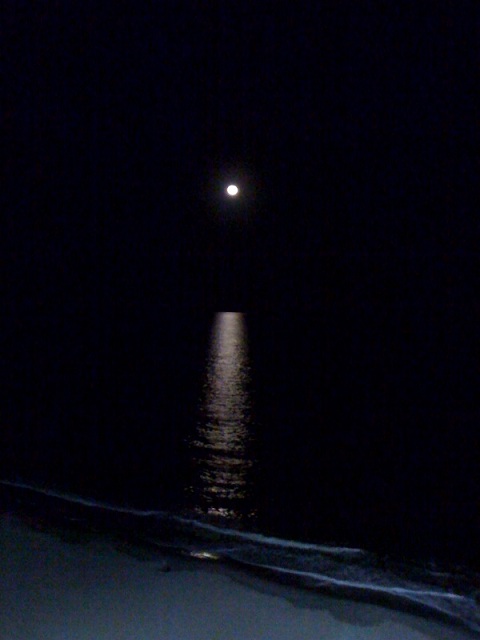
Moonlight on the Beach

Happy President’s Day everyone! I’m spending the week in South Carolina at my cousin’s timeshare – I needed a few days away from New York and the ocean isย  my favorite place. (If I ever have money, I’m definitely buying a beach house somewhere.ย  I could never be one of those New Yorkers who buys a country home up in the mountains. I don’t understand those people. Who wants to risk a run-in with a bear or coyote or jaguar? Not to mention deal with permanently cold temperatures…) Anyway, the light from last night’s full moon on the ocean was gorgeous. My iPhone is not so good at taking pictures at night, so you’ll have to take my word for it ๐Ÿ™‚

The condo’s wireless connection is a bit off and on, plus, it’s unexpectedly nice weather here – 71 degrees today, plus I’m supposed to be working on my novel, so I don’t know how much time I’ll have to blog. But here are a few items of interest:

Roberto Bolle makes his Hollywood debut;

John Epperson talks about his role as “Jaded Piano Player” in Black Swan; and

Our friend Benjamin Millepied is now getting hounded by the tabloids for working too hard and not paying enough attention to Ms. Portman

Also, here are some photos I just received of the magnificent Sara Mearns debuting as the Siren (opposite Sean Suozzi) in Balanchine’s Prodigal Son a couple weeks ago at NYCB:


Finally, if you haven’t seen Natalia Osipova dance yet, next Sunday, March 6th, will be your chance. She’ll be dancing Kitri in Don Quixote with the Bolshoi, in a performance that will be live-streamed direct from Moscow via Emerging Pictures’ Ballet in Cinema series. NY performance time is 11:00 a.m., at the Manhattan Big Theater, and she’ll be dancing opposite Ivan Vasliev. This is the role that made her famous, and she owns it, so try not to miss it if it’s showing at a theater near you. Check Emerging Pictures’ website for times and locations.

Okay, that’s all for now. Happy holiday everyone!

Sara Mearns Was Gorgeous in Swan Lake, But Overall Production Was Lacking


Last week was Sara Mearns week for me (well, for many New York ballet fans, I suspect). On Tuesday night, she made her debut as the Siren in NYCB’s Prodigal Son. (I’m still awaiting photos and will post as soon as I receive them!) Sean Suozzi danced the lead role. He did very well, but she just always stands out to me whatever she is in – particularly the story ballets. She was the best, most tantalizing, sinister, seductive, all around captivating Siren I’ve ever seen. The way she whipped that cape in between her legs, wrapping it around each one, the way she’d bend her knees slowly into a second-position plie while on point, basically squatting over the son’s head in a suggestive but also sinister manner, the way she’d raise her hand behind her head with the wrist bent and the fingers splayed to indicate her triumph over the son’s will, even just the way she’d walk out onstage on pointe, tiptoeing all around him – everything, every movement was in service of the character and was an integral part of the character’s story. I often feel like I’m seeing steps with other dancers. Just steps. The pas de deux between the son and the siren contains some of Balanchine’s oddest-looking choreography- especially those lifts – ‘here, stand on my knees, wrap your legs around my neck and let me carry you around like that,’ etc. I imagine it would feel very odd and foreign doing some of that, which of course was the point. It’s supposed to look warped and off-kilter. Everyone has mastered those steps, but to me, Mearns makes it the most deliciously warped. I love her.

Then, on Friday night, the company premiered their Swan Lake (Peter Martins version), and she danced the lead. (Photo above by Paul Kolnik, from Playbill Arts.)

In sum, I loved her; I wasn’t in love with the production. I went with several friends, two of whom don’t regularly go to the ballet, and that seemed to be the consensus. Everyone was excited to see Mearns dance again, but not to see that production. She was wonderful for all the same reasons I’ve written about before – she’s like a Veronika Part to me; she does such a full job of developing character, she brings you so fully into her world, you feel all of her pain with her. But of course she’s also an excellent dancer. She has a way of arching her back so, of working her arms and hands so, of extending her leg so high in arabesque, of extending her line so beautifully and making such full shapes – it’s a cliche, but her adagio / White Swan is just breathtaking. It almost makes you want to cry, and one of my friends did!

But she excels in the Black Swan / allegro role as well – not so much because she can do athletic feats like Gillian Murphy or Natalia Osipova (there were “just” a bizillion fouettes during the pas de deux, not a bizillion fouettes divided by multiple pirouettes and wild swan-like port de bras thrown into it all) but because she can do that all perfectly fine while still making it all about the character. When she does a series of lifts with Jared Angle where she spreads her legs into a straddle split in the air above his head, it’s just so wicked! And even at the beginning of the Black Swan, when she makes her entrance and presents her hand to the queen – it’s clear she’s up to no good. But she also doesn’t overdo it. She’s conniving and sinister but with a sweet face.

But the rest of the production: Jared’s an excellent partner, that’s clear. Mearns was way off her center of gravity in much of the White Swan partnering, and he securely held her balance, freeing her up to make those gorgeous shapes, and to act it all out the way she so brilliantly does. But in his own dancing, he just, like practically all dancers these days, goes for the cliche. It all looks so fake. I don’t believe he’s in love with her, or that he’s ever longing for what he doesn’t have, and that he’s devastated when she leaves him in the end. It’s all her sorrow and longing alone. So the performance was so unbalanced. I wish so much I could see her dance this with Marcelo Gomes, who really brings Prince Siegfried’s internal conflicts to life like no one else.

The other major issue I have with this production is the costumes – the costumes and the sets. I always forget about them until I see the ballet again, and, especially when I go with friends. My friends Friday night really found it hard to look beyond those costumes. For some reason, I kept thinking of the Flinstones, my friend, Marie, called them Jackson Pollack on speed or something to that effect (I haven’t read her review yet but will after I finish this post), and the others we went with just couldn’t stop talking about the brash colors. I remember my friend in the fashion industry saying of the Romeo and Juliet costumes (Per Kirkeby designed sets and costumes for both Martins productions) that the colors needed to be muted; these brash, bright, almost neon colors made the characters look like cartoons. Same with the Swan Lake costumes. Cartoonish is NOT what you want to go for in serious ballets like this.

Also, the RACISM. This is another thing I hate to admit I often forget about until I see the ballet again with a friend, and the friend is horrified at the fact that a black man is playing the evil character. Must von Rothbart always be danced by Albert Evans or Henry Seth? Are we not living in the year 2011? I mean, this is a huge reason why young people are so turned off from the ballet. And none of the very educated critics ever seem to be calling Martins on this. What’s up with that? Seriously? I think once you go to the ballet a lot you begin to forget about these things, you become immune to them. Which is horrible. But really, asking your audience to associate black men with evil is a horrible insult to that – probably very educated – audience.

Another problem here: Faycal Karoui (the conductor) was seriously on speed. He was flying through the first half. The poor dancers couldn’t even express the story. They really had to rush falling in love. If I’d never have seen this ballet before (and there were probably some such people there due to the Natalie Portman film), I don’t know if I would have gotten much out of the White Swan pas de deux. And that’s kind of an important part of this ballet…

All other dancers did well – I particularly liked Ana Sophia Scheller and Anthony Huxley (filling in for Sean Suozzi as Benno) in the first act Pas de Trois, and, in the second act, Abi Stafford and Joaquin DeLuz in the Divertissement Pas de Quatre, and Antonio Carmena in the Neapolitan Dance – but everyone did very well (those were just the ones who stood out to me). Oh and I loved Daniel Ulbricht throughout as the Jester. With his immense skill at jumps and turns – and combo jumping turns – and his comical sensibilities, he is perfect for such a role, as he is for Puck in Midsummer Night’s Dream – my favorite roles for him.

But I have to say, I was floored when none of the other dancers came out and took bows at the end of the production. Why? Whose idea was that? Only Mearns and Angle and Evans took bows. I realize the dancers are all very hard-working and probably needed to get home to get sleep for the next day’s matinee. But this severely cut Mearns’s bow and curtain calls short. It reduced the celebratory aspect of a production well done. Worse, it also really makes it look like none of the other dancers cared about Mearns, and about the production. It made it look like the company is not really a company of dancers who all work together and support each other. I’ve honestly never seen such a thing before. I’ve seen it where dancers who only dance during the first act will take their bows and curtain calls after the first act and not at the end of the whole, but the dancers who danced in the last act always come out for their bows at the end. Anyway, it really stood out to me. What did other people think?

Here is my friend Marie’s write-up.

Janie Taylor Debuts in Millepied’s “Why Am I Not Where You Are” Etc.

I’ve been remiss in my New York City Ballet posts! Last week I saw two programs: one featuring three dances to three different violin concertos – Peter Martins’s Barber Violin Concerto, Robbins’ Opus 19 / The Dreamer, and Balanchine’s Stravinsky Violin Concerto. And the other program was another in the “See the Music” series but was also dedicated to Santiago Calatrava, who designed sets for all three of the ballets performed – Benjamin Millepied’s Why Am I Not Where You Are (pictured above, photo by Paul Kolnik), Christopher Wheeldon’s Estancia (pictured below, photo also by Kolnik), and Mauro Bigonzetti’s Luce Nascosta, all of which premiered last season and which I wrote about here, here, and here.

Calatrava was in the theater, and after encouragement by Peter Martins, he rose and took a bow.

Then, as with the first “See the Music” program, before the performance began, the orchestra pit rose and conductor Faycal Karoui gave a humorous little explanation of various parts of the Thierry Escaich score from Millepied’s Why, the first ballet performed.

These explanations are really interesting to me, I have to say. I only took one classical music class in college and now wish I’d taken more. Karoui talked about how there were four main parts to the score: a waltz, a tango, a disco, and a final climactic part, and he talked about the differences in tempo between them, and between them and a typical waltz, tango, etc.. He also talked about how the ballet has a central male character (danced very well by Sean Suozzi – in top picture, being carried by the group of men), and how you can hear that central character’s theme – or voice – throughout each section of the music. But the voice changes with each section: at first, he’s shy and mysterious (and his voice in the first section is portrayed by a violin solo), then as the orchestra grows sharper and stronger in the second, tango, section, so did the character, etc.

When we got to the “disco” section (it sounded nothing like disco to me but just slightly more mechanical and percussive than the preceding sections), Karoui really began rocking out as he led the orchestra. It was like he was actually dancing in a disco, and I nearly cracked up. I’m not sure if that’s what he normally does down in that pit – if he regularly starts to embody the music literally like that, or if he was just being a goof for the audience. He didn’t seem to be hamming it up at that point, though – oddly – so who knows. Anyway, he is very entertaining and I find his musical explanations very educational as well. What more can you ask than to be both entertained and educated, right?

Anyway, Janie Taylor debuted in the Millepied. She was supposed to have debuted when the ballet did last season but she was out with injury and so Kathryn Morgan had filled in. Character-wise I thought she played it the same as Morgan. Except with Morgan it seemed to have a West Side Story feel to it; with Janie it was darker and more La Valse-like. Both were tragic, but in a different way; Kathryn’s character seemed more innocent. Anyway, this was my second time seeing the ballet and it grew on me. It’s very dramatic, not a dull moment in the whole thing, and you’re really on the edge of your seat, both because of the intensity of the music – maintained throughout each section – and the dramatic story of the poor innocent guy who’s drawn into another world by his enchantment by this ethereal creature, only to get trapped and ultimately destroyed, along with her.

To me, Sara Mearns and Amar Ramasar, with their bravura roles, largely stole the show – I think I remember thinking the same last time. She with those crazy fast chaine turns all around stage that almost make you sickly dizzy, and he with his virtuosic leap sequence – they are kind of the sinister characters, seducing Suozzi but also the audience.

Then came Estancia, and it was my first time seeing Ana Sophia Scheller and Adrian Danchig-Waring (pictured above) in the leads. I’m not a huge fan of this ballet – well, I like the ensemble sections, particularly the dancing and taming of the “horses” – but I nearly fall asleep during the middle, romance part, where city boy wins country girl over. I think it’s just the choreography in that middle section (that I found relatively bland) that slows it down – along with the music – but I liked Scheller and Danchig-Waring just as much as the first pair of leads – Tiler Peck and Tyler Angle. In fact, they seemed to fit the roles a bit more. Scheller reminded me of the main character of Agnes de Mille’s Rodeo and there was something more sweetly, playfully tomboyish about her look than Peck’s. And Danchig-Waring perfectly suited the city boy trying to woo her. He acted his part very well. And his movement is always very sharp. Andrew Veyette and Georgina Pazcoquin as the horses who are eventually tamed, were fabulously entertaining.

And lastly was Bigonzetti’s Luce Nascosta (picture at left by Kolnik), which I’ve seen now three times and which I like but think is too long. I missed seeing Craig Hall in the middle section that seems to be softer and looser than the other sections, where the movement is more marked by those extreme shapes with the flexed hands, splayed fingers, and angular balances and slides on pointe. Hall seems to have the ability to move in a more undulating, kind of serpentine way than most of the others and it seems to me to suit that middle section well.

In the previous program, I loved Megan Fairchild again as the “modern” dancer in Barber Violin Concerto, and, as always, Gonzalo Garcia as “the dreamer” in Robbins’ Opus 19!

WAYNE MCGREGOR’S OUTLIER


Some photos of the new ballet, which premiered last Friday at NYCB, by Paul Kolnik. Top is of Wendy Whelan and Craig Hall, bottom is of cast with Gonzalo Garcia and Sterling Hyltin front and center.

I liked Outlier if mainly because it provided something different for New York audiences, and the dancers seemed to love dancing it, perhaps to be challenged by a different movement vocabulary. Music was to Thomas Ades and was generally sharp and made for an unsettling vibe, which the movement complemented. Cast was all principles: in addition to Hyltin, Garcia, Whelan, and Hall, there were Ashley Bouder, Maria Kowroski, Tiler Peck, Adrian Danchig-Waring, Joaquin De Luz, Robert Fairchild, and Amar Ramasar. Dancers mainly danced in male / female pairs and movement was intentionally awkward, with lots of sharp, angular lines,ย  jutting, hyper-extended limbs, at times rubbery-looking as a foot would go from pointed to flexed in a split second, and there were lots of kind of sliding motions in the upper body, which is uncharacteristic of ballet – classical anyway. The whole thing felt alien, ominous, something seriously awry.

Maria Kowroski, Wendy Whelan, and Robert Fairchild shone, as I think they have the bodies most suited to this kind of movement. The audience gasped audibly and some laughed in astonishment when, at one point, Maria Kowroski did an arabesque penchee with her lifted leg in attitude and she swung her leg up so fast and with such force (intentionally) that she looked like she was completely jointless. Then she wrapped her bent knee around her partner’s head — I think it was Amar but can’t remember for sure. She looked like a spider. And Robert Fairchild is really becoming one of the greatest male dancers around – at least that I know of. He can do anything and with such precision, not to mention massive amounts of stage presence.

Lighting (by Lucy Carter) was really cool as well, starting out a bright red, with an almost kaleidoscopic image on the back wall,then turning cream-colored and solid, and creating at times rather ominous shadows that highlighted the bizarre movement.

My main problem with the whole was that it didn’t really seem to go anywhere. A story never seemed to take hold and the movement and overall feeling you had remained the same throughout. Maybe I just need to see it again though.

Outlier was shown with two other, completely different ballets – Balanchine’s beautiful Serenade in which Kaitlyn Gilliland really moved me, and his Cortege Hongrois, with Sara Mearns dancing the part of the classical ballerina to splendid perfection with the very capable Jonathan Stafford as her partner, and Sean Suozzi and Rebecca Krohn ever entertaining as the Hungarian folk dancing duo.

NEW YORK CITY BALLET OPENING NIGHT GALA: NAMOUNA AND WHY AM I NOT WHERE YOU ARE


All photos by Paul Kolnik. Top two are of Benjamin Millepied’s new Why am I not where you are, and bottom two are from Alexei Ratmansky’s new Namouna: A Grand Divertissement.


Sorry I’m late with this post — I had serious internet problems over the weekend and they’d better not continue today or I may kill someone from Time Warner. Anyway, Thursday night was the opening night of New York City Ballet’s Spring / Summer season, and there were two world premieres: first Millepied’s Why am I not where you are, followed by Ratmansky’s Namouna, A Grand Divertissement.ย  I thought both were good and entertaining, if nothing earth shattering. And maybe it’s just that I’m getting to the point where I’ve seen so much ballet but it seems that everything is a combination of several other things, which isn’t bad. Millepied’s kept me more engrossed, only because Ratmansky’s was just too long.

Millepied’s reminded me by turns of Balanchine’s La Valse (which everyone seems to have thought), Robbins’s West Side Story, and even Balanchine’s version of Swan Lake, particularly where Siegfried frantically tries to find Odette through the swarm of swans who run around her in circles, frighteningly, creating a kind of hurricane.ย  It seemed there were also parts of the White Swan pas de deux between Sara Mearns (who danced gorgeously, as always), and her “love interest” Amar Ramasar. There even seemed thematically to be elements of Angelin Preljocaj.

The main character is Sean Suozzi who, wearing all white, seems to be a lost in time, or a human searching for other earthlings and who runs into this lot of ethereal creatures all dressed in colorful Romantic tutus. But instead of being beautifully beguilingly ethereal, they are more frightening, like aliens. There’s a very modern set by architect Santiago Calatrava (who collaborated with many of the choreographers who are premiering ballets this season and to whom the season is devoted — he was toasted by Peter Martins at the beginning of the evening), that to me gave the sense that someone — either Suozzi or the others — were from another place. Music, by Thierry Escaich, is unsettling as well. Suozzi falls for Kathryn Morgan, but in their initial pas de deux Morgan can’t see him. She seems to be blind to him. But he tries. The group of men do a kind of intense West Side Story dance, and eventually, Suozzi manages successfully to fit in, to become one of them, as is made clear by Ramasar’s giving him several articles of colorful clothing (a la La Valse) to don. Afterward, he dances again with Morgan but now it is he who cannot see her. Soon, the others swarm around her, violently plucking pieces of her tutu off. Eventually she’s the one wearing nothing but white undergarments, and she’s left devastated, alone and alienated. It was intense and enthralling and I definitely want to see it again, perhaps with Janie Taylor in the female lead (she withdrew due to injury).

Ratmansky’s reminded me of a cross between Branislava Nijinksa’s Les Biches and his own Concerto DSCH with elements of Balanchine’s Midsummer Night’s Dream thrown in. It’s harder to describe than the Millepied because there wasn’t much of a through story, just abstract portions combined with smaller stories that didn’t seem to merge into a larger whole. It’s set to really lovely music by Eduoard Lalo, which in places sounded like Glass’s In the Upper Room. I can’t remember the whole thing but Robert Fairchild is this guy dressed in white sailor garb. At one point, he happens upon some women dressed in 1930s beachy-seeming clothes and wearing hair caps and kind of taunting him with their humorously sexy cigarette smoking. Jenifer Ringer did a fabulous job of playing the main cigarette-bearing “taunter.” She’d puff in his face and he’d look enraptured but confused. Later, a group of people run toward him, carrying a passed-out Ringer and one man bows at Fairchild, as if for forgiveness. The other women haughtily puff on at the front of the stage. Everyone laughed. This cigarette girl part was my favorite. Then, there were some bravura parts for Daniel Ulbricht, dressed in kind of Puck-ish Midsummer Night‘s garb and doing the same high jumping, running through the air leaps as Puck. If I can remember correctly he was accompanied by some cutely impish female elfs, in the form of Abi Stafford and Megan Fairchild. There are sections where a lot of women in long yellow dresses do various port de bras and rather humorous (to me anyway) jumps in place a la Concerto DSCH, and toward the end Wendy Whelan emerges and is this kind of bride for Fairchild. They do a pas de deux filled with lots of classical ballet lifts and then they get married and supposedly live happily ever after.

I liked the Ratmansky and would be happy to see it again if it weren’t so blasted long! It felt like it went on for about an hour and a half! Before seeing it, I recommend taking a walk at intermission to stretch your legs, and go to the bathroom!

WATCH NY EXPORT OPUS JAZZ WEDNESDAY NIGHT ON PBS!


Tomorrow night, Wednesday, March 24th, at 8:00, the new film made by New York City Ballet dancers Ellen Bar andย  Sean Suozzi, along with directors Henry Joost and Jody Lee Lipes, will air nationally on PBS.

I was sent a preview tape but I’d rather wait until everyone has a chance to see it to discuss. It’s about an hour long. The first 45 minutes is a movie of current New York City Ballet dancers dancing the original choreography of Jerome Robbins’s 1958 dance New York Export: Opus Jazz. The dance is really like an abstract version of Robbins’ more popular West Side Story suite — same jazzy rhythms, same jazzy movement, but without a clear linear narrative. The dance made its first televised appearance on the Ed Sullivan Show to popular acclaim. But it’s since kind of fallen out of the repertoire, with Robbins’ other ballets being more often performed. Critics have said this piece doesn’t really have the timelessness or genius of his other work, like West Side Story.

Anyway, the NYCB dancers have done something very cool: instead of just filming the dance in a studio, as it originally appeared on Ed Sullivan, they’ve filmed the same dance sequences at various locations around New York City – and not touristy ones, but “real” locales. It’s fun!

I’m interested to know what people think not just of the filming (which I find very clever) but of the choreography itself and the extent to which it’s dated. I think it’s interesting how you can kind of see the origins of hip hop. And I love the music, by Robert Prince. My favorite scene is still the balletic pas de deux between Craig Hall and Rachel Rutherford on the pre-redeveloped Highline. But yours may be different.

The second part of the program is a series of interviews with some of the people involved in this production as well as those who knew Robbins, and there are some clips of the original Ed Sullivan Show performance. Definitely worth watching. Go here for more info on the movie, and go here for your local schedule.

NEW YORK CITY BALLET’S SLEEPING BEAUTY IS THOROUGHLY CAPTIVATING FROM START TO FINISH


This past week, New York City Ballet began its two-week run of Sleeping Beauties. I saw the opening night performance, with Ashley Bouder (above with Damian Woetzel, in Paul Kolnik photo) in the lead. She danced opposite Andrew Veyette, as Prince Desire. Both did really, a near-perfect job (just because nothing’s ever completely perfect!). Really, I don’t know what more you could ask for, although I’m waiting to write my full review on the production until later this week, after I’ve seen two more casts: Kathryn Morgan as Aurora and Tyler Angle as PD (with Janie Taylor as the Lilac Fairy!), and then Tiler Peck and Gonzalo Garcia as the leads.

I love NYCB’s production — a lot more than ABT’s — and I can’t really figure out why. In NYCB’s there’s really never a dull moment — there’s no boring court dancing, just all the wondrous ballet, the very intricate and complicately awe-inducing variations for the various faeries (Sara Mearns was gorgeous as Lilac Fairy — in photo below by Paul Kolnik, as were Amanda Hankes, Lauren King, Rebecca Krohn, Erica Pereira, and especially Ana Sophia Scheller as Fairies of Tenderness, Vivacity, Generosity, Eloquence, and Courage respectively), the fun “wedding scene” with all the cute virtuosity-driven duets for the fairy tale characters (once again, loved Sean Suozzi last week — here as Puss in Boots, and Stephanie Zungre as his partner the White Cat; loved Tiler Peck and Daniel Ulbricht as Bluebird and Princess Florine, loved Henry Seth as the Wolf but not sure why they had a little girl dance Little Red Riding Hood…), the “jewels” starring Stephen Hanna :), and of course the beatific Grand Wedding Pas De Deux between Bouder and Veyette.

I don’t know, there’s just never a dull moment: you go from the Rose Adagio with all the virtuosic balances for Aurora (and the handsome cavaliers), to the richly choreographed fairy variations (that seemed to me more Balanchine than Petipa), to the drama of Carabosse’s arrival with her creepy minions and the frightening spell she casts, to the sweet Vision scene, to the quick Awakening (nothing in this production is long and drawn out; each scene gets right to the point), to the Wedding with the entertaining guests, and ending with the beautiful pas de deux between Beauty and the Prince.

I can’t figure out what exactly is different between this version and the others I’ve seen before, but honestly, this hasn’t been one of my favorite story ballets. So I was just really floored by how captivating NYCB’s production was. I can’t wait to see a few more this week. NYCB is good at story ballets! If you’re in NY and you can make it sometime this week, do go!


PASHMINA LIFTS AND LITTLE DOGS WHO STEAL SHOWS: ALEXEY MIROSHNICHENKO’S "THE LADY WITH THE LITTLE DOG"


Last night at New York City Ballet was the world premiere of a new ballet by Alexey Miroschnichenko, The Lady with the Little Dog (photo above, of Sterling Hyltin and Andrew Veyette, by Paul Kolnik). The ballet is based on the short story by Anton Chekhov of the same name (which I haven’t read but now wish I had). Miroshnichenko made the ballet in honor of the 150th anniversary of Chekhov’s birth and he dedicated it to Maya Plisetskaya in honor of her 85th birthday.

I really liked the ballet — really enjoyed the whole evening. Though I didn’t know the story, The Lady with the Little Dog was very Chekhovian, very full of angst-ridden characters (danced by Hyltin and Veyette), along to a score by Rodion Shchedrin that went along well with the drama.

It began with Sterling Hyltin dressed in a gorgeous deep purple dress with a plush velvety top and romantic tutu, walking a little dog on its leash across stage. Veyette was in the back, bespectacled, and wearing a white suit, looking like a 19th Century Russian businessman. (The splendid costumes were by Tatiana Noginova). There were also several male dancers dressed in grey bodysuits writhing around onstage. I originally thought they were a kind of chorus that would echo or foretell the action of the “play” but then they had some very dog-like movements – holding their hands up, bent at the wrists, kind of like dog paws, lying on the ground and playfully kicking their feet in the air, rolling over. But the program called them “angels.” It soon became clear that their function was to control the events — get the lady and the gentleman to meet, sleep together, then tear them apart — perhaps one of them died? — then bring them in the end together again as they walked along a path toward heavenly light.

Anyway, back to the beginning: well, as Sterling walked that little dog across the stage (I’m not good with dog breeds, but he was small and fluffy, with straight shaggy hair), he kind of initially stole the show. He kept looking out at the audience, into the darkness, but he looked intrigued, not scared. Then, Sterling would lift her leg and he’d turn and look at her like she was a bit off her nut. Then a grey guy came up and wiggled around and the dog would take a step back, then try to go around him, but the leash preventing him from getting too far. It was too much. Finally, Sterling stopped, frozen in time, and a grey man took the leash and led the dog offstage. Right before he went into the wings, he took another inquisitive look out at the audience. There were several giggles. It was too cute and I was reminded of Melanie LaPatin once saying no performer ever wants to follow an act involving children or animals.

Anyway, fortunately the dog didn’t return (although I secretly kept wanting him to). It took a few seconds for the audience to calm down and re-focus, but eventually we did. They grey people set up what looked like a long rubber mat which separated Sterling and Andrew. Each principal danced separately, then with the grey men, then the grey men eventually brought them toward each other and they danced together. The only odd thing to me was the background set (along with that rubber mat; set designs were by Philipp Dontsov). The back wall looked very abstract, which seemed kind of out of place in a period drama, although maybe it was meant to universalize the emotion. It looked to me like the middle of an airplane, with slanted airplane-like windows lining the back wall. As the action unfolded, the windows got smaller and smaller until they eventually disappeared.

Anyway, in the second movement, Hyltin and Veyette danced this really gorgeous MacMillan-esque pas de deux with lots of beautiful sweeping overhead pashmina-esque lifts — which of course I’m always a sucker for! So that was my favorite part. Then, the grey men returned and helped the two principals out of their clothing, and they danced a rather beautiful sex scene in skin-toned underwear. I have to say, as I was watching I couldn’t help but think of a similar scene from Pascal Rioult’s Views of the Fleeting World, which was so slow and serpentine and tantalizing, yet beatific. This wasn’t the same; it was a little more frantic and angst-ridden, which I guess is more Chekhovian (I will have to the read that story).

Then, the grey people direct them to get back into their clothes, and soon we see Veyette doing a kind of mad dance, eventually running across the stage and disappearing into the wings, Hyltin running after him, but unable to catch him. Then she does a rather sorrowful solo.

Eventually Veyette returns, they dance together again. But this time it’s a more mature love, not as Romeo and Juliet balcony scene as the first. Eventually, they take off their clothes again, the mat is laid vertically across stage, running front the front of the stage to the back, and the two hold hands and walk together down the path, toward the back of the stage, toward a bright, golden light. The end. I wasn’t sure if Veyette died and they were coming together again in the afterlife, or if they just had a fight and this final scene represented them kind of going off into the sunset.

Of course Miroshnichenko came out for a bow during the curtain calls — and unbelievably, though the vast majority of the audience applauded, there were a few audible boos. It’s like some people were getting opera confused with the ballet. I mean, seriously, this wasn’t a new, iconoclastic production of Tosca; it was a brand new ballet…

Anyway, I liked it and would like to see it again.

The other two ballets of the night were Balanchine’s Agon, an abstract black and white leotard ballet set to Stravinsky’s unsettling score. The choreography was really brilliant, very original, and there were lots of pretzel-shapes in the duets (the main one danced by the hyper flexible Wendy Whelan, with Albert Evans), and it made me realize where Christopher Wheeldon gets his inspiration from ๐Ÿ™‚

The evening ended with Cortege Hongrois, basically Balanchine’s wonderful one-act version of Raymonda, which I’ve been going on about after seeing ABT II perform part of it at the Guggenheim recently. Sean Suozzi danced what I’m now calling the Irlan Silva part — the virile, folksy Hungarian lead — along with Rebecca Krohn. I haven’t noticed Suozzi much before this season, but he is really standing out to me. He danced the lead in this, one of the duets in Agon, and he did a lot of dancing in Who Cares? last week. He is really good! And Maria Kowroski and Jonathan Stafford danced the balletic leads and made me badly want to see Diamonds” again.

NYCB’S FIRST NUT OF THE SEASON


Photo by Paul Kolnik, copied from NYCB website.

Okay, after blabbering on about the audience Friday night and new post-ballet restaurants, on to the actual performance.

It was magical, as always. Megan Fairchild and Joaquin De Luz were charming as the leads (the Sugarplum Fairy and her cavalier) — above headshots by Paul Kolnik, from NYCB website. I always love watching these two — Megan’s so sweet and she always seems to have this “cat who just swallowed the canary” smile on her face. She’s the ideal ballerina for this role. Maybe it’s just that I haven’t seen City Ballet in a while now, but Joaquin, who was injured at the end of last season, seems to be jumping higher and spinning far faster than ever before. As always, he was the perfect manly cavalier.

Beautiful Sara Mearns danced the other main role — Dewdrop. (Headshot by Paul Kolnik)


I wonder if something was done to the stage floor during renovations because Ashley Bouder had slipped on opening night in the new Martins ballet, and Mearns slipped twice on Friday night. I don’t think I’ve ever seen Mearns fall and Bouder was just kind of standing when she fell, so it made me wonder if something’s slippery. Anyway, Sara seemed a bit shaken at first, but she soon recovered and danced with her typical beautiful fluidity and lush, expansive lines.

The little girls are so cute — you can hear all the ooohs and aaaahs when Dewdrop and her ladies in pink fill the stage. Below, Megan Fairchild in that role, photo by Paul Kolnik, taken from Explore Dance.


Other highlights were the magical-seeming Christmas tree that in little Marie’s dreams rises up from the floor and shoots straight through the ceiling, Sean Suozzi as Candy Cane — the incredible things he did with that hoop! — and, even though the Chinese stereotypes bother me in the Tea section, high jumper Daniel Ulbricht did expectedly well as the lead there, although I thought I remembered that dance being longer? And of course Justin Peck was a lot o fun as Mother Ginger, the role many of us most remember from seeing the ballet during childhood.

Balanchine’s version of the Christmas classic is a little shorter with a more children-heavy cast than most, making it the ideal holiday treat for families. It runs through January 3rd.

FILM OF NEW YORK EXPORT OPUS JAZZ COMING TO PBS


Remember the film version of Jerome Robbins’s New York Export: Opus Jazz that NYCBallet dancers Ellen Bar and Sean Suozzi had planned — and begun — to make in 2007? If not, I wrote about it here and here when a completed scene (pictured above) that was filmed in Manhattan’s High Line starring Rachel Rutherford and Craig Hall had been shown at NYCB and the Guggenheim.

Well, as of August 24, 2009, filming has resumed thanks to WNET (New York’s PBS station), who has acquired the film for its excellent Great Performances: Dance in America series.

The team — which consists of Bar, Suozzi, and filmmakers Henry Joost, Jody Lee Lipes, Matt Wolf and Anna Farrell — is currently scouting locations to shoot the remaining four movements of the 28-minute ballet (the film will consist of the ballet, interspersed with documentary coverage and narratives of the dance’s characters and their background stories). Each danced movement is to be filmed in a different part of the city (to capture NY’s different moods) and will be danced by NYCB dancers.

WNET plans on a broadcast sometime in the Spring of 2010. I’m really hoping it shows on other local PBS stations outside of New York as well, please please PBS — so everyone else can see it! This is the first Robbins ballet to be filmed since West Side Story. I will keep you updated on times and stations, and you can check the project’s Website and Facebook page as well.

In the meantime, here’s a trailer:


MIDSUMMER NIGHT’S DREAMS


Last week, I saw two Midsummer Night’s Dreams at New York City Ballet. This was my first time ever seeing Balanchine’s version of the ballet and it was really sweet. It follows the Shakespeare pretty closely: Theseus, Duke of Athens is to be wed to Amazonian queen Hippolyta and Hermia is to be wed to Demetrius. But Hermia doesn’t love Demetrius, she loves Lysander, but her father insists she obey him and marry Demetrius. She and Lysander elope and wander the forest. But first, Hermia informs her friend Helena of her plans. But Helena is in love with Demetrius, a love he doesn’t return. He is in fact quite rude to her. So she decides to try to win his favor by telling him of Hermia and Lysander’s plan of escape.

Meanwhile in the land of the fairies, King Oberon and Queen Titania are fighting because Titania refuses to give Oberon her boy servant, which Oberon badly wants. So Oberon arranges for his friend, the devious Puck, to apply a magical potion to Titania’s eyes while she’s asleep that will make her fall in love with the first person she sees on awaking. After turning a man from the wedding entertainment troupe into an ass, Puck applies the potion to Titania and arranges for her to fall in love with the man/donkey when she awakes, which she does.


Angry about Demetrius treating Helena badly, Oberon also instructs Puck to put the potion on Demetrius’s eyes so that he will fall in love with Helena. But Puck mixes up Demetrius with Lysander and Lysander falls in love with Helena, to Hermia’s obviously great dismay. The two women fight, and the two men fight over Helena. Puck eventually realizes his mistake, rights his wrong, and Demetrius ends up with Helena, Lysander with Hermia. Eventually, he changes the entertainer back into a human and Titania and Oberon make up, she giving him the servant.

The story’s told entirely in the first act, the second consists only of a celebratory divertissement of a three-way wedding between Theseus and Hippolyta, Lysander and Hermia, and Demetrius and Helena.

On my first night seeing this, Faye Arthurs and Abi Stafford most stood out to me as Helena and Hermia respectively. Abi in particular danced with more emotion that I’ve ever seen before from her. I really felt sorry for her when Lysander ran off with Helena and she ran through the forest, searching desperately for her lost love, and scared like a child. Sometimes she disappears to me in the story-less Balanchine or Robbins ballets, which makes me think maybe she needs more roles like this, where she can really delve into a character, because she really blew me away. I haven’t seen much of Faye Arthurs, but she was really hair-pullingly tormented by Demetrius. I really felt for her too. Give these two wonderful women more acting roles, Mr. Martins!

My first Oberon was Antonio Carmena, who danced the role very very well.


There’s a very difficult Scherzo (a humorous section of music with a typically very fast tempo) with lots of high jumps with the fluttering bird-like beats of the feet and multiple turns, and he pulled it off very well. He was a rather nice Oberon, seeming to ask Maria Kowroski’s spectacular Titania nicely for the boy-servant and for Puck to commit his mischief (rather than to demand those things of them).

Andrew Veyette was my Oberon the second night I saw the ballet and I loved his interpretation. Andrew’s a more virile dancer and he made all the demands Antonio’s Oberon did not. Overall, Veyette was probably my favorite dancer in the whole two nights.


Andrew’s Oberon was a deliciously pissed off fairy god, a real match for Teresa Reichlen’s stunning Titania and Daniel Ulbricht’s over-the-top Puck, directing the two of them all around this way and that. Daniel Ulbricht as Puck was of course an excellent jumper, as always — and he did these moves where it looked like he was running in the air. Others do more of a cute scampering hop, but he’s able to really run in the air because he attains such height on those jumps. He’s a true gymnast, you can tell from his body when he’s not in tights! But critics have noted that he tends to take over, make Puck the central figure of this ballet when he dances it. Not here. At least not in my mind. Andrew’s Oberon was most definitely the main character. He has too much virility and command to ever let anyone else take over, whatever he’s dancing.

One other thing about Ulbricht: audiences really seem to love him. I’m not a sucker for the high jumps and the pyrotechnics unless they’re necessary to character (though, looking back, I admit I was more of a sucker for that kind of thing when I first started watching ballet). I think audiences go completely wild for that though and I think they expect him to be cast as Puck and when he’s not, they feel cheated. When it was announced he’d be subbing for an injured Sean Suozzi the audience went wild with applause, making me feel sorry for Suozzi. If I was Peter Martins, I’d try to cast Ulbricht as Puck for every single performance, if possible, so as not to upset audiences. Seriously.

Robert Fairchild, making his Lysander debut Thursday night, was cute in the role, as always, as was Sterling Hyltin as Hermia. And Henry Seth was a cutely funny Bottom. He had the slurred-footed “donkey” moves a little more down pat than Adrian Danchig-Waring on the previous night, and you could practically see through his donkey head his hilarious inner conflict over whether to go for that grass or the beautiful Titania.

Savannah Lowery really stood out to me Thursday night as the huntress Amazonian queen Hippolyta. She did her multiple whipping fouette turns like no one’s business. She’s a very strong dancer. An excellent performance.

And Jared Angle did really well as the leading man in the divertissement adagio, which he danced Thursday night with Jenifer Ringer. He strikes me as a very good, very caring partner who will really take care of his lady. And he’s well cast in these noble roles, like his brother Tyler. I think Sebastien Marcovici is likewise a very good partner and he always makes sure he saves his woman before worrying about himself. He worked very hard Wednesday night in that divertissement adagio and big huge kudos to him. The ballerina he was partnering was having a real struggle with her nerves out there — it was visible, and I felt very sorry and nervous for her. It made me wonder whether there’s anything dancers can take for their nerves, to calm them down without making them so relaxed their dancing suffers? I don’t know, is there? Anyway, there are lots of very good, strong male partners in New York City Ballet.

Ariel and I thought we spotted actor Jeff Goldblum in the audience on Wednesday night.

MICHAEL TO THE RESCUE!: TERESA REICHLEN, JANIE TAYLOR AND TYLER ANGLE STAND OUT IN FINAL MIDSUMMER CAST


Yesterday was stressful. Had to make a hard hard choice: whether to spend the matinee at New York City Ballet watching three of my favorite dancers — Gonzalo Garcia, Tyler Angle, and Janie Taylor — make their debuts in Midsummer Night’s Dream, or at American Ballet Theater seeing Hee Seo debut as the title character in La Sylphide, with one of my favorite ABT dancers, David Hallberg opposite her. (Review coming very soon, along with earlier Sylphide cast, and two Midsummer casts — yes, I’m behind behind behind!)

I’d actually contemplated running back and forth across the Plaza, like I know some have done in times past, but the running times for the first acts were totally different and there was no way I was going to be able to see Gonzalo’s Oberon in Midsummer and then make it to the Met in time for David and Hee in the first act of Sylphide. So, I chose my David, and the lovely debuting Hee. Ever so thankfully I talked my friend, author Michael Northrop, into covering the goings on across the Plaza.

p6202228

Afterwards, over drinks and food at the Alice Tully Hall Cafe (they have half-priced specialty drinks from 3-6 pm! And not watered-down at all! I nearly passed out after two sips of that mojito in front of me ๐Ÿ™‚ ), he told me that Gonzalo did just fine with that crazy high-flying scherzo for Oberon in the first act (I knew he would!), and that he really liked Teresa Reichlin as Titania and Janie and Tyler in the second act divertissement, which received a lot of applause, which I can just imagine! He also agreed to write a little review, which I’ll post in a minute. (If you don’t know the story of Midsummer, read about it here — Balanchine pretty closely follows the Shakespeare).

p62022292

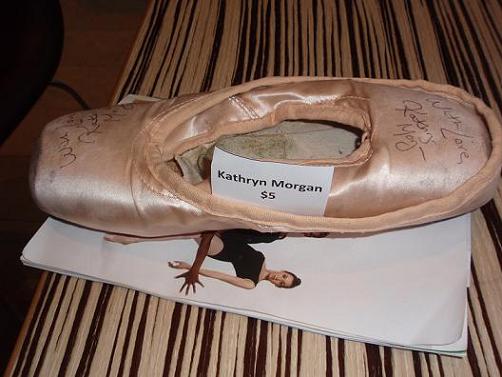
But first, it being Michael’s last day at NYCB this season, he browsed the gift shop, and ended up with a pair of Kathryn Morgan toe shoes. He told me (and, apparently the amused gift shop attendant) he figured she wasn’t going to be $5 for much longer ๐Ÿ™‚ I guess their shoes cost a certain amount according to their status: principal ballerina shoes are $30, soloists are $15 and corps members $5. I didn’t know all this. I’ve never wandered over to the toe shoes section. I initially wondered why, then realized, oh, my favorite dancers don’t usually wear toe shoes. Sorry to be lewd, honestly, but I then couldn’t help but wonder — just because of that crazy strong mojito that nearly put me on the floor — why they don’t sell other kinds of used dancewear that my favorites *do* wear, alongside the toe shoes. Sorry! But can you imagine? Total alternate universe.

Anyway, here is Michael’s review:

At Dunkin’ Donuts, they sell munchkins 25 at a time. That’s about how many you get at New York City Ballet’s A Midsummer Night’s Dream, as well. The squadron of young dancers from SAB added a nice dose of fun and energy to a matinee that already had plenty of both on Saturday.

Daniel Ulbricht didn’t dance the role of Puck, so instead of gravity-defying antics, we just got antics. Corps member Troy Schumacher was announced as a late sub for soloist Sean Suozzi in the role, and there were some disappointed Ohhs around me. The thought: We’re getting the third string. Schumacher did an excellent job, though. He moved with an appropriately sprightly energy and showed a nice touch with the comedic moments. When he realized his magical matchmaking mistake, you could almost hear the “D’oh!”

Teresa Reichlen was fantastic as Titania, displaying just the right balance of regal, playful, and otherworldly for a fairy queen. And Robert Fairchild, a very busy man this season, excelled in yet another role (albeit in a ridiculous Prince Valiant costume) as Lysander. His put-upon love interest was once again Sterling Hyltin. The leads from NYCB’s Romeo + Juliet both showed they can handle Shakespeare’s comedy as well as his tragedy. Hyltin, for example, dialed up a slightly manic quality to great effect.

And Balanchine’s choreography tells the entire story in Act I, leaving Act II free for the divertissement. A quick wedding march and then Janie Taylor and Tyler Angle were center stage. They brought down the house.

Angle is a strong presence, but he defers so gracefully and lifts so effortlessly that he never soaks up more than his share of the spotlight. I noticed that when he partnered Tiler Peck in Mercurial Manoeuvres, and again on Saturday. Janie Taylor was both a delicate vision and a physical wonder, sometimes in turns, sometimes simultaneously. It’s a complete oxymoron in print, but she pulled it off onstage. Amazing.

The final scene was especially poignant for me, because I knew this was the last performance I’d see this season. Fireflies flickered around Puck against the dark backdrop of, yes, a midsummer night. It was the kind of night you don’t want to end, and the kind of season.

And here is Oberon’s (I mean Philip’s) review of the same cast.

And this just in! Another review (I’m interested in what he says of Gonzalo Garcia) — the one (by a pro critic who doesn’t say things are good when they’re not, and with great detail and specificity) that I’ve been waiting for ๐Ÿ™‚ I knew Gonzalo’d nail it! I knew he’d be brilliant! I knew it!