Originally uploaded by swan lake samba girl via mobile.
T-Mobile

Tonight is the fabulous Dance Times Square escapade to see Pasha et al in the So You Think You Can Dance spectacular. I am really excited about it — have no less than three cameras in my bag just in case of battery outage (though I charged everything anyway — just the neurotic in me) 🙂 I do hope they let us backstage and to take pics; otherwise expect a copious write-up! Good: I was upset this morning after logging onto some of my regular dance websites, and am now feeling better just writing about tonight 🙂 Thanks Pasha, and thanks blogging software 🙂
What I’m really upset about is how shallow the world of ballet seems to be. At the Fall For Dance festival a few days ago I saw a most profound, moving work performed by African American dance-maker Kyle Abraham. As I wrote earlier, to me the piece used a combination of ballet, modern dance and hip hop to explore racial and gender issues and evoke the struggle to break free of prejudices — both those held by others and sometimes subtly taken on yourself. I’m very upset about the complete dismissal and oversight of Abraham’s work by both the press and the blogosphere. NYTimes chief dance critic Alastair Macaulay says only of the work that it was show-offy and involved too much upper-body “archness.” (Macaulay also criticized Wheeldon’s “After the Rain,” which I liked, but I’m not bothered by that because he actually gave it the time of day and analyzed it a teensy tiny bit; I’m far more disturbed by his complete dismissal of the meaning inherent in Abraham with no real analysis to speak of).
Similarly, Justin Peck of the Winger, a NY City Ballet dancer and Columbia University student wrote a little review of the night, perhaps for his class on dance criticism, and in his review of Abraham, he simply names the different dance forms used, then dismisses the piece as lacking “structure” (without further analysis). Neither reviewer seemed even to notice the racial or gender implications of the work. How anyone could fail to hear the loud gunshots and ambulance / police sirens going off at the beginning of the piece is completely beyond me, but I guess I’m a criminal appeals attorney who’s represented poor minorities for the past several years, so such noises may be more resonant to me. (By the way, a bit off topic but important: I think all attorneys should at some point in their careers represent someone whose life is starkly different from their own — even if it’s just pro bono — it expands your universe exponentially).
Then yesterday on The Winger, smart ABT dancer David Hallberg, posted this video of choreography by Mats Ek, whose work he was moved by at the Fall For Dance performance he saw. I thought it was a beautiful, moving portrait of a woman’s sorrow at losing her husband. Others, however, couldn’t see any sorrow, any story, but only focused on dancer Sylvie Guillem’s beautiful feet. Yes, Guillem has great feet. But is an attractive body part what really draws people to this art form? Is that what ballet is all about? Prettiness? Is it not about meaning, about moving people by telling them a compelling story, about making people think? Is ballet really that unintellectual? I have two advanced degrees. If you don’t at least try to stimulate my brain cells with your so-called art, I’m perfectly happy to return to favorite novelists who actually explore the human condition.
The problem isn’t just ballet fans though. I feel sometimes that those entrusted with stimulating public discourse are not even trying. (Here I’m primarily speaking of critics who write for the NYTimes, which I admit, is the only paper I regularly read due to both time and money constraints). Claudia LaRocco’s review of the final night of FFD read something like this: this whole festival is stupid, so it goes without saying that everything I saw that night was stupid. The first piece, in addition to being stupid was ethnically insulting in its “cliched” use of Indian dance to characterize London business culture (no further analysis as to exactly what it was about that piece — a huge crowd-pleaser that I found very intriguing — was cliched); the second piece (a brief excerpt of Camille A. Brown’s evocation of a woman trying to find herself) was bad because Brown moved too fast; the third piece was worthless because it was just there (no further analysis); the fourth piece comes from a choreographer (Jorma Elo) whose work always sucks; and the last piece was bad because it was “pleasurable only at a kinesthetic level and only at times.”
The critic character in Laura Jacobs’s novel, “Women About Town,” which I’ve quoted from before, views her work as deciphering for the public just what it is that makes a performance work or not, and unlocking and illuminating the hidden meaning of a piece (“there’s always a key,” she says at one point, though I’ve returned the book to the library so may be getting the exact quote wrong). I just don’t see any of that going on in the world of dance.
Tellingly, LaRocco begins her review by asserting that these days there is such a plethora of crap the best a critic can hope for is “competence.” These critics are coming from a place of anger, not of analysis. Countercritic led me to this article bemoaning how bloggers are displacing professional critics, which, the author argues, is tragic given critics’ historic role in leading the audience to understand and appreciate something in which they couldn’t previously find value (ie: Beckett’s “Waiting For Godot”). Okay, I understand that. But can someone please tell me when was the last time a dance critic illuminated a work of cultural value that was dismissed by the general public instead of the other way around?
I can’t even begin to describe what that auditorium sounded like after the presentation of Elo’s work (the ‘always sucky’ choreographer). His “Brake the Eyes” which I wrote about earlier, was so stunning, so brimming over with meaning, the audience was buzzing with discussion after the china doll / puppet ballerina snapped her fingers and the lights flicked off. “Was she controlled by the others or was it the other way around?” “That combination of music was so interesting!” “What was that cool music besides the Mozart, it doesn’t say in the Playbill.” “What was she saying in Russian?” were some of the questions I overheard. People are starved for analysis. Some of these people (especially the young and internet savvy) are going to come home and Google “Jorma Elo” or “Brake the Eyes,” and what are they going to find? Certainly not analysis. How can the public find meaning in concert dance, see it as anything other than the movement of attractive body parts if the writers aren’t trying to lead them the right direction?
Of course I know newspaper writers are under very strict word count limitations, making it impossible for them to delve very fully into their subject. But in the age of the internet, can’t at least the web articles be longer? Also writer Paul Parish has an interesting analysis of the newspaper problem (go to the very bottom of this post — scroll all the way down to where the bold reads “Paul to Tonya et al” and then to the paragraph that starts “I still think…” Foot in Mouth posts tend to be delectably gargantuan!!!). I don’t entirely understand what Paul is saying, but it sounds intriguing!
Anyway, the closer it gets to 4 pm (when the magic DTS bus departs for SYTYCD land), the better I am feeling. Hopefully I should have a good dance night: there won’t be any ballet there, after all 🙁
Okay, Pasha didn’t save ballet; he actually doesn’t have much of anything to do with ballet, other than that he’s touring with Danny Tidwell right now. But he’s on my mind because last night, on my way to Fall For Dance, I stopped by Dance Times Square to pick up my receipt for the long-awaited and highly anticipated “DTS Students And Friends Outing” to the Nassau Coliseum next Tuesday to see Pasha’s tour!!! Er, I mean the So You Think You Can Dance concert tour 🙂 I chatted with Melanie a bit, and she told me that they’re trying hard hard hard, fingers crossed fingers crossed, to get the SYTYCD tour powers that be to allow us all backstage. Apparently they don’t have a problem with a couple of people, but they freaked a bit when she told them we’re a group of, more like … 40. Still! Come on, we’re a bunch of ballroom dancers, how rowdy can we be??? Please SYTYCD people in power, let us in to see our friend and beloved former teacher! We promise to behave! We promise!!
Okay, on to Fall For Dance. This is a most excellent event that’s taken place at City Center in midtown for the past I think three years now. Each night for about two weeks four or five different dance companies perform an excerpt from their repertoire. Tickets are a miraculously low $10 for the whole night. So, audiences — especially young audiences — can be exposed to several new companies for only $10 a night!
Last night marked the very first performance in New York by a promising new ballet company, called Morphoses, whose mission is to bring new life and new audiences to that most poetic of dance forms that many have feared is getting a bit withery and dried up. It’s founded by 34 year-old Christopher Wheeldon, formerly the first-ever resident choreographer at New York City Ballet. Wheeldon doesn’t yet have a permanent group of dancers, but is using guest dancers from several ballet companies, mainly NYC Ballet. I’ve loved so many of Wheeldon’s pieces that I’ve seen at NYCB over the past couple of years, so I have really high hopes, as do, I think, the vast majority of ballet lovers here. Last night the company performed not a brand new work, but one created by Wheeldon a couple of years ago for NYCB, a lovely duet called “After the Rain.” I see it as kind of a bittersweet pas de deux whose theme is a couple’s attempt to patch things up and find some common ground in the aftermath of a bad fight. It was danced by two NYCB dancers, the really cute Craig Hall and celebrated prima ballerina Wendy Whelan, to Arvo Part music composed of a string and piano section, in which the light tapping of high piano keys actually sounds like rain drops. It goes without saying that Wendy is just such an incredible dancer; when I see someone like her perform I realize it’s not just a choreographer who’s responsible for the success of his or her work. She dances with such conviction, with a fully formed thought in her mind of what her movements mean so that even though she dances mostly abstract ballets, as with this one, there’s just such an intensity and drama to her performance, the audience finds a story anyway. Well, listen to her talk about her work herself. I really love that City Center has done this this year — put up these little audiocasts on their website of interviews with several of the artists whose work is being performed at FFD. Go here to see a list of participating companies arranged by date, click on “info” for a breakdown menu of companies performing on that date, then click on that company to be taken to their info page where you can see an interview. Very cool!
So last night was actually my second night at FFD. I went Wednesday night as well but didn’t have time to blog about it yesterday. Highlights for me have been, in addition to Wheeldon, Keigwin + Company, a rather hip, young modern dance ensemble. I really wish Larry Keigwin, the company’s choreographer, would do a piece or two for SYTYCD. He’s so much fun. They performed “Love Songs” — several humorous duets performed by three different couples, pieces of which I’ve seen before. Each couple had its own distinct ‘couple personality,’ and told its own humorous story of relationship angst. On first and last was a youngish charmingly awkward pair who were obviously trying rather desperately to get to know each other better. They danced to a set of Neil Diamond songs. In another set, a more sophisticated couple, danced by Keigwin himself and one of my favorite modern dancers Nicole Wolcott, performed a voluptuous witty tango-y pas de deux to clever-sounding French music. And the third couple, the most wickedly funny imo, evoked, to Aretha Franklin music, the classic struggle between male and female for the upper hand in the relationship, rendered all the cuter by their mismatched sizes — fleshy woman (Liz Riga, my second favorite female modern dancer), smaller man. At times, when the woman wore the pants, she would drag her beau around, at times lifting and carrying him around the floor, and, when Franklin belted out some of her “let me tell you how it is” lyrics, she’d bop her head at him right along with the words. Then the reverse would happen; he’d have her begging. Then tables would turn, she’d have him back in the palm of her hands (literally with those crazy lifts), but he’d become too needy; she realized she should be careful what she wished for. It was so fun, funny, evocative, and very relatable.
The other one I loved Wednesday night (along with the crowd) was Urban Bush Women‘s performance of its most famous piece “Batty Moves.” They tell you in the program notes that Batty is a Caribbean word for rear end, and the piece is a rather fun, raucous celebration of the African-American female form. The women sang rap lyrics, called out to the audience encouraging proud black women to rise, then launched into solo after solo of amazing combination African / modern dance. The audience was on its feet; a perfect ending to Wednesday night’s show.
Unfortunately, I felt really badly for ballet Wednesday night. The audience was filled with young and /or newcomers to dance and people related so much more to Keigwin and Urban Bush Women. The two ballets performed — one by Royal Ballet of Flanders — was a very abstract and rather slow-moving meditation on the passage of time and consisted of four couples dressed in generic pink leotards and white shorts doing abstract movements center stage while others dressed in black simply walked slowly around the stage’s perimeter.
The other ballet performed Wednesday night was NYCB’s small-scale one-man performance of Jerome Robbins’s “A Suite of Dances,” in which a male dancer interacts with an onstage violinist, at times almost cutely competitively. Robbins is my favorite “old time” choreographer, but he did most of his great work in the 1940s and 50s. And even though this particular piece had its premiere in 1994, the movement still had a very 50s feel to it, like Fancy Free. I love many of his ballets (particularly Fancy Free, as it’s often performed by my favorites like him and him), but I feel like every time I go to the ballet nine times out of ten they’re putting on something decades or centuries old. The audience was so much more into the aforementioned two pieces, not the ballet. I left with the feeling that ballet is encountering some serious relevancy problems. Kristin Sloan and I had an interesting little back and forth regarding “Suite” in the comments section on this post. I understand what she is saying, that’s it’s a softer sale, but I don’t know if the audience is really automatically pulled into a man’s own playful encounter with music. At least it doesn’t have the same urgency or speak to the human condition in the same way that glorifying a body Western Culture has long deemed “other” does. I don’t know, perhaps I would have had a different reaction if one of my favorites had performed the piece. There’s something about Marcelo‘s very being that is somehow always contemporary and relatable. It’s an extremely interesting discussion, though, classical ballet’s ability to speak to modern audiences, and I’m very interested to know what others think.
Anyway, that’s why I was so happy last night to see the Wheeldon. It was contemporary, meaningful, relatable, and gorgeously, poetically danced. Also standing out to me in last night’s program was the piece immediately preceding Wheeldon’s, “Inventing Pookie Jenkins” by Kyle Abraham. It began with Abraham, an African American man, sitting in a pile of white tulle, which, when he stood, was revealed to be a long skirt reminiscient to me of Matthew Bourne’s all-male Swan Lake. He moved about, first on the ground, then standing, at times jerky, at times with beautiful lyric fluidity, to a soundtrack of gunshots and ambulance or police sirens. Then the soundtrack changed to a provocative / celebratory hip hop song, “Respect Me” by Dizzee Rascal. Abraham’s movements alternated between hip hop and lyrical modern, as he seemingly tried to break free of … of what? A policeman’s custody, stereotypes superimposed on him, even his own self-image — which took on both a racial and gender significance. It really just blew me away and if you ever get a chance to see him perform, by all means do!
Tomorrow night is, sadly, the last night of the festival. I’ll be looking forward to “Quick” by Indian company Srishti, in which several ‘London businessmen’ use classical Bharantanatyam technique and South Indian rhythms to deal with today’s cut-throat corporate climate. Interesting! I’ll also be looking forward to “The Evolution of a Secured Feminine” by Camille A. Brown, which I’m dying to see just because of its name alone! (go here for Eva Yaa Asantewaa’s audio interview with Brown), Jorma Elo’s Brake the Eyes, which I blogged about before, and South African troupe Via Katlehong Dance.
Finally, I’m very excited about the illustrious Vanity Fair contributing editor James Wolcott’s commenting on my last post on Nureyev!!! Apropos of that post, apparently there was a big book party for author Kavanagh, which he attended and wrote about on his blog. Sounds fun, albeit a bit nerve-wracking! There were many members of the ‘glitterati’ there, including Jay McInerney, an abundance of “New Yorker” people, and even our favorite Sir Alastair 🙂 It made me think of the book parties I’ve been to — only two: one for my former Feminist Jurisprudence professor, Drucilla Cornell, a comparably very academic, toned-down affair, and one for a friend of a friend, Ben Schrank, at which I made a flaming fool of myself in front of favorite author Colson Whitehead, a story which I’ll have to save for another day since this post is now 500,000 words long.
Anyway, while I’m kind of on the subject, for reasons that are too ridiculously complicated to explain, I haven’t been able to set up a “recent comments” column here yet, so just want to point out that artist Bill Shannon whose work “Window” I reviewed earlier, left a comment on that post, along with a YouTube link; and Ruth left a comment on my Suzanne Farrell post inviting interested people to participate in a Farrell fan site she’s set up.
Okay, I’m finally done blabbering. More on my final FFD later this weekend 🙂
This book (the latest biography of the greatest dancer EVER imho), which officially went on sale yesterday in bookstores everywhere, is so huge it’s almost overwhelming just to look at. I think it makes more sense for me to give my thoughts on the book in segments, so that I don’t end up with a 100,000- word-long review!
In the first couple chapters Kavanagh paints a fairly well-rounded portrait of Rudik’s parents and upbringing. (I hope I don’t sound pretentious, by the way, calling him that — I just think Rudik is so much cuter than Rudolf and more original and “Russian-sounding” than Rudi 🙂 ) He grew up in abject poverty in a provincial state in northern Russia called Ufa, far removed from any city with its attendant vibrant cultural life. His family is Tatar, which is an oppressed ethnic minority in Russia, and he was raised Muslim and Tatar-speaking; didn’t learn Russian until later in school. (I actually hadn’t known Tatar was a language). He had three siblings — all sisters — and his mother, Farida, who had wanted to become a school-teacher but whose hopes for an education were dashed by pregnancy after pregnancy after pregnancy, took care of the children while his father, Hamet, served in the Red Army, his status forever in frightening limbo by Stalin’s erratic demotion / murder sprees.
Rudik was actually born on a train, when Farida went to visit Hamet at his bunk, which is how Kavanagh sweetly starts off her book. Much of his childhood was filled with such train rides, and the family at one point lived near train tracks. Rudik thus retained a life-long fascination with the locomotives, and when he was older and a professional dancer, part of his performance preparation consisted of leaving the studio and sitting outside near train tracks, listening for the sounds of the engines to get their rhythm into his body.
Hamet didn’t return home permanently until Rudik was well into boyhood, and by then, Rudik had been surrounded by so many women, he didn’t know how to react to the presence of a male; he seems to have been a bit afraid of his father. Hamet, well-liked by his comrades, was a real “mensch” type, and freaking out a bit over his son’s effeminacy, tried to make the proverbial man out of him by taking him on hunting trips, etc. Sensitive and quiet by nature, Rudik didn’t fare so well, needless to say, beginning a lifelong struggle with his father, exacerbated of course by his desire to become a dancer. Rudik had the best relationship with his older sister Rosa, the most intellectual and artistic one in the family who took dance and piano lessons and would teach her younger brother what she had learned in her ballet history lectures and bring him home costumes which he would (in his words) “gaze at so intensely that I could feel myself actually inside them. I would fondle them for hours, smooth them and smell them. There is no other word to describe it — I was like a dope addict.”
Rudik was introduced to ballet when he was seven years old and Farida bought a single ticket to a performance in Ufa, and managed to sneak all of her children into the theater with her. He knew then and there what he wanted to do with his life, and he never looked back. But even before that he had shown he was a natural dancer. Starting in kindergarden, as with all Russian children, he took national folk-dancing in school, exhibiting such talent and charisma, he was often chosen as a soloist in his school’s performances which they took on the road, performing in hospitals housing men recovering from war wounds. Kavanagh quotes from the (very well-written and gorgeously descriptive) novel, Dancer, by Colum McCann, which is based on the life of Nureyev. “In the spaces between the beds the children performed . . . Just when we thought they were finished, a small blond boy stepped out of the line. He was about five or six. He extended his leg, placed his hands firmly on his hips and hitched his thumbs at his back . .. the soldiers in their beds propped themselves up. . . Those by the windows shaded their eyes to watch. The boy went to the floor for a squatting dance. When he finished the ward was full of applause…” That’s one of my favorite passages from McCann too and I really love that Kavanagh quotes from a novel.
Because of his family’s poverty, Rudik got a late start on ballet, preventing him from ever acquiring full hip turnout (which must be attained before puberty, when hip ligaments and tendons are still flexible) thus making it all but impossible for him ever to develop wholly proper ballet technique. Poor and poorly clothed (in too-short pants, lacking shoes, etc.), Rudik was often made fun of by his classmates, and he struggled not to let their taunting get to him. When he later began ballet school in Leningrad, he was older than most of the students by several years. In response to their condescending stares, he, rather (in)famously, announced he would outdo them all. Talk about haughty, Shane Sparks (who told Danny Tidwell he was “arrogant”) 🙂 And of course, through eating, breathing, and sleeping ballet basically for the rest of his life, he did outdo them all.
Kavanagh has done an amazing job of gleaning so much information (the book took 10 years to complete), but she includes so much detail that it kind of weighs the narrative down. She also doesn’t footnote, which, I don’t know if it’s the lawyer in me or the former History grad student or what, but it’s driving me nuts. For example, she asserts that Nureyev had a “lifelong willingness to let women martyr themselves for him” (pg. 21) that he derived from his father, then quotes — I guess either Nureyev or Hamet (?) saying, “‘At home she must work harder than her husband and when he is relaxing she must still carry on.'” Where is this from? What’s the context? Who is speaking? I need sources!!!
She also assigns motives to and makes judgments about her subject that to me are a bit ill founded. For example, she argues that Nureyev fabricated that his father had beaten his mother and him, and her basis for claiming that this is a lie is that the other family members denied it — as if a family’s denying allegations of abuse in order to protect one of its own has never been known to happen before. She claims that Nureyev lied because he was angry at his father for his refusal to tolerate his dancing: “There was only one real reason for his contempt: Hamet refused to tolerate his dancing.” (pg. 22). It just doesn’t strike me as all that mind-boggling that someone who’d spent a large part of his life in the military and looked down on his son for his supposed lack of masculinity could be physically rough. Plus, if dancing is your identity, your being, your life, and a parent refuses to acknowledge you, then that’s a pretty profound reason to harbor some hostility.
Okay, that’s all for now; more to come as I read further. Here is Joan Acocella’s review. Here is Gia Kourlas’s interview with Kavanagh. And here is a quoted excerpt of a review from John Carey that I found on James Wolcott’s blog. Reading the excerpt prompted me to Google Carey. And look at this book I found! I wonder what he’d have to say about the Ballet versus “So You Think You Can Dance” debate?! Hmmm, this may have to be next on my reading list…
If Dancing With the Stars is any indication. Last season the first contestant knocked off the show was Eighties supermodel Paulina Porizkova; this season the first two to go have been the two models — the first, Josie Maran, a Sports Illustrated Swimsuit one no less… America used to worship supermodels; what happened!
I was actually disappointed and a bit surprised last week when Maran was booted — I thought she could possibly be this season’s Kelly Monaco-esque underdog; she’d definitely have worked very hard and she seemed sweet. I was a little disappointed this week as well. When I first saw Albert Reed, I thought what an immature goof. But then his silly playfully little-boyish charm started to grow on me. And I felt he was far from the worst, though that has nothing to do with anything on this show, as we all know.
Personally, I like that Sabrina brings something different to ballroom — I rather liked watching her hip hoppy take on Cha Cha the first night — but I don’t really think it’s fair that she’s in the competition since she obviously has a great deal of dance training that the others don’t have. I do want to see her make it far along in the comp though since she’s dancing with a member of this country’s royal family of ballroom, Hon. Mark Ballas 🙂 And it shows: he’s quite the nimble, quick-footed dancer. And my crush grows on the cute Brazilian, Helio! (Am dying to know if Marcelo talks like that!)
I hope people watched the results shows both weeks — last week to see tap legend Savion Glover and this week to see several of my ballroom favorites! Isn’t Nick Kosovich a dream! And Victor Fung and Anna Mikhed — aren’t they just oozing with charm!
And, most importantly: J.T. J.T. J.T.! I’m so happy she was on dancing the tango tonight. As they said on the show, and as I’ve blogged about before, she and her partner Tomasz Mielnicki just won the American Smooth championships this year. Of course that goofus Drew Lachey got her name wrong — it’s J.T. DAMALAS not J.T. Thomas (her partner’s first name). J.T. used to teach at my former studio. I remember one time I was having a really difficult time doing a lift with Pasha and J.T. was in the studio practicing. Pasha called her over and she nicely took time out of her practice session to help me. And she worked magic! She not only demonstrated by doing but gave me tricks on how to push my shoulder and arm down over his back onto his opposite shoulder in order to help me lift myself. (I hadn’t wanted to push down on his shoulder, thinking I’d be hurting him, but she explained I was hurting him a lot more by not having any way of holding myself up and making him do all the work). A lot of teachers just show you by demonstrating themselves and then they think you can pick it up through imitation, but they don’t realize a lot of us need more: we need actual instructions. Anyway, I remember that moment well. I never ever EVER would have thought I was so lucky to be standing between two such people — one of whom would go on to dance on an extremely popular television show and be known by millions, the other who would become the national champion and be seen on another popular show. So completely surreal!
With dance audiences supposedly dwindling, it seems like all the talk these days is how to attract the young (generally ages 20-40). Last week I attended two very different performances whose mission was basically just that. On Thursday I went to the Joyce in Chelsea for the tap dancing rock concert called “Revolution” by the show’s founders, tap dancer and rock and roller Michael Schulster, and the absolutely breathtakingly, mind-bogglingly spectacular Irish step dancer, Joel Hanna. Here’s a rather fun interview with the two very excited guys in Newsday. Anyway, If it isn’t clear from the list of adjectives I used to describe him, go see the show if you haven’t already if only to see Hanna. He’s the Joaquin Cortes of Irish step dancing. His fast fancy footwork is only the half of it; he dances with such an intense fiery passion it just sets the whole stage ablaze and makes you, as with Cortes, yearn to find out more about the underlying spirit of his dance. I remember seeing Riverdance when it first came out and I don’t ever remember seeing dancing quite like this. There was such a Latin fervor to Hanna’s pounding, beating steps I felt like he must have been influenced by Flamenco, or that Irish step dancing shared something fundamental with that Romani dance.
Unfortunately, I felt the rest of the show was unremarkable. It started out fun though. Electric guitars blared “Paradise City” by Guns ‘N Roses over the speakers (actually one of my favorite songs, not kidding!), and a set of six screens erected above the band showed different images of the dancers getting ready — in make-up, in a studio warming up, and eventually coming up the stairs to make their stage entrance. Very rock concert, maybe somewhat goofy, but uniquely cool for concert dance if you’re open-minded about it. As soon as an ensemble of dancers emerged onstage — four women and about eight men– and began tap dancing to the guitars, a camera guy entered and began filming them live from a variety of angles, the images then projected to the screens above.
I had a complicated oral argument in court Friday morning that I was nervous about, so my first thought was, excellent, something really to take my mind off my anxiety! After the initial heavy metal number, Schulster, a good tap dancer (though his rock and roll fascination makes him far different from my favorites in this department: Savion Glover or Jason Samuels Smith) took the stage for a solo. A tape was shown on the back screen of Schulster beating a punching bag with boxing gloves, explaining that his tap shoes were an instrument, akin to a musician’s guitar. The screen went blank, a combo of electric guitars and flashing strobe lights set the stage on fire and Schulster, center stage, began tapping like a fiend to the electrified strumming. Audience members (a combination of traditional dance-goers well over the target age and young’uns I’d never seen before) went nuts, screaming and cheering, raising their hands in the air as the strobe lights flashed through the crowd, blinding me at times, just like in a rock concert. I started laughing and couldn’t stop — it was really a lot of fun, and my argument was nowhere in my mind!
Then Hanna took the stage for the third number, the first of his thankfully many solos and I nearly fell out of my seat. It’s funny because here was true talent, and, at first the audience was so stunned they could only watch, no hoots and hollers, no screams, just staring at the stage in disbelief the way audiences unfamiliar with dance initially react to genius. After he finished of course everyone took a moment to process, then went wild with the applause.
The problem was, for me, it didn’t really move after this, as Sir Alastair’s rather sardonic review of the show indicates. It was just more of the same for the next hour and a half. Most annoying to me was the way the women were used. In their first number they wore skin-tight jeans, ridiculously movement-restricting, and such high stilettos everyone seemed off-kilter. Of course it didn’t matter that they couldn’t move in their attire because all they did was make a series of ludicrous sexy poses. It was like a Robert Palmer video, which, had Schulster played such music in the background, I might have actually liked the number, thinking it was intended as an ironic statement. Fortunately he didn’t confuse me. No ironic distance from his beloved rock genre there. Throughout this number, camera guy committed my cardinal sin — homing his camera in on the women’s body parts, and you can imagine just which body parts those were. While the men danced of course the camera captured their bodies in whole, often shooting them from below, making them look like demi-gods, or diagonally, making their dancing appear dizzyingly cool. I’ve noted before that I think dance filmed that way, at least in moderation so it’s not TOO dizzying, can be fun and engaging. But THE BOOBS AND BUTTS THING IS MY PET PEEVE, CAMERA MAN. It’s as if young men need to be told what to find sexy; they can’t figure it out themselves. What’s that about?
Anyway, later in the show, there was a number involving several duets with some nice partnering. At one point, a woman jumped on the back of a man, desperately attempting to win him back, he throwing her off. The audience gasped. The lift did look rather hard. I liked it because it was the one moment where I felt we got a little bit of meaning, a story. There were characters who wanted something from one another, who were having a conflict. It grabbed your attention. The show needed a lot more of that, a lot less of the sex poses, and more variety and depth. Even with Hanna’s fantastic dancing, I felt like more connection to Irish culture was needed. For example, when I’ve watched Cortes perform (whom I mentioned above), yeah he was a hot sweating shirtless guy dancing his heart out, but the performance was so much more than that. With the band playing the fascinating accompanying Gypsy music, at times celebratory at times haunting, his dancing expressed that complicated emotion. I knew nothing about Romani culture but from that alone longed to learn more. From the little I know of Irish culture, it contains the same dual complexity. Why not use Black 47 music, or something similar? Instead of just entertaining us, make us think.
It’s playing at the Joyce through next week; go here for tickets. As I said, worth seeing for Hanna’s raw talent alone.
The audience at Columbia University’s on-campus Miller Theater was almost the opposite of Revolution’s. This saddened and confused me. The majority of performances at Miller are of new music; this event, in combination with the Guggenheim’s Works & Process, was an ideal commission for the theater combining as it did new music and new dance. George Steel, the Theater’s director, says that he seeks to engage young people, at a minimum, the Columbia student population, in the arts. I saw very few students though. When I was in college and grad school (at University of Arizona and Brown University respectively) I went to practically every single thing the on-campus theaters took on. I remember seeing everything from Vienna Boys Choir to Cats to Christopher Durang’s play “Beyond Therapy” to Les Ballets Trockadero. I had so much fun taking in everything I could; youth is the ideal time to expand your mind with access to the most affordable culture you’ll ever have — that provided by your University. Perhaps with Columbia students, it’s just that there’s just so much culture in New York and everything’s easily accessible. I hope…
Anyway, the ballets included were: “dogwood” by Amanda Miller, a very modern piece in which four dancers made movements at times jerky and intentionally awkward suggestive of discomfort, at times more lyrical and fluid, and used chairs that to me resembled cartoonish mini-thrones and evoked something out of “Through the Looking-Glass”; “Four/Voice” by Italian choreographer Luca Veggetti, a very beautiful ballet exploring the intersection of dance and music; and “Sweet Alchemy” by Alison Chase, a charming ballet involving three sets of partners and their interactions with each other. Here’s the New York Times article (which I haven’t read yet).
My favorites were the latter two. I was surprised to have liked the Veggetti so much since I don’t know a lot about classical music and I’m usually not one to have much of an appreciation simply for danced interpretations of music. But here I was really mesmerized watching the dancers interpret in different ways the striking sounds made by a solitary cello played over a taped recording. The colors were really lovely as well, a combination of gold and black, the scheme repeated in the backdrop and stage lighting as well. These visuals worked very harmoniously with the music; somehow the colors just sounded like the cello, if that makes any sense. The dancers — two men (some of my favorites from New York City Ballet: Robert Fairchild and Daniel Ulbricht), and two women — at times resembled cello strings themselves. I really got lost in it, watching their bodies strike the chords. I was so disappointed when it ended! Beautiful!
As for “Sweet Alchemy” — what a fitting name 🙂 The ballerinas were dressed in short-skirted, flirty, rose-colored dresses evocative of a French countryside in summertime, and their slippers were tie-dyed dark pink on the bottoms. Music was performed by a string quartet. Chase is a former choreographer for the playful, comedic dance troupe, Pilobolus, famous for making shapes evocative of funny-looking creatures and other amusing objects. Although this was ballet and not modern (as is Pilobolus), you could see the influence. The dancers (all from NYCB), worked in partnerships of two, sometimes three, making interesting shapes and interacting with each other. At one point the men did what appeared to be hurdle-jumping over each other, in competition for the attention of the women, who at first sat facing them, then in unison, turned their backs. It was cutely funny. The women would climb all over the men, each using her danseur as a human jungle gym. Fun! 🙂 At times the men would lift the women awkwardly upside-down, the way a father would carry a misbehaving child off kicking and screaming. Except the women weren’t kicking and screaming. So tables were turned. Men were tricked into doing heavy lifting, perhaps? At times the men would carry the women so that their feet would touch the back wall, she scampering along the wall as he skittered along on the ground, ala Larry Keigwin, except here it was light and humorous rather than more intense. It was all sweetly, playfully romantic. Similar to Revolution, there was a large screen on the back wall, which showed, instead of live filmed shots of the dancers, still pictures of them. Some pictures homed in on an embrace, torsos pressed against each other, arms wrapped around backs, bodies linked, enmeshed in each other. So much more sensual, maybe even somewhat erotic if you want to see it that way, than the Robert Palmeresque poses and shots of sexualized body parts, if you ask me. An abstract work, there was no linear narrative here. You had to piece things together for yourself, use your imagination. It’s not as easy as being told what to think, but I would hope young audiences, at least intelligent ones, would be intrigued by the challenge.
One more thing: it’s so weird, albeit very cool(!), to see ballet in such a small, intimate setting. You notice little foibles that on a majestic stage like the Met Opera House or NYCB’s State Theater are completely lost on the audience. You see the difficulty in a lift betrayed by a man’s shaking knees or a woman’s vibrating body as she holds herself in position in the air, intense concentration or fearful hesitation registered ever so discreetly in the eyes. You notice that Charles Askegard is, delightfully, like, eight feet tall 🙂 I love this aspect of a small theater: it makes ballet more real, more human, to me.
Update: Here’s Apollinaire’s Newsday review of the pieces; here’s Tobi Tobias on the same; and here’s Claudia LaRocco’s NYTimes review (a different write-up from the one I linked to above). I’m the only one who liked the Chase! The others also found things I hadn’t in the Miller. Everyone seemed to like the Veggetti 🙂
I love this! When’s the book coming out here, when when when?! Perhaps the excerpt contains hints as to why Danny Tidwell may have felt not so at home in the world of ballet…
Also, I don’t have time to blog about Dancing With the Stars today, but hope to later in the week, after the results show tonight, which is, by the way, especially worth watching, even for those not solely into ballroom. The man widely hailed as the greatest tap dancer in the world will be on. That’s Savion Glover of course of course! So, that’s tonight, ABC, 8pm / 7 Central.
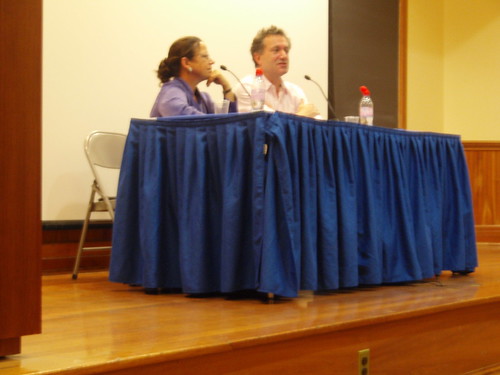
But he didn’t say much. And I should probably stop calling our new(ish) Chief Dance Critic ‘Sir Alastair’ and come up with a different nickname; he came across more as a jolly, down-to-earth commoner than a lord. Anyway Mr. Macaulay, along with dance writer and professor Mindy Aloff, addressed a crowd of mainly students, critics, and dance insiders last night at Barnard College. He spoke of: his move to New York (he’s still not completely moved into his new apartment and has no television, allowing him neatly to evade the question of the moment — what about all this dance stuff on tv?); what he misses about London (his garden, the West End’s plethora of Shakespeare plays); how he felt about becoming the NY Times’ chief dance critic (it was a welcome mid-life change, he and his audience at the Financial Times in London had grown a bit tired of each other, he was worried his appointment wouldn’t be well taken since he was from out of town — and rightly so, why should a critic not be homegrown?– people laughed at this, not sure why); his most trying life moments (serving jury duty and having to announce the verdict to a raucous courtroom, being charged with taking indecent pictures of minors after an officer saw him photographing frolicking children on a beach– don’t worry, it all worked out well as charges were eventually dropped); his dance training (ballroom, reading ballet technique books and sitting in on ballet classes); his favorite artists (Shakespeare and Mozart), etc. etc. — things on that level. It was nice to see his face and hear his voice, and it did make you realize he was human despite his sometimes harsh reviews, which was probably the point of the whole thing, but it was hardly the in-depth discussion of issues important to the dance world that I was hoping for.
During the Q & A, a student asked him if he felt that bad reviews played any part in declining dance audiences. He thought for a moment and answered that he didn’t know how much of an effect reviews really had on audiences. He thought his reviews had absolutely no effect on that of American Ballet Theater, as the Met Opera House was far from packed each week during the their summer season regardless of what he’d said in his most recent review. He also felt as a critic a certain degree of harshness was necessary, as it was the critic’s responsibility to “hav(e) a passionate subjective response” to a work. Wendy Perron, editor in chief of Dance Magazine, after noting that he’d largely written subjective reviews frequently inserting his own voice, asked if he’d ever taken a more objective tone. He responded that he wasn’t sure of the difference between subjective and objective with respect to criticism, but felt that his writing was a combination of the two. He viewed the objective part as describing what he saw, the subjective to tell why it mattered.
Eva sweetly asked him in her beautifully mellifluous voice whether he was going to explore the entire New York City dance scene and all the wonderful things it has to offer. He brightened considerably and said he’d just discovered “downtown” and had gone to a performance entitled something like “Accounting” and really liked it. He sounded authentic and it was actually rather cute. I don’t think he knows he got reemed for his review of that 🙂 Countercritic guy asked him something along the lines of whether he had to consider something beautiful in order to value it. I thought it was an interesting question and Macaulay did too, and even said so. “But I’m not sure how to answer it,” he replied. He said he liked it when a choreographer challenged his notion of beauty as Mark Morris has on occasion. Which I thought was a good answer. He mentioned other such choreographers, but I’ve forgotten who– I’d put my notebook away by then and was packing to go.
Hmm, what else do I have in that notebook?… He takes a few notes during performances but usually they don’t amount to much. He was first seriously impressed with the New York Times when he picked up a copy of the paper in London and saw a review of a classical dance performance on the front page. Such a thing would never have happened in a London paper, he said, as concert dance wasn’t considered “sexy.” He doesn’t regularly read others’ reviews of a piece because he doesn’t want them to influence his own, although his favorite critics are the New Yorker’s Joan Acocella (who has an “engaging” “shrewd” voice that, even if you disagree with, “you really want to spend time with”) and Wall Street Journal’s Robert Greskovic, who has a gift for detailed description (and is his good friend and sends him copies of his reviews). He said dance and music criticism were very challenging because the dialog one had with the piece was not a direct or natural one (as with a play) but forced the critic to translate from one language into another. I thought that was nicely stated.
That’s all. It was about an hour and twenty minutes altogether. It was okay, just wish the discussion would have gone deeper.
I came home and watched the video I’d taped of Dancing With the Stars. I’ll blog about it more tomorrow — am too tired now — but, very briefly: ridiculously, he hasn’t even danced yet and I am totally in love with Helio 😀 Does Marcelo have that same accent 🙂 🙂 😀 Am also in dancerly love with Mark Ballas 😀 How great were the perfs by those “girls” — Cheetah and Spice?! Whoa! And that opening pro number: you can’t say the ballroom dancing, despite Pasha and Anya, is better on So You Think You Can Dance! I wish there were more pro numbers like that! You can tell how different the demographic is for this show as compared with SYTYCD though — they have a lot of older contestants here. I thought Marie Osmond was a bit of a goof, but charming in her own way, and Jane Seymour was sweetheart 🙂 Could some ballroom insider please smack Chmerkovskiy for me for that self-description: “I’m known as the bad boy of the ballroom. But how can I be so bad when it feels so good?” 🙂 Okay, more tomorrow, I’m off to bed…
Claudia LaRocco writes briefly in today’s NYTimes about TV show So You Think You Can Dance and whether it’s of any value in bringing concert dance to a larger audience. She didn’t mention the lively debate taking place on Apollinaire’s blog, in which I nominated the wonderful Rasta Thomas as “Ambassador of Dance.” Apollinaire sweetly made me feel good about the Times’ mention of him as well in that role, since when all the other nominations came in and people began talking, I felt really stupid, as if I’d nominated Playgirl’s Playmate of the Year (if they even have such a thing 🙂 ) So, I’m glad the powers that be were on a similar wavelength 🙂
I’m also glad that Ms. LaRocco interviewed Kristin Sloan of the Winger to weigh in on the question, and so didn’t completely leave out the blogosphere. Unfortunately, SYTYCD was mentioned not once on the Winger. I don’t mean to be critical at all, it’s still my favorite dance blog and I dearly love many of the contributors, but I think with so many of them now, no one’s really in charge and everyone’s expecting someone else to take on the important issues, so the debates have been had elsewhere. I just wish the dance community was a bit more cohesive. I just feel sometimes like everyone’s writing, blogging, talking in a vacuum, and that’s unfortunate for dance because it cuts down the level of discussion…
Update: Kristin just published a really interesting post on a Chinese TV show on cable that she compared to our SYTYCD. I like the sound of this one! Okay, I take back what I said above 🙂 🙂
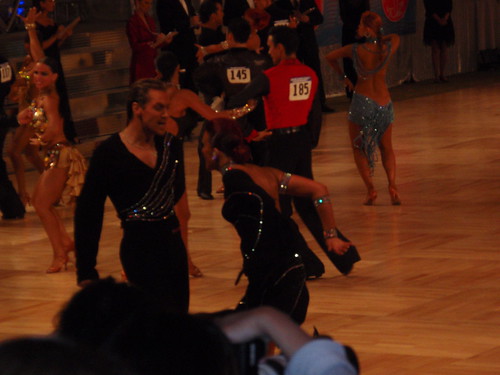
I know, it doesn’t exactly have the ring of “Oh, Marcelo Marcelo Marcelo!” does it? Hehe, oh we so love our Eastern European dancers and their ever so fun names (and their ingenuousness at not even thinking to Americanize them…)! But, though he looks nothing like him, Vaidotas Skimelis (whom I’ve been on about here and there throughout the comp) actually kind of reminds me of my favorite ballet dancer, mainly because of their large sizes and the kind of virility that almost naturally entails. I mean, large bone structure is difficult with Latin because speed is so important to the style — and certainly Vaidotas’s jive will never look anything like winner Max Kozhevnikov’s. But still, I like his size — as I do Marcelo’s — there’s something so sexy and romantic about a big hunk of a guy, right 🙂 Plus, difference is good! Who wants all the dancers to look the same whether it’s Latin or ballet — boring, I say!
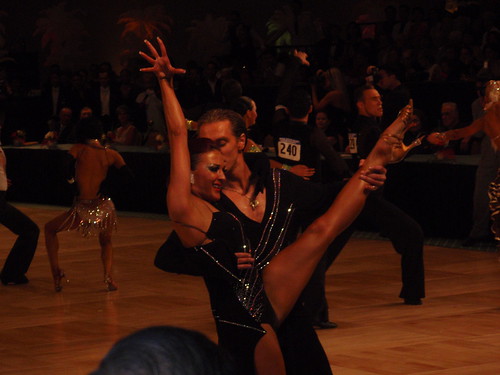
One of the not horrible things about Pasha and Anya leaving (at least for now) the competition world is that it made room for Vaidotas and his lovely plum-haired partner, Jurga Pupelyte, to be seen, to make it to the top ranks, where they most definitely belong. I only wish he didn’t live in California! As one of the only non-tiny Latin dancers, he’d be perfect size-wise for me as a teacher. But of course I shouldn’t even be thinking of private lessons because they are too expensive! So, good rather that he lives all the way out in California…
Anyway, here are a few more pics of my favorite couples and other stuff I did in Florida:
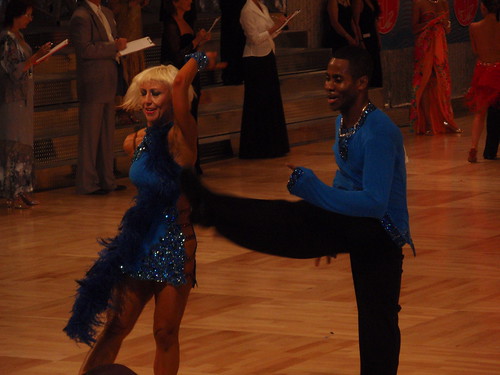
Emmanuel Pierre Antoine and Julia Gorchakova, a super fun couple with creative routines and great show quality whom I wanted to take American Rhythm, but who ended up placing third.
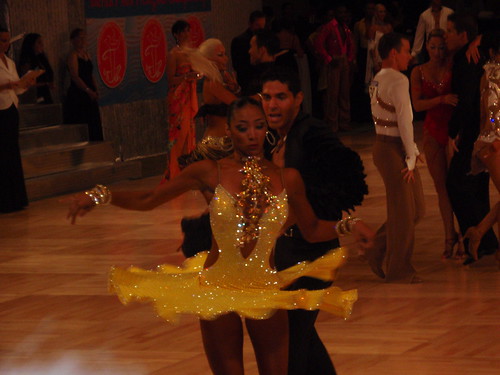
Matt and Karen Hauer, semifinalists in American Rhythm and second-place finishers in the National Mambo championships, who teach at my former studio. He does do a mean Mambo, I think second only to Jose DeCamps’s, and they’re young and in love and cute and their dancing reflects all that 🙂
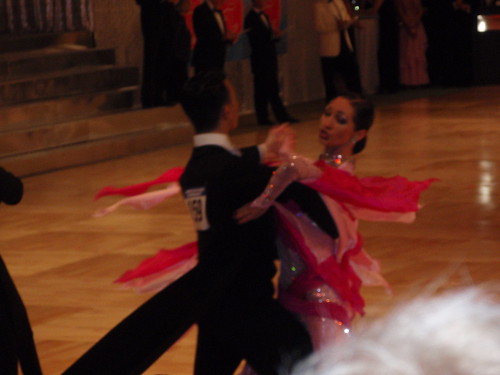
America’s sweethearts, Anna Mikhed and Victor Fung, second-place, as always, in International Standard. Okay, they may not be as perfect technique-wise as Jonathan Wilkins and Katusha Demidova, but they’re the king and queen of charm, those two.
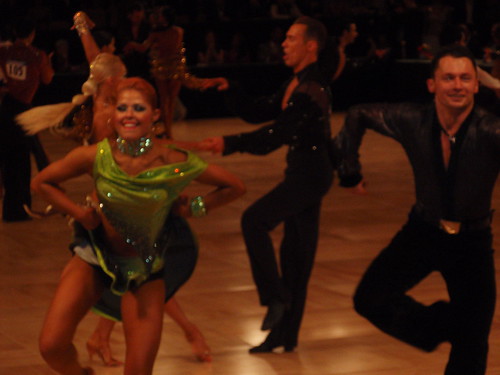
The adorable Anna Trebunskaya (from Dancing W/ Stars) and her new partner, Pavlo Barsuk. They placed sixth in the finals, which is excellent for them.

Hehe, am I a paparazzi in the making or what? Here’s her hubby Jonathan Roberts (the brown-haired guy here, also of DWTS) intently watching her. She’d look out in the audience for him and he’d give her a little wave and a wink and she’d smile like she was on cloud nine. So cute!
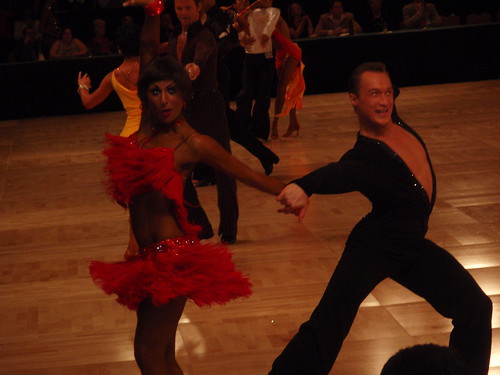
Very sexy Latin couple that I like a lot, Nikolai Shpakov and Tatiana Banko. Friends keep telling me Nikolai (who resides in NY) would be a good teacher for me … But of course I am not listening since I can’t afford ballroom lessons anymore…
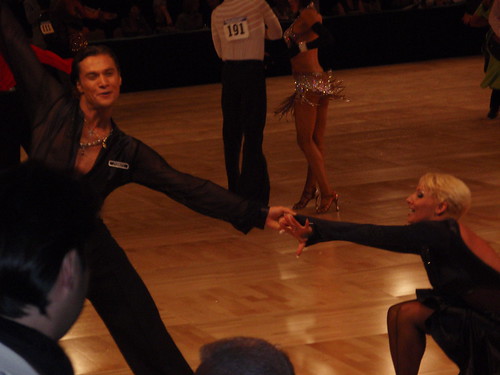
Aw, the just-displaced now former National Latin champs Andrei Gavriline and Elena Kruychkova. They are an immensely good couple and no one flies across that dance floor like Andrei. He’s truly beautiful to watch; so slender and light-footed his feet sometimes look inches above the parkay. And I certainly don’t think it’s impossible for them to get their title back at some point in the future; I just think others need to be given a chance as well. And this was simply Max and Yulia’s year.
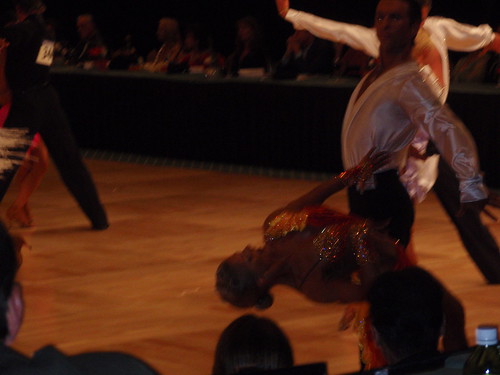
Speaking of the new champs… look at Yulia’s gorgeous arch! How is she even supporting herself like that?
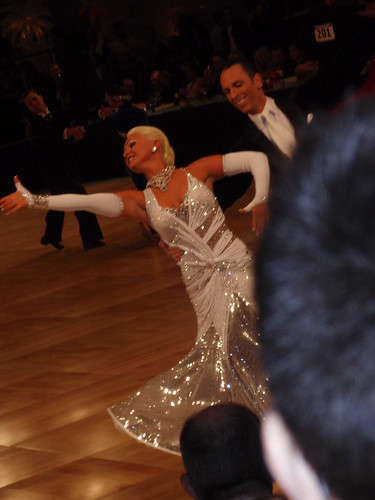
An American Smooth couple I like, Eulia Baranovsky and Stephen Dougherty. I actually thought they’d win, but they placed fourth or fifth. So, I was off on that! I think that couples like these two and the winners J.T. Damalas and Tomasz Mielnicki are bringing the life back into what was becoming a rather staid and boring style. The Smooth championships, placed between Latin heats though they were, were actually really exciting to me for once.
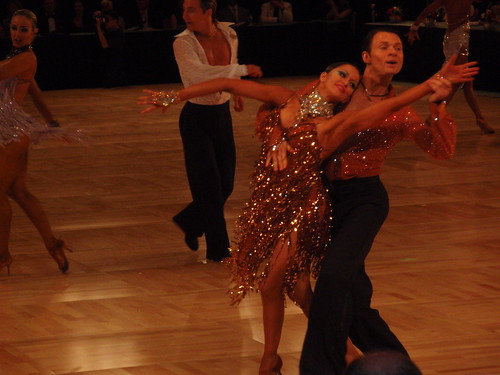
Another Latin couple, Andrei Strinedko and Olga Kinnard, who caught my eye big time this comp. A lot of women wearing these shiny gold dresses this year… What I really love about this photo though is that they are doing my very favorite Latin dance step in all of life, a Samba roll in shadow position. From here, they’ll arch far back together in beautiful unison, then they’ll bend way forward from the waist and then back again making a circle with their upper bodies while doing a hip-rolling side step across the dance floor. It’s hard because you have to be in perfect harmony or you’ll step all over each other’s feet or bop him in the crotch with your butt or whack him upside the face with your arm (I know all of this because…) , but gorgeous when done properly 🙂
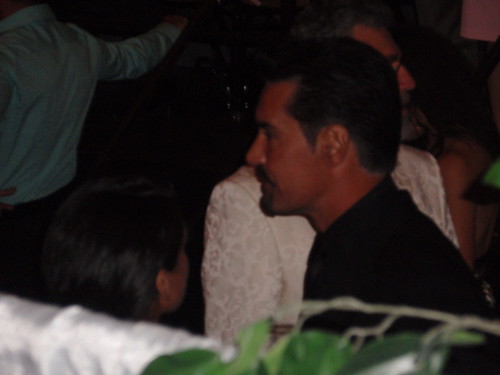
Another proud paparazzi photo of mine 🙂 This is Nick Kosovich who designs the dresses for Dancing W/ Stars (and he appeared in the show a couple of seasons ago — partnered Tatum O’Neal). When he was on the show I thought he was a bit nerdy-looking, but after seeing him in person at the last few competitions, I realized how good-looking this man actually is. Tall dark and handsome Aussie! He’s retired from competition but at Blackpool did this James Bond-styled showcase with his partner, who I’m pretty sure is his wife 🙁 and they really blew me away, which is highly odd since they’re Standard dancers. Anyway, the fact that he is so gorgeous makes my former stupid “breast” experience with him all the more embarrassing… (he was the “Austrailian guy” / “LeNique guy” — as I later found out — in this post).
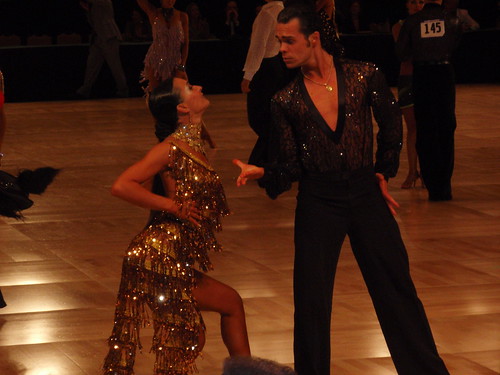
More Latin favorites of mine — Delyan Terziev and Boriana Deltcheva, who placed third, moving up a whole three notches from last year! Good for them; they’ve been working very hard and they deserve it. To me, this couple is one of the most artistic. She moves just like a spider and she’s just bewitching. She kind of reminds me of a Latin, raven-haired version of ballerina Janie Taylor, with her kind of ethereal, goddess-like sexiness.
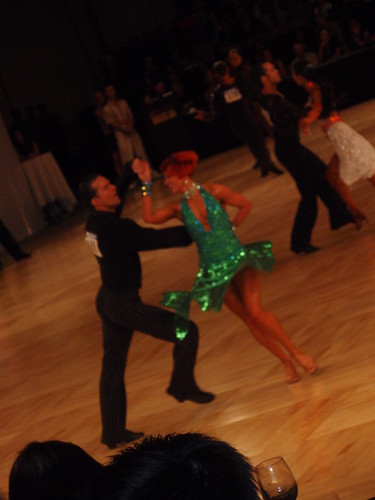
Andrej Skufca and Katarina Venturini from Slovenia who competed in the Open-to-the-World Latin category on Saturday night. This is the competition I was hoping my favorites Slavik Kryklyvyy and Sergey Surkov would participate in, as they did last year, but oh well. Andrej and Katarina (4th in the world in Latin, right behind Slavik & partner Elena) were the only top couple to compete, so it was rather boring; they easily took first. For some reason, Max & Yulia didn’t stay and compete in this category, like they did last year. Not sure what happened. Maybe they were too tired. I hope no one was injured … that’s happened before in competition, couples injured during last-minute practice. Anyway, I loved Katarina’s bright emerald dress. Looked spectacular with her carrotty hair (which I personally love, though I know that opinion is most definitely not shared by all 🙂 )
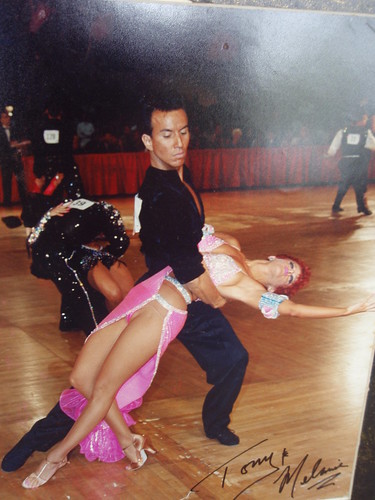
Look who this is!! They had the hallway leading down to the ballroom lined with blown-up pictures of former champions. This one’s of Tony Meredith and Melanie Lapatin (choreographers from SYTYCD) in their heyday, circa 1995! Look how young he is — such a little cutie!
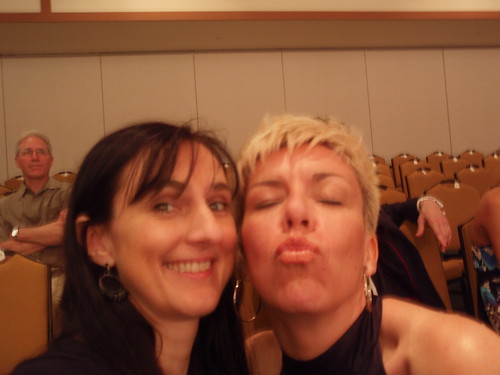
Ewwwwww!!!! It was some ungodly hour of the morning and comps were still going on (judging by the rows behind us, I think many departed the ballroom already, save us insane diehards) and I, not being a late night owl, am half dead here, no makeup and flat as a pancake hair thanks to the lovely Florida humidity. Plus the angle gives me a quintuple chin. Oh well. Michele, my roommate for the comp, is being herself 🙂

Okay, I am almost done, I swear. I took one day off from comp-spectating and went to Epcot Center. I’ve never been to Disney World though, growing up in Phoenix, went often to nearbyish Disneyland as a child. So, of all of the parks, I chose Epcot because I figured, not to sound like a dork, but I so loved the “It’s a Small World” ride at Disney as a kid, I figured I’d have the most patience and respect for one that introduces children to the world beyond our borders. But I found it disappointing, and this picture epitomized why. It was so Disney-fied — the cartoons completely overtook the exhibits. Everything was so cheesy, not at all educational. “Viva Donald”?? Great way to introduce kids to a foreign language. Maybe I’m misremembering things and my child’s mind over-glorified them, but, a bunch of silly dolls though they were, that Small World ride really made me promise myself that I’d go to Argentina, Holland, Spain, etc. one day. The dolls were so sweet and their costumes so beautiful. And everyone singing that song in their native language sounding so mellifluous — definitely made me so curious to hear more (and I did take a ridiculous amount of foreign language classes in high school and college). And who wouldn’t be enthralled with Africa by that nutty laughing hyena! I don’t know, maybe if I went on that ride again, I’d feel differently, but it definitely gave me an appreciation for foreign culture as a child. I can’t imagine this doing the same at all. Kids are too busy laughing at the stupid cartoon characters, and the adults buying all the horrendously cheesy souvenirs.
A great celebration of Italian culture for sale. It was like you paid $75 just to be able to buy a bunch of souvenirs. I don’t get it…
This guy demonstrating how to extract pearls from oysters in the Japanese souvenir shop was okay. Demo was interesting and the guy pretty flamboyant.

Returning to NY. Could they have blurted over the loudspeaker one more time at the Orlando airport that the alert level had been raised to orange / four, and we were all to exercise great caution in leaving bags unattended, etc. And then there had to be some crazy hurricane off the coast of North Carolina. I’m a nervous flyer man! Fellow fearful flyers have recommended Valium, but I don’t like drugs. I much prefer alcohol. In case of emergency, you can always talk yourself out of being drunk; not the same if knocked out cold by prescription medication! This wine, by Best Cellars, was pretty good.
Anyway, okay I’m done, I’m done! Thanks for humoring me and my ballroom fetish, you guys 🙂
Reading Dance beat’s coverage of sytycd
Originally uploaded by swan lake samba girl via mobile.
They thought pasha had most versatility though not technically best dancer & anya was booted bc solos can’t showcase ballroom technique.