THE BRIGHT STREAM at ABT


David Hallberg in Ratmansky’s The Bright Stream, Rosalie O’Connor photo.

I’m not exactly sure yet what to think of this ballet, which made its premiere at American Ballet Theater last week. There are a couple more performances left this week and I think I may see it one or two more times. Right now I kind of feel like the history of the production (as told by Marina Harss in ABT’s Playbill) is more interesting than what I actually saw.

According to Harss, the production was originally choreographed by Fyodor Lopukhov and premiered in Leningrad in 1935. But Stalin hated it so, he banned it, and eventually even sent the man who helped write the libretto to the Gulag. It was the last ballet Dmitri Shostakovich ever composed. Alexei Ratmansky (artistic director of the Bolshoi from 2004-2009) restaged it during his reign there, and the Russians loved it.

With a history like that, you have to wonder what it was that angered Stalin so. I can’t see it.  I just see it as a rather silly ballet – kind of reminiscent of Shakespeare’s Midsummer Night Dream but not quite there – that takes place on a collective farm during one harvest season. According to the newspaper Pravda, Harss writes, the producers’ crime was “balletic falsehood,” meaning, she says, it wasn’t a realistic portrayal of what people are like who live on a collective farm. In other words, there was too much silliness, and farmers are serious workers, not goofs. But Ratmansky explains that, in reviving the ballet, he was attracted both to the “lovely, danceable” music and the lightly humorous vaudevillian aspect of the tale, as well as to an underlying darkness, an edge, he found in Shostakovich. “There is always something hidden in Shostakovich,” he says.

To me, that’s fascinating, and is the reason I’m going to need to see it again … and the reason I’m going to need to listen to more Shostakovich.

I think, though, the problem to me may have been more that the Russians have a keener sense of how to put on something like this, where basically every role has bravura parts. I plan to go see the Osipova / Vasiliev / Simkin cast this week to see if I feel differently about it. I saw the third cast – Veronika Part as the main character, Zina (and Part was beautiful, and the one perfect thing I felt about this cast – she was the heart and soul of the ballet), Alexandre Hammoudi as her straying husband, and Cory Stearns and Stella Abrera as the main ballet dancers in the theatrical troupe that comes to town and shakes things up. I liked Cory too. He had the cross-dressing role that David Hallberg is pictured in above and he was very good. He’s a good actor, good with both comedy and romance and has a charming, very stand-0ut stage presence.

Anyway, the plot is rather complicated, and when I expressed that to my friend she laughed and said she’d given up on the synopsis and decided just to enjoy the beautiful music and the humorous dancing. She liked it much better than I did, probably because she decided to stop trying to figure things out and just enjoy… The plot: Zina works as a local amusements organizer. Her husband, Pyotr, has a wandering eye. When a traveling theatrical troupe comes to town to stage a ballet, Zina recognizes the main ballerina – they once took classes together. They dance together, and reminisce — it’s really Zina reminiscing about her dancing past (and Part did this just beautifully) – while Pyotr becomes enchanted with the ballerina. There are also a couple of older, long-married dacha dwellers, who are rather goofy and humorous (danced by past ABT greats Victor Barbee and Martine Van Hamel). The male dacha dweller falls for the ballerina, and the female becomes enamored of the male ballet dancer. When it becomes clear how attracted to the ballerina Pyotr has become, Zina begins to cry. The ballerina calms her, promises her she has no intentions of returning his affections, and suggests they all play a trick on the married dacha dwellers and on Pyotr whereby she will dress as the male ballet dancer and the male ballet dancer will dress as her. So, that’s why the whole cross-dressing thing happens. There are many subplots as well, one involving a milk maid and her companion, a handsome tractor driver (who decides to dress as a dog), but this theme of married man falling for someone who is not his wife, then realizing how much he does value her, is the main theme of the ballet.

It was pretty funny to see Cory Stearns try to dance on pointe, but funnier to watch his character get carried away with the spread-legged, very masculine-looking jumps in that white sylph dress. He and the ballerina are, after all, ultimate hams in need of audience applause, so it makes sense that he forgets himself for a time and starts really acting like a man. I really wonder how David Hallberg does that part – and that makes me want to see his cast as well. Stella Abrera was fine as the ballerina, and mildly funny when she becomes a boy, but she’s not as spectacular of a dancer as, for example, Natalia Osipova, and I’d think that role should go to an allegro dancer like her. I imagine Osipova must be absolutely perfect in that role (since she can do mind-blowingly crazy high jetes better than many men).

Alexandre Hammoudi did well as Pyotr, though there didn’t seem to be a whole lot to that role, which makes me curious to see Marcelo Gomes and Ivan Vasiliev in the part.

I feel like, because the story-line is so slight, and because, as I said earlier, practically every role has some bravura parts, that this is a ballet that needs really spectacular dancing, that needs people cast in every part who are the kind of dancers who are constantly saying, “Hey, look at me, I can jete to the ceiling!” or “I can develope over my head!” or whatnot. And ABT dancers just aren’t trained to be that way – at least most of them aren’t.

One other gripe is the costumes, particularly for the men. The blasted pants. The mens’ lines were clumsy and unfinished and I think it was because the pants were too restrictive. It’s unusual that every single man would be unable to do a proper straight-legged jete or lift his leg more than a couple inches off the ground in arabesque – especially Gennadi Savliev, who always comes through on the stunning athletics. It had to be the pants. I understand why Ratmansky wanted to set the period with the costumes, but as with classical ballets, can’t the tops be the period-setters and the bottoms just be regular tights? Ballet is all about form!

Did anyone see the other casts yet?
ABT’s LADY OF THE CAMELLIAS


(Photo of Cory Stearns and Irina Dvorovenko in John Neumeier’s Lady of the Camellias, taken from ABT website – click on photo for link).

I so love this ballet. It’s my favorite ABT is putting on this season (since there’s no Manon or Romeo and Juliet). I went to see Lady of the Camellias Saturday night – out of curiosity, went to see the new cast – Cory Stearns and Irina Dvorovenko – and just came away from the Met feeling like I had the fullest, richest, most rewarding night at the ballet this season. I just feel like something about the minimal, but completely realistic sets, the authentic and beautiful period costumes (both costumes and sets are by Jurgen Rose), the depth of emotion conveyed by the story, the heartbreaking story itself, the book it’s based on, the gorgeous partnering, all just really drew me in and made me feel like I was inside of the narrative.

First, I love how there are no curtains – you just walk in to the auditorium and there’s the open stage;  you walk in on the set. And then the first dancer comes out on stage before the chandeliers have risen to dim the auditorium’s lights … so it’s not like a performance at all; it’s like you’re eavesdropping on the characters and their story.

And I love how at points the dancers use the front side of the stage.  You feel like they’re right above you. And you can watch both side stories – taking place there – and the center story, taking place center stage – at once.

I should say, this is the story of a younger man, in love with an older woman – a famous Parisian courtesan (the text is based on the 1849 novel by Alexandre Dumas, fils) who is dying of consumption. It’s a tragedy, as, through the meddlings of others who don’t want them to be together for various reasons – they are torn apart.

Cory Stearns was perfect as the younger man, Armand Duval. He danced very well – executed all of those seemingly impossible but beautiful lifts 🙂 , and he really brought his character to life. He is a natural actor. Either that or he has acting training, because he’s one of the best in the company at that, in my opinion. I love Diana Vishneva in the main role – Marguerite Gautier (and my friend and I passed Diana, holding flowers and still made up, as we were walking from the Italian restaurant where we had dinner to the Met), but I thought Dvorovenko did very well too, danced beautifully, had strong chemistry with Stearns, and overall fit her role as well.

I also loved the supporting cast. Gennadi Saveliev doesn’t often impress me, but wow, he did Saturday night in the role of the party attendant who’s having big fun with that horse whip, holding it next to his pelvis and making suggestive movements, and all that. He was a lot of fun, and he danced the bravura parts spectacularly. Luciana Paris shone as his partner, the sultry, hip swaying, Mlle. Duvernoy, and Melanie Hamrick was also radiant as Olympia, Armand’s would-be mistress, had he not been so in love with Marguerite. Vitali Krauchenka and Grand DeLong were totally believable as, respectively, Armand’s father, and the regal, all-powerful angry Duke who wants Marguerite for himself. And finally, Stella Abrera danced beautifully as Marguerite’s reflection of herself (or Manon Lescaut in the ballet-within-the-ballet, however you want to see it). Blaine Hoven was a good partner for her, as Des Grieux. His ballet technique is near perfect – even someone without a huge amount of ballet training can tell that – and I think he is acting and emoting much better than before, though I still think he has a ways to go before he might be considered principal material.

The pianists (music is Chopin) – Koji Attwood, Nimrod Pfeffer, and Emily Wong – were brilliant. They deserved their substantial applause at the end, during curtain calls.

Everything just came together to make a really memorable ballet. And these weren’t even the “star” dancers – these were the “up and comings”! The choreographer, John Neumeier, originally created the ballet for the Stuttgart Ballet. He currently runs the Hamburg Ballet (both companies being in Germany, of course, though I think Neumeier is American). So many of my European friends think ballet is so much more alive in Europe than in America, and they enjoy going there so much more than here. I can see why. More Neumeier and MacMillan, Kevin McKenzie!

ALL DAY AT ABT: ALL AMERICAN AND ALL ASHTON PROGRAMS

Last Saturday I had my first crazy ABT day where I spent the whole day at Lincoln Center, seeing both matinee and evening performances. I’ll do the same tomorrow with two Sleeping Beauties – can’t miss Alina Cojocaru (who I’ve never seen before) guesting from the Royal Ballet in the lead, and then in the evening the spectacular Natalia Osipova.

Anyway, last Saturday the matinee was their All-American program; the evening was the All-Ashton. The All-American opened with Twyla Tharp’s Brahms-Hayden Variations, which I’m sorry to say is the first Tharp that’s bored me. I just couldn’t connect to it. It had none of her trademark thrilling throws and lifts and clever partnering or dramatic, actable parts, and none of her enlightening contrasts between ballet and other forms of dance. Not that I saw anyway. I think the excerpt the company performed during the opening night gala was the only part I liked. There were good dancers – Marcelo Gomes, Stella Abrera, Herman Cornejo – but they didn’t seem to have that much to work with. It was just kind of lyrical gaiety. Like Mark Morris.


Then was Paul Taylor’s Company B, which is always fun – especially when Craig Salstein dances the hotly dorky guy in “Oh Johnny Oh” and Herman Cornejo the flashy “Boogie Woogie Bugle Boy,” but somehow it lost some of its magic on the large Met stage. I don’t know – I think it plays better at City Center – you somehow miss the silhouettes in the back at the Met, or you don’t connect them to what’s happening center stage as well.


And last was my favorite of the day, Robbins’ Fancy Free, this time starring Sascha Radetsky (image above, from here) as the cocky, sexy Latin sailor, Carlos Lopez as the dreamier one, and Daniil Simkin as the little acrobatic one. The two main women were Maria Riccetto as the girl in yellow whom the guys originally approach, and then Isabella Boylston as the girl in pink who momentarily gets interested in hot cocky Latin guy. Well, Sascha Radetsky completely took my breath away here. Before he had his momentary hiatus in with Netherlands Ballet, I’d always thought he was cute and a very solid, precise dancer, but he couldn’t act. I think he must have taken acting lessons in the Netherlands because he’s just so much better now. I really believe him in each role I’ve seen him in. And he really inhabited this sailor. He was really so compelling to watch; I couldn’t even focus on Daniil and his crazy sky-high jumps with Radetsky on the same stage.

Hehe, but one thing that really stood out for me was Isabella Boylston’s back-leading! All throughout ballroom training we were yelled at ad nauseam  — not just me but all the women — for constantly back-leading. And that’s because grown women generally pick up dance steps a lot faster than grown men (not necessarily true for girls versus boys but definitely true for men vs women for some reason). Anyway, it’s only now I really know why. It looks horrible. I know this is ballet with choreographed steps and not ballroom, but their characters are doing social dance so it really had to look like he was leading her in the steps, not like she was anticipating what he’d so and then turn herself or make the move before he led her to do it. It ended up looking like she was in control, and he’s supposed to be seducing her here. I’m sure they’ll get it with more practice, it just looked obviously wrong and out of character. But maybe that’s just my ballroom training talking because they definitely got the most applause.


The Ashton program opened with Birthday Offering (image above from Dance View Times), which ended up being my favorite piece of the night. Absolutely gorgeous costumes (by Andre Levasseur) and what lovely variations with fast, fancy, very original footwork for the women. Stella Abrera, Simone Messmer, and Gemma Bond in particular stood out to me. Hee Seo (my favorite Juliet) danced as well – not in love with the choreography for her variation as much but she has the most beautiful Alessandra Ferri feet. She and Veronika Part both!

Then came the Thais Pas de Deux, which was performed by Jared Matthews and Diana Vishneva. I can’t wait to see Hee Seo and Sascha Radetsky perform this at the end of the month. I saw them in rehearsal and they really took my breath away. They’re so sweet together, and they really bring out the beauty of the choreography in a way that Diana and Jared as a partnership just didn’t, in my mind. Diana and her melodramatic curtain calls really crack me up. At first they annoyed me but I’m beginning to accept that they’re part of the performance for her and they’re just her. Who knows, maybe someday I’ll find it endearing.

But as far as her dancing, she’s hit or miss with me. I haven’t gotten around to writing about it yet, but I absolutely loved her in Lady of the Camellias. She brought so much more to the role than Julie Kent had the day before and she really brought me into the drama of it all – she and Veronika Part both (who danced the Manon role). And her dancing was gorgeous. She and Marcelo were excellent in that. A performance to see again and again (if ABT would only make a DVD of it…)

Then was The Awakening Pas de Deux from Ashton’s Sleeping Beauty, danced by Veronika Part and David Hallberg. It’s funny but choreography can look so completely different on different bodies and it looked like a wholly different piece than when Paloma Herrera and Cory Stearns danced it on opening night.

Finally, was The Dream, Ashton’s version of Midsummer Night’s Dream. Honestly, I was getting really tired by this point and I’ll have to see it again. I did really like Cory Stearns as Oberon. He is another dancer who’s a hit or miss with me but I found his Oberon was endearing while still being rather demanding with Titania up front. He did a good job, and he dancing was beautiful. Alexei Agoudine was a lot of fun as Bottom (who’s on pointe here, unlike in the Balanchine version and has a lot more to do), and Daniil Simkin was Puck. I enjoyed his Puck but found myself unable to get Daniel Ulbrich’s Puck out of my mind. I’ve been told I have to see Herman Cornejo in this role. And so I hope to before the season ends.

In between performances I had ice cream in the park behind Lincoln Center cinemas, where I saw Blaine Hoven and Marcelo, and then I went and had a glass of wine in the outside patio area of the newish Alice Tully Hall cafe. It’s nice out there when it’s warm, which it was for part of the time. So far we seem to be having another chilly summer. Tomorrow I have two friends who, happily, are as crazy as I am, so I will have people to hang with instead of just my book 🙂

ABT OPENING NIGHT GALA MET SEASON 2010


Photo from inside the gala tent last night at American Ballet Theater’s opening night gala taken from NY Social Diary, who, sadly, don’t seem to have any pics up of Irina Dvorovenko in her beautiful red gown. It was one of the most beautiful dresses I’ve ever seen — long and many-layered but each layer seemed to be made of a light, sheer piece of fabric, so the whole thing looked light and diaphanous, though it wasn’t really see-through, just looked that way. Anyway, if anyone finds a picture of her, please let me know! Roberto Cavalli probably designed it…

Anyway, so the opening night gala was last night. It was loooong — one of the longest I’ve seen. We didn’t get out until 9:30, and it began at 6:30. It opened with an excerpt from Frederick Ashton’s Birthday Offering, of seven couples waltzing at what seemed to be a party (I haven’t seen this ballet), with Irina Dvorovenko and Maxim Beloserkovsky the main couple.

Following that was a series of introductions and thank yous by Kevin McKenzie (Art. Dir.), Blaine Trump and Caroline Kennedy (the two women were honorary chairs of the evening, along with Michelle Obama, who wasn’t there), and then David Koch who has funded the upcoming production of the company’s Nutcracker this winter.

Then, a group of ABT II dancers performed an excerpt of Edwaard Liang’s Ballo Per Sei, which was a contemporary lyrical piece, set to Vivaldi. I recognized a SLSG favorite — Irlan Silva — right away.

Then came the “Rose Adagio” from Sleeping Beauty, performed by Michele Wiles, with Sascha Radetsky, Craig Salstein, Gennadi Saveliev, and Roman Zhurbin as suitors. I don’t think I’ve ever seen this performed so well. Michele really held those balances, and she was so vivacious! Both she and Paloma Herrera, who danced a later excerpt from SB later in the evening, really embodied a young Princess Aurora very well. Michele got loads of applause – the most thus far of the evening.

Then came David Hallberg and Natalia Osipova’s Olympic version of Giselle — this an excerpt from Act II. People laughed and shook heads in amazement at Osipova’s sky-high ballons and sprightly jumps and leaps. She is really incredible. And then at the end when she jeted off and he followed her, it was really beautiful. But athletically astounding as it was, it was still moving; nearly brought tears to my eyes. I mean, how do you manage to do athletic feats like that and make it seem like you’re a light, other-worldly spirit instead of nearly exhausting yourself to death? I don’t know if I’ll ever be able to see anyone else dance Giselle again besides Osipova now. I saw a couple of etoiles from the Paris Opera Ballet perform it at the Guggenheim a few months ago and all I could think was, “wait, where’s the ear-high develope?” and “that arabesque penchee is nowhere near 6:00!” Natalia Osipova has spoiled me.

Then came Veronika Part and Marcelo Gomes doing my favorite gala fare, the Black Swan pas de deux. They were magnificent. Veronika kept doing these equally astounding crazy penchees, and she was so tantalizing with all of her faux White Swan poses! She was really a bad tease! And perfect fouette sequence for her, and his jetes and all — they got loads of applause too (oh, and so did David and Natalia).

Then was the beautiful Thais Pas de Deux by Ashton, danced by Diana Vishneva and Jared Matthews. I recently saw this rehearsed at a studio visit by Hee Seo and Sascha Radetsky, and it looks so different onstage far away and with costumes and all. It looked a lot more like MacMillan than I remembered. I loved it; Diana and Jared did very well but I still can’t wait to see Hee and Sascha. For her gala gown, Diana was wearing a very interesting-looking Japanese-styled dress.

Ending the first half of the evening was the finale of Tharp’s Brahms-Hayden Variations, danced by a group of seven couples, replete with trademark Tharpian flash and crazy lifts and high energy. Can’t wait to see this now either. I have in my notes, “who is dancing with Hammoudi?!” When I looked at my program, I saw it was Stella Abrera. She is really back and really on!

First dance after the intermission was the “Kingdom of the Shades” scene from La Bayadere.  Beautiful as always though it seemed some of the dancers were not completely in unison.

Then came Paloma Herrera and Cory Stearns dancing the Awakening Pas de Deux from Sleeping Beauty, which was followed by the wedding pas de deux from that ballet danced by Herman Cornejo and Xiomara Reyes. I particularly loved Paloma. As I said before, she and Michele Wiles really embodied the sweet, youthful spirit of Aurora. Paloma and Cory danced very well together. They seemed like a real couple.

Then was my second favorite excerpt of the night — the Act III Pas de Deux from Neumeier’s Lady of the Camellias, danced by a very passionate Roberto Bolle (who received a load of applause when the curtain initially opened on him) and a very dramatic Julie Kent. Every excerpt of this ballet makes me want to see the whole. Not much longer now — it begins next week, and I can’t wait. I think they received the greatest applause of the night. Audience really went wild, and it’s partly because he’s so internationally famous, but also I think because they just did so well with it. This seems to be a ballet that requires both good acting and excellent partnering ability because some of those lifts… The pianist, Soheil Nasseri, came onstage too for a bow at the end. He was very good.

Next to last was the Act III Pas de Deux from Don Quixote, danced by ABT audience faves Ethan Stiefel and Gillian Murphy. There was a slight mishap with the lift where he throws her up, she does a crazy twist in the air and then he catches her and the fish dive wasn’t hands free, but they each danced spectacularly on their own. It looked at one point like she was doing quadruple pirouettes between some of her fouettes, and he nearly kicked his leg to his forehead during some of his jumps and then did a flashy little jump during his fouette sequence that had the audience screaming.

The evening ended on a modern note  with David Parsons’s Caught, danced by Angel Corella, who, expectedly did an exquisite job. The audience, many of whom hadn’t seen that dance before, seemed so spellbound they almost forgot to clap right away. Angel’s so cute 😀

And finally, everyone who danced came out onstage at the end and took a little bow while the orchestra continued to play. Dancers still in costume — Daniil Simkin, Craig Salstein, Gennadi Saveliev come to mind — did a flashy trick, the “Shades” did a little dance in unison, and then dancers who danced in the first half came out in party gown (which is how I fell in love with Irina’s dress).

Fun evening. During intermission I checked my cell-phone and found a text from a friend who saw me sitting in orchestra from the side par terre, where he was sitting. So I texted him to meet me afterward, and we went for martinis, clam chowder and crab cake sandwiches at Ed’s Chowder House across from the Plaza, my favorite post-ballet place to go since it replaced Center Cut mid-NYCB fall season. They have a TV in the bar, and I was happy that the Yankees were still on. So I saw A-Rod hit his game-tying home-run… But how my friend ever saw me in that enormous Met crowd I’ll never know. Though many arrived late, house ended up being packed.

Oh, and I almost forgot: at the beginning of his speech, Kevin McKenzie introduced several dancers – each representing an era of ABT (this being the company’s 70th anniversary)- who all came out and took a bow. Included were Lupe Serrano, Baryshnikov, Nina Ananiashvili (who got a lot of applause), Alessandra Ferri, Natalia Makarova, and cutie Frederick Franklin, who gave a little speech as well. Isabella Rosellini was in the audience, a few rows down from me. I didn’t recognize anyone else in the audience.

ABT AT 70 AT THE GUGGENHEIM

Last night American Ballet Theatre put on a little celebration of its 70th anniversary and gave a little preview of its upcoming Met season (which begins next Monday, May 17th) at the Guggenheim, as part of the museum’s Works and Process events. Dancers from each decade of ABT’s existence — Susan Jaffe, Susan Jones, Donald Saddler, Lupe Serrano, and Rachel Moore – spoke briefly about what the company was like back in the day, and then there was (happily) a great deal of dancing.

Stella Abrera, Marian Butler, Jared Matthews and Sascha Radetsky performed the Lovers’ Quarrel from Ashton’s The Dream (based on Shakespeare’s Midsummer Night’s Dream), followed by Xiomara Reyes and Alexei Agoudine dancing the Titania / Bottom pas de deux from that ballet. I’ve never seen Ashton’s version of this ballet — only Balanchine’s — and the choreography looks so rich, richer to me, in a way, than Balanchine’s (though I know a lot of NYCB fans will balk at that). So, I’ll be looking forward to that. Audience cracked up, of course.

Then, Abrera, Isabella Boylston, and Yuriko Kajiya performed the Shades Trio from La Bayadere. Stella in particular took my breath away. Veronika Part and Eric Tamm then did a gorgeous pas de deux from John Neumeier’s Lady of the Camellias (which I’ve never seen before and now can’t wait to; it appears to be his version of Manon). Though everyone from ABT looks near perfect, everyone just pales in comparison to Veronika. I just can’t ever take my eyes off her. After last night I’m really really looking forward to her in Lady.

Then came the pas de deux between romantic sailor guy and the girl in pink from Robbins’ Fancy Free, which was danced well by Sascha Radetsky and Isabella Boylston (who has probably developed a fan base among Natalie Portman haters). Judging by the applause and a few words I overheard, the audience really took to them. Part and Abrera then performed the La Bayadere fight scene between Nikiya and Gamzatti (Abrera is an excellent Gamzatti by the way), and the program ended with the final Don Quixote pas de deux danced sweetly by Yuriko Kajiya and Jared Matthews.

As far as the discussion, interesting points to me were when Jaffe said of all the characters she’s danced, she felt closest to Tatiana in Eugene Onegin (I wasn’t a regular ABT-goer when Jaffe danced and didn’t know they’d ever done that ballet — made me desperately want them to bring it back), Lupe Serrano mentioned that there used to be only one cast per ballet (which we’ve talked about before on this blog as being perhaps preferable to the current system of rotating dancers since it’d be more likely to, like opera, create stars), and Saddler (who began with the company in 1939 and performed in its inaugural season) talked a bit about founder Lucia Chase, who wanted a “star system” for the company, and what it was like to dance ballet at a time when there really wasn’t any here. He said Fokine was the greatest influence on him, as, like Tudor (later a great influence on him as well), each step was reflective of character.

MORE ON AMERICAN BALLET THEATER’S AVERY FISHER SEASON


Daniil Simkin and cast in Benjamin Millepied’s Everything Doesn’t Happen at Once in Gene Schiavone photo, courtesy of ABT; all photos by Gene Schiavone (except for Arron Scott headshot below and bottom picture).

Just to let people know, as the photos shows above, the guy who was flinging himself into the group lifts in the first cast of the Millepied was Daniil Simkin; in the second cast it was Arron Scott (below). The program notes only gave a special mention to the two dancers doing the pas de deux and a lot of people were asking who the main soloist was.


Anyway, here are a few more reviews:

Here is James Wolcott on opening night gala (and our fab Shun Lee dinner afterward 🙂 ), here is Apollinaire Scherr’s FT review; and here are more of Apollinaire’s thoughts on her blog, Foot in Mouth. I’m surprised there aren’t more reviews — this was a pretty big season, with three world premieres — but that’s all I can find at the moment. (Update: Robert Greskovic’s WSJ review just went up; thanks to Meg for letting me know.)

Re the Wolcott write-up: I forgot to mention the models — Iman and Veronica Webb, who, instead of A.D. Kevin McKenzie, thanked the gala sponsors and introduced the program — screwing up Benjamin Millepied’s name. It wouldn’t have been such a big deal if they wouldn’t have been so giggly over it. It seemed like they were reading their notes for the first time and were really unprepared. I really don’t know how to pronounce his name either — I’ve always said the last two syllables to rhyme with plie (without the “l”) but have been told that’s wrong. But damn did ABT get a lot of press for signing them on. Just Google “ABT Fall 2009 Season” and it’s all about Iman.


(Gillian Murphy, Cory Stearns and Eric Tamm in Aszure Barton’s One of Three)

Anyway, I saw four of the six programs, saw the Ratmansky and the Millepied ballets four times and the Barton three, and they each grew on me the more I saw them. The Saturday matinee was my last performance and I found it by far the best. I felt like the dancers were finally comfortable with the new dances, knew what they were all about, and really made them meaningful. I described the ballets here.

Oh and regarding SanderO’s comment on that earlier post: yes, I do need to see the story in the dance. The dancer and choreographer won’t pull me in at all if they don’t each tell me some sort of story. That doesn’t mean the ballet has to be a traditional full-length dramatic novel or something with a clearly defined beginning, middle, and end, inciting incident, rising action with crises 1,2, and 3, climax and resolution, etc etc. but there needs to be some kind of story; there needs to be some intention in the abstraction. A lot of critics use the word “evocative” — a dance needs to be evocative of something, and I just mean the same thing. If there isn’t something meaningful going on, there’s no reason for me to see it. I can appreciate the neat geometric patterns and pretty images, but that’s not enough to make me go.

Anyway, I saw more in Millepied’s Everything Doesn’t Happen at Once on further viewings. At first I thought it was kind of everything but the kitchen sink the way Apollinaire kind of describes, but after several viewings I saw more of an evolutionary, battle of the sexes theme throughout, which becomes a more literal battle by the end. The piece starts with the stage looking swimming-pool like with the dancers making broad strokes with their arms. The stage gets over-crowded and eventually someone in charge — looking rather conductor-like, kind of throws his arms up and dismisses everyone.

Then, there’s a pas de trois (two men one woman), which becomes a double pas de trois (same), which turns into the central pas de deux (man-woman). Throughout there seems to be struggle going on — in the pas de trois the men kind of manipulate the woman around, until she’s practically on her side. In the central pas de deux is in places tender, in places more angsty as if the girl is trying to get away from the guy or fight him in some way, and he is struggling to hang onto her.

By the end, the scene has evolved into a kind of battlefield with marching music and the ballerinas doing those Balanchinian marches en pointe. Except they’re more unsettling than cutesy, like in Balanchine. This is the part where Daniil / Arron gets tossed into the crowd, throws himself with wild abandon at the groups of men, who catch him mid-split, then gets caught up with a bunch of grabbing girls.

Interestingly, the audience laughed when this role was danced by Simkin — I think because he is small and a bit long-haired and it kind of looked like he was afraid he’d be taken for one of them and was trying like hell to assert his masculinity. (I think it would have worked better had the girls been chasing him and then he flings himself into the groups of guys rather than the other way around, but not a big deal).

But no one laughed when it was Arron. It looked far more serious with him in the role — it looked like he was practically getting raped by that rabid group of girls.

Also I noticed with Arron that after the rabid group of girls leaves him alone, he kind of internalized the tauning; there was now an invisible fist punching him all about. It really looked like he was getting beaten up by that thing. But the fist was invisible so it was like he’d been driven mad. It was very unsettling, and I think, with the music and the rest of the action, this feeling is more of what Millepied was going for — not all the high air flips, crazy long spins, and windmill jumps that Simkin is known for and did here. Simkin’s character made the end of the ballet more playful than battle-like.

There’s also a short section where there’s all this marching music and there’s more centerstage chaos with all 24 dancers out there at once and suddenly a group of dancers standing at one corner break into partners and go waltzing through the crowd. But it’s really short-lived, like even courtship is a battle.

I don’t know — that’s what I saw on further inspection. But I could be making it all up. It’s kind of fun with abstract ballets (the ones that have a lot going on in them anyway) to make up your own story. I mean, the way dances get made anyway, as I learned at a Guggenheim event last night featuring ABT’s efforts to adapt ballets to different stages (including this small one in AF Hall, meant for concerts), is that things get changed depending on space, depending on the logistics of the stage, depending on dancers. Whoever knows if the end product is what the choreographer originally had in mind anyway.

I don’t think Millepied’s was a perfect ballet — I found a lot of the bird-like patterns from his recent NYCB ballet, Quasi Una Fantasia, to be out of place here – he didn’t need all that; he should have focused more on the battle — but I found his the darkest, the most thematically clear and the most absorbing.


Stella Abrera and Gennadi Saveliev in Alexei Ratmansky’s Seven Sonatas.

The Ratmansky grew on me, as did the Barton. On the last day, Michele Wiles danced the main female character (in the long white ballgown) in the Barton and I loved her. She gave the character a real story. When she comes out onstage she is all bitchy and glamorous, but Michele it’s really an act; she is seeking attention from the main man (in that cast Blaine Hoven) while trying to maintain her haughty demeanor so as not to be shown up by him if he dismisses her. At one point, she extends her arm out to him, as if he’s supposed to kiss it but he turns and runs offstage. She crumbles. It’s heartbreaking.

I also really loved Craig Salstein, Jared Matthews and Daniil Simkin in Barton’s second cast (Matthews and Simkin alternated parts opposite Salstein). They danced a section in the second part and all three made it clear (Salstein most so) that they were in a little competition for the girl’s attention. The girl (Luciana Paris), meanwhile, was just dancing on her own, in her own world, paying them no mind at all. It was hilarious.

But back to Michele Wiles for a minute: a wonderful ABT patron gave me her ticket for a company class, which she couldn’t attend, and Michele seemed so sweet — smiling out and waving at people during the class and even during warm-up.

Also, can some choreographer please please please create a little solo or some kind of dance just for Gillian Murphy! Please! During that company class, during the center floor work when the dancers divided into groups and did turns in a diagonal down the center, Gillian blew everyone completely away. She was like a tornado. But a technically perfect tornado! Everyone in my section literally began to laugh and shake their heads in amazement. She needs something to showcase her technical brilliance and athletic prowess. C’mon ABT!

Each of the dancers brought their own special thing to the Ratmansky. Christine Shevchenko (an up and coming corps member) was gorgeous with the role created by Julie Kent (danced opposite David Hallberg). She was more lyrical than Julie, with flowing, expressive arms that resembled Natalia Makarova in Other Dances. Julie’s arms were more staccato. Hee Seo, who completely blew me away as well, did a combination of the two — by turns feathery and lyrical, and modern and staccato. Alexandre Hammoudi and Jared Matthews both danced David’s original part and they were very different than David. Both connected with their ballerinas much more — when they were left alone onstage they clearly looked about for her, wondering where she was, then accepting they were alone and falling into their solo.

David Hallberg. I can never get enough David Hallberg. He didn’t look around for his ballerina when she left him, but when she returned to the stage, he danced well with her. But when she was offstage, she was out of sight, out of mind with him — he was too busy making Ratmansky’s movement wholly his own. He seems to be a rapidly maturing artist, playing with the music, playing with rhythm, giving some things more emphasis than others. When I first saw him dance this role I thought his “character’s” movement was more modern than classical, but I think that was just because of the way he did one section where he keeps pushing out with his hands, like he’s stopping the air, or stopping something from getting too close. He slowed down that movement a lot, really emphasizing the arms, and then did some ensuing footwork at the speed of light, whereas the others did everything in equal measures -so it didn’t have the same look.


Jared Matthews and Maria Riccetto in Some Assembly Required, photo by Rosalie O’Connor.

ABT also put on Clark Tippet’s Some Assembly Required from 1989, a male-female pas de deux evoking a lovers’ quarral replete with difficult-looking angst-filled lifts, struggling pushes and pulls, then more tender making up. It went on a bit too long; some middle parts that were repetitive could have been taken out, but the cast I saw — Jared Matthews and Maria Riccetto did very well with it. Jared is dancing and dramatizing better than ever before, imo.

And the company also did Robbins’ Other Dances, another male-female pas de deux (this one pretty famous) that was choreographed on Baryshnikov and Makarova. I saw both casts — Marcelo Gomes and Veronika Part, and David Hallberg and Gillian Murphy. I liked both — although I think I honestly prefer Tiler Peck and Gonzalo Garcia’s at NYCB. Gonzalo has a smaller body, more like Baryshnikov’s, and I think some of the gestures — like the placing the hand behind the head, kind of primping, looked sweetest on him. Ditto for Tiler. David is dancing very aggressively these days. He’s making the absolute most of every movement — it can be stunning at times, and at times it seems a bit overdone, which it seemed to me a tad here.

I also think that joke on the Kirov dancers getting dizzy and losing their footing because they don’t spot-turn doesn’t come across as such to new audiences. When Marcelo and Gonzalo did it, many in the audience honestly thought the dancers screwed up for real, not on purpose. David really didn’t do the joke because he’s a cheat 🙂 I’m kidding — he did, but he spun, stopped, got dizzy, shook himself out of it, and started the next phrase all in the blink of an eye, so you didn’t even notice he “got lost.”

Gillian was good but it didn’t seem to be a dance that showcased her talents to their fullest. I’ll say it again — I really think she is the most athletic and technically one of the best female dancers in the world and she desperately needs more roles that prove that!

SOME PHOTOS OF ABT’S FALL ’09 OPENING NIGHT GALA


Above photo by Rosalie O’Connor of Everything Doesn’t Happen at Once by Benjamin Millepied; photos below by Andrea Mohin from the NY Times, of Millepied’s Everything (dancers: Marcelo Gomes and Isabella Boylston), and Alexei Ratmansky’s Seven Sonatas (dancers l-r: Stella Abrera, Xiomara Reyes, and Julie Kent).


Here is Gia Kourlas’s review in the Times.

ABT OPENING NIGHT GALA FALL 2009: THREE PREMIERES IN BLACK AND WHITE, AND WOOD


Photo of Veronika Part in The Dying Swan, taken from Vogue; photos of the three premieres coming as soon as I receive them.

After ABT‘s fall season opening night gala performance last night, the really wonderful James Wolcott and Laura Jacobs took friend Siobhan and me out for dinner at Shun Lee (I’d never been there — but wow, excellent excellent food!) and when Laura asked me if I was going to write about the performance, I kind of rolled my eyes and said, “I’ll try!” We all agreed that dance is absolutely the hardest art form to review, especially on seeing a dance for the first time. Let alone THREE dances seen for the first time. With visual art you can stand there all day and examine at it, with music you have recordings and scores, film critics generally see a movie several times before writing a review. With dance you have one chance — often one split mili-second — to remember a half an hour or so of movement, images, patterns, structure, costumes, music, lighting — everything. It’s impossible. Since starting this blog I have so much more respect for dance critics.

Anyway, there were three premieres last night: Seven Sonatas by Alexei Ratmansky, One of Three by Aszure Barton, and Everything Doesn’t Happen at Once by Benjamin Millepied. Also on the bill was a performance by Veronika Part of Fokine’s The Dying Swan. ABT performed, for the first time, in Lincoln Center’s Avery Fisher Hall, a concert hall not accustomed to housing dance performances. (ABT usually holds its fall season in City Center, but changed venues because of City Center’s renovation plans.)

I’m going to be seeing each premiere a couple more times this season and prefer to write after I’ve seen each more than once. But since the season is so short (it ends October 10, this Saturday), I’ll write something up front. These are only first impressions though, and I’ve found I see so many more things with repeated viewings.

Honestly, everything kind of blended together for me. Part of this was because of the sparseness of the Avery Fisher stage — there were no sets, no wings, no curtains — so dancers warmed up onstage before us, giving each piece a kind of Cabaret-like feel; and part of it was because costumes for each piece were all black and white. I remember lots of black, lots of white and the hardwood of that stage.

1) Ratmansky’s Seven Sonatas was performed to Domenico Scarlatti music by three male-female couples: David Hallberg and Julie Kent, Herman Cornejo and Xiomara Reyes, and Gennadi Saveliev and Stella Abrera. Costumes were all white — flowing dresses for the women, classical tights and 18th-Century tops for the men. The movement was a combination of classical and modern and, though the ballet was generally story-less, each couple seemed to have a little narrative: Cornejo and Reyes were the young, playful couple, Herman full of high jumps with many beats of the feet that really wowed the crowd and Xiomara dizzying rapid multiple turns. At one point Herman did this crazy turn in the air, landed on his back, and caught her. Crowd went wild.

Abrera and Saveliev seemed to be a more mature couple, perhaps in mourning. It seemed Abrera was a woman, possibly a mother, who’d lost a child or something — Saveliev seemed to be trying to console her and keep her from self-destructing. It seemed like she kept trying to break free of him and reach out to some invisible thing.

I’m not sure what Hallberg and Kent were meant to represent except maybe a modern couple — they seemed to have the most modern movement. David appeared to be trapped in a box and he kept pushing out; he had a lot of quick movement with fast stops in different directions and a lot of it in parallel — not turned-out — position. Julie had a lot of sharp, staccato movement. They could’ve also been a courting couple: at one point, David was on one knee and he invited Julie to run at him and jump on him. When she did, he took her into this lovely lift. It’s sweet and many in the audience lightly laughed.

The ballet was broken into duets and solos and bookended by two ensemble movements, the first pretty and lyrical, the latter more chaotic as they all perform their very different movement motifs at once, some trying on others’ movement styles — everyone does the staccato arm patterns for a while, etc. At the end, the women lay on the floor and the men wrapped their bodies over them.

One other thing: our David Hallberg is sporting longish hair these days 🙂 I think it looks good, and fun for a change! Funny thing is, he’s so beautiful and glamorous, I tend to get jealous if him, even though he’s a man… which I guess should be kind of odd…

2) Barton’s One of Three was set to Maurice Ravel’s Violin Sonata in G and danced by a whole slew of tuxedoed men, and three women — Gillian Murphy, Misty Copeland, and Paloma Herrera. Why is it that women choreographers tend to use men so much more! (And female dance-writers tend to focus on male dancers 🙂 — is this feminist?)

Anyway, the piece begins with Cory Stearns walking out dressed in a tux and black jazz shoes. He does a little solo and his movements are all modern, angular, which contrasted in an intriguing way with the tux. I don’t know if it was his being a bit weirded out by the curtainless stage (which forced him to walk out in the dark with all of us watching) or whether it was part of the character, but he seemed to have this loopy smile in the beginning, that was really rather endearing. I chatted with a friend during intermission and she felt just the same.

Anyway, soon Cory was joined by more tuxedoed men, and then by Gillian, who came prancing out in a long white cocktail gown with her radiant red hair tied back into a sleek twist. The men would kind of veer toward her, sideways, their bodies leading their heads in, to me, a rather amusing way. Gillian’s character was very haughty, very glam and posh and she acted like she was ordering the men around with her little finger. The men often seemed led by their bodies, moving first with the back, or at times one leg would take a step, the rest of the body reluctant to follow (I noticed that most with Jared Matthews, who I thought was dancing at his best last night). I found this a very interesting movement motif.

Misty Copeland was the lead character in the second movement. She wore a short black and white dress, her costume and character more flirty and wild. But same thing — she seemed to kind of taunt her tuxedoed men.

And third movement was led by Paloma, wearing a black lacey top and black pants. She smiled a lot more than Misty and Gillian, but she seemed to move in a slinky, sexually-empowered way, like a tanguera.

Now that I think about it, though there were many more men here, the women seemed to have all the power. Fun!

3) Next on was Part’s Dying Swan, which was really poignant, as I knew it would be. It’s a very short piece, but it’s funny how the ballerina can really do it however she wants to; I just saw Diana Vishneva perform this in the Fall For Dance Festival and her Dying Swan was very different. Whereas Diana spent most of the time on her toes, bourreeing, Veronika spent more time on the floor, one leg stretched out before her (like in above picture), then rising again to her toes for one more breath. Diana’s swan seemed to flutter about more, like she was fighting death, she lay down only at the very end. Veronika kept holding her arms up in front of her, her wrists bent and her hands cupped over, as if to foreshadow what would happen to her body. In general, Veronika’s swan accepted and approached death more gracefully or willingly, but Diana’s, with that broad wingspan, at times really looked strikingly birdlike. I don’t know if I can say I liked one interpretation better than the other — both were breathtaking and both very poignant.

Did anyone else see both swans?

4) And the program ended with Millepied’s Everything Doesn’t Happen at Once, set to David Lang music that was at times mellifluous and at times cacophonous or eerie. He used a large group of dancers but Marcelo Gomes, Isabella Boylston and Daniil Simkin had the main parts and so stood out the most (and Kristi Boone shone in a smaller role).

There was a lot going on here — both in the music and in the dance, and I felt that, unlike with Millepied’s earlier piece for ABT — From Here on Out — composed to music by Nico Muhly (who was in the audience) — in this one the movement kept up, didn’t let the music outshine it. The stage is set up to resemble — at least to me — a pool. Dancers would gather around it and watch the people dancing in the lit-up center. At the beginning there seemed to be a swimming motif, with large, rounded arm movements resembling breaststrokes. Movement is also evocative of birds as well though, and some of the same lifts were present as in Millepied’s recent work for NYCB, where the women are perched on the men’s shoulders, their arms outstretched sideways.

In the middle part, Marcelo and Isabella have a rather haunting solo. The ballet is generally story-less but as far as I could make out any narrative, it appeared she was sort of struggling against him. He seemed very careful and gentle with her (in sharp contrast to a later, more hostile duet he has with the super-strong Kristi Boone, who seemed to be either Isabella’s competitor or her double), but she — Isabella — nevertheless kept trying to push away from Marcelo as he held her. The duet ends with them walking toward the back of the stage holding hands, connected, but her body is lunging as far as possible away from his. A rather warped relationship.

Then there’s a rather amusing section where bravura dancer Daniil Simkin is struggling with a bunch of women. He tries to break free of them but then he keeps throwing himself into their arms, making them catch him in these rather breathtaking group lifts — one of them ending in a perfect split in the air. And he has a bunch of crazy multiple pirouettes that had the audience audibly gasping. It all went with his character though, who seemed rather crazed, like he may have just escaped from an asylum or something. I kept wondering who else was ever going to be able to perform that role…

I didn’t go to the gala party but in addition to Muhly, I saw Alessandra Ferri in the audience, one of the Billy Elliots, and apparently Natalie Portman was there.

Anyway, I’ll write more at the end of the season, when I’ve seen these new dances a few more times. Here is Haglund’s review.

ABT OPENS AT BARD


…to rave reviews, particularly Benjamin Millepied’s latest:

“Receiving its world premiere performance, Benjamin Millepied’s “Everything Doesn’t Happen at Once” was a knockout.  Contrary to its title, there was a lot happening all the time, as the full compliment of 24 dancers often filled the tight performance space with a busy but ordered beauty.  Solos and lifts popped up like little tornados.  A sensual pas de deux featured Stella Abrera and Marcelo Gomes.  Near the conclusion, lines of dancers moved in a militaristic lock step.

During the final movement Daniil Simkin – a 22 year-old blonde Russian – stole the show. As the other men flung him up and about, he balanced in their raised hands and posed like a bare-chested god. And in solos that went by in a flash, Simkin seemed to tumble in midair, as strong as a gymnast yet light as a bird.

To the kinetic music of David Lang and the stark but effective lighting of Brad Fields, Millepied’s choreography was propulsive and contemporary. After making a strong impression with a new work at SPAC last summer, Millepied showed an even steadier hand here and with a larger compliment of dancers to boot.  Move over Christopher Wheeldon, Millepied is now the ballet choreographer to watch.”

ABT begins its four-day NYC season at Avery Fisher Hall this Wednesday. Can’t wait!


IT’S ROMEO & JULIET WEEK AT ABT, WITH CELEBRATION OF FREDERIC FRANKLIN’S 95TH BDAY


Finally, Pashmina week is here!

I couldn’t find any pictures of the pashmina lifts, but watch this video — two occur around 430-440 and 528-532. By the way, that clip, from a BBC broadcast apparently, is really good — the Royal’s Darcey Bussell talks about MacMillan’s gorgeous balcony pas de deux and then it’s performed by the great Carlos Acosta and Tamara Rojo.

Anyway, last night’s debut cast at ABT was Marcelo Gomes and Diana Vishneva in the leads. It was excellent. The audience collectively rose to its feet right after the curtain went down on the two lovers, dead in the crypt, and hardly anyone sat down or left until after the final curtain call. And a significant amount of people didn’t even want to leave then, after all the lights came up. I don’t think I’ve ever seen quite that kind of crowd reaction before. Diana was the best I’ve ever seen her (she’s really growing on me). The end was a bit melodramatic and overdone, but that aside, her performance was brilliant — perfectly and passionately danced and in character throughout. And the bourrees 😀 Marcelo is always perfect. He’s the lifting king in this very lift-heavy ballet. And he’s of course very romantic and passionate to boot 🙂 He’s never not completely made my night at ABT. He kissed Diana on the lips during curtain call; audience went “awwwwwww!”

Herman Cornejo danced Mercutio, and, believe me, there’s no one better for that part. No one! Audience went wild over him, nearly as much as the leads. Veronika Part replaced Stella Abrera as Lady Capulet. It’s not a dancing role but a very serious acting one. I’ve never seen a more tragic Lady Capulet. I really felt her horror at Tybalt’s death. I almost cried with her. Isaac Stappas was a very good Tybalt, very virile, very threatening, but ultimately vulnerable. And Carlos Lopez was a very good Benvolio — he landed all of his jumps very well 🙂


And 95-year-old Frederic Franklin played Friar Lawrence (and got loads of applause for it when he first appeared onstage — for a minute I thought they were going to have to stop the music so he could take a bow!)

So the rest of the week: Marcelo will dance Romeo once more, on Wednesday night, with Paloma Herrera as Juliet. Tonight (Tuesday) and Saturday night Roberto Bolle dances with Irina Dvorovenko (a must-see performance). Wednesday and Saturday matinees are David Hallberg and Gillian Murphy. And Friday night are Herman Cornejo and Xiomara Reyes in the leads. Thursday night’s performance should be special: the young Hee Seo and Cory Stearns are making their debuts in the roles, and, according to the Playbill, there is also to be a little celebration that night in honor of Franklin, who will again play Friar Lawrence.

Pretty amazing to still be onstage at 95!


For ABT’s schedule and ticket info, go here.

GILLIAN MURPHY AND ANGEL CORELLA’S MOST PASSIONATE SWAN LAKE

Last night’s Swan Lake at ABT was the best I can ever remember seeing. Honestly. Angel Corella was the most passionate Prince Siegfried full of, by turns, intense longing, boyish amazement, passionate love, sexual excitement, sorrow, tragic pathos, etc. etc. etc. And Gillian was the ideal combination of swan and human being — not too ethereal to have a human connection with him, but also not entirely of this world, representing his ideal.


The White Swan pas de deux, which I am often bored by, was just breathtaking, oozing with passion. You could just seen Angel’s boyish marvel at Odette transform into romantic love. I don’t think anyone arches her back quite like Gillian. And Angel was all over her, resting his head on her chest when she’d end in that arched back pose. And those overhead lifts were heart stopping. They were the same lifts Marcelo Gomes did with Nina Ananiashvili in Le Corsaire — where he lifts her so high and she arches back so far she just looks weightless and you wonder how in the world she’s staying up there like that.

Audience went nuts for them. And at the end of the pdd, Angel harkened Gillian out for another bow. He let her have all the applause, and bowed to her, though the audience was going crazy for them both. So cutely boyishly deferential to his ballerina 🙂

And at the end of that pas d’action, when Odette turns back into a swan and floats off the stage, Gillian marked the tranformation from girl to swan with razor sharpness, shooting her arms out almost violently to her sides right as von Rothbart’s wicked theme begins in the music. And then she moved her arms up and down with such expansiveness and fluidity — she definitely had the biggest, most beautiful “wing span” of any ballerina I’ve seen!

And then in the Black Swan pas de deux that gorgeous wing span returned. Between every fouette, Gillian would do multiple pirouettes and raise her arms up and down, up and down. She really looked like she was flying. The audience went completely nuts. And Angel! Those two are the quintessential spinners! His fouettes, well they were just Angel fouettes – -no one, NO ONE turns like that man, with that kind of speed and wildness 🙂 And he kept leaning his head far to the side when he’d dip Gillian’s Odile. It was interesting because it looked dramatic and original and all but it also looked like he was really falling under her spell, like a foreshadowing of his encroaching ruin.


Jared Matthews danced like I’ve never seen him, not only perfectly clean but really nailing with precision and detail all of those jumps in his Benno (Siegfried’s friend) solo. Honestly, I’ve never seen him dance so well. He danced Benno’s pas de trois with Maria Riccetto, and Stella Abrera. It was my first time seeing Stella dance something difficult since her injury and she was perfect. She really lit up the stage and I can’t wait for her to make her full return.

Gennadi Saveliev and Roman Zhurbin danced von Rothbart, Roman in the sorcerer’s swamp creature form. And Roman completely took over every scene he was in, which is typical for that one 🙂 I don’t know what it is — others like Vitali Krauchenka who dance that part — are taller and larger, but somehow Roman just has a way of eating up space. He kept bending his knee and lunging far to the side for one thing, which gave him a lot of breadth. And he really threw those caped wings about with such flair. Roman, ever the scene stealer!


But Gillian and Angel really made the night. They’re just magic together. Just everything they do — at one point, they were doing a series of assisted pirouettes and it really looked like she was just spinning herself around and around. Of course she wasn’t but that’s how it should look; it shouldn’t really look like the guy’s doing the work.

Ever so fortunately, there’s actually a DVD of this cast (but with Marcelo as von Rothbart!), so everyone can see it. And watch some YouTube clips: here, here, here, and here. The last link is to the Black Swan solos. Gillian doesn’t do the rapidly “flapping” arms there, but the straight fouettes. I wonder if that’s a new invention of hers…

AMERICAN BALLET THEATER OPENING NIGHT!

p5182145

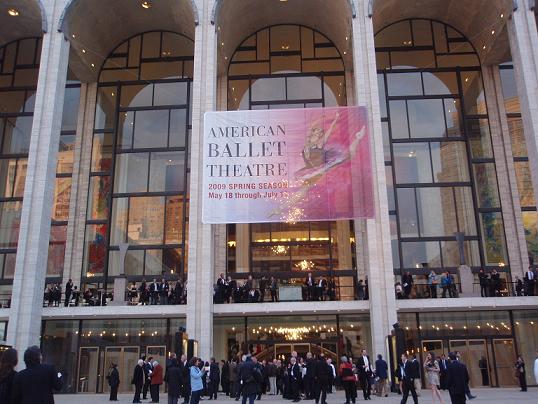
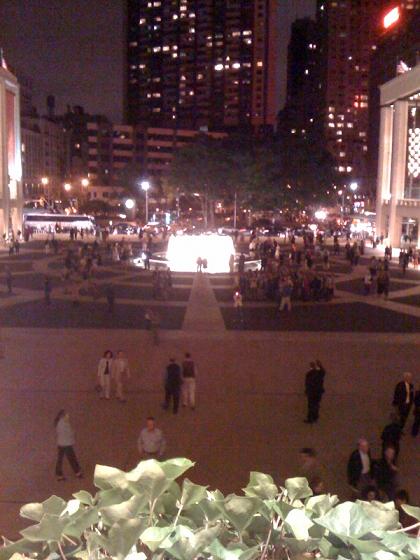
Yay, the season has offically begun! This picture was taken during intermission; that’s why it doesn’t look that crowded. I was sprinting in, nearly late, as usual, so didn’t have time to snap some pics before the performance but fortunately it was still light outside during intermission.

Anyway, Michelle Obama (who served as one of the gala’s honorary chairs) looked smashing in a sleek dark grey sleeveless, knee-length dress with tiny black ruffles lining the bottom. I’m sure there will be beaucoup des pictures seeing as how many blasted camera people there were; I’ll be sure to steal some when they’re posted on all the society websites 🙂 (Oh, look, here it is in the NYTimes already)


It was just about the craziest thing I’ve seen on the Met Opera stage: after Veronika Part’s mouthwatering Mozartiana opened the show, artistic director Kevin McKenzie came out and thanked everyone who needed thanked — all the donors, designer Caroline Herrera who funds the gala, etc., and Senator Chuck Schumer came out and gave a little talk about the importance of funding for the arts, etc. Then, Schumer disappeared behind the curtain and moments went by. Everyone kind of looked around at each other like “what’s going to happen next?!”

Soon, the curtain was pulled back to allow some people to carry out a podium with a banner “American Ballet Theater” draped over its front. The doors to the lobby opened and a flock of people bearing weapon-sized cameras blasted in. Several men dressed in black promptly rose from their aisle seats and followed the flock of weapon-camera-bearers to the front of the aisle, near the stage. Caroline Kennedy was announced. She came out, everyone applauded, and she mentioned that the school of ballet associated with ABT, the Jacqueline Kennedy Onassis School, would be performing on the Met Opera stage for the first time ever tonight. Everyone ooohed and aaahed. Then, she announced First Lady Michelle Obama.

The curtain pulled back again and out she came. Of course everyone gave a standing ovation. She smiled radiantly, then, after a moment, directed us to be seated. Then she gave a short speech. It was a little hard to focus on what she was saying with everyone — both professional photographers and audience members with cell phone and digital cameras alike — flashing away as they were, but she talked about the necessity of the Arts for a culture to flourish, the importance of arts education, etc. Then she introduced the Jacqueline Kennedy Onassis School students.

As soon as she disappeared behind the curtain, the auditorium remained still pending the exit of the flock of pro camera wielders. It’s funny because there were all these non-dance writers in the press section. You could hear the sighs of relief, the sinking down into the chairs, and the putting away of pens and paper — and cell phones, which they’d used to light their writing paper during Mrs. Obama’s speech, which would have been extremely annoying had it not been for all the flashing bulbs anyway. But it made me wonder how they’d ever survive as performing arts critics! I mean, who needs light to see to write!

Anyway, the students were excellent. They performed Le Defile (The Procession) by Raymond Lukens. There were three large groups of them, in three levels — the very little ones, a medium-age / level group, and the older, very advanced ones. The choreography was basically a showcase of classical ballet steps, much like a very advanced ballet class — jumps, jumps with changing feet, jumps with changing feet that went on forever performed by a set of advanced boys (which drove the audience to wild applause), jetes, chaine turns, multiple pirouettes, fouttes, etc., and then a bit of partnering. It gave the students a chance to show what they could do — and the advanced ones could do a great deal! Extremely impressive, and great fun.

Then on were Xiomara Reyes and Herman Cornejo doing an excerpt from August Bournonville’s La Sylphide. This was the most dramatic I think I’ve ever seen Xiomara. I was sitting in the back of the orchestra and she really projected. She was really sweet. And Herman as always amazed with his virtuosity, his jumps, his razer-sharp precision, his astounding clarity of line.

The corps in both this, La Sylphide, and Swan Lake, later in the evening, were absolutely amazing, by the way. Not a head arched back more than the others, not a leg raised higher. They were all so on. When they work together like that, in perfect unity; it’s really visually breathtaking.

Then was Balanchine’s Tchaikovsky Pas de Deux danced by Ethan Stiefel and Gillian Murphy. Ethan and his strutting around stage, taking his own good time after their duet and before beginning his solo, making the conductor wait for him! And his high jumps with all miraculously many beats of the feet. I wished my friend Alyssa could have come so she could see he’s not just Mr. Sexy; he’s a superb dancer. And Gillian was radiant, and a perfect foil with her speed-of-light chaine turns. They enjoyed a long, slow kiss during the curtain call. The audience went mad!

Then was the hunt scene from Sylvia danced by Michele Wiles followed by a piece d’occasion (the first of two of the night), by Alexei Ratmansky, for Nina Ananiashvili, called Waltz Masquerade. It was set to the Waltz from Aram Khachaturian’s Masquerade Suite and it was cute and comical. She was dressed in this long, red dramatic, Carmen-like dress with a sexy black lace overlay on the top. There were four tuxedoed men, each bearing a gold candlelabra, one at each corner of the stage. These men turned out to be: Jose Carreno at the front left corner; Marcelo Gomes, at back left; Angel Corella back right; and a blonde on the front right who I initially thought was David Hallberg (I was sitting FAR back from the stage!) until the fun began and he shook his head about like a sassy mop and I realized DH just does not have enough goofball in him to do such a thing, even if he tried. So, I decided it was either Ethan or Maxim Beloserkovky. Anyway, Nina’s character was supposed to be dancing about the stage in a melodramatic solo — but it was purposefully melodramatic, and so comical. Like a silly, cartoon version of an upcoming swan song, really, which, is of course, what’s coming up for her later in the season (and will be much more sobering when it does). At one point, she just passionately crashes to the ground and remains there, in a heap. Nothing happens. The men, obviously her servants, start looking at each other like, what now? They shrug, slowly walk over to her. Then, Marcelo starts imitating her melodramatic dance, but far more cartoonishly, and of course it’s hilarious. The others join in. Max (I think it was Max, not Ethan) does his thrashing hair thing. I couldn’t see facial expressions but I assume they were making fun of their master. Then she wakes up, catches them, and they’re sent back to their posts.

After intermission was the balcony pas de deux from MacMillan’s Romeo and Juliet, danced by Marcelo and Diana Vishneva. At first, Diana approaches her balcony with all the drama of a ballerina playing Juliet, rather than Juliet herself. I rolled my eyes. This is what I don’t like about her. She’s an excellent dancer but she’s all about the pomp and circumstance and not about the character. Maybe it’s a Russian thing, but I don’t see that in Veronika Part or Irina Dvorovenko. Anyway, she eventually lightened up, thankfully, and I felt like I was watching not a prima ballerina being a prima ballerina but Juliet herself, falling hopelessly in love. When she runs around him one foot solid on the ground, the other on pointe, it’s so girlish, so real yet so poetic. Those are the best — I don’t know what to call them — runs around kneeling Romeo — that I’ve ever seen — not even Alessandra Ferri’s were that sweet. Still, I felt some of the lifts lacked the beauty and magic of  those Marcelo and Julie Kent do together when they dance this scene. I don’t feel she dances that well with a partner; she’s more into herself. Marcelo’s leaps around the stage and big high passionate jumps were thrilling. He got some good bravos for those.

Then were Paloma Herrera and Max Beloserkovsky in the Act II pas de deux from Swan Lake. I was hoping it’d be the Black Swan pdd, but no. I guess the program was pretty bravura-heavy already. I don’t see him dance much, but Max is really quite good. He’s really a character and he’s the perfect Prince Siegfried, regal yet vulnerable and tragically in love. And he’s a good partner.

Then was the mad fun of Le Corsaire, with Irina Dvorovenko, David Hallberg as Conrad, and Angel Corella as Ali. Except something happened at the beginning and I hope David’s okay. The tallest guy in the entire opera house had to sit in front of me and I was trying to navigate my way around his enormous head just as a bunch of people up front went “Oooooooh!” When I was finally able to see the stage, Irina was standing in front of David, face toward the audience. She didn’t seem to have any particular expression on her face, but, then, I was light years away from her. Then David did an assisted pirouette with her and everyone applauded, so it must have been a lift that didn’t quite happen or something. Anyway, I hope he’s okay; I know his shoulder sometimes comes out of socket. Anyway, all seemed to be fine after that: all three were brilliant. Of course. Angel astounded, as always, and I started giggling during his first solo and couldn’t stop all the way through the second. I love Irina. She was radiant. She did those continuous turning kicks on pointe like they were nothing. She has the drama and the virtuosity when needed and the always beautiful, graceful lines. And David’s leaps all over the stage were magnificent. I could see this goofy ballet over and over and over again, as long as no one gets hurt 🙂 Angel did not leap out from behind the curtain during curtain call, sadly.

Then there was another piece d’occasion. Herbie Hancock played piano, onstage, while first Jose Carreno, then Stella Abrera, danced to his music. This was cute and comical as well, and kind of reminiscent of Jerome Robbins’s Other Dances or Suite of Dances, where the dancer(s) connect mainly with the musician. At one point, Hancock went nuts with the keys, obviously way too fast to be danceable, and Jose stopped in his tracks, looked over at him, and lifted his hands, like what gives, dude? He sat down near the base of the piano and just rested. The same happened with Stella. She danced, then stopped and gave Hancock a look when he began another little virtuoso section. She finally sat down beside him on the piano bench, and eventually, he ended on a romantic note, she snuggling next to him softly, sweetly.

The evening ended with the finale of Balanchine’s Theme and Variations. The leads were danced by Sarah Lane and Daniil Simkin. It was a nice way to end the program, but with the likes of Simkin, I wondered why they only did that group finale, where he and Sarah are basically leading a processional, instead of some of the earlier bravura parts with all the corkscrew turns for the man. An opening night gala performance is meant at least in part to showcase the dancers doing what they do best, and he is best at the bravura stuff, not leading processionals.

Anyway, the whole night, as usual, was magic. Saw Sigourney Weaver and Kelly Ripa in the audience.

Oh, for my Dancing With the Stars readers, I taped the show, but for lord knows what reason it was somehow muted. I have no idea how on earth I managed to do such a thing, but it was pretty amusing watching the show in pure silence — no words, no music. Needless to say, I’ll have to watch online tomorrow.

But now, dead tired, must sleep. Goodnight.