NYCB CLOSES ITS FIRST CLASSICAL SEASON WITH BALANCHINE AND ROBBINS


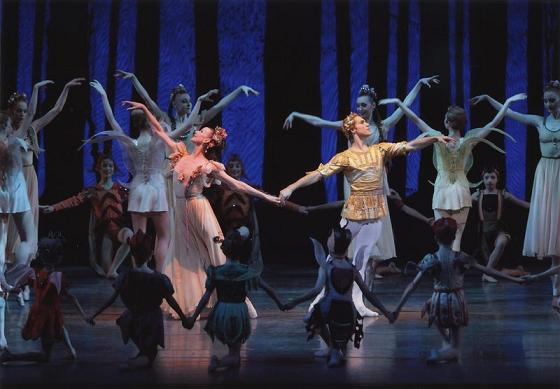
(photo of Liebslieder Walzer by Paul Kolnik, taken from Washington Post review).

New York City Ballet is closing out its Winter season — and first ever Classical season — this week. Tomorrow begins Balanchine’s masterpiece (imo), Jewels (which continues through Sunday); last week were two programs of mixed rep, which included Balanchine’s Liebeslieder Walzer and Tschaikovsky Piano Concerto No. 2, and Jerome Robbins’s Dances at a Gathering and West  Side Story Suite.


Making his debut in Liebeslieder was corps member Justin Peck (headshot above by Paul Kolnik, from NYCB website); he danced the part that Nilas Martins is dancing in the photo at top, along with Jennie Somogyi (who is also in that photo). I thought they really did well, and they stood out the most to me of the four couples.

This ballet is divided into two sections: it begins with the ballroom section where the women are in ballgowns and dancing in regular heeled ballroom shoes, and the section section where they are in long skirts made of tulle, and toe shoes. The men remain in tuxedos throughout. Balanchine has said that in the first section, it is the couples who dance; in the second it is their souls.

And that sentiment is really beautiful. But I don’t see a real difference, except for the obvious — the women’s costumes and shoes. I still thought each section was lovely though, particularly the opening ballroom section, but that could be because I’m trained in ballroom.

Critics have also said that each couple is supposed to represent a man and woman at a different stage in their romantic lives (one couple was supposed to be young love — which I thought would be Justin and Jennie; another more mature love, etc. — so I thought Darci Kistler and Philip Neal). But I didn’t really see that — I thought at points Justin and Jennie represented young, sprightly love, but then at other points their movement is slower and more deliberate and less scoop-me-off-my-feet — and at one point he picks her up and carries her horizontally, as if she’s collapsed, either from fainting or from sleep or perhaps sickness? It’s a beautiful lift whatever it means. And then at points Darci will run playfully and let Philip chase her. It’s sweet and made me fall in love with them momentarily and become involved in their story. But it didn’t seem then like they were this more mature couple. Not that you can’t run and jump and be excited and playful if you’re not “the young ones” of course, but I mean, the couples didn’t really seem different to me. And the fact that I couldn’t discern any particular story behind any of their actions made me less involved in the ballet than I wanted to be. But I still found the movement and the music (Brahms Opus 52 and 65) relaxing and engaging. Maybe I need to see it a few more times.

Every time I see Tschaikovsky Piano Concerto No. 2 on the program I think I’ve never seen this Balanchine / Tchiakovsky piece before, and then once it begins, I realize it is the ballet ABT calls Ballet Imperial. I think ABT has a set though, which resembles a palace, which makes it seem more “imperial.” At NYCB the stage is bare. This is the ballet with all the beautiful brises for the main man — the jumping from side to side with many beating together of the feet in the air. Here, that man was Stephen Hanna and he did an excellent job. Teresa Reichlen and Kathryn Morgan were the female leads. Hanna was most memorable to me though. Hanna partnered Reichlen very well, and I’m thinking he and Jared Angle are probably two of the strongest male partners in the company.

The Dances at a Gathering production on Sunday afternoon (Feb. 21) was the best I’ve ever seen of that ballet. SLSG favorite Gonzalo Garcia (!) was the guy in brown, and he did an excellent job. That character really sets the ballet in motion as, at the end of his opening solo, he looks out with a bit of nostalgia at the stage, surveying it, kind of preparing the audience for all of the characters who will appear on it — who seem to be people from his life, his memories. It’s like he’s taking you on a journey with him and Gonzalo set that up perfectly. And then everyone else was just so on! Maria Kowroski was the carefree, independent girl in green cutely shrugging off male onlookers, Jenifer Ringer and Abi Stafford were the younger, frolicking girls; when Jenifer partnered with Jared Angle those two did some of those lifts with the most sweep I’ve ever seen — the audience exclaimed practically in unison.

And Jared Angle was stunning with his tour jetes and his series of corkscrew jumps flowing right into the Russian folk-steps afterward. He is definitely one of the best men overall at NYCB right now — in terms of his technique, his form, his ability to both partner strongly and dance those bravura solos perfectly. You don’t think of him as a bravura dancer, and he’s not really — he’s more of a great partner, which is probably why I’m just now recognizing his brilliance, during this classical season where strong partnering is essential for being a successful romantic lead.

Sara Mearns was brilliant (again) as the dreamy, pensive woman in mauve, and I realized at one point what it is that makes her a favorite of mine. She was dancing alongside two other women — all three were partnered by men and they were all doing supported slides with the women in a dipped position, the men sliding the women across the floor like that. Well, the two other women immediately brought their free arm down at the beginning of the slide and held it in that position, which was pretty and created a nice line. But Sara brought hers down slowly and made a fuller, kind of half-circle motion, nearly brushing the floor with it. She doesn’t seem to strike poses so much as she is always moving and I think that’s what makes her so captivating — she’s always doing something, carrying out the line and extending the shape, and embellishing the music.

As for the other dancers: Antonio Carmena was very on with all of his jumps and turns, as was the fast-moving Megan Fairchild, and Jonathan Stafford and Amar Ramasar stood out in their roles as well. Amar always looks good in those strutting walks and that Russian folk-like movement Robbins uses in many of his ballets.

And that day ended with West Side Story Suite, which the audience went wild over. A woman behind me exclaimed that it was better than what she’d seen on Broadway. This ballet is always a romp, though I think it starts to lose some of its thrill the more times you see it. Still, I always love Andrew Veyette as the leader of the Jets and watching Georgina Pazcoguin do all those gorgeously high kicks and belt out the tune to America. I can’t imagine ever seeing anyone else in that role. And of course she gets loads of applause at curtain call. Benjamin Millepied danced Tony, which I’ve seen him dance before. He did fine, as always, but I wondered what Gonzalo might be like in this part?

Okay, on to Jewels!
SARA MEARNS’ MOVING ODETTE, A TRIBUTE TO DARCI KISTLER, AND NEW ADAM HENDRICKSON BALLET


Photo of Sara Mearns in Swan Lake, by Paul Kolnik, taken from NY Times.

Last week was the first time I’d seen Peter Martins’ version of Swan Lake. Overall, I wasn’t in love with the production, but I was in love with the dancing, particularly Sara Mearns’ interpretation of Odette, which nearly moved me to tears, which just hardly ever happens with Swan Lake. She is the Veronika Part of New York City Ballet to me and I just love her. She inhabits whatever character she’s dancing with her entire being and she takes you to that place with her; she really creates another universe and she puts you right there and won’t let you leave it! I think here what I loved was that she humanized her Odette. So many ballerinas will focus on getting the fluttering foot just right, waving their arms about with just the proper fluidity that they look like actual wings, and of course totally nailing the chaines and fouettes in the second act. They make the White Swan all about the styling and the Black Swan all about the athletics. And they forget about the story.

But with Mearns — just the way she would wrap Prince Siegfried’s arms around her body, the way she’d nearly dive into an arabesque letting him catch her before turning her, or fall nearly to the floor and arch her back, wrapping herself around his kneeling knee — everything was about the tragic story, about Odette’s loving the prince and longing for him and her need for him, and then his inability to fulfill that need. I’ve honestly never been so moved before, and when she bourreed away from him at the end (there are no suicide swan dives into the lake here), leaving him, it just left me with such a emptiness. I couldn’t stop thinking about that — about her wrapping his arms around her in the pas de deux and then her sorrowful bourrees away from him at the end — for days; I still can’t get over it. I think those images will always be in my mind when I think of this ballet.

And she just had so much stage presence. Sometimes when all the swans are onstage together, I’ll lose Odette, but not with Mearns. I think that may partly be because she has a broad face, allowing her expressions to be more noticeable to the entire house. But of course she makes those expressions that not everyone does — her face, her body, she is always fully immersed in the role.

And Jared Angle was the absolute perfect partner. You can tell he’s a very strong guy and a very solid partner who’s easy to get along with. Because she’d really really throw herself into those arabesques and he’d catch her and she was so off her center of balance — she had to be in order to show the passion and emotion, and the full, expressive line – and he’d promenade her like that, and it was so incredible because you could tell he spent the better part of the ballet supporting a lot of her body weight.

And he acted it well too, and did perfectly on his solos. Very impressive performance by him!

The other cast I saw was on opening night with Maria Kowroski in the lead and Stephen Hanna making his debut as Siegfried. Hanna was very good — he’s a strong guy too, and that night, he performed a major save! Toward the beginning Kowroski went to jump into his arms, on her way into a shoulder-high lift, and she slipped before she ever got to him. He somehow reached out and caught her anyway, and took her up into that lift beautifully. The whole audience went “ahhhhhh”! I think it threw Kowroski a bit though because she seemed nervous and a bit shaky throughout the rest of the ballet. She might also have been a bit anxious because Hanna was debuting in the role, so they obviously hadn’t performed it together yet. At intermission, someone mentioned she might have been less nervous dancing with her usual Charles Askegard. Maybe that’s true. I thought Hanna did a very good job overall.

But I’m not in love with the production. Like Martins’ Romeo + Juliet, the sets are very modern, and the costumes for Siegfried and Benno and his friends are bright, color-coded, and basic with minimal embellishments. But the sets are the worst. In the beginning, you can’t even tell they’re in a palace. In the second act, the sets are not only minimal, but what’s there is so incredibly modern, just a few brown and beige slashes on some backboards. And yet, the people are dressed in Elizabethan costumes. Either set it in modern times completely or go with the historical thing, but don’t do half and half?…

And the production just moves way too fast, in my opinion. This worked for Sleeping Beauty (the paring down of all the miming and the boring court dances, in favor of getting right to the point and to those gorgeous variations), but it didn’t work here because there’s too much story up front missing. We see all these people dancing — we don’t know they’re in a palace, so we just see them all dance, and next thing we know, Siegfried’s all bouncing around with a bow and arrow. Then he runs offstage and a moment later, on comes Odette. Then Siegfried runs back out and they do a pas de deux, and after that’s over, Odette runs one way, Siegfried runs the other, and on come the swan ensemble. And — and maybe this is conductor Karoui’s doing — but you don’t even realize Odette’s run away from Siegfried because she’s afraid of Von Rothbart, and that now Siegfried is running around madly trying to find her. Instead, it just looks like a bunch of running. There should be pauses so that you know exactly what’s happening and why– the pacing is way way too fast. I never really did see Siegfried fall for her. I first realized there was something between them when Mearns’ Odette wrapped Siegfried’s arms around her in the White Swan pdd.

The other thing is the ending, which I both like and don’t like. In this ending, there is no suicide with the two lovers  ending up together in eternity. Instead, since Siegfried has betrayed Odette with Odile, they can’t be together. The problem is that Martins still has Von Rothbart die — he melts into a puddle and dies once he realizes their love is undying and real. But then, if he dies, the spell should be broken and Odette can resume human form. So, the ending then loses its mysticism and becomes a human ending — Odette leaves him because he’s betrayed her, and even though he’s horribly sorry, the damage is done and can’t be undone. So, basically she just can’t forgive him. But why not? It doesn’t really have the resonance to me that it should. I think Martins should just not have Von Rothbart die. That way the lovers can’t be together because of Siegfried’s betrayal. But she still loves him, so that when she bourrees away from him, letting go of him little by little, her arms still reaching out toward him as she disappears into the wings, it just makes you want to bawl your eyes out the same way as the Giselle ending.

One other thing: Martins has some children dance in the beginning courtly scene, which I love. It’s very Balanchine to put the children in, and they were very sweet. And I could tell the people around me thought the same.

Oh and one final other thing: there’s no real dancing for Von Rothbart — it’s really just a character part. But I missed the seductive Marcelo making all the women swoon with his sexy jumps, and then tossing his Odile all about!


Anyway — sorry, I’m behind on blogging and have to blog about these things all together — but earlier in the week, I attended a daytime tribute to retiring Balanchine ballerina Darci Kistler (above photo from the front of the program). She danced the Preghiera passage from Mozartiana beautifully, with some children from School of American Ballet, then the White Swan pas de deux with Jared Angle. And then Kathryn Morgan danced the Sleeping Beauty wedding pas de deux with Tyler Angle, which was sheer perfection. They also showed some excerpts of interviews with Kistler from a 1989 documentary, Dancing For Mr. B, and there was a short panel discussion where Bob Craft from the NYCB Board interviewed her. Later, the two were joined by Peter Martins, Philip Neal (who seems very polite and well-mannered), and the hilarious Albert Evans, who you can tell is the type of guy who puts everyone at ease. He got up there and immediately started reminiscing about a blue sweater Darci’d wear to rehearsals all the time and how much he wanted it (she ended up saying he could have it!) and some rather amusing (in retrospect) goof-ups they had together, and she just really burst into genuine laughter.

Oh and at the beginning, Kathryn Morgan presented Kaitlyn Gilliland with the 2010 Janice Levin Award (Morgan was the 2009 recipient). Both gave little speeches, and Gilliland (who seems like a natural speaker) prefaced hers by pronouncing Kathryn’s recent Sleeping Beauty debut “historical,” which nearly brought tears to my eyes. Can’t think of a more apt description!

And finally, earlier last week, I saw the debut of a new ballet by corps member Adam Hendrickson. It was presented in a small downstairs auditorium at Carnegie Hall and was part of a program featuring newly discovered Prokofiev music performed by students and faculty of Yale’s School of Music. Hendrickson’s ballet was set to his Music For Athletic Exercises, and it was fast, flirty, and fun. It was performed by three dancers — Matthew Renko (who is really a stand-out dancer — I kept wondering why he wasn’t with a major ballet company, and then realized later in the week he’s a corps member at NYCB), Elysia Dawn, and Colby Damon and one pianist — Boris Berman — and Hendrickson’s original, clever choreography had elements of Ratmansky’s Concerto DSCH as well as Jerome Robbins. At one point, Dawn’s feet are moving so fast and furiously, and the pianist just keeps at it and won’t let up, and she kind of stops and shoots him a look. It reminded me of Robbins’ Suite of Dances — it was cute and the crowd loved the joke. This is the second work I’ve seen of Hendrickson’s and I found both to be engaging and memorable. I think he may have a real future as a choreographer. Anyway, here is Philip’s account of the evening, and here is an article on the music.

MORE BEAUTIES


So, toward the end of last week I saw two more casts of Sleeping Beauty in New York City Ballet’s production. Above are the beautiful Kathryn Morgan as Aurora and Tyler Angle as her Prince Desire (Paul Kolnik is the photographer). Below are some photos of the other couple I saw, Tiler Peck (both she and Kathryn were making their Aurora debuts), with Gonzalo Garcia, albeit not from this ballet.


(in Four Bagatelles, photo by Paul Kolnik)


(and in the Christopher Wheeldon / Martha Wainwright collaboration over the summer, photo from NYTimes by Andrea Mohin; I like this photo because I think it shows each of their personalities well).

And then last week, I saw Ashley Bouder and Andrew Veyette.

I’ve been thinking about who I thought was best in what role but it’s actually really hard to do that. I honestly ended up liking everyone, though there were definite differences.

I do have a lot to say about Gonzalo Garcia though. I LOVED him as Prince Desire — he really melted me, he really completely stole the show that night and I feel like I’m not ever going to like anyone quite as well in that role now. I mean, you just have to see him in a classical ballet, as the romantic lead, and you realize why San Francisco audiences were so upset when he left SFB for NYCB a couple years ago. Some of those SFBallet fans were really devastated when he left. And I think it’s been such a puzzle to those fans that New Yorkers haven’t really fallen for him the same way. And I think it’s because he hasn’t had the chance to shine because NYCB is so Balanchine-heavy. He needs roles where he can act and become a character. He’s such the quintessential romantic prince.

You can really tell how differently he’s trained than the other NYCB dancers, who’ve nearly all come from SAB and been trained on Balanchine’s non-actable abstract ballets. I felt like with Gonzalo I was seeing someone from ABT — mainly Angel Corella (in terms of the body type, dramatic style and boyishly handsome face). The way he’d hold onto the music, draw it out while it crescendos, by for example in the vision scene holding out a finger to the princess and then leaning back, then looking out to the audience — not AT the audience but in the audience’s direction — to show how enthralled he is, how much he wants to catch her, all before then turning and running toward her. The other two — Tyler and Andrew — they didn’t do all that. They just kind of looked toward her standing more and more toward the tips of the toes, ready to run toward her when the music told them to. Gonzalo’s way was so much more Petipa and Tchaikovsky and Bolshoi and Romantic Russian and all that, and it might all seem overly melodramatic to audiences who aren’t used to that. But that’s what I’m used to with ABT — and that kind of stuff makes me swoon!– so that’s why I think I loved him so much. But I’m wondering what others who saw this cast thought?

And Gonzalo just knows what’s expected of him, as the prince. Later, when he went to do that crazy series of jetes, he was rested up and ready and he nailed them like I’ve never seen him nail anything. I’ve never seen his legs straighter, in perfect splits, and the whole way around the perimeter of the stage, without tiring. And it’s like he knew that was a very important part, and he had to do them perfectly because that’s just what the romantic hero does — that’s the way he shows his love for the princess, and that he’s worthy of her. The other two obviously took them seriously (because they’re crazy hard, you have to take them seriously), but it just was more of a difficult feat, instead of having the same meaning. You know what I mean? Like he looked out all across the stage wistfully, and then he just took off flying around it. It gave it a different meaning than just flying around.

It makes me wonder though if contemporary audiences understand that, or appreciate it. Or whether they prefer for the emotion to look more “natural”? I’m not saying Gonzalo was better than the other two, just different.

I wonder what Joaquin De Luz was like, since he’s not SAB trained either. Did anyone see him?

As far as partnerships, Kathryn and Tyler were my favorites. Tyler had a few flubs on some of his solo variations (but I still love him!), but he was always the perfect partner, he was always solid when supporting her. And the series of fish dives in the wedding pas de deux were some of the most breathtaking I’ve ever seen. Her legs were pointing completely up toward the ceiling! Magnificent! And the final hands-free fish dive was picture perfect.

I liked all of the Aurora interpretations, but they were different too. Kathryn was the most princess-like, the most regal, though that may just be the way she looks. She just kind of looks like royalty! Ashley and Tiler seemed more “real girlish”  – all smiles and sweetness and awe at the world and their cute suitors.

The rose adagios were all near perfect. (ABT’s Sarah Lane is still the queen of the balances to me — it seems like she could hold them for hours.) Kathryn had the most absolutely gorgeous extensions. Do I have to giggle every time Robert Fairchild comes out leading the cavalcade of suitors? I loved Craig Hall as the “African prince,” – I don’t know what exactly stood out about him but something did. And even though it wasn’t a dancing role, I loved Henry Seth as the King; he acted it really well. Chase Finlay was lovely as Gold in the wedding scene – -he’s a really beautiful dancer with exquisite lines. Everyone’s talking about him being the next romantic lead. I loved tiny Erica Pereira as the fairy of eloquence and Ana Sophia Scheller as the fairy of courage, thought Faye Arthurs and Adrian Danchig-Waring were brilliant as The White Cat and Puss in Boots, and Daniel Ulbricht is the quintessential gymnastic court jester.

And there’s NEVER been a better Carabosse than Georgina Pazcoguin! Nor has there ever been (or, perhaps, could there be) a better Lilac Fairy than Sara Mearns. I love how she arches her back so luxuriously and opens up her chest. And the rich, full-out port de bras. Such beautiful expansiveness, that, with her beatific face, makes her perfect for this angelic role. She reminds me of Veronika Part.

Okay, that’s all I can think of, for now!

This week begins the Swan Lakes. I’ve never seen Peter Martins’ version, so I’m really excited. In particular, I’ve heard wonderful things about Maria Kowroski as Odette and I’m psyched for Stephen Hanna’s debut as Prince Siegfried!

NEW YORK CITY BALLET’S SLEEPING BEAUTY IS THOROUGHLY CAPTIVATING FROM START TO FINISH


This past week, New York City Ballet began its two-week run of Sleeping Beauties. I saw the opening night performance, with Ashley Bouder (above with Damian Woetzel, in Paul Kolnik photo) in the lead. She danced opposite Andrew Veyette, as Prince Desire. Both did really, a near-perfect job (just because nothing’s ever completely perfect!). Really, I don’t know what more you could ask for, although I’m waiting to write my full review on the production until later this week, after I’ve seen two more casts: Kathryn Morgan as Aurora and Tyler Angle as PD (with Janie Taylor as the Lilac Fairy!), and then Tiler Peck and Gonzalo Garcia as the leads.

I love NYCB’s production — a lot more than ABT’s — and I can’t really figure out why. In NYCB’s there’s really never a dull moment — there’s no boring court dancing, just all the wondrous ballet, the very intricate and complicately awe-inducing variations for the various faeries (Sara Mearns was gorgeous as Lilac Fairy — in photo below by Paul Kolnik, as were Amanda Hankes, Lauren King, Rebecca Krohn, Erica Pereira, and especially Ana Sophia Scheller as Fairies of Tenderness, Vivacity, Generosity, Eloquence, and Courage respectively), the fun “wedding scene” with all the cute virtuosity-driven duets for the fairy tale characters (once again, loved Sean Suozzi last week — here as Puss in Boots, and Stephanie Zungre as his partner the White Cat; loved Tiler Peck and Daniel Ulbricht as Bluebird and Princess Florine, loved Henry Seth as the Wolf but not sure why they had a little girl dance Little Red Riding Hood…), the “jewels” starring Stephen Hanna :), and of course the beatific Grand Wedding Pas De Deux between Bouder and Veyette.

I don’t know, there’s just never a dull moment: you go from the Rose Adagio with all the virtuosic balances for Aurora (and the handsome cavaliers), to the richly choreographed fairy variations (that seemed to me more Balanchine than Petipa), to the drama of Carabosse’s arrival with her creepy minions and the frightening spell she casts, to the sweet Vision scene, to the quick Awakening (nothing in this production is long and drawn out; each scene gets right to the point), to the Wedding with the entertaining guests, and ending with the beautiful pas de deux between Beauty and the Prince.

I can’t figure out what exactly is different between this version and the others I’ve seen before, but honestly, this hasn’t been one of my favorite story ballets. So I was just really floored by how captivating NYCB’s production was. I can’t wait to see a few more this week. NYCB is good at story ballets! If you’re in NY and you can make it sometime this week, do go!


NEW YORK CITY BALLET OPENS THEIR WINTER SEASON WITH MIDSUMMER NIGHT'S DREAM & GERSHWIN

New York City Ballet opened their Winter 2010 season last week with rotating performances of Balanchine’s Midsummer Night’s Dream, and a two-ballet program of his Who Cares?, set to Gershwin music, and Peter Martins’ Naive and Sentimental Music.

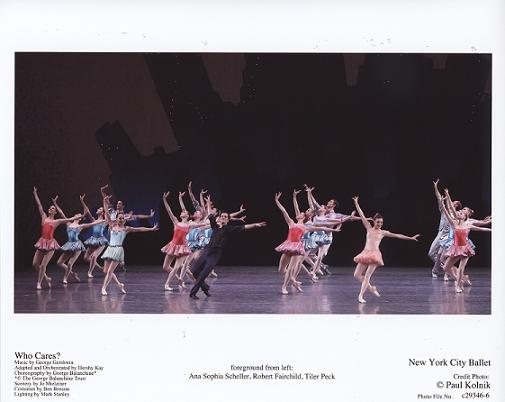
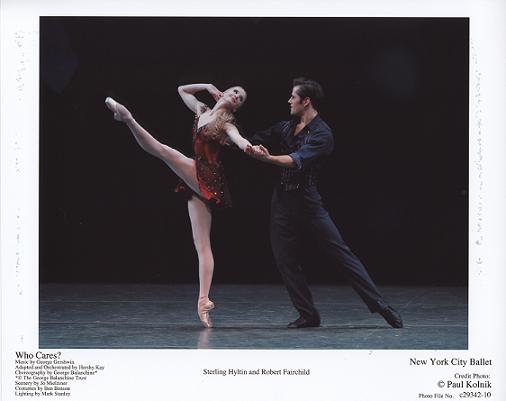
I LOVED Who Cares?! (photos above — of Robert Fairchild and Sterling Hyltin, and of the whole cast — by Paul Kolnik.) I’d only ever seen the pas de deux before and didn’t even realize the whole was comprised of a whole slew of Gershwin songs, some danced by the ensemble, some by only the women, others by only the men, with solos and pas de deux mixed in. I particularly loved Tiler Peck’s duet with Robbie Fairchild in The Man I Love. She has such a clean, beautiful line and she’s so expressive and so engaging. She can make a story out of anything. And of course Fairchild is always the perfect romantic male lead 🙂 Crowd went wild over his and Ana Sophia Scheller’s duet to Embraceable You as well as Scheller’s My One and Only solo. Such a fun ballet — I’m going back for more this week.

Also shown in that program was Martins’s new Naive and Sentimental Music, set to John Adams’ score of the same name. I wrote about that ballet when it premiered here and posted pics of it here. Seeing it again evoked a bit of Balanchine’s Jewels, particularly the lovely lyrical white section (my favorite) and the sexy red.

One little thing I have to say: this ballet was created on and is danced only by principals but Adrian Danchig-Waring danced in last week’s production as well, and he is still a soloist (I think he may have been replacing Amar Ramasar, who must be injured because he was replaced a few times over the week…) Anyway, I realize NYCB is top heavy at the moment, but I think Danchig-Waring definitely needs to be next in line for a promotion!

And earlier in the week I saw the best EVER cast of  Midsummer Night’s Dream. I finally got to see my Gonzalo Garcia as Oberon 😀 (photo above by Paul Kolnik, of Garcia as Oberon and Darci Kistler as Titania). I’d missed him in this role at the end of last season. He did very well – -not only with the dancing — particularly that crazy fast scherzo — but also, and less expected for me, with the acting. I thought he’d be a sweet, glowingly endearing Oberon, but, no, he was a pissy, demanding fairy king — just as much as Andrew Veyette last season (cutely pissy and demanding though!) He wanted Titania’s servant boy and he wasn’t letting her say no to him. Only thing regarding the dancing — his legs don’t seem to be as flexible as they once were. It seems like he may have injured an adductor muscle, or else he’s built up so much thigh muscle or something — but his legs when he jumps are not making perfect splits. But his upper body is so fluid and graceful and he exudes such charm that he’s still the perfect lyrical male dancer nonetheless.

Titania was the beautiful Sara Mearns (headshot by Paul Kolnik — a new headshot for her, right?)– and she was the best Titania I’ve personally seen. Oh she’s such a beautiful dancer! She throws herself so fully into every move she makes. If Garcia is the ideal male lyrical dancer she is the ideal female – they were so perfect together.

And I’m so glad Stephen Hanna is back at NYCB (still annoyed with the Billy Elliot directors for not making good enough use of him on Broadway). He was Titania’s cavalier and his pas de deux with Mearns was the best Titania / Cavalier pdd I’ve ever seen. He’s so big and strong — which certainly amps up the romance factor — and his numerous tour jetes just have so much power. Honestly I often get bored during that pdd and just want Oberon to return, but not with Hanna’s cavalier!

And new to the cast of human characters who get their hearts messed with by a mischievous Puck (Troy Schumacher) was Janie Taylor, as Helena. She is another one who excels at story dances, always delving into a character and making clear to the audience what’s going on in her mind. She’s pathetically, endearingly funny from the time she enters the stage all forlorn over Demetrius, to her being completely bewildered by Lysander’s sudden attraction to her, to her searching the forest madly for Demetrius, to her cat-fights with Hermia, etc. She really brought out the humor.

In the section where I was sitting, there were at least three large groups of people you could tell had never seen the ballet before — nor likely the play; they didn’t seem familiar with the story. But they were laughing hysterically throughout the whole thing and were really awed by the dancing, and by some of the tricks (like Puck’s being pulled up to the ceiling via harness at the end). That’s when you can tell with a story ballet that the cast really brought it to life, when the newcomers are enthralled.

NYCBALLET OPENING NIGHT: NEW MARTINS’ NAIVE & SENTIMENTAL MUSIC A SUCCESS!


New York City Ballet officially opened its 2009-10 winter season last night, with a performance and black tie gala dinner. The performance included Alexei Ratmansky’s Concerto DSCH (above photo of that ballet — dancers are Ana Sophia Scheller, Gonzalo Garcia, and Joaquin De Luz — by Paul Kolnik, taken from NYTimes), stars of the Paris Opera Ballet Aurelie Dupont and Mathias Heymann dancing the central pas de deux from Balanchine’s “Rubies,”


(photo taken from Kulturkompasset; Dupont is center, Heymann is holding the hand of another dancer).

And then the evening finished off with the world premiere of artistic director Peter Martins’ Naive and Sentimental Music, set to John Adams’ (brilliant) score of the same name (I’ll post photos when I receive them).

But first, there was a short film of the reconstruction of the inside of the Koch Theater (still can’t help but think of it as the State Theater…) while the orchestra played Tchaikovsky’s Sleeping Beauty overture (as it turned out, the perfect music to highlight the comically sped-up but ultimately awe-inducingly huge renovation process). Highlights of the renovated theater are — most importantly and coolly — the orchestra pit with a floor that can rise to stage-level (! — and this is how the orchestra played the overture), and two aisles now carved into the orchestra seating section. (Before, orchestra section had no aisles — so, though this is how Balanchine wanted it, apart from being extremely hard getting to a middle seat, it was a fire hazard).

Anyway, after the mandatory thank-you speeches by Peter Martins and David Koch (who funded the renovation), came the  Ratmansky. The fun frolicking threesome in blue (top photo) were danced by Joaquin De Luz, Gonzalo Garcia and Ashley Bouder (all three brilliantly on, Bouder thankfully back from an injury), and the adagio couple in green were Benjamin Millepied and Wendy Whelan (photo below). I think this was danced better than I’ve ever seen it done before — it could have been because I was so excited to see Bouder return, or because the dancers are all beginning-of-season fresh… but this is by far Ratmansky’s best, imo — it’s got the most complex structure and original movement.


(photo by Paul Kolnik, taken from Danza Ballet)

Next were the POB couple, who danced “Rubies” brilliantly — not only with precision and clarity but with great exuberance as well. One thing I meant to say earlier about La Danse (the Wiseman film about the POB) and forgot, was that the POB dancers are all so trained to make meaning out of every little thing they do — every step, every gesture, no matter how small. You have to have some kind of thought in your mind whatever you do. (This is not what Balanchine taught his dancers; he taught them simply to do his steps and those would contain everything the audience needed to know.) I feel that this allows POB dancers to bring a certain passion and humanity to all of the works they do — I noticed that from performance footage from that film as well as from last night.

And third came the highlight — for me anyway — of the night: the new Peter Martins’ ballet. The John Adams music was absolutely gorgeous — rich, many-layered, complex, intense, varied and structured into many sections — some lighter, many heavier, evocative, etc. etc. Beautiful! Oftentimes music like that overpowers the dancing, but not here.

In a short film shown before the dance (methinks Martins is taking after Wheeldon here with these little introductory films), Adams says the title refers to the difference between musicians whose music was fresh and original (the “naive” composers — like Mozart, he says) and those whose music was meant to speak to the past, to convey a sense of history, music that kind of carried the weight of the world on its shoulders so to speak (the “sentimental” — which he considers Beethoven). You could really see that in the music — some of it lighter, much of it weightier. Martins said in the film he tried to evoke that visually through dance, and I think he did so successfully — there’s a lighter, adagio section with dancers dressed in pristine white, another light but fast section with dancers in red, and then the more intense, almost severe sections with dancers in blues and deep greens and black.

Though most sections are danced in ensemble, Martins created the ballet for the principals only. This created an interesting dynamic, because, except for the middle section with the three pairs of dancers in white, almost all roles had equal weight — and yet practically all of the dancers stood out. It was an overload of star power!

And, though some sections seemed a slight bit underrehearsed (or maybe it was just that the footwork was so difficult and fast), everyone shone since Martins highlighted each dancer’s strengths: Maria Kowroski and Sara Mearns as lyrical women in white, Sterling Hyltin and Teresa Reichlin as kind of sharp-edged, sassy women in fiery red, Andrew Veyette and Daniel Ulbrich at the high-jumping bravura guys in black, there were some jazzy moves for Amar Ramasar, etc. etc.

Oh and I just love Tyler Angle 🙂 He partnered Yvonne Borree and I don’t think I’ve ever seen her so at ease and so fluid! She looked really beautiful. Nice also to see Stephen Hanna back from Billy Elliot! He partnered Darci Kistler in the white section.

It’s a rather long ballet but I was thoroughly engrossed and can’t wait to see it again. I hope they keep it in the rep.

Okay, that was the gala. Now onto the Nuts. Regular season begins in January.

AMERICA DANCES HONORING PATRICK SWAYZE MONDAY NIGHT


Just a reminder that this Monday night, November 2, is the America Dances! gala fundraiser for Career Transitions for Dancers at City Center. This year’s gala performance will honor Patrick Swayze (who will be given a posthumous Rolex Dance award), and include performances by Desmond Richardson, Ashley Bouder and Andrew Veyette of NYCB, Stephen Hanna and Tony winner Kiril Kulish of Billy Elliot the Musical, Dancing With the Stars dancers (who are as of yet unspecified), and Cedar Lake Contemporary Ballet, amongst others.

Career Transitions for Dancers is a very important organization that helps dancers (who retire young and often without much education outside of dance) to transition into other careers. Swayze strongly supported the organization and was planning to attend the event and receive his award before he passed away.

For more info, go here.

BILLY ELLIOT’S STEPHEN HANNA RETURNS TO NEW YORK CITY BALLET


Stephen Hanna is returning to NYCB this winter season. Apparently he’s going to be listed as a guest for the upcoming season, but he’s resuming his principal rank. He leaves the Billy Elliot Broadway cast at the end of this month.

I’ll be excited to see him on the NYCB stage again, especially since the Billy Elliot production, ridiculously, didn’t give him enough to do.


His Billy Elliot replacement hasn’t yet been determined.


BILLY ELLIOT — WHERE WAS STEPHEN HANNA!!!


I finally got around to seeing Billy Elliot on Broadway. I’d resisted for a while since I’m not a fan of musical theater — at all — but my friend Mika had an extra ticket and talked me into going with her (by telling me there was a lot of dancing) 🙂 And she was right — there was. Unbelievably, I actually liked it!

It follows the movie pretty closely, is the story of a boy from a working-class town in Northeast England who, amidst a miners strike his father and older brother are involved in, falls in love with ballet after mistakenly happening in on a dance class — he’s only supposed to be returning some boxing mitts to their proper place but the teacher sees him and asks him to join class, which he does begrudgingly. Once he realizes he’s pretty good at the turns, etc., he’s a goner. Of course his father believes that ballet is for pansies and, besides, the family doesn’t have the money for expensive lessons and admission to the Royal Ballet Academy and all that, but of course it all works itself out throughout the course of the play.

There was a lot of dancing — not only in obvious places like the dance classes and audition, but in the scenes between the striking miners and their clashes with police — in full riot gear, present to protect Scabs — and the ballet students, and Billy. It was really well orchestrated. Go here to see some great performance photos.

I also loved the actor who played Billy’s father, Gregory Jbara. He’s of course the most dynamic character in the whole thing since he’s got a lot of gender prejudices and class issues to overcome, and when he does finally begin to change, to support his son, he really makes you want to cry.

There are three Billy’s — the one on my night was Trent Kowalik, who was pretty good as well. As a dancer he excels at turns. But of course what I was waiting for the whole time was Stephen Hanna, (former) New York City Ballet principal dancer, who plays the older Billy. I was a bit disappointed in the way they used him though. The film ends with the grown-up Billy doing a portion of Matthew Bourne’s Swan Lake, so I was expecting that. But they completely cut it! And I was so upset! I waited all night to see Stephen Hanna do that! Instead they had this rather corny scene in the middle (pictured above) where the little Billy is having a dream and he dances with the image of who he will become — Stephen Hanna. At first it’s nice — they both do some turns and jumps in tandem, and eventually some partnering with Stephen lifting Kowalik into some lovely little fish dives. But then Hanna straps Kowalik into a harness and for about the final third of the piece, the damn harness carries Kowalik all around stage — it’s like circus tricks, not dance!

After that I kept waiting and waiting for more Stephen, but the only other time we see him is in a non-dance scene with the father. It’s actually a pretty funny scene and Hanna’s able to utilize his acting skills — and he’s pretty good, except that he falls back into an American accent at the end of his last line 🙂 . It’s at the Royal Ballet Academy where Billy is about to try out. Billy’s gone back to change and the father’s left in the hallway alone — still trying to get over his homophobia / fear of male ballet dancers, when along comes Hanna (and then you knew why they needed such a big, muscly dancer), for a smoke. Hanna’s dressed in a blousy 18th Century-style top and tights, so when he takes out a smoke and strikes a nonchalant pose it’s rather funny. Then he starts doing some developpes (slow lift of one leg, with bent knee, into full extension of that leg), lifting his leg right in Jbara’s direction, exposing his crotch. Jbara looks like he’s going to have a heart attack and the audience is cracking up. It ends with Hanna warning Jbara to support his son lest he may lose him to his dream, and the father listens.


But no dancing in that scene. So, I was waiting and waiting until the end, and then, curtain call after curtain call, and dance-within-curtain-call after dance-within-curtain-call and it just never happened. Hanna also plays one of the regular strikers and so is dressed for the final dance scene in his construction boots and all, so I’m thinking maybe he just didn’t have time to do a costume change. But then just have another actor / dancer do those scenes — you certainly don’t need a NYCB principal-caliber dancer for that! — and leave Hanna to the ballet! Argh! I realize Hanna took the role knowing what it would entail, but they really could have used him to much better effect, showing audiences what male ballet dancers are really capable of, and what the future Billy will be like.

Anyway, overall I did enjoy it — for those very well choreographed dance scenes I mentioned above and for the actors, particularly Jbara. It’s worth seeing if you get the chance.