Last Week at New York City Ballet


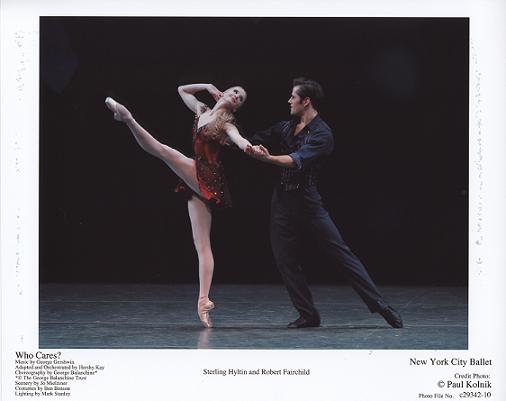
Last week I went to two performances of NYCB – opening night and Thursday night’s “See the Music” program – and to two of the free all-day Balanchine events on Saturday. First, I’ll talk about the last two since I found them so informative. The free studio talk on Saturday afternoon – Balanchine’s birthday – was moderated by Sean Lavery (former NYCB principal dancer, now ballet master), and included Sterling Hyltin (in Paul Kolnik photo above with Robert Fairchild), Chase Finlay, and Jenifer Ringer. Lavery asked the dancers to talk about their first Balanchine ballets, their favorites, and what drew them to NYCB. Hyltin named as her favorite Duo Concertant (pictured above) which I’d just seen her dance on opening night. She said she liked the syncopated movement, the he goes and I go kind of back and forth movement conversation with her partner, and with the musicians. I really liked it too. The violinist and pianist are onstage (the music is Stravinsky), and I like the interaction between the dancers and the musicians, and between the two dancers, and I like the sharp, angular movement. She seemed particularly animated when I saw it. I love Robert Fairchild and think he’s such a sharp, masculine mover with a presence that commands your attention without meaning to – he kind of reminds me of a less cocky Ethan Stiefel – but she seemed so happy to be dancing this piece that she stood out to me more. It was nice to hear her talk about it.

But what I really loved was the School of American Ballet class taught by Peter Martins. He interacted cutely with the students, particularly “Cyrus,” (at least I think that was his name…) a tall, long-limbed young man who I think will soon be in the company. Cyrus didn’t always do everything perfectly (at least in Martins’s eyes) but he had a charming presence and a great leading-man physique and you can tell he works hard.

Martins had the class demonstrate ballet basics – beginning with the five positions, and they showed us a perfect fifth position (with the toes of the front foot touching the heel of the other and vice versa). More interestingly, he had the class show us the difference between a Balanchine hand and a classical ballet hand. I’d always noticed there was a difference but couldn’t figure it out exactly. God gave us five fingers, Balanchine had said, so we shouldn’t hide two of them. The Balanchine hand shows all five fingers, the classical ballet one only three (with the ring finger and pinky held so that they are hidden from view behind the middle finger).

Martins also had the students show us how Balanchine’s fourth position differed from others’. In Balanchine’s the back leg is straight; in all others’ the back leg is bent. Martins didn’t go into any functional explanation for this – just said “here, we think it looks better.” But I thought about it and thought, wow, it must be hard to take off in a jump for example with the back leg straight. And then I realized that’s partly why Balanchine’s choreography always looks so fluid, like one step leading right into another, without a lot of stopping to build up to a big athletic feat – a big jump or series of turns. Other companies – like the Russians, like the Bolshoi – are all about preparing so that you can do something astounding. So they’re all about the building up.

This was mentioned in the studio talk as well. Lavery also talked about how fluid Balanchine’s movement was, and how, for example, in a lift, a guy would pick up a girl, then take two steps, and put her down rather than walk all over stage with her hoisted above his head. Balanchine wanted her to come up, then down right again, because that was more fluid, rather than have her head bobbing around up there while the guy was running all around with her.

Martins also demonstrated the bows. At City Ballet, he said, we just do them as such, and the girls did a little curtsy with the back leg slightly bent, without going down on one knee. Making fun of the dramatic Swan Lake bows, Martins went all the way down on one knee, exclaiming, “Yes, yes, I know I’m good!!!” while putting his head down, forehead nearly touching the floor, and raising his arms up in back of him like wings, fingers pointed toward the ceiling. It was hilarious.

Anyway, here are a couple more photos of opening night:


Above: Ashley Bouder in Valse-Fantaisie, and below, the cast, including Andrew Veyette, in the same (all photos by Paul Kolnik)


I liked Balanchine’s Valse-Fantaisie (Veyette replaced Joaquin DeLuz – but don’t know why because DeLuz danced Concerto DSCH two nights later) but I really loved the first of the evening, Walpurgisnacht Ballet. I’d never seen Walpurgisnacht before and it’s funny but I always seem to love the Balanchine ballets that are the least often performed. This was really beautiful. It’s from Gounod’s Faust, and features a group of women (and only one man – here Charles Askegard) in deep red dresses, their hair down in the second half as the music increases in tempo so that there’s almost kind of a hedonistic madness in the mood – and the footwork is so intensely complicated and fast fast fast. Wendy Whelan even made a tiny little flub, which I’ve never seen her do before. Crazy! And breathtaking!

And the evening ended with The Four Temperaments. I’ve said before and I’ll complain again that I still don’t understand why everyone goes on about how brilliant this one is. To me, there are supposed to be four temperaments, and the ballet is divided accordingly into four variations after the theme: melancholic, sanguinic, phlegmatic, and choleric. But they all seem to be the same to me. The dance seems one-note throughout so that after the first variation, I’m waiting for it to end. I’ll keep seeing it though, perhaps performed by a variety of companies if I have the chance, and will keep looking for the nuances…

“See the Music” night opened with Faycal Karoui’s discussion of Mozartiana, Tchaikovsky’s homage to / riff on Mozart, which made me appreciate Tchaikovsky even more. Then that piece was danced – by Maria Kowroski, Daniel Ulbricht, and Tyler Angle. Tyler stood out to me. As always, he dances with so much meaning, so much intention, and so much expansiveness. He’s a really beautiful dancer.

Then came Ratmansky’s Concerto DSCH, danced by Wendy Whelan, Ashley Bouder, Joaquin DeLuz, Andrew Veyette (replacing this time Gonzalo Garcia), and Benjamin Millepied. Oh, Natalie Portman was there, albeit late – she came in with a friend after Karoui’s lecture and right before Mozartiana was performed. Then, she left right after Concerto DSCH, after Millepied was done performing, and before the last piece. I thought it was a shame she missed Sara Mearns in the last dance, but a Twitter friend said she had a movie premiere that night, so I guess she needed to leave early for that.

Anyway, as usual, Millepied did not stand out to me, and I couldn’t stop thinking of seeing Tyler Angle in that role before and the way he lunges romantically toward the main girl, making it clear how much he yearns for her. Millepied’s knees nearly touch the ground in his deep steps toward her and it just looks like a dance step, not like anything evoking a specific emotion. As always I loved Bouder and DeLuz in the fast, playfully firtatious three-some part. I missed Garcia – where is he? I hope not injured! – but thought Veyette did a fine job in his stead.

And the evening ended brilliantly with Sara Mearns and Charles Askegard dancing the ballet leads in Balanchine’s Cortege Hongrois, while Rebecca Krohn and Sean Suozzi just as brilliantly danced the folksy Hungarian leads. I really love that dance and it made me all the more eager to see Mearns in Swan Lake!

On both nights, I went with my friend, author Maria Mutsuki Mockett. She writes an author blog but has been attending the ballet much more frequently and is now blogging a lot about ballet as well. She’s an excellent writer, so please check out her blog!
More Photos of Millepied’s “Plainspoken”

Here are a couple more photos of Benjamin Millepied’s Plainspoken, which premiered last week at New York City Ballet and which I wrote about here.  Top is, from left: Amar Ramasar, Sterling Hyltin and Tyler Angle; below, from left: Jennie Somogyi, Amar Ramasar, Sterling Hyltin, Tyler Angle, and Jared Angle. Both photos by Paul Kolnik.


ALBERT EVANS FAREWELL


Photos by Paul Kolnik (top, of Albert Evans during final curtain call, bottom with Wendy Whelan in Herman Schmerman)

Sunday afternoon longtime beloved principal with NYCBallet, Albert Evans, gave his final performance. He danced two roles he is well-known for – the pas de deux from William Forsythe’s Herman Schmerman, with Wendy Whelan, whom he’s often been partnered with, and Balanchine’s The Four Temperaments (he danced the third variation – “Phlegmatic”). It was perfect – -a humorous, playful pas de deux and a very serious, emotionally moving classic Balanchine ballet. He danced both fabulously. I haven’t seen Herman Schmerman much, and he made me want to see it again. And he danced “Phlegmatic” so well, with such precision and intensity (honestly, better than I remember seeing it danced previously) it made me take notice of a Balanchine ballet I honestly haven’t much liked before.

Also on the program was La Source, a pretty in pink ballet by Balanchine set to Delibes and danced very well by Joaquin de Luz and Megan Fairchild in the pas de deux and Lauren King as leader of the ensemble. I have in my notes “dive!!!” which means Megan must have dove into Joaquin’s arms with brilliant gusto!

And in the middle was The Lady with the Little Dog, a newish ballet by Alexey Miroshnichenko that premiered last season, danced again very well by Sterling Hyltin and Andrew Veyette. I think they re-staged and / or re-thought it a bit because it seemed so much better this time. I remember liking parts of it last time; I really loved it this time. The lifts are stunning and it’s very emotionally moving with lots of climactic build-up. I think it’s more focused on the couple this time and the “angels” are more functional and less involved in the choreography and I think that made a big difference. I always love Sterling’s little dog. This time he (or she?) wanted to be picked up a lot.

Anyway, Albert Evans is quite the character and his curtain call was probably the most celebratory I’ve seen at City Ballet. I said on Twitter that it was of Julio Bocca-esque proportions! Of course everyone – audience and the dancers – loves him, and many of the female dancers came out and did a little dance with him when giving him their bouquet. He did several little goofy dances himself, with lots of Rocky Horror Picture Show-style pelvic thrusts. He picked up one of his bouquets and flung it out to the audience. Then, he took off his shoes. Oh and he had a glass of champagne, brought out by a group of male principals. See, what I mean – Julio Bocca all over again! Crowd went wild, and didn’t want to leave the theater.

Since it was a nice day, after the performance I sat outside on the benches near the stage door with Oberon and we waited for Albert to emerge. He never did! Well, he probably did after several hours – Philip and I imagined he was getting plastered with Wendy Whelan and Maria Kowroski (neither of whom emerged either during the time we sat there) and his other regular female partners. A good hour after we’d been sitting out, a dancer came out and talked with Philip a bit and told him she just saw Albert inside yakking it up with everyone and he was still in his ballet clothes. So we decided we’d be waiting all night and we’d better leave. Did get to meet a lot of dancers though — all very charming and immensely polite and gentlemanly! Amar Ramasar, Robert Fairchild, Troy Schumacher (who made me want to dig back into Proust – have the tomes of his work but have never gotten around to cracking them open), Craig Hall, Tiler Peck, Abi Stafford… those are the ones I can remember. Fun day!

For more on Evans’s career, Oberon has a really good write-up with lots of photos.

CHRISTOPHER WHEELDON’S ESTANCIA


Last Saturday night was the premiere of Christopher Wheeldon’s new ballet, Estancia, at New York City Ballet. Everyone in the audience seemed to go wild over it. When it ended, I overheard people saying they didn’t want it to end, and others saying they thought it was his best work, and in the lobby, several of my friends said they really liked it. I thought it was so so. And definitely a departure from Wheeldon’s usual.

Estancia is a story ballet, set to to music by Alberto Ginastera, that takes place on a ranch (Estancia is Spanish for ranch) in the Argentine Pampas (countryside). A young city man (Tyler Angle) is smitten with country life, and a girl he meets there (Tiler Peck), particularly after he watches her tame a horse (Andrew Veyette). The ballet is his attempt to woo her, and of course at the start she wants nothing to do with him and his annoying urbanity (he wears a suit throughout), but eventually she overcomes her prejudices and lets herself fall for him. He ends up proving his adroitness at being a rancher by taming another horse (Georgina Pazcoguin).

The dancing was all very good — Pazcoguin and Veyette were wonderful as the wild horses, and the T(i)ylers were perfect for these roles. Tyler Angle is always so good at those deep longing romantic lunges toward his partner. For the most part, though, the choreography was a bit blah, I thought. Except for some interesting backwards walks, that looked at bit like moonwalks, performed by the “horses,” the choreography seemed like nothing I hadn’t seen before, which is unusual for Wheeldon. The romantic pas de deux  between the leads were pretty but the lifts were rather basic.

The Ginastera score was originally commissioned in 1941 by Lincoln Kirstein for a ballet to be made by Balanchine to be shown when Kirstein’s American Ballet Caravan toured Buenos Aires. But the Caravan disbanded and the ballet was never made. I feel like Wheeldon, or someone at NYCB, felt the need for closure on the project. It had the feel of something out of a bygone era, particularly with the horses – you really don’t see dancers galloping around stage these days in horse costumes. But it doesn’t seem as corny if you think back to Firebird, for example, with all the forest creatures.

The sets were designed by architect Santiago Calatrava (and NYCB is showing a short film about his work and his collaboration with the choreographers every time his sets are used this season). They consisted of water-color-looking paintings displayed on the back wall, one of a countryside, another more abstract one of horses (I think – because of the storyline, but maybe they were bulls … they seemed to have horns).  Anyway, all in all, it was a fine ballet but didn’t blow me away like it did many others.

Two other ballets were performed, both by Balanchine — Danses Concertantes, with my favorite, Gonzalo Garcia and Sterling Hyltin in the leads, and Brahms-Schoenberg Quartet in which Yvonne Borree danced particularly well partnered by Benjamin Millepied. It’s going to be sad to see her retire this Sunday afternoon.

Above photo by Paul Kolnik.

WAYNE MCGREGOR’S OUTLIER


Some photos of the new ballet, which premiered last Friday at NYCB, by Paul Kolnik. Top is of Wendy Whelan and Craig Hall, bottom is of cast with Gonzalo Garcia and Sterling Hyltin front and center.

I liked Outlier if mainly because it provided something different for New York audiences, and the dancers seemed to love dancing it, perhaps to be challenged by a different movement vocabulary. Music was to Thomas Ades and was generally sharp and made for an unsettling vibe, which the movement complemented. Cast was all principles: in addition to Hyltin, Garcia, Whelan, and Hall, there were Ashley Bouder, Maria Kowroski, Tiler Peck, Adrian Danchig-Waring, Joaquin De Luz, Robert Fairchild, and Amar Ramasar. Dancers mainly danced in male / female pairs and movement was intentionally awkward, with lots of sharp, angular lines,  jutting, hyper-extended limbs, at times rubbery-looking as a foot would go from pointed to flexed in a split second, and there were lots of kind of sliding motions in the upper body, which is uncharacteristic of ballet – classical anyway. The whole thing felt alien, ominous, something seriously awry.

Maria Kowroski, Wendy Whelan, and Robert Fairchild shone, as I think they have the bodies most suited to this kind of movement. The audience gasped audibly and some laughed in astonishment when, at one point, Maria Kowroski did an arabesque penchee with her lifted leg in attitude and she swung her leg up so fast and with such force (intentionally) that she looked like she was completely jointless. Then she wrapped her bent knee around her partner’s head — I think it was Amar but can’t remember for sure. She looked like a spider. And Robert Fairchild is really becoming one of the greatest male dancers around – at least that I know of. He can do anything and with such precision, not to mention massive amounts of stage presence.

Lighting (by Lucy Carter) was really cool as well, starting out a bright red, with an almost kaleidoscopic image on the back wall,then turning cream-colored and solid, and creating at times rather ominous shadows that highlighted the bizarre movement.

My main problem with the whole was that it didn’t really seem to go anywhere. A story never seemed to take hold and the movement and overall feeling you had remained the same throughout. Maybe I just need to see it again though.

Outlier was shown with two other, completely different ballets – Balanchine’s beautiful Serenade in which Kaitlyn Gilliland really moved me, and his Cortege Hongrois, with Sara Mearns dancing the part of the classical ballerina to splendid perfection with the very capable Jonathan Stafford as her partner, and Sean Suozzi and Rebecca Krohn ever entertaining as the Hungarian folk dancing duo.

JEWELS


Janie Taylor and Benjamin Millepied in “Rubies.” All photos are by Paul Kolnik.


Sterling Hyltin and Gonzalo Garcia in “Rubies.”


Jonathan Stafford and Sara Mearns in “Diamonds.”


Maria Kowroski and Charles Askegard and cast in “Diamonds.”


Abi Stafford and Jason Fowler in “Emeralds.”

So New York City Ballet ended its Winter season with Balanchine’s Jewels, his three-act abstract ballet in homage to three different styles of classical ballet: “Emeralds” set to Gabriel Faure in honor of the French style; “Rubies” set to Stravinsky in honor of the American jazzy / showgirl-y style; and “Diamonds” set to Romantic Tchaikovsky and in the imperial, celebratory Russian style.

“Diamonds” has long been my favorite part, but the more I see of the full-length ballet (“Rubies” is often performed apart from the rest, in mixed rep programs), the other two are growing on me, particularly “Emeralds” with its complex patterns, its subtlety and nuance. And of course I like “Rubies” because I think, through this part of the ballet, new audiences unfamiliar with Balanchine can best see how he created a certain kind of “Americanized” ballet for his adopted country.

There were several debuts in the various roles: Janie Taylor and Gonzalo Garcia in “Rubies,” and I think Sterling Hyltin in “Rubies” as well (it was my first time seeing her anyway). Janie was an absolute blast to watch. She doesn’t really have the proper hips for this heavily hip-jutting, hip-swaying role — she’s so tiny and waify — but she was putting everything she had into it, taking every single movement, every jump and stretch and supported penchee and pose as far as it could possibly go and you just couldn’t take your eyes off her. It was the best performance of that part that I’ve seen since Ashley Bouder debuted in it a couple years ago. What was also so stunning about Janie’s performance was her commitment to perfecting every little detail in making a certain shape — it reminded me of her absolutely captivating performance as the Novice in Robbins’ The Cage. Except this wasn’t a creepy male-devouring insect, but a fun flirty showgirl. And yet there was a certain darkness to it — I think there always is with her (Alastair Macaulay has noted the same), but that darkness somehow worked here. She made the role her own, which is what a great interpretive artist must always do.

Janie Taylor danced with Benjamin Millepied, who was very good as well — the most animated I’ve seen him lately, actually. Maybe Natalie Portman was in the audience? I didn’t see her though.

When Gonzalo debuted he danced with Sterling. Of course I always love Gonzalo and, as always, he was very animated and dramatic, making a little story out of every little interaction with Sterling. Which is what I always love about him and what I find so engaging. They did have a few kinks to work through though – -sometimes it seemed like they’d nearly missed hands in connecting, like they weren’t completely in sync with each other. But that was only physical and was likely something you might have only caught if you were sitting up close (as I was). Emotionally they connected perfectly — which to me is more important — unless of course a physical mis-connection results in a fall or something. Hyltin does have the hips for this role and she seemed like she was having a lot of fun with it too. She was really stunning.

Of course I loved Sara Mearns in “Diamonds,” which I knew I would. This was my first time seeing her in the role and she was perfect. It was just like Swan Lake all over again. Sir Alastair in his end of the season review calls her the best ballerina in NYCB and perhaps all of New York and I generally agree, especially regarding her adagio. I guess the perfect ballerina would be someone with her or Veronika Part’s adagio technique and Gillian Murphy or Paloma Herrera’s allegro — I would have preferred for Mearns, for example, to be a tiny bit more seductive with the fouettes in the SL Black Swan pdd — but I don’t know if that ballerina exists today. I don’t know if she’s existed ever. Maybe Gelsey Kirkland? I don’t know, I never saw her dance live, but judging by what I hear from those who did, and from my own video-watching, she seems to have had everything…

Anyway, “Emeralds”: I liked Abi Stafford in the solo; I liked her port de bras — very beautiful arms, very well-articulated gesturing. Her performance was sweet. I also liked Jenifer Ringer as the second girl who does what I call “the courtship walk” with the male dancer. Her performance was full of subtlety and charm; I sensed a kind of  sweet shyness as she tip-toed en pointe along with the boy, first going in his direction, then kind of changing direction and walking around him in circles, making him kind of follow her.

At my final performance of the season, I sat next to James Wolcott and Laura Jacobs, who introduced me to several Ballet Review people. Ballet Review seems like such an excellent publication and it’s really too bad the articles aren’t available online because Jacobs has a very interesting scholarly piece on this ballet, arguing that it’s more about Balanchine’s love of Suzanne Farrell than anything else. If you can get your hands on it, I highly recommend that article!

PASHMINA LIFTS AND LITTLE DOGS WHO STEAL SHOWS: ALEXEY MIROSHNICHENKO’S "THE LADY WITH THE LITTLE DOG"


Last night at New York City Ballet was the world premiere of a new ballet by Alexey Miroschnichenko, The Lady with the Little Dog (photo above, of Sterling Hyltin and Andrew Veyette, by Paul Kolnik). The ballet is based on the short story by Anton Chekhov of the same name (which I haven’t read but now wish I had). Miroshnichenko made the ballet in honor of the 150th anniversary of Chekhov’s birth and he dedicated it to Maya Plisetskaya in honor of her 85th birthday.

I really liked the ballet — really enjoyed the whole evening. Though I didn’t know the story, The Lady with the Little Dog was very Chekhovian, very full of angst-ridden characters (danced by Hyltin and Veyette), along to a score by Rodion Shchedrin that went along well with the drama.

It began with Sterling Hyltin dressed in a gorgeous deep purple dress with a plush velvety top and romantic tutu, walking a little dog on its leash across stage. Veyette was in the back, bespectacled, and wearing a white suit, looking like a 19th Century Russian businessman. (The splendid costumes were by Tatiana Noginova). There were also several male dancers dressed in grey bodysuits writhing around onstage. I originally thought they were a kind of chorus that would echo or foretell the action of the “play” but then they had some very dog-like movements – holding their hands up, bent at the wrists, kind of like dog paws, lying on the ground and playfully kicking their feet in the air, rolling over. But the program called them “angels.” It soon became clear that their function was to control the events — get the lady and the gentleman to meet, sleep together, then tear them apart — perhaps one of them died? — then bring them in the end together again as they walked along a path toward heavenly light.

Anyway, back to the beginning: well, as Sterling walked that little dog across the stage (I’m not good with dog breeds, but he was small and fluffy, with straight shaggy hair), he kind of initially stole the show. He kept looking out at the audience, into the darkness, but he looked intrigued, not scared. Then, Sterling would lift her leg and he’d turn and look at her like she was a bit off her nut. Then a grey guy came up and wiggled around and the dog would take a step back, then try to go around him, but the leash preventing him from getting too far. It was too much. Finally, Sterling stopped, frozen in time, and a grey man took the leash and led the dog offstage. Right before he went into the wings, he took another inquisitive look out at the audience. There were several giggles. It was too cute and I was reminded of Melanie LaPatin once saying no performer ever wants to follow an act involving children or animals.

Anyway, fortunately the dog didn’t return (although I secretly kept wanting him to). It took a few seconds for the audience to calm down and re-focus, but eventually we did. They grey people set up what looked like a long rubber mat which separated Sterling and Andrew. Each principal danced separately, then with the grey men, then the grey men eventually brought them toward each other and they danced together. The only odd thing to me was the background set (along with that rubber mat; set designs were by Philipp Dontsov). The back wall looked very abstract, which seemed kind of out of place in a period drama, although maybe it was meant to universalize the emotion. It looked to me like the middle of an airplane, with slanted airplane-like windows lining the back wall. As the action unfolded, the windows got smaller and smaller until they eventually disappeared.

Anyway, in the second movement, Hyltin and Veyette danced this really gorgeous MacMillan-esque pas de deux with lots of beautiful sweeping overhead pashmina-esque lifts — which of course I’m always a sucker for! So that was my favorite part. Then, the grey men returned and helped the two principals out of their clothing, and they danced a rather beautiful sex scene in skin-toned underwear. I have to say, as I was watching I couldn’t help but think of a similar scene from Pascal Rioult’s Views of the Fleeting World, which was so slow and serpentine and tantalizing, yet beatific. This wasn’t the same; it was a little more frantic and angst-ridden, which I guess is more Chekhovian (I will have to the read that story).

Then, the grey people direct them to get back into their clothes, and soon we see Veyette doing a kind of mad dance, eventually running across the stage and disappearing into the wings, Hyltin running after him, but unable to catch him. Then she does a rather sorrowful solo.

Eventually Veyette returns, they dance together again. But this time it’s a more mature love, not as Romeo and Juliet balcony scene as the first. Eventually, they take off their clothes again, the mat is laid vertically across stage, running front the front of the stage to the back, and the two hold hands and walk together down the path, toward the back of the stage, toward a bright, golden light. The end. I wasn’t sure if Veyette died and they were coming together again in the afterlife, or if they just had a fight and this final scene represented them kind of going off into the sunset.

Of course Miroshnichenko came out for a bow during the curtain calls — and unbelievably, though the vast majority of the audience applauded, there were a few audible boos. It’s like some people were getting opera confused with the ballet. I mean, seriously, this wasn’t a new, iconoclastic production of Tosca; it was a brand new ballet…

Anyway, I liked it and would like to see it again.

The other two ballets of the night were Balanchine’s Agon, an abstract black and white leotard ballet set to Stravinsky’s unsettling score. The choreography was really brilliant, very original, and there were lots of pretzel-shapes in the duets (the main one danced by the hyper flexible Wendy Whelan, with Albert Evans), and it made me realize where Christopher Wheeldon gets his inspiration from 🙂

The evening ended with Cortege Hongrois, basically Balanchine’s wonderful one-act version of Raymonda, which I’ve been going on about after seeing ABT II perform part of it at the Guggenheim recently. Sean Suozzi danced what I’m now calling the Irlan Silva part — the virile, folksy Hungarian lead — along with Rebecca Krohn. I haven’t noticed Suozzi much before this season, but he is really standing out to me. He danced the lead in this, one of the duets in Agon, and he did a lot of dancing in Who Cares? last week. He is really good! And Maria Kowroski and Jonathan Stafford danced the balletic leads and made me badly want to see Diamonds” again.

NEW YORK CITY BALLET OPENS THEIR WINTER SEASON WITH MIDSUMMER NIGHT'S DREAM & GERSHWIN

New York City Ballet opened their Winter 2010 season last week with rotating performances of Balanchine’s Midsummer Night’s Dream, and a two-ballet program of his Who Cares?, set to Gershwin music, and Peter Martins’ Naive and Sentimental Music.

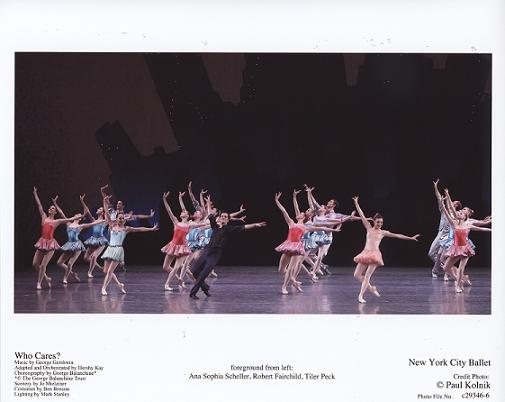
I LOVED Who Cares?! (photos above — of Robert Fairchild and Sterling Hyltin, and of the whole cast — by Paul Kolnik.) I’d only ever seen the pas de deux before and didn’t even realize the whole was comprised of a whole slew of Gershwin songs, some danced by the ensemble, some by only the women, others by only the men, with solos and pas de deux mixed in. I particularly loved Tiler Peck’s duet with Robbie Fairchild in The Man I Love. She has such a clean, beautiful line and she’s so expressive and so engaging. She can make a story out of anything. And of course Fairchild is always the perfect romantic male lead 🙂 Crowd went wild over his and Ana Sophia Scheller’s duet to Embraceable You as well as Scheller’s My One and Only solo. Such a fun ballet — I’m going back for more this week.

Also shown in that program was Martins’s new Naive and Sentimental Music, set to John Adams’ score of the same name. I wrote about that ballet when it premiered here and posted pics of it here. Seeing it again evoked a bit of Balanchine’s Jewels, particularly the lovely lyrical white section (my favorite) and the sexy red.

One little thing I have to say: this ballet was created on and is danced only by principals but Adrian Danchig-Waring danced in last week’s production as well, and he is still a soloist (I think he may have been replacing Amar Ramasar, who must be injured because he was replaced a few times over the week…) Anyway, I realize NYCB is top heavy at the moment, but I think Danchig-Waring definitely needs to be next in line for a promotion!

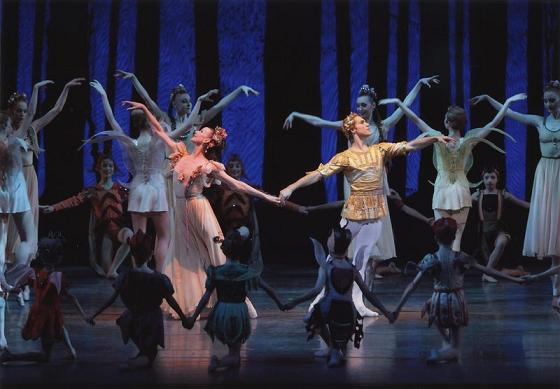
And earlier in the week I saw the best EVER cast of  Midsummer Night’s Dream. I finally got to see my Gonzalo Garcia as Oberon 😀 (photo above by Paul Kolnik, of Garcia as Oberon and Darci Kistler as Titania). I’d missed him in this role at the end of last season. He did very well – -not only with the dancing — particularly that crazy fast scherzo — but also, and less expected for me, with the acting. I thought he’d be a sweet, glowingly endearing Oberon, but, no, he was a pissy, demanding fairy king — just as much as Andrew Veyette last season (cutely pissy and demanding though!) He wanted Titania’s servant boy and he wasn’t letting her say no to him. Only thing regarding the dancing — his legs don’t seem to be as flexible as they once were. It seems like he may have injured an adductor muscle, or else he’s built up so much thigh muscle or something — but his legs when he jumps are not making perfect splits. But his upper body is so fluid and graceful and he exudes such charm that he’s still the perfect lyrical male dancer nonetheless.

Titania was the beautiful Sara Mearns (headshot by Paul Kolnik — a new headshot for her, right?)– and she was the best Titania I’ve personally seen. Oh she’s such a beautiful dancer! She throws herself so fully into every move she makes. If Garcia is the ideal male lyrical dancer she is the ideal female – they were so perfect together.

And I’m so glad Stephen Hanna is back at NYCB (still annoyed with the Billy Elliot directors for not making good enough use of him on Broadway). He was Titania’s cavalier and his pas de deux with Mearns was the best Titania / Cavalier pdd I’ve ever seen. He’s so big and strong — which certainly amps up the romance factor — and his numerous tour jetes just have so much power. Honestly I often get bored during that pdd and just want Oberon to return, but not with Hanna’s cavalier!

And new to the cast of human characters who get their hearts messed with by a mischievous Puck (Troy Schumacher) was Janie Taylor, as Helena. She is another one who excels at story dances, always delving into a character and making clear to the audience what’s going on in her mind. She’s pathetically, endearingly funny from the time she enters the stage all forlorn over Demetrius, to her being completely bewildered by Lysander’s sudden attraction to her, to her searching the forest madly for Demetrius, to her cat-fights with Hermia, etc. She really brought out the humor.

In the section where I was sitting, there were at least three large groups of people you could tell had never seen the ballet before — nor likely the play; they didn’t seem familiar with the story. But they were laughing hysterically throughout the whole thing and were really awed by the dancing, and by some of the tricks (like Puck’s being pulled up to the ceiling via harness at the end). That’s when you can tell with a story ballet that the cast really brought it to life, when the newcomers are enthralled.

NYCBALLET OPENING NIGHT: NEW MARTINS’ NAIVE & SENTIMENTAL MUSIC A SUCCESS!


New York City Ballet officially opened its 2009-10 winter season last night, with a performance and black tie gala dinner. The performance included Alexei Ratmansky’s Concerto DSCH (above photo of that ballet — dancers are Ana Sophia Scheller, Gonzalo Garcia, and Joaquin De Luz — by Paul Kolnik, taken from NYTimes), stars of the Paris Opera Ballet Aurelie Dupont and Mathias Heymann dancing the central pas de deux from Balanchine’s “Rubies,”


(photo taken from Kulturkompasset; Dupont is center, Heymann is holding the hand of another dancer).

And then the evening finished off with the world premiere of artistic director Peter Martins’ Naive and Sentimental Music, set to John Adams’ (brilliant) score of the same name (I’ll post photos when I receive them).

But first, there was a short film of the reconstruction of the inside of the Koch Theater (still can’t help but think of it as the State Theater…) while the orchestra played Tchaikovsky’s Sleeping Beauty overture (as it turned out, the perfect music to highlight the comically sped-up but ultimately awe-inducingly huge renovation process). Highlights of the renovated theater are — most importantly and coolly — the orchestra pit with a floor that can rise to stage-level (! — and this is how the orchestra played the overture), and two aisles now carved into the orchestra seating section. (Before, orchestra section had no aisles — so, though this is how Balanchine wanted it, apart from being extremely hard getting to a middle seat, it was a fire hazard).

Anyway, after the mandatory thank-you speeches by Peter Martins and David Koch (who funded the renovation), came the  Ratmansky. The fun frolicking threesome in blue (top photo) were danced by Joaquin De Luz, Gonzalo Garcia and Ashley Bouder (all three brilliantly on, Bouder thankfully back from an injury), and the adagio couple in green were Benjamin Millepied and Wendy Whelan (photo below). I think this was danced better than I’ve ever seen it done before — it could have been because I was so excited to see Bouder return, or because the dancers are all beginning-of-season fresh… but this is by far Ratmansky’s best, imo — it’s got the most complex structure and original movement.


(photo by Paul Kolnik, taken from Danza Ballet)

Next were the POB couple, who danced “Rubies” brilliantly — not only with precision and clarity but with great exuberance as well. One thing I meant to say earlier about La Danse (the Wiseman film about the POB) and forgot, was that the POB dancers are all so trained to make meaning out of every little thing they do — every step, every gesture, no matter how small. You have to have some kind of thought in your mind whatever you do. (This is not what Balanchine taught his dancers; he taught them simply to do his steps and those would contain everything the audience needed to know.) I feel that this allows POB dancers to bring a certain passion and humanity to all of the works they do — I noticed that from performance footage from that film as well as from last night.

And third came the highlight — for me anyway — of the night: the new Peter Martins’ ballet. The John Adams music was absolutely gorgeous — rich, many-layered, complex, intense, varied and structured into many sections — some lighter, many heavier, evocative, etc. etc. Beautiful! Oftentimes music like that overpowers the dancing, but not here.

In a short film shown before the dance (methinks Martins is taking after Wheeldon here with these little introductory films), Adams says the title refers to the difference between musicians whose music was fresh and original (the “naive” composers — like Mozart, he says) and those whose music was meant to speak to the past, to convey a sense of history, music that kind of carried the weight of the world on its shoulders so to speak (the “sentimental” — which he considers Beethoven). You could really see that in the music — some of it lighter, much of it weightier. Martins said in the film he tried to evoke that visually through dance, and I think he did so successfully — there’s a lighter, adagio section with dancers dressed in pristine white, another light but fast section with dancers in red, and then the more intense, almost severe sections with dancers in blues and deep greens and black.

Though most sections are danced in ensemble, Martins created the ballet for the principals only. This created an interesting dynamic, because, except for the middle section with the three pairs of dancers in white, almost all roles had equal weight — and yet practically all of the dancers stood out. It was an overload of star power!

And, though some sections seemed a slight bit underrehearsed (or maybe it was just that the footwork was so difficult and fast), everyone shone since Martins highlighted each dancer’s strengths: Maria Kowroski and Sara Mearns as lyrical women in white, Sterling Hyltin and Teresa Reichlin as kind of sharp-edged, sassy women in fiery red, Andrew Veyette and Daniel Ulbrich at the high-jumping bravura guys in black, there were some jazzy moves for Amar Ramasar, etc. etc.

Oh and I just love Tyler Angle 🙂 He partnered Yvonne Borree and I don’t think I’ve ever seen her so at ease and so fluid! She looked really beautiful. Nice also to see Stephen Hanna back from Billy Elliot! He partnered Darci Kistler in the white section.

It’s a rather long ballet but I was thoroughly engrossed and can’t wait to see it again. I hope they keep it in the rep.

Okay, that was the gala. Now onto the Nuts. Regular season begins in January.

PROKOFIEV AND CLASSICAL BALLET ON SO YOU THINK YOU CAN DANCE!


Well, I am sad and surprised that Nigel Lythgoe did not give any kind of tribute to Pina Bausch last night, the way he did Michael Jackson, Farrah Fawcett and Ed McMahon last week. Pina Bausch is a legend in the dance world; how can you have a serious show about dance and not mention something as huge as her passing?

I did of course love that the show had its first ever classical ballet routine– performed by ballerina Melissa and her partner Ade to Prokofiev’s Romeo and Juliet, a version of the famous balcony scene choreographed by Thordal Christensen. It was more Peter Martins than Kenneth MacMillan, but I mean, come on! Am I complaining 🙂 I keep forgetting what Ade’s dance style is, which is perhaps a testament to how well he excels at everything. But I do know it’s not classical ballet! She was beautiful it goes without saying. Those overhead lifts were difficult-looking and perfectly executed, the slide (that NYCB’s Robert Fairchild and Sterling Hyltin admitted they could never get down and so took it out when they performed 😉 ) was likewise perfect, beautiful continuous super-charged chaine turns for her, really gorgeous lines and pointe work. She was really lovely. And Ade did quite well too. I mean, I don’t think he landed the jumps in perfect position and he wasn’t turned out, but come on, he’s not a ballet dancer and I don’t know if he even has any ballet training. He did miraculously well with all of those jetes and twisty turning jumps. And he was the perfect partner with those lifts. As Mia Michaels pronounced, “GORGEOIS!”

I also of course love the newly-established Dizzy Feet Foundation scholarship for dance training for underprivileged kids. Can’t wait to see Katie Holmes dance on July 23rd. Love how Judith Jamison appeared in an interview to talk about the scholarship. Just like her to be involved in something like this!

Okay, the other couples:

Janette and Brandon’s Cha Cha choreographed by Jean Marc and France Genereux was excellent, I thought. Particularly Janette. That one can do anything. Like Mary said, she’s a salsa dancer and, though people may not realize it, salsa technique is far different from cha cha. Salsa’s much more bent-kneed and free-form, less stylized. Cha Cha has to have the straight knees and the super quick leg action, the quick hip shifting. She did so well with it; I really thought she was a competitive ballroom dancer. I actually didn’t like Brandon as well as I liked her or as well as the judges did. He looked a bit robotic, he didn’t have enough hip action. It looked to me more like a hip hop version of cha cha.

Kayla and Kupono’s contemporary Sonya Tayeh routine: so, they said up front she’s supposed to be trying to escape death and he’s trying to draw her to it? Wouldn’t it work better the other way? Like she’s attracted to the dark and he’s trying to help her out? Anyway, I thought it was so so. I thought she had very good lines and very good form. I don’t like Kupono though; I just don’t. I thought his lines in his jumps were clumsy, his form wasn’t good — especially compared to hers. They partnered well though, seemed comfortable together. And good in sync dancing.

I actually really liked Randi and Evan’s Broadway routine, choreographed by Joey Dowling. They danced to Rich Man’s Frug from Sweet Charity, which I love. I thought they did really well getting the character down, both of them. I thought the bent wrists were sufficiently pronounced; I thought the lines were all there; the character, the sexiness, the attitude, the sharpness — it was great fun. I don’t know what the judges were on about. Then again, I don’t see a lot of Broadway. Oh, my favorite part was when he lifted himself out of the chair. How did he do that like that? It looked like he used no leg muscles at all to get up! Like he raised himself straight from his center. Amazing!

I wasn’t into Jason and Caitlin’s Brian Friedman jazz routine. She was supposed to be an alien who’d blown up earth and destroyed all of humanity and was coming back to use him, the last remaining man alive, to impregnate her? Sounds fun! She was sufficiently robotic, great isolations for the both of them. I love when she was smacking him about, and his face reacted to her imaginary slaps of the hand. He had a good jump and she an astounding gymnastic flip. Not sure what the flip was doing there though. Like the judges, I wasn’t so into the choreography — sounded a lot more fun than it was. But the dancing was good.

Phillip and Jeanine’s hip hop routine choreographed by Tabitha and Napoleon. So, they’re supposed to be chained together by the ankles and said chain is to show how on the show you’re locked into a partnership — for better or for worse. I thought they had some great isolations — especially with the shoulders and chests, which I think the judges pointed out. I thought the chain could have been used to better effect, actually. It was so long, they really didn’t seem chained together. I just remember a ballroom routine — I think it was performed by Max Kozhevnikov and Yulia Zagoruychenko way back when and they were connected by their costumes, which wrapped around each other. They could unwrap themselves to an extent, but the fabric was connected, so they could only unwrap so far. It was mesmerizing watching how they worked that fabric, doing lifts even, connected the way they were. This was just not at that level, in terms of the prop.

And Karla and Vitolio’s Quickstep, choreographed by Jean Marc and France. I agree with the judges on this — one of Jean Marc and France’s best pieces on the show ever. Wow! That had everything — a couple of balletic jumps performed side-by-side with the batting of the feet (one of my favorite jumps in ballet), beautiful lifts, traditional Quickstep with all its fast, super-charged footwork with some fun social Charleston thrown in, excellent concept of him being a statue at a museum, she bringing him to life, and he placing her on the pedestal at the end. And of course excellent costume trick with one dress changing into another with the simple pull of a spaghetti strap. I thought they did very well with it too.

Except for the lack of a Pina Bausch tribute, I really enjoyed the show this week.

MIDSUMMER NIGHT’S DREAMS


Last week, I saw two Midsummer Night’s Dreams at New York City Ballet. This was my first time ever seeing Balanchine’s version of the ballet and it was really sweet. It follows the Shakespeare pretty closely: Theseus, Duke of Athens is to be wed to Amazonian queen Hippolyta and Hermia is to be wed to Demetrius. But Hermia doesn’t love Demetrius, she loves Lysander, but her father insists she obey him and marry Demetrius. She and Lysander elope and wander the forest. But first, Hermia informs her friend Helena of her plans. But Helena is in love with Demetrius, a love he doesn’t return. He is in fact quite rude to her. So she decides to try to win his favor by telling him of Hermia and Lysander’s plan of escape.

Meanwhile in the land of the fairies, King Oberon and Queen Titania are fighting because Titania refuses to give Oberon her boy servant, which Oberon badly wants. So Oberon arranges for his friend, the devious Puck, to apply a magical potion to Titania’s eyes while she’s asleep that will make her fall in love with the first person she sees on awaking. After turning a man from the wedding entertainment troupe into an ass, Puck applies the potion to Titania and arranges for her to fall in love with the man/donkey when she awakes, which she does.


Angry about Demetrius treating Helena badly, Oberon also instructs Puck to put the potion on Demetrius’s eyes so that he will fall in love with Helena. But Puck mixes up Demetrius with Lysander and Lysander falls in love with Helena, to Hermia’s obviously great dismay. The two women fight, and the two men fight over Helena. Puck eventually realizes his mistake, rights his wrong, and Demetrius ends up with Helena, Lysander with Hermia. Eventually, he changes the entertainer back into a human and Titania and Oberon make up, she giving him the servant.

The story’s told entirely in the first act, the second consists only of a celebratory divertissement of a three-way wedding between Theseus and Hippolyta, Lysander and Hermia, and Demetrius and Helena.

On my first night seeing this, Faye Arthurs and Abi Stafford most stood out to me as Helena and Hermia respectively. Abi in particular danced with more emotion that I’ve ever seen before from her. I really felt sorry for her when Lysander ran off with Helena and she ran through the forest, searching desperately for her lost love, and scared like a child. Sometimes she disappears to me in the story-less Balanchine or Robbins ballets, which makes me think maybe she needs more roles like this, where she can really delve into a character, because she really blew me away. I haven’t seen much of Faye Arthurs, but she was really hair-pullingly tormented by Demetrius. I really felt for her too. Give these two wonderful women more acting roles, Mr. Martins!

My first Oberon was Antonio Carmena, who danced the role very very well.


There’s a very difficult Scherzo (a humorous section of music with a typically very fast tempo) with lots of high jumps with the fluttering bird-like beats of the feet and multiple turns, and he pulled it off very well. He was a rather nice Oberon, seeming to ask Maria Kowroski’s spectacular Titania nicely for the boy-servant and for Puck to commit his mischief (rather than to demand those things of them).

Andrew Veyette was my Oberon the second night I saw the ballet and I loved his interpretation. Andrew’s a more virile dancer and he made all the demands Antonio’s Oberon did not. Overall, Veyette was probably my favorite dancer in the whole two nights.


Andrew’s Oberon was a deliciously pissed off fairy god, a real match for Teresa Reichlen’s stunning Titania and Daniel Ulbricht’s over-the-top Puck, directing the two of them all around this way and that. Daniel Ulbricht as Puck was of course an excellent jumper, as always — and he did these moves where it looked like he was running in the air. Others do more of a cute scampering hop, but he’s able to really run in the air because he attains such height on those jumps. He’s a true gymnast, you can tell from his body when he’s not in tights! But critics have noted that he tends to take over, make Puck the central figure of this ballet when he dances it. Not here. At least not in my mind. Andrew’s Oberon was most definitely the main character. He has too much virility and command to ever let anyone else take over, whatever he’s dancing.

One other thing about Ulbricht: audiences really seem to love him. I’m not a sucker for the high jumps and the pyrotechnics unless they’re necessary to character (though, looking back, I admit I was more of a sucker for that kind of thing when I first started watching ballet). I think audiences go completely wild for that though and I think they expect him to be cast as Puck and when he’s not, they feel cheated. When it was announced he’d be subbing for an injured Sean Suozzi the audience went wild with applause, making me feel sorry for Suozzi. If I was Peter Martins, I’d try to cast Ulbricht as Puck for every single performance, if possible, so as not to upset audiences. Seriously.

Robert Fairchild, making his Lysander debut Thursday night, was cute in the role, as always, as was Sterling Hyltin as Hermia. And Henry Seth was a cutely funny Bottom. He had the slurred-footed “donkey” moves a little more down pat than Adrian Danchig-Waring on the previous night, and you could practically see through his donkey head his hilarious inner conflict over whether to go for that grass or the beautiful Titania.

Savannah Lowery really stood out to me Thursday night as the huntress Amazonian queen Hippolyta. She did her multiple whipping fouette turns like no one’s business. She’s a very strong dancer. An excellent performance.

And Jared Angle did really well as the leading man in the divertissement adagio, which he danced Thursday night with Jenifer Ringer. He strikes me as a very good, very caring partner who will really take care of his lady. And he’s well cast in these noble roles, like his brother Tyler. I think Sebastien Marcovici is likewise a very good partner and he always makes sure he saves his woman before worrying about himself. He worked very hard Wednesday night in that divertissement adagio and big huge kudos to him. The ballerina he was partnering was having a real struggle with her nerves out there — it was visible, and I felt very sorry and nervous for her. It made me wonder whether there’s anything dancers can take for their nerves, to calm them down without making them so relaxed their dancing suffers? I don’t know, is there? Anyway, there are lots of very good, strong male partners in New York City Ballet.

Ariel and I thought we spotted actor Jeff Goldblum in the audience on Wednesday night.

MICHAEL TO THE RESCUE!: TERESA REICHLEN, JANIE TAYLOR AND TYLER ANGLE STAND OUT IN FINAL MIDSUMMER CAST


Yesterday was stressful. Had to make a hard hard choice: whether to spend the matinee at New York City Ballet watching three of my favorite dancers — Gonzalo Garcia, Tyler Angle, and Janie Taylor — make their debuts in Midsummer Night’s Dream, or at American Ballet Theater seeing Hee Seo debut as the title character in La Sylphide, with one of my favorite ABT dancers, David Hallberg opposite her. (Review coming very soon, along with earlier Sylphide cast, and two Midsummer casts — yes, I’m behind behind behind!)

I’d actually contemplated running back and forth across the Plaza, like I know some have done in times past, but the running times for the first acts were totally different and there was no way I was going to be able to see Gonzalo’s Oberon in Midsummer and then make it to the Met in time for David and Hee in the first act of Sylphide. So, I chose my David, and the lovely debuting Hee. Ever so thankfully I talked my friend, author Michael Northrop, into covering the goings on across the Plaza.

p6202228

Afterwards, over drinks and food at the Alice Tully Hall Cafe (they have half-priced specialty drinks from 3-6 pm! And not watered-down at all! I nearly passed out after two sips of that mojito in front of me 🙂 ), he told me that Gonzalo did just fine with that crazy high-flying scherzo for Oberon in the first act (I knew he would!), and that he really liked Teresa Reichlin as Titania and Janie and Tyler in the second act divertissement, which received a lot of applause, which I can just imagine! He also agreed to write a little review, which I’ll post in a minute. (If you don’t know the story of Midsummer, read about it here — Balanchine pretty closely follows the Shakespeare).

p62022292

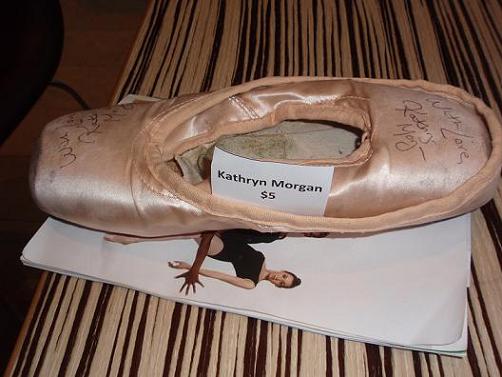
But first, it being Michael’s last day at NYCB this season, he browsed the gift shop, and ended up with a pair of Kathryn Morgan toe shoes. He told me (and, apparently the amused gift shop attendant) he figured she wasn’t going to be $5 for much longer 🙂 I guess their shoes cost a certain amount according to their status: principal ballerina shoes are $30, soloists are $15 and corps members $5. I didn’t know all this. I’ve never wandered over to the toe shoes section. I initially wondered why, then realized, oh, my favorite dancers don’t usually wear toe shoes. Sorry to be lewd, honestly, but I then couldn’t help but wonder — just because of that crazy strong mojito that nearly put me on the floor — why they don’t sell other kinds of used dancewear that my favorites *do* wear, alongside the toe shoes. Sorry! But can you imagine? Total alternate universe.

Anyway, here is Michael’s review:

At Dunkin’ Donuts, they sell munchkins 25 at a time. That’s about how many you get at New York City Ballet’s A Midsummer Night’s Dream, as well. The squadron of young dancers from SAB added a nice dose of fun and energy to a matinee that already had plenty of both on Saturday.

Daniel Ulbricht didn’t dance the role of Puck, so instead of gravity-defying antics, we just got antics. Corps member Troy Schumacher was announced as a late sub for soloist Sean Suozzi in the role, and there were some disappointed Ohhs around me. The thought: We’re getting the third string. Schumacher did an excellent job, though. He moved with an appropriately sprightly energy and showed a nice touch with the comedic moments. When he realized his magical matchmaking mistake, you could almost hear the “D’oh!”

Teresa Reichlen was fantastic as Titania, displaying just the right balance of regal, playful, and otherworldly for a fairy queen. And Robert Fairchild, a very busy man this season, excelled in yet another role (albeit in a ridiculous Prince Valiant costume) as Lysander. His put-upon love interest was once again Sterling Hyltin. The leads from NYCB’s Romeo + Juliet both showed they can handle Shakespeare’s comedy as well as his tragedy. Hyltin, for example, dialed up a slightly manic quality to great effect.

And Balanchine’s choreography tells the entire story in Act I, leaving Act II free for the divertissement. A quick wedding march and then Janie Taylor and Tyler Angle were center stage. They brought down the house.

Angle is a strong presence, but he defers so gracefully and lifts so effortlessly that he never soaks up more than his share of the spotlight. I noticed that when he partnered Tiler Peck in Mercurial Manoeuvres, and again on Saturday. Janie Taylor was both a delicate vision and a physical wonder, sometimes in turns, sometimes simultaneously. It’s a complete oxymoron in print, but she pulled it off onstage. Amazing.

The final scene was especially poignant for me, because I knew this was the last performance I’d see this season. Fireflies flickered around Puck against the dark backdrop of, yes, a midsummer night. It was the kind of night you don’t want to end, and the kind of season.

And here is Oberon’s (I mean Philip’s) review of the same cast.

And this just in! Another review (I’m interested in what he says of Gonzalo Garcia) — the one (by a pro critic who doesn’t say things are good when they’re not, and with great detail and specificity) that I’ve been waiting for 🙂 I knew Gonzalo’d nail it! I knew he’d be brilliant! I knew it!