DAY OF SLEEPING BEAUTIES: ALINA COJOCARU AND NATALIA OSIPOVA


Alina Cojocaru and Jose Carreno in Sleeping Beauty, photo by Gene Schiavone. (My favorite pose in all of life – no hands fish dive 🙂 )


And Natalia Osipova and David Hallberg as Aurora and Prince Desire, photo by Rosalie O’Connor.

So, I spent another Saturday at Lincoln Center, watching back-to-back Sleeping Beauties. This is probably my least favorite ballet — neither the story nor the choreography really speaks to me – but I was curious to see Alina Cojocaru in the role (it’s supposed to be her best and she’s was guesting for only one day from the Royal Ballet in London), and now that I’m an official Natalia Osipova fanatic, I must see her in everything she’s in.

So, matinee was Cojocaru. I thought overall she was really lovely and did as much as she could with what to me is a bland role. She was fresh, girlish and inquisitive in the first part when she’s meeting all the cavaliers and before she pricks her finger, then is more beatific and ethereal in the vision scene (where Prince Desire, out hunting, envisions her and then is led by the Lilac Fairy to her bed where he’ll kiss and awaken her – I don’t know how many people know the ballet), and then is full of grown-up, sophisticated charm in the third part when she marries the prince. A lot of ballerinas don’t really distinguish between the various stages of the ballet – their Auroras are the same throughout, so I liked that Cojocaru did this.

I just have to say, I’m sorry but for the first part of the Rose Adagio (where four cavaliers present her with roses, at the beginning) I couldn’t stop focusing on her feet.

Continue reading “DAY OF SLEEPING BEAUTIES: ALINA COJOCARU AND NATALIA OSIPOVA”

CORELLA BALLET OPENING NIGHT NYC


Photos top to bottom: Angel and Carmen Corella in Solea, Herman Cornejo and Adiarys Almeida in Sunny Duet, and Corella Ballet cast in Christopher Wheeldon’s DGV. All photos by Rosalie O’Connor.

Last night Corella Ballet Castilla Y Leon made their U.S. debut. It was one of the best evenings I’ve had at the ballet since ABT ended their Met season last July. Angel Corella (beloved ABT principal and founder of this company) is known of course for his bravura dancing, his ability to form a character on the stage even in the few storyless ballets ABT does, his passion, his charisma, his sweetness, his charm, but mostly of course his virtuosity. And even though he himself only danced in two pieces last night (with only a small duet in the Wheeldon), the whole evening had that same overall brilliance. It’s like he managed to find a company of dancers exactly like himself. I don’t know how he did that because I thought there was only one of him, but even the corps members seemed to have all of those qualities.

The night began with Angel’s own String Sextet, his first piece of choreography, set to Tchaikovsky’s String Sextet “Souvenir of Florence.” It was very allegro, very fast-paced, with lots of brilliant partnering — a ballerina would spin at lightning speed into her partner, they’d go into assisted pirouettes or a supported arabesque penchee (with the ballerina’s legs always in a perfect split), another would jump into her partner’s arms and he’d catch her in a variety of positions. Kazuko Omori and Yevgen Uzlenkov completely blew me away, as did all of the couples but those two in particular. It’s like, where did he find these people and how did I not know they existed?! Omori is a brilliant allegro dancer but she also had the qualities of an adagio ballerina, with lots of expression in her upper body. Then, in the third movement, Joseph Gatti blew everyone away with his bravura, Angel-esque solo replete with jetes and fouettes and crazy high tornado jumps. The crowd went wild for him, as expected. Both the duets and solos and the ensemble parts were equally captivating. Toward the end everyone did a fish dive in unison and it’s so sweet. It was like all the best parts of classical ballet — or at least my favorites 🙂

Next was Walpurgisnacht, by Leonid Lavrovsky, which reminded me of the Corsaire pas de trois between Ali the slave, Conrad the pirate, and ballerina. Again the beautifully expressive, lightning-footed Omori and high jumping Gatti starred, and the stunning Kirill Radev danced the part that reminded me of Conrad. He had this series of scissor jumps but the splits were forward-facing, straddle position, rather than long-wise, like usual. And then he’d do these multiple pirouettes with these seemingly impossible held-out endings. The crowd was nearly screaming with applause, which doesn’t often happen in New York.

Then was Sunny Duet, from 1973, by Vladimir Vasiliov and Natalia Kasatkina, danced by our Herman Cornejo and Adiarys Almeida. Everyone applauded for Herman when he took the stage 🙂 This ballet was sweetly romantic, like man in adoration of his woman, with Arabian / Bayaderesque styling. Herman really blew me away last night with his partnering. The pdd began with this extended overhead lift where he looked up at her for what seemed to be minutes, in the end making it into a single-handed lift. I’ve always thought he was a brilliant soloist but that he had some trouble in the partnering, but not last night! He was also very dramatic, and, at one point, where they go into their bravura solos, he played off of her, giving her this “oh yeah, well this is how I feel!” look before doing a bunch of crazy turns or jumps. The original, archived music, by Arno Babajanyan, was played on tape. There was a note in the program stating, “The company is committed to the revival of worthy pieces that have had an important influence on classical ballet. The piece will be performed as it was originally created by the legendary Russian choreographers Natalia Kasatkina and Vladimir Vasiliov. The artists will be performing to Arno Babajanian’s archival recording, as this specially commissioned score no longer exists.”

Next was Solea, choreographed by Flamenco dancer and choreographer Maria Pages, and performed by Angel and his sister Carmen. I was happy to see Carmen back onstage; I was sad when she left ABT. This was an absolutely beautiful combination of ballet and Flamenco, though I often see Paso Doble in what people call Flamenco, being a ballroom person — still not sure of the difference… For example, at one point, they would come at each other, she swirling her long skirt about, cape-like, he coming at her like a matador — that’s Paso — but instead of rushing toward each other, hips thrust forward, they’d do chaine spins — she on pointe, spinning right past each other, balletically. Then they’d approach each other again, she’d retreat quickly back with supercharged bourrees. I love it! I’ve always wanted to see a Paso Ballet, but most ballroom dancers don’t seem to know how to choreograph such a thing, even if they have extensive ballet background. Then, during the Flamenco taps (which you can hear in the recorded music), Angel would do his trademark lightning fast fouettes, or else entrechats, or just crazy fast footwork; and she’d do the same on pointe. Flamenco taps on pointe! And each of them had the perfect Flamenco styling. And there was a kind of back and forth “competition”, which I guess is called “Bulerias” in the world of Flamenco, which was kind of like a set of “variations” or solos in ballet, with him doing the trademark jetes around the perimeter of the stage and she responding with her own thing. And at the end, they came together and she stood behind him and he wrapped her arms around him. Sweet. Audience gave them a standing ovation.

Last was Christopher Wheeldon’s DGV: Danse a Grand Vitesse, which was I think the most intense, spellbinding Wheeldon ballet I’ve ever seen. It was premiered in 2006 by the Royal Ballet and was nominated for an Olivier Award. Set to music by Michael Nyman, which was commissioned by the French railway company TGV in 1993 to commemorate their opening of a new high-speed train line, there were several large pieces of twisted metal in the background — between which the dancers would weave in and out from time to time. The music had a very “locomotive” rhythm to it and the whole thing — both music and movement — had a kind of eerie feel to it. Movement was trademark Wheeldon — very modern, lots of angularity, sharp jagged lines, unique partnering. Women were often carried overhead and upside down with their legs in a split or sideways with their knees bent outward and toes together, creating an intentionally awkward shape. At times the music would stop completely while the dancing continued — creating some of the most intense moments. This is the first time the piece has been performed outside of the Royal, the program notes say, and, with its intensity, it was a perfect choice for this company.

So, the evening was a celebration of classical ballet, fusing classical ballet with traditional Spanish dance, and contemporary ballet, which seems to be what this company is about. Excellently done!

There’s one other piece on the program, Epimetheus, which will show Saturday afternoon. It’s by a young choreographer / dancer with the company, Russell Ducker. Will report back as soon as I’ve seen it!

CORELLA BALLET CASTILLA Y LEON UPCOMING AT CITY CENTER

Just a reminder that Angel Corella’s new company is making its U.S. debut at City Center next month (March 17-20 to be exact). Here are a few pictures to whet your appetite:


Angel with his sister, Carmen Corella (who, if you remember, was a SLSG favorite before she left ABT); photo by John Anderson;


Angel and dancers in String Sextet (Corella’s first piece of choreography), photo by Manuel de los Galanes;


Two pics of Angel, in Corsaire by Joseph Aznar (top), and in Bayadere by Rosalie O’Connor; and


Rehearsal photo of dancers Kazuko Omori, Ashley Ellis, and Alba Cazorla by Fernando Bufala.

In addition to Angel’s first piece of choreography, String Sextet (set to Tchaikovsky’s Souvenir From Florence), the program will feature new work by Russell Ducker, a new pas de deux by flamenco dancer Maria Pages danced by Angel and Carmen (which I am particularly excited about), and works by Christopher Wheeldon (DGV: Danse a Grand Vitesse, which was nominated for an Olivier award when it premiered in London in 2006) and Leonid Lavrovsky, and Vladimir Vasilyov and Natalia Kasatkina’s Sunny Duet to be danced by Adiarys Almeida and our Herman Cornejo (who is married to Carmen, for those who didn’t know).

Go here for more info and schedule.

AMERICAN BALLET THEATER’S NEW NUTCRACKER SEASON AT BAM

pb302363

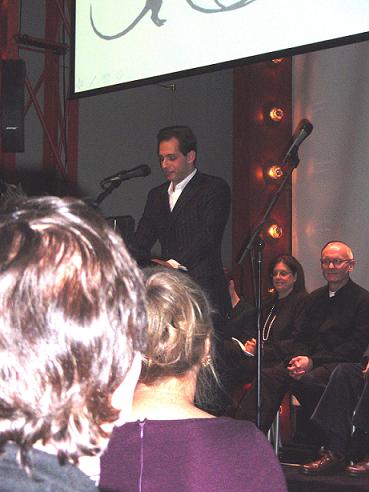
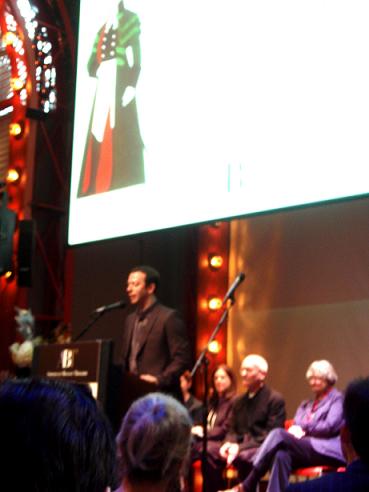
Yesterday morning at the Brooklyn Academy of Music, ABT announced their plan to hold an annual Nutcracker season at BAM. Above is SLSG favorite, soloist Craig Salstein, enthusiastically speaking to the crowd. He was the only dancer to address the crowd; David Hallberg was there too but stood in the back the whole time. A group of young dancers from the Jacqueline Kennedy Onassis School of Ballet (associated with ABT) was there as well — they’ll be dancing in the party scenes when the production opens next year, on December 23, 2010. For the first year, the season will be two weeks, but after that the company hopes to have a longer run.

pb302361

ABT resident choreographer Alexei Ratmansky will be choreographing.


Here’s a slightly better picture of him, by Fabrizio Ferri. Someday I will get a pro camera, I swear!

This was the first time I’d heard Ratmansky speak. He is very soft-spoken and has a heavy Russian accent and seemed to know what he wanted to say but struggled a bit to get the words out in English. And he makes the same grammatical mistakes as Pasha and Baryshnikov (mainly leaving out articles — there are no definite or indefinite articles in Russian — a, an, the — so they tend to leave those out: “…is great score,” etc.) I think English must be the hardest language to learn, especially for Russians. I know Russian is the hardest language I ever tried to learn…

Anyway, Ratmansky seemed shy and soft-spoken but genuinely excited, especially when talking about Tchaikovsky’s score, which he called the greatest ballet music ever written. I felt vindicated 🙂

But Brooklyn Borough President Marty Markowitz really kind of stole the show with his little speech. He was so out of place in this crowd of rather gentle artists with that booming Brooklyn-accented voice! He of course praised ABT’s decision to hold the season in Brooklyn, then told Ratmansky he should move to the borough since it boasts the greatest Russian population in the U.S. He also called Brooklyn the dance capital of New York (in terms of studio space — which leads to the great number of companies rehearsing there), which is in turn the creative capital of the U.S. These politicians do kind of know how to make their constituencies proud. After bemoaning the fact that the last time ABT was in Brooklyn was before Baryshnikov defected, he called the ABT / BAM plan “a grand jete into the future for Brooklyn.”

The project is expected to cost $5 million and is being partly funded by David A. Koch (yes, of the Koch Theater — he’s matching dollar for dollar donations up to $2.5). ABT also plans to perform community outreach, particularly in Brooklyn schools, including pre-performance workshops for the children, attendance at dress rehearsals, and dance classes.

The rest of the production team includes Jennifer Tipton, lighting designer extraordinaire, and Richard Hudson, an award-winning theater designer, who will design costumes and scenes. Below are some of his sketches:


TCHAIKOVSKY AND TWIZZLERS DO NOT MIX, NYCB!

New York City Ballet’s Nutcracker season opened on Friday night. Review coming soon, but first I just have to complain about what I assume is a new custom in the Koch Theater, at least during Nutcracker season — the selling of Twizzlers, gummy bears, M&Ms and other bags of candy, along with bottled water, in the concession area, which is situated so close to the auditorium, audiences are assuming they’re for consumption inside the theater.

My friend Mika and I were seated comfortably in our orchestra seats (my first time in the new Koch house orchestra — wonderful wonderful improvement from the old: each row of plush velvety seats is staggered considerably higher from the prior row so that you can easily see above the head in front of you! Yay!), the lights dimmed, Faycal came out and took his cute little bow, the orchestra began — this is some of my favorite music in all of ballet — and suddenly, the row behind me began this all-out candy fest. Multiple bags were torn into, water bottles opened. “Here, honey, have a licorice,” said the mother. I turned around and shot the mother a look but she completely ignored me — or perhaps didn’t even register that I was looking at her for a reason. This continued — the passing of the crinkly bags, the water bottle’s cap being removed and replaced, the noise the plastic bottle made as the water was drunk and it filled with air, the “here, have the rest of this cookie,” etc. continued throughout the entire first act. I don’t think anything has ever disturbed me so much in the theater. I felt like I was at a movie — and a noisy movie at that. I almost felt like crying during the mouse / soldier fight scene — I love those tantalizing flutes! And I could hardly hear them.

When the curtain went down on the first act, I turned around, but the family of four kept right on gorging, staring right back at me, like they had no idea what I was looking at, and not even trying to hide their food. I felt like lecturing them on manners, on music appreciation, on ballet-going not only being a visual experience. I looked down the row to see if anyone else was annoyed and then noticed several others were doing the same exact thing.

I decided this wasn’t a regular ballet crowd and some random audience member lecturing everyone would be ridiculous. So, I spent most of intermission walking up and down the aisles searching for an usher — did they get rid of half the staff or something? Finally, a woman dressed in black asked me if I needed something, and I asked her if she worked here. She said yes, and I told her about the picnic-ers, and led her to them, where she told them eating wasn’t allowed in the theater. They all looked rather astonished.

Then Mika and I walked out front and I saw the concession stands overflowing with that same candy. Then I felt bad. I realized they didn’t just go to the Duane Reade and buy out the candy counter in preparation for the night; they bought it inside the theater, thinking, like at the circus or something, it was perfectly okay to chow down during performance. They’d dressed up their little girls in bright satin-y dresses, they’d obviously splurged on orchestra seats, and they didn’t look that wealthy. I felt like an obnoxious snob! On our way back in, I saw several others carrying bags of candy in with them. The family in back of me clearly weren’t the only offenders. (see the comments too)

I mean, it is about manners, but it’s not just about etiquette. It’s about art appreciation. Most mainstream movies don’t rise to the level of art; they cater to people’s preconceived notions and their plots don’t require many brain cells to understand. So it makes sense that people can take considerable time from looking up at the screen to focus on getting at their candy and passing it all around. But of course not every form of entertainment is so simple. In order to appreciate the artists’ abilities to subtly structure sound and movement to tell a story, you can’t be so focused on your food.

Anyway, happily, they obeyed the usher and didn’t eat at all during the second act (which I was able to enjoy much more). But I think, to avoid that kind of embarrassment and audience annoyance, if they’re going to sell circus-like candy at the concession stands during the Nutcracker, then there should be signs posted nicely but clearly instructing people to consume the food and beverages in the lobby, not the theater.

RATED R NUTCRACKER

photo21

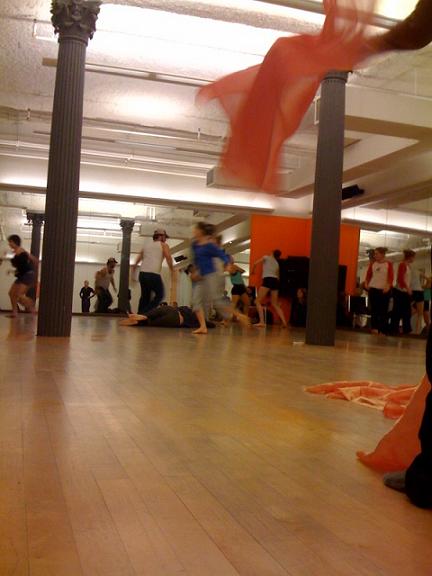
My friend, Michael Northrop, and I were invited to a rehearsal of a rated R Nutcracker on Sunday evening. I had to leave early but Michael kindly stayed and wrote up this review. I took the photo above with my iphone. Here’s Michael:

Did you see the movie Bad Santa? No, me neither, but you get the idea. Holiday traditions are familiar and tend toward the precious and that makes them excellent targets for parody and irreverence. The thing about parody in the dance world, of course, is that it has to be well danced. The examples that leap to mind, en pointe, are the bounding “ballerinos” of Les Ballets Trockadero de Monte Carlo. The modern ballet Nutcracker: Rated R fits the bill nicely, as well.

This raunchy, entertaining Nut is set in early 1980s New York, the era of subway trains tagged tip-to-tail with graffiti, collapsing tenements, and a drug dealer on every corner, rather than a Starbucks. I got an early Christmas present when I got to watch a rehearsal of Act I on Sunday night.

Choreographer/director Angela Harriell got right to business working through the kinks, so to speak, in an intricately choreographed fight scene pitting rats vs. the soiled soldiers of the Department of Sanitation. The rats knew martial arts, which was bound to happen in this city sooner or later. Hyosun Choi, a Mighty Mouse of a rat, flew over the top of a leaning Sanitation worker with a perfect miss of a kick only to take on another.

Harriell gave the dancers plenty of freedom to improvise: “And then it’s whatever you want,” she said. “Wrestle! wrestle! And then there’s the hitting sound.”

Many hitting sounds later, a quick run-through revealed a fun, feisty fight scene, and it was on to the next piece: the Party Scene. The Tchaikovsky was cued up and the partners took their places. A few more quotes from Harriell should give you a good idea of the action:

“Then there’s the moment when you pick up the dildo and you’re like, ‘Nobody needs to know about that,’ and you keep it for yourself.”

“So let’s get back to the drunk parents dance . . . Yeah, you’re totally easy.”

“Then it’s open step and closed step and open and shake-a, shake-a butt.”

Sometimes the dancers had questions:

“So on the second triple thing,” said Eddie Gutierrez, “there’s no butt at the end?”

Harriell had the answers and kept them on the music:

“And roll in, and throw up, and 1-2-3-4!”

The party scene ends on a late-night subway platform. [I’ll pause here so you can remember what that’s like.] And then there was a final run-through of “most of Act I.” The marked steps and questions were replaced by muscular lifts-at a few points, dancer Michael MacLaren was defending three women against the ground-dramatic extensions, and long stretches of seriously good dancing. The dancers were having fun, and it came through in the movement. It was a blast, even in an unadorned studio after two and a half hours. I don’t see what chance the audience has to resist it when the full production hits the stage.

Nutcracker: Rated R begins its fourth season, December 17-31, at New York’s Theater for the New City in the East Village.

I WANT TO DO FISH DIVES WITH MARCELO


So ABT is in the midst of its week-long Balanchine-Tchaikovsky program, which began last night, after Monday’s opening night gala. I’ve gone to both performances thus far, last night’s and this afternoon’s.

Last night I was seated next to Irlan Silva — ABT studio company dancer, and movie star! (actually, I’d noticed his dancing before the movie; I was only drawn to the movie because it was about Brazil, and only when I was sitting there during the Tribeca Film Festival did I realize I’d seen one of the documentary’s subjects before!) Anyway, he seemed really polite and quiet, but then he applauded and hooted loudly during dancer bows, so is obviously very supportive. I like seeing dancers at performances; Julio Bocca wasn’t right about everyone when he said young people are too into their cell phones these days to watch and learn. And, today I saw Ashley Bouder (of New York City ballet), sitting in the front orchestra.

Also last night, on the way in I saw Laura Jacobs. I wanted to thank her for sending me an advance copy of her new novel, but she appeared to be engaged in conversation and I didn’t want to interrupt. I didn’t see her husband, but I assume Mr. Wolcott was there at some point since this was Veronika Part’s first full performance of the season, and as principal ballerina!

Anyway, first on was Allegro Brillante, danced by Ethan Stiefel and Gillian Murphy. Today it was danced by Xiomara Reyes and Daniil Simkin. I noticed both in this and in the two Mozartianas that I saw that there seems to be a difference between the way Russians and Americans (Latin Americans included) dance Balanchine.

Continue reading “I WANT TO DO FISH DIVES WITH MARCELO”

WHY NOT MORE JOHN CRANKO IN THE US?


My friend, Mika, who is half Austrian, half Japanese and who spends a significant amount of time abroad was asking me the other day why I thought there wasn’t much of John Cranko’s work performed here when his ballets are so popular in Europe. I didn’t know. But I do know from some of Evan and Patricio’s Winger posts that his ballets are widely performed elsewhere, including obviously Chile. I was intrigued

Continue reading “WHY NOT MORE JOHN CRANKO IN THE US?”

UN BAISER AND SWAN LAKE


Over the weekend I saw the French film, Un Baiser S’il Vous Plait, or Shall We Kiss (I don’t much like the English title translation, sounds too much like Shall We Dance and “A Kiss Please” is just cuter). I guess I’d call the movie a sweet romantic comedy albeit not without a bit of tragedy. Problem for me was, soundtrack is comprised mainly of Tchaikovsky ballet music — largely The Nutcracker and Swan Lake, and I learned something about myself: I can’t watch a movie with subtitles and focus on the subtitles when my favorite ballet music is playing in the background — I keep seeing the dancers instead of the little words at the bottom of the screen. I do wonder if I were fluent in French how the music would have affected me — whether I’d likewise have been unable to listen to the words over the notes– but I do know for sure I can’t concentrate simultaneously on three visuals (actors on screen, words on screen, and dancer-visions in my head).

It also made me think how enduring music is. There’s one little scene where a woman is cutely and “innocently” flirting with a man — although the whole film is about how destructive one supposedly simple little kiss can be, what it can lead to — and in the background is playing the Dance of the Four Cygnets from SL. And it’s actually very dulcet, although if you listen carefully, you can see how the music could be interpreted as somewhat threatening in its seductive charm. It ends up being perfect for this story where flirtatious behavior can destroy a relationship. And yet, that’s not what’s really going through your mind during that dance in the ballet. At least I don’t think it’s what’s supposed to be going through your mind? As I’m watching, anyway, I’m not thinking how dangerously seductive are those cute little swans; it’s just a difficult part for four dancers doing challenging steps perfectly in sync. But it made me think how Tchaikovsky’s ingenious music can be used to add insight and emotion to other stories besides that for which it was created. Maybe music has a longer-lasting life than dance, sadly… Although I love that filmmakers are using it — perhaps it will make watchers curious about the music’s origins…


Anyway, I never wrote about Balanchine’s Swan Lake, which I saw at NYCB last season, so now seems like as good a time as any… if I can remember it all.

Balanchine, I guess predictably, makes it all about the ballerinas — his “butterflies”. Prince Siegfried hardly figures – -there’s no ball at which he’s to pick a wife, no mental reflection in the forest, no “bird hunting,” no Odile, no Black Swan pas de deux where Odette’s human imposter seduces him leading to tragedy… Just Siegfried meeting Odette at the lake, falling for her, having her taken away from him by the evil von Rothbart and his flock of black swans.

I feel like the focus on the pretty ballerinas eviscerated the story. Prince Siegfried is the protagonist. It’s his story, his inner conflict, his unmet needs, his all too human weakness of character that you identify with, and that leads to tragedy. The story opens with Prince Siegfried at the first of a series of balls, at which he, having just turned 21, is to choose a wife. Beautiful princesses from all over Europe are being presented to him — what a choice! What more could a prince want! But he’s not at peace, for some reason. He’s just not into any of them. Why, he’s not sure, but something’s just not right. So, he decides to leave the first evening’s party early, go out into the woods, near the lake where he often reflects. His friends want to come with him, but no, he’d rather be alone. And then he’s lying by the lake, thinking, reflecting, perhaps having fallen asleep and dreaming, and he sees a beautiful swan. He takes aim with his bow and arrow when suddenly this magnificient creature turns into a woman before his very eyes. He of course becomes mesmerized with her. She — this fanstasy creature — he knows immediately, is his soul-mate.

She sees him, she’s afraid but he tosses the bow and arrow down, tells her not to worry, she tells him what happened to her — that von Rothbart cast a spell on her so that she’s a swan during the day, and can only be human — her true self — at night out by the lake. But the spell can be broken if someone — a sexual innocent, such as himself — pledges eternal love to her and then remains faithful. Of course Siegfried vows that he can do that, right before von Rothbart, who’s been listening in on their conversation, reclaims her for the evening, turning her back into a swan.

The next night at the ball, von Rothbart casts a spell on his daughter, Odile, so that she’ll look just like Odette. They show up at the ball and Sig is completely taken with Odile (in some versions he actually thinks she is Odette, the likeness is so close; in others he just falls for her, human frailty being what it is). A seduction ensues with all those ten thousand fouettes and gigantic, stage-traversing jetes as the climax, and then Odette appears, making it clear either Sig’s been deceived into cheating on her or making him remember his oath of faithfulness, which, either way, he’s now broken, therefore forcing her to live in eternity as a swan and making their love in this life impossible. They go back to the lake, do a tragically beautiful pas de deux and then — in most versions — she kills herself by throwing herself into the water, he follows suit, vR tears his hair out in agony and then we’re shown a vision of Siegfried and Odette together in the afterlife. (In some Kirov and Bolshoi versions Siegfried slays von Rothbart, and the story ends happily, which I find appalingly cheesy).

So, it’s a story of not being able to love who you truly love because of societal constraints — arranged marriage, familial circumstances, governmentally enforced heterosexuality — what have you, along with themes of deception, unfaithfulness, inconstancy, human fallibility, and deep abiding love eventually conquering all those worldly limitations. But Balanchine makes it about this man caught up in this world of ethereal beauties — which is really a ballet cliche.

There are some really beautiful scenes though. Apollinaire Scherr, who I sat next to the night I saw it (and who likes it much more than I), describes well how in the end, the flock of black swans overtakes Odette, tragically separating her from Siegfried. It’s really visually stunning, horrifying — almost like she’s drowning in the tidal wave they create — and you just want to hold your hand up to block it out. Balanchine does get to the action quickly, and he uses the Tchaikovsky score to its fullest — beginning and ending with the familiar competing von Rothbart and Siegfried / Odette themes, while toy swans slide by in a background lake, showing, at the beginning what Odette has been and in the end what she’s been returned to. I do like the sliding toy swans better than ABT’s version, where von Rothbart, in swamp creature form, is shown grabbing human Odette, taking her behind a curtain, then emerging with a swan stuffed animal. There are other commendable things about Balanchine’s version, but I still think truncating Siegfried’s story the way he does turns it into a ballet cliche and deprives it of its power to speak to the human condition. I know people will disagree with me, but those are my thoughts.