Angelenos Boo Merce!: L.A. Dance Project’s Dramatic Premiere

This past weekend marked the premiere of L.A. Dance Project at the Walt Disney Concert Hall in downtown LA. Of course this is the event – the full-evening debut of Benjamin Millepied’s new LA-based company – that all dance-going Angelenos have been eagerly awaiting. There were two performances: opening night was Saturday; I went to the Sunday matinee. According to reports of Saturday’s performance, Natalie Portman was present, fully decked out in Oscar attire. Robert Pattinson was also there. No report of what he thought though, other than that the evening made clear to him that he has no talent for dance. His words 🙂

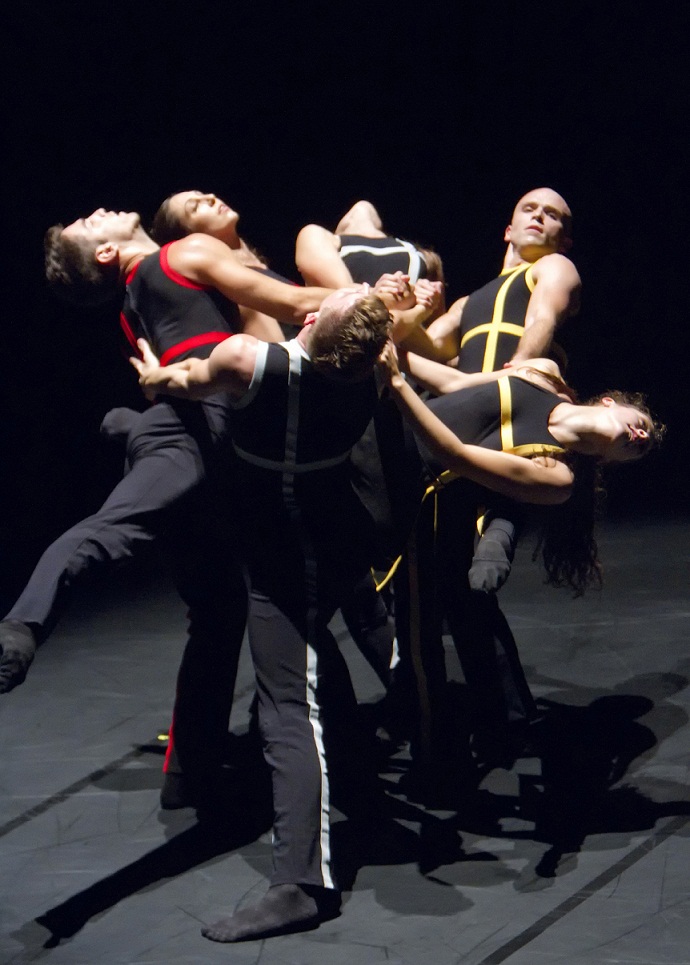
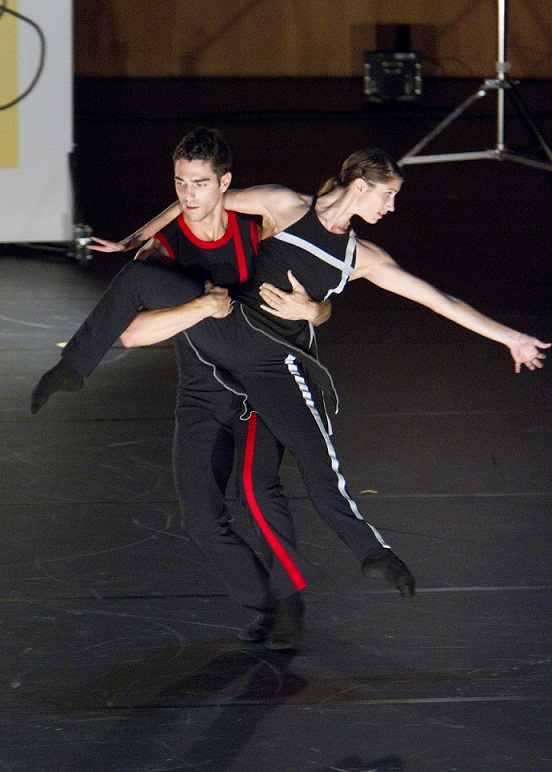
There were three pieces on the program: William Forsythe’s Quintett, from 1993; Merce Cunningham’s Winterbranch, from 1964; and the world premiere of a Millepied dance, Moving Parts (photo above, by Eric Politzer; all photos by Politzer).

By far the most astounding, confounding, spellbinding, brilliant piece on the program was the Cunningham. And for that reason alone L.A. Dance Project proved itself an invaluable asset to its new community. Every critic so far has said the same, so I know I’m not alone in thinking that. But I don’t know how much dance-going Angelenos would agree. During my performance, a woman sitting next to me angrily got up and walked to the back of the theater. Immediately after the dance ended, she cried out, “Thank God!” more than loudly enough for everyone in the entire theater to hear. Many showed their agreement with her as a chorus of loud boos started to emanate throughout the auditorium. This soon was countered by a chorus of cheers. For a moment there was a war going on. I have to say I’ve never ever seen that kind of visceral, dramatic reaction to any dance performance in New York. I’ve never seen that anywhere in response to dance; the only time I’ve ever seen a work of art booed was the Metropolitan Opera’s recent re-interpretation of Tosca.

I mean, part of me was excited that dance could evoke such strong feelings. But part of me was disappointed in the booing Angelenos for not being the least bit open-minded, for not giving the piece even a second’s consideration; for failing to think, “I’m going to go home and look up this Merce Cunningham person on the internet and find out what in the world that was all about.” Cunningham is obviously a master, and I don’t know as much about him as I should. This definitely made me want to know more. It also made me kind of sad that I wasn’t around in the 60s if that kind of art was going on. I wish Alastair Macaulay would have been in L.A. reviewing this for the NY Times. I’d like to know what he would’ve thought – of the piece, and the audience reaction, he loves Cunningham so.

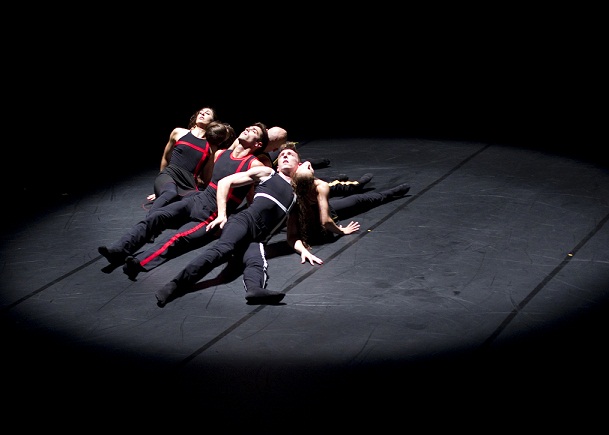
According to program notes, Winterbranch was taken out of the Cunningham repertoire not long after it premiered, so most people probably know nothing about it. It was a collaboration between Cunningham, Robert Rauschenberg, and sound artist La Monte Young. Rauschenberg designed the costumes (all six dancers are in black sweatsuits with smudges of black painted under their eyes) as well as the absolutely brilliant lighting (which was reconstructed for this stage by Beverly Emmons).

At the beginning one dancer (originally Merce himself) slithers across a dark stage carrying a flashlight. Following him, other dancers take the stage, and the piece is basically a meditation on the act of falling and and pulling yourself back up. Dancers sometimes fall quickly and violently, sometimes they fall slowly, as if they’re being crushed by some invisible psychological weight. Sometimes they have difficulty rising; they crawl over each other, they contort their bodies and crab-walk across stage. Meanwhile the stage is dark, except for that brilliant Rauschenberg lighting whereby a light will briefly flash, like a headlight, then fade, then reappear tunnel-like, growing stronger, again like the lights of an approaching car.

About half-way through the sound starts. And, yes, it’s very harsh. Young’s composition is called simply 2 Sounds and those two sounds are: the sound of “ashtrays scraped against a mirror;” and of “pieces of wood rubbed against a Chinese gong.”

Yes, the whole thing was very unsettling. It felt like being caught in headlights, perhaps in a tunnel, or on a dark street, with sound so shrill you couldn’t escape. It felt very industrial, urban, Los Angeles – probably why Millepied thought to bring it here.

Wasn’t Cunningham all about questioning what dance is? Do people really want it to be all about pretty girls doing sexy things? Don’t people want to be challenged? Believe me, the people doing the complaining (mainly about the sound from what I overheard) didn’t look like they’d never been to a rock concert before. And after this ended my eardrums were nowhere near numb.

I think Millepied took a real chance bringing such a piece to a place where perhaps many have only seen classical ballet and popular dance on television. And for that I respect him more than ever.
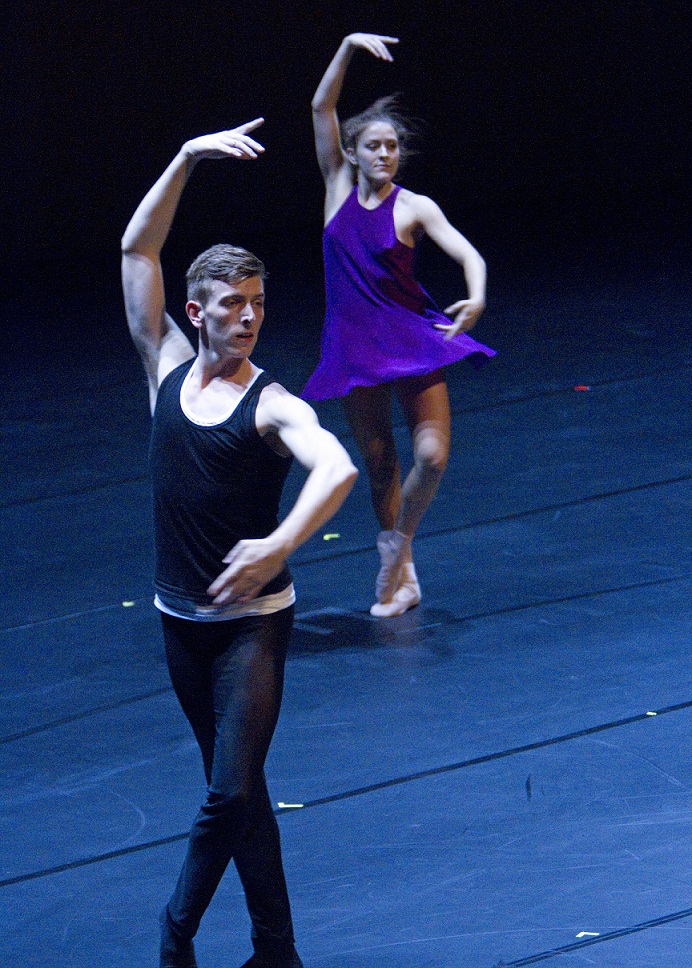
The other two pieces weren’t quite as strong. I think Forsythe’s Quintett (photo above) meant more if you knew about it, about him, and about his wife who died young of ovarian cancer. It’s a waltz but there are five people – three men and two women. So there’s a woman missing. The music is Gavin Bryars’s Jesus’ Blood Never Failed Me Yet, a sweet, folksy choral piece in which the singer keeps repeating that line over and over and over again. The dancing is mainly light and joyful, and the press notes state that he meant it to be a kind of tribute to her. Unfortunately the program notes don’t give out that information, so the audience was unaware.

I kept thinking of Forsythe’s intense, unforgettable installation piece, You Made Me a Monster, another take on the same thing, with a completely different mood, which showed in New York several years ago at the Baryshnikov Arts Center (and which I wrote about here). The dancer Charlie Hodges – my favorite of the six-person dance troupe – reminded me of a similar-looking dancer in Monster. His movement was the most expansive with every motion seemingly filled with intent. And he was the character who seemed to evoke the sole man, the man without the partner. Quintett had much more lightness and fluidity than Monster, and was far more hopeful than tragic, and it nearly made me cry. I’m just not sure if an audience who knew nothing about his wife and the work’s origins, and who’d never seen Monster, would have gotten the same out of it.

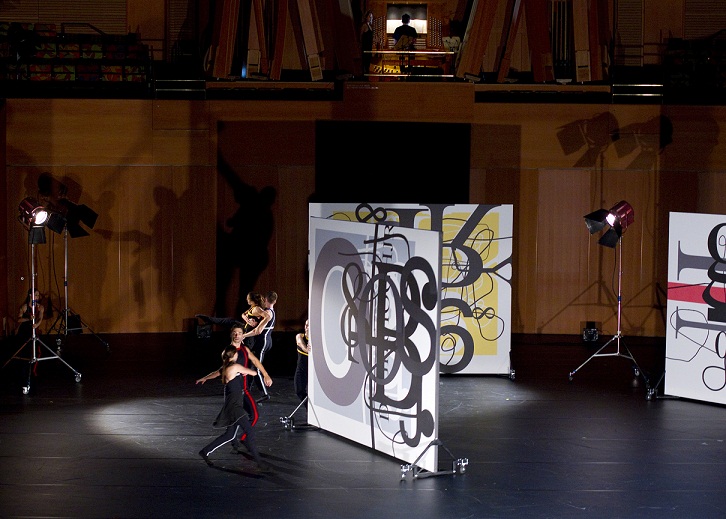
Third on was Millepied’s new Moving Parts, a collaboration with the always rousing Nico Muhly, costumers Kate and Laura Mulleavy of Rodarte, and visual artist Christopher Wool. I thought the most interesting parts of this collaboration were Muhly’s music – a bold, rich combination – at times mellifluous, at times slightly off-kilter a la Philip Glass – of violin, clarinet, and organ (played spectacularly on the magnificent, elevated organ at the top of the concert hall) and Wool’s artwork, consisting of three large canvasses bearing a combination of letters and numbers. One or two of the six dancers would push the paintings, on wheels, around the stage, the others dancing around them. The dancers wore basic black unitards; and were paired – male and female – by a same colored stripe running along the top of the costumes. Each painting also bore one of those colors. But this color-coordination didn’t seem to have much meaning.

The dancers were all very good – Hodges, Frances Chiaverini, Julia Eichten, Morgan Lugo, Nathan Makolandra, and Amanda Wells, but I didn’t find the choreography particularly intriguing or the dance as a whole to have much meaning. But I find Millepied to be like that – he’s either on or off. This time he was off, but next time he may well be very on.

Nevertheless, every time this company performs, I will always be there. That Cunningham revival made me trust that Millepied will always bring something significant.

Here are a few more photos of Moving Parts, courtesy of the Music Center.
ALBERT EVANS FAREWELL


Photos by Paul Kolnik (top, of Albert Evans during final curtain call, bottom with Wendy Whelan in Herman Schmerman)

Sunday afternoon longtime beloved principal with NYCBallet, Albert Evans, gave his final performance. He danced two roles he is well-known for – the pas de deux from William Forsythe’s Herman Schmerman, with Wendy Whelan, whom he’s often been partnered with, and Balanchine’s The Four Temperaments (he danced the third variation – “Phlegmatic”). It was perfect – -a humorous, playful pas de deux and a very serious, emotionally moving classic Balanchine ballet. He danced both fabulously. I haven’t seen Herman Schmerman much, and he made me want to see it again. And he danced “Phlegmatic” so well, with such precision and intensity (honestly, better than I remember seeing it danced previously) it made me take notice of a Balanchine ballet I honestly haven’t much liked before.

Also on the program was La Source, a pretty in pink ballet by Balanchine set to Delibes and danced very well by Joaquin de Luz and Megan Fairchild in the pas de deux and Lauren King as leader of the ensemble. I have in my notes “dive!!!” which means Megan must have dove into Joaquin’s arms with brilliant gusto!

And in the middle was The Lady with the Little Dog, a newish ballet by Alexey Miroshnichenko that premiered last season, danced again very well by Sterling Hyltin and Andrew Veyette. I think they re-staged and / or re-thought it a bit because it seemed so much better this time. I remember liking parts of it last time; I really loved it this time. The lifts are stunning and it’s very emotionally moving with lots of climactic build-up. I think it’s more focused on the couple this time and the “angels” are more functional and less involved in the choreography and I think that made a big difference. I always love Sterling’s little dog. This time he (or she?) wanted to be picked up a lot.

Anyway, Albert Evans is quite the character and his curtain call was probably the most celebratory I’ve seen at City Ballet. I said on Twitter that it was of Julio Bocca-esque proportions! Of course everyone – audience and the dancers – loves him, and many of the female dancers came out and did a little dance with him when giving him their bouquet. He did several little goofy dances himself, with lots of Rocky Horror Picture Show-style pelvic thrusts. He picked up one of his bouquets and flung it out to the audience. Then, he took off his shoes. Oh and he had a glass of champagne, brought out by a group of male principals. See, what I mean – Julio Bocca all over again! Crowd went wild, and didn’t want to leave the theater.

Since it was a nice day, after the performance I sat outside on the benches near the stage door with Oberon and we waited for Albert to emerge. He never did! Well, he probably did after several hours – Philip and I imagined he was getting plastered with Wendy Whelan and Maria Kowroski (neither of whom emerged either during the time we sat there) and his other regular female partners. A good hour after we’d been sitting out, a dancer came out and talked with Philip a bit and told him she just saw Albert inside yakking it up with everyone and he was still in his ballet clothes. So we decided we’d be waiting all night and we’d better leave. Did get to meet a lot of dancers though — all very charming and immensely polite and gentlemanly! Amar Ramasar, Robert Fairchild, Troy Schumacher (who made me want to dig back into Proust – have the tomes of his work but have never gotten around to cracking them open), Craig Hall, Tiler Peck, Abi Stafford… those are the ones I can remember. Fun day!

For more on Evans’s career, Oberon has a really good write-up with lots of photos.

INTERVIEWS WITH SONYA TAYEH AND BILLY BELL


Okay, here are the interviews I did with Sonya Tayeh and Billy Bell last week at the DeMa Dance Company rehearsal. (Bell and Tayeh are most known for their work on So You Think You Can Dance, if you don’t know – Bell was on the show briefly at the beginning of the season and had to withdraw due to illness, and Tayeh is a choreographer). I spoke with them very quickly, during their tiny lunch break, and I shared the interview with a writer from Dance Spirit magazine. It was hard to get everything down (especially with Billy, who is a fast talker!) and remember the other writer’s questions, etc. (I intend to get a flip camera for the future). Anyway, it’s hard to put this in a question / answer format, so I’m just going to summarize and paraphrase what they each said.

Billy was so sweetly enthusiastic and excited about his life. So much fun to talk to!

First things first – SYTYCD, since that’s how most people know him. He said he definitely plans to return to the show next season. The producers told him he’ll be automatically advanced to the top 100 – so he’ll start out at the Vegas auditions and go from there.

He had to leave the show at the beginning of this season after being diagnosed with Mononucleosis. The problem wasn’t that he was contagious any longer by the time he was diagnosed, but that the illness had significantly enlarged his spleen, and he even had to be hospitalized. Doctors told him if he moved too much with his spleen so enlarged, he could have ruptured it and died. It would likely take a few months for the spleen to return to normal size, they said, which is why he had to leave the show at that point. Now, it’s nearly back to normal though it’s still a slight bit enlarged. “That’s why I wasn’t really dancing full-out,” he said with a little laugh, referring to the rehearsal we’d just seen. Dance Spirit woman and I nearly fell off the couch at this. “If that wasn’t full out, I can’t imagine what you normally look like!” she said. And I agreed. He seemed completely healed to me, to make a massive understatement.

I asked him how he got started in dance. He said he started late, in high school, and he actually began with Hip Hop. His lack of early training didn’t matter for that dance because, unlike ballet for example, the movement isn’t codified. But he soon became interested in Jazz, for which he needed ballet training. He initially learned by mimicking movement, but he soon enrolled in the ballet academy at Ballet Florida and, in order to make up for lost time, really threw himself into it, moving very close to the studio and taking several hours of dance per day, along with his other studies. After a while of ballet, he became interested in tap, and so began training in that too. He’s interested in multiple dance forms but considers his main style to be contemporary ballet.

I asked him who his favorite dancers were or if he had any particular heroes or sources of inspiration. He immediately named Andrea Miller, choreographer and director of Gallim Dance, whom he called his “personal mentor.” He’s worked with her before – when he was 18, his first pro experience — and he performed her work at the Joyce SoHo. He loves her approach to movement and how she teaches: she wants you to experience the movement in your body, he said; it’s not just about the positions, but about how the movement makes you feel. He’s excited to be able to work with her again at Juilliard; she’s to set a piece there soon.

I asked him what other choreographers or companies he’d like to work with. In addition to Gallim, he named William Forsythe and Ohad Naharin’s Batsheva. He finds in this “dance theater” an outer simplicity and yet so much complexity behind it. “What’s going on inside you – (with Gallim and Naharin’s Gaga training) – is simple and yet so complex.” He would also love to do some Paul Taylor, Merce Cunningham, Jose Limon, Jerome Robbins, to name a few.

But his biggest passion: choreographing. He wants to dance while he’s young but eventually his goal is to create dances. He said with a laugh that he loves “destroying ballet” – kind of bending those rods ballet dancers seem to hold up their spines and freeing them up, allowing them to go back and forth between different kinds of movement. He loves being able to work with dancers and bring certain things out in them. He strives to move people emotionally, to move the audience, he loves having that power. He choreographed his first piece — 15 minutes long — at Dreyfoos, his high school back in Florida. It was performed there at a show in January.

But that’s in the future. In the meantime, he’s finishing up at Juilliard (he’s about halfway through his BFA; has another couple years to go), he has the SYTYCD Vegas auditions coming up next season, he’s participating in a choreographic competition that travels throughout the States, and he just became a principal dancer at DeMa this month. Despina Simegiatos, one of the artistic directors of DeMa, says back when she was looking for strong male dancers for her fledgling company, she found him on YouTube, through some videos he’d posted, and really fell for him. He hadn’t yet gone on SYTYCD.

He’s excited about working with DeMa because it’s a company that seeks to fuse the creative with the commercial. Companies are where artists can focus on their creative work, but commercial work is what pays the bills. In an ideal world these would be fused, but in the U.S. they rarely are, he said. He seeks to be able to transition back and forth between the two. He’s excited about working with Sonya because he was just about to work with her before he had to leave the show. A couple of other Juilliard students are also dancing with DeMa, which makes the company feel homey to him.

He sweetly said he considers himself the luckiest person in the world that he gets to do what he loves and get paid for it.

Sonya Tayeh, like her work, was very intriguing and I wish I would have had more time with her but she was so busy creating this piece. This is her first time working with DeMa. As I mentioned earlier, her dance, titled When the Love Enters, the Light Shines, is six minutes long and is set to Bjork’s Unison.

When asked a bit about this piece, she said it’s about finding moments where you look at your life and you’re just in love with it. She actually found making this dance a bit challenging, she said. She’s really in love right now, very comfortable with herself and unafraid, and usually her choreography is about fighting. Lately she’s been so peaceful. But it’s nice to exhale, she said with a laugh.

When asked what she wants of her dancers, she said all she asks is that they listen to her instructions but that they try to find the emotion in themselves, to embody it in the movement, not just go through movements she’s creating. She has a very disciplined way of working and seeks to embellish movement as much as possible. She likes to have fast, abrupt stops and starts; she likes elements of surprise. She’s high-strung, she said with a little laugh – she has wild hair, wears crazy clothes, is really out there. Her choreography echoes that.

I asked her what inspires her, how she works, and what her goals are. She said it’s hard to talk about inspiration. She’ll have an idea in her head, but not the movement. She needs to get to the studio to see the dancers in order to create the movement. She begins with a mood in her head. She doesn’t watch much of others’ choreography because she’s afraid of duplicating them. Instead she watches a lot of documentaries of dancers and dance makers for inspiration. She watches cartoons, a lot of animation, and has a rather fantastical mind. Her focus is on making a mark in the world with movement, with her choreography.

Here are some more pictures, by Kim Max, of Tayeh rehearsing with the DeMa dancers (the picture at the top of the post is of Tayeh choreographing on Bell).


A FALL SMORGASBORD: CATHERINE GALLANT, EMIO GRECO, WILLIAM FORSYTHE, AND LUCINDA CHILDS

Reviewed by Christopher Atamian

In the past month I attended four very different performances that were all interesting for different reasons.  Readers will forgive me for giving brief overviews of each rather than the more in-depth analysis that they undoubtedly deserve, but lack of time and deadlines preclude me from doing them full justice!


On September 26, I had the pleasure of seeing Catherine Gallant/Dance present a series of rarely performed works at the Joyce Soho.  (Photo above of Gallant/Dance performing Isadora Duncan taken from Moving Arts Project.) These included works by Gallant herself, as well as José Limon, Isadora Duncan and Anna Sokolow.  Gallant’s company is rather unique because it is composed of dancers of all ages and body types—it was refreshing to see older women on stage (as in over 30!).  While they may not always have had the same power and lift as their younger counterparts, they displayed a welcome maturity, elegance and presence.  This was particularly true in the sublimely wistful 16 Waltzes Op. 39, choreographed in 1903, also referred to as “the many faces of love.”  Set to Brahms waltzes and as performed by Loretta Thomas, Eleanor Bunker, Michelle Cohen, Francesca Todesco, Marie Carstens and Gallant, the piece lulled the viewer into an almost blissfully intoxicated state.  It was also refreshing to see Anna Sokolow’s 1953 Lyric Suite, set to music by Alan Berg performed by Francesca Todesco, Eleanor Bunker, Michelle Cohen and Chriselle Tidrick.  Another highlight of the evening was the athletic Kristen Foote, a member of Jose Limón, interpreting Isadora Duncan’s Revolutionary (ca 1920-1924), with music by Alexandre Scriabin.  Foote displayed remarkable strength, vitality and grace in this simple but powerful piece.  That she could capture with each step and arm thrust the spirit of the October Revolution and spirit us, the audience, away to a Russia so distant in time and place, is a tribute to this remarkable young performer.  While one or two of the other pieces presented were arguably a bit lackluster, my only regret was that a larger audience hadn’t attend the performance, for Gallant is a historian and choreographer, a dancer and archeologist of dance history who brings to the stage pieces that we might never otherwise see.  We owe her a small debt for her good work and taste.


Emio Greco (photo above by Jean Pierre Moran) came to the Joyce in late September to present the second in his Dantesque trilogy, popopera[purgatorio]. I’ve already written a review of the performance for Dance Magazine which should be out in a few months so I won’t go into any detail here.  While I understand the issues that some critics may have had with the performance, Greco’s intellectual take on dance, the offbeat look of the dancers themselves, as well as the original, spasmodic movement vocabulary were interesting enough to me, although it wasn’t necessarily the most memorable show of the year. All told, the dancers gave a sexy, brassy performance. They also wielded and played the electric guitar-one for each dancer–with some panache.


I was rather surprised by the generally enthusiastic reviews of William Forsythe’s cacophonous mess Decreation (photos above by Julieta Cervantes) at BAM (October 7-10).   I am a huge fan of BAM, of their New Wave Festival and of William Forsythe who is obviously one of our great choreographers-in fact some of the most exciting performances that I have seen in the past years have been choreographed by Forsythe, including an outstanding Juilliard Spring Repertory Concert performance some years back of Limb’s Theorem III which included a wonderful, young Riley Watts contorting his body in the most fantastic ways, an amazing rotating globe and choreography that made the dancers appear almost super-natural or alien in their physicality.  But try as hard as I could, I couldn’t find anything noteworthy about Decreation, which is based on an essay by Canadian writer Anne Carson that examines lives unraveled by love: Sappho, Simone Weil and Marguerite Porete, a medieval mystic who was burned at the stake for not renouncing the views that she expounded in her book The Mirror of Simple Souls.  Decreation begins with Dana Caspersen re-enacting a nasty spat with a past lover while George Reischl repeats her speech in German: they are both barely understandable and contort, grab at shirt, face and body in such visually unappealing ways that they look like two inmates in an insane asylum-perhaps an apt metaphor for something or other, but what is the relation to a failed relationship?  That it drives you mad? That’s it’s just exasperatingly distorting to the soul? And every time Reischl screams out “It’s a spiel” (so what’s new, love’s a game?) I wanted to reach out and well, slap him. At another point in the performance a women grabs her breasts with one hand and her crotch with the other, hanging on to her private parts as she is sandwiched between two male counterparts.  Decreation came off as a questionable mix of dance theatrical elements and surreal or post-modern theater-oh yes, and occasionally someone actually moved, as if to remind the audience that they were at a dance performance.  Certainly this work is complex, but in an abstruse and frankly ugly way: everyone on stage contorts in such odd and unappealing ways and David Morrow’s soundtrack is so grating that you aren’t quite sure how to enter the piece as a viewer. Forsythe received a standing ovation from a few people in the audience which proves, I suppose the old adage de gustibus non est disputandum. (Of the reviews that I have read so far only Tobi Tobias had the courage to call a spade a spade-so I will link to her review here, and to be fair, to Roslyn Sulcas’ altogether more positive New York Times review)


Finally, a redeeming, exquisite Lucinda Childs performance at the Joyce on October 6.  The highlight of the night was Childs’ Dance (photo above by Nathaniel Tilleston), which was accompanied by Sol Lewitt’s wonderful film projected onto a translucent screen, so that one could watch the dancers performing live with the original 1979 filmed performance simultaneously juxtaposed over them.  While this staging doesn’t work as well in a small theater like the Joyce, the dancers were simply exquisite as they performed relatively simple but quick steps (sideways jumps and turning jumps in arabesque) over and over again, mostly in straight lines, changing direction here or there, making absolutely exquisite patterns that have been likened elsewhere to Persian rug designs.  At first the execution seems almost identical, as do the dancers costumed in identical unisex black outfits, but each one actually added his or her own idiosyncratic head tilt or subtle interpretation. It’s not easy to choreograph to music as purposefully repetitious and as fast-paced as Phillip Glass but the dancers acquitted themselves famously, as if floating on a seemingly effortless ethereal cloud for close to an hour.  It was refreshing to see work of such distinction and quality: one felt transfixed as one should by great art.  (Childs, almost seventy, also danced a brief piece with less success, but how nice to see her up there anyway!)

{A random aside:  After another recent performance, I was discussing Ulysses Dove and his remarkable Red Demon with another dance critic (Dove passed away from AIDS in 1996) and about the past twenty years of choreography.  She gently reminded me that the generation that we lost to AIDS in the 80s and 90’s has left a large hole in our choreographic heritage-between older choreographers and the debatable quality of much of what we now see in contemporary dance.  I will go one step forward and say that while I am all for free expression and believe that anyone who wants to should try his or her hand at choreography, that we have way too many people of middling talent presenting dances today-which is neither good for dance nor for its reputation with the general public.]

COMPUTER CRASH!

Just as I was about to send the final version of my novel off to the publisher my computer crashed. My wonderful friend Mika allowed me to use hers for the day. But since I don’t know how long my laptop is going to have to spend in the hospital, blogging might be intermittent for the next few days.

In the meantime, I’ll try to tweet via my cellphone.


As soon as I return, more on this year’s Fall For Dance Festival, as well as my thoughts on William Forsythe’s Decreation which I recently saw at BAM. I normally really like Forsythe, but I felt you had to have read the Anne Carson essay (of the same name) that the work is based on in order to understand it. Did anyone in NY see it? (photo by Andrea Mohin from NY Times review.)

TONIGHT IS ALMOST HERE!: ABT AT AVERY FISHER AND FORSYTHE AT BAM


Finally, ABT’s Contemporary season is here; it opens tonight at Avery Fisher Hall, at Lincoln Center, with premieres by choreographers Azsure Barton, Alexei Ratmansky and Benjamin Millepied (pictured above, left to right). Plus, there’s a special addition — a performance of Michel Fokine’s Ballets Russes classic, The Dying Swan, by SLSG favorite Veronika Park! (top photo, by Jade Young)


Another important dance event that opens tonight is William Forsythe’s company performing the U.S. premiere of his Decreation, at Brooklyn Academy of Music. Unfortunately, their performances are the exact same nights as ABT’s shortened season so most big dance fans are probably going to be at Lincoln Center for the next few days. But Forsythe is a very important choreographer and I strongly encourage all New Yorkers to try to make it out to BAM for at least one of the perfs between tonight and October 10th.

There’s a post-performance talk with Forsythe tomorrow night at BAM (October 8), and another talk between Forsythe and philosopher Alva Noe about consciousness as a kind of dance at the New York Public Library the following day. I find Forsythe to be brilliant and it’s always fascinating to hear him talk.

SOME FAVORITES FROM VAIL

Wow, there are a lot of video clips up of the many many companies and dancers that performed at this year’s Vail International Dance Festival. Here are some of my faves:

Dance Brazil in a modern / capoeira combo, Luna:

Daniel Ulbricht and Misa Kuranaga doing a Corsaire pdd:

Sofiane Sylve and Simon Ball in Forsythe’s In the Middle Somewhat Elevated:

Wendy Whelan and Edwaard Liang (dancing with Morphoses) in Forsythe’s Slingerland pdd:

Matthew Rushing in Ailey’s beautifully bluesy Reflections in D:

Linda Celeste Sims rehearsing Ailey’s classic Cry:

Gillian Murphy and Ethan Stiefel’s Black Swan pdd:

Tyler Angle and Tiler Peck in the pdd from Wheeldon’s Mercurial Manoeuvers:

Some Lindy Hop with Naomi Uyama and Todd Yannacone:

And some Argentine Tango by Natalia Hills and Gabriel Misse:

There are many more vids and photos though, so visit the festival’s blog. I don’t see any up yet of the Ballroom evening — Hanna Karttunen and Victor DaSilva and J.T. Thomas and Tomas Mielnicki, et al. Hoping to see some of those soon. Excellent blog though, letting peeps who couldn’t be there in on what all went on. And splendidly diverse festival!

THE POPULARITY OF KEIGWIN + COMPANY


During ballet season my time is so limited and I just can’t attend everything I want to. And so, regrettably, I had to miss Keigwin + Company at the Joyce last week. But my friend, writer Christopher Atamian, agreed to attend for me and write a review here. I’m a big fan of Larry Keigwin, but unfortunately my friend didn’t like the performance very much! Oh well, such is life… Anyway, I’m very thankful and flattered that professional writers want to write for my blog. I do want to make clear, though, the views expressed herein are Mr. Atamian’s and not my own. I’ve seen all of the pieces reviewed here except Triptych, which is new, and I’ve really liked all of them. I also think diversity of opinion and the dialog it can engender is very important to the arts. Here is Mr. Atamian’s review.

Continue reading “THE POPULARITY OF KEIGWIN + COMPANY”

When Is My Beloved Alvin Ailey Going to Start Live-Streaming?

Kristin Sloan just wrote this excellent post on The Winger. Apparently, the Berliner Philharmoniker is doing like Misnomer did and is live-streaming their performances. Except they’ve set theirs up so that they have a permanent website and they charge people for viewing. You can buy either single or season tickets. And then you watch live on the internet.

I think this would be such an excellent idea for dance companies. Nothing can take the place of a live performance but there are so many people who don’t get a chance to see those because of where they live, because of finances, etc. Why not live-stream so everyone can see? Then I wouldn’t be having so many of these discussions about my favorites with myself 🙂 or with very few fortunate others who happen to live in New York or another big city.

Every season at Alvin Ailey they put out a souvenir book that includes pics of the dancers and info about the history of the company, which I always get. This year, in honor of their 50th anniversary, they had a section where the dancers were quoted saying something about what being in the company, dancing, etc. means to them. Kirven Boyd, one of my favorites, said how amazing it was to perform under the Parthenon in Greece, “to be on stage under the stars.” Of course initially I felt a pang of jealousy. But then I thought, how great that would be for all their home-based fans to see as well. And others who’ve never had the chance to see them. This is a company that travels widely, all over the world. How cool would it be for them to live-stream their international performances?

And how cool to live-stream as well performances by other intriguing and provocative dance companies — Morphoses, William Forsythe, Tere O’Connor, Jerome Bel, to name a few? Then we could all have these discussions about choreography, about how meaning is made through movement, about what constitutes art, etc., that the people who make these annoying TV shows are so insistent on not having!

Complexions @ Joyce Chelsea & Foniadakis’s Rite of Spring @ Joyce SoHo


Sorry, am very behind again on my review posts — so busy with all manner of stuff to get done before Thanksgiving! Anyway, both of these two programs — Complexions Contemporary Ballet at the Joyce’s Chelsea theater, and Andonis Foniadakis’s new version of “Rite of Spring” at its SoHo location — were both danced brilliantly — big huge kudos to all of the dancers, but especially to Ioanna Toumpakari (below, in photo I swiped from Oberon’s Grove), who did what appeared to be an extremely emotionally intense and physically vigorous 40-minute solo in “Rite.”


I didn’t feel as strongly about the choreography of either though.

Complexions (I saw program A; there is also a program B) included five pieces, my favorite of which by far was “I Will Not Be Broken,” choreographed by Dwight Rhoden and having its world premiere this season. This ballet is on both programs, by the way. It began with S. Epatha Merkerson (an actor on Law & Order) first speaking the words of a poem, then breaking out into song — a set of slavery spirituals. Desmond Richardson — who is amazing beyond belief — sat on a bench at the front of the stage, body contorted, hunched over, then arms moving quickly, waving something off, brushing off shackles — binds not only physical but mental — then fanning himself with quick flicks of the wrists, like cooling himself down from being taken by the spirit. He’d lift his feet flexed-footed, as if tense, very alive, a body occupied by another force — then kick out violently, fall to the ground, jump up into an amazing flexed-footed split, come up for air. More jumps, then he’d sit on the bench again, cover his eyes, cradle himself.

While he rested, another couple — a man and woman sitting on another bench — danced a duet. But I just found myself unable to wait for Richardson to catch his breath, start up again. I’m not even sure what each specific movement meant or was intended to evoke, but overall I got the sense of a man being lifted out of himself, out of his pain, to freedom, letting the spirit free him — which is of course what slavery spirituals were all about. He brought the words Merkerson spoke and sang vividly and compellingly to life, to say the least.

The rest of the program was so-so choreographically, though danced very well. “Ave Maria” was performed by a couple — Hiroko Sakakibara and Simon Sliva — who lifted and wrapped their limbs around each other lovingly and with beautiful intensity; “Rise”, a set of dances set to U2 music; “Routines” a piece that started out with a group of dancers warming up, then donning exaggerated Forsythian ballet costumes — the women in saucer-like tutus, the men in short skirts danced to a collage of industrial music (with clanking bells, train whistles, etc.); and “Constructs for 4” a nice lyrical piece for three men and one woman to soft violin music by Bach.

I guess my main issue with Rhoden’s choreography (aside from “Broken”) is that the dancing, while very rhythmic and musical, doesn’t really amount to a discernible theme or create a specific feeling. For example, the “Rise” music was great fun, it was like traveling through time, remembering all those U2 songs from when I was in college. But the songs are all about something and that’s their genius — the sentiment they convey, not just that they’re danceable. For example, “I Still Haven’t Found What I’m Looking For” is in part about race relations and our society’s continual failure to achieve social justice. I didn’t see anything evoking that here — bodies moving rhythmically – jumping happily, skipping, running, doing brilliantly high battemants — but nothing that made the song’s lyrics, its spiritual rhythm, come alive. And it was that way with the rest as well — not only the piece danced to U2 songs, but Ave Maria, the one danced to the violins (though this one was choreographed by Igal Perry) — yes, the lifts were lovely, but neither created an atmosphere for me or told a story or made me really feel anything. Still, I have to say, Complexions is worth seeing for “Broken” alone. And for the dancers and their sculpted muscularity — some are quite built — and which they somehow spectacularly combine with hyper flexibility and an air of feathery lightness. And the other dances are fun — the music is great, and the dancing is rhythmic, just not evocative enough or emotionally all there to me.

And same with the Foniadakis. Actually, I was going to wait until I had some time to do research on the history of “Rite of Spring,” and watch some of the other versions (there are many!) but then my post wouldn’t go up until the run is long over. I know the original Stravinsky music and Nijinsky dance involve violence, sexuality, fertility rites, and depictions of young girls dancing themselves to death. And I know many versions — like that by Pina Bausch, and the Joffrey — are danced by an ensemble. This was danced by one woman — the seemingly indefatigable Toumpakari. She was dressed only in a tribal thong, a grassy-looking fabric lining the waist, with paint marks on her forearms, calves and forehead.

Before the music began, she walked around stage, with kind of a prancing limp, as if performing a tribal custom. When the Stravinksy began, she seemed on the verge of a sexual awakening, her hip-jutting, pelvis-rolling movements and facial expressions very sexually suggestive. Then, she began performing more of an African dance, throwing her arms and shoulder over her waist, kicking out with flexed feet. She began fighting an imaginary person, lashing out, scratching, growling at him. This was followed by more frenzied movement, until she worked herself up so she nearly collapsed. She fell to the floor, slowly rose, bent over deeply from the waist, looked at her hands, horrified — they appeared to be turning into claws before her eyes, she couldn’t control the fingers. Finally, she gained control over her body and began the African-like movement again, running around stage with the limp, starting the process anew. Each phase seemed to repeat several times until, finally, at the end, out of breath, she slowly looked over to the side of the room, where her street clothes lay, walked over very slowly and calmly, and changed from costume into jeans and white t.

I feel like I’d need to do more research on the dance history to form a better judgment of the choreography, but I was highly impressed by Toumpakari.

For other perspectives, here is Roslyn Sulcas and here Christopher Atamian on Complexions; here is Claudia La Rocco and here and here Oberon on Foniadakis.

Complexions shows through November 30; “Rite of Spring” through this Sunday.

It’s Cedar Lake Time Again


Next week, Wednesday through Saturday, August 20-23, Cedar Lake Contemporary Ballet will present its next work, The Copier, an installation piece by Jill Johnson. I have high hopes for this one, as Johnson is a protege of William Forsythe, one of contemporary dance’s most forward-looking, innovative, thought-provoking masters (imho of course), and former dancer with his company, Frankfurt Ballet.

The dance, the final of Cedar Lake’s installation projects, is intended, in Johnson’s words, to examine “the impact of our culture of repetition and routine and what happens when we break from it… Now that we can create perfect duplicates of photographs, music, even livestock,” she asks, “do we put a greater value on things that are organic and made by hand, or do we prefer the perfection of a seamless copy?”

Yesterday, the company invited bloggers to a rehearsal where I took these pictures.


Bottom one is of Johnson herself talking to the dancers; sorry so blurry — I didn’t want to disturb anyone with my flash.

Since it wasn’t a full dress rehearsal, but dancers practicing on their own and being coached by Johnson in groups one at a time, it was hard to get a sense of how it will look when performed, but we’ll see next week.

Evan (Dancing Perfectly Free) attended several practice sessions and blogged about them here, here, and here. There’s also an interesting back and forth between her and Doug Fox of Great Dance on the meaning and forms of audience participation in such an installation. Here’s Doug’s post, and here’s Evan’s response.

To receive a blog-reader discount to next week’s performances, visit Smartix and use code “BLOGCP”.

Kirov, Forsythe, and Alvin Ailey Outdoors


Last night I went to see the Kirov Ballet (based in St. Petersburg, Russia) currently performing (through this weekend) at New York’s City Center. I chose to see their all Forsythe program, since I haven’t seen much Forsythe, particularly his ballets. William Forsythe is a postmodern American choreographer who moved to Germany after poor reception to his work here. I’ve seen only a couple of his works, both of them recently made, which I wrote about here and here.

Anyway, I loved it! I’m reviewing the program for Explore Dance and I’ll link to my review once it’s up, but I love how Forsythe challenges the boundaries of both performance and ballet. Space-age looking tutus, classical movement that looks ever so slightly off-kilter, theater lights going on and off and curtains falling throughout the performance, classical poses intertwined with postmodern, harsh yet rhythmic music, dancers taking the stage to talk with each other and practice dance phrases all the while before an actual audience, ballerinas appearing to lift themselves, their men seeming to work against rather than with them, fast jumps and virtuostic leaps taken to their allegro extreme… Plus, I loved Elena Sheshina. It was mesmerizing simply watching her “practice” her routine over and over and over again. And it’s always a delight to watch shaggy-haired, deliciously mischievious-looking Mikhail Lobukhin (here he is dancing) (and in bottom photo above), and the liquidy Alexander Sergeev, whose limbs flow like water.

Afterward I walked down 55th Street to the Alvin Ailey studios to see filmmaker David Michalek‘s latest installation, of slow motion videos of the Ailey dancers.


It was cold so I didn’t stay long enough to see all of them. But I will defintely be back throughout the summer!