MORE BEAUTIES


So, toward the end of last week I saw two more casts of Sleeping Beauty in New York City Ballet’s production. Above are the beautiful Kathryn Morgan as Aurora and Tyler Angle as her Prince Desire (Paul Kolnik is the photographer). Below are some photos of the other couple I saw, Tiler Peck (both she and Kathryn were making their Aurora debuts), with Gonzalo Garcia, albeit not from this ballet.


(in Four Bagatelles, photo by Paul Kolnik)


(and in the Christopher Wheeldon / Martha Wainwright collaboration over the summer, photo from NYTimes by Andrea Mohin; I like this photo because I think it shows each of their personalities well).

And then last week, I saw Ashley Bouder and Andrew Veyette.

I’ve been thinking about who I thought was best in what role but it’s actually really hard to do that. I honestly ended up liking everyone, though there were definite differences.

I do have a lot to say about Gonzalo Garcia though. I LOVED him as Prince Desire — he really melted me, he really completely stole the show that night and I feel like I’m not ever going to like anyone quite as well in that role now. I mean, you just have to see him in a classical ballet, as the romantic lead, and you realize why San Francisco audiences were so upset when he left SFB for NYCB a couple years ago. Some of those SFBallet fans were really devastated when he left. And I think it’s been such a puzzle to those fans that New Yorkers haven’t really fallen for him the same way. And I think it’s because he hasn’t had the chance to shine because NYCB is so Balanchine-heavy. He needs roles where he can act and become a character. He’s such the quintessential romantic prince.

You can really tell how differently he’s trained than the other NYCB dancers, who’ve nearly all come from SAB and been trained on Balanchine’s non-actable abstract ballets. I felt like with Gonzalo I was seeing someone from ABT — mainly Angel Corella (in terms of the body type, dramatic style and boyishly handsome face). The way he’d hold onto the music, draw it out while it crescendos, by for example in the vision scene holding out a finger to the princess and then leaning back, then looking out to the audience — not AT the audience but in the audience’s direction — to show how enthralled he is, how much he wants to catch her, all before then turning and running toward her. The other two — Tyler and Andrew — they didn’t do all that. They just kind of looked toward her standing more and more toward the tips of the toes, ready to run toward her when the music told them to. Gonzalo’s way was so much more Petipa and Tchaikovsky and Bolshoi and Romantic Russian and all that, and it might all seem overly melodramatic to audiences who aren’t used to that. But that’s what I’m used to with ABT — and that kind of stuff makes me swoon!– so that’s why I think I loved him so much. But I’m wondering what others who saw this cast thought?

And Gonzalo just knows what’s expected of him, as the prince. Later, when he went to do that crazy series of jetes, he was rested up and ready and he nailed them like I’ve never seen him nail anything. I’ve never seen his legs straighter, in perfect splits, and the whole way around the perimeter of the stage, without tiring. And it’s like he knew that was a very important part, and he had to do them perfectly because that’s just what the romantic hero does — that’s the way he shows his love for the princess, and that he’s worthy of her. The other two obviously took them seriously (because they’re crazy hard, you have to take them seriously), but it just was more of a difficult feat, instead of having the same meaning. You know what I mean? Like he looked out all across the stage wistfully, and then he just took off flying around it. It gave it a different meaning than just flying around.

It makes me wonder though if contemporary audiences understand that, or appreciate it. Or whether they prefer for the emotion to look more “natural”? I’m not saying Gonzalo was better than the other two, just different.

I wonder what Joaquin De Luz was like, since he’s not SAB trained either. Did anyone see him?

As far as partnerships, Kathryn and Tyler were my favorites. Tyler had a few flubs on some of his solo variations (but I still love him!), but he was always the perfect partner, he was always solid when supporting her. And the series of fish dives in the wedding pas de deux were some of the most breathtaking I’ve ever seen. Her legs were pointing completely up toward the ceiling! Magnificent! And the final hands-free fish dive was picture perfect.

I liked all of the Aurora interpretations, but they were different too. Kathryn was the most princess-like, the most regal, though that may just be the way she looks. She just kind of looks like royalty! Ashley and Tiler seemed more “real girlish”  – all smiles and sweetness and awe at the world and their cute suitors.

The rose adagios were all near perfect. (ABT’s Sarah Lane is still the queen of the balances to me — it seems like she could hold them for hours.) Kathryn had the most absolutely gorgeous extensions. Do I have to giggle every time Robert Fairchild comes out leading the cavalcade of suitors? I loved Craig Hall as the “African prince,” – I don’t know what exactly stood out about him but something did. And even though it wasn’t a dancing role, I loved Henry Seth as the King; he acted it really well. Chase Finlay was lovely as Gold in the wedding scene – -he’s a really beautiful dancer with exquisite lines. Everyone’s talking about him being the next romantic lead. I loved tiny Erica Pereira as the fairy of eloquence and Ana Sophia Scheller as the fairy of courage, thought Faye Arthurs and Adrian Danchig-Waring were brilliant as The White Cat and Puss in Boots, and Daniel Ulbricht is the quintessential gymnastic court jester.

And there’s NEVER been a better Carabosse than Georgina Pazcoguin! Nor has there ever been (or, perhaps, could there be) a better Lilac Fairy than Sara Mearns. I love how she arches her back so luxuriously and opens up her chest. And the rich, full-out port de bras. Such beautiful expansiveness, that, with her beatific face, makes her perfect for this angelic role. She reminds me of Veronika Part.

Okay, that’s all I can think of, for now!

This week begins the Swan Lakes. I’ve never seen Peter Martins’ version, so I’m really excited. In particular, I’ve heard wonderful things about Maria Kowroski as Odette and I’m psyched for Stephen Hanna’s debut as Prince Siegfried!
NEW YORK CITY BALLET’S SLEEPING BEAUTY IS THOROUGHLY CAPTIVATING FROM START TO FINISH


This past week, New York City Ballet began its two-week run of Sleeping Beauties. I saw the opening night performance, with Ashley Bouder (above with Damian Woetzel, in Paul Kolnik photo) in the lead. She danced opposite Andrew Veyette, as Prince Desire. Both did really, a near-perfect job (just because nothing’s ever completely perfect!). Really, I don’t know what more you could ask for, although I’m waiting to write my full review on the production until later this week, after I’ve seen two more casts: Kathryn Morgan as Aurora and Tyler Angle as PD (with Janie Taylor as the Lilac Fairy!), and then Tiler Peck and Gonzalo Garcia as the leads.

I love NYCB’s production — a lot more than ABT’s — and I can’t really figure out why. In NYCB’s there’s really never a dull moment — there’s no boring court dancing, just all the wondrous ballet, the very intricate and complicately awe-inducing variations for the various faeries (Sara Mearns was gorgeous as Lilac Fairy — in photo below by Paul Kolnik, as were Amanda Hankes, Lauren King, Rebecca Krohn, Erica Pereira, and especially Ana Sophia Scheller as Fairies of Tenderness, Vivacity, Generosity, Eloquence, and Courage respectively), the fun “wedding scene” with all the cute virtuosity-driven duets for the fairy tale characters (once again, loved Sean Suozzi last week — here as Puss in Boots, and Stephanie Zungre as his partner the White Cat; loved Tiler Peck and Daniel Ulbricht as Bluebird and Princess Florine, loved Henry Seth as the Wolf but not sure why they had a little girl dance Little Red Riding Hood…), the “jewels” starring Stephen Hanna :), and of course the beatific Grand Wedding Pas De Deux between Bouder and Veyette.

I don’t know, there’s just never a dull moment: you go from the Rose Adagio with all the virtuosic balances for Aurora (and the handsome cavaliers), to the richly choreographed fairy variations (that seemed to me more Balanchine than Petipa), to the drama of Carabosse’s arrival with her creepy minions and the frightening spell she casts, to the sweet Vision scene, to the quick Awakening (nothing in this production is long and drawn out; each scene gets right to the point), to the Wedding with the entertaining guests, and ending with the beautiful pas de deux between Beauty and the Prince.

I can’t figure out what exactly is different between this version and the others I’ve seen before, but honestly, this hasn’t been one of my favorite story ballets. So I was just really floored by how captivating NYCB’s production was. I can’t wait to see a few more this week. NYCB is good at story ballets! If you’re in NY and you can make it sometime this week, do go!


GYOR NATIONAL BALLET FROM HUNGARY AT THE JOYCE


Photo by Bela Szabo, of Gyor National Ballet’s Rite of Spring, from here.

Reviewed by Christopher Atamian.

Györ National Ballet (at The Joyce January 26-31)

From the land of Bartók and Kodály, strudel and palascinka, comes Hungary’s Györ National Ballet, a vibrant dance company that everyone should have the pleasure of seeing at least once during their next New York appearance.  It takes considerable originality and artistic vision to re-interpret Petrushka and Rite of Spring with the verve and sometimes breathtaking visual appeal that Györ brought to the Joyce on January 26.  The company was founded in 1979 by two graduates of the National Ballet Institute.  Led by Janós Kiss since 1991, it has since won accolades worldwide: all twelve members that performed here are talented, vibrant and passionate dancers with evident balletic training behind them.

The presentation at the Joyce, titled “A Stravinsky Evening” was dedicated to the twentieth anniversary of the fall of the Iron Curtain.  The original Petrushka ballet was of course choreographed by Mikhail Fokin but this version, credited to Dmitrij Simkin and James Sutherland presents a fresh look at the well-worn story.  Here Petrushka (Bálint Sebestyén) is transformed into a free thinker who resists communist indoctrination, while the sorcerer (Balázs Pátkai) is a party leader in uniform who tracks him down, interrogates and tortures him. Both Sebestyén and Pátkai dance their roles beautifully.  Pátkai is appropriately rigid and authoritarian (but sinuous and sinister as well) while Sebestyén is equally adept at performing different tempos and phrasings—at one point he dances torso nu to a particularly sensitive segment of Stravinsky’s music with rare, almost spellbinding sensuality, as if he were actually in a trance: his body quivers all over as he moves arms and legs into languorous serpentine positions. The other dancers are also attuned to soft almost ethereal body movements; as a whole they executed beautifully but their strength was surely the seemingly effortless synchronicity that they achieved with the Stravinsky score.  The piece ends as it begins with a fast-paced pop-inspired communist scout march—a lovely bookend to the Stravinsky. The dancers again perform as communist scouts, mainly running in place and repeating a few movements in synchronicity—illustrating with deft alacrity that complete oxymoron known as “happy totalitarianism.”

This Petrushka presents the type of work that European companies often still perform best: intelligent, classically-based work updated for contemporary audiences—based in literature or myth, the stories told seem fresh and relevant.  In the program notes, Simkin avers: “I present here, not dolls with human feelings…as in Fokin’s work, but humans who act like puppets in a society controlled by propaganda where misleading the masses and brainwashing controls the whole society.” Simkin and Sutherland introduce current themes and update ballet’s sometimes archaic fairy tale themes, while presenting innovative movement not slavishly hampered by traditional technique and point work.  The scenery and costumes, also by Dmitrij Simkin were arresting: a large shining red star hung over a stage; a large head of Lenin lay in the background. The piece sometimes lacked subtlety—Stravinsky is already domineering enough as it is without being hit over the head with an overt political message; and when the Lenin head was rolled around and literally knocked everyone to the ground, you sort of just sighed at the obviousness of it all. But that is small criticism surely when compared to its overall depth and beauty.

Attila Kun’s Rite of Spring was sheer delight.  Here the set changes to minimalist and ultra-modern: a white rectangle surrounded on the edges by a black border, all of it glinting like marble under the stage lights.  The eleven dancers of both sexes, all equally beautiful physically, wear only white—the men in long pants, bare-chested in cotton frocks, the women in culottes and asymmetrical tops that made them look as if they had just come down an Hervé Leger catwalk.  At one point the dancers sit down facing each other two-by-two to apply ceremonial paint, remaining stoic in light of what is about to take place. The clean lines and unencumbered choreography create the illusion that perhaps we are not about to witness something terrible.  And the lithe Lilla M. Horváth is simply astounding as “The Chosen One,” both as an actress and dancer, even as she futilely fights for her life and gasps her last breath. The other dancers—all assistants and too numerous here to mention—defy time and place, something almost Egyptian or ageless in their presentation as if they had walked off an episode of Stargate, noble in demeanor, sporting long limbs and almost extraterrestrial in bearing! As the piece comes to a close, the dancers have not only presented a pagan sacrifice, but also the idea of renewal and hope, much like modern Hungary emerged from communist rule, proud and independent.

HENNING RUBSAM’S "IMPENDING VISIT"


I’ve been such a bad blogger (and bad friend) lately! Back in November, my friend Henning Rubsam, who founded, directs and choreographs for SenseDance, premiered his latest dance, Impending Visit, at the Jacqueline Kennedy Onassis Theater in midtown. I’d meant to write about it but lost track of time. So here are some pictures, all by JAN LA SALLE. Dancers are Erin Ginn, Heidi Green, Maria Phegan, Victor Gonzalez, Dartanion Reed, and Ramon Thielen.


It wasn’t the world premiere of the work, but the New York premiere. The world premiere took place in October at a festival — the Fiesta Iberoamericana de las Artes, in Old San Juan, Puerto Rico, at which Henning was honored for his longtime commitment to using contemporary music in his ballets. He collaborated on this piece with Puerto Rican composer Rafael Aponte-Ledee.

The music was very abstract, very modern and at times light and mellifluous, at times discordant with an air of mystery, which well suited the dance, a combination of ballet and modern with some Puerto Rican social dance — rumba basics, salsa, and some swing — thrown in. Dancers moved in pairs, trios and in ensemble. The partnering moved from sweet and flirty (the social duets), to more daring (the balletic), with complex lifts and balances. The stage was made up, as you can see above, to resemble an industrial landscape, like the action took place in the interior of some kind of skyscraper perhaps. Lighting was by Philip Trevino. I’m not sure what it all meant, since it was very abstract, but it made me think of the way cultures can initially collide but through mutual exploration can eventually harmonize and breed something new.

Also showing were several other of Henning’s dances – I think there were eleven in all! What I love about going to a SenseDance show is that there is such variety. He gets straight to the point, his dances are never too long, and he presents a variety — ballet, modern, jazzy. My favorites are still Caves and Amaranthine, both danced with his most stand-out dancers (imo): Maria Phegan and Dartonian Reed. Caves in particular reminds me a bit of Balanchine’s Prodigal Son — with the innocent young man and the seductive siren, except here it’s more like human / ethereal creature resembling a spider who veers from companionable and intriguing to potentially ensnaring. Phegan has limbs that just go on and on and her poses are always so striking. And Reed is the perfect foil / partner for her.


(photo from Treehugger).

Here is a video clip of a composite of the performed dances:

PASHMINA LIFTS AND LITTLE DOGS WHO STEAL SHOWS: ALEXEY MIROSHNICHENKO’S "THE LADY WITH THE LITTLE DOG"


Last night at New York City Ballet was the world premiere of a new ballet by Alexey Miroschnichenko, The Lady with the Little Dog (photo above, of Sterling Hyltin and Andrew Veyette, by Paul Kolnik). The ballet is based on the short story by Anton Chekhov of the same name (which I haven’t read but now wish I had). Miroshnichenko made the ballet in honor of the 150th anniversary of Chekhov’s birth and he dedicated it to Maya Plisetskaya in honor of her 85th birthday.

I really liked the ballet — really enjoyed the whole evening. Though I didn’t know the story, The Lady with the Little Dog was very Chekhovian, very full of angst-ridden characters (danced by Hyltin and Veyette), along to a score by Rodion Shchedrin that went along well with the drama.

It began with Sterling Hyltin dressed in a gorgeous deep purple dress with a plush velvety top and romantic tutu, walking a little dog on its leash across stage. Veyette was in the back, bespectacled, and wearing a white suit, looking like a 19th Century Russian businessman. (The splendid costumes were by Tatiana Noginova). There were also several male dancers dressed in grey bodysuits writhing around onstage. I originally thought they were a kind of chorus that would echo or foretell the action of the “play” but then they had some very dog-like movements – holding their hands up, bent at the wrists, kind of like dog paws, lying on the ground and playfully kicking their feet in the air, rolling over. But the program called them “angels.” It soon became clear that their function was to control the events — get the lady and the gentleman to meet, sleep together, then tear them apart — perhaps one of them died? — then bring them in the end together again as they walked along a path toward heavenly light.

Anyway, back to the beginning: well, as Sterling walked that little dog across the stage (I’m not good with dog breeds, but he was small and fluffy, with straight shaggy hair), he kind of initially stole the show. He kept looking out at the audience, into the darkness, but he looked intrigued, not scared. Then, Sterling would lift her leg and he’d turn and look at her like she was a bit off her nut. Then a grey guy came up and wiggled around and the dog would take a step back, then try to go around him, but the leash preventing him from getting too far. It was too much. Finally, Sterling stopped, frozen in time, and a grey man took the leash and led the dog offstage. Right before he went into the wings, he took another inquisitive look out at the audience. There were several giggles. It was too cute and I was reminded of Melanie LaPatin once saying no performer ever wants to follow an act involving children or animals.

Anyway, fortunately the dog didn’t return (although I secretly kept wanting him to). It took a few seconds for the audience to calm down and re-focus, but eventually we did. They grey people set up what looked like a long rubber mat which separated Sterling and Andrew. Each principal danced separately, then with the grey men, then the grey men eventually brought them toward each other and they danced together. The only odd thing to me was the background set (along with that rubber mat; set designs were by Philipp Dontsov). The back wall looked very abstract, which seemed kind of out of place in a period drama, although maybe it was meant to universalize the emotion. It looked to me like the middle of an airplane, with slanted airplane-like windows lining the back wall. As the action unfolded, the windows got smaller and smaller until they eventually disappeared.

Anyway, in the second movement, Hyltin and Veyette danced this really gorgeous MacMillan-esque pas de deux with lots of beautiful sweeping overhead pashmina-esque lifts — which of course I’m always a sucker for! So that was my favorite part. Then, the grey men returned and helped the two principals out of their clothing, and they danced a rather beautiful sex scene in skin-toned underwear. I have to say, as I was watching I couldn’t help but think of a similar scene from Pascal Rioult’s Views of the Fleeting World, which was so slow and serpentine and tantalizing, yet beatific. This wasn’t the same; it was a little more frantic and angst-ridden, which I guess is more Chekhovian (I will have to the read that story).

Then, the grey people direct them to get back into their clothes, and soon we see Veyette doing a kind of mad dance, eventually running across the stage and disappearing into the wings, Hyltin running after him, but unable to catch him. Then she does a rather sorrowful solo.

Eventually Veyette returns, they dance together again. But this time it’s a more mature love, not as Romeo and Juliet balcony scene as the first. Eventually, they take off their clothes again, the mat is laid vertically across stage, running front the front of the stage to the back, and the two hold hands and walk together down the path, toward the back of the stage, toward a bright, golden light. The end. I wasn’t sure if Veyette died and they were coming together again in the afterlife, or if they just had a fight and this final scene represented them kind of going off into the sunset.

Of course Miroshnichenko came out for a bow during the curtain calls — and unbelievably, though the vast majority of the audience applauded, there were a few audible boos. It’s like some people were getting opera confused with the ballet. I mean, seriously, this wasn’t a new, iconoclastic production of Tosca; it was a brand new ballet…

Anyway, I liked it and would like to see it again.

The other two ballets of the night were Balanchine’s Agon, an abstract black and white leotard ballet set to Stravinsky’s unsettling score. The choreography was really brilliant, very original, and there were lots of pretzel-shapes in the duets (the main one danced by the hyper flexible Wendy Whelan, with Albert Evans), and it made me realize where Christopher Wheeldon gets his inspiration from 🙂

The evening ended with Cortege Hongrois, basically Balanchine’s wonderful one-act version of Raymonda, which I’ve been going on about after seeing ABT II perform part of it at the Guggenheim recently. Sean Suozzi danced what I’m now calling the Irlan Silva part — the virile, folksy Hungarian lead — along with Rebecca Krohn. I haven’t noticed Suozzi much before this season, but he is really standing out to me. He danced the lead in this, one of the duets in Agon, and he did a lot of dancing in Who Cares? last week. He is really good! And Maria Kowroski and Jonathan Stafford danced the balletic leads and made me badly want to see Diamonds” again.

NEW YORK CITY BALLET OPENS THEIR WINTER SEASON WITH MIDSUMMER NIGHT'S DREAM & GERSHWIN

New York City Ballet opened their Winter 2010 season last week with rotating performances of Balanchine’s Midsummer Night’s Dream, and a two-ballet program of his Who Cares?, set to Gershwin music, and Peter Martins’ Naive and Sentimental Music.

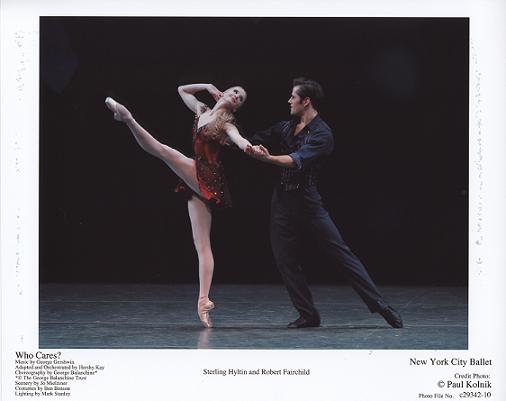
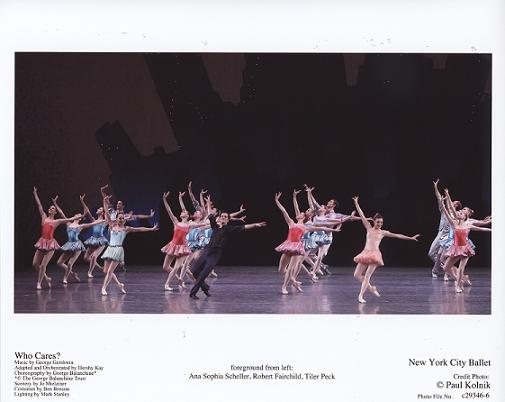
I LOVED Who Cares?! (photos above — of Robert Fairchild and Sterling Hyltin, and of the whole cast — by Paul Kolnik.) I’d only ever seen the pas de deux before and didn’t even realize the whole was comprised of a whole slew of Gershwin songs, some danced by the ensemble, some by only the women, others by only the men, with solos and pas de deux mixed in. I particularly loved Tiler Peck’s duet with Robbie Fairchild in The Man I Love. She has such a clean, beautiful line and she’s so expressive and so engaging. She can make a story out of anything. And of course Fairchild is always the perfect romantic male lead 🙂 Crowd went wild over his and Ana Sophia Scheller’s duet to Embraceable You as well as Scheller’s My One and Only solo. Such a fun ballet — I’m going back for more this week.

Also shown in that program was Martins’s new Naive and Sentimental Music, set to John Adams’ score of the same name. I wrote about that ballet when it premiered here and posted pics of it here. Seeing it again evoked a bit of Balanchine’s Jewels, particularly the lovely lyrical white section (my favorite) and the sexy red.

One little thing I have to say: this ballet was created on and is danced only by principals but Adrian Danchig-Waring danced in last week’s production as well, and he is still a soloist (I think he may have been replacing Amar Ramasar, who must be injured because he was replaced a few times over the week…) Anyway, I realize NYCB is top heavy at the moment, but I think Danchig-Waring definitely needs to be next in line for a promotion!

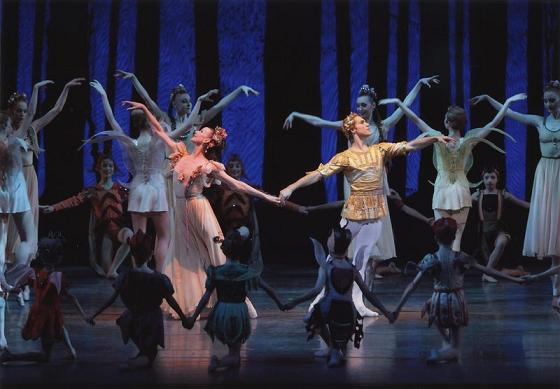
And earlier in the week I saw the best EVER cast of  Midsummer Night’s Dream. I finally got to see my Gonzalo Garcia as Oberon 😀 (photo above by Paul Kolnik, of Garcia as Oberon and Darci Kistler as Titania). I’d missed him in this role at the end of last season. He did very well – -not only with the dancing — particularly that crazy fast scherzo — but also, and less expected for me, with the acting. I thought he’d be a sweet, glowingly endearing Oberon, but, no, he was a pissy, demanding fairy king — just as much as Andrew Veyette last season (cutely pissy and demanding though!) He wanted Titania’s servant boy and he wasn’t letting her say no to him. Only thing regarding the dancing — his legs don’t seem to be as flexible as they once were. It seems like he may have injured an adductor muscle, or else he’s built up so much thigh muscle or something — but his legs when he jumps are not making perfect splits. But his upper body is so fluid and graceful and he exudes such charm that he’s still the perfect lyrical male dancer nonetheless.

Titania was the beautiful Sara Mearns (headshot by Paul Kolnik — a new headshot for her, right?)– and she was the best Titania I’ve personally seen. Oh she’s such a beautiful dancer! She throws herself so fully into every move she makes. If Garcia is the ideal male lyrical dancer she is the ideal female – they were so perfect together.

And I’m so glad Stephen Hanna is back at NYCB (still annoyed with the Billy Elliot directors for not making good enough use of him on Broadway). He was Titania’s cavalier and his pas de deux with Mearns was the best Titania / Cavalier pdd I’ve ever seen. He’s so big and strong — which certainly amps up the romance factor — and his numerous tour jetes just have so much power. Honestly I often get bored during that pdd and just want Oberon to return, but not with Hanna’s cavalier!

And new to the cast of human characters who get their hearts messed with by a mischievous Puck (Troy Schumacher) was Janie Taylor, as Helena. She is another one who excels at story dances, always delving into a character and making clear to the audience what’s going on in her mind. She’s pathetically, endearingly funny from the time she enters the stage all forlorn over Demetrius, to her being completely bewildered by Lysander’s sudden attraction to her, to her searching the forest madly for Demetrius, to her cat-fights with Hermia, etc. She really brought out the humor.

In the section where I was sitting, there were at least three large groups of people you could tell had never seen the ballet before — nor likely the play; they didn’t seem familiar with the story. But they were laughing hysterically throughout the whole thing and were really awed by the dancing, and by some of the tricks (like Puck’s being pulled up to the ceiling via harness at the end). That’s when you can tell with a story ballet that the cast really brought it to life, when the newcomers are enthralled.

PACIFIC NORTHWEST BALLET MAKES ITS JOYCE DEBUT (and Marco Goecke Steals the Show IMO)


Tuesday night, the Pacific Northwest Ballet opened its 5-day run at the Joyce. This was my first time seeing this company, and it has a reputation as one of the most prestigious in the U.S. Helmed by Peter Boal, a former dancer with New York City Ballet, the company is already familiar to many NYCB fans, but not yet to me.

I really wish they could have brought the whole company and danced at City Center, a more suitable stage for ballet. The Joyce is small and known for modern dance and so they could only bring a small portion of the company. And, the small stage limited their choice of choreography and prevented the dancers from dancing full-out. So I felt it lacked a certain balletic grandeur, although I still greatly enjoyed the evening.

For one thing, I was thrilled to finally be able to see Brazilian ballerina Carla Korbes dance, after being introduced to her on the Winger. She had a part in just about every ballet and she did not disappoint — she has great charisma and dances with great dramatic intention.

I was also happy to be able to see Seth Orza again 😀 (Everyone who’s read this blog for a while knows how downright devastated I was when he left NYCB…) He’s so sharp and precise, and so strong — I think he definitely needs to be promoted to principal (he’s now a soloist, as he was when he left NYCB).

So, there were four pieces on the program: Opus 111 by Twyla Tharp, Fur Alina by Edwaard Liang, Mopey by Marco Goecke (my favorite, and pictured above, James Moore dancing), and 3 Movements by Benjamin Millepied.

I’ll start with my favorite — Mopey, by Goecke, danced very intensely by Moore.


I’d always been curious about this young German choreographer ever since this little exchange (the “Evan M.” being Evan McKie, a principal with Stuttgart Ballet).

Anyway, Mopey is hard to describe — basically just a solo for a man who by turns twists and contorts his body into awkward shapes, bounces up and down, makes muscle-man poses, waves his arms about gracefully, appears to be possessed and struggling to control his limbs — his fingers bent and curved down somewhat grotesquely, almost monster-like. It was short but really engrossing.   Here’s a YouTube clip of a dancer from Stuttgart dancing an excerpt from the piece. Unlike in the clip, which is danced only to one piece of music, Moore danced first to silence, then to Bach, then to pop punk by The Cramps.

I also liked Millepied’s 3 Movements, pictured below (dancers are James Moore and Lucien Postlewaite).


All photos by Angela Sterling, by the way.

It was abstract but I thought I detected a bit of a men versus women showdown (I think this is a recurring theme of his — at least in his recent works). It was set to rather unsettling Steve Reich music and filled with original movement, the way the groups of men and women would go at each other at times, almost like they were from separate clans. But the costumes were contemporary: almost casual work attire for the men and little flirty dresses for the women. Costumes were designed by Millepied’s girlfriend, Isabella Boylston, corps dancer at ABT.

I also liked Fur Alina by Liang. It was a man woman pas de deux danced by Carla Korbes and Karel Cruz and it seemed to be the somber story of two lovers slowly deciding to part. It was set to Arvo Part (who it seems, understandably, is becoming the most used composer for contemporary ballet these days — at least for these despairing pas de deux).

Oddly, the Tharp was my least favorite (below: dancers in front are Korbes and Batkhurel Bold).


I’ve never seen Opus 111 before and this one (set to Brahms) didn’t seem to have any of Tharp’s signature comical character roles or her theme of ballet versus other kind of dance (fill in the blank: American social —  like in Deuce Coupe, Scottish folk, hip hoppy aerobics —  like in Upper Room) or her crazy, almost death-defying lifts. It was pretty and lyrical and the dancers lightly flew around the stage, at times coupling off. But sweet as it was, it just seemed to lack something. Might have been the small stage though and they just couldn’t dance it full-out?… Sir Alastair saw something more in it though.

I hope the company comes to NY again — to City Center.

HAPPY HOLIDAYS EVERYONE!


Hi you guys. Sorry I’ve been so bad about posting lately. This book –argh! Took me a ridiculously long time to figure out my Kindle conversion! If I wasn’t so computer dyslexic…. Anyway, Kindle version should be up soon on Amazon. Will post when it is.

I have a few blog posts to write — about Alvin Ailey and about Rasta Thomas’s Rock the Ballet which, okay, I admit — I liked!!! — despite (or perhaps of) Roslyn’s almost hilariously scathing review! I liked it, but can definitely see how others wouldn’t.

And Alvin Ailey — they’re in the midst of their City Center season (which ends January 3rd). I’ve loved most of their season premieres — there are several — namely Hymn and Divining by Judith Jamison, and Dancing Spirit by Ronald K. Brown (photo above of Matthew Rushing in Dancing Spirit, photo by Paul Kolnik). Hymn is a really breathtaking tribute to Alvin Ailey — the man himself. It was made in 1993 right after he passed away. It’s with spoken word by Anna Deavere Smith, based on her interviews with Jamison and the company dancers from that time, and on Ailey’s words themselves; choreography is by Jamison. And, Divining and Dancing Spirit are both part African, part ballet / modern. Dancing Spirit starts slowly, then builds to a really beautiful crescendo. Audience went nuts with applause after it premiered, and justifiably so! Definitely do try to go see it before the season ends.

The “20 years” tribute to Jamison’s time with the company is also a great program. Exposes you to excerpts of many of the ballets she commissioned over the years, which I now want badly to see.

Oh, interesting tidbit: one of my friends told me she sat next to SYTYCD’s Tyce Diorio at one of the Ailey perfs, and he highly recommended to her Hymn and Divining. So, see, I know what I’m talking about 🙂

I also need to blog about Nine, the film, which I saw yesterday. Thought it was okay, not as good as I was expecting. The musical numbers were excellent — especially those led by Kate Hudson, Judi Dench, and Fergie. But the story line is rather boring and slow-moving. And I hate to say this but this is the first thing I haven’t loved Daniel Day Lewis in. He just didn’t become the character to me, like he normally does; just couldn’t inhabit this role. Weird because his Unbearable Lightness of Being character had many of the same flaws, and he was so much more believable as Tomasz than he was here as Guido. Anyone else seen it?

My website (and, thus, this blog) is going to be up and down a bit over the next couple days because I’m having some of the pages re-done. But I will resume blogging very soon. In the meantime, get thee to Alvin Ailey!

Oh, and happy holidays 🙂

"PRAISE THE LORD!"


Alvin Ailey audiences are always so fun! Last night was their “Target night” (tickets were severely discounted, sponsored by Target), and these kinds of audiences are the best — people screaming and cheering throughout; yelling “yeah” and “go girl!”, unable to help themselves from taking pictures — with the flash (!), and this one guy kept yelling out “Praise the Lord” during Revelations.

I have no time to write — am off to Art Basel for the weekend — but it was an excellent night. In addition to the always moving Revelations (I will never tire of seeing that), they’ve done something to Bigonzetti’s Festa Barocca — it’s so much better now; they captured the humor this time, and they’ve really amped up the passion / sensuality / struggle in those pas de deux. The audience went wild for it, including myself.

And Judith Jamison’s Divining was so magnificent. It’s a beautiful combination of ballet and African and the music is fascinating. She made it in the 80s but they’ve restaged it. Don’t miss it!

ABT may have the world’s top ballet dancers, but this company has the best all-around dancers who can do just about anything and look like the best in the world at it. And does Antonio Douthit have a skeleton? That man’s body moves in ways I’ve just never seen a body move before!

Go see them — they’re at City Center through the very beginning of January.

More when I get back (and the interviews with Bell and Tayeh as well). Now off to Miami!

Photo above of cast in Jamison’s Divining, by Nan Melville.

FELA! ON BROADWAY A MUST-SEE


All photos by Monique Carboni.

If you’re in NY or are coming here at all for the holidays, definitely do not miss FELA! It’s honestly one of the best musicals — if not the best — I’ve ever seen (and I don’t often like musicals!)


It’s a very “real” musical in that it takes place in a night-club in Lagos, Nigeria — called The Shrine — founded by  real-life Nigerian composer, musician, founder of Afrobeat, and human rights activist Fela Kuti (1938-1997). It’s the late 1970s and he and his dancers (mostly female) perform their unique — and fascinating — blend of what seems to me traditional African, Reggae, and funk, and you’re part of the night-club audience!


Through the songs — most of them are actual music by Kuti — Kuti tells his story, and that of his mother, Funmilayo Ransome-Kuti, who was killed by the police just months earlier, when they raided Kuti’s compound. Funmilayo was a feminist and human rights activist who was vocal in her opposition to colonialism, and to the corrupt government, and her death, along with the attack on Kuti’s compound, were politically-motivated.

It’s hard to understand the exact political problems in Kuti’s Nigeria — I’d think it would be near impossible to explain something that complicated in a show like this — but suffice it to say the government is corrupt, there’s no accountability of government officials, the police force / Army is murderous, Nigerian citizens are suffering, and Kuti is speaking out against it all through his songs.


The story-line moves back and forth in time, much of it devoted to Kuti’s memory of Funmilayo, played brilliantly by Lillias White (in photo above).


The show is expertly choreographed and directed by Bill T. Jones (photo above by Joseph Moran), who, I feel, does his best work on Broadway. The dancing is so incredibly stunning. I have never seen African dance done this well. Jones must have looked long and hard for those miraculous performers! The play obviously provides a great history lesson, but, seriously, you can go for the dancing alone and be completely blown away.

But, as I said, you’re made to feel you’re part of the Shrine audience — and Kuti (played, on my night, excellently by Sahr Ngaujah — Kevin Mambo alternates with him in the role) will ask everyone to stand up and clap, dance (at your seat!), sing, repeat words after him — it’s a lot of fun. At one point, they re-enact the police breaking into the compound, kidnapping several of the dancers, torturing them, beating Kuti, and throwing Funmilayo out of a top-floor window, killing her. But when the police storm the place, the dancers and cast -members run about the theater, through the aisles, you hear screams, shots. You feel like you’re one of them, and it’s really actually quite frightening for a split second. I actually wished they’ve have done a bit more of that — had not just the compound’s inhabitants running around screaming, but the police chasing them, waving batons, threatening everyone, including you, the “foreigner.” (My friend who I saw the show with, a black man, thought I was a bit off my nut wanting this — this rather authentic re-enaction of police brutality…)

Anyway, brilliant brilliant show — a definite must-see! I also loved Saycon Sengbloh as a female friend, whom Kuti meets during his travels. She mainly sings, and, like White, she’s got a really beautiful, powerful voice.

One last thing: at the end, the dancers and singers all emerge from the wings and carry through the aisles and out onto the stage small tombstones. It’s really cool — there are cameras all about filming live and the scene is supposed to be a political demonstration. Because of the cameras, even though the audience is all seated, everyone still kind of looks like they’re part of the demonstration. Very cool effect. Anyway, Kuti carries a tombstone bearing his mother’s name; the others’ bear words like peace, dignity, etc. At the end, they stack all tombstones atop one another onto a pile in the middle. I noticed as we were putting on our coats to leave that the one in the middle said “I am Sean Bell.” I thought that was interesting because obviously Sean Bell is a contemporary American reference and this took place in Nigeria decades ago. And, the Nigerian police stormed Kuti’s compound and attacked him and his followers for their outspoken political beliefs, whereas Bell was shot and killed by police during a failed prostitution bust because they thought — notoriously wrongly of course — that his friend was reaching toward his waistband to retrieve a gun. One outlash of violence seems so much more politically-motivated than the other. But then maybe the Bell case is political just in the fact that the police had targeted a club in a black part of town in the first place and were looking for criminal activity. Maybe both the Kuti and Bell communities were equally “under siege” in a way. I don’t know … racism in the U.S. these days takes such complicated forms because there are just layers upon layers upon layers of historical oppression.

NYCB’S FIRST NUT OF THE SEASON


Photo by Paul Kolnik, copied from NYCB website.

Okay, after blabbering on about the audience Friday night and new post-ballet restaurants, on to the actual performance.

It was magical, as always. Megan Fairchild and Joaquin De Luz were charming as the leads (the Sugarplum Fairy and her cavalier) — above headshots by Paul Kolnik, from NYCB website. I always love watching these two — Megan’s so sweet and she always seems to have this “cat who just swallowed the canary” smile on her face. She’s the ideal ballerina for this role. Maybe it’s just that I haven’t seen City Ballet in a while now, but Joaquin, who was injured at the end of last season, seems to be jumping higher and spinning far faster than ever before. As always, he was the perfect manly cavalier.

Beautiful Sara Mearns danced the other main role — Dewdrop. (Headshot by Paul Kolnik)


I wonder if something was done to the stage floor during renovations because Ashley Bouder had slipped on opening night in the new Martins ballet, and Mearns slipped twice on Friday night. I don’t think I’ve ever seen Mearns fall and Bouder was just kind of standing when she fell, so it made me wonder if something’s slippery. Anyway, Sara seemed a bit shaken at first, but she soon recovered and danced with her typical beautiful fluidity and lush, expansive lines.

The little girls are so cute — you can hear all the ooohs and aaaahs when Dewdrop and her ladies in pink fill the stage. Below, Megan Fairchild in that role, photo by Paul Kolnik, taken from Explore Dance.


Other highlights were the magical-seeming Christmas tree that in little Marie’s dreams rises up from the floor and shoots straight through the ceiling, Sean Suozzi as Candy Cane — the incredible things he did with that hoop! — and, even though the Chinese stereotypes bother me in the Tea section, high jumper Daniel Ulbricht did expectedly well as the lead there, although I thought I remembered that dance being longer? And of course Justin Peck was a lot o fun as Mother Ginger, the role many of us most remember from seeing the ballet during childhood.

Balanchine’s version of the Christmas classic is a little shorter with a more children-heavy cast than most, making it the ideal holiday treat for families. It runs through January 3rd.