American Ballet Theater’s Original New Nutcracker


More photos coming soon. This one (of Gillian Murphy and Catherine Hurlin as the two versions of Clara) is taken from culture.wnyc.org.

Last night was the official opening of ABT’s much awaited new Ratmansky-choreographed Nutcracker at BAM. I loved almost every single second of it. I’ve only seen about six different versions of this ballet, but this one to me seems most original. It’s very entertaining, very humorous at points, and can somehow maintain the attentions of small children while being clever and witty – and beautiful – for adults. It’s very theatrical and it’s not as “dancy” as the one I just saw from the Bolshoi (Grigorovich’s version)- there’s more non-balletic jumping and playing around in Act I at the party, but there’s plenty of beautifully choreographed classical ballet during the grown Clara and Nutcracker Prince pas de deux and the ensemble snow scene and waltz of the flowers.

It opens with the cooks and maids in the kitchen preparing Christmas dinner. They’re going about their merry preparations when suddenly their space is invaded by mice. The mice completely take over, chase out the cooks, jump up on the tables and grab for the hanging meats. Adorable and hilarious. There’s one very cutely mischievous little mouse who appears throughout.

Then the party scene happens and Drosselmeyer (a non-dance role here) presents the children with two sets of life-sized dolls. The dancing was very good, but there were no sharp, stunted staccato movements as in the Bolshoi’s, so the dancers didn’t look like real dolls to me. I loved the costumes for Harlequin and Columbine though. They looked the most commedia dell’arte that I’ve seen. All costumes were brilliant – one of the most excellent things about ABT’s production. They, and the equally brilliant sets, were made by Richard Hudson, of Lion King fame.

When the dolls are ordered to return to their boxes, the children do a group dance that looks more like fitful stomping than anything balletic. But it’s still musical and evocative and cute, and it got a lot of laughs. The nutcracker that Drosselmeyer then gives Clara (danced brilliantly by Catherine Hurlin) is half-doll, half-human. He’s danced by a boy (Tyler Maloney) but he has a full nutcracker head, so he can’t do as much as the Bolshoi’s human nutcracker doll – his movements are much more limited. Once Clara’s dream begins, the boy removes his doll head before escorting her off to the Kingdom of the Sweets. I have to say, I really liked the boy who danced Clara’s bratty brother, Fritz – Kai Monroe. He was very entertaining, did a good job with both the acting and the dancing (high jumps!), and I think he will be one to watch for.

The Battle scene between the mice and the nutcracker and his soldiers was good, and, again, the costume for the mouse king (Thomas Forster) was fantabulous. I couldn’t even count the heads he had there were so many. I think of all battle scenes, I like Balanchine’s the best. I love how a mouse will scurry ominously across the floor right in time with a flute chord. Then the mice begin to gather and organize right in time with the flute ensemble so that it seems like the mice are talking. And Balanchine’s battle scene seems the most theatrical. Balanchine’s growing tree is also magnificent. Here, the tree only grows a bit, but soon they multiply and trees begin to eat up the wings, which was also spectacular.

The snow scene was really beautiful and this is where we first meet the grown-up Clara and her nutcracker prince (last night they were Gillian Murphy and David Hallberg, but there are many casts – see James Wolcott’s review of a preview starring Veronika Part and Marcelo Gomes here). Their first pas de deux is a beautiful waltz, and it’s made very clear that this is Clara’s grown-up vision of herself and her prince. The child Clara and Nutcracker boy waltz alongside Gillian and David until the classical ballet steps takes over, and the children stop dancing and gaze longingly at their grown-up selves as they finish the pas de deux. There’s a really beautiful Viennese waltz-type of lift where he spins around with her perched on his shoulders.

The Kingdom of the Sweets is really different from other versions. The “Sugar Plum Fairy” or “Nanny” as she is alternately called here, is not a dance role, but more of an escort through this kind of tour of It’s a Small World. She dons an absolutely gorgeous ancient Indian costume, as does her male companion. The dancer representatives from various countries are not dolls; they are real, but most of the dances are very different. The Arabians, for example, are danced by one man (last night, Sascha Radetsky) and four women, and the women are all cutely chasing the one very wickedly flirtatious man. It reminded me a bit of Kevin McKenzie’s von Rothbart deviously flirting with all the court women at the beginning of the Black Swan pas de deux. At the end of this dance, though, the tables are turned and the women come into their own and no longer need him. Now of course, he’s not very happy about that. It’s great fun and I loved this dance the best.

The Russians (Mikhail Ilyin, Craig Salstein and Arron Scott) were more folksy than bravura ballet, which was fine, because they later did a circle of barrel turns as their part of the final ensemble dance.

And we see Mother Ginger again (or who, as a child, I called The Fat Lady with the big skirt). I haven’t seen her since Balanchine! And there’s an added element of hilarity here involving the mischievous little mouse from the kitchen!

The only dance I didn’t really care for was the Chinese. As I’d expected, these roles were danced by Daniil Simkin and Sarah Lane. But Ratmansky didn’t really use them for what they are known for and the dance is very tame compared to this dance in the other Nut versions. I really wanted to see Daniil go flying around the stage in those crazy million times-overrotated turning leaps that he’s known for. There weren’t even any high jumps. It’s just that I look to the Russian and Chinese dances for the bravura parts and it’s okay if they’re lacking in one dance, but not both! The Chinese weren’t as goofily portrayed though as in other versions, so I appreciated that.

And I loved the waltz of the flowers. Included here are some very charming bees, but they’re not used in a slapstick way at all, which I thought they would be when I initially saw them. They dance is very classical and there’s a beautiful part where the four male bees toss the red and pink-clad ballerinas into each others’ arms in a circular rotation. That received a lot of audience applause.

And then is the ending pas de deux again between Gillian and David. I’d written before, when I saw an excerpt at the Guggenheim, that it looked more modern lyrical than classical, but last night it looked very classical to me. Ratmansky used my favorite lift from the Grigorovich Bolshoi version where the prince lifts and holds Clara up by one lower leg and carries her all around stage like that. The solo variations were nice. David didn’t seem to have the height he normally does on his jetes (I was told later at dinner though, by a dancer – not from ABT – that that choreography was crazy hard) but he made up for it in a series of spins. I know in ballet they’re called turns, but he was going so fast they looked more like ice-skating spins to me!

The only thing I found bothersome was the acoustics in the BAM opera house. Maybe I’ve just never heard live music played there but it just seemed like the orchestra was playing so softly. The sounds of the toe shoe-clad feet and the sounds of children coughing dominated.

Oh, one final thing: when David Koch, who financed a good part of the production, gave his opening speech, he accidentally called Kevin McKenzie “Peter.” Got a lot of ooooohs from the audience. I couldn’t hear through the ooooohs what he said after that – I assume it was an apology – but whatever it was it elicited even more ooooooohs. Funny.

Overall it’s a brilliant new ballet, a very original new production. Definitely get out to BAM if you can! Go here for the rest of the schedule.
The Bolshoi’s Nutcracker

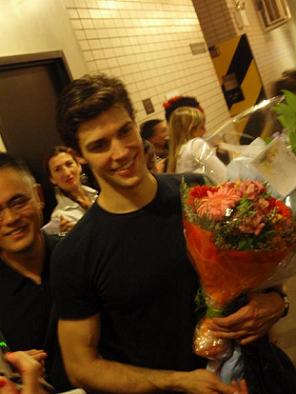
So of course I went yesterday to see the Bolshoi’s Nutcracker, live-streamed into movie theaters all over the world, though, judging by the opening remarks made by announcers and intermission interviews, I think most of the audience was in France. Anyway, there was a pretty good turn-out at the Big Cinema in Manhattan – bigger than turn-outs for the two recorded Emerging Pictures ballet films I saw earlier (the Royal Ballet’s Nutcracker and the Bolshoi’s Flames of Paris). Still, the theater wasn’t packed, as it should have been.

Anyway, this was the best Nutcracker I’ve seen so far. I really loved it. I don’t think anyone puts on a show, makes ballet into theater, quite like the Bolshoi. And their dancers have got to be among the most talented in the world. The things they can do… I think every single woman had a point like Veronika Part and every man like David Hallberg.

This production, by Yuri Grigorovich, had no Sugar Plum Fairy, but instead the grand pas de deux was danced by Marie (so-called here instead of Clara), and her nutcracker, turned into a prince in her dream. I like it so much better this way than having a Sugar Plum Fairy. It just makes more sense in the story to have the young girl imagining herself as a grown-up princess. It makes that final pas de deux so much sweeter. And here, they actually get married, Marie and her prince.


The same ballerina – the exquisite Nina Kaptsova (who I remembered immediately from her role in Flames of Paris as the delicate and sympathetic Marquis’s daughter; photo above from dance.net) – danced both the young and grown-up princess versions of Marie and she was surprisingly believable as both. You’d have to have a small dancer with a very youthful physique to be able to dance both parts. (San Francisco Ballet has grown-up Clara dancing the final pdd too, but two different dancers dance the young and older Clara). Kaptsova’s prince was Artem Ovcharenko, who was also very good though he didn’t stand out quite as much as she. For ABT fans, he reminded me a lot of Maxim Beloserkovsky.

What I really, really loved about this Grigorovich production, though, was all of the dancing. It begins with the guests en route to the party, and they dance across the stage. There are really no non-dance moments as there are in most Nutcrackers I’ve seen, where you have the party with children scurrying about and the grown-ups chasing after them and chatting with each other, and Clara and her brother fighting over the little nutcracker, who is actually a doll. Here, the children aren’t really children but dancers in the company (one reason why there’s so much more dancing), and, magnificently, the “toys” are all dancers as well! I don’t think I’ve ever seen a real dancer play the little nutcracker doll. And s/he (not sure which gender, as unfortunately the name isn’t listed in the program) was brilliant  – one of the best parts of the first Act. A shame there’s no name – unless it’s Anna Proskurnina, who’s listed as Marie’s brother? I’ll have to look it up.

The other two toys in the first Act – Harlequin and Columbine – were danced brilliantly as well, by Vyacheslav Lopatin and Anna Tikhomirova. Those dancers were the most doll-like dolls – with their stunted, sharp staccato movements – that I’ve ever seen.

After the snow scene, Marie and her Nutcracker (now, in his human version, danced by Ovcharenko) didn’t really go to a Land of Sweets but more like a land of toys, as male / female pairs of dolls from various parts of the world entertain them. I went to the performance with my a Chinese friend and of course I was really embarrassed by the Chinese dolls. He thought they were funny though, and we both agreed they were danced very well, by Svetlana Pavlova and Denis Medvedev. I can really see Daniil Simkin dancing this role in ABT’s production, if Ratmansky does it the same way. ( I know Simkin will also have a turn as the Nutcracker Prince / Cavalier at ABT). I also hope Ratmansky doesn’t resort to stereotypes in creating these roles, as virtually every other choreographer has.

As the Indian dolls, Victoria Osipova (relation to Natalia?) and Andrei Bolotin had a bit of a slip and she fell, but I didn’t think it was that big of a deal. She got up immediately and there was no sign of injury. This is usually the dance most of us in the US know as “coffee” or the Arabian part, but here the costumes are very different – more classical, no bare midriff and tiny top – and the dancing more conservative.

I loved the grand pas de deux. It was both sweet and innocent (like you’d expect of a young girl’s dream of her older self being swept off her feet by a handsome prince), and stunning in its athleticism. Some of those lifts are the most breathtaking I’ve ever seen. At one point, he held her up by her calf and she’s upright, and he carried her all over the stage that way. There are many overhead lifts where he’s holding only her waist, with her legs in the air, feet delicately crossed, and she looks down at him, crossing her hands beatifically. And at the end of the wedding, he carries her off in a cradle lift. So sweet. The solo variations for each were equally breathtaking. Kaptsova had a series of super-fast chaine turns but with all kinds of additional footwork thrown in. Watching her dance, at points I couldn’t believe my eyes.

Oh and also Drosselmeyer was much more of a dance part than most other Drosselmeyers I’ve seen. He was danced very well by Denis Savin.

Overall brilliant production. I feel spoiled now, like I’m never going to be able to see another Nutcracker again. But I will this Thursday – when Ratmansky’s opens at BAM!

Guggenheim Announces its 2011 Works & Process Season

And it looks like there are several good dance events, including the Royal Danish Ballet with Nikolaj Hubbe, a program on how judges judge the big ballet competitions like the Youth America Grand Prix, a sneak peek at Pacific Northwest Ballet’s new Giselle production, a night of Robert Wilson-curated choreography and performance art, and more ABT.

Click on the link below for their press release, containing the full dance event schedule.

Continue reading “Guggenheim Announces its 2011 Works & Process Season”

Gillian Murphy Critical of “Black Swan”


Apparently, Gillian Murphy gave an interview to the L.A. Times in which she called Black Swan unrepresentative of the ballet world and said she was a little disturbed by its intentionally overdone darkness. She says in her experience the lecherousness of the artistic director is fake (thankfully!) as is the competitiveness within the company, though she admits it’s competitive to get into a big company in the first place. I would have thought it would be competitive within a company as well, but from the time I’ve spent around ABT and NYCB dancers (and from reading their blogs) it does seem that the dancers are very supportive of each other. And the support doesn’t seem false, like it’s forced whenever outsiders are around, but genuine. Look at how everyone came to the support of Jenifer Ringer over Macaulay’s snarky comment about her weight.

But apparently Dancing on My Grave presents another story. Maybe things have really changed since then.

Interestingly the article mistakenly calls Murphy British (as if they’re trying to present her as uppity toward Hollywood). She’s American though, and has never seemed the least bit snobbish, imo.

Above, Gillian with Ethan Stiefel in Swan Lake (as the white swan! 🙂 ); photo by Fabrizio Ferri, from here.

Sneak Peek of ABT’s New Nutcracker

The Guggenheim just sent me the above video, which is of their Works & Process event a few weeks ago that I’d attended and written about a bit here, featuring excerpts of ABT’s upcoming Nutcracker at BAM. It starts December 22nd – getting excited!

Also, yesterday I attended a screening of the Royal Ballet’s Nutcracker, as part of Emerging Pictures’ Ballet in Cinema High Definition film series in theaters across the country. I’ll write about it soon. They put on a very good, very different Nutcracker!

Paperback Dolls and Nutrackers

I have a guest post up today at the Paperback Dolls blog! They’re currently featuring New York authors and bloggers as part of their “Passport to New York” series. So, since I’m both, I talked about both my novel and the blog.

Regarding the blog, I gave their readers some recommendations on what to see in New York for the next couple of months dance-wise. I then realized I haven’t done that for my own readers yet, because I’ve been so blasted busy. But of course everyone who regularly reads my blog knows what I’ll recommend: Alvin Ailey, upcoming at City Center for the month of December (it’s Judith Jamison’s last season as artistic director so there will be lots of tributes to her); New York City Ballet’s Balanchinian Nutcracker which has already begun and continues on through the beginning of the year; and ABT’s new Nutcracker, which begins December 22nd and will be at Brooklyn Academy of Music.

I didn’t have a chance to write about it but I saw a small sneak preview of ABT’s new Nut at the Guggenheim’s Works & Process event a couple weeks ago, at which choreographer Alexei Ratmansky and conductor Ormsby Wilkins spoke. Several excerpts were performed including Veronika Part and Marcelo Gomes dancing part of the final Clara and the Prince pas de deux, the Russian dance, and some of the snow scenes. Ratmansky and ABT representatives had said earlier during a press conference that it would be pretty much traditional, but from what I saw it looks very modern. The costumes and sets – which are gorgeous and are made by Richard Hudson, the Tony award-winning set designer of the Lion King – are period, but the movement looked very modern to me, not at all classical. The pas de deux looked like lyrical and more romantic (without a capital “r”) and less fairy tale-like than I’ve normally seen, and the Russian dance looked folksy and even a bit slapsticky rather than the classical bravura dancing we’re used to with “Trepak.” Anyway, Ratmansky had noted that the original choreography for this ballet is no longer extant so that’s why there are so many different versions. The only two versions I’m really that familiar with, I guess, are Balanchine’s and the San Francisco Ballet’s two-year-old version, the DVD of which I reviewed a while back.

Anyway, I think the new Ratmansky Nutcracker is going to be a departure from the ordinary, and it will be interesting to see the whole and see how audiences react!

Happy Thanksgiving, everyone!

ABT in Cuba

So, American Ballet Theater performed at the Karl Marx Theater in Havana, Cuba, as part of the Havana International Ballet Festival, this Wednesday and Thursday. This is the first time ABT has performed in Cuba since 1960 when diplomatic relations between the U.S. and Castro began to break down. They honored Alicia Alonso who danced with the company in the 1950s and 60s and whose 90 birthday is coming up, on December 21st. Apparently, she came out onstage and took a bow.

Unlike ABT’s historic trip to Beijing last year, this one has received a lot of coverage, both in the press and in some blogs. In addition to the Reuters article, here are some others:

NY Times Arts Beat blog 1;
New York Times Arts Beat blog 2;
The Express Tribune (who has an excellent slide show!);
In Havana with Risquet (who has more great photos);
ABC News (video);
News Daily;
Times Union (more pix);
HDLNR.com (video);
CBS News (good video)

I’m sure there are many more, but those are some of the posts I found, to give you a bit of weekend viewing / reading 🙂

Who Will Play Romeo in the Film Version of Anne Fortier’s “Juliet”?

Haha, I don’t even think this book has been optioned yet for film! It should be though – it’s very cinematic. All throughout reading it, I kept “seeing” Romeo – and always as one of my favorite male dancers who’s danced the role. Roberto (top left) is of course the natural choice since he’s Italian and the book’s set largely in Italy. But I feel he may not have enough of the delicious cockiness in him; Roberto’s too nice, at least onstage. Ditto for Cory (top right). Marcelo of course would probably be best … although I don’t know if he has acting skills required for a speaking role in a film. He’s definitely a good stage dancer/actor.

I’m being goofy. I’m sure they would cast Andrew Garfield or Louis Garrel or someone.

Anyway, Anne Fortier’s Juliet, which I recently finished, is a really interesting read, especially for fans of Kenneth MacMillan, and I guess … Shakespeare 🙂

It’s part historical fiction, part romance, and part mystery / suspense and it shifts back and forth between the present day and the Siena, Italy of 1340, when the two people Shakespeare based his characters on – Romeo Marescotti and Giulietta Tomolei – actually lived. Of course in Shakespeare’s version, the lovers were from Verona, but according to this book, early stories – and there were many tales of Romeo and Juliet; Shakespeare’s was only one of many – had all the action happen in Siena.

The novel starts when 24-year-old American Julie Jacobs receives an inheritance after the death of her great aunt Rose, who raised her after her mother and father were suspiciously killed when she was a child. The inheritance is simply a key to a safe deposit box in Siena, which her mother had originally left with the aunt. Julie is told by her aunt’s butler and his lawyer that it contains a treasure, which she must go to Italy to find. So she sets off for Siena. There she encounters other, less savory types, who are equally interested in her treasure, and so begins the suspense part of the novel.

Julie soon discovers that at the time her mother died, she’d been researching the history of Romeo and Juliet, or Romeo and Giulietta. Julie’s mother’s last name was Tolomei, and it turns out Julie is related to the original Giulietta. I don’t want to give too much away, but the contemporary part of the story consists of the suspense and romance of finding the treasure – which is related to R&J – as well finding Romeo’s descendant.

Julie finds in her mother’s belongings in Italy the earliest version of the story of Romeo and Giulietta, and her reading of that accounts for the historical half of the novel, which was the most compelling and poignant to me. It’s different from the version we all know through Shakespeare. The warring families are the Tolomeis and the Salimbenis, with the Salimbenis being far more vicious and far more financially powerful. At the beginning of the historical story, the Salimbenis have just raided Giulietta’s house and murdered everyone but her. (She was in church at the time.) In a nutshell, Friar Lorenzo is able to sneak Giulietta out to her uncle Tolomei’s estate. Romeo, who is a Marescotti – a historically highly respected military family with connections to Charlemagne but who currently has no financial power – is a hopeless playboy. But once he sets eyes on Giulietta’s portrait, while he is having his own Marescotti-family portrait done, he is in love.

The artist tells Romeo that Giulietta resides at the Tolomei castle. He goes to a ball there in search of her, finds her (she’s a Helen of Troy type and stands far out from the crowd), and follows her into her chamber. She’s still traumatized by what’s happened to her family and so is immune to his flirting. She does tell him though that he can have anything he wants from her if he brings her the heart (or was it the head?…) of the master of the Salimbeni family, who ordered the execution. Romeo’s a bit taken aback, but tells her he’ll do anything.

The next day Friar Lorenzo brings Giulietta to the Marescotti estate and she tells Romeo she doesn’t know what came over her the other day to ask such violence of him; she doesn’t want him to get hurt. He kind of plays with her a bit, she softens, and over the course of this and several other meetings, they fall in love.

Romeo talks his father into asking Tolomei for her hand in marriage. For Romeo I mean. The father is reluctant because he doesn’t want to be seen as “getting involved” in the Tolomei / Salimbeni feud. But seeing how in love his son is, he agrees.

But just as he goes to approach Tolomei that night, old Salimbeni, smitten with Giulietta whom he spies in the distance, reveals that he wants her for himself. This will end the violence between the families once and for all, he claims. The whole crowd gasps, since Salimbeni is old enough practically to be her grandfather, not to mention married (although everyone also knows his wife will soon be dead, as he is starving her, as he’s done to prior wives… Medieval society must have been so lovely…) Of course Tolomei has no choice but to say yes – the Salimbenis are far more powerful – both physically and financially. Saying no to Salimbeni would be family suicide.

Poor Giulietta nearly collapses upon hearing she’s to be the wife of the man who slaughtered her family, and she begs Tolomei not to let the marriage happen. Tolomei refuses. Romeo declares that he will beat Nico, Salimbeni’s son, in the Palio (a Medieval-style horse race that continues to this day), and, if he does, he will win Giulietta’s hand.

At the Palio the following day, Romeo does win, but during the course of the race, Nico kills Tebaldo, Tolomei’s son, but with Romeo’s dagger, making it look like Romeo is the murderer. This is how Romeo gets banished. Although Romeo sneaks back to town with Friar Lorenzo and marries Giulietta in the back of the church where she is at worship, Salimbeni finds them and, well, things don’t go too well for Romeo…  Salimbeni’s wife finally starves and he marries Giulietta, then keeps her a prisoner in his country castle.

I should stop there! But the story goes on and there are all kinds of twists and turns. It’s a fascinating narrative and you can see all the same – or many of the same – elements Shakespeare included. But the theme in Shakespeare is the warring families or factions, gangs, what have you – and how innocent individuals get unfairly, tragically caught up in the fighting. In the original, it’s more about the viciousness of one evil, all-powerful man. I found it interesting to see how a great writer manipulated facts to craft a story with themes that would reach far beyond the time and place in which the story was set. I mean, Shakespeare’s version also contained beautiful poetry of course, but his basic story is more powerful and far-reaching than the original. The original does give you a sense of how violent and how absolutely awful Medieval society was for women though.

Anyway, the novel’s very good – at least the historical part. I highly recommend it for that. The contemporary part is cute romance-wise, and definitely suspenseful, but in my opinion not nearly as powerful from a literary perspective as the historical.


Funny, I didn’t really think of who would play Julie / Giulietta. Diana Vishneva or Veronika Part would be good – she has to be Helen of Troy beautiful! But they both have Russian accents and I don’t know if that would work… Hmmm, who else?…

(Photos above, clockwise from top left: Roberto Bolle, taken by me; Cory Stearns, from ABT’s website; and Marcelo Gomes, from ABT’s website.)

Morphoses at the Guggenheim

Over the weekend, Morphoses had its first NYC program sans former artistic director Christopher Wheeldon. They presented two pieces, at the Guggenheim, as part of the museum’s Works and Process program. They commissioned two choreographers – American Jessica Lang and Swedish dancemaker Pontus Lidberg- to each make a different dance set to a score by Pulitzer Prize-winning composer David Lang.

(I wrote about seeing an early rehearsal here).

Using most of the same dancers (most of whom are from American Ballet Theater now, instead of New York City Ballet, as they were when Wheeldon was A.D.), the two came up with vastly different dances, both very engaging.

Lang’s (top four photos – all photos by Richard Termine) was more a study of gravity, as she explained (hence Misty Copeland here “climbing the wall”), and of contrasts between the masculine and feminine (indicated, to her, in the music by percussion and chimes).

Interestingly Lidberg heard the music differently and used the percussion section first, melting into the chime section, so apparently the music had no prearranged order. His dance was more lyrical, with the visual theme of a night-blooming flower.

I love that Morphoses now seems to be using a lot of ABT dancers – all soloists or standout corps members — Misty Copeland and Kristi Boone, Eric Tamm, Blaine Hoven, and Isaac Stappas – because I really connect with them. Other dancers included Melissa Barak, Laura Feig, Gabrielle Lamb, Rachel Sherak, Andrea Spiridonakos, and Matthew Prescott. And Lang mentioned that she also used her husband, modern dancer Kanji Segawa (the man doing the floor work on the right-hand side in the photo third from the top), in her piece, which worked well since the aesthetic of modern dance is more “grounded” than ballet.

To hear the music and see some of the dance, here is an excellent video made by the Guggenheim:

MARCELO IN FIRE ISLAND


Here’s a photo fabulously informative reader Jonathan sent me of our Marcelo Gomes dancing this past weekend in the Fire Island Dance Festival. I was unable to attend unfortunately. This is the festival Danny Tidwell had danced in last year but I am told he did not dance this year as he is touring with Rasta Thomas’s “Bad Boys.” Other dancers however included Travis Wall and Nick Lazzarini (So You Think You Can Dance winner from season one). Argh. Someday I am going to have to make it out there to this festival. It’s just that it always occurs right after ABT season is over and I’m pooped by then. Plus this year I had book stuff to deal with…