THIS WEEK: SWANS, SWANS AND MORE SWANS, AND AN URBAN BOLERO


Yep, here come the Swans! Tonight begins ABT’s Swan Lake week.

I had another hard time choosing casts. I ended up opting for the ones I haven’t yet seen, but they are really all worth seeing:

Tonight, Monday, beautiful, dramatic Irina Dvorovenko and Maxim Beloserkovsky open the ballet, with my favorite Marcelo Gomes as the villain von Rothbart;

Tuesday are powerhouse Gillian Murphy dancing with forever enchanting Angel Corella;

Wednesday and Saturday matinees are David Hallberg and Michele Wiles with my new fave Cory Stearns as the villain;

Wednesday evening is critically acclaimed Diana Vishneva and Marcelo Gomes (this time as Prince Siegfried);

Thursday night are Paloma Herrera and Ethan Stiefel (fingers crossed he’s recovered from his injury);

Friday night is my favorite Vernonika Part with Italian star Roberto Bolle and David Hallberg as von Roth;

And the week will end Saturday night with the knockout, perhaps the biggest night of the entire season: widely beloved Georgian ballerina Nina Ananiashvili will give her farewell performance with ABT. She’s dancing with Angel Corella, and Marcelo again as von Roth.


Meanwhile downtown, don’t forget about Keigwin + Company at the Joyce, opening Tuesday night, and alternating nights with Nicholas Leichter Dance.

NATALIA OSIPOVA AND HERMAN CORNEJO’S LA SYLPHIDE


Monday night, I saw the Bolshoi’s Natalia Osipova guest-star with ABT in their production of La Sylphide. I wrote a little about her and more about Herman Cornejo, at the bottom of my prior post. Just to reiterate, if you ever want to see pure excellence, do see Herman Cornejo in something — anything. He is just pure, unmitigated, supreme, excellence!


August Bournonville’s La Sylphide is the story of a Scotsman, James (Cornejo), who is engaged to be married to a woman named Effie, but is seduced by a sylph (Osipova), who no one but he can see. Gurn, a young man in love with Effie, sees James talking and dancing to the air, and tries to warn everyone that he thinks James has gone mad. But people ignore him. An old witch-like lady, Madge (think MacBeth) prophesies that Gurn will marry Effie. Later, when the wedding party guests perform a fun Scottish folk dance, James continues to be taunted / haunted by the sylph who flies through the air. James chases her but she flies out the window. Later, James is on the verge of marrying Effie, even holding up to her the wedding ring, when the sylph plucks it right from his hand and flies out the window. He chases after her into the forest, her lair. Effie collapses into tears and Gurn leads the groomsmen in search of the missing groom.

The second Act takes place in the forest. The sylph seduces James with food, drink, and dance, but every time he tries to touch her she flies away. James wanders the forest, upset about the sylph’s elusiveness. He happens upon Madge and her mates who are concocting a poisonous brew in which they are soaking a scarf. He tells Madge of his troubles and she tells him the scarf is magic; if he wraps it around the sylph’s wings, he can have her. James takes it. When he next sees the sylph, he seduces her with the scarf’s beauty. She flies toward it, delighted and excited, as he waves it around. But once he wraps it around her wings, she slowly dies.

James, brokenhearted, falls into unconsciousness, as the wedding procession of Gurn and Effie is heard in the distance and the sister sylphs carry the sylphide to heaven.

Neither the story nor choreography are as grand and memorable as Giselle, and I’d written before that I was stunned by Osipova’s athletic prowess but not really moved by her Giselle. Here, I thought that, though I didn’t like the choreography as much, her playful, sky-high jumps made much more sense in this story. Here, she’s not human, she’s not of this world. She’s both a faery and a figure in a man’s dream. So, her unearthly high springing jumps went along with that; they were believable within the story. She is a really beautiful dancer and can certainly jump like no one’s business, but I wished she would have been a bit more tantalizing and playfully vexing, the way Janie Taylor was in Robbins’ The Dreamer. Not like a vixen or an evil spirit; I just mean more forcefully refusing to leave him alone, making him realize what a dull life he’s leading; how he longs for something more. Just like in Giselle, she seemed to be dancing on her own, not really working opposite a partner. It’s probably really hard, though, when there are language barriers, and I think both times either she or her partner (David Hallberg, and Herman) filled in for someone else last minute.

I thought Herman did an excellent job of showing how tormented he was by her, and how confused he was about what to do, how frustrated he was about his life. And his super-charged solo variation expressed that. No one jumps like him. No one. No one turns like Angel Corella and no one jumps like Herman Cornejo. He opened that variation with the best tour jete I’ve ever seen, and I knew — the whole audience knew judging by the gasps — we were in for something huge. Then onto all the high jumps with the fluttering beats of the feet. Everything he does is marked by sheer perfection — perfect sharpness, perfect precision, perfect control, perfect line, perfect clarity, perfect enunciation, beyond perfect height, beyond human height. He’s a god!

My problem with this choreography is that there’s not enough for him to do. And I got really frustrated. I didn’t want that variation to end. Nor did I want Daniil Simkin’s (as Gurn) solo variation to end. There wasn’t enough for him to shine in his either. He had a few kicking jumps, but I need for him to do so much more; Daniil’s too great of a dancer as well! Daniil was hilarious, though, when he imitated to the guests James’s bizarre actions, his weird dancing to the air. In addition to being a superb bravura dancer, he’s a very lively actor too.

On before La Sylphide was Paul Taylor’s light, lyrical Airs. I’m going to write about this more after I’ve seen it a couple more times this weekend, but I love watching ABT dancers do Paul Taylor! I hope no one takes offense and I love Paul Taylor’s dancers, but ABT just brings so much more to “modern dance” than a modern dance company. They bring poetry. Paul Taylor is American modern, and when his dancers dance him it looks celebratory, celebratory of humankind and of the dancing spirit, like something you’d like to get up on stage and do with them. It’s participatory, inviting. Of course you know if you’ve ever tried how hard, how impossible it actually is to dance like them without loads of training. But when you see ABT dancers dance that’s obvious from the get-go. It’s not celebratory and participatory, it’s elevated, awe-inducing dance, dance as an art. You know what I mean? All of the dancers were excellent — particularly Kristi Boone and Misty Copeland, but I loved Arron Scott the most because he so exemplified what I said above: outwardly he looked just like a Paul Taylor dancer, but he starts to move and he’s just so much more!


ABT GUEST-STAR NATALIA OSIPOVA’S ATHLETICALLY ASTOUNDING GISELLE


The Bolshoi! Russian ballerinas! Insane extensions, insane jumps, insane speed!

Last night Bolshoi ballerina Natalia Osipova guest-performed with American Ballet Theater as Giselle. David Hallberg was her Albrecht, Jared Matthews Hilarion, and Veronika Part was Myrta. (Go here for a synopsis of that ballet).

It was all-around some of the best dancing I’ve ever seen, but I have to say, on a scale of 1-10, in terms of chemistry between Osipova and Hallberg, I’d give it a 1.5, and in terms of all-around acting (excluding Kristi Boone’s captivating turn as Bathilde and a rather amusing Vitali Krauchenka as her father), a 2. Regarding the chemistry, to be fair, Osipova was originally supposed to dance with Ethan Stiefel, but because of an injury, David danced in Ethan’s place. A Twitter friend DM’d me asking why she didn’t dance with Angel Corella and I think it’s a good question. He would have been a better fit size-wise and stylistically for her.

But as I said, the dancing was tremendous. During the second act, Osipova did a develope to her ear, she did those hops with her arms in the air as if she had springs in her toe shoes or had a trampoline beneath her, and she did that flat-footed jumping turn at the speed of damn light. Seriously, when she made her entrance during the Wilis act, I put my opera glasses to my face, watched her walk out, and suddenly she was gone from my frame of view. I searched around and around for her with the damn glasses attached to my face wondering where in the world she went. When everyone around me suddenly started screaming BRAAAVAAAA BRAAVAAA BRAAAVAAA, I nearly dropped the glasses. When I took them away, I saw her mid-jumping turn going around and around, in a blur.

Audience (largely Russian, at least in the back orchestra) went stark raving nuts for her. I nearly had my left eardrum blown out over the ear-high develope. And those hopping jumps — seriously, she was half-way to the ceiling. I mean, when Paloma did them (I really did like her Giselle the more I think about it) she raised her head, like those jumps were a prayer to return to life. But here Natalia was going boing boing boing, up to the sky, head straight forward probably so as not to take away from her springing height. I mean, I don’t know. I love to be moved by the image a step creates, as Paloma did, but I can’t deny the thrill of those insanely high jumps and that lightening-fast turn and that insanely high develope.

The high bravura jumps in the first, peasant act, though, worked with her characterization. Her Giselle was all frolicking gaity, a girl in love with dance, in love with life. Her mad scene was over-the-top histrionics. The critic next to me described it as traditional.

And then David. Well, at the beginning he did his Albrecht as a romantic not a carefree playboy. But his was a romantic who was pretty madly infatuated with her. I think David is trying hard to get rid of his nice guy image. He rapped on her door like her mother’d better let her out or else. And when his squire didn’t full-out approve of his peasant costume, I thought he was going to kill him. And after the mad scene, he had kind of a mad scene of his own: I thought he was going to throw poor Jared’s Hilarion straight into the orchestra pit.

But ditto for David on the virtuosic dancing. I think by the time the second act came around, he was following Natalia’s bravura lead, doing sky-high jetes. He only did a Marcelo throw back of the head on the first jump in the diagonal, and then did the ten bizillion entrechats, same as Roberto Bolle. But David’s Nureyev feet!ย  His feet are so heavenly — I think he has the best of any dancer around today, at least any dancer I’ve ever seen. Those entrechats were from God.

As Myrta, Veronika Part jeted around the stage like I’ve never seen her leap before. She really takes up the stage when she leaps and she appeared to just be flying. I don’t even think I noticed all those jumps before! Her Myrta was icy cold and remained so throughout. Of course it was hard to concentrate on her face with all the theatrics going on behind her, but I didn’t see her peeking over her shoulder like Michele Wiles did. After she directed Hilarion’s death, she turned from him, toward us, and gave a wickedly simple little “and that’s that” nod right to the beat of the music, right as he fell, a smug smirk crossing her lips. Splendidly frightful!

I loved Kristi Boone as Bathilde, Albrecht’s betrothed princess. This is a pure character role, no dancing, and she was radiant in that gorgeous red dress, initially all supremely bitchy and regal, then softening when Giselle started pressing her skirttails to her face, allowing the poor girl to have one thing in common with nobility — a love of clothing. Then, when she realized Albrecht’s betrayal, instead of stomping all over Giselle’s pride and insisting Albrecht kiss her gloved hand, she looked more wounded and discomfited.

Vitali Krauchenka was rather amusing as Bathilde’s father, the prince, probably unwittingly so. He seemed to have his eyes half-closed the whole time and the way he looked at her, following her all around as she decided where to sit, whom to talk to, etc., it looked like he was saying “yes, yes, miss priss, whatever you want.” It cracked me up. I think he might have been better opposite Maria Bystrova’s Bathilde though. Hers was more of an unrelenting snobby witch.

Hee Seo and Blaine Hoven were very good in the peasant pas de deux. It was one of the most entertaining peasant pdd’s I’ve seen, which I guess went along with the virtuosity of the whole night.

Only the Russians ๐Ÿ™‚ I’ll be excited to see more of Osipova next week. She’s dancing La Sylphide with Herman Cornejo on Monday night and again with David Hallberg on Wednesday evening. Go here for the full schedule.

AMERICAN BALLET THEATER’S PROKOFIEV PROGRAM


On the Dnieper grew on me after seeing it the second time on Tuesday night, with the new cast, although I still generally preferred the first cast. If you missed my earlier post on Ratmansky’s new ballet, it’s here. Second cast was: Jose Carreno as Sergei the returning soldier; Hee Seo as Natalia, his betrothed; Diana Vishneva as Olga, the flirt who steals his heart; and Alexandre Hammoudi as Olga’s volatile fiance.

I absolutely loved Diana as Olga. She and Hee Seo, who was excellent as well, really drove home the ballet’s pathos and heartbreak. A BalletTalk poster said that with Diana, Olga became the central character and I think they’re right. Diana’s Olga was the most dynamic character in the whole thing; she really underwent a change in those mere 40 minutes. And it was believable. She starts out this carefree and careless flirtatious girl, frolicking around, teasing Sergei, teasing her boyfriend. And when her flirtatiousness with Sergei sets the whole disastrous string of events in motion — Sergei falls for her and she for him, her fiance has an emotional breakdown and beats Sergei, her parents are distraught, and she realizes what she and Sergei have done to poor Natalia — she really grows up, overnight, becomes a totally different person, takes responsibility for her actions. When she and Sergei bow to Natalia at the end in a prayer for forgiveness, before running off to their new life together, you feel equal heartbreak for both women.

Hee Seo and Veronika Part were equally compelling, although Seo seemed a little younger and more naive up front and I didn’t notice the holding out of the arms and the resting of the head on the shoulder like I did with Veronika. Jose, who’s generally ABT’s best actor I think (he never overdoes it; everything is authentic), was good as Sergei, but different from Marcelo. Jose seemed to be searching for something at the beginning, trying to rediscover his hometown with those short, staccato steps in each direction. His movements at the beginning were more modern than ballet, sharp and staccato at points, like he was unnerved that he didn’t recognize things or that things were different. (That kind of movement is more visible on a smaller body though.) Marcelo didn’t seem as sad or desperate up front. But then when torn between the two women, with Jose Iย  didn’t notice the back and forth of the jumps, this way and that, as I did with Marcelo. The jumps first to one woman, then the other, are my favorite Sergei movement trait, along with the throwing himself to the ground in anguish, almost like a half push-up.

Alexandre Hammoudi was a very different fiance from David Hallberg. Alexandre was quieter, especially up front, not seeming to realize the potential dangers of Olga’s flirtatiousness. He underwent a character change, like Diana’s Olga, then, becoming aggrieved and angry when he realized what had happened. David was more volatile up front, as if that was fundamentally part of the fiance’s character. Those extremely fast-paced steps during his anger scene were not as pronounced with Alexandre as with David. It looked more like he was kicking up leaves (which they had strewn on the ground); with David he was using those feet like daggers. David made such an impression with that character, and specifically that going nuts scene — I’m never going to forget it; I’m never going to forget that insane, almost terrifying, tap dance.

Okay, can I stop talking about this ballet now and focus on the other Prokofiev pieces?!

I generally wasn’t in love with Desir (photo at top of post) by James Kudelka, at least not as it was danced here. The movement is lovely and much of it original and the dancers are excellent but something was just lacking and I can’t figure out exactly what. It’s a ballet about several different couples, and I think my problem is that all the couples are basically the same, at least the way it’s being danced by ABT. With someone like Tharp or Robbins, different couples have different issues — there’s a romantic couple, a sexed-up couple, a fighting couple, etc. Here, the first two couples on first, dressed in fiery red — the women in long, flowing dresses that really whirl when they turn, the men in brown pants and long-sleeved colored tops —ย  both seem passionate and in love, all but Gillian Murphy from the first night’s cast, wearing bright smiles. But I don’t know if the happy smiles are supposed to be there. Some of the movement is rather chaotic. The woman seems to want to go one way and the man keeps turning her the other, mid-air. Gillian was the only one who made this dramatic, as if there was something not quite right going on between the characters. Apollinaire Scherr noticed that as well; read her very insightful comments on the whole program here (scroll down).

Then we move to a set of four couples, all dancing at once. My favorite part of the whole ballet is the men of these couples. At one point, men and women split and the men all dance together, followed by the women doing a group dance. When the men group dance in this way, each is doing his own thing — one jumping arms up toward the sky as if in ecstasy, another jeteing back and forth as if confused, another spinning himself into a whirlwind, etc. Then the women dance and they all do exactly the same thing — hold up their skirts and tip toe around, jump waving the skirts all about, all in unison, in sync. They’re all the same character — what does this say about men and women? Then, the couples pair up again, each man to a woman, and there’s one really funny part where the women stand still and the men do a bunch of high, twisty turning jumps,their limbs flying — as if to protest, “what’s up with that?,” “how can you say that to me?” It’s very funny, very evocative of real life relationships. The audience seemed to laugh louder on the first night though.

Still, in all, the couple who stood out to me the most is the more adagio one with all the beautiful lifts. The second night it was danced by Jared Matthews and Maria Riccetto, who were very good, but there was just something extra special about Cory Stearns and Isabella Boylston that really took my breath away the first night. Another performance I’m not going to forget.

And then Prodigal Son. This isn’t really my favorite ballet and I don’t honestly see how critics can trash Boris Eifman so and love this. What’s with all that fist-pounding on the thighs, the wide-mouthed screams at what, being asked to get water from the well with his sisters? How melodramatic is that? I know it’s a classic now, but I feel if it premiered today people would laugh and roll their eyes. Unless Balanchine meant for parts of it to be funny, like that up front melodrama, and the “sex” scenes. Anyway, read Apollinaire’s comments about Prodigal too, though; she made me appreciate it more, and talked about how certain dancers can play up the immaturity in those early thigh-pounding scenes so that it doesn’t look so full of melodrama.

Herman Cornejo as the son and Michele Wiles as the Siren danced the leads on opening night; Angel Corella and Kristi Boone the second night. Unfortunately I have to miss the third cast — the magnificent Daniil Simkin and the tantalizingly beautiful Irina Dvorovenko. If anyone sees them, please report! I’m dying to know how they do together!

Herman was excellent dance-wise. As expected, he nailed all those high-flying, angst-ridden jumps at the beginning. He danced a little more carefully than Angel, who had a minor slip at the beginning, then looked like he might fall on his way down that slide in the middle section. But I felt Angel delivered on the drama better; he took me through the emotions with him. The way he watched his Siren, he was like a little boy mesmerized. It made you mesmerized by her too. And then the way he danced with her — it was like an awkward, boy losing his virginity, sex scene. I’ve never seen it quite look like that before, though it’s probably supposed to! Then when he was robbed and left to die (Herman was really shockingly stunningย  in this part too — he was a horrid sight, his body up there, leaning almost lifeless against the cross-like slide), and came crawling back home body all dirt-encrusted, then into his father’s arms, like a baby. It does end up being very emotionally compelling, silly as it is at the top. I’d like to see Herman in this later, after he’s had a few goes at it. I think if he could up the drama more, he’d be perfect.

Kristi so far has been my favorite Siren! This role I find a bit inherently awkward too — all that wrapping the long train of her costume around her legs, crouching to get it between her thighs. It almost always looks more weird than sexy, but somehow Kristi whipped the fabric around so fast, it was spellbinding, practically had a dominatrix feel. And then when she does those — what I call upside-down crab walks — where she’s on her hands and toe pointes, belly up and she walks past him develope-ing her legs up with each step, spider-like — most dancers kick straight up, but Kristi’s developes went all the way back, practically to her chest. It looked so much more tantalizing than I’ve seen that before. Kristi’s pointed toes are so pronounced, her feet practically look like ensnaring sickles — she probably has a better Siren body than anyone (except for maybe Veronika Part — I wonder if she’ll ever be cast?)

Okay, I’m done. Sorry I keep writing so much! If anyone sees the Daniil / Irina Prodigal cast, please let me know!

TESTOSTERONE OVERFLOW AT ABT LAST NIGHT!

Things got a bit crazy on the Met stage last night! With Craig Salstein madly shooting off his guns as the up-to-no-good pirate Birbanto, Marcelo Gomes as the wily, endearingly ferocious head pirate Conrad, and Jose Manuel Carreno as the fiercely unslave-like Ali the slave, I thought someone might get hurt.

This (pretty much uncontestedly silly) ballet tells the story of a group of pirates that happen upon a Turkish bazaar at which women are being auctioned off as slaves. Conrad the loveably aggressive head pirate falls for Medora, one of the women the big Pasha has just bought. Then power struggles ensue: he and his men steal her, Lankendem the bazaar owner steals her back, and so on. Of course Medora and Conrad eventually end up together. Their ship crashes as they flee the Pasha, but they end up safe on a glacier, forever together.


Craig Salstein is always very dramatic, always great with character and he often dances the lovable nerd, but his Birbanto here was all testosterone, more traitor than friend to Conrad. His dancing was excellent — all those crazy kicking jumps high and precise. Seriously, when he decided to turn against Marcelo’s brawny Conrad, it was like Pirates of the Caribbean (not the movie but the Disney ride — which is actually kind of scary; you never know what deep-voiced, gun-fire-laden brawl is coming up around the next corner).

After a wicked solo, Marcelo took what seemed like a minutes-long series of bows in character, throwing his arms about in the air, pumping his fists. Maybe they were in character … maybe they were in dancer persona meant to say, “I nailed it, look at me!” In any event, the crowd went nuts. You’ve got to have guts to do that!

Nina Ananiashvili danced Medora. She is a very lively, very dramatic dancer and she was my favorite Medora so far. She wasn’t quite as athletically strong as Paloma but she did a wicked series of fouettes in the second Act and her projection of character more than made up. She really vamped up the sweetness and innocense, as did Sarah Lane as the slave girl Gulnare (I felt sorry for Sarah as she was getting shown and sold by Lankendem; Yuriko Kajiya’s Gulnare was more playful and carefree about her situation).

My favorite part: Nina flung herself with wild abandon into Marcelo’s arms during the bedroom scene! And of course he did crazy dives with her, tossing her small body around like a doll. So I finally got my flings with wild passionate abandon that I’ve missed in all the Tchaikovsky PDDs of late! Thank you Nina ๐Ÿ˜€

Jose was Jose. His Ali is far more masculine, more just-one-of-the-guys than Angel Corella’s, whose is more of a protective guardian angel. When Jose’s Ali went to wake up Conrad after he’d been tricked into a deep sleep by Birbanto’s poisoned rose, I thought he was going to toss him across the room. When Angel’s Ali did the same, he lightly but urgently plucked at David Hallberg’s chest. Jose doesn’t do Angel’s “genie spins” — the up and down movement with the standing leg during the multiple pirouettes that drives the audience stark raving mad. His turns looks more brawny and muscly and powerful. Angel is definitely more flamboyant. It kind of does look like he’s tweaking his nipples ๐Ÿ™‚


Gennadi Saveliev was Lankendem. He delivered well on all those barrel turns with the legs slicing through the air, same as Daniil Simkin. He’s a much taller man than Daniil and his long limbs made some of those turning jumps look really spectacular. I don’t think he has the tautness and control of Daniil, but he was still stunning.

The three Odalisques were well danced by Simone Messmer, Renata Pavam and Kristi Boone. Kristi, again, really stood out to me with her strong legs and sharply pointed feet and miraculously held-out arabesques. I can’t wait to see her Siren in Prodigal Son next week!

At the end, bows went on forever and a day and Nina and Marcelo were bombarded with bouquets from the left side of the theater. During curtain calls, Nina girlishly pulled him along to the opposite side of the stage so they could receive more flowers ๐Ÿ™‚ Sweet night. I think her many fans are slowly trying to prepare themselves for her upcoming retirement.

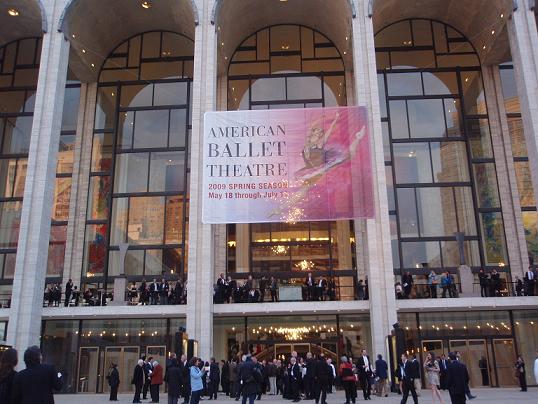
AMERICAN BALLET THEATER OPENING NIGHT!

p5182145

Yay, the season has offically begun! This picture was taken during intermission; that’s why it doesn’t look that crowded. I was sprinting in, nearly late, as usual, so didn’t have time to snap some pics before the performance but fortunately it was still light outside during intermission.

Anyway, Michelle Obama (who served as one of the gala’s honorary chairs) looked smashing in a sleek dark grey sleeveless, knee-length dress with tiny black ruffles lining the bottom. I’m sure there will be beaucoup des pictures seeing as how many blasted camera people there were; I’ll be sure to steal some when they’re posted on all the society websites ๐Ÿ™‚ (Oh, look, here it is in the NYTimes already)


It was just about the craziest thing I’ve seen on the Met Opera stage: after Veronika Part’s mouthwatering Mozartiana opened the show, artistic director Kevin McKenzie came out and thanked everyone who needed thanked — all the donors, designer Caroline Herrera who funds the gala, etc., and Senator Chuck Schumer came out and gave a little talk about the importance of funding for the arts, etc. Then, Schumer disappeared behind the curtain and moments went by. Everyone kind of looked around at each other like “what’s going to happen next?!”

Soon, the curtain was pulled back to allow some people to carry out a podium with a banner “American Ballet Theater” draped over its front. The doors to the lobby opened and a flock of people bearing weapon-sized cameras blasted in. Several men dressed in black promptly rose from their aisle seats and followed the flock of weapon-camera-bearers to the front of the aisle, near the stage. Caroline Kennedy was announced. She came out, everyone applauded, and she mentioned that the school of ballet associated with ABT, the Jacqueline Kennedy Onassis School, would be performing on the Met Opera stage for the first time ever tonight. Everyone ooohed and aaahed. Then, she announced First Lady Michelle Obama.

The curtain pulled back again and out she came. Of course everyone gave a standing ovation. She smiled radiantly, then, after a moment, directed us to be seated. Then she gave a short speech. It was a little hard to focus on what she was saying with everyone — both professional photographers and audience members with cell phone and digital cameras alike — flashing away as they were, but she talked about the necessity of the Arts for a culture to flourish, the importance of arts education, etc. Then she introduced the Jacqueline Kennedy Onassis School students.

As soon as she disappeared behind the curtain, the auditorium remained still pending the exit of the flock of pro camera wielders. It’s funny because there were all these non-dance writers in the press section. You could hear the sighs of relief, the sinking down into the chairs, and the putting away of pens and paper — and cell phones, which they’d used to light their writing paper during Mrs. Obama’s speech, which would have been extremely annoying had it not been for all the flashing bulbs anyway. But it made me wonder how they’d ever survive as performing arts critics! I mean, who needs light to see to write!

Anyway, the students were excellent. They performed Le Defile (The Procession) by Raymond Lukens. There were three large groups of them, in three levels — the very little ones, a medium-age / level group, and the older, very advanced ones. The choreography was basically a showcase of classical ballet steps, much like a very advanced ballet class — jumps, jumps with changing feet, jumps with changing feet that went on forever performed by a set of advanced boys (which drove the audience to wild applause), jetes, chaine turns, multiple pirouettes, fouttes, etc., and then a bit of partnering. It gave the students a chance to show what they could do — and the advanced ones could do a great deal! Extremely impressive, and great fun.

Then on were Xiomara Reyes and Herman Cornejo doing an excerpt from August Bournonville’s La Sylphide. This was the most dramatic I think I’ve ever seen Xiomara. I was sitting in the back of the orchestra and she really projected. She was really sweet. And Herman as always amazed with his virtuosity, his jumps, his razer-sharp precision, his astounding clarity of line.

The corps in both this, La Sylphide, and Swan Lake, later in the evening, were absolutely amazing, by the way. Not a head arched back more than the others, not a leg raised higher. They were all so on. When they work together like that, in perfect unity; it’s really visually breathtaking.

Then was Balanchine’s Tchaikovsky Pas de Deux danced by Ethan Stiefel and Gillian Murphy. Ethan and his strutting around stage, taking his own good time after their duet and before beginning his solo, making the conductor wait for him! And his high jumps with all miraculously many beats of the feet. I wished my friend Alyssa could have come so she could see he’s not just Mr. Sexy; he’s a superb dancer. And Gillian was radiant, and a perfect foil with her speed-of-light chaine turns. They enjoyed a long, slow kiss during the curtain call. The audience went mad!

Then was the hunt scene from Sylvia danced by Michele Wiles followed by a piece d’occasion (the first of two of the night), by Alexei Ratmansky, for Nina Ananiashvili, called Waltz Masquerade. It was set to the Waltz from Aram Khachaturian’s Masquerade Suite and it was cute and comical. She was dressed in this long, red dramatic, Carmen-like dress with a sexy black lace overlay on the top. There were four tuxedoed men, each bearing a gold candlelabra, one at each corner of the stage. These men turned out to be: Jose Carreno at the front left corner; Marcelo Gomes, at back left; Angel Corella back right; and a blonde on the front right who I initially thought was David Hallberg (I was sitting FAR back from the stage!) until the fun began and he shook his head about like a sassy mop and I realized DH just does not have enough goofball in him to do such a thing, even if he tried. So, I decided it was either Ethan or Maxim Beloserkovky. Anyway, Nina’s character was supposed to be dancing about the stage in a melodramatic solo — but it was purposefully melodramatic, and so comical. Like a silly, cartoon version of an upcoming swan song, really, which, is of course, what’s coming up for her later in the season (and will be much more sobering when it does). At one point, she just passionately crashes to the ground and remains there, in a heap. Nothing happens. The men, obviously her servants, start looking at each other like, what now? They shrug, slowly walk over to her. Then, Marcelo starts imitating her melodramatic dance, but far more cartoonishly, and of course it’s hilarious. The others join in. Max (I think it was Max, not Ethan) does his thrashing hair thing. I couldn’t see facial expressions but I assume they were making fun of their master. Then she wakes up, catches them, and they’re sent back to their posts.

After intermission was the balcony pas de deux from MacMillan’s Romeo and Juliet, danced by Marcelo and Diana Vishneva. At first, Diana approaches her balcony with all the drama of a ballerina playing Juliet, rather than Juliet herself. I rolled my eyes. This is what I don’t like about her. She’s an excellent dancer but she’s all about the pomp and circumstance and not about the character. Maybe it’s a Russian thing, but I don’t see that in Veronika Part or Irina Dvorovenko. Anyway, she eventually lightened up, thankfully, and I felt like I was watching not a prima ballerina being a prima ballerina but Juliet herself, falling hopelessly in love. When she runs around him one foot solid on the ground, the other on pointe, it’s so girlish, so real yet so poetic. Those are the best — I don’t know what to call them — runs around kneeling Romeo — that I’ve ever seen — not even Alessandra Ferri’s were that sweet. Still, I felt some of the lifts lacked the beauty and magic ofย  those Marcelo and Julie Kent do together when they dance this scene. I don’t feel she dances that well with a partner; she’s more into herself. Marcelo’s leaps around the stage and big high passionate jumps were thrilling. He got some good bravos for those.

Then were Paloma Herrera and Max Beloserkovsky in the Act II pas de deux from Swan Lake. I was hoping it’d be the Black Swan pdd, but no. I guess the program was pretty bravura-heavy already. I don’t see him dance much, but Max is really quite good. He’s really a character and he’s the perfect Prince Siegfried, regal yet vulnerable and tragically in love. And he’s a good partner.

Then was the mad fun of Le Corsaire, with Irina Dvorovenko, David Hallberg as Conrad, and Angel Corella as Ali. Except something happened at the beginning and I hope David’s okay. The tallest guy in the entire opera house had to sit in front of me and I was trying to navigate my way around his enormous head just as a bunch of people up front went “Oooooooh!” When I was finally able to see the stage, Irina was standing in front of David, face toward the audience. She didn’t seem to have any particular expression on her face, but, then, I was light years away from her. Then David did an assisted pirouette with her and everyone applauded, so it must have been a lift that didn’t quite happen or something. Anyway, I hope he’s okay; I know his shoulder sometimes comes out of socket. Anyway, all seemed to be fine after that: all three were brilliant. Of course. Angel astounded, as always, and I started giggling during his first solo and couldn’t stop all the way through the second. I love Irina. She was radiant. She did those continuous turning kicks on pointe like they were nothing. She has the drama and the virtuosity when needed and the always beautiful, graceful lines. And David’s leaps all over the stage were magnificent. I could see this goofy ballet over and over and over again, as long as no one gets hurt ๐Ÿ™‚ Angel did not leap out from behind the curtain during curtain call, sadly.

Then there was another piece d’occasion. Herbie Hancock played piano, onstage, while first Jose Carreno, then Stella Abrera, danced to his music. This was cute and comical as well, and kind of reminiscent of Jerome Robbins’s Other Dances or Suite of Dances, where the dancer(s) connect mainly with the musician. At one point, Hancock went nuts with the keys, obviously way too fast to be danceable, and Jose stopped in his tracks, looked over at him, and lifted his hands, like what gives, dude? He sat down near the base of the piano and just rested. The same happened with Stella. She danced, then stopped and gave Hancock a look when he began another little virtuoso section. She finally sat down beside him on the piano bench, and eventually, he ended on a romantic note, she snuggling next to him softly, sweetly.

The evening ended with the finale of Balanchine’s Theme and Variations. The leads were danced by Sarah Lane and Daniil Simkin. It was a nice way to end the program, but with the likes of Simkin, I wondered why they only did that group finale, where he and Sarah are basically leading a processional, instead of some of the earlier bravura parts with all the corkscrew turns for the man. An opening night gala performance is meant at least in part to showcase the dancers doing what they do best, and he is best at the bravura stuff, not leading processionals.

Anyway, the whole night, as usual, was magic. Saw Sigourney Weaver and Kelly Ripa in the audience.

Oh, for my Dancing With the Stars readers, I taped the show, but for lord knows what reason it was somehow muted. I have no idea how on earth I managed to do such a thing, but it was pretty amusing watching the show in pure silence — no words, no music. Needless to say, I’ll have to watch online tomorrow.

But now, dead tired, must sleep. Goodnight.

New York City Ballet: Founding Choreographers I


Tuesday night I went to see New York City Ballet’s Founding Choreographers I program (I know, I’m very late; it’s been a nasty week of migraines and sanity-destroying upstairs neighbors — more on the latter later).

It was a good, varied program. First on were two short abstract but very musical “leotard ballets” by Balanchine, both set to Stravinsky, that went together nicely (though they were choreographed years apart), Monumentum Pro Gesualdo and Movements for Piano and Orchestra. The pieces are mainly abstract and play with geometrical shapes and configurations, and there’s a bit of cute “Egyptian” styling in the flexed hand and feet gestures, and the ballets really give the dancers the chance to show off their musicality, especially the second, fast-paced one. I’m liking Maria Kowroski (in the top picture with Charles Askegard) better and better. She was very charismatic. Even though the ballets were story-less, she was kind of playing a part, and it really drew your attention to her. Askegard was really on too.

The second piece, Robbins’ Dances at a Gathering (pictured second, up top) was what I really went for. It was Kathryn Morgan’s debut in the ballet. She was very good, but who really ended up standing out to me was Sara Mearns. She danced her part in a way that really reminded me of ABT’s artiste supreme Julie Kent in Robbins’ similar but shorter, more virtuosic version, Other Dances. Mearns, like Kent, really connected with the music — not just like she was dancing to the music but with it; it, rather than the male dancer, became her partner. I remember in Other Dances when Kent girlishly lifted her shoulders and a big, joyful grin sweetly overcame her face when the onstage pianist first put his fingers to the keys. Sure Angel was there too, but the music is what made her dance, he was secondary. Robbins has I think three (that I know of) of these dancers-interacting-with-musicians dances: this one, Other Dances, and Suite of Dances, danced by a solitary man to/with an onstage cellist.

The problem to me with Dances at a Gathering is that there’s so much, it’s just too long, and you lose the quality and the mood that are so prevalent in the other two. Instead of one dancer connecting with a musician, or a duo with each partner connecting in his and her own particular way, here there’s a multitude of dancers, each trying to do that throughout the l-o-n-g dance. Every time I see it, I’m in love with it until about half-way through when it starts to drag. Then there’ll be another section that draws me in, and then another section that drags, then another section that drags, then another that begins to draw me in again where I begin to think, gee if there weren’t all those sections earlier that dragged, this one would be quite engaging, but by this point, I just want the damn thing to end already. And I know I’m not the only one who felt that way. You can feel the whole audience shifting in their seats. You can hear the heavy breathing. Someone needs to seriously edit that ballet!

Anyway, that said, I also really liked Benjamin Millepied. He dashed around the stage as if he were desperately searching for someone or something he’d lost. There was a longing and a quiet urgency to his performance that was really quite poignant.


See principal Megan Fairchild talk about that ballet (and see excerpts) here.

Last on was Balanchine’s Stars and Stripes, the high-speed, super-energetic ballet danced to John Philip Sousa’s marching band music that today looks kind of goofy in its hyper-patriotism. At first you want to roll your eyes at what seem to be a cheesy series of Rockette-like high kicks and formation changes and almost circus-like high jumps and stage-traversing turning jetes in the soldier section, but then you realize that in 1958, when it premiered, it was still kind of a point at which America was becoming acquainted with ballet, with the movements and with the Petipa structure — the wondrous in sync ensemble work, the pas de deux with the breathtaking lifts, the solos with their athletic jumps for the man, fouettes and fast chaine turns for the woman. As eye-rolling as this ballet may now be, if you look at it with a historical eye it was very original in its celebratory Americanization of the classical.

Guardian Angel, Chase Brock Experience, Three Movements, San Francisco Ballet, Cynthia Gregory, Doctor Atomic


Blah! I had a very strange dream last night in which this one basically told me in his own sweet way that I need to calm down and not stress over blogging like a mad fiend. I have no idea why Angel Corella was on my mind since, although my favorite ballet company begins their City Center season tonight, he, for the second CC season in a row now, is not participating (likely to work on his own company, in Spain). Which is probably why he invaded my dreams — I’ll be missing him badly these next two weeks.

I do know why blogging like a crazed nutter was on my mind. I’m trying to juggle way too much. I’m like a rabbit on speed these days. While I love blogging about dance, sadly, it doesn’t pay and I need to spend less time writing ridiculously long reviews (which I don’t think people appreciate anyway) and more time on paying work (and on writing the two novels I’m currently working on simultaneously, as well as revising my first, and on legal CLE courses so I can keep my license). I honestly think I was less busy when I was practicing law full time.

So, in the interest of shorter reviews (there will be a couple of longer ones in other publications, and I’ll link when they’re up), here goes my last, insane, week:

1) Chase Brock Experience:


Went to this last night. Was supposed to see Danny Tidwell perform as a guest artist but he didn’t show, nor did Neil Haskell. Edwaard Liang did, and he and Elizabeth Parkinson (Tony-nominated star of Tharp / Billy Joel project, Movin’ Out, pictured above in John Bradley photo, taken from here) were, by far, the highlights. Parkinson, in specific, showed me how a great dancer can make any choreographer look good. Everything she did had meaning, even basic choreography (and Brock’s choreography is very basic) like rising to the balls of her feet. The way she went on releve was heavenly.

I hadn’t heard of Brock, but he’s a 25-year-old choreographer who makes theater, modern, and ballet (non-pointe) dances. His modern and ballet were lacking — choreography was very basic, very unoriginal. It was like he was a Larry Keigwin but without the ingeniousness, originality, and sophisticated sense of humor. He’s young though, and can learn a lot by watching other, more sophisticated artists.

2) Three Movements

This is an off-off-Broadway play on Theater Row I saw on Sunday, about the Balanchine, Tanaquil LeClerq, Suzanne Farrell true-story melodrama. The characters were given different names, but playwright Martin Zimmerman made clear it was based the Balanchine story.

First, I finally got to meet (NYTimes writer and now blogger) Claudia La Rocco, in the elevator of all places! Fun fun – -by far the best part of the afternoon, as well as hanging out with my ballroom friend, Mika.

If you’re not a balletomane, story is basically this: Balanchine, the Russian / American choreographer, could only work, and could only fall in love (non-sexually, as many contend he was a closeted gay man) with ballerinas who could be his muse. He often married his muses, but of course, no sex. He married his muses, then obsessed over their bodies, every little flaw, and starved them (in the documentary Ballets Russes, many of the dancers remember him taking food away from his wife Maria Tallchief, because she was too “fat” — ie: large-boned; their marriage lasted approximately 5 minutes, because Tallchief had a brain). Is it obvious yet how much I like Balanchine as a person?

So, he married Tanaquil LeClerq, up-and-coming ballerina extraordinaire, his main muse, and therefore star of all of his ballets. After driving her hard in rehearsal — the choreographer comes across here as completely impossible to please — she collapses, tragically stricken with polio, unable ever to walk again. I don’t know why more writers don’t focus on her — her story seems the most awful, the most pathetic, the most heart-wrenching. Because she can no longer be his muse, he falls out of love with her. He must look for a new one, which he finds in 18-year-old Suzanne Farrell. Of course he falls in love with her, dumps bedridden LeClerq, and proposes to Farrell (he’s 60, mind you, and is dumbfounded when she doesn’t accept). But Farrell is in love with a male ballet dancer in the troupe, Paul Mejia. In a jealous rage, Balanchine fires Mejia (yes, the man is a walking advertisement for the need for sexual harassment law), fires Farrell, and threatens she’ll never be anything without him, etc. etc.

It’s very hard to make Balanchine likeable. Here, I could tell there were many in the audience who knew nothing about him, judging by all the snickers and harrumphs when the actor (Mike Timoney) recited his more misogynistic fare (telling Farrell her tiny thighs were too fatร‚ — which the dancer recounts at the beginning of her autobiography, so it’s not untrue — and screaming at her later when she tries to leave him, telling her he didn’t teach her, but “created” her — the man had a major God complex, to put it mildly). To me, this play did nothing to make me feel any sympathy toward Balanchine whatsoever. Nor did I feel what it was about him that made his work genius. But, then, I already knew the story and had preconceived notions of how I’d feel upon seeing it dramatized. Perhaps someone who didn’t already know the story is a better judge here?

It’s no mystery why writers choose to re-tell this story. It makes for great drama. Of the fictionalized accounts I’ve read though, I like Adrienne Sharp’s the most, and recommend it, particularly if you don’t know the story (it’s a short story contained in this collection, all about dancers). She most softened Balanchine’s edges, making him human, vulnerable, and to some extent, even forgivable.

The play runs through October 26th and tix are $18.

3) San Francisco Ballet


Went back for more on Saturday, and loved them again. Dancer-wise, they are one of the best companies in the world. Everyone, down to the most recently-hired corps member, is just flawless. Standing out to me again were the same ones as before — Lorena Feijoo, Davit Karapetyan, Pascal Molat (their bravura dancer), and the newbie Cuban guy Taras Domitro — probably because I was looking for them; they also had main roles though.

As far as the dances go, my favorites (I saw two out of three programs) were Concerto Grosso and On a Theme of Paganini, both by the company’s artistic director, Helgi Tomasson; Ibsen’s House, by Val Caniparoli, whose work I’d never seen before; and Balanchine’s The Four Temperaments. Sir Alastair did not like anything on that list besides the last and, though I disagree with him, I can see his point. Tomasson’s choreography is very basic, very classical ballet, nothing out of the traditional vocabulary, and nothing like the richness, the variety, the suspenseful development, and the engrossing intricacies of Balanchine. Seeing the Balanchine next to Tomasson makes you realize Balanchine’s genius (the way a play about him likely never could).

But what I like about Tomasson is that he knows how near-perfect his dancers are, and he showcases that to maximum, brilliant, spectacular effect. Concerto Grosso is basically a male ballet class, beginning with simple tendus, all the way up to the super-advanced ginormous leaps, barrell turns, and twisty, impossible-looking corkscrew jumps. These men are such excellence personified, I could sit there and watch that ballet repeat all day long. In fact, I recommend to anyone seriously trying to learn ballet to see this company, and watch very closely. The dancers are not only perfectly precise, every movement perfectly, fully executed, but they somehow add so much character and passion to every little thing they do. Even non-story ballets grow to have little narratives with this lot.

Which is why I liked Ibsen too. This is not so much a rendition of any of Ibsen’s plays as a kind of an expressionistic work of Ibsen’s universe. Women wearing richly hued fabrics in 19th Century designs, dance in solo, in units, and with their men, all of their stories fraught with drama, with anger, conflict, love. I didn’t know what exactly was going on in each little segment, and I don’t think the choreographer meant for you to, but watching the dancers lament, cherish, struggle both internally (which, brilliantly, could be read on both face in movement of the body, particularly with Feijoo) and with each other, was deeply engaging. And made me want to read up on my Ibsen!

Philip has some more great pictures of the company on his blog, here and here.

4) Cynthia Gregory at Barnes & Noble


On Friday night, I went to see the legendary ballerina give a talk with writer Joel Lobenthal at the B&N at Lincoln Center, basically to promote her new DVD, of her dancing with equally legendary Fernando Bujones (now deceased). We saw some clips of that DVD, particularly of her dancing Strindberg’s Miss Julie (had no idea there was a ballet made from that play!) and excerpts of her dancing Sleeping Beauty. She was a truly gorgeous dancer, moved with a great deal of emotion and purpose and fluidity, and with her size, seemed to devour the stage (kind of like a Veronika Part). And she was very dramatic, very expressive — would have been my kind of dancer, and I can see why Apollinaire loves her. Apollinaire’s also right about Bujones: he does resemble my favorite!

Gregory has a sweet, very charming personality. She talked about dancing with Bujones, and her various other partners, including Erik Bruhn, and Nureyev, whom she characterizes (unlike many who’ve worked with him) as very sweet and mild-tempered, albeit passionate, and said she was thinking of writing a book about all of her male partners — she danced with basically everyone who was anyone in the 70s and 80s. She was greatly encouraged to do so (write the book, that is) by the crowd (which pretty much packed the reading room).
One thing I found interesting, she said Bruhn taught her how to make up words to her movements and her miming gestures, which helped a great deal with her acting. Brilliant, Erik Bruhn! So, inside, she was singing words to herself while dancing. I think all dancers should do this, so they know what they’re trying to do, all the better to show us.

She talked about what she learned from other female dancers of her day, Carla Fracci (how to imbue her roles with humanity), Natalia Makarova (making the most of slow, dramatic developpes), how she coaches today, what it was like to work with big choreographers like Ashton, Tudor, and Balanchine (only worked with the latter once), traveling with the company, and just her life in general. She also mentioned she’s taken up painting and there will be a showing of her work in December at the Vartali Salon (yes her hair salon!), in NY.

5) Doctor Atomic


I saw this opera at the beginning of last week at the Met. It tells the true story of J. Robert Oppenheimer and his work in creating the world’s first atomic bomb, which we of course dropped over Hiroshima and Nagasaki, during WWII. The opera takes place before we bombed Japan, though, in July 1945 when Oppenheimer and his crew were testing it in New Mexico. It deals with the different personalities involved — Oppenheimer and his wife, his co-workers, the demanding military man who oversaw production — and each person’s internal conflicts and power struggles with the others.

Because I am tired and hungry — I started this post nearly 4 hours ago — I’m just going to refer you to Anthony Tommasini’s review for description, to scenes of the opera on the Times website, to the Met’s mini-site, and to Alex Ross’s blog where you can listen to one of the best arias in the work.

As I said before, I don’t have a lot of opera-going experience, but I liked this and think it’s definitely worth waiting in line for one of those $30 tickets, as I did. In particular, I liked: the sets — the mobile art-work suggesting pieces of debris hanging from the ceiling, the enormous bomb itself (anatomically correct, as the artist worked from a model), the cubicle-d office the physicists worked in, the posters of the actual people involved posted at times over the cubicle holes in place of their bodies, the gorgeous Native American katchina-like statues that at one point stand atop the the cubicles in warning; some of the choreographed movement — at one point singers are contorted in their cubicles, limbs askew, doing a prolonged handstand, their legs and feet bent awkwardly, shoved up against one side — in synecdoche of the effects of the blast; the libretto, comprised of actual documents from that period, writings and speeches of Oppenheimer, and the poetry of Baudelaire, John Donne, and Muriel Rukeyser, beloved by Oppenheimer; and of course the John Adams score itself, creating the whole atmosphere of horror, conflict, fear, and at the end, right before the blast, the drums just beat through your body — I was actually shaking — and this is followed by the voice of a Japanese woman searching for loved ones, for water, asking for help. The whole thing is spectacular, chilling, haunting.

Okay, I don’t know how well I obeyed, Angel, but it’s time to stop, time for my poached eggs & croissant ๐Ÿ™‚

Best Night Yet at the Met!


Last night’s La Bayadere was ABT‘s best night at the Met yet. They had the largest, most enthusiastic audience, many of whom seemed to be Marcelo fans! He got lots of ‘bravos’ and huge applause throughout, and he sensed early on the crowd was really with him so he kind of took it over the top with the enormous jetes and those interesting running-in-the-air jumps, whatever they’re called. I thought he may throw his back out after he landed a tour jete on one knee and dramatically arched back, his fingers gracing the ground behind him. And when he lands a jete it’s almost earth-shattering because of his size. But of course those huge leaps fit in with the role too since his character here is a warrior. It’s funny; it was like he was on a mission to really deliver – -it seemed his dancing was even fuller-bodied and more theatrical than usual. He’s always my favorite no matter ๐Ÿ™‚

Dancers are definitely very sensitive to how the crowd is reacting to what they’re doing — or at least Marcelo and Angel are, which is probably why I like them so. You can read their feelings all over their faces. Or at least you can if you kind of “know” them from seeing them so many times.

And Veronika Part really owns this role. Her expressive wrists, those luscious developes of which she is the queen (lift of the leg at the knee, then slowly unfolding to a full extension), and her gorgeously almost tragically poetic arabesques (back leg lifted). Oh, by the way, Bayadere is set in ancient India, and tells the story of Solor the warrior who falls in love with a temple dancer, Nikiya, but is betrothed to the princess Gamzatti. Veronika (as Nikiya) got loads of applause during her solo curtain calls at the very end of course. This is how the ballet should always be; the crowd going nuts like that.

But Marcelo and Veronika weren’t just great on their own; they were a perfect partnership as well, which to me is really everything, more important than the solo dancing. I really believed they were hopelessly, tragically in love. She was so forlorn, I wanted to cry for her when it was clear she wasn’t going to get her love. And Marcelo as always was the perfect actor, making perfectly clear how truly torn he was between his beloved and his betrothed, especially after the latter’s sexy, seductive whipping fouette sequence, and then how distraught he was on realizing he was in love with Nikiya but had to marry the princess.

Of course this ballet is so beautiful, many come regardless of who’s dancing, just for the story and the poetry of the choreography, particularly the breathtaking Kingdom of the Shades scene (which at first I have to admit I wasn’t so fond of because it’s so slow and there are few men ๐Ÿ™‚ ) but has really grown on me with its beauty. This is the part of the ballet where Solor sleeps and dreams of his Nikiya, whose image floods his subconsious by suddenly duplicating itself many many times over, as illustrated by a series of ballerinas all in white, emanating from the mountainside traveling forward in a pattern of lovely arabesques, then taking center stage and bourreeing in place, all in perfect sync, in perfect harmony, reminiscient of a spirit-world, and foreshadowing that this is the only place Solor and Nikiya will be together.


Finally, Michele Wiles was PERFECT as the princess Gamzatti. Throughout the first two acts she was icy cold bitchiness, which to me, she’s thus far excelled at. Critic Joan Acocella once referred to her as a sunny cheerleader type, but I’ve never seen that in her. I see her more as the spoiled rich girl who will have her way at all costs. She was pure golden-dressed evil when she puts the snake in Nikiya’s bouquet, basically casting a spell on her. Yet, when it’s clear Marcelo’s Solor is in love with Nikiya and is only going through the marriage because he must, you really start to feel sorry for Michele’s princess. She tries hard to maintain her power, but she can’t. She found the vulnerability in the character and made her sympathetic and that’s what makes this a true tragedy — for all.

It was also just such a great night because there were so many people there. I finally got to meet James Wolcott from Vanity Fair, and his wife Laura Jacobs who writes about dance for the New Criterion (and whose book I keep going on about — she writes so beautifully about dance)! I suspected they’d be there because they love Veronika so. I’m so shy, I always feel like such an oaf meeting famous people ๐Ÿ™‚ But they’re really nice and it was so cool to finally meet them!

Philip was there too and we hung out during first intermission, with friends and blog readers Susan and Philip’s opera buddy (whose name I keep forgetting…)

Great ballet, favorite dancers, very fun audience, meeting famous writers you admire, chatting with old friends — excellent night all around! I am happy.

More Damian, Etc.


I’ve had another full weekend of dance and am quite exhausted. Saturday and Sunday days I went to New York City Ballet for, sadly, my last of their programs celebrating Jerome Robbins. Until this season I’d only seen the very major works by Robbins, so it’s been really educational to see the others, although this season made clear why some of his ballets survived better than others.

Yesterday’s program was all set to Chopin (much of it to piano music) and included the famous DANCES AT A GATHERING, which I thought too slow-moving and long (the man needed an editor, big time!) to sustain my attention and one of my favorites OTHER DANCES, similar to GATHERING but much shorter and to the point. Julie Kent from American Ballet Theater, a favorite of mine, guest-starred in this one, with the very handsome Gonzalo Garcia. They were lovely together, and you can see why Julie is the star she is with the little things she does like holding her hands to her heart while regarding the onstage pianist, indicating hearing a beloved tune she just MUST dance to. And third was the comical, slapsticky THE CONCERT in which Sterling Hyltin and Andrew Veyette (fast becoming a favorite of mine) cracked me up so I nearly laughed out loud (naughty in such quiet atmosphere!!!)

Today’s matinee was the long, but far better (imo) THE GOLDBERG VARIATIONS set to Bach. It was long and similar to GATHERING in that it involved many couples, a combination of solos, duets and ensemble work in which the dancers interracted with each other, but there was so much more variation in the choreography, so many surprises — Andrew Veyette and Amar Ramasar doing handstands-cum-somersaults over each other, Andrew lying down and balancing Amar in the air only by his feet, Amar floating bird like above, boys exiting stage together disregarding girls, girls doing the same, playful wiggles of the behind for Andrew and Wendy Whelan, an astonishing series of turning leaps for Gonzalo and Jared Angle — a lot of great, fast, fun, original choreography during both allegro and slower adagio sections that made you keep your eyes peeled for what was coming next. Even costume changes from 18th Century to contemporary workout ballet garb helped keep your attention.

The second one on for today, entitled BRAHMS/HANDEL I didn’t like so much. It was co-choreographed with Twyla Tharp and it just didn’t seem to go anywhere. It made full use of the company and there was a lot of playfulness, mainly by, again, Andrew Veyette, who at times looked like a frog bouncing from one lillypad to another. He’s so cute. I really like him and I’m realizing it’s only partly because he’s such a great dancer who brings so much to the stage. I think it’s also that he reminds me of my cousin who died a couple of years ago. Just in his lightness of spirit, his ability to be funny, and his youthful enthusiasm and boundless energy, the way he throws himself so into everything he does.

Anyway, I have reviews of some of these programs upcoming, so won’t go on anymore here.

On Saturday night, I saw a small ballet company, Christopher Caines Dance Company, at the Rose Theater in the Jazz At Lincoln Center area of the Time Warner building. It was my first time both seeing this company and in that theater, and, man is that space small! It’s a tiny room, almost a studio, and they had little cocktail tables set up surrounded by chairs, for the audience to sit at. I’d sat in that kind of space for a Flamenco production at Baryshnikov’s Performing Arts Center, but never for a ballet performance. When they first began I thought, oh no, this is far too intimate for ballet, but then, when the program got underway, I began to forget my surroundings and became mesmerized by the dancing in a way I don’t think I’ve ever been before with ballet. It was really cool. Anyway, review coming up!


Finally, I ‘ve managed to upload my pictures of Damian Woetzel’s farewell performance on Wednesday night. I liked best the picture I posted up top because it looks like he and Ethan Stiefel are about to have an intimate moment ๐Ÿ™‚ Anyway, here’s the rest of the album. Click on thumbnails for captions. Ethan Stiefel, Paloma Herrera, Gillian Murphy, and Angel Corella were there from American Ballet Theater, and they all, along with all of NYCB went up onstage at the end to join in the confetti storm. Angel and pals sat in the row in front of us (I sat next to Philip and in front of Evan) and I of course I couldn’t stop fixating. I was really nervous and I think it’s because I had just turned in my Angel write-up to HuffPost and then there he was right in front of me. Of course I only said glowing things about him, but it still made me nervous being around him like that. The man is like a human-sized doll, I swear. His skin is like milk, not a single flaw, his hair was gelled up into this almost Elvis-esque do, not a single strand out of place, and his long-lashed eyes, the way they blink open and shut and open and shut … just like a walking baby doll.

Anyway, I feel like everyone’s already said everything about Damian’s farewell, but it was a wonderful show. First on was FANCY FREE, Robbins’s character-driven classic about three sailors on shore leave trying hilariously unsuccessfully to pick up some girls in a bar. Damian danced the cocky one (also known as the Latin, or Rhumba sailor, but I call him the cocky shithead); Tyler Angle was the romantic, and Joaquin De Luz the short, high-jumping guy who tried to impress with his bag of tricks.

Next on was the Rubies section from Balanchine’s JEWELS, the Russian choreographer’s tribute to American jazz and sass. This one was fun because in this ballet there’s a main couple with lots of virtuosic partnering and alternating solos and the program had listed Ashley Bouder and Joaquin De Luz as that couple. But it was actually danced by three different couples, including, in the middle, Damian, partnering sweet Yvonne Borree. It was a nice surprise, and man, did he give his section some real gusto. At one point he went spinning off into the wings, like, in Sir Alastair’s nice simile (in his wonderfully-descriptive and informative review), “an accelerating tornado.”

And third on, was PRODIGAL SON, based on the Biblical story of a boy who tries to go out into the world on his own, only to return to his loving father beaten and nearly destroyed. So much pathos for his very final performance! I think the whole audience was in tears.

Four dance-dazed and star-struck bloggers during intermission! Thanks to Sarah (second from right) for the photo. Also, there’s an event tomorrow night (Monday) at the Jewish Community Center about Robbins. Some NYCB dancers will be performing and there’s a lecture. I can’t go unfortunately, it sounds really interesting. See Sarah’s post for deets or go here.

Are American Audiences or Productions the Problem?

So Angel quite nicely bookended my trip to Blackpool, which I’ll be writing more about — I’m doing a fuller report of the festival for Explore Dance and will definitely link to it when it’s up. This is ballet month in NY and I just don’t want to get behind on my ballet writing!

I haven’t seen much of Angel and I realize how much I’m missing. He danced Prince Siegfried in ABT‘s Swan Lake last night opposite the legendary Nina Ananiashvili as Odette / Odile. I was really looking forward to Nina’s Swan — and she was very beautiful; had lovely liquid arms which looked like she was moving through water, and at one point when she did a series of turns, fluttering about all the while, she really looked like she was about to fly away. Her beautiful feathery expressiveness made for one of the best Odettes I’ve ever seen. She was also very dramatic and acted the role well. I could see her trying to tell the prince of her plight and I felt her misery.

But as usual with the men of ABT, they stole the show. First Angel, who was the perfect boyish prince at the start not wanting to choose a wife and grow up, then turning into the mature, tragic hero who falls in love with Odette but allows himself to be seduced by her evil counterpart. Angel is one of the most charismatic dancers; he has these enormous powers of projection, he’s able to reach everyone sitting everywhere in that massive opera house. I don’t know how but he does it. And his dancing was, as always, spectacular. He did a series of fouettes / pirouettes and went so fast he was a blur. I’ve never seen that before from anyone. Those turns elicited the only, I felt, genuine moment of applause from the audience, which I’ll get to in a minute.

And then, OMG, BLAINE! Blaine blew me right away! He danced the prince’s friend, who initially gives him the bow and arrow to go swan-hunting, and who has a few solos and pas de trois with the town women. He had such height on his jumps, and his form was sheer perfection. I couldn’t believe it was him. I’ve seen him excel at the more modern work the company does in the fall season, but never really at classical. But last night made me think he’s ready for larger roles. His acting was decent, I still think he needs to work on it a bit more, but his dancing is nothing short of superb.

I sat next to a man who writes for that website Ballet Co. He was really nice, introduced me to the press room and its free beverage service! (Apollinare would never go in there!) Said they used to have wine but now only sodas. Anyway, we were talking about the best dancers in each role and he said he found Veronika Part to be the best Odette / Odile, which made me all the sadder I had to miss her because of Blackpool. Anyway, I mentioned that I was really sad she was leaving ABT and the writer told me knew about that interview she gave in which she said she was leaving but he was told by ABT people she’s still on, at least for the foreseeable future. I hope hope hope he’s right. Please let him be right, please Veronika, don’t leave!!

So, the dancing last night was excellent, but the production … hmm. I don’t have much to compare these productions to, to be honest. Most of the classical ballets I’ve been introduced to through ABT, so those are the only productions I know and have nothing to compare them to. They seem fine to me — I care much more about breathtaking dancing and moving portrayals than sets and costumes, etc., but I know critics think too many story elements are taken out, which I kind of agree with, but don’t know what needs to be put back in exactly. Sir Alastair in his review of David and Michelle’s Swan kind of mentioned in passing that, though the dancing was stunning, this production lacked the necessary pathos and tragedy. But he didn’t really go into detail as to why.

At Blackpool I was talking with my friend who’s a ballet fan as well, and who is half Viennese, half Japanese, and she said there’s just something lacking in the American ballet. She couldn’t really say what but just that in Europe the productions are so much more grandiose, so much more thrilling, and celebratory of dance. As I was sitting there last night I began to wonder if it’s not the audience interaction with the production — or lack thereof in the case of the US — that she’s reacting to. Sometimes it’s just the noises made by your neighbors that makes you sit up and take notice of something and I feel like oftentimes American audiences are just dead, like they’re just there to be “cultured” and aren’t really engaged. Last night, all throughout Blaine’s breathtaking jumps not one word, not one clap. When the solo or pdd was finished and the dancers stood and bowed before the audience, people politely clapped, but not during the dancing, with the exception of Angel’s vision-blurring turns. And I feel like Angel’s such a star, people clap because he’s Angel and they know whatever he does is deemed “great”; when it’s someone unexpected people are too sleepy to take notice.

I remember when I was in St. Petersburg 10 years ago now, I went to a Swan Lake at the Maryinsky. There wasn’t a moment of silence throughout the entire thing. People were cheering, clapping, literally screaming throughout — even when a dancer wasn’t doing anything particularly spectactular, people were going completely nuts. I remember being just as entertained by the crazed audience as the actual dancing. And in that Born to Be Wild video of Jose Carreno dancing in Cuba, it’s the same thing.


What is it about these formerly Communist countries where people value art so highly? Is it because they’ve been so deprived? I know ticket prices are significantly, significantly cheaper, and there’s inexpensive sparkling wine in the lobby — the ballet is just more of a celebration there.

I don’t know — what do people think: half asleep audiences who don’t know how to appreciate art, or lacking productions, or both? I just know it’s not the dancing.