
A Gorgeous "Clear" Debut, An Eerily-Intriguing Nocturnal Reverie, and A Sparkling "Ballo"!

Another happy night for me at American Ballet Theater [a.k.a Danny Tidwell’s Old Company — sorry, I’ll only do that for this City Center season, I promise 🙂 ] But that goes without saying; ABT is always a blast.
Tonight was the debut of a long-favorite dancer of mine, the legendary Jose Carreno, in “Clear,” Stanton Welch’s beautiful male-centered ballet which I’ve been chirping about incessantly here, here, and here. That first “here” links to my post chattering on about the excerpt of this ballet that I saw performed two nights ago with Herman Cornejo in the lead. Well, interestingly, Jose gave it a completely different tone here. Where Herman was more grounded and virile (‘man-god’ I called him), Jose was lighter and more ethereal, like Angel Corella, on whom the ballet was originally created. (Angel has skipped out on performing with ABT this season, I assume because he’s working on getting his own new company underway in Spain. Fun fun!). I know how much Jose admires Angel because, when I once sat in the front orchestra far to the side, I could see into the wings where Jose was watching Angel perform Sinatra Suite — so cute! — so I figure he’s watched Angel a lot and had his movement in mind. Also, abstract though the ballet is, Herman gave it a bit more of a story, with his more angsty interaction with his ballerina, at times seeming haughtily to refuse her, then taking notice of her, succumbing, and ultimately becoming, blissfully, one with her. Jose kind of kept it at the same level, being ‘nice’ to his ballerina throughout, and concentrating more on the watery fluidity of the movement. Jose excels at turns, and he was breathtaking in the ballet’s repeated sequence of continuous spins for the lead man, where he spots in one direction and fouettes himself around several times, then turns a quarter and spots in that direction and fouettes around, then the next quarter, and so on, into a full circle. Herman’s forte is his sky-high jumps. So, Herman’s “Clear” was more virtuostic, dramatic; Jose’s more poetic. Just fun to see how two genius interpretive artists, through their different strengths, make a ballet their own.

And can I just sound like a schoolgirl for a moment and get something out of my system: Jose is so damn gorgeous!!!!! The girls behind me were giggling all through the beginning movement. It was hard not to join them. But Sir Alastair was sitting right in front of me, so I had to behave like an adult…

And all the up & coming young dancers like Jared Matthews were so cute; I was sitting up close tonight so could see faces well. He and the others kind of had these looks like “oh my god, I can’t believe I am sharing the stage with this legend…” Adorable 🙂

Just one more thing regarding “Clear” and then I’ll shut up about it: Blaine Hoven!!!!! I made a trip to the ladies room during intermission and a woman in line whom I didn’t know turned around to me. “You know who I am really liking?” she blurted out to me as if we were the best of friends, as she looked down at her Playbill and scanned the cast list. Her finger stopped at Blaine’s name and just as she looked back up at me, I nodded and we simultaneously said “Blaine Hoven.” The man is starting conversations amongst complete strangers in the ladies room line! He needs to develop his artistry more, and perhaps hone his partnering skills, but as a soloist, his technique, his lines, and the ease with which he takes on the modern movement vocabulary: extraordinary.

Second on tonight’s program was Lar Lubovitch’s beautiful, but somewhat eery, crepuscular dreamscape, “Meadow,” danced by my favorite partnership, Marcelo Gomes and Julie Kent. This is a ballet that makes me yearn to know more about dance and the way choreographers create meaning. The whole thing unfolds behind a scrim, so from the start it has that feeling about it that it’s not quite real; it takes place in the land of the imaginary. It begins with an ensemble of both women and men, the women wearing nude-colored tops, the men shirtless, and both in flowing, blue skirts (more like skorts for the men) bearing abstract, cloud-like shapes. They flitter around the stage almost like night-time fireflies, or night-nymphs, some throwing their arms up as they run, a couple at a time doing a lift and carry. The music is a melodic Franz Schubert. But intriguingly, at various points a sole instrument — an untuned violin here, a bass there — will strike out discordantly over the mellifluous music. It sounds like an orchestra warming up, one instrument at a time, but why in the midst of already-playing music? Then, the sound completely shuts off while the dancers are still in the midst of a sequence, before slowly scattering off into the wings. This musical disruption, to me, gives the piece a disconcerting, eery feel, like something is awry, but what?

After the ensemble disappears, Marcelo and Julie, standing in the background and in the midst of an impossible-looking overhead lift, slowly come to view under an increasingly bright light shining down from above. They wear skin-tight unitards, Julie’s completely skin-toned like the tops of the night-nymphs, Marcelo’s the same blue with cloud shapes as the skirts / skorts of the ensemble. They complete a series of slow, high, dangerous-looking lifts that have that same, slow-motion dreamy feel. The ensemble returns, another pas de deux happens, and eventually Julie and Marcelo interact with the night creatures, Julie getting lost among them, and lifted away by one of their men-folk, Marcelo reaching out in vain behind her. It’s rather sad. The piece ends with the ensemble gone again and a final pas de deux beginning in the same crazy-high overhead lift as in the first duet. This time, though, Julie is lifted (by stage wires apparently emanating from the ceiling), all the way up to the heavens, Marcelo standing on the ground, reaching up, looking very alone. The audience oooohed and aaaahed over the trick with the wires, but I was left feeling unsettled; it was beautiful but discomfitting. And I still am not sure about the soundscape at the beginning. The dancers didn’t react to it at all; their movement corresponded to the underlying mellifluous Schubert. Maybe it was supposed to evoke the consciousness trying to wake the subconscious before it goes too far and there’s no turning back?…

Last was Balanchine’s pretty, poetic, female-centric “Ballo Della Regina,” which I also just blogged about as being performed opening night. This one starred Michele Wiles and Maxim Beloserkovsky. As I mentioned earlier, I was nearly knocked out of my seat and catapulted up to the chandeliers by David‘s opening-night performance. So I was expecting to be a bit let down tonight, which I most definitely was not. Max was great, perfect really, for what I imagine Balanchine to have wanted. David took over the stage, but Max blended in more; he was just a happy-as-can-be man amongst the butterflies. Of course that’s not to say there was anything wrong with David’s performance. Never! David is what makes you want to spend the money and go to the ballet in the first place. You just really don’t want to see anyone else onstage when he is around; you just want him.

Michele was the one who really blew me away tonight. She not only danced the female lead here perfectly, she gave it so much life, so much sparkle, she set the stage on fire tonight. Of course Kristi Boone and others in the ensemble helped. The women’s bright smiles brought a real humor to some of Balanchine’s more original, subversive-at-the-time steps: the high-leg-lifted marching on pointe, sometimes with bent knee resembling a playful tip-toe-ing across the stage, the cute little square-dancish jumps, the jazzy can-can-esque kicks. I noticed the ABT dancers wear wide grins while the NYCBallet dancers (who perform Balanchine much more frequently) are generally more subdued (excepting Ashley Bouder). I don’t know which is officially better, or if one even can be said to be, but to me the lively facial expressions bring out the charming fun of Balanchine.

Anyway, off to bed for me now, I’m tired… Tomorrow night at ABT is the premiere of a new ballet by NYCB’s Benjamin Millipied, and Saturday night another, the new one, a Jorma Elo / Chuck Close / Philip Glass collab. And tonight’s program will repeat later in the week. Go here for info.

David is the Next Nureyev, Herman is a Man-God, Jose is a Legend, and Marcelo Brightens the Whole World!!!

Yay, my favorites returned to City Center last night 😀 😀 😀 I feel like I should call them DOC (“Danny’s old company”); can’t figure out if that sounds funny or obnoxious: ABT/ DOC… Hmm, guess it depends…

Okay, well, I gave my sum-up of the evening in the title’s post, above, I have nothing more to say now… No, seriously, I felt like there wasn’t a whole lot to the gala program, it was a pretty short evening of excerpts, but nearly everything I saw was spectacular.

First, I just have to say, I found the perfect place to sit in City Center with its universally acknowledged evil sightlines: the very last row of the rear mezzanine. You sit all the way back there, you fold up your seat til it’s against the seat back, and then you sit on the top of the seatback. You’re not blocking anyone since you’re in the back. Of course I have a permanent indentation on the tops of my back thighs and I could hardly walk afterwards since my legs were numb from cut-off circulation, but I could see!!!

First on was David in Ballo Della Regina, a pretty, pastel, story-less Balanchine with about 10,000 women wearing simple light-colored leotards and flowing diaphanous skirts, and one man in a white blousy top and pastel tights. David was the man. Well, I just said that… I don’t know if I’m “supposed to” feel this way since Balanchine’s ballets are so female-centric, but David made the ballet for me. He was by far the most beautiful, poetic element in the whole thing. His high high HIGH demi-pointe (tip toes), the way he just flies about the stage with those ethereal jumps — forget Balanchine’s gender divisive, man is human, woman is soul universe. David is the consummate combination of both. In her 1996 New Criterion essay, “Figures in the Carpet,” (contained in her book “Landscape With Moving Figures”) Laura Jacobs wrote this, “When you first see this dancer set foot upon the stage, though blond and not overly muscled, you can’t help thinking of Nureyev. He has the deliberate walk and the stage-bound self-containment … Where Nureyev brings a dark force to his dancing, he brings lightness, restraint… He can break your heart with a tendu.” She was talking about Vladimir Malakhov; David was a child then. (I feel that unfortunately, being relatively new to ballet, I’ve all but missed the era of Malakhov.) But I feel like she could easily be talking about David here. He’s not so ferociously feline or animalistic like Nureyev and he’s certainly not dark; he’s sheer radiant perfection. And talk about “breaking your heart” with a simple point of the foot… By the time the ballet was over I had this pit in my stomach and I felt kind of sick, like when you see something truly sublime and someone so perfect. I don’t mean to be corny. Gillian Murphy was sweet and danced beautifully as his partner, as well. David just stole the show to me. I think he’s the greatest dancer in the world right now.

Next, they juxtaposed Balanchine’s beatific feminine universe with some excerpts from “Clear,” Stanton Welch’s glorious male-centric ballet. Herman Cornejo and Xiomara Reyes had the pas de deux leads here. The more I see of this ballet, the more I’m loving it, and I’m realizing that though it is abstract, there is a little story in it. And I really love its spirituality. Herman is really starting to come alive to me. When I first started watching him dance I thought he was technically spectacular, but didn’t show enough emotion and so kind of bored me. Now I feel that he is really putting a lot of thought and emotional strength into everything he does. He was really intense in “Clear,” the way he’d brush off Xiomara’s advances, then hesitantly succumb to her. And the way he raises his chest, the way he jetes and pirouettes, he’s like a demi-god. He’s the antithesis of David, not ethereal at all but totally somehow grounded even when airborne (and he flies high). He’s a virile beauty.

Then there was a very short excerpt duet from Antony Tudor’s “The Leaves are Fading.” It was danced nicely by Michele Wiles and Alexandre Hammoudi, but the pas de deux was so short, it didn’t leave much impact.

Then there was a fun, flirty, Latiny pas de deux from the classical Petipa ballet, Don Quixote, danced by the now legendary Jose Manuel Carreno (one of my longtime favorites, and, for SYTYCD fans, Danny Tidwell’s chief idol!) and Paloma Herrera. I love Jose so much and I miss not seeing him as often as I used to; he doesn’t seem to dance all that often anymore. This fun, sexy Latin role is so perfect for him; he owns it like no other.

And last was Jerome Robbins’s 1944 ballet “Fancy Free” about three sailors on shore leave and the comical little troubles they get themselves into trying to pick up women in a bar. This one “starred” (because that’s just the word that most comes to mind when I think of him) Marcelo, along with Herman, and Sascha Radetsky as the sailors, and Julie Kent and Stella Abrera as the unsuspecting pick-up-ees. So fun. I always love this little romp, especially when ABT does it. The guy next to me and I giggled throughout the entire thing. Marcelo is the best dramatic dancer out there, no doubt about it. He just brings the stage to life; he brings the whole theater to life. If anyone wants to learn how to have absolute massive amounts of stage-presence, look no further than the master!

That was it; then the party began (which I am far too poor to attend). Their City Center season is only two short weeks this year; usually it’s three. Two world premieres happen later this week: the Millipied, which I blogged about here, and the Chuck Close / Philip Glass / Jorma Elo collaboration, which I blogged about here. Just too much excitement for one week… Visit CC for tix.

Morphoses' First Full Program: A Complete and Utter Bore, Unfortunately

And anyone who has been reading my blog for the past couple of weeks knows it pains me to say that. But unfortunately tonight was one of the most mind-numbing, boring nights I’ve ever had at the ballet. And I was looking so forward to it! Maybe too much…

First of all, when I referred earlier to Christopher Wheeldon as a genius, I meant the Christopher Wheeldon who’s choreographed some of my favorite ballets for NYCB, like “Scenes de Ballet” his first, “An American in Paris,” “Carousel,” “Klavier,” “Evenfall.” What happened to him? Not that I like everything syrupy sweet — definitely not — but those ballets had meaning you could latch onto, a storyline even if slight, SOMETHING. Tonight was like an extended Rorschach test, and even those can be more fun assuming you’re with someone who’s oversexed and keeps seeing genitalia in everything. Tonight was completely meaningless weird abstract shape after completely meaningless weird abstract shape after completely meaningless weird abstract shape. I’m not stupid, can you please engage my mind, Mr. Wheeldon? One abstract piece fine, but a whole night of them is insulting; I have better things to do. I probably shouldn’t say it that way: I mean that I just get tired of visuals all the time; can a dance-maker alternate the visual with the intellectual? I just don’t know what I’m supposed to be getting out of all this abstraction and it gets so frustrating when that’s all there is.

Second, regarding my earlier pronouncement of Wheeldon a genius: I think either I need to stop going to the Guggenheim Works & Process things or else I need ONLY to go to those, because everything looks so different on that small stage and in that intimate setting. All of these ballets tonight were not only abstract but when they weren’t pas de deux they utilized very few dancers, and I think either these dancers didn’t know how to dramatize or project or emote, or else the stage was just too vast and the audience too far away to really see any subtlety, to make any sense of anything. Either Wheeldon needs to make larger-scale works for a larger stage or keep these smaller scale ones and put them in a more intimate setting.

Okay, first on the program was “There Where She Loved,” a piece which I’d just raved about after seeing it at the Guggenheim. Unfortunately, the only part of it that was really compelling was the part that they staged at Works & Process. The whole is about 20 times longer and it’s so long and drawn out, it really loses its steam; it’s just completely boring. And by the time we get to the good part which I’d seen earlier (and was waiting and waiting and waiting for), I was so on the verge of falling asleep I almost missed it. To be sure, there was one earlier sweet little pas de deux evoking young love danced by Sterling Hyltin and Gonzalo Garcia whose charm is likely due to its prettiness (lots of “awwwwws” in the audience), but it only lasted a couple of minutes.

Second was “Tryst Pas De Deux” which was danced by just-retired Royal Ballet legend Darcey Bussell, and Jonathan Cope. All I could see in this ballet was: two people come out onstage, regard each other, walk toward each other with purpose (making me momentarily intrigued), but then simply begin doing lifts, making a series of abstract shapes with their connected bodies. Then it was over.

Then came William Forsythe’s “Slingerland.” From what I’ve seen of his work, Forsythe is a choreographer who really respects the intellect of his audiences; he’s a very smart man and he really gives you something to chew over with his dances. And everytime I’ve seen anyone other than his own company perform his work: it’s a no-go. I wish if others were going to put on something of his, they’d work directly with him, let him coach the dancers. He has something very specific in mind and if the dancers or the person who staged the piece isn’t in on it, the audience certainly isn’t going to be. The way this came out here, it was now Wendy Whelan and Edwaard Liang who walked out onstage, regarded each other, then proceeded to make weird meaningless abstract shape after weird meaningless abstract shape with their bodies.

Next was “Prokofiev Pas De Deux.” What can I say: more abstract shape after abstract shape, although these shapes were more traditionally balletic than awkward, and the female lead was danced by Tina Pereira, who is one of the few exceptions to what I said above in terms of dancers not really knowing how to emote, dramatize or project. Other exceptions to that are: Sterling Hyltin, Gonzalo Garcia, Ashley Bouder (for sure!), Michael Nunn, and sometimes Wendy Whelan and Maria Kowroski depending on the piece. Unfortunately, for anyone who wasn’t there tonight, you’re not going to get to see the affecting Ms. Pereira because she’s being replaced by Alina Cojocaru for the remainder of this program.

Next was “Dance of the Hours.” Okay, I’ve never seen this one, but, according to the Playbill, it is taken from La Gioconda, Act III from 1876. The audience found this funny, and I easily got the idea that it was a riff, a joke on something, but I didn’t know what. Because of the way the magnetic Ashley Bouder dramatized it, I laughed along with everyone else, but the problem I feel is that if Wheeldon wants to draw new audiences to ballet through his work, he has to make sure everyone gets the joke. The humorous riff is a lot funnier if you have a sense of what is being “riffed” of course. And the program doesn’t tell us.

Then last was “Fools’ Paradise,” another Rorschach test, this one involving several dancers instead of just two. At one point Maria Kowroski came alive, she had a series of abstract, awkward shapes, but she had a real intention to them, her body was making a shape for a reason, and believe me the entire audience in my section leaned forward almost simultaneously. Dancers: please understand, we can tell when you think, when you’re not just doing a series of steps by rote. Unfortunately, within 15 seconds she’d disappeared into the wings.

In the New York magazine article, which I linked to in my last post, the writer frames the piece by showing Wheeldon’s venture from the perspective of a very young girl who happens in on a rehearsal, presumably the kind of new viewer Wheeldon wants to attract. The little girl likes sports, not ballet, which she knows nothing about. Wheeldon invites her in, lets her watch. At the end of the first performance, he asks her if she likes ballet now. She says no. He asks her if she likes ballet dancers, she smiles and nods yes. He says, “well then you like ballet.” But is that true? I think that’s a big part of what goes on in the ballet world right now. People are connecting to their favorite dancers. Do NYCB fans really love Balanchine and all that his ballets stand for, or are they connecting with their favorite dancers? Would I like “Clear” and “In the Upper Room” and “Sinatra Suite” as much if they weren’t danced by Marcelo Gomes and David Hallberg and all of the ABT faces and bodies and personalities that I’ve come to know and love over the past few years? I don’t really know; I’ve never seen those ballets performed by anyone else. Maybe part of the reason I wasn’t so enthralled with tonight’s program is that Wheeldon has used many dancers with whom I’m not familiar; I’m positive Philip is going to have a completely different take when he sees the program tomorrow night, and I’ll bet you he focuses mainly on his favorite dancers and not on Wheeldon’s work. Is this a good thing though? I want to get something from the choreography; I want the choreography to speak to me, the same way Forsythe’s choreography does, not just the dancer. Otherwise, I’ll only ever want to see ABT. And, how will new fans be made, who don’t already love these dancers, who don’t already have favorites? In my opinion, there’s far too much, almost absurdist, abstraction in contemporary ballet, that speaks to no one. On Friday afternoon, at his open rehearsal, Wheeldon really should spend a good deal of his time explaining to young newcomers exactly how they are supposed to read these ballets, exactly what they are supposed to get out of them. Because I’m almost positive that, with this program, no new fans will be made.

Anyway, I feel badly disliking my evening as much as I did, since I had such high hopes. As I said at the beginning of this post, maybe I had been looking too forward to this, with all the hype. So, the good thing is, if you’re reading this and haven’t yet seen Morphoses and are going to, now you’ll have this nasty review in your mind and can think how off the mark that crazy blogger was, how it’s not at all as bad as she said it was, she was just nuts. So there, I just made your enjoyment of it that much better 🙂

Movmnt Magazine Has Lots of Promise

When I was in the bookstore earlier I finally had the chance to check out this newish magazine, co-founded by Danny Tidwell and journalist David Benaym, devoted to pop culture, fashion and of course dance. I remember they had a stack of an earlier issue in the lobby at Bad Boys of Dance at Jacob’s Pillow, and I remember flipping through and seeing some ads featuring Mia Michaels, but at that point I wasn’t really sure what it was.

It’s slim (as is to be expected with any new publication), but has some good articles. There are, amongst other things, an interview with choreographer Lar Lubovitch (one of my favorites) by dancer Rasta Thomas (also one of my favorites!), an article on up-and-coming choreographer Aszure Barton, an interview with Grey’s Anatomy song writer Ingrid Michaelson, a photo essay on Cuba that’s part glossy travel essay and part photo-journalism, and a write-up of The Winger featuring interviews with five of its contributors: founder Kristin Sloan, ballet and modern dance stars David Hallberg and Miki Orihara respectively, and, happily, South African grad student and dance artist Maia Jordaan, and dance and technology expert and B-boy Tony Schultz. Being theory-based, the Winger posts of the latter two are a bit more esoteric than the others’, and thus harder to understand (though definitely worth trying!), and I’m really happy the magazine decided to include interviews with them instead of only the most “popular” contributors. In particular, I just love Maia — she’s so smartly charming: “My work is inspired by the sense of a body in motion emoting a connection with the audience. Even stillness contains movement … In a society where the head is often cut off from the body, it is essential to bring head, heart and body together … My work is open-ended, asking the audience to fill the empty spaces with their own appreciation and understanding…” There’s also a little description of one of her own dance pieces, entitled “Still Waters” a site-specific work in which Jordaan, wearing pink underwear, half submerges herself in the dangerously murky waters of the Kaolin Quarry not knowing what may be found underneath. I don’t remember ever seeing this posted on the actual website and I wish she’d post more often her own work and South African performances she attends. She and Tony have thus far concentrated on leading the book discussion group, which so far has focused on the very theory-oriented work of dance philosopher Andre Lepecki, which is, I think very difficult for non-grad students of dance to comprehend.

In his “letter from the editor” at the front of the magazine, Benaym says he’s recently travelled around the country speaking with today’s teens, asking them that age-old question, what do you want to be when you grow up? Benaym laments the responses of the Facebook / MySpace generation (which Thomas Friedman calls Gen. Q.) as centering more around being “famous” than real achievement. “What happened to wanting to be an actor, or an astronaut, or a fireman?” he asks. “Yesterday’s kids dreamed of becoming heroes. Today they just want to be famous.” The magazine, by bringing pop culture together with artistry, “yearn[s] for a movement where talent and dedication take precedence over a thirst for stardom.” Hopefully they’ll continue to showcase and bring public attention to those who, like Jordaan and Schultz, have a hunger for art and knowledge and can pass it on to their audiences, and not just go after the celebrities. Anyway, I think it’s off to a great start!

Dissing of Kyle Abraham And Shallowness of Ballet World Is Marring My Pasha Excitement

Tonight is the fabulous Dance Times Square escapade to see Pasha et al in the So You Think You Can Dance spectacular. I am really excited about it — have no less than three cameras in my bag just in case of battery outage (though I charged everything anyway — just the neurotic in me) 🙂 I do hope they let us backstage and to take pics; otherwise expect a copious write-up! Good: I was upset this morning after logging onto some of my regular dance websites, and am now feeling better just writing about tonight 🙂 Thanks Pasha, and thanks blogging software 🙂

What I’m really upset about is how shallow the world of ballet seems to be. At the Fall For Dance festival a few days ago I saw a most profound, moving work performed by African American dance-maker Kyle Abraham. As I wrote earlier, to me the piece used a combination of ballet, modern dance and hip hop to explore racial and gender issues and evoke the struggle to break free of prejudices — both those held by others and sometimes subtly taken on yourself. I’m very upset about the complete dismissal and oversight of Abraham’s work by both the press and the blogosphere. NYTimes chief dance critic Alastair Macaulay says only of the work that it was show-offy and involved too much upper-body “archness.” (Macaulay also criticized Wheeldon’s “After the Rain,” which I liked, but I’m not bothered by that because he actually gave it the time of day and analyzed it a teensy tiny bit; I’m far more disturbed by his complete dismissal of the meaning inherent in Abraham with no real analysis to speak of).

Similarly, Justin Peck of the Winger, a NY City Ballet dancer and Columbia University student wrote a little review of the night, perhaps for his class on dance criticism, and in his review of Abraham, he simply names the different dance forms used, then dismisses the piece as lacking “structure” (without further analysis). Neither reviewer seemed even to notice the racial or gender implications of the work. How anyone could fail to hear the loud gunshots and ambulance / police sirens going off at the beginning of the piece is completely beyond me, but I guess I’m a criminal appeals attorney who’s represented poor minorities for the past several years, so such noises may be more resonant to me. (By the way, a bit off topic but important: I think all attorneys should at some point in their careers represent someone whose life is starkly different from their own — even if it’s just pro bono — it expands your universe exponentially).

Then yesterday on The Winger, smart ABT dancer David Hallberg, posted this video of choreography by Mats Ek, whose work he was moved by at the Fall For Dance performance he saw. I thought it was a beautiful, moving portrait of a woman’s sorrow at losing her husband. Others, however, couldn’t see any sorrow, any story, but only focused on dancer Sylvie Guillem’s beautiful feet. Yes, Guillem has great feet. But is an attractive body part what really draws people to this art form? Is that what ballet is all about? Prettiness? Is it not about meaning, about moving people by telling them a compelling story, about making people think? Is ballet really that unintellectual? I have two advanced degrees. If you don’t at least try to stimulate my brain cells with your so-called art, I’m perfectly happy to return to favorite novelists who actually explore the human condition.

The problem isn’t just ballet fans though. I feel sometimes that those entrusted with stimulating public discourse are not even trying. (Here I’m primarily speaking of critics who write for the NYTimes, which I admit, is the only paper I regularly read due to both time and money constraints). Claudia LaRocco’s review of the final night of FFD read something like this: this whole festival is stupid, so it goes without saying that everything I saw that night was stupid. The first piece, in addition to being stupid was ethnically insulting in its “cliched” use of Indian dance to characterize London business culture (no further analysis as to exactly what it was about that piece — a huge crowd-pleaser that I found very intriguing — was cliched); the second piece (a brief excerpt of Camille A. Brown’s evocation of a woman trying to find herself) was bad because Brown moved too fast; the third piece was worthless because it was just there (no further analysis); the fourth piece comes from a choreographer (Jorma Elo) whose work always sucks; and the last piece was bad because it was “pleasurable only at a kinesthetic level and only at times.”

The critic character in Laura Jacobs’s novel, “Women About Town,” which I’ve quoted from before, views her work as deciphering for the public just what it is that makes a performance work or not, and unlocking and illuminating the hidden meaning of a piece (“there’s always a key,” she says at one point, though I’ve returned the book to the library so may be getting the exact quote wrong). I just don’t see any of that going on in the world of dance.

Tellingly, LaRocco begins her review by asserting that these days there is such a plethora of crap the best a critic can hope for is “competence.” These critics are coming from a place of anger, not of analysis. Countercritic led me to this article bemoaning how bloggers are displacing professional critics, which, the author argues, is tragic given critics’ historic role in leading the audience to understand and appreciate something in which they couldn’t previously find value (ie: Beckett’s “Waiting For Godot”). Okay, I understand that. But can someone please tell me when was the last time a dance critic illuminated a work of cultural value that was dismissed by the general public instead of the other way around?

I can’t even begin to describe what that auditorium sounded like after the presentation of Elo’s work (the ‘always sucky’ choreographer). His “Brake the Eyes” which I wrote about earlier, was so stunning, so brimming over with meaning, the audience was buzzing with discussion after the china doll / puppet ballerina snapped her fingers and the lights flicked off. “Was she controlled by the others or was it the other way around?” “That combination of music was so interesting!” “What was that cool music besides the Mozart, it doesn’t say in the Playbill.” “What was she saying in Russian?” were some of the questions I overheard. People are starved for analysis. Some of these people (especially the young and internet savvy) are going to come home and Google “Jorma Elo” or “Brake the Eyes,” and what are they going to find? Certainly not analysis. How can the public find meaning in concert dance, see it as anything other than the movement of attractive body parts if the writers aren’t trying to lead them the right direction?

Of course I know newspaper writers are under very strict word count limitations, making it impossible for them to delve very fully into their subject. But in the age of the internet, can’t at least the web articles be longer? Also writer Paul Parish has an interesting analysis of the newspaper problem (go to the very bottom of this post — scroll all the way down to where the bold reads “Paul to Tonya et al” and then to the paragraph that starts “I still think…” Foot in Mouth posts tend to be delectably gargantuan!!!). I don’t entirely understand what Paul is saying, but it sounds intriguing!

Anyway, the closer it gets to 4 pm (when the magic DTS bus departs for SYTYCD land), the better I am feeling. Hopefully I should have a good dance night: there won’t be any ballet there, after all 🙁

American Ballet Theater at the Guggenheim!

Tonight I went to another Works & Process event at the Guggenheim museum, this one focusing on the upcoming season of my favorite ballet company in the world, American Ballet Theater 🙂 We were treated to brief excerpts of four of the works they’ll be putting on, including, most excitingly, a brand new ballet choreographed for ABT by New York City Ballet principal dancer Benjamin Millepied called “From Here On Out.” I was hoping Millepied would be there to talk about his work, but he wasn’t; instead the composer commissioned to create the score — prodigy / wunderkind / kid genius Nico Muhly, and ABT’s orchestra conductor Ormsby Wilkins were there. Muhly really cracked me up. He’s 26 years old, recently graduated with his MFA from Juilliard (Columbia undergrad), and is already a highly sought after composer — I mean this is an orchestral work for the largest dance company in the country! He was so cute, so excited about this piece. Since I don’t know much about music, most of what he said was like overhearing a conversation in another language: the piece is a pasacaglia with a baseline melody with repetitions, the variations and entrances of which can be disguised, like a trick, which can be very provocative, etc. etc. He described the musical repetitions with variations as being like several NY city blocks, all of which span the exact same distance but which vary in terms of their flavor depending on neighborhood, which I thought was a nice little analogy. Wilkins, the conductor, told us the music to this piece was so amazing, so compelling, we should make several trips to the ballet this season to see each and every one of its performances. That way, he exclaimed excitedly, we could actually watch the ballet the first time, then the second, third and fourth sit back and listen to the sheer genius of the music! Or, if we preferred, each time we saw it, we could keep one eye on the stage, and both ears on the music!

“Yes!” Muhly shouted, grabbing the air. Since he was so young, he explained further, he was really nervous that this would be the end! Every work his last! “I mean, this may be the last ballet I ever do; I had to put everything I had into it, everything!” he said gesticulating wildly and nearly smacking moderator Wes Chapman right in the face. Anyway, we saw a very brief excerpt of the dancing, and it did look very lovely, with lots of wave-like movements, very watery, flowing, and some beautiful partnering. I can’t wait to see, oh, I mean HEAR it in full!!!

They also had some excerpts from “The Leaves Are Fading” created for ABT in 1975 by Antony Tudor, a ballet comprised of several pas de deux telling the story of a male / female relationship, at various stages. I’ve never seen this one before and I’ll be interested to see what it looks like on the big stage in costume and in full. From the excerpts I saw, it looks pretty, but without a lot of originality in the partnering — a lot of the lifts I’ve seen before and then again and again and again. I guess it is from 1975. Whenever I see a romantic pas de deux, I can’t help but compare it to something by MacMillan, and he always far outshines whatever else I’m watching. To me, he was just the master of the passionate, poetic pas de deux and I fear I’ll never feel so moved by anyone else’s work again. He was so original; no lifts, no movements were repeated, and nothing was something learned in a basic partnering class — everything was completely unique — every shape, every passionate or frenzied embrace an original form. Anyway, the nice thing about this portion of the talk was that they had two of the original dancers from the first ever production discuss what it was like to work with Tudor; they also showed some slides of that 1975 performance. The dancers — John Gardner and Amanda McKerrow — said Tudor wanted them to strive for pureness and simplicity, told them not to “put anything on top of the movement,” to keep it “simple and clean.” I interpreted this as meaning no acting, no passion, no intensity, which is likely one reason it didn’t do much for me. I like passion and drama; I like pieces that mean something and that allow a dancer to make choices that give us an in on that meaning. We’ll see how Marcelo and Julie do with it…

Then there was an excerpt from Agnes de Mille’s “Fall River Legend,” about the tragedy of Lizzie Borden. And last, but the antithesis of least, was an excerpt from Australian choreographer Stanton Welch’s “Clear.” I have to say after Fall For Dance I was getting a bit disillusioned by ballet, thinking it, in comparison to all of the other amazing dance I saw, the form most lacking in relevancy, meaning, urgency and ability to make one think (more on that later). But “Clear” reminded me of what is so compelling about just watching something abstract that is beautiful, even if you can’t decipher the meaning. “Clear” is a male-centric ballet, with only one ballerina who’s only onstage for small portions of the ballet. And the men dance so beautifully. You just get so lost in the sublime movement. I guess you don’t normally think of men as delicate and beautiful — you think of them as virile and daring and strong, carrying a ballerina high above their heads all over stage then doing a bunch of injury-defying twisty leaps, but you don’t often see a group of men dancing together and just looking so beatific. So perhaps there is actually a gender element, a challenging of convention that I’m finding provocative in this piece. But regardless, I can’t wait to see it in full at City Center. I can just watch it again and again and again and get so lost in its beauty.

One last thing: afterward, during the reception I met Barbara, who comments frequently on my blog and on The Winger! I’m so glad she came up and introduced herself to me, along with her daughter. It was really fun chatting over wine and little finger foods about such things as how we felt about seeing David Hallberg perform for the first time: Blown Away! She’d gone to see another dancer who was out sick and reliable David took over. She hadn’t known who he was but was immediately was so taken by him that she came right home and Googled him and found our blogs 🙂 And now she’s more hooked on ballet than ever! Yay! We also agreed that Blaine Hoven, who performed in two excerpts tonight, is amazing and is soon going to be promoted. I especially love how he moves his upper body; the way he’ll scoop his shoulders forward and you can see the wave ripple all the way down to his hips. Most ballet dancers with their classical training are so straight in their upper bodies that contemporary moves like that are all but impossible. Blaine definitely has something special. Anyway, it was so great meeting and hanging out with you guys, Barbara! Thanks so much for introducing yourself to me!

"The New York City Dance Community"

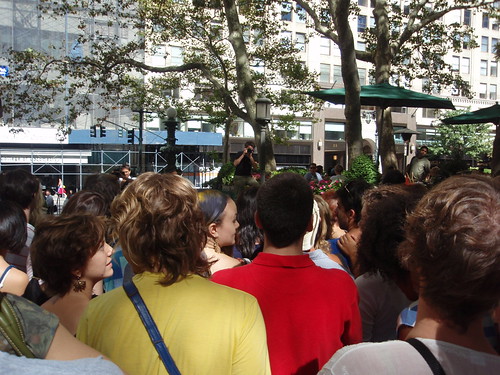
dance community NY group photo in bryant park

I don’t know who in the dance community annoys me more: those who consider themselves hipper than thou and call themselves “downtown,” or those who consider Ballet the only form of dance.

Spurred by Eva’s suggestion, I went to Bryant Park this afternoon to take part in the first ever group photograph of the New York dance community, organized by Belgian online dance initiative Sarma and local dance collective Chez Bushwick. Everyone who considered themselves part of the dance community was invited. Since I’m a dance blogger, ballet and modern fan and amateur ballroom dancer, I decided that included me.

When I arrived I spotted a robust, jovial-looking, curly-haired man wearing a t-shirt that announced he was a member of the photo op, and headed toward him. I kind of look like Sylvia Plath but shorter and with darker hair, or maybe Suzanne Farrell but not anywhere near as pretty 🙂 I have long hair and was wearing a ballet-y black bouncy-skirted sundress bow-tied at the waist by a red silk scarf, and sandals whose straps were topped with embroidered flowers. I was carrying an oversized pink bag bearing books. After making brief eye contact with me, the man peered around me to another woman and began greeting her, until I stopped right in front of him.

“Oh hi,” he said to me, surprised. “Um, we’re actually taking a photograph of the New York dance community here. Would you like to participate?” he asked hesitantly.

“Uh-huh, that’s what I’m here for,” I said.

“Oh. Oh good,” he said handing me a piece of paper announcing the rules (you gave them permission to use the photos of you on the internet and in magazines, yadda yadda). He also told me after the picture was taken, I was to sign my name on a roster of attendees and would receive a sticker entitling me to a free drink at one of the concession stands. He then told me they were running a little behind schedule and directed me to take a seat at one of the tables in an adjacent elevated area along the path.

I did as he suggested. Turned out to be the perfect little perch for me since its elevation gave me a good view of the crowd. I enjoy being an observer. Plus, I was having a bad hair day and was a little worried of running into Marcelo or David or one of my ballet heartthrobs, so could be on the lookout and duck for cover if need be. I had nothing to worry about as it turned out: there wasn’t a soul from the ballet world there.

Many people began arriving, and I didn’t know anyone. Finally, I spotted a fellow blogger in the crowd. As he was making his way to the tabled area after receiving his instruction paper, I waved to him.

“What are you doing all the way over here?” he said as he approached. I didn’t really understand the question so responded with a quizzical look.

“We don’t ever see each other,” he then announced, “because you’re a snobby elitist who only goes to uptown things. I go to all the cool downtown things.”

I just stared at him, not really knowing what to say. He laughed. Apparently I was supposed to take it as a joke.

“Well, I’m going to go around and meet new people while you sit here like a wallflower.” And he was off.

I kind of sat there stupefied. I think I saw Eva, but after that didn’t feel like getting up to say hello. Maybe some other time. I saw Jonah Bokaer, one of the organizers of the event and a dancer with Merce Cunningham. He’s rather cute in person 🙂 He was going around giving people who looked like they belonged small bottles of water. That didn’t include me. He looked right through me when he passed directly in front of my table even though I had my piece of paper with the instructions prominently displayed. A twenty-something woman with dark hair bearing a green “press pass” around her neck was going around with a notepad. She stopped at a table in front of me at which sat a man and two women with really cool-looking dreadlocks. I overheard them tell her they were retired dancers, now choreographers. I wondered if the interviewer was Gia.

About half an hour later, an announcer muttered something over a microphone that barely worked. From the crowd’s actions, I figured he was telling people to line up to his left. I followed suit, but kind of wish I’d just have stayed where I was to take pictures. I got a space all the way in the back of the crowd. I could hear him now telling taller people to move to the back, but apparently the average man over six feet either doesn’t understand English or has no sense of his size in comparison to others. Or else “downtown” male dancers are just rude. Some tiny women in the back brought over some chairs and stood on them. Soon, a security guard was in on the action ordering the people to get off the chairs. They paid him no mind. He yelled louder. They continued to ignore him. I couldn’t believe their audacity. And it did look dangerous: the plastic chairs were very insubstantial and the ground was really rocky and unstable. I wouldn’t stand on such a thing and these were dancers. He walked right up to one of them and yelled in her face to get off the chair or else. This was far more exciting than the photographer up front!

“Oh come on, officer” she whined like a character in Rent. Thankfully the last picture was snapped and the whole experience over, so there was no further trouble.

Good thing about being in the back was I was first in line to record my name. That of course didn’t mean I was actually first to do so. As the man handed me pen and paper, someone reached over my head and snatched the whole right out of my fingers, bumping me on the crown with the back board. Other pens and rosters were handed about, arms flying feet stomping everywhere. About fifteen minutes later I was finally able to scribble my name, identity (blogger), place of birth and email address, and receive my sticker, which I promptly took to the nearest concession stand.

“What’s this thing?” the clerk snapped.

“We’re supposed to get a free drink?” I said.

She laughed shaking her head. “I don’t know nothin’ about this.”

“The dance community gathering, over there,” I pointed to the raucous crowd bombarding the man with the rosters and stickers.

“I don’t know and I don’t wanna know,” she spit.

I guess it was a fitting end to a discomfiting experience. Weird, I was just saying how good it felt to be part of the dance community.

David Speaks!

Matt posted a little video he made of him and David Hallberg attending a live taping of the Broadway play “Legally Blonde” for MTV. Pretty good video, Matt! But interesting thing to me is, this is the first time I’ve actually ever heard David speak! He’s more fragile-seeming than he appears onstage. He’s so cute 🙂 🙂 🙂 It’s just funny because in dance (in contrast to theater, movies, etc.) you see a favorite dancer onstage many many times and you never hear the sound of his voice.

Flabbergasted

Okay, I must admit, since SYTYCD began this season, several of my most intelligent friends would, if they were lawyers or writers, roll their eyes and snicker, or if they were serious arts journalists, make much more pained faces, whenever I chirped poetic about the show. They found it, at best just a silly waste of time, at worst demeaning and harmful to the art of dance. I would get really angry: my friend was on the show, and he’d had so many ups and downs, had just come out of a long illness, the ballroom competition judges who ruled his world could be so very nasty — I was so thrilled that he was finally getting his due, that the public supported him the way it did. I’d never really watched the show in prior seasons, and I couldn’t understand how my friends couldn’t see how amazing the show was to give people like Pasha such brilliant opportunities. Now he’s off, along with my blinders; I hate to say it, but my friends were so right.

First, the dancers who are left … they’re just nothing like what I’ve seen live, and it’s such a shame. Just because Danny is from ballet doesn’t mean he’s a perfect representative from that world. To me he doesn’t have the charisma, the personality of, say, Angel Corella, or my favorite. And he doesn’t have the virtuosity of David Hallberg or Ethan Stiefel — his legs don’t fully extend out into the splits when he jumps, like theirs do, and he doesn’t do hard combinations, he just does a bunch of turns, then a bunch of jumps, then a bunch of turns again. And what was all that crazy gymnastics at the end? Why didn’t he combine things into a difficult routine? The public is being cheated if they think this is real ballet. Yeah, he’s technically better than the others left on the show, but who cares when everyone’s a bore? Who wants to watch a show with no competition?

The good thing about Pasha was that he was so good at something so different than Danny. So, the public was seeing two very good dancers who excelled in their own styles — it was like people got a good taste of two wholly different points of view.

I think both because Pasha’s gone and because Danny’s not making ballet come alive to me, Danny’s completely wrong cha cha, which might otherwise have been cute since it was wrong but was ballet-dancer wrong, instead totally annoyed me. I remember seeing Jose Carreno dance salsa in his native Cuba in the film Born To Be Wild and thinking, hehehe, that’s not Salsa, that’s Ballet-Salsa! The reason ballet dancers can’t do Latin properly is because you have to settle fully into your hip in order to look properly grounded; ballet dancers have a natural turn-out, so if they settle properly, into a turned-out hip, they’re really going to grind to bits whatever cartilage is there, which means end of ballet career. So, no settling, no grounding, no proper hip action. But watching Jose in that movie was charming, because then you got to see him perform an absolutely breathtaking, beatific Don Quixote right in front of Castro. So, you got to be blown away seeing him do what he DOES. Not so here with Danny. And you don’t get a proper version of Cha Cha since Pasha’s off. And Lacey and Neil’s Lindy Hop: eh, they did what they could with it, but it’s just that if you’ve seen real Swing dancers, you know how not there it really was.

Second, what the HELL was that choreography — particularly the so-called contemporary? The Swing and the Cha Cha were fine because those dances are supposed to be cute, not meaningful, not thought-provoking, not profound, not poetic, not moving the viewer to a higher level. (Not that Latin can never do that — I very badly one day want to see Bodas de Sangre, the Latin dance version of the Garcia Lorca play.) But, those are the reasons we go to see concert dance. What was that hideous fox thing whoever choreographed for Lacey and Sabra? How am I supposed to be moved by mommy and baby fox-people doing whatever in God’s name they were supposed to be doing to each other? What was I as a viewer supposed to get out of that? And what was that 80s Adam Ant thing Mia Michaels forced poor Danny and Neil to do with each other? Is it too much to ask for serious choreographers? Lar Lubovitch for a male duet, anyone? Twyla Tharp for contemporary combined with social to brilliant effect, anyone?

No, you see, real choreographers are used to dealing with professionals. More than anything tonight I was absolutely appalled at the extreme immaturity of those dancers. Pasha never would have acted like such a child. Making fun of the choreographers to their faces, making fun of dance, making fun of a foreign language? I’m so embarrassed for Lacey that she doesn’t know better, that she doesn’t know how horridly unsophisticated she looked. I’m so embarrassed to admit that I can’t understand spoken French very well, and she’s flaunting her ignorance like that. I just … on so many levels, I’ve never seen such puerile, such beyond juvenile behavior. I just, I’m honestly in shock. I liked Lacey too before tonight.

Melanie LaPatin — bless that woman. God bless her. For the first time, she actually gets her day as choreographer, out from Tony Meredith’s shadow. Let me tell you, that woman is a slave-driving hard-ass — one reason I love her. She makes you work like you’ve never worked before in her studio — unlike Tony; he’s a softie 🙂 In a good way — we love him too, just for that 🙂 But Melanie takes no shit whatsoever, and I really thought she was going to lose it here. You know she didn’t because she had to smile pretty for that stupid ass camera. Bless her soul; she’s a far bigger woman than I am.

I was so mortified, after the show ended, I had to go outside and take a long walk, had to reassure myself there were were people with pulses, with brainwaves, on this planet, whose eyes had not been glued to their TV for the past two hours. Sure enough, wine bars were overflowing with twenty and thirty-something hipsters engaged in conversation, take-away ice cream parlors with happy-faced children and parents, coffeehouses and bookstores with people engaged in mental activity. Ah, people with lives. As of now, count me one of them.

Danny Tidwell Could Use A Bronzed Dance Belt!!!!

Hahhahha! I recently got an email about this earlier post where I was pondering whether I should get Pasha and Luis bronzed dance belts for a holiday gift as an apology for constantly kicking them there during lessons. I’m just so glad, after tonight’s SYTYCD episode that I’m not the only one with that little problem!!

It’s hard to be a male dancer!… What’s up with that look on my face??… Anyway, there we are trying this very cool Karina dip (that I stole from her but can’t do correctly to save my life because, hello, I am NOT Karina!)… This trick is so gorgeous too when done properly IF you can do it properly (when he dips you, it ends up looking similar to the graphic on the top right part of the blog, except of course it should look GOOD, not like that because that is me; I wish I could post a YouTube of Karina and her old partner Slavik doing it because it looks so gorgeous, but they withdrew the clip…) But the trick is so hard because you have to get so close to him and shove your hips into his waist / crotch so that when you arch back you can still hold yourself up and he doesn’t have to throw his back out… And with Rhumba, the beauty of the trick is that you’re coming into him really fast, and with my longish legs, often the left knee that’s kind of humping his back here would be aimed a little farther to the right… He’d shout “hellohellohellohellohello” whenever he needed to warn me. Dancing is so much harder than it looks… Anyway, Argentine tango with all those between-the-legs kicks is just all the worse and I’m sure Pasha is very happy that Argentine tango is not on the International Latin syllabus!

Gosh this is like a lifetime ago! And it’s only last September… Pasha is so incredibly sweet — I just came across these pics recently. He’d agreed to have them taken with me in the studio wearing this Winger t-shirt to model for the Winger! Kristin Sloan (Winger founder and NYCBallet dancer) offered to post pics on the site of Winger readers wearing their t’s at their dance studios or dance-related events, so Pasha nicely let me model the shirt with him 🙂 🙂

I look ridiculously scared!


This was Kristin’s favorite. I look downright in pain! The shirt design is really cool though, right!

I miss him so much! And I miss dancing so much. The most worrisome thing is that, we took these pics right after we’d all returned from Nationals last September (which is on my mind since I’m about to book my tkts for this year — yay!) and I just re-looked at some of my posts on that. I was worried about my flabby butt back then… now, that I haven’t danced in a good — geez eight months — it’s so far beyond sag it’s not even funny. I MUST take dance lessons. I MUST find an inexpensive place.

Anyway, speaking of the Winger, Bennyroyce posted some excellent pics of Bad Boys, the troupe I’d posted on yesterday — they’re far better than mine since they’re up close, or from the perspective of … the Wings! Also, here’s an interesting article in a local Berkshires paper about Rasta and his guys. (Speaking further of the Winger, we still do not know for sure if that dance belt model above is indeed Mr. Hallberg. He would never fess up!!! I think it is — look how similar the face… it’s you, David!)

And coming full circle to Danny and SYTYCD, I was being masochistic and looking up photos of Rasta’s wedding 🙁 and I found this from his ballet school’s alumni page. Look who is in the center of the bottom right-hand picture! And who’s above him — is it Travis from last season?