When Is My Beloved Alvin Ailey Going to Start Live-Streaming?

Kristin Sloan just wrote this excellent post on The Winger. Apparently, the Berliner Philharmoniker is doing like Misnomer did and is live-streaming their performances. Except they’ve set theirs up so that they have a permanent website and they charge people for viewing. You can buy either single or season tickets. And then you watch live on the internet.

I think this would be such an excellent idea for dance companies. Nothing can take the place of a live performance but there are so many people who don’t get a chance to see those because of where they live, because of finances, etc. Why not live-stream so everyone can see? Then I wouldn’t be having so many of these discussions about my favorites with myself 🙂 or with very few fortunate others who happen to live in New York or another big city.

Every season at Alvin Ailey they put out a souvenir book that includes pics of the dancers and info about the history of the company, which I always get. This year, in honor of their 50th anniversary, they had a section where the dancers were quoted saying something about what being in the company, dancing, etc. means to them. Kirven Boyd, one of my favorites, said how amazing it was to perform under the Parthenon in Greece, “to be on stage under the stars.” Of course initially I felt a pang of jealousy. But then I thought, how great that would be for all their home-based fans to see as well. And others who’ve never had the chance to see them. This is a company that travels widely, all over the world. How cool would it be for them to live-stream their international performances?

And how cool to live-stream as well performances by other intriguing and provocative dance companies — Morphoses, William Forsythe, Tere O’Connor, Jerome Bel, to name a few? Then we could all have these discussions about choreography, about how meaning is made through movement, about what constitutes art, etc., that the people who make these annoying TV shows are so insistent on not having!

Halloween & Center Stage

Interesting decoration I saw on the street.

Happy Halloween, everyone!

Also, don’t forget, the night after Halloween, (Saturday, November 1) Oxygen cable network is airing the premiere of the new movie Center Stage 2, or Center Stage: Turn It Up. According to the network’s website, it’s scheduled to show a couple of times that evening, as well as the following Sunday and Wednesday. So you have plenty of chances 🙂

Movie in the Making: NY Export: Opus Jazz

I’m behind on my blogging. Last Sunday, I braved the freezing cold (I HATE NY when temps drop down to the teens and single digits; all I can think of is death) and ventured up to the Guggenheim for another Works & Process event. This one, entitled “Ballet in Sneakers,” was about the making of a new film of Jerome Robbins’ 1958 jazz ballet, “NY Export: Opus Jazz.” Two New York City Ballet dancers — Ellen Bar and Sean Suozzi — are the impetus behind the project. The filming is still currently underway and, in fact, is not very far along unfortunately. I was hoping they would have more clips to show other than that which I saw earlier at NYCity Ballet (which I blogged about here), but so far the duet I wrote about in that post is the only one that has been filmed. The (very young!) filmmakers — director Henry Joost, along with Jody Lee Lipes and Ariel Schulman, were there to discuss a bit of the logistics of filming that piece and the locations in which they’re thinking of shooting other parts: a tobacco warehouse under the Brooklyn Bridge, a hidden area in Staten Island under the Verrazano Bridge, and they’re looking for a low rooftop surrounded by high rises. Joost gamely asked the audience to let him know if they knew of such a place. Basically, they are seeking to film one of each of the five parts of the dance in each of the five burroughs, which I thought was sweet, and fitting since Robbins was a quintessential New Yorker who loved this city, and made his ballet in honor of it. I’ll be interested to see the finished product.

I do wonder how long it’s going to be, though, since the ballet itself is not as long as a full-length feature film, and whether it’s going to show in regular cinemas, art house theaters, the New York State Theater, PBS, go direct to DVD, etc. I really wish the Works & Process organizers would allow some time for an audience Q&A. They do have a cocktail social afterward, but it’s often difficult to track down the speakers, and Sunday night it was impossible since the lobby is currently being used for the filming of another movie (don’t know which, but I heard Clive Owen was spotted in the museum earlier that day) and so was unavailable to us.

Speaking of movies, “How She Move,” of which they showed a trailer during “Dance War” on Monday night, looks kind of good. Well, the dancing at least looks decent… It opens here tomorrow night.

And speaking of “Dance War” — really, I’m sorry this post is so all over the place! — I wasn’t tremendously impressed with Monday night’s first team dance-off. I liked Team Carrie Ann’s last performance the best, mainly because they did what I said I’d most prefer in my last post on the show: put the divas up front and center and have the men as backup dancers. The women can really sing (at least four of them can), and though I’m not sure I’m tremendously impressed with anyone‘s dancing, at least the choreographers seem to be entrusting the men with somewhat more interesting moves than the women. I didn’t much care for Carrie Ann’s first team performance, though — the hip hop with all the posturing. I thought it was interesting at first, and very initially reminded me of Camille A. Brown’s “Groove to Nobody’s Business,” but it got old fast and went nowhere. I couldn’t much appreciate Bruno’s first piece, with all the pimpish sex kitten crap. He basically said he wants “sexy women and strong men,” so that is apparently where it’s at for him. And I honestly can’t remember his second piece…

Ballet in Your Local Multiplex? Yes!!

Look what Canada is doing! Thanks to Apollinaire for alerting me to this. As Apollinaire says in her blog, yes, we’ve been discussing whether Met Opera Director Peter Gelb’s success in introducing new audiences to opera through broadcasting some of the Met’s productions in movie theaters could work for ballet as well. Well, Canada has beat us to the experiment.

And thanks to Matt for alerting me to this: a New York Observer blog post on Kristin Sloan, founder of The Winger and New York City Ballet dancer, indicating that she has retired from dancing to become the Director of New Media for the company. Go Kristin! I wonder if NYCB will now be the harbinger of more great experiments to come? Will NYCB be the first to bring ballet to your local cinema???

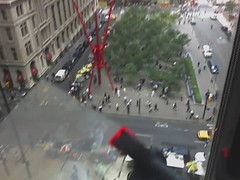
Watching "window" by bill shannon

Watching “window” by bill shannon

Originally uploaded by swan lake samba girl via mobile.


This was so cool! Review to come. Definitely try to go if you can!

Okay, now that I’m back at my desk I can write more. Bill Shannon’s “Window” is the last of the works shown as part of the Lower Manhattan Cultural Council’s “Sitelines” series (consisting of site-specific dance performances) in its “River to River Festival” for this year. (“River to River” takes place downtown each summer). The two others I was able to see, I blogged about here and here.

I really really liked “Window.” Bill Shannon is a disabled dance / conceptual artist who uses crutches. (If you’re in L.A. right now, he is one of the performers included in the David Michalek “Slow Dancing films” exhibit.) Here he and three other men — one wearing black pants, top and hood, one wearing all white, and one dressed in a business suit — performed break-dance and hip-hop out on Liberty Park Plaza while Shannon, skateboarding on crutches, zoomed around on the streets surrounding the park. At points Shannon would skate into the park and dance, very well mind you, on the crutches.

There were two sets of audiences: the random passersby in the park and on the street who got caught up in all the commotion; and us, those who RSVP’d to the event through lmcc’s website and were escorted into the 8th floor of the high-rise at 140 Broadway, where, amongst the bemused real-estate brokers who regularly inhabit the office, watched the scene down below through the window. A couple of camera people outside filmed the performances by Shannon and the three others and those films were projected live onto four screens inside, where we stood. One screen was set up in such a way that it would reflect on the ceiling, where you got kind of an upside-down version of what was going on outside. The filmmakers also played with the projections a bit so that the colors of the dancers’ clothing would change, or, at points, the dancers would be projected onto a different background; at times the images looked rather 3D. So, you had your choice of watching what was actually going on outside through the window, or the way it was projected onto the screen, as intermediated by the filmmakers.

They also had speakers set up inside, which played a variety of hip hop, techno and pop music. Shannon had headphones bearing a small microphone so he danced to the music and interacted with us through the mike.

I preferred watching what was actually going on through the window, partly because, Liberty Park being so big and crowded, everytime I took my eyes off of Shannon, I lost him. I also found it more interesting seeing how normal everyday besuited business people and tourists, not expecting to see a show — and a rather odd one at that (I didn’t see any speakers down there so assumed they couldn’t hear the music and only saw a bunch of guys rocking out to silence), interacted with him. Of course this being New York, most pretended not to notice him at all, although you could kind of see them spying him out of the corner of their eyes. They didn’t have the roads blocked off and at one point I thought he may be hit by a large white van barrelling down Liberty Street, but the driver thankfully saw the crazy guy bopping around on crutches whilst skateboarding and slowed to a stop. “Whoaaa” Shannon sang over the speakers.

At the beginning, Shannon looked up at us and called out, “How do you put rhythm into a city? How do you make a city come alive?” while clapping his hands above his head and shaking his hips to the percussion like a rock star. There was something at first eery but eventually comforting about watching him rockingly skateboard around what was once a triage unit, the construction site that was once Ground Zero and before that the World Trade Center diagonally behind him.

Day of Merce and Frustration!

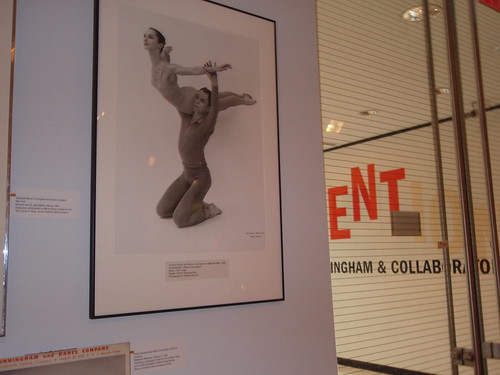
Yesterday I went to the Merce Cunningham exhibit at the New York Performing Arts Library at Lincoln Center. At noon there was a short, live, four-person performance of solos and duets right in the lobby. All dancers — two male, two female — wore blue unitards and the music sounded somewhat like the ocean. At times the dancers looked a bit like they were swimming. Of course it was abstract, but that’s what I got out of it.

I then headed into the exhibit, which was really pretty cool. I’m embarrassed to admit it, but this was my first experience with Cunningham (aside from the time Winger Tony Schultz and I saw him in the audience, wheelchair-bound, at another modern dance performance). Embarrassing to admit since he’s only one of the founding fathers of dance in this country! The exhibit was pretty comprehensive and very entertaining. They had videos of several of his works, all performed in the last ten years, but some choreographed far earlier. Cunningham himself danced mainly in the 40s and 50s. He is still choreographing, but of course no longer dancing.

The videos were my favorite part of the exhibit. They had several screens mounted on the wall, you took a chair hooked up to earphones and selected the music from whichever screen you wished to concentrate on. I actually found all screens mesmerizing and it was hard to focus on only one at a time. Funny thing, though, you really didn’t need to. The music (oftentimes sounds — of waterfalls, birds, people talking, etc.) seemed not to matter at all; you could have selected any soundtrack and watched any one of the screens. This, to me, marked Cunningham the complete opposite of Mark Morris, whose choreography is his rendition of that particular musical piece in motion. Also in contrast to how I personally felt watching Morris’s Mozart Pieces on PBS, Cunningham’s choreography was so engaging, I actually didn’t care what the sound was like.

My favorite video was called “How to Pass, Kick, Fall and Run” which was accompanied not by music but by Cunningham and another man, named David Vaughn, reading bits of text to the audience. At times their voices would overlap so you couldn’t even really make out the words, at times you could and the text was very humorous, and at times you just couldn’t pay attention to the text because the moving bodies were just so mesmerizing, even though they weren’t doing anything tremendously virtuostic. One passage, read by Vaughn, told of a man who gave a lecture on how to attend a lecture. He instructed attendees to listen, which they couldn’t do if they were taking notes. One woman was taking notes. The man next to her told her she was not supposed to take notes. She quickly read over her notes and said to the man, “that’s right. I’m not supposed to take notes; I’ve got that written right here.” The audience laughed like crazy. Throughout the reading of the text, the dancers, wearing colorful sweaters over plain black leotards, would jump, hold each other and bounce, kick playfully, scamper across the stage, then do slower prettier arabesques, sometimes with an awkwardly bent standing leg. The movements kind of did and didn’t correspond to the text. If you watched it a couple of times, it did, in a way. For example, at one point Vaughn began a brief vignette in which two women went to a women’s business meeting, and at that point two female dancers would wrap arms around each other and hop on one leg around in a circle, then let go of each other and both hopped toward the front of the stage. Kind of goofy-looking, but then a man emerged and they began a complicated, serious, lift sequence with him. Is a business meeting silly, serious, or both at times? I don’t know. But I found the process of watching the piece a few times and arriving at different conclusions each time rather fun and invigorating. It was also cool to recognize one of the dancers, Holley Farmer, who was in the David Michalek films.

Then, they had tons of pictures of the company performing, from 1945 up through the present, another film showing an interview with Cunningham, numerous costumes some of which were quite colorful and interesting-looking to put it mildly (one was a leotard with aluminum cans taped to the legs! — wish I would have seen that piece!), a bunch of musical scores and choreographer’s notes (the latter of which looked like heiroglyphics to me and made me wonder how in the world choreographers notate a work to preserve it), and some posters by such great artists as Jasper Johns and Andy Warhol promoting the company on tour and at home.

Top pic is of Carolyn Brown dancing with Cunningham himself in the company’s early days, which was interesting to me since I’d recently seen her speak about her new memoir about dancing with Merce, at Jacob’s Pillow (in that picture that I linked to above, from the previous blog entry, she is the woman in the white dress). It was quite a long time ago that she had danced with him and, wow, was she was a striking beauty back then.

Anyway, for people in NYC, I urge you to check it out. It’s a real history lesson, a fun informative trip through time, since Cunningham is such a foundational figure in dance in this country. It closes on October 13th, so you still have some time.

I recently bought a new camera with more pixels, a more powerful zoom, and motion control (so as to take better photos of all the lovely ballroom dancing I will soon be viewing, like tomorrow!) Hopefully, the pics will be better than before (the picture in this entry is better than previous ones, right!). But I’m having trouble uploading from my new software to my Plogger. Spent a good deal of the day trying to figure it out to no avail. It has no problem uploading the pics from my former camera software (which it seems is incompatible with the new camera). Argh, I HATE technology — just can’t figure things out! So, for the time being anyway, I’m using my Flickr account to upload new pictures. I created a link down at the bottom of the blogroll to my Flickr page, which is likely where I’ll end up putting the pictures from the dance competition I’m about to head off to… Have to go pack!

Oh, and my TAC headache seems to be officially over, for now anyway. Yay! Thank you so much, you guys for your concern 🙂 I really appreciate it 🙂

Mark Morris, Mozart, and Full-Length Concert Dance on TV

Over the weekend, I watched Mark Morris’s Mozart Dances, filmed for TV and shown as part of PBS’s Live From Lincoln Center. I actually watched the tape I made of it three times, plus I’d also seen it live last year. Doug Fox was very disappointed with the televised filming; visit his blog for some interesting commentary. Also, as I’d linked to earlier, read Apollinaire’s article for more on the filming aspect of the program, and an interview with the filmmaker.

Before turning to the filming, I briefly want to give my two cents on the dance itself. I’m not a huge fan of contemporary Mark Morris. I’ve skimmed Joan Acocella’s book on him and wish like anything I would have been able to see Strip Tease and some of his earlier, more iconoclastic work from the 80s when he was a young upstart. Now, it seems like he’s toning it down. My first thought on seeing the program was that it was too slow and repetitive, making it long-winded and a bit tedious. But each time I watched, I liked it more and more and saw more of the things Acocella had written about, just in subtler form. (Go here for her current New Yorker article on this piece). One of the ways in which the dance is broken down is by gender, as Alastair Macaulay noted in the Times. The first movement is danced almost entirely by women, the second by men, the third by both together. In the first, the women, as Macaulay also noted, look very weighted and “flat footed.” The men in the second act (my favorite), in contrast, look light and feathery. This is the opposite of course of classical ballet, where the ballerina on pointe looks poetic floating about in the air and the grounded man is her support, her connection to the earth. So to an extent this is the usual Morris turning those gender assumptions on their heads.

And he does it well: during the part of the first act’s piano concerto where the music sounds like a lullaby, the women, wearing these almost dominatrix-looking black costumes — black bra and underwear with diaphonous black chiffon gown hanging from the bottom of the bra to the knee — do not tiptoe around in a circle all willowy and delicate, but brashly stomp forward, arms swinging front to back as if in a march. Hardly the maternal ideal. During the men’s portion, at one point, the men, wearing blousy, billowing white shirts, dance in a circle as well. But their dance is quite different; it’s light and lyrical, poetic, like a Balanchine ballet. But where Balanchine would have pretty ballerinas with long flowing blonde hair bouncing around, playfully holding hands with each other, raising arms, and inviting a dancer through their arc, Morris’s dancers do the same but the whole look is altered because they are men. Or is it? What is femininity and why does gender matter in dance? Maybe it doesn’t. And I love Joe Bowie, the main soloist in the men’s section. I love that the man who, at least to me, represents Mozart himself is an urbane black guy dressed in hipply ripped black conductor’s jacket and black spandex bike shorts. Morris definitely challenges gender and race assumptions, though it’s rather pathetic that they still need to be challenged. And the costumes were simply superb.

Also, Morris is known for being a very “musical” choreographer, meaning what exactly? He works with the music well? To me, his dance is almost a contradiction of the music. His dancers’ movement is very modern, yet the music is obviously classical. Also as Macaulay notes, Mozart has a lot of beautiful lyrical flourishes in his compositions. Morris doesn’t seem to follow those by creating his own lyrical poetic flourishes; the dancing instead is rather intentionally mundane, earthy. There’s no virtuosity either (big leaps, multiple pirouettes and fouette turns, etc.) Which is part of why Morris doesn’t thrill me. Cool costumes, evocativeness and assumption-questioning aside, to me the whole thing generally dragged and there didn’t seem to be any climactic arcs or discernable overall themes.

Interestingly Morris says during his interview segment of the show, that he doesn’t like “poses;” he finds the steps in between poses to be “the dancing.” I guess that’s what I’m missing here. Of course that’s what Ballet and Latin are all about, so call me shallow, or bun-brain or Latin girl or whatever, but I’m for the poses. Of course getting from one pose to another easily is what dancing is all about and it’s necessary to make smooth transitions. [In my own dancing I concentrate so much on the pose — the arabesque (one leg lifted in back), the develope (slow, unfolding delicate kick), or how my body looks in position in a lift, that I forget to think about getting into the position in the first place. The result: I look like crap on my way into a lift, etc. But I think this is common among students / amateurs, and I’m learning… :)] In any event, watching my Morris tape a few times, though, the dance has grown on me a lot, so maybe if I kept watching it would continue to do more for me.

So, the film aspect. Funny but I felt the exact opposite of Doug. I didn’t think the camera did enough, had enough of a point of view. I was glad that, for once during a full-length concert dance performance, someone didn’t simply plop a tripod at the edge of the stage and hit ‘record’; the camera-operator actually had an opinion, told the viewer where to look. The camera would at times home in on one dancer, either his or her entire body or just torso, then would pan out to the ensemble. At times it would follow a dancer or smaller group of dancers, excluding perhaps things happening at the other end of the stage. These were all reasons Doug gave for disliking it; I felt that this was too rarely done, and when done was still too lacking in focus. When the camera homed in on a dancer’s upper body, it did a half-assed job; if you want to humanize the dancer, make people relate to him or her, get a close up of the person’s face. It doesn’t have to stay there long, but a few close-ups go a long way. The eyes are the window to the soul, you know.

And you can’t just focus the camera in and out without playing with angles. Everything here was a straight shot. Forgive me, by the way, for not knowing correct film terminology; I know what I mean, but don’t know if I am expressing it right because I have no film-making (only extensive film-viewing 🙂 ) background. For example, when some of the dancers were doing pirouettes, do a close-up of that dancer and angle the camera so that it’s focusing on the dancer at a diagonal. It makes the dancer look superhuman, like s/he has miraculous balance and it’s really cool. And, like with those little wrist-flourishes the dancers were doing, home up really closely and find a better shot — maybe of the wrist coming toward the camera — to make it look multi-dimensional or something. And, as I said, unfortunately, there were no big jumps and leaps here, but if there were, have the camera underneath the dancer. This emphasizes the majesty of the height and showcases the dancer’s musculature. Generally, it always heroizes the subject to have the camera focused upward at him / her — so this could have been done at any point, with pirouettes, etc. Conversely, if you want to highlight a dancer’s vulnerability, create poignancy or sympathy, do the opposite and place the camera at a downward angle on top of him or her. Also, it would be cool to have, like in those highly successful Anaheim Ballet videos on YouTube, the camera directly behind or immediately next to the dancer so that the viewer would be given a sense of what the dancer sees, during, for example, fast pirouettes.

Of course none of this could be done with the Morris the way it was constructed. To do any of the above, the choreographer would have to work very closely with the filmmaker discussing the most effective correlation of movement and film angles. It would change the entire choreography. This piece was meant for the stage; Morris meant for the audience to come to its own conclusions about its meaning and evocation. He specifically tells us during the interview segment (which I loved — in a way those interviews were the best part), that he directs his dancers not to make any decisions about the emotion of the movement — if a movement is fast, dance it fast, not happy; if it’s slow, dance it slowly, not sad. So, he certainly wouldn’t want the filmmaker intruding on the audience’s turf either. Which is largely why this didn’t work for me. You can’t effectively film a play made for theater for the same reasons you can’t film a dance made for the stage. You can obviously create a film version of a play, a film version of a dance, but they are versions, not the same exact thing placed on film. Film is a completely different animal than live theater and it must be treated as such for it to be effective, exciting, and garner a good-sized audience.

I mean, I’m glad that this film exists and that I have it taped; I can now watch it repeatedly and gain more appreciation for Morris. I’m just saying that I doubt that anyone new to dance was blown away by it, unlike with SYTYCD. Did anyone else see it?

A few final thoughts. Doug was also annoyed by the film’s flashing to musician Emmanuel Ax, playing piano, or to the conductor. I actually liked this because I felt it gave the viewer an idea of the whole performance with all of its various elements. The conductor and musicians are part and parcel of a live performance. Plus, I loved the music so much, I wanted to see who was responsible for it! I also liked the interviews with Ax and Morris. I like that Ax mentioned that he had a camera on the piano so he could see the dancers as well. Sometimes, when I’m at the ballet and I’m lucky and have a seat up close and central where I get a good view of the conductor, I like watching how he relates to the dancers, if at all. Sometimes it seems that the conductor doesn’t even look up onstage, which can result in music played way too fast, not giving the dancers sufficient time to get where they need to go or to act something out fully in a dramatic ballet. And the interview with Morris: it’s always fun to hear a choreographer talk about his work. Always! I also liked the behind-the-curtain shots, though I don’t know if anyone noticed them but me. I love how some of the dancers just collapsed after that curtain went down! And, when Sam Waterson (did his voice seem shaky and nervous or was it just me?) gave his opening remarks, it was prior to the curtain going up, so we got to see dancers warming up and talking and planning, maybe giving each other little pep talks. That was quite fun too!

I would have liked to have seen some interviews with the dancers as well. One of the reasons these shows — SYTYCD and Dancing With the Stars — are so popular (I know, some of us have had this discussion before with America’s Ballroom Challenge), is that the competitors are portrayed as not ‘just’ dancers, but real people to whom everyone can relate. Little background stories are given — where the dancers are from, how they fell in love with dance, etc., little interviews, little clips of them in rehearsal trying to learn choreography, sometimes struggling with it (again, something we all can relate to), having their own hurdles to overcome — it’s all part of what makes the dancers, and therefore the dance, come alive to us. Mark Morris after all isn’t performing, his dancers are! They could have at least had interviews with Bowie and Lauren Grant, the two main soloists, or we could have heard the dancers talking with Morris during the segment where he is shown instructing them.

Okay, that’s all I can think of, for now…

Annual Trek to Brooklyn's Finest Stretch of Sand!

Every summer I must go out at least once to Brighton Beach / Coney Island. I don’t know why, really; I just feel like it’s not a proper summer without it! I usually take a day off of work around mid-May, before it gets too crowded and humid, but this year I must have been too busy because I never made it. Now that our fiscal year’s over at work and I have a couple of vacation days I must take before Labor Day, I looked up on weather.com to see which day this week would be most ideal weather-wise, only to find that it’s going to be rainy and cloudy and fall-like temperatures all week — Saturday was the only day with a little sun icon 🙁 So, I decided to brave the weekend crowds and went out yesterday. It’s kind of more fun that way anyway!

Here’s a little photo essay:

Fun in the sun! And relatively nice blue water.


Beside sunbathing, I love the town. Brighton Beach is very Russian; many people are new immigrants and hardly speak English. I love shopping in these stores, flipping through the Russian romance novels, the Russian videos and CDs, seeing if I can understand anything. I must have a very slavic-looking face; have actually been told several times that I look Eastern European, which is funny because I think I’m more Spanish-looking with my olive skin and dark hair… Anyway, everyone here assumes I’m Russian and begins conversations with me in Russian. Gives me a decent chance to practice my Russian — although, who’m I kidding; I haven’t had any classes since college, I barely remember the Cyrillic alphabet… Most of them don’t know any English anyway, so it makes no difference once they realize I have no idea what they’re saying and then I massacre their language with my hideous American accent. We end up gesticulating wildly with each other — just like in St. Petersberg, the one time I went to Russia, several years ago now — best foreign travel experience of my life!

I remember trying to impress Pasha once by telling him I came out here regularly and he just made this goofy smirk and rolled his eyes. I said, “What?!” and asked him why he didn’t come out here to get a taste of his homeland, be with people with whom he had so much in common. He said that just because someone’s Russian doesn’t mean they’re going to be your friend. I asked him why not; he mumbled something about generation gaps, culture clashes, judgments… It’s kind of sad, but I remember seeing that documentary Ballets Russes about that early 20th Century ballet company (a great movie by the way), and I remember one of the Russian ballerinas laughing and saying that Russians don’t like each other very much. They love us, they love everyone else, but it does seem like they don’t get along with each other very well for some reason.

Anyway, after I finished with the Dom Kniga (bookstore; or literally, house of books), I walked along the boardwalk down to Coney Island.


where they have the huge amusement park. I’ve only been on one ride — the giant ferris wheel, when my roommate from law school, Chris, and I came out here years ago. I was so terrified; that thing is so high off the ground. Chris, who normally had a very tough exterior, admitted as soon as we were safely on the ground that, when we were at full height, she was a bit worried too, though her way of so indicating was to say that she realized, if we were killed on the ride, our estates wouldn’t be able to sue because we’d assumed the risk… typical law students 🙂

And here’s the famous Cyclone, which I think they are supposed to be taking down at some point in the future (?), but apparently not yet, behind this cute froggie ride.

Haha, one of the many lovely eateries aligning the boardwalk on the Coney Island part. This one caught my attention because the name reminded me of dance 🙂 Do you think they misspelled “hole” on purpose??

This kind of freaked me out. They had this guy running around behind some garbage cans with a helmet and shield and people paid to shoot him with what I think was a BB gun?…


Can’t ever go to the beach without a little stop at the aquarium!

Where I saw all manner of wonderful sea creatures. If I was an animal, I’d either want to be a cute little primate denizen of the warm gooey rainforest or some kind of marine animal who inhabits warm waters…

Big, fattypants walrus entertained the crowd greatly 🙂

As did this saucer-eyed giant turtle. I love the woman with the camera. Everyone has digitals these days. No wonder you never see postcards anymore.

Ooh, scary shark, my biggest animal fear. This little girl was adorable though.

They have a couple of seals in this tank that used to be inhabited by the adorably cherubic white beluga whale. He died a couple of years ago and I think he’s too expensive for them to replace, but I always loved coming to see that little whale and his cute little “smiley face.”


Walking back along the boardwalk to Brighton, so I could dine at my favorite Russian restaurant, Tatiana’s (!), I passed this volleyball tournament. Must have been a big deal because they had bleachers set up and there was a big crowd.

The boardwalk kind of scared me. Some of those planks were quite loose, and the street was far below!


If you want to make lots of money off of a food or drink item, just call it “Naked”!

Final desination: Tatiana’s, on the boardwalk, getting my annual fill of caviar (red not black, I can’t afford $120 for lunch!), with sour cream and red wine. Mmmm, so good…

but so filling. Even though it always looks so small, I can never finish it all and I always feel badly for wasting such good food! Summer reading, by the way, New York Magazine restaurant critic Gael Greene’s memoir “Insatiable.” This woman cracks me up: when she was a fledgling journalist, she slept with Elvis after getting herself admitted to his suite following one of his shows by playing up her press credentials. She was in such shock the whole time that all she could remember about the entire thing was that he asked her to call room service for him and order him a fried egg sandwich. She said she knew she was destined to be a food writer after that 🙂

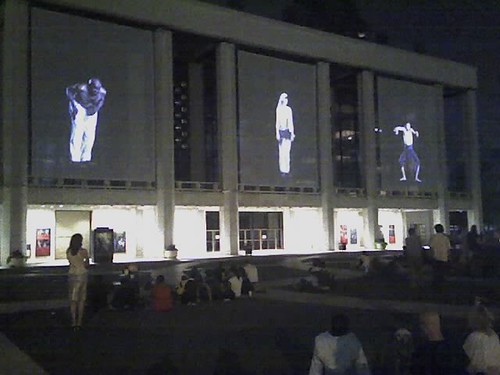
Samba & michalek – perfect combo :)

Samba & michalek – perfect combo 🙂

Originally uploaded by swan lake samba girl via mobile.


… and Desmond Richardson of course (in the background)! I swear they seemed to be moving faster tonight — the Michalek dancers I mean! Maybe it was just an effect of the fast, fun Samba of the Midsummer Night Swing event, or maybe it really was sped up a bit, especially in some of the middle parts?… Hmmm… Maybe it’s just that I’ve seen the exhibit so many times now that I have no perspective anymore! Anyway, something about it made it especially spectacular tonight, and it’s definitely growing on me more and more each time.

And then I got home just in time for the horrible results on STYTCD. I’m so upset about Anya. She is a really beautiful, rhythmic dancer and I’m really going to miss her on the show. I don’t know how the other two female contestants performed tonight, but I do know that as far as ballroom goes, Anya Garnis is one of the very best in this country. Oh well, what can you do? Good news is that Pasha and Danny will be touring 🙂 🙂 🙂

David Michalek's "Slow Dancing": A Good Idea But Poorly Executed (*Update in Bold)

Hehe, my friend, Ariel Davis, a young journalist currently in NYC for an internship with a big magazine, emailed me bright and early yesterday morning to tell me that we were quoted in the NYTimes! Of course I immediately scoured the article. Well, we weren’t actually quoted, in that our names weren’t listed, but we were the ones exclaiming, “he looks like a god,” the top quote in Claudia LaRocco’s write-up of the opening night of the Slow Dancing films I’ve been mobile-blogging about for about the past fifty posts now. (I promise to stop soon with the cell phone blogging; it’s just so exciting, in its own way). Anyway, the “god” Ariel and I were speaking of was Herman Cornejo of course 🙂

Anyway, I’m going to see it several more times before it leaves NY, but so far my thoughts are that the project is a great idea that has some real kinks to work out.

For starters, Lincoln Center is really annoying me and if I was Michalek I would be pissed. Slow Dancing starts at 9 p.m and continues until 1:00 in the morning; Midsummer Night Swing ends at 10:00 p.m. But after the MNS band stops playing, Lincoln Center really shuts down: the alcohol and snack bars all close shop, making it impossible to enjoy a drink with friends while watching the films, and, more seriously, a very noisy cleanup begins. The Aquafina guy noisily dismembers his metal booth then hauls it all, bit by bit, to a huge garbage-like truck waiting, motor running, in the nearby taxi cab lane; the bar guys clinkily clear bottles and glasses from their shelves; garbage collectors noisily bag trash and load it onto little trucks, which they drive dangerously through the crowd darting in and out and around groups of people, sometimes even honking if you don’t see them coming — how’s the audience supposed to focus on the film with all this crap going on? You feel like Lincoln Center’s telling you it’s time to go home now, show’s over, you’re out past your bedtime. Until July 29th, when this exhibit ends, could they possible re-arrange clean-up schedules? It’s hugely disrespectful to the artist and his audience.

As for the project itself, I think it’s a great idea and it seemed to work well when I saw it indoors at the earlier Works & Process event at the Guggenheim Museum, but for some reason, it’s not as exciting outdoors on the huge Plaza. I think part of my being so captivated at Guggenheim stemmed from the fact that I know and love all three dancers who were showcased that night: Wendy Whelan (ballerina of New York City Ballet), Herman Cornejo (American Ballet Theater), and Desmond Richardson (Complexions). But the vast majority of the dancers participating in the whole project I don’t know, or at least don’t recognize.

As LaRocco alludes to in her article, not a lot of the people on the Plaza for Midsummer Night Swing paid much attention to the films, unfortunately. Several heads did turn when the screens first lit up, and people watched for the first couple of minutes, but when they couldn’t see very much happening, they returned to their own fun. LaRocco bemoans that these social dancers, themselves participating in Dance, are ignorant of those on the screens, many of them the greats of ballet and modern dance.

Well, why should those dancers, having such a blast learning to dance themselves, stop what they’re doing in order to worship these people on the screens, whom they don’t know? Might someone, perhaps, tell them who they are?

From what I’ve seen so far, here are my critiques of the project:

1) No one knows who the dancers are and no one is bothering to tell them. If they’re not going to have easily available pamplets listing the names and credentials of the dancers, with pictures, could they run the names and a brief word about who they are somewhere prominent on the screen, at least at the start of each performance? Names humanize people. I’ve noticed this watching people watching filmed ballroom dance competitions — people who aren’t really seriously into the art of ballroom just kind of glance at the screen and look away after all of a minute — there are far too many people out there on the floor at once, it’s too much to take in, it’s confusing and nonsensical.

But once names are placed over the dancers (briefly, not for the entire time the camera’s focused on them of course), people pay much more attention, even if they’ve never heard the name before (which is highly likely). You think, ‘oh that couple’s obviously from Russia with huge names like that,’ ‘oh a Japanese couple,’ ‘wow, another Russian; a lot of Russians in ballroom, who knew…’ ‘oh wow, those are the national champions, yeah, they are really good,’ etc. etc. Names humanize. A little bit of info goes a long way.

Update: I went again tonight (Sunday), with Oberon, and found that there are little Lincoln Center playbills near the entrance to the State Theater, along with a poster, both giving the names and a brief background of each dancer next to his or her picture. I still like the idea of printing the names somewhere on the screens though! Also, I met Wendy Whelan tonight — she’s a very sweet person! Here is a picture of her and Oberon. Awww 🙂

2) There are either too many of the same types of dancers or there’s not enough variety and spontaneity in the rotations. At several points, there are two to three dancers shown all at once who are all doing modern. This is boring and reductive. Also, can everyone not be dressed exactly the same? Wendy Whelan and Janie Taylor are ballerinas but they’re both dressed in the same silky flowing gowny things as about ninety percent of all the women. To someone who doesn’t know dance, it could be confused with yet more modern. Couldn’t at least one be in a tutu and on pointe. And, could someone do a fouette or multiple pirouettes? The movement is too much the same. It would be much more interesting if there was, say, in the middle a classical ballerina on pointe in a tutu doing fouettes, then say the African dancer guy on one end, and maybe William Forsythe doing his modern on the other end; then shift in the next sequence to the bellydancer, adjacent to the head-spinning break dancer, and sandwiched in between, the drag queen; then next sequence, say the guy on the crutches, the pregnant woman, another ballerina; or have a ballerina surrounded by a strong ballet guy and one of the modern women. Just make sure there’s variety in every sequence of three. That makes it interesting and it’s more of a celebration of Dance, in its rich variety.

3) I realize the point of the project is to show movement in extreme slow motion, but I feel that it is too slow. At points you can’t even see the dancers moving at all. This actually may be a glitch in the film, because at some points I think the films have actually stopped for a while — sometimes even for as much as a full minute. This is confusing to the audience, who is already perplexed enough trying to figure out, as LaRocco illustrated with one couple’s conversation, if there actually is movement. Possible technical problems aside, though, the movement is generally still too slow. Instead of people admiring every detail of the body in motion, every ripple of a muscle, the audience just gets bored, especially if the dancer isn’t “flashy” enough. These past couple days I’ve become most fascinated with Glem Rumsey, who dances here as his flamboyant drag persona “Shasta Cola.” I find myself waiting for him to come on because I know I’m going to be most entertained. In contrast, one of the dancers I was most excited to watch was Janie Taylor. Yet, I find myself getting unexpectedly bored when she’s on here. She does nothing really over-the-top; no spectacular balletic feats. Even that crazy hair flip that generated a lot of press talk pre-show opening — it’s nothing; I almost missed it. There’s no appreciation for subtlety when the movement is this weighted down. The guy on crutches is initially intriguing because you’re wondering what he’s going to do, but you get bored and stop watching when he takes so long to get going. All of a sudden you look back and him and he’s in the air. You think, ‘oh wow,’ but it still doesn’t hold your attention for long because it takes a number of minutes for the guy to do one rotation. You lose interest. Same thing with the Whirling Dervish. Slow-mo can have a very dramatic effect, but not when it’s this slow.

My own personal favorites are Herman Cornejo, Desmond Richardson, William Forsythe, and the aforementioned Rumsey, all of whom, excepting Rumsey, I’m pretty sure I like simply because they’re already so familiar to me. I’m bringing a bunch of friends to the show over the next couple weeks, many non-dance-goers, so will be interested to hear what they think, who their favorites, if any, are. Will most definitely report back!

In the meantime, I’ve started an album on the photo page; I expect to add more pictures, but here are the first few.