ROBERT FAIRCHILD DEBUTS IN FANCY FREE (BUT TILER PECK GLOWS!)


Over the weekend, SLSG favorite Robert Fairchild had his debut in Robbins’ Fancy Free at New York City Ballet. This is one of my favorite short ballets: three sailors on shore-leave try to pick up women in a bar, but, there being only two women, they kind of get into a little competition, dance-off-style of course. Fairchild danced the role of the Latin guy, Tyler Angle the more head-in-the-clouds romantic one, and Daniel Ulbricht, the short Swing-y one with all the toe-to-finger splits jumps off the bar. The first woman was Georgina Pazcoguin and the one in purple who for a moment falls for the romantic one was Tiler Peck.

(photo above by Paul Kolnik, taken from Ballet.co, of, l-r Amanda Hankes, Tiler Peck, Damian Woetzel, Tyler Angle and Daniel Ulbricht)

Ah, Tiler Peck was so lovely! She dances that role so well — she really inhabits it, and when romantic guy cartwheels her over his head it just makes me swoon! I like her even better than the ABT ballerinas who dance this role – Gillian Murphy and Julie Kent. Peck brings the most to it I think — the dreamy girl who allows herself to get swept off her feet, at least until the guys get out of control. Pazcoguin and Kaitlyn Gilliland – who debuted in the ballet as well, as the third girl who comes on at the very end — did well too, although I thought Gilliland looked a slight bit unbalanced in the high heels.


(Robert Fairchild headshot by Paul Kolnik)

Ulbricht was perfect as the high-flying guy with his bag of tricks, and Tyler Angle was fine as the dreamy balletic one — the best role for him in this ballet, although I don’t really think this ballet suits him that well. I would really have preferred to see Robert Fairchild in his role though, rather than as the Latin sailor with bravado galore. I don’t think he has enough of the cocky shithead in him to quite pull it off. Of course I couldn’t stop thinking of Jose Manuel Carreno in the role — how he always cracks me up when he struts around with the lady’s purse after playfully snatching it, how he tries to please the ladies with those rumba basics that he thinks are oh so sexy but are really just silly the way he does them. I’m sorry Robert, I just couldn’t get Jose out of my head!

Also on was Prodigal Son, starring Joaquin De Luz (who I imagine really excels at the Latin sailor) and Maria Kowroski as the Siren. Joaquin is my very favorite Prodigal Son — including the ABT dancers I’ve seen (I never got a chance to see Daniil Simkin when ABT did it last Met season). De Luz’s jumps at the beginning perfectly emanate youthful restless angst without being too much about the acrobatics. And he acts it brilliantly. He really takes you on that journey with him from restless youth anxious to see the world, to seduction at the hands of the ruthless Siren, to beaten and begging his family for forgiveness.

Watch a tape of him performing and talking about the role here.


And last was Firebird starring the inimitable Ashley Bouder (photo above by Paul Kolnik from NYCB site). My favorite Firebird by far. I love the quick-changing shapes she makes during the pas de deux where she’s trying to break free of Prince Ivan’s (Jonathan Stafford) grip — her being caught by but also intrigued by him. And her liquid fluid arms with lush wingspan are so beautiful. And of course no one does the jetes around the perimeter of the stage like she does!

This program repeats a few times this week, alternating with Martins’ Romeo + Juliet and another program — which begins tomorrow night — and includes the world premiere of a ballet by Alexey Miroshnichenko.

INTERVIEWS WITH SONYA TAYEH AND BILLY BELL


Okay, here are the interviews I did with Sonya Tayeh and Billy Bell last week at the DeMa Dance Company rehearsal. (Bell and Tayeh are most known for their work on So You Think You Can Dance, if you don’t know – Bell was on the show briefly at the beginning of the season and had to withdraw due to illness, and Tayeh is a choreographer). I spoke with them very quickly, during their tiny lunch break, and I shared the interview with a writer from Dance Spirit magazine. It was hard to get everything down (especially with Billy, who is a fast talker!) and remember the other writer’s questions, etc. (I intend to get a flip camera for the future). Anyway, it’s hard to put this in a question / answer format, so I’m just going to summarize and paraphrase what they each said.

Billy was so sweetly enthusiastic and excited about his life. So much fun to talk to!

First things first – SYTYCD, since that’s how most people know him. He said he definitely plans to return to the show next season. The producers told him he’ll be automatically advanced to the top 100 – so he’ll start out at the Vegas auditions and go from there.

He had to leave the show at the beginning of this season after being diagnosed with Mononucleosis. The problem wasn’t that he was contagious any longer by the time he was diagnosed, but that the illness had significantly enlarged his spleen, and he even had to be hospitalized. Doctors told him if he moved too much with his spleen so enlarged, he could have ruptured it and died. It would likely take a few months for the spleen to return to normal size, they said, which is why he had to leave the show at that point. Now, it’s nearly back to normal though it’s still a slight bit enlarged. “That’s why I wasn’t really dancing full-out,” he said with a little laugh, referring to the rehearsal we’d just seen. Dance Spirit woman and I nearly fell off the couch at this. “If that wasn’t full out, I can’t imagine what you normally look like!” she said. And I agreed. He seemed completely healed to me, to make a massive understatement.

I asked him how he got started in dance. He said he started late, in high school, and he actually began with Hip Hop. His lack of early training didn’t matter for that dance because, unlike ballet for example, the movement isn’t codified. But he soon became interested in Jazz, for which he needed ballet training. He initially learned by mimicking movement, but he soon enrolled in the ballet academy at Ballet Florida and, in order to make up for lost time, really threw himself into it, moving very close to the studio and taking several hours of dance per day, along with his other studies. After a while of ballet, he became interested in tap, and so began training in that too. He’s interested in multiple dance forms but considers his main style to be contemporary ballet.

I asked him who his favorite dancers were or if he had any particular heroes or sources of inspiration. He immediately named Andrea Miller, choreographer and director of Gallim Dance, whom he called his “personal mentor.” He’s worked with her before – when he was 18, his first pro experience — and he performed her work at the Joyce SoHo. He loves her approach to movement and how she teaches: she wants you to experience the movement in your body, he said; it’s not just about the positions, but about how the movement makes you feel. He’s excited to be able to work with her again at Juilliard; she’s to set a piece there soon.

I asked him what other choreographers or companies he’d like to work with. In addition to Gallim, he named William Forsythe and Ohad Naharin’s Batsheva. He finds in this “dance theater” an outer simplicity and yet so much complexity behind it. “What’s going on inside you – (with Gallim and Naharin’s Gaga training) – is simple and yet so complex.” He would also love to do some Paul Taylor, Merce Cunningham, Jose Limon, Jerome Robbins, to name a few.

But his biggest passion: choreographing. He wants to dance while he’s young but eventually his goal is to create dances. He said with a laugh that he loves “destroying ballet” – kind of bending those rods ballet dancers seem to hold up their spines and freeing them up, allowing them to go back and forth between different kinds of movement. He loves being able to work with dancers and bring certain things out in them. He strives to move people emotionally, to move the audience, he loves having that power. He choreographed his first piece — 15 minutes long — at Dreyfoos, his high school back in Florida. It was performed there at a show in January.

But that’s in the future. In the meantime, he’s finishing up at Juilliard (he’s about halfway through his BFA; has another couple years to go), he has the SYTYCD Vegas auditions coming up next season, he’s participating in a choreographic competition that travels throughout the States, and he just became a principal dancer at DeMa this month. Despina Simegiatos, one of the artistic directors of DeMa, says back when she was looking for strong male dancers for her fledgling company, she found him on YouTube, through some videos he’d posted, and really fell for him. He hadn’t yet gone on SYTYCD.

He’s excited about working with DeMa because it’s a company that seeks to fuse the creative with the commercial. Companies are where artists can focus on their creative work, but commercial work is what pays the bills. In an ideal world these would be fused, but in the U.S. they rarely are, he said. He seeks to be able to transition back and forth between the two. He’s excited about working with Sonya because he was just about to work with her before he had to leave the show. A couple of other Juilliard students are also dancing with DeMa, which makes the company feel homey to him.

He sweetly said he considers himself the luckiest person in the world that he gets to do what he loves and get paid for it.

Sonya Tayeh, like her work, was very intriguing and I wish I would have had more time with her but she was so busy creating this piece. This is her first time working with DeMa. As I mentioned earlier, her dance, titled When the Love Enters, the Light Shines, is six minutes long and is set to Bjork’s Unison.

When asked a bit about this piece, she said it’s about finding moments where you look at your life and you’re just in love with it. She actually found making this dance a bit challenging, she said. She’s really in love right now, very comfortable with herself and unafraid, and usually her choreography is about fighting. Lately she’s been so peaceful. But it’s nice to exhale, she said with a laugh.

When asked what she wants of her dancers, she said all she asks is that they listen to her instructions but that they try to find the emotion in themselves, to embody it in the movement, not just go through movements she’s creating. She has a very disciplined way of working and seeks to embellish movement as much as possible. She likes to have fast, abrupt stops and starts; she likes elements of surprise. She’s high-strung, she said with a little laugh – she has wild hair, wears crazy clothes, is really out there. Her choreography echoes that.

I asked her what inspires her, how she works, and what her goals are. She said it’s hard to talk about inspiration. She’ll have an idea in her head, but not the movement. She needs to get to the studio to see the dancers in order to create the movement. She begins with a mood in her head. She doesn’t watch much of others’ choreography because she’s afraid of duplicating them. Instead she watches a lot of documentaries of dancers and dance makers for inspiration. She watches cartoons, a lot of animation, and has a rather fantastical mind. Her focus is on making a mark in the world with movement, with her choreography.

Here are some more pictures, by Kim Max, of Tayeh rehearsing with the DeMa dancers (the picture at the top of the post is of Tayeh choreographing on Bell).


MORE ON AMERICAN BALLET THEATER’S AVERY FISHER SEASON


Daniil Simkin and cast in Benjamin Millepied’s Everything Doesn’t Happen at Once in Gene Schiavone photo, courtesy of ABT; all photos by Gene Schiavone (except for Arron Scott headshot below and bottom picture).

Just to let people know, as the photos shows above, the guy who was flinging himself into the group lifts in the first cast of the Millepied was Daniil Simkin; in the second cast it was Arron Scott (below). The program notes only gave a special mention to the two dancers doing the pas de deux and a lot of people were asking who the main soloist was.


Anyway, here are a few more reviews:

Here is James Wolcott on opening night gala (and our fab Shun Lee dinner afterward πŸ™‚ ), here is Apollinaire Scherr’s FT review; and here are more of Apollinaire’s thoughts on her blog, Foot in Mouth. I’m surprised there aren’t more reviews — this was a pretty big season, with three world premieres — but that’s all I can find at the moment. (Update: Robert Greskovic’s WSJ review just went up; thanks to Meg for letting me know.)

Re the Wolcott write-up: I forgot to mention the models — Iman and Veronica Webb, who, instead of A.D. Kevin McKenzie, thanked the gala sponsors and introduced the program — screwing up Benjamin Millepied’s name. It wouldn’t have been such a big deal if they wouldn’t have been so giggly over it. It seemed like they were reading their notes for the first time and were really unprepared. I really don’t know how to pronounce his name either — I’ve always said the last two syllables to rhyme with plie (without the “l”) but have been told that’s wrong. But damn did ABT get a lot of press for signing them on. Just Google “ABT Fall 2009 Season” and it’s all about Iman.


(Gillian Murphy, Cory Stearns and Eric Tamm in Aszure Barton’s One of Three)

Anyway, I saw four of the six programs, saw the Ratmansky and the Millepied ballets four times and the Barton three, and they each grew on me the more I saw them. The Saturday matinee was my last performance and I found it by far the best. I felt like the dancers were finally comfortable with the new dances, knew what they were all about, and really made them meaningful. I described the ballets here.

Oh and regarding SanderO’s comment on that earlier post: yes, I do need to see the story in the dance. The dancer and choreographer won’t pull me in at all if they don’t each tell me some sort of story. That doesn’t mean the ballet has to be a traditional full-length dramatic novel or something with a clearly defined beginning, middle, and end, inciting incident, rising action with crises 1,2, and 3, climax and resolution, etc etc. but there needs to be some kind of story; there needs to be some intention in the abstraction. A lot of critics use the word “evocative” — a dance needs to be evocative of something, and I just mean the same thing. If there isn’t something meaningful going on, there’s no reason for me to see it. I can appreciate the neat geometric patterns and pretty images, but that’s not enough to make me go.

Anyway, I saw more in Millepied’s Everything Doesn’t Happen at Once on further viewings. At first I thought it was kind of everything but the kitchen sink the way Apollinaire kind of describes, but after several viewings I saw more of an evolutionary, battle of the sexes theme throughout, which becomes a more literal battle by the end. The piece starts with the stage looking swimming-pool like with the dancers making broad strokes with their arms. The stage gets over-crowded and eventually someone in charge — looking rather conductor-like, kind of throws his arms up and dismisses everyone.

Then, there’s a pas de trois (two men one woman), which becomes a double pas de trois (same), which turns into the central pas de deux (man-woman). Throughout there seems to be struggle going on — in the pas de trois the men kind of manipulate the woman around, until she’s practically on her side. In the central pas de deux is in places tender, in places more angsty as if the girl is trying to get away from the guy or fight him in some way, and he is struggling to hang onto her.

By the end, the scene has evolved into a kind of battlefield with marching music and the ballerinas doing those Balanchinian marches en pointe. Except they’re more unsettling than cutesy, like in Balanchine. This is the part where Daniil / Arron gets tossed into the crowd, throws himself with wild abandon at the groups of men, who catch him mid-split, then gets caught up with a bunch of grabbing girls.

Interestingly, the audience laughed when this role was danced by Simkin — I think because he is small and a bit long-haired and it kind of looked like he was afraid he’d be taken for one of them and was trying like hell to assert his masculinity. (I think it would have worked better had the girls been chasing him and then he flings himself into the groups of guys rather than the other way around, but not a big deal).

But no one laughed when it was Arron. It looked far more serious with him in the role — it looked like he was practically getting raped by that rabid group of girls.

Also I noticed with Arron that after the rabid group of girls leaves him alone, he kind of internalized the tauning; there was now an invisible fist punching him all about. It really looked like he was getting beaten up by that thing. But the fist was invisible so it was like he’d been driven mad. It was very unsettling, and I think, with the music and the rest of the action, this feeling is more of what Millepied was going for — not all the high air flips, crazy long spins, and windmill jumps that Simkin is known for and did here. Simkin’s character made the end of the ballet more playful than battle-like.

There’s also a short section where there’s all this marching music and there’s more centerstage chaos with all 24 dancers out there at once and suddenly a group of dancers standing at one corner break into partners and go waltzing through the crowd. But it’s really short-lived, like even courtship is a battle.

I don’t know — that’s what I saw on further inspection. But I could be making it all up. It’s kind of fun with abstract ballets (the ones that have a lot going on in them anyway) to make up your own story. I mean, the way dances get made anyway, as I learned at a Guggenheim event last night featuring ABT’s efforts to adapt ballets to different stages (including this small one in AF Hall, meant for concerts), is that things get changed depending on space, depending on the logistics of the stage, depending on dancers. Whoever knows if the end product is what the choreographer originally had in mind anyway.

I don’t think Millepied’s was a perfect ballet — I found a lot of the bird-like patterns from his recent NYCB ballet, Quasi Una Fantasia, to be out of place here – he didn’t need all that; he should have focused more on the battle — but I found his the darkest, the most thematically clear and the most absorbing.


Stella Abrera and Gennadi Saveliev in Alexei Ratmansky’s Seven Sonatas.

The Ratmansky grew on me, as did the Barton. On the last day, Michele Wiles danced the main female character (in the long white ballgown) in the Barton and I loved her. She gave the character a real story. When she comes out onstage she is all bitchy and glamorous, but Michele it’s really an act; she is seeking attention from the main man (in that cast Blaine Hoven) while trying to maintain her haughty demeanor so as not to be shown up by him if he dismisses her. At one point, she extends her arm out to him, as if he’s supposed to kiss it but he turns and runs offstage. She crumbles. It’s heartbreaking.

I also really loved Craig Salstein, Jared Matthews and Daniil Simkin in Barton’s second cast (Matthews and Simkin alternated parts opposite Salstein). They danced a section in the second part and all three made it clear (Salstein most so) that they were in a little competition for the girl’s attention. The girl (Luciana Paris), meanwhile, was just dancing on her own, in her own world, paying them no mind at all. It was hilarious.

But back to Michele Wiles for a minute: a wonderful ABT patron gave me her ticket for a company class, which she couldn’t attend, and Michele seemed so sweet — smiling out and waving at people during the class and even during warm-up.

Also, can some choreographer please please please create a little solo or some kind of dance just for Gillian Murphy! Please! During that company class, during the center floor work when the dancers divided into groups and did turns in a diagonal down the center, Gillian blew everyone completely away. She was like a tornado. But a technically perfect tornado! Everyone in my section literally began to laugh and shake their heads in amazement. She needs something to showcase her technical brilliance and athletic prowess. C’mon ABT!

Each of the dancers brought their own special thing to the Ratmansky. Christine Shevchenko (an up and coming corps member) was gorgeous with the role created by Julie Kent (danced opposite David Hallberg). She was more lyrical than Julie, with flowing, expressive arms that resembled Natalia Makarova in Other Dances. Julie’s arms were more staccato. Hee Seo, who completely blew me away as well, did a combination of the two — by turns feathery and lyrical, and modern and staccato. Alexandre Hammoudi and Jared Matthews both danced David’s original part and they were very different than David. Both connected with their ballerinas much more — when they were left alone onstage they clearly looked about for her, wondering where she was, then accepting they were alone and falling into their solo.

David Hallberg. I can never get enough David Hallberg. He didn’t look around for his ballerina when she left him, but when she returned to the stage, he danced well with her. But when she was offstage, she was out of sight, out of mind with him — he was too busy making Ratmansky’s movement wholly his own. He seems to be a rapidly maturing artist, playing with the music, playing with rhythm, giving some things more emphasis than others. When I first saw him dance this role I thought his “character’s” movement was more modern than classical, but I think that was just because of the way he did one section where he keeps pushing out with his hands, like he’s stopping the air, or stopping something from getting too close. He slowed down that movement a lot, really emphasizing the arms, and then did some ensuing footwork at the speed of light, whereas the others did everything in equal measures -so it didn’t have the same look.


Jared Matthews and Maria Riccetto in Some Assembly Required, photo by Rosalie O’Connor.

ABT also put on Clark Tippet’s Some Assembly Required from 1989, a male-female pas de deux evoking a lovers’ quarral replete with difficult-looking angst-filled lifts, struggling pushes and pulls, then more tender making up. It went on a bit too long; some middle parts that were repetitive could have been taken out, but the cast I saw — Jared Matthews and Maria Riccetto did very well with it. Jared is dancing and dramatizing better than ever before, imo.

And the company also did Robbins’ Other Dances, another male-female pas de deux (this one pretty famous) that was choreographed on Baryshnikov and Makarova. I saw both casts — Marcelo Gomes and Veronika Part, and David Hallberg and Gillian Murphy. I liked both — although I think I honestly prefer Tiler Peck and Gonzalo Garcia’s at NYCB. Gonzalo has a smaller body, more like Baryshnikov’s, and I think some of the gestures — like the placing the hand behind the head, kind of primping, looked sweetest on him. Ditto for Tiler. David is dancing very aggressively these days. He’s making the absolute most of every movement — it can be stunning at times, and at times it seems a bit overdone, which it seemed to me a tad here.

I also think that joke on the Kirov dancers getting dizzy and losing their footing because they don’t spot-turn doesn’t come across as such to new audiences. When Marcelo and Gonzalo did it, many in the audience honestly thought the dancers screwed up for real, not on purpose. David really didn’t do the joke because he’s a cheat πŸ™‚ I’m kidding — he did, but he spun, stopped, got dizzy, shook himself out of it, and started the next phrase all in the blink of an eye, so you didn’t even notice he “got lost.”

Gillian was good but it didn’t seem to be a dance that showcased her talents to their fullest. I’ll say it again — I really think she is the most athletic and technically one of the best female dancers in the world and she desperately needs more roles that prove that!

FALL FOR DANCE ’09 PROGRAM 2

Highlights of Program 2, which I saw last night, were Morphoses and Tangueros Del Sur.


I was wandering around the lounge beforehand and ran into a couple of old friends from my first ballroom studio, Paul Pellicoro’s Dancesport. Always fun to catch up with old friends — especially since one of them belonged to my swing team and I shared with her my first ever lovely competition experience. Anyway, little did we know then, but one of our former tango teachers was in the show! Ivan Terrazas! I was so proud; he was absolutely electrifying (along with the rest of the Tangueros)!

Sir Alastair had gone on and on about this troupe — led by Natalia Hills and Gabriel Misse — when he saw them at the Vail Dance festival recently, and rightly so! Oh my gosh, that was the most astounding tango I’ve ever seen! The piece was called Romper el Piso and was mainly tango but with some footwork and rhythms from other Latin dances like Samba and a little bit of Cha Cha thrown in — but all danced with tango aesthetics. There were duos and trios, both mixed-sex and same-sex. The choreography was original and enlightening and the dancing so polished, precise, lightning fast, sharp, passionate, everything you can imagine in a tango, in a dance. I really hope some of you can see them tonight.

Afterward, my friend Alyssa and I hung out in the lounge. When we left we were a little tipsy (c’mon, the wine is $2!) and I kind of tripped over nothing on the way out, causing us to both burst out laughing. One of the cute tango guys said to us, “tranquilo, tranquilo!” but very flirtatiously πŸ™‚

All photos above by Carlos Furman, courtesy of City Center.


The other knockout performance of the night — for me — was Softly As I LeaveΒ  You, choreographed by Lightfoot Leon and performed by the stunning Drew Jacoby, who is now one of my favorite female dancers (Alyssa’s as well) and Rubinald Pronk, performing on behalf of Morphoses. Christopher Wheeldon was in the audience and he got mobbed during intermission πŸ™‚

It was the best thing I have ever seen by Morphoses — more Lightfoot Leon, Mr. Wheeldon, please please!

It’s set to a combo of music by Bach and Arvo Part (including the Part section all New Yorkers are now so familiar with, from Wheeldon’s After the Rain pdd), and begins with the statuesque Ms. Jacoby standing inside a box opening out to the audience, contorting herself to fit within its confines, struggling to break free, making the most mesmerizing shapes with her body. Then, in the second movement, Mr. Pronk comes out and they dance an, at times somber, at times peaceful, duet. Then, in the third (with the After the Rain music), they continue dancing together, but now come to a closure; he ends up in the box, she slowly walks behind it, disappearing offstage.

To me, this was about the human need for connection or the struggle between wanting to be alone and wanting to be with another. Alyssa saw it as someone being held back by something and struggling to overcome that; she was moved by the change of positions between the two dancers. Or, as the title suggests, I guess it can be about a woman leaving a man. The most compelling of these abstract duets Wheeldon is known for (either choreographing himself or including in his Morphoses programs) I think allow for that kind of interpretative range, while giving the viewer enough that they can really latch onto something and let their imaginations go with it.

The above photo of Jacoby and Pronk, by Erin Baiano (courtesy of City Center), is not from this piece.

Also on Program 2 was Martha Graham’s sweet ode to spiritual and human love, Diversion of Angels. Nice to see some of the Graham dancers, who are beginning to become familiar to me, again.

And closing the program was Noces by Dutch choreographer Stijn Celis, performed by Les Grand Ballets Canadiens de Montreal.

1

2

32

This was Program 2’s tribute to Ballets Russes. Branislava choreographed the original Les Noces, and there have been several versions since (Jerome Robbins’, Pascal Rioult’s). It was danced to Stravinsky’s choral score (which he created for Ballets Russes), but with some remixing too (I think). The music seemed to be longer, and there seemed to be some German language in the score, which sounded like it was from a Broadway show like Cabaret (but not Cabaret exactly). The program doesn’t seem to note any addition to the Stravinsky though so I may well have been hallucinating.

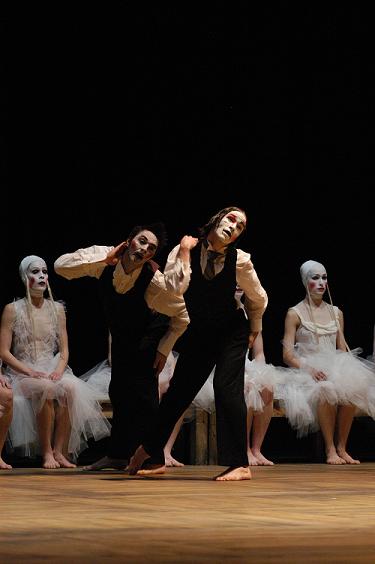
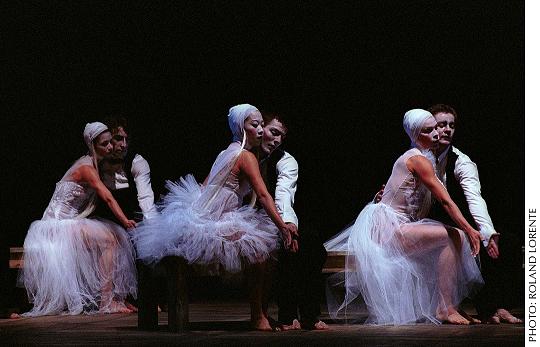
The dance (and the Stravinsky music) depicts a Russian peasant wedding and it’s very Rite of Spring-like — more focused on the sexual rite of passage, the consummation, and the rather forced marriage rituals than love or anything weddings evoke for us today. In the Celis (as well as Rioult) version, there isn’t a single man and woman but a group of men and women undergoing the marriage ceremony. The women here are dressed in sexy white bridesgowns, the skirts short and much of the material see-through mesh. The women have white-powdered, very made-up faces that look almost clownish, as do the men, who are dressed in tuxes. Alyssa thought their make-up looked zombie-like, like they’re walking dead. The movement is very frenetic, with lots of thrashing about, and the group consummation scene would have been comical, as the women bounced around on the men’s laps, if it wasn’t so violent.

I’ll be interested to see what the critics and other viewers say of this –whether it gets dismissed as gaudy “Eurotrash” or whether people take it more seriously as a commentary on ritual (or something else). I do think it worked as an homage to Ballets Russes because from what I know of that legendary company, they seemed to have been very cutting-edge, going far out to push ballet to its extremes, even if it induced a lot of eye rolling.

Big kudos to the dancers though for performing that long, near-continuous frenetic movement.

Photos of Les Grands Ballets Canadiens de Montreal courtesy of City Center.

FILM OF NEW YORK EXPORT OPUS JAZZ COMING TO PBS


Remember the film version of Jerome Robbins’s New York Export: Opus Jazz that NYCBallet dancers Ellen Bar and Sean Suozzi had planned — and begun — to make in 2007? If not, I wrote about it here and here when a completed scene (pictured above) that was filmed in Manhattan’s High Line starring Rachel Rutherford and Craig Hall had been shown at NYCB and the Guggenheim.

Well, as of August 24, 2009, filming has resumed thanks to WNET (New York’s PBS station), who has acquired the film for its excellent Great Performances: Dance in America series.

The team — which consists of Bar, Suozzi, and filmmakers Henry Joost, Jody Lee Lipes, Matt Wolf and Anna Farrell — is currently scouting locations to shoot the remaining four movements of the 28-minute ballet (the film will consist of the ballet, interspersed with documentary coverage and narratives of the dance’s characters and their background stories). Each danced movement is to be filmed in a different part of the city (to capture NY’s different moods) and will be danced by NYCB dancers.

WNET plans on a broadcast sometime in the Spring of 2010. I’m really hoping it shows on other local PBS stations outside of New York as well, please please PBS — so everyone else can see it! This is the first Robbins ballet to be filmed since West Side Story. I will keep you updated on times and stations, and you can check the project’s Website and Facebook page as well.

In the meantime, here’s a trailer:


BERTRAND NORMAND’S "BALLERINA" AT WALTER READE AGAIN


If you’re in New York and you missed it last winter, Bertrand Normand’s 2006 documentary, Ballerina, will show at the Walter Reade again on Monday, August 31 at 1:30 p.m. The doc follows five Kirov ballerinas — Alina Somova, Svetlana Zakharova, Ulyana Lopatkina, Evgenia Obraztsova, and our Diana Vishneva.

If you don’t live in New York (or are one of the lucky who have a job and can’t make the daytime showing), it’s apparently now out on DVD as well (the trailer is here).

Also at the Walter Reade this month, as part of a Natalie Wood retrospective, is Robert Wise and Jerome Robbins’ 1961 film West Side Story. It shows on August 19 at 6:15 p.m., August 21 at 8:50 p.m., and August 23 at 1:00 p.m. Eliot Feld will introduce the August 23rd showing. Go here for more info.

UPDATE: The August 31st screening of Ballerina has been cancelled; the new screening time for that film is Thursday, September 3rd at 9:00 p.m.

SO YOU THINK YOU CAN DANCE SEASON FIVE FINALE

I know this will come as a surprise to everyone (not!), but I really agree with Mary when she commended Evan for having introduced young audiences to a dance style that was in danger of dying: good old fashion Broadway / classic MGM — Fred Astaire, Gene Kelly and all that. To me that has been the highlight of the season. To me, none of the dancers really had the sort of overall star power that Danny Tidwell, for example, had a couple of seasons ago, but Evan shone for what he excelled at. And I really believe audiences went for that — not for his cute face, as Nigel put it, or his good guy-ness, but for the way he brought that classic Broadway / Hollywood style of the ’40s and ’50s charmingly to life with character and intelligence — and with very good technique.

I don’t understand why all the judges kept harping on him. I actually thought he outshone Brandon in the Laurieann Gibson routine (at the beginning, they both jumped and his was sky high, with better lines than Brandon’s). I thought both he and Brandon did well at the more hip hop-y parts, but Evan outshone Brandon with the jumps and turns. But people will probably disagree with me on that…

And I thought he was technically better than Kayla in Tony and Melanie’s Jive. I thought her arms were way too busy. In jive your arms aren’t supposed to be swinging about wildly; your legs and mid-section are supposed to be doing the work. I feel that if you use your arms too much, it’s like your center and legs are weak — it’s like using your arms to haul your body up during sit ups or something. Outwardly you’re doing the movement pattern, but you’re not using the proper muscles. Anyway, I thought his legs were fantastic — those jive kicks had so much strength. And the lifts were spectacular — I love how they slowed them down mid-air to keep in time with the music. They almost looked like they were in slow motion. Difficult! I honestly thought that jive — and Evan’s performance in particular — was one of the best I’ve seen on the show. And how much do I love the audience chanting for him when the judges were being harsh πŸ˜€

I do think overall, though, my favorite dance of the night was Jeanine and Brandon’s Paso Doble. What a triumph for Louis van Amstel — holy cow! Normally I don’t like non-traditional Paso music, but this (from The Matrix) worked well — can you say intense?! Great razor sharp movement for both of them, he had some gorgeous turning jumps, and what a beautiful jete into an assisted slide for her. I totally agree with Adam Shankman’s comment that the reason this worked so well is because they focused on the transitionsΒ  — the movement between the tricks — and not only the flashy things. As my former teacher, Luis, always used to say to me, the actual dancing takes place between the tricks. Nowhere was that better demonstrated than with this Paso. Kudos to everyone involved.

My other favorite moment of the night was Jeanine’s solo — by far the best of the night, I thought. That modern-y tango was so original — part Latin, part American Modern with the staccato, angular movement, the sharp stops, the isolations. And, contrary to Adam, I loved the rose stem held between her teeth. I thought it gave the dance character, and was a bit humorous to boot. And those pirouettes — totally agree with Adam there — WTF! Those were incredible! She began with a group of fouettes to give herself speed, then wound down into a combination of pirouettes that she somehow slowed to a perfect stop at the end, holding her balance after the last one ended, in perfect form. Astonishing — that was like something you’d see from Gillian Murphy and it made me think she’s been holding back all season…

But then … when she danced the Mia Michaels routine side-by-side with Kayla, I thought Kayla outshone her. I thought Kayla had greater height on her kicks and jumps, and overall more precision in her body. I think Kayla has the best modern dance technique of anyone on the show, and it really shows in the way she is able to dance with so much expansiveness, so much breadth, yet still keep such a tight form. In the group routine I found her to be the most expressive, to have the greatest range of movement in her head, neck and torso. And she’s got such stunning leg extensions. That Tyce DiOrio routine she did with Brandon — she really blew me away when she swung her right leg up, held it nearly to her ear, and then he threw her over his head in a split.

I wasn’t as in love with Brandon’s solo this week as I was last (and as the judges were), but I did love how he ended in that sudden straddle split. That is kind of his thing — making these sudden and intense lines. And his solo last week was to die for — so he’s definitely had his moments on the show.

Again, I have no idea who will win tonight. I feel that everyone has something: Kayla’s a great mover, Brandon has strength and intensity and can really blow you away at times, Jeanine excels with original solos and really brought it on this week and did something astounding, and Evan I love for bringing back Gene Kelly. Maybe Evan’s popularity on the show will lead to increased appreciation of Jerome Robbins?… Okay, I can dream πŸ™‚

SO YOU THINK YOU CAN DANCE WEEK FIVE: GO JANETTE!

Fun seeing Pasha and Anya again, huh!

Janette is really becoming my favorite dancer. I love her because I don’t think there’s really anything she can’t do (except maybe a ballet routine on pointe, assuming she’s never had training in that, and I don’t think she has). She doesn’t seem to have any real training — she’s just Cuban, just born with dance in her blood and is working her butt off and excelling at every blasted thing that gets tossed in her way. I always like rooting for the underdog πŸ™‚ And we haven’t had a female ballroom winner on the show yet, right? It’s time, it’s time!

Okay, so I obviously loved both of Janette and Brandon’s routines — that kickass Argentine Tango (were those lightening fast, razor sharp kicks and flicks and hooks and gauchos not to die for? Not to mention her gorgeous lines in all the lifts and poses and just the power and passion of it all); and that killer Wade Robson Jazz dance (I love how both were very loose and rubbery but still had very solid form; it was very Rich Man’s Frug and now I see what we missed last week with Evan and Randi’s performance).

My other favorite couple is Melissa and Ade. That disco! Can Ade move or what?

Continue reading “SO YOU THINK YOU CAN DANCE WEEK FIVE: GO JANETTE!”

ADRIAN DANCHIG-WARING AND REBECCA KROHN MAKE IT HIGH ON NY MAG’S APPROVAL MATRIX


Just skimming this week’s New York Magazine and saw this — look at top right corner! It’s the exact pose from Robbins’ In G Major that I was going on about in my Dancers’ Choice post! I loved that piece and loved Danchig-Waring and Krohn in it. I thought no one else would really like it since it was a bit slower-paced and less flashy than some of the other pieces performed that night, but someone else apparently did!

"BRAVO, MR. B.": DANCERS’ CHOICE PROGRAM, NEW YORK CITY BALLET


I love these Dancers’ Choice programs at NYCBallet! Established to raise money for the Dancers’ Emergency Fund, it’s the one night of the year where the dancers plan everything — the ballets to be performed, which excerpts, and who dances them. One dancer plays artistic director for the night (tonight’s wasΒ  principal ballerina Jenifer Ringer), another designs the program graphic (tonight, Janie Taylor, above), and another choreographs a ballet to be premiered (tonight, Ashley Bouder, with costumes by Janie Taylor) Dancers who are visual artists donate their artwork for a silent auction during intermission. And that’s my one and only complaint with the evening — the intermissions are always too flipping short. There’s no way people have time to browse through the special items for sale and make their purchases in 15 minutes. Why don’t they double or even triple the intermission? People can buy sparkling wine and browse and buy, not to mention people-watch (practically everyone shows up for these things — all the dancers past and present at NYCB and even ABTers from across the plaza). And it wouldn’t be more expensive to do that, right — if you’re selling alcohol and art, what’s the added expense? What do people need to get home for by 10:00 anyway πŸ™‚

Okay, that’s my little rant.

The program was excellent. They chose the best parts of some great ballets, and some ballets I’ve never seen before — and ended up loving — and of course Bouder’s new ballet!

I’m not going to go in order, but just write what comes to mind first, which is the new Bouder,

Continue reading “"BRAVO, MR. B.": DANCERS’ CHOICE PROGRAM, NEW YORK CITY BALLET”

GONZALO GARCIA IS A ROCK STAR AND JANIE TAYLOR A GRACEFUL MURDERER


Those are my friend, Judy’s terms in the title, by the way! Friday night at New York City Ballet was one of the most exciting in recent memory. The dancers were all excellent, the ballets fun, the audience pumped (okay, a little over-pumped in places!) It was just one of those nights to remember. It was an all-Robbins program, consisting of four of his most diverse, but liveliest dances: Glass Pieces, The Cage, Other Dances, and The Concert.

First, of all, Wendy Whelan appears to be out with a minor injury, so it was announced before curtain rose that Janie Taylor would be dancing the lead in The Cage. If anyone heard some psycho girl shout “Yay!!!” — sorry. Didn’t mean for it to echo like that… πŸ™‚

Glass Pieces is always enjoyable with that rhythmic music, especially in the first and last sections with the intense strings and pulsating drums respectively, the dancers in the first walking across stage as “normal people,” every once in a while a “dancer” appearing and turning and /or jumping ‘dancer-like’ across stage — the most visible of whom is Tyler Angle. I can watch this ballet endless times just to see him in that first section. He’s beautiful in that golden unitard, and always breathtaking no matter what he’s doing.


The second, adagio section, was danced by Maria Kowroski and Philip Neal. Maria nailed this section like I’ve never seen anyone do before. Her body is of course so long and thin and she’s got such spidery limbs, she can really make wicked lines. I don’t know what the dance means, but every form she made was so pronounced and so full of intent, she was just mesmerizing.


Then, Janie’s Cage! Sometimes you just know that no matter who’s done the role in the past — Tanaquil Le Clercq — whoever — this is just the best; no one’s ever going to outdo that and no one no how has done better before. That’s how I felt Friday night watching Janie. It’s like this role was made for her, even though literally it wasn’t. It’s like she’s very mindful of how each shape she’s making is going to look from every vantage point in the house. You can tell how much she worked at this and thought about it. Maybe it comes from being a visual artist as well (she’s a cartoonist and a costume designer).

Anyway, The Cage is the heartwarming (not) story of a colony of female ants – or some kind of insect — who, like black widows, kill their male counterparts, after mating. (Where did Robbins get the idea? Ballet’s from 1951. Hmmm.) Janie was absolute wicked splendid perfection; she just looked like a spidery-limbed little arachnid as her tiny waify body descended on poor big muscly Sebastien, digging her tentacles into his sides, slapping and clawing him all about. And the way she’d flick her wrists and make those insect-like shapes with her hands at such speed and with such perfect definition, it looked like she was metamorphosing into some creaturely other right before your eyes. It was really rather terrifying.

At one point — either she’s on top of him or him on her, I think it’s the former since she’s killing him — their bodies each curve out from the other to make this big hollow O shape, and it looks like one of those human limb-eating plants (what’s the name?…) Crazy beautifully creepy! Of course the drama is that Janie’s the “novice” here and she doesn’t want to eat this man because she kind of falls for him, but she has to for group acceptance. The way she shows that, wanting to reject the rites, by caving in from her center, collapsing into herself, then rolling herself into a ball and letting the male bug hold her — is stunning as well.

Teresa Reichlin is the ideal Madame of the colony, or whatever you want to call her. Her long legs just beat the air on those battemants, like she is the queen and you don’t question her. I can’t find many pictures, but here is Wendy Whelan talking about the ballet, with some clips of it.


Then was Other Dances, starring (really, a very apt word) Tiler Peck and Gonzalo Garcia. This is a gorgeous ballet, full of sweetness and romance and virtuosic dancing with high leaps and jumps and spins and all, originally made for Baryshnikov and Natalia Makarova. I can’t imagine this one being done better either. Both dancers have such endearing stage presences. Tiler Peck is really growing on me — her obvious love for the music, her playful phrasing, her sweetness and freshness and innocent charm. She was beautiful on those overhead lifts where she lay on her side, her arm behind her head, looking down at him. And Gonzalo’s in love with his audience, and you can tell. He says in this article that he’s naturally shy, but he’s also a natural performer. As I said on Twitter, at the beginning of his second solo, two girls screamed “I love you!” Very very unusual for NYCB! “What is he, a rock star?” Judy asked me. Apparently. Gonzalo is turning NYCB into ABT πŸ™‚ What is it about these Spanish men?…


Tiler and Gonzalo work very well together. There was some weirdness between him and Ana Sophia Scheller, but these two are a very good partnership. I think they’re friends too — I see them together on the street sometimes. They danced the virtuosic leads in Donizetti Variations two days earlier and were equally stellar. I’m told he had a big fan base in San Francisco, where he came from. Well, he’s won me over. Ariel, who came with me on Donizetti day (and who comes with me to NYCB rather frequently), took one look at the program and said, “Wow, they have Gonzalo dancing a lot these days.” I said, “Yeah, particularly when I happen to have tickets. Funny that.”

And the evening ended with the comical The Concert, which Judy loved, as I knew she would. It’s cute and funny and no one does up the humor like Sterling Hyltin as the sweetly goofy music lover who can’t dance her way out of a paper bag, and Andrew Veyette and Gwyneth Muller as the cutely warring husband and wife. Andrew even took curtain calls with his ‘obnoxious husband’s’ pipe gripped firmly between his teeth.

The other highlight of the week to me was Balanchine’s Stravinsky Violin Concerto, danced spectacularly by Robert Fairchild, who I’m positive I will never ever tire of seeing. He’s got to be one of the hardest working young men in ballet these days and it really shows. He’s becoming a real David Hallberg. His movements are so precise and everything is so well-articulated. He bends from the waist more than anyone else (that I can see) and that gives him so much breadth and expansiveness. And he’s always making some sort of statement, even in abstract ballets, particularly in abstract ballets.

I love this Stravinsky choreography as well. There are so many stand-out moments, you just can’t mention them all. I love the part where the man of the first couple (here, the aforesaid Robert the spectacular) stands over the ballerina and turns her, or rolls her. She bends underneath him so he looks like her shadow. If this is the same ballet, I felt like Robert leaned in closer to her before and held his arms around her waist, held her more closely, and almost put his head on her back, and it looked so romantic, so tender and loving. It just melted me. He didn’t do that either night I saw him dance this this week. He still turned (or rolled her — don’t know what to call it) brilliantly, but I feel like someone told him not to lean in and make it tender like that. But I want him to do that again! Unless it’s another ballet I’m thinking of … is it? Does anyone know what I’m talking about??

I also love the rather acrobatic choreography for the second couple — first night I saw it danced by Maria Kowroski and Sebastien Marcovici, second night by Amar Ramasar and Kaitlyn Gilliland (filling in — and doing very well — for Wendy Whelan and Albert Evans). I love how she does backbends and handstands over and around him and he just looks at her with amazement, and follows.

Finally, I really liked Liebslieder Walzer earlier this week, which I wrote shortly about here. I know some think it’s slow, and it wasn’t very popular when Balanchine first showed it in 1960, but I really prefer the choreography here to that in his more popular Vienna Waltzes, which is mainly straight ballroom. The choreography is more complex here, and revealing of character. One man (the night I saw it, it was Jared Angle –who looked sharper and more gentlemanly than ever to me) circles around his lady and she circles the opposite way on the inside of him. It’s a lovely effect and I think it shows they are going in opposite directions, not meeting mentally. The couple danced by Sebastien and Janie seemed the most romantic, at one point approaching one another while making expansive circles with their arms as they entered into an embrace. I do agree with Sir Alastair, though, that the couples need to work on their differentiation from one another in order to amp up the drama. It’s choreographically beautiful though and I hope they keep doing it in future seasons – -maybe not with the equally slow and somber Les Noces though!

(By the way, that program — Liebeslieder and Noces — program 8 — is showing twice more this week and I found it not really to be a program for newcomers to ballet. I brought my friend, Jonathan (who I haven’t seen since law school, don’t want to say how many years ago now πŸ™‚ ) and if he wasn’t an opera fan who could latch onto the chorals (which feature heavily in both dances on the program), I fear he might have been bored. I think you have to really be into the intricacies of choreography to appreciate it. If you’re new to ballet, or bringing someone new, see Programs 9 and 10 this week — both containing more dramatic, lively dances.)