
NYCB: A DIFFERENT DREAMER, A BRILLIANT HALLELUJAH JUNCTION AND A SWAN LAKE DEBUT


I spent all of Saturday at New York City Ballet, watching both matinee and evening performances like the obsessive I am ๐Ÿ™‚ Highlight of the daytime performance was Jerome Robbins’s 1979 ballet, Opus 19 / The Dreamer in which Robert Fairchild and Janie Taylor made their NYC debuts in the lead roles. This is only my second time seeing this ballet — the first was a season or two ago when the main parts were danced by Gonzalo Garcia and Wendy Whelan. (Robbins created the ballet on Baryshnikov and Patricia McBride). My research has revealed that critics don’t consider this to be a major Robbins ballet; Arlene Croce seems not to have written a word about it. Audiences seem to adore it though, me included.

Funny but the first time I saw it, I thought the main male character was a “dreamer” in the sense of being an idealist. Wendy seemed to represent Gonzalo’s ideal. And there often seems to be a kind of charmingly airy, carefree, “head in the clouds” quality to Gonzalo’s dance persona.

Robert was more solid and sharp and weighty than Gonzalo. In his beginning solo, he’d slice through the air with his arms and legs, stretch an arm out, hand bent up, as if to be pushing out against something, or stopping something from getting too close to him. What that something is isn’t entirely clear. It seemed more like he was a literal dreamer, someone lost in a dream that was neither entirely pleasant nor unpleasant, something he kind of wanted to escape from but was drawn to as well. And Janie — I love her! — was all tantalizing, bewitching, taunting little mischief-maker haunting his subconscious, not leaving his psyche a moment’s peace. Whenever she was onstage, she completely captivated — both him and us. Even when she’d collapse in his arms, he’d struggle to straighten her up again. He’d lovingly wrap his arms around her; she’d be out of them in a split second. It was very different from the way Wendy danced, if I remember correctly. I wonder how Patricia McBride did it.

I read a review of a dancer who performed the male lead in the 80s. The writer — Jack Anderson — said the dancer — Jeffrey Edwards — looked like a thinker, very introspective. I always love watching Robert — I think he is one of the most fascinating movers around. I’m not sure if what I saw here was introspection or more like inner turmoil. He was definitely lost in himself — he doesn’t even seem to notice all the lavender-clothed dancers flitting about him, didn’t seem to notice anyone until Janie came darting by and commanded his attention. I guess it seemed more like he was lost in his own angst, haunted by his dreams, than lost in his thoughts or his art. But it would be hard, I’d think, to embody introspection.

They don’t seem to be performing this ballet a lot, but I’d love to see Tyler Angle dance the part as well.

Also during the day was Chaconne, which I’m growing to love more and more — particularly the first pas de deux where the man lifts the ballerina and she has her arms out to the sides and does these large, sweeping steps forward, every few beats lightly tickling the floor with one toe shoe, and it looks like she is flying — and Vienna Waltzes, which, probably ridiculously for me since I’m a ballroom dancer, honestly just kind of bores me. The choreography’s not very intricate or compelling (odd for Balanchine) — it’s mostly straight-forward waltzing, which I can only watch for so long. There’s a middle section composed of high-energy allegro ballet which was danced very theatrically by Yvonne Borree and Benjamin Millepied. That section seriously kept me from falling asleep.

Highlights from the evening program were Peter Martins’s Hallelujah Junction, Joaquin De Luz in Donizetti Variations, and Sebastien Marcovici’s debut as Prince Siegfried in Balanchine’s Swan Lake. I hadn’t seen this cast of Hallelujah before — it was Sterling Hyltin, Gonzalo Garcia, and Daniel Ulbricht. This cast wasn’t so dramatic, so romantic, so intent on telling a little story, as other I saw (Marcovici, Taylor, Veyette), but seemed more focused on simply making the music visual — and they did so to fascinating effect. I greatly enjoyed just sitting back and watching all that brilliantly fast-paced, razor-sharp movement — Gonzalo with his sexy impish bouyancy (he’s not really a small man but somehow he seems like he’s always airborne; I think he’d make a great Sleeping Beauty Bluebird), Sterling with her Russian ballerina-high extensions that she does with incredible speed, and Daniel for his intense precision. This is the best I think I’ve ever liked Daniel Ulbrich before. He didn’t just jump inhumanly high; he really nailed very difficult-looking, intricate footwork and he did so with such sharpness and tautness. If he’d only be given more than just jumping guys parts, he can show that he can actually dance extremely well.

Sebastien danced Siegfried with great passion, expectedly. Balanchine really eviscerated the man’s part in his version of the ballet but Sebastien went as far as he possibly could with it. At one point, one of the corps swans in the back row fell and of course the audience had to go “ooooooohhhhhhh,” but he didn’t let it faze him as his Siegfried searched desperately among the swans for his beloved Odette. He had a minor flub on one of the many traveling turn jump thingys but no big deal. It was heartbreaking when Wendy bourreed back away from him and he reached out to her like she was taking his life with him as she went. Also, I love the black and white plastic swans swimming in the little stream at the beginning and end, but the people working them should just make sure the white swan appears at the right time! One time Wendy wasn’t fully into the wings yet when her swan form began sailing across the stage and Charles Askegard’s Prince Sig didn’t know where to run — the swan or Wendy. This time it was a little late and Sebastien kind of had to go searching upstream for her ๐Ÿ™‚

Balanchine’s Donizetti Variations was danced brilliantly by Joaquin De Luz and Megan Fairchild. But what I really love about Joaquin isn’t his bravura dancing but his dramatic abilities — how he interacts with the other dancers. Even when dancing a storyless ballet, he’ll look at the others as they do their thing, shoot them a cocky grin — or a genuine smile — and do his thing, his steps a clever or comical response to theirs.

Also on this program was the newish ballet by Melissa Barak, A Simple Symphony – -my second viewing of that. She does borrow from Balanchine, but her choreography also has its own wit, which you notice on multiple viewings. Like Balanchine, the drama is in the actual choreography — every little flex or softening of the wrist meaning something. At one point, the ensemble of ballerinas all turn their hands and flex their wrists, and it looks like they’re cutely shrugging their shoulders. It’s such a pretty ballet with such mellifluous music though, sometimes you don’t want to focus on the choreography; you just want to sit back and enjoy the loveliness of it all.
NEW YORK CITY BALLET: JANIE’S DSCH, KATHRYN’S SCOTCH AND MORE VIEWINGS OF PREMIERES


I can see how ballet is so addictive, especially to those with dance training who’ve either danced the roles they see onstage or pick up choreography on sight. It’s so interesting to see different dancers perform the same roles, to see what they can each do with something, where they can take it. A ballet can look completely different depending on cast.

Janie Taylor recently debuted as the female lead in Ratmansky’s Concerto DSCH and I absolutely loved her. I thought she brought a certain vulnerability, delicateness, and romantic touch (both big and small “r”)to the role and as such created a poignant centerpiece to this ballet that is mainly full of fast, frolicking fun. She was perfect partnered with Tyler Angle, who gives everything an emotional, Romantic quality. There’s one point where the girl bourrees (tip toes) backward from the guy and he steps toward her in a series of lunges, arms outstretched. It was rather heart-grabbing when Janie and Tyler did that. It was like Tyler was reaching for her with all his might, but she just kept falling away from him, telling him no, it couldn’t be.

The original cast for the romantic couple was Wendy Whelan and Benjamin Millepied, and when I saw them perform it again a few days ago, I looked for that part. I almost didn’t see it until Wendy had bourreed practically into the wings. Benjamin, instead of reaching toward her with all his power, bent his knees and performed those walking lunges close to the ground, kind of bouncing up with every step forward. His arms were still outreached but the deep kneed, close to the ground walks gave it overall a more playful feel, or perhaps like he was looking up to Wendy, his supreme ballerina. Wendy’s of course such an icon in the ballet world and she’s stronger and less vulnerable and delicate than Janie and so it just had a kind of man worshiping woman instead of a boy trying desperately to hang on to his love feel.

Ashley Bouder has been out with an injury so Ana Sophia Scheller is filling in for her in the main allegro ballerina part, still dancing alongside Joaquin de Luz and Gonzalo Garcia.


There seemed to be a slight bit of drama going on between Scheller and Garcia at first — I don’t know what it was — he was his usual sexily mischievous, charismatic self and she seemed nervous and holding back a bit (albeit not with Joaquin), but hey, drama is always fun ๐Ÿ™‚ I think that has been all worked out though. The last time I saw them dance this together they were right on. She appears to be a lovely dancer and I’d like to see more of her.

I’ve also seen two very different casts in Scotch Symphony: the first Benjamin with Jenifer Ringer, the second Robert Fairchild and Kathryn Morgan. This is a sweet Balanchine ballet, telling the story of a young kilt-clad Scotsman lost in the Highlands who becomes completely smitten with an ethereal goddess dressed in Romantic tutu. He keeps trying to reach her but is thwarted right and left by a group of Scottish guards. Finally, they meet and dance a lovely pas de deux.

My friend, Alyssa, now has a huge crush on Benjamin. I don’t know how it happened; we were standing in line at the box office to pick up tickets one night and he was talking on the overhead screen, likely about his new ballet (I’m not sure because the sound was off) and Alyssa became mesmerized by his face. “That’s the guy who recently premiered a new ballet,” I said. “Oh, he’s a choreographer? He’s cute!!” Then when we got inside and were looking at the Playbills she screamed, “look, the cute guy is dancing!”


Afterward at dinner all she could talk about was how other dancers (like Daniel Ulbricht, who we saw in Tarantella that evening) were great jumpers and technically perfect and all, but Benjamin just brought so much more to the dance. “He was just so … so… he was perfect in everything he did, but he wasn’t just perfect, he was… ” she waxed unable to come up with the right word. It was Ethan all over again (whom she fell for after seeing at Martha’s Vineyard merely introducing his Stiefel and Stars and saying he was unable to dance because of the knee operations).

I nodded. He does have a certain beneath-the-surface charm (Benjamin that is), and he is a very good dancer, always coming through with those ever so challenging fast-paced Balanchine roles.

But of course I was dying to see Robert Fairchild in the same role, with Kathryn Morgan as his ethereal love object. They were so beautiful together. She’s just so angelic, and he always dances with such passion and boundless amounts of energy, and of course he’s always got that boyish charm that he’s had since debuting in Romeo two years ago at age 19 but that I don’t think is every going to go away. He’s such a hard-working young guy, you can tell — he puts everything he has into his dancing. He had a tiny fumble coming out of a jump and had to check himself with a couple extra steps to secure his footing (but he didn’t fall), and at one point he was a bit too far from Kathryn during a supported arabesque penchee and she couldn’t get her leg all the way up in the air. But, to me, honestly, when a dancer makes a blunder it only makes him or her all the more endearing, more human.


(Robert Fairchild, Kathryn Morgan)

I loved Tiler Peck in Tarantella — another role that usually belongs to Ashley Bouder, but Tiler brought a certain freshness and wit to this cutesy extreme high-speed dance. Ashley usually brings a sexy, flirtiness to it; Tiler was more sweet and smart. I like both, and, again, it shows dancers often make the dance.


Daniel Ulbricht (photo above by Paul Kolnik), as always, delivered on the technical and difficult athletic aspects of the dance — the high jumps the turns and all. Audiences always go absolutely wild over him. I personally like Joaquin de Luz a bit better (in this and the other roles he dances — he and Daniel usually alternate) because he delivers on the virtuosity as well but he makes it more about the character. At the end, the boy here steals a kiss from the girl. With Daniel, the high jumps and theatrics are the dance, the kiss is just a little reward at the end; with Joaquin the whole thing is about that kiss, the mad leaps and spins and turns with the tamborine are simply leading up to it. But audience do go completely wild over Daniel.


(Tiler Peck)

I saw the new ballets once again — Benjamin Millepied’s Quasi Una Fantasia and Jiri Bubenicek’s Toccata, and both grew on me. Funny, but I sat in orchestra this time for both — first time I was looking down from the first ring side, and it’s really interesting how different the ballets look from different vantage points — especially the Millepied. Looking down from above, this ballet really seemed to evoke a flock of birds, at times sinister and foreboding. Looking at it straight on, it was still unsettling — with that haunting Gorecki score — but at times the dancers resembled insects reminiscent of Robbins’s The Cage, and later, just figures — one weak and somewhat broken, the other strong — moving in various groupings. My friend Michael and I both noticed how he’d make various groupings or formations with the dancers — phalanxes, Michael called them. Sir Alastair had noted the same, saying he likely got the ability to work a large ensemble like that from Balanchine. I don’t always notice such things until someone points it out — I’m usually more focused on the theme, what the choreographer is trying to evoke, or make me think and feel.

I wish I had a picture of what the dance looked like from above. Overall, I think I still see Hitchkockian birds ๐Ÿ™‚

I still don’t know exactly what Toccata is about but I love how there is a great deal of really intense partnering, sometimes several duets happening at once, the dancers by turns pushing and pulling, sliding, strugging with and embracing each other, and I love how at points the bodies just kind of mesh into one another, just melt into each other. It’s really kind of sexy in its own way. I love Robert Fairchild in these kinds of abstract roles. As I think I’ve said before, he always makes a little character out of a role no matter how abstract, and he dances with such expansiveness. With that and his immense charisma he devours the whole stage.


(Robert Fairchild and Georgina Pazcoguin in Toccata, by Paul Kolnik, from Oberon’s Grove)

I’m also liking Maria Kowroski much better. I heard she is taking acting lessons and it shows. Every little step is meaning something, saying something, a little quip perhaps, a little retort, to her partner (who has often been Sebastian Marcovici these days) and to the audience. I particularly liked her in Balanchine’s modernist Movements for Piano and Orchestra and his sweet, more classical Chaconne. Huge kudos to Sebastien in the latter for doing some really intensely fast footwork and really nailing it all. He is a large guy and that’s not easy. A friend told me afterward he thought Sebastien looked a bit “heavy” in the role, and I can definitely see that — a smaller dancer would have looked much lighter and more frolicking and playful — where Sebastien brings more virility and power and intensity — but, again, what makes ballet so addictive is the different bodies, different strengths, different personalities, different interpretations.

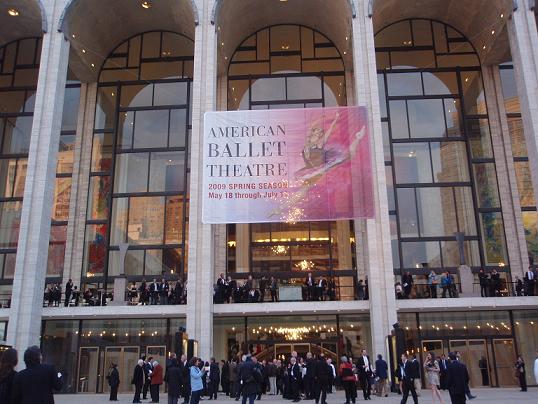
AMERICAN BALLET THEATER OPENING NIGHT!

p5182145

Yay, the season has offically begun! This picture was taken during intermission; that’s why it doesn’t look that crowded. I was sprinting in, nearly late, as usual, so didn’t have time to snap some pics before the performance but fortunately it was still light outside during intermission.

Anyway, Michelle Obama (who served as one of the gala’s honorary chairs) looked smashing in a sleek dark grey sleeveless, knee-length dress with tiny black ruffles lining the bottom. I’m sure there will be beaucoup des pictures seeing as how many blasted camera people there were; I’ll be sure to steal some when they’re posted on all the society websites ๐Ÿ™‚ (Oh, look, here it is in the NYTimes already)


It was just about the craziest thing I’ve seen on the Met Opera stage: after Veronika Part’s mouthwatering Mozartiana opened the show, artistic director Kevin McKenzie came out and thanked everyone who needed thanked — all the donors, designer Caroline Herrera who funds the gala, etc., and Senator Chuck Schumer came out and gave a little talk about the importance of funding for the arts, etc. Then, Schumer disappeared behind the curtain and moments went by. Everyone kind of looked around at each other like “what’s going to happen next?!”

Soon, the curtain was pulled back to allow some people to carry out a podium with a banner “American Ballet Theater” draped over its front. The doors to the lobby opened and a flock of people bearing weapon-sized cameras blasted in. Several men dressed in black promptly rose from their aisle seats and followed the flock of weapon-camera-bearers to the front of the aisle, near the stage. Caroline Kennedy was announced. She came out, everyone applauded, and she mentioned that the school of ballet associated with ABT, the Jacqueline Kennedy Onassis School, would be performing on the Met Opera stage for the first time ever tonight. Everyone ooohed and aaahed. Then, she announced First Lady Michelle Obama.

The curtain pulled back again and out she came. Of course everyone gave a standing ovation. She smiled radiantly, then, after a moment, directed us to be seated. Then she gave a short speech. It was a little hard to focus on what she was saying with everyone — both professional photographers and audience members with cell phone and digital cameras alike — flashing away as they were, but she talked about the necessity of the Arts for a culture to flourish, the importance of arts education, etc. Then she introduced the Jacqueline Kennedy Onassis School students.

As soon as she disappeared behind the curtain, the auditorium remained still pending the exit of the flock of pro camera wielders. It’s funny because there were all these non-dance writers in the press section. You could hear the sighs of relief, the sinking down into the chairs, and the putting away of pens and paper — and cell phones, which they’d used to light their writing paper during Mrs. Obama’s speech, which would have been extremely annoying had it not been for all the flashing bulbs anyway. But it made me wonder how they’d ever survive as performing arts critics! I mean, who needs light to see to write!

Anyway, the students were excellent. They performed Le Defile (The Procession) by Raymond Lukens. There were three large groups of them, in three levels — the very little ones, a medium-age / level group, and the older, very advanced ones. The choreography was basically a showcase of classical ballet steps, much like a very advanced ballet class — jumps, jumps with changing feet, jumps with changing feet that went on forever performed by a set of advanced boys (which drove the audience to wild applause), jetes, chaine turns, multiple pirouettes, fouttes, etc., and then a bit of partnering. It gave the students a chance to show what they could do — and the advanced ones could do a great deal! Extremely impressive, and great fun.

Then on were Xiomara Reyes and Herman Cornejo doing an excerpt from August Bournonville’s La Sylphide. This was the most dramatic I think I’ve ever seen Xiomara. I was sitting in the back of the orchestra and she really projected. She was really sweet. And Herman as always amazed with his virtuosity, his jumps, his razer-sharp precision, his astounding clarity of line.

The corps in both this, La Sylphide, and Swan Lake, later in the evening, were absolutely amazing, by the way. Not a head arched back more than the others, not a leg raised higher. They were all so on. When they work together like that, in perfect unity; it’s really visually breathtaking.

Then was Balanchine’s Tchaikovsky Pas de Deux danced by Ethan Stiefel and Gillian Murphy. Ethan and his strutting around stage, taking his own good time after their duet and before beginning his solo, making the conductor wait for him! And his high jumps with all miraculously many beats of the feet. I wished my friend Alyssa could have come so she could see he’s not just Mr. Sexy; he’s a superb dancer. And Gillian was radiant, and a perfect foil with her speed-of-light chaine turns. They enjoyed a long, slow kiss during the curtain call. The audience went mad!

Then was the hunt scene from Sylvia danced by Michele Wiles followed by a piece d’occasion (the first of two of the night), by Alexei Ratmansky, for Nina Ananiashvili, called Waltz Masquerade. It was set to the Waltz from Aram Khachaturian’s Masquerade Suite and it was cute and comical. She was dressed in this long, red dramatic, Carmen-like dress with a sexy black lace overlay on the top. There were four tuxedoed men, each bearing a gold candlelabra, one at each corner of the stage. These men turned out to be: Jose Carreno at the front left corner; Marcelo Gomes, at back left; Angel Corella back right; and a blonde on the front right who I initially thought was David Hallberg (I was sitting FAR back from the stage!) until the fun began and he shook his head about like a sassy mop and I realized DH just does not have enough goofball in him to do such a thing, even if he tried. So, I decided it was either Ethan or Maxim Beloserkovky. Anyway, Nina’s character was supposed to be dancing about the stage in a melodramatic solo — but it was purposefully melodramatic, and so comical. Like a silly, cartoon version of an upcoming swan song, really, which, is of course, what’s coming up for her later in the season (and will be much more sobering when it does). At one point, she just passionately crashes to the ground and remains there, in a heap. Nothing happens. The men, obviously her servants, start looking at each other like, what now? They shrug, slowly walk over to her. Then, Marcelo starts imitating her melodramatic dance, but far more cartoonishly, and of course it’s hilarious. The others join in. Max (I think it was Max, not Ethan) does his thrashing hair thing. I couldn’t see facial expressions but I assume they were making fun of their master. Then she wakes up, catches them, and they’re sent back to their posts.

After intermission was the balcony pas de deux from MacMillan’s Romeo and Juliet, danced by Marcelo and Diana Vishneva. At first, Diana approaches her balcony with all the drama of a ballerina playing Juliet, rather than Juliet herself. I rolled my eyes. This is what I don’t like about her. She’s an excellent dancer but she’s all about the pomp and circumstance and not about the character. Maybe it’s a Russian thing, but I don’t see that in Veronika Part or Irina Dvorovenko. Anyway, she eventually lightened up, thankfully, and I felt like I was watching not a prima ballerina being a prima ballerina but Juliet herself, falling hopelessly in love. When she runs around him one foot solid on the ground, the other on pointe, it’s so girlish, so real yet so poetic. Those are the best — I don’t know what to call them — runs around kneeling Romeo — that I’ve ever seen — not even Alessandra Ferri’s were that sweet. Still, I felt some of the lifts lacked the beauty and magic ofย  those Marcelo and Julie Kent do together when they dance this scene. I don’t feel she dances that well with a partner; she’s more into herself. Marcelo’s leaps around the stage and big high passionate jumps were thrilling. He got some good bravos for those.

Then were Paloma Herrera and Max Beloserkovsky in the Act II pas de deux from Swan Lake. I was hoping it’d be the Black Swan pdd, but no. I guess the program was pretty bravura-heavy already. I don’t see him dance much, but Max is really quite good. He’s really a character and he’s the perfect Prince Siegfried, regal yet vulnerable and tragically in love. And he’s a good partner.

Then was the mad fun of Le Corsaire, with Irina Dvorovenko, David Hallberg as Conrad, and Angel Corella as Ali. Except something happened at the beginning and I hope David’s okay. The tallest guy in the entire opera house had to sit in front of me and I was trying to navigate my way around his enormous head just as a bunch of people up front went “Oooooooh!” When I was finally able to see the stage, Irina was standing in front of David, face toward the audience. She didn’t seem to have any particular expression on her face, but, then, I was light years away from her. Then David did an assisted pirouette with her and everyone applauded, so it must have been a lift that didn’t quite happen or something. Anyway, I hope he’s okay; I know his shoulder sometimes comes out of socket. Anyway, all seemed to be fine after that: all three were brilliant. Of course. Angel astounded, as always, and I started giggling during his first solo and couldn’t stop all the way through the second. I love Irina. She was radiant. She did those continuous turning kicks on pointe like they were nothing. She has the drama and the virtuosity when needed and the always beautiful, graceful lines. And David’s leaps all over the stage were magnificent. I could see this goofy ballet over and over and over again, as long as no one gets hurt ๐Ÿ™‚ Angel did not leap out from behind the curtain during curtain call, sadly.

Then there was another piece d’occasion. Herbie Hancock played piano, onstage, while first Jose Carreno, then Stella Abrera, danced to his music. This was cute and comical as well, and kind of reminiscent of Jerome Robbins’s Other Dances or Suite of Dances, where the dancer(s) connect mainly with the musician. At one point, Hancock went nuts with the keys, obviously way too fast to be danceable, and Jose stopped in his tracks, looked over at him, and lifted his hands, like what gives, dude? He sat down near the base of the piano and just rested. The same happened with Stella. She danced, then stopped and gave Hancock a look when he began another little virtuoso section. She finally sat down beside him on the piano bench, and eventually, he ended on a romantic note, she snuggling next to him softly, sweetly.

The evening ended with the finale of Balanchine’s Theme and Variations. The leads were danced by Sarah Lane and Daniil Simkin. It was a nice way to end the program, but with the likes of Simkin, I wondered why they only did that group finale, where he and Sarah are basically leading a processional, instead of some of the earlier bravura parts with all the corkscrew turns for the man. An opening night gala performance is meant at least in part to showcase the dancers doing what they do best, and he is best at the bravura stuff, not leading processionals.

Anyway, the whole night, as usual, was magic. Saw Sigourney Weaver and Kelly Ripa in the audience.

Oh, for my Dancing With the Stars readers, I taped the show, but for lord knows what reason it was somehow muted. I have no idea how on earth I managed to do such a thing, but it was pretty amusing watching the show in pure silence — no words, no music. Needless to say, I’ll have to watch online tomorrow.

But now, dead tired, must sleep. Goodnight.

ALVIN AILEY II: THE EXTERNAL KNOT


I don’t have much time to write– this week is beyond crazy, but last week I went back for more Alvin Ailey II (Ailey’s studio company) to see their program of repertory favorites, my favorite of which was Troy Powell’s The External Knot. See a video of excerpts from that here.

What I found intriguing about this piece was Mr. Powell’s use of music. He set the dance mainly to Philip Glass (with some Robert Schumann thrown in), to sections of In the Upper Room and Glass Pieces (the section from the latter was from Akhnaten, that fun, bouncy, drum-laden section). I’d only ever seen set to that music Twyla Tharp’s In the Upper Room and Jerome Robbins’ Glass Pieces, and I’d only ever seen Balanchine ballets to Schumann, so it was interesting to me to see how another choreographer visualized the music.

The External Knot is the story of this young man who seeks individuality, to set himself apart from the crowd and go off on his own. But there is a certain loneliness in doing that. But then, being a conformist is not very challenging and there ends up being a certain loneliness in being part of a group as well. The movement, along with the Upper Room and Schumann music conveyed that well. Upper Room is one of my favorite pieces — both the dance and the music alone — particularly that middle section where the piano keys sound like raindrops — it’s somehow simultaneously peaceful yet sad. I always envision this solitary person stuck in a cell — either a prison or a mental institution. Then, towards the end, the orchestral music swells and there’s a choral part indicating there’s a light at the end of the tunnel and I then think of the confined person as on a journey toward that light. I’ve often wondered when listening to the music where in the world Tharp got her ideas for the dance, because I don’t see any of that unsettling isolation and confinement in her ballet. But then, that is part of the fun of Tharp — you can often get the unexpected. And then Balanchine has used Schumann to convey madness. But here, that music perfectly suited the theme as the young man dances on his own, kicking up and out, jumping, lunging, reaching, doing a lengthy painful-looking shoulder stand, his legs bent awkwardly in the air, his legs slowly spreading into an arc, then a full split, his body finally rolling over onto to the ground, while the group dances on in the background — either moving in sync as an ensemble, or fragmenting into duos or trios, all movement seeming to express a longing for something.

At one point, the man is very indecisive: he can’t figure out whether to lead, follow, or leave the group. The group follows him, he looks over his shoulder as if to ensure they’re there, then they turn and leave him behind. He seems upset, he follows them, as if to harken them back. When they turn again and come at him, he turns back around, goes on hurredly forward whether they’re behind him or not.

And then in the last section, instead of using the choral music from Upper Room, Powell switches to the exciting,ย  rhythmic Akhnaten, where the dancers perform expansive movements in the background — large bends forward from the waist, big, far-reaching port de bras, while the man jumps, twists and turns up front, seemingly more upbeat, at peace with himself whether he is one with the group or not.

GO SEE RIOULT!


Over the past week, Rioult (formerly called Pascal Rioult Dance Theater) has become one of my favorite modern dance companies. Artistic director and choreographer Pascal Rioult’s work is like a visual opera, or an opera told all in dance (since opera is already visual). It’s so breathtaking. And his movement style is like a combination of Balanchine and Martha Graham (he danced with Martha Graham’s company). His dances are very expressionistic and full of drama and intensity and his dancers, most of whom are excellent movers, know how to convey that drama by dancing with a real sense of urgency and specificity of purpose. Every movement they make, there seems to be a specific thought behind it. If only all dancers would dance like this…

I saw four pieces over the past week at the Joyce (Chelsea): the world premiere of The Great Mass, set to Mozart’s Great Mass in C Minor; and three of Rioult’s classics: Views of the Fleeting World, Les Noces, and Wien. I loved all of them.

The Great Mass, Rioult’s only full-length evening work, is dedicated to Marguerite Rioult, Rioult’s mother, who passed away this year. She was a musician — a piano teacher and choir director, and a lover of Mozart. It’s so much harder to describe works that you really like than works that you don’t, particularly when they’re abstract, but suffice it to say this was really beautiful, and, again, very operatic. I don’t know much about Mozart unfortunately, but the music is choral, and known as his greatest Mass (go here to listen to the “Kyrie” section), and the dance included all sections of the music: Kyrie, Gloria, Credo, Sanctus, Benedictus, and Hosanna. Through much of it dancers wore richly embroidered white bodices with white tulle skirts and danced as if taken by the spirit, in passionate praise and glory.

But my favorite part was the darkest, a middle section from Gloria in which the dancers wore skin-toned leotards and appeared to be either spirits in hell reaching desperately upward toward a light shining brightly from above, or else humans still on earth praying desperately for salvation. They looked almost animalistic, serpentine, as they writhed around on the ground, then crawled about each other, trying to lift themselves upward toward the light. In the following section, three of my favorite dancers in the troupe — Robert Robinson (who looks like a smaller version of Clifton Brown), Jane Sato and Marianna Tsartolia — danced a pas de trois, each woman wrapping her arms and legs snake-like around Robinson, as if they were by turns trying to tempt him and hold onto him for dear life, as if he’d lead the way to salvation. Tsartolia had a more tormented look on her face, and seemed more desperate, while Sato gave her movement a more tempting and seductive feel. Robinson looked like he was trying to retain inner strength. That’s what I loved about these dancers — everyone was so specific in their movement and intent, like they were always playing character.

The second program began with Views of the Fleeting World (pictured above), a long piece set to Bach’s The Art of Fugue, that consisted of many different sections: Orchard (shown above, with the dancers in the gorgeous red skirts), Gathering Storm, Wild Horses, Dusk, Sudden Rain, Night Ride, Summer Wind, Moonlight, and Flowing River. Each section had a different theme and mood and each was accompanied by a different background impressionistic painting. My favorite section was Moonlight, when the magnificient Penelope Gonzalez danced a very sexy, almost entirely floor-bound duet with Brian Flynn. When I was reading up on the company, I read a lot about Gonzalez, and I see why so many critics love her. She is a tiny powerhouse, one of the most remarkable movers I’ve ever seen.


My friend Mika and I were mesmerized by the way they snaked their limbs in, out, over and around each other’s bodies, sometimes a flexed foot, sometimes a pointed toe, how they lifted themselves up from the ground, upper body, then lower body, touching the floor at times only with one small part of their back (talk about a work-out!), how they’d dramatically arch their backs, how she’d slowly climb onto him, he’d lift her with his arms, on his back (that’s hard work too). I was so blown away; this is one of the most brilliantly choreographed, mesmerizingly, tantalizing, beautiful “sex scenes” I’ve ever seen in dance.

Then was Les Noces, Mika’s favorite of the night. It’s set, just like Jerome Robbins’ ballet of the same name, to Stravinsky’s Les Noces, and, like Robbins’, depicts the marriage rite of passage. Whereas Robbins’ (which I wrote about here, near the end) depicted a Russian peasant wedding set about a century ago, Rioult’s is contemporary, and the curtain opens on four women dressed in bras and underwear dancing intensely atop a set of four chairs, kind of Mein Herr-like, the emotion they convey by turns fearful and seductive. After they dance, they help each other into a pair of bloomers and a corset-like waistband. The lights then dim on them and turn to a set of four men, dressed only in underwear, who dance atop four chairs of their own, the emotion similar but more masculine, more angry (perhaps some don’t want to get married, feel like they’re being pressured) At the end of their dance, then don black, tuxedo-like pants. The two groups then turn chairs toward each other, break into four separate male / female pairs, and each pair really goes at each other, an intense battle of the sexes. The consummation scene begins, as in Robbins’, fraught with fear and trepidation and is rather horrifying, but eventually softens and grows sensual. The couples have overcome the storm.

And the evening ended with Wien (Vienna), set to Maurice Ravel’s La Valse (which was originally titled Wien), which has become one of my favorite pieces of music, the same that Balanchine used for his La Valse (which I wrote about here). Rioult’s version carries the same dark themes as Balanchine’s — beauty turned bad, encroaching tragedy, social refinement embodied in the Viennese Waltz disintegrating in the face of human violence and destruction. But here, a small group of several huddle around each other, walking to the waltz in small steps, one right after the other, almost mechanically, or Charlie Chaplin-like. There is something inhuman and distorted about their movement, their need to huddle in a group, and follow the others. As the music swells, they move faster, but they’re moving so quickly, and in circles, thatย  they can’t retain their balance. One in the group will try to reach up to the sky, only to go crashing to the floor. The others, far from helping the fallen one up, simply walk over him or her, making an effort not to trip, but to keep their steps — it’s like they’re in a militaristic march and they can’t step out of line. At points they waltz with each other — men with women, women with women and men with men — but it’s a very grotesque kind of waltzing. The women often look like rag dolls, dead; the men viciously throw them about. The movement is very different from Balanchine’s, but the piece has that same intensely haunting, world-gone-mad quality.

I strongly recommend this company! They’re at the Joyce through the 19th. Go here for info and to see an excerpt from Views of the Fleeting World.

New York City Ballet Season Finale and Wrap Up With Response to Sir A


So, Sunday marked the end of New Yorkย  City Ballet’s winter season. I was honestly in a blue funk all day yesterday, which shows, I guess, that I am really beginning to love this company since I’ve normally only gotten so sad over ABT and Alvin Ailey.

Sunday was a one-day only program, the All-American Season Finale, which included Robbins’s Glass Pieces, Martins’s Hallelujah Junction, and Balanchine’s Tarantella and Stars and Stripes. Tarantella (this is the only time it showed this season) is always fun, with its cute Neapolitan peasant boy-tries-to-get-girl caricatures, lightening-charged footwork, and series of bravura solos for both man and woman, all performed with a tambourine. I was completely out of breath after watching Joaquin de Luz fly across the stage and ultimately steal a kiss from Megan Fairchild. Joaquin is not just a dancing virtuoso but a dramatist as well and his characters are always these virile, sexed-up, but charming, innocuous men. I really love him.

Glass Pieces and Hallelujah Junction also really grew on me. I don’t know if it was Maria Kowroski or what, but theย  slower, more adagio section of Glass Pieces was very compelling this time, and it really spiced up the last man-centric, drum-beating, section as well. At first I wasn’t a huge fan of Maria Kowroski, but either she has improved or she has really grown on me. I always thought she had an excellent dancer body, but now she is using it in a much more expressive way, really to say something. The only thing I’m not in love with choreography-wise in Glass Pieces is in the last section, how the men come jogging out, hands powerfully punching the air, doing their ‘man things’ to the booming drums, and then the women daintily slink in to the sound of the flutes. Corny.

I was able to watch more than just the mesmerizing lighting in Hallelujah Junction this time. I love the movement theme –toward the beginning — of the landing a jump or phrase on releve and then swiftly lowering the ankle to the floor. On Andrew Veyette it looked kind of teasing but in a sinister way, like the slicing of a knife. There is something very sinister in general about Andrew Veyette, very virile in a threatening way, which makes him perfect for the devious man dressed in black here.

And I love how Sebastien Marcovici, the man in white, kind of Janie Taylor’s saviour, would powerfully jete across stage after him, threatening him, banishing him. Sebastien and Janie are such the romantic couple, in part because they work so well together and in part because of their respective sizes. Someone very knowledgeable in the dance world told me they thought he’d been working out a lot, trying to build muscle. I do think he seems to have become more muscular lately, especially his legs. Building muscle often decreases the muscle’s flexibility and he doesn’t seem to make a perfect split on a jete like some of the others, but I still think it’s so romantic that he’s so much larger than little Janie; he can just sweep her off the floor and scoop her up into his arms — aw ๐Ÿ™‚

The program notes state that Stars and Stripes, the somewhat cheesily patriotic but excellently danced Balanchine ballet, was shown at presidential tributes, like that of Kennedy and Johnson, and at Nelson Rockefeller’s NY gubernatorial inauguration. It’s so weird to me to think of that, though I could see it performed back then. But now? At President Obama’s inauguration? It just doesn’t seem like it would fit. It would seem kind of anachronistic, sadly…

Anyway, the talk of the ballet world lately has been Sir Alastair’s New York Times season wrap-up.

Taylor Gordon, my friend and fellow blogger / dance writer, says, “whether you agree with him or not, it boggles me that one person has the power to say these things in basically the one print medium dance criticism has left. Ouch.”

Macaulay basically takes the women of NYCB to task, saying none of them really command authority like true ballerinas,

Continue reading “New York City Ballet Season Finale and Wrap Up With Response to Sir A”

DAVIDSBUNDLERTANZE!


Say that five times in a row ๐Ÿ™‚ (

Last Wednesday, my friend Judy and I went to NYCB for their Founding Choreographers II program, which included two by Balanchine — Ballo della Regina, and Robert Schumann’s Davidsbundlertanze (it’ll be a miracle if I don’t misspell it at some point), and Jerome Robbins’s Glass Pieces.

My favorite was the middle one (whose name translates to “Dances of the League of David” — Schumann’s imaginary society of artists organized to combat Philistinism), and it’s becoming one of my favorites of Balanchine’s in general, though many people can’t stand it and think it moves way too slowly. Made in 1980 and one of Balanchine’s last works, it’s meant to depict the mid-19th Century composer Schumann’s relationship with his wife, a pianist named Clara Wieck, and his ensuing mental breakdown, which led to a suicide attempt, followed by institutionalization.

There are four couples who seem to me to depict various stages of the same relationship — one is older and more mature, another is young, hot-headed and full of passion, another frolicking and playful, and the last and most pathos-ridden somewhere in between, full of loving and longing but pockmarked with fateful misunderstandings and missed connections, generally standing I think for the tragic impossibility of true human connection.

Continue reading “DAVIDSBUNDLERTANZE!”

Don’t Miss the Jerome Robbins Doc on PBS Wednesday


Don’t miss — don’t fail to record so you have it forever — the Jerome Robbins documentary on PBS this Wednesday evening, February 18th at 9pm EST. It’s long — 2hours — and very extensive; includes discussion and excerpts of nearly all of his ballets and Broadway shows. There are interviews with many many people — Baryshnikov, Chita Rivera, Rita Moreno, Peter Martins, Violette Verdy (a former ballerina), Suzanne Farrell, Stephen Sondheim (who is not at all what I expected!), Jacques D’Amboise (who is quite the character!) writers Deborah Jowitt and Robert Gottlieb (the only two critics whose faces I’d never seen), and more — can’t even think of everyone who spoke. And there’s footage of interviews with Robbins himself both recently and further in the past.

He and others talk about his inspiration for and meaning of much of his work — The Cage, Fancy Free (one of my favorites, which was based on a Paul Cadmus painting, which I hadn’t known), Interplay, Dances at a Gathering, Glass Pieces, NY Export Opus Jazz, Afternoon of a Faun, West Side Story, Gyspy, the wonderful Fiddler on the Roof (Broadway) and Les Noces (a rather haunting ballet about a Russian wedding based on Fiddler, which I guess is kind of obvious, now that I know), Goldberg Variations, Watermill (lots of interviewees defending this pretty controversial work!), Suite of Dances, etc. etc. etc.

There’s brilliant footage of Tanaquil Le Clercq and Jacques D’Amboise dancing Afternoon of a Faun (and please tell me if you’ve ever seen anyone better than those two in those roles!), of Robbins himself dancing Fancy Free, of Barysh also dancing FF, Dances at a Gathering, and Other Dances (with Natalia Makarova), of Robbins and Balanchine dancing in a piece Robbins choreographed for the Stravinsky Festival, etc. etc. — there’s so much, I can’t remember it all, but I think they’ve got excepts of just about everything.

There’s also coverage of major events in his life — so upsetting when his ex-fiance talks about discovering one evening that he was in love with Montgomery Clift and was gay and trying hard to marry and be “normal”; his excruciatingly difficult decision that would forever haunt him to testify before the House Un-American Activities Committee; his visits to Eastern Europe that resulted in the making of one of his masterpieces — Fiddler; the quite nasty things he did to a Gypsy actress who couldn’t remember some important actions in the play…

And dancers and actors talk about how Robbins rehearsed them, which I found extremely interesting. An actor from West Side Story says he always made people do their own character sketches, which they’d have to present to him — which I love! He was a hardass to put it mildly, but only in a certain respect. He worked the dancers hard mentally (similar to one of his tutors, Antony Tudor), but when it came to the physicalities of the dance, he’d ease up considerably, ask dancers why they were working so hard — the opposite of Balanchine. At then end, Peter Martins remarks that it was mentally challenging to work with Robbins but physically relatively easy; it was the complete opposite with Balanchine.

This is honestly one of the best PBS specials on dance that I’ve ever seen. It does get slow in some points — especially early on when there are all these people talking and you can’t read the subtitles quickly enough to figure out who everyone is — and Robbins was so prolific that the film moves quite quickly and sometimes you can’t figure out which dance the interviewee is even talking about. So, I’d highly recommend taping it so you can watch it again and again. Believe me, you’ll want to. Go here to check local listings. (Type in “Jeromeย  Robbins: Something to Dance About”).

Splendid Night at NYCB: 20th Century Music Masters Program


Wednesday night was one of the most enjoyable nights I’ve had at New York City Ballet. I’m totally in love with Balanchine’s La Valse. I wrote about it here when Miami City Ballet performed it and it grew on me immensely when I saw it on NYCB. My friend, Judy, fell head over heels for it too — I think she was the first person in the whole theater to begin clapping (when the curtain began going down admist the swirling Viennese waltzing couples, the group of men carrying Janie Taylor’s limp body high above their heads, pall-bearer-like).


It’s such an intoxicating ballet, with the gorgeously bedazzling, mid-calf-length tulle (which fashion industry person Judy tells me is called “tea length” or is it “t-length” or “tee-length”?) — deep maroon for the waltzing women, bride-white for main character Janie. Janie and Sebastien (who played the leads, pictured in top photo) and Tyler Angle all gave the whole thing such a tragic pathos. When Janie was waltzing with the “devil-character” — a frightening Philip Neal (just about the most intensely captivating I’ve ever seen him) and getting swirled and whirled and tossed madly about, she did these gorgeously elaborate back kicks on the fast third step, when he lifted her high into the air, almost tossing her like a rag doll. It added greatly to the crazed momentum.


It was really Tyler Angle who blew me away though. (See Times article on him by Claudia La Rocco here). He danced one of the waltzing men, prone to romanticism, who gets swept away by the seductive atmosphere, kind of a foreshadowing of what will happen to Janie’s character. At one point, he falls to the floor, and just sits in the middle of the stage, unable to lift himself of out this dream, but doing this fabulously expansive port de bras, waving his arms all about dreamily all the time kneeling, while the women twirl around him, their skirts flying, and couples whiz by him, through him actually, almost ghost-like as they separate their waltzing bodies from one another just enough pass their connected arms right over his head. Somehow his swan-like arms narrowly manage to miss them. It’s really brilliant.

I was sitting really close to the stage this time (third row!) and picked up on so many things like this that I’d missed before, when I was just taking in the whole spectacle. Such a beautiful ballet.


Also on was Jerome Robbins’ West Side Story Suite, which is always a load of fun and I’m always floored by Andrew Veyette’s booming but melodious voice as the leader of the Jets, and Georgina Pazcoguin as the sexy salsera Anita. I love how Robbins uses dance style to separate the gangs from one another and identify each’s prevailing ethos: the Jets wear white and are Swingers performing crazy aerials, the Sharks wear red and are fast-dancing, hip-swaying Saleros.

Also performed was Balanchine’s Stravinsky Violin Concerto, a story-less leotard ballet. I love how sitting so close up you can see the dancers’ facial expressions, as well Balanchine’s delectably intricate choreography. At one point, while a main couple is dancing, several women line the back of the stage and stand in place, but they don’t stand still; they flex their wrists and splay their fingers and turn their hands back and forth to the beat. It creates a kind of twinkling star-like effect on the main couple. At another point, the men stand to the sides of the main dancers and simply do port de bras. It creates kind of a fluid, beatific effect, like they’re blessing the couple. I feel like a lesser choreographer wouldn’t have done anything with them, would just have had them standing around while the soloists dance. But Balanchine adds these little details that really make the dance.

Wendy Whelan was, again, very intense and striking (and we saw her and her husband, photographer and filmmaker David Michalek, after the performance, at P.J. Clarke’s, which was fun!) And Robert Fairchild: just, all I can say is show-stealer, naughty little show-stealer!!


“That’s Romeo,” I said to Judy.

New York City Ballet: Early Music Masters Program

Last night I brought my friend Judy with me to New York City Ballet for their Early Music Masters program. It happened to be a very ballroom-y night: I saw two sets of ballroom dance friends — one a fellow former Pasha student from Dance Times Square, and the other a former fellow West Coast Swing team member from my first studio, DanceSport. Always fun to reconnect and see what everyone’s up to. Actually I often see people I know from the ballroom world at the ballet. So, just a little note to ballet companies: I do really think serious ballroom dancers are a potentially big cross-over audience for ballet.

Anyway, first on the program was Balanchine’s Divertimento No. 15 set to Mozart and in the style of a courtly dance from his era in which ballerinas are clad in sky blue and yellow tutus and their cavaliers in blousy tops with ornate vests. Honestly I find Mozart rather bland for ballet.

Continue reading “New York City Ballet: Early Music Masters Program”

New York City Ballet: Founding Choreographers I


Tuesday night I went to see New York City Ballet’s Founding Choreographers I program (I know, I’m very late; it’s been a nasty week of migraines and sanity-destroying upstairs neighbors — more on the latter later).

It was a good, varied program. First on were two short abstract but very musical “leotard ballets” by Balanchine, both set to Stravinsky, that went together nicely (though they were choreographed years apart), Monumentum Pro Gesualdo and Movements for Piano and Orchestra. The pieces are mainly abstract and play with geometrical shapes and configurations, and there’s a bit of cute “Egyptian” styling in the flexed hand and feet gestures, and the ballets really give the dancers the chance to show off their musicality, especially the second, fast-paced one. I’m liking Maria Kowroski (in the top picture with Charles Askegard) better and better. She was very charismatic. Even though the ballets were story-less, she was kind of playing a part, and it really drew your attention to her. Askegard was really on too.

The second piece, Robbins’ Dances at a Gathering (pictured second, up top) was what I really went for. It was Kathryn Morgan’s debut in the ballet. She was very good, but who really ended up standing out to me was Sara Mearns. She danced her part in a way that really reminded me of ABT’s artiste supreme Julie Kent in Robbins’ similar but shorter, more virtuosic version, Other Dances. Mearns, like Kent, really connected with the music — not just like she was dancing to the music but with it; it, rather than the male dancer, became her partner. I remember in Other Dances when Kent girlishly lifted her shoulders and a big, joyful grin sweetly overcame her face when the onstage pianist first put his fingers to the keys. Sure Angel was there too, but the music is what made her dance, he was secondary. Robbins has I think three (that I know of) of these dancers-interacting-with-musicians dances: this one, Other Dances, and Suite of Dances, danced by a solitary man to/with an onstage cellist.

The problem to me with Dances at a Gathering is that there’s so much, it’s just too long, and you lose the quality and the mood that are so prevalent in the other two. Instead of one dancer connecting with a musician, or a duo with each partner connecting in his and her own particular way, here there’s a multitude of dancers, each trying to do that throughout the l-o-n-g dance. Every time I see it, I’m in love with it until about half-way through when it starts to drag. Then there’ll be another section that draws me in, and then another section that drags, then another section that drags, then another that begins to draw me in again where I begin to think, gee if there weren’t all those sections earlier that dragged, this one would be quite engaging, but by this point, I just want the damn thing to end already. And I know I’m not the only one who felt that way. You can feel the whole audience shifting in their seats. You can hear the heavy breathing. Someone needs to seriously edit that ballet!

Anyway, that said, I also really liked Benjamin Millepied. He dashed around the stage as if he were desperately searching for someone or something he’d lost. There was a longing and a quiet urgency to his performance that was really quite poignant.


See principal Megan Fairchild talk about that ballet (and see excerpts) here.

Last on was Balanchine’s Stars and Stripes, the high-speed, super-energetic ballet danced to John Philip Sousa’s marching band music that today looks kind of goofy in its hyper-patriotism. At first you want to roll your eyes at what seem to be a cheesy series of Rockette-like high kicks and formation changes and almost circus-like high jumps and stage-traversing turning jetes in the soldier section, but then you realize that in 1958, when it premiered, it was still kind of a point at which America was becoming acquainted with ballet, with the movements and with the Petipa structure — the wondrous in sync ensemble work, the pas de deux with the breathtaking lifts, the solos with their athletic jumps for the man, fouettes and fast chaine turns for the woman. As eye-rolling as this ballet may now be, if you look at it with a historical eye it was very original in its celebratory Americanization of the classical.

New York City Ballet: Robbins, Chiaroscuro, and Sebastien Marcovici


Methinks with Seth and Nikolaj now gone, Sebastien Marcovici has kind of taken over as NYCB’s hunky male dancer. He shone in two of my favorite ballets from the past week anyway.


I went to City Ballet’s all Jerome Robbins program mid-week and today’s “Four Voices” — featuring ballets by four different choreographers (Lynne Taylor-Corbett, Peter Martins, Alexei Ratmansky, and Balanchine).

Both programs were excellent. My favorite ballet from today was Chiaroscuro by Taylor-Corbett, whom I’d never heard of before but whom I now won’t be forgetting.

Continue reading “New York City Ballet: Robbins, Chiaroscuro, and Sebastien Marcovici”