
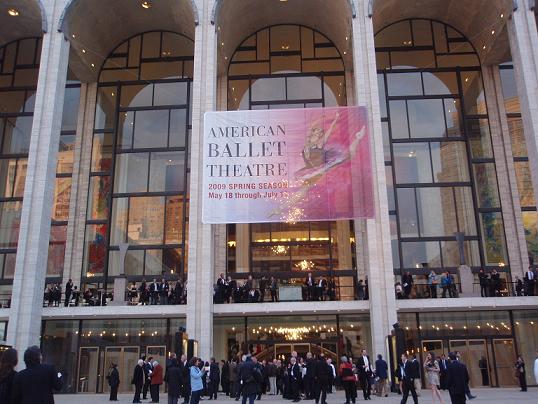
AMERICAN BALLET THEATER OPENING NIGHT!

p5182145

Yay, the season has offically begun! This picture was taken during intermission; that’s why it doesn’t look that crowded. I was sprinting in, nearly late, as usual, so didn’t have time to snap some pics before the performance but fortunately it was still light outside during intermission.

Anyway, Michelle Obama (who served as one of the gala’s honorary chairs) looked smashing in a sleek dark grey sleeveless, knee-length dress with tiny black ruffles lining the bottom. I’m sure there will be beaucoup des pictures seeing as how many blasted camera people there were; I’ll be sure to steal some when they’re posted on all the society websites ๐Ÿ™‚ (Oh, look, here it is in the NYTimes already)


It was just about the craziest thing I’ve seen on the Met Opera stage: after Veronika Part’s mouthwatering Mozartiana opened the show, artistic director Kevin McKenzie came out and thanked everyone who needed thanked — all the donors, designer Caroline Herrera who funds the gala, etc., and Senator Chuck Schumer came out and gave a little talk about the importance of funding for the arts, etc. Then, Schumer disappeared behind the curtain and moments went by. Everyone kind of looked around at each other like “what’s going to happen next?!”

Soon, the curtain was pulled back to allow some people to carry out a podium with a banner “American Ballet Theater” draped over its front. The doors to the lobby opened and a flock of people bearing weapon-sized cameras blasted in. Several men dressed in black promptly rose from their aisle seats and followed the flock of weapon-camera-bearers to the front of the aisle, near the stage. Caroline Kennedy was announced. She came out, everyone applauded, and she mentioned that the school of ballet associated with ABT, the Jacqueline Kennedy Onassis School, would be performing on the Met Opera stage for the first time ever tonight. Everyone ooohed and aaahed. Then, she announced First Lady Michelle Obama.

The curtain pulled back again and out she came. Of course everyone gave a standing ovation. She smiled radiantly, then, after a moment, directed us to be seated. Then she gave a short speech. It was a little hard to focus on what she was saying with everyone — both professional photographers and audience members with cell phone and digital cameras alike — flashing away as they were, but she talked about the necessity of the Arts for a culture to flourish, the importance of arts education, etc. Then she introduced the Jacqueline Kennedy Onassis School students.

As soon as she disappeared behind the curtain, the auditorium remained still pending the exit of the flock of pro camera wielders. It’s funny because there were all these non-dance writers in the press section. You could hear the sighs of relief, the sinking down into the chairs, and the putting away of pens and paper — and cell phones, which they’d used to light their writing paper during Mrs. Obama’s speech, which would have been extremely annoying had it not been for all the flashing bulbs anyway. But it made me wonder how they’d ever survive as performing arts critics! I mean, who needs light to see to write!

Anyway, the students were excellent. They performed Le Defile (The Procession) by Raymond Lukens. There were three large groups of them, in three levels — the very little ones, a medium-age / level group, and the older, very advanced ones. The choreography was basically a showcase of classical ballet steps, much like a very advanced ballet class — jumps, jumps with changing feet, jumps with changing feet that went on forever performed by a set of advanced boys (which drove the audience to wild applause), jetes, chaine turns, multiple pirouettes, fouttes, etc., and then a bit of partnering. It gave the students a chance to show what they could do — and the advanced ones could do a great deal! Extremely impressive, and great fun.

Then on were Xiomara Reyes and Herman Cornejo doing an excerpt from August Bournonville’s La Sylphide. This was the most dramatic I think I’ve ever seen Xiomara. I was sitting in the back of the orchestra and she really projected. She was really sweet. And Herman as always amazed with his virtuosity, his jumps, his razer-sharp precision, his astounding clarity of line.

The corps in both this, La Sylphide, and Swan Lake, later in the evening, were absolutely amazing, by the way. Not a head arched back more than the others, not a leg raised higher. They were all so on. When they work together like that, in perfect unity; it’s really visually breathtaking.

Then was Balanchine’s Tchaikovsky Pas de Deux danced by Ethan Stiefel and Gillian Murphy. Ethan and his strutting around stage, taking his own good time after their duet and before beginning his solo, making the conductor wait for him! And his high jumps with all miraculously many beats of the feet. I wished my friend Alyssa could have come so she could see he’s not just Mr. Sexy; he’s a superb dancer. And Gillian was radiant, and a perfect foil with her speed-of-light chaine turns. They enjoyed a long, slow kiss during the curtain call. The audience went mad!

Then was the hunt scene from Sylvia danced by Michele Wiles followed by a piece d’occasion (the first of two of the night), by Alexei Ratmansky, for Nina Ananiashvili, called Waltz Masquerade. It was set to the Waltz from Aram Khachaturian’s Masquerade Suite and it was cute and comical. She was dressed in this long, red dramatic, Carmen-like dress with a sexy black lace overlay on the top. There were four tuxedoed men, each bearing a gold candlelabra, one at each corner of the stage. These men turned out to be: Jose Carreno at the front left corner; Marcelo Gomes, at back left; Angel Corella back right; and a blonde on the front right who I initially thought was David Hallberg (I was sitting FAR back from the stage!) until the fun began and he shook his head about like a sassy mop and I realized DH just does not have enough goofball in him to do such a thing, even if he tried. So, I decided it was either Ethan or Maxim Beloserkovky. Anyway, Nina’s character was supposed to be dancing about the stage in a melodramatic solo — but it was purposefully melodramatic, and so comical. Like a silly, cartoon version of an upcoming swan song, really, which, is of course, what’s coming up for her later in the season (and will be much more sobering when it does). At one point, she just passionately crashes to the ground and remains there, in a heap. Nothing happens. The men, obviously her servants, start looking at each other like, what now? They shrug, slowly walk over to her. Then, Marcelo starts imitating her melodramatic dance, but far more cartoonishly, and of course it’s hilarious. The others join in. Max (I think it was Max, not Ethan) does his thrashing hair thing. I couldn’t see facial expressions but I assume they were making fun of their master. Then she wakes up, catches them, and they’re sent back to their posts.

After intermission was the balcony pas de deux from MacMillan’s Romeo and Juliet, danced by Marcelo and Diana Vishneva. At first, Diana approaches her balcony with all the drama of a ballerina playing Juliet, rather than Juliet herself. I rolled my eyes. This is what I don’t like about her. She’s an excellent dancer but she’s all about the pomp and circumstance and not about the character. Maybe it’s a Russian thing, but I don’t see that in Veronika Part or Irina Dvorovenko. Anyway, she eventually lightened up, thankfully, and I felt like I was watching not a prima ballerina being a prima ballerina but Juliet herself, falling hopelessly in love. When she runs around him one foot solid on the ground, the other on pointe, it’s so girlish, so real yet so poetic. Those are the best — I don’t know what to call them — runs around kneeling Romeo — that I’ve ever seen — not even Alessandra Ferri’s were that sweet. Still, I felt some of the lifts lacked the beauty and magic ofย  those Marcelo and Julie Kent do together when they dance this scene. I don’t feel she dances that well with a partner; she’s more into herself. Marcelo’s leaps around the stage and big high passionate jumps were thrilling. He got some good bravos for those.

Then were Paloma Herrera and Max Beloserkovsky in the Act II pas de deux from Swan Lake. I was hoping it’d be the Black Swan pdd, but no. I guess the program was pretty bravura-heavy already. I don’t see him dance much, but Max is really quite good. He’s really a character and he’s the perfect Prince Siegfried, regal yet vulnerable and tragically in love. And he’s a good partner.

Then was the mad fun of Le Corsaire, with Irina Dvorovenko, David Hallberg as Conrad, and Angel Corella as Ali. Except something happened at the beginning and I hope David’s okay. The tallest guy in the entire opera house had to sit in front of me and I was trying to navigate my way around his enormous head just as a bunch of people up front went “Oooooooh!” When I was finally able to see the stage, Irina was standing in front of David, face toward the audience. She didn’t seem to have any particular expression on her face, but, then, I was light years away from her. Then David did an assisted pirouette with her and everyone applauded, so it must have been a lift that didn’t quite happen or something. Anyway, I hope he’s okay; I know his shoulder sometimes comes out of socket. Anyway, all seemed to be fine after that: all three were brilliant. Of course. Angel astounded, as always, and I started giggling during his first solo and couldn’t stop all the way through the second. I love Irina. She was radiant. She did those continuous turning kicks on pointe like they were nothing. She has the drama and the virtuosity when needed and the always beautiful, graceful lines. And David’s leaps all over the stage were magnificent. I could see this goofy ballet over and over and over again, as long as no one gets hurt ๐Ÿ™‚ Angel did not leap out from behind the curtain during curtain call, sadly.

Then there was another piece d’occasion. Herbie Hancock played piano, onstage, while first Jose Carreno, then Stella Abrera, danced to his music. This was cute and comical as well, and kind of reminiscent of Jerome Robbins’s Other Dances or Suite of Dances, where the dancer(s) connect mainly with the musician. At one point, Hancock went nuts with the keys, obviously way too fast to be danceable, and Jose stopped in his tracks, looked over at him, and lifted his hands, like what gives, dude? He sat down near the base of the piano and just rested. The same happened with Stella. She danced, then stopped and gave Hancock a look when he began another little virtuoso section. She finally sat down beside him on the piano bench, and eventually, he ended on a romantic note, she snuggling next to him softly, sweetly.

The evening ended with the finale of Balanchine’s Theme and Variations. The leads were danced by Sarah Lane and Daniil Simkin. It was a nice way to end the program, but with the likes of Simkin, I wondered why they only did that group finale, where he and Sarah are basically leading a processional, instead of some of the earlier bravura parts with all the corkscrew turns for the man. An opening night gala performance is meant at least in part to showcase the dancers doing what they do best, and he is best at the bravura stuff, not leading processionals.

Anyway, the whole night, as usual, was magic. Saw Sigourney Weaver and Kelly Ripa in the audience.

Oh, for my Dancing With the Stars readers, I taped the show, but for lord knows what reason it was somehow muted. I have no idea how on earth I managed to do such a thing, but it was pretty amusing watching the show in pure silence — no words, no music. Needless to say, I’ll have to watch online tomorrow.

But now, dead tired, must sleep. Goodnight.

WHO WOULD MAKE A BETTER MODEL THAN A DANCER?


I was in the bookstore the other day looking for literary magazines and somehow got caught up in the latest issue of Vogue Hommes International. I’ve been a fan of Keanu Reeves all the way back since River’s Edge (honestly) and I saw on the cover that there was an interview inside with Bret Easton Ellis (novelist, Less Than Zero, American Psycho, Glamorama, etc. etc.) Interview with BEE is pretty funny, actually, in a way it likely wasn’t intended to be. IE: interviewer: So, you were an icon in, like the 80’s. BEE: Yeah, it was hard being an icon. And confusing. Seriously. I’d get in a fight with my boyfriend and I’d be like, wait, you can’t criticize me; I’m an icon!” But my favorite BEE quote is here.

Anyway, I was flipping through and there are all these little mini interviews with and photos of writers (Stefan Merrill Block too!), architects, actors and filmmakers, of course designers and models.


But not a single dancer anywhere. Why not? They’d make such good models ๐Ÿ™‚


(Sergey Surkov, my photo; Slavik Kryklyvyy from here)


(Arunas Bizokas, my photo; Linas Koreiva, from here and here)

Vogue Hommes should so hire me to compile a dancer spread! Fabrizio Ferri can do the pictures. Maybe Bruce Weber, though he can get kind of cliched and corny… No, Fabrizio.

Then, yesterday, I saw Valentino: The Last Emperor, which was pretty good. The Dolce Vita-esque scenes were the best ๐Ÿ™‚ย  And it reminded me of Fashion Week’s being moved from Bryant Square to Lincoln Center, and I thought how excellent (and fitting of course) it would be to have NYCB and ABT ballerinas as the models, an idea Kristin Sloan had proposed on the Winger a while back. Ballerinas generally have far better bodies than models. Come on!


ETHAN STIEFEL AND LARRY KEIGWIN AT GUGGENHEIM


Last night the Guggenheim Museum’s Works and Process event centered on Ethan Stiefel’s new dean-ship of the University of North Carolina School of the Arts (which is both a high school and now a university as well). Stiefel is of course a famous ABT principal, star of both Center Stage movies, and ran the summer program Stiefel and Students / Stiefel and Stars, out on Martha’s Vineyard, which my friend Alyssa and I went to a couple of years ago. It was hosted by blogger / dance writer and photographer (and former ABT dancer and NC School of the Arts alum) Matt Murphy, and also included choreographer Larry Keigwin (artistic director of Keigwin + Company), who was the recipient of the school’s first residency under Stiefel.

It was a fun evening. Discussion centered around Ethan’s decision to take on the position, in light of the fact that he’s still dancing (he’d had several surgeries on both knees, knew he wanted to do something like this at some point but stressed about when was proper time to do it), his new schedule (now waking at 6:30 — as opposed to 11 am when he use to wake as a dancer — to take class, then teach a couple of classes, then do all manner of administrative / financial / directorial things – -not easy tasks in light of current economic crisis, and still try to find time for his own rehearsals), and just generally his teaching and directorial aesthetics (he’d come up with eight “initiatives” to instill a culture and sense of identity in the school, the last of which Matt read — which was to encourage students to be inspired by both art and life.) Gia Kourlas has a good article in the Times that summarizes all of this as well.

Keigwin joined Matt and Ethan for the last quarter or so of the panel, and he spoke about his residency, how he’d choreographed a new work both on the students and his own company simultaneously, what it was like to work with students, and what it was like to be out of NY. I’d never heard him speak before and he’s very personable, fun, and chatty with a good sense of humor (which doesn’t surprise me — his work is largely humorous and accessible as well). He talked about the company being beyond thrilled with the washing machines and the cooking space (if you don’t get out of New York much, this kind of surprise happens!) and so enjoyed performing a lot of domestic activities. He was cute! And Ethan was his usual self — his completely understated, deadpan style of talking oozing with sexiness and manly charm. Before introducing one of his students’ performances — of the Four Cygnets in Swan Lake — he explained the girls wouldn’t have the swans’ usual hairpieces: “We got a lot going on and … we just didn’t get that done in time,” he said with a smile and a shrug. Somehow the way he said it just gave everyone the giggles, which, honestly, often happens when the man speaks.

Anyway, we saw Tangled Tango, a modern piece by Dianne Markham, a contemporary choreographer at the school, the pas de deux and coda from Le Corsaire, which Ethan staged, the Four Cygnets from Swan Lake staged by Nina Danilova, and August Bournonville’s The Jockey Dance, also staged by Ethan.

Finally, we ended with Keigwin’s Natural Selection (a modern piece), which totally blew me away. The Keigwin was based on Darwin, survival of the fittest and all that, and was so stunning, filled with very difficult partnering, lifts, students crawling around on the floor, clawing at the ground and each other, lashing out, really having at each other. (So, not quite his usual humorous piece) A guy crawled around with a girl wrapped around him, underneath him. At one point, it slowed, several dancers huddled around each other in a group, each kind of resting, momentarily, putting his / her ear to the back in front of them, perhaps comforting the other, perhaps trying to determine whether his / her heart was still beating, lungs still rising, to determine whether they’d “won”. Then a girl came rushing at them, climbed right over the huddle and jumped right onto the wall in back of them. Someone crawled after her and pushed her back to the ground. Keigwin’s signature move then ensued: a group of male dancers lifted her and she bent sideways, and ran alongside the back wall. The audience was wowed. But more importantly, I think, it was such a wonderful piece for students. I mean, what better way to teach them partnering, how to work with each other, how to be dramatic, how to make the meaning of a work come alive. I loved it!


My other favorites were: the Four Cygnets — whoa, that was PERFECTLY done! Those girls — Tessa Blackman, Maya Joslow, Amy Saunder, and Lauren Sherwood — should be so proud of themselves; and Le Corsaire ๐Ÿ™‚ — but of course I’m a sucker for that kind of bravura dancing. I was really afraid, holding my breath the whole time with that one — I mean that stage is soooo small for all that leaping and those insanely high lifts. The two dancers — Claire Kretzschmar and Kristopher Nobles (who looked like a young Gillian Murphy and Jose Carreno respectively!) did splendidly on their own. I couldn’t help but giggle during Nobles’s huge, stage-encompassing leaps and Kretzschmar’s beautiful continuous fouettes and the gorgeously high lifts — all wonderfully executed — except because of said miniscule stage, her hand almost took a light out on one such spectacular lift. There was a tiny bit of fumbling on some of the partnering — the assisted pirouettes and the promenade, but I was actually glad for the audience to understand how insanely hard those things are. People think that’s the easy stuff — and the lifts are the hard parts — but the assisted pirouettes and promenades, when the girl is totally off her center of gravity and the guy has to help keep her centered, are some of the hardest aspects of partnering. Now maybe Met orchestra peeps will not be so confused when the young dance students in family circle go wild for Marcelo the great’s ten bizillion one-handed turns with Julie Kent ๐Ÿ™‚

Here’s a video of the Four Cygnets, here’s some classic Corsaire (they didn’t do all of this insanity, but you get the idea), and here is The Jockey Dance (it was performed last night by two boys, Devin Sweet and Shane Urton).

The Jockey Dance was fun too — one of those dances that looks deceptively easy, but you can tell is really hard, with all the bouncing jumps, playful competitiveness– using a whip no less, and fast footwork.

Gillian Murphy (ABT prima ballerina, Ethan’s girlfriend, and NC School of the Arts alum) was there too. Poor thing had to sit in the critics’ section! Luckily Sir Alastair was not there… The program repeats tonight, but is sold out.

Dance Times Square Outing to Latin Quarter


Last night I went with Dance Times Square on their holiday party outing to the Latin Quarter, a salsa nightclub in midtown on the east side, near Grand Central.

It was fun — I haven’t social danced in a really long time! Do think I might have hurt my knee though. How, I have no idea. I’ve damaged my meniscus coming out of a fish dive weirdly, trying to force turnout on an arabesque in attitude (back leg up, bent knee), trying to force turnout on rhumba walks, trying to force turnout in samba walks, trying to force turnout in ballet, yadda yadda, but I didn’t know you could really hurt yourself doing basic salsa steps?! Hopefully it’s just a bruise…

Anyway party started at the studio, where we had an hour-lesson in open Salsa taught by Tony and Melanie (who are back from Canada’s So You Think You Can Dance). Picture above, student Elaine (my friend) is in foreground dancing with Tony. After the class, we had food (lots of good munchy things like pate and cheese and meat slices and this enormous cheesecake, and bottles and bottles of wine ๐Ÿ™‚ ), then walked several blocks to the club.

The club was nice, but small dance floor … although I have nothing to compare it to since I don’t go out to a lot of social dance clubs. They had a few bars (although, I find it a bit hard to dance drunk) and little areas for sitting around and chatting. We took an area on the second floor, and, when it got too crowded on the main floor, just danced up there. I danced mostly with my friend Steve, but then this guy who was not in with our group kept asking me to dance, which was nice at first, until I realized he was kind of a pelvis-grinder. Just too close for comfort. So, I told him I was tired the next couple times he asked, which of course made it hard to dance with others then. Steve told me I was fun to dance with because I unwind (out of a turn) like no one else, thanks to my “sinuous” body! ๐Ÿ˜€

Salsa band was fun, but it’s kind of funny; I’ve mainly been to parties at dance studios where they play a variety of music. So, I kept getting ready for a samba or rhumba or swing or something, and it never happened. Also, I really kind of wish people danced more in groups here, like they do in this video (when you get to the salsa club part, around 4:50). How fun would that be? And would seem to cut down on someone’s hogging another person all night. But I guess that kind of group dancing necessitates sharing a culture where you all know the same words and funny little moves, which doesn’t really happen these days … I guess except for the Electric Slide.

Anyway, very fun to see old friends again. I really should start taking a group class again at some point because it’s good for socialization, and, I realized after the night was over what a real workout it had been.

More formal review coming soon on ExploreDance.com.


Tiny Tiny World


Last night I went to my lawyer friend’s holiday party and met one of her co-workers, a Brazilian lawyer named Beatrice. Our conversation naturally led to a discussion of dance, which of course led to a discussion of Samba, and eventually even ballet. She revealed that as a child and teen, she danced with Laura Alonzo’s student company of Ballet Nacional de Cuba!

She remembered Marcelo! Said she never danced with him because he was so “little”; much smaller than she. I was like, “Little?! No, he’s huge, much larger than life!” She said, not then! What’s he like, what’s he like, I asked?! She said, well, when he was 10 he was really sweet! Said his parents always went to the studio with him and seemed so supportive, which was so cute, and so unusual for the parents of a boy dancer in Brazil back then. She said he used to always get partnered with this really bitchy girl who thought she was god’s gift and she was such a prima, always demanding and blaming him for anything that went wrong. But he was so nice, he was always a sport about it.

So, not much has changed for poor Marcelo then? ๐Ÿ™‚

Beatrice also got to dance once with the great Jose. Said he was huge back then. She never talked to him, only danced one brief duet once. She still has the picture of him lifting her little body far above his head. How very lucky to have grown up in Latin America…

Daniil’s Debut and a Riveting Pillar of Fire


Last night was the New York debut of ABT‘s newest star soloist, Russian-born, Daniil Simkin. He danced the Tico-Tico section of Company B, which I wrote about here, and which is going to be a dance I can tell will grow on me each time I see it. Tico Tico is probably the solo with the most bravura theatrics, and it suited him well. He has a small, compact body and can go very high on those jumps, really sail around the floor on those barrel turns. But the solo is also jazzy, and he pulled off the softer, subtler elements as well. At the solo’s end he got huge applause from the crowd, and more whooting applause mid-dance (which rarely happens with dance crowds these days) in the very last ensemble section, when he went whizzing halfway up to the ceiling in a twisty turning jump. “That little one was sure something!” exclaimed a couple of women as we left the theater.

My only thing — and this goes for the whole cast, not just him — at the end of the male solos, each man falls to the floor. This is meant to show that they’ve died in war. It it only their spirits that are dancing; the duets are the memories of the women they’ve left behind; the solos are ghosts. So, the dance on its surface is fun and frivolity with jazzy music and pretty girls and the whole nine yards, but there’s underlying tragedy, which gives the dance its power.


On the way out of the theater a woman was complaining to her friend that the ABT dancers “aren’t doing it right; it’s not clear they’ve fallen,” she said. And I agree. At the end of Daniil’s solo, he raised his arms and pushed back from the waist while disappearing into the wings as if he was hit in the stomach by a bullet. But he wore the same happy carefree smile as he had throughout the whole solo (likely because the audience could tell he was finishing, the cheers were beginning to sound and he’d just finished his NYC debut), so you’d never know he’d been shot. But it wasn’t just him — others in this cast did the same. I think the first cast, and especially Herman Cornejo, gave those moments more gravity and pathos. I still don’t know if it was enough though — something tells me people missed the war leitmotif altogether — but it was more. Don’t know how much is enough, really. I’ve never seen Paul Taylor’s company perform it so it’s hard to tell the choreographer’s original intent. You definitely don’t want to overdo it or it becomes preachy. It has to be subtle.

Anyway, I will look forward to seeing Simkin again next week in the Russian ballet, Flames of Paris (Ratmansky, woo hoo!) which I’m, obviously, immensely excited about. Simkin, by the way, keeps a blog; it looks like he updates his Twitter feed more often than the posts.

Also on were Antony Tudor’s Pillar of Fire and Jiri Kylian’s Overgrown Path. This was my first time seeing Pillar and I found it absolutely riveting.


The ballet’s from 1942 and the story’s dated — girl longs for good boy, good boy’s into her sister, girl doesn’t want to grow up to be spinster like older sis, so goes for bad boy who takes her virginity and “ruins” her, so that when good boy leaves brainless sis and comes around, she’s damaged goods. This results in tragedy; she can now only have good boy in her dreams, in the moonlight. At least that was my interpretation.

The great thing about Tudor, dated as this story is, is that he’s so dramatic, his drama comes from within, within the body. You can tell his dancers have to spend so much time working out the characters, and everything is made so clear not so much by facial expressions, but by body movement and posturing and gestures — which is dance, after all. David Hallberg as the good boy (I know, immensely annoying — good boy is shiny American blonde, bad boy is big dark Brazilian Marcelo; there are also “lovers of innocence” blonde and wearing white nightgowns and “lovers of experience” dark-haired and dressed in ‘slutty’ gypsy-like attire, but we won’t go there for the time being) has this quick, rushed gait, so that he passes right by Gillian’s heroine, paying no attention whatsoever to her body, contorted and hunched-over from the waist, cramp-like, with pain. Marcelo definitely notices her, and throughout he keeps doing this thing, rubbing his hands with the flat of his palms on both sides of his groin. It’s so sexual and so sexy and so threatening. I kept bolting upright and leaning forward every time he did it, and had to keep reminding myself, this is City Center, you move a millimeter and you’re blocking every single head behind you.

Marcelo was Marcelo, perfectly in character as always, and Gillian blew me (and the audience, judging by the substantial applause) away with her inner development and tragic portrayal of heroine Hagar. Only thing lacking (apart from the stereotypical casting and costuming), and just a smidgen, was David, in the beginning. His walk was perfect (Tudor concentrated greatly on gaits as a revealer of character), but he was a bit too severe. I couldn’t really see how Gillian’s Hagar was so enthralled with him. He seemed like a jerk the way he ignored her. Then, when he comes around to her, he slows it down, but then he has his regular pointy-footed, slightly hip-swaying, rumba-esque walks. It’s quintessential sexy David, but I don’t know if it’s this character.


The only piece that wasn’t to my liking was Kylian’s Path. They’re putting it on this season because Kylian made it in honor of Tudor, who considered the Czech choreographer his artistic grandson, and the season is devoted to Tudor. It just seemed too one-note, too dreary, without a serious drama you could latch onto. It’s meant to evoke sadness and pathos — is set to piano music by Leos Janacek, who composed the piece (On an Overgrown Path) not long after losing his son, then daughter, and you see a set of women who seem to be mourners, heads hung down, at times reaching out into the air as if in vain, and a young woman dances several duets with a man (Jose Carreno, who, weirdly, couldn’t even save the ballet for me), then disappears into the curtains. I don’t know, maybe I wasn’t in the mood, maybe it’ll grow on me, because I’ve certainly liked other things Kylian has done.

The company has a mini-website devoted to Tudor, where you can view videos and pictures here.

ABT Gala: Craig Salstein Has a Future as a Choreographer, and Herman Steals the Show (Or At Least The Second Half Of It)


So, last night was opening night of ABT’s fall Contemporary season (which will last for the next two weeks) at City Center. I love galas, for the most part: I love seeing all my favorite dancers in the best excerpts from my favorite ballets. Although the only piece that really fit that tonight was Jose Manuel Carreno dancing the bravura pas de deux in Don Quixote with Xiomara Reyes. I am such a child; I again got a bad case of the giggles the second he stepped onstage — both during the duet and then when he had his leaping, fouetteing, barrel-turning solo — this always happens with Jose — and really had to control myself; I was sitting only a few seats down from Kevin McKenzie (who is thin — most go the opposite way after they stop dancing — and as I mentioned before, behind Alessandra). Anyway, see a video here of Jose dancing DQ with Paloma Herrera.


First, because it’s most on my mind since it was the only piece (performed in its entirety) on the second half of the program: Company B, choreographed by Paul Taylor, which I LOVED. I’d never seen it before: it’s a jazzy modern piece (no toe shoes) set to several 40s era songs by The Andrews Sisters (like Boogie Woogie Bugle Boy of Company B). Both song and dance are cute and fun on their surfaces, but in the background from time to time a line of men march slowly, their bodies at the back of the stage, in shadowed silhouette. Some of them hold what appear to be guns. Some hold their arms up as in surrender. They are going off to war (timely then — during the era of the songs, timely now). But you almost don’t notice them. At points, a sweet romantic duet will be centerstage, and one of these men will join the dancers, flying happily about the stage, along with them, then suddenly slam to the ground, as if shot. Because of the marked contrast between fun and play and love, and being shot dead in the line of battle, the background war theme is all the more poignant.

Herman Cornejo stood out to me here. He was cutely carefree, leaping about (as usual, halfway to the ceiling, though the height seemed like pure coincidence, like he hadn’t meant to go that high at all, it was just natural for him), then is left sadly, starkly alone in the end, without the girl, without his carefree ways, and perhaps eventually without life (at times he is also one of the silhouettes in the background). Herman used to be all about huge jumps and leaps and turns to me, but he’s grown hugely as an artist, and now the jumps and leaps and turns are all done in the furtherance of character, though no less awe-inducing. He grows on me each time I see him perform. The Taylor piece was perfect for him. And, as I said, it’s timely and I’m thrilled ABT’s chosen to put it on this season. It’s showing several more times and I can’t wait to see it again and again.

The first half of the program consisted mainly of excerpts (except for Craig Salstein’s excellent Time, which I’ll get to in a sec); in addition to DQ, there was Balanchine’s Theme and Variations performed by my favorite, Marcelo Gomes, and Paloma Herrera. When, at the beginning of a solo, Marcelo walked out onstage and kind of looked out at us, it looked like he was looking right at me. How does he do that? How does a performer do that? It’s uncanny! When Kevin then came out and gave his little thank-you to all the gala sponsors, he did the same thing. Angel Corella does it too. Hmmm.

Anyway, Marcelo was excellent, of course. The far-too-shy crowd was ridiculously late in applauding his series of 15 or so continuous twisty multiple-turning-jumps. American audiences, argh! Marcelo is the quintessential romantic leading man, as I’ve said about 10,000 times throughout the course of this blog :)ร‚ — the way he lifted Paloma about every which way, all over his head; partnering is his forte. But, because of his size, you can tell when the choreography is really fast ๐Ÿ™‚


Second on was a scene from Romeo and Juliet (when Romeo leaves Verona), danced by David Hallberg and Gillian Murphy. But this R&J was not the one I’m used to, the one by MacMillan; it was choreographed by Antony Tudor (whom the company is honoring this season; it would have been his 100th birthday this year). Tudor’s R&J is much more dramatic than pashmina, without all the flourishes and breathtaking lifts, but instead with lots of yearning arabesques where the dancers lean toward each other, balancing on the tip of their toes, nearly falling forward, longing but seemingly unable to reach the other. It was passionate in its own sad way and makes me look forward to more Tudor.


And then there was Time, a new piece by well-liked soloist Craig Salstein, a short solo, danced by Michele Wiles. I think this piece marks his choreographic debut. It was originally made in December 2007 for Dancers Responding to AIDS. I loved it. It was soft and lyrical but had modern elements as well, such as short, staccato movements of the arms and legs, and a frontward leaning arch, with arms extending up and back, like a bird taking flight, reminiscent of Alvin Ailey or Martha Graham. Michele danced with a sorrowful passion; it was hauntingly beautiful. As its name and the group it was created for implied, it felt like a woman struggling hard to extend her time here on earth. She would reach upward toward the heavens, but in vain, and she kept brushing her right leg backward, as if trying to brush off a negative thought, a harsh reality. Later, she would dance with fluidity and grace, in acceptance. And the movements would repeat themselves, like they would psychologically in someone who is grieving: denial, anger, acceptance, denial, anger, acceptance. To me, this one little work showed that Craig has wonderful originality, understands how to build structure, understands different kinds of movement and what they do, and has a strong sense of how to convey what he is trying to convey to the audience and really move us. BRAVO CRAIG!!! And brava Michele!

There was a little more, but these were my favorites. Also, Gillian Murphy and Jared Matthews impressed me last night. I don’t know exactly why because she’s always technically brilliant, but Gillian just shined last night; everything she did brought my attention right to her, even when she was surrounded by many others; she just had an extra glow. And Jared I’ve always seen as kind of the skinny blonde guy who blends in with everyone else, but he is looking more and more polished, dancing with greater and greater sharpness and precision and standing out for those reasons — and he was looking even rather majestic last night.


Praise the Lord For Antony Tudor!!!


Last night I went to one of the best Works & Process events at the Guggenheim that I’ve been to in a long time. (By the way, I spent practically all weekend, despite a severe cold turned into sinusitis turned into a migraine episode, at City Center watching Morphoses, and despite said sickness had a pretty good time — promise to write all about that very soon!) Anyway, this Works & Process event, about American Ballet Theater’s upcoming City Center season honoring choreographer Antony Tudor, was so excellent because:


1) three of my favorite dancers (excepting Marcelo that is — he never does Guggenheim sadly) were onstage working their magic only feet away from me. This included Jose Carreno (headshot above), Julie Kent and Veronika Part, the first and third of whom I’ve never seen at Guggenheim. And it was the best dancing I’ve seen there. Usually, with the space being so intimate, the stage so close and the dancers in workout clothes rather than actual costumes, everything just seems scratchy, like you notice all the little foibles the distance of the stage at the Met or City Center prevents you from seeing. But with these three: looked just like it does in the big opera house, completely smooth and polished and dramatic and intense and perfectly in character and just miraculous movement altogether.

Veronika I must say almost made me cry with her Leaves are Fading character, and she and her partner, Alexandre Hammoudi, only performed a short excerpt from the 4th pas de deux of that ballet. She’s probably ABT’s most dramatic ballerina; her mission is always to make you feel exactly what her character is feeling, to bring you to that same place and make you a part of that world. To do so she puts everything she has into a role and the results are always so rich. There are other wonderful actress dancers in ABT, but there’s just no one on her exact level.


And the second reason I loved last night’s program was that I found it really informative. I didn’t know much about Tudor and I learned a great deal. Kevin McKenzie (ABT’s artistic director) spoke, and he talked about him not so much as a director trying to sell people on his company’s upcoming season but more as a former student reminiscing on how wonderful it was to be taught and coached by a genius.


Tudor created character-driven story ballets, and he gave his characters great psychological depth, as expressed, of course through movement. He’d develop a character through the walk, the way hands are held, through specific repeated gestures, spending hours and hours going over these things with his dancers, McKenzie said. Which is why I titled this post as I did. I’m just getting so tired of all these abstract story-less ballets with movement that doesn’t seem to have any meaning (at least not literal) or where the point is to make beautiful music visible. If I want to bask in the beauty of music, frankly, I’d rather go to a symphony and close my eyes and drink it all in. Movement should be more; it should be something beyond music. I like dances that are more like plays with movement substituting for words. I want characters with real lives and issues and emotions and depth, that I can latch onto and feel for. I want to get caught up in their stories, and cry for them; I want their predicaments to make me think about the state of things.

We saw some little film excerpts of Tudor speaking. “Dance must change to stay alive. Life is change,” he said. He wanted to modernize ballet, which is interesting because Christopher Wheeldon (Morphoses man who I’ll get to soon) says the same. But Tudor’s way of doing so (and most of his ballets were created from the 1930s through 70s; he died in 1987) was to make it more people-oriented, enable viewers to see the characters onstage as real people with genuine emotions, allow them to identify with those characters.

We saw excerpts of several of his ballets: his sweet Little Improvisations, a duet between a boy and girl; Judgment of Paris, a rather funny re-telling of three goddesses vying for the attention of one god but re-set in a bar with prostitute / ‘dancers’ subbing for the goddesses and a drunk patron for Paris; Pillar of Fire, a tragic portrait of three sisters, their relationships with each other, and their men; and The Leaves Are Fading, a sadly beautiful story of the life of one relationship.


Anyway, I’m now very excited for ABT’s Tudor season, upcoming at City Center at the end of October. Even if some of the ballets are a bit dated now (which we’ll have to determine when we see them), they’ll still be a welcome break from all the abstract shapes and movements that are supposed to evoke something … or not, and sometimes do, sometimes don’t, and sometimes do but I don’t care… I feel that the way to modernize ballet again today is to give us more, new, updated stories, but more on that later.

Sorry if this post is a bit loopy and rambling … I’m still suffering the after-effects of a week of Sudafed intake (and am kind of realizing the reason they put the drug behind the counter :S)

Back For More Jose

I went back to ABT last night for another Merry Widow with Jose and Julie in the leads. Couldn’t resist! And I’m glad I did; I ended up meeting Roslyn Sulcas, writer from the New York Times, who is really nice and down to earth, and elegantly beautiful.

Anyway, I already wrote a bit about this ballet earlier, and have to get ready for a pre-competition dinner, but I quickly just want to mention a few other tidbits about Jose that make him so great, that I noticed last night. He keeps in character throughout, even when he’s not center stage. I mean, they all do, but Jose really keeps in character. As Julie’s rich widow was dancing with the Pontevedrian men, each man trying to curry her wealthy available favor, Jose was sitting off to the side flirting devilishly with Misty Copeland. And he was really flirting, not just chatting. At one point he raised his eyebrows at her in a way that made me nearly fall out of my seat.

And the way he struts around stage, like a cocky, spoiled, at times drunk, misbehaving boy … it’s not at all balletic, the way other dancers might do, but perfectly in character (and somehow on him, mischievous as it is, becomes so endearing).

I also noticed that when he spots as he’s doing a slow turn, carrying his ballerina in his arms, he looks at each spot on the floor with intent. During his pas de deux with Julie when he was remembering happy times with her in the past, he looked down at each point on the floor like he was lost, forlorn, wondering where they all went. With most dancers they look like they’re doing exactly what they’re doing — spotting so they don’t lose balance. He turns simple technique into art.


I also wanted to point out how fantastic Joseph Phillips was, as leader of the Pontevedrian men, with his spectacular bravura-embellished folk dancing, and Craig Salstein as he sweetly but sadly unsuccessfully vied for Julie’s hand. And Julie as the widow was sweetly flirtatious, her smiles and raised eyebrows infusing her prolonged flexes of the foot into quick, snappingly sharp points, with added sexual meaning.


Anyway, I’m very excited for Giselle next week!


Happy 4th of July, everyone!

Jose carreno is dancing again!

Jose carreno is dancing again!

Originally uploaded by swan lake samba girl via mobile.


T-Mobile

Although hopefully with all this drunken choreography he won’t reinjure himself.

Update: So, this week’s ballet at ABT is “The Merry Widow,” created in the 1970s and originally an opera. When I first read the synopsis I thought, this plot is so intricate, like an Oscar Wilde-ish comedy of manners, how are they ever going to pull it off without words. They didn’t really — and so you need to read that synopsis — but it’s still a lot of fun to watch the dancers try to mime everything.


I love Jose Carreno with all my heart. Every little emotion, no matter how subtle, registers thoroughly on his face, every perceived rejection, every memory. When he wrapped his hands around Julie Kent’s waist, finger by finger, before lifting her, when he traced his hand from her wrist to her shoulder, when he looked as if he was biting at her neck — just sends chills!

Julie was beautiful, Xiomara Reyes did a great acting job, the whole cast was excellent. I thought the very modern choreography had great humor and was a lot of fun, but I must warn you, this is this season’s Cinderella, so purists are likely not going to be too happy.

Oh and the sets and costumes on this one — extremely lavish. Don’t think I’ve ever seen such elaborate sets for an ABT production; they put a lot of money into this one.