Is Pasha a Nureyev or a Baryshnikov: What's In a Dancer's Sexuality Anyway?

Okay, I’m probably going to get attacked right and left for this post, but I’ve been receiving a lot of emails asking me if my former dance instructor, the extremely personable and talented (not to mention sexy 🙂 ) Pasha Kovalev, who is now a serious contestant on SO YOU THINK YOU CAN DANCE, is gay or straight. My first thought was, argh, why does it even matter! But then I thought about it and realized, homophobia is totally passe and no one is asking because they want to judge anyone and, although of course it is completely irrelevant to the actual dancing, it does inform your crush on the guy (if you’re a straight female dance fan, which a good number of us are). I mean, you have a different kind of crush depending on whether he’s straight or gay, right?! (mine are usually far worse on the gay ones, but go figure…)

When I first fell big time for this one, my favorite dancer in the world (besides Pasha of course!), I did what everyone living in the 21st Century would do, an internet search of course. And how did my heart drop when I saw this, his cover story in The Advocate! NOOOOOOOO, I must have let out the most horrid cry. We’re never getting married now! (Because of course otherwise we were, since he’s not a big huge famous ballet dancer or anything…) But I have to say, it was far worse finding out this one, my second favorite, was married, and that this one is engaged to be married. After all, I’m never going to have to be jealous of any of Marcelo’s partners (you can’t envy a man; it just doesn’t make any sense).

And reading the Marcelo article of course made me fall in love with him all the more, and realize why he is, as Dance Magazine called him, the guy all the girls want to dance with. He is a big strong warm Brazilian guy, a kind of teddy bear, albeit a gorgeous one — in whose arms could you feel safer or more comfortable and secure?! Of course the actual story of the dance performance that unfolds onstage or TV is not real anyway, but dramatic narrative aside, to me Marcelo and Julie Kent, his frequent partner, are the greatest partnership around today, and that’s precisely because of the way you can tell they feel about each other: it’s obvious they truly love each other as friends and partners, and that’s everything in making a performance come to life!

I’ve never had the opportunity to dance with Marcelo of course 🙁 but in my own experiences, gay men are crazy fun as partners. Straight men are too, but, I dunno, there’s just something about gay men, that IMO, takes some pressure off and just lets you be you. If something gets touched, you know it was an accident, or if something stupid happens like this, or this, it’s not THAT embarrassing! And back to Marcelo briefly (I know, I can never stop talking about him; it’s an illness really…), big warm swoony stage door kisses like this could never happen if the dancer was straight, right — I mean, that might be looked on … just… a little perverted or something.

But, I also think that a dancer’s sexuality, as with all aspects of his or her personal life, though completely irrelevant to the dancing, do, rightly or wrongly, come into play in constructing the dancer’s persona or mystique, should he or she ever become really famous. Joan Acocella, in reading from her latest book at Barnes & Noble recently, said that she thought part of Baryshnikov‘s fame stemmed from his reputation for being a skirt-chaser. The press, she said, just went on a field day with a straight male dancer. I personally think it was more the political situation at the time (he defected from a country we were obsessed with hating after all), because, how does that explain the fame of Nureyev? To me personally, it is Nureyev who is the more intriguing: in addition to dealing with the shock of fame and wealth after having grown up in abject poverty, the horribly difficult decision to defect and leave his family forever behind (his mother was very ill), he also had to deal with societal and political oppression based on his sexuality. And the attacks that he had to endure, of leading a life of “debauchery” in the West while those left behind in his homeland starved, were criticisms I’m sure Baryshnikov never got. And, as for partnerships, please — that between Nureyev and Margot Fonteyn was the stuff legends are made of. For a very good, rather poetic book on this most fascinating of all dancers (IMO) please go here.

Anyway, back to Pasha, and THE QUESTION! Sorry for the long-windedness, I just wanted to make everyone read about all my favorite dancers 🙂 Okay, well, I don’t want to be gossipy, but I feel there is nothing wrong with pointing you all toward something he said on TV on either the first or second episode of the show! Remember! Remember what he said about why he wanted to become a ballroom dancer, what led him to dance in the first place! That’s a pretty good indication 🙂 If you can’t find it anywhere on the show’s website, I’ll give you a hint — it’s the same thing said by this other dance hearthrob on what drew him to ballet in the very fun documentary, “Born to Be Wild,” which if you haven’t seen, you can read his words on that issue here.

Poetry in Silence: My Last Post on the Michalek Exhibit, I Swear!

Okay, I’ll have everyone know that it is currently between the hours of 9 pm and 1 am and I am NOT, I repeat NOT, on Lincoln Center Plaza!!! This is a huge step forward for me; yes, I feel that I am steadily on my way to overcoming my addiction…

Here are some pictures from last night, Sunday, when I attended “Slow Dancing” for my fourth time in, yes, the mere four days the exhibit has shown, this time with my fellow blogger, Oberon. It was a “schmoozing with the artists” night for us:

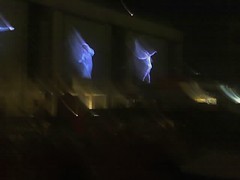
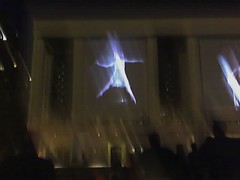
Oberon cutely peeking over his shoulder at me. And, in the background is Michalek (in red bandana) talking to the filmed dancer on crutches, whose name I now know (thanks to the playbills near the State Theater entrance 🙂 ) to be Bill Shannon, or “Crutchmaster.”

And here is Philip with his favorite ballerina, the spectacularly amazing, and, given her enormous status, almost ridiculously nice and personable, Wendy Whelan:

Sorry to be going on about it ad nauseam now, but I’m just so excited about this exhibit because I feel like it has so much potential to be really powerful. It’s like ballet for the masses, and I LOVE it.

Interesting thing about last night was, unlike the previous ones, there was no Midsummer Night Swing. So it was shown in stunningly dead silence. At first Philip and I were thinking, hmmm, this is going to be odd without music, maybe they could have classical or something?… But then after it began we agreed it was really quite beautiful, really poetic this way. Actually, it was more like a regular concert dance performance, like being at the ballet, but outside. And in this poetic silence, I feel like my previous suggestion of having the dancers’ names on the screens, would be as ludicrous as having an announcer yell out names, SuperBowl style, during a Met performance. But then, I still think it would make good sense to post the names prominently during the MNS crowd, because those people are not going to go running up to the State Theater to pick up a brochure or search for a poster; in that context, it needs to be easier.

Anyway, the lack of raucous crowd enables you really to focus on the odd beauty of the movement; I saw many things I’d missed before. Of course I had Philip and Wendy as guides. Wendy told us to watch for Allegra Kent, a former prima ballerina who danced many a performance, with the New York City Ballet, right inside that State Theater. At the start of her routine, she briefly turns her back to you, the viewer here, in order to face her beloved theater, and, inside, her audiences past. She raises her arms up high, in eternal gratitude to them, to what happened beyond those doors, now long ago. It’s such a poignant gesture of reverance to those fans, to the past, and, given who she is, to ballet history in general, and you just want to cry.


And I guess that’s why I want there to be a way of spreading that message to everyone; if you don’t know who she is, I fear she may just look like some weird lady casting a spell or something, you know? And that would be just a travesty.

When Janie Taylor came on, Philip squealed, grabbed my arm and galloped, dragging me along behind, over to the far right of the plaza, beyond the Midsummer Stage, where we could have a full view — something that definitely wouldn’t have been possible if it was a social dance night.

“Oooh, her hair, look at her hair, look at her hair!” he screamed, flailing about so wildly he really could’ve knocked me out had I been a little closer. Funny, but that flying mane did look cooly like a waterfall this time. Philip should be a professional laugher, or whatever those people are called who get paid to fire up the audience.

So, I dunno; I feel like my perception of the event, of the spectacle, varies on the context. There was still a congregation, but of course nowhere near the size of that on a Midsummer Night. It was a night for the true diehards. I’m glad I saw it when it was quiet and I could really concentrate (and meet Wendy!), but I still love watching with the Swingers, seeing what they see. (Thanks, by the way, to Michele, who commented on my last post, giving her view from that salsa mosh pit!) I have seen many of the social dancers, taking breaks, stand back and gaze up, and try to imitate some of the moves. You develop a dance aesthetic as a watcher / participant and it’s fun to try to mirror those screen giants, so long as no one gets hurt with some crazy over-the-head leg extension… 🙂

David Michalek's "Slow Dancing": A Good Idea But Poorly Executed (*Update in Bold)

Hehe, my friend, Ariel Davis, a young journalist currently in NYC for an internship with a big magazine, emailed me bright and early yesterday morning to tell me that we were quoted in the NYTimes! Of course I immediately scoured the article. Well, we weren’t actually quoted, in that our names weren’t listed, but we were the ones exclaiming, “he looks like a god,” the top quote in Claudia LaRocco’s write-up of the opening night of the Slow Dancing films I’ve been mobile-blogging about for about the past fifty posts now. (I promise to stop soon with the cell phone blogging; it’s just so exciting, in its own way). Anyway, the “god” Ariel and I were speaking of was Herman Cornejo of course 🙂

Anyway, I’m going to see it several more times before it leaves NY, but so far my thoughts are that the project is a great idea that has some real kinks to work out.

For starters, Lincoln Center is really annoying me and if I was Michalek I would be pissed. Slow Dancing starts at 9 p.m and continues until 1:00 in the morning; Midsummer Night Swing ends at 10:00 p.m. But after the MNS band stops playing, Lincoln Center really shuts down: the alcohol and snack bars all close shop, making it impossible to enjoy a drink with friends while watching the films, and, more seriously, a very noisy cleanup begins. The Aquafina guy noisily dismembers his metal booth then hauls it all, bit by bit, to a huge garbage-like truck waiting, motor running, in the nearby taxi cab lane; the bar guys clinkily clear bottles and glasses from their shelves; garbage collectors noisily bag trash and load it onto little trucks, which they drive dangerously through the crowd darting in and out and around groups of people, sometimes even honking if you don’t see them coming — how’s the audience supposed to focus on the film with all this crap going on? You feel like Lincoln Center’s telling you it’s time to go home now, show’s over, you’re out past your bedtime. Until July 29th, when this exhibit ends, could they possible re-arrange clean-up schedules? It’s hugely disrespectful to the artist and his audience.

As for the project itself, I think it’s a great idea and it seemed to work well when I saw it indoors at the earlier Works & Process event at the Guggenheim Museum, but for some reason, it’s not as exciting outdoors on the huge Plaza. I think part of my being so captivated at Guggenheim stemmed from the fact that I know and love all three dancers who were showcased that night: Wendy Whelan (ballerina of New York City Ballet), Herman Cornejo (American Ballet Theater), and Desmond Richardson (Complexions). But the vast majority of the dancers participating in the whole project I don’t know, or at least don’t recognize.

As LaRocco alludes to in her article, not a lot of the people on the Plaza for Midsummer Night Swing paid much attention to the films, unfortunately. Several heads did turn when the screens first lit up, and people watched for the first couple of minutes, but when they couldn’t see very much happening, they returned to their own fun. LaRocco bemoans that these social dancers, themselves participating in Dance, are ignorant of those on the screens, many of them the greats of ballet and modern dance.

Well, why should those dancers, having such a blast learning to dance themselves, stop what they’re doing in order to worship these people on the screens, whom they don’t know? Might someone, perhaps, tell them who they are?

From what I’ve seen so far, here are my critiques of the project:

1) No one knows who the dancers are and no one is bothering to tell them. If they’re not going to have easily available pamplets listing the names and credentials of the dancers, with pictures, could they run the names and a brief word about who they are somewhere prominent on the screen, at least at the start of each performance? Names humanize people. I’ve noticed this watching people watching filmed ballroom dance competitions — people who aren’t really seriously into the art of ballroom just kind of glance at the screen and look away after all of a minute — there are far too many people out there on the floor at once, it’s too much to take in, it’s confusing and nonsensical.

But once names are placed over the dancers (briefly, not for the entire time the camera’s focused on them of course), people pay much more attention, even if they’ve never heard the name before (which is highly likely). You think, ‘oh that couple’s obviously from Russia with huge names like that,’ ‘oh a Japanese couple,’ ‘wow, another Russian; a lot of Russians in ballroom, who knew…’ ‘oh wow, those are the national champions, yeah, they are really good,’ etc. etc. Names humanize. A little bit of info goes a long way.

Update: I went again tonight (Sunday), with Oberon, and found that there are little Lincoln Center playbills near the entrance to the State Theater, along with a poster, both giving the names and a brief background of each dancer next to his or her picture. I still like the idea of printing the names somewhere on the screens though! Also, I met Wendy Whelan tonight — she’s a very sweet person! Here is a picture of her and Oberon. Awww 🙂

2) There are either too many of the same types of dancers or there’s not enough variety and spontaneity in the rotations. At several points, there are two to three dancers shown all at once who are all doing modern. This is boring and reductive. Also, can everyone not be dressed exactly the same? Wendy Whelan and Janie Taylor are ballerinas but they’re both dressed in the same silky flowing gowny things as about ninety percent of all the women. To someone who doesn’t know dance, it could be confused with yet more modern. Couldn’t at least one be in a tutu and on pointe. And, could someone do a fouette or multiple pirouettes? The movement is too much the same. It would be much more interesting if there was, say, in the middle a classical ballerina on pointe in a tutu doing fouettes, then say the African dancer guy on one end, and maybe William Forsythe doing his modern on the other end; then shift in the next sequence to the bellydancer, adjacent to the head-spinning break dancer, and sandwiched in between, the drag queen; then next sequence, say the guy on the crutches, the pregnant woman, another ballerina; or have a ballerina surrounded by a strong ballet guy and one of the modern women. Just make sure there’s variety in every sequence of three. That makes it interesting and it’s more of a celebration of Dance, in its rich variety.

3) I realize the point of the project is to show movement in extreme slow motion, but I feel that it is too slow. At points you can’t even see the dancers moving at all. This actually may be a glitch in the film, because at some points I think the films have actually stopped for a while — sometimes even for as much as a full minute. This is confusing to the audience, who is already perplexed enough trying to figure out, as LaRocco illustrated with one couple’s conversation, if there actually is movement. Possible technical problems aside, though, the movement is generally still too slow. Instead of people admiring every detail of the body in motion, every ripple of a muscle, the audience just gets bored, especially if the dancer isn’t “flashy” enough. These past couple days I’ve become most fascinated with Glem Rumsey, who dances here as his flamboyant drag persona “Shasta Cola.” I find myself waiting for him to come on because I know I’m going to be most entertained. In contrast, one of the dancers I was most excited to watch was Janie Taylor. Yet, I find myself getting unexpectedly bored when she’s on here. She does nothing really over-the-top; no spectacular balletic feats. Even that crazy hair flip that generated a lot of press talk pre-show opening — it’s nothing; I almost missed it. There’s no appreciation for subtlety when the movement is this weighted down. The guy on crutches is initially intriguing because you’re wondering what he’s going to do, but you get bored and stop watching when he takes so long to get going. All of a sudden you look back and him and he’s in the air. You think, ‘oh wow,’ but it still doesn’t hold your attention for long because it takes a number of minutes for the guy to do one rotation. You lose interest. Same thing with the Whirling Dervish. Slow-mo can have a very dramatic effect, but not when it’s this slow.

My own personal favorites are Herman Cornejo, Desmond Richardson, William Forsythe, and the aforementioned Rumsey, all of whom, excepting Rumsey, I’m pretty sure I like simply because they’re already so familiar to me. I’m bringing a bunch of friends to the show over the next couple weeks, many non-dance-goers, so will be interested to hear what they think, who their favorites, if any, are. Will most definitely report back!

In the meantime, I’ve started an album on the photo page; I expect to add more pictures, but here are the first few.

Dance Is For Everyone: David Michalek's Ginormous Public Video Art and Those Midsummer Night Swingers

I’m not a huge social dancer (I mainly take ballroom lessons in order to compete and perform), but I do like going to Midsummer Night Swing to watch the crowd having itself a blast. Midsummer Night Swing is held on the Plaza at Lincoln Center from mid June through July. Each night a different band performs on the bandstand, alternating between several types of danceable music: big band Swing, country western, Salsa (by far the most popular), Disco, and at one point this year there is even to be Samba! At the start of each evening, instructors from various ballroom dance studios in the city give a little lesson in the dance style of that night.

Above are the ever amusing Melanie Lapatin and Tony Meredith, owners of my old studio and 1995 U.S. National Latin Champions, on July 4th, giving the salsa lecture.

Which was followed by this very crowd-wowing demo by a young couple associated with Dance Times Square, Sascha and Oksana.

Always fun to see how people take to the action: some bemusedly learning to dance for the very first time, and others, like this guy above, showing his homeland pride and helping the band out a bit from the sidelines with his maracas.

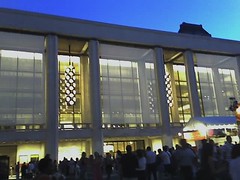
It was raining off and on on the 4th, so the crowd was unusually small, but it’s normally so packed out there you can hardly move. I just love how they have this immensely popular social dance event located smack in the center of THE institutions of “high art” dance: The State Theater, to the left in the top pic, houses the New York City Ballet, and the Metropolitan Opera House, in the back, the American Ballet Theater, which just ended its Spring Season. For the first couple weeks of Midsummer Night Swing, ABT performances were still happening, though, and I often wondered if any of the social dancers, for example, this cheery Puerto Rican group, noticed any of the several large posters in front of the Met showing scenes from the ballet, and were at all inspired to try a ballet performance. Something tells me likely not.

But tonight, that may well change. It’s the official opening of photographer / filmmaker David Michalek‘s new public art dance exhibit, “Slow Dancing,” also at Lincoln Center Plaza.

Michalek filmed twelve dancers from various styles (including several from ballet), doing a very brief five-second movement, which he then slowed way the heck down, so that each segment plays on film for a whopping 10 minutes. Three giant screens are to be erected on the front of the State Theater, one dancer on each. I’d gone to see him speak about the work at the Guggenheim a few months ago, and blogged about its potential iconic effect on the dancers shown, here.

This public art project is part of the Lincoln Center Festival and will continue through the end of July, when it will travel to other outdoor venues throughout the country.

I love that this project is available for all (there’s no fee to access the Plaza), and I’m really excited to see this unique intersection of ballet and social dance, or, I guess “high” and “pop” art, if you believe in dichotomies. From the sound of it, the screens will be so large that I feel people will be compelled to look. Hopefully, of course, they will be captivated by the movement as well. We shall see!

Don’t Listen to Alastair Macaulay! Or, Rather, Do Listen to Him, But Listen To Everyone Else As Well!!!

I got so upset and angry when I read his review of Cinderella in the Times yesterday, which is rather funny for me since not too long ago, I screamed at everyone at Oberon’s Grove (a very New York City Ballet fan-centric blog) for not letting a critic be critical and obsessing over those who harp on NYCB’s artistic director, Peter Martins 🙂 And now that Macaulay’s ripping on my beloved American Ballet Theater, I know how they feel! Seriously though, obviously I stick to my guns that in a democratic system a critic can and should be critical, should never be silenced, and should offer opinions based in knowledge, education, insight, and love and passion for his/her chosen field. So, I value Macaulay’s opinions, and I respectfully disagree with him. The problem with dance criticism I feel, and the reason why fans get so upset, is that (unlike, say, film criticism or theater criticism), there aren’t enough critical voices out there offering different perspectives, leaving one person’s opinion to have HUGE repercussions, especially when that one person writes for the New York Times.

Anyway, I’ll return to my thoughts on dance criticism in a minute, but first I just want to say how much I LOVE the version of Cinderella that ABT is doing right now. (That’s dreamy David Hallberg, as Prince Charming, and fabulous Gillian Murphy, as Cinderella in that pic above, by the way). This version, a recent one by Canadian choreographer James Kudelka, sets the action in the Roaring Twenties, the women donning wavy bobs, the men suits (that means no tights, for straight men who freak out over such things — more on that subject in a later post…), replete with Art Deco sets and very fun, colorful costumes. The dance style is not classical, but rather modernist, ballet, and, set in the Jazz Age, the movements have a swingy, jazzy, hip-jutting, flirty component that’s rather fun and sexy if you ask me. In the Ball scenes, the women slink around on point, walking like they’re on a catwalk. It looks ten times cooler than it would in high heels, and makes me wanna go out and buy a pair of toe shoes, just to walk like that! No, it’s not “classical” ballet, but it’s a lot of mad crazy fun — can ballet please be fun for once? Is there a rule that says it always has to be serious and that everything ABT does has to be “classical”?? Almost everything ABT does during its Met season is classical. I’m so happy they gave us Kudelka’s Cinderella, and Lar Lubovitch’s Othello for a change. Classical ballet is sublime and it must be preserved and its beauty shown to younger audiences, but there must also be a good amount of the new for ballet to maintain a fresh focus and have a future. ABT is “America’s National Ballet Company” and it should have something for everyone, younger and older. We don’t need more (classical) Frederick Ashton, as Macaulay wants; we need more James Kudelka for the younger generation!!! Okay, enough of that rampage, back to Cinderella.

Everyone knows the basic Cinderella story, so I don’t need to repeat it, but here, Kudelka has gone all out on the humor and kept the wickedness to a minimum. Cindy’s stepmom is a nutty, silly drunk; her stepsisters consist of a bespectacled dork who nevertheless seems to smack into everything in (her poor) sight and confuse the prince with his assistants, and a would-be vixen who’s far too much of a sweetly geeky screwball to actually be seductive. Since this is a ballet, the stepmom hires a dance instructor (danced gorgeously by my wonderful — and tall — Vitali!) to teach the stepdaughters and their equally looney paid escorts to the Ball, how to dance. Of course the sisters hilariously fall all over each other and their paid men. Macaulay finds these characters all unfunny. I couldn’t disagree more. The audience was laughing hysterically and the ballerinas who danced the sisters, who took curtain call bows in character, all got tremendous rounds of applause, so I think the audience was largely with me on this.

I love the way the pointe shoes are used: in contrast to the sisters who don the shoes throughout, in the beginning Cinderella dances barefoot, echoing her life of poverty. Part of her Ball costume, as bestowed by the Fairy Godmother, consists of the beautiful toe slippers, one of which comes off during the mad midnight rush to get her back to her stepmom via her theatrical Pumpkin-mobile. (By the way, regarding all these fun props, etc., Apollinaire Scherr in her Newsday review likens Kudelka to film director Tim Burton. I LOVE that comparison! Please, Mr. McKenzie, spice things up more often at ABT; more ‘Tim Burton’!!!) Anyway, once Cindy gets home, she dances, one foot on pointe, the other flat — one foot in the land of fairy-tale, the other in that of her drab sad life. To me, it’s a perfect poetic illustration of the power of ballet to transport you to another world.

Okay, as for the dancers: Marcelo as P. Charming 🙂 🙂 🙂 Marcelo’s like a movie star who somehow ended up on a ballet stage. He’s such a great actor, and he just has this face that says it all without even trying. When the dorky myopic stepsister puts on her glasses to see she has just been flirting with the wrong man and turns around to lay all her “charms” on Marcelo’s poor Prince, all he has to do is shift his facial muscles ever so slightly to widen his eyes and it’s the perfect understated reaction. You just can’t stop laughing. He’s like a Rupert Everett or a Hugh Grant or something; he doesn’t need to do much onstage; he’s a natural. I love the fact that he dances in NY, where I can see him up close several weeks per year, and would never ever want him to leave, but I do wonder if he could make that Baryshnikovian transition from stage to screen… And Julie Kent was beautiful. She dances so well with him; they’re such a perfect match. The pas de deux, which Apollinaire’s more advanced dance vocabulary can far better describe than I, were so sweet I wanted to cry.


David, on the other hand, is the quintessential ballet dancer. Just one look at him and you can tell he was born to dance ballet. He’s like a throwback to the great ballet men of yore. Marcelo is the consummate ‘leading man’; David the ‘danseur noble.’

And Gillian is such a spectacular ballerina, and, with her warmth and glow, so perfect as the fairy-tale heroine. Julie is a perfect partner — when I think of her I think of a beautiful, dreamy pas de deux; when I think of Gillian I think of crazy fast fouettes and pirouettes — she definitely brings to life the solo bravura parts of any choreography. People say Gillian is shy in real life — I can’t believe that! She seems so outgoing onstage!

The others: Carmen Corella!

I absolutely LOVE her would-be-a sexpot-if-she-wasn’t-such-a-klutz stepsister. (She danced in the first, Marcelo / Julie cast.) I know a lot of people long to play the principal roles, but the ‘sidekick’ parts are crucial, the main roles in contrast can often be a bore. She really brings those parts to life and often makes the ballet with her crafty, unique, often hilarious interpretations of them. Kristi Boone, who played that character in the second cast, was good, but I just really think Carmen owns that role — she should dance it every night. Marian Butler was expectedly cute as the bespectacled dork sister, but Maria Riccetto surprised me with her raucous rendition as well. (I still miss Erica Cornejo, who owned that role last year before she left ABT for Boston!).

Craig Salstein!


He did this absolutely scream-out-loud pelvic gyration while Carmen’s stepsister was trying to fit her fat foot into the tiny toe shoe. It went along perfectly with the beats of the music and it was so funny I’m sorry to say I giggled all throughout the beautiful (and very serious) ending pas de deux between Cindy and the Prince, just remembering Craig.

Adrienne Schulte made my night Tuesday as the hilariously drunken stepmom. She completely commanded my attention everytime she was onstage. She is a Carmen-to-be 🙂


I left out a bunch of fun stuff, like the wildly bouncing pumpkin men, the ever-amusing Twenties-style world-wide search for the girl who fits the shoe, including the bumpy “car ride,” the independent-woman Amelia Earhart who could give a crap about some prince and his toe shoe, and the photographer with his blindingly flashy camera and the vanity of the new media with all its ‘poseurs.’ It’s so much fun, and is playing now through Saturday night. Don’t listen to Macaulay! Go!

Okay, if you’re not a dance-industry person or just some crazy person like me who really really really cares about dance, please stop reading now (because this next section will bore the pants off of you). Just get a ticket and go see Cinderella. Hurry, you only have a couple of days left. Go here for tix.

Now for a few stray thoughts on dance criticism: Apollinaire Scherr has a very interesting post today about her thoughts on Alastair Macaulay’s reign as the New York Times chief dance critic thus far (he replaced outgoing chief John Rockwell earlier this year; go here for Apollinaire’s earlier (and very controversial!) writings on that). As the chief dance critic of the New York Times, she believes he has the most important role of all press people in the dance world. I both agree and disagree with that. I think the Times speaks to the audience that is most likely to go to a ballet performance, and so, I think whoever has an article in that newspaper is going to have a lot of power. I think it’s we people in the dance world – the writers, the dance-makers, the administrators, the dancers, the fans — who pay attention to bylines; I think the average newspaper or magazine reader has no idea who wrote what article; they just remember the writing and opinion expressed within as “the Times article,” as in “The Times said, this,” or “The Times thought that,” about a performance.

That said, while I often disagree, yet sometimes agree, with Macaulay’s interpretation of or opinion on something, I appreciate that it’s there. BUT, I think it’s ESSENTIAL that other voices abound and are heard. Apollinaire (I’m sorry, I tend to call dancers and writers who I “know” –either personally or through their stage presence — by their first names! — it’s a sign of familiarity not disrespect, but I’ll try to remember to call people by last names!!) — anyway, Ms. Scherr made a reference to Macaulay not being that much of an “old fart” like some of his predecessors (ie: Rockwell, who I thought had some good ideas toward the end of his tenure which I’ll get to in a minute). I kind of disagree with her on that. I think some of the views he’s expressed have been that of an older generation, and, in particular, an older male generation, such as his piece on the retiring ballerinas, in which he made some kind of reference (sorry the permalink to the article has expired or I’d link to it) to ballerinas as being the most important part of ballet. As a younger woman, I, like several younger women I know, go to see the men, so that does not ring true with us. For example, it was lamented recently by one such younger woman that ABT’s 2007 calendar contained ballerinas. And, a look at some of the posts on the Winger message board, for example, replete with pics of Hallberg posing for a catalog in a dance belt, and you can see who is going to the ballet and for what reason. Anyway, I felt completely alienated from that review of Macaulay. BUT, I am also glad to have read a review with an alternate opinion from my own and, now I know why ballet is so important to an older generation, and particularly a male one. And I can use it to fight with my straight male friends who insist that no straight men ever go to the ballet unless they have homosexual tendencies (but more about that later…) Also, this Cinderella review, I felt, came from an older perspective — one that wanted all the classics back and was not open to the new.

I’m relatively new to dance, but I’ve noticed that there’s a lot of real anger and animosity and even rather crazy intense hatred in the dance world between writers / media and fans and media and administrators and dancers, sometimes even between media people. There seems to be more fighting in the dance world even than amongst lawyers 🙂

I don’t know if this is normal in the arts, but I recently attended two panel discussions that really floored me. The first was The Nothing Festival, which I blogged about earlier, and which was organized by choreographer Tere O’Connor and was supposed to deal with the creative process and the process of grant application writing. Instead, it very quickly devolved into a discussion, all choreographers both on the panel and in the audience in agreement, of how much the press basically sucks — how horrible the writers are, how they don’t know what to look for in a dance performance, how dance is totally devalued in the Times and on TV, how there are no good dance critics like (film critic) Pauline Kael, how dance criticism is awful compared to other arts criticism, etc. etc. etc. It was really actually very interesting for me as a newcomer to the dance scene, and I’m very glad I attended, and, toward the end of the four hours, we were actually beginning to get somewhere productive, but then it ended.

I then attended a panel discussion at NYCB with the main R+J dancers (Hyltin, deLuz, and R. Fairchild) right after the opening of Martins’ Romeo + Juliet. One of the first questions the moderator posed to the dancers was, “how did you deal with all of that criticism?” Mumbles of annoyance abounded in the audience. “Oh, it’s very hard; I don’t look at reviews anymore until after the run is over,” Hyltin said, a very upset tone in her voice. “One very nasty review really affected my performance one time,” she said, dejected. DeLuz, older and more experienced, was more cynical: “I gave up paying attention,” he laughed with a shrug. “They’re gonna say what they’re gonna say — they know beforehand, before they even see it.” A woman audience member then raised her hand: “Oh I just got so mad at that one critic; I just wanted to wring her neck… I just … well … I should have written in,” said, shaking her fist in the air. “Yes, you should have,” the audience practically said in unison. And just on my blog and on Philip’s blog, some of the comments we get, there’s so much anger at the dance writers.

All of that anger upsets me because, after being forced to take a break from dancing myself and now turning to blog about these dance performances that I see, I can say, of all the things I’ve done: law school, heinous bar exam, writing a novel and actually getting an agent to represent me, learning to dance as an adult — writing meaningfully, forget beautifully just meaningfully (!) about dance, about something so visual and so amazingly beautiful and so compelling, is just about the most challenging thing I’ve ever done. So, it greatly bothers me that dance people have so little respect for the incredibly difficult (and often very underpaid) work that dance writers do.

But what really confused me was why, why all the anger. I regularly attend book readings (where authors read from their work), independent film festivals (where the filmmakers are on hand to discuss their film), art openings (ditto for the artist), and I’ve never heard anyone ask, “how on earth do you deal with all the criticism?” And it’s not like criticism doesn’t abound in those fields — particularly film and book reviews. I think it’s at least partly due to the fact that there are so few writers, so few voices, which make those few existing voices incredibly important to the success of the production, or the reputation of the dancer. Scherr also criticised Macaulay for his sometimes sarcastic tone, in particular with respect to Irina Dvorovenko, and how damaging it can be to a dancer. I agree. Sarcasm in reviews is nothing new though — Gia Kourlas and Robert Gottlieb have done the same, as have Pauline Kael and, one of my overall favorite critics, Anthony Lane, whose reviews I often find to be works of art in themselves. And sarcasm is oftentimes very funny and it works well to make a point. But, I think that kind of thing just operates differently in film criticism — there must be tens of thousands of film critics all over the country. If a dance critic does the same thing, it could have a profound effect, since that one voice is often the only one that’s heard on a certain production or dancer. Tuesday night in the ladies room I overheard one woman to another: “How are you liking it?”

“Oh, I really like it?! I do!”

“I know, so do I?!”

“I can’t believe it, it got bad reviews, but it’s really actually good!”

People take these reviews very seriously.

I honestly got so upset over Macaulay’s Cinderella review, I’m embarrassed to say I nearly cried! I always get weird though at the end of the season; after all I’m not going to be able to see my favorites again for several months, and then only for a tiny three-week run at City Center. I guess I just worry that audiences aren’t going to see Cinderella because “The Times” didn’t like it, and then Kevin McKenzie’s not going to put it on again, and I really really really think that if ballet audiences are going to grow there needs to be more contemporary work performed, a combination of the classical with the modern, like McKenzie kind of did this season. I personally want to see them do more of it: more Mark Morris, and some Matthew Bourne and William Forsythe and Neuemier’s “Death in Venice,” etc., etc., but I well know I’m not going to get all that! Just some, though, would be nice, and the Kudelka is a huge start 🙂

I’m glad Macaulay’s given Gia Kourlas some good assignments (she got to write the Othello review and the Alessandra Ferri farewell review), and she kind of represents a different, younger-generation voice, so that’s good. But there’s still only one review of each thing, and so little space is given… And of course there are other papers and magazines but they often get overlooked by the general public, and then their review space is so limited too. And half the time, the reviews come at the END of the run (what was that Joan Acocella article on the two Romeo and Juliets doing in last week’s New Yorker; it’s been like 10 years since Martins’ R+J premiered now??) Dance critics and writers are hugely important, as they bring dance to the public with their insight, their vast knowledge, their poetic descriptions, their expressions of passion for their art, they create excitement for dance, they create dancer personalities with interviews and profiles. There needs to be more!

I also think sometimes dance critics are SO knowledgeable that they get bogged down in their own ken and forget who their audience is. As Scherr pointed out, in his review of Sleeping Beauty, Macaulay went on and on about the differences between McKenzie’s version of the ballet and the others, for example, the one the Royal Ballet puts on. I know it’s hard not to do this when there’s a brand new version that’s being shown and you have all these prior productions that you feel are superior, but what is the average ballet-goer supposed to do with a review like that? So, he thinks the Royal’s version is better; the Royal’s not performing in New York right now, so what am I supposed to do, buy a plane ticket and head to London, petition McKenzie to change versions for next year? Should I go see ABT or not — that’s all I want to know as a Times reader. Maybe this is completely contraditory, but I did like, however, his first couple of reviews, of the beginning of NYCB’s season and their Balanchine programs, particularly of Kyra Nichols’s performance compared to the others’. I’d blogged about it here. I thought those early reviews hinted at (and only hinted unfortunately, presumably because of space limitations) what made Kyra so great, what made Balanchine great, what perhaps could be missing from NYCB, from the other dancers, in terms of presenting Balanchine. Not that such reviews told the average reader whether or not to go to NYCB, but I guess it gave me a small sense of what to look for in Kyra, what to look for in Balanchine, how to look more closely at a Balanchine ballet and what to appreciate about it. And it got some people, for a short while, talking. So I guess good dance writing should also make people think, or compel them to look more closely, or give them a sense of what to look for, or just get people talking. His Beauty review didn’t do this, unless I don’t know the Times audience at all and everyone really does want to know which version is the best. How do you know who your audience is anyway?

Oh, and the thing I was going to say about Rockwell: I thought, “fuddy duddy” though he may have been, that he made a great suggestion toward the end of his tenure, and that was to rotate the productions during ABT’s Met season, as the opera does. I know one reason why newspapers and mags don’t give a lot of space to dance is because the runs of a certain performance are so short and a paper gets the review out and readers have about five minutes to get a ticket before the thing closes. I think getting rid of the block programming would give the media a chance to create buzz about something (through either positive or negative reviews) well before it closes. I realize this does nothing for the smaller companies who can only afford to have very short runs… It’s like dance isn’t that popular because there’s so little press and there’s so little press because dance is not popular… Ugh. Sorry for all the random, haphazardly expressed thoughts. Apollinaire just got me thinking!

Diana’s Beautiful But Aloof Prima Russian Swan, and A Snubbed Marcelo!

So, last night I went to see ABT‘s Swan Lake, starring my favorite (Marcelo Gomes OF COURSE), and the Russian ballerina ALL the critics are talking about, Diana Vishneva, who divides her time between the Kirov Ballet, in St. Petersberg, and ABT. I was really looking forward to seeing these two together, and particularly to Ms. Vishneva, since I’ve seen so little of her.

I just WANT so badly to love her. She just didn’t really do it for me here. I do think she’s a great ballerina capable of really taking your breath away at points. In the third Act of the ballet (the famous black swan pas de deux), she whipped around those fouettes around like I’ve never seen anyone do before — I’m not a counter but I swear it seemed they numbered in the triple digits, and she was spinning so fast I felt my own head spin just watching her. She looked pleased with herself, for once (I think she’s very, very hard on herself). But artistically, and I almost feel badly criticizing her for this because I feel kind of like it’s a Russian thing, but I feel that she’s a great solo dancer, a great prima ballerina, but one who works magic on her own, not with a partner.

In fact, she wasn’t working with my Marcelo at all! Near the beginning, Marcelo’s Prince Siegfried has just been given a crossbow at his coming-of-age party and now is out in the woods dealing with the fact that he’s about to become king and must get over his childishness and pick a bride. He sees the beautiful swan and of course, like a dumb boy, starts to take aim, when she suddenly transforms into the beautiful girl, Odette, that she is (pre-spell cast by the evil von Rothbert). When she does so, he is stunned, immediately taken with her, and quietly watches her. She soon spots him and is afraid, and he makes clear he’s not going to harm her; to the contrary, he’s mesmerized. She then tells him her sorrowful story of the spell and what must be done to relieve it.

So, I feel like I only saw this story from Marcelo’s point of view. When he shows her he’s not going to harm her, his feelings are so clear; he acts it perfectly. But she hasn’t seemed fearful, so I’m totally confused. And I don’t see her transforming from swan to girl, back to swan — I see something lovely and ethereal, but that’s all, no story and no dual character. And then when they do the pas de deux (in which she’s supposed to tell him her sad story), I see a prima ballerina dancing gorgeously as a beautiful swan, but NOT a swan — a prima ballerina dancing as a swan. And, I don’t see her communicating in the least with him. It’s like the man is just a human elevator, just there to lift her ballerina / swan into the air so that she can shine up there, half way to the ceiling, gloriously. And I know there are those to whom this is what Ballet is: the man is not supposed to be seen; he’s just there to carry the ballerina all over the stage and keep her from falling during her turns and arabesques so that the illusion that she’s this ethereal being who can float in the air unsupported can be maintained.

But that’s not Ballet for me. The man is essential to me. He’s part of the story, and he’s an important character, and he’s not just a human transporter of ethereal ballerinas. He’s the man, he’s Marcelo, and he should be seen, dammit! 🙂

Okay, back to that third Act, the black swan pas de deux where she does the spectacular fouettes: Diana is now playing the evil von Rothbert’s daughter, Odile, whose mission is to seduce him so that he will not be able to save Odette from her swan fate. I felt this duet worked ever so slightly better since she’s now supposed to be kind of wickedly, meanly, seductively playing with his feelings, but it still wasn’t what it would have been if theirs was a true partnership. It was too much about her; she was still too aloof to be seductive.

Weird as this may sound, what I actually DO kind of like about her is what she brings culturally to ABT. She so Russian, the way she takes her mid-performance bows and then curtain calls in the end. It’s actually kind of fun to see that on an American stage — all of that slow, drawn-out melodrama and extreme seriousness. Russian ballet dancers take themselves and their art with all the seriousness in the world. And what I love so much about Marcelo is that he’s such a great partner, such a great guy, such a great overall human 🙂 that he just goes along with whatever his ballerina is doing. So, with her, he kind of became “Russian” too — standing in back of her and presenting her as if she’s absolute Royalty, all intense seriousness and melodrama right along with her.

My ballet universe just would not be the same without Marcelo 🙂 He tells the story for me and makes everything real and human and relatable. Even just the way he sits on his throne watching all the would-be brides, taking it all in, humored by some of them at points, then thinking he sees Odette, remembering her, realizing how devastated he is, the way he first sees the swan and boyishly wants to take aim, then is overtaken by her transformation, the way he “talks” to her… Like I said, he just tells the whole story with his face and his actions. And even outside of the world of the story, the way you can see the dancerly concentration on his face, making sure he’s being a perfect support for the ballerina, just taking care of her onstage — it’s so endearing; makes him seem like a real guy and not a “dancer” — I guess the complete antithesis to her.

One other thing about her: I saw this posted on Ballet Talk. It’s her website and she has a page where fans can interact with her. One fan recently told her they were excited about coming to see her perform here, said they were really looking forward to seeing marvelous dancing. Her response: “good luck.” Hehe. She obviously has a fun sense of humor, another thing that makes me want to like her… Not like personality is a substitute for knock-out dancing, but it’s definitely not unimportant either… I will definitely keep going to her performances; there is something very intriguing about her; she has a real mystique, even if she hasn’t blown me away yet 🙂

Anyway, intermissions were fun-filled as well. I saw Anna Kisselgoff, former New York Times chief dance critic, in the ladies room. Then, I ran into Apollinaire in the lobby! She took me to the press office to get press packets — there’s a lot of very interesting info in these little packets: in-depth history and synopsis of the ballet, info on the choreography, the scenery and costumes, the music and the score broken down to each tiny piece of the ballet, all kinds of cool details. And there’s a whole little universe over there on the lower left side of the house, orchestra level — all these little nooks and crannies, little rooms and offices! Who knew?!

AND, while we were lounging outside of the press office, in the hallway, who should come blazing through the back door but the illustrious Roberto! I tried to stay all calm and act nonchalant and pretend I had no idea who he was, but, as they rounded the corner, his friend caught me staring at him all doe-eyed from behind. Oh well…

One last thing: here is Vitali Krauchenka, a corps dancer who danced von Rothbert:

Philip and I saw him at the gift shop at New York City Ballet a few days ago (albeit looking not like the pic above but like this :)) during the final performance there. Very strong stage presence! I really like him.

So Excited: Tonight, Favorites Dancing Swans, and in the Future, a Portrait in Dance of Chuck Close!

Tonight I’m seeing Swan Lake performed by these two above — my favorite Marcelo Gomes and the ballerina EVERYONE’S talking about, Diana Vishneva. I’m so excited — my first time seeing them dance together 🙂

Also, I’m so excited about this. During their upcoming Fall season, American Ballet Theater will be premiering a brand new ballet by Finnish choreographer Jorma Elo set to Philip Glass’s piece “A Musical Portrait of Chuck Close,” with set designs by that oh so iconic artist. I just love Chuck Close and I’ve loved everything I’ve seen so far by Elo, and of course Philip Glass is Philip Glass — this is going to be a HUGE collaboration between three spectacular artists from three different fields and is one I just can’t wait to see!

They’ve also got a bunch of other very fabulous stuff on the Fall agenda, including another premiere choreographed by NYCBallet dancer Benjamin Millepied, an ABT premiere of another Balanchine I haven’t seen, and revivals of some of my favorites, including Tharp’s Sinatra Suite 🙂 Robbins’s Fancy Free 🙂 Stanton Welch’s Clear and Lar Lubovitch’s Meadow. Go here to see it all.

Ashley Bouder's Absolute Gem of a "Ruby"

Okay, this has to be short and sweet because I have about five briefs to write before I go to bed tonight, but I just got back from seeing my second production of “Jewels” at NYCBalletgo here for my post on seeing this wonderful ballet for the first time. (By the way, I just started flipping through Terry Teachout‘s book on Balanchine and noticed he signed it and wrote, “To Tonya, in honor of her first Jewels.” Aw!!) This was my first time seeing ballerina Ashley Bouder in the main role in “Rubies,” as her debut in the part took place just last night (which explains what Alastair Macaulay was doing sprinting back and forth across Lincoln Plaza last night — if you don’t know what I’m talking about, go here, for my post on last night. Hehe, I hope I’m not revealing anything I shouldn’t be 🙂 — Arlene Croce said she used to do the same thing… and it does show how happening the NY dance scene is right now if the critics are running all around like mad people trying to see everything at once.) Anyway, as I said, Macaulay did not seem to have been successful in getting into Jewels last night, so I do hope he went back today because Ashley Bouder IS NOT TO BE MISSED IN THIS ROLE!!!! Oh my gosh, she completely knocked me out! She is such a powerhouse, just wizzing around stage in those turns this way and that, traveling at lightning speed and changing directions like there’s nothing to it. But she is not just an athletic, virtuostic marvel — she is known for that after all — artistically she was brilliant as well; she really brought to this role exactly what Balanchine must have had in mind when he created it. She perfectly exemplified the sexy, jazzy, sassy, flirty American with showgirly flair. She really brought Rubies to life for me, in other words. I can’t help but still love Diamonds best — just watching all of that beautiful partnering, the stage filled with couples at the end, the gorgeous pas de deux and the Tschiakovsky music… it just makes me nearly cry — but Ashley’s performance today almost made me reconsider my favorite “jewel.” It’s really too bad that today marked the end of the NYCB season (a lot of endings this weekend), but when they bring it back, you MUST go see this one in Rubies! You must!

I loved Emeralds just the same — it’s probably my least favorite of the “stones” but I think it’s slowly growing on me. And I’m loving Rachel Rutherford — last time I went on and on about her beautifully expressive wrists, this time I couldn’t get over her lovely en pointe tiny-stepped pas de bouree couru turns. Is she dancing the role that Balanchine originally choreographed on Violette Verdy I wonder? I’d love to see what Verdy looked like, not to compare, but just because the former history grad student in me wants to know. Philip, who accompanied me today, handed me his binoculars when Robert Fairchild took the stage! (He knows how much I like him 🙂 ) We were sitting near the front of the orchestra!! I said, I don’t think I need them to see him that close up! And Maria Kowroski was stunning again in Diamonds, as was her very leading-manly partner Charles Askegard (who I forgot to mention last time). Oh dear, I almost called him Charles Bushnell… Speaking of which, Candace Bushnell (his wife, and “Sex and the City” lady), was right when she told him he was tall for a ballet dancer. I usually sit in the fourth ring, where everyone looks a lot shorter, but sitting up front, as I have been lately, you can really see people’s real sizes!

Oh, also, Philip and I met up with some of his friends, Monica Wellington and her beautiful daughter Lydia (who is currently a student at the School of American Ballet, run by NYCB), and, at intermission, they took us to the patron club, called The Green Room. This was the first time I’ve been in there and it’s really lovely. It looks just The Green Room at the Victoria and Albert Museum in London, so called after 19th Century artist / designer / writer / philosopher William Morris. It looked like it was perhaps decorated with his wallpaper designs… Beautiful!

Oh, last note, happy Gay Pride day, everyone 🙂

Farewell To My Favorite Ballerina

Last night was Alessandra Ferri‘s last night performing with ABT; she is now retired. Horribly sad night. I don’t even know what to say other than that I am very sad right now.

(Here she is with her two little girls).

But I have to say, the blow was lessened by Roberto Bolle, who played her Romeo. When I first heard she was bringing in someone from La Scala (Italy’s national ballet company) to dance the male lead in her final performance, I was so upset. Why wouldn’t she dance with an ABT dancer — why not Jose Carreno, who partnered her frequently? Actually, I was secretly hoping they’d bring back Julio Bocca (who was known as her long-time ABT partner and who retired last year), but no such luck. Why someone from outside, I thought? She said it was her gift to him (Bolle) — to let the world see him. Now I can see what she was talking about!

Seeing someone new, and with such promise(!!!), made you focus on a beginning, not an ending. And, oooooh, he was so amazing last night as Romeo; words cannot even describe! He was overall the best Romeo I’ve seen at ABT (excluding the aforementioned Jose, who I think all ABT fans know in their heart of hearts is going to be going soon) — he acted the part perfectly, he danced it spectacularly. And he is oh so gorgeous — such a beautiful beautiful man. He needs to come to ABT permanently! WE NEED HIM AT ABT!!!!! What is La Scala anyway? New York’s where it’s all at, right!! We so need a tall, dark and handsome romantic male lead. Of course there’s Marcelo, my love, but he is not enough. And, well, he is just different anyway. He’s like the down-to-earth college football-player boyfriend. Roberto is tall, dark, and foreign. (I mean, Marcelo’s from Brazil, but he just looks so American, and he’s been here since he was 13 so he basically is American). Anyway, we need Roberto!!! Oh please please please please please, Kevin, make him an offer he can’t resist! Puleeeease!

(I am really sorry my pictures are so crappy — I was sad and my hand was shaking and people were bumping me right and left, so they’re blurry as hell, but, still, I have GOT to get a new camera!)

Of course there were 10,000 curtain calls. Here are a few more pics:

(Picking up her bizillions of bouquets, the conductor behind her)

The dancers came out one by one (just like with Julio’s farewell), to hug her. Of course I had to get a shot of Marcelo in the action!


Here comes Paloma in the flowing red skirt. David is behind Alessandra, diagonally and to her left. He was the first one out.

Aw, Kevin McKenzie (ABT Director) hugging her.

It’s raining confetti!


It goes without saying, the house was PACKED.

They had these enormous, blown-up photographs of her, taken by her husband, photographer Fabrizio Ferri, lining the walls of the lobbies.

There wasn’t as much curtain-call insanity as when Julio retired last year: no taking out a beer, letting it explode all over the stage, pouring it on yourself, then letting the crowd watch you slowly enjoy your beer, then letting David and Marcelo hoist you high over their heads and carry you all over stage, then coming out in your underwear at the end… but then again Julio is Julio… 🙂

About the two previous pics, taken with my cell phone: in the second one down, the poster is of Angel Corella and I think Diana Vishneva posing for Romeo and Juliet, not Roberto and Alessandra — it was just the only thing I could think of to take a picture of on the spot during intermission so I could gush on and on about how in love with Roberto I was!!!

And top pic below, I tried to take a picture of the Fabrizio Ferri photographs in the lobby with my cell phone, but, as you can see, it didn’t come out so well! I was very excited because I was sitting in orchestra, and this couple came down to the front and was looking for a pair of free seats (like there were going to be any on this night of all nights). I heard the guy behind me say, “Are you looking for seats? Well, the seat next to me will be free but only for the second act. My friend, who’s from the New York Times has gone over to NYCB to watch Jewels for this act, but he’s coming back over here for the final act.” Oh wow, I thought, I wonder who it is. The woman looking for a seat sat down. Then, a couple of minutes later, I hear, “Oh, sorry, the seat’s not available after all. Alastair is back.” Apparently the Jewels idea didn’t work out. Of course I whiplashed my head around. He didn’t look very old! Not that The Times is going to hire as their new chief dance critic an 80-year-old to replace the retiring 80-year-old, but still — he looked REALLY young. Of course I didn’t sit there and stare, but … he looked so normal! I just expected a chief critic to look like … the conductor in my picture above, or Gorbachev or something, big and hefty and aged and distinguished ha ha! And, also, he looked American — he was wearing a Polo-type t-shirt… (Macaulay is a Londoner). Maybe that guy was just goofing with everyone, trying to impress by pretending to know Alastair Macaulay and it wasn’t him at all, haha!

Anyway, ugh, it was obviously an unforgettable night and I am really really going to miss her. I think I included in this post practically all of the pictures I took, but in case I didn’t, here’s the album on my photo page.