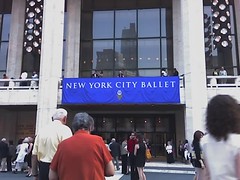
A Beautiful (and Emotional) Farewell to One of the Last of the Balanchine Ballerinas at NYCB

Last night marked the final performance of Kyra Nichols, the second-to-last still-performing ballerina to have worked directly with George Balanchine, and thus widely considered to be of the last of “the Balanchine ballerinas.” (The other Balanchine ballerina is Darci Kistler, also of NYCB). I’m relatively new to ballet and especially New York City Ballet, so I haven’t had many chances to see her dance, and I’m really feeling sad now, as I felt when I recently saw the legend Gelsey Kirkland perform (in a non-dance role) in American Ballet Theater‘s Sleeping Beauty, that I’ve missed out on an era. Ms. Nichols danced brilliantly last night; I was so overwhelmed and I wish so much I would have seen more of her over the years. Since I don’t know a huge amount about her, here’s an interview she gave recently to Gia Kourlas of Time Out NY, and here is Joel Lobenthal’s article in The Sun (I remember NYTimes’s Alastair Macaulay also wrote an article on the several retiring ballerinas but it’s impossible to link to because they only allow paying subscribers to access articles). Also, here is long-time NYCB fan Oberon’s review of last night.

Last night was breathtaking. Peter Martins (NYCB Director) put together a gorgeous program for her. First on was Serenade, what to me seems to be classic Balanchine — involving oodles of beautiful ballerinas in gorgeous flowing baby blue chiffon, and one or two men overwhelmed by them all! (which is largely, it seems, Balanchine’s take on ballet 🙂 ) It was mostly abstract but with a slight narrative in which Nichols poignantly danced the main character. (I will definitely be reading more on this splendid ballet in Terry Teachout’s book on Balanchine, but more about that in a minute…) Second was Balanchine’s “ballroomy” piece for four couples set to Robert Schumann’s “Davidsbundlertanze” (try saying that several times in a row!), which I’ve seen before and loved, and set to lovely onstage piano music. And, my favorite of the night (can’t help it, I’m a ballroom dancer!), “Der Rosenkavalier” from Balanchine’s Vienna Waltzes, a shortish piece in which the stage is overtaken with waltzing couples — the men in elegant black long-tailed tuxes and the women in long lavish white gowns — one of the most exquisite sights I think I’ve ever seen on a stage, and one that rekindled the passion I felt for Standard Ballroom upon attending my first competition. Not that several couples waltzing their own routine on a ballroom floor could look anything like this (even if those couples are at the level of Mirko Gozzoli and Alessia Betti or Jonathan Wilkins and Katusha Demidova…) — it takes a genius choreographer, not just a few great dancers, to create such a sublime spectacle. And one thing I love about ballroom is how it seems to convert little boys into mature gentlemen — Robert Fairchild and Tyler Angle looked so dapper whisking their ladies all around the floor — so charming! It just takes you to another time and place, to a fairytale land…

Anyway, although it was the end of an era in the ballet world, for me it was a time of new beginnings, of meeting new people and making new friendships. I met up with critic and writer extraordinare Apollinaire Scherr, who introduced me to the illustrious critic and writer and author of several books, Terry Teachout, who gave me a copy of his biography of Balanchine!!

The three of us met up during intermissions, then all went out afterward and chatted all about the ballet world, and the dance critic world — so very interesting for newcomer me! Mr. Teachout is so brilliant. He’s a former jazz musician and has been writing for so long about the worlds of classical music, ballet, and now theater, he’s just like a walking encyclopedia of the New York arts scene. It’s so amazing. I can’t wait to start reading his book — which I’m going to begin this afternoon (in between trying to finish two briefs for work by the end of the month — I’m going to get it all done I swear…) Meeting him was so fun, and so educational, and I’m sure his book is going to open up a new world to me (and, he even said he liked my blog 🙂 :)) — thanks so much, Apollinaire!

There was so much going on last night, every ballet fan in the universe (or at least those lucky enough to have got tickets) must have been there — but somehow I was also able finally to meet Sarah, who frequently comments on The Winger as well as Philip‘s and my blogs, and Bob, who comments a lot on our blogs as well! That was fun, and I’m completely amazed that in that massive crowd people were actually able to recognize each other. I sat next to Susan, who also is a big blog and Ballet-Talk-commenter (and met her nice husband), and Philip and Wei (who I also met beforehand at the stage door and hung out with. Philip is great fun to lurk around the stage door with because he knows everyone and everything at NYCB … he should be a tour guide, if there was such a thing!) We all looked for Carbro at Ballet Talk, but couldn’t find her.

Anyway, it was a really amazing night, amazing experience. Oh, we also spotted Kristin Sloan onstage filming — so her video’s going to be a lot of fun to watch when she finishes it. I think it’s so magnificent that we now have this technology that enables us to preserve these monumental events in this way. First those excellent “Tragic Love” videos documenting Martins’s new Romeo + Juliet and now this — NYCB is just going to HAVE to expand it’s website’s broadband to make room for all these awesome videos Kristin’s making!

Okay, time for rest and relaxation (and brief-writing) until tonight … when a ballerina whose career I HAVE followed and whom I love, retires as well — there were many teary eyes in last night’s audience; tonight is going to be my night for being a hysterial wreck…

I am a Crazy Czarist Russian, Who Knew?: Balanchine’s "Jewels" at NYCB

Whew, am so busy with work (law work, that is), writing stuff, and ballet-going, I’m badly behind on blogging… I’ve seen so many things over the past few days at New York City Ballet — after suddenly realizing that, between ABT‘s Met season and the Blackpool Dance Festival, NYCB’s spring season is practically over and I’ve seen hardly anything but Martins’s ROMEO AND JULIET, so am trying to make up for lost time… I plan to blog on everything I’ve seen as soon as I can catch up, but for now, I’ll start with JEWELS, the most breathtaking ballet I’ve seen in a while, and one that really drove home to me like nothing else George Balanchine’s magic. This was my first time seeing it and as a result I now want to devour everything written about that man, and plan, as soon as I get time, to run to the store for the biographies by Terry Teachout and Robert Gottlieb.

JEWELS is divided into three “acts,” or parts, each one representing a specific period and style of classical ballet. Of course the ballet’s not literally about precious stones; the jewels are a metaphor for each period, each of which, near and dear to Balanchine’s heart, is its own unique kind of gem. Premiering in 1967, the ballet was considered a radical departure from the long-dominant big story ballets and is recognized as the first full-length abstract (ie: narrative-less) ballet.

Part I, Emeralds, is Balanchine’s celebration of French classical dance, and is choreographed to Gabriel Faure’s concert suites from 1889, used in that year to accompany French adaptations of Shakespeare plays. This first piece is, to me, characterized by quietness (at least in contrast to the latter two!), fluidity, elegance, the beauty and charm of simplicity, and by subtle expressiveness. Rachel Rutherford captured my attention with her gorgeously expressive wrists. (She also captivated me yesterday in CONCERTO BAROCCO, but more on that in a later post…) With those beautiful wrists — ahhh, I wanna see HER do BAYADERE now! Also entrancing me was a certain R. Fairchild … Robert Fairchild aka “Romeo” Fairchild 🙂 Seriously, where did this kid come from? Was he seen onstage before Martins cast him earlier this season for the world premiere of his R&J? He’s spectacular — everything he does — turns, jumps, everything is marked with amazing precision. And he has that extra something that is undefinable that makes him stand far out in a crowd. (I saw him yesterday in BRANDENBERG and TRIBUTE looking very charmingly James Dean-esque … but more on that later… methinks he may be the Angel Corella of NYCB?…) Well, Peter Martins surely has a knack for uncovering talent, of that I am sure!

As Philip rightly noted, (and part of the charm and the fun of this ballet is, I think) everyone has their favorite part. Philip’s is this first part, and I can why with its soft, elegant beauty and quiet, subtle charm.

Going into the ballet and knowing as little as I did about it, I was sure the second part, Rubies, would be my favorite. This is Balanchine’s panegyric to America, his adopted country. Choreographed to lively, late 1920s piano music by Igor Stravinsky and using spicy red short-skirted costumes, this is Balanchine’s vision of what American dance, of what America, the New World, is — high-spirited, fast and energetic, jazzy with jutting hips, showy, full of zest and flavor, fun, cheery, endlessly upbeat, overflowing with youthful optimism. This part is the one most often performed when companies use it in mixed repertories, and you can see why — it is the most “Balanchine-esque” — this vision of America, this combination of classical ballet with what we already had here, with what was uniquely American, was the stylistic hallmark of his oeuvre, and, since he is the father of American ballet, it is in turn our national style…

Yvonne Borree, looking, to me, physically not like herself (has she perhaps dyed her hair darker?), was super fun to watch– she was cute, sassy, charming — she was PERFECT for the American part! As was Theresa Reichlen, who looked very Firebird-y. And is there any NYCB male dancer more perfectly suited for the all-American guy-role than Mr. AMERICAN IN PARIS, Damian Woetzel?!

I was so excited by Rubies, I thought the third section, Diamonds, would bore me in contrast. Boy was I wrong. It completely blew me away to such an extent I almost cried at the end, which I haven’t done since nearly a year ago when Jose Manuel Carreno‘s Romeo woke up thinking Alessandra Ferri‘s Juliet dead at the Met… Diamonds is Balanchine’s homage to his homeland, to the grand, sweeping, large-scaled classical tradition of the Russian Ballet. Returning to 1875 and using Tschiakovsky’s Symphony No. 3 in D Major — anyone who has ever been to the ballet more than once instantly recognizes Tschiakovsky music, even if they’ve never heard the exact score before, as THE quintessential classical ballet music. The choreography here, a tribute to the great Russian story ballets of the 19th Century, with its dramatic lifts accompanying the orchestra as the music builds to a climax, the many men dashingly courting their ballerinas around the stage at once narrowly missing sideswiping each other as their paths criss-cross, the large ensemble dancing in perfect unison, the gorgeous pas de deux and the solos for that most pristine and celebrated of creatures — the Russian ballerina, is equally instantly recognizable.

This is actually what confuses me about my own reaction to the ballet: I’m really not a Petipa-head — I don’t really go for those huge-scale, five-hour-long ballets like SWAN LAKE and SLEEPING BEAUTY just drenched with pomp and circumstance so overwrought you can’t enjoy the basic beauty of the actual dancing. But then, I had to remind myself that this is Balanchine’s version of Petipa, of the grand tradition of Russian ballet — scaled down and with all of the elements he didn’t care for so much taken out, with only what he truly loved left in. Oftentimes the tribute shines far brighter than the original. And this is a most endearing encomium, a diamond obviously being the most valuable of all stones and that enjoying never-ending life…

Ballerina Maria Kowroski (who danced the principal female role in Diamonds the night I went) wrote a little blurb in the Playbill about the ballet:

Jewels is undoubtedly one of Balanchine’s greatest masterpieces, and, during my career, I’ve been lucky enough to dance in each of the ballet’s parts…

“The first of the ballets I danced was Emeralds. This ballet has a very specific quality, a real perfume, and it has a fluid and effortless style…

“When I saw Rubies for the first time, I knew right away I wanted to do the soloist part. It’s so daring and fast — its flashiness appealed to me…

“But Diamonds is my favorite. I don’t even know how to describe it, except to say that it’s heavenly. First of all, that costume, with the beautiful headpiece, makes you feel like a million bucks. Then the ballet starts off very slowly, with a beautiful pas de deux, and the music takes you to a different place, as if you’re just floating along. When I dance Diamonds, I feel like royalty, like I’m in a beautiful palace of music and movement. Near the end, there’s a thrilling moment when the music slows down almost to a stop, and then it starts up again for the big finish, with the stage filled with dancers all moving in unison — I always get chills, and sometimes, I come close to crying. It’s just so gorgeous.”

I can assure you, it feels the same exact way watching it! The season is, horribly, nearly over, but hopefully, hopefully please please NYCB will perform this gem again, many times — and not just the Rubies section, but the ballet in its entirety. I feel that each section informs the others and that each part reveals its true beauty and magic only in contrast to the others, so I strongly feel the ballet should be put on in whole and not split up. You have only a few more opportunitities to see this masterpiece next week — on Thursday, Saturday night and next Sunday’s matinee, when NYCB will end its season with it. Visit their website for tickets. Do not miss it!!!

Carlos Who?

I’m such a goof. This evening I was at New York City Ballet and during intermission I saw a guy on his cell phone in the lobby all distressed, shouting, “Gomez is out? Gomez is out?!” I thought, oh NO, what’s wrong with Marcelo???? At the same time I thought it was kind of cool that someone was so upset about a dancer s/he called his/her spouse, friend, etc. via cellphone from just across the plaza with the news.

Then I got home and saw the sports news… I’m so out of it regarding sports!

I am going to blog about the NYCB repertory I’ve seen over the past couple of days, by the way, just need to get a free moment!


"Writing (Or Scribbling Messily) in the Dark," "The Nightingale and the Rose," and My Sleeping Beauties

On Friday night I went to New York City Ballet to see the premiere of a new ballet, “The Nightingale and the Rose,” by current resident choreographer (though soon to leave NYCB and focus on his own new company) Christopher Wheeldon.

Above picture is of my crazy notes, hehe. After attending a marathon post-modern dance panel discussion, about which I previously blogged, and hearing a small consensus of choreographers name Arlene Croce a good (former) critic, I’ve been flipping through her book, “Writing in the Dark, Dancing in The New Yorker” (which is a lot of fun by the way — reads almost like a novel or memoir of going to the ballet practically nightly in New York for two and a half decades and makes the NYC dance scene look like THE place to be from the seventies through early nineties — which, with the likes of Barsyhnikov and Suzanne Farrell and Merce Cunningham and all, it WAS … but, hey, it still is, just with different people!) Anyway, she talks up front about her method of note-taking, by which she carries a pad and pen to the performance, then jots things down, or sometimes — more often actually — gets so carried away by the performance that she forgets to write anything down at all, then is forced to rely on memory, which didn’t always work for small details like colors of costumes, etc., which is not a good thing when on deadline. Still, she concludes minimal notetaking is best: “it is the afterimage of the dance rather than the dance itself which is the true subject of the review,” she says, and in order “[t]o let an afterimage form, one has to give the stage one’s full attention, without the distraction of notes” (pg. 6). When Apollinaire Scherr invited me to NYCB to see one of the “Romeo”‘s, I noticed she did the same thing — had a small notepad and pen. I don’t think she wrote anything down though — it’s hard – you don’t want to take your eyes off of that stage! Anyway, I often forget small details like costume colors and minor props and sometimes even the exact sequence of events, so, I figured I’d try to be like a ‘real writer’ and actually jot down deets. Well, suffice it to say, it didn’t go too well — I was writing while looking at the stage, my scribbling is so sloppy I can barely read a word, some sentences are completely atop others, and some run off the page and into the open Playbill, where they’re now superimposed over pictures of dancers rehearsing, etc. Oh well, I tried… Anyway, here are my “afterimages”:

I thought Wheeldon’s ballet was beautiful in the images he created and emotions produced by the sad story, a great idea that may not have been completely perfectly executed (but are they ever on very first try?) The ballet’s narrative derives from the Oscar Wilde short story of the same name, and the storyline is as follows: a nightingale is onstage singing of love when a professor’s daughter enters followed by an ardent student infatuated with her. The daughter, aloof and undesirous of his attention, refuses to entertain his affections unless he can bring her a red rose. He runs about the school gardens, searching for one, but can find only yellow and white. The nightingale, touched by his plight (and perhaps in love with the student herself?), agrees to help him. After searching long and hard, she finally finds a rosebush that produces red roses, but the winter has chilled its veins to the point that it cannot provide a vibrant red flower. In order to produce the desired object, the tree tells her, she must sing to it with her breast against its thorn giving the bush her life-blood, which she agrees to do. After the tree has produced the rose, the student hastily plucks it and presents it to the professor’s daughter, who, finding its aroma unappealing, refuses it and runs off. In his haste to continue pursuing her, futilely, the student steps on the discarded rose, crushing it and in the process nearly tripping over the now lifeless body of the nightingale.

It’s a sad but gripping story. Wendy Whelan danced the nightingale, Tyler Angle the student, Sara Mearns the professor’s daughter, and Seth Orza and Craig Hall led the ensemble who performed the part of the rosebush. I thought the tragic beauty of the piece really came alive in the scenes where the men forming the red rosebush surrounded the nightingale, raising her into a series of poetic lifts, enveloping her as she sings, then stabbing and ripping at her, a slicing arm here, a kicking leg there, eventually draining her of her life, before blossoming to produce the red rose. The costumes worked magnificently. The rosebush men wore brownish outer-clothing and must have been wearing red tights and tight undershirts underneath the brown, because, in order to show the nightingale’s blood-letting, reddening the bush’s stems, the dancers somehow discreetly rolled up their sleeves and outer tights to reveal the red under-clothes.

The parts that didn’t impress so well were the dancers who comprised the members of the white and yellow rosebush trees. They just kind of danced on their own, each seeming to do her own thing, and after Whelan passed them by holding up a hand to them, presumably to show that they had told her they had no red roses to give her, they continued dancing as before. I thought this could have been more powerful. The nightingale could have tried hard to wrest a red rose, climbing on them, reaching out to them, pawing at them, trying desperately to penetrate their core, while they could have pushed her away or huddled together, moving as a unit away from her, in rejection.

I also thought Sara Mearns, whose part was small, was too nice. She should have been more bitchy and spoiled in her rejection of Angle, who was perfect as the lovelorn male student, and her demand of the red rose. Another thing I don’t always understand and probably often lay the blame in the wrong place when something doesn’t work perfectly, is the music composition and the speed at which the conductor leads the orchestra, which in turn dictates the speed at which the dancers dance. Mearns took the rose from Angle, and in a split second, practically rammed it into her nose, tossed it down and fled, leaving no time for her character to take in the smell, determine it wasn’t good enough, and perhaps act at first as if she may accept it, playing meanly with Angle’s emotions. Her haste made the scene look very fake. But I don’t know whether it was Mearns’s acting or the orchestra playing way too quickly that was at fault.

Also, I love Wendy Whelan and think she is a wholly unique, very interesting dancer with a wiry, hyper-flexible body that well-suits the more contemporary pieces that NYCB does. I thought her angular body with its sharp lines made her nightingale very distinct and tragic in its own way — and that image at the end of her lifeless nightingale lying in a tangle on the floor is one only she is capable of making — but I would like to see another ballerina, known for her beautiful, swan-like evocations dance that part as well and see how it comes out. I know this nightingale is not a swan or a firebird, etc., but I’d still like to see someone else’s interpretation; I think it would make a very interesting contrast.

One final thing, that I can’t help but find endlessly amusing, but don’t know if anyone else will: at the beginning of the sound accompaniment, composed by resident composer Bright Sheng (this ballet marks the very first time he and Wheeldon have collaborated, which I didn’t know), the only sound is that of a lovely but very faintly chirping bird. Of course it’s beautiful and perfectly fitting. But, funny thing is, you can hear human voices speaking throughout the chirping, interrupting the bird. I thought this was intentional: I thought, oh that’s interesting, he’s trying to evoke the world of the humans — the professor’s daughter and the student who are offstage but presumably about to enter — encroaching as they do in ultimately tragic ways upon the sublimity of the natural world. And, I noticed this chatter resume whenever the orchestra stopped playing and the sound consisted only of the bird. I mentioned this to Philip, of Oberon’s Grove, at intermission, and he said it was the stage manager! He said he can often hear the talking whenever it gets very very quiet onstage! Haha, I had no idea — I honestly thought it was part of the composition! Anyway, the stage manager, as it turns out, added to my interpretation of the piece.

Yesterday, I went to my second, and my last, of two “Sleeping Beauties” at American Ballet Theater. This Beauty is a new creation by artistic director Kevin McKenzie, but ‘after Petipa,’ which, to be honest, I’m not completely sure what that means in terms of exactly how novel it is. This ballet in general is not my favorite, so I didn’t have many expectations nor much to compare it to, and I wasn’t that upset when I had to miss the original premiere, which happened while I was still in England. But I did see the original cast, performing a few days later. To be fair, one of the reasons the ballet is not my favorite is that I don’t really relate to the themes of the fairytale it is based on. Unlike others, such as Cinderella (who CAN’T relate to the hard-working slave who never gets any recognition from elites until, through friendship and compassion for those less fortunate, she gets her day in the sun?), the morals from Sleeping Beauty (don’t fail to invite someone to your party or they might wreak havoc??, etc.) don’t really speak to me. Anyway, those feelings aside, after viewing it twice, I actually ended up really liking it. I saw it on Monday night and again yesterday (Saturday, matinee), and I’m so glad I waited to blog about it until I’d seen it again because I was just way too tired to enjoy it fully on Monday night, just after I’d returned from my long trip.

So my first (Monday night) cast was Veronika Part and Marcelo Gomes in the leads (Beauty and her Prince, of course), with legend Gelsey Kirkland as the evil fairy Carabosse, Stella Abrera as the ethereal day-saving / kingdom-saving Lilac Fairy, and Herman Cornejo and Xiomara Reyes as Bluebird and Ms. Bird (the latter of whom Playbill refers to as Princess Florine, but here she enters as a caged bird, released by Beauty in order to dance with Mr. Blue) who ham it up for the crowd-cheering bravura parts during the wedding dance scene. Veronika was a dreamily serene Beauty who danced with splendid perfection, Marcelo a very cute prince who jumped sky high during his solos, and, together they completely overtook the stage with their glorious Grand Pas De Deux, complete with those gorgeous fish dives I live for 🙂 Note: Veronika’s feet are like no other ballerina’s — her point is so pronounced and her arch so high, they nearly pop right out of those toe shoes! Herman and Xiomara were astounding as the high-flying ‘birds’ and I got all of my breathtaking overhead lifts I missed out on in their opening night “Romeo and Juliet” excerpt (thank you, Herman 🙂 🙂 🙂 )!

But, oh, the one who really took my breath away that night was Gelsey! The way she hunched her back, scrunched up her face, and hobbled around, she was pure perfect fairytale wickedness on that stage, and with her tiny little body, she commanded your attention like no one’s business! The way she captivated your gaze, it actually made me sad to think of what I must have missed out on by never having had the opportunity to see her dance in her heyday — so sad I missed that era in ballet… she must have been amazing with Baryshnikov.

As perfect as all the dancing was on Monday night, though, I don’t know what it was — perhaps I was just still tired from my trip or missing my Latin men and their beyond sexy hip-swaying, pelvic contractions or what have you, but I just couldn’t get that into the ballet at that point and was really rolling my eyes over the silly story. BUT all that changed with yesterday afternoon’s performance, which really brought home to me “Beauty’s” magic. Cast was Gillian Murphy and David Hallberg in the leads, with Carmen Corella as Carabosse, Craig Salstein as the King’s Chief Minister (who tries futilely to warn of the coming danger) and Sascha Radetsky and Hee Seo as the birds. Part of the magic for me of yesterday’s performance could have been the children who filled audience. No one dances to kids like Gillian. I know she runs the children’s program at Stiefel and Stars over the summer in Martha’s Vineyard and she must be so good at that; little ones just eat her fairy-princesses up. And, there’s no more ideal ballerina than she to both show little girls the splendor of ballet with her beatific, glowing face, and to prove what women dancers are capable of with her bedazzlingly athletic jumps and turns. If others like Veronika and Diana Vishneva perhaps excel at conveying more mature subject matter through their subtle acting and artistry, Gillian is the consummate fairytale heroine.

And there’s no more perfect a prince than David. He doesn’t come on until the second half, and when he did, this row of little girls behind me, sighed almost in unison. They were so young and it was so real and so completely adorable, the grown woman next to me (who I didn’t know) and I took one glance at each other started cracking up. Who cares if there’s no relatable moral when Prince David, running all over stage with furrowed brow searching and searching for his princess, ends up saving you and the whole kingdom with just one heavenly kiss!!! One thing I noticed about David though, sitting so close: he looked overly sweaty and a bit out of breath quite early on — a little too early on. I’m sure no one noticed sitting further back, and it didn’t show in his dancing AT ALL — which was nothing short of spectacular, but I did worry. I heard he didn’t dance last night, as he was billed for, so I hope he’s okay and is just taking a breather. He’s both an amazing dancer and a dependable, almost preternaturally responsible man, so I know he is counted upon to fill in for anyone and everyone who gets ill or injured (Vladimir Malakhov, unfortunately, is out this season with injury, so David’s been cast to replace him), and I’m sure it gets to be a bit too much, especially to be dancing two principal roles in one day — as much as I long to see him onstage, the last thing I want is him getting sick!

Sascha and Hee were brilliant as the birds — Herman is known for his sky-high jumps, so it’s a little expected that he is going to go soaring across stage, but I thought Sascha performed his with just as much knock-out height and speed.

Philip, whose review is here, didn’t like the casting of Craig Salstein, a young dancer after all, in the non-dancing role of the king’s advisor, face painted to make him appear older. True, as Philip says, there are many older, retired dancers in the company perfectly capable of such a part (and I had Wes Chapman on Monday in that role), but I rather liked Craig. He was hilarious in his defeat, especially when getting his hair plucked out by Carabosse. I actually think he looks pretty good with longish hair (albeit without the male-pattern baldness up top) and think he should consider growing his real hair out a bit… 🙂 Seriously, his acting was really pretty extraordinary and he put so much umph into that goofy little part that at points I couldn’t take my eyes off his reactions to Beauty’s dancing to look at Gillian!

Carmen Corella: ooh la la, big time! Okay, I have always had a bit of a thing for her, and her Carabosse, though completely different from Gelsey’s, just sent chills up and down my spine! Her devious fairy, instead of being pure evil, was more sexy sultry vixen, albeit totally hilarious, kind of in the manner of her would-be seductress “Cinderella” stepsister (which I CAN’T WAIT to see her perform again later this season — I so wish they’d bring Erica Cornejo back just for the role of her little dorky sidekick — they were miraculous together; they MADE that ballet, IMO). After she makes her first crackling entrance, complete with pyrotechnic display, the whole kingdom aghast, Carmen turns toward the King and Queen and, raising a pinky to the air, gives a little wave, all sweet smiles drenched with wicked sarcasm crossing her face. It was so funny, I wanted to burst out laughing. Anyway, Philip hated Carabosse’s costume … well, after seeing Carmen wear that thing, ooh how much do I want it! She made that thing so gorgeous — I’d so cut it short, clip off those fairy wings and make it into a mad hot Art Deco-ey ballroom outfit — totally serious! Carmen really excels in these kind of roles — she does so much with them — the deliciously mischievious fairy, the goofy sexpot evil stepsister, Lescault’s frighteningly charming mistress (who she dances with Marcelo 🙂 ) in Manon… I wish they’d give her a principal role to try; I just love her!

Sarah Lane was so sweet as the Fairy of Joy, in both of my casts. Everytime I see her onstage, I can’t help but remember her ever-sweet performance and curtain call with Angel in Sinatra Suites last season. So cute she was dancing, then receiving, all wide-eyed, her numerous bouquets and curtain calls, with him! Oh and, hehe, the Fairy of Joy is dressed in bright yellow (a detail I wouldn’t have remembered but for this: Philip said he didn’t like the costumes — I thought nothing of them, but now am remembering overhearing a little girl behind me say, “yellow, really mother! I mean really!” just like an adult and as if her mother was somehow responsible … hmmm, maybe she was?? Anyway, I guess Philip is not the only one who didn’t like the costume colors…) Misty Copeland is a powerhouse, as always, and I’m so sorry I missed her in Sinatra Suite. Vitali Krauchenka stood out to me as well in the various smallish roles he had — don’t know why exactly — he didn’t have any huge dancing parts, but he seemed very tall and upright the way he just stood about and took up space, and he was always in character… and, he kind of looks like a little Max… don’t know, could just have Russia on the mind, having come from a ballroom festival (which I can’t stop mentioning for some reason…)

Chunnels Chunnels Everywhere…

Ha ha, now that I’ve calmed down a bit, looking at my last post, I was pretty harsh! It’s fun to be angry though … the truth often comes out when you’ve just come from something that impassioned you and you’re writing at 1:30 in the morning all cranky because of all the work you have to get through the next day to go on your dance vacation the following day — under such circumstances you’re not bothering to edit yourself and you’re just more honest… Anyway, I was basically trying to ponder ways to make ballet more popular. I feel that some of the reasons young people are turned off is because of the melodramatic acting and the story-lines that they can’t relate to either because they are too silly and not relevant or because they’re too abstract and don’t make sense. Everyone knows Shakespeare, everyone can relate to Shakespeare, he is timeless… I feel that if you do Shakespeare you can’t go wrong, and, even though I would most definitely go see Lubovitch’s Othello again and again and again, because that’s just how I am, it was still far from perfect, and I don’t know that a non-obsessed ABT-o-mane would do the same…

Anyway, apropos of all this, I had asked Apollinaire Scherr why she thinks opera is so much more popular than dance, and she and some other critics and readers responded. Go here to see that discussion.

By the way, not a whole lot of people went to Othello. There’s hardly any chatting on BalletTalk, not many pro reviews. And where is Alastair Macaulay’s NY Times review? Shouldn’t it be online by now? The audience Tuesday night wasn’t very full — I’d say 1/2 to 2/3 seats filled, which upsets me, especially given that this was the NY debut… We have to make younger audiences understand how great ballet is, how relevant and exciting and profound and moving and beautiful and poetic…

Speaking of which … Apollinaire has great hopes for ABT’s Sleeping Beauty! (Yay!!) … the debut of which I’m unfortunately going to be missing because of my trip. But I’ll be back for one of the later performances… I will also, horribly, be missing “Essential Balanchine” at New York City Ballet

why oh why oh why does Blackpool have to come at this time of year! Can’t someone re-schedule it to coincide with opera season for cry-eye????

And why oh why can’t I take some other form of transportation … I love travel, I love trains, I love cars, and I LOVE ships — can’t I take a ship across the Atlantic?… like in the Titanic? I mean, not the Titanic per se of course, but a big huge ship — so romantic to travel in 19th Century fashion! Or why can’t there be underwater Chunnels everywhere like that between London and Paris? That would be soooo cool to take a big long Chunnel train to England, or Australia or Thailand or Japan… chunnels everywhere… who decided to create air travel instead of underwater transit…

Anyway, packing is oh so much fun:


I’ve been packing all week little by little, as I always do so it’s not so overwhelming all at once… I tend to forget less this way. Everyone makes fun of me because I’m so anal, but who was the only American at the dance festival last year who could use her cell phone and palm pilot and re-charge her digital camera???? — because who was the only one who remembered to bring, not just all of her chargers, but U.K. / Hong Kong electrical converters as well! I was very popular last dance festival…


I always go through my money belts as well scrounging around for any pounds and pence I can find. England does still use English money, right; they didn’t switch to the Euro yet? Look at all this pre-Euro European money I have (on the right) — I hope it’s worth something someday!

And look at all this Russian cash. I have so much left over because when I was in St. Petersberg, I met up with friends who were going on to Moscow while I was (traveling alone) returning to Helsinki. Since I was planning on giving my leftover cash to them, I didn’t exchange or spend it, but then whilst trying to catch my train at Finlandia Station, I couldn’t find my proper track because I was spelling Helsinki with a Cyrillic first letter that looks like our “E” instead of the letter that looks like our “X” – (the Russian alphabet doesn’t contain our “H”). So, I almost missed my train and forgot to hand over my cash! What am I gonna do with it now?!…

Packing my Winger t, for dance-y comfort 🙂

Aw, a pic from packing last year. My dear little Najma passed away last October from congestive heart failure. I miss her so much. Packing is just not the same without her…

Anyway, on one last dance note:

hehehe, I was joking around earlier about a male Bayadere and Marcelo Gomes dancing the lead. Then I saw in this week’s Time Out New York Gay and Lesbian section that there actually are some gay bars with male bellydancers!!!

Macaulay on ABT, and More Same-Sex Ballroom Stuff on NYTimes Website

NYTimes’s website is rocking these days. First, NYTimes Chief Dance Critic Alastair Macaulay’s review of ABT’s opening night gala is now up. Read it here. Whoa, far more critical than anyone was of NYCB’s opening. I’m not trying to be thick, but I honestly don’t understand his paragraph on the excerpt from Othello, danced by Alessandra Ferri and Marcelo Gomes, and choreographed by Lar Lubovitch. This in particular is what I don’t get:

“This choreography pursued a hammy old dance-expressionist rule: ‘Never express an emotion to the left that you don’t also express to the right, preferably several times either way.'”

This is in the context of his contention that Ferri’s “willing victim” schtick didn’t really work and Gomes struggled with being “intense.” So, I don’t get it: is he saying Ferri did something wrong, Gomes did, they both screwed up together, or the choreography was nonsensical? And what does he mean by left and right — does he mean literally don’t do something one-sided or half-assed, or does he mean it in an art versus reason sense (don’t make an intellectual choice if you can’t back it up with the proper emotion), or in a political sense (Ferri’s willing victim and /or Gomes’s macho intensity were anachronistically and stupidly misogynistic for this day and age, making them disingenuous)? They’re all interesting points of view; I just want to understand! Oh wait, is he just saying either she needed to take it down a notch or he needed to take it up a notch? That makes sense, and is what I was saying as well (the second part, rather). Well, everyone just go see Othello and we’ll all figure Macaulay out together 🙂 …

Also, they have a video of the gala here with some rather amusing commentary by former Wonder Woman Linda Carter. The reporter concludes that many of the chi chi guests came out not to watch the dancing, but to hob-knob and boogie down themselves. Interesting.

And, finally, something my friend sent me regarding that same-sex ballroom dance competition held here two weekends ago that I blogged about earlier and was written up in the City section last weekend — the Times has a little video clip up of that too. It’s really quite interesting: they give a little history of the competition and talk about some of the reasons why people participate in same-sex ballroom dancing — it’s not always because the couples are homosexual; sometimes women just feel sexier leading rather than following, and it’s too hard to lead a male partner. Interesting. I never did get the hang of following! Here’s the video.

Ad Hoc Ballet, and Final Thoughts on Romeo + Juliet With Major Kudos to NYCB for Audience Accessibility

I’m so behind on my blogging! I meant to blog about all of these things I did over the weekend MUCH earlier in the week, but with ABT opening and all, it’s just been…crazy!

So, last Saturday evening I went to see ad hoc ballet, a very intriguing new company founded by engagingly unique Deborah Lohse, with dancers Amy Brandt, Elizabeth Brown, and Candice Thompson, a new contributor to the Winger and the reason I found about about this cool new company in the first place! I had also seen Lohse a couple of weeks ago at Symphony Space in a work by choreographer Monica Bill Barnes and was immediately drawn to her.

I just love ad hoc’s mission statement: “ad hoc Ballet is committed to creating new works, which incorporate elements of classical ballet and modern dance, while exploring current social tribulations. Drawing inspiration from outsider populations that America tends to ignore and uniting pathology with empathy to uncover new movement, ad hoc Ballet explores the beauty in the alternatives to the classical aesthetic of perfection.” This is just the kind of dance I love — dance with contemporary social meaning that is rooted in the beauty of classical ballet and incorporates modern elements to explore issues and devise new, original forms of movement.

This performance was called “The Lucy Poems,” a title taken from a group of William Wordsworth poems, which Thompson talked a bit about on the Winger, and dealt with mental illness. The hour-long ballet opened with Lohse sitting in the corner in various contorted body positions, surrounded by a circle of very bright lights — so bright, they kind of blinded me to look at her. After she finished her first short piece, the lights went completely off and loud, brash sounds emanated from the speakers. It was really rather frightening, and gave you a sense of what the world must be like to a mentally ill person. Then the lights came on again, the music mellowed, and the other three dancers, all on pointe, took the stage and danced various duets and solos. It was really captivating. At times the dancers would contort and distort their bodies, taking different positions and shapes, then they would be perfectly “normal” and dance in the manner of a classical ballerina, as if mental illness could be something that came in waves or attacks. I went to see the program with Doug Fox and we both found compelling the ways that the dancers at times would visibly struggle to control their limbs, as if their arms and legs had minds of their own and operated independently of their minds. What was so amazing was that you could see this struggle played out in the face and body of the dancers — which I’d think would be really hard to do. Another thing I really liked about The Lucy Poems was, in contrast to for example, Forsythe’s You Made Me A Monster, that, sad subject though it was, there were moments of peace, and even within the contortions, there was a strange beauty to the movement.

The costumes were really interesting too and perfectly suited to the theme. They were dresses of haphazardly patched-together pieces of raggedy-edged blue denim-looking fabric, and were tied tightly around the backs of the dancers — so tightly they resembled sleeveless straight-jackets, if that makes any sense, or perhaps corsets, revealing possibly an underflying gender motif?…

It was a brief and small-scale but really spellbinding production and I will definitely look forward to seeing more from this promising company.

Earlier on Saturday, the wonderfully nice Newsday critic Apollinaire Scherr invited me to NYCB‘s matinee for one final viewing of their new Romeo + Juliet. As Apollinaire’s guest, I actually had a good seat at NYCB for once — thanks Apollinaire!! Though, I have to say, I think all seats in the State Theater, including those in Fourth Ring are really quite good.

So I think this was the cast with the youngest leads of all — Erica Pereira, still an apprentice with the company, and Allen Peiffer. I thought Pereira was really sweet — very small and with fluid movements and really beautiful willowy arms; she just glided around the stage, she was just a delight. She worked well with her Romeo, though, very cutely, she didn’t LOOK at him a whole lot! She kept her bright smile and shining face mostly turned out toward the audience, at least throughout her first pas de deux, as if a bit nervous to regard him. She almost looked surprised when he lifted her, from behind! Adorable given given her age — it is kinda scary to look at the boy 🙂 The couple next to us, a sweet, elderly pair who’d been coming to the ballet for many many years, just adored her.

Daniel Ulbricht was an awesome Mercutio again, and this time Craig Hall was Tybalt — the most imposing of all of the Tybalts. He didn’t have Joaquin‘s virtuostic flair, but he acted the part well and he actually wore well that costume (that everyone but me, basically, seems to have had a problem with).

But, the ballet as a whole … I still had the same problem with the overacting and the lack of interesting choreography. The couple next to us, loving as I said, Pereira, felt the same about what they considered a lack of movement in the choreography. But these are the things that the critics and the avid balletomanes, who have seen every version of the ballet under the sun, are kind of naturally going to focus on. But Martins was trying to reach out to new audiences. And here’s what two such new audience members had to say:

My friend from work and her husband, compelled by the brilliant ads they saw in the Times (the design of which is pictured above on the postcard setting on my lap), along with my offer to buy them $10 discounted Fourth Ring tickets, attended Sunday’s final performance, starring the original cast. My friends, a public interest attorney (meaning, poorer but more arty than the average lawyer 🙂 ) and an actor, have sophisticated aesthetic sensibilities but have not attended a concert dance performance in years. They know the play of course, but nothing of all of the prior versions of the ballet, and almost nothing of the dancers and who’s a big ballet star and who is not (though my friend did know of Kistler).

So, their verdict: they couldn’t get enough of Ulbricht 🙂 🙂 , they thought the leads — Fairchild and Hyltin were lovely, their dancing was beautiful and they captured the innocense of youth. They thought the minimalist sets were fine, but the costumes garish, particularly Tybalt’s, and unlike me, had a hard time appreciating Joaquin’s brilliant dancing because of it. They thought the choreography was a little “fast” in places — such as the balcony scene, when Juliet only has a second to look down and find Romeo before running down the steps; they wanted her to do a little lyrical dancing up on the balcony ballet before slowly spotting him and then processing whether or not she should go to him, then excitedly skipping down) and the death scenes at the end happened too fast to be believable. And, like me, they thought the acting was way too overdone. My friend laughed this off though, thinking it was silly but not a huge deal, and telling me her father-in-law, a ballet fan, won’t go to the story ballets because of the “bad acting. I mean, everyone knows the story of Romeo and Juliet,” she said, “we don’t need all the extreme gestures.” So, to them, it didn’t ruin the ballet at all, but was just a silly but inevitable thing that one should expect to see in a story ballet.

My problem with the overacting — and it was the same way with all three casts that I saw so I’m now assuming the dancers were only following Martins’s instructions — is that, I really believe in a story ballet it’s of the utmost importance, it’s what emotionally moves the audience and propels the drama along, and if it’s totally overdone, it ends up looking cartoonish — resulting in the exact opposite effect. In the Saturday afternoon cast, Jonathan Stafford played Paris and his kissing Juliet’s hand in an attempt to win her over at one point was so abrupt, so overdone, it just looked comical. As revealed by the excellent Tragic Love videos made by Kristin Sloan (discussed further below), the company spent so much time on the sword-fighting — and it shows; that scene is by far the best. Mercutio doesn’t toss up his sword the moment he is fatally stabbed, clench his chest and fall straight to the ground screaming; rather, it takes him a lot longer than that — as it would had he actually been struck. Tybalt’s death is the same. If they would have just had some actors come in and instruct the dancers on how to emote without overdoing it to a ridiculous extreme, I think the whole would have been so much better. I realize these dancers are used to performing abstract ballets; so much more reason then to have actors come in and help out for this kind of ballet.

Last Thursday evening, I attended a studio talk at which members of the original cast — Robert Fairchild, Sterling Hyltin, and Joaquin De Luz — spoke. I have to say NYCB people are really some of the nicest people. Originally the talk was to be held in the Rose Building, where apparently they normally take place, but it was moved last minute to a studio in the State Theater, so there were a lot of lost people wandering around in the bowels of the studio corridors! None of the young dancers made fun of me in the least, annoying though I must have been holding them up on stairs and in narrow hallways trying to figure out where in the world I was supposed to be! When I finally arrived at my proper destination, the moderator and the other organizers actually congratulated me 🙂

Anyway, the discussion was very interesting. One thing the moderator asked the dancers was how they dealt with all the criticism of this new production. (I actually didn’t think there was that much harsh criticism though.) Hyltin was sweet. She said, after a bad experience once reading, in the midst of the run of a particular ballet she was performing, a critic’s harsh words about her, which really hindered her next performances, she no longer reads reviews until the run was finished. I think that’s very wise. Although all artists put themselves in the public eye and must be able to take criticism, dancers in general tend to be the youngest of artists, and these dancers in particular are very young, so it’s got to be hard on them. DeLuz, older and more jaded, with a good sense of humor, shrugged his shoulders and said he stopped letting it get to him: they’re gonna say what they’re gonna say you know; you can usually predict at this point who will say what. Fairchild, called “Robbie” — how cute! 🙂 — ran in late and sweaty from a rehearsal. I realized listening to him talk at this, just how young he really is. All wide-eyed and smiling brightly, he chirped, “Well, I’m totally new at this, so I read EVERYTHING!!” He sounded pretty happy about it and I don’t remember any bad reviews of him. But, in general, I have to say to Hyltin (and to Morgan, whom I was a little hard on in my last post!), maybe sometimes, not always, but sometimes, the critics are harsh because they see a kernel of something there and are anxious to see it taken to another level. I’d think that a critic’s not noticing you is worse than them saying something critical. A critic is writing for the general public and readers of his or her publication rather than the dancers and ballet-makers, but maybe, taken the right way, a critic’s words can help improve something. Assuming of course that the critic is open to looking at the next performance with fresh eyes, which I think was what Joaquin was complaining is all too often unlikely. Hyltin said after she finishes her run, she will read some reviews, take what she can of the criticism, and learn from it, and leave the rest. I think that’s so smart — she’s a wise young woman 🙂

And one other happy thing about ‘Robbie’ 🙂 🙂 : the dancers were also asked how they prepared for their roles. Apropos of what I said in my earlier post about watching the greats dancers of the past, he said his sister, the magnificient Megan, gave him a DVD of Nureyev and Fonteyn dancing the ballet 🙂 So, see, the good dancers do agree with me!

One last thing about R+J: I feel that something that was left out of many of the reviews was recognition of all the hard work the company put, especially Kristin Sloan, into making this production publicly accessible to everyone, both in and outside of New York, and to attracting new audiences. That Tragic Love video series broadcast over the internet, originally on NYCB’s website and now on bliptv, here, is downright trailblazing. Also, the advertising, with those very cool designs, the already inexpensive but further discounted seats in honor of Kirstein’s birthday, the studio talks allowing audiences to hear directly from the dancers — invaluable to me for one — for all of that, NYCB is really on the forefront of promoting ballet and expanding audiences, particularly through internet use, and for that alone it deserves MAJOR KUDOS.

One final thing about Romeo + Juliet and then I swear I’m done, is this from the Wired blog. Which prompted me to write this to Apollinaire, who sweetly posted my thoughts. I fully realize this writer, Todd Jatras, who from his oeuvre appears to be of the Sebastian Junger uber-mensch school of journalism, is writing for a certain audience and is trying to convince his readers to try a ballet performance, as he did, after meeting Kristin and viewing her awesome Tragic Love videos. And I’m very happy that he did and that he admitted his formerly-held prejudices about “muscely men in tights”, etc., were silly. But it just worries me that promoting a ballet on the bases that it’s just like action-packed film with lots of sword fights is problematic … I mean, what are people then going to think of the more abstract ballets, which is what NYCB primarily puts on? And why must one go to the ballet in order to see the same thing you can see at the movies? For a Schwarzenneger film, you need simply to run up to your local mulitplex; ballet is art; it’s like the opera, it’s like an art museum — people should go for the same reasons they’d go to those things, to be exposed to something different, to have a cultural experience. I mean, I obviously love a good drama too, which is why Romeo and Juliet is one of my favorite ballets, and I CAN’T WAIT to see ABT’s Othello next week (!!), but ballet is drama mixed with poetic movement and beautiful music, or it’s abstract beauty and lyricism … it’s just so much more than a Schwarzenneger film! And that led me to wonder why the same people who don’t mind spending an evening at the opera or afternoon at an art museum — who are NOT expecting to see Schwarzenneger action in such a place — are hesitant to go to the ballet, when it’s the same art form… I don’t get it.

Okay, one more thing, not related to R+J but to NYCB: Sarah, a friend who I met on the Winger (where I’ve made many new ballet friends 🙂 ) sent me some information about a talk hosted by the Jewish Community Center next Monday, in celebration of the centennial of Kirstein’s birth, on the making of Dybbuk, one of Jerome Robbins’s ballets. NYCB dancers will be there performing and there will be a talk on staging this ballet and the music used in it. For more information, go here and here.

Okay sorry for the hugely long post; I’m done, for now!

Joaquin Cortes on Dancing With the Stars!!!!

Omigod omigod — did everyone see him on DWTS?!?! He was soooo amazing! I think it totally came through what a stellar, world-class dancer he is on TV — at least the studio audience could tell, judging by their cheers. I believe this is a new high for this show – Cortes is one of the greatest dancers in the world. Did you see that footwork — hello?!!!!! And Joaquin is also an ambassador to the European Union representing the Roma people, flamenco being a dance that emanated from the Gypsies. For more about that, visit Root Magazine, here. Pretty cool having a dancer as ambassador 🙂 I really think this proves mine and Dean Moss‘s points about Dancing With the Stars — that watchers of the show are, in Moss’s words, “developing an aesthetic for viewing dance,” and that its popularity can lead to increased popularity of other forms of dance such as ballet and modern…

So, Ian and Cheryl just got booted. I didn’t really like the Elvis look on him — particularly the wig, and I thought even in his last jive he was trying so hard to dance like “a guy,” to not be “girly” (which he had earlier complained about Latin seeming to him) that it really hindered his learning technique and acquiring proper dance skills. Virility in dance, as in life I suppose, is something that, if it is there, is just going to come out naturally, certainly not from stomping around on the floor consciously trying to look macho. He could have benefitted from watching Herman and Marcelo and Seth, and Cortes too!

Seth Orza = Heartthrob Romeo, For Sure(!), But Production Still Lacked Intensity…

Last night I decided last minute to see Martins’s “Romeo + Juliet” at NY City Ballet again. Okay, I just couldn’t resist wondering what Seth Orza looked like in the lead 🙂 I have to say, its sweetness grew a little on me seeing it a second time. Could have been, of course, just watching gorgeous, hunky uber-mensch Orza 🙂 Interestingly, Alastair Macaulay in the Times compared the four pairs of leads and concluded that this was his favorite set, a view shared by NY Observer’s Robert Gottlieb, who wrote a rather humorously sardonic review. Though I liked Orza a lot, I still feel like there was something significant missing.

Orza doesn’t show a lot of facial expression; he’s more stoic and serious-looking, or perhaps a bit shy-seeming even, somewhat like Herman Cornejo of ABT. But this isn’t a bad thing; his body is more his instrument of expression. When he grabbed that sword and walked toward Tybalt following Mercutio’s slaying, he needed no facial emotion — I was terrified for Tybalt! And he’s so strong — he just scoops up his ballerinas, raises them high above his head and carries them all around stage, which just oozes with romance! And he’s just so handsome in that classic movie-star / Rock Hudson way, he doesn’t really need to “act”; he just naturally IS a romantic leading man.

My problem with Morgan was that I thought she was too much the opposite of him. She over-emoted, acting like a crying little girl throwing a temper tantrum when her parents pushed her to Paris, and, at the end, she threw up her arms and beat the sky in over-acted despair before she even fully turned around to see Romeo lying dead. I thought she might have been better partnered with Robert Fairchild, the younger, more impetuous Romeo, but paired with Orza, she seemed more like his little sister. I know he’s not much older than she, but perhaps because of his more calm demeanor, or his large body and upright, manly posture, he seemed so much older. I prefer to see him partnered with more mature, sophisticated ballerinas like Miranda Weese, as he was in Evenfall. They were beautiful together in that ballet! Of course, maybe it’s the Nureyev / Fonteyn mystique that I so long to see re-appear in the present day, of which there is a tiny bit in the Marcelo / Julie dynamic at ABT… I also found a few technical glitches — at one point during the balcony scene, it looked like she slipped, then, when they repeated the step, I realized it was a slide. I don’t remember it looking like a mistake though when Sterling Hyltin performed it.

But, speaking of the greats of yore, do the young dancers of today ever watch them, ever pay close attention, dissecting what exactly it was that made them who they were? What is still so missing, I feel, is that the dancers don’t seem to know entirely the dynamic of the ballet they’re performing. The bedroom pas de deux is almost the same — both stylistically and choregraphically — as the balcony scene. Juliet acts silly and girlish and excited. But her new husband has murdered her cousin and consequently been banished from Verona — that’s kind of a big thing. If I remember correctly, Nureyev and Fonteyn gave that scene so much more passion, so much more tragedy…

I remember Julio Bocca saying that ABT used to be far different than it was today: in the past, the dancers used to watch each other intensely in the wings; today everyone is too interested in their cell phones to care about what makes a great dancer. That’s simply pathetic. I once saw Jose Carreno in the wings at City Center watching, with much intensity, Angel Corella perform Sinatra Suite. Jose is of that Julio generation, and it’s not at all surprising to me why he is so far above his fellow dancers when it comes to many of the big story-ballet roles. I find it tragic that he’s not going to be around that much longer…

A classical musician named Griffin recently posted some very interesting comments on my former post about Macaulay’s criticism of NYCB and Balanchine (I haven’t yet figured out how to have “recent comments” show above the blogroll, but those comments are really interesting and are worth looking at) saying more attention needs to be paid to the ballerinas on whom Balanchine created those ballets. I also just think that in general dancers need to pay more attention to the past and current greats. Pounding your fists at the air is not showing grief; that emotion needs to come from far deeper within. Watch Margot Fonteyn dancing with Nureyev, or for a live rendition, go watch Alessandra Ferri show grief and despair when she performs the role at ABT in July — but hurry up, she is about to retire…

Finally, just one more thought about Tyler Angle, who was cast last night as Tybalt. I find him to be a very interesting dancer, and a beautiful man with a very striking, dramatic face that’s full of expression and on which he just loves to apply that make-up! It’s fun and it’s his thing and I love that he stands out to me whenever he is onstage, but I think he was miscast as Tybalt. Tybalt is, in a sentence, a hyper-masculine, testosterone-laden, aggressive bad-ass and I thought Tyler was a bit too flamboyant. When Orza’s Romeo went after him following Mercutio’s slaying, it seemed like an unfair fight. I wanna see more of Angle for sure, just not as Tybalt!